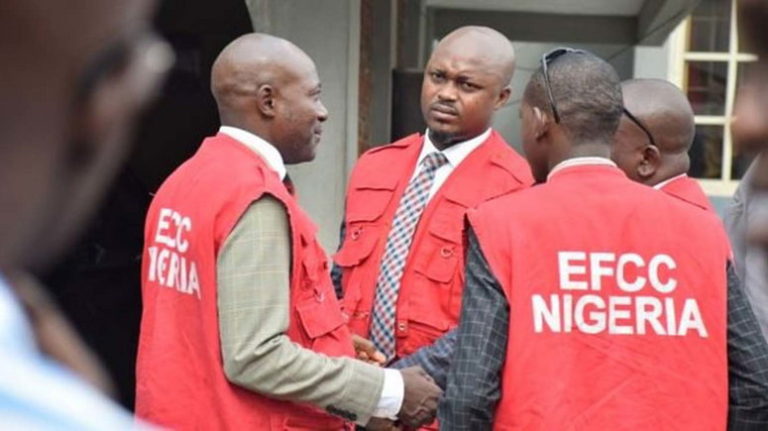
THE Economic and Financial Crimes Commission (EFCC) has deployed its officers to the 36 states and the Federal Capital Territory to monitor the forthcoming 2023 polls.
The Commission described this as part of its efforts to ensure the integrity of the February 25, 2023, Presidential and National Assembly elections.
This was disclosed in a statement by the EFCC spokesperson, Wilson Uwujaren, on Wednesday, February 22, 2023
According to the statement, the EFCC chairman, Abdulrasheed Bawa, charged the operatives to be conscious of the nation’s interest, and to exhibit a high sense of professionalism in the discharge of their duties.
“You are out on a national assignment, and I expect you to conduct yourselves responsibly in line with our core values of professionalism, integrity and courage.
“You have a responsibility to ensure that this election is devoid of financial malpractices, especially inducement of voters. The attention of the world is focused on Nigeria and we must do what is necessary to ensure that we have credible, free and fair elections,” Bawa charged the operatives.
Besides the teams deployed across the country, the EFCC has also released incident reporting hotlines for the 36 states and the FCT.
The Commission urged members of the public to report any case of vote- buying or selling, or other evidence of financial malpractices designed to compromise the electoral outcome through these hotlines.
“Members of the public can also report anyone trying to buy or sell votes by making use of the EFCC financial crimes reporting App, Eagle Eye, which is available for download on the Google Play or Apple store,” the EFCC said.
It added that the public could reach the Commission through its social media handle, @officialefcc or by email, info@efcc.gov.ng.
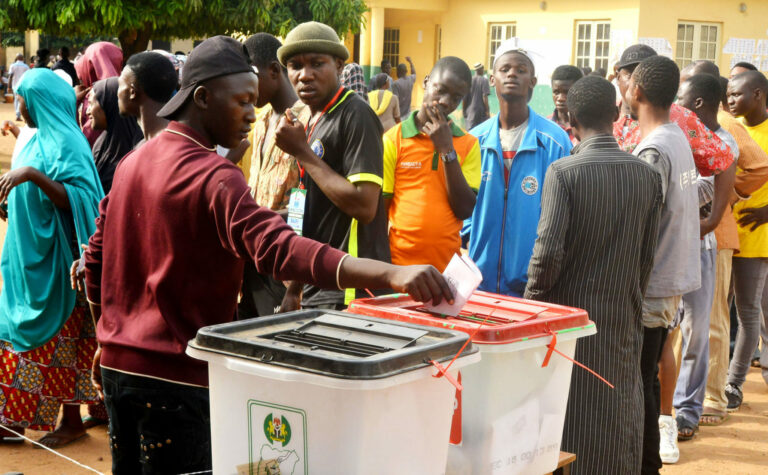
THE Independent National Electoral Commission (INEC) has accredited 229 national and international groups that would be deploying 146,913 observers for the general elections starting on February 25.
The chairman of the commission, Mahmood Yakubu, disclosed this on Wednesday, February 22 in Abuja at a media briefing for accredited observers for the elections.
Yakubu said the commission approved the accreditation of 196 national and domestic organisations that are deploying 144,800 observers, and 33 international organisations that are deploying 2,113 observers.
Yakubu noted that the number was the largest in the history of the country.
He called on the observers not to be partisan, stressing that the foreign observers must respect Nigeria’s sovereignty.
The INEC chairman warned that the observers must not interfere in the country’s electoral process or show partisanship.
He said, “I wish to remind observers that there is a code of conduct for election observation. You are, by definition, observers. Do not interfere with the process or show partisanship.
“In addition, international observers must be guided by the fact that the election is conducted by the Federal Republic of Nigeria, whose sovereignty must be respected. I urge you all to keep to the rules, listen to the presentation that will be made shortly, and ask questions where you require further clarification.”
In the same vein, the United Kingdom had on Tuesday, February 21, promised to take action against those elements planning to subvert democratic processes in Nigeria.
In a statement released by the British High Commission, the UK’s Minister of State for Development & Africa, Andrew Mitchell, vowed to use all legal tools available to the country against groups or individuals who seek to undermine the general elections in Nigeria.
“Where the UK is aware of attempts to subvert democratic processes at the National or State level, we are prepared to take action against those who engage in or incite electoral violence and other anti-democratic behaviours.
“These actions could include preventing people from obtaining UK visas or imposing sanctions under our human rights sanctions regime,” Mitchell said.
The UK government reinstated its commitment to supporting credible and inclusive elections, adding that the success of Nigeria’s elections was fundamental to regional and global democracy.
AS Nigerians gear up to elect new set of leaders who would pilot the affairs of the country for the next four years,insecurity has been identified as one of the major challenges that may mar the process as the safety of electoral personnel and voters cannot be guaranteed in some parts of the country battling insecurity. Nurudeen Akewushola reports how security situation in some terrorised communities in Kaduna threatens citizens’ participation in the 2023 polls.
————————————————————————————
As many Nigerians are enthusiastic about casting their votes, the situation is a bit different for 30-year-old Hussaina, a resident of Kaduna state. Election is the least of her worries because her husband is currently lying helplessly on a sick bed after being shot twice by terrorists during an attack that occurred earlier in February prior to The ICIR visit.
On that fateful day, residents of Ringin Unguwan village were swallowed by fear when they woke up to the sight of sporadic gunshots by bandits. While women and young children scampered for safety, the grown men picked up their local guns and exchanged fire with the attackers.
Hussaina
The attack is not the first of its kind. Before then, terrorists had attacked the community several times, robbed them of their possessions, and kidnapped residents in exchange for ransom, but due to the failure of the government to find a lasting solution, they often resorted to self-defence.
On that fateful day, Hussaina’s husband, Magaji Ringin, 67, was one of the men that volunteered to face the bandits to protect the lives and properties of the residents from the grip of terrorists. Magaji was shot twice in the leg during the fierce encounter.
Recounting his encounter with the terrorists, Magaji said, “I decided to join them to protect our people because I’m aged, and I don’t need to fear death. I just faced them, and we were exchanging fire when two bullets pierced my leg.”
Magaji
– Politicians shun troubled communities –
“We don’t have peace, and we cannot participate in the election on the election. I don’t think elections would hold in our community because no politician came to our village for election campaign”, Magaji told The ICIR.
“Our community has been taken over by bandits, our Animals have been carted away by them. So who will stay back to vote, or who would bring the boxes on election day? Even some of us that lived in the community later left because of fear of terror. What will happen to somebody that’s not from the community? If the security situation improves, we can go back to our community and cast our votes, but if the situation remains the same, we cannot go back,” Magaji explained.
Nigerians are set to choose who leads them in the next four years. The Presidential election is scheduled for February 25, while the Governorship and State Assembly is scheduled for March 11. However, experts have said rising insecurity across the country could deny many citizens from participating in the elections.
Kaduna, a North West state, has been identified as one of the most terrorised states in the country despite being armed with heavy presence of the military and police.
A total of 723 attacks resulting into 3,672 deaths have been recorded in the state in the last four years, while 124 kidnapping incidents were also recorded during the period, according to Nigeria Security Tracker.
Some local government areas in the state, such as Chikun, Kajuru, Kachia, Zangon Kataf, Kauru, Lere, Birnin Gwari and Giwa local government areas of the state are battling with this alarming humanitarian crisis.
– Activities of terror groups –
Earlier, a terrorist organisation, Ansaru enacted a law in some communities in the state banning all forms of political activities ahead of the elections.
The Jama’ar Ansarul Muslimina fi Biladi Sudan, also known as Ansaru terrorist group, is known to have an extremist ideological posture against democracy and secular authorities.
On June 25, 2022, the fundamentalist group also released audio against any form of political campaigning in the area. The statement specifically mentioned some villages as “no political campaign” zones.
The governor of the state, Nasir El-Rufai, also confirmed this development in a letter written to President Buhari seeking the federal government’s support to tackle the insurgency operations in the state.
However, security experts have argued that terrorism reins in the country due to lack of political will by the government to deal with the situation decisively, weak engagement, and slow response to intelligence.
The failure of the the authorities to address the widespread insecurity in the state threatens the safe conduct of the 2023 general election as the safety of electoral personnel and voters cannot be guaranteed in parts of the state that are prone to terror attacks.
Displacement leading to disenfranchisement
Like some other states in Northwest Nigeria, the insecurity in Kaduna is fueling a growing displacement crisis. The development has left many villages deserted, with many disenchanted and distraught even as election remains few days.
Thousands of people from the affected villages have been forced to leave their homes, and those with nowhere to go have to live at the mercy of the terrorists.
According to the International Organization for Migration, about 1.08 million have been forced to flee their homes in Nigeria as of September 2022. In Kaduna, 92,852 IDPs were identified.
The report identified insecurity which includes armed banditry, kidnapping, communal clashes, and attacks by gunmen, as the reasons for the displacement of 95 per cent of the IDPs in Kaduna.
Although the Chairman of the Independent National Electoral Commission (INEC), Mahmoud Yakubu said Nigerians living in internally displaced person camps would vote in the 2023 general elections, but the INEC framework only covers the internally displaced persons who reside in formal IDP camps.
The policy does not capture IDPs that reside in host communities despite the fact that they account for 80 per cent of IDPs in the country
INEC chairman, Mahmood Yakubu.
“Unfortunately, in some states, it is difficult to identify the IDPs because they are not in camps but rather settled among extended family members, relations and good Samaritans within safer communities where they are not registered voters. As a result, it is very difficult for the Commission to provide necessary electoral services to such IDPs. However, those in camps within Nigeria will be catered for in line with the Commission’s policy,” Yakubu said at Chatham House.
Aisha Musa, 40, is one of the survivors of insecurity not covered by this policy. The mother of seven is seeking refuge in an uncompleted building donated by a philanthropist in Iyatawa village of Giwa local government after terrorists forced her and her family to leave their village.
The terrorists murdered her 2-year-old son, injured her daughter and shot her husband in the leg when one Wednesday in 2021.
Aisha and her husband managed to exit the community after spending a week in the bush before coming to Iyatawa to seek refuge.
“We don’t know anything like political activities, no politician comes to our village to campaign, because our community has been sacked by terrorists. There’s no peace there again,” she told The ICIR.
Aisha, who said she left everything behind in her village, said she lost her Permanent Voters Card (PVC) during the relocation.
“I would not vote for anybody because they fail to protect us and our properties. I even don’t know where I put my PVC. I don’t think the election will hold in our community because there’s no peace. Most of us have departed from the village.”
– Residents not willing to return to villages sacked by terrorists –
Hussaini Yakubu was a vice Imam of a Juma’at Mosque at Bakali Kidandan village before he ran for his life. Yakubu said he has his PVC but the village where his polling unit is located has been sacked by bandits.
Yakubu
Yakubu, who lost three of his brothers to terrorist attack, cannot vote at Iyawa village, where he lives as an IDP and cannot risk returning to Bakali, his former village.
“I don’t think terrorists will allow elections to hold in Bakali, because most of the inhabitants have deserted the village. No political activities taking place there because there are no people in the community,” Yakubu said.
Terror victims express mixed reaction
Some victims of insecurity in Kaduna who spoke to The ICIR expressed mixed reactions over the forthcoming polls. While some of them expressed apathy, some expressed their willingness to cast their ballots.
A 42-year-old Ibrahim Lawal was one of the persons that narrowly escaped the bandit attack at Kerawa village in Igabi local government area of Kaduna State which led to the death of several persons including newborn babies.
According to him, most people have deserted the village and can no longer go back, even for the elections, but he expressed willingness to cast his ballot.
“I have PVC and would vote for a credible candidate. My family also have PVCs, and they will all go out and vote for the political party of their choice.”
Unlike Lawal, Hannatu Bakali, 32, from Bakali village, said she will not to go out on the election day.
The mother of two narrated how she had lost all her possession, including her PVC, to bandits’ attack. She said she raised millions of Naira to secure the release of her kidnapped husband.
Hannatu Bakali
“I don’t think elections will hold in Bakali because they scattered the village, even the politicians do not go there for campaigns. I would not go out to vote because safety is our priority now. My PVC got lost during the migration,” she said.
Sunusi Isiyaku
Sunusi Isiyaku, 54, from Karau Karau village bemoaned the incessant kidnapping in his community. He said a large part of their yearly harvest ends up as a ransom for the bandits.
“The issue of insecurity is highly alarming. Even yesterday, the terrorists kidnapped one of our people in Karau Karau, I have just come back from the village to condole with the family of the victim,” he said.
Sunusi reiterated his resolve to cast his ballot despite the insecurity in his community. He expressed his hope for a safe election.
A community head at Iyatawa community, Abbas Abdullahi, Sarkin Bakin of Giwa local government bemoaned the incessant attack by bandits in the community.
Abbas Abdullahi, community leader
Abbas appealed to the government to provide adequate security for the community to enable the constituents to cast their votes on the election day.
“My call to the government is that Giwa Local government area is in terrible condition, we are urging the government to rescue good people of Giwa because if this problem is not tackled decisively, terrorists would likely take over all the villages in the local government.”
2023: Stakeholders express concern over insecurity
Nigeria’s elections have historically been fraught with violence and other abuses. Voter turn out has been on steady decline since 2007.
Experts have said disenfranchisement caused by insecurity could lead to voter turnout figure dropping again this year.
Voter turn out in Nigeria’s Elections
Even though the INEC chairman had always reiterated that the election would hold as planned, the chairman of INEC’s Board of Electoral Institute was quoted to have said: “If the insecurity is not monitored and dealt with decisively, it could ultimately culminate in the cancellation and/or postponement of elections in sufficient constituencies to hinder declaration of elections results.”
The Centre for Democracy and Development (CDD) identified insecurity as one of the critical issues that may frustrate the outcome of the 2023 elections.
The Director of the Centre, Idayat Hassan had, said that various gangs of criminal elements and terrorists group are working towards disrupting the poll.
Idayat noted that the insecurity in the country may make logistics difficult for the INEC and hinder its ability to mobilise personnel for the voting exercise properly.
Idayat called for the intensification of military operations to tackle insecurity in the run-up to the forthcoming elections.
In an interview with The ICIR, a security analyst with the Lagos-based SBM Intelligence security firm, Confidence MacHarry, said the influence of Ansaru terrorist group, who earlier banned political activities in some parts of Kaduna communities, has been stemmed, but the rise in banditry attacks remains a major challenge.
“I don’t think the activities of terror groups is going to stop the election, and even if it does, there’s provision for a supplementary election as they did in 2019 and other past elections”, he noted.
Roadmap to Safe polls: Nigerian Police force expresses readiness
As part of measures by the Nigerian Police Force to ensure hitch-free polls, the Inspector General of Police, Usman Alkali Baba disclosed that 404,106 security operatives will be mobilised for the February 25 presidential election.
The IGP said the Nigerian Police, with support from other security agencies, have perfected plans to deploy in a coordinated and collaborated manner to cover all locations.
Inspector General of Police, Usman Alkali Baba
He asserted that an intelligence unit is in place to track and apprehend those who may engage in vote buying and others who may want to disrupt the exercise.
Alkali said the security operatives will include officers of the Nigeria Police Force (NPF), Federal Road Service Corps (FRSC), Nigerian Correctional Service (NCoS), National Drug Law Enforcement Agency (NDLEA), Nigeria Security and Civil Defence Corps (NSCDC), and Economic and Financial Crimes Commission (EFCC).
He said a minimum of at least two personnel drawn from the above agencies would be jointly deployed to each polling unit across the country.
“The deployment will cover the national collation centre in Abuja as well as other collation centres across the states of the federation, FCT, and 774 LGAs,” he said.
“In view of the above, the Nigeria police will deploy 310,973 personnel for election security operations. The manpower required for this exercise will be completed by the military and other security agencies.
“In this regard, aside the military and DSS, other security agencies would contribute a total of 93,495 personnel for the election security operations.”
On plans to mitigate violence, Baba assured that a unique technical intelligence assets and special intelligence unit of the police are working with other security agencies and INEC, are in place to track and apprehend culprits.
Calls and text messages sent to the Public Relations Officer of Kaduna State Police Command, Mohammed Jalige, to confirm the command’s preparedness for the polls were not responded to as of the time of filing this report.
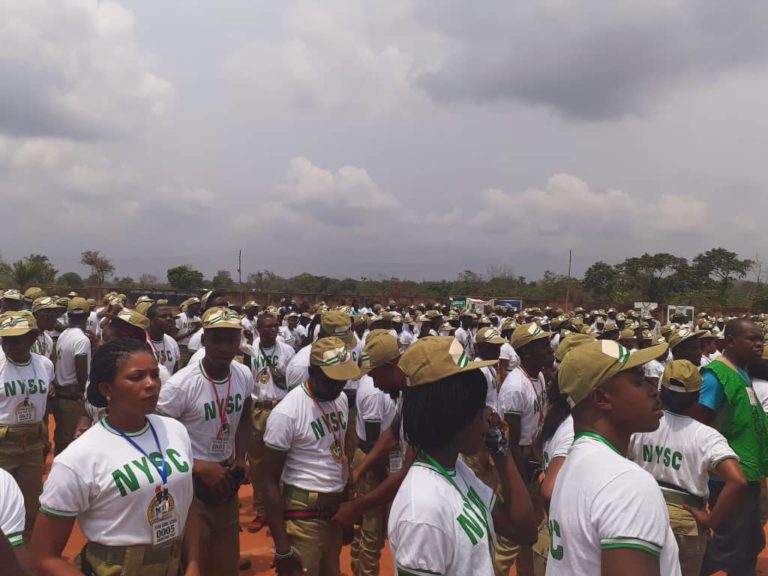
THE National Youth Service Corps (NYSC) says over 200,000 corps members have been deployed as adhoc staff for the 2023 general elections.
The Director-General of NYSC Brigadier General Yushau Dogara Ahmed disclosed this on Tuesday, February 21, at a press conference on the organisation’s preparations for the elections.
Ahmed said the deployed corps members had been trained rigorously by the Independent National Electoral Commission (INEC) on election procedures.
He said, “We have deployed over 200,000 corps members. Those who are participating in this election have already been trained. Some of them are trained outside the camps. Those who just passed out were trained by INEC officials in the camp. Proper training has been given to them, guidelines were given to them. They have been well informed and they are ready to give their best.”
The NYSC boss warned the corps members against collecting gratification from politicians.
He also asked the corps members to be careful of the environment they find themselves in during the elections.
“What I want to warn corps members about is that they should be careful in whatever environment they find themselves in. They should not accept any gift from any politician.
“They must not accept any food from anybody. As they go, they should carry at least their service support. Any form of gratification or gifts, we don’t expect any corps member to accept.”
According to him, the NYSC has put in place measures to ensure the safety of corps members during and after the elections.
He added, “What is fundamental for me to also mention is the security of these corps members. Since I took over, I have met with the IG of Police and the DSS. I have met with the Nigerian Security and Civil Defence Corps, I have equally met with INEC and every hand is on deck to ensure that the corps members are secured
“We were assured by INEC that they will carry these corps members to their respective places of assignment and bring them back safely from wherever they are picking them from.”
The ICIR had reported that the Chairman of Independent National Electoral Commission Mahmood Yakubu, assured corps members on election duty of premium security, noting that the NYSC plays a critical role in the election process.
Yakubu stressed that the commission would continually operate within the framework of the existing Memorandum of Understanding (MoU) between the commission and the NYSC.
It would be recalled that a former Resident Electoral Commissioner (REC) of the Independent National Electoral Commission (INEC), Mike Igini had called for transparency in the selection of NYSC members and others who will serve as adhoc staff for the 2023 general elections.
The former REC alleged that politicians usually connive with NYSC officials to influence the selection of adhoc staff for elections.
THE United Kingdom (UK) has ordered the closure of its Visa Application Centres (VAC) in Nigeria, in view of the country’s forthcoming Presidential and National Assembly elections scheduled to hold on Saturday.
This was disclosed in a statement issued by the UK Visas and Immigration on Tuesday, February 21.
“The Visa Application Centres in Abuja, Ikeja, and Victoria Island will be closed on Friday, February 24, and Monday, February 27,” the statement said.
Consequently, no visa appointment will be booked on these days, but customers have the option to purchase the Keep my Passport and Courier return services in advance of the VAC closure, in order to retain their passport during this period.
“Priority Visa services remain available. Super Priority Visa services will be suspended on Wednesday 22nd and Thursday 23rd because the next working day opening is not until Tuesday 28th, ” the statement added.
THE United Kingdom (UK) Metropolitan Police is investigating the death threat issued to British-Nigerian lawyer and activist Shola Mos-Shogbamimu by the National Action London Cell, a British right-wing extremist and Neo-Nazi terrorist organisation based in Warrington.
Mos-Shogbamimu had raised alarm over a death threat she received from the organisation over her comments and activities against racism and inequality.
The Metropolitan Police said that after being first made aware of the letter as a result of Twitter posts, the case was now being investigated by its Counter Terrorism Command.
In a threat letter delivered to her home which contained vile racist and transphobic language, the National Action London Cell warned Mos-Shogbamimu to leave the UK or risk getting killed along with members of her family.
“Shola you are a constant troublemaker and liar who appears on television frequently. You make shabby living from criticizing and race grifting against ethnic white Europeans and our culture.
“We suggest you leave the UK ASAP. This is the only way you can avoid what is coming to you… It is only a matter of time before you receive your punishment, your execution,” parts of the letter which contained information about her home address read.
Reacting to the threat, Mos-Shogbamimu said: “They don’t consider killing me ‘murder, they call it an execution. This letter was through my front door.”
Another presenter and transgender activist India Willoughby, who has appeared on ITV’s Loose Women, confirmed in a reply to Mos-Shogbamimu’s tweet that she had also received a threatening letter.
FIRST Lady Aisha Buhari has said a fake statement falsely attributed to the Central Bank of Nigeria (CBN), shared via her Instagram handle, was posted by hackers.
The President’s wife disowned the post in a statement she released through her Instagram account on Tuesday, February 21.
She further disclosed that hackers had been tampering with her Instagram account since 2018.
“This person is a hacker, criminally minded with the intention to continue attacking my reputation through my social media platforms. But I am assuring you that this is the first and last I am disclaiming fake news on my handle.
“It is the responsibility of the security agencies to find out who am sharing my social media handles with, despite being verified accounts, and take all necessary actions,” she said.
A statement which claimed that the old N500 and N1000 notes had been reintroduced along with N200 and would remain legal tender until May 1, 2023 was uploaded on the First Lady’s Instagram handle on Tuesday.
The statement said the decision to recirculate the old N500 and N1000 currencies was taken by the Central Bank of Nigeria (CBN) on Monday, February 20.
The CBN, however, denounced the statement, describing it as fake news and urged the public to beware.
Aisha deleted the statement from her Instagram page and put out a disclaimer blaming the post on hackers.
THE Trade Union Congress of Nigeria (TUC) has called for calm from Nigerians over the hardship they are experiencing from the currency redesign policy of the Central Bank of Nigeria (CBN).
In a statement issued by the TUC president, Festus Osifo, and its general secretary, Nuhu Toro, dated February 19, the union condemned attacks by protesters on banks in states like Lagos, Ogun, Oyo, and Edo as a result of the cash crunch arising from the redesign policy.
The body appealed to the protesters to stop attacking banks, saying bankers could not be held responsible for the gaps in the policy implementation.
“Our hearts go out to ordinary Nigerians and their families who are forced to undergo hardship, including inability to buy food and basic medicines, or pay for transportation because their monies are hanging in the banking system.
“It is also understandable that in some cases, the patience of people is worn so thin that they have resorted to protests and publicly demonstrating their feelings and frustrations. However, some of these protests are wrongly directed at bank workers and other staff of financial institutions,” the statement said.
The union stated that bank and financial institution employees at junior and senior staff levels were mere workers distributing currencies made available to the various banks by the regulatory agencies.
The statement further read, “Even the CBN, which initially claimed that banks were hoarding the new currencies, has admitted that it has been unable to provide the new notes in sufficient quantities to meet public needs.
“Unfortunately, the initial dummy sold to the public that the banks were hoarding the new bank notes was bought by some members of the public who have come to see the banks, bank staff and even ATMs as legitimate targets of attack.
“Congress appeals that this misdirected anger should stop. Our fellow compatriots should realise that bank staff are like other Nigerians, victims of the poor implementation of the new currency design policy.”
The union stressed its commitment to finding a lasting solution to the current crisis, and expressed its readiness for peaceful solidarity actions with other Nigerians in collaboration with market associations, youth and student groups, professional associations and civil society organisations.
The body also warned the Muhammadu Buhari administration against use of maximum force on protesters, declaring the government had no right to use maximum force on Nigerians peacefully demonstrating against the failure of government to produce depositors’ money on demand.
It said, “The use of live bullets against defenceless Nigerians as the first line of response is criminal. TUC can compile evidence of such atrocities and seek to bring them to justice if not in Nigeria, then outside the country.
“Congress does not in any way encourage miscreants and those destroying public/private infrastructures, looting the valuables of innocent Nigerians and shops under the guise of protest. If caught and investigated, they should be made to face the law.”
The union appealed to the Nigerian masses to rein in their provocation, and where they choose to publicly demonstrate their feelings, “which is their human right”, to do so peacefully.
THE National Bureau of Statistics (NBS) says the average retail price paid by consumers for petrol increased from N166.40 in January 2022 to N257.12 in January 2023.
This is according to the NBS Premium Motor Spirit (Petrol) Price Watch for January 2023 released in Abuja on Tuesday, February 20.
The report said the January 2023 price represented a 54.52 per cent increase when compared to the value recorded in January 2022 at N166.40.
The average retail price in January also increased by 24.70 per cent from N206.19, compared to the average price value in the previous month of December 2022.
The report stated that on profile analysis, Imo State paid the highest average retail price for petrol at N332.14, followed by Rivers and Akwa Ibom states at N327.14 and N319.00 respectively.
Conversely, Sokoto State paid the lowest average retail price for petrol at N191.43, followed by Plateau State at 192.14, and Borno State at N193.91
Analysis by zone showed that the South-East recorded the highest average retail price in January 2023 at N307.85, while the North-Central recorded the lowest at N217.15.
The NBS also revealed in its Automotive Gas Oil (Diesel) Price Watch Report for January 2023 that the average retail price paid for diesel by consumers was N828.82 per litre.
It said the January 2023 price amounted to a 187.69 per cent increase from the N288.09 per litre recorded in January 2022.
On a month-on-month basis, the price increased by 1.34 per cent from N817.86 per litre reported in December 2022.
On state profile analysis, the report said the highest average price of diesel in January 2023 was recorded in Bauchi State at N900.00, followed by Benue State at N885.71, and Adamawa State at N866.67.
On the other hand, the lowest price was recorded in Bayelsa State at N768.75, followed by Edo State at N788.00, and Akwa Ibom State at N788.75.
In addition, the analysis by zone showed that the South-West had the highest price at N845.59, while the South-South recorded the lowest price at N800.49.
The president, Petroleum Products Retail Outlets Owners Association of Nigeria (PETROAN), Prince Billy Harry, saw the increase in prices of petroleum products as gradually reflecting current global pricing realities.
Harry said, “There’s a gradual shift to full deregulation with gradual price hike, which I believe the government would effect once the nation’s refineries become fully operational.”
He noted that deregulation would enable market forces determine the real price of fuel and give marketers a competitive edge to be in business.
Last week, The ICIR made a survey check on the average price of petrol across the country and discovered that logistic concerns and third party purchases by marketers were still major factors influencing prices across the country.
THE Kogi state Resident Electoral Commissioner (REC) Hale Longpet has said the Independent National Electoral Commission (INEC) office located around the Okehi local government secretariat was not affected in an attack that occurred on Monday, February 20.
The REC disclosed this at a press conference in Lokoja on Tuesday, February 21.
“It’s not true that our office in Okehi LGA was blasted in the evening of Monday. We understood there was a blast at the council’s secretariat, where we also have our office, but the office was not affected in any way.
“We want the world to know that none of INEC facilities in Kogi is under any form of attack as we are very ready for the 2023 general elections starting on Saturday,” he said.
Speaking on the level of preparedness ahead of the general elections, Longpet said 3508 Bimodal Voters Accreditation System (BVAS) machines had already been deployed for the Presidential and National Assembly elections in the state.
He also added that some machines, which malfunctioned during a mock accreditation exercise carried out in the state, had been replaced to avoid hitches during the elections.
He also stressed that safety of voters during the exercise was guaranteed.
Unidentified attackers had blown up some parts of the Okehi local government secretariat using explosive devices on Monday.
According to a statement by the Police Public Relations Officer (PPRO) in the state, the incident is being investigated, and steps would be taken to prevent future reoccurrence.
In December 2022, an explosion occurred in the Okene area of Kogi, shortly before President Muhammadu Buhari’s visit to commission projects in the state.