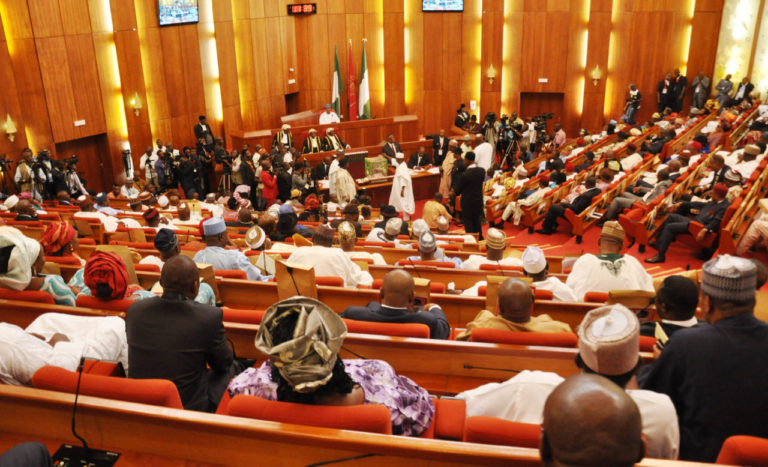
THE SENATE on Tuesday urged the Federal Government to quickly take steps to reduce the population in the nation’s correctional centres as well as disinfect them to avoid any possible outbreak of an epidemic among inmates.
Uche Ekwunife, a PDP senator representing Anambra Central Senatorial District, who moved the motion said it was a matter of urgency for the state of correctional facilities in Nigeria to be looked into.
Ekunife who canvassed that the centres be upgraded was corroborated by Abba Moro, also a PDP senator representing Benue South Senatorial district, who noted that the motion was timely.
Moro, a former Minister of Interior under which the correctional cemtres fall added that over 70 per cent of prison inmates were awaiting trial.
He further lamented that steps taken in the past to address the situation have not yielded.
“Every effort taken has not addressed the problem. We must make a bold attempt to ensure this problem is solved once and for all,” he said.
Supporting the motion, Gabriel Suswam, a former governor of Benue State and senator representing Benue North East, Benue State maintained that the centres needed to be disinfected urgently.
‘’On disinfecting the place, we need to as a matter of urgency urge the appropriate authority to address the issue raised, and most of the people who are there do not need to be there and they are congesting the place,” Suswam said.
Rochas Okorocha, senator representing Imo West Senatorial District noted that the Nigerian prison environment has been in a bad and terrible shape.
The centres, he said, were not the best place to be, urging the Federal Government to budget more to build new prisons.
The Red Chamber called on the authorities managing the correctional centres to adequately profile inmates and separate them accordingly to avoid lumping of light or first offenders with hardened criminals.
It particularly called for a national clean up as well as fumigation of all correctional facilities in the country to avoid outbreak of epidemics.
The Senate also advised the Federal Ministry of Interior to commence the process of upgrading facilities in all the correctional centres while also adding that the Judiciary, the Ministry of Interior and correctional centres need to work together and come up with a workable modality on how to fast track the process of de-congesting the correctional centres in the country.
Last year August, President Muhammadu Buhari, signed the prison reform bill which sought to solve the challenges of prisons in Nigeria. The new law changed the name of the Nigeria’s Prison Services to the Nigeria’s Correctional Services.
Nigeria’s Correctional Services currently has about 250 prisons of which 155 are prisons for convicts and 83 are satellite facilities and with 74,000 inmates.
According to a report by VOA, an average Nigerian prison houses about five times the number of inmates it was intended for.
Overcrowding being one of the many challenges of the average Nigerian prisons poses a great threat as one of the prisons in the Southeast houses more than 4,000 inmates whereas it was built for 804.
Out of the nearly 74,000 inmates in the country, only about 24,000 have actually been convicted. That means 68 percent of the total prison population is awaiting trial.
CONSUMER Price Index (CPI) which measures inflation increased to 12.20 per cent (year-on-year) in February 2020,which is 0.07 per cent points higher than 12.13 per cent recorded in January, a report by National Bureau of Statistics (NBS) has revealed.
According to the NBS report released on Tuesday, increases were recorded in all the Classification of Individual Consumption According to Purpose (COICOP) divisions that yielded the headline index.
The report shows that urban inflation rate increased to 12.85 per cent (year-on-year) in February 2020 from 12.78 per cent recorded in January 2020, while the rural inflation rate increased to 11.61 per cent in the same month from 11.54 per cent in January 2020.
The composite food index rose to 14.90 per cent in February 2020 compared to 14.85 per cent that it was in January.
It stated that rise in the food index was caused by increases in prices of bread and cereals, fish, meat, vegetables, and oils and fats.
On a month-on-month basis, the food sub-index increased to 0.87 per cent in February 2020, down by 0.12 per cent points from 0.99 per cent recorded in January 2020, the report showed.
According to the NBS report, ”All items less farm produce” or core inflation, which excludes the prices of volatile agricultural produce stood at 9.43 per cent in February 2020, up by 0.08 per cent when compared with 9.35 per cent recorded in January 2020.
The highest increases were recorded in prices of pharmaceutical products, non-durable household goods, catering services, passenger transport by air, repair of furniture, maintenance and repair of personal transport equipment, water supply, carpet and other floor coverings, major household appliances, dental services, hospital services and vehicle spare parts.
The NBS report showed that in February 2020, all items inflation on year-on- year basis was highest in Bauchi 14.47 per cent, Niger 14.06 per cent and Plateau 13.98 per cent, while Borno 10.46 per cent, Abuja 9.68 per cent and Kwara 9.59 per cent recorded the slowest rise in headline year on year inflation.
But on a month-on-month basis however, in February 2020 all items inflation was highest in Kano 1.59 per cent, Benue 1.55 per cent and Taraba 1.53 per cent.
While Ondo, Ogun, Nasarawa, Kebbi, Bauchi, Anambra all recorded price deflation or negative inflation (general decrease in the general price level or negative inflation rate).
It further showed that in February 2020, food inflation on a year on year basis was highest in Sokoto 17.12 per cent, Plateau 16.99 per cent and Gombe 16.96 per cent, while Nasarawa 13.50 per cent, Bauchi Katsina 13.04 per cent and Bayelsa 11.89 per cent recorded the slowest rise.
While on a month on month basis, February 2020 food inflation was highest in Benue 2.38 per cent, Osun 2.36 per cent and Rivers 1.77 per cent, Abuja, Anambra, Bauchi, Bayelsa, Katsina, Kebbi, Nasarawa, Ogun and Ondo all recorded price deflation or negative inflation.
LESS than 24 hours after the Federal Government announced the third confirmed case of novel coronavirus in the country, a friend of the patient has called out the Nigerian Centre for Disease Control (NCDC) over what he described as its poor handling of the case.
Ayobami with the Twitter handle @dondekojo tweeted that the confirmed case would have been better managed if the NCDC had been proactive in testing the 30-year-old patient, who according to him had made herself available for a test immediately she returned from the UK on Friday March 13.
He disclosed that the centre had responded to calls arguing that “UK isn’t a high risk country.”
“We could have avoided a lot of effort we’d now have to do on contact tracing if this test had been done since Friday. NCDC basically told me that the UK isn’t high risk and won’t promise a test until I kept going at them. Stay safe,” Ayobami wrote on Twitter.
According to him, he had promptly followed the public health advisory shared on the NCDC’s website and also called the phone number of the organisation which is widely advertised as toll free when his friend started showing symptoms of coronavirus shortly after her arrival from the UK.
Reacting to the claim by the government that the patient is receiving care, Ayobami submitted that it was a bogus claim as the patient was with no one to attend to her.
“Hello @LSMOH @ProfAkinAbayomi you lied in the Press release that she’s “receiving care” when no one has attended to her at all. No toiletries or regular power supply, lack of any sort of medication apart now. Fix up,” his tweet read.
The ICIR however, reached out to Ayobami but as at the time of filing this report, he did not respond to questions sent to him via Twitter.
Meanwhile, the Director General of NCDC, Chikwe Ihekweazu in a tweet which appeared to be a reaction to Abayomi’s claim urged Nigerians to be patient with the organisation.
According to him, the centre is busy receiving hundreds of calls daily and is working hard.
He added that citizens desist from criticizing them as it’s distracting and discouraging.
“We’re extremely busy. Our call handlers are taking hundreds of calls every day, 24/7 including weekends, from across Nigeria Please be patient with us & help us by pulling together. The criticism distracts us from critical work. We are trying VERY hard to meet all urgent needs,” his tweet reads.
So far, Nigeria has recorded only three cases of coronavirus and one of the patients was recently reported discharged after testing negative to the virus.
THE Christian Aid, the official relief and development agency of 41 Christian churches in the UK and Ireland, is partnering with Connected Development (CODE) to support six youth-focused organisations in the country as part of efforts to boost youth empowerment in Nigeria.
During the launch of the nationwide Youth Challenge fund, held on March 13, CODE announced that through funding from Christian Aid it would sub-grant £30,000 to selected organisations, to empower them in addressing some of the growing developmental challenges across communities in Nigeria.
The CODE, also said it would train the selected organisation in building capacity and driving their initiatives towards achieving sustainable results.
“The fund is in recognition of the immense capacity of young people to address some of the growing developmental challenges across communities in Nigeria, if given the opportunity and required resources,” Charles Usie, Christian Aid Nigeria’s Country Director said during the launch.
“We have therefore put this in place as part of our mandate to end poverty in Nigeria.”
Speaking on the essence of the project, Chief Executive Officer of CODE, Hamzat Lawal, submitted that the government must understand the growing importance and potential of young people and consider their contribution to nation building.
He called for increased financing, education and technical support for Nigerian youth noting that doing this would greatly impact on the future of the country.
Lawal also stressed that young people constitutes 60 percent of the Nigerian population whose potentials should be activated, adding that the country is in need of community change makers.
In selecting organisations to kick-start the project, Lawal said CODE in partnership with Youth Hub Africa and Christian Aid assessed over 120 applications before choosing with six organisations whose projects focus on impacting youths in the most remote areas in the country.
THE Lagos State Ministry of Health says it has identified a new case of Coronavirus in the state, making it the third confirmed case of the deadly virus in the country.
The state government in a tweet Tuesday morning disclosed that the patient who is a 30-year-old Nigerian woman arrived from the United Kingdom on March 13 and observed the advisory self-isolation.
It explained that during the course of self-isolation, the patient developed symptoms and was tested which came out positive.
Akin Abayomi, the state’s Commissioner of Health confirmed the new case and stated in a tweet that contact tracing on the newly-identified patient has commenced.
According to the Minister of Health, Osagie Ehanire, who also confirmed the third case in the country, the new patient is currently stable.
The patient whose identity is undisclosed is the third case registered in the country since the first imported case, an Italian man was registered on February 28.
The Nigerian Centre for Disease Control (NCDC) also confirmed the third case quoting the Minister of Health as announcing the case.
The lady, it was gathered is currently receiving treatment at the Mainland Infectious Disease Hospital, in Yaba area of Lagos.
It was reported that the second case who came in contact with the index case, a Nigerian man, was recently discharged after testing negative to the virus despite initially testing positive and being asymptomatic.
Globally, according to the World Health Organisation (WHO), Coronavirus has has infected over 160,000 persons and caused over 6,000 deaths.
As the pandemic grows with no vaccine or known cure discovered yet, the world is gradually grinding to a halt.
Countries like Uganda, US, Russia and Germany have shut down borders to prevent importation of the virus which originated from Wuhan, China in December 2019.
ON Monday, the Federal High Court sitting in Abuja adjourned the trial of former Comptroller-General of the Nigeria Customs Service, NCS, Abdullahi Dikko after the ex – customs boss failed to appear in court despite, a bench warrant being issued for his arrest.
Dikko who is currently being prosecuted by the Independent Corrupt Practices and other related offences Commission, ICPC, alongside a former Assistant Comptroller-General of the agency in charge of Finance, Administration and Technical Services, Garba Makarfi, and Umar Hussaini, a lawyer and owner of Capital Law Office.
They were alleged to have induced the Managing Director of Cambial Limited, Yemi Obadeyi, to pay N1.1 billion into the account of Capital Law Office as a refundable “completion security deposit” for the purchase of 120 units of duplexes as residential accommodation for officers of the Nigeria Customs Service.
The presiding judge, Justice Ijeoma Ojukwu at the resumed hearing stated that despite issuing the bench warrant for the ex-Customs boss arrest in February, the prosecuting team had failed to collect it.
“Usually, the next thing they do before I leave at 4 or 5 pm, they bring those warrant for my endorsement. I have endorsed the warrant but you have never come for it. Is that not the position? So, you know you are not serious,” she said.
In February, Justice Ojukwu had issued a warrant for Dikko’s arrest for his continued absence in court. His lawyer, Solomon Akuma, had presented a medical report to the court saying Dikko was critically ill and on admission at a London hospital.
In a twist of events, Justice Ojukwu said the address on the medical report contradicted his claim that he was in a London hospital as the address on the medical report was No 6 Ahmed Musa Crescent Jabi, Abuja.
However, she asked the prosecution team to set aside the arrest warrant if they discover that the ex-custom boss was in a London hospital else he should be arrested and brought to court on March 16.
The warrant for Dikko’s arrest had still not been collected from Justice Ojukwu by the ICPC’s prosecuting team.
The prosecuting counsel, Ebenezer Shogunle said Dikko had travelled out of the country when the bench warrant was issued for his arrest.
“We confirmed that the first defendant left Nigeria February 14, three days before the sitting of the court. His destination was Dubai, currently he is reportedly in London,” he said.
He pleaded with the court to extend the duration of the bench warrant and sought a further date for the arraignment.
“I am not adjourning this matter for the sake of it. If you are not interested in it, let me discharge it. Whenever you are ready to prosecute the first defendant we will re-arraign him,” Justice Ojukwu said.
The case was adjourned and slated for hearing on May 3. In a phone interview with Okoduwa Rashidat, spokesperson for the ICPC, when asked why the ICPC was yet to collect the warrant of arrest from the court she disclosed to The ICIR that she wasn’t aware of the details of the case and won’t be able to respond until she is briefed by the lawyers.
“I am not aware of the current information on that case because I am just hearing that information from you which is one – sided until I am briefed by our lawyers I won’t be able to respond but ordinarily if we are not serious about prosecuting the case then we won’t be in court,” she said.
AT every point in the Nigerian justice system, there is a corrupt government official ripping innocent Nigerians off and doing it so brazenly.
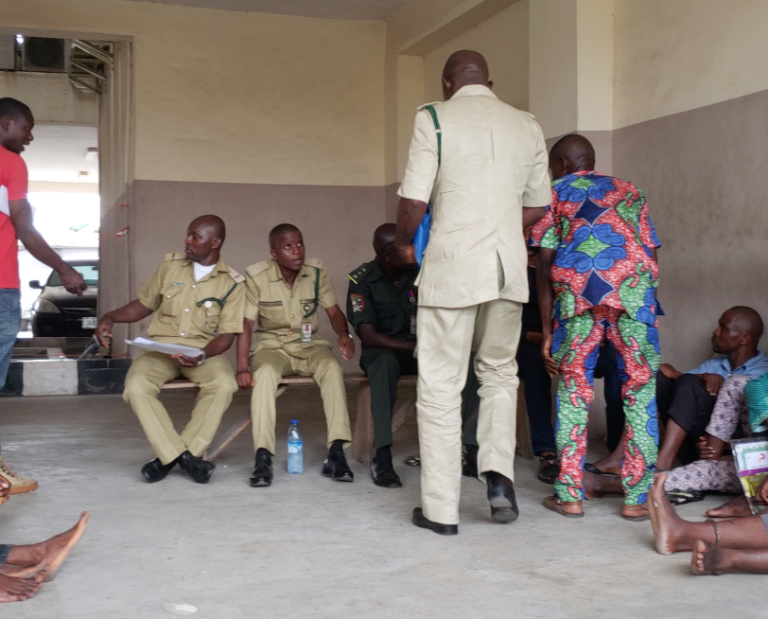
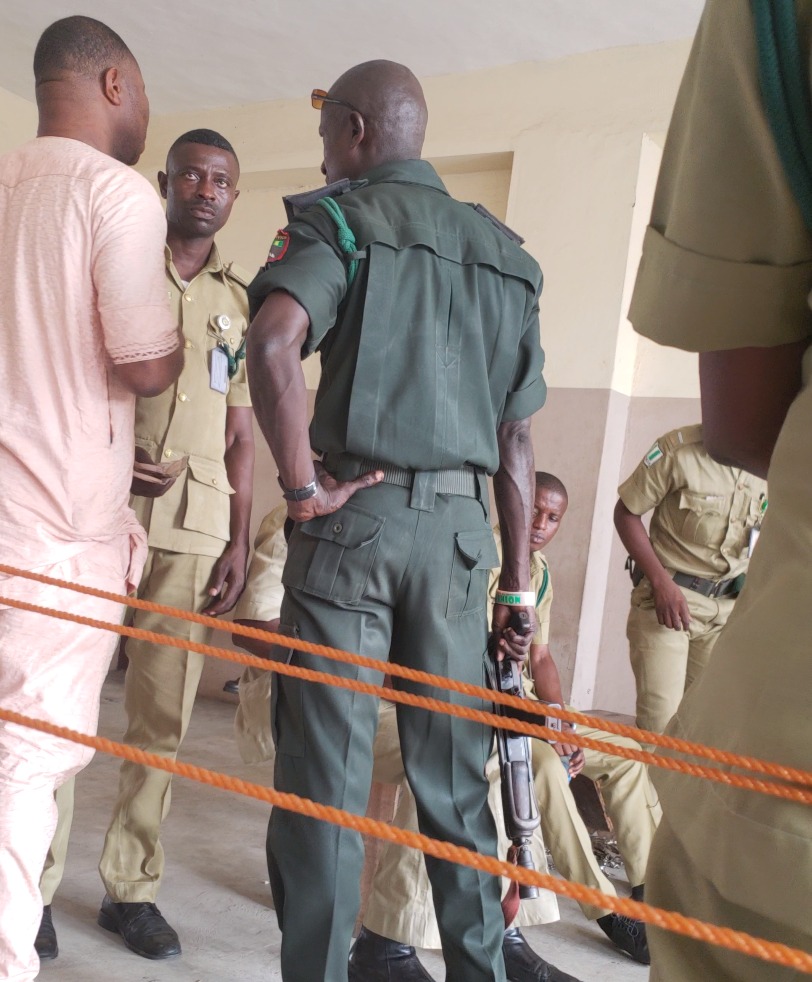
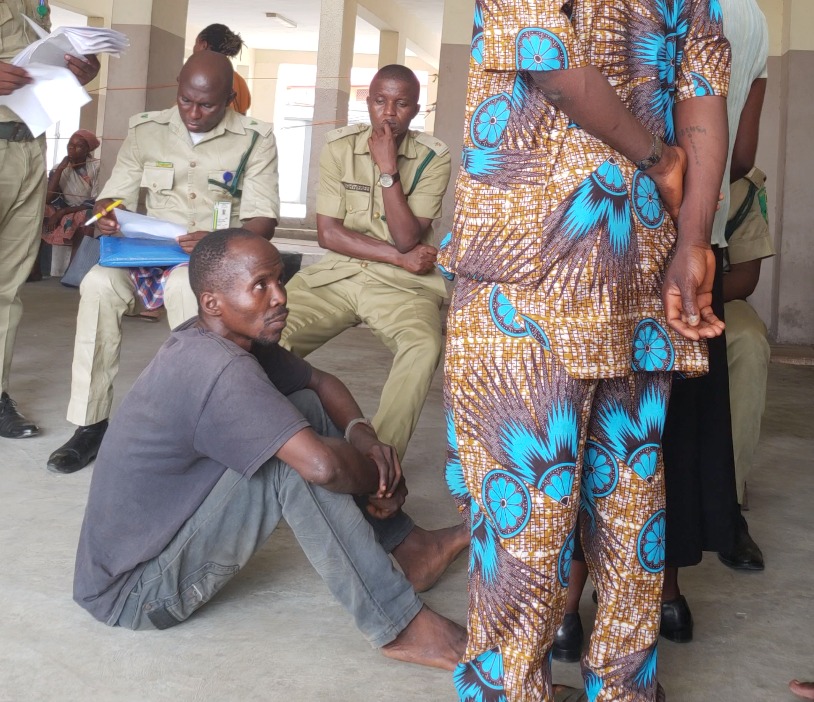
The prison wardens, like the police and the judicial officers, also weave an illegal extortion racket around the inmates they were employed to protect.
The illegal operation is so blatant it is carried out in the full sight of the Lady Justice, within the premises of the court.
Every court has a holding cell where inmates produced from prison custody are held. At the Ogba, Ojo and Ikorodu magistrate courts, the holding cells have no toilet and sanitation facilities – and this is particularly bad for women. The absence of cross ventilation locks up body odours that create stench perceived from miles away.
“If you can no longer hold your urine, you have to relieve yourself in the cell. The other inmates understand because they too will do the same,” Chizoba Okoli said while narrating his experience in Ojo holding cell.
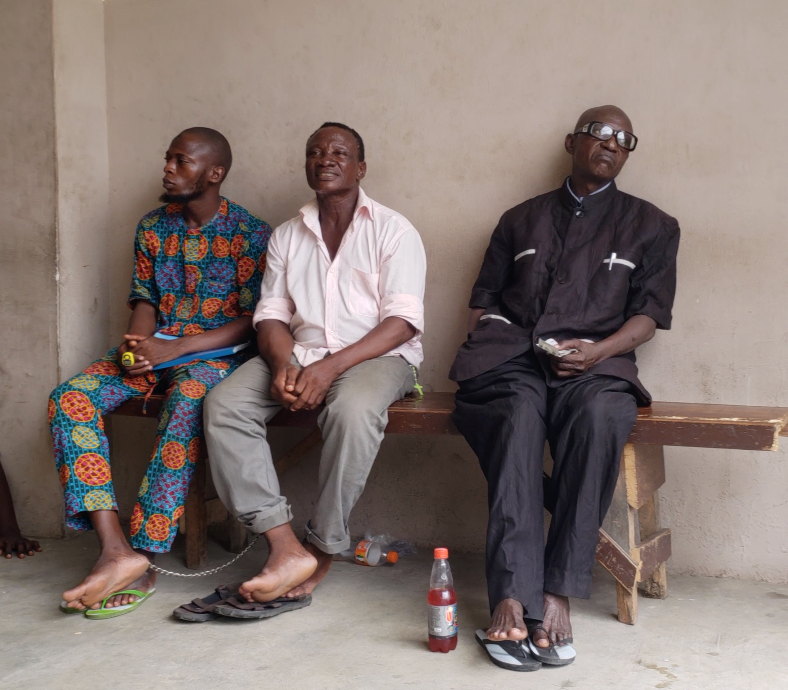
Defendants who paid to stay outside the cell
The wardens are not bothered about these filthy cells because they profit from the inhumane conditions these inmates are subjected to. For many newly arraigned suspects, staying in the holding cell while their bail conditions are being perfected is unimaginable.
“I cannot stay in the cell,” Chukuemeka said. “Apart from the scary people locked in that cell, the smell from the cell alone is unbearable.”
Chukwuemeka is a typical Nigerian ‘big man’ who could afford to pay his way through the corrupt legal system. He paid N5,000 to the wardens to stay out of the holding cell. He and others who could pay for “the fresh air” sat on a long bench away from the filth and stench of the holding cell in Ogba Magistrate Court.
N3,000 to visit detainees
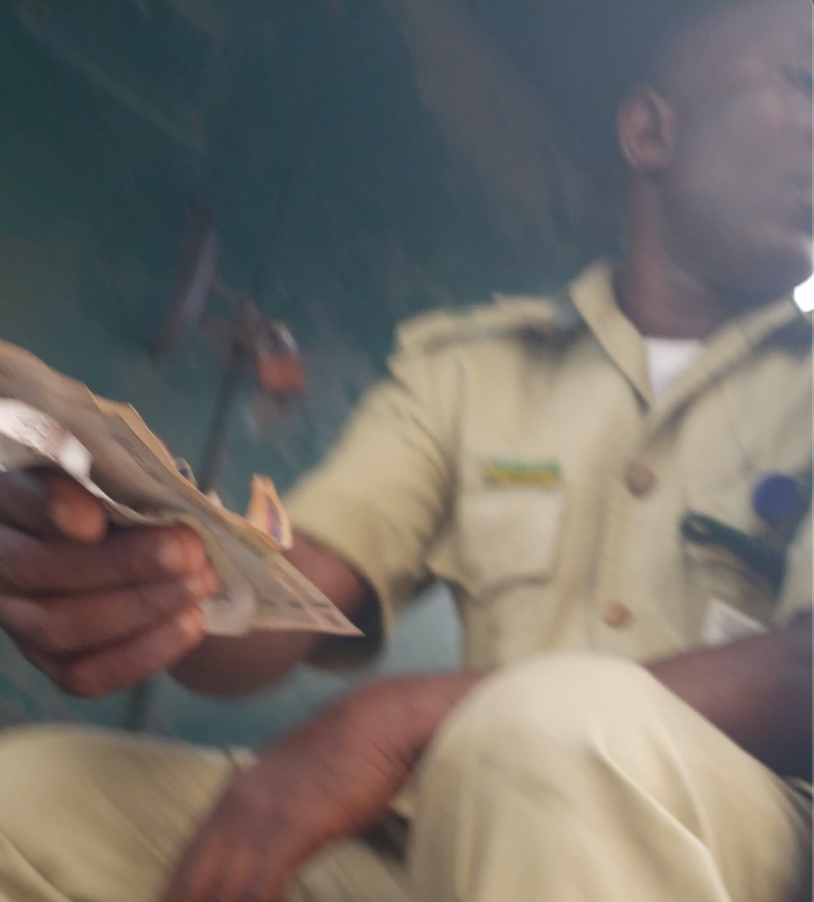
This form of extortion is just one way the prison wardens fleece the suspects and their family members. Requesting to see the inmate is another way. Relatives are forced to bribe the wardens before they are allowed access to the inmates.
Babajide was brought to court on May 6. He had been in prison, having been unable to perfect his bail conditions. His wife said she visited him at the Kirikiri prison once. The elaborate pockets of extortion at the prison discouraged her. The court was her only means to see him and update him on the difficulties in getting him out of prison. But the prison warden would not allow any such interaction.
She approached one of the wardens to allow her see her husband.
“If you want to see him it is N1000, if you want him to come out and sit here, you’ll pay N3000.” Gabriel, one of the wardens at Ogba Magistrate court gleefully said.
Gabriel was later given N1,500 for Babajide to be allowed out of the holding cell he shared with over 30 other inmates.
This extortion is a practice across all the holding cells in the magistrate court. At Ikorodu and Ojo Magistrate court, some prison wardens were seen extorting relatives who wanted to see their relations.
N5,000 to sign Release Order
The secretary of magistrate Fashola had informed the family of Babajide that the wardens would demand some money before they acknowledge receipt of the release order. This was just as she took her own share of N2,000.
“You will take the document to the wardens downstairs. They will request some money from you,” she explained, showing that the racket was an open secret within the court. “I am not sure how much, but it should be between N3,000 and N5,000”.
It was almost the close of business when the release order was presented to warden Gabriel. He refused to receive it.
Warden GABRIEL
“N5,000 is the least I can collect from you,” he charged. “If you don’t have it, take it to the prison yourself and see if you won’t pay more.” As he named his price, he then walked away from the wife who was pleading with N3,000.
He refused to receive the order, despite pleas from the family members, until he was given N5,000. He would also collect an additional N500 as the transportation fee for Babajide.
Inside Kirikiri Prison
The Nigeria prisons are overcrowded; available data has shown. According to the statistics provided on the website of the Nigerian Correctional Service on January 20, 2020, 70 per cent (50,856) of the 72,987 inmates in the centres are awaiting trial.
The Network of University Legal Aid Institutions, a non-governmental organisation promoting clinical legal education, legal education reform, legal aid and access to justice in Nigeria, said 50% of those awaiting trial are young people under the age of 30.
The difficulty of meeting bail conditions is one of the reasons for the high number of people awaiting trial, said Charisa Kabir, the organisation’s monitoring and evaluation officer.
“Once a person has been remanded in prison, bail is usually supposed to be based on certain amounts. Sometimes, N4, to N5, 000. But if these people don’t have that money, or anyone to support them, they are forced to remain there for a long time,” Kabir was quoted in a news report in September 2018.
Thousands of young people rounded up in random raids by the Nigeria Police Force remain in detention partly because they are unable to cough out the humongous, illegal fees required to perfect bail conditions.
KIRIKIRI WARDENS
Ganiyu Bankola, 22, said he was raided by policemen from Idimu Police Station, and transferred into the custody Special Anti-Robbery Squad (SARS), where he was detained for about four months. Unable to pay the bail fees being demanded by his IPO, identified simply as Supro Banti, he was charged to court in January 2019.
The young man was granted bail but again, could not meet his bail terms; then, he has no relatives to stand surety and could not afford to hire a professional surety nor pay the prosecutor. As at May 2019, he was still held at the Kirikiri Medium Prison, uncertain if he would ever make it out from prison.
“Please, help me out of this place, I don’t have anyone,” Bankola pleaded with this reporter during an undercover visit to the prison.
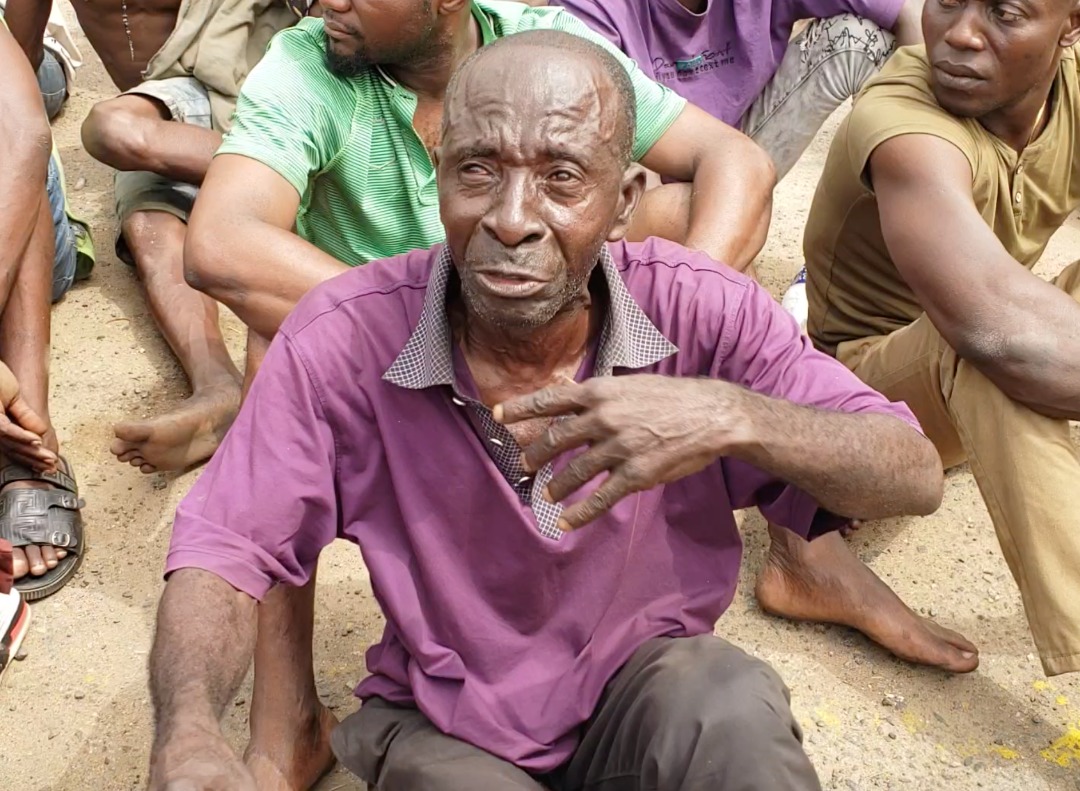
There are several hapless others, like Bankola, languishing in Nigerian prisons. Young male adults rounded up from their homes overpopulate the prison. Consequently, the facilities are overstretched and inmates have to struggle, and in most cases, pay to access the most basic amenities.
“When you get into the kirikiri prison, you be asked to pay if you will like to stay in a comfortable spot,” Babajide said while narrating his experience in the prison. “When I got there, I was asked to pay N20,000 but I could not afford that. I paid N10,000”
The N10,000 afforded Babjide a spot beside the cell marshal, the most senior inmate in his cell.
Abandoned and Forgotten
A good number of inmates in Kirikiri prison do not have contact with any of their family members. They were arrested, arraigned and thrown in jail, oddly cut off from families and loved ones. This was the case with Daniel Johnson, a 26-year-old hairstylist, who has remained in prison since June 2018 when he was arrested.
“We have not seen him in a long time,” his grandmother told this reporter. “He does not live here anymore and he does not visit often. We did not know he is in prison.” Johnson is an orphan. He lost his parents when he was only a child. His only immediate relative is his teenage sister who lived with their grandmother at Alakuko in Sango area of Lagos state.
For a year, neither the police nor the prison service contacted his grandmother. Until this reporter contacted the family in mid-May, 2019, none of his relations knew he was in prison.
Johnson was arrested on June 19, 2018, he said. He was on his way from a client’s home where he rendered home service.
“I was raided at night when I was coming from where I went to barb hair for my client [haircut],” he recalled. “I did not steal anything. I am a barber,”
When Johnson got to Kirirkiri prison, his dreadlocks were shaved off. He gave the home address of his relative but no one paid him any attention. He had no legal representation in court too.
“I am here all alone,” the downcast young man said.
Johnson’s version of how he got to prison differs from the state’s. The Commissioner of Police charged him for stealing. He allegedly stole some items from the dormitory of Girls Grammar School in Ogolonto. A staff of the school, identified simply as Kamala, claimed that he caught him and handed him over to the school’s security.
According to Kamala, when he gave testimony for the Ikorodu Magistrate Court, Johnson allegedly stole mattress, a gas cylinder and burner from the school premises.
“He had placed the items on the fence and was going to run away when I caught him.” Kamala told the magistrate.
The prosecutor, Mary, said there is a confessional statement wherein Johnson confirmed Kamala’s story. The statement was presented before the court. But Johnson denied writing any statement. He said he was only made to sign a piece of paper. Unfortunately, Johnson cannot adequately defend himself. He could not afford a lawyer. When the pro bono lawyers from the Nigeria Bar Association took up his case, he had already spent about a year in prison.
Children in Adult Prisons
17-year-old Emmanuel Iroakazi had spent one week at the Kirikiri prison when he met with this reporter. Like Bankola, he was randomly arrested during a raid on his way home.
“I hawk bottled water,” he disclosed. “I was coming home, I did not know police were raiding at Maza Maza [an area in Lagos]. They arrested me and threw away my bowl.”
Iroakazi was eventually arraigned before a magistrate court at Orege. He was granted bail but like many other teenagers raided on the street or in Lagos traffic where they hawk water to survive, Iroakazi could not meet his bail conditions. N50,000 and a surety in like sum were the conditions imposed by the magistrate.
“I don’t have money and nobody will stand as surety for me,” the 17-year old boy said. “They brought me to court because I don’t have money. They released the other people they arrested me with when they paid for bail.”
PARADED VICTIMS
These kids are many in Nigerian prisons. Homeless kids who were picked on the street or arrested for hawking on restricted roads.
Afeez Buhari, 15, said he was raided but charged to court for stealing. Buhari had been in prison for six months. Neither his parents nor any of his relatives knew he was arrested. He was arrested alongside Daniel, who he described as his casemate.
When this reporter called Daniel, he dropped the call the moment he realized it concerned his court case.
We are not pleased with the bad reputation, says Lagos Chief Registrar
This reporter approached the Lagos State judiciary with evidence of extortion gather during the investigation. the Lagos State Chief Registrar, Taiwo Olatokun, condemned the conduct of the clerk at Justice Fashola’s courtroom during a sit-down session with her alongside the Deputy Chief Registrar and the Director of Public Affairs.
Olatokun promised that the matter would be forwarded to the Personnel Management Board (PMB Discipline) for investigation.
She said the leadership is also bothered about the reputation of the judiciary and encourage Nigerians to report officials caught enriching themselves unlawfully.
Police Keep mum
This reporter also reached out to the spokesperson of the Lagos State Police Command, Bala Elkana, but the messages and calls to his known number when unanswered.
Messages sent to his WhatsApp messenger on January 17, 2020, got no replies.
On two different occasions, this reporter went to his offices at Oduduwa Way in Ikeja GRA and the Command headquarters, the junior officers met said he was not “available”.
We will investigate, Says Nigerian Correctional Service
The spokesperson for the Nigerian Correctional Services, Francis Enobore, said the indicted officers will be investigated.
“We cannot deny that there will be some unscrupulous people in the service that are acting outside the law and this is the same in every organisation. However, what is important and should be of paramount importance is whether the institution concerned condone such behavior or whether they have the capacity to address such error.”
Enobore assured that indicted officers would be dealt with if found guilty.
Note: This is the final part of the three-part series. Read Part 1 here, and Part 11 here.
THE United State Government says Nigerian Government has been flippant about issues affecting women, particularly rape, battery and other forms of violence against womenfolks.
In its latest report on Human Rights Practices in Nigeria, the US observed that Nigeria lacks all-inclusive regulation that could effectively address violence against women across the nation.
Though the report recognises the Violence Against Persons Prohibition (VAPP) Act which seeks to check physical, psychological and sexual violence against women, it noted that only very few numbers of states have domesticated the law in their respective states.
The states include Kaduna, Anambra, Oyo, Benue, Ebonyi, Edo, Ekiti, Enugu, Osun and the Federal Capital Territory (FCT).
“There is no comprehensive law for combating violence against women that applies across the country,” the report says.
“Victims and survivors had little or no recourse to justice. While some, mostly southern, states enacted laws prohibiting some forms of gender-based violence or sought to safeguard certain rights, a majority of states did not have such legislation.”
“…Because the VAPP has only been adopted in a handful of states, state criminal codes continued to govern most rape and sexual assault cases and typically allowed for lesser sentences.”
Rape, for instance, is regarded as a criminal offence in the country, but the report questioned why rape cases have been on the increase with less number of prosecutions.
It made reference to March 2019 report by the United Nations Children Fund (UNICEF) which shows that, one in four girls and one in 10 boys were victims of sexual violence prior to their 18th birthday.
Aside, it identified the case of a university student, who was raped by an enlisted soldier on 31 July, at a military checkpoint in Ondo State.
The police authority, the report noted has been unhelpful in certain situations particularly at rural communities where the victims are perceived as the cause of sexual abuse and assaults.
Though sexual abuse issues are gradually gaining attention, following several reports on assaults, it stated that Non-Governmental Organisations (NGOs) and Civil Society groups are demanding more pragmatic steps from the relevant governments.
State governments are particularly urged to either design an appropriate law to check the menace or domesticate the violence against persons prohibition act.
“Sentences for persons convicted of rape and sexual assault were inconsistent and often minor…Police often refused to intervene in domestic disputes or blamed the victim for provoking the abuse. In rural areas courts and police were reluctant to intervene to protect women who formally accused their husbands of abuse if the level of alleged abuse did not exceed local customary norms,” the report added.
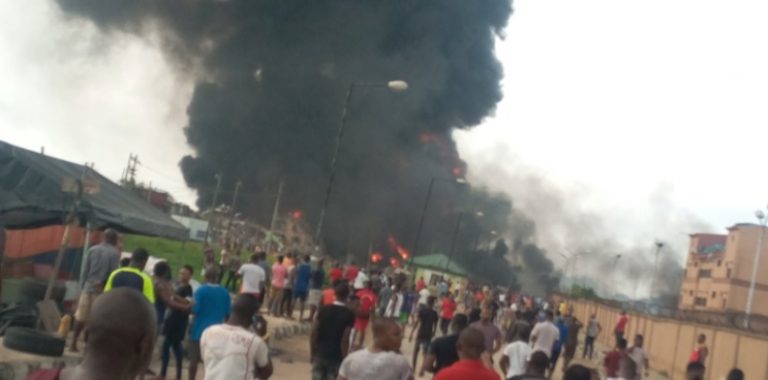
THE Environmental Rights Action/Friends of the Earth Nigeria (ERA/FoEN) has described the Sunday ‘pipeline’ explosion at Abule-Ado, Lagos as suspiciously different, urging the Federal Government to carry out a forensic investigation to unravel its cause.
The Head, Media and Campaigns of ERA/FoEN, Philip Jakpor disclosed this in a statement on Monday, calling on the Lagos State Governor, Babajide Sanwo-Olu to immediately set up a Special Task Force on pipelines security with the purpose of preventing ceaseless pipeline accidents in the state.
The group noted that there was “something suspiciously different about this explosion,” which killed over 17 people and led to devastation of epic proportions.
It added that the scale of destruction was nothing like any of the pipeline explosions that had been monitored and documented for several decades.
“The Sunday incident’s scale of destruction could only be likened to military grade explosions or aerial bombardment. We can’t treat this casually as an accident caused by a truck,” the group said.
The suspected explosion which happened earlier on Sunday had witnessed over 17 deaths and still counting as “many are still unaccounted for and suspected to be under rubbles in collapsed houses.”
The statement read in part, “The Sunday morning blast occurred near the popular ASPAMDA market and Mechanic village in Abule Ado, Amuwo Odofin Local Government Area. Vibrations from the blast shook many parts of the state and were felt as far as Iba, Okokomaiko, Agege, Alimosho and Surulere, among others.
“The Lagos State Government had earlier stated the incident was not in any way linked to pipeline vandalism but could not provide details on the cause of the incident but the Nigerian National Petroleum Corporation (NNPC) insisted it was caused by a truck that hit some cylinders stacked in a gas processing plant located near the corporations’ system 2B Pipeline right of way.
“Among the casualties of the explosion were a Reverend Sister, Henrietta Alokha who is also the Principal of Bethlehem High School, Abule Ado and some students of the school she was trying to rescue.
“A family of four that were on their way to church also died. Many are still unaccounted for and suspected to be under rubbles in collapsed houses at the time of preparing this statement.”
ERA/FoEN, however, cautioned the Federal Government not to be too casual to conclude that the incident was an accident, noting that the accounts of the NNPC on the real cause of the blast is unconvincing and raises salient questions.
“With the current security challenges facing this country, it is extremely premature to draw conclusions without conducting forensic investigation on this particular blast. Not even the accidental detonation of bombs at the Ikeja cantonment caused this scale of destruction and ruins.
“Government must conduct comprehensive investigation to establish if this was a crime or an accident.
“And there are questions begging for answers: Who drove the truck? What is the truck doing on a pipeline on Sunday morning? Was the gas plant opened on a Sunday? Was the content of the truck weaponized?
“And for the NNPC that has admitted some level of culpability by confirming that the primary explosion came from its gas truck, it should immediately initiate the process of providing remediation for the affected families and businesses while its officials found to have through negligence orchestrated this massive destruction should be made to face the law,” ERA/FoEN noted
ERA/FoEN commiserated with the families of those who lost their lives and those that lost properties and businesses. The group, however, urged Sanwo-Olu to immediately set up a task force on pipeline security.
“It is unfortunate that the federal agencies saddled with the protection and security of pipelines has failed woefully.
“The governor as the Chief Security officer of the state needs to act in a way that will put an end to this perennial deaths and destruction since Lagos sits on a web of oil and gas pipelines,” ERA/FoEN noted
THE Corps Marshal, Federal Road Safety Corps (FRSC), Boboye Oyeyemi has ordered a nationwide clampdown on overloaded private school vehicles in order to reduce road crashes involving school children.
In a series of tweets on the official Twitter handle @FRSCNigeria, Boboye said Sector Commanders across the 36 states of the federation, including the Federal Capital Territory have been directed to impound at sight, any private school bus carrying more than the required number of children in the bus.
In the tweet, Bisi Kazeem, spokesman of the Corps, also stated that the clampdown has become very necessary going by the deliberate efforts made by school proprietors, their management and the bus drivers to make mockery of established laws possibly to achieve economic gains, to the detriment of the lives of the school children conveyed to and fro school by those buses.
“We have tried to enlighten these drivers and the proprietors on many occasions to make them comply with the minimum safety standards on passengers’ carriage but they kept contravening the laws,” Kazeem said.
“The Corps is championing child safety campaign as it targets to reduce and possibly eradicate all crashes involving school children on our roads.”
He added that the Corps Marshal has also directed the retraining of all drivers of this category nationwide to further concretize the anticipated total safety of school children.
“To help the Corps achieve success in this campaign, the public is encouraged to always tune into the @TrafficRadio1 107.1FM to report any of such buses seen with overload school children or any obstruction or emergency noticed on the road for immediate action”, Kazeem implored members of the society.