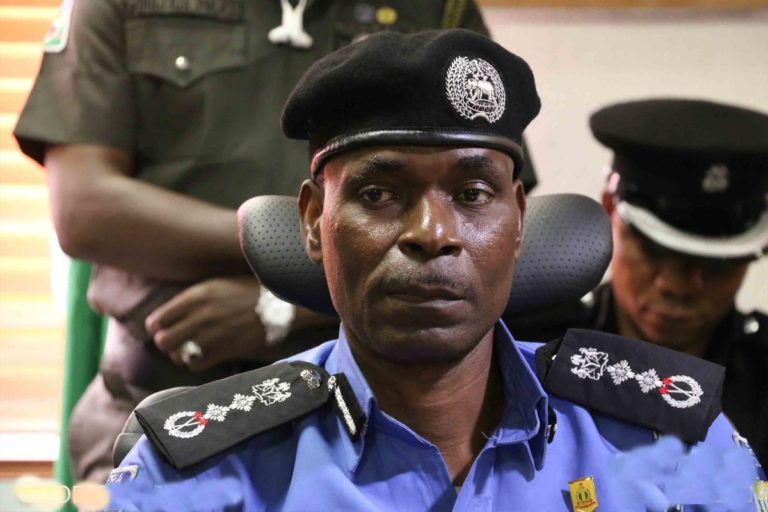
A Federal High Court sitting in Abuja has on Monday ruled in favour of the Inspector General of Police, Mohammed Adamu and the Nigeria Police Force over the power tussle between the IGP and the Police Service Commission (PSC) on the right to recruit 10,000 police into the Nation’s police force.
The Sitting Judge on the case, Inyang Ekwo dismissed the PSC’s suit on lack of merit, says the defendants indeed have the right to recruit the 10,000 police constables.
Ekwo ruled that the Nigeria Police Force Regulations signed by the Nigerian President in 1968 with accordance with the provisions of section 46 of the Police Act of 1967 indeed gave the defendants the power to do so.
He noted that the PSC by law of establishment could only appoint constables after enlistment exercise had been carried out by the NPF
Ekwo said it was the PSC that was attempting to usurp the NPF’s power because section 71 of the Nigeria Police Service Regulations gave the power to enlist constables to the Police council under the control of the IGP.
He noted that the Civil Service Rules cited by the PSC in defining the meaning of “appointment” to include “recruitment” did not apply to the NPF, because it is not a civil servant.
PSC had on September 24 filed a petition against the IGP, NPF and the ministry of police affairs challenging the authority of the defendants on the recruitment of 10,000 police officers.
The commission prayed the court for an order to stop the defendants from appointing, recruiting or attempting to appoint any person into any office of the NPF.
NIGERIA earned N275.12 billion from Value Added Tax in the third quarter of 2019, data released by the National Bureau of Statistics have shown.
According to the Sectoral distribution of VAT report released on Monday, the new earning is a decline of N36.82 billion as against the sum of N311.944 billion generated in the previous quarter of the year.
The amount also flagged an obvious Quarter -on- Quarter decrease of -11.81 per cent from 2018 third quarter remittance of N273.50bn.
The Bureau also revealed that Professional Services generated the highest amount of VAT with N32.09bn generated and closely followed by other manufacturing generating N30.27bn, commercial and trading generating N14.47bn.
However, data showed that the mining industry generated the least and was closely followed by the textile and garment industry at N44.30 million and pharmaceutical –N253.83million, and soaps & toiletries at N291.06million.
“Out of the total amount generated in Q3 2019, N150.74bn was generated as non-import VAT locally while N63.00bn was generated as non-import VAT for foreign. The balance of N61.37bn was generated as NCS-import VAT,” read the report in part.
THE Independent Corrupt Practices and Other Related Offences Commission (ICPC) has raised questions over the budget of N2.9bn Naira to the Ministry of Foreign Affairs (MFA) for Zonal Intervention constituency projects.
During a media roundtable in Abuja, ICPC Chairman, Bolaji Owasanoye, said after a breakdown of the 2019 allocation for zonal interventional projects, they found out that the Ministry of Foreign Affairs would spend N2.9 billion naira on constituency projects.
The ICPC boss also revealed that N2.7 billion was also allocated to the Ministry of Justice in the same budget saying that it constitutes some of the anomalies surrounding the implementation of constituency projects across the nation.
“What is constituency project doing in Foreign Affairs? We will ask questions about this kind of allocation.” Owasanoye lamented.
He said he has concerns that constituency projects, which principally were projects and empowerment programmes designed to bring development to rural communities within the country had been included in the budgets of MFA and other non-relevant ministries and agencies.
According to him, only about 60 per cent of constituency projects have been completed with a lot of them executed in shoddy ways due to poor technical designs, impositions and other sundry irregularities.
He said zonal intervention projects should be handed to local government authorities after completion for the effective maintenance and sustainability of the projects.
“If somebody had nominated a project and succeeded in getting the project to the community, it is not the duty of the person to maintain it, communities need to understand that it was public funds that were used, and they need to take ownership,” he noted.
Owasanoye added that the Commission would not give up on tracking constituency projects as long as government keeps funding them and therefore called on local communities to own the projects for themselves.
SO far, the Federal Government has released N667 billion for the implementation of capital projects in the 2019 budget, representing 32 percent of the total capital allocation of N2.09 trillion for the year, The ICIR has found.
The document on details of capital performance for ministries, departments, and agencies (MDAs) as at 15th November, obtained from the Office of the Accountant-General of the Federation shows that an additional eight percent would be released by the year ending, raising the release to 40 percent of the budget.
Since the 2020 appropriation is expected to kick off in January, then the 2019 budget may be terminated by the 31st of December.
A breakdown of the amount released to the MDAs indicated that ministries such as Labour and Productivity, Youth Development, Women Affairs, Petroleum Resources, and Finance have had the highest releases in terms of the percentage of the amount released to them as against their appropriated capital budget. These ministries have 108.25 percent, 100 percent, 100 percent, 100 percent, and 87.7 percent respectively of their total capital allocation released as of November 2019.
Ministries that have gotten the least in terms of the amount released compared to their capital allocation are Ministries of Health, Education, Water Resources, Agriculture, and Budget and National Planning with 27.48 percent, 26.63 percent, 11.39 percent, 9.51 percent, and 0.32 percent of their total capital allocation released to them as of November 2019.
As at the end of the 2018 fiscal year, about 72 percent (N2.07 trillion) of capital appropriation (N2.87 trillion) was released to all MDAs.
President Muhammadu Buhari, in his Independence Day speech, had directed the Ministry of Finance, Budget, and National Planning to release N600 billion for capital expenditure in the next three months, with just only a month to go, it is not clear and certain if the Finance Ministry has been able to do that.
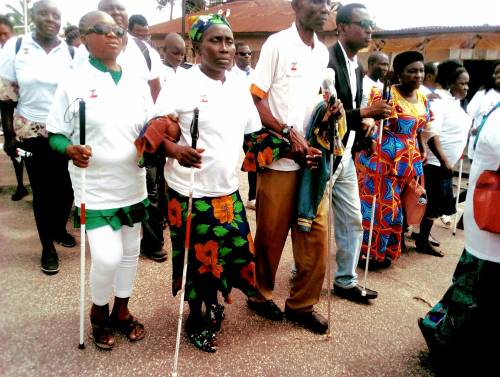
NIGERIA’s ineffective inclusive education policy, aggravated by widespread fraud and infrastructure dearth, is driving more of its blind population to beg for a living
A quick fact-check: Presenting the 2019 budget proposal to the state House of Assembly in November 2018, governor of Akwa-Ibom State, Mr Udom Emmanuel, announced that his administration had spent a chunk of the N646.649bn budget for 2018 on training and resettlement of 20 visually impaired persons (the blind) in different skills at the Nigerian Farm Craft Centre, Lagos and subsequent empowerment for them to start up their businesses in the development trade they learnt.
Suppose the governor did exactly as he had told his legislature, that would have been 20 persons lifted out of a life of penury and street begging for which Nigerians living with disabilities are known.
Several SMS and Whatsapp messages sent to Charles Udoh, immediate-past Akwa Ibom State Commissioner for Information, requesting for information on the details of the trainees and the amount of the budget invested on them did not receive a reply.
To verify the governor’s claim, the reporter contacted the principal of the Nigeria Farmcraft Centre for the Blind, Mohammed Shuaibu Afegbua, who made it known that no student attended the centre in 2018, not even in 2017.
“This school has neither admitted nor trained a single visually challenged Nigerian since 2016, he stated, adding “the last set of students we admitted graduated in December 2016.
Also, it is not possible for a state to send twenty visually challenged persons to the NFCB at once in a given session, contrary to Emmanuel’s claim. This is because the centre is a federal institution that operates a quota system of admission.
In essence, only three visually impaired candidates from each of the 36 states of the federation and the Federal Capital Territory may be admitted in a given academic session, the principal further disclosed.
“But as I speak, virtually all the states have candidates waiting on standby from six years back.”
Conclusion: It is not true that Mr Udom Emmanuel spent part of the budget passed by the Akwa Ibom State House of Assembly in 2018 to train 20 blind citizens of the state at the NFCB.
In the throes of dakness
The casualties of this kind of official deception are much more than those shortchanged by Governor Emmanuel. No less than a million persons living with blindness across the country are in dire need of some form of urgent rehabilitation to enable them live a productive and independent life again.
That is an estimate from an old study though. For over a decade now, just one national blindness and visual impairment survey has been carried out across the country.
The survey, at the instance of the London School of Hygiene and Tropical Medicine, shows that well over four million Nigerians are visually impaired.
Visual impairment among those who cannot read and write, according to the survey, also stands at 5.8 per cent nationwide. This is against 1.5 per cent among those who can.
Ahmed Pindiga is one of such sore statistics of unlettered blind Nigerians analyzed in the now obsolete eye health survey. Every Friday afternoon, he joins a phalanx of itinerant street beggars who prime themselves around the Ikotun Central mosque, East of Alimosho Local Government Area in Lagos State.
The beggars have not come to observe the Jumat prayers. Rather they would wait patiently for the worship to end, and the scramble for the day’s Zakat, the Islamic form of religious alms-giving and show of benevolence to the needy, would begin.
He was at the same spot on September 6 this year when the reporter had a chat with him. Suddenly, Ahmed’s right hand disappeared into his pocket and brought back an old mobile phone. Soon he began to fumble with the keypad on the device as the phone rang and vibrated endlessly to signal an incoming call.
Unbeaten, he fiddled with the keypad, again and again, glowering at the same time, until his restive finger finally found and hit the green button after several unsuccessful attempts.
It’s not exactly unusual to see frustration written on his face and many like him each time they try to receive calls on their mobile phones, Babatunde Mohammed, a rehabilitation expert and Chairman of the Nigeria Association of the Blind in Lagos State, told the reporter.
“It has to be so because the phone obviously is not designed to enable a visually impaired person receives calls or identify his callers,’ he explained.“
That aside, it is also apparent he has not been through a functional rehabilitation program necessary to enable him leverage assistive technology to be independent and enjoy his privacy as a blind.”
For an illiterate, non-speaker of the English Language who relies on a child guide to lead him around as he scrounges for a living amidst the bedlam of crazy traffic at the busy Ikotun intersection, functional rehabilitation, independence and privacy, as hinted by Mohammed, actually sound like some jargons from a Latin dictionary.
“Ban jiba walahi,’ Ahmed responded in his native Hausa dialect to inform the reporter he didn’t understand what the rehabilitation expert meant by assistive technology.
Ahmed is not alone in the dark about the option of rehabilitation and assistive technology available to enable him live an independent life. So is Isaac Olayinka, a blind clergyman at the Christ Apostolic Church in Ibadan who also relies on others every day to enable him navigate the crowded Ibadan roads and elsewhere he goes to preach.
Like Ahmed, Isaac has never learnt how to use a Braille machine or computer-assisted devices to enhance his duties as a preacher. The best he has done, he told the reporter, was to perfect a cumbersome method to enable him recall chapters and verses of the holy bible.
“For a long time, I have mastered how to cram the bible on a daily basis, after people must have read any particular portion to me,” he told the reporter.
“I have never heard that computer and phone can help one read the bible or other Christian books on one’s own as a blind. You are the first to tell me so.”
Graphics of years Nigeria needs to rehabilitate its blind population at NFCB
Ignorance everywhere
That kind of widespread information poverty is not exactly unusual in Nigeria. Eye health crises and the exact rehabilitation needs of those worse affected by visual impairment have been worsened by an apparent scarcity of public health education and accurate data.
That is in addition to a combination of depressing geographical, financial, and personal hurdles which constantly stand between this vulnerable community and the rehabilitation they need to be independent.
In other climes where inclusive education and rehabilitation are at the front burner of policy discourse, community-based rehabilitation initiatives are already eliminating those obstacles impeding the likes of Ahmed and Isaac.
For one, the innovation is less cumbersome because it provides rehabilitation programs to persons with visual disabilities right in the communities where they live.
“So they don’t have to travel a long distance from their communities to attend a rehabilitation school, or be huddled together in one outskirt of the town, as though disability is infectious,” Dr Sheu Bukola Adebayo, Chairman of the Joint National Association of Persons With Disabilities in Lagos, explained.
“Unfortunately, Nigeria is yet to come to terms with this social model of rehabilitation. And that’s why the traditional model of rehabilitating the visually impaired continue to fail us.”
Blessing is a casualty of that failure—the inability of governments at all levels to launch widespread and sustained public enlightenment campaigns about community-based rehabilitation options for the blind who scavenge for living in street corners and those locked up in different homes by their families.
Blessing showing off one of her beadwork at the NFCB
Struck with sudden blindness at age of three, Blessing was simply abandoned to rot away in her Delta State hometown—denied any formal education. She is 19 years old already, she told the reporter, after a Lagos-based television personality found out about her plight and offered to reform her.
Usman Ojo, now registered at Omoyeni Home School for the Blind in Ibadan, Oyo State, also suffered the same cruel fate as Blessing. Blind at birth, the boy spent the next 12 years of his life in a dinghy room with his mother, without nursery and primary education.
The father, a tailor before coming to Lagos to work for a fashion outfit in Lekki, told the reporter he knew late about the possibility of a school for the blind.
“He was born blind, so I didn’t know anything could be done to get him an education. But by the time I heard about Pacelli School for the Blind in Lagos, they were not willing to take him again,’ he told the reporter.
“When I tried again the following year, and I couldn’t meet up with the financial obligations, I became frustrated,” he lamented.
Sad, but real, many visually challenged Nigerians may never learn to be productive or independent after all, worried Dr. Adebayo, if the government fails to systematically implement the National Policy on Inclusive Education currently gathering dust in the Federal Ministry of Education in Abuja.
“We have a National Policy on Inclusive Education at the federal level, and about 15 states also have their own policies as well, but the problem has always been implementation,’ the JONAPWD chairman lamented.
Part of the implementation problems is the scanty number of rehabilitation centres for the blind, compared to the population of persons living with visual disabilities across Nigeria, explained Nicholas Obot, Principal of the Vocational Training Centre for the Blind in Oshodi, Lagos, and National Secretary of the Braille Advancement Organization of Nigeria.
The majority of these centres are mostly private initiatives and profit-driven too, the reporter discovered.
Collapsed infrastructure
Despite plunking down N25m in 2017 to revalidate the National Policy on Rehabilitation of Persons With Disabilities, only a few things would appear as normal for anyone visiting the Nigeria Farmcraft Centre for the Blind in Lagos for the first time.
Established in 1967, according to its Principal, Muhammed Shuaibu Afegbua, the centre bears the responsibility of rehabilitating visually impaired persons from across Nigeria—through developing their skills in mobility, Braille, computer/ICT, and craft as well as farming.
Not many blind Nigerians and their families are aware the NFCB exists, however. This is because the centre is neither advertised in the media nor in public enlightenment and rural outreaches.
At any rate, for two sessions back to back, the centre, with all of the hope it brings to the blind, was left to rot away.
NFCB did not admit or trained a single visually challenged Nigerian since 2016 until April 2019, the reporter who visited the centre in the guise of a blind person seeking rehabilitation found out.
And according to Afegbua, that is because of certain challenges he would not disclose to the reporter during their chat.
But at the Federal Ministry of Women Affairs headquarters in Abuja, sources told the reporter the disruption was due to funding and seething tussling between the federal ministries of Education and Women Affairs and Social development over which controls the NFCB.
Corruption unlimited
The years of redundancy at the NFCB, however, did not stop civil servants in the centre from earning their monthly salaries and leave bonuses.
It also did not stop some corrupt officials at the Federal Ministry of Women Affairs and Social Development, under which the NFCB is an agency, from creaming off a huge N40m from the 2017 approved budget, supposedly as upkeep for the trainees at the NFCB, even though no single person with visual disability was admitted into the centre that year.
The steady sleaze in the guise of rehabilitating the blind leaped through the 2018 budget as well, even though the gates of the NFCB remained shut to trainees. Another N150m was sneaked into the 2018 approved budget of the Women Affairs ministry, as “upkeep of the trainees and strengthening activities at the following social welfare, rehabilitation, and other welfare centres.”
The Rotary Club of Egbeda, trying to do good in marking its 15th anniversary, also visited the NFCB on Saturday, March 31, 2018. The visitors did not suspect the centre had neither admitted nor trained any blind Nigerian for two years. So, they donated clothings and other items, supposedly to keep the blind trainees comfortable.
Double jeopardy
Waiting endlessly on the queue is torture any prospective blind must endure before he is considered for admission at the NFCB, the reporter found out.
The centre can only admit three candidates from each of the 36 states and the Federal Capital Territory in any particular session, disclosed its Principal. And that is just 111 lucky few every year. The less than fortunate candidates are then made to wait on the lists until another year when the jostle for admission would begin again.
“Admission is competitive here because your state must have to recommend you to us for admission in any particular year,’ revealed Afegbua. ‘But as I speak, virtually all the states have candidates waiting on standby from six years back.”
Assume that the population of blind Nigerians will remain at one million as indicated in the 1998 national eye health survey, and the NFCB will only admit 111 persons out of this cluster in any given year, it will invariably mean that Nigeria will need some 9,009 years to rehabilitate and make its blind citizens independent and productive again.
But if the entire population of the blind and visually impaired, estimated at a little over four million in the survey, is to scramble for space at the NFCB given the yearly admission benchmark, then Nigeria will require some 35,036 years or more before the entire visually challenged population would be fully rehabilitated.
To make matters worse, unlike in the past when trainees used to enjoy tuition-free rehabilitation, stipends, and boarding at the centre, a prospective student is now expected to pay a huge N120,000 upon admission.
The conspiracy against the blind, the reporter found out, was reached at the 10th National Council on Women Affairs and Social Development held between August 5-10, 2019 in Lagos, with all Commissioners for Women Affairs from across the states in attendance.
Those who are not fortunate to be sponsored by their states, explained Afegbua, may then have to attend the school as self-sponsored students.
That financial burden is yielding a backlash already, the reporter found out.
When the NFCB finally resumed academic session in April this year, only 48 visually challenged students from across 15 states of the federation were fortunate to take up their slots.
Blessing didn’t get sponsorship from her Delta State of origin though, but she is one of the two self-sponsored trainees from the state currently at the NFCB. And to be in class, a good Samaritan had to squeeze out the compulsory tuition fees of N120,000.
Failed states
The other 21 states, Afegbua said , simply would not invest N360,000 on three of their blind citizens at the cost of N120,000 each for the entire session “due to lack of funds”.
Many of the defaulting states (Edo, Abia, Anambra, Ebonyi, Cross-Rivers, Taraba, Kano, Katsina, Bauchi, Borno, Adamawa, Sokoto, Kebbi, Zamfara, Plateau and the FCT) are from the North of Nigeria. This is followed by a few Southeastern states and then two states—Oyo and Ekiti—from the South-West.
Akande O.M. of the Social Welfare Department at the Ministry of Women Affairs and Social Development in Oyo State revealed as much. The devil that sabotaged the efforts of candidates from the state in filling up their quotas at the NFCB this current session was a combination of bureaucracy and insensitivity, he told the reporter, who presented himself as a blind citizen seeking sponsorship from the state.
“We got the letter informing us of the new tuition fee at the NFCB late, but even after treating the request and sending it out for approval, the file never came back again because the government in power then was more concerned about the elections than anything else.
“Even as I speak, the file is yet to come back to the ministry. But I am optimistic something positive will happen next session, and you may be one of the lucky candidates to be selected, especially now that we have an Executive Assistant on Disability in the Governor’s Office.”
The same reception of shock was awaiting the reporter when he arrived at the Blind Centre in Ogbomosho, also in Oyo State, the following day. The school has no facility in place to teach computer skills, or the technology needed to make the blind navigate a computer independently, the instructors explained.
“We can’t teach you what you want to learn here, because there is no facility for that in school. But you can learn how to Braille and use the typewriter.
“In fact, we don’t even admit older candidates like you, but because of the person that brought you, we may admit you into Primary 2, so you can learn any vocation that you like and still go-ahead to do common entrance later,” the headteacher assured the reporter out of pity.
The vocational training on offer at the school are as odd as the proposal made to the reporter. They include weaving, both of chairs and ropes for tethering livestock, as well as bead making.
But they are not too offensive to dissuade Ibukun Ogundijo from getting registered at the Blind Centre after all.
Ogundijo is one perfect example of the setback that inadequate infrastructure can cause in schools for the blind in Nigeria.
Now 20, the young man lost his sight while preparing to graduate into the junior secondary school in 2008. In search of a panacea, his family rushed him to the Blind Centre in Ogbomosho, after an initial desperate move to have his sight restored in hospitals and spiritual homes failed.
Another shocker was waiting for the blind lad instead. Ibukun was made to start all over again from Primary 1.
“But when the school began to notice my performance, they offered me double promotion twice,’ he narrated to the reporter.
All talk but slow inclusion in Lagos
In spite of the disability-friendly initiatives and inclusive education policy in Lagos State, blind students are not learning anything in those inclusive schools, Adebayo insists. “
Lagos is not implementing inclusive education yet, griped the JONAPWD chairman, adding, “so I can’t score the government high. In fact, it will be unfair on PLWDs living in Lagos to score the government 40 per cent for their effort so far.”
“It is one thing to have an inclusive education policy, it is another thing entirely to make it work. And that’s why we continue to insist the government must design an operational guide for implementing inclusive education in Nigeria, in addition to supporting schools with the teachers, instructional materials and equipment needed to make disabled students learn.”
Those who lost their sight as adults are not learning anything in Lagos either. There are only just four rehabilitation centers that can provide training and assistive devices for the crowd of visually impaired in the state for instance, and all of these institutions are either private initiatives or run by civil society organizations.
The only state-controlled institution, the Lagos State Vocational Rehabilitation Centre for Persons With Disabilities in Owutu, Ikorodu“is anything but a rehabilitation centre for persons with disabilities, if you compare it with international global best practice”, Adebayo told the reporter.
He is right after all. The centre merely exists in structure and not in equipment and devices needed to effectively address the special needs of blind students especially, the reporter found out on his visit.
Expensive alternative
From the schools for the blind in Lagos to Ibadan, down to Ogbomosho and back to Ijebu-Igbo where the reporter presented himself as a prospective student, the blind have an option though: to shun the empty and dysfunctional state-controlled special schools and patronize private institutions. That’s if they will ever be able to afford the cost.
According to Obot of the Vocational Training Centre for the Blind, “it costs nothing less than N750,000 [about $2,100] to take a visually impaired through complete rehabilitation, and that includes rehabilitation fee, laptop and JAWS, typewriter, stylus and guide cane.”
The bargain is no less expensive at the Anglo-Nigerian Welfare Association for the Blind [ANWAB], another rehabilitation centre for the blind in Yaba, Lagos, the reporter discovered.
According to CajetanDuru, an instructor in the school, Job Access With Speech [JAWS], the software that enables a visually impaired navigate the computer and Internet, costs N300,000, while the market price of a new laptop computer varies between N180,000 and N250,000.
“Other than that, you will need an Android phone which can help you do the same thing a JAWS will enable you do on the laptop, and that will cost at least N50,000. However, we can allow you pay your rehabilitation fee in installments since the training is in three phases, beginning with mobility and typing training,’ Duru explained.
The rich and willing visually impaired also have an option of patronizing private home bound rehabilitation services, revealed Sunday Badejo, a visually challenged expert in education for the blind. At a more expensive charge, though.
“The least I charge is 100,000 and that is for a professional who suddenly lost his sight and requires an accelerated rehabilitation to go back to work in just six weeks, Badejo told the reporter, adding,“but my professional fee can be more than that, depending on a number of considerations such as location, distance and length of training required by the client.”
Badejo has travelled across several states in Nigeria, including in Kano, Niger and Jigawa, providing home-bound rehabilitation services to visually challenged persons who can pay his bill, but “it’s alright if the person wants to come and meet me in Lagos,” he said.
“I can help negotiate accommodation and factor the logistics into my final charges. That’s why I told you initially it depends on location, duration and such other factors,” the graduate of Federal College of Education [Special] in Oyo explained.
One scary consideration is the cost of the devices a visually impaired would have to procure to live a normal productive life again, he said. According to Badejo, aside from rehabilitation fees which can run into hundreds of thousand, students will be required to buy JAWS, Braille machine, Pearl scanner, typewriter, embosser, guide cane as well as stylus and mabourg.
“Now, a JAWS software is around N500,000, Braille machine is N300,000, Pearl scanner is N469,000, a typewriter is N10,000, the least cane is N15,000 while stylus and slate cost N7000. So you are looking at well over one million naira as cost of devices needed to give you independence as a visually impaired person, aside from my own professional fee as a private instructor.”
For a disadvantaged community constantly frustrated by employment inequalities and other forms of negative stereotypes, raising no less than N1m to enable them go through coordinated rehabilitation programs has become a huge incentive for flushing on to the streets to beg for alms, lamented Mohammed.
“You can call them names for causing a nuisance on the streets if you want,’
Muhammed griped, ‘but the truth is that government institutions that should ordinarily rehabilitate them at little or no cost are dysfunctional, and that leaves them with no alternatives other than the few private rehabilitation centres which are expensive to attend already.”
Gateway to inclusion, equality
Inside the Enabling Technology Room at the Southwest Resource Centre in Abeokuta, Ogun State, a revolution similar to the community-based rehabilitation strategy recommended by the World Blind Union (WBU) and the World Health Organization (WHO) is taking a steady foothold.
Sired in the twilight of the President Bill Clinton administration in 2004, narrated Emmanuel Akinola, the centre is an innovative ICT hub designed by the Americans to accelerate the globalization process in Nigeria through building the capacity of citizens in Information Communication Technology.
And, to give that intervention a fillip, similar centres were erected in other geopolitical zones, including Bauchi, Cross River, Enugu, Kaduna, Ogun, and the FCT.
“That was how we got the idea of including persons living with disabilities in the wider program,’ Akinola, also a blind lawyer, and Consultant instructor in Basic ICT Education for the blind explained.
Attendance is tuition-free for the blind here, the reporter found out after registering and attending classes as a blind in need of rehabilitation at the centre.
“That’s why this room is called the Enabling Technology Room because it is meant for PLWDs generally. The reason why only persons with visual disabilities are here now is that others can still see and read printed matter, unlike the blind who requires special skills in ICT to navigate the computer and internet,” said Akinola.
Again the criplling Nigerian factor
That is some huge breather for inclusive education advocates like Adebayo and Mohammed really. But the excitement is not going to last long. For one, acceptance for blind trainees at the Southwest Resource Centre is difficult and low compared to the huge number of blind persons who need rehabilitation to enable them participate fully in public life again.
Blame the sustained employment inequality and harsh economic condition that frustrate the bid of many of them who indeed registered their interest in the training but could not make it to Abeokuta in the end.
The three weeks course is free –written off by the Ogun State Government. But not transportation logistics, accommodation and feeding.
Governors of other southwest states deserve much of the flak afterall, groaned Akinola. “Even though the Southwest Resource Centre is designed to serve all the states in the region, these governors just carry on as if they are not concerned”, the blind lawyer and rehabilitation expert lamented.
The low attendance could not have been otherwise then. More so that public enlightenment about the centre, and deliberate mobilization of blind persons, are not on the priority list of the governors. And that’s a violation of Article 26 of the Convention on the Rights of Persons With Disabilities (CRPD) to which Nigeria is a signatory.
The law imposes obligations on state parties to take effective and appropriate measures to provide comprehensive habilitation and rehabilitation services and programmes, particularly in the areas of health, employment, education and social services for their citizens with disabilities.
The blind have little or no choice here really. Not even in a stranded economy where more than half of the population survive on less than $2 a day.
* This report was done with the support of Ford Foundation and International Centre for Investigative Reporting, ICIR
IN the 1960s, before oil became a major source of revenue, Nigeria used to be one of the most promising agricultural producers in the world. Cocoa, oil palm, and groundnut were some of the agricultural produce that fetched Nigeria a majority of its foreign income. Agricultural communities thrived as they produced food not only for local consumption but also for export. All that changed with the discovery of oil in commercial quantity as agriculture and farming communities were left to rot.
A World Bank Senior Agriculture Economist, Adetunji Oredipe, on September 6, said Nigeria’s neglect of the agricultural sector costs the country about $10 billion annually.
In an effort to tackle the problem, in April, the former Minister of Agriculture and Rural Development, Audu Ogbeh, advised Nigerian youth to deepen their interest in farming before struggling for political positions.
However, one factor that could deter young people from farming is if they look at the fate that befell the farmers and farming communities that thrived in the 50s and 60s.
One of such communities is Olorunda in Oyo West Local Government Area of Oyo State. It is one of the major ‘garri’ producing communities in Nigeria but has never had electricity. That was arguably normal in the 1950s and 60s, but the situation has remained the same in the 21st century.
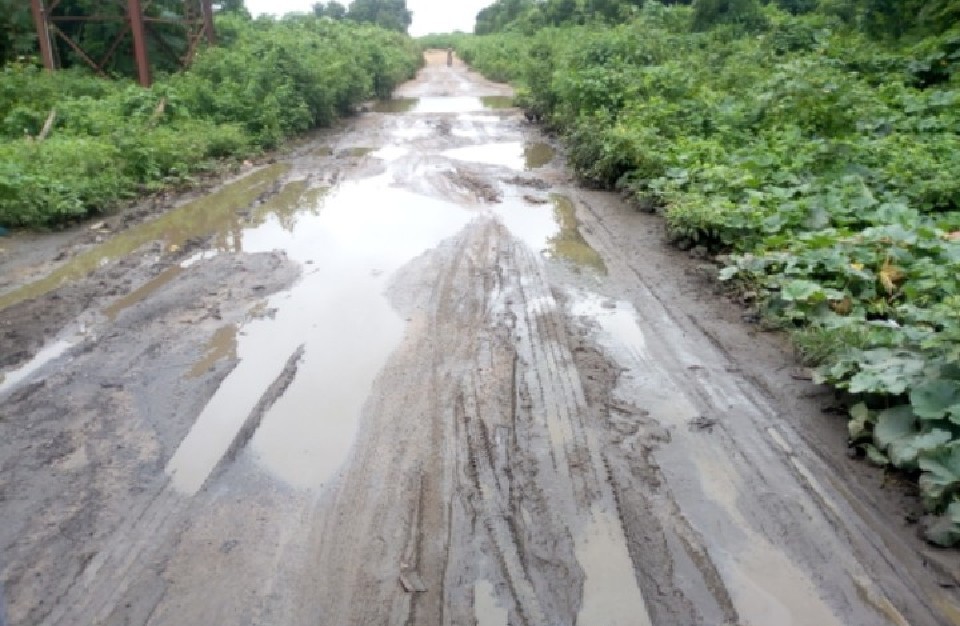
Olorunda’s problem is not just the lack of electricity, the only major road that leads there has also been destroyed by years of neglect and lack of repairs.
The community is now about an hour drive (120 kilometres) from the nearest motorable road.
Lack of electricity and motorable road are joined by the absence of a school and functional health centre for the thousands of residents of Olorunda, majority of whom are cassava farmers and garri processors.
Garri Production
Garri is a staple food in Nigeria and many other sub-Saharan African countries.
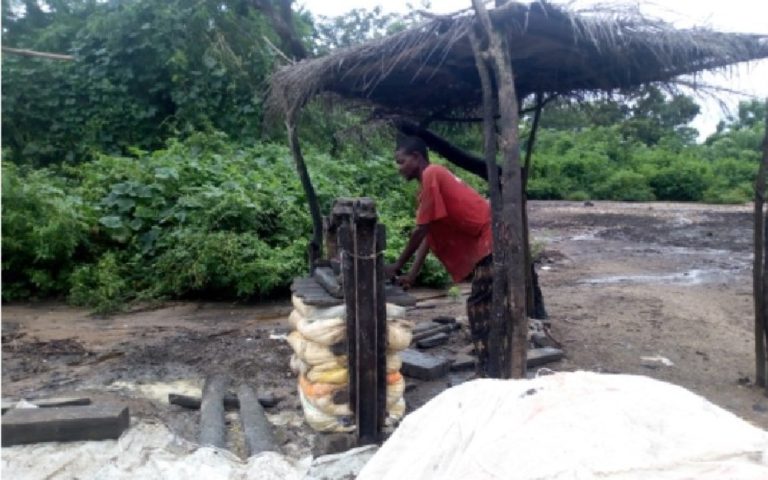
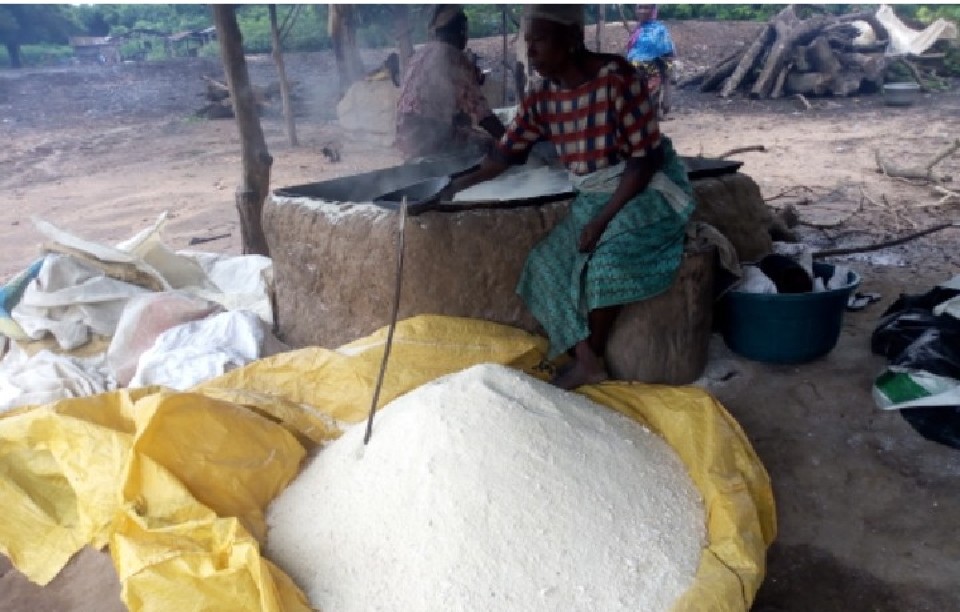
Garri production involves the peeling of cassava, grinding of the cassava, extracting water from the grounded cassava with the use of a jack and frying the extracted grains.
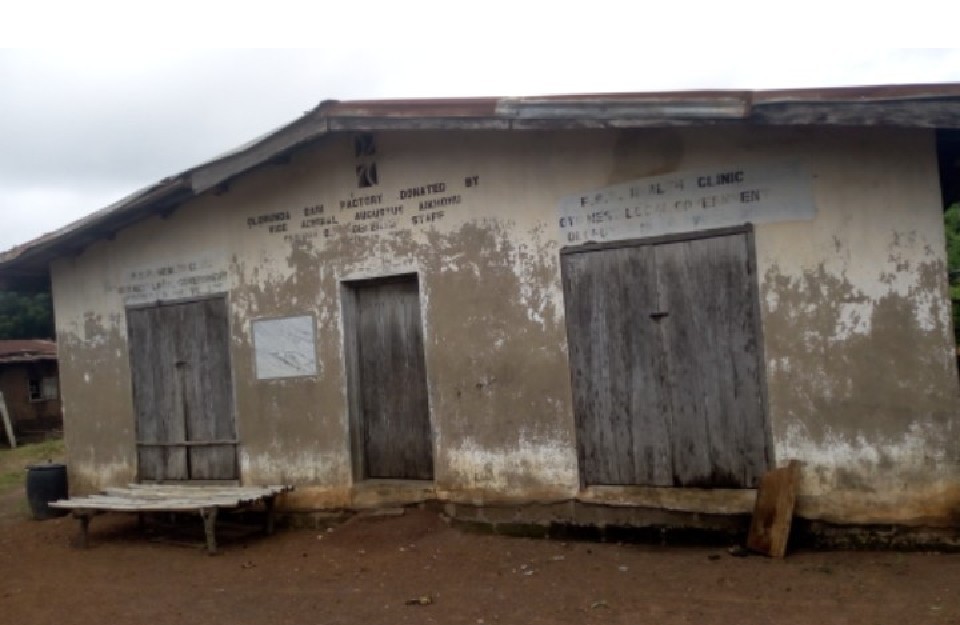
In 1989, the government of General Ibrahim Babangida provided a garri processing factory to help Olorunda residents add value to their cassava. The factory had its own power generator. But the facility was no longer functioning at the time PREMIUM TIMES visited the community in August. Residents said that had been so for over a decade.
Women making garri. PHOTO CREDIT: PREMIUM TIMES
Despite the situation in Olorunda, the community still continues to be a major source of garri from residents of Oyo and other South-west states in Nigeria. Our reporter observed hundreds of vehicles with farmers sitting atop conveying yam, cassava, processed garri and other agricultural produce from the community to Oyo town for sale.
A Community In Darkness
Despite the community’s agricultural prospect, residents say they have never had electricity. Many residents of the community lack the knowledge of what a television, electric bulb or even refrigerator looks like.
As a first-timer in the community, the presence of electric poles, a transformer and electric cables may suggest that Olorunda has in the recent past had electricity but these are mere ‘decorations’.
PREMIUM TIMES findings revealed that the electric poles, transformer and cables were brought in the year 2000 during the regime of President Olusegun Obasanjo. Then, the community felt their years of darkness would soon come to an end, but that remains a dream.
“We were very happy in 2000 during the time of Baba Obasanjo when they brought poles, transformer and cable to us. We were happy and optimistic that we will witness new dawn but that was just a mere hope that is yet to be realized about 20 years after the intervention,” Muniru Alamu, a resident told PREMIUM TIMES, speaking in Yoruba.
Muniru Alamu, a resident PHOTO CREDIT: PREMIUM TIMES
Our correspondent also gathered that following the failure of the government to connect the community to the national grid, some of the electric cables were stolen.
Kabir Lasisi, one of the youth leaders said: “The transformer they brought is useless and it must have been spoilt by now. Due to government neglect, some thieves in the neighbouring communities are already stealing the cables. We made all these known to the government but there was no response.”
Mr Lasisi told this newspaper that it took the effort of the security guards employed by the community leaders to save the remaining cables. This newspaper also observed that some of the poles and electric cables have fallen off while the transformer is left to rust with tall grasses covering it.
“There was a time we were cutting the grasses surrounding the transformer. We kept doing this thinking the government will come one day to listen to our cry but that is yet to happen. People got tired and left the grasses to grow,” Mr Lasisi said.
Residents said the lack of electricity has deterred any industrial growth in the community.
“Outsiders who visit here for business run away after spending a night because they cannot cope in a community without electricity, they cannot find cold water to drink and, most importantly, they don’t have means of charging their phones”, Kazeem Bada said.
A resident, Titilayo Akerekan, narrated how she closed down her business due to lack of electricity in the community.
Abandoned garri factory PHOTO CREDIT: PREMIUM TIMES
“At a time, people who return from farm after garri processing find cold drinks difficult to get. So, from my daily thrift, I bought a small refrigerator and a generator to run the small business I practice in my room but the business did not last. I have to travel far to Oyo town to buy petrol for the generator.
“Pure water companies cannot even locate here let alone soft drinks company. After six months of torture called business, I ended up selling the refrigerator and the generator to those running business at places where they can make the money in Oyo town.”
No passable road, no water
While the residents battle for survival without electricity, they are also handicapped by poor state of the road linking the village to Oyo town. This newspaper learnt that trucks conveying agricultural produce break down often due to the deplorable road.
Road to Olorunda village PHOTO CREDIT: PREMIUM TIMES
Our correspondent, during a visit to the community, witnessed the breakdown of two vehicles within two hours. In fact, it was gathered that farmers donate money from their personal income to keep the road in its current shape to enable them transport their goods. The bridge on the way to the community is not in good condition and is prone to flooding during a heavy downpour, a situation this reporter witnessed during the August visit.
“The government of Oyo State is aware of the state of the road. We’ve complained to them but they are also avoiding to come here for inspection because of the road,” Mr Lasisi echoed.
Awawu Ilebada, a septuagenarian, lamented how the bad road affects their daily lives.
“The poor state of the road has really affected our business,” she said in Yoruba.
“We hope the government listens to our cry, especially during the rainy season. We can’t send our kids on errand except we want to lose them to erosion,” Mrs Ilebada said.
Expressing her displeasure while carrying out her garri production, another woman who simply identified herself as Saki said: “before the road became totally bad, a truck takes as many as 50 bags of garri but we dare not try that now especially during rainy season. Trucks break down and sometimes, our garri is left to sleep on the road for sometimes two days before mechanic from Oyo town will visit to fix the vehicle.”
She recalled a day rain spoilt her farm produce after the vehicle conveying her garri broke down.
“Sometime in June, the truck taking my garri got spoilt but before the driver could go to Oyo and return with a mechanic, rain fell spoiling some bags of garri in the truck. It was a sad experience,” she lamented.
No Potable Water
PREMIUM TIMES also observed two solar-powered water points and boreholes in the community. But none of these provides potable water for residents. In 2009, the Federal Government through Ogun – Osun River Basin Development Authority built the solar-powered boreholes for the community but residents say the project did not last two years.
The community continues to suffer to get water except during the rainy season. They trek over 30 minutes to Olorioso, a nearby community, to fetch water during summer.
“As old as we are, we trek a great distance to fetch water during summer. We only enjoy during rainy season. We get water from the downpour. This, however, is not the case when rain stops falling”, Mrs Ilebada said. “There are elders in the community who stay several days without taking their bath because they don’t have any young person around them to help fetch water. Life cannot be said to be easy for those of us living in this community.”
Olorunda residents said that kids who leave the community to Oyo town for holidays often refuse to come back.
“They see the community as hell where they don’t have opportunity to see good cars, potable water, and even a well tiled road. My daughter was forced back home when she visited her elder sister in Ibadan some weeks back. Upon her return, she became sick of the difficulties we pass through here.”
“At a point, my first son asked if Olorunda is part of Nigeria or another country entirely with forgotten people struggling to make life better without the support of government,” Felicia Ebire said. She also said the water from the stream despite being polluted is the best alternative used for cooking and other domestic necessities.
According to the World Health Organisation (WHO), contaminated water can transmit diseases such as diarrhoea, cholera, dysentery, typhoid and polio. In fact, contaminated drinking water like the experience of those in Olorunda is estimated to cause 485,000 diarrhoeal deaths globally each year. WHO fact sheet of June 2019 says safe and readily available water is important for public health and better management of water resources, can boost countries’ economic growth and reduce poverty.
PREMIUM TIMES interviewed Kazeem Olawoyin, a six-year-old boy standing beside a manual borehole if he ever witnessed water from the borehole. His idea about the borehole differs from the purpose of the failed project. He told our correspondent that he knew “kids in the community play around here every evening” and that’s the only testimony he can give about the borehole. He was later excited after this reporter educated him on the main purpose of the borehole. “It will be of good help and reduce the stress of going to the stream or Olorioso to fetch water if it is functioning”, the youngster said.
Reacting to this, a medical doctor, Bunmi Taiwo, explained that “the death of 297,000 children aged under 5 years according to WHO could be avoided each year if there is potable water. When there is available water, there will be less expenditure on health as people are less likely to fall ill of transmitted disease such as dengue fever and others.”
In Olorunda, water is gold, “you dare not misuse a cup when opportune to have it on your table”, one of the residents remarked.
Abandoned PHC
PREMIUM TIMES gathered that the only health centre in Olorunda was built in 2009 under the Millennium Development Goals scheme. The health centre was never commissioned until residents took a bold step of putting it into use themselves.
At the time our correspondent visited the building, it wore a faded blue colour. The gate was locked which denied this reporter from gaining entrance for inspection. The building is surrounded by tall grasses, which signal long time disuse.
Residents told PREMIUM TIMES that the health care centre lacks drug, staff and other relevant facilities. Since 2009, there is only one health care officer in charge of the facility and he only comes twice a week, except if there is an emergency. The condition of the PHC speaks volumes of why some residents would rather use local birth attendants for child deliveries.
Mr Alamu said: “We don’t have staff and necessary facilities at the health care. The maternity was built during Akala time as governor but we don’t have doctors to take care of us. We call doctors on phone from Oyo town anytime our wives want to deliver baby.”
Alao Akala won the gubernatorial election in 2007 under the platform of the Peoples Democratic Party (PDP) and became the Governor of Oyo state, serving a full term till May 2011.
A doctor, Titilayo Ajayi, told PREMIUM TIMES that there might be limited chances of survival during emergencies. When our correspondent made inquiries about the nearest functional health care centre, residents said it is about 45 minutes away (some 90 kilometres). During this reporter’s second visit to Olorunda in October, Iyabo Olonode narrated her ordeal during the delivery of her second daughter in the middle of the night.
She said: “I saw hell at the cause of giving birth to my second daughter. I began to labour around 12:30am in the midnight. It took the grace of grace of God and the effort of old women in the community to help me out. Perhaps, I won’t experience such hardship if there was a functioning PHC with 24hrs staff.”
No School
Nigeria has the highest number of out-of-school children in the world and according to the United Nations, out-of-school children are kids who are yet to be enrolled in any formal education excluding pre-primary education.
The United Nations Children’s Fund (UNICEF) website revealed that even though primary education is officially free and compulsory, about 10.5 million Nigerian children aged 5-14 years are not in school. Only 61 per cent of 6-11-year-olds regularly attend primary school and only 35.6 per cent of children aged 36-59 months receive early childhood education.
Unfortunately, hundreds of children in Olorunda are part of this sad data.
Coupled with difficulties of lack of access to electricity, water, bad roads and a dysfunctional health care, Olorunda community does not have a single school. The only school serving the community is at Olorioso community which is 30 kilometres away and the children have to trek for over 30 minutes to get there. It was learnt that the school has a single teacher attending to primary one to six pupils and she only comes three times in a week. (Monday, Wednesday and Friday).
Parents told our correspondent that most of their grown-up kids cannot recite simple alphabets and recitation of “states and capital” is a nightmare.
“For over 40 years that we’ve been living in this community, there is no single school for our kids. The only available one that our kids attend is at Olorioso which is very far from here,” said Mr Muniru.
Expressing her displeasure, Mrs Ilebada told this reporter that the kids hardly understand the purpose of schooling since the government did not provide one for them.
“Our kids don’t know anything”, she said. “We want the government to give us both primary and secondary school. The one at Orioloso has just a single teacher for children from primary one to six”.
They also spoke on how they often pay the single teacher with the income they make from their agricultural produce.
While some kids pass through the pain of trekking the long distance to Olorioso primary school from Olorunda, some parents deny their kids access to school during the rainy period due to the poor state of the road.
“The moment rain falls, all the roads leading to the school will be at the mercy of erosion and no parent will love to see his or her kids go out in the rain”, Mrs Ilebada concluded.
Kazeem, a basic four pupil, also narrated the travails faced in the school.
“Our teacher comes two or three times a week. We don’t have windows or doors in my class and every other class”, he said.
This newspaper also interacted with Idowu Awonusi, an underage kid who left school to support his parents in their garri business.
“There are times when you go to school but won’t meet any teacher. The stress is unbearable and my parents already told me that when I come of age, they will send me to Oyo to start my academics with my mother’s uncle”, he narrated.
When PREMIUM TIMES journeyed to Olorioso community to investigate Olorunda residents’ claim about the primary school, this reporter was confronted with an embarrassingly appalling sight. A careful inspection of the single block school with six classes buttressed the claim by Olorunda residents that they are “systematically discriminated against”.
The reporter observed a blown-off roof, ceiling, and building surrounded with tall grasses. The classrooms are occupied with broken chairs and desks. The doors and windows have no lock as the wood used for the construction had been destroyed by termites leaving the classrooms flooded when it rains
The three days in a week academic programme is sometimes disrupted when it rains, PREMIUM TIMES learnt. The school has no playground, no running water and no toilets.
Disturbed community leaders
Narrating the ordeal of Olorunda, the community’s chief, Iyiola Ojo, told our correspondent that the place has over 500 residents but lacks the necessary amenities to make life bearable for them despite their agricultural impact.
“We’ve been in the darkness for over 40 years and we haven’t witnessed electricity for a single day in this community,” he said.
“The road is in bad shape. The hospital did not see staff…Pregnant women go as far as Oyo town. The government should help us. We are suffering and begging,” he lamented.
Authorities
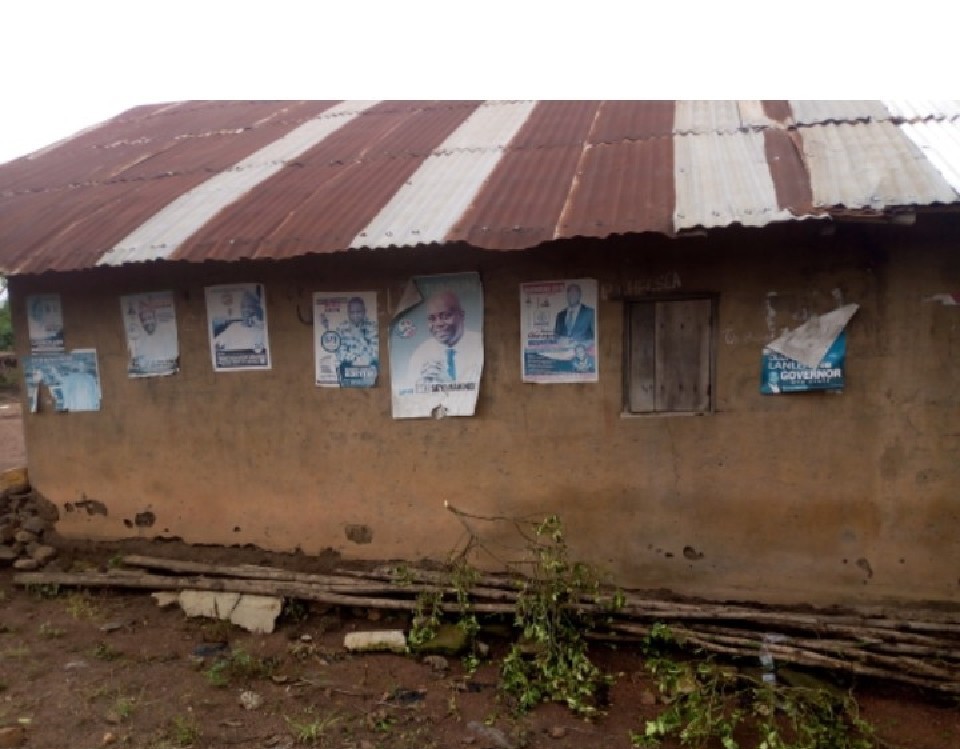
During this newspaper visit to the village, our correspondent observed that residents always take part in every election. This reporter sighted campaign posters of various political parties and their candidates for different political positions. Our findings, however, revealed that politicians visit only during election period.
Politicians visit only during election period. PHOTO CREDIT: PREMIUM TIMES
Efforts by PREMIUM TIMES to get Monsurat Sunmonu, a former Oyo Central senator proved abortive. She did not respond to enquiries with respect to the forgotten community; same as Teslim Folarin’s, the constituency incumbent senator, who failed to respond to calls and text messages.
However, when confronted with the plight of Olorunda, Adeyemi Hakeem, the member of the House of Representatives representing Oyo Federal Constituency, said he is aware of the travails of the community.
Mr Adeyemi who is also the son of Oba Lamidi Adeyemi, the Alaafin of Oyo, in an interview with our correspondent noted that “the construction of the community road is the exclusive responsibility of the local government and the establishment of school is the local government responsibility… They will liaise with State Universal Basic Education Board (SUBEB). On electricity, we’ve approached the rural electrification from the national level but the distance of the community to national grid is far. I have visited the community and we will attend to them.”
When asked how soon the problem of basic amenities in Olorunda would take to be resolved, he simply said that “at the moment the state government has proscribed the local government who should focus on the rural communities but at the moment there is none and that has been a challenge to us.
“In fact, most of their problems can be addressed by the state honourable member. But, I can assure you that whatsoever is possible for us to do for them at the federal level will be done. I don’t have power to build schools and others. But, I will liaise with the state honourable of that constituency. You are doing great job in helping us to tell the stories of these rural communities”.
PREMIUM TIMES also reached out to Isiaka Kazeem, the local government ‘s representative at the state assembly. He told this newspaper that he is aware that Olorunda is not an exception to many other forgotten communities in Nigeria.
“We’ve been doing our best. I contacted a consultant to give us data of all schools in rural areas, the roads as well as the people living there. Our aim is that even if we cannot provide them with potable water, we can still help them with well. We are working tirelessly to get the number of amenities needed. We understand that they don’t have basic amenities and people are suffering. I have visited the ministry of works to see the commissioner on the necessary things to be done in Oyo communities. We will also visit the rural electrification agency and they said they will do the needful.”
Speaking on the prospect of the garri business of Olorunda folks, he said: “once we have good road connection, I can tell you that the economy of the community will boom itself. It is just a matter of time and even private bodies will show interest.”
Meanwhile, Governor Seyi Makinde blamed Olorunda’s decayed infrastructure on previous governments of the state. His Chief Press Secretary, Taiwo Adisa, in response to PREMIUM TIMES enquiries said: “Yes, those areas are deprived because past governments neglected them”.
“Governor Seyi Makinde will, as part of our rural rejuvenation scheme which is an integral part of our agriculture renaissance, pay attention to such places going forward”.
He also told this reporter that the Oyo West Local Government would be assisted and encouraged to alleviate the plight of those villagers.
Government needs to do more:
In his reaction, the lead programme officer for Amplify, a civic organisation for sustainable development in rural underserved Nigeria communities, Ayodele Ibiyemi, said that the government needs to do more to help rural communities.
“Rural dwellers like the people of Olorunda community village constitute 53 per cent of Nigeria’s pollution yet no government intervention”, he told PREMIUM TIMES. “Many of these communities have no social amenities and the people are only remembered when it is election time.”
He said the government has to invest in these communities because the “bulk of Nigeria’s foods come there”.
Mr Ibiyemi said aside electricity, there are other things the community is “battling to have access to such as road, school, hospital and other social amenities.”
The community is in an “emergency state”, he concluded.
This report is supported by the Ford Foundation and the International Centre for Investigative Reporting, (ICIR).
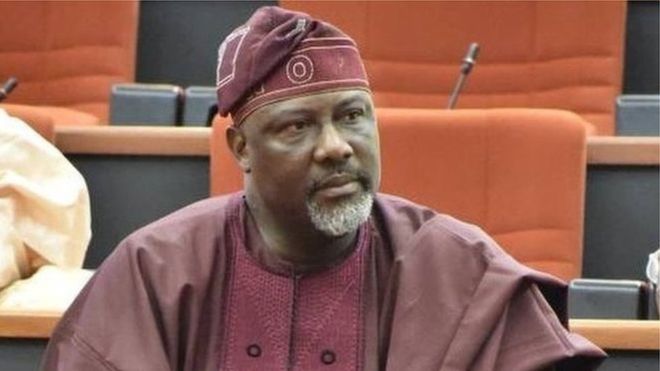
AFTER ten months of struggle to return to the Senate for the 3rd time, Candidate of the People’s Democratic Party, Dino Melaye has been defeated by the All Progressive Congress (APC), Smart Adeyemi at the Kogi West Senatorial supplementary Elections.
The Returning Officer of the election, professor Olajide Lawal made this known on Saturday after the collation of results in Kogi State.
He said Adeyemi polled a total of 88,373 votes to defeat Dino Melaye who was able to gather a total vote of 62,133.
This came after the election of the senatorial district was declared inconclusive.
Candidate of the Social Democratic Party (SDP) Rufus Aiyenigba trailed Dino, polling a total of 659 votes while John Olabode of the African Democratic Congress (ADC) had 262.
The returning officer of the election had declared the November 16 election as inconclusive on the basis that the number of cancelled votes in 53 polling units was more than the 20, 570 margin with which Adeyemi defeated Dino.
The Kogi West Senatorial Election was therefore annulled by the court of appeal which ruled that a rerun be conducted after Adeyemi approached the court to nullify the elections due to over-voting, irregularities and non-compliance with the electoral act.
AFTER Terngu Uduezue lost her mother to cancer in February, she developed a deep interest in advocacy, especially in the provision of counselling centres to reduce the plight and pain of families that battle with the disease.
Dance Against Cancer, an event organised by Project Mum Nigeria, in collaboration with Project Pink Blue, a cancer-fighting non-profit organisation, held on Saturday at Millenium Park, Abuja.
Speaking at the event, Uduezue whose mother died seven months after been diagnosed said late detection of the cancer disease took her life at an early age.
While the disease had placed huge financial burden with lots of psychological stress, Uduezue said she realised there is no counselling centre to support families in the condition.
“I know what these families are going through. Up till now my family is still trying to pick up the pieces,” she said.
Cancer is the leading cause of death worldwide accounting for an estimated 9.6 million deaths in 2018. The most common are cancers of the lung, breast, colorectal, prostrate, stomach and skin.
Cancers caused the death of 41,000 Nigerians in 2018, according to World Health Organisation, about 160,000 new cases were also recorded.
Mampak Nanre, Coordinator of Post-Basic Oncology Programme at the National Hospital Abuja, who gave a health talk on the disease said late detection of cancer in an individual could result in complications and death.
“Cancer is not a death sentence”,”she said adding that early detection and effective treatment would safe lives.
“The cancer burden can also be reduced through early detection of cancer and management of patients who develop cancer. Many cancers have a high chance of cure if diagnosed early and treated adequately,” WHO also noted.
Mampak Nanre addresses the female participants on Saturday on how to do a self-breast examination
As breast cancer stands as the major type affecting Nigerian women, Nanre described how females should do a self-breast examination while standing. She urged the women to do the examination every month, three days after the menstruation for those who have not reached the menopause.
“Women carry breast but they don’t know their breasts,” said Nanre urging them to study their breasts’ shape, size and colour of any milk discharge.
She explained that breast cancer is the abnormal growth in the cell that forms the breast tissues.
Abia Udeme, an assistant director at the the Federal Ministry of Women Affairs who represented Dame Pauline Taline, the Minister by delivering the keynote address said President Muhammadu Buhari’s administration had declared cancer a priroity in the health sector.
Udeme claimed that the FG commitment “has encouraged the establishment of oncology unit in the various health centres in the country to aid the treatment of various cancers”.
The minister’s representative said research has shown that six out of every 10 cancers in Nigeria are women cancer.
Meanwhile, Emmanuel Nwagboso, the Partnership and Advocacy Lead of Project Pink Blue said there has not been enough funding for the prevention, treatment and management of cancer disease in Nigeria. Nwagboso who also lost his dad to prostrate cancer in December 2018 said federal government is also yet to focus on support system for the families.
He said his NGO have registered 53 people to its support group to address psychological and socio-economical problem surrounding cancer.
MEMBERS of Aghoro 1, community, Ekeremor Local Government Area in Bayelsa on Friday berated the Shell Petroleum Development Company of Nigeria (SPDC) for short-changing them.
They criticised the oil firm for arbitrarily determining the compensation figure for the May 17, 2018 spill in the area.
The oil spill had impacted and polluted an estimated area of 113.03 hectares.
A joint Investigation Visit (JIV) report of the incident obtained by NAN had concluded that the leak on the pipeline at three spots were caused by equipment failure and discharged some 1,114 barrels of crude oil into the environment.
Mr Friday Otigha, a Community Leader and member of the Community Development Committee (CDC) in Aghoro 1, said that the N34 m offered by SPDC was unacceptable and had no relation with the impact assessment report.
Otigha said that despite a recommendation of N3.68 billion by the National Oil Spills Detection and Response Agency (NOSDRA), SPDC proposed a paltry N34 million which the community rejected.
He said that SPDC connived with some unauthorised community leaders to foist the arbitrarily determined compensation which fell short of NOSDRA compensation rates on the community, a development that attracted sanctions to the leaders.
Otigha recalled that the oil leak, which was reported on May 17, but the joint visit could not be immediately conducted until June 23, a development that worsened the adverse impact of the spill on the predominantly fishing coastal community.
He said that hundreds of impacted fishermen thrown out of fishing by the incident were disappointed at the turn of events as they had expected SPDC to act in line with international best practices.
He urged the federal government to prevail on SPDC to retrace its steps and resolve the compensation in line with existing oil spill compensation guidelines set by the regulators.
Mr Bamidele Odugbesan, Media Relations Manager, SPDC, had earlier assured that the oil firm would compensate impacted victims of the spill, as well as remediate the polluted areas of the community.
Reacting to the allegations, Mr Michael Adande, a Spokesman of SPDC insisted that the oil firm acted with industry stakeholders to arrive at the compensation for the oil leak but declined to state the exact amount paid to victims of the spill.
“The SPDC conducts a comprehensive damage assessment and enumeration exercise with active participation of other members of the Joint Investigation Visit Team, especially the impacted claimants.
“We also use geomatrics map to establish the exact area of impact and extent within SPDC’s Right of Way or third party area and the degree of impact to arrive at a fair compensation value.
“In the case of the regrettable incident in Aghoro in Bayelsa State and Odimodi in Delta State in 2018, SPDC has paid the agreed compensation to the affected persons and communities.
“The NOSDRA Post-Impact Assessment report, however , included a N2.74 billion as ‘ecological damage assessment’ for environmental restoration and not as compensation.
“SPDC takes responsibility for clean-up, remediation and restoration.” Adande said.
It was learnt that NOSDRA had recommended a total of N 3.68 bn as compensation while N 930 million was paid out to impacted communities
THE Chairman, Nigerians in Diaspora Commission (NIDCOM), Abike Dabiri-Erewa has expressed contentment over the ruling of a Durban Court in South Africa which found a South African Police Officer guilty of killing a Nigerian man.
Shyam Ganda, a South African judge of Durban Court in South Africa found the Police Officer, Austin Luciano Reynold guilty of robbing and shooting Ebuka Okoli, a Nigerian in South Africa at close range.
In a statement signed by NIDCOM Head of Media and Public Relations Unit, Abdur-Rahman Balogun, Dabiri-Erewa said the commission is glad that there has to be consequences for actions and that the commission is glad that the case finally came to an end.
She added that the decision of the court has demonstrated South Africa’s political will to deal with xenophobia in the country.
Dabiri implored Nigerians in South Africa to adhere to President Muhammadu Buhari’s admonition to be the best wherever they find themselves.
The Chairman added that Nigeria and South Africa will continuously work at a United Africa while those who perpetrate crime irrespective of their nationality should face the penalty for their actions.
Dabiri-Erewa commended the Nigerian Mission in Johannesburg for painstakingly following through with the case and other cases involving Nigerians.
The Consul General of Nigeria in South Africa, Godwin Adama also said that he was happy that the case came to an end on Friday with judgment pronounced on the guilty police officer.
He noted how his deputy, M.J. Sambo has been at the court with the Provincial Chairman of NICASA and members of the Nigerian Community in Durban, Kwazulu Natal Province.
He disclosed that the second case of 8 policemen being tried for the murder of a Nigerian, Ibrahim Olamilekan Badmus, was adjourned till April 2020 for final ruling due to some technical issues adding that he is optimistic that judgment in other matters will also be in favour of Nigeria.