Home Blog Page 2242

In praise of the soft vengeance Busola Dakolo

0

By Chidi Anselm ODINKALU

At the end of June 2019, #MeToo became #ChurchToo in Nigeria.

BUSOLA Dakolo, a mother of three who grew up a gifted child was the unlikely heroine in this script. She first laid bare her claims in an interview with Chude Jideonwo, lawyer and co-founder of the digital platform, YNaija. These claims later became the basis for her civil claim filed at the Abuja High Court on 6 September 2019, detailing harrowing allegations of rape perpetrated against her by Pastor Biodun Fatoyinbo, best known as the Senior Pastor of the Commonwealth of Zion Assembly (COZA). The acts took place on 23 and 26 September 2002.

To be clear, this was not the first time allegations of sexual predation had been made against this Pastor. Mrs. Dakolo’s allegations, however, felt different. They were detailed; as a married mother, she had very little to gain from making these allegations public and an awful blowback was both predictable and to be expected from partisans and propagandists of the alleged perpetrator.

The first incident of sexual assault allegedly took place when she was 17 in her parents’ house in Ilorin, Kwara State. Neither parent was at home and the Pastor knew this. She had never experienced sexual intimacy before then. She looked up to the Pastor as her “Spiritual Father”. The facts would suggest that the alleged perpetrator probably groomed her for this moment. After the sexual act, he reportedly gave her a bottle of “Krest”, a lemonade-flavoured soda and forced her to drink it. There was a second incident which reportedly took place in or on a car. As a young Christian girl from a polygamous home, Busola Amupitan, as she was when these sexual assaults reportedly took place, initially was unable to confide in anyone about these crimes.

Expectedly, these allegations set off a firestorm across Nigeria and beyond. The alleged perpetrator initially issued a statement offering a general denial of the allegations and threatening both civil and criminal proceedings. For the first time, Pastor Fatoyinbo found himself issuing a public response to such allegations. In the past, he had not dignified similar allegations with an acknowledgment. Pastor Fatoyinbo’s threat of criminal proceedings sounded like bluster. He did not have a plausible path to criminal proceedings against her.

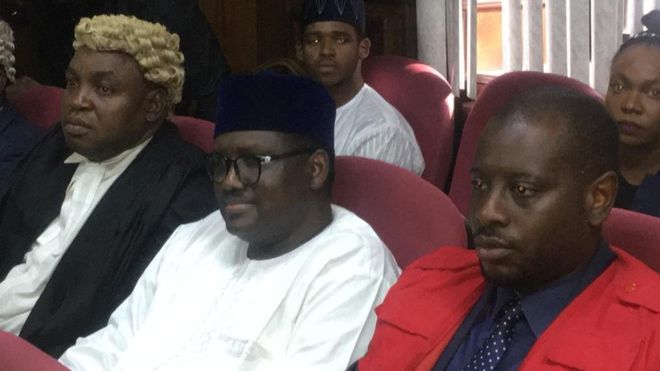
In the end, Mrs. Dakolo sued before the civil courts. A mere nine weeks after her case was filed, Justice A.O. Musa, sitting on the outskirts of Abuja in Bwari, delivered a ruling on the outskirts of the jurisprudential season, holding on 14 November that it was statute-barred. Under the applicable laws, he ruled, such cases must be filed not later than 75 months (six years and three months) after the act complained of. Having dismissed Mrs. Dakolo’s action, the judge then added: “…what we are now left with in this suit is sentiment. This suit is soaked in emotions and ferried into this court by the claimant riding on the thick clouds of bourgeoning sentiments”, claiming that it will “occasion grave miscarriage of justice” to ask the pastor to answer to these claims after 16 years.

This ruling raises many questions about the state of both law and procedure concerning sexual assaults in Nigeria, especially, one reported so many years after it happened. As the world marks the International Day for the Elimination of Violence against Women, it is important to return to these.

In principle, there is no limitation on criminal prosecution for rape or sexual violence. The fact that the allegations, in this case, happened long ago does not preclude an investigation or, if evidence of rape is in fact unearthed, of prosecution. Achieving such an outcome, however, would be dependent on overcoming some constraints of law, evidence and practice.

Let’s begin with the broad regime of laws affecting rape and sexual violence in Nigeria. At present, Nigeria has a multiplicity of sources of laws on rape and sexual violence. There are at least five. In the Federal Capital Territory, the Violence Against Persons (Prohibition) Act (VAPPA) of 2015 has a robust definition of rape as a crime that can be committed by both men and women and involves penetration of any bodily orifice. Nine states – Anambra, Benue, Ebonyi, Edo, Ekiti, Enugu, Kaduna, Osun, and Oyo – seven in the south and only two in the north – have adopted the VAPPA. In nine other states of Southern Nigeria, the Criminal Code applies. Separately, Lagos State enacted a Criminal Law in 2011, which defined rape in terms that both anticipated and resemble the VAPPA. 12 States of Northern Nigeria that have adopted Sharia also recognize a Huddud crime of rape. Additionally, the Penal Code remains applicable in 17 States of the north in relation to the crime of rape.

Both the Criminal and Penal Codes are Victorian pieces of legislation, the gist of whose prescriptions on sexual violence were defined in the last quarter of the 19th century during the reign of Queen Victoria. By the way, she died in 1901. In the terms alleged, the crimes against Mrs. Dakolo took place in Kwara State, where the Penal Code is applicable. Section 282 of the Penal Code defines the crime of rape as comprising four essential elements:

(a) penetration of female genitals with the male phallus;

(b) the act of penetration achieved without the consent of the woman or the consent – if one is alleged – was obtained by fraud, force, threat, intimidation, deceit or impersonation;

(c) the woman is not the wife of the perpetrator; and

(d) the perpetrator intended to achieve penetration of the woman without her consent or acted recklessly without regard to whether or not she consented.

The two most important of these four elements are the physical act of penetration and the communicative act of lack of consent. Every investigation of rape invariably turns on these, making rape a trial of the body of the woman or victim.

Rape typically occurs outside public view. Overcome invariably by personal feelings of guilt and filth, victims are often too ashamed in the immediate aftermath of the crime to confide in anyone. As a result, rape kits are often not performed until after loss of biological evidence. By the time a rape kit is performed, essential biological evidence would have been lost, making the likelihood of effective investigation or successful prosecution rather low or non-existent. Criminal proceedings, if one were to take place, become a trial, not of the alleged perpetrator, but an ordeal for the victim, in which her intimate life is subjected to humiliating micro-examination for the purpose of granting the perpetrator a free pass. Unsurprisingly, many victims, unwilling to subject themselves to such ordeals, would rather nurse their violations and not report rape.

This is the context for assessing the ruling dismissing Mrs. Dakolo’s civil case. The victim was too young at the time of the alleged incident. The judge, having held the case was statute-barred, went on to venture gratuitous put-downs that did not do him a lot of credit. He rendered judgment with neither compassion nor humaneness and was too enthusiastic to lay into the victim. The award of punitive costs against her counsel (in the sum of one million Naira) appeared rather uncalled for at best.

Whatever the difficulties of proof, cases like Mrs. Dakolo’s remind us of the need to scale up rape law reform in Nigeria. Some basic steps can help.

First, the definition of rape in both the Criminal and Penal Codes is clearly very outdated. It makes the crime near impossible to prove. To achieve this, VAPP Act needs to be taken to all the States and made the standard all over Nigeria. This will make it possible to harmonise the laws of sexual offences across the country, eliminating the confusion that presently exists. The Conference of Attorneys-General in concert with the Inspector-General of Police can commit to legislating to make this possible.

Second, at present, the law allows evidence of the sexual or intimate histories of victims from the proceedings but mostly precludes such evidence on the part of alleged perpetrators. This incidence of the laws of evidence in rape proceedings in most jurisdictions in Nigeria can be reversed by amending the relevant laws in all the states other than Lagos where this has already been achieved.

Third, in civil cases alleging rape of minors – as in persons under the age of 18 – or culpability of persons in authority over the victim (as in a pastor), it should be possible to allow for a doctrine of continuing violation triggering the commencement of computation for limitation purposes from either the attainment of majority or the end of the power relationship between the victim and the perpetrator (whichever is later). If this requires updating legal doctrine or amending the statute of limitations, then it should be done.

Fourth, predictably, propagandists for the alleged perpetrator have gone to town with unfounded claims of his exoneration. That, sadly, is far from what has happened. It is impossible, however, for victims in cases such as this not to feel let down by the system. We must invest in weaning judges through training of a prevailing Victorian mindset about remedying rape.

Pastor Fatoyinbo may have achieved a technical legal victory but it has left his name in ruins. He may never be able to clear himself of allegations that he is a rapist. That is a terrible burden for a “Man of God” to live with, a testament to the soft vengeance of Busola Dakolo’s incredible courage.

 

There are still huge gaps in Nigeria’s efforts to protect children

0

By Daniel Ogunniyi, University of Nottingham

IT is 30 years since countries across the world adopted the UN Convention on the Rights of the Child . Yet, to date, the terms it sets out to protect children remain far from reality in many countries.

This is true in Nigeria too, even though its federal government ratified the convention in 1991.

After years of complex negotiations, Nigeria passed a new law – the Child Rights Act – 16 years ago. The law was designed to bring the country into line with the provisions of the convention. The act deals with a range of threats that children might face. This includes child labour and other forms of exploitative practices.

Nigeria has also passed other non-specific child laws that protect children. These include the Labour Act and the Trafficking Act.

Despite these additional statutes, huge gaps remain.

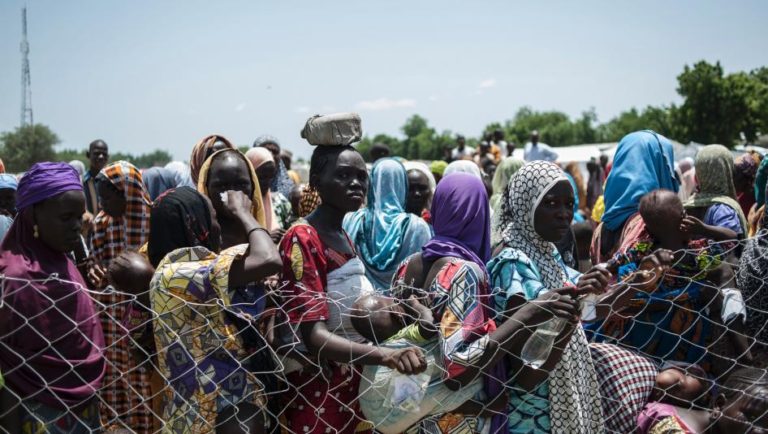
The biggest is that the Convention on the Rights of the Child incorporated through the Child Rights Act does not apply across the country, only 25 states have adopted the Act.

The reason for this is that Nigeria is a federation comprising 36 legally equal states and the Federal Capital Territory. Each state has an independent legislature. Certain laws, including those that pertain to children’s rights – even after they’ve been passed by the federal government – don’t become effective until they’ve been adopted by the lawmakers in each state.

The reason for the hold up in the 11 states is that they disagree with provisions in the act which they argue are in conflict with religious and cultural norms. All 11 states are in the northern part of Nigeria.

Objections

Nigeria’s population is roughly split between a majority Muslim north and a largely Christian south, with a small fraction of the population identifying with indigenous African religions. But it’s important to note that the country can’t be neatly divided into a Muslim north/Christian south binary, as there are pockets of Christians in the north, just as there is a sizable number of Muslims in the south. On top of this, worshippers of traditional African religions cannot be tied to any particular region in the country.

The states that have yet to sign the Child Rights Act have laid down specific grounds for rejecting the law.

The major objections include the fact that the act:

  • prohibits child marriages.
  • prohibits marriage to members of an adoptive family, and
  • defines a child as anyone below the age of 18.

The prohibition of child marriage in the statute responds to dominant practices whereby younger girls are married off to older men, which often skews power relations in favour of those men. Evidence suggests that domestic violence by an intimate partner is usually more widespread among girls than among older women who are able to provide informed consent.

Also, there is often a strong correlation between child marriage and exposure to health risks, including complications during pregnancy and childbirth. The Word Health Organisation, for instance, notes that adolescent pregnancy is one of the major contributors to maternal and child mortality.

Complications arising from pregnancy and childbirth are regarded as the leading cause of death among girls 15 to 19 year old globally. Apart from its health consequences, adolescent marriage could also have socioeconomic effects on girls.

With regard to education for instance, leaving school could be the rational choice for pregnant girls, which could, in turn, deny them economic opportunities and perpetuate a cycle of poverty. The WHO estimates that child marriage reduces future earnings of girls by around 9%.

The 2008 Nigerian Demographic and Health Survey estimated that 48% of girls in northern Nigeria were married off by the age of 15, while 78% were married before their 18th birthday. The survey put the median age of marriage in the north-western region at 15.2 years of age. The most recent demographic survey released last month, does not include this data.

Regarding the prohibition of marriage to adoptive parents, it is worth noting that although the concept of adoption is generally not recognised under Islamic law, the provision of the Child Rights Act on this subject is considered by many states in northern Nigeria to be far reaching.

Under Islamic law, “kafalah” is the principle governing relations between parents and adopted children. It draws a distinction between biological and non-biological children, and considers the latter as maintaining blood relations to their original family, and consequently may be married to members of the adoptive family.

Therefore, political leaders in northern Nigeria perceive the Child Rights Act as challenging a practice legitimised by religion – Chapter 33: 4–6 of the Qur’an generally affirms as valid a marriage between an adoptive parent and an adopted child as there is no blood relations between them.

However, this practice could well mask child exploitation. Parents could use their position of power subjectively, thereby exposing children to similar risks associated with child marriage. Childhood and vulnerability are intrinsically tied together, and every child must be accorded legal protection. Moreover, it is important that child rights laws apply equally across Nigeria, as opposed to the current practice where children within the country are subject to different legal standards simultaneously.

The way out

All is not lost. Nigeria’s Labour Act and the Trafficking Act could offer some protection to children across the country, especially in the areas of child labour and child trafficking.

Nevertheless, the vulnerabilities of children and their susceptibility to exploitation for example, through child marriage, demand more sustained efforts. Pressure should continue to be exerted on the 11 states that have yet to re-enact the Child Rights Act to take the best interest of children into account.

Daniel Ogunniyi, Research Fellow in Anti-Slavery Legislation and Governance, University of Nottingham

This article is republished from The Conversation under a Creative Commons license. Read the original article.


Physical, spousal violence against women increases in NigeriaㄧReport

AS today marks the commemoration of the International Day for the Elimination of Violence Against Women, women-targeted violence is said to have increased with more than 30 per cent of them having already experienced abuse. 

The United Nations has set aside November 25 for putting efforts to prevent and end violence against women at the global, regional and national levels.

UN defined Violence Against Women as “any act of gender-based violence that results in, or is likely to result in, physical, sexual or psychological harm or suffering to women, including threats of such acts, coercion or arbitrary deprivation of liberty, whether occurring in public or in private life.”

According to the recent National Demographic and Health Survey for 2018, the persistent of physical abuse against the country’s women rose up in 2018 with a 31 per cent of females between 15 and 49 years physical abused. 

This was against the estimated 28 per cent of women that experienced physical violence in both 2008 and 2013. 

With 31 per cent of women that had experienced physical violence as of 2018 in Nigeria, it means one in three females age between 15 and 49 years have been physically abused.

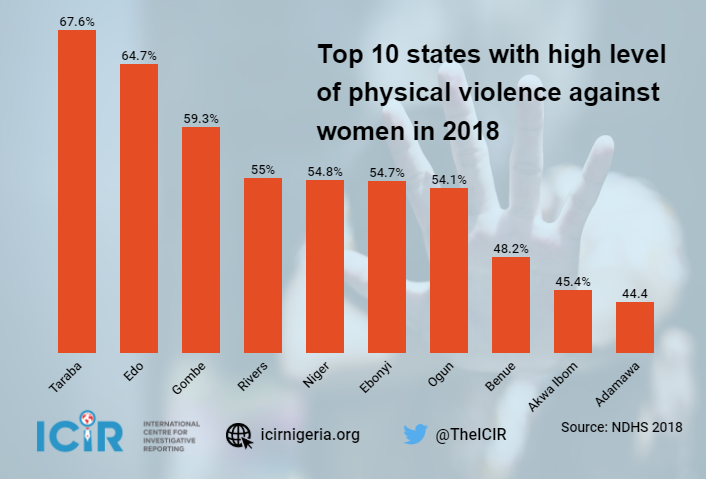
Top 10 States with high level of physical violence against women
Infographics credit: Rebecca Akinremi

To get information on the physical violence, the NDHS indicated that women were surveyed by asking if anyone had hit, slapped, kicked, or done something else to hurt them physically. 

The report also recorded spousal violence to be higher in 2018 than in 2013. It noted that 36 per cent of ever-married women have experienced spousal physical, sexual or emotional violence in 2018, contrary to 25 per cent in 2013. 

The 2018 NDHS that also documented the help-seeking behaviour of the women after being abused showed 55 per cent of them did not seek help to stop the violence. This indicates that more than half of Nigerian women who have experienced physical or sexual violence have never sought help. The help-seeking behaviour had thus grown worse because forty-five per cent of the women had not sought help in 2013.

The majority of the 32 per cent of females that reported their experience did to their families, the report added.

At the regional level, Southsouth has the highest rate of women who have experienced physical violence since age 15 with 46 per cent of women affected. The region is followed by Northcentral and Northeast with 43.3  and 38.3 per cents respectively.

Taraba state leads the 36 states and the Federal Capital Territory with the highest prevalence of violence against women. 67 per cent of the Taraba women have experienced violence, followed by Edo state with 64 per cent of the women aged 15-49 years already abused.

Explaining some predominant patterns of the violence against Nigerian women, the NDHS noted that women who were employed but did not earn cash experienced physical violence than those who were employed for cash or women who were not employed. It stated that employment status, level of education and wealth status are some factors that determine the risk of violence against women.

Thus, as today marks the International Day for the Elimination of Violence Against Women, the UN Women has kicked off 16 days of activism against gender-based violence to urge actions in ending the scourge that impacts one in three women worldwide, including Nigeria. The campaign will end on December 10, which falls on Human Rights  Day.

According to a World Health Organisation research that detailed impacts of violence on women’s physical, sexual, reproductive and mental health, women who experience physical or sexual abuse are twice as likely to have an abortion, and the experience nearly doubles their likelihood of falling into depression.

In some regions, they are 1.5 times more likely to acquire HIV, and evidence exists that sexually assaulted women are 2.3 times more likely to have alcohol disorders.

Reactions trail Singapore’s controversial social media law copied by Nigerian lawmaker

0

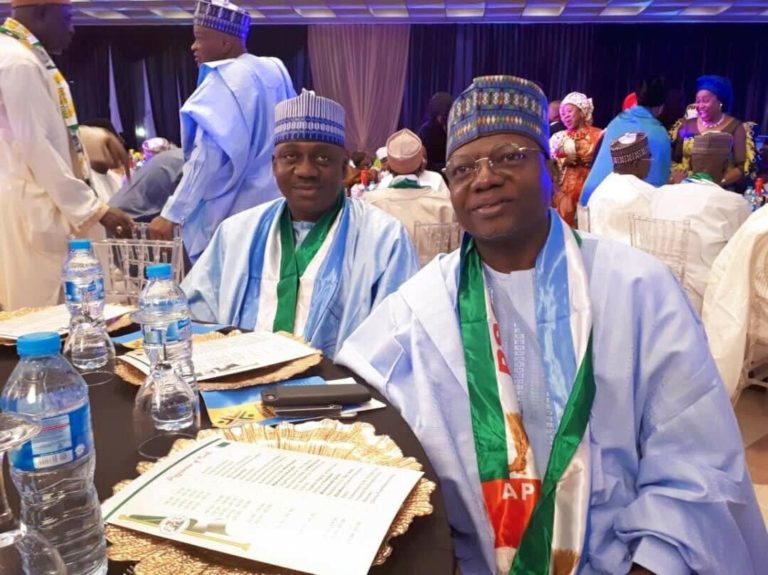
ON TUESDAY, November 5, a bill to regulate the social media was introduced to the Nigerian Senate and the sponsor, Mohammed Sani Musa, lawmaker representing the Niger East senatorial district, has been called out for copying the document word-for-word from a similar law in Singapore. The ICIR takes a look at some of the reactions to the parent law.

The bill has outlawed the transmission of false information likely to be prejudicial to security, prejudicial to public health, prejudicial to Nigeria’s friendly relations with other countries, influence electoral outcomes, incite enmity, or diminish public confidence in the government.

It proposes that anyone who violates this shall pay a fine of N300,000, spend three years in prison, or be ordered to do both, and also asks that the government be empowered to block internet access to certain end-users.

The bill has been criticised by many Nigerians, especially as Nigeria already has a reputation for arbitrarily arresting and prosecuting journalists using the 2015 cyber-crime law. The bill’s sponsor, however, appears buoyed by the fact that Nigeria is not the first country to consider enacting such laws.

“While the phenomenon of internet falsehood and manipulation is a serious global challenge, countries like Singapore have taken measures to curb the proliferation of fake news and disinformation with the passage into law of the Protection from Online Falsehoods and Manipulation Act 2019, which is aimed at protecting society from fake reports that harm public interests,” he said while soliciting support for the bill’s second reading on Wednesday.

He added: “So many other countries have adopted this bill and they are guiding on how the use of internet will be.”

The lawmaker did not, however, mention that the Singaporean law passed in May, and which took effect last month, is controversial and has been widely criticised.

The Asia Internet Coalition (AIC), for example, observed in May that the vague definitions of such terms as “false statement” and “public interest” in the bill leave room for a “highly subjective application”. It also pointed out the lack of explicit protection for critical opinion and satire.

“The overwhelming consensus is that this Bill will impact freedom of expression and curtail the rights of individuals, Singaporean or otherwise, to freely express opinions and participate in informed discussions, even debates, that are necessary to ensure executive transparency and accountability,” AIC managing director Jeff Paine said.

“As the most far-reaching legislation of its kind to date, this level of overreach poses significant risks to freedom of expression and speech, and could have severe ramifications both in Singapore and around the world.”

The International Commission of Jurists (ICJ) warned that the law could be subjected to abuse.

The commission’s Asia Pacific director, Frederick Rawski wrote to Reuters: “The severe penalties proposed under the bill, its broad scope of territorial jurisdiction and the absence of clear protections for expression pose real risks that it will be misused to clamp down on the free exchange and expression of opinions and information.”

Also, Human Rights Watch has observed the law “provides a carte blanche for Singapore ministers” to pull down any content online they consider false regardless of where it is circulated to.

Phil Robertson, the deputy director in Asia, told NPR that all independent media organisations in the country only publish online, adding that the country “whitewashes bad news and persecutes activists and whistleblowers who call the preferred image of Singapore into question”.

“Singapore’s new ‘fake news’ law is a disaster for online expression by ordinary Singaporeans, and a hammer blow against the independence of many online news portals they rely on to get real news about their country beyond the ruling People’s Action Party political filter,” Robertson also wrote on Twitter.

“Singapore’s leaders have crafted a law that will have a chilling effect on internet freedom throughout Southeast Asia, and likely start a new set of information wars as they try to impose their narrow version of “truth” on the wider world.”

Speaking to Reuters in May, Google said that it remained concerned that the law “will hurt innovation and the growth of the digital information ecosystem”. “How the law is implemented matters,” the company added. 

Facebook has also expressed concern “with aspects of the law that grant broad powers to the Singapore executive branch to compel us to remove content they deem to be false and proactively push a government notification to users”.

Singapore is currently ranked 151 out of 180 countries on the World Press Freedom Index.

“Despite the ‘Switzerland of the East’ label often used in Singapore government propaganda,” notes Reporters Without Borders, “the city-state does not fall far short of China when it comes to suppressing media freedom.”

The Nigerian Senate had, in late 2015, proposed a similar law to regulate publications and conversations on the internet, triggering public outcry. President Muhammadu Buhari, then, affirmed his commitment to freedom of speech and assured Nigerians he would not sign any law that is inconsistent with the constitution.

Eventually, the bill was withdrawn following a report from the Senate Committee on Human Rights and Legal Matters that said the law does not only violate existing laws but is likely to infringe on the rights of citizens.

It remains to be seen if the new bill is going to suffer a similar fate. For now, the Senate Committee on Judiciary, Human Rights, and Legal Matters has decided to set the ball rolling later this week with a public hearing.

Welfare of 47 Million Nigerians hangs in the balance due to NDDC’s mismanagement of N1.53 trillion

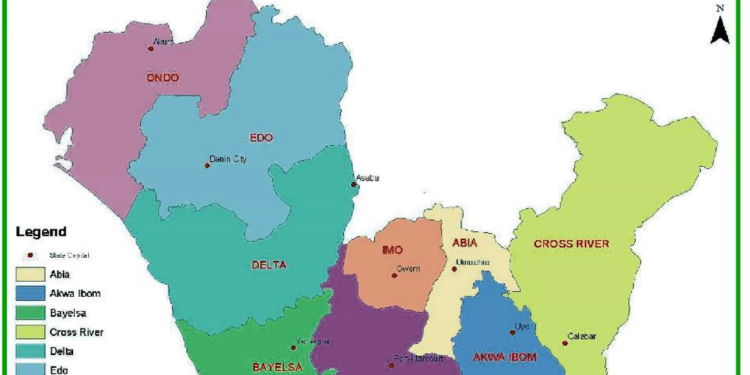
AT least N1.534 trillion has been received by the Niger Delta Development Commission (NDDC) since its inception in 2001.

This amount was allocated to the NDDC for expenditures on projects to reverse the huge infrastructural deficit in the nine Niger Delta states as a result of decades of government’s neglect and environmental degradation by oil exploration companies. However, the development crises that impact the oil-rich region with an estimated population of 46.8 million people remain unresolved. Expectedly, concerns are growing about the utilisation of the funds accrued to the Commission over the years.

10-Year Revenue of N1.413 trillion from 2007-2016

Two reports by the Nigeria Extractive Industries Transparency Initiative (NEITI) covering a period of 10 years have revealed that the Commission received a total of N1.413 trillion. The Fiscal Allocation and Statutory Disbursement (FASD) documents reveal that the Commission received a sum of 593.96 billion naira from mineral and non-mineral sources from 2007 to 2011, and also received 819.81 billion naira between 2012 to 2016. These, ten years (2007-2016) summed up to N1,413.77 billion (or N1.413 trillion).

10-Year Expenditure of N3.03 trillion from 2007-2016

For expenditure in the same 10-year period, the reported value is N961.94 billion from 2007-2011, in addition to N932.632 billion and $6.107 billion spent between 2012 to 2016. For the latter 5-year period, the 6.107 billion expenditure in US dollars was converted to Naira at a conservative average of N186/$1 for the 5-year period. This gave a Naira exchange value of N1,136 billion, which was added to the N932,632 billion reported, to arrive at the N2,068 billion for the period of 2012 to 2016. Hence, DATAPHYTE’s conservative estimate for the total expenditure for the ten years is computed to be N3,030.57 billion (or N3.03 trillion).

10-Year Expenditure surpasses Revenue in the same period (2007-2016)

Following this computation, we tried to calculate the difference between revenue and expenditure for the 10 year period, we got a negative difference of N1,616.80 billion (i.e N3030.57 billion minus N1413.77 billion). This is shown below:

Period Revenue (N’Bn) Expenditure (N’Bn) Source
2001 – 2004 121.05             ?? NDRMP
2007 – 2011 593.96 961.94 FASD
2012 – 2016 819.81 2,068.63 FASD
Total (2007 to 2016) 1,413.77 3,030.57
Total (2001 to 2016) less 2005-2006 1,534.823

It is also surprising to find out from the recently constituted interim management of the Commission that the pending NDDC Interim Payment Certificates are worth over N3 trillion. That is, “what the NDDC owes these phantom contractors”.

This suggests one of two things: that NDDC is deliberately running a deficit budget OR the Commission has not done full disclosure of its revenue to NEITI auditors and the undisclosed amount is over 3 trillion naira. The latter seems more plausible considering a PREMIUM TIMES report that Igo Weli, the General Manager of Shell Petroleum Development Company of Nigeria (SPDC) disclosed his company and its partners have remitted about $2 billion to the Niger Delta Development Commission (NDDC) in 16 years. If only SPDC remitted about $2 billion, there is a high potential, ten of billions of dollars have accrued to NDDC from the remittances of other big oil and gas companies institutions.

Revenue from Inception in 2001 to 2016 (less 2005 and 2006)

In accounting for the NDDC’s revenue from inception in 2001, there were six years of revenue (2001-2006) that were not captured in the 2007-2011 FASD report. However, DATAPHYTE found a revenue of N121.05 billion that the Commission received between 2001 – 2004. The data as reported in Chapter 6 of the Niger Delta Regional Development Master Plan (NDRMP) showed that NDDC received a total of $1billion ($1,000,768,000) between 2001 and 2004. At a moderate average exchange rate put at N120/$1 during the period, this amounts to N121.05 billion as accrued revenue between 2001 and 2004.

When this 121.05 billion naira revenue figure is added to the receipts (N1.413 trillion) reported by NEITI for 2007 to 2016, the total from 2001 to 2016 totaled N1.534 trillion. It should be noted that the revenue received by NDDC between 2005 and 2006 is not included because the data could not be accessed at the time of this report.

Given this, we found that less or more of N1,495.75 billion of revenue is still unknown following the NEITI audit report.

Since the Commission was established, a series of projects have been initiated within the region. These projects are development interventions in Education, health, provision of potable water, electrification, road infrastructures, environment and waste management, security, skill acquisition and youth development, and agricultural development programmes, among others.

With thousands of these projects rolled out every year across the nine states, various media reports have chronicled how tons of the projects are abandoned or never implemented. For instance, investigations published by PREMIUM TIMES and linked here exposed how contracted projects are fake, become dumpsitesor not foundEven a 3 billion naira worth of Shoreline Protection Contract project failed and 600 projects worth over N200 billion revoked

Below is a graphical illustration of its expenditure from 2012 to 2016 in NGN Millions.

Source: FASD Summary Report 2012 – 2016

Also, according to the audit report of the Fiscal Allocation and Statutory Disbursement (FASD) of the Federal Government, the sum of N7.442 billion was grossly mismanaged within the five-year period.

A report from the NEITI revealed that the Niger Delta Development Commission (NDDC) has been inefficient in empowering the community through its projects and programs as projects worth over N1.24 billion (N1,248,911,325) were unutilized and gross mismanagement of funds in tune of N7.44 billion unaccounted for.

Key findings showed that a total of 22 projects were duplicated in the project schedule with a total contract sum of N1.18billion, mobilization payments of N370.70million, interim payment certificates (IPC) issued to the tune of N156.81million and mobilization recovered on IPC’s of N93.09 million.

Likewise, it was observed that substantial work has not been carried out in a significant number of projects even though mobilization has been paid.

“For instance based on the review from this audit, projects with a contract sum of 284.884 billion naira and mobilisation or advance payments of 63.558 billion naira was made but was not certified for work done on the established milestones or progression and therefore no interim payment certificate (IPC) had been issued.”

Inefficient Utilization and Mismanagement of Funds by NDDC

NEITI’s report also lamented how N1,248,911,325 being spent on projects without utilization which amounts to waste until these facilities are used and N7.442 billion being mismanaged. Despite the huge amount spent on various projects of which some have been completed and commissioned, they are however not been put into effective use to the benefit of the communities. Such projects include:

  • Construction of Nigerian Police Barracks (Special Protection Unit – Base 6 Block of flats, Block A)
  • Construction of admin block, commander’s residence, service block and Gatehouse with a contract sum of N249,910,500.
  • Construction of Nigerian Police Barracks (Special Protection Unit – Base 6) LOT 3:
  • Construction of Block of Flats/Residential Quarters (Block B) in Port Harcourt, Rivers State with a contact sum of N249,750,000.
  • Construction of mobile Police Barracks (Special Protection Unit – Base 6), LOT 6, – General External Works, Port Harcourt with a contact sum of N249,750,825.
  • Construction of Nigeria Police Barracks – Base 6 LOT 4: Construction of Block of flats/Residential Quarters (Block A) in Port Harcourt with a contact sum of N249,750,000
  • Construction of Nigeria Police Barracks – Base 6 LOT 2: Construction of Block of flats/Residential Quarters (Block A) in Port Harcourt with a contact sum of N249,750,000
  • The supply of whole-body X-ray scanner, Baggage and parcel scanner, including walkie talkies with Base station and mobile repeaters to Uesiri Security Services Ltd. A project meant to be for the whole community but done for a single company
  • It was also observed that there was a general allocation of NGN7.442 billion to the nine state-offices of the Commission for the completion of small-ticket projects which were neither identifiable nor scheduled for monitoring and proper management.

All these sum up to over N1,248,911,325 being spent on projects without utilization which amounts to a waste until these facilities are used and N7.442 billion being mismanaged.

Food for thought

The roving thought for us is why it is difficult to nip this incessant corruption in the bud and it is allowed to continue barely checked for sixteen years. More troubling for our democracy and economy is why government agencies saddled with the provision of intervention projects have little or no process of scrutiny.

We fear, then, and sound a warning about the North-East Development Commission that is being instituted with billions already earmarked for various intervention projects without proper data on different dimensions of the problem.

Closely related to this is the incapacitation of the Bureau of Public Procurement to properly scrutinise public contracting processes across MDAs and to sanction projects being implemented all over the country.

Overall, the inadequacies of Federal government anti-corruption and accountability institutions beckons the National Assembly and States’ House of Assembly to reconsider what federalising these institutions means against independent structures at the state level.

This report was first published by Dataphyte

Instagram celebrity, Mompha remanded in prison custody over N32.9 billion scam

0

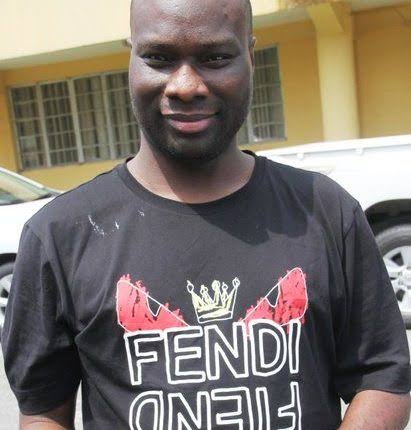
ON Monday the Federal High Court sitting in Lagos ordered alleged Internet fraudster, Ismaila Mustapha, alias Mompha, to be remanded in the prison custody pending the hearing of the case.

The presiding judge, Justice Mohammed Liman ordered that he should remain in prison after Mompha was arraigned before him on a 14-count charge of internet fraud, money laundering and operating a foreign exchange business without a license from the Central Bank of Nigeria, CBN.

Reading the charges against him, the Economic and Financial Crimes Commission, EFCC, alleged that Mompha had procured one Ismalob Global Investment Limited and kept N32.9 billion between 2015 and 2018.

The EFCC stated that Mompha “ought to have reasonably known that the money formed part of proceeds of the unlawful act, connected to fraud.”

He allegedly perpetrated his fraudulent activities under the guise of being a Bureau de Change, BDC, operator. Before his arrest on October 18, he was frequently flaunting huge amount of foreign currencies on his social media platforms.

The anti-graft agency said they confiscated five wristwatches from him with a total worth of over N20, 000, 000 when he was arrested.

The prosecuting counsel for the EFCC, Rotimi Oyedepo, said Mompha acted contrary to sections 5 and 29(1)(c) of the Foreign Exchange Monitoring and Miscellaneous (Provision) Act Cap F34 Laws of the Federation of Nigeria 2004 and he was liable to be punished under Section 29(2) of the same Act.

After the charges were read to Mompha, he pleaded “not guilty” to all of the charges.

While requesting a date for commencement of trial, the prosecution counsel urged Justice Liman to order that the defendant be remanded in the prison custody.

Defence counsel, Gboyega Oyewole said he was not opposed to the application for a trial date, but said he had already filed a bail application for his client and had also served the same on the prosecution.

The prosecution confirmed that it had been served with the bail application but said it required time to read and respond to it.

Justice Liman adjourned till Friday, November 29, to take arguments on the bail application and for the trial to commence.

However, the prosecution applied that the judge issue summonses on some of its listed witnesses, including the Director of Trade and Exchange Department at the CBN, Ahmed Umar, Enu Matthew of the Special Control Unit Against Money Laundering, Ministry of Trade, amongst others.

Maina gets N1bn bail as son remains in custody till bail hearing

0

THE Former Chairman of the defunct Pension Reform Task Team (PRTT), AbdulRashid Maina has been granted bail of one billion naira by a Federal High Court sitting in Abuja on Monday.

The sitting Judge on the case Okon Abang granted a one billion naira bail to the former Chairman with two sureties in like of the sum.

He added that both sureties must be serving Senators of the Federal Republic Of Nigeria and must not have any criminal case pending before the court.

According to the court ruling, the sureties must provide to the court, a 3-years tax clearance certificates and must appear alongside Maina at all further court rulings on the case.

Abang ordered that both sureties must own fully developed landed property either in Maitama or Asokoro district of Abuja.

The judge said that the sureties must file an affidavit to show they can pay the penance sum of one billion naira.

Maina who was reported to have arrived Court 6 of the Federal High Court, Abuja in support of a walking stick is currently facing charges by the Economic Financial Crime Commission (EFCC) for allegedly looting billions of Naira while he served as the PRTT Chairman.

He was arrested by the Department of State Services (DSS) on the request of the EFCC at Pennsylvania Avenue Hotel, Utako in Abuja together with his son Faisal Maina who will remain in custody pending his bail application which is set to be heard on Friday, November 29.

The ICIR had reported that Faisal, a final year student at the Canadian University of Dubai attempted to evade arrest and in the process pulled out a gun and shot at an operative before he was demobilised.

According to Channels TV,  Faisal is being charged for allegedly shooting at security operatives in a bid to evade arrest.

Why I proposed the Hate Speech Bill – Senator Abdullahi

0

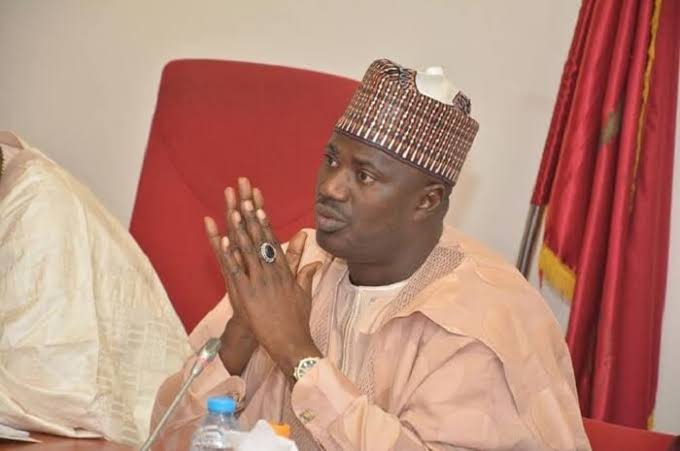
THE Deputy Senate Chief Whip, Bali Abdullahi representing Niger North Senatorial district has explained the reasons behind the Hate Speech Bill he privately sponsored which has generated criticism from many Nigerians.

In a video posted on the official social media handle of the Nigerian Senate, he explained that he proposed the bill during the 8th Senate-Assembly but it couldn’t go for second reading because he noticed that the political atmosphere was charged.

Abdullahi said because of the sensitive nature of the bill, he felt it would not enjoy a fair conversation in the Senate so he put the bill on pending till the end of the 8th Senate Assembly.

Stressing the need for a bill on Hate Speech, Abdullahi said more than 20 countries have bills on hate speech including United Kingdom, Canada, Australia, Japan, Germany, France among others.

According to Abdullahi, hate speech is increasingly becoming a problem and from his studies, the word ‘Hate Speech’ was coined by a United States scholar who looked at the hindrances of victims of hate speech to seek legal redress in a case of such.

“People who have fallen victim of hate speech are left like that without any restitution, without any compensation, without any recourse to seeking justice for them,” he said.

He added that from his readings on all the violence and crisis in Nigeria, he found out that most of them if not all were preceded by hate speech.

He said it is sad that people are shutting down the bill by amplifying death by hanging penalties for people who are found guilty of hate speech.

“The bill is not that when someone says anything that can be termed as hate speech then he should be hanged; it is far from the truth,” he added

The Senator added that in fact, there are statements that must be made and it also requires inviting the suspect and the other party so that they can broker peace and have understanding in a manner that the parties will be able to continue to relate with each other harmoniously.

Abdullahi added that he thinks the misunderstanding of the bill is justified and that it tells him that Nigeria is united in the understanding that death is not good.

He said since violence preceded by hate speech leads to death then it means it is bad and should be stopped.

“The idea of the bill is to have a body that can bring in parties involved in the exchange for dialogue or reconciliation,” he added

He said the bulk of people involved in the act are highly placed people because when they speak, a large majority of the people listen to it and they take action.

He painted a scenario where someone comes to a large gathering and say inciting statements about ethnicity or religion and is mobbed and killed

“The idea of the proposed Independent National Commission is to provide room for proper prosecution of hate speech offenders instead of risking an atmosphere where someone can say something inciting and might lead to a mob attack on the person,” Abdullahi noted.

He appealed to Nigerians, saying that they don’t have to be a victim before they can appreciate the need for the bill but insisted that there are Nigerians who have fallen victim and suffering in silence because of hate speech.

He said the bill is not a perfect document but a proposal before the National Assembly and they have the opportunity to contribute when it gets to a public hearing.

He also called on Nigerians to look at the bill,  not from the standpoint of what they do not like about it, but they should look at its overall impact.

Nigerians agonise over bad roads, poorly funded health centre…but no solution in sight ―CHRICED

0

A Civil Society Organisation, Resource Centre for Human Rights and Civic Education (CHRICED) said millions of Nigeria citizens are groaning due to bad roads, poorly funded and ill-equipped health centre and dilapidated school buildings.

Addressing pressmen on State of the Nation in Abuja on Monday, the Executive Director of the organisation, Ibrahim Zikirullahi, charged the Federal Government to use proceeds of corruption to alleviate sufferings of the poor and the vulnerable Nigerians.

Zikirullahi said apart from the Abacha loot, disbursed through the Conditional Cash Transfers (CCT), other recoveries made by anti-corruption agencies are idly sitting in the National Treasury of the country.

He said  CHRICED on several occasions had called for the recovered funds to be used for the execution of high impact intervention projects across the nation.

On the just-concluded Kogi and Bayelsa state elections, Zikirullahi said the elections left behind a trail of sorrow tears and blood and cannot be considered as democratic elections because they fail to meet the minimum standards of free and credible polls as universally accepted.

“Nigerians witnessed how thugs sponsored by Politicians overran the election terrain which caused the deaths of innocent citizens and disrupted the process of the election.”

The Department of State Services (DSS), depriving citizens of their freedoms in defiance of court orders should understand the damage their impunity is doing to the stability and orderly governance of the country, he said.

CHRICED further condemned the emerging culture of abuse and abridgement of citizen’s right and attacks on free press.

He called for the release of  Omoyele Sowore and Dadiyata including Agba Jalingo whom he said is being hounded by the Governor of Cross River, Ben Ayade.

Speaking on the burden of multiple taxations borne by Nigerians, he said: “For us, the idea of taxation without a bold and imaginative effort to create wealth and lift citizens out of poverty is a recipe for economic disaster,” he said.

He added that between 1999 and 2018, over N67 trillion naira has been budgeted by the Federal Government and within that period, the number of out of school children has risen from nine million to ten million in Nigeria.

Group calls for implementation of Child Rights Act

SAVE the Children, a leading child rights organisation has called for the actual implementation of the Child Rights Act (CRA) in Nigeria in commemoration of the 30th United Nations Convention on the Rights of the Child to mark the world children’s day.

At a digital literacy training for 30 girls from  Government Secondary School, Gwagalada, Abuja, Save the Children stressed the need for the implementation of the CRA in Nigeria, noting that Nigerian children are currently witnessing the erosion of their fundamental human rights by both state and non-state actors.

Ammanuel Mamo, Director of Advocacy and Campaign, Save the Children Nigeria said in his speech that the CRA should not just stop at being domesticated only by states.

“In Nigeria for example, there are so many states that have already domesticated the Child Rights Act, which is a very good and important step forward,” Mamo said.

However, it does not end right there. It has to be implemented. “Implementation starts with budgeting for it, clarifying the plan of actions and clarifying accountability towards that,”  he added.

Out of the 36 states and the FCT, 11 states are yet to domesticate the CRA. The states include Adamawa, Bauchi, Yobe, Sokoto, Borno, Zamfara, Gombe, Katsina, Kebbi, Jigawa, and Kano.

“We would like to take this opportunity to urge them to immediately domesticate the Act as a very important step forward for the realisation of the Child Rights Act, Mamo said about those states who are yet to domesticate the CRA.

Save the Children disclosed that there are about 1.7 billion children who are affected by violence every year. 5.9 million children are affected by preventable causes like pneumonia each year, while four girls under the age of 15 get married every minute in the world, amounting to 5,760 married under-aged girls in a day.

The organization, therefore, called on the government to define specific actions to take in ensuring that further progress is made towards realising the rights of every child with a focus on the most marginalised and that children should be included in a meaningful way of the decision-making process of the government.