Home Blog Page 2243

CONTROVERSY: Questions trail execution of TETFund projects in UNILAG, FUTA (2)

0

This is the second and concluding part of INNOCENT DURU’s investigation into what public varsities in the South West are doing with the funds received for the implementation of TETFund projects in their respective institutions.


READ ALSO:

The University of Lagos, popularly known as UNILAG, is one of the federal universities that have benefitted immensely in terms of resources meant for the execution of TETFund projects.

But visits our reporter paid to the institution revealed that the implementation of some of the projects are riddled with question marks.

On Page 54 of a document titled ‘Performance Report on 2015-2018 Budget, TETFUND and NEEDS Assessment, Including 2019 Proposed Budget Implementation’ sent to the Senate Committee on Tertiary Institutions and TETFUND, the institution listed the construction of an 11-storey library complex as one of the ongoing projects. The project is under the institution’s 2012 High Impact TETFUND Special PROJECT Batch II (New Library Building).

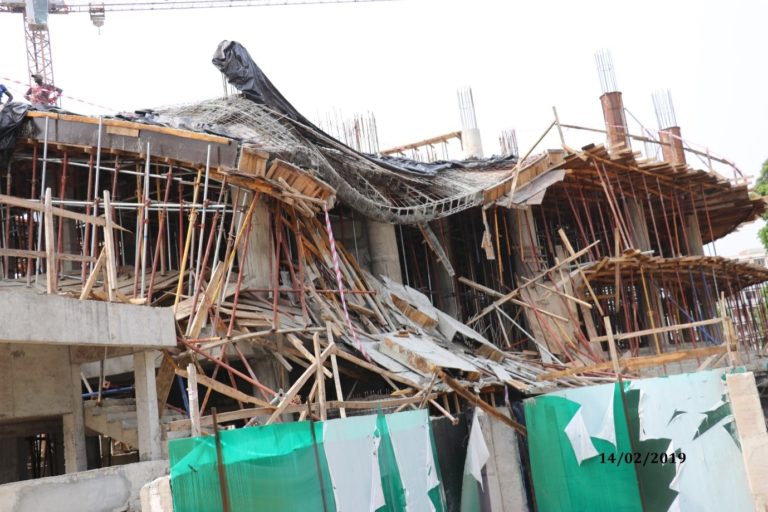
Findings, however, revealed that the institution is building a seven-storey building instead of the 11-storey building in the design at the sum of N1,935,135,087.35. Suspicions concerning the building project was compounded by the controversy generated by its partial collapse recently. The new university library building purportedly being constructed by Dutum Construction Company Limited collapsed sometime in February 2019, provoking hot verbal exchange between the Governing Council and the management of the institution.

The Chairman of the House of Representatives Committee on Public Procurement, Oluwole Oke, said after a visit to the site that the lower chamber decided to investigate it as well as others after a letter written by the Pro-Chancellor of the university, Dr Wale Babalakin, drawing attention to issues of alleged financial infractions and faulty project implementation.

Oke said: “We are here pursuant of the resolution of the House mandating us to investigate the alleged infractions of provisions of public procurement Act 2007 and other financial issues. And we invited the stakeholders.

“Even though the regulators, the NUC and the Federal Ministry of Education, have already taken steps, we felt that the allegations of the Pro-Chancellor were very weighty and we felt we should investigate his claims.”

Consultant to the library building project, Mr Oreoluwa Fadayomi, was reported as saying that he had warned the contractor, Mr Olatunde Runsewe, that the building could collapse if proper steps were not taken, and even refused to approve progress thereby delaying the project.

Fadayomi, Director of Landmark Integrated Technologies Limited, told the House of Representatives Committee on Public Procurement which inspected the site that Runsewe’s Dutum Co Ltd workers lacked the expertise to complete the library project, which he said should have been delivered since November 2018.

He said: “The management of the contractor as it was (as at the time of incident) cannot handle the continuation of the project. Here is a job we should have handed over in November last year and we are still on the first floor.

“And why were we on the first floor? Because I was diligently monitoring and refusing to approve shoddy work, and I was being blacklisted and blackmailed.

‘We changed supervisor over three times because we said no. They would give us methodologies that would not work and we would say no. The management, the staffing have to be overhauled to continue the project.

“If it is the same persons and process, Sir, my firm will withdraw from that project because we cannot continue to supervise at that level. They have to up their game if they have to continue.”In his defence, Runsewe said he was competent to handle the construction as he had handled similar projects – such as the Senate Building of the Covenant University and that of the University of Ibadan.

But UNILAG’s Vice-Chancellor (VC), Prof Young Ogundipe, told the committee that Runsewe did not deliver the UI project on time.

The panel set up by the Governing Council of the university in a 40-page report recommended termination of the contract with the contractor – Dutum Company Limited (DCL).

The panel said it had established the fact that the contract was designed to fail. It said the procedures for the procurement were faulty and that the contractor ought not to have been engaged in the first instance.

“The contract was not executed in line with the executed signed contract. However, the panel believes that the omission to seek permit and approval from the relevant state agency was not in wilful disregard of the law but in the mistaken belief that the university, being a federal institution, did not have to seek approvals or permits for its building projects,” the report reads in part.

The panel also condemned the change in the building’s foundation from pile to cellular raft, adding that the amount of work done so far did not justify the total sum of N444.6 million already released to the contractor.

Students of the institution who spoke with our reporter were miffed that project, which would have enabled them to have a bigger and better place to study, had suffered untold setback.

One of them, who identified herself simply as Elizabeth, said: “We read in our respective faculty libraries. If this particular building had been completed as stated, we would have had a bigger and better place to study.

“They should stop this needless verbal war and do the needful. Our future is what they are toying with here.”

Other projects

Several other projects running into millions of naira also listed under the library contract were said to have been 75 per cent completed while the main project is stalled.

The projects include:

1) Consultant Project: Architect for the construction of the new university main library building put at N33,648,146. The document shows that the institution had spent the sum of N29, 321,955.79 on this to balance N4,326,190.51

2) Consultant Project: Manager for the construction of the new university main library building put at N33, 000, 000.00. The sum of N27,235,408.52 had been spent, according to the document, leaving behind a balance of N5,764,596.48.

3) Consultant Project: Quantity surveyor for the construction of the main university new library building awarded in the sum of N22,354,560.06. The sum of N17,754,056.09 had been spent, remaining a balance of N4,600,503.97.

4) Consultant Project: Electrical engineering for the construction of the new university main library building awarded in the sum of N21,725,000,000. The document shows that the institution has spent the sum of N18,532,662.88, with a balance of N3,192, 337.12.

5) Consultant Project: Structural engineering for the construction of the new university main library building awarded in the sum of N39,600,000 out of which the sum of N31,226,250.28 had been spent and the sum of N8,373,749.72 outstanding.

6) Extra low voltage consultancy services for the construction of the new university main library building awarded in the sum of N17,600,000, out of which N16,418,289.76 had been spent, leaving the sum of N1,181,710.24 as balance.

Apart from the library project, findings showed that Scholars’ Hostel building listed in the document had been completed by the institution but was not being used for the purpose it was built. The building, it was gathered, was meant to encourage and accommodate lecturers from abroad to improve the institution’s standard and rating.

The Nation investigation revealed that the buildings are being occupied by privileged staff of the institution who pay some money annually as rent.

A woman was sighted spreading wet wrappers on the rail in one of the flats, while a number of young boys and girls in sizzling romantic gestures were seen on the balcony of another flat.

A non-academic staff member, who did not want her name in print, said: “I know some of the lecturers that live in the hostel. The purpose of building the hostel has been defeated because it is now being used by privileged lecturers in the university. They pay some money annually, but the amount they pay is not in the public domain.”

The supply and installation of security equipment, whose contract sum was N211,667,950.00, was already completed, but none of the equipment was functional when our correspondent visited.

“Some of the equipment did not function for more than a month before they packed up. It is a complete waste of tax payers’ money,” a security officer, who craved anonymity, said.

The Nation investigation also revealed that the procurement and installation of 10 units of 360 degree executive swivel black leather chair, 10 units of wooden bookshelves with both glass and wooden doors: five tier shelve with locks, 10 units of Vono metal spiral double bunk beds worth how much mattresses for the furnishing of two fire stations already completed had not been done. The project, which cost N10,998,225.00, was recorded to have been 80 per cent completed was still ongoing, even though it was scheduled for completion before the end of April 2019.

A worker in the section said: “Those things have not been provided. The fire station was hurriedly completed to pave the way for Vice President, Yemi Osinbajo, to come for the commissioning, as a date had already been fixed.”

Why original design could not be accomplished — UNILAG

Reacting to our findings on the library project, the management of the University of Lagos, in a reply sent by the spokesperson, Taiwo Oloyede, said the library project was proposed to be a nine-storey building comprising a basement, ground floor and seven suspended floors.
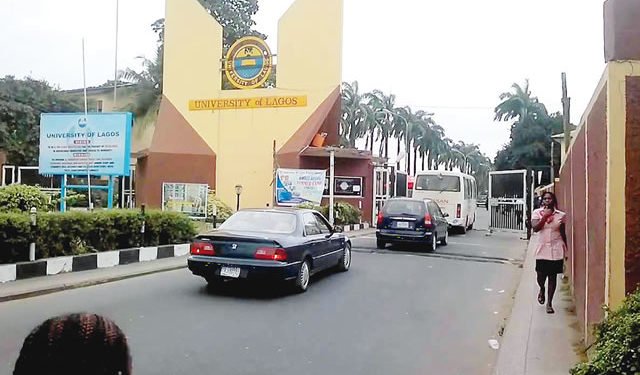
UNILAG’s entrance gate

In a response sent as attached document through WhatsApp message, the institution said: “The number of floors were scaled down to nine (9) from the initial eleven (11) approved by TETFund due to inadequate fund. The estimated cost of an 11-storey building based on the university’s brief to the consultants was far above the allocated sum of ₦2 billion, hence the need to scale down prior to going to tender.

“Furthermore, the high estimates were also a result of the rapidly increasing inflation and escalating foreign currency exchange rate, all of which culminated in the increase in material cost (cement, etcetera), making the ₦2 billion earmarked insufficient for the completion of an 11-storey building of quality.

“Based on the foregoing, the project was scaled down to nine storeys with a basement, ground floor and seven suspended floors, for which the available ₦2 billion fund could procure. Importantly, this scaling down was done before the project went to tender.”

The spokesman’s defence, however, contradicts the information provided by the institution in the document submitted to the Senate committee quoted above.

Explaining why the library project, which was supposed to have been completed in November, 2018, was stalled, the institution said the project was plagued by challenges “such as inclement weather, slow pace of work by the contractor occasioned by inadequate human and equipment resources deployment, among other issues.

“However, it is important to note that the National Assembly had reviewed the situation of this project and proffered a solution to help move the project forward, which is still being reviewed by the university.”

The institution, while admitting that a good number of scanning machines are grounded, put up a defence on why they are not functional.

According to the institution, “most of the scanning machines are still functional, but their use in some locations such as the J. F. Ade-Ajayi Auditorium and Jelili Adebisi Omotola Hall, are restricted to major events only.

“For the ones that are not functional, they were damaged as a result of power surge. This is the case with the scanners at the Senate House of the University. It took some time to procure the damaged parts, as they were not locally available and the suppliers did not provide readily available backup services.”

The institution further said: “Presently, the damaged scanners have been repaired, although their use has been put on hold pending the procurement of UPS and other protective devices to avoid another power surge related damages.

“In addition, the university is in the process of commencing the implementation of a redesigned ground floor lobby of the Senate House to enhance the use of these machines.”

On the Scholar’s Hostel that our investigation revealed was not being used for the purpose it was built, the institution said: “Both scholars from within and outside the university reside in the Scholars Hostel. Occupants from outside the university are visiting researchers on fellowship, joint research, sabbatical and research leaves, and they stay on either short or long-term basis.

Scholars Hostel at UNILAG

“In addition to this, select internal scholars representing all faculties also reside in the hostel.

“With reference to the amount paid to occupy the hostel, it is usually worked out to reflect the quality of the facility and paid from research grants for the external scholars and subsidised for internal scholars.”

Responding to findings that the furniture meant for the fire station was yet to be put in place, the institution said: “Please, note that this assertion is wrong, as the furniture has been provided and the building is now in use.”

FUTA

A copy of the Federal University of Technology, Akure, Ondo State, report to the Chairman of Senate Committee on Tertiary Institutions and a TETFund report, also obtained by The Nation, show that the projects approved for the institution were principally on the provision of materials for the library.

FUTA’s entrance gate

Our correspondent, who visited the three reading rooms in the library, reports that no furniture with TETFUND inscriptions were there. Only old furniture was seen in the three reading rooms. Heaps of furniture with 2015 TETFund projects inscribed on them were found in a corner of the library, but none of them had 2016, 2017 or 2018 inscribed on them.

One of the old FUTA’s reading rooms with old furniture

The same thing applies to textbooks found on the shelves. Some of them had 2015 TETFUND projects printed on them.

ICT/Bindery/Audio Visual and security equipment awarded on July 12, 2017 were also not sighted during the visit.

FUTA management makes clarification

The management of the Federal University of Technology made some clarifications on the findings.

In a response sent through email by the Deputy Director, Corporate Communications and Protocol, Adegbenro Adebanjo, the institution said: “First, please be informed that the TETFund projects being executed are strictly for 2013/2014/2015 intervention.

“The projects were awarded in May 2017. Due to protracted delay in the release of funds, contractors are just delivering their goods.

The deliveries are conspicuously placed on the ground floor and are feasible from both the main entrance and the back entrance of the library. Many of the books are already on the shelves. This could be verified in main the library and the school libraries such as the School of Health Sciences, School of Sciences, School of Management Technology, and so on.”

He added: “For the avoidance of doubt, items carried are for the year the intervention funds are meant for irrespective of the year of execution of the project due to late release of funds. This is the extant practice in all Nigerian universities benefiting from TETFund intervention

“The equipment, furniture and books which are being delivered in 2019 will be marked 2013/2014/2015 because that intervention is meant for those years.”

On why the latest TETFund books found on the shelves were stamped 2015 and none for 2017, Adegbenro said: “Please, note that though the projects were awarded in 2017, they were meant for 2013/2014/2015 and are invariably being delivered in 2019 due to delay in fund release. If it is executed in 2020, it will be marked 2013./2014/2015.

Also responding to our findings that old furniture, instead of new ones with TETFund inscriptions were seen in the three reading rooms, the PRO said: “The furniture and equipment are just being delivered. The ones that had long been delivered had been used to equip newly established School of Health and Health Technology Library at Oba Kekere, Federal University of Technology, Akure.

“The correspondent should understand the working of TETFund as an intervention agent. Their projects will be executed when their funds are released. Please, note that contractors Nos 1 (Tunero Nig. Ltd), 2 (Onicon and Havillah), 3 (Publishers Express and Onward Assets) and 4 (Holadson Educational Books, Yusai Teleview and Jaspers Books) were duly pre-qualified and certified to meet all the laid down conditions in the procurement act. They were officially awarded the contracts in May, 2017.”

The items, he stated, bear the year the intervention funds are meant for “irrespective of the year of execution of the project. This is the extant practice in all Nigerian universities benefiting from the TETFUND intervention.”

Expressing confidence in the calibre of contractors selected by the institution, the spokesman said: “They have gone far in executing their works and they had delivered substantial parts of their contracts. Evidence of their deliveries could be examined through the audit reports and Goods Received Notes. A random pictorial evidence of the above claims are provided in soft copies (see attached).”

He opined that it is a distortion of facts due to lack of adequate information to say that 2013/2014/2015 TETFund projects are nowhere to be found.

He said: “We again extend invitation to The Nation for an on the-spot-assessment of all items that had been delivered, including books, ICT/Security gadget, equipment (books shelves), furniture, office tables, students’ chairs and many more.

“I wish to state that all contracts go through due process and are executed according to the laid down rules governing such projects as specified by the intervention agencies, procurement laws and other laws governing such matters in the federation.”

Concluding, he noted that the “items and the goods delivery notes can be physically examined by your correspondent at your convenience. In FUTA, transparency and due process is adhered to strictly.”

This investigation was supported by the John D. and Catherine T. MacArthur Foundation and the International Centre for Investigative Reporting.
Charge Nigerian govt to release Sowore, stop harassing Falana, others — SERAP urges AU

0

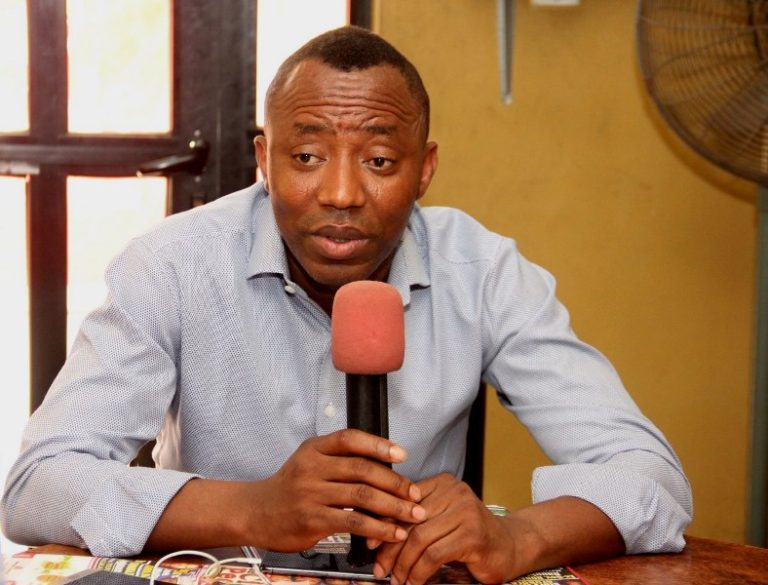
THE Socio-Economic Rights and Accountability Project, SERAP, has written to the African Commission on Human and Peoples’ Rights, ACHPR, urging the African Union’s quasi-judicial body to put pressure on the Nigerian government to release Omoyele Sowore, detained Sahara Reporters publisher.

The letter, dated November 22, was addressed to the Commission’s chairperson, Soyata Maiya, and signed by SERAP deputy director Kolawole Oluwadare.

Diego Garcia-Sayan, UN Special Rapporteur on the independence of judges and lawyers, was copied.

The civil society group asked the Commission to urgently intervene by pressurising the government to “immediately end the intimidation and harassment of detained journalist and activist Omoyele Sowore and Olawale Bakare, their sureties and lawyers, particularly Femi Falana, SAN, simply for defending their clients’ rights.”

It also urged the body to demand that the government’s agencies take measures to protect the sureties and lawyers, immediately release Sowore and Bakare as ordered by the Federal High Court, and investigate allegations of harassment of detained activities, as well as their sureties and lawyers.

“Nigeria’s State Security Service (SSS) has stated that it would not release the activists until it is allowed to vet sureties that have already been verified by the court, implicitly harassing the sureties apparently with the aim of pushing them to disown the detained activists. Similarly, a group of apparently sponsored ‘protesters’ calling themselves ‘Save Nigeria Movement’ asked Femi Falana to ‘stop intimidating security agencies’,” SERAP said.

“The harassment of detained activists for demanding strict compliance with court orders, and then their sureties as well as lawyers who come to their defence, shows a steady slide away from the rule of law and underscores the urgent need for the Commission to insist on the restoration of respect for human rights in Nigeria.

“The harassment is emblematic of a broader pattern of official threats to and harassment of Nigerian civil society. We are concerned that rather than releasing Sowore and Bakare as ordered by the court, the Nigerian authorities are now implicitly intimidating the activists, sureties, and lawyers, particularly Femi Falana.

“Apparently sponsored attacks, harassment and intimidation of sureties and lawyers for doing their independent duties undermine and erode the integrity of the legal profession, access to justice, Nigerians’ confidence in the courts, and make a mockery of the entire justice system.”

The non-profit also condemned a demonstration that held in Abuja on Friday where protesters asked Falana to stop harassing the SSS, describing them as “apparently sponsored”.

“The intimidation and harassment of Sowore and Bakare’s legal team is intended to, and will most likely lead to, other lawyers being unwilling to defend anyone facing politically motivated and high-profile prosecutions,” SERAP said.

“Sureties and lawyers are essential to ensure the effective operation of the justice system, and the rule of law; they need to be protected not harassed and intimidated. Lawyers ought to have the freedom to carry out their legal work and should never have to suffer any intimidation and harassment for discharging their professional duties.”

The group noted that the United Nations Declaration on Human Rights Defenders gives everyone the right to peacefully oppose rights violations, and the UN Basic Principles on the Role of Lawyers likewise requires governments to ensure lawyers are able to perform their professional functions without intimidation and hindrance.

“Nigeria’s State Security Service (SSS) has continued to refuse to release Omoyele Sowore and Olawale Bakare despite court orders,” it added.

“The SSS has stated that it would not release the activists until it is allowed to vet sureties that have already been verified by the court, implicitly harassing and intimidating the sureties and by extension, the detainees and their lawyers, particularly Femi Falana, apparently with the aim of pushing the sureties to disown the detained activists, and Mr Falana to withdraw from the suit. However, under Nigerian law, the SSS does not have any power to vet sureties.”

Senate’s Anti-Social Media Bill is an act of inter-generational warfare

0

By Chidi Anselm Odinkalu

Senator Mohammed Sani Musa’s Anti-Social Media Bill now making its way through Nigeria’s upper legislative chamber is worse than a throwback to the worst years of Nigeria’s experience of military rule. It is a hubristic act of inter-generational warfare that must be resisted and defeated.

A Senate comprising essentially an analogue generation, whose average age exceeds Nigeria’s life expectancy by about 30%, seeks to liquidate the only means of expression left for a digital generation whose analogue rulers have afflicted with little choice and no hope. A cross-party effort, this bill is evidence of how elite consensus in Nigeria, wherever it happens, is both self-serving and irresponsible.

Rather than start a war that it cannot win, the Senate should be well advised to withdraw this Bill and seek to influence digital content through good leadership and positive example. It can still do so.


READ ALSO:

On 20 November 2019, in Nigeria’s upper legislative chamber, the Senate, the “Protection from Internet Falsehoods and Manipulation and Other Related Matters Bill”, successfully navigated second reading. The Senate has now committed the bill to its Committee on Judiciary, Human Rights and Legal Matters.

The sponsor of the Bill is Senator Mohammed Sani Musa, of the ruling All Progressives Congress (APC) representing Niger East in the north-central. In the debate on the Senate floor, Senator Sani Musa received ample support from Elisha Abbo, the woman-battering, young senator of the opposition Peoples’ Democratic Party (PDP) representing Adamawa North in North-east Nigeria, and Abba Moro, also from the PDP representing Benue South in the North-central. In his last major public service role as Interior Minister, Mr. Moro presided over the culpable homicides involving the death of many young Nigerians in a phantom hire for jobs in the Immigration Service in March 2014, for which he proved incapable of empathy or compassion. Also supporting the Bill is Gobir Ibrahim Abdullahi of the APC, representing Sokoto East in North-west Nigeria.

Senator Sani Musa’s Bill is not the only one on the books of the Senate at the moment seeking to eviscerate social media and free expression in Nigeria. His colleague from the neigbouring Niger North Senatorial District, Aliyu Sai Abdullahi, Baraden Borgu, is also single-mindedly pushing “A Bill for an Act to Provide for the Prohibition of Hate Speeches (sic) and for Other Related Matters.” This latter Bill proposes to create an “Independent National Commission for the Prohibition of Hate Speeches (sic)”.  In its earlier incarnation, Senator Sabi’s bill also included a provision for death penalty for what he calls “hate speeches” (sic). That will be a subject for another day.

Senator Sani Musa’s anti-social media bill is the latest in various attempts by successive administrations in Nigeria to social media their exclusive mouthpiece or, if they fail, shut it down. Previous attempts in 2014 and 2017 failed.

Senator Sani Musa’s Bill is an awful cut-and-paste job. In every essential respect, the bill is a bad copy of Singapore’s Protection from Online Falsehoods and Manipulation Act No. 18 of 2019, signed into law on June 3, which entered into force on October 2, 2019. It comprises 36 sections, just a little over half of the 62 sections found in its Singaporean ancestor. Characteristic of Nigerian politicians, however, the author of the bill and his distinguished senatorial supporters are not interested in copying Singapore’s experience of decent and effective government. Rather, they want to extinguish in Nigerians any capacity to complain about a pattern of misrule that ensures that we can never dream of the kinds of things that the people of Singapore take for granted.

But this Bill is worse than merely a bad import from Singapore in a season when Nigeria’s borders are closed. In essentially seeking to re-enact the Public Officers (Protection against False Accusation), Decree, Number 4 of 1984, it clearly returns Nigeria to an era that is both forgettable and best forgotten.

Issued by the military in 1984, Decree No. 4 purported to punish any false report about the government, (then as now, headed by Muhammadu Buhari), which brought or was intended to bring officials of the military government into disrepute or ridicule. It substantially drew upon the Public Officers (Protection against False Accusation) Decree No. 11 of 1976, which also purported to punish allegedly false reports linking the then military regime or any of its officers with corruption or malfeasance. Decree No. 11 of 1976 was designed to separate the military regime of Murtala Mohammed/Olusegun Obasanjo from the scandal-ridden last years of its predecessor, the regime of Yakubu Gowon, whom they overthrew in July 1979. In one essential respect, however, Decree No. 4 of 1984 was different from and harsher than Decree No. 11 of 1976 – truth was no defence under Decree No. 4.

This is where Senator Sani Musa’s Bill takes its inspiration from. Contrary to its title, it is far from solely or even substantially about Internet falsehoods and manipulation.  The Bill proposes two broad categories of offences. First, there are offences for which truth may be a defence, such as the offence of doing an “act in or outside Nigeria in order to transmit in Nigeria a statement knowing or having reason to believe that it is a false statement of fact.” Against a charge for this offence, for instance, it may be a defence to plead that the statement in question was in fact true or reasonably believed to be true. The number of possible offences for which this defence may be available under the Bill is, however, miniscule.

Second, and very importantly, for most of the offences under Senator Sani Musa’s Bill, just as with Decree No. 4, truth is no defence. Quite clearly, it is impossible to legislate against falsehood by sending truth into exile.

Like Decree No. 4, this Bill creates nebulous crimes in open-ended, subjective language, such as statements “likely to be prejudicial to the security of Nigeria or any part thereof”.

The crime of making a statement “prejudicial to public health, public safety, public tranquility or public finance” can be used, for instance, to jail any citizen for criticising a thieving politician.

The Bill also proposes to criminalise statements that are likely to “influence the outcome of an election to any office”. This provision effectively would prohibit digital campaigns by opposition parties because all campaign statements made digitally are designed to influence election outcomes. It’s a charter for a single-party state and an end to political pluralism.

The clincher is the provision that seeks to punish statements likely to “diminish public confidence in the performance of any duty or function of, or in the exercise of any power by the government.” Under this, anyone who calls out government when it is not performing is liable to be jailed for a felony.

The punishment under this bill could be anything for up to three years or 300,000 Naira. The people most likely to be jailed are tech-savvy young people for whom the digital space is both livelihood and political oxygen.

There are many more notable things about this bill, not the least of which is the lack of federal character in the list of its distinguished advocates. Rightly or wrongly, the fact that its most ardent supporters come from one part of the country feeds an unhealthy narrative that contradicts the claim of its sponsors to being concerned about healing Nigeria’s deepening divisions.

In reality, Senator Sani Musa’s Bill is a criminal mis – normer. It has little to do with Internet falsehoods or manipulation. Rather, it seeks to throttle active citizenship in Nigeria and to punish truth telling to people like these Senators who are in power today.

This Bill is also a threat to entrepreneurship and can be used to shut down most digital start-ups.

If this Bill passes, the last citizen left in Nigeria will not even be afforded the luxury of turning out the lights or whistling in the darkness. This is why Nigeria’s young people must rally together and tell these senators to stuff their sabres of inter-generational warfare.

A co-convenor of Nigeria Mourns, Odinkalu works with the Open Society Foundations and writes in his personal capacity.

‘God heard our prayers… farmers now among well-to-do Nigerians’—Buhari

0

By Vincent Ufuoma


PRESIDENT Muhammadu Buhari has thanked God for giving Nigerian farmers abundant harvests and good rainy seasons in the past four years and said farmers are now among “very well-to-do” Nigerians.

In his goodwill message at the Farmers’ Day celebration held on Saturday in Obie, Rivers State, the president claimed Nigerian farmers have brought the country to food self-sufficiency by saving billions of dollars that would have been spent on food importation yearly.

He added that such funds “are now deployed to other developmental projects, particularly infrastructure.”

“As I have said on occasions in the past, what would we have done as a nation, if God had not been kind to us, giving us good and abundant rainy season and good harvests in the past four seasons?” he asked.

“As at 2015, our economy was in such perilous state, with oil prices crashing internationally, and so many challenges nationally and locally. In fact, our country was in a desperate state.

“We then decided to put the modest resources we had where our mouth was. We focused on agriculture, and God heard our prayers. And we got good returns from our investments.”

Buhari said farming has improved the social and economic status of millions of Nigerians.

“Farmers are now among very well to do Nigerians. They can cater for their families, meet other existential needs, and even embark on various capital projects,” he noted.

“Above all, farmers have led the country to the food self-sufficiency we now enjoy, saving us billions of dollars yearly, which would have been spent on food importation. Such funds are now deployed to other developmental projects, particularly infrastructure.”

The President said through the federal government’s agencies, such as the Central Bank of Nigeria, support has been given to farmers. He lauded farmers for responding positively to initiatives created “to empower and strengthen their hands.”

The Farmers’ Day Celebration is a yearly event organised by the Nigerian Agip Oil Company to promote food security and poverty alleviation in its host states the Niger Delta through the generation of employment and economic diversification.

Its aim is to showcase farming products and services, provide a platform for networking and exchange of ideas, and promote the company’s commitment to rural farming in areas of operation. This year, the event is themed ‘Farm and Fortune’.

US indicts Air Peace boss for over $20 million bank fraud, falsification of documents

0

THE Chairman and Founder, Air Peace,  Allen Onyeama and one other has been charged with bank fraud and money laundering for moving more than $20 million from Nigeria through United States bank accounts in a scheme involving false documents on purchase of aeroplanes. 

Onyeama who was recommended by the Nigeria House of Representatives for a National Award for ensuring the evacuation of Nigerians in South Africa following the Xenophobic attacks on Citizens of Nigeria and other African Nationals has been accused of bank fraud by the United States Department of Justice.

In a Press Statement, the US Department of Justice said along with Onyeama, the airline’s Chief of Administration and Finance, Ejiroghene Eghagha, has also been charged with bank fraud and committing aggravated identity theft in connection with the scheme.

According to the statement, United States Attorney of Georgia Northern District, Byung J. Pak said Onyema allegedly leveraged his status as a prominent business leader and airline executive while using falsified documents to commit fraud and that the US will diligently protect the integrity its banking system from being corrupted by criminals, even when they disguise themselves in a cloak of international business.

“Allen Ifechukwu Athan Onyema, 56, of Lagos, Nigeria, and Ejiroghene Eghagha, 37, of Lagos, Nigeria, were indicted on November 19, 2019, on one count of conspiracy to commit bank fraud, three counts of bank fraud, one count of conspiracy to commit credit application fraud, and three counts of credit application fraud.  Additionally, Onyema was charged with 27 counts of money laundering and Eghagha was charged with one count of aggravated identity theft,” the statement read

Pak said that in 2010, Onyema began travelling frequently to Atlanta, where he opened several personal and business bank accounts.  Between 2010 and 2018, over $44.9 million was allegedly transferred into his Atlanta-based accounts from foreign sources.

He added that Onyema after establishing in years following the founding of Air Peace, he travelled to the United States and purchased multiple aeroplanes for the airline.

He noted that over $3 million of the funds used to purchase the aircraft allegedly came from bank accounts for Foundation for Ethnic Harmony, International Centre for Non-Violence and Peace Development, All-Time Peace Media Communications Limited, and Every Child Limited.

Pak said beginning in approximately May 2016, Onyema, together with Eghagha, allegedly used a series of export letters of credit to cause banks to transfer more than $20 million into Atlanta-based bank accounts controlled by Onyema.

“The letters of credit were purportedly to fund the purchase of five separate Boeing 737 passenger planes by Air Peace.  The letters were supported by documents such as purchase agreements, bills of sale, and appraisals proving that Air Peace was purchasing the aircraft from Springfield Aviation Company LLC, a business registered in Georgia,” the statement read.

The US Department of justice, however, added that members of the public are reminded that the indictment only contains charges.  The defendants are presumed innocent of the charges and it will be the government’s burden to prove the defendant’s guilt beyond a reasonable doubt at trial.


Judge’s claims in leaked tape ‘not correct, if not fictional’… Agba Jalingo’s lawyer kicks

0

AGBA JALINGO’s lead counsel, Adeyinka Olumide-Fusika, SAN, has described the comments made by the presiding Federal High Court judge, Simon Amobeda, in a leaked tape as incorrect “if not fictional”.

Jalingo, the Publisher of CrossRiverWatch was charged in August by the Nigeria Police with treason and disturbance of public peace over a publication critical of the Cross River State government.

In an audio recording leaked to the press the previous week, Amobeda alleged that Olumide-Fusika attempted to bring down the court and was noisy two out of three times he appeared before him. He also suggested that the lawyer’s “antecedent” of shouting at judges is why he was denied the Senior Advocate title for 35 years.

Jalingo filed a notice of motion on Wednesday, November 13, requesting for the introduction of an electronic recording system for the trial, which has been ruled to proceed “in camera” and with hidden witness identities.

In an affidavit filed on Tuesday in support of the notice by Olumide-Fusika, he gave his version of the events that took place during the trial on November 12, stressing that he did not stage a walkout.

“To the best of my own knowledge and recollection, after delivering his ruling, His Lordship followed up with a pronouncement standing down the case to 12:00 pm. As I had no other business before the court that morning, I respectfully (in the full glare of everybody in the courtroom) took my bow and exited the courtroom with other members of my defence team,” he narrated.

“I dispute anything said or any impression given to the contrary in any record of the court, especially by the statement allegedly made by His Lordship in the leaked audio.”

He added that he is confident CCTV footage from the proceedings and records taken on the day by independent observers would contradict the judge’s claim.

“I say with all emphasis at my disposal that what His Lordship represented of me behind my back to his jury of unidentified persons is not correct,” the Senior Advocate said.

“I further say that all His Lordship represented as happening before him on the three occasions that I had led the defence team, and especially on Tuesday, the 12th day of November 2019, is inaccurate, if not fictional.”

Olumide-Fusika said he has only argued two applications before Amobeda, one oral, the other written.

He also described as untrue allegations that he shouted at the court.

“It was not a secret session. It was in a jam-packed courtroom with persons other than His Lordship and myself in attendance,” he noted.

“There are in existence several independent reports of what transpired, and especially of the words I uttered and the tone with which I uttered them … None of these independent accounts of my utterances and/or how the tone with which I addressed the court reported me as saying, ‘Waoh! Waoh! Waoh!’ or that I did so or otherwise addressed the court ‘shouting at the top of’ my voice.”

He concluded: “I note the investigatory discovery allegedly made by His Lordship that I was ‘denied’ the SAN title for ’35 years’. Whether or not I deserve the denial is not an element of the offences for which the Defendant stands charged before His Lordship in this case.”

Court adjourns Faisal Maina’s bail application hearing until November 29

0

THE Federal High Court, on Friday, says it will take the bail application of Faisal Maina, son of Abdulrasheed Maina, the former Chairman, Pension Reform Task Team (PRTT) on November 29.

Justice Okon Abang gave the ruling after taking the objections of the Economic and Financial Crimes Commission (EFCC) and the defence counsel, after which he adjourned the case until November 26 for the continuation of trial

Also, Justice Abang, ordered the prosecution counsel, Mohammed Abubakar, to submit copies of judicial authorities reported in law pavilion, electronic law report, on or before the close of work on November 25.

Recalled that Faisal was arrested alongside his dad, at the Pennsylvania Avenue Hotel, Utako, Abuja by the operatives of the Department of State Services (DSS). The EFCC had requested the DSS for their arrest.

The ICIR had reported that Faisal, a final year student at the Canadian University of Dubai attempted to evade arrest and in the process pulled out a gun and shot at an operative before he was demobilised.

Items recovered from him include a pistol with live ammunition, a bulletproof Range Rover SUV, a BMW Saloon car, foreign currencies, a Phantom 7 drone and sensitive documents.

A security operative had disclosed to The ICIR, Faisal was prosecuted for illegal possession of firearm and corruption, however, on October 25 the court said he had fresh charges yet unread, but a report by  Channels TV said Faisal was been charged for allegedly shooting at security operatives in a bid to evade arrest.

Robbery suspects connived with bankers, Police say on Ekiti bank robbery

0

A RECENT bank robbery attack in Ekiti State that claimed two lives is speculated to have resulted from connivance between bankers and the robbers.

The Commissioner of Police in Ekiti State, Asoquo Amba made this known on Friday after a CCTV footage showed staff taking money from the vault a few minutes before the attack.

On Thursday, there was a reported case of bank robbery in Oye-Ekiti by gunmen numbering 10 shooting sporadically.

The robbery attack reportedly took the lives of a policeman and a girl, even as community residents scampered for safety and bankers also.

The bankers had admitted hearing the gunshot 10 minutes before the security door at the entrance of the bank was destroyed.

In a report by the Commissioner of Police after an investigation, the CCTV had captured bankers moving in and out of the vaults, stating that the vault was opened before the robbers arrived.

“What baffles me is that there was nexus between the robbers and insiders in the banking premises. The Oye Police Division is about one or two poles from here. It was the first point of attack. The bankers confirmed that they heard the shots and it took about 10 minutes before the robbers arrived at the bank from there.

“Between the time the robbers attacked our men and the time the robbery took place, the staff had enough time to escape through the exit door. They were captured by CCTV moving in and out of the vault. The vault was even opened before the robbers came.”

“Within the period, there were some activities that went on inside the bank. It is either there was strict connivance, or that the bank officials took advantage to carry out their own intention which an investigation would prove.

“Despite the opportunity, none of them made efforts to escape, they were stuffing money and there is evidence to prove this. The staff opened the vault by 3.05 p.m. and the robbers blew up the security door at 3.12 p.m., this gave a strong suspicion that there was internal collaboration in this matter,” Amba said.

The CP also said the robbers carted away over N25 million after the attack, but the sum of N2 million contained in a carton was recovered.

“The carton was hidden under the table within the banking hall. This should be part of the loots from the strong room,” he said.

FACT CHECK: Did China close its borders ‘to the whole world’ for 20 to 40 years?

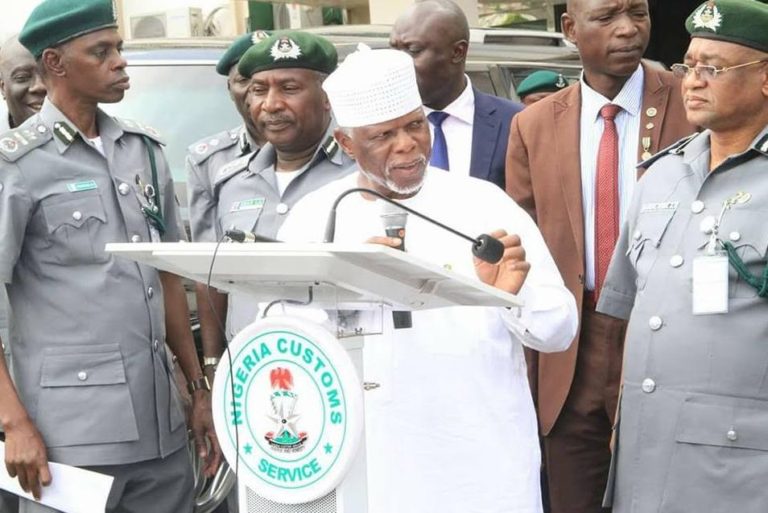
IN DEFENDING Nigeria’s decision to close its land borders, the Comptroller-General of Nigeria Customs Service, Hameed Ali, has repeatedly claimed that China similarly shut its borders to international trading for decades and this somehow improved its economic fortunes. But this is not true. 

Following a partial closure exercise two months earlier, the Customs Service announced in October that it had banned the importation and exportation of goods through the country’s land borders to ensure “total control over what comes in”.

Despite widespread criticism from many quarters, including from the Economic Community of West African States, President Muhammadu Buhari earlier this month approved the extension of the closure till the end of January 2020.

To justify the closure weeks ago while addressing the press, Ali said in a widely shared video that China also closed its borders “for 40 years to the whole world and today they are great China”.

“Don’t you want to be great Nigeria?” he then asked.

Last Friday, the Customs boss insisted the federal government will not bow to pressure from neighbouring countries to reopen the borders, again citing the Chinese example—only now halving the number of years.

“The Chinese closed their doors for over 20 years and now they are on top,” he said.

“We need to close our own. There is nothing that is being produced today that we cannot consume in Nigeria. Our industrialists do not have to look out to find the market; we have it right here. And we need to grow that market.”

No evidence this ever happened

The ICIR has found no record proving that China, on its way to becoming a global economic powerhouse, ever shut its frontiers totally to international trade. The contrary appears, in fact, to be the case.

Fatima-Zohra Er-Rafia, an independent researcher and PhD in Business Administration with a focus on China and Japan noted in a 2018 publication that the first of four major factors that made China become the World’s second economic power is “Deng Xiaoping’s opening-up-to-the-world policies and the 1979 Equity Joint Venture Law”. (Xiaoping was China’s paramount leader between 1978 and 1992.)

“Together they have allowed (among other things) foreign capital and Western companies to enter China, transforming the domestic economic landscape entirely from one that is traditional and obsolete to one that is dynamic and modern,” she wrote.

The Chinese, however, did put in place some measure of border closure in the 15th century in reaction to an influx of foreign merchants and settlers and in order to protect local traditions. The isolation of the empire started during the Ming dynasty and continued into Qing dynasty.

Through a series of isolationist policies known as the haijin (or sea ban), the empire ordered the restriction of private maritime trading. Trading still occurred during this period though through piracy and smuggling, and local authorities even disregarded the law by engaging in illicit trading. Nevertheless, the restrictions led to a loss of revenue from taxation, funding difficulties, and a rise in poverty levels.

‘Not in recent times,’ says expert

Hans van de Ven (FBA), a professor of Modern Chinese History at the University of Cambridge, told The ICIR that China has not closed its borders “in recent times” as suggested by Ali.

“If your official is referring to the People’s Republic, China was subject to a US embargo until the 1970s, and hence couldn’t trade with US-allied countries, but that is rather different than China closing its door,” said Hans, who is also a Guest Professor at Nanjing University’s Department of History.

“In this period, China did trade with and exchange personnel with Communist countries. During the Qing dynasty, China did close its doors to foreign trade for a couple of decades, but it needed foreign trade and so opened them again.”

He further emphasised that the link between China closing its country and hence having a vibrant economy, as implied by the Customs boss, “seems very difficult to defend”.

The total trade embargo imposed by the United States followed China’s intervention in the Korean War in the late 1950s and was ended by US President Richard Nixon.

Also writing in response to enquiries from The ICIR, Michael Szonyi, a professor of Chinese History at Harvard University and Director of the Fairbank Center for Chinese Studies, described the claim as “factually inaccurate”.

“At no point in the twentieth-century did China (or any political regime governing China) close its borders to international trade,” he said.

“While China’s international trade did vary considerably over the Maoist period, the increase of China’s international trade in the late 1970s coincides with the rapid growth in the Chinese economy (though the causal relationship between these phenomena continues to be debated).”

World Bank statistics negate claim

A look through data from the World Bank shows that there was no time in China’s history, from 1960 till date, when either imports or exports of goods and services seized completely.

In 1960, imports into the country were worth $2.6 billion and have risen over the years to an all-time high of $2.5 trillion in 2018. The lowest point was in 1962 when imports were worth $1.4 billion. The steep in imports noticeably started in the 1990s.

The data on exports show a similar trend. All exports were worth $2.6 billion in 1960 and have risen to $2.7 trillion in 2018. The lowest value was $1.9 billion in 1962.

Interestingly, statistics from the World Bank also reveal that the ascending curve in China’s Gross Domestic Product (GDP) corresponds sharply and proportionally to the curves representing the weight of its imports and exports. This means the country’s GDP increased at the same time and rate as transactions with other countries received a boost.

The trend of China’s GDP, import, and export growths. Source: World Bank National Accounts Data

“Through the 1990s, China began to clock rapid growth rates and joining the World Trade Organisation in 2001 gave it another jolt. Trade barriers and tariffs with other countries were lowered and soon Chinese goods were everywhere,” the BBC reported in October, citing David Mann, global chief economist at Standard Chartered Bank.

‘It is a fallacy’

Former BudgIT head of research and Senior Project Officer at the International Budget Partnership, Atiku Samuel, also described the claim that China closed its borders to the whole world as “actually a fallacy”.

“China has never and will never close its borders to the whole world,” he emphatically told The ICIR.

“What they had was more of a stringent, regimented trade agreement … The second thing is that there is no nation, even North Korea that in quote people believe now that they have a closed border, they still do trade with their neighbours. They still do trade with China. They still do some level of trade with other people in the world. And that’s about the most closed economy you can think about now. In clear terms, a country cannot exist without doing trade with its neighbouring countries.”

Samuel said the situation in (West) Africa is a complex one since the communities in various countries were already trading among themselves before modern borders were introduced.

“My own conclusion is that nothing like that exists in the world. I am yet to see it. What you can have is some level of restriction around trade. And then even the modalities for ensuring you have a closed system can never happen in Nigeria, except we have money to fence all the 4000 kilometres (of the border).”

The policy analyst also said, in 2015, Nigeria exported goods worth about N1.04 trillion to West African countries and imported about only N74 billion worth of goods.

Indeed, according to data from the Observatory of Economic Complexity (OEC), between 2010 and 2017, Nigeria exported goods worth up to $25.04 billion to other West African countries while it imported only goods worth $9.09 billion. And, in 2017 alone, its export value to the region was $2.6 billion, far outweighing its import value of $309.1 million.

The implication of this, Samuel explained, is that “Nigeria has more advantage in terms of trade with West Africa … We sell more to them than we actually take from there. That is given. That is a statistic of government”.

He said, with the border closure, Nigeria is not only breaching the ECOWAS free-trading policy but is also encouraging smuggling and black market transactions.

The solution, he concluded, is to address why goods produced locally cannot compete with cheaper ones from other countries and to make legitimate importation hassle-free by improving the ports.

“We need to look at why the cost of production in Nigeria is high and we need to begin to address those issues. That is the only practical way to stop unnecessary importation.”

Verdict

The claim made by the Customs boss that China, towards becoming a global superpower, closed its borders to the whole world is false. China made that move in the 15th and 16th century, but not only were the protectionist policies unsuccessful and widely disobeyed, they also led to increased poverty levels and reduced government revenue.

The rise of China’s GDP, The ICIR likewise observed, in fact, corresponds over the years with an increase in trading with other countries.

The country did not close its borders in the 20th century when its economic indices sharply improved but rather was on the receiving end of a 21-year trade embargo imposed by the United States and its allies.

African Union orders Britain to withdraw from Chagos Islands, end ‘colonial administration’

The African Union ordered Britain on Friday to withdraw from the Chagos Islands and end its “continued colonial administration” after a United Nations deadline for it to do so expired.

The Chagos Islands belong to the Indian Ocean island nation of Mauritius, according to the advisory opinion the top U.N. court issued in February. The U.N. General Assembly in May voted in favour of Britain returning the islands to Mauritius and set a deadline for Nov. 22.

In a statement, the African Union called on Britain to comply with the U.N. resolution.

Britain does not recognize Mauritius’ sovereignty claim.

“The UK has no doubt as to our sovereignty over the British Indian Ocean Territory (BIOT), which has been under continuous British sovereignty since 1814,” the Foreign Office said in a statement on Nov. 5.

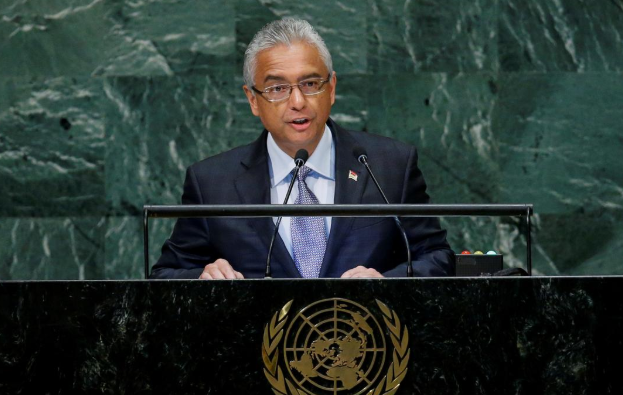
Mauritius Prime Minister Pravind Kumar Jugnauth called Britain’s refusal to give up control of the islands a violation of international law.

“The United Kingdom cannot profess to be a champion of the rule of law and human rights whilst maintaining an illegal colonial administration,” he told parliament on Thursday.

The only inhabited island of the Indian Ocean archipelago is home to the Diego Garcia U.S. military base, rented out by Britain and a bomber base for the Air Force.

(Reuters)