Home Blog Page 2246

Court jails six internet fraudsters in Delta

0

A FEDERAL High Court sitting in Warri, Delta State has on Wednesday convicted six internet fraudsters charged by the Economic and Financial Crimes Commission (EFCC) Benin Zonal Office.

In a statement made available to The ICIR, the commission disclosed that it has been able to secure the conviction of six internet fraudsters apprehended in 2018.

According to EFCC, the convicts are Ufuoma Miracle ( a.k.a Roland Gobalin) ,  Ofomola Omovigho ( a.k.a Doctor),  Abraham Idede ( a.k.a Eugene Berry) ,Onatakapoma Julius (a.k.a Chris Roman: Frank Leonard),  P. Rarowe (a.k.a Meyers)  and Freeborn Efe.

The commission said five of the convicts, Miracle, Rarowe , Julius,  Omovigho and Efe were arraigned on charges of impersonating foreign nationals on Facebook and defrauding their female victims in the process.

EFCC added that the sixth defendant, Abraham Dede was arraigned on a count charge of making a false statement and misrepresenting his identity for the purpose of procuring a Facebook account with intent to defraud unsuspecting people.

The Sitting Judge on the case, Emeke Nwite on Monday, November 18 convicted and sentenced five of the defendants to six months imprisonment and a fine of N200,000 each while Ofomola Omovigho was fined N300, 000.

One of the counts reads: “That you Onatakapoma Julius ( a.k.a Be. Chris Roman, a.k.a Frank Leonard) sometime in 2018 at Sapele, Delta State within the jurisdiction of this honourable court did with intent to defraud sent electronic messages which materially misrepresent facts to one  Linda”.

The commission noted that Linda is a lady from Indonesia who suffered financial loss amounting to the sum of N370,769, 88 only and thereby committed an offence punishable under Section 14(2) of the Cybercrime (Prohibition Prevention etc) Act, 2015.

The statement further read that the six convicts pleaded guilty to the charges read to them by the Judge as levied against them by the commission.

EFCC added that the defence counsel, P.E.Ejiga prayed the court to temper justice with mercy as they were first time offenders who are remorseful for their actions.

The prosecution counsel, Fredrick Dibang urged the court to convict the defendants and also prayed the court order the forfeiture of items recovered from the defendants to the Federal Government.

Nwite, therefore, ruled that all items recovered from the convicts during investigation be forfeited to the Federal Government of Nigeria.
Buhari sets up agency to curb open defecation by 2025, urges lawmakers to penalise practice

0

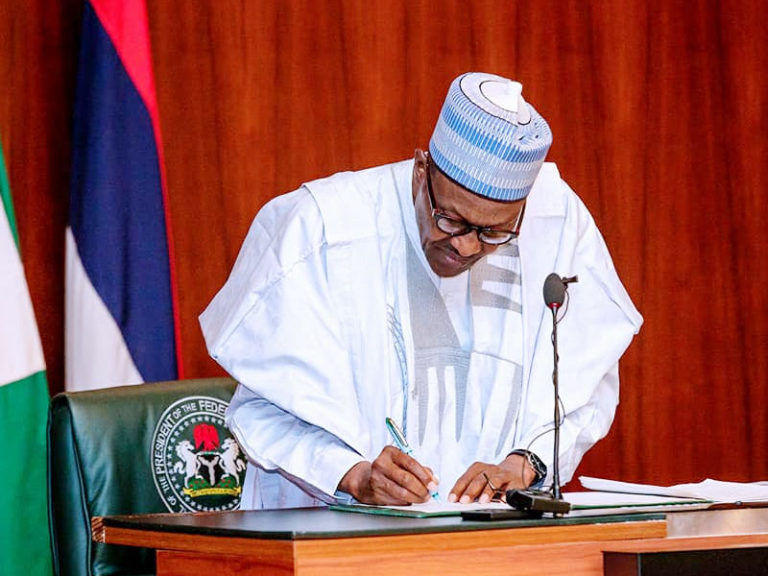
PRESIDENT Muhammadu Buhari on Wednesday has signed an executive order setting up an agency to ensure all public spaces have sanitary facilities and end open defecation in Nigeria by 2025.

The Executive Order 009, according to a press release signed by presidential spokesman Femi Adesina, is titled The Open Defecation-Free Nigeria by 2025 and Other Related Matters Order, 2019, and is meant to show that Nigeria is committed to being open defecation-free in six years time.

The order, which takes effect immediately, charged that the National Open Defecation Free (ODF) Roadmap developed by National Council on Water Resources in 2014 be implemented.

It also establishes under the Federal Ministry of Water Resources a “Clean Nigeria Campaign Secretariat”.

According to the executive order, the secretariat is authorised to, on behalf of the President, ensure “that all public places including schools, hotels, fuel stations, places of worship, market places, hospitals and offices have accessible toilets and latrines within their premises”.

It further instructed all ministries, departments, and agencies to cooperate with the secretariat, and urged the National Assembly and state lawmakers to make open defecation a crime punishable under the law.

“All development projects shall include construction of sanitation facilities as an integral part of the approval and implementation process,” it added. “The Secretariat shall terminate when Nigeria is declared Open Defecation Free.”

The press statement said the order became necessary considering that Nigeria “is ranked second amongst the nations in the world with the highest number of people practising open defecation estimated at over 46 million people – a practice which has had a negative effect on the populace, and has contributed to the country’s failure to meet the United Nations Millennium Development Goals (MDGs)”.

“President Buhari had described the statistics on open defecation and access to pipe-borne water service and sanitation as disturbing, and had declared commitment to implement the National Water Supply, Sanitation and Hygiene (WASH) Action Plan,” it added.

“The President had declared a State of Emergency on Nigeria’s water supply, sanitation and hygiene sector, the action being imperative as it will reduce the high prevalence of water-borne diseases in different parts of the country which have caused preventable deaths.

“Nigeria has committed to end open defecation throughout the country by 2025 in consonance with her commitment to the United Nations Sustainable Development Goals (SDGs).”

Social media bill passes second reading despite criticism by Nigerians

0

ON Wednesday, the Bill for an Act to regulate the spread of fake news on the internet has passed its seconding reading, despite criticism by media practitioners and other stakeholders that it may violate the rights of expression of Nigerians.

The bill titled: Provisions for the Protection from Internet Falsehood and Manipulations Bill, 2019 (SB. 132) was sponsored by Senator Muhammed Sani Musa.

Senator Ibrahim Gobir and  Senator Elisha Abbo have argued for the speedy passage of the bill.

Abbo alluded to his own experience as a victim of propaganda circulated on social media, saying “even conventional media that are regulated are suffering from falsehood.”

“Today we know that America has risen up against fake news as it has had very terrible consequences in America. Fake news is dangerous, therefore Mr President, we must rise to the challenge,” Abbo said.

However, Senator Chimaroke Nnamani expressed disapproval over the passage of the bill, saying, “I not only oppose it in totality, but I also condemn this Bill”.

Nnamani said, “based on our constitution that guarantees freedom of speech, there is a cybercrime act that deals with this”.

The Senate President Ahmad Lawan referred the Bill to the Committee on Judiciary, Human Rights and Legal Matters to report within four weeks.

The presidential candidate of the People’s Democratic Party (PDP), Atiku Abubakar in the 2019 General Elections had criticized the proposed bill as a means to shrink the democratic space to satisfy personal and group interests.

The mere contemplation of such laws is in itself not just hate speech but an abuse of the legislative process, Atiku was quoted by his media aide Paul Ibe.

The Nigerian Bar Association (NBA) also “strongly advised” the senate to tread carefully on the bill.

NBA said that the newly introduced bill could not be justified in a democracy reminding the senate that section 39(3) of the Nigeria Constitution had made it mandatory that no law could abrogate the rights of Nigerians to exercise their right to freedom of speech.

Meanwhile, the bill proposing the establishment of a regulatory agency to protect persons with mental health has on Wednesday passed second reading at the Senate.

The bill, proposed by Oloriegbe Yahaya, who represents Kwara Central Senatorial District also seeks to establish a commission for mental and substance abuse services, to effectively manage mental health challenges in the country.

The bill is titled: “A Bill for an Act to provide for the establishment and regulation of Mental Health and Substance Abuse Services, protect persons with mental health needs and establishment of National Commission for Mental and Substance Abuse Services, for the effective management of mental health in Nigeria and for other related matters, 2019 (SB. 66)”.The bill was supported by Senator Matthew Urhoghide and Senator Abdullahi Yahaya.


Customs nabs man with 2.5 million fake currency, intercepts 40 drums of NAFDAC stamped ethanol

0

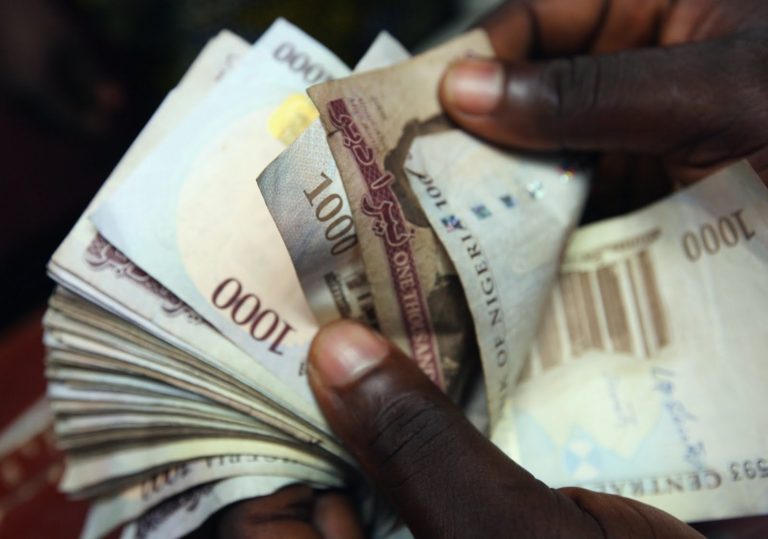
THE Nigeria Customs Service (NCS) Ogun State Command 1 said it has apprehended a man with 2.5 million fake Nigerian currency notes on Tuesday during patrol by the anti-smuggling unit of the service.

In a statement by NCS Public Relations Officer, Abdullahi Maiwada, he said the NCS Ogun State Command 1 arrested one Samson Odejiba who was in possession of the fake notes at Ihunbo checking point along Sango-Idiroko road.

According to Maiwada, he said the suspect assented to the allegation and confessed that he was contracted by one Alfa who promised to remunerate him with N5,000 if he delivers them to Owode-Yewa.


READ ALSO:

The notes are allegedly being targeted at people who have the intention of changing their cash to new notes.

 Maiwada added that the anti-smuggling team also intercepted 40 drums of ethanol stamped by the National Agency for Food and Drug Administration and Control (NAFDAC) for industrial use.

He noted that some people are in the habit of distributing the product to unsuspecting members of the public, who ignorantly mix it with water and sell as an alcoholic beverage.

He said the ethanols are mostly dispersed as alcoholic beverage in Idiroko and neighbouring towns of the state.

He added that the ethanol are imported from the Republic of Benin for industrial use but the suspects sell it to final consumers without going through industrial processing.

Maiwada said the consumption of the product taken as alcoholic beverage is harmful to the health of those who drink it.

Convicted fraudster inside Kirikiri caught in fresh $100m fraud

0

THE Kirikiri Maximum Prison in Lagos state is under fire as an incarcerated internet fraudster, Hope Olusegun Aroke, doing 24 year jail time in the prison has been caught masterminding another  $100,000,000 fraud.

The Economic Financial Crimes Commission (EFCC) said it is currently investigating Aroke who it said bears a fictitious name, Akinwunmi Sorinmade.

The convict had opened two accounts with First Bank Plc and Guaranty Trust Bank Plc.

A statement by EFCC on its official website said the convicted fraudster pulled the heist right from prison using a network of accomplices.

The lid on his latest scheme was blown following intelligence received by the EFCC, the Commission said.

EFCC said a preliminary investigation revealed that the convict, against established standard practice, had access to internet and mobile phone in the Correctional Centre where he is supposed to be serving his jail term.

“Even more puzzling was the finding that Aroke got himself admitted to the Nigeria Police Hospital, Falomo, Lagos for an undisclosed ailment. And from the hospital, he would move out to lodge in hotels, meet with his wife and two children and attend other social functions,” the statement said.

The circumstance of his admission into the hospital and those who aided his movement from the hospital to hotels and other social engagements, is already being investigated by the EFCC.

Besides the account that he opened with the two banks, the Commission revealed that Aroke also bought a  property at Fountain Spring Estate, Lekki Lagos in 2018 for N22million and a Lexus RX 350 2018 model registered in his wife’s name, Maria Jennifer Aroke.

“The convict was also in possession of his wife’s bank account token in prison, which he used to freely transfer funds,” it said.

Further investigation revealed that, while his trial was ongoing in 2015, Aroke bought a four-bedroom duplex at Plot 12, Deji Fadoju Street, Megamounds Estate Lekki County Homes, Lekki for N48million.

Aroke was one of two Malaysia-based Nigerian undergraduate fraudsters arrested by the EFCC in the closing weeks of 2012 at the 1004 Housing Estate, Victoria Island, Lagos following a tip-off.

The indigene of Okene, Kogi State had claimed to be a student of Computer Science at the Kuala Lumpur Metropolitan University, Malaysia.

But the Commission’s investigation fingered him as the arrowhead of an intricate web of internet fraud scheme that traverses two continents.

When Aroke was arrested, a search conducted by EFCC operatives on his apartment led to the recovery of several items such as laptops, iPad, traveling documents, cheque books, flash drives, internet modem, and three exotic cars – a Mercedes Benz Jeep, One 4Matic Mercedes Benz Car and a Range Rover Sport SUV.

He was eventually convicted by Justice Lateefa Okunnu of a Lagos State High Court on two counts of obtaining money by false pretence, cheque cloning, wire transfer and forgery.

He was sentenced to twelve years imprisonment on each of the two counts.


Tackle poverty to clampdown on extremism in Africa ― Tony Elumelu

0

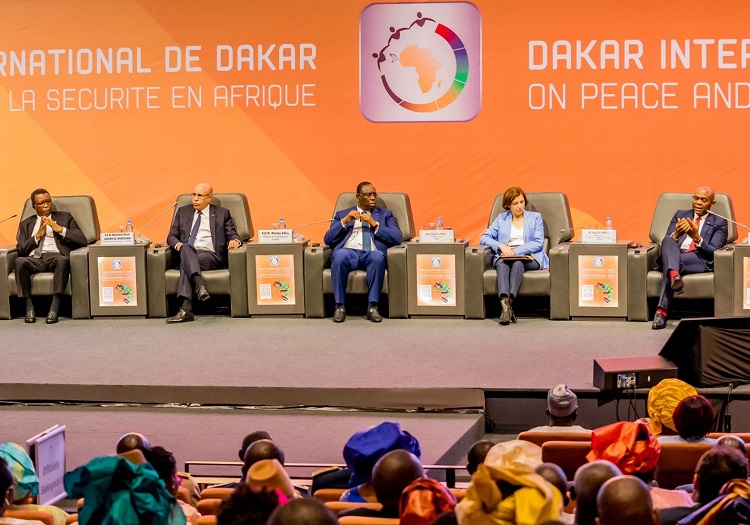
THE Founder of the Tony Elumelu Foundation (TEF) and Chairman of the United Bank for Africa Group (UBA) Tony Elumelu has stressed the need to tackle extremism in Africa, by annihilating its root cause, poverty.

He made this disclosure while speaking on a high-level panel with some Africa Leaders including; Macky Sall, President of Senegal; Mohamed Ould Ghazouani, President of Mauritania; Florence Parly, Defence Minister of France; and Pierre Buyoya former President of Burundi and representative of the African Union in Dakar, Senegal.

“We know, and we say, that poverty anywhere is a threat to mankind everywhere. What manifests itself in what we call security breakdown or terrorism, or extremism is actually deeply rooted in poverty, in joblessness.

“So with due respect, we can have 101 seminars like this but unless and until we begin to address these issues of poverty, joblessness amongst our young ones, they will continue to allow themselves to be brainwashed by people who see no future, and they will continue to engage in extremism,” he said.

Elemelu said, while the discussion of weaponry and other means to deal with the insurgency, is inevitable,  “lasting peace can only be attained in the long run by investing in our young people across Africa”.

The business mogul proposed job creation for the youth, inclusive growth, and gender diversity as priority areas for Africa’s development agenda to achieve peace and stability on the continent.

In the same light, H.E. Macky Sall consented to the need for the public sector to collaborate with the private sector to tackle poverty on the continent.

He said: “Addressing the threats cannot be done on a standalone basis due to the fact that the challenges know no borders”. He called for a more collaborative approach to alleviate violence and extremism to boost investments in Africa.

Elumelu identified the impact of the TEF’s $100 million Entrepreneurship Programme as one of the practical ways the private sector in Africa can intervene in ensuring peace and stability on the continent.

He also referenced the partnership between the United Nations Development Programme (UNDP) and the TEF to empower 100,000 young Africans in 10 years with a focus on the Sahel region for its first year.

listing other TEF partnerships with international development agencies such as GIZ and ICRC, he said such activities and interventions would help bring economic hope to people in Africa.

“We support these young ones and we are beginning to see how their successes are translated into better and more secure communities,” he said.

Elumelu said businesses cannot flourish where there is extremism stating that people are afraid for their lives and such will deter global private capital needed for large infrastructure projects and long-term investments which can help to fix Africa’s economy.

Elumelu ended his session on an optimistic note, calling on all stakeholders to collaborate to win the war on poverty and insecurity.

“There is a lot we all can do – the private sector, government, and development partners – in making sure that we focus on winning the war on terrorism; that we make sure we stem the migration of our young people crossing the Mediterranean through harsh conditions, in search of hope, when indeed we have more opportunities and resources in our continent. We need to work together to ensure that extremism is totally annihilated in Africa. It is possible but we need to work together to achieve this,” he said.

Suspect on FBI list bags two years imprisonment for $150,000 fraud

0

ON Tuesday the Economic and Financial Crimes Commission, ( EFCC), Sokoto Zonal office secured the conviction of one Emmanuel Adedeji Oluwatosin, whose name was on the wanted list of the US Federal Bureau of Investigation, (FBI).

According to a statement by the EFCC, Oluwatosin was convicted before Justice M S. Sifawa of the Sokoto State High court sitting in Sokoto and prosecuted on one count charge bordering on Internet fraud to the tune of $150, 000.

The charge  reads, “that you Adedeji Emmanuel Oluwatosin, sometime between January and July 2019 at Sokoto within the jurisdiction of the Sokoto State High Court did steal the sum of $150, 000 through wire funds transfer from multiple foreign victims by fraudulent intrusion into their retirement accounts domiciled in United States of America via internet…

“…and transferred the said sums into fraudulent business accounts created by you and you withdrew the said funds through ATM Cards and cashier cheques and you thereby committed the offence of Theft contrary to Section 274 of the Sokoto State Penal Code Law 2019 and punishable under Section 275 of the same Law”.

The statement noted that upon arraignment, Oluwatosin pleaded guilty to the charge.

It said, in view of the defendant’s plea, the prosecuting counsel, Musa. Mela Gwani asked the court to convict and sentence the defendant.

However, the statement noted that the defence counsel, Shamsu A. Dauda, pleaded with the court to temper justice with mercy as his client was a first time offender who has become remorseful.

It said, Dauda told the court that the convict is ready to restitute the victims by forfeiting his home in Kaduna and two Mercedes Benz cars (Models C550e and C450) to the victims.

Justice Sifawa, thereafter convicted and sentenced the defendant to two (2) years imprisonment with an option of N2 million fine and ordered the convict to restitute the victims by forfeiting the proceeds of the said crime:

“A residential apartment situated at No17/19 Seamans Street, Maigero, Kaduna State and two Mercedes Benz Models C550e and C450 respectively through Asset Forfeiture Unit of the EFCC for disposal and return of the proceeds to the victims of the offence through the US Legal Attaché in Nigeria,” the paper said.

The statement said Oluwatosin’s journey to prison started on the 29th of August when he was arrested in Kaduna at Unguwan Maigero in a luxury apartment, following intelligence by FBI on his involvement in internet scams.

“Items recovered from the residence included two cars (Mercedes Benz C550e, Mercedes Benz C450), an iPhone, laptops, a modem and SIM cards,” the statement said.

Haemophilia: Rare but affects Nigerians, group seeks govt support

WHEN the six-year-old Trust missed school on Tuesday to join Haemophilia Foundation of Nigeria (HFN) for an awareness campaign in Abuja, his father also had to take the day off at work.

The HFN, a non-governmental organisation that advocates on behalf of all Nigerians with blood disorders, has set aside November 18 to 24  as the national Awareness Week for the bleeding disorders in Nigeria.

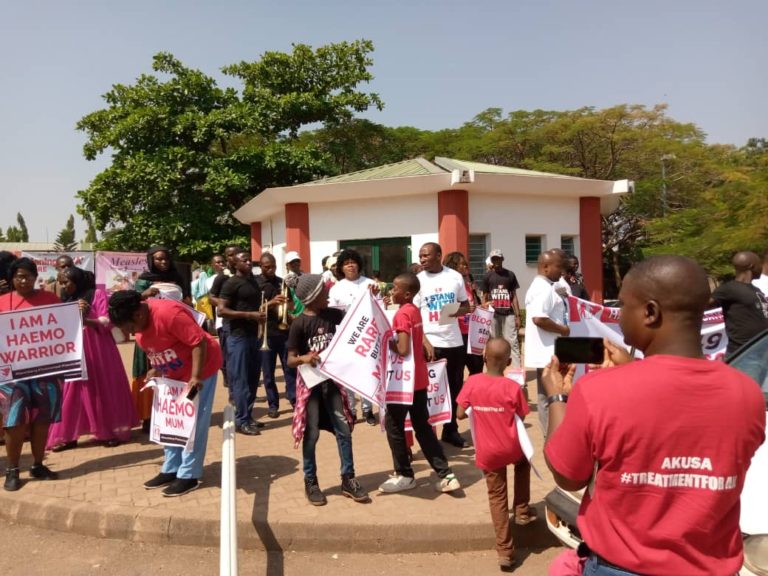
The march that took off at the National Hospital, Abuja on Tuesday morning was a crowd of persons living with haemophilia, relatives, nurses, doctors and other individuals that seek an end to the disorder.

The group had later marched to the Federal Ministry of Health at the Federal Secretariat Complex. 

Olawole Omitola, the foundation’s program officer told The ICIR that the awareness aims to seek the government’s attention on the disease. She said the government has not supported the treatment and management of persons with the disorder in the country, adding that there was no national plan to address the condition. 

“So we are at the Ministry of Health so as to get the attention of the minister to allocating funds for the treatment of this condition,” she said.

Having identified over 450 Nigerians with haemophilia, the foundation said more were not aware of their conditions as 97 per cent remain undiagnosed. “Nigerians with bleeding disorders remain with little or no treatment at all,” it noted. 

Haemophilia is a bleeding problem. People with haemophilia bleed for a longer time. Their blood does not have enough clotting factor, a protein that controls bleeding. It is a rare condition that usually affects a male person whereby any injury on the body would result to prolong bleeding.

The group creating awareness at the Federal Secretariat on Tuesday. Trust in front by the right.

Ojetunde Bolanle, a doctor in the department of haematology unit of National Hospital, Abuja said most parents do not know of their children disorder until the circumcisions are carried out where the cut could not stop bleeding. She said the continuous bleeding could lead to death when professional healthcare was not received.

Bolanle said it is important to identify babies with the condition immediately after birth to avoid unnecessary bleeding that could result in death.  

“Sometimes, they bleed to death. It’s a very dangerous disease to have, she said adding that People with haemophilia could bleed inside or outside the body.

Most bleeding in haemophilia occurs internally, into the muscles or joints, she said.

“Bleeding into particular joint overtime make walking difficult. You can see people with bow legs, bent legs, and some already retired to wheelchairs”.

The doctor said about 50 people have registered with the National Hospital for treatment of the disorder. According to her, the cost of the treatment for a person in crisis could be as high as N250,000, which could be every week, monthly, yearly depending on the severity of the individual condition.

“Children that are yet to be identified could bleed to death. After circumcision, if they are lucky enough they just give them blood transfusion when what was necessary was the real treatment to avert complications.

“We need support from the government to make sure people are not dying unnecessarily,” she said.

Alayo Sopekan, the National Desk Officer of haemophilia and sickle cell disease at the Federal Ministry of Health while addressing the group at the Ministry encourage them to forward their concerns to the National Assembly. He said the ministry could do only but a little if the National Assembly does not approve a plan proposed to manage the condition in the country. 

“It (the campaign) should not be restricted to the Ministry of Health because the thing is we can have good plans for you but if we send the plan to the National Assembly, who are your representatives, and those things are not approved, is there anything we can do?” he said.

But Sopekan assured the foundation that the government would address the issues surrounding haemophilia in the country. He agreed that the government needs to adopt a national roadmap for the treatment and management of the disorder.

Trust who had took the day off from school today held his banner all through the street campaign.  It reads “Nothing about us without us”. His father told this reporter that the awareness was necessary in  order to make sure that unborn children do not inherit the condition 

Other children, teenagers and adults with the disorder that were present including their caregivers all held placards and pamphlets that narrated some of their experiences. Many had travelled from other towns to the Federal Capital Territory.

Senate to investigate NEMA over ‘selective’ disaster response in 2019

0

THE Senate on Tuesday has directed its Committees on Special Duties, Ecology and Climate Change and Environment to investigate the effectiveness of the National Emergency Management Agency over disaster response in 2019.

The directive follows the implementation of a response programme for the flood disaster that affected various communities in Demsa, Numa, Guyuk and Lamurde Local Governments of Adamawa State.

Senator Binos Yaroe (APC, Adamawa South) moved a motion to have NEMA investigated.

According to him, the agency has been selective in its disaster response intervention which goes against the Act 50 of the 1999 constitution that established NEMA.

“NEMA performed a disaster response action by distributing relief materials to communities in Furore, Yola South, Yola North and Girei Local Governments of Adamawa State affected by the floods.

“This intervention by NEMA was not extended to other local governments in Adamawa State along the River Benue valley equally affected by the flood disaster.

“Although the attention of the Director-General of NEMA was drawn to the need to provide relief materials to communities of the four local governments in Adamawa State severely affected by the October floods, nothing has been done; and NEMA would appear to be selective in its disaster response interventions,” Yaroe said.

Meanwhile, the Senate on Tuesday has also considered a Bill for an Act to amend the National Council on Public Procurement and Bureau of Public Procurement Act No. 14 of 2007.

The bill sponsored by Senator Abdullahi Sankara is among the three bills up for amendment of the Public Procurement Act by the National Assembly.

According to the Senate President, Ahmad Lawan, an amendment to the Public Procurement Act would ensure a successful implementation of the 2020 budget when passed into law by the National Assembly.

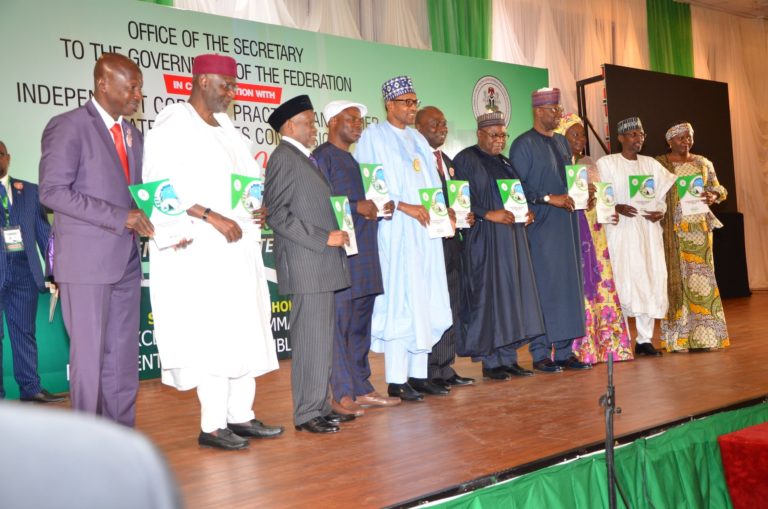
This development comes also as President Muhammadu Buhari at the National Summit on Diminishing Corruption in Public Sector told the Independent Corrupt Practices and other related offences Commission (ICPC) to investigate contractors and government collaborators who have been receiving funds for constituency projects that till date remain incomplete.

“N1tn has been appropriated in the last 10 years for constituency projects, but the impact can hardly be seen,” the president said at the State House Conference Centre Tuesday in Abuja.


Buhari directs ICPC to probe ministries yet to join govt’s e payment platform

PRESIDENT Muhammadu Buhari has directed the Independent Corrupt Practices And Other Related Offences Commission (ICPC), to put its searchlight on ministries, departments and agencies (MDAs), that have not migrated to the Integrated Payroll and Personnel Information System (IPPIS), to reduce public sector corruption.

The president spoke on Tuesday at a summit on “Diminishing Corruption in the public sector” organised by the anti-corruption agency and the Office of the Secretary to the government of the Federation, OSGF, held at the State House Conference Centre, Abuja.

“I urge ICPC to beam its searchlight on all agencies yet to get on the IPPIS and our e-government platform in order to fully halt the padding of personnel budgets and the diversion or misappropriation of capital budgets,” he said.

Buhari commended the ICPC’s efforts to reduce public sector corruption through preventive strategies, said that his administration had mandated all government agencies to join the e– payment system.


READ ALSO:

The president, who reiterated his conviction that corruption is one of Nigeria’s major problems, said that fighting it would require the efforts of all arms of government working together. He also called on all Nigerians to join the government in efforts to combat the malaise.

“As I have repeatedly said, corruption is the cause of many major problems in our country. It is a catalyst for poverty, insecurity, weak educational system, poor health facilities and services and many other ills of our society,” Buhari said.

He observed with dismay that over N1 trillion has been spent zonal intervention projects, otherwise known as constituency projects, but lamented that the result of this huge investment has not been felt by communities and ordinary Nigerians.

“It is on record that in the past ten years One trillion naira (N1trillion) has been appropriated for constituency projects yet the impact of such huge spending on the lives and welfare of ordinary Nigerians can hardly be seen,” the president noted.

The President commended the ICPC for saving the government billions of naira that it discovered in padded personnel costs of MDAs and the assets it had so far recovered from corrupt persons, assuring Nigerians that he would ensure that all recovered assets and funds are used for the benefit of the people.

In his own remarks at the Chief Justice of Nigeria (CJN), Justice Ibrahim Muhammad, who also agreed that corruption is the nation’s major problem, bemoaned a situation whereby Nigeria has earned a bad name in the comity of nations, in spite of the efforts by successive administration to address the problem of corruption.

He commended the efforts of the ICPC and other anti-corruption agencies in tackling the cankerworm, noting that the administration of President Buhari has shown a will to deal with the problem headlong.

Muhammad said that the anti-corruption effort of the government is already yielding fruits as seen in Transparency International’s latest Corruption Perception Index, which ranks Nigeria 144 on the list of corrupt nations, up from 158.

He, noted, however, that the ranking still shows that a lot needs to be done, adding that the ICPC, EFCC and other anti-graft agencies must be challenged by the Transparency International rating.

The CJN said that every arm of government, including MDAs, must put in place an internal anti-corruption system, adding that the judiciary’s effort at doing this is evidenced by the National Judicial Council, NJC’ss sanctioning of erring judicial officers.

Justice Muhammad assured that the judiciary under him would not condone any maleficence on the part of judicial officers, but also called on the government to ensure that every Nigerian is held accountable for his actions, irrespective of his/her position in society.