Home Blog Page 2262

ANALYSIS: Why Nigeria’s border closure may spike price of local rice

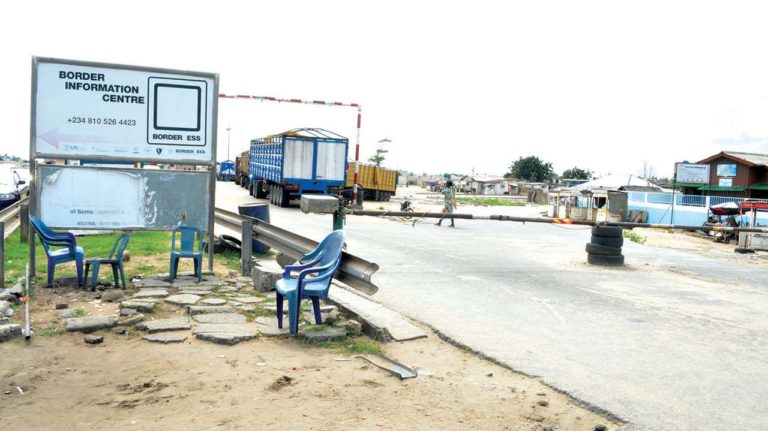
SINCE the Federal Government launched a border closure policy in late August, the decision has triggered mixed reactions from Nigerians, neighbouring countries and regional bodies.

Farm produce from neighbouring nations such as Benin Republic, Togo, Ghana meant for the Nigerian market rots away daily due to the government’s policy. And the cost of food items in Nigeria, particularly rice, is on a steady rise.

For instance, prior to the land border closure, a 50kg bag of rice that was sold at N13, 000, now goes for N25, 000.


As at 2011, Nigeria annually spent N24.5 trillion importing food items into the country. Five years after, a different report put the figure of four major imported commodities – Wheat, Rice, Sugar and Fish at $11 billion (4 trilliion). Experts have argued that Nigeria’s fertile soil places it at advantage to grow rice in over 18 states across the country, thus feeding itself with the commodity which has an annual estimated import figure of N356 billion.

For reasons partial border closure appears to be the right decision, the above figure is invariably assumed good enough to create local jobs. Rather, what we have are continued job exports through persistent food imports. Former Ministers of Agriculture and Rural Development, Dr. Akinwumi Adesina and Chief Audu Ogbeh, as well as former Agriculture Minister of State, Heineken Lokpobiri, have repeatedly claimed rice and frozen foods illegally imported through the land borders lack good nutritional value compared with local varieties. They argued further that such imports keep crippling local capacity and government efforts to promote farming, especially among the youth. Ironically, more than 18 states from the 36 across the country have the potential to grow rice.

Some of the states include Kebbi, Ogun, Kaduna, Adamawa, Sokoto, Kano, Katsina, Cross Rivers, Ebonyi, Benue including the Federal Capital Territory (FCT) to mention but few.

Most importantly, the sector has significantly enjoyed the attention of repeated administrations either in terms of funding or policy. Aside from Levy and Excise Duty-free tariff for agricultural commodities, the sector has enjoyed World Bank loans through the FADAMA projects and recent FADAMA Additional Funding I and II.  The CBN, as at April 2019 says it has so far disbursed N174.48 billion to farmers via the Anchor Borrowers Programme (ABP). And since the border closure, the federal government boasted to have raked in N1.4 billion and arrested 319 suspected smugglers.

But, despite these interventions and the recent land border closure, believed good enough to ensure self-sufficiency in rice production, the nation might continue to witness higher costs of rice except deliberate and sustained actions are taken in selected areas. The ICIR identifies these to include farm mechanisation, extension services, subsidy for farmers such as the Growth Enhancement Support Scheme (GES), establishment of more rice milling centres, improved finance – single-digit interest rate; banks until lately have been recalcitrant to lending to farmers and even those who do do so at high-interest rate; addressing infrastructure deficit and awareness creation on insurance or early warning system against flooding or natural resources that could affect farm harvests.

Farm Mechanisation
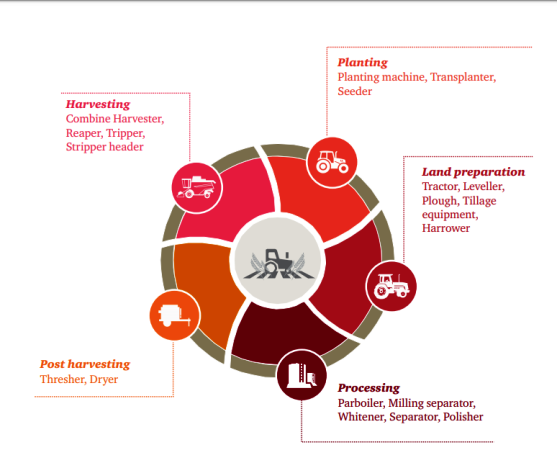
 

Machinery and Equipment Requirement Across the Rice Value Chain.
Source: PWC 2017 Report on Boosting Rice Production through Increased Mechanisation

Statistics have shown that Nigeria’s large population is fed by subsistence farmers largely in rural communities. Majorly, 80 percent of rice grown in the country which is about 3.7 million tonnes is produced by smallholder farmers while the remaining 20 percent is cultivated by commercial farmers. Yet, local consumption of staple food stands at 6.4 million tonnes as of 2017.

Invariably, this implies an almost 50 percent deficit in local consumption. Cultivation has also been manual, usually through the use of cutlasses, hoes and other crude equipment; hence the level of production output. As such, Nigeria clearly has a high deficit in farm mechanisation, a factor threatening local rice sufficiency target.

A 2017 report from the PriceWaterCoopers (PWC) titled Boosting Rice Production through Increased Mechanisation revealed that agricultural mechanisation in the country has remained so low at 0.3hp/ha unlike 2.6hp/ha in China and 8hp/ha in India.

The report further put the estimated figure of tractors in the country at 22,000 farm machines, relative to 1 million in China and 2.5 million in India – all top rice-growing nations.

“We estimate that increasing the mechanisation rate in Nigeria from 0.3hp/ha to 0.8hp/ha in the next 5 years, can double rice production to 7.2 million tonnes. To achieve this, we estimate that Nigeria will need to at least triple its current stock of machinery over the same period,” the report says.

Extension Services

The role of extension services to farmers cannot be overemphasised. Their responsibility is mainly to enlighten farmers either as groups or through other means on better agricultural practices. Oftentimes, the extension workers are domiciled in the State and Federal Ministries of Agriculture and Rural. They go round to sensitise the farmers of the right choice of seeds, rain onset and offset to guide farmers towards better harvests.

However, the ratio of extension workers to farmers is low.

The National Agricultural Extension Research Service (NAERLS) in a report criticised the population of extension service to the farmers. As a result, a digital platform to share information across to farmers was established. But again, how many farmers are digitally literate?

Farm Subsidy

Several experts have argued that for the nation to realise its food sufficiency target, there should be a constant and strategic subsidy for farmers. Such incentive was provided to farmers during the administration of Adesina, the former Minister of Agriculture and Rural Development. The local farmers across the nation were provided with subsidised seeds and fertilisers.

The model was such that the Federal Government pays 50 per cent for the farm inputs, the State was responsible for 25 per cent while the interested but captured farmers only paid 25 per cent. Ogbeh, the immediate past agriculture minister also maintained the same argument attributing lack of subsidy to farmers as a reason for the increasing price of local rice.

“Agriculture should be subsided, but strategic subsidization at the point of providing general incentives that give enabling environment for farmers to achieve optimum production,” Prof. Oluwole Fatumbi, Lead Specialist at the Forum for Agricultural Research in Africa (FARA) added at recent training in Abuja.

“….only 2 per cent of Americans are farmers on the farm while 13 per cent are in value chain development, processing and financing which brings growth and reduction in the price of the commodity. So, I am not against government efforts, they are trying, but they need to channel the efforts and energy in the right direction to ensure that agriculture delivers for the larger population.”

Rice Milling Centres

Rice generates more income for farmers than any other cash crop in the country. This singular reason led to a steady increase in local production despite the poor mechanisation. For instance, in 2017, the United Nations’ Food and Agriculture Organisation put the value of harvested rice paddy at 4,912,650 but mainly affected by milling capacity.

Rural farmers are mostly faced with the challenge of logistics to transport rice paddy to millers. Some would often travel kilometres to mill but local access roads are usually in bad states while corruption trails distribution of milling machines.

Though new mills are springing up via private sector involvement such as the 250 tonnes daily milling capacity Amarava Rice Mill, Kano state, local access to farm mechanisation remains abysmally low.

In July 2018, the former Agric. minister signed N10.7 billion deal on behalf of the government with MV Agro Engineers, to make available integrated rice mills for the use of local farmers. It is to be delivered in December this year. Hopefully, this promise will be fulfilled by the set date.

Single Digit Interest Rate

Except for CBN interventions with special interest on rice, farmers’ access to credit from commercial banks has been a huge challenge. This situation also extends to rice farmers which, in most cases, the commercial banks prefer to give loan more than other businesses.

Until August 2018, commercial banks gave loaned to farmers with an interest rate of about 30 per cent, an initiative  Ogbeh repeatedly described as non-sustainable.

“That the Central Bank considered working with the Bankers’ Committee to finance agriculture from the commercial banks’ huge reserves, running into billions of naira, is a cause for optimism in the agricultural sector.

“This is more so as the single-digit interest rate of nine per cent on long-term credit of a minimum tenor of seven years will support stable agricultural investment and predictable increase in food production. The multiplier effect of this initiative at a time of a restructured and recapitalised Bank of Agriculture will be a reduction in uncertainties and avoidable risks in agricultural investments where farmers will enjoy wider latitude of access to loans from either commercial banks or BOA with less hassles,” Ogbeh had stated. Yet, farmers wanted a 5 per cent rate instead of the existing 9 per cent.

Infrastructure Deficit

One of the major challenges of rural farmers is basic infrastructure such as access roads to transport agricultural products from farms to markets. This is evident in Benue State where farm produces rots away, especially during the rainy season due to lack of motorable roads. Also for rice, transporting paddy from farm to milling machine has reportedly been a huge problem – far worse during the wet season.

Awareness Creation

The Nigerian Agricultural Insurance Commission (NAIC) is an agency of government responsible for insuring farm produce against flooding and other forms of disasters, but, most farmers are unaware of its existence yet annual budgetary allocation goes to the agency. Aside, most farmers are still ignorant of how to access financial supports from the government despite huge sum disbursed since the commencement of the Anchor Borrowers Programme (ABP).

More so, information on the free import duty for agricultural machinery is not so popular among rural farmers. These, among others, are to be addressed if the nation must achieve its rice sufficiency target.

Meanwhile, Aminu Goronyo, President of the Rice Farmers Association of Nigeria (RIFAN), conclusively maintained that border closure was to promote patriotism and not to enrich rice farmers.

“Before 2015 Nigeria, spent nothing less than N368 billion for rice importation but today that same money is in circulation within the country’s business community….However, the closure is not to enrich rice farmers but a devotion to the welfare of the country and commitment to compete with other nations,” he said.
Police debunks news of kidnapping in Kuje

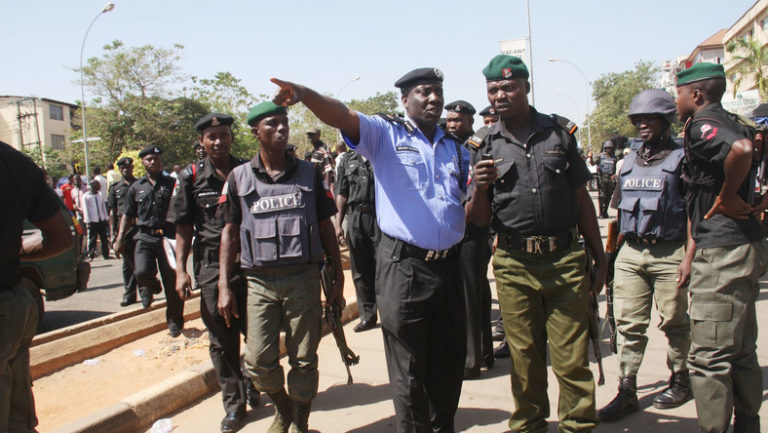
The Federal Capital Police has denied a news report that two persons were kidnapped at Rubochi Community in Kuje on Sunday.

According to a media report, there was a shooting by gunmen at midnight on Sunday and it led to the kidnap of a police inspector and one other person.

Meanwhile, Istifanus Sunday Bako, Police public relations officer (PPRO) for Zone 7, Abuja said there was nothing like the abduction of anyone at the Kuje community on Sunday. And no police inspector was kidnapped, he said.

Bako said the report received from the Kuje area on Monday morning did not include cases of kidnapping and shooting.

“I made some contact also, there is nothing like that”, he told The ICIR during a phone call.

The report had stated that the kidnappers demanded a ransom of N10 million.

The ICIR also contacted three other police spokespersons but they were yet to comment on the issue. Those contacted were Frank Mba, National Police PRO; Adeniran Aremu, Deputy National PRO and Anjugurijesse Manzah, the FCT police PRO.

Border Closure: CBN governor gives condition for opening

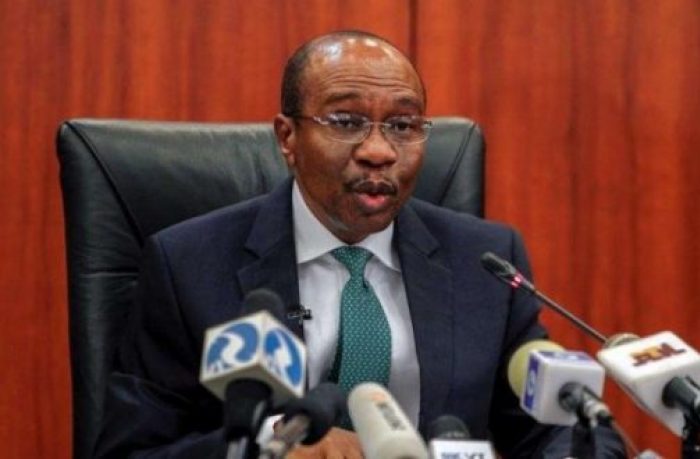
GOVERNOR of the Central Bank of Nigeria, Godwin Emefiele, has stated condition at which Nigerian borders would be opened following the closure in August.

Nigerian President, Muhammadu Buhari had ordered that all Nigerian land borders be partially closed in August 2019, a decision that has sprung national and international reactions.

Emefiele after a closed-door meeting with Buhari on Monday before the latter left for Saudi Arabia, addressing the State House correspondents that before the nation’s borders can be opened, neighboring countries must agree to implement mutual anti-smuggling policies.

He said that the Nigerian rice and poultry farmers have been the major benefactors from the border closure because they have been able to sell all their accumulated produce which have before now remained unsold due to illegal smuggling and importation from other countries.

Emefiele said Buhari, the leadership of the CBN and some state governors launched the WetSeason Rice Farming in Kebbi state in November 2015 and that there has been an immense growth in the numbers of farmers going into farming and production has largely gone up.

He also said that 2015 hither-to, Nigeria has also seen an astronomical rise in the number of companies, corporate and individuals that are setting up mills, integrated mills and even small mills in various areas.

“We have been embarking on a programme where we are saying if you are involved in the business of smuggling or dumping of rice in the country, we close your account in the banking industry and that is very effective”

Stating the reasons behind the border closure, he said the chairman of the Rice Processors Association who owns Umza Rice in Kano called, saying all the rice millers and processors are carrying nothing less than 25,000 metric tons of milled rice in their warehouses.

He said the rice has been unsold because of the smuggling and dumping of rice through the Republic of Benin and other border posts that are in the country.

Emefiele also said that members of the Poultry Association of Nigeria complained that they have thousands of crates of eggs that they could not sell; even some of the processed chickens that they could not sell, also arising from smuggling and dumping of poultry products into Nigeria.

“A week after the borders were closed, the same rice millers association called to tell us that all the rice that they had in their warehouses have all been sold,” he said.


Students reflect on ills within Nigerian universities in new anthology

STUDENTS and graduates from over 70 Nigerian universities have shared their campus-based experiences in a newly launched anthology, the Memoirs of Nigerian University Students (MONUS).

The publication of over 100 true-life stories is an initiative of a Tell!, a start-up run by students at the University of Ibadan.

The institutions featured in the anthology include the University Of Ibadan, Ladoke Akintola University of Technology, University of Lagos, University of Benin, Babcock University, Ahmadu Bello University, FUOYE, and various others.

“With stories cutting across themes such as sexual harassment, cultism, rape and institutional irregularities, the publication serves as a means of reflection on the state in which our universities have degenerated into,” the start-up said in a statement shared with The ICIR.

“The organisers hope that the stories can attract both national and international attention to University education in Nigeria for the purpose of inciting sustainable change and development in the universities.”

They also said proceeds from the sale of the anthology will be partly used “to support at least 10 students from low-income families across various universities, with a sum of N100,000 education grant”.

MONUS was guest-edited by award-winning investigative journalist, ‘Fisayo Soyombo, and its foreword was written by Tijani Mayowa, Business and Development Editor at TheCable.

It was created in partnership with Okadabooks, Bambooks, and the University of Ibadan Literary and Debating Society.

Facebook launches news tab to support journalism

0

FACEBOOK has launched “Facebook News”, the latest attempt by the social media giant to support journalism on its site.

The section will appear alongside the familiar news feed in a special “news tab”, dedicated solely to journalism.

After being tested internally with Facebook staff, the tab is expected to be made available to a subset of people in the United States before becoming more widely available over the next year.

Mark Zuckerberg, Chief executive of the social media platform first announced the plan in April, saying he wanted the tech giant to support struggling news outlets.

“When we started talking to news organizations about building Facebook News earlier this year, they emphasized that original reporting is more expensive to produce and better recognized by seasoned journalists than by algorithms.

“Facebook News was built to bring people closer to the stories that affect their lives. We’ll continue to learn, listen and improve News as it rolls out more broadly. We hope this work aids in our effort to sustain great journalism and strengthen democracy,” read a statement on the Facebook website.

Based on a survey carried out by the platform, topics on health, business, sports and entertainment will be making up major areas of focus.

After Facebook launched its News Feed in 2006, it became very successful with readers, leaving publishers pressed for revenue as most advertisers chose to advertise with the social.


Kogi’s paradox of six and half-a-dozen

0

By Bolanle Bolawole


THAT which is crooked cannot be made straight: and that which is wanting cannot be numbered. – Ecclesiastes 1: 15

“A friend of my friend is my friend. A friend of my enemy is my enemy. An enemy of my friend is my enemy”. “There are no permanent friends but permanent interests”. “If we do not forget or forgive what happened yesterday, we will have no one to associate with today”. “Politics is a dirty game”. “Friendship or friends are not forever” “The end justifies the means” “The first casualty in war – nay, politics – is truth”

“The elements of surprise, ambush and deceit are not only acceptable but effective weapons of war” “God Himself endorsed the application of deceit to convince King Ahab to go over to Ramoth-Gilead and fall”

“A politician is someone who sees black and calls it white” “Politics is not for the saints” A sufficient understanding of the above statements helps our understanding of not just the on-going paradoxes in Kogi State as another governorship election draws nearer but also affords an informed appreciation of the polity called Nigeria.

How time flies! And nothing lasts forever! It looked like only yesterday that Audu Abubakar died on the way to winning – and returning – to Kogi’s governorship. If Audu hadn’t died, Kogi might never have had the misfortune of a Yahaya Bello.

From prison to palace – a bible story was repeated before our very eyes. Our own Joseph even climbed higher than biblical Joseph, the boy with the coat of many colours. Olusegun Obasanjo did not stop at being a Prime Minister; he was Pharaoh himself. A man reportedly pilloried another former leader, asking him what he forgot at the seat of power; a man quipped, how many presidents do you want to make of me; yet OBJ got back into the office and plotted a third term! If you can answer some of the questions God asked Job: if you know the way of an airplane in the sky or that of the ship on the sea; if you can put a hook in the nose of the Leviathan, then, you may know the ways of the Nigerian politician!

Obasanjo/Atiku: Close associates turned inveterate foes. In 2003 Atiku had OBJ by the balls but allowed the wily fox to escape. OBJ thereafter put pepper in Atiku’s eyes. In the last election, the impossible happened as both came together again. OBJ ate his vomit on Atiku. Atiku also ate his own vomit on OBJ. OBJ/Atiku against Jonathan/PDP became OBJ/Atiku for PDP. The party OBJ said was dead “resurrected” in the ex-president’s own reckoning, to the consternation of Nigerians. Atiku, who led seven PDP rebel-governors to tear PDP apart and ship-wreck Jonathan to enthrone Buhari, is now in Buhari/APC’s black books.

How about Bukola Saraki and Dino Melaye: From PDP to (ACN, for Melaye), then APC and back to PDP. Today, the Buhari/APC they brought to power plots their political Nunc Dimittis while Atiku still runs after what he let slip through his fingers in 2003.

Iyiola Omisore was foundation member and financier of the AD; the Osun governorship was Omisore’s just for the asking but he blew it! He let the late Chief Bola Ige cajole him into stepping down for Chief Bisi Akande. The governorship form that Akande filled was purchased by Omisore; rather than fill his name on it, Omisore handed it over to Akande while he settled for the deputy governorship slot.

Omisore was told Akande would do only one term. Politicians who accept promissory notes are like shop-owners who sell on credit. “No credit today, come tomorrow” “Business survives and thrives best when friends and family pay for services rendered” Gospel truth – in politics more so! Political permutations change like quicksilver. What is tenable today may become anathema tomorrow.

When Omisore tried to enforce the gentleman’s agreement, he first got impeached and later got entangled in the “Who killed Bola Ige” saga. He left for PDP and became a senator. He contested the governorship under the party but lost. In the last Osun governorship election, however, he lost the party ticket to “dancing” Adeleke. Enraged, Omisore quit PDP.

You needed to have seen Omisore when the times were good between him and ex-Ekiti state Gov. Ayo Fayose. The Ekiti Government House was one of Omisore’s hibernation spots. See him sprawl on the sofa in one of the inner sitting rooms at the Osuntokun Government House and you could mistake him for the governor!

Today, himself and Fayose are enemies while Omisore is back in the circles of his Nemesis, Bisi Akande. In the Osun-West senatorial by-election won by PDP, Omisore and the Adelekes cooperated on the understanding that the Adelekes would help Omisore with the governorship; but when the time came for Omisore to draw his cheque, the Adelekes wanted the plum office for themselves. “Once bitten, twice shy” but Omisore’s got twice bitten! First-time, it was Ige; the second time, Omisore held Fayose culpable. Adeleke ran from APC when it was certain he would not get the ticket and birthed in PDP overnight, putting sand in Omisore’s “garri”.

It is rumbling in Edo State. Gov. Obaseki was ex-Gov. Adams Oshiomhole’s godson whom the new APC National Chairman fought tooth-and-nail to enthrone. Adams fought his own deputy for Obaseki’s sake. He did everything to make Obaseki “win”, even though many believe that election was tainted.

Ex-APC National Chairman, Oyegun-Odigie is in Obasaki’s camp today. It had not always been so. Oyegun-Odigie was originally a Bola Tinubu man but after piggy-backing on Tinubu to power, he ditched Tinubu and pitched his tent with Presidency cabals. State after state, the cabal used the Oyegun leadership to put pepper in Tinubu’s eyes – in Ondo where his candidate Segun Abraham “lost” the primaries to incumbent Gov. Rotimi Akeredolu.

In the previous governorship election, the same Akeredolu was Tinubu’s candidate but lost to incumbent Gov. Olusegun Mimiko. Where is Mimiko? From AD to PDP to Labour Party and then flirting (?) with Tinubu’s ACN and Buhari’s APC: Ask Eyitayo Jegede, Mimiko’s Attorney-General and Commissioner for Justice and the PDP governorship candidate in the last Ondo governorship election! Ondo is rumbling as another governorship election draws near. Akeredolu must be losing a lot of sleep. Things are reportedly no longer at ease between him and his deputy. At the last count, there are three governorship aspirants from Akeredolu’s own Owo axis. The cat-and-mouse between Aketi and Tinubu gets adumbrated as the elections draw closer.

Engr. Segun Oni was said to have been Tinubu’s preferred candidate in last year’s Ekiti APC’s governorship primaries. Oni, from PDP to APC where he lays prostrate at the moment, is marginalised by Fayemi’s people. APC can’t trust these PDP guys. Presidency cabal, bent on teaching loquacious and enfant terrible Ayo Fayose a lesson, drafted Fayemi, then Minister of Solid Minerals, into the fray. It was also to cut the influence of Tinubu; thereby killing two birds with one stone. Ekiti’s politics is a labyrinth of sorts. Oni is seen as an OBJ acolyte.

Fayose also – until his OBJ-orchestrated impeachment, which the Supreme Court upturned years later. Oni as governor tried unsuccessfully to send Fayose to jail. Fayose retaliated by supporting Fayemi against Oni in those celebrated Ido-Osi re-run saga. Fayemi won eventually but reneged on the promises made to Fayose. Fayose went to see Gov. Fayemi to press for revalidation of the promises but ex-Gov. Niyi Adebayo, now Minister, walked Fayose out of Fayemi’s office. Fayose years later chased Fayemi out of office but curiously remains friendly with Adebayo, whom he refers to as “our leader” When Gen. Adeyinka Adebayo died, Fayose literally carried the burial on his head, to Niyi’s admiration and acknowledgment. Fayemi never recognised Segun Oni as governor.

He tore down his photographs and never paid him a dime as entitlements. Fayose, of all people, came and restored Oni’s privileges and entitlements. But today, Oni and Fayemi are in same APC. In the next election, however, permutations are that Oni could be PDP’s joker because many PDP big-wigs – and even some in APC – belonged in Segun Oni Campaign Organisation (SOCO) or were his appointees.

The likes of Chief Bisi Kolawole, Senator Dayo Adeyeye, Biodun Olujimi, even Fayose’s Chief of Staff, Dipo Anisulowo and his social media guru, Lere Olayinka. Adeyeye used to be AD, then ACN, then PDP and now APC. What APC gave him with the right hand (the Senate seat), some say it is trying to take away with the left (Adeyeye lost at the tribunal level to Olujimi) so he would not be a threat to Niyi Adebayo’s wish to return as governor. Fayose had trounced Adebayo in 2003, preventing him from doing second term.

Now, Adebayo is well positioned as Minister, if you know what that means. It was from that vantage position that Fayemi returned to Ekiti to seize the governorship, to quote ex-Gov. Ibikunle Amosun of Ogun State, who said they would hijack it – and they did. Once that decision was made by the powers-that-be, Fayose became miserably exposed on all flanks. The South-west must learn from the South-south, Rivers and Bayelsa especially.

Election is war, pure and simple. Line up Federal might behind you or raise your own “Army” To be relevant; to get reckoned with – have fire-power!  Fayemi, Dele Alake, Opeyemi Bamidele, Niyi Adebayo, Segun Oni, Babafemi Ojudu: They have aligned and re-aligned. They have fought battles for and against one another. Only time will tell what the next formation will look like.

Back to Kogi: Audu laboured for others to eat. He toiled but another entered into his rest. Who did he offend? James Faleke, Audu’s running mate, thought he should have been governor; many informed commentators thought so, too, but the process of cutting Tinubu to size was still on, and Faleke was Tinubu’s man. Faleke represented Lagos State in the House of Representatives but wanted to be Kogi governor. His sin was being a Tinubu man at the wrong time. Had the timing been the last General Election when Tinubu was hot cake again to Presidency cabals, the story might have been different.

Tinubu and his camp seized on the opportune occasion the last time out to punish Oyegun-Odigie for his sins and send him to political Siberia. Yahaya Bello was the right man at the right time – malleable, had nothing at stake, and had no nexus with Kogites. A man like that would know where his bread is buttered. His loyalty will be to those who installed him.

Yahaya has been that: loyal and unwavering, supporting his masters all the way – RUGA and all. He is a man cast in the mould of Rauf Aregbesola, ex- Osun governor/now Minister of the Interior. Rauf reportedly said if his godfather asked him to commit suicide, he would simply ask what type of death! Yahaya Bello has said he, too, could die for Buhari. Someone said Dino, Smart Adeyemi, Duro Meseko (?) were friends and political associates.

Dino’s political tendency and Bello’s were on the same page at some point (on account of the Saraki/Tinubu divide) but today both Dino and Yahaya are sworn-enemies. The embattled Kogi deputy governor, who got “impeached” recently, grinned from ear to ear with Bello when the going was good between them. They both inflicted hardship on others but as things fell apart, one party wants to be seen as the oppressed. Interestingly, the new deputy governor sees nothing wrong with the injustice being meted out to his predecessor – but his own Karma lurks in the corner.

Yakubu’s INEC is worse than Ovie-Whiskey’s FEDECO, Maurice Iwu’s “iwuruwuru” and Jega’s predetermined INEC. It doesn’t get better here, it gets worse. It doesn’t rain for Nigeria; it pours. Six and half-a-dozen; half-filled and half-empty; between the devil and the deep blue sea; and between the rock and the hard place – God help us!

Bolanle Bolawole can be reached at turnpot@gmail.com, 0705 263 1058

Again, Buhari to spend two weeks on private visit to London

0

PRESIDENT Muhammadu Buhari is to spend two weeks in London on a private visit at the end of his trip to Saudi Arabia on Saturday.

Femi Adesina, Special Adviser on Media and publicity to the president in a press statement said that the president who is scheduled to attend the Economic Forum of the Future Investment Initiative (FII) in Riyadh will depart to London on a private visit.

“On the sideline of the event, President Buhari will hold bilateral talks with His Majesty King Salman and His Majesty King Abdullah ll of Jordan.

“On Wednesday, 30th October 2019, the President will participate in the High-Level Event titled “What is Next for Africa: How will Investment and Trade Transform the Continent into the Next Great Economic Success Story?” with Presidents of Kenya, Congo-Brazzaville and Burkina Faso,” the statement read in part.

Buhari who is expected back by November 17, 2019, will perform lesser hajj in Saudi Arabia before leaving for London.

In June 2016, he took a 10-day medical leave to treat a “persistent ear infection” in London, though he eventually spent 14 days. In August 2018, he also spent a ten-day annual leave also in London.

Between May 2015 and May 2018, Buhari set a new record, dislodging Late President Umaru Yar’Adua to become the Nigerian President to have spent more time on medical travels outside the country.

 Stash or Trash: Does Africa have a taste for the World’s e-waste?


By Kolawole Talabi


HIS name, Victor, could have been given fortuitously almost three decades ago but beyond chance, Victor Amienwanlan, 28, is an Edo State native of Esan origin who has had to fight to claim his place in this world. I first met him at one of the branches of the Redeemed Christian Church of God in Italy — in the city of Bologna to be precise. He serves as one of the volunteers at the church, performing a wide range of functions including but not limited to logistics and bible teaching. His peculiar way of vocalizing the common Charismatic refrain ‘Hallelujah’ is rather amusing. He always goes: “A-Lei-Loo-Jar!”

One Sunday morning last spring, I walked into the church as Mr. Amienwanlan was giving one of his biblical lessons. He was narrating his own story as an adjunct to the main teaching for the service. It was then and there I learned that he used to be a refugee. As he told his tale, I was drawn to the harrowing experience he had endured and wanted to know more. His is one story of endurance and inspiration, the kind that sometimes makes it into Hollywood. I was convinced his experience would benefit thousands of African youths seeking greener pastures in Europe.

Benin City to Bologna via Benghazi

Famous for its bronze artifacts, some of which are currently being held in European museums, Benin City is one of the greatest achievements of Africa in the second millennium of the Common Era. Like many African polities, the city and the empire that grew around it suffered foreign incursions and subjugation towards the end of the nineteenth century when British troops invaded, looted and destroyed a civilization that had existed for hundreds of years. Benin City has since risen from the ashes of British brutality to become the capital of Edo State, one of Nigeria’s 36 subnational divisions.

Mr. Amienwanlan spent parts of his adulthood in Benin City where he studied accounting at the extension school of Olabisi Onabanjo University. Upon completing his studies, he took up a job at a UBA bank office where he served customers receiving funds via Western Union for three years. He soon became friends with a Nigerian woman who lives in Libya and frequently sends money back home to her family in Benin City. Sometime in 2014, the woman promised to help him immigrate to Europe where it is hoped he would get a better job. Over the course of few months, arrangements were made for him to make the big move.

As part of the travel logistics, he was to take a bus to the northern State of Sokoto from where he crossed the border to Niger, Nigeria’s northern neighbor, through the bush, effectively evading the checkpoints of the Nigeria Immigration Service. The woman had also arranged for a company of traffickers to move him through the Sahara Desert. The stint operates like a relay. Once he arrives at a destination, he is instructed to contact someone who takes him in and moves him through the desert before handing him over to the next go-between. Mr. Amienwanlan recalled surviving on just sugar and water as he traversed the desert.

In Niger, he was put on a bus heading to Agadez where he bought a local SIM card to stay in connection with his traffickers. The trip took two days. Upon arrival in Agadez, he was taken to the house of an Arab man where he met two other Nigerians attempting to cross the Sahara to Europe.

“He brought out a gallon of water which we paid for,” Victor said. Next, they were placed in the back of a Toyota Hilux van. About 60 persons were packed in the vehicle like sardines for the long journey through the wilderness. “We were told to wear a mask,” he recalled. “We paid for the mask to protect our faces from the sand. We drove for about one week in the desert. We saw a dead person in a well. We saw skeletons during our stops.” Victor said he paid around 10 Libyan dinars for the mask.

Upon arriving in Libya, he recalled being locked up in a holding cell with about 70 other persons of different nationalities. They were fed bread occasionally. “I was locked up for a month in a small cell. In fact, it’s a prison, on a farm where people cannot find you,” Victor Amienwanlan said.

Eventually, he left the ‘prison’ and travelled to Benghazi, Libya’s second city where the Nigerian woman took him in for almost four months. She provided Victor with basic lodging — he had to learn welding to fend for himself during his sojourn in the Libyan port city. Having earned enough cash to make the journey across the Mediterranean, he bid his hosts goodbye and took a boat towards Italy. “I spent four days on the sea and the boat was leaking.” Despite the mishap, he chose to stay on the boat even when a Tunisian ship came to rescue them. Eventually, he reached Italy where the local police brought them to the refugee camp.

At the refugee camp, he met with a Jehovah Witness adherent who told him his options for survival in Italy were limited to one of three livelihood alternatives: begging, e-waste trade or internet fraud. He chose the only decent of the three options: to barter in e-waste.

From Refugee to Retailer

He left the refugee camp having satisfied rigorous Italian procedures of ascertaining his residency suitability. At the beginning, he would go from street to street to pick up electronic equipment that locals had left at their doorsteps, but his face soon became familiar and people wishing to dispose their e-waste would call on him to take delivery of the used items. He upgraded his business; he got a bicycle and his operations ran even more smoothly. Once he collects a considerable volume of used electronics, he puts them inside a used car and ships the merchandise to Lagos, Nigeria’s former capital and busiest seaport.

About 7% of used electronic and electrical equipment (UEEE) imports into the Port of Lagos between 2015 and 2016 came from China, a published report says. The study was co-authored by the Basel Convention Coordinating Centre for Africa (BCCC Africa) and the Sustainable Cycles (SCYCLE) Programme of United Nations University (UNU). This is in violation of international and national protocols on the disposal of e-waste, some of the most injurious to human health. Under the Basel Convention, the shipment of e-waste is prohibited but merchants (exporters and importers alike) continue to bypass the laws.

These UEEEs are shipped as carry-ons with automobiles. According to the study, it was revealed that 70% (41,500 tons) of the e-waste shipped to Lagos in the two-year period arrived inside vehicles. Yet another consignment arrived in containers. Of the 18,300 tons of UEEE per year shipped in containers, roughly 29% originated from ports in EU countries; 24% originated from China and 20% from USA. By weight, LCD-TVs and flat panel monitors made up the largest category (18%) of imported UEEE of which more than half of these were found to be non-functioning e-waste.

The second-largest category, (Cathode Ray Tube) CRT-TVs and CRT-monitors (14%), are banned from importation into Nigeria. Under the Basel Convention, only UEEE that is functional and for reuse may be shipped. In Nigeria, the National Environmental Standards and Regulations Enforcement Agency (NESREA) is the government organ saddled with the responsibility of ensuring a clean and healthy environment for Nigerians. Under NESREA’s broad oversight remit is the control of e-waste, either those generated locally by companies and households or brought in from overseas by merchants of garbage.

Its website further reveals: “It also has the responsibility to enforce compliance with provisions of international agreements, protocols, conventions and treaties on the environment to which Nigeria is a signatory.”

Established in 2007, the agency is headquartered in the city of Abuja, the purpose-built federal capital but maintains branch offices in strategic locations across the country including the port of Lagos. NESREA carries out its duties through different protocols and procedures such as the Environmental Import Clearance (EIC) regime, which ensures that banned and restricted chemicals, end-of-life electrical or electronic equipment and hazardous wastes are not imported into the country. NESREA requires importers of its regulated items to do an initial registration which costs around $320. Renewals costs $140 per year.

Despite the availability of these protective measures, e-waste has not ceased from entering Nigeria’s territory. It is a problem today. It was a problem in the past. If drastic actions are not taken, it will continue to be a problem in the future.

A Brief History of Toxicity

Koko is a town, a river port located in Delta State, in Nigeria’s oil-rich Niger Delta region. Its coordinates are as follows: 11°28N 4°29E and it is situated in Warri North Local Government Area. In Nigeria, a local government area (LGA) is an administrative division of the 923,768 km2 federation. There are currently 774 constitutionally recognized LGAs in Nigeria and Warri North Local Government Area is one of these. Although Koko is a small township of about 30,000 inhabitants, it is largely peopled by the Itsekiri ethnicity whose population is around 1 million, spread across the Niger Delta region.

Itsekiris are traditionally engaged in fishing, farming and trading. They are among the first people in the region to engage Portuguese traders, long before the British colonized the territory. In his 2014 book, The Fortunes of Africa — A 5,000-Year


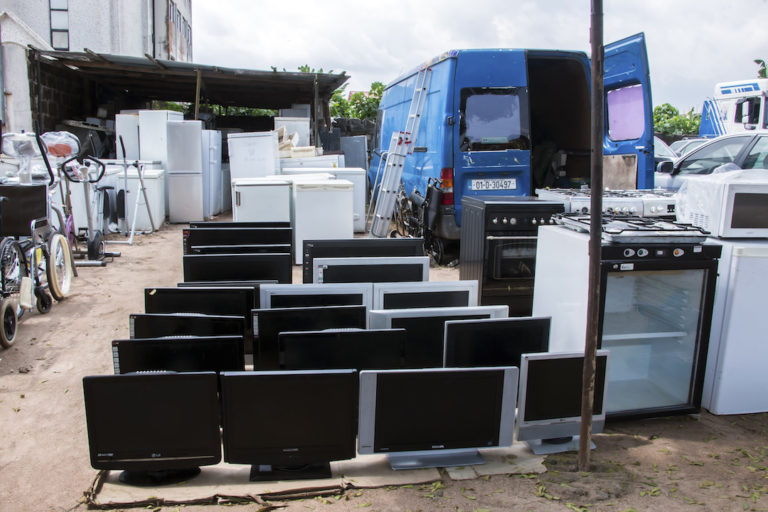
Used washing machines and gas burners at a store in Lagos, Nigeria. Credit: Hamed Adedeji

According to a 2019 report by the United Nations, the volume of trashed electronic waste is estimated at 50 million tons and this figure is expected to double by 2050. Sensing a looming crisis, some governments and several civil society organizations have been raising awareness and working to find a solution to the crisis. Riding on the crest of this movement is the campaign on the ‘Right to Repair’ — essentially proposals that will compel manufacturers of electronics to make their products last longer and easier to fix if or when they break down. Some EU countries are beginning to understand this is a crisis that needs attention.

Interestingly, the Right to Repair movement has gathered momentum and entrepreneurs like Ugo Vallauri, an Italian expat in the United Kingdom, founder of The Restart Project and a fellow of the Shuttleworth Foundation. The Restart website succinctly explains what the project aims to do: “[It] is a people-powered social enterprise that aims to fix our relationship with electronics.” Started in 2013, the project has executed over 12,000 repairs directly or organized as part of the same community. It has achieved some success too: 55% of electronics brought in have been repaired while 20% are broken but are source of spare parts.

“The Restart Project is about helping people rethink the way they consume, and we use the insights we collect for legislation at European levels, to force manufacturers to do better,” Ugo Vallauri said over Skype in August 2019.

Other stakeholders take a more commercial approach to the problem of electronic waste. In Italy, some associations and companies work to recycle metals from these products and find uses for remnant byproducts, thus aiding their re-entry into the value chain in a process otherwise call the circular economy.

StenaTechnoworld Srl is the Italian subsidiary of Stena Technoworld, one of Europe’s largest e-waste treatment companies with head offices in Sweden. The Italian subsidiary operates two treatment centres, dealing with all types of WEEE, but mainly specializes in cooling appliances and LCD screens. The business climate is not particularly exciting given the high costs of operating these recycling facilities. In fact, the company made a loss in 2018 possibly due to economic externalities such as the decision by the Chinese to stop the importation of e-waste.

NIMBYism comes to China

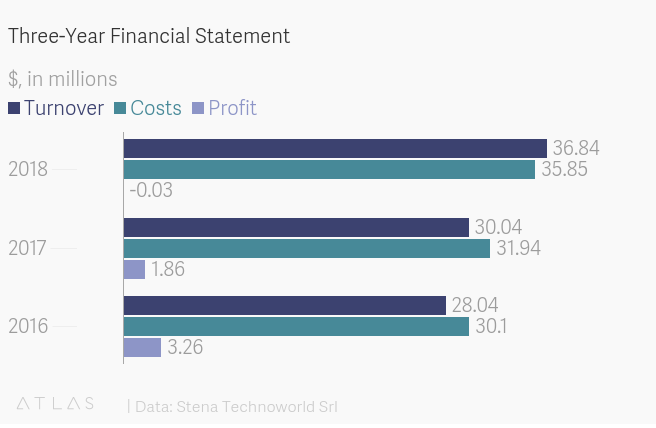
Whereas StenaTechnoworld made a paltry profit of €1.8 million in 2017 and €3.2 million in 2016, future profit margins are susceptible to rising operational costs and China’s ban on plastic fractions from e-scrap. Up until 2017, China was the world’s largest importer of e-waste, relieving the global community of its burden of electronic garbage. The about-face from Beijing is no surprise. Economic growth spurs domestic consumption which in turn creates an aura of cosmopolitanism. China has indeed come of age in terms of productivity. Once the sleeping giant of Asia, it has overtaken the likes of Korea and Japan in GDP metrics.

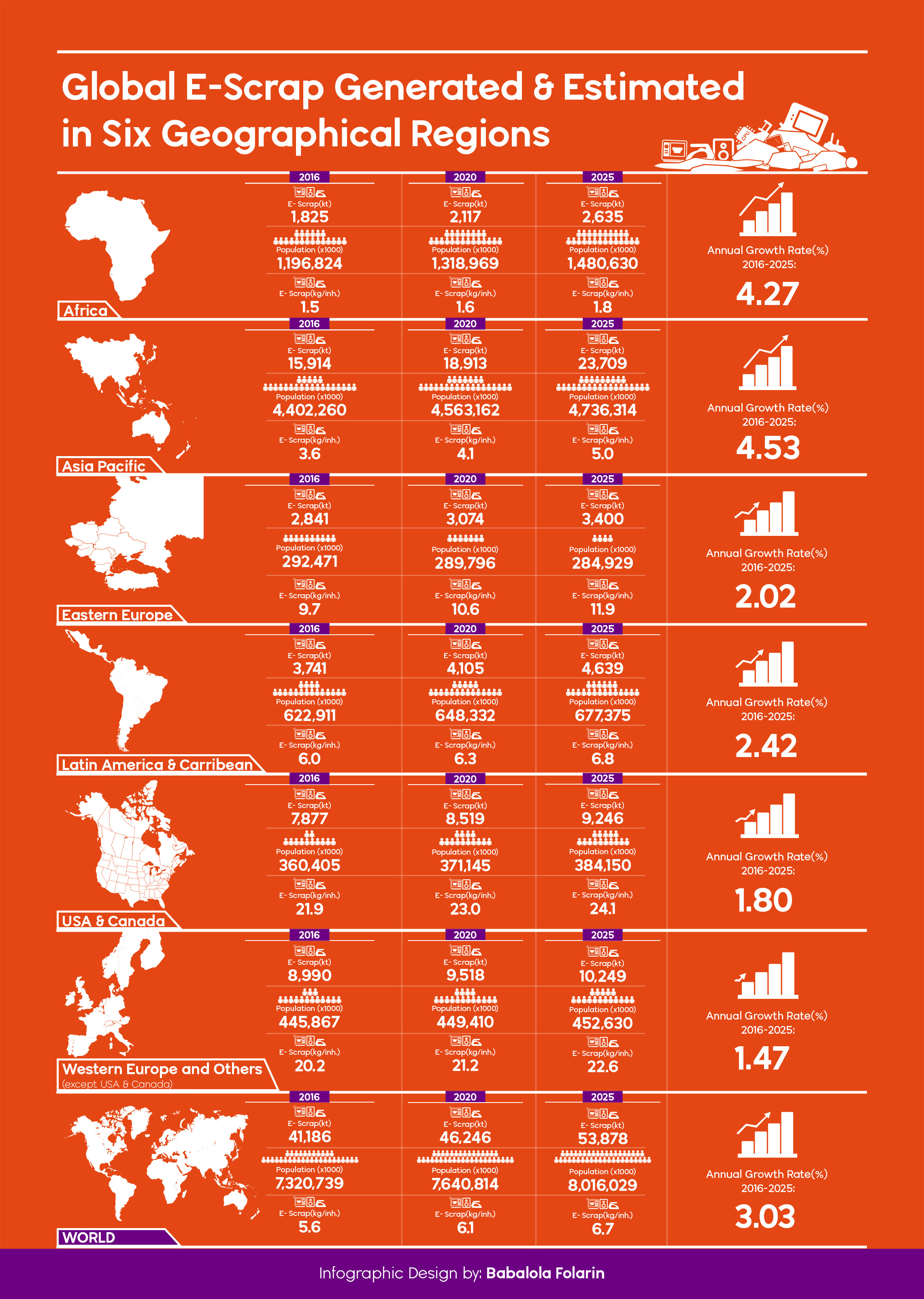
According to a 2018 report by the Brussels-based Bureau of International Recycling (BIR), the Asia-Pacific region generated almost 16 million tons of e-waste. Leading the group are China with 5.9 million tons, Japan with 2.6 million tons and India with 1.5 million tons. But the BIR report reveals much more. In 2003, China’s 1.2 billion people produced 1.7 million tons of e-scrap, thus yielding 1.4kg/person. China has since emerged as the world’s second largest generator of electronic waste even though the per capita waste created is still meagre when compared to other Asian countries.

This trend indicates that China’s continued economic rise despite the current trade war between Beijing and Washington will not only lead to an increase in the quantity of e-waste. Per capita waste figures are expected to grow significantly as well.

Prosperity provides protection. This is the summary of the reasons the Chinese government gave when it announced the ban on foreign e-scrap. The rich loves its digital wants but hates its electronic waste. As China’s volume of generated e-waste grows, it is expected that the volume sent abroad to emerging countries where labour costs and lax controls allow unscrupulous merchants and syndicates to operate will only increase. The ban by China has since increased shipments to other Asian countries like Thailand and Malaysia. But these jurisdictions are also putting regulations in place to fight off such polluting inflows.

In the UNU report cited earlier, China’s aggregate of imported UEEEs examined in the Port of Lagos is second only to that of the EU, a direct consequence of the region’s reluctance to process its own e-scrap waste at home. NESREA says it lacks the capacity of enforce its own rules on the importation of e-waste into Nigeria amidst the issue of overlap of institutional roles. First, the agency’s duties are curtailed by the lack of data. “The quantity of UEEE shipped into Lagos from China…cannot be estimated by NESREA as the Agency does not get the manifest of shipments,” a NESREA spokesperson said.

In the past two years, NESREA says it only inspected about 150 containers at the four terminals of the Port of Lagos. The scale of the containers in comparison with the availability of inspection personnel makes proper controls of e-waste from abroad a herculean task for Nigerian officials. Despite the logistical challenges it faces, the Agency discovered three containers of WEEEs including batteries, computer motherboards, scrap electronics panels, and cables that had been imported into Nigeria in 2018. The consignment was repatriated back to Malaysia on August 28, 2018.

Three-Year Financial Statement of StenaWorld Srl. Credit: Matteo Civillini

One man’s trash is another’s stash. In Nigeria, recycling companies are beginning to spring up in response to the increase in e-waste generated domestically and those imported from abroad. E-Terra is one of Lagos’ recycling companies. It currently has 35 people on its payroll, up from 25 the previous year. The company also processes about 40 tons of waste yearly. On a tour of its facility, it was revealed that E-Terra recently signed a partnership agreement with Envirobat, another recycling company in Spain. The agreement could ensure a transfer of technical know-how that will enable E-Terra to recycle batteries.

When asked about the payoffs of their business, E-Terra’s facility manager, Patrick Inoh said, “We have a local market where precious metals like iron, copper, aluminium are sold. There are vendors who take these metals from us, at a cost, and sell to the local iron and aluminium smelting companies.”

Solar Solutions, Polluter Problems

The growing threat of climate change has necessitated that countries undergo energy transition by replacing fossils with renewables. The quest to reduce carbon emissions is at the forefront of the drive to install solar panels, both on rooftops for household usance and on large-scale industrial sites. The compelling argument that solar energy is a non-polluting source of cheap and clean power drove many Italian homes to install these panels in the 90s and 2000s. Designed to function for around 25 to 30 years, an increasing number of these solar modules are coming to the end of their life cycle.

The EU categorizes these used solar panels as e-waste and they fall under the WEEE Directive, which has been ratified by member states. The Directive requires manufacturers of the modules to collect and dispose them at the end of their life cycle. In the past months, Italian authorities have raised alarms about the involvement of criminal groups in the disposal of solar panels. The danger inherent in the lack of treatment of used modules is like other e-waste — their component hazardous materials enter the environment, thus polluting poorer communities in faraway places such as Africa.

“Our ongoing investigations are showing us that criminal enterprises are very interested in taking exhausted solar panels, which have a specific life cycle. They issue a false declaration of underperformance and in that way the solar panels are not treated as ‘waste’ anymore but as second-hand products that can be sold in other parts of the world. We are observing several trafficking routes going to countries in Africa or Asia,” Angelo Agovino, the chief of Italy’s environmental police reported to parliament in March 2019. More shipments of 1,000 tons of solar panels were found at Genoa port, bound for Africa, two months later.

Fabrizio Longoni, the president of CdC RAEE, the public authority in Italy that is tasked with the responsibility of optimizing the collection and treatment of waste electronic and electrical equipment (WEEE) has a markedly different opinion on solar panels being shipped to West Africa.

“There is a real second-hand market for the solar panels,” Longoni says. “Why is the panel good for African countries? Because in fact it is an energy generator that does not need to be attached to the grid. They don’t care that it is low performance. If you buy it at a very low price it is useful, and it could last another ten years. This is not a waste but a reuse. We do not know how much this market is worth in numerical terms.”

Giuseppe Piardi is a key stakeholder in the Italian recycling industry. Besides the irritating bureaucratic red tapes for which any official government business in Italy is renowned, Piardi says cost drivers are by far the most important factors affecting the sustainability of e-waste processing enterprises in his country. “We have a very expensive bureaucratic system. It has been assessed that the compliance costs for a plant that follows the rules range from 50 to 80 euros per ton of WEEE. On refrigerators, we receive an average fee of 50 euros per ton, which is zeroed only by compliance costs.”

Some NGOs differ in their approach to the issue. Declan Murray, a University of Edinburgh researcher and blogger, has assisted CLASP, a Washington DC-based non-profit organization working “to mitigate the growing energy demand from the use of appliances, lighting, and equipment in the developing world” to organize the Global LEAP Solar E-Waste Challenge. Around $1.6 million in funding was earmarked by the organizers for competitors of the challenge and winners were named in Nairobi, Kenya in July 2019. Murray served as a technical adviser for the project, deciding on categories, criteria and other matters.

“The idea of the programme is to highly raise it as an issue but also start demonstrating solutions,” he said over Skype. “It also serves as a pilot funding for some organizations to start collecting solar waste.”

In Germany, I have observed how consumers are able to return plastic bottles in exchange for vouchers at retail stores. Apple does something similar with its range of products. If you make it, you must take it back once it’s broken. That’s a tenet which manufacturers of digital devices, and by extension various producers and businesses must be compelled to live by. It’s the 21st century; the capacity to achieve these goals are available. What we need is the courage to do them.

Victor not Victim

Mr. Amienwanlan plans to return to university for graduate studies. His success might inspire others, especially youths, not to give up.

Disclaimer: Although support for the investigation came from the Wits Africa-China Reporting Project and the Money Trail grant of Journalismfund.eu, the funders had no editorial oversight whatsoever in the course of the reportage. Matteo Civillini, an Italian reporter, also contributed to the investigation.


‘Fisayo Soyombo and the legal propriety of prosecuting an undercover journalist: A dialogue

By Timothy Ola Bamgboye


Prelude

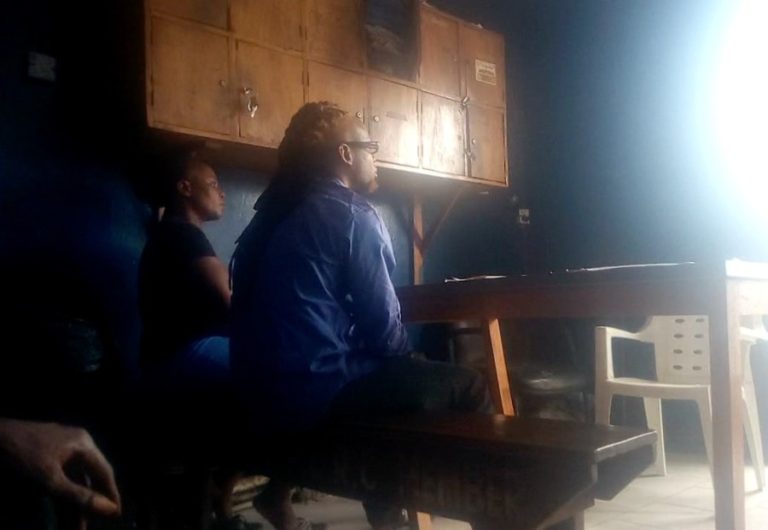
‘FISAYO Soyombo, a multiple award-winning journalist, in a three-part article, chronicles with the aid of pictorial and filmic pieces of evidence, how he got himself arrested, detained in police cell, and remanded in prison (now known as correctional facility) in a daring bid to expose the depth of systemic corruption in Nigeria’s judicial system. In the wake of the stunning expose, rumours were rife of the plot of the Correctional Service authorities to get the journalist arrested and charged under Section 29 of the Nigeria Correctional Service Act.

Subsection 1 (c) reads: “A person is deemed to have committed an offence if he procures or facilitates the procurement of communication devices for an inmate or makes conversation or aids the making of conversation through a mobile phone or other devices to an inmate other than as provided in the Correctional Standing Orders and other related correctional policies.” By virtue of Subsection 2 (b), anyone charged for the said offence is liable on conviction to a fine not exceeding N3,000,000 or imprisonment for a term not exceeding three years or both.

Against this background, the following is a dialogue between a learned colleague and I on the legal propriety of the possible prosecution. I call my colleague “counsel” for this purpose, while I go by the name, Tim. Read on.

The Dialogue

Counsel: I feel for ‘Fisayo. It’s a thankless, sacrificial thing he has done. But you know, if they decide to prosecute him, they have a good case.

Tim: Forget it. It’s a hopeless case in law and common sense.

Counsel: Let’s talk law. Stick with the law.

Tim: What do you mean by sticking with the law? You talk about law as if it’s a lifeless object that can be removed from the context of human society and human relationships.

Counsel: The law is not perfect. But the tenets of the law is that of certainty and uniformity. We cannot excuse certain conducts because of morality if the law frowns at it. If we create an exception for this and create an exception for that—slowly but surely, the Rule of Law would come crashing, and the entire fabric of the society with it.

Tim: Man is not made for law; law is made for man. And law is not an end in itself but a means to an end, which is justice. The day we agree to do law for law sake, caring less whether or not it achieves the end of injustice, we have lost the essence of law.

Counsel: What is justice? Isn’t that a jurisprudential complexity in itself? Do we do away with what is unambiguously stated in our laws as an offence just because we have a subjective view of what justice is? We will come back to the issue of justice. Let’s stick with the law first. Do you agree that the law is an ass?

Tim: Yes, the law is an ass as long as men choose to be assholes.

Counsel: Funny. But do you agree that according to the law, a physical act and a guilty mind are what constitute a crime? And that motive is irrelevant? It’s just like a starving man who steals to stay alive or to feed his family. Does the motive for his theft detract from the fact of commission of a crime?

Tim: You are comparing apples and oranges.

Counsel: How so? A journalist’s motive for breaking the law is irrelevant. The question is “did he break the law? Did he intend the natural consequence of his action?” Those are the facts in issue.

Tim: That is not a law of Medes and Persia that cannot be derogated from under exceptional circumstances like this. In fact, motive in his case is a pointer to the absence of a guilty mind.

Counsel: You want to rewrite settled principles of law.

Tim: No principle of law is cast in stone. None could possibly envisage all possible future circumstances to cover. Principles of law must essentially be expanded and contracted to achieve the end of justice.

Counsel: Justice again! Stay with the law first, bro! What tenable argument can you proffer to excuse his guilty mind?

Tim: I already told you. He had no intention to break the law to achieve any self-gratification. It was purely sacrificial to expose systemic corruption. Systemic corruption cannot be fought using conventional styles. It has to be unconventional.

Counsel: So, altruism is your argument.

Tim: That, and much more.

Counsel: The altruism claim can be faulted. Nobody is completely altruistic.

Tim: Tell me what he stood to gain exposing himself to such risks?

Counsel: Fame, for one.

Tim: Balderdash! Are there not easier ways to be famous? Whatever happened to blogging your way to Ovation and the likes?

Counsel: Well, some opt for costly popularity rather than cheap popularity. Doesn’t make it 100 per cent altruistic

Tim: Utter tosh!

Counsel: And your argument of having to use unconventional means does not hold water. The law is what it is. Break it, pay for it. Such is life. And life isn’t always fair.

Tim: That is mechanical thinking. Too pedestrian! You talk as if legal education is rote learning, and jurists and judges are robots without a mind for critical reasoning. Have you ever heard of an undercover journalist in the civilised world jailed for their investigative work?

Counsel: Have you ever heard of one who was tried but not convicted?

Tim: No, I have not heard of it perhaps because the prosecution would not even contemplate it. That is why they have wide discretion on who to prosecute and whom not to prosecute. I dare Nigeria’s law enforcers to declare him wanted, prosecute and convict him and enter the Guinness Book of Record of the Worst Villains.

Counsel: I agree. They have the discretion not to charge him. But my point is, if they decide to, they will likely win.

Tim: No, they won’t, except the judge wants to fight for the front page of that Book of Record with them.

Counsel: What excuse would a judge have in law not to convict him if the Prosecution proves beyond reasonable doubt the elements of the offence and a concurrence of the actus reus and mens rea?

Tim: Public policy is a thing. So is judicial activism.

Counsel: There is a thin line between judicial activism and judicial rascality. You can’t upturn settled principles of law by fiat.

Tim: A core duty of a judge is to make laws by interpreting the law to suit the end of justice. Failure to do that is failure in all that he or she swore to uphold.

Counsel: Who determines what is just?

Tim: There are shared human values that we hold as a people; and the test of a reasonable man can be called to aid.

Counsel: That is subjective.

Tim: Objectivity has always been a subject of subjectivity. There is no other way to attain, progress, peace and prosperity. And of course justice!

Counsel: Law! Talk law, bro!

Tim: Law is not just rules and regulations. Law is wrapped in philosophy, psychology, sociology, and critical thinking! Listen, why were the principles of equity evolved at a time in English jurisprudence? Was it not to mitigate the harshness of common law? And why do we talk of substantial and technical justice today? Is it not to ensure that what is fair, equitable and just prevails over and above slavish adherence to rules?

Counsel: Yes

Tim: There is even a portion of the Rules of Professional Conduct that aligns with my position… Check Rule 15.

Counsel: What does it say?

Tim (retrieves the Rule to peruse): Yes, Rule 15. While 15 (2) (a) insists that a lawyer shall keep strictly with the law in his representation of his client notwithstanding any contrary instruction from such client. 15 (3) (c) gives a mandate that I find so profound and fundamental.

Counsel: I’m with you.

Tim: It says a lawyer shall not knowingly advance a claim or defence that is unwarranted under existing law, BUT HE MAY ADVANCE SUCH CLAIM OR DEFENCE IF IT CAN BE SUPPORTED IN GOOD FAITH FOR AN EXTENSION, MODIFICATION, OR REVERSAL OF EXISTING LAW.

Counsel: Interesting

Tim: See that caveat—extension, modification, or reversal of existing law! We should be agents of social engineering through a purposive interpretation of law. We are lawyers, not mechanics!

Counsel: Hmmm.

Tim: I shudder when people try to extricate morality completely from the law. Society will collapse if our laws do not have a public morality face. Even the constitution recognizes laws reasonably made for the purpose of public morality, and clothes them with such enormous power that some fundamental rights can be derogated from under the grounds of public morality! But that is a talk for another day. Today, we must emphasize that any law that gives the Prosecution or a Court power to persecute a journalist who is fighting to break us loose from the chains of systemic corruption under the guise of prosecuting him is no law at all. Trust me, the day the Apex Court holds that it is an offence for the press pursuant to Section 22 of the Supreme Law to uphold the responsibility and accountability of the Government to the People through unconventional means, I will permanently hang my wig and gown. Thank you for your time.

Counsel: (silence).

$15 billion tax evaded by companies can build new classrooms in over 70,000 public schools, equip 30,000 PHCs

THE Chairman of the Federal Inland Revenue Service, FIRS, Babatunde Fowler had said on Wednesday, October 23 at the West Africa Tax Administration Forum in Abuja that the country loses about $15 billion, an equivalent of about N4.57 trillion at N305 to $1, annually to tax evasion.

A query by The ICIR has shown that this amount of money can help construct two blocks of three classrooms in over 70,000 primary and secondary schools in Nigeria, renovate and equip 30,000 primary health centres and still get the 21 federal teaching hospitals a radiotherapy machine each.

Fowler made the disclosure at the forum organised to chart ways of combatting offshore tax evasion through the exchange of information regime. He said a huge amount of money is being kept offshore and is un-taxed.

Fowler noted that the challenges offered a global response to the issues of international tax avoidance, tax evasion, illicit financial flows, money laundering and other harmful tax practices based on cooperation and the use of advanced technologies to tackle the issues.

He said when the technology is out in plain terms, revenue available from it will be  spent on public service and investments in human capital.

What N4.57 trillion can get Nigeria

The N4.57 trillion worth of evaded tax has a huge potential of projecting socio-economic prospects for the country, thereby improving the human capital index of the country.

Going by the 2020 proposed budget estimates, for instance, the Universal Basic Education Commission (UBEC) budgeted the sum of N50 million for the construction of two blocks of three classrooms in Jos, Plateau North Senatorial District.

A Basic Education Profile of National & Regional Statistics from the UBEC reveals that there are 73,179 number of schools: primary (61,305) and junior secondary(11,874) in Nigeria. Enrolment data also from the UBEC states that there about 24 million students at the primary level and 4.2 million at the junior secondary level.

With the spate of dilapidated and uncompleted classrooms in public schools littered across the country, the government can spend N3.6 trillion to build two blocks of three classrooms each at the rate of N50 million each fo the entire 73,179 public schools in the country.

Another important determinant of human capital development is the health of a nation. The ICIR in 2017 under its Open Contracting Reporting (OCR) project carried out a nationwide investigation that exposed the rotten state of primary healthcare centres (PHCs) across the country. Over the years, billions of naira have been committed to construction and equipping PHCs and ensuring universal health coverage for the country. PHCs are the closest to people at the grassroots.

In the proposed 2020 budget details, the National Primary Health Care Development Agency (NPHCDA) allocated between N9 million and N16 million for the renovation and equipping of a PHC.

The ICIR could not get the number of PHCs in the country from the website of the NPHCDA, the government agency charged with the responsibility of making PHC services available to all in Nigeria. However, an article published by the United States National Center for Biotechnology Information (NCBI) pegged the number of PHCs in Nigeria at 30,000. This would mean that N480 billion will renovate and equip all PHCs across the country at N16 million each.

Still on health, an undercover investigation by The ICIR in 2018 revealed the true quality of healthcare available to cancer patients resulting from insufficient radiotherapy machines in most federal teaching hospitals across the country have impeded the treatment of numerous cancer patients, leaving many of patients stranded.

The investigation revealed that there are only four radiotherapy machines available all over Nigeria and that only the one at National Hospital Abuja is functional for cancer treatment; the rest are only useful to prolong a patient’s life. The story also reveals that the most expensive linear radiotherapy machines cost between $750,000 and $1.5million (between N228 million and N457million at the official rate of N305 to $1). This excludes associated costs such as the vault that will house the system, treatment planning, and oncology information system software, lasers, and other accessories.

With the 21 number of federal teaching hospitals in the country, at the rate of N457 million for one radiotherapy machine, this will cost the country about N9.6 billion to acquire the machine for each teaching hospital.

In summation, if the government is to take on these expenditures, it would have spent N4.15 trillion, about N421 billion less than the actual worth of evaded tax.  N421 billion is more than 45 percent of the $3 billion (N915 billion) loan approved by the World Bank for the expansion of the power transmission and distribution networks in the power sector.