FOR four years, between 2015 and 2019, the 8th National Assembly introduced a total of 2,166 bills but only 515 of the bills were passed into law, a new report launched on Friday has revealed.
Scorecard of the 8th National Assembly — Report of a performance assessment of the 8th National Assembly in Nigeria’s Fourth Republic released by YIAGA Africa Centre for Legislative Engagement, revealed that there was a significant increase in the number of bills handled by the 8th National Assembly.
It noted that 21 of the 515 passed bills were Constitution Alteration bills while five of them received presidential assent.
“The Senate passed a total of 172 bills while the House of Representatives passed 343 bills within the same period. Some of these bills could be regarded as a landmark or significant for the widespread interest they generated, high media attention, pertinent issues they addressed and overall high perception of their potential impacts,” said the report.
The report was the product of a study to assess the legislature as a cardinal institution of democracy with regards to its responsibilities for legislation, oversight and representation.
It indicated that bills such as the North East Development Commission Bill and Not Too Young to Run Bill, among others were among those that were passed by the 8th Assembly.
It, however, noted that 53 bills were declined Presidential assent and only about 80 (15.5%) received assent adding that several Bills were still awaiting assent at the time of study.
However, the report said data on the number of bills transmitted to the president for assent were not available.
Over the same period, 15 bills were withdrawn while 33 were ‘negatived’- killed.
In total, the efficiency percentage of the Assembly was 23.8 per cent, representing the proportion of all bills introduced that were successfully passed by the 8th National Assembly.
According to the report, the 8th Assembly fared better compared to the 7th National Assembly, which passed a total of 205 Bills out of a total of 1367 introduced.
The report also revealed a high level of increase in the number of private members bill, which accounted for 95.8 per cent of all Bills introduced during the 8th National Assembly.
The House of Representatives, it said, accounted for 65 per cent of this category of Bills, which it said was due to its numerical strength over the Senate.
YIAGA’s report stressed that two decades of unbroken democratic governance and attendant accumulation of institutional memory may have tremendously enhanced the law-making capacity of legislators in terms of expertise.
It, however, disclosed that some of these bills generally classified as Private Member bills, though sponsored by legislators, were actually initiated by professional associations and civil society organisations, including the Not Too Young To Run bill.
“This not only shows that civil society organisations have a significant impact on law-making efficiency in the 8th National Assembly but also underscores its positive disposition to participatory law making.”
In terms of the gestation period, the report revealed that some of these bills took long to be passed.
“Ideally, a bill should, averagely, take less than six months to pass. But out of the 515 bills passed in the 8th National Assembly, only 47 (9.1 per cent) were passed within fifty days, while a whopping 271 (52.6 per cent) took over 351 days.
“Furthermore, 14 bills were passed within 100 days, 12 within 150 days, 80 within 200 days, 41 within 250 days, 23 within 300 days and 27 within 350 days. Notably, most of the bills passed within 50 days were either executive bills or, of emergency nature.”
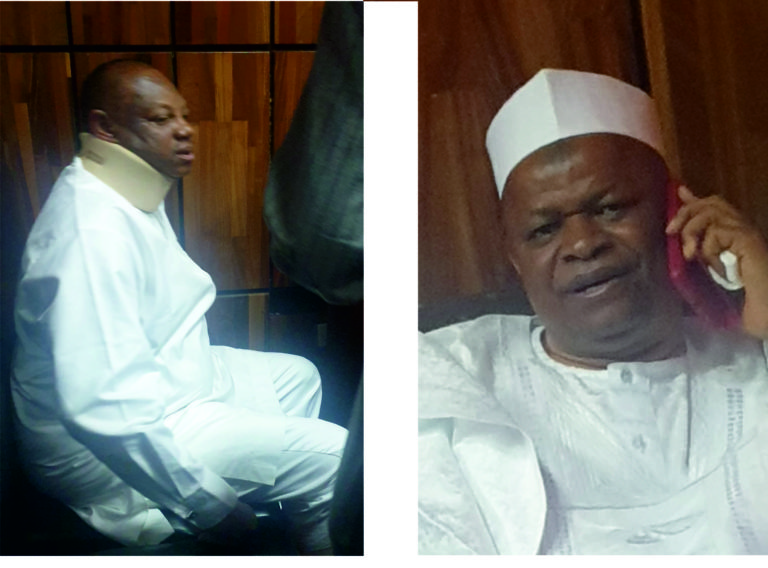
ECONOMIC Financial Crime Commission (EFCC) on Thursday arraigned before High Court in Abuja an ex-special adviser to Buhari on Presidential Amnesty, Brigadier General Tarelah Paul Boroh (rtd.) and Hanafi Musa Moroki for allegedly diverting public fund to personal use.
Boroh and Moroki were arraigned on nine-count charges including criminal breach of trust, and diversion of fund amounting to N974,768,466 and $1,914,000.
EFCC Head, Media and Publicity, Wilson Uwujaren, disclosed this in a press release obtained by The ICIR.
Earlier in 2018, the sum of $9 million (N2.75 billion) was allegedly found at the Abuja residence of the former special adviser to the president in discovery by the EFCC and Office of the National Security Adviser.
The duo were alleged to have on different occasions, dishonestly converted the sums of N8,601,571; N106,288,445; N12,078,450; N382,800,000; N456,000,000; N9,000,000 and more, while they were in office.
The third count of the charge read, “That you, Paul Boroh and Hanafi Moriki between the 1st of December 2016 and 30th July, 2017 at Abuja within the jurisdiction of this Honourable Court whilst being public servants entrusted with property to wit funds of the Office of the Special Adviser to the President on Niger Delta and Coordinator of the Presidential Amnesty Programme, dishonestly converted the sum of One Million, Seven Hundred and Fourteen Thousand United States Dollars to your own use and thereby committed an offense contrary to and punishable under section 315 of the Penal Code Law”.
Both defendants pleaded not guilty of all of the charges read to them by the court.
Counsels to Boroh and Moroki charged the court that the both be granted bail on liberal terms while counsel to Boroh stressed that his client be granted bail because he brought himself to the court despite his failing health.
EFCC counsel, Aisha A.T Habib opposed the bail application; she stated that a counter affidavit had been filed against the applications and prayed the court to grant the case accelerated hearing.
However, Justice O.Goodluck granted Boroh two million naira bail while Moroki was granted bail in the sum of twenty million Naira.
She also ordered the defendants to provide two sureties not below the rank of Assistant Director in the Federal Public Service, who must be resident in Abuja and that both defendants should deposit their international passports with the court registry.
Goodluck after granting bail to the defendants adjourned the case to 26, 27 November and 3, 4 December 2019 for the commencement of trial.
THE Federal High Court sitting in Calabar on Friday denied bail to the detained journalist, Agba Jalingo stating there was no substantial evidence to show that his health was failing to necessitate his bail.
Attah Ochinke, the lead counsel to the defendant, had pleaded with the court to grant his client bail on grounds that he was willing to see the trial through. He also pleaded that the journalist should be admitted to bail on health ground.
The prosecution counsel, Dennis Tarhemba, had countered the bail application.
Justice Simon Amobeda, the presiding judge ruled that the charges against Jalingo were serious which also carried capital punishment before dismissing the bail application for lack of merit.
Jalingo, the publisher of CrossRiverWatch, an online newspaper, with a focus on Cross River State, was arrested on August, 22, but was incarcerated for 34 days in police detention before he was arraigned on September 25.
The journalist, whose arrest and the trial have attracted outrage from human rights groups across Nigeria, arrived at the court premises in handcuffs.
He was charged with treason over his report about an alleged diversion of N500 million by the Cross River governor, Ben Ayade.
The incarcerated journalist recently released some prison notes, urging the people of Cross River state to remain steadfast in the struggle against “dictatorship”.
He said in the notes that he is ready to go through his travails faithfully, with the belief that victory and glory await him in the end.
“One final assurance that I give to my people of Cross River, in particular, is that ‘we will overcome that dictator in Peregrino House.
“Dictatorship has never defeated goodwill and a determined people. Even if I end up not standing with you in the summit, remain strong and be rest assured that the arc of life is on our side and we will win,” a section of the note reads.
However, Justice Simon adjourned the case to Wednesday, October 16 for the start of his trial for treason.
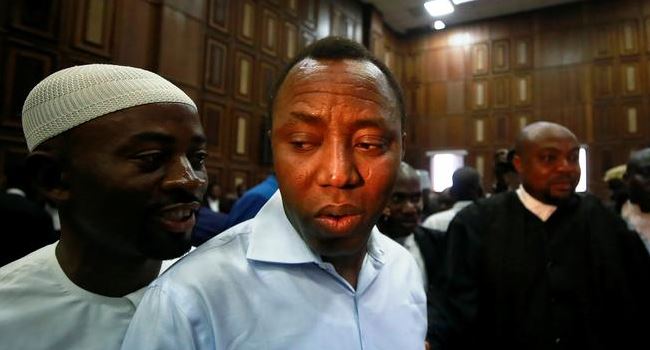
THE Federal High Court in Abuja has granted bail to Omoyele Sowore, convener of #RevolutionNow protest and publisher of the Sahara Reporters.
The judge, Ijeoma Ojukwu, ordered the release of Sowore and Olawale Bakare after listening to the submissions of both the prosecutor’s counsel Hasssab Liman and the defendants’ lawyer led by Femi Falana on Friday.
“Since the charge before the court does not carry any death penalty, I am inclined to grant bail,” she held.
The trial judge granted bail to the two defendants in a total sum of N150 million.
The court ordered Sowore not to partake in any rallies. It added that both defendants should remain within the Federal Capital Territory, Abuja.
This is the second time the court will be granting Sowore bail after being arrested and arraigned by the Department of State Security Service for masterminding the protest.
The government did not obey the rule of the court after Sowore was granted bail on September 24. Rather, Sowore and Bakare were arraigned on Monday on seven counts bordering on an alleged conspiracy to commit treason, cyberstalking and money laundering among other charges.
Sowore’s counsel, led by Femi Falana had applied again at the court hearing for bail application.
At the hearing of the bail application on Friday, the judgeordered that Sowore and his co-defendantbe released from the military detention.
She asked Sowore to drop his passport with the court within 48 hours as part of the bail conditions.
The court asked Sowore also provide N100 million as the bail bond with two sureties in like sum.
The second defendant, Olawale Bakare, was to be bailed with a bond of N50 million.
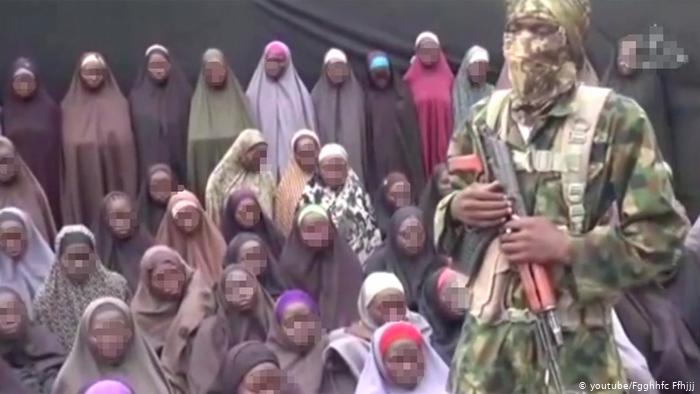
THE Bring back Our Girls campaign movement is set to commemorate the 2000 days of the disastrous kidnapping of 276 schoolgirls of Government Girls Secondary School on the 14th of April 2014 by Islamic Extremist Group, Boko Haram in Chibok town.
In a release by the spokesperson of the movement, Nifemi Onifade, he noted that some of the 276 school girls have been rescued, some escaped but towards the commemoration of the 2000 days of the kidnapping, 112 schoolgirls are still unaccounted for.
“The BringBackOurGirls movement will commemorate this ongoing tragedy by keeping hope for the return of our Chibokgirls alive,” he added.
Bring Back Our Girls movement is set to organise an activity on Saturday 5, October to commemorate 2000 days of unaccounted 112 schoolgirls of Chibok.
Nifemi said that the movement would continue to uphold her promise to the Chibokgirls by demanding their immediate and unconditional return from the Federal Government of Nigeria.
He also thanked people who have continued to stand by the movement and their unwavering support for the Chibokgirls during the Bringbackourgirls struggle.
Nigerians continue to witness several abduction cases in the Northeastern part of the country, it should also be noted that the Boko Haram group, alsokidnapped more than 100 schoolgirls in Dapchi, North-East Nigeria, although most of them have been recovered by the Nigerian government.
However, many Nigerians have criticized the government’s inability to recover the remaining 112 schoolgirls of Chibok, Leah Sharibu among others.
The former Minister of Education, Oby Ezekwesili also criticized the Federal Government in a tweet on her official page, she quoted Buhari of saying that the FG would not claim to have defeated Boko Haram without rescuing the Chibokgirls and all other innocent persons held hostage by insurgents and that the government went ahead to do so.
Renowned government critic and Special Assistant to Former President Goodluck Jonathan, Reno Omokri statement said, ”President Muhammadu Buhari, you should do everything in your power not to score political points, keep her and when it’s time for elections let her go”.
AFTER waiting for nearly 30 minutes on the queue at the banking hall Nnajiofor Cynthia, a student of the University of Nigeria, Nsukka anxious to make her deposit that morning, was notified that a sum of N300 bank charges would be required to finalise her school fees deposit of N45,600 into the Treasury Single Account, TSA.
In December, 2011 the Central Bank of Nigeria, CBN, signed a contract to hire Systemspecs- a local financial/tech company that designed Remita, an online platform. The firm is expected to facilitate e–payments on government financial services to a single account overseen by the apex bank in line with chapter five, Section 80 (1) of the Nigerian Constitution.
The decision to hire the company owned by John Obaro was borne out of fact that the Nigeria Inter-Bank Settlement System Plc (NIBSS) – a subsidiary of the CBN, at the time lacked the capacity to carry out the functions for which Systemspecs was being hired for.
By August 2015- September 2016, Remita reportedremittance of over three trillion Nairas into the TSA (N3, 651,360,698,359.03) for the Federal Government.
However, public outcryandcriticism in October 2015 of fraudulent extortion and exorbitant charges by the payment interface led to a pause on payment charges into government accounts.
Abayomi Oniku, Divisional Head, Public Sector Systemspecs who spoke to The ICIR said the gains made from the use of the interface as charges billed payers was shared amongst shareholders–Systemspecs Remita, CBN, Deposit Money Banks at 50 per cent, 10 per cent, and 40 per cent respectively.
Therefore, it wasn’t kept by the fintech company alone – An assertion to which John Obaro, Chief Executive Officer, and CEO, Systemspecs, had earlier attested.
As the controversy thickened, the CBN on November 1 2018, released a directive for the enforcement of a flat rate charged payers for every deposit—both cash and electronic transaction made into the TSA’s.
“All payers using other channels apart from Cards (Bank Transfers, Mobile Payments, Bank teller points, USSD and all other channels) shall pay the sum of N150.00 (One Hundred and Fifty Naira only), per transaction,” a section of the letter read.
It also stipulated that “All payers using cards are to be charged N150.00 (One Hundred and Fifty Naira only) plus 0.75 per cent of the amount being paid, subject to a maximum of N1,200.00 (One Thousand Two Hundred Naira Only).”
This meant that depositors would have to pay additional charges on every transaction for using the interface–birthing a ‘non-seamless’ deposit transactions into the TSA as the federal government reneged on its initial responsibility to bear the cost of service on behalf of the revenue payers.
However, the introduction of the directive by the CBN may have come a little too late.
Different folks, different strokes
Between 2016 to 2017, prior to the directive, The ICIR was able to establish that some DMB’s placed arbitrary charges on payments made through the Remita gateway into the TSA, as sources revealed that they paid between N300-N1000 –not captured on the final Remita receipt.
“When I gave my money to the cashier, I was asked to pay N300 charges which is to be paid using the bank deposit teller. So it was not evident in the final receipt issued at the end of the transaction that there was an extra charge for the service,” The ICIR was told.
Coming to terms that she would have to pay N5000 to acquire her original JAMB admission letter, rather than getting the document on her profile through the portal, Peace Agada had to pay additional bank charges of N175.50 bank charges– an amount she said would have preferred to use in purchasing a much-needed bottle of cold coke beverage to calm her parched throat in the sweltering Makurdi-Benue State- sun after her business at the bank.
“I asked at the bank why we are paying the extra fees apart from the original payment, and they said it is bank charges. I have been paying for bank charges and I don’t even know what it is for. I come to give someone else money, only to be charged for doing so,” she fumed
The undergraduate who visited the bank with her friends to make the same payment told The ICIR that although they all came for the same purpose—deposit- varying charges were demanded each transaction.
“In fact, some even paid N200 as the bank charges instead of the N175 that we were charged. On that particular day, we were more than 30 students,” she said.
The ICIR also got the same report from another student who was present at the banking hall that afternoon.
Similarly, Ebere Anioke an overstay student of UNN, who also spoke to the reporter said the sum of N300 extra charges was demanded of her in other to facilitate payment of N500 billed for course registration.
Worthy to note, the Remita Public sector officer, Oniku, told The ICIR a ratio for Value Added Tax (VAT) is also included in the charges.
“IT is clear in the CBN circular that you mentioned it is clear that the channels of payments are recognised. So if you are making payment through a bank branch for instance, then VAT payments are included,” He told The ICIR.
However, a cursory look at some final Remita payment receipt does not indicate any deduction of VAT charges.
Remita Payment Receipt: No VAT deduction indicated
Attempts by the reporter to ascertain the ratio remitted to the FIRS—if any– from the service proved abortive at the time of this report.
Unfortunately, due to the inconsistency of the sum charged payers, an estimation of the exact amount that could have been raked in for charges into the TSA could not be ascertained.
However, records obtained from the Joint Admission Matriculation Board (JAMB) showed that from 2017 to 2018, the total number of 1, 116,482 (one million one hundred and sixteen thousand, four hundred and eight two) candidates gained admission into Federal Higher institutions of learning in the country.
Going by the fixed CBN flat rate at N150 flat rate on every transaction to the TSA, the undergraduate students would have paid N167,472,300 (one hundred and sixty-seven million, four hundred and seventy-two thousand, three hundred) on charges alone for their school fees payment into the TSA.
While at N157, the sum of N175, 287,674 (one hundred and seventy-five million, two hundred and eighty-seven thousand, six hundred and seventy-four) would have been incurred on charges alone.
According to Onyeka Olisa, a banker that spoke to The ICIR, “The payer has no option but to pay through this platform. The depositor, in this case, pays for the services being offered not the government.
“It should not be, but unfortunately, this particular issue falls under the circle of concern and not circle of influence.
“The circle of influence we can change, but matters within the circle of concern we cannot change. It falls within the jurisdiction of the lawmakers who made this law. It is only the National Assembly that can change it.
Also bemoaning the incessant charges incurred by the use of the Remita interface, Mahmud Abdul, a lawyer in Abuja said it is shameful and wrong for Nigeria as a country approaching high modernity to seek the assistance of a third party in the managementof her resources.
“Expensive charges itself shut out people from open government. The country should be able to develop its own framework to make payment of fund into the government coffers easier without unnecessarily burdening her citizen.
“Hence it is not proper for these extra charges to be passed over to ordinary poor Nigerian citizen who is trying to access the government framework. Access to the government should be free!”
The ICIR was able to ascertain that in Ghana where the Treasury Single Account (TSA) was launched in 2016, Systemspecs-Remita interface has also been introduced and banks charge the Ghanaian government for maintaining the accounts while payers are not charged extra fees for transactions into the TSA accounts.
The CBN had claimed that at the inception of Remita, the government was charged with paying the fintech company for running the TSA gateway, however, through 2016 to the later part of 2018 the government claimed it could not shoulder the financial obligations of paying the systemspecs.
Investigations revealed that this development resulted in the arbitrary charges imposed on payers by the banks. Consequentially, the government had intently dumped the cost of operating the TSA gateway on Nigerians while the CBN still partook in the sharing pattern of 10 per cent ratio incurred from billing Nigerians, Remita 50 per cent and Deposit Money Banks 40 per cent.
Implementation of a flat rate was also obviously not in favour of the poor masses who were being charged varying amounts ranging from N157 to N500.
Although the CBN-recent propagators of cashless policy- has directed for a seamless transaction-no extra charge- for payers using e-transaction payment channels, this is yet to be implemented on payments into the TSA. The reason is that some payers remitting revenue to the government still have to pay for services rendered by e-payment gateways through the DMB’s when making cash transactions.
The situation in Nigeria is absolutely different from what is obtained in Ghana as depositors are still billed the sum of N150 and above on a daily basis, and this is shared among the four stakeholders—CBN, REMITA, FIRS and DMB’s.
The first part of this undercover investigation exposed how students of The Polytechnic Ibadan are being extorted by the academic staff of the institution, how they systematically pay for grades and how students are made to pay for lecture notes by their lecturers.
In this second part, Uthman SAMAD reveals how lecturers at the foremost polytechnic in Southwestern Nigeria charge fees for supervising final year projects of students.
FINAL year project or thesis is a partial requirement for the award of university or polytechnic degree or higher diploma in Nigeria. It requires rigorous academic research by undergraduates under the supervision of a lecturer assigned as a supervisor.
Once a student is certified by his lecturer to have carried out satisfactory academic research on a given researchable topic, he is deemed to have fulfilled the partial requirement for graduation—the other requirements being his academic performance—and must be found worthy also in character.
But at the Polytechnic Ibadan, this student-lecturer relationship is being traded for money. Here, final year students literally pay money into accounts of their supervisors and are allowed to duplicate other people’s work as their final year projects.
Students, graduate narrate their ordeal with supervisors
When Taiwo (surname withheld) was assigned to be supervised by his Head of Department, Mr. Makinde for his final year project, the final year student had looked forward to a rigorous engagement with his supervisor.
Taiwo, then an undergraduate in the Marketing Department, submitted Chapters 1-3 to his supervisor, hoping that the experienced lecturer would look through his work, make corrections and put him through what to be done next.
He was wrong. Mr. Makinde instead asked him to part N40,000 and get a full score for the project rather than writing and submitting in chapters.
“I can literarily tell you that I didn’t do anything like I didn’t submit a word like this, this lecturer pressurised me and I paid 40K(N40,000) soft,” he said, recalling his encounter with the supervisor back in school.
“I was placed under Mr. Makinde who was then the HOD. I could remember that I have started writing my project before Baba said he did not need my project. I have written like three chapters and I took it to him,” Taiwo reminisced.
“Aranse, there is nothing I will do with this, or are you telling me you are brilliant? I am not using all these? Your own payment is N40, 000. I have marked enough of things like this,” the supervisor told him when he submitted the first three chapters.
With this reality staring him in the face—N40, 000 or no project and graduation—he went looking for the money.
“I went to Lagos to hustle for the 40k, I paid and that’s all,” he said.
Another student from the Department of Public Administration who spoke under anonymity narrated his ordeal with another lecturer at the institution, one Mr. Ganiyu Hakeem, who teaches Community Development and Public Finance. He also doubles as the staff adviser for the department.
“All is done and dusted now. Project is a means some lecturers use to fill their hungry stomachs,” he said.
“My case was an example,” he started. “Firstly, I was surprised when my supervisor asked me to pay a certain amount for the project because he believed I can’t do it alone.”
In this case, the supervisor was operating through a proxy—a cyber café operator was his agent.
“Although we didn’t pay to him directly but he directed us to a café man and we paid the money to him,” he recalled.
“I later heard that the café man will take half of my money and then give the commission to the supervisor which is half of the money I paid which was N20, 000.”
Another student of Public Administration who was supervised by the same Mr. Akeem recounted how hard it was to pass through a supervisor without paying.
“The first day we met him, he frankly told us to pay N30, 000 through a café man. It’s an individual project and not group, so everyone carried their burden. I heard later that he eventually pegged the amount to be paid at N20, 000 per student.”
I understood the meaning of the word ‘hard’, he said.
He would not attend to me daily for months, yet he gave priority and attention to those that made the payment.
“He asked those that were willing to pay to a café man beside the Music Department. So they just go there to collect the project and submit chapter-by-chapter.”
When contacted for comments through a telephone call, Mr. Ganiyu Akeem denied the allegation.
“There’s never been such since I have been working and I will never do that,” he responded angrily.
“The first part of your investigative report has caused a lot of trouble on this campus because I had this same information from somebody, I have been waiting for you till now.”
Livid with anger, he hurled abuses and curses on the reporter as a result of what he says were the bad consequences of the first part of this reporter’s expose.
“I have been issued queries because of this same issue. There’s no reason asking me about this again”
“If you don’t want to die untimely, leave me alone, don’t ask me anything about this again. This is no more a news. I don’t know anything about what you are talking about, I have never collected a dime from anybody,” he said and ended the call.
Akintunde, a graduate of Computer Engineering Department of the institution also shared his own story.
He painted a sorry picture of how he and three other members of the group were directed by their Electronic Package lecturer who was their final year supervisor to meet one of the café shop owners on the south campus market of the institution.
“I graduated last year, just a session ago. Our Electronic Package lecturer, Mr. Adebisi was our supervisor then and we were just four in number. We didn’t waste any time. He directed us to meet a café man at the South campus market to get a project done,” Akintunde narrated.
“The project was about ‘gas leak detector’, so the man did the hardest part of it which is hardware building, and he collected N40, 000.
The student said the sum was shared by the four of them at N10,000 each. We later wrote the write-up on the hardware ourselves.”
In another interview, Mr. Adebisi of the Department of Engineering also denied the allegation levelled against him.
He said :“ I don’t understand what you are talking about. We don’t give projects to students. I don’t know any café around Music Department, and I don’t collect money from any student, so I don’t understand what you are talking about.”
All efforts to reach Mr. Makinde of the Marketing Department proofed abortive as his number was not reachable throughout the period of filing this investigation.
Welcome to Kalkulus Concept where final projects are for sale
The signpost of Kalkulus Concept, a business centre where Final Year project is plagiarised for just N5000. Photo Credit: Uthman Samad
There are quite a number of business centres on the campus of The Polytechnic Ibadan, where final year projects are plagiarised and sold to students who could not do projects on their own. Investigations also revealed that the operators of the centres work with lecturers of the institutions who serve as project supervisors to the final year students.
Kalkulus Concept is one of such centres where anyone can walk in and get a copy of final year of any department purchased. It is located in small settlement opposite the Department of Survey and Geo-informatics. The settlement itself is populated with computer business centers and canteens.
A visitor is attracted to the businesses going on there by series of advertisements and marketing strategies—oral jingles like “brother, Photocopy dey o, Brother spiral binding wa o—were some of their marketing lines.
Kalkulus Concept also solicit students who want their research project to be done by a proxy.
“Are you a final year student or a researcher? Contact Kalkulus for researchable project topics, seminar topics/writing, project materials and Data analysis,” a part of the banner reads.
A fair complexioned man with an average height who would later identify himself as Qudus welcomed this reporter to the center.
“Good morning sir, we can give you whatever you want here sir” Qudus said with vivacity of a problem solver.
“I want to get a finished project from the Department of Public Administration,” the reporter said plainly.
“You know this is first semester, I should have finished by now but the fact is I am working and schooling, I don’t really have much time. I have been told by many students of my department that you be guru for this kind matter; just help me with this thing, any amount I will pay”
Convinced by the apologetic nature of this reporter’s request, Qudus smiled, assured him to worry less that he was at the right place. He even boasted of the centre’s popularity. Below is the conversation between Qudus and this reporter.
Quadri, altering the information on a Final Year project and replacing it with those of a new buyer of the project at Kalkulus Concept. Photo Credit: Uthman Samad
Qudus: What is the name of your supervisor?
Reporter: (without much ado) Mr. Ganiyu Akeem.
Mr. Ganiyu Akeem, a known lecturer in the department, has a track record of asking his students to pay him before being supervised for their final year project.
Kudus: Kosi wahala (no problem), Ganiyu is a person that has his own people that works for him here.
Reporter: I know him
Qudus: So you know him? You know that’s it? (Qudus raising an eyebrow for confirmation)
Reporter: Yes now
Qudus: (relaxing) I can understand, Ganiyu, Ganiyu, ah ah ah, no problem.
So how do we go about it?
Reporter: Do you have anyone (finished project) that was once supervised by Ganiyu Akeem?
Qudus: Ha ha, any project that you want, we will just change the name and that is all. We will just have to collate the chapters, because it is on the laptop.
Reporter: Okay then
Qudus: When do you want to submit it?
Reporter: If possible as we are talking right now
Qudus: You cannot have it today, or wait let me help you to ask
Reporter: Just make it ‘coded’ sir
Qudus: No problem, don’t worry.
Qudus went inside the shop without hesitation to open a file of portable device format (PDF) of a finished project done by them (Kalkulus concept) on his computer. He checked to realise that some chapters of the project to be sold to this reporter were missing.
Qudus called Quadri, a senior colleague at the center who is also a student of the institution for the missing part. In less than 15 minutes, this reporter was introduced to Quadri, who sounded to have full knowledge of the reporter’s ‘problem’.
“I have the files ready, let’s talk about the money” Quadri said with a face of a busy businessman.
Reporter: how much is it?
Quadri: It Is N15, 000
“Let me pay N5000k sir. You can see, it’s already late for this submission, just help me” this reporter said apologetically.
Quadri accepted the offer and asked for the transfer of the N5, 000 to his Guaranty Trust bank account with account number 0162168898 and Adeyemi Damola Quadri as the name which authenticates the account. The transfer was made immediately without hesitation.
After acknowledging the receipt of the N5, 000 transfer, Quadri surfed through his laptop computer to look for an already done and submitted project in the acclaimed department of this reporter.
At the end, he came up with a project submitted by one Tajudeen, on the topic: “Civil Service As a Vehicle Towards A Nation Building In Nigeria (A Case Study Oyo State Civil Service Commission)”.
PLAGIARISED! A copy of Final Year project bought for N5000 by this reporter at the business centre. Photo Credit: Uthman Samad
Quadri began to work on the project. After 20minutes or so, the modification was complete and was the reporter was handed ‘his’ final year project which contained a review of literature, analysis of sourced data and others.
The name of the supervisor, matriculation number of the student and date of submission were cleared off and replaced with those presented by this reporter.
Part-time students also not spared
The practice of asking students to pay for their final year project by their lecturers who serve as supervisors also affects students in part-time programmes.
Muhammed, a student of Mass Communication graduate explained that he and his course mates did not even attempt to write any project. Rather, they paid a certain amount of money to their supervisor and they graduated.
“During our time, that was a session ago, we didn’t do any written project like full-time students,” Mohammed recalled.
“We were asked by our supervisor, Mr. Olawale Olagoke who teaches Graphics of Communication to contribute N5, 000 each. We were more than 114 students then. The money was used to make a SAV banner and we were just given a technical report at the end that we just submitted”.
Also, a current ND11 female Daily Part-time (DPP) student, Omolola (not real name though) of Mass Communication Department also revealed that part-time students in her department have been grouped and were asked before the end of their last examination (first semester) to pay a sum of N1, 000 each under the supervision of one Mr. Najimdeen Adunola who teaches Advert related courses.
“I am grouped under Mr. Najimdeen Adunola and we have been asked to pay N1, 000 each,” Omolola noted.
What the law says about stealing of intellectual property
It has been defined by Black’s Law Dictionary, 9th Edition as a right granted to the author or originator of certain literary or artistic productions, whereby the creator is invested, for a limited period, with the sole and exclusive privilege of multiplying copies of the literary or artistic works and publishing or selling them, Oturu further explained.
He said the Copyright Act Chapter C28 Laws of the Federation of Nigeria 2004 (Copyright Act) does not define the word “works”. But quoting Section 1 (1) of the Copyright Act, Oturu said the Act provides that the following shall be eligible for protection: Literary works, Musical works, Artistic works, Cinematographic films, Sound recordings and broadcasts.
Any work that is created which does not fall under the foregoing categorisation cannot vest copyright in its creator. Furthermore, it is not sufficient to have created a work; such work will only be eligible for legal protection if: “(a) Sufficient effort has been expended on making the work to give it an original character; (b) The work has been fixed in any definite medium of expression now known or later to be developed, from which it can be perceived, reproduced or otherwise communicated either directly or with the aid of any machine or device.”
He concluded that it can be gleaned from the above statutory provision that the moment a literary, musical or artistic work has been fixed in a definitive form and effort has been expended on the work to give it an original character, it qualifies as a work eligible for protection.
“Originality within this context does not connote inventiveness or novelty. It simply denotes that the work was not copied or plagiarised. It is therefore pertinent to note that copyright does not protect ideas and copyright is acquired by expending skills on a work and not by invention,” he added.
Also, a Lagos based lawyer, Abimbola Ojenike, posited that the case of intellectual property theft can be viewed from civil and criminal perspectives of which any of these perspectives can be referenced to indict defaulters.
“If I submit my project to Obafemi Awolowo University or the University of Ibadan, I am submitting it for the purpose of assessment not an assignment of role to anyone, Ojenike said.
“Whoever the lecturer is selling it to or through a proxy, it’s unlawful, it is even more unlawful because the students are dealing with a third party who basically gets access to university’s archive and reproducing it.
“It depends on how you are looking at it. You can view it from civil Law perspective and you can look at it within the criminal context.
“Criminal context will be that academic dishonesty, the bribery that goes on between one person and the other, a kind of fraudulent transaction between a lecturer and a computer center worker to sell final year project, there’s nothing like intellectual property here, it is a general criminal law that applies to that.
“The owner of the work has the civil right to sue for intellectual property infringement which will result in compensation.”
ASUP speaks
The Academic Staff Union of Polytechnic (ASUP), The Polytechnic Ibadan branch has been suspended by the management couple of sessions ago due to internal fracas, but a former deputy chairman of the union, Asiwaju Akinade expressed surprise at the development when this reporter spoke to him.
He insists such practice never existed on the campuses of the institution.
“What’s the meaning of that? Akinade queried in surprise, and added, “ I know quite a number of students that haven’t paid their school fee talk less of paying N20, 000 for the project.” “I know them; their parents can’t even afford it.”
As far as he is concerned, no lecturer is engaging in the sale of projects or collecting money from students to supervise them for their final year project. “As I have said, if you know of any frivolous activities, contact the right quarters and I am very sure that does not exist here,” he with an aura of certainty.
Students have the right to report wrongdoings by lecturers—Management
When contacted, Soladoye Adewole, Public Relations Officer of the polytechnic exonerated the management of the institution from the ‘final year project businesses, which he described as ‘satanic’. He, however, didn’t deny or confirm the existence of the practice.
“That is satanic conspiracy,” Adewole said. “It is academic fraud,” he added, because according to him, “the students too are willing too (to pay) as they are criminally minded.”
“If it happens as you said, that means the student is just a lazy bone.”
The polytechnic spokesperson maintains that students have the right to report to the management of the institution if they were coerced by any lecturer to do anything against the law or against their wish.
“You are once a student too, did our Vice-Chancellor know about your final year project? You have every right to report any moves by any lecturer to the management,” he said.
An ignorant students’ union government
Akadiri Bayonle, the polytechnic’s Students’ Union Government (SUG) president claimed he was not aware of such unwholesome practice in the institution. This, according to him has never been reported to the union nor has he ever heard of it in the institution.
“You know, I have not written any project before on this campus due to the fact that I didn’t have my National diploma here,” Bayonle said proving his ignorance of the project sale business. “I can tell you officially that we don’t pay as to the information I got. I have even never heard of it.”
He said there are 32 departments in the institution with more 28 presidents of departmental associations.
“I can’t force information out of their mouth and I can tell you as the president of the union, I am personally working to stop all extortion,”Bayonle said.
“You know the funny thing is, we students are even the one extorting ourselves, the SUG sometimes made a move that no association should pay more than a thousand naira, the rule stands, we will proclaim this over extortion and I can tell if truly this is happening, it will be a thing of the past”
What fact sheets say on Nigerian lecturers
A research conducted in all 36 states and the Federal Capital Territory (FCT) between April and May 2016 by United Nations Office on Drugs and Crime (UNODC) in collaboration with the National Bureau Statistics (NBS), published in July 2017, shows that teachers/lecturers are one of the corrupt officials in the country.
Teachers/lecturers were ranked13th out of 18 corruption marked officials in the country with a prevalence rate of 11.7 per cent.
The 2019 Global Corruption Barometer Africa in her latest release also made it clear that in 2015, 25 per cent of total bribery cases was from public schools while in 2019, the prevalence shifted higher to 32 per cent.
Fight against corruption should start from tertiary institutions—Activists
Hamzat Lawal, activist and founder of Connected Development (CODE) while reacting to the level of corruption in Nigeria’s higher institution of learning, recommended that fight against graft should start from tertiary institutions.
“Corruption has eaten deep and particularly into our higher institution of learning,” Lawal said.
He said Nigeria has huge number of her citizens living in poverty who still struggle to send their wards to school, particularly public institutions.
“I can imagine what the parents are going through directly or indirectly to pay a corrupt lecturer before they get their project done,” he said.
“We can’t exonerate the board foreseeing these polytechnics. We can’t say the ministry of Education or NBTE is not aware of these corrupt practices in our higher institutions.
“It is quite unfortunate and we must resist this kind of extortion because this is sheer extortion, if we don’t resist it from the academic state, then Nigeria is not on the pathway of tackling corruption. Segun Awosanya, popularly known as “Segalink”, an activist and media strategy consultant also decried the worrisome spate of corruption in the higher institutions of learning.
“How can ethically informed decisions be made from our citadel of knowledge when the teachers are mired in the most putrid of corruption?” Awosanya wondered.
“How can intellectually and morally ignorant reprobates hide behind lecterns to reinforce the culture of bribery for the supervision of projects?
“We have seen the trajectory of the impunity stemming from the alteration of grades, coercion of students to purchase handouts, etc… now it is deemed a religion to bribe a lecturer before your project can be supervised in Polytechnic of Ibadan? Are the school authorities aware of this trend? What steps have they taken to curb this malfeasance,” he asked worriedly.
“The sociopolitical dereliction you see in the Nigeria of now is as a result of a culture of disconnection, division, disunity, selfishness, widening institutional gaps and lack of national integration.
“It gets worse with the dearth of political will when people don’t believe it matters especially if it doesn’t affect them directly. But we have seen where that leads and must begin to re-calculate our coordinates towards the #NewNigeria where the country is put to work, where human lives matter, where law order is prioritized, where the rule of law is sacrosanct.”
FACEBOOK on Friday took down over 400 pages, groups and accounts on its platform that peddle fake news, stating they were engaged in a co – ordinated inauthentic activity and operated by marketing firms in Egypt, Nigeria and the United Arab Emirate, UAE.
The takedown operation removed 211 Facebook Accounts, 107 Facebook Pages, 43 Facebook Groups, and 87 Instagram accounts which revealing the extent malicious actors across different platforms to create disinformation platforms to promote their agenda.
In a statement by Facebook’s Head of Cybersecurity Policy, Nathaniel Gleicher he explained the reasons behind shutting down the pages. groups and accounts on Facebook saying their behaviour to manipulate people rather than contents posted was a major pointer.
“Taking down these Pages, Groups and accounts were based on their behaviour, not the content they posted. In each of these cases, the people behind this activity coordinated with one another and used fake accounts to misrepresent themselves, and that was the basis for our action.
“We’re constantly working to detect and stop this type of activity because we don’t want our services to be used to manipulate people,” he said.
Although the people behind this activity attempted to conceal their identities, our investigation found links to three marketing firms — Charles Communications in UAE, MintReach in Nigeria and Flexell in Egypt.
Facebook stated that it had tracked an operation associated with three marketing firms in the UAE, Egypt, and Nigeria specialising in the use of fake accounts to broadcast its content on topics ranging from elections and candidates, UAE’s activity in Yemen, Iran nuclear deal amongst others.
The firms involved include Charles Communications in UAE, MintReach in Nigeria and Flexell based in Egypt.
It also showed that the UAE–Nigeria network spent close to $150,000 promoting its content on Facebook, and attracted close to 1.4 million followers for the associated pages, according to the Facebook announcement. The Instagram profiles were followed by nearly 70,000 people.
He was optimistic about Facebook’s efforts to curtail the spread of misinformation on its social media platforms.
“We are making progress to root out this abuse, though it’s an ongoing challenge. That means building better technology, hiring more people and working closely with law enforcement, security experts and other companies,” he said.
In August, Facebook had announced the removal of more than 350 pages and accounts it said were engaged in coordinated inauthentic activity and operated by marketing firms in Egypt and the UAE according to a Reuters report.
“This was a network of pages designed to appear like local media organizations and advocacy organizations,” David Agranovich, Facebook’s Global Lead for Threat Disruption said in the report.
The countries affected in that Facebook accounts purge include Iraq, Ukraine, China, Russia, Saudi Arabia, Iran, Thailand, Honduras and Israel.
SIX female students and two teachers have been kidnapped by gunmen on Thursday at Engravers College in Kakau Daji, a village near Kaduna Refining and Petrochemicals Company (KRPC) in Chikun, KadunaState.
Recently, Kaduna State has witnessed several kidnap cases reported along the Kaduna – Abuja expressway with almost 13 victims kidnapped, leading to the state being ranked first in the list of state with kidnapping cases earlier in September.
The school bursar, Elvis Allah-Yaro, said the attack by gunmen happened at around 12:30 am on Thursday
Police Public Relations Officer, Kaduna State Police Command, Yakubu Sabo also confirm ed that the gunmen invaded the school, scaling the fence very early on Thursday morning.
He said the gunmen went straight to the female hostel immediately they got in and abducted the students and their female teachers residing inside the school. Their whereabouts are still unknown as at the of filing this report.
Sabo said a joint team of Police Mobile Force and Anti-kidnapping Squad have begun the search for the victims, adding that the Intelligence Respond Team has also been contacted for technical support for the rescue of the abductees and apprehension of the perpetrators.
He advised private school authorities to give immediate reports of any suspicious persons around their premises to avoid future recurrence of such incidents.
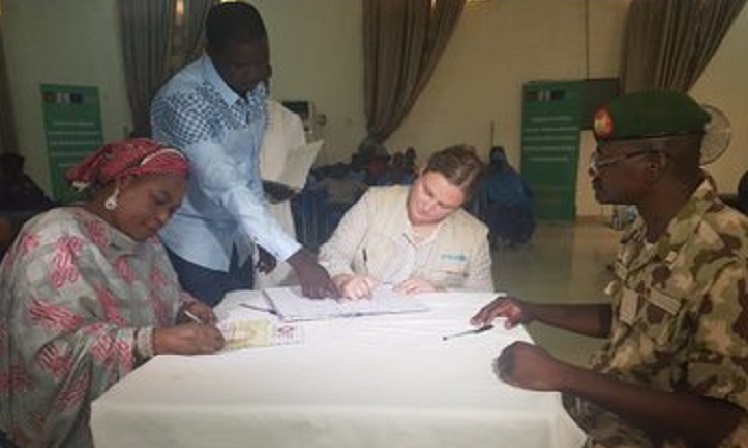
THE Nigerian military has released from detention 25 children who were once victims of the Boko Haram attack to the United Nations Children’s Fund (UNICEF) and the Borno State government.
The handing over was done in Maiduguri by Major General Olusegun Adeniyi, Theather Commander of Operations Lafiya Dole on behalf of the military on Thursday, according to an update on the UNICEF Nigeria Twitter account.
The children had been released to be reintegrated into the society after being cleared of ties with Boko Haram insurgents.
“Let me say here that I am handing over 25 children formerly associated with Boko Haram.
“These children have been cleared of any wrongdoing because they were arrested during our operations along with their fathers who are still under investigation,” said Adeniyi.
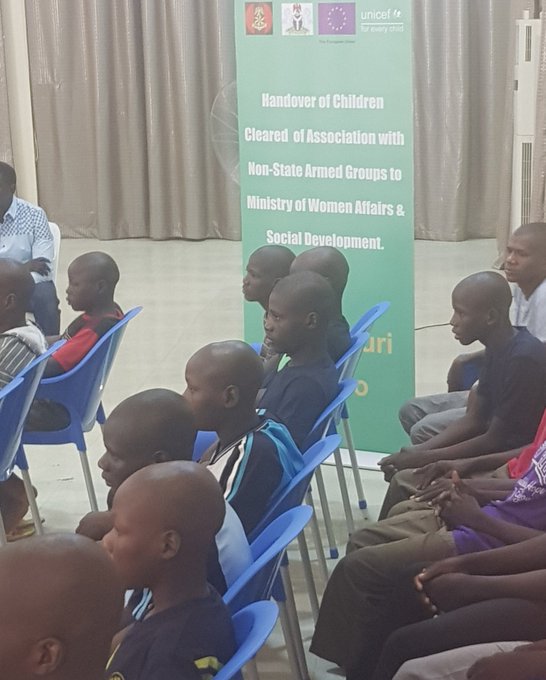
Cross-section of the children released from the military detention and handed over to UNICEF and Borno State government on Thursday. Photo credit: Twitter/UNICEF_Nigeria.
The military urged the Borno government, UNICEF and other partners to ensure an adequate education for the children.
“So, we are happy for these children but I know Boko Haram criminals are not happy because they could not use them as suicide bombers,” it added.
Receiving the children, UNICEF noted that the children would access reintegration support which includes psychosocial support, education and livelihood skills.
They would be kept at a UNICEF-supported transit centre whilst efforts to reunite them with their families and reintegrate them back to their communities are underway.
The release of the 25 children on Thursday came less than a month the Human Rights Watch published a report stating thousands of children, some as young as five, were still in the military detention for suspected involvement with Boko haram insurgents.
The report released on September 10 recommended to the Nigerian government immediate release of children in military detention who were not charged with a criminal offence in order for rehabilitation, community reintegration and family reunification.
“Nigerian authorities should also immediately release children currently in military custody. If military or intelligence authorities have credible evidence of criminal offences by children, they should transfer them to civilian judicial authorities to be treated in accordance with international juvenile justice standards. The government should also accelerate efforts to ensure access to education for children affected by the insurgency,” the report stated.