TRADE unions and advocates under the Nigerian Movement for the Liberation of Western Sahara (NMLWS) have demanded that Nigerian companies should put an end to “buying stolen phosphate, fertiliser, and fishes from Morocco”.
These items, the unions say, are unlawfully extracted from the Sahara Arab Democratic Republic (SADR) more commonly called Western Sahara.
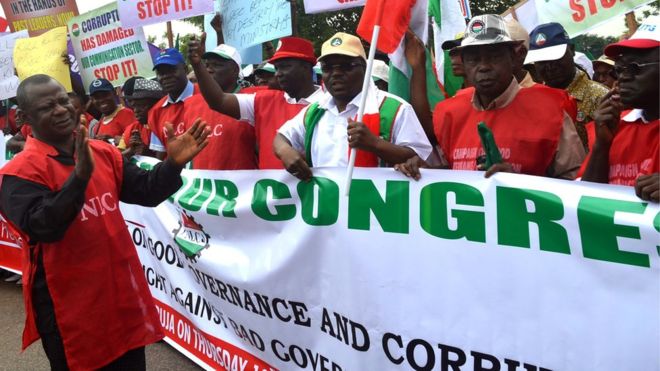
The demand was made on Wednesday at a press conference held in Abuja. The NMLWS, chaired by former foreign affairs minister Ibrahim Gambari, is a coalition that comprises the Nigeria Labour Congress, Trade Union Congress, Academic Staff Union of Universities, as well as 17 Civil Society Organisations.
The NMLWS said it plans to bring to book all companies in Nigeria who profit from an “unholy theft” by receiving phosphate “stolen by the kingdom of Morocco from Western Sahara to produce fertiliser”.
“This movement supports the development of Nigeria, but not with stolen resources,” the press statement from the conference obtained by The ICIR said.
“We insist that although our country needs fertiliser, but not that produced with the blood of our brothers and sisters in Western Sahara.”
“About this, we are definite. This principle is planted in the Nigerian culture of non-exploitation of other peoples and defender of colonised peoples as we did in the struggle for the liberation of countries like Guinea Bissau, Mozambique, Angola, Zimbabwe, Namibia and South Africa.
“Nigerians are freedom-loving peoples, not accomplices of leaders of a country like Morocco who against all known tenets of African brotherhood, religious obligations and social justice, would invade and occupy a member country of the African Union, dehumanise its people and plunder its resources which it sells to European Union (EU) countries and companies in Nigeria.”
The NMLWS recalled that in December 1984, Nigeria, then led by military ruler Muhammadu Buhari, had recognised Western Sahara as an independent African country.
“It is, therefore, inconceivable that thirty-five years later, under an elected President Muhammadu Buhari, Nigeria would tolerate the occupation of the same country by a sister African country and be receiving the natural resources of Western Sahara plundered by Morocco,” it observed.
The group also lamented human rights violations committed by Morocco’s occupying forces against the Saharawi.
Citing instances, it said, a lady was crushed to death by a police car after people from Western Sahara jubilated following Algeria’s victory at the African Nations Cup.
“As we speak, fifteen Saharawi youths are still in prison just for celebrating a football victory,” it noted.
Prepare to be sued and picketed
The NMLWS warned all companies receiving resources taken from Western Sahara to be ready for demonstrations at their offices and legal battles if they do not desist.
“After giving this notice to the Nigerian companies dealing in stolen Western Sahara resources, we will picket them across the country and bring them before our courts,” it said.
“This also includes supermarkets selling sardines and fishes from Morocco because 92 per cent of these fishes is stolen from the Western Sahara coast.
“It is in furtherance of this we have invited these lawyers to meet, exchange ideas, and plot our legal strategies and commence legal actions.”
The movement urged Nigeria to deal decisively with the problem and learn from South Africa, where a court in May 2017 ordered “the seizure of a 55,000-tonne cargo of phosphate illegally extracted and stolen by Morocco from Western Sahara”.
AU, UN must act … and other demands
The Nigerian Movement for the Liberation of Western Sahara urged international organisations such as the African Union, United Nations, and European Union not to “remain silent in the face of atrocities perpetrated by Morocco in Western Sahara”.
It also made the following six demands; that:
The Moroccan monarchy and leadership be called to order and brought to book for gross human rights violations in Western Sahara.
The consent and permission of the Saharawi people through the SADR government be secured before the natural resources of the country is utilized or traded in any form.
The AU defends its member SADR by giving Morocco a timeline to vacate Western Sahara and if it fails, to expel and impose stiff sanctions against it as we did to Apartheid in South Africa.
The UN expands the mandate of MINURSO to include human rights violations so its Mission can protect the Saharawi people.
Morocco vacates the parts of Western Sahara it is occupying and allows the Saharawi like other Africans and peoples of the world to freely govern themselves and develop their country without any interference.
All should be done to ensure that the Moroccan-Saharawi armed conflict is not re-ignited as renewed war can lead to an avoidable international conflagration.
The press conference on Wednesday had in attendance Gilles Devers, Western Sahara’s European Lawyer; Femi Falana, Senior Advocate of Nigeria (SAN) and Western Sahara’s lawyer in Africa; and Oubi Bachir, former Ambassador of Western Sahara to Nigeria and its current representative in France.
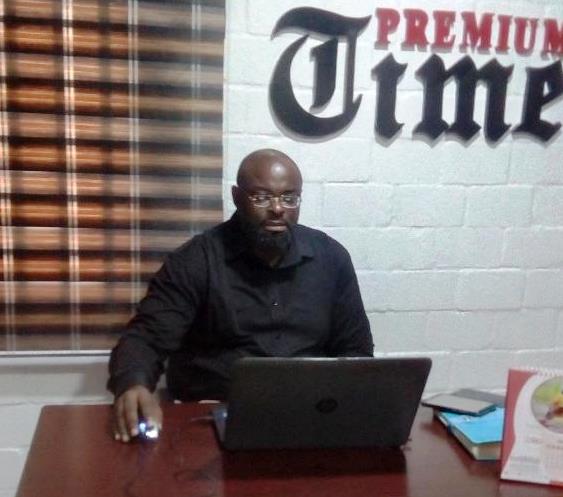
FOLLOWING today’s release of Mary Ekere, a female journalist detained for two nights in Akwa Ibom, Cletus Ukpong, Regional Editor, South-South for the Premium Times, who broke the story of the reporter’s arrest, has been threatened with the same kind of treatment.
The threat was made by Cristo Ekpoh, a strong loyalist of Udom Emmanuel Gabriel, the Akwa Ibom State Governor.
Ukpong had earlier written on the illegal arrest and detention of Ekere and shared the report on his timeline. But Ekpoh went on Premium Times Facebook timeline condemning the report. He tagged Ukpong in his reaction with claims that it was misleading.
“Misleading headline by Cletus Ukpong to tarnish the image of the governor. It should have been you that was thrown into prison,”Ekpoh stated.
When The ICIR called Ukpong on the tweet threat, he said that Ekpoh has been threatening him since he did a report on the poor condition public schools and travails of theschool teachersin Akwa Ibom State.
The journalist added that Ekpoh also threatened to deal with him and members of his family, promising that he would be attacked anywhere he is found.
Ukpong in 2018 did a six part report which exposed the rot of public schools in Akwa Ibom State.
Speaking on the threat to its reporter, Premium Times Editor – in – Chief, Musikilu Mojeed, said that the newspaper would not be intimidated by threats to any of its reporters, adding “whoever does anything unlawful to our reporter will be brought to book, if not by the Nigerian government by authorities in other places.”
Meanwhile, Ekere who was assigned to cover the Akwa Ibom State House of Assembly for the Post, a local newspaper in the state, was arrested and detained for taking pictures of a task force set up by the state government to work with the state Environmental and Waste Management Agency.
Reports say she was remanded in Uyo prison after being held up in police detention.
Following the incident, the Nigerian Union of Journalists (NUJ), in a letter signed by Inimfon Silas, State Chairman of the NUJ Chapter and Anthony Udoh, his Secretary on Monday threatened to institute legal action and demanded her release.
Earlier today, the Nigeria Association of Women Journalists (NAWOJ) also condemned actions of the state officials for the arrest, stripped the journalist naked, and eventually made her pass two nights in detention while embarking on a journalistic duty.
“We will work with our parent body (NUJ) to ensure that we follow up with legal actions to stop any further harassment and intimidation of our members by any government or private agency. Enough is Enough,” the statement jointly signed by Uduak Ekong, NAWOJ State Chairperson and Esther Effiong, the Secretary read.
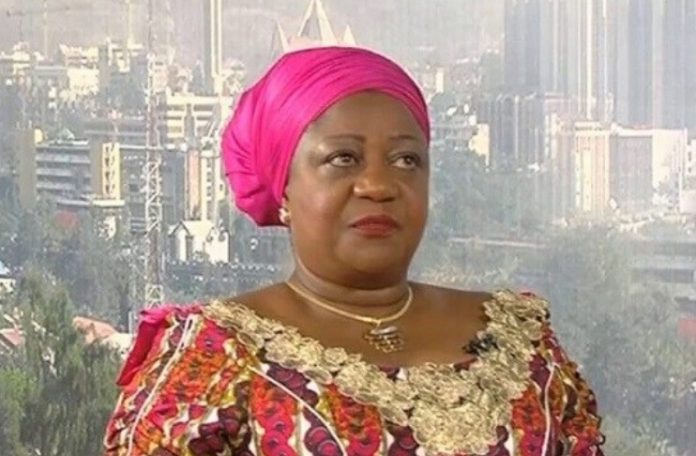
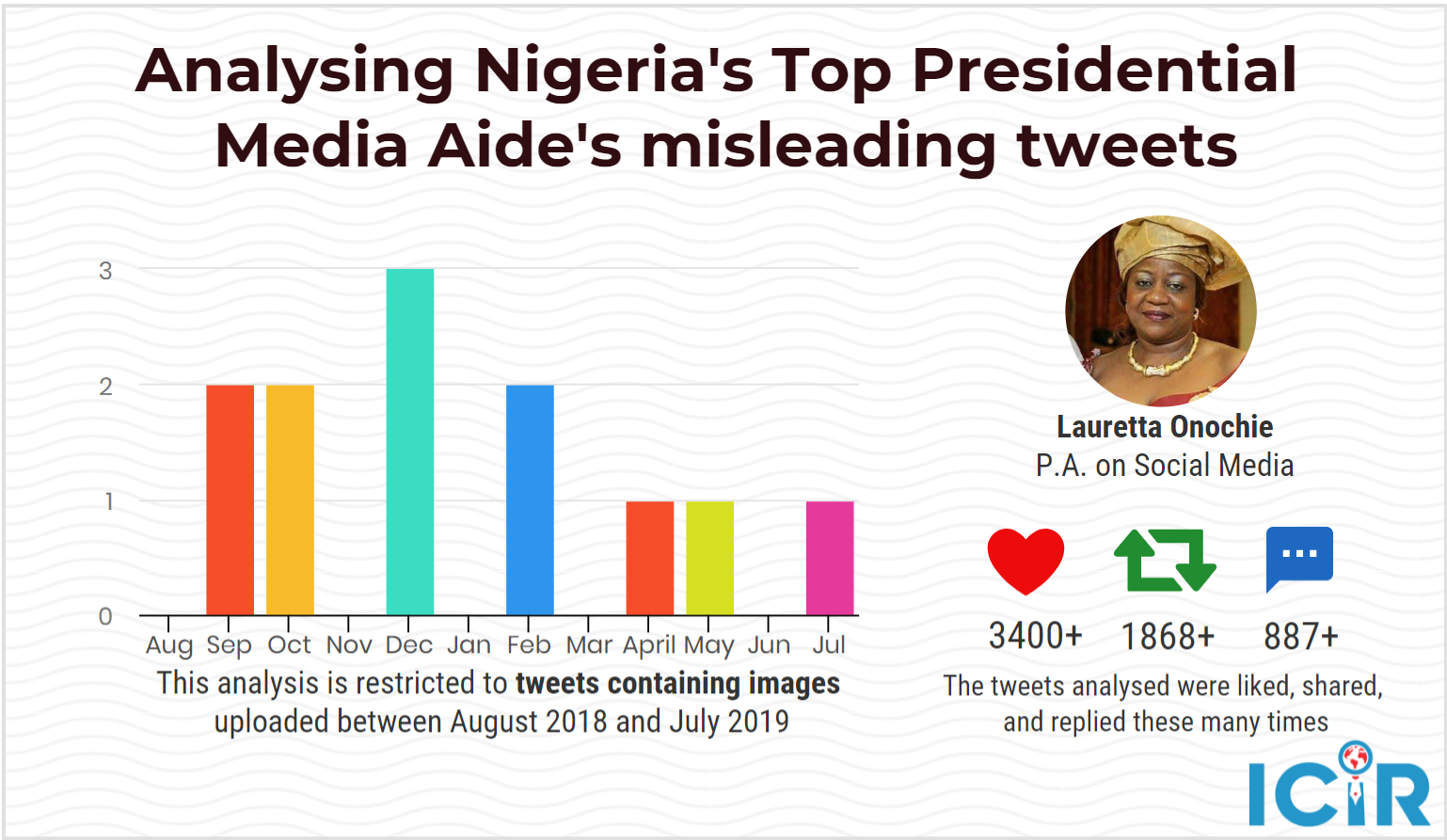
Pictures can mislead in several ways: when they contain false information, are doctored to misinform or are employed in a false context. As part of a series scrutinising online posts by prominent social media users, The ICIR used publicly available tools to verify pictures shared on Twitter by Lauretta Onochie, Personal Assistant on Social Media to the Nigerian president.
DURING the first term of President Muhammadu Buhari, a good number of his aides restricted their social media posts to official releases and photographs. But some shared a lot more - including outright misinformation.
And, in the days, weeks and months leading to the last general elections in Nigeria, social media became, for presidential aides, as for many others, a tool for merely selling their principal. Social media platforms became a battleground, a turf for peddling propaganda and misinformation and a weapon to discredit and shoot down opponents’ reputations.
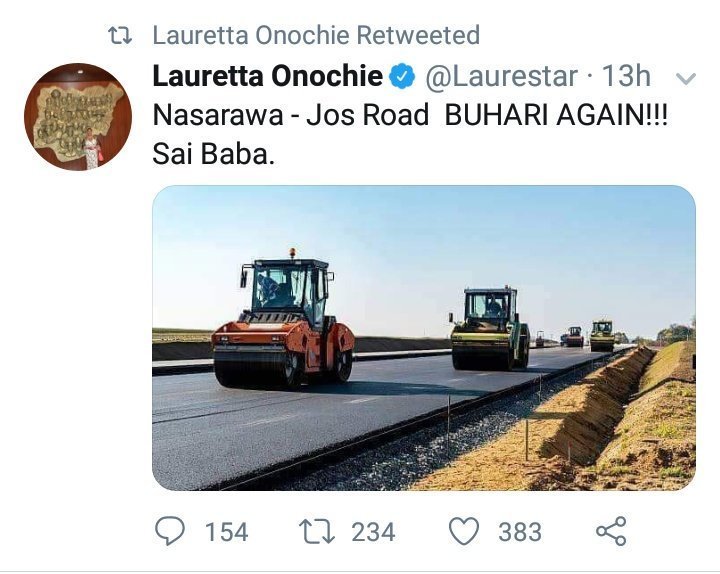
President Buhari’s Personal Assistant on Social Media, Lauretta Onochie, in September 2018, tweeted a picture of an asphalt road being constructed. She captioned it “Nasarawa-Jos Road”, giving the impression that it was a road constructed by the government, but it is actually a stock photo uploaded to Getty Images in November 2015.
The inaccuracy triggered a wave of sarcastic tweets under the hashtag #TweetLikeLaurettaOnochie. She then pulled down the tweet andapologised for the “big mistake” saying “it won’t happen again”.
Onochie’s tweet wrongly crediting the federal govt. for a foreign road project
But, it has happened again and again as many of Onochie’s other tweets since then havealsoincluded misinformation, such as one in December 2018 showing foodpacks bundled with N500 notes. She claimed Atiku Abubakar, PDP presidential candidate in the 2019 election, had shared the money with voters.
It turned out that the picture was not taken at an Atiku campaign rally but had actually been put out in February 2017 by a Lagos – based charity organisation during an outreach.
Though the President mentioned “fake news” as a security challenge in August 2019, he reappointed Onochie along with several other media aides shortly thereafter. Together the aides command a Twitter following of over 1.7 million, providing a considerable platform to any misleading information they might share.
How we conducted our research
Using Twitter Media Downloader, a Google Chrome extension that downloads images in bulk from particular users, The ICIR studied 1,058 images uploaded by Onochie between August 1, 2018, and July 31, 2019.
In at least 12 cases, she had used inaccurate pictures. This was determined mainly by scouring the internet for instances where the pictures had been used before in an attempt to locate the original source. (Note: Learn how to conduct a reverse image search here.)
After the search, the findings were brought to Onochie’s attention through a phone interview, but she declined to comment on them, choosing rather to insult the reporter.
“You must be very stupid,” the presidential aide replied curtly, before ending the call.
“I think you need to take your 419 [fraud] somewhere else; the FBI will soon be on your case,” she added minutes later during a second conversation.
Misleading pictures
Mishmash of housing photos
Four picturesappeared on Onochie’s timeline in September 2018 showing what was suggested as low-cost housing projects in the Federal Capital Territory, FCT, funded by the Federal Government.
But one picture was first uploaded in April 2014 by the Lagos State Home Ownership Mortgage Scheme. The houses were built as part of the state government’s Rent-to-Own Programme that supports first-time buyer residents. (Note: Here is another picture of thestructures under construction.)
Another picture is actually of abungalow at the Sir Michael Otedola Housing Estate in Odoragushin, Lagos. Former Lagos State governor Akinwunmi Ambode wasphotographed inspecting the estate in November 2016.
A third picture dates back to at least 2016 and has been used in articles about housing projects inMalaysia, Guyana and Kenya.The ICIR traced the last picture, to affordable housing that was planned for Revelstoke in British Columbia, Canada.
None of the four pictures, therefore, show housing projects in the Federal Capital Territory, Abuja.
Borno solar panel manufacturing plant or…
In April 2019, Onochie shared a picture with her followers in which she praised then Borno State governor Kashim Shettima for launching “Africa’s biggest Automated Solar Panel manufacturing plant”.
The tweet was liked 1,309 times and shared by 587 users of the social media platform.
Checks, however, show the picture that is credited to senior airman Larry E. Reid Jr (staff sergeant at the US Air Force), is over 11 years old and depicts a solar power plant in Las Vegas in the US.
‘Clashes’ actually fuel subsidy removal protest
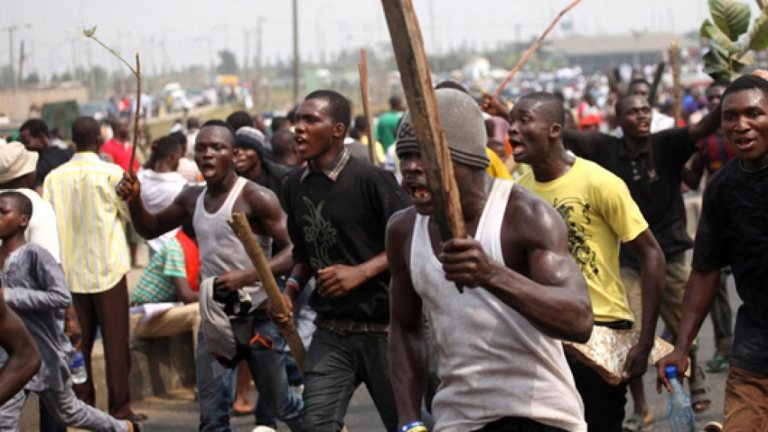
Misleading picture purportedly of communal clashes in Cross River
In July 2019, Onochieuploaded a picture with a caption lamenting the loss of lives to inter-communal clashes in Cross River State.
However, the picturewas taken in January 2012 by Reuters photographer Akintunde Akinleye. It shows protesters chanting slogans “as they march through Ikorodu road during a protest against a fuel subsidy removal in Lagos”.
Doctored image
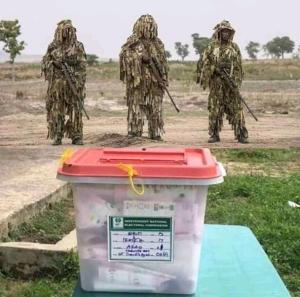
Two days before the presidential election in February 2019, Onochie shared a picture on Twitter which seemed to show three soldiers dressed in heavy camouflage guarding a ballot box.
“Self-explanatory,”said her caption, “God bless Nigeria.”
The tweet came after Buhari had instructed the security agencies to deal with anyone who attempted to disrupt the election and said whoever tried snatching ballot boxes did so “at the expense of his life”.
Scrutinising the picture reveals that it is a combination of two photos.
The photo of the soldiers in ghillie suitsdates back to April 2018 when it was taken by AFP freelance photographer Stefan Heunis at a military demonstration held in Abuja. It was joined to a picture of a ballot box used at St. David’s Anglican Primary School, Afao, during the 2018 gubernatorial elections in Ekiti. This was uploaded by TheCable in July 2018 to its liveblog of the collation process.
The misleading combinationwent viral, with a number of blogssharing it as though it were genuine.
Obasanjo misattributions
Onochie twice shared quotes supposedly from My Watch, the three-volume memoir of former president Olusegun Obasanjo that was published in 2014.
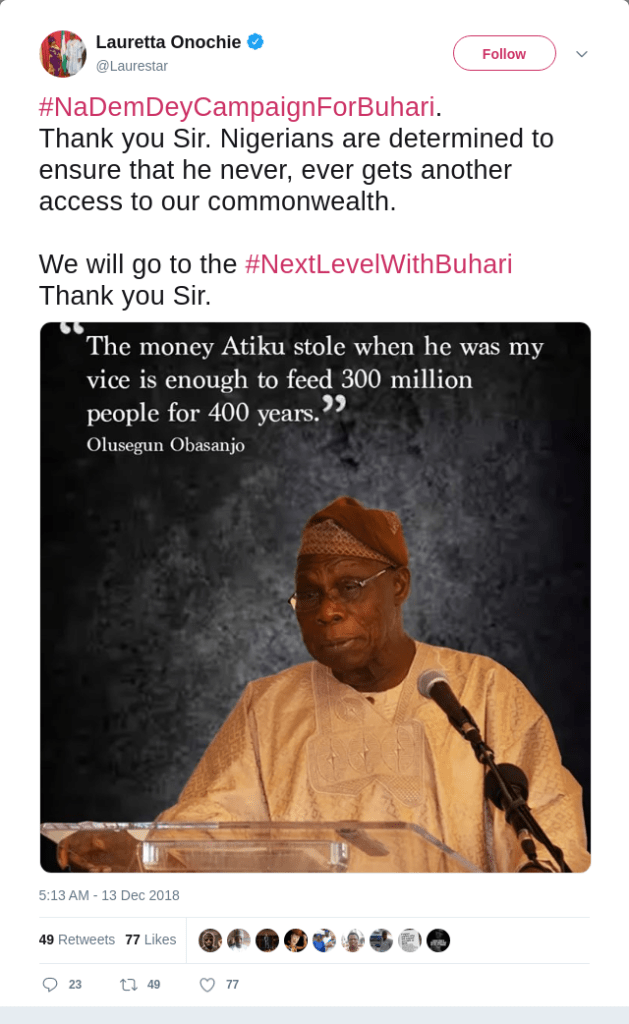
In December 2018, she shared an image of Obasanjo with a quote credited to him: “The money Atiku stole when he was my vice is enough to feed 300 million for 400 years.” (Note: Though the source of the quote was not mentioned, severalotherpostsclaimed it is from pages 31 to 32 of My Watch, Volume 2.)
Again, in February 2019, she uploaded a Facebook status screenshot thatsaid “‘Atiku becoming president is like hearing that a former armed robber is now your bank manager’ – OBJ (My Watch, page 49)”.
The ICIR reviewed the pages cited, which didn’t contain anything close to the quotes tweeted. Pages 31 and 32 narrate how Obasanjo settled on Abubakar as his running mate and the regrets he later had. It contains some unpleasant remarks about Abubakar -mentioning a “somewhat shadowy” parental background, propensity to corruption and poor judgment – but does not indict him for large-scale stealing during his time in power.
Pages 49 of all three volumes make no mention of Abubakar or his likeness to an armed robber.
Other excerpts published from the book about Abubakar alsodo not contain the two quotes shared by Onochie. The quotes are, thus, misattributed.
THE Nigerian Centre for Disease Control (NCDC) has disclosed that a total of 550 suspected cases of eight different diseases comprising measles, cerebrospinal meningitis, yellow fever and five others were recorded in one week across the states in the country.
In its weekly, epidemiological report for the week 35 released on Tuesday, the NCDC listed other diseases to include cholera, lassa fever, monkey pox, acute flaccid paralysis, and influenza subtype A and B.
According to the breakdown of the cases, measles account for the highest figures with 307 suspected cases across 127 local governments of 27 states and the Federal Capital Territory.
Acute flaccid paralysis and lassa fever diseases followed measles with 74 and 73 suspected cases respectively.
Others were Yellow Fever with 44 cases, cholera-33 cases, cerebrospinal meningitis-16, monkeypox-2 and a case of influenza.
Measles is a vaccine-preventable disease, however, thousands of measles cases have been recorded in 2019 in Nigeria.
To tackle the public health disease, NCDC said the multi-agency National Measles Technical Working Group (TWG) was monitoring and coordinating response activities, working closely with the National Primary Health Care Development Agency (NPHCDA) towards measles supplemental immunization activity in the country.
According to the World Health Organisation (WHO), the best protection against the disease is through receiving two doses of the measles vaccine.
But a WHO’s report in April 2019, noted that more than four million Nigerian children missed the first dose of measles vaccine in 2017.
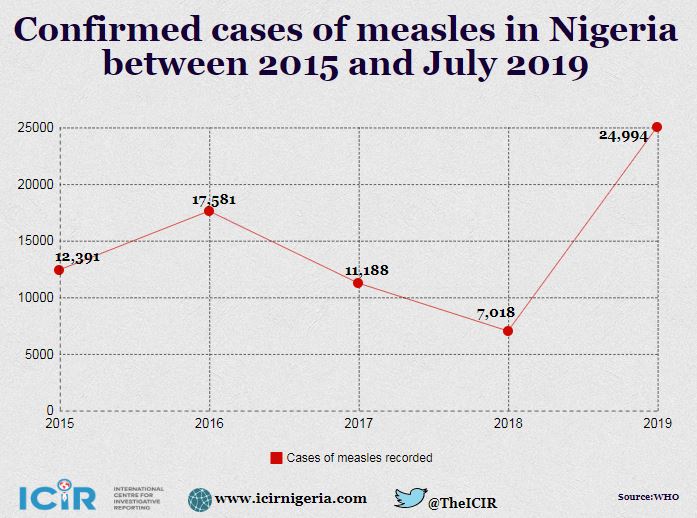
Cases of Measles between 2015 and as of July 2019.
The result of the missed-out is visible in the country as between January and July, it recorded a total of 24, 994 cases, according to WHO’s statistics. Nigeria’s figure was the fourth-highest globally.
Lassa Fever also affected 73 people in the last week of August across 15 local governments in 12 states. It caused the death of two people.
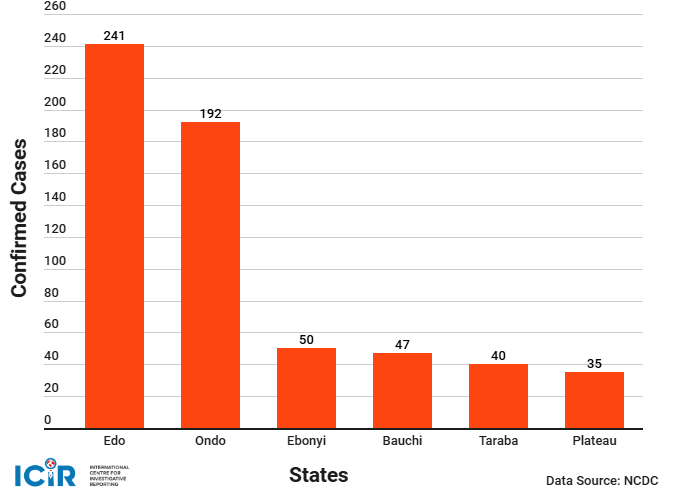
Edo State has the highest number with 36 cases. The state is followed by Ondo State with 13 casualty figures. Other states that were affected with Lassa Fever are Lagos – 12, Ebonyi – 3, Bauchi – 2, Plateau – 1, Kaduna – 2, Benue – 1, Delta – 1, and Abia –2.
The disease is caused in humans by being infected with Lassa virus from exposure to urine or faeces of infected Mastomys rats. The virus could also spread between humans through direct contact with the blood, urine, faeces, or other bodily secretions of a person infected with Lassa fever.
Going by the situation update report, Nigeria has recorded 3,617 suspected cases of the disease so far in 2019. Of these, 678 were confirmed positive and a total of 147 people died to the disease.
Responding to the disease, NCDC noted there is a TWG that co-ordinates the response activities at all levels.
The prevention of Lassa fever relies on promoting good “community hygiene” to discourage rodents from entering homes with effective measures that include storing grain and other foodstuffs in rodent-proof containers, disposing of garbage far from the home, maintaining clean households and keeping cats, according to WHO.
Confirmed Cases of Lassa Fever in Six States in Nigeria as of August 2019. Infographics by Olugbenga Adanikin/The ICIR.
Another epidemic Nigeria is fighting is Acute flaccid paralysis (AFP). The disease which is described by the global health agency as a sudden onset of paralysis or weakness in any part of the body of a child less than 15 years of age were suspected to affect 74 people across 25 states and the FCT for that week.
Yellow Fever, Cholera and Cerebrospinal Meningitis that are all vaccine-preventable diseases recorded casualty figures close to 100 people.
MINISTER of the Federal Capital Territory (FCT), Muhammad Bello says residents of the nation’s capital should be vigilant and be conscious of their personal security as kidnappers make inroad into Abuja.
“It is almost impossible for security agencies to be everywhere one hundred per cent…so every resident in a way is also a security officer,” Bello said in Abuja on Tuesday after the meeting of the FCT Security Committee.
“So, it is very important for residents to be vigilant…to to be very conscious of their personal security. If for instance, you see a vehicle without number plates, it means that vehicle is not registered and can be used for criminal activities, please report to the relevant authorities,” he added.”
The Security Committee comprises the police, military and para-military formations in the FCT as well as Area Council Chairmen and religious leaders.
While admitting that there were recent cases of kidnapping in the city, the Minister insisted that Abuja, “remains quite safe,”compared to other cities of the world.
Five persons were reportedly kidnappedin Abuja over the weekend, police confirmed two cases as the victims were released or rescued. There has been growing fear among the residents on the state of security in the territory.
Bello said that in comparison to several cities around the world, FCT remains quite safe. While acknowledging that there were indeed two incidences of kidnappings over the past few weeks, the Minister said both victims have been rescued.
He called on residents to not be swayed by rumours or unverified news online but to confirm their veracity before circulating. Fake news or false security information has the capacity to lead to breach of peace, he said.
On the issue of communal clashes, he commended the efforts of the Area Council Chairmen and traditional rulers in curbing the herders/farmers clashes and urged them to continue on the path of ensuring peace.
Bello also assured residents that the FCT administration would continue to partner and render support to the Nigerian police, the military and para -military commands in the FCT that are charged with the task of keeping the city secure.
Also speaking, the FCT Minister of State, Ramatu Tijjani Aliyu called for synergy between all security agencies in the task of combating crime and enforcing security measures in the FCT.
The FCT Commissioner of Police Bala Ciroma on his part said that there would be more deployment of officers and men across the city to combat crime.
He revealed that the police have also intensified both vehicular and foot patrol to ensure more visibility of officers and men of the Force in the city. The raid of black spots he said, will be stepped up.
Ciroma echoed the opinion of the Minister when he said that community policing, which involved a robust collaboration between the police and the citizenry will be intensified.
This method, he said, has succeeded in curbing criminality in the Area Councils, especially Abaji where information provided by the citizens stopped a kidnapping ring which operated between Kogi State and the FCT.
On the menace of “one chance” the Police Commissioner said that the criminals perpetrate their acts by using unregistered and unpainted taxis.
He said that the police was collaborating with the FCT Directorate of Road Transport Services to apprehend the criminals.
Ciroma also revealed that a unit within the CID was created specifically to combat one chance and so far, over one hundred of suspected one chance perpetrators have been arrested and their vehicles confiscated.
PRESIDENT Muhammadu Buhari on Tuesday dissolved the Special Presidential Investigation Panel for the Recovery of Public Property (SPIP) headed by the suspended Okoi-Obono Obla.
A statement by Femi Adesina, Special Adviser to the President on Media and Publicity, directed the Attorney-General of the Federation and Minister of Justice, Abubakar Malami, to immediately take over all outstanding investigations and other activities of the SPIP.
The panel was established in August 2017 by the then Acting President, Yemi Osinbajo, to investigate specifically mandated cases of corruption, abuse of office and similar offences by public officers.
Buhari, who thanked all members of the dissolved panel for their services, said he looked forward to receiving the final Independent Corrupt Practices and other Related Offences Commission (ICPC) report on the ongoing investigations of the dissolved panel’s chairman, Obono-Obla.
Buhari had on August 14 approved the suspension of Obono-Obla from office.
Obono-Obla’s suspension letter, signed by the Secretary to the Government of the Federation, Boss Mustapha, directed the embattled official to step down and then proceed to answer questions from the ICPC.
He is facing probe over allegations of certificate forgeryand other corruption-related charges.
THE recent decision by the Federal Executive Council (FEC) to increase the Value-Added Tax (VAT), on goods from 5 per cent to 7.2 per cent in a bid to increase the country’s non – oil revenues and also reduce its reliance on crude oil sales has continued to generate hot debate among experts and Nigerians.
The Minister of Finance, Budget and National Planning, Zainab Ahmed, in a news report explained that the extra revenue will create the required funds to meet the new minimum wage obligation.
“This is important because the Federal Government only retains 15 per cent of the VAT, 85 per cent is actually for the states and local governments to enable them to meet the obligations of the minimum wage,” the minister had said.
“We were proposing and the council has agreed to the increase in the VAT rate from five per cent to 7.2 per cent. Though, a decision is yet to be taken on the effective date of the new rate.”
Although, Ahmed made a U-turn in a statement by her spokesperson, Yunus Abdullahi, saying that that the proposed increase was 7.5 per cent instead of the initial 7.2 per cent earlier announced based on the recommendation of the presidential technical advisory committee.
After the increase in the minimum wage from N18,000 to N30,000 in April 2019, the Federal Government had argued that majority of the 36 states would struggle to pay salaries of their workers, insisting the proposed VAT hike is part of its drive to increase tax revenue for states to pay their staff.
A VAT is a consumption tax payable on goods and services consumed by individuals, government agencies and business organisations.
Currently, Nigeria has one of the lowest VAT rates globally when compared with other African countries like Ghana with a VAT rate of 15 per cent, South Africa 14 per cent, Egypt 10 per cent, Morocco 20 per cent and Mauritius 15 per cent — the difference is quite obvious.
At the current rate of 5 per cent, Nigeria raised N1.1 trillion in 2018 from VAT which amounts to 0.9 per cent of it’s Gross Development Product, (GDP), which is insignificant when matched with several Commonwealth and ECOWAS countries earning 3.8 per cent of their GDP from VAT according to a report by PriceWaterhouseCoopers (PWC).
What does this increase mean for Nigerians?
It has been argued that the proposed VAT increase has implications for the ordinary Nigerian. For instance, a Nigerian who earns N30,000 monthly wage and wants to obtain a product worth N10,000 with the VAT charge inclusive will have to pay N10,720 which means he has spent 35.73 per cent of his income, while another Nigerian earning N500,000 monthly will spend 2.14 per of his monthly income to purchase the same product.
Analysis carried out by The ICIR shows that Nigerians with higher income will pay less proportion of their income as VAT on taxable goods or services and save more while Nigerians with lesser incomes would pay more and save less.
However, some items most Nigerians consume enjoy VAT exemptions namely basic food staples, water, medical, veterinary and pharmaceutical raw materials, books, newspapers, infant products, and
magazines.
Apart, from the exempted goods listed above, other goods are subject to VAT which includes Sanitary protection for women such as pads and tampons, television, amongst others.
BudgIT NG, a civil advocacy organisation in a 2018 report revealed that final consumption expenditure of households in Nigeria moved from N42 trillion in 2012 to N74 trillion in 2015 reflecting a leap of about 76 per cent. It also revealed that the consumption pattern of most households in Nigeria tilted towards food, accommodation, and transportation.
Though 2.2 per cent VAT increase looks minimal it is yet prone to lead to a 40 per cent increase in cost to small businesses and consumers according to the report.
The result is a likely reduction of spendable income for poor households resulting in lower consumption patterns, increase in prices leading to higher inflation, and a decline in the GDP growth rate.
On the bright side, extra VAT revenue will help reduce budget deficits, reduce government debt and fund social services if utilised appropriately.
What is Statistics saying?
Nigeria had raked in N3.627 trillion as proceeds from VAT between 2015 to 2018 according to data obtained from the Federal Inland Revenue Services (FIRS).
The country earned its highest VAT income in 2018 receiving N1.1 trillion. In 2017, it earned N972 billion and N828 billion in 2016. The least was in 2015, which was N767 billion.
If the proposed VAT increase of 7.2 per cent is implemented, Nigeria would earn an extra N440 billion annually from VAT according to a PWC forecast.
It also means that the Federal Government will earn an additional N66 billion, the 36 States would also earn N220 billion more and the Local Governments would get extra N154 billion at the level of 2018 collection.
However, VAT revenue of N767 billion generated in 2015 is less than 1 per cent of Nigeria’s consumption GDP of about N80 trillion despite the country being import-dependent.
Lagos sits on the top of the pack in terms of VAT receipts generated across the country. For example in 2018, Lagos State averaged N8.033 billion monthly up from its average of N6.38 billion in 2017.
While Nasarawa, Bayelsa, Gombe and Ebonyi complete states had the least VAT remittances.
The VAT increase will lower demand which would create more revenues for the government but the timing and impact on low-income earners will be huge because not every Nigerian can afford the new tax regime.
Available records suggest that a better approach would have been to expand the tax collection base through efficient use of other revenue outlets for public services and infrastructure to act as palliatives and catalyst for growth.
FOR the third time in roughly three months, trade unions in Nigeria have threatened to down tools over the government’s protracted delay in implementing the new national minimum wage of N30,000.
The new wage was approved by President Muhammadu Buhari in April following recommendations from a tripartite committee set up by the federal government.
In a statement released on Tuesday by the Trade Union Side (TUS) of the Joint National Public Service Negotiating Council (JNPSNC), the unions said they would not give further notice before millions of their members across the country “commence strike over the non-implementation of the new national minimum wage and appropriate consequential adjustment”.
The TUS comprises eight public service trade unions present in all states in the country, including the Federal Capital Territory.
A meeting of the joint council that held in Abuja on Monday had ended in a deadlock as the unions accused government of not being “serious at all [and] … taking us for a ride”.
In the statement signed by the JNPSNC Acting Chairman, Anchaver Solomon and Secretary, Alade Bashir Lawal, the unions accused the government of frustrating the new wage’s implementation process and said all attempts to persuade government officials have been unsuccessful.
They said it was clear the government was not committed to paying the new minimum wage and adequate consequential adjustment.
“The Consequential Adjustment Committee two weeks ago agreed that the proposal of the TUS that salary of officers on grade levels 07-14 should be increased by 29% and those of officers on grade levels 15-17 by 24% vis-a-vis that of Government Side of 10% for officers on Grade levels 07-14, 5.5% for those on Grade Level 15-17 should be forwarded to President Buhari to see the patriotic position of labour and approved appropriate consequential adjustment accordingly,” the statement said.
“When the meeting reconvened on Monday 16th September, 2019 to get a feedback on the expected approval from Mr. President, the Government Officials brought a fresh proposal of 11% pay rise for officers on Grade Levels 07-14 instead of its earlier position of 10% and 6.5% for those on grade levels 15-17 instead of the former 5.5%.”
Third threat in a few months
It is not the first time the trade unions have threatened to go on strike over perceived unseriousness from the government on the issue.
On July 2, the same threat was made in a statement signed by Solomon, which said the government has been “coming up with one strange proposal or the other, all with the intent of scuttling the implementation of the new national minimum wage”.
“Labour may have to embark on industrial action if the current state of affairs as regards the issue of consequential adjustment arising from the new national minimum wage of N30,000.00 per month remains the same,” Solomon declared.
Again on July 17, the TLS said its members should be prepared to go on strike as the government had “introduced a strange clause to the discussion”.
“All efforts by the trade union side to persuade the government side to return to the right track of negotiation and agree on a realistic percentage increase proved abortive,” the council’s acting chairman noted in a communique released to journalists.
The ICIR could not get a statement from Benson Upah, head of information of the Nigeria Labour Congress (NLC), as he explained that he was at a meeting.
Data reveals new wage changes little
Based on data from the National Bureau of Statistics analysed by The ICIR, the new minimum wage of N30,000 changes nothing in the standard of living of the average Nigerian.
NBS’s Consumer Price Index (CPI) and Inflation Reports show that the CPI in August 2015 was 175.4 while that of August 2019 is 295.5.
We evaluated the statistics using the newly approved minimum wage and found that workers who earned N18,000 in 2015 and now earn N30,000 have still lost 1 per cent of their purchasing power.
In other words, the new wage can only buy about the same amount of items which N18,000 could buy four years back. This is as a result of an increase in the prices of commodities as well as other economic activities.
Ilaje-Otumara, a neglected community in Lagos, Nigeria’s foremost commercial city, has an estimated population of almost a million people including women and children. Sadly, for decades, access to water and toilet facilities has been a major problem. Olugbenga ADANIKIN writes on agonies of residents of this slum and their vulnerability to diarrhoea, cholera and toilet infections.
EIGHTY SIX-year- old Alhaji Ogundele Ibrahim Agbede takes gentle steps — he manages to walk through the filthy wet road —heading towards his commercial borehole facility in Otumara community, Mainland Local Government Area of Lagos State.
He sits and watches residents of the settlement, also known as ‘Ilaje-Otumara’, coming in out to fetch water for domestic use.
Alhaji Agbede as he is called by residents never had intended to sink the borehole that is now serving the community. He had attempted,albeit politically to bring succour and facilitate public water supply to the neglected community for about 50 years, but all to no avail —leaving the people and the community to contend with poor access to water and sanitation.
“I am 86 years of age and I have nine children. Access to clean water has been a big challenge for us in this community,” says Agbede.
In fact, I joined politics over 50 years ago to clamour for water and road from our local and state governments to Otumara community.”
Residents of Ilaje Otumara near a dirty bathroom fetching water. Photo Credit: Olugbenga Adanikin, The ICIR
“They said we should deliver and we have delivered,” clearly referring to winning the area for the ruling political party, All Progressives Congress (APC).“But we have not heard from them ever since…they left us because we are in a secluded area.”
Each household has an average of five persons in a room while others could number up to 10.
But they lack access to good toilet facilities and sanitation. For 16 years, they struggled to run a Primary Health Care facility in the community until it was refurbished last year.
Safe water and sanitation is a right which residents of Otumara have been denied for decades. They all practice open defecation, except for very few homes built at the entrance of the slum. Those who still prefer to use a toilet would have do so at a cost, which also depends on the sanitary level of the latrine.
“In this community, we pay for toilets and ordinary water,” says Francis Nwuoha, 39, Chairman of Otumara Market Association, who came to the community in 1998.
“One gallon of water is N50, while a bucket is N30.” Approximately, Nwuoha spends about N3, 000 monthly for water and the use of a toilet facility.
“Toilet in this area be N50 but in case water no dey, you can get it for N150.”
One of Ilaje Otumara residents defecating at ‘pako toilet’ where residents are charged N20 per visit. Photo Credit: Olugbenga Adanikin,
“At times when you go to Pako toilet, na N20, but the brick toilet is N50,” he stressed narrating how residents defecate in a makeshift toilet constructed with planks on a canal and their vulnerability to toilet diseases.
“In Otumara we are human. If you put a human in a confinement, you will find a way to live comfortably,” Ojo Jude, another resident added. “At the entrance, one (public toilet) is built by the Baale. There is another one on the field and there are other private ones on the lagoon, which is not something strange in Africa”.
“If you go to Eti-Osa or Apogbon, you will see it. People defecate into the Lagoon directly and I think it is very good for the fish,” he noted jokingly, perhaps oblivious of the fact that this could have severe health implications.
Worrying statistics
According to the United Nations, globally, nearly 1,000 children die daily due to preventable water and sanitation-related diseases such as diarrhoea.
The story and living conditions of Otumara residents are no doubt very pathetic and saddening. It negates the vision of Lagos state-planned transition to Africa’s model megacity and global economic and financial hub. Nigeria’s vision to attain the United Nations Sustainable Development Goals (SDGs) by the year 2030 is also at risk.
The 2015 UN-Water Global Analysis and Assessment of Sanitation and Drinking Water report, perhaps, speaks volume of the daily experiences of Otumara residents.
According to the report, an estimated 100 million Nigerians lack access to basic sanitation while 63 million do not have access to an improved potable water source.
Open defecation, it states, is still practised by a third of the rural population in the country while “some 12 per cent of the urban population also practices open defecation.”
“While 75 per cent of the urban population is served by improved water supply, often people will collect water from vendors and carry water a good distance after collecting it in containers.”
As a result, Nigeria failed to attain the 2015 Millennium Development Goals (MDGs), according to the World Health Organisation.
Meanwhile, the statistics dropped from 100 million to 70 million persons in 2019. The United Nations Children Fund (UNICEF) currently puts the figure at 70 million Nigerians as those who lack access to water, sanitation and proper hygiene. A survey by the Nigerian Bureau of Statistics (NBS) and UNICEF in March further showed that 3 in 10 persons still lack access to clean water sources, thus the need for more government action.
Entrance to one of the houses in Ilaje Otumara Community. Photo Credit: Olugbenga Adanikin, The ICIR
So far, the Federal Government has been grappling to meet its water and sanitation need. Suleiman Adamu, the re-appointed Minister of Water Resources, in May told the Federal Executive Council (FEC) that only 21, 000 communities in the country, representing 10 local governments from the 774 LGAs in Nigeria have achieved open defecation free status.
Adamu said Nigeria would require N959 billion, to meet the water need of the citizenry, a sum that may not be realised in the next four years due to the nation’s economic reality and budgetary allocations to the ministry.
Living in squalor with lost hope
Otumara is one community where waste and filth compete with humans for space. Residents — children, the old and youths—have resigned to fate, they have lost hope of any help from governments.
While they have grown resilience to adjusting to the inhabitable conditions in the community, often they bear the brunt of floods during the raining season.
Ironically, the large population of Otumara residents is a true representation of Nigeria’s cultural diversity. It is a multicultural community with a convergence of indigenous persons from other parts of the country. They have made the slum their home.
For eight years, James Uleke, a pastor in one Pentecostal church, had lived in the community with the hope of government intervention one day.
He expressed dismay at the neglect by both state and local governments, stressing that the only time Otumara and its people get government’s attention is during election . “We have been neglected. I named here marine kingdom because rain doesn’t need to fall before you see water overflowing everywhere,” says Uleke.
A boy in the slum manoeuvres through the filth with a tray of food perching on his head while a small girl watches. Photo Credit: Olugbenga Adanikin, The ICIR
“Sometimes, for hours, you see us packing water with buckets from our houses. The situation here is very terrible and bad enough,”he adds.
“We are living almost in the canal and there is nowhere to defecate so everyone does throwing”, a euphemism of defecating in a newspaper or a polythene bag and throwing it into the gutter.
There are also no senior secondary schools in the entire western part of the local government including Otumara. Students would travel 20 kilometres to seek knowledge in the nearest school situated in Ojota.
Gbolahan Hotonu, a security analyst and stockbroker, who hails from Badagry but was raised in the communitysays, except for the junior school, there is currently no secondary school in the western part of the area.
Ilogbo Junior High School, the only Junior Secondary School in Ilaje Otumara Community Ebute Meta West Founded in 1981. Photo Credit: Olugbenga Adanikin, The ICIR
“It is necessary we say it, we need pipe-borne water. We need proper electricity, let them provide prepaid metres because we are using bulk metres. When this community was neglected for too long, the community took it upon itself to ensure we have stable light,” says Jude.
They all shared their concerns at the Palace of Chief Oladipupo Arowojolu, Baale Ilaje Otumara 1 and High Chief Kalejaiye when ActionAid Nigeria visited alongside Journalists Against Poverty Initiative (JAP) to create awareness against corruption and the need to report corruption cases.
Anti-corruption Campaign Sign Post erected by ActionAid Nigeria at the entrance of the secluded community Photo Credit: Olugbenga Adanikin, The ICIR
Newton Omatseye, representing Ene Obi, the ActionAid Country Director charged the residents to collectively join the fight against poverty to reduce inequality, poverty and foster development.
“…poverty is an exclusion. Once people cannot have access to education, health facility, good roads and water and other basic things that make life bearable, we consider those people to be poor. We can feel your pain. You don’t need to define poverty to us anymore…so we will help amplify your voice.”
Looming disease outbreak
The ICIR observed that except urgent action is taken to address concerns of the residents, there may be an outbreak of disease. Aside from poor access to potable water, waste management is a great challenge in the community.
“We need road, water and school, but before the road comes, if there is no place to dump our refuse, there will be a problem,” another resident pleaded.
But for the recently refurbished health care centre in the community, the situation would have deteriorated. Even then, other concerns such as access to drugs and health personnel at the PHC remain.
One of the residents disclosed that there was once a cholera outbreak and cases of malaria. “There was sometimes in the past we had the issue of cholera. What I’m saying is about five years ago but since then; we have not had any disease outbreak.”
“This is a community where you have graduates, educated fellows but people see us as criminals because of the way our buildings are constructed. We are not criminals,” says Ojo describing the neighbourhood as the safest in Lagos Mainland.
Urgent need for road construction
During the tenure of Babatunde Fashola as governor of Lagos State, attempts were made to fix the road after several visits to the Governor’s office to persuade the officials to action. “Most times, when we visit the ministry, they will ask us to come with honourable and we took honourable there several times until the change in government.”
“The politicians know that the votes here are significant. This is a multi-ethnic community especially Igbos and Ebonyi people so we need government support.”
There are five local governments under Lagos Central Senatorial District – Apapa, Eti-Osa, Lagos Island, Lagos Mainland and Surulere. These councils are in the constituent of Senator Oluremi Tinubu who until now was the Chairman Senate Committee on Environment. She currently heads the Communications Senate Committee.
When The ICIR contacted Tinubu, she didn’t respond to calls put to her line. A 3-page text message sent to her was not also acknowledged or returned. Also, while at the State Ministry of Health, the newly appointed commissioner was said to be away attending the 62nd National Council on Health (NCH).
HOSTWRITER has called for applications for its 2019 Hostwriter Prize, which grants €5000 in awards for collaborative journalism between members.
Host Writer announced on it’s official @hostwriter twitter page that application is now open for journalists willing to participate until 31st October, 2019.
The award is in two categories— The Story Prize which presents awards for collaborative projects that have already been published, with €2000 going to the first prize winner and €1000 going to the second prize winner and The Pitch Prize awards €1000 each to two collaborative projects that have not yet been published.
Host Writer is a German based open network established in 2013 to promote collaboration among journalists across the globe.
The initiative is founded in an effort to use cross border journalism as a tool to overcome national bias and prejudice with a focus on fostering well informed, better accountable and democratic societies of the world.
The network helps journalist to collaborate, seek and offer help, whether in the form of local advice, story collaboration or accommodation and boasts of connecting over 4000 journalists across 150 countries of the world which has built a foundation for connectivity and trans border information carriage and collaboration.
Previous winners of the awards are Nathalie Bertrams and Ingrid Gercama, for their story, “Vanilla Fever: Fear sours the sweet scent of Madagascar’s success published in Mail & Guardian” while second placed winners are Arthur Debruyne and Kolawole Talabi for their story, “fish for cash: How the EU robs Africa of its seafood”and Irene Caselli, Mariangela Maturi, Claudia Jardim and Emil Staulund for their story, “A woman’s game: The first naturalised Dane female soccer player with Afghani roots”.
Host Writer Prize is supported by an annual donation from the Otto Sprenger Stiftung, a foundation that honors the work of Otto Sprenger, a former unionist and employee of the NDR (a German public service broadcaster).