Home Blog Page 2305

Education ministry officials collude with principals to sabotage FG’s Safe School Program

While Unity Schools principals budget millions yearly for perimeter fencing they are building in the sky, their supervising department remains the pillar behind the imaginary walls.


By Elijah Olusegun

Last November, former Education Minister Adamu Adamu made a dash to flaunt the accountability of his ministry and President Muhammadu Buhari administration. He gave a lowdown of the N7bn the ministry spent on beefing up security infrastructure in 104 federal government colleges across the nation in 2017 and 2018.

Reeling out the figures on cameras, he believed was the honest thing to do as the chief steward of the nation’s education sector.

“As far as I am concerned, the best and only way to be accountable to the Nigerian people is through the media,” he said at a press conference in Abuja. The minister also pointed out that opening up the book would ensure civic participation in the projects.

“Civil society groups and communities where these schools are located [will be able] to monitor the implementation of the projects,” he enthused.

His seeming candour inspired this investigation, but the finding showed that his claims are incongruous with reality.

The federal government colleges, also known as unity schools, and their supervising department, have built layers of bureaucratic bulwarks that no journalist or civil society group can penetrate. And inside there, a lot of things go on—things for which many of the school administrators will be hard put to account for.

Perimeter fencing is one of them. And it stands out in the on-going rot on two fronts: the federal government’s N7bn school security infrastructure initiative and the FGC annual capital projects.

A case in point: The Federal Government College, Odogbolu, Ogun, budgeted N180.9m in 2017, and N7.9m in 2018, totaling N188.8 million, for constructing a new perimeter fence, as part of its yearly capital projects. It invited tenders on one of those two occasions.  But the school authorities would not welcome the media poking around to know what they spent the money on, compared to what is on the ground.

“We don’t talk to the press as civil servants,” one of the school’s vice principals, who said he had just been transferred there, told the National Daily. “You must get a letter from the ministry permitting you to come and interview us.”

That was a necessary excuse. But, really, at the FGC Odogbolu, a school sprawling over a swathe of land the size of three stadiums, there was nothing to say about the perimeter fencing project.

There was no new fence. No need for a new one, to begin with, let alone budgeting N188m for it in two years. The fence around the school perimeter had been there years before 2017. The profile of the walls close to the school gate, and even elsewhere, revealed a mix of decades-old and recent bricks.

Those living around the school told the newspaper that no construction took place around the perimeter fence in 2017 and 2018. It had been there for as long as they could remember.

“What the school has been doing is mend any part of the fence that breaks down,” a resident of Odogbolu explained. With a long, hard look, any observer would note the patches were not difficult to make out. And along the major road on the school premises, close to the gate, there were hundreds of clean cement blocks sitting in piles like six feet high. “It’s from there they take blocks for the fence-mending,’’ the resident added. The school used the blocks for any other construction too—not for mending the fence alone.

As a government ministry or department or agency, making a budget for what you don’t need—or spending the fund released on something other than it is proposed for— comes across as a financial sleight of hand. It is a breach of Section 18(14.3.1)(ii-ii) of the Public Procurement Act (PPA 2007) which ensures needs assessment, and identification of goods, works, and services come before financial planning. And, illegal as such procurement manipulation is, it is widespread in this aspect of Nigeria’s education.

FGC Odogbolu

The FGC Odogbolu administrators in those two years were not the only ones in the perimeter fencing budget game. There was a gang of principals—or directors, according to the civil service hierarchy—that might have shaved at least N277m off the slack they and the approving departments created from just the FGC fencing budgets.

In the southwest alone, no fewer than 14 principals had been proposing millions in their annual budgets since 2016, for constructing hundreds of metres of perimeter fences their schools already had. And when the federal government released the billions it claimed it did for school security infrastructure, many of the principals—at FGC Ogbomosho, Ikole Ekiti, Ikare-Akoko, Shagamu, amongst others—would only add a layer or two of blocks atop the old fence, especially the sections around the main entrance.

Other principals would just brick up clefts and cracks that age or impact or erosion made in the walls. Some, like the Ikare Akoko FGC, polished the outer parts of the fence and mixed some red ceramic blocks in patches all around.

That is all a prying eye is allowed to see—the glamour of the outside fence putting on a new complexion every year. Other details to prove the value for money spent on the perimeter fencing projects are an official secret, including the series of activities that came before the project—from need assessment to budgetary planning, bidding, contract awards, and projects execution. Even the notice boards that usually mark federal government project sites were not in place. The principals carried on as if they operated in a world where transparency to the media and taxpayers is a dirty word. And that confidence bolstered them up to make free with public funds by budgeting for a need already met.

The FGC supervising office, the Department of Basic and Secondary Education, also seems ready to play along in this. “You are chasing a shadow,” said the department’s media director, Ben Goong, as he declined the National Daily’s FOIA request and interviews for clarification on funds released and other details. Goong would only insist there was no corruption in the process.


The loophole

According to the Organisation for Economic Co-operation and Development (OECD), between 10 percent and 30 percent of government procurement is lost to corruption, In more transparent climes, that is. The rate in such government spending in Africa, especially Nigeria, is better imagined.  Looking at the patterns of repetition and cost inflation in those years, it appears that the FGC perimeter fencing was not necessarily about security of the schools. It only presented an opportunity—for leakages. And most civil servants would not bat an eyelid if they had to dig their fingers in the till for handfuls of the budget surplus. The odds were in their favour, after all.

The Federal Ministry of Education, in 2016, just laid a blanket order: that all the 104 FGCs across the nation should strengthen their school security with CCTV cameras, modern gates, solar street light, and perimeter fencing. Making it part of its own capital projects, the education ministry’s between 2017 and 2018, budgeted N7bn for this and tagged it security infrastructure in FGCs.

Principals of at least 12 of the 17 schools in the southwest, however, cashed in on the broad directive. Alongside the multibillion-naira headquarters security infrastructure project for the FGCs, which included perimeter fencing, another perimeter fencing project kept coming up annually. This time, it was part of the FGCs own capital projects. Eight of the principals pushed theirs twice between 2016 and 2018.

The National Daily made effort to clarify whether the headquarters budget—and the perimeter fencing item of the security infrastructure project—are the same as the FGC’s perimeter fencing capital projects. There was no response from the authorities.

The minister’s order, which brought about this duplicity, was a knee-jerk response. It was made after Boko Haram abducted 276 schoolgirls at the Federal Government Girls College, Chibok, Borno, and killed 59 schoolboys at the Federal Government Boys College, Buni Yadi, Yobe in 2014. Securing public schools then became a hot potato in Nigeria and across the world. Many experts and big businesses bristling with Corporate Social Responsibility, CSR, dollars also weighed in on the discussion. An offshoot of that was the Safe School Initiative.

Former British PM Gordon Brown, in partnership with many multinationals, in Nigeria and abroad, came and launched the initiative in Abuja in 2014. A sum of $10m was floated to improve security in 500 public schools in the pilot phase of the initiative.

In spite of that, violence on school premises had risen higher by 2016. UNICEF said over 50 percent of school children were exposed to violence at school. The federal government, then, had to double its efforts.  It began voting funds for perimeter fencing, along with other security measures, in public schools, from the primary level to the tertiary level.

According to Adamu, 69 of the FGCs got N5bn for perimeter fencing and other security projects in 2017, while 35 got about N2bn in 2018.

But, in his defense of the principals’ transparency, the Department of Basic and Secondary Education’s spokesperson gave the National Daily a different figure. “Security infrastructure were to be provided in terms of fencing, gates, and solar-powered streetlights, and CCTV cameras across 34 unity colleges,” Goong said in a text message he sent May 20.


No fence. More funds. More fraud

Those two years were not the first time perimeter fencing, among other security projects, would stick up in the budget.  Under Adamu, FGCs budgeting for that line item dates back earlier, at least to 2016. Four of the 17 schools in the southwest were allocated funds same year, and in 2017. (Only three of the region’s unity schools—in Akure, Queens College in Lagos, Kings College also in Lagos—never bothered about perimeter fencing between 2016 and 2018.)

FGC, Ijaniki Perimeter Fence

Four of those that budgeted for fencing in 2017 also came back in 2018. That made it eight schools budgeting twice between 2016 and 2018—for constructing fences that had been standing there for decades. In the budget, some were tagged “new”, others, “on-going”.

For the 2016 budget, half of the fencing vote for each of the four schools was released, as part of the 2016 capital releases, according to a document by BudgIT, a public finance watchdog.  For instance, the Ijanikin FGC got N7.4m of the N14.7m budgeted for its perimeter fencing in 2016. The FGC Ikirun got N7.5m of the N15m it budgeted; the one in Oyo got N10m of its N25.2m; the unity school at Ijebu Mushin got N8.4m of its N16.7 million approved in 2016. The budget values of the four schools added up to N75m. And about N33m was released for this.

By 2017, the Ijanikin project came up again as new, and its value rocketed up to N135.8m. Like Ijanikin, others—Ikirun, Oyo, and Ijebu Mushin—would later budget N140m, N17.9m, and N22 million respectively for the same fencing in 2017.

Six other FGCs—Ilesa (N24.5m, Ikare (N65.5m, Usi Ekiti (N204.5 m, Shagamu (N54m), Ogbomosho (N121.6m), Efon Alaaye (N24.6m)—budgeted once (in 2017 alone) for perimeter fencing.

So for perimeter fencing projects the FGCs themselves proposed in 2017, 14 of the 17 FGCs in the southwest budgeted N1.1 billion. The ministry would not confirm if the fund released for these was from the N5 billion the headquarters said it provided for the FGCs security infrastructure that year. Or if the fund was entirely the capital vote of the FGCs.

But the trend extended to 2018. The FGCs at Idoani, Ikole Ekiti, Ipetu Modu, and Odogbolu voted N70.9m, N23.7m, N43.7m, and N180.7m respectively for constructing perimeter fences in 2017. Somehow, the projects reared up in 2018, and, in that order, the four schools, again, budgeted N3.6m, N8.3m, N21.6m, and N7.9m.

The 2018 votes—adding up to N41.4m—were smaller compared to the preceding year’s. Most likely they were balances of the 2017 budgets. Which means the four schools got about N277m for the fencing projects in 2017—when their fences had been standing there over the years. The FGC Odogbolu’s was tagged new, and others’, on-going in the 2018 budget, though nothing new was going on in any of them at the time the National Daily investigated this. The total amount Adamu said the federal government spent on its own FGC security infrastructure project in 2018, across all the geopolitical zones, was N2bn.

BudgIT, however, told the National Daily these repetitions and variations are not enough to establish if anything went amiss. “That a line item is repeated in the budget may be of two reasons,” Olaniyi, an official of the organization said in a chat. “It may be a continuous project going on of which will be stated in the budget with the status ‘Ongoing’.  A line item may also be repeated if money was not released for it in previous years.” Fund allocation and release, Olaniyi added, are two different things.

Granted. But six of the FGC principals, between 2016 and 2018, advertised no fewer than nine invitations for tender for perimeter fencing projects, amongst other capital projects. The principals of the FGCs at Ikirun and Ikole invited tenders twice each: 2016 and 2017; 2017 and 2018 respectively. That of Ijebu Mushin FGC did once in 2016, and the FGC Ikare Akoko, Ijanikin, Odogbolu invited tenders in 2017. Calling bidders for projects that stand no chance of getting funds doesn’t hint of transparency. Nor does an “on-going” fencing project, a mile-long fence for which N15m was budgeted in 2016 at the FGC Ikirun, but got N7.5m released same year, and still earmarked N140m in 2017 to complete the remaining 1,000m—a project that never began at all in those two years. Those the newspaper interviewed said the perimeter fence had been there before 2016. No construction was in sight, either.

If the N7bn the government claimed it provided in 2017 and 2018 was for the FGCs, the 14 federal government colleges in the southwest were supposed to have got N1.2bn, all together, based on their budgets for the fencing. But only the N33m released in 2016 as the FGC capital projects votes, before Adamu gave the 2016 order, can be verified.

The National Daily, through the International Centre for Investigative Reporting, ICIR, made a Freedom of Information Act request on May 7 to the supervising department of the FGCs. The request was for the details of funds released, the contractors involved, and the monitoring unit report on perimeter fencing contracts executed.  Which was in line with the spirit and letter of the PPA that demands transparency in public procurement. But the department never granted the request as at the time of publishing the report.

And the school authorities that the newspaper met for interviews said they needed the Federal Ministry of Education’s nod to talk to a reporter. The newspaper also made FOIA requests made to the principals got no response, either. So it was difficult to establish if the N7bn Adamu claimed was released got approved for the projects, or the principals were only pushing perimeter fencing as their own annual capital budget rituals. Or, like BudgIT suggested, previous funds were not enough—a shop-worn excuse public agencies always like to give.

None of these is excusable, though.

The law regulating public procurement frowns at starting a project without adequate funds.  In Section 16, subsection 4.2 (b), the PPA states: No procurement proceeding shall be formalized until the procuring entity has ensured that funds are available to meet the obligation….  This, if followed, could have prevented the contract repetition and cost inflation that characterised the perimeter fencing budgets in 2017 and 2018.

As the principals refused to open their books, a lot of things about the perimeter fencing remained in the dark—deliberately.

FGCO gbomosho Perimeter Fence

However, at least to the naked eyes, this is plain: there was no construction of new perimeter fencing which 12 of the 14 FGC principals included in their budgets; and only two FGCs had their fencing projects completed within the period Adamu said billions were released in 2017 and 2018 for the federal government-sponsored security projects in the 104 FGCs.

Clearly, there was no point for many of those schools proposing new perimeter fencing construction. Ten of the 14 FGCs that budgeted for this had had their fencing completed, standing years before 2017. Only two—the Usi Ekiti FGC, and the Oyo FGGC—recently completed theirs. The FGCs at Idoani (which budgeted N70.9m in 2017, and N4.6 million in 2018), and Efon Alaaye (N24.6m in 2017 only) remain uncompleted.


Banging your head against a brick wall

What many of the principals and the supervising department did with the huge windfall the budget repetition and inflation created— painting, chain-link wiring, additional layers of blocks, and patching—could not be marked up as construction. Not for such millions of naira in their budgets. That is if the funds were actually released.

The Shagamu FGGC, for instance, budgeted N54.6m in 2017 for constructing a perimeter fence. There was nothing to show for the money. Except for the three layers of blocks recently added to it, the fence standing there was old—as old as 2006. A commercial motorcycle rider told the newspaper he was among the labourers that worked there at the time. The principal then, Mrs. Agnes Owolabi, was later redeployed.  The current principal, Mrs. Tofunmi Akanmo, was not around for an interview when the newspaper got there. And she did not respond to the FOIA request delivered to his secretary S.I. Owoade on June 20.

The difference between the Shagamu FCG and that at Ijebu Mushin, some 20 minutes’ ride from Ijebu Ode, Ogun, was the paint. On the outside, the co-ed school fence was glorious, painted light blue, setting it apart, with its ivory gate, from other buildings in the Ita Mogiri neighbourhood. But on the inside, the black-gray colour of the fence told the story of age.  It had been standing there before 2016, when the school first appropriated N16.7m, and in 2017, N4.6m, for building a perimeter fence. The principal was not around when the National Daily went there for clarification—whether the N4.6m was the balance of the first contract sum for constructing a fence already standing. She didn’t respond to the questions and FOIA request the reporter left her through her secretary Mrs. Baderin.


The Ijebu Mushin FGC and three others—at Ikirun, Ijanikin, and Oyo—were the first to start the quest to fence up their schools in 2016. In spite of the half of the budget released to each of the schools, their principals still pushed for new perimeter fencing in 2017 when the old ones, which had been standing for years, remained—at least at the Ijanikin FGC, and that at Ikirun. It was only the Oyo FGGC that had more than 50 percent of the perimeter fence built with blocks that appeared newer than other parts. Which indicated it was completed, probably, between 2016 and 2018. The front was coated with milk color. Principal A.A. Ajisafe was not around when the newspaper got there for an interview. Her vice principal said they were not allowed to speak to the press. “Even if she was around, she would not grant any interview,” he said. (She didn’t respond to questions and FOIA request sent.) Like many others, the principal that was in charge in 2016, Mrs. Tolulope Olasusi, had been transferred. Her successor for the 2017 repeat budget, Mrs. M.A. Olodo, had equally moved.

Ajagbe, FGC,Ogbomosho

Olodo headed the Ikare Akoko FGC, Ondo, whose former principal proposed N65.5 million for fencing in 2017. The fence was patched all over with red blocks at the entrance. A stretch of the perimeter was a blend of black, grey, and ash. It had been there, too, before 2017, a member of the school’s non-teaching staff told the newspaper. He had been working there before and after the former director was transferred.

The transfer further strengthens the brick wall that shuts out any effort at accountability in this closed system under Basic and Secondary Education Department. Somehow, every window available for public searchlight has been draped with an iron curtain. Minister Adamu probably didn’t know this.

Many of the principals the newspaper sought out for clarification were not in school. Those that were refused to talk. Mrs. Olodo was on her school premises at Ikare Akoko when the National Daily got there April 29. But the security men at the gate insisted she was too busy to attend to the reporter, especially since she fixed no appointment for the interview.

At the Ogbomoso FGC, the principal was around. He only waited long enough to listen to the introduction to the perimeter fencing talk. After that, he just brought down the shutters. “Even if you are a journalist, I can’t talk to you,” said Mr. A. J. Agbaje. His school, with a glimmering gate painted yellow, was duly fenced up—and not just two years ago. ‘This fence has been there for many years,” a PTA teacher told the National Daily. And it was obvious. The walls across the breadth of the school, away from the front, were greying, overgrown with rampant weeds withering and blooming every year. There was a depression somewhere along the front. Water pooled there during rains, and that part of the fence always tore off, the teacher explained. Some repairs were going on there on April 25. And two layers of blocks were added to the old fence in some parts. That was about the most recent mortar-and-brick work that took place around the FGC’s perimeter. Under the school’s former principal, Hilda Onyekwere, a sum of N121m, in 2017, was voted for this patchwork—though it was tagged ‘construction’ of a perimeter fence.

Agbaje insisted they wouldn’t talk to newsmen. If he was even gentlemanly about his refusal, his counterpart at the Ilesa FSTC, Mrs. Akinbamijo I.O, was not. The introduction hardly ended before she shot back. “Is it your project?”

“It’s the federal government’s, ma.”

“And how is that your business?”

Her school, ringed with walls in gleaming green, along the Ilesa-Ijebu-Ijesa road, in Osun State, was among the 10 in the southwest that budgeted for perimeter fencing in 2017. Under Mrs. Usima Ejeh, who was the principal then, the college budgeted N24.6m—for a fence that had been there since the school started as a teacher training college.  People who knew the institution well told the newspaper the fence wasn’t constructed in 2017 or 2018. “They only paint the walls every year,” a commercial motorcycle operator on that route told the National Daily.

Almost all the principals attempted some whitewashing of the perimeter fencing projects. Even the FGCs at Efon Alaaye and Idoani that are yet to complete their perimeter fencing did some makeover around the gate. For instance, the FGC Efon Alaaye, in Ekiti, is a girls-only school. It is carved out of the gradient of a hill at Oke Osun, on the outskirts, like ten minutes’ ride from the centre of the town. The fence, proposed in 2017 only, for N24.6m, stopped about 100 metres from the painted gate—on the left. At Idoani, too, sources within the school told the National Daily the perimeter fence had been there years before 2017. It was not completed yet. The gate was, however, painted, and rigged with CCTV cameras. Former Principal Oyinloye Yakubu, the reporter learnt, was in charge when the school first budgeted N70.9m in 2017—for 2700-meter perimeter fencing alone. The 2018 budget was N4.6 million. The new director, Mrs. E.J. Okaliwe, was not around the day the National Daily visited the school.

Like Idoani, the FGCs at Ikole Ekiti and Ipetu Modu also proposed twice—in 2017 and 2018—for the fences they already had.

At Ikole Ekiti, some of the staff that spoke with the National Daily said there was nothing like a federal government directive to improve security in the school. Going by observation, and what a teacher and a student said, the fence, too, had been there long before 2017. And no fencing took place in 2017, in the administration of the school’s former principal Kolawole Isaac—and none in 2018, under Mrs. K.I.A. Fashola.

Mrs. Akinbamijo, principal Ilesa FSTC

Mrs. Kehinde Borha was the principal when the Ipetu Modu FGC, in Osun, first budgeted N43.7 m in 2017. By 2018, under Mrs. Akinyemi T., the school came back again with the same project, for which   the principal budgeted N21.6m. Nothing new happened in those two years—except a chain-link wire looped over the fence in 2018.

Historically, perimeter fencing wasn’t a problem in all these schools. And it has never been, at least in the southwest, since public schools started grappling with insecurity.

Since the beginning of Adamu’s administration, the earliest four colleges that took this perimeter fencing budgeting seriously—the FGCs at Ikirun, Ijanikin, Ijebu Mushin, and Oyo—started in 2016. As of then, fencing was never a need for them. They and many others in the southwest had their perimeter walls standing rock-solid, for years. The security staffs the newspaper spoke with in many of the FGCs said kidnapping or any kind of invasion was not a threat to the schools. People in those towns also confirmed this. The principals, like their host communities, know, too, that, down southwest, the frequency of school violence, especially kidnapping, is low. The criticality, if there is any incident at all, doesn’t even compare with what goes on in the northeast. Only three incidents have been recorded between 2016 and 2019 in the southwest: at the Nigeria-Turkish International School, Ogun; the Lagos Model College, Igbonla, Epe, Lagos; and the Babington Macaulay Junior School, Ikorodu, Lagos. None took place in any of the FGCs in the region. At least their perimeter fencing has been serving its purpose as the first layer of protection, old as the walls are.

That relative security in the region, then, puts at issue the motive for throwing money around, almost annually, for perimeter fencing. It also calls to question the darkness and silence around the projects procurement information.

The information silo and all the principals did—pushing budgets inflated for two years for perimeter fencing they didn’t need, and inviting bidders for projects for which they had no fund—may appear shady. It does—only in light of the PPA. To the FGC supervising department, the principals did no wrong. They were just by-standers.  “It was the ministry that budgeted for and executed the security infrastructure contracts for the facilities and not the principals,” Goong told the National Daily. That is disputable.

True, procurement of a N7bn project, by law, is above the pay grade of even a minister. (And for the school principal or director, the approval threshold (limit) the law permits is below N100m.) The Federal Executive Council (FEC) sure has the approval authority for that threshold. And for such approval, the Bureau of Public Procurement (BPP) issues a certificate of no-objection to the contractor. But on the BPP list of all the FEC-approved projects in 2017, the N5bn security infrastructure project was not there. There was not any certificate of no-objection issued to any contractor, either.

Goong also told the newspaper he was part of the ministry’s tenders board that awarded the contracts. Yet he refused to grant any of the requests the newspaper made for clarification.

The FGCs, for their own perimeter fencing projects, had their own tenders boards. The principals stated this in their invitations for tenders for those years’ perimeter fencing projects. So the FGC principals were not necessarily the on-lookers Goong tried to make them in this perimeter fencing racket. They were co-travellers—if only for their refusal to be transparent about the procurement of their own capital projects.


Security gives way to conspiracy

That conspiracy by the region’s unity schools principals, in proposing, repeatedly, for perimeter fencing construction, ought to bother budget watchers. It appears the budgeting was hardly about security.

It was, most likely, about what might trickle down from state resources, those in financial management say. And that kind of sleaze is epidemic in Nigeria. “We believe that more than 60 percent of corruption issues in Nigeria are built and legalized in the budget,” Prof. Suleiman Aruwa, president of Nigerian Accounting Association (NAA), once said.

In 2017 alone, according to BudgIT, more than N500 billion of the year’s N7.44tr budget was primed for leakage.  The conduits, it explained, included allocations for projects that had no location, no description.  The 2018 budget also had its share of this leakage. The Media Rights Agenda and the Centre for Social Justice (CENSOJ) said about 5.43 per cent, N467.4 billion, of the expenditure proposed in the 2018 budget was wasteful. Eventually, all of these funneled down as free monies at the procurement level which, experts say, is fraught with coercion, collusion, and over-invoicing.

So in the FGC perimeter fencing funding, N277m wouldn’t be accounted for if the schools at Ikirun, Ijanikin, Odogbolu and Oyo had their 2017 funds released—either as their capital project funds or headquarters-sponsored. Because they had their fences long before 2016. In the same vein, all of the 14 schools would have had over N1bn of the amount in the approved budget unaccounted for (wasteful)—since 12 of them had their fences already.

The supervising department was not ready to release the budget and procurement data for these colleges to establish the fraud. The office of the accountant-general of the federation (AGF) also declined responsibility to make the information on funds it released in those three years available. Its Director of Funds Mohammed K. Usman, in a response to an FOIA request, said the office only cashbacks funds released to MDAs based on instructions.

In any case, that the principals had been budgeting annually, over more than five years, for ‘constructing’ fences already standing there, revealed fund was leaking.

The leakage, however, doesn’t surprise many budget watchers. Budgeting means little. “That a project is allocated for in the budget does not mean fund was released for it,” BudgIT said. Even when the fund is released, the process encourages no accountability and public scrutiny. In the last five years, only one year’s capital budget releases were published, line item by line item, in a document. “The last information that was sent to us on federal capital releases from Ministry of Finance was in 2016,” the NGO told the National Daily.

All this stonewalling by the principals, the Department of Basic and Secondary, and other government authorities makes reckoning more air-tight, and finger-pointing more difficult.  Many budget-monitoring watchdogs and concerned Nigerians are now slow to bark—like they are in the FGC perimeter fencing—when they smell corruption in public procurement.

But a report by the Transparency International, on corruption in the education sector, is quick to scream. In the first Corruption in Education: Global Corruption Report 2013, Nigeria ranked the 7th on the barometer, 3.5 above the global average of 3.2. The report also identified procurement in ‘construction’ as one of many types of corruption in education.

Not much has changed since the report was published. And if anything will, the onus rest on leadership. “The ministries of education need to be the first to pursue corruption as an obstacle to high quality education,” the report stated.

That step, certainly, goes beyond grandstanding in the media, as Minister Adamu did last November. According to the TI, proactive disclosure of information in public interest is a basic step.

It is what the PPA also demands from the Basic and Secondary Education Department.

That demand has only become a problem to the FGC principals and the department.

This investigation was done with the support of the John D. and Catherine T. MacArthur Foundation and the International Centre for Investigative Reporting

 

G7 leaders in France approve $251M to support women entrepreneurs in Africa

EMMANUEL Macron, French President and G7 leaders on Sunday in Biarritz, France approved $251 million in support of the Affirmative Finance Action for Women in Africa initiative to support women entrepreneurs in Africa.

The move to begin implementation of the AFAWA project, aimed at establishing a financial mechanism for women’s economic empowerment adopted by African leaders in 2015 has been hailed as a much needed strategic move towards women development in the continent.

“I am particularly proud, as the current G7 president, that the programme we are supporting today, the AFAWA initiative, comes from an African organisation, the African Development Bank, which works with African guarantee funds and a network of African banks,” Macron stated at a press conference at the G7 Summit.

Also, Akinwumi Adesina, AFDB president applauded the support of the world economic leaders that would provide ‘incredible momentum’ to the project.

“This is a great day for African women. Investing in women entrepreneurs in Africa is important because women are not only Africa’s future, they are Africa’s present.

“Currently, women operate over 40 per cent of SMEs in Africa, but there is a financing gap of $42 billion between male and female entrepreneurs. This gap must be closed, and quickly.

“This financing effort for women is the most significant in the continent’s history,” Adesina said.

AFAWA is expected to raise up to $5 billion for African women entrepreneurs while the African Development Bank will provide $1 billion financings.

The initiative is solely focused on three fundamental principles– improve women’s access to financing, provide capacity-building services, and improving the legal and regulatory environment.

Championing gender equality as a major theme of his five-year term, Macron heads the presidency of the G7 in 2019.


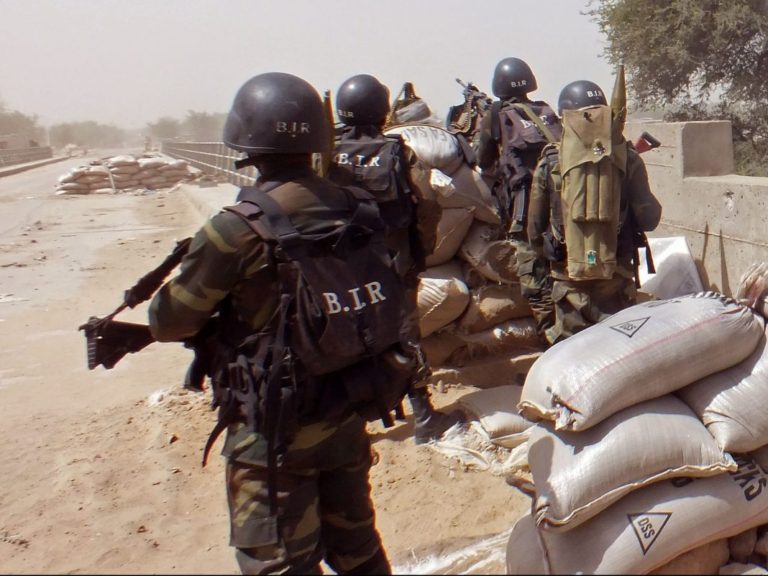
Trial of Cameroonian soldiers caught killing four must lead to justice-Amnesty Intl

THE Amnesty International has called on Cameroonian government to pursue a fair justice on the case of seven soldiers caught on video brutally murdering four citizens in July 2018.

The trial of the soldiers caught on video killing the four people has been set for August 27.

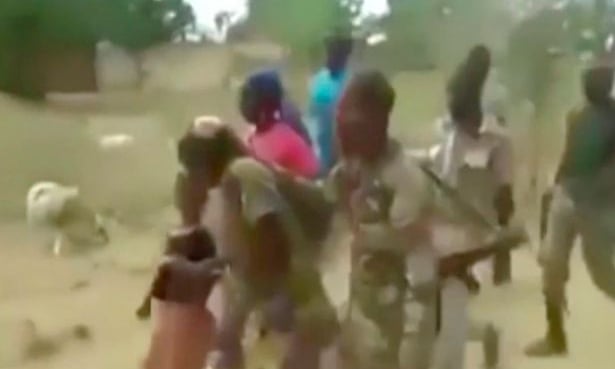
The video that went viral in July 2018 showed seven men on a military uniform, brutally leading two women and two children to a remote place. They were all shot dead.

Initially, the Cameroonian authorities had denied any link to it and described it as “fake news”.

But an investigation carried out by the Amnesty International confirmed that the Cameroonian military personnel was responsible for the shocking extrajudicial executions caught on video.

It had relied on multiple strands of credible evidence including expert analysis of the uniforms and weapons used, and linguistic and other contextual clues in the speech that gave away the identities and ranks of the soldiers. The evidence had suggested that Cameroonian soldiers were the ones extrajudicially executing civilians in the video.

Cameroonian soldiers leading the two women and two children away to a remote place for murdering. Photo credit: Facebook.
Cameroonian soldiers leading two women and two children to a remote place for murdering. Photo credit: Facebook.

In the same vein, the BBC Africa Eye also published documentary in September 2018 that pinpointed the exact location to be near the town of Zelevet.

It narrowed down the date it had occurred to late March or early April 2015.

Consequently, the government announced the seven soldiers had been arrested. Issa Tchiroma Bakary, Cameroon Minister of Communication who made this announcement added that they had been disarmed and would be prosecuted.

The seven will appear on 27 August before a military court in the capital Yaoundé on charges of joint participation in the murder, breach of regulations and conspiracy.

“The Cameroonian authorities must leave no stone unturned in their pursuit of justice for two women and two children who were brutally murdered by the military,” the humanitarian group wrote in a statement made available to journalists on Monday.

“This horrifying video shone a spotlight on the way civilians in Cameroon’s Far North have been ensnared in atrocities amid the fight against Boko Haram,” said Samira Daoud, Amnesty International’s West and Central Africa Deputy Regional Director.

She said security forces who were supposed to be protecting people had instead carried out “arbitrary and extrajudicial executions”.

“The Cameroonian authorities must draw a line and ensure no army personnel responsible for atrocities will escape from prosecutions.

“Tomorrow’s trial is the first step towards justice and reparations for victims and their loved ones,” said Samira.

She urged the government to also ensure that all those reasonably suspected of crimes against civilians were brought to justice in fair trials before civilian courts.

“While playing an important role in defending people threatened by Boko Haram, the Cameroonian security forces’ response has too often been heavy-handed and rife with human rights violations.

“Amnesty International is calling on authorities to bring all those suspected of criminal responsibility to justice in fair trials, before ordinary civilian courts and without recourse to the death penalty,” the statement submitted.

Port Harcourt mosque only demolished in part -Police

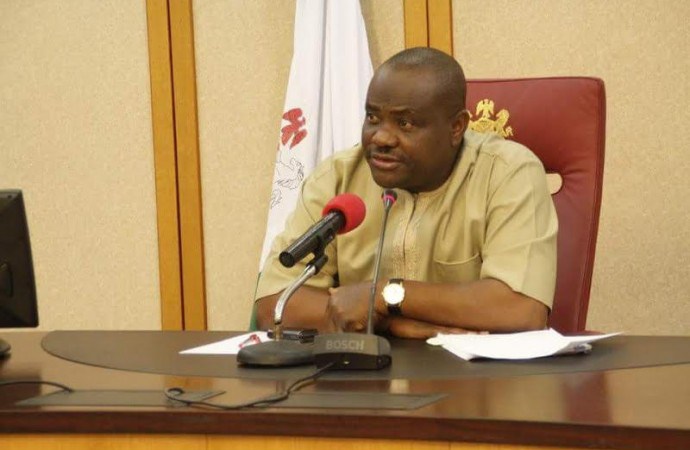
THE Police in Port Harcourt on Monday said that the alleged demolishing of mosques trending on Twitter is  ‘not entirely true’ and that Nyesom Wike, governor of the state, did not declare the rich oil state solely Christian .

“That report is not too correct, in the sense that it wasn’t the complete mosque that was destroyed.”

Following reports on the removal of the Muslim place of worship in Trans Amadi quarters of the Obio-Akpor Local Government Area(LGA),  Twitter was abuzz, with allegations that Wike had declared the state a Christian state.

However, Omoni Nnamdi, the Police Public Relations Officer in Rivers State, speaking to The ICIR, said that the police cannot comment on the matter as it would be  prejudicial to a court case since judgment is yet to be delivered in the matter. However, Nnamdi did confirm that the mosque was demolished in part but “not entirely”.

“That matter is in court, and they are seeking redress in court. It would be prejudice when we continue to comment on matters that are already in court. So the matter is in court incur the wrath of the court by going on air to devour the court of competent division.”

The oil-rich state over the years has witnessed internal ethnic disputes arising from perceived exclusion in the process of resource distribution.

However, the current situation is considered by many commentators as an attack on the freedom of association and religion.

Checks by The ICIR showed that @Gimba Kakanda–was among the people who with large followers that tweeted about the demolition: “Why did Governor, Wike demolish this mosque in Trans Amadi, Port Harcourt? I am asking this question because, in spite of our history of intolerance, places of worship hardly feature in our politics of hate. We are descending into a new low and it’s sad,” he tweeted.

Kakanda, however, deleted the tweet after an update stating “ I have been informed that the structure of the mosque had not been erected as reported and that there is no incident of demolition at all. Unless anyone has a counter to this, I think we should all let it slide”.

This, nevertheless, elicited mixed reactions among tweeters. While some condemned the development as that which may fuel unrest in the society,  others disbursed the information as false.


The ICIR could not reach, Mr. Simeon Nwakaudu, the Special Assistant on Electronic Media to the Rivers State governor because he did not answer his call.

Beware of fraudulent loan offers on social media, CBN warns investors

THE Central Bank of Nigeria on Monday has denounced knowledge of calls for loan applications to small and medium- scale business being circulated on social media, says it is fraudulent.

Issac Okorafor, Director, Corporate and Communication Officer of the apex bank in a press release said although the bank has several development finance intervention programmes, that the central bank ‘does not’ carry out such transaction through direct interaction with the applicants.

He advised prospective applicants to follow proper procedures for accessing CBN intervention funds often disbursed through Deposit Money Banks, Development Finance Institutions, Microfinance Banks and participating institutions.

“The attention of the Central Bank of Nigeria (CBN) has been drawn to fraudulent messages in the social media circles requesting unsuspecting loan seekers and owners of small-scale businesses to apply for loans provided by the Federal Government through an e-mail address (empowermentcbnloan@gmail.com) purportedly being handled by the Central Bank of Nigeria (CBN)”.

The apex bank also warned the social media users to disregard messages requesting them to send personal details—phone numbers, email passwords-to empowermentcbnloan@gmail.com or any other one that may be contrived.

“These messages are fake and anyone who enters into correspondence with them does so at his or her own risk.”

NNPC records 77 per cent increase in pipeline vandalism in June

0

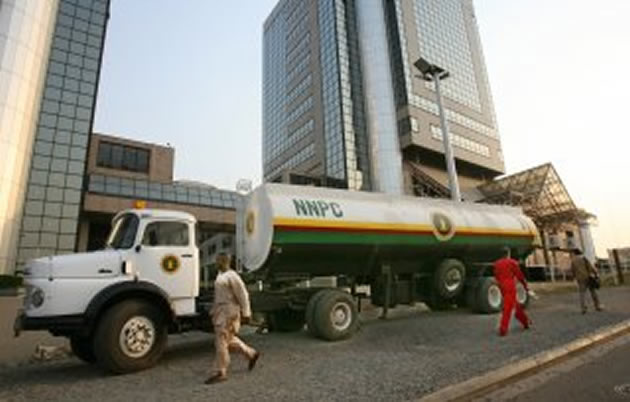
THE Nigerian National Petroleum Corporation, NNPC, on Sunday revealed in a Twitter post that pipeline vandalism had increased significantly by 77 per cent according to its records for June.

This was contained in its Monthly Financial and Operation Report, MFOR, released in Abuja boosting its monitoring mechanism of supplies and distribution of petroleum products across the country.

It also stated that about 1.76 billion litres of Premium Motor Spirit, PMS, also known as petrol, was supplied in June, while 58.65 million litres of petrol was distributed daily for the period under review.

The report showed that there was a 77 per cent rise in cases of oil pipeline vandalism in its network of pipeline infrastructure, where 106 pipeline points were breached, compared to the 60 points vandalized in May 2019.

Aba-Enugu axis in the system 2E pipeline corridor accounted for 25 per cent of the total pulverized points, while the Lagos Atlas Cove-Mosimi axis of the system 2B had 23 per cent of the compromised pipeline points.

Also, the Ibadan-Ilorin leg of the System 2B pipeline accounted for 18 per cent of affected lines, followed closely by the PortHarcourt-Aba section of the system 2E which was responsible for 13 per cent of the affected pipeline.

“Other areas accounted for the remaining 21 per cent of cumulative line breaks,” the report reads.

Stating the frequent breaches of its critical pipeline network during the period, the corporation had ensured continuous fuel supply and effective distribution across the country for the month under review.

In the gas sub-sector, the report disclosed that 223.98 Billion Cubic Feet, BCF, of natural gas which translates to an average daily production of 7,466.09 Million Standard Cubic Feet Per Day, mmscfd, produced in the month under review.

“The figures posted a slight increase of 0.11 per cent compared with the previous month’s gas production. For the period June 2018 to June 2019, a total of 3,063.89BCF of gas was produced representing an average daily production of 7,873.58mmscfd during the period,” the report reads.

“Period-to-date Production from Joint Ventures, JV, Production Sharing Contracts, PSC, and NPDC contributed about 68.93 per cent, 21.34 per cent and 9.74 per cent respectively, to the total national gas production,” it concluded.

EFCC to ‘cooperate’ with US on $1.1billion internet fraud by 77 Nigerians

NIGERIA’s anti-corruption agency, the Economic Financial Crimes Commission (EFCC) on Friday pledged to ‘cooperate’ with the United States (US) government security operatives including the Federal Bureau of Investigation (FBI) in the $1.1 billion cyber fraud allegation levelled against 77 Nigerians.

Though, it claimed it is yet to receive official complaint as well as the list of the accused persons from the US Government.

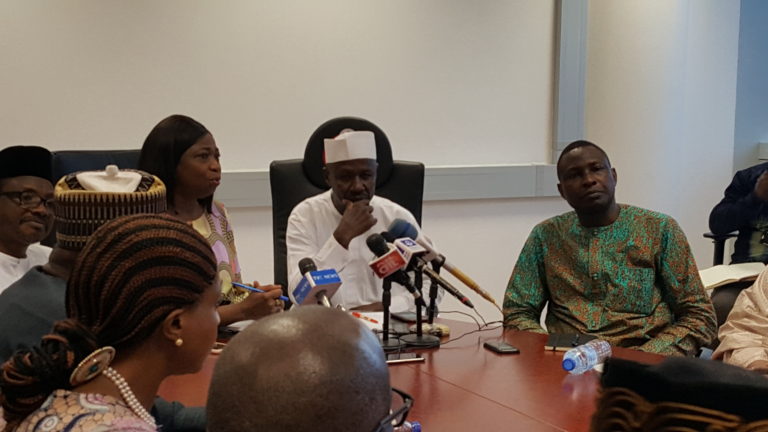
Ibrahim Magu, the EFCC Acting Chairman disclosed this when Mrs Abike Dabiri-Erewa, Chief Executive Officer of the Nigerians Diaspora Commission visited headquarters of the Commission in Abuja.

She was accompanied by Dr Nasiru Mohammed Nadan, Director-General, National Directorate of Employment (NDE) and other top government functionaries at the meeting that ended late in the evening.

Describing the cyber-fraud incident as very sad and, a borderless crime, Magu restated that the EFCC would support the security operatives of the US government. He said the commission, through its “operation wire-wire”, once partnered with the US to flush the internet fraudsters from the country, especially in Lagos state.

“Is like the era of 419 is coming back, I remember we worked with the FBI in Lagos and Benue. We carried out this operation wire-wire. I think the FBI mentioned us among the agencies that participated in the operation and it was very successful only to come back to this 77 Nigerians. We will go out to their strongholds and hideouts,” says Magu.

“We will also cooperate with our partners.

“Last time we were in Ghana, you will realise that when the heat was so much here most of them moved to Ghana. They are now operating in Ghana and neighbouring countries. So we will cooperate with our neighbours also to check the menace of these yahoo-yahoo guys and the cyber-crime issue because it’s a borderless crime.”

The EFCC chairman, who emphasised that tackling the menace should be a collective effort, expressed excitement that the Americans did acknowledge participation of the commission against the crime in joint operations.

He urged the media to help enlighten the public, stressing that some Nigerians don’t believe the internet fraud is illegal. According to him, the group has ‘mothers of yahoo-yahoo association’ such that each time the accused persons are arrested; they launch protests, converge at the EFCC office demanding for their releases.

“One woman was saying that his father (the accused’s father) did not do achieve anything or build a house but when the boy started, within three months, he demolished the whole place and built a new structure. So it is very difficult,” Magu added.

However, he disclosed that 42 convictions on internet fraud have been secured only within the Federal Capital Territory (FCT) since January till date while 32 cases are still in court.

In her remarks, Dabiri-Erewa said the Federal Government would support extradition of the accused persons if requested by the US government.

But she stressed that the identified persons are not guilty until proven otherwise by a competent court.

“A few who committed the crime must not tarnish the image of all other Nigerians. So those who committed these crimes will be brought to book,” says Dabiri-Erewa.

Nadan also charged Nigerian youths to take advantage of the NDE’s new work portal – NDE as well as the Mentored Graduate Attachment Programme. He also mentioned the Graduate teaching Scheme all accessible to interested youths on the organisation’s website.

The ICIR earlier reported how the accused persons allegedly stole the huge sum within seven months, after over 14, 000 petitions were submitted to the security operatives.

“I’ll like to give you some numbers. In the first seven months of this year, the Federal Bureau of Investigation (FBI) internet crime complaint centres received nearly 14, 000 complaints from victims reported Business Email Compromise (BEC) incidents with a total loss of $1.1 billion,” says Paul Delacourt, the FBI Assistant Director in charge of the case.

The accused persons, most of whom the United States Justice Department claimed are in Nigeria have been under surveillance for arrest and prosecution for the alleged offence committed.

Two among those allegedly involved, Valentine Iro, 31, and Chukwudi Christogunus Igbokwe, 38, had been arrested by the US Federal Bureau of Investigation (FBI).


Africa’s history shows the perils of degrading the rule of law

By Chidi Anselm ODINKALU

THE rule of law is undergoing chastening times in many African countries as rulers and their parties – struggling to hang on to power – look for convenient devices to eliminate the uncertainties associated with democratic competition, kettle their opponents (both real and imagined), disrupt vocal civics and dismantle legal constraints on abuse of power.

Across the continent, governments are doing their best to intimidate judges and degrade the rule of law. In December 2018, for instance, Kenya’s Chief Justice, David Maraga, and his wife survived a suspicious-looking car crash. The following month, Nigeria’s ruling party decapitated the judicial tenure of the Chief Justice, Walter Onnoghen, with a dubious ex-parte order from an executive organ. In the third week of August 2019, Gabon’s government procured the suspension of an appeals court judge, Paulette Mba, for doing her job when she accepted to hear an application on whether or not to evaluate the medical fitness of a manifestly crocked President Ali Bongo.

It’s all redolent of the immediate post-colonial period, whose abiding lessons for the would-be destroyers of the rule of law appear to have been lost on a contemporary rulership deliberately devoid of memory. Some illustrations may drive home the point.

As French West Africa prepared for De Gaulle’s self-rule referendum in 1957, Ernest Boka was one of the most promising stars in the region’s politics. In his native Côte d’Ivoire, Boka was only eclipsed in popularity by the Felix Hophouët-Boigny, the wealthy Baoulé Chief who was the first black person to be appointed Minister in France. Born in 1928, 23 years younger than Hophouët, Boka was a bright lawyer who appeared destined for greatness. At just 28 in 1957, he became Chief of Staff to the Governor-General, before rising from 1958 to 1959 to ministerial portfolios, first in education and then public service. As Independence approached in 1960, Boka was one of the leaders of Houphouët-Boigny’s Parti Démocratique de la Côte d’Ivoire (PDCI), who strong-armed other platforms from the contest, enabling Houphouët to emerge unopposed as Côte d’Ivoire’s President.

As Boka’s reward, Houphouët appointed him Côte d’Ivoire’s first Supreme Court President in 1960, where he initially proved to be a trusted believer. But Boka was always a man of the people with socialist sympathies. At 35, in March 1963, Ernest Boka resigned as Supreme Court President. Shortly thereafter, in August 1963, he was among hundreds rounded up under the direction of Houphouët-Boigny for allegedly plotting to kill the President with Juju. A special security court sentenced 19 to life terms and condemned another six to death. But Ernest Boka did not live long enough to stand trial. His lifeless body was found hanging from the ceiling of his cell in Abidjan bearing marks consistent with torture. In response to strong rumours that Boka’s death was not suicide, Houphouët-Boigny himself called foreign diplomats and correspondents to a briefing in April 1964 at his presidential palace for what turned out to be a trial of a dead man. At the briefing, Houphouët announced that Ernest Boka had confessed to an attempt to use Juju to assassinate the President. As evidence, Houphouët-Boigny, a practising Catholic, produced two suitcases containing an assortment of magic potions, dried remains of dead animals and a collection of puny coffins reportedly seized from Ernest Boka’s family house.

About the time Ernest Boka was being liquidated in Côte d’Ivoire, a lowly court clerk and interpreter was working his way into reckoning in Spain’s African plantation in Equatorial Guinea. Francisco Macias Nguema was famous for allowing financial inducements to dictate the content of his translations. As one of few locals with facility in Spanish, the colonialists came to hang on his every word, mistaking him for a man of influence. In one year between 1966 and 1967, Macias rose from assistant interpreter to Mayor, then Minister for Public works before becoming Deputy President of the Governing Council. When the gong sounded for Independence in 1968, he was well placed to be installed as Equatorial Guinea’s first President on 12 October 1968.

But Macias was unwell and given to outbursts of paranoia and violence fueled by dependence on tropical hallucinogens. Six months after being installed as President, in March 1969, he personally bludgeoned his foreign minister to death before having opposition leader, Bonifacio Ondo Edu, abducted from exile in neighbouring Gabon and executed. A reign of terror ensued during which Equatorial Guinea’s small population of professionals, including lawyers and judges were either killed or exiled. Rules were dismantled. With no judges, regime enemies were tried and executed by youth militias organized and administered by Macias’ nephew, Teodoro Obiang Nguema M’ba N’Zogo, an army Lieutenant-Colonel.

On 3 August 1979, Teodoro Obiang toppled his uncle and had him put on trial for mass atrocities, including genocide and embezzlement. As there were no judges left in the country nor lawyers to defend accused persons, the trial was conducted in a cinema hall by militias of precisely the same sort that liquidated his enemies. Macias’ fate was predictable. On 29 September, 1979, the militia found him guilty and sentenced him to death. Hours after his predicted condemnation, an elite military unit flown in specially from Morocco executed him by firing squad at the Black Beach Prison in Malabo.

Two years after the death of Macias, on Christmas Eve in 1981, the government of Dr. Hastings Kamuzu Banda abducted Malawi’s exiled, first Attorney-General and Justice Minister, Orton Chirwa, and his wife, Vera, from Zambia and returned them to Lilongwe. Orton Chirwa was the founding President of the Malawi Congress Party (MCP), which led Malawi to Independence in 1964. He was also Malawi’s first lawyer. As minister in the transitional government in 1962, Orton took issue with the presumption of innocence and burdens of proof in criminal trials, arguing for their replacement with traditional African norms and institutions. As Attorney-General, he pushed for these reforms but was turfed out of Cabinet in September 1964 in a power tussle with Banda, his successor as MCP President, before they were promulgated. Following the collapse of the Chilombe Murder trials in 1969, Banda scrapped criminal trials by regular courts, transferring jurisdiction over crimes to Traditional Courts, comprising a traditional chief as chair, with three citizen assessors and one lawyer. The traditional court system was appointed by Banda, who was both President and Justice Minister. They also reported to him.

In an ironic twist of fate, Orton would be arraigned for treason in 1983 before the kind of traditional courts he had advocated for as Attorney-General. His trial was a charade. The court denied him and his wife – herself also Malawi’s first female lawyer – legal defence or the right to call witnesses. Initially sentenced to death on conviction, Banda commuted this to life imprisonment. Orton spent the remainder of his life in solitary confinement at the Zomba Prison in Malawi, where, in December 1992, he died at the age of 73.

As Nigeria’s military ruler from 1985 to 1993, Ibrahim Babangida eviscerated the courts, mostly precluding them by military decree from jurisdiction over whatever his regime did. In 1991, he issued a special decree making legal proceedings against his regime a felony punishable with up to two years’ imprisonment. Out of power in 2001, a successor regime asked him to appear before a Commission of Inquiry to defend his record. Rather than do that, the man who made going to court a crime hired a coterie of highly prized lawyers to go to court and question the powers of an elected civilian administration to ask him to account. The case ended up before a Supreme Court presided over by judges, some of whose judicial careers Babangida had advanced.

Africa’s history has firm lessons for powerful men who want to get ahead by retarding legal process. The biggest argument for defending and preserving the rule of law is self-interest – those who degrade it often end up in need of it, usually to save them against their own collaborators. Karma has a brutal sense of humour.

Odinkalu, co-convener of Nigeria Mourns, works with the Open Society Foundations.

Seven million Nigerians fall into extreme poverty in 13 months

The number of extremely poor Nigerians has risen to 94, 212 064 million, data from the World Poverty Clock shows.

The figure implies that virtually half of Nigeria’s population now live in extreme poverty.

As Nigeria faces a major population boom—it is estimated by the United Nations in a 2017 report that it would become the world’s third-largest country by 2050—it’s a problem likely to worsen.

The latest figure shows that an additional seven million Nigerians have since fallen under the poverty line.

Also, the 2019 Global Multidimensional Poverty Index in July of this year indicated that the multidimensionally poor Nigerians rate increased from 86 million to 98 million between 2007 and 2017.

The report which was released by United Nations Development Programme and the Oxford Poverty and Human Development Initiative, noted that in Nigeria, even though the proportion of people who are multi-dimensionally poor has remained constant at just over 50 per cent over the past decade (up to 2017), the actual number of people who are multi-dimensionally poor increased from 86 million to 98 million over the same period.

Nigeria population according to the Poverty Clock currently stands at 197, 543 429 million, making 47.7% of the country population in extreme poverty.

The country is considered the world capital of poverty.

The World Poverty Clock is a tool to monitor progress against poverty globally.

It uses publicly available data on income distribution, production, and consumption, provided by various international organisations, most notably the United Nations, World Bank, and the International Monetary Fund.

The World Poverty Clock had in June of 2018 named Nigeria the poverty capital of the world when it revealed that Nigeria had 87 million people living in poverty.

But the Buhari-led government had rejected the report when it was published by the organisation, insisting that it had created jobs especially in the area of agriculture and reduced poverty.

Former British Prime Minister, Theresa May, however, reiterated the statistics during her visit to South Africa in  August 2018.

May during the visit said Africa is home to a majority of the world’s fragile states, and a quarter of the world’s displaced people.

She added that Africa has the highest number of poor people in the world, stating that 87 million Nigerians were living below the poverty line of $1 and 90 cents per day.

“Much of Nigeria is thriving, with many individuals enjoying the fruits of a resurgent economy, yet 87 million Nigerians live below $1 and 90 cents a day, making it home to more very poor people than any other nation in the world,” the UK prime minister said.

The World Poverty Clock, which was created by Vienna-based World Data Lab on the 13th of February 2019, revealed that 91.16 million Nigerians were now living below a dollar a day.

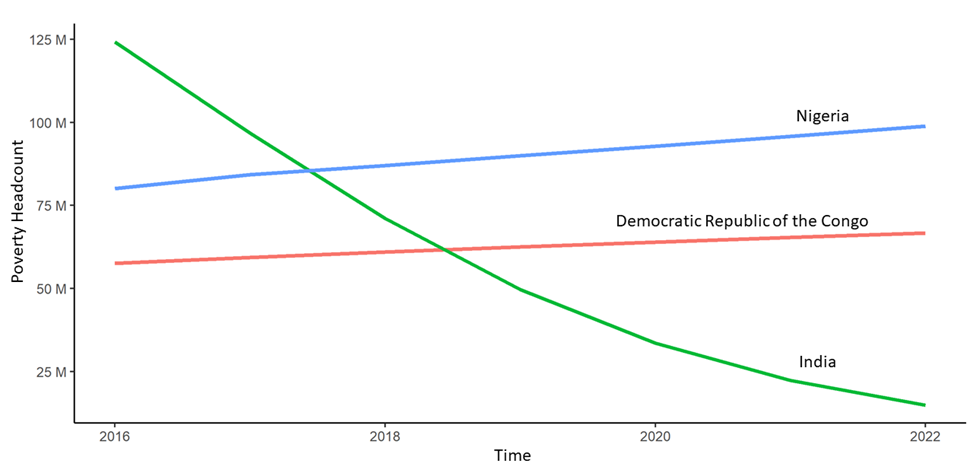
A report by Brookings Institution in the same year, said Nigeria has now taken over as the nation with the highest number of extremely poor people, overtaking India which use to hold the position with a population of 1.324 billion people as against Nigeria’s 194 million.

Nigeria is moving upward in global poverty rankings Credit: Brooking Institute, June 19, 2018

The report said then that the number of Nigerians in extreme poverty increases by six people every minute.

According to our projections, Nigeria has already overtaken India as the country with the largest number of extreme poor in early 2018, and the Democratic Republic of the Congo could soon take over the number 2 spot (Figure 1 below).

At the end of May 2018, our trajectories suggest that Nigeria had about 87 million people in extreme poverty, compared with India’s 73 million. What is more, extreme poverty in Nigeria is growing by six people every minute, while poverty in India continues to fall.

In fact, by the end of 2018 in Africa as a whole, there will probably be about 3.2 million more people living in extreme poverty than there are today.

Already, Africans account for about two-thirds of the world’s extreme poor. If current trends persist, they will account for nine-tenths by 2030. Fourteen out of 18 countries in the world—where the number of extreme poor is rising—are in Africa.

The International Monetary Fund Chairman Christine Lagarde in March of 2018, said Nigerians are getting poorer and that “coherent and comprehensive” economic reforms are urgent.

Policemen extort Lagos motorist for using Google map

THE Lagos State Police Command has promised to investigate the alleged extortion of a motorist by some of its personnel.

According to Punch, the state Police Public Relations Officer, Bala Elkana, said that the command was already in contact with the victim and action would be taken.

The motorist had gone on the social media to allege that the cops extorted N45,000 from him for using Google map on his phone.

In a series of tweets the motorist, who wrote on the Twitter handle, @viva_jc, stated that he was late for work.

He said, “I was harassed by some policemen on my way to work this morning (Tuesday) at Ojota around 8.10am while I was in traffic. I had reached for my ID card and calculator (needed at work) from the armrest of my car, only for this unarmed policeman to jump in front of my car claiming that I was using the phone while driving. Of course, I argued with him and showed him the stuffs I had reached for, but he kept shouting.


“My reporting time was 9am and I didn’t want to get to the office late, so I rolled down and kept talking to him, only for his other colleagues (two in uniform and one not in uniform) to also join in the drama. The two guys in uniform took my keys and sat in the front seats, while the other two asked me to go to the back (seat) for us to go to the station.

“I was sandwiched between the two, who were not in uniform. Inside the car, they saw my phone; I was using Google map to get the best route to work and one of them kept saying that it was an offence to use Google map while driving.

“These policemen said they were going to charge me N120,000 for the ‘offence’. I had to resort to begging them when I realised that arguing with them wasn’t going to lead me anywhere and I didn’t want to get late to work.

“One of them asked for my driving licence; he snapped it with his phone and he started negotiating on how much they would collect, while they were driving me around feigning that they were taking me to the station.

“Throughout the negotiation, they took turns shouting at me while also playing the good cop and the bad cop in their minds. When they discovered that I needed to get to work as soon as possible, they kept saying the best they could do was to collect N50,000.

Join our WhatsApp group for more updates

 “After several pleas, the ‘good cop’, said they would only collect N45,000. By this time, we had got to Maryland and turned back (opposite direction to my office, which I had told them). At the end of the negotiation, they took me back to Maryland and parked by the roadside for me to go and withdraw money at the Wema Bank ATM (they had asked for the money to be withdrawn at the ATM); while one of them went with me, the other three stayed back in the car.”

Lamenting the extortion, the motorist added, “These policemen collected my hard-earned N45,000 for no reason and I still got late to work! This is injustice.”

Elkana, however, gave an assurance that the investigation would soon commence.

“The matter was reported to us and we are investigating it; the victim got in touch with me to report and I told him to come to my office so that we could investigate the matter,” he stated.

Similarly, Nigerian realtor and Human rights activist Segun Awosanya, popularly known for convening the campaign against police brutality in Nigeria on social media also gave assurance concerning the situation saying the case is being attended to.