Home Blog Page 2310

EFCC arraigns Isabella Oshodin in N22.9bn money laundering scandal

0

ISABELLA Oshodin was arraigned by the Economic and Financial Crimes Commission, EFCC, on Monday alongside Bob Oshodin Organisation Ltd before the Federal High Court sitting in Abuja on charges of money laundering.

A 25-count charge was slammed on Oshodin and the owners of Bob Oshodin Organisation Ltd for their alleged role in the illegal transactions made from the Office of the National Security Adviser, ONSA headed by Sambo Dasuki to the tune of over N22 billion.

Investigations carried out by the anti-graft agency revealed that Oshodin on 16 different occasions had received various sums of money to the tune of N2,366,000,000 which was allegedly laundered through her account from ONSA.

At the hearing, the presiding judge, Justice Taiwo Taiwo, allowed the charges to be read to the defendants.

“That you, Mrs. Isabela Mimie Oshodin, Bob Oshodin Organisation Ltd and Robert (Bob) Oshodin (still at large) on or about 22nd June, 2014 in Abuja within the jurisdiction of this honourable Court directly transferred the sum of $7,712,598 (Seven Million, Seven Hundred and Twelve Thousand, Five Hundred and Ninety-eight Dollars) to one Portfolio Escrow Company with account number 3102004330 domiciled in California Republic Bank, United States of America,” it reads.

“Which sum you reasonably ought to have known to proceed of an unlawful act of Sambo Dasuki, the then National Security Adviser to wit: criminal breach of trust and you thereby committed an offence contrary to Section 15 (2) (b) of the Money Laundering (Provision) Act, 2011 as amended in 2012 and punishable under Section 15(3) of the same Act,” count two of the charges read.

The EFCC also revealed that the defendant on eight occasions received from Dasuki’s ONSA sums totalling $57,217,301.15 into the Escrow accounts of Bob Oshodin Organisation Ltd.

The defendant pleaded “not guilty” to the charges when it was read to her.

In view of her plea, prosecuting counsel, Aisha Tahar Habib asked the court to fix a date for the commencement of trial.

“I have noticed my lord the second defendant is not represented, notwithstanding, in view of the first defendant’s plea of not guilty, I will like to ask for a date for trial,” she said.

However, counsel for the defendant, Osahor Odemodia, informed the court of the bail application for his client and urged the court to grant her bail on liberal terms, pending the commencement of trial.

But Habib opposed the application for bail, informing the court of a counter-affidavit filed on July 10, 2019, and so urged the court to refuse her bail, and instead, give the case accelerated hearing.

The trial judge adjourned to August 21 and ordered the defendant to be remanded in EFCC custody pending the ruling on the bail application.

Former petroleum minister, Alison Madueke begs court to retrieve jewelry from EFCC

0

Former Minister of Petroleum Resources, Diezani Alison-Madueke, on Monday, pleaded with the Federal High Court sitting in Lagos to order the Economic and Financial Crimes Commission, EFCC, to return jewellery worth over $40 million confiscated from her residence.

Diezani, currently resident in the United Kingdom, UK, accused the EFCC of entering her apartment illegally and taking the items without any court order.

In an application filed on her behalf by Prof Awa Kalu, SAN, she said the anti-graft agency violated her fundamental “right to own property and to appropriate them at her discretion,” under sections 43 and 44 of the constitution.

She urged the court to reject the prayer by the EFCC to permanently seize the jewellery and the gold iPhone to the Federal Government.

In July, the EFCC had secured an order of the court to temporarily forfeit the collection of jewellery and a gold iPhone to the Federal Government.

According to the schedule attached to the application, the jewellery was categorised into 33 sets, which include 419 expensive bangles, 315 expensive rings, 304 expensive earrings, 267 expensive necklaces, 189 expensive wristwatches, 174 expensive necklaces and earrings, 78 expensive bracelets, 77 expensive brooches and 74 expensive pendants.

After granting the interim forfeiture order on July 5, the court adjourned till August 19 for Diezani or anyone interested in the confiscated properties to appear before it to give reasons why the items should not be permanently forfeited to the Federal Government.

Rotimi Oyedepo, counsel to the anti-graft agency told the court that the EFCC found and recovered the jewellery and the customised gold iPhone stating that operatives of the agency reasonably suspected that the former minister acquired them with “proceeds of unlawful activities”.

“The respondent’s known and provable lawful income is far less than the properties sought to be forfeited to the Federal Government of Nigeria,” he said.

Kalu argued that the court lacked jurisdiction to have granted the interim forfeiture order in the first place as the former minister had not been charged with any crime or served with any summons by the EFCC.

The presiding judge, Nichola Oweibo adjourned the case till August 29 for further hearing on the matter.

How Buhari’s administration plans to lift Nigerians from poverty

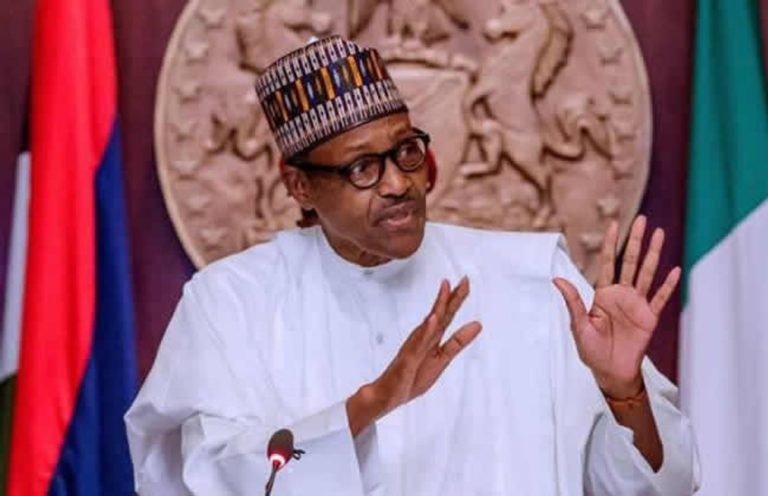
PRESIDENT Muhammadu Buhari on Monday said his administration’s plan is to “lay the foundation” for 100 million Nigerians to be lifted out of poverty.

Speaking at a retreat for ministers-designate in Abuja, Buhari said the target would be achieved at the end of his eight-year term in 2023.

“Our Administration’s eight years will have laid the grounds for lifting 100 million Nigerians out of poverty in 10 years, this outcome will fundamentally shift Nigeria’s trajectory and place us among the World’s Great Nations.”

The president had on August 1 claimed his administration had lifted 5 million Nigerians out of poverty in three years. He said the National Social Investment Programme achieved that goal.

It will be recalled that the World Poverty Clock in 2018 reported that Nigeria had overtaken India with the largest number of people living in extreme poverty.

According to the report released on May 2018, Nigeria now has an estimated 87 million people in extreme poverty, compared to India’s 73 million.

Data from the World Poverty Clock shows that the number of Nigerians living in extreme poverty has increased yearly.

The President further explained that his government has made significant progress in improving security, economy and corruption war.

He said only the “most partisan” will dispute that claim.

“First – we have rolled back the frontiers of terrorism; we are actively addressing other challenges such as kidnappings, farmer-herder violence, improving the safety of our roads, railways, air traffic and fire control capacities,” he said.

“Second – we are steadily turning the economy around through investment in agriculture and manufacturing, shoring up our foreign reserves, curbing inflation and improving the country’s infrastructure.

“Third – on corruption, we have recovered hundreds of billions of stolen assets and are actively pursuing control measures to tackle leakages in public resources. We will not let up in fighting corruption.”

Read the full speech by the president below:


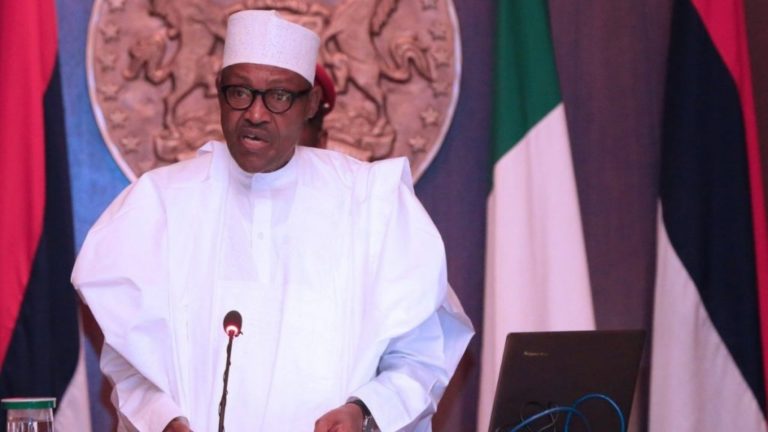
ADDRESS BY HIS EXCELLENCY, MUHAMMADU BUHARI PRESIDENT OF THE FEDERAL REPUBLIC OF NIGERIA AT THE PRESIDENTIAL RETREAT FOR MINISTERS-DESIGNATE, PRESIDENTIAL AIDES AND OTHER TOP GOVERNMENT FUNCTIONARIES, HELD AT THE STATE HOUSE, ABUJA MONDAY, 19 AUGUST 2019 PROTOCOLS:

I welcome you all to this meeting whose purpose is firstly, to familiarize ourselves with our colleagues with whom we shall be working closely for the next four years GOD willing; secondly, to reflect and assess the country’s position in 2015 and today; and thirdly, to chart a course for the country for the foreseeable future.

  1. I congratulate all the new comers who your country has chosen above others to join the first term Ministers whose performance has been outstanding. All of you are appointed to assist and advise the President in running the affairs of our country. At the end of the Retreat, it is hoped that all of you will be in tune with the roles and responsibilities of positions you will occupy in Government. Many national issues require unified decisions.
  2. It is a great privilege for you to be called upon to serve in these Great Offices of State and you must grasp the chance with two hands and put in your best efforts as Nigeria today needs top managers to handle our numerous challenges. There will be long hours and you must be prepared to live laborious days if we are to serve our people optimally.
  3. Ladies and gentlemen, we are all aware of the looming demographic potential of our country. By average estimates, our population is close to 200 million today. By 2050, UN estimates put Nigeria third globally behind only India and China with our projected population at 411 million.
  4. This is a frightening prospect but only if we sit idly by and expect handouts from so-called development partners. The solution to our problems lies within us.
  5. Honourable Ministers-Designate, in our first term we identified three salient areas for close attention and action, namely to secure the country, to improve the economy and to fight corruption.
  6. None but the most partisan will dispute that we have made headway in all three areas:

First – we have rolled back the frontiers of terrorism; we are actively addressing other challenges such as kidnappings, farmer-herder violence, improving the safety of our roads, railways, air traffic and fire control capacities.

Second – we are steadily turning the economy round through investment in agriculture and manufacturing, shoring up our foreign reserves, curbing inflation and improving the country’s infrastructure.

Third – on corruption, we have recovered hundreds of billions of stolen assets and are actively pursuing control measures to tackle leakages in public resources. We will not let up in fighting corruption.

  1. As Ministers, I am counting on you together with Advisers and Nigerians willing and able to contribute to build upon our road map of policies, programmes and projects that will lift the bulk of our people out of poverty and set them on the road to prosperity.
  2. Our Administration’s eight years will have laid the grounds for lifting 100 million Nigerians out of poverty in 10 years. This outcome will fundamentally shift Nigeria’s trajectory and place us among the World’s Great Nations.
  3. Honourable Ministers-Designate, you will be responsible for the development and implementation of policies, programmes and projects in your various Ministries, Departments and Agencies in line with Government priorities. You must also ensure that Agencies under your Ministries are effective, efficient and accountable in the discharge of their responsibilities.
  4. Honourable Ministers-Designate, we must work as a team. Although you have been chosen to represent your states as a constitutional imperative, it is vital for all of you to work as Nigerians.
  5. Furthermore, working as a team demands that we know what the next person is doing. You must open communications with your colleagues. Lack of communication leads to lack of cooperation and sub-optimal performance.
  6. Finally, although this is called a Retreat, I would like to think this is a preparation for an advance to the Next Level. Thank you ladies and gentlemen. I wish you fruitful deliberations.


Ekweremadu: German police refutes Abike Dabiri’s claim, says protesters were not arrested

GERMAN police authorities-Landespolizie- in Nürnberg, Germany has disclosed that no arrest has been made in connection with the Saturday attack on Ike Ekwereadu, the former Deputy Senate President, despite the claim of the Chairman and Chief Executive Officer of Nigerians in Diaspora Commission, Abike Dabiri-Erewa.

The NDIC boss had described the incident as “shameful pathetic” and had earlier claimed in a tweet that some of the protesters are in police custody.

Ekweremadu, who represents Enugu West in the Senate, was in Nürnberg for the New Yam when some aggrieved members of the proscribed Indigenous People of Biafra (IPOB) attacked him.

The police authorities, however, has dismissed the attack as “just a protest” and said no arrest was made and didn’t have plans of making any future arrest.

“There was nothing much about this senator from Nigeria that came. About 30 persons demonstrated against him and the police were called and they called the situation down and the senator drove away in his car.

“Nothing happened, so there is not going to be any arrests. No arrests were made, nothing. No police investigation will be carried out in relations to the chaos,” said a police press officer in Nürnberg.


FACT-CHECK: Has Nigeria really achieved food security?

ON Tuesday 13th August, President Muhammadu Buhari disclosed that Nigeria has achieved food security, thus directed the Governor of Central Bank of Nigeria (CBN) to stop Forex to food importers.

“We have achieved food security,” Buhari said proudly.

Buhari made this disclosure while hosting the All Progressives Congress (APC) Governors during Eid-el-Kabir celebration in Daura, Katsina State, stressing that the foreign reserve of the country would be spent solely to diversify the economy.

But this claim has been a subject of debate among  Nigerians at home and abroad.

Buhari’s agriculture development policy

The Federal Government in 2016 unveiled the Agriculture Promotion Policy (APP) otherwise known as the Green Alternative. It was an integration of the past government’s agricultural policy – Agricultural Transformation Agenda (ATA). The policy was targeted to achieve ‘food security’, import substitution, job creation and diversify the economy.

It specifically prioritised crop productions as a way of achieving the food security plan, and boost export for increased foreign revenue.

“Focusing policy on achieving improved domestic food security and boosting export earnings requires a measure of prioritisation. Therefore, for domestic crops, the initial focus in 2016 – 2018 will be expanding the production of rice, wheat, maize, soya beans and tomatoes,” the policy states without a specific benchmark.

Going by the policy document, Nigeria is expected to have significantly improved food production beyond local demand, particularly farm commodities such as rice, wheat, maize, soya beans and tomatoes by end of the president’s first tenure in office.

Other crops targeted for increased local production and exports within the same period include cocoa, cassava, oil palm, sesame and gum Arabic.

But what is food security?

The term food security has an implied or explicit meaning, but there are major variables such as access to food, food availability and affordability in terms of prices. The continuous change in the operational definition of the concept has led to more inclusion of other parameters such as food safety and nutritional values for a balanced diet for a healthy living.

As defined by the United Nations’ Committee on World Food Security, and adopted by the International Food Policy and Research Institute (IFPRI), food security “means that all people, at all times, have physical, social, and economic access to sufficient, safe and nutritious food that meets their food preferences and dietary needs for an active healthy life”.

The World Food Programme (WFP) also notes that people are considered, “food secured when there are availability and adequate access at all times to sufficient, safe, nutritious food to maintain a healthy and better living”.

Also, 2019 Global State of Food Security and Nutrition report analysed food security from two indicators – Prevalence of Undernourishment (Hunger) which estimates the number of people that lacks access to dietary energy, secondly, those who lack access to nutritious and sufficient food due to lack of money or other resources. Does this apply to food reality in Nigeria?

In relation to the food situation in Nigeria, this means beyond food production, do we have enough nutritious food to maintain a healthy living of over 190 million Nigerians. Are these foods safe? Are they accessible and sufficient at all time?

The Global Food Security Index (GFSI), while measuring Nigeria’s food security ‘fete’ ranks the country 96 from the 113 index countries. Nigeria was surpassed by most African countries such as Angola, Rwanda, Togo, Kenya, Cameroun and Benin Republic in the food security index. Nations that are currently battling with crises, such as Myanmar where killings as a result of religious clashes, and forced migration still got higher ranks than Nigeria.

Nigeria which ranks 96 leads Sudan by only three steps, ranking 99 from the 113 nations surveyed.

The ICIR takes a further look into Nigeria’s volume of local food production as detailed by the FAO in alignment with the APP, it showed an unstable increase in production except for rice and maize but does not translate to food security. The agricultural policy has also not been fully realised.

For instance, Nigeria produced Soybeans to the tune of 588,523 MT in 2015. In 2016 it increased to 614,632 MT and 730, 000 in 2017 while local demand is currently 750, 000 MT.

For wheat, 60, 000 MT was produced in 2015 and 2016 while 66, 576 metric tons was realised in 2017. No available data on 2018 production while local demand is 4.7 million MT.

In 2015, Nigeria produced 6.2 million Metric Tons (MT) of rice paddy, in 2016 it increased to 11.3 million MT, while 9.86 million MT of rice paddy was realised in 2017. No clear data on 2018 harvest but local demand for rice stands at between 6.3 and 7 million MT.

In 2015, 10.5 million MT of maize was produced. In 2016, it increased to 11.5 million MT while 10.4 million metric tons of the commodity was realised in 2017. No available data on 2018 production. However, while the APP puts the demand figure at 7.5 million MT, the Maize Farmers Association of Nigeria placed the current production figure at 20 million MT.

As for tomato, about 4.22 million MT of the commodity, major perishable farm produce was produced in the country in 2015. Its production declined to 4.12 million MT in 2016 and in 2017, it further went down to 4.10 million MT while local demand stood at 2.2 million MT.

World Poverty Clock

One of the globally accepted platforms to measure attainment of the UN Sustainable Development Goals (Goal 2), especially on extreme poverty is the World Poverty Clock. It says 94.17 million Nigerians are currently living in extreme poverty. According to the clock, as of January 2016, 78.04 million Nigerians were extremely poor. Meanwhile, the SDG goal two which connotes end hunger; achieve food security as well as nutrition should be achieved by 2030.

However, these imply that between 2016 and August 2019, 16.13 million Nigerians have been plunged into extreme poverty. But if the claim by the federal government is true that 5 million people were rescued from poverty in the first four years of Buhari’s administration, it means, there would still be over 11 million extremely poor Nigerians. The clock further predicted a likely increase in the percentage of people living in extreme poverty to 46 per cent by 2030.

Malnutrition still on the increase

In addition, the FAO in its report on the State of Food Security and Nutrition in the World (2018) largely linked access to a healthy diet and safe nutrition to food security. It maintains that food insecurity could cause child stunting, micronutrient deficiencies and obesity. As a result, the United Nations Children Fund (UNICEF) in the latest 2019 state of food security and nutrition report, however, says an estimated 2 million children are suffering from severe acute malnutrition in Nigeria.

“The alarming signs of increasing food insecurity and high levels of different forms of malnutrition are a clear warning that there is considerable work to be done to make sure we leave no one behind on the road towards achieving the SDG goals on food security and improved nutrition,” the State of Food Security and Nutrition Report 2018 and 2019 states, affirming the link between food security and malnutrition.

The reports were signed by Jose Graziano da Silva, FAO Director-General, David Beasley, WFP Executive Director, Gilbert Houngbo, President of the International Fund for Agricultural Development (IFAD), Henrietta Fore, UNICEF and Tedros Ghebreyesus, WHO Director-General.

But specifically, the report affirmed that 46.1 million Nigerians were severely food insecure between 2015 and 2017. It shows further that 21.5 million Nigerians were as well under-nourished between the same period as against 1.7 million persons in Senegal and 1.9 persons in Sierra Leone. It also listed Nigeria among low-income food-deficit countries.

2018 version of the same report, released this year shows the prevalence of stunted children rose to 43.6 per cent from 13.9 per cent in 2017. The number of severely malnourished people also rose to 25.6 million people.

In conclusion, the FAO further identified food security as a multi-dimensional phenomenon rather than a single indicator to measuring attainment of food security as disclosed by the president.

Verdict

Based on these pieces of verifiable pieces of evidence, the president’s claim of achieving food security cannot be substantiated, thus MISLEADING and at worse FALSE. This is because food security goes beyond food production. Rather it also comprises access, affordability, nutrition and safety. Aside from the available evidence, Nigeria has currently ranked among the nations with second-highest burden on stunted children globally with 32 per cent national prevalent rate.

MEDRIVE trains journalists on Sensitive and Conflict Reporting

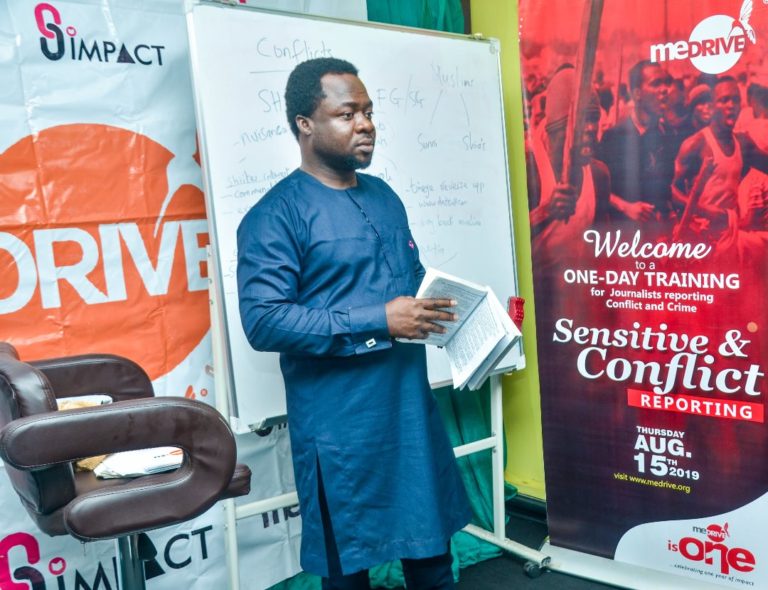
JOURNALISTS from broadcast, print and online media on Thursday 15th August were trained in Lagos on Sensitive and Conflict Reporting.

The training facilitated by MEDRIVE, a media hub focused on training African journalists, included practical and highly interactive sessions to ensure that knowledge is truly passed and retained

Speaking at the opening of the training, Wemimo Adewuni, Founder of MEDRIVE, said the organisation which was founded in 2018, has trained over 120 journalists from five states in Nigeria and mentored 40.

She disclosed that the trainings have included Story Crafting, Impact Journalism, Using Social Media for New Age Journalism, Elections Reporting, Grants Writing, and the latest centered on Conflict Reporting, targeting journalists reporting crime and conflict.

“At MEDRIVE, we believe that the media has an all important role to play in governance and development,” Adewuni said.

“The media is the Fourth estate of the Realm and holds a duty to hold government accountable on behalf of the people. We empower journalists with the accurate knowledge and skills needed to make impactful reports.

“The 88 applications received from 12 states namely Rivers, Oyo, Abuja, Akwa Ibom, Sokoto, Ogun, Enugu, Edo, Osun, Kogi, Ekiti, Kwara, Bayelsa, and Imo, for the Sensitive and Conflict Reporting reflects the dire need of journalists to be trained on this important subject and other development issues,” she added.

Adewuni, a multimedia journalist and presenter with 99.3 Nigeria Info FM took participants the concepts of Conflict Reporting.

She highlighted the need for risk assessment before going into a conflict zone, researching about the conflict, objectivity, and need to aim for resolution, not to escalate conflicts.

While emphasising on the important role the journalist plays in escalating or containing the effects of conflicts, Adewuni practically showed how to research a conflict, look beyond the surface, dig deep into multi-layer data to produce a factual, balanced, analytical and comprehensible story.

Human Rights and Constitutional lawyer, Evans Ufeli, taught the participants on the importance of challenging stereotypes in reporting by understanding the law.

He emphasized the constitutional role bestowed on journalists and enshrined in the Nigerian constitution. Going through Sections 2, 4 and 33, Ufeli challenged participants to understand the law to better appreciate human rights and report human rights abuses.

Niran Odufayo, a crime reporter with the Federal Radio Corporation of Nigeria (FRCN), during his session, shared strategies of reporting crime and conflict.

Odufayo who has covered crime for FRCN for over 15 years played some of his reports, which were gathered under intense situations including murders, the clash between cultists in Lagos, protests, among others.

Adekunle Ajibulu,  First Aid trainer and instructor in the Training Cadre of the Red Cross taught participants of the Conflict and Sensitive Reporting lifesaving and resuscitation skills needed during emergencies while reporting conflict.

He explained the difference between scars and burns, and how to manage fractures while waiting for medics to arrive at the scene.


Oyo-Ita submits resignation letter as Head of Service

WINIFRED Oyo-Ita, the head of service on Monday in a letter  to President Muhammadu Buhari said she would be retiring from civil service with immediate effect.

According to reports, the head of service was being probed over an alleged contract scam amounting to N3billion and has been pressurized by family members to resign.

Since the news of the probe went public, she has consistently denied her involvement in any scam, until Sunday when she eventually sent in her resignation letter.

“Mrs Oyo-Ita has sent in her letter of retirement,” said a family member.

It has been previously alleged that the probe was borne out of a misunderstanding with Abba Kyari but Oyo –Ita has vehemently refuted the insinuations.

The Economic and Financial Crimes Commission (EFCC) recently questioned Oyo-Ita over allegations that she used proxy companies to get contracts when she was a permanent secretary before her appointment as head of service in 2015.

Prior to her invitation by the anti-graft agency, the sum of N600 million was traced to the account of one of her aides, who has been interrogated by the EFCC but was later released.

Oyo-Ita has refuted the allegation to defraud the state, claiming the money was meant for death benefits of staff.

The president is yet to take a final decision on the resignation letter.


Why Fowler, FIRS boss got a query

BABATUNDE Fowler, chief executive of the Federal Inland Revenue Service (FIRS), is expected to respond to the query served him by President Muhammadu Buhari today.

The query stamp, dated August 8, was issued over declining tax collection since 2015.

Sources within the FIRS confirmed the development to PREMIUM TIMES on Sunday after a letter querying Mr Fowler’s performance appeared on the social media in the morning.

In the query, the Chief of Staff to the President, Abba Kyari, said the presidency “observed significant variances between the budgeted collections and actual collections for the period 2015 to 2018.”

A copy of the query served to Mr. Fowler

Mr. Fowler was asked to respond by Monday, August 19.

The FIRS records obtained by The ICIR showed that while the tax collection was on the increase throughout the President Goodluck Jonathan administration, reverse is the case in the Buhari administration.

In fact, the FIRS under Mr Fowler, unlike his predecessor Samuel Odugbesan, has never met collection targets since his appointment as chief executive in 2015.

For example, FIRS targeted revenue was N3.64 trillion in 2011, and the agency by the year-end has collected N4.63 trillion.

In 2012, the collection rose to N5 trillion.

Though a shortfall of N200 billion occurred in 2013, FIRS was still able to exceed its target of N4.47 trillion ­­– the actual collection being N4.8 trillion.

In 2014, the target was N4.09 trillion, while the actual revenue was N4.71 trillion.

But since 2015, tax collection has been on a consistent decline, and there was no time the agency met its own target.

In 2015, the collection was N3.74 trillion against the target revenue of N4.57 trillion.

The following year, FIRS lowered the bar and set a target of N4.2 trillion, yet it was only able to hit N3.31 trillion. In 2017, the target was N4.89, while the actual was N4.02.

The collected revenue in 2018 increased significantly to N5.32 trillion, but it fell short of N1.43 trillion – the target being N6.75 trillion.

The opposition party, PDP, in a statement, has described the consistent fall in revenue collection in the last four years as a vindication of their claim that the administration is corrupt.

“The stealing of our taxes by APC agents has brought so much anguish to Nigerians, who suffer the brunt of collapsed infrastructure, decay of social amenities and a crippled national economy under President Buhari,” the statement read.

Meanwhile, Garba Shehu,  Special Senior Adviser, Media & Publicity has tweeted that the chief tax officer is not under investigation.

“Following reports making the rounds in some media outlets, it is necessary to state categorically that the chairman of the Federal Inland Revenue Service, Babatunde Fowler, is not under any investigation.

“The letter from the Chief of Staff to the President, Abba Kyari, on which the purported rumour of an investigation is based, merely raises concerns over the negative run of the tax revenue collection in recent times,” he added.

Data on tax collections in Nigeria showed that FIRS has been beating its target since 2000, except in 2006 when it recorded a shortfall of N1.2 trillion.

Fowler was the Executive Chairman Lagos State Board of Internal Revenue and Chief Executive Officer Lagos State Internal Revenue Service between 2005 and 2013. He was appointed the chairman of FIRs in 2015.


South East governors, Buratai will be attacked if spotted outside Nigeria – Nnamdi Kanu

THE leader of the proscribed Indigenous People of Biafra (IPOB) Nnamdi Kanu says members of the group will attack Chief of Army Staff, Tukur Buratai and South-East governors if spotted outside Nigeria.

Kanu said this in a live broadcast monitored by The ICIR on the group official Facebook page, Radio Biafra on Sunday night.

Kanu was speaking on the recent attack by some of his members on Senator Ike Ekweremadu in Germany and the spate of killings and kidnappings in the southeast.

Kanu said the group will never forgive Buratai for his role in various killings and atrocities allegedly committed by the Military against the Igbo people in southeast Nigeria.

In the 87- minute broadcast, Kanu said the grudge of the group with the governors is that they proscribed the group.

He warned them to stay steer clear of any foreign country for their own good.

He also announced that N1m will be offered as reward for credible information on the overseas travel itinerary of Igbo leaders, especially governors from the zone.

He said, “A member of the group has made the money available for credible information anytime governors of the Southeast and other leaders from the zone are traveling”

“If you are working in any Government House in Southeast and you know which city in the world the governors are going to be, inform us so that we will mobilize for him and you will be rewarded with N1m”.

“We have nominated five persons each in every country of the world who are ready to be arrested and be jailed for this purpose. Many of us have been killed so what is there in going to jail”.

He alleged not the Federal Government of Nigerian but governors from South East that proscribed IPOB.

Apart from the governors and Buratai, Kanu listed Ohaneze Ndigbo President-General, Nnia Nwodo on the group’s overseas watchlist.

Kanu also berated Nwodo for allegedly accusing Igbo youths of carrying out criminal activities in the Southeast, especially in Enugu State.

He said Nwodo was their original target and will be targeted if spotted outside Nigeria by IPOB.

On the attack on the immediate past Deputy Senate President Ike Ekeremadu, the IPOB leader said the senator connived with the governors to proscribe his group.

“The Army came to me. It was the Igbo that invited the military to stop Biafra. They said they proscribed IPOB to douse rising tension in the region. What caused the tension, because the military raided my house in Umuahia” he said.

“When they came to my house, they killed more than a hundred people and twenty-eight killed in my father’s house. “

“They also brought the Army to raid my House in Umuahia. How many times has he (Ekweremadu) spoken against the killings and kidnappings happening in his own state?”

“He went to celebrate New Yam Festival in Germany when his people are being killed and our women being raped. Where did they get the new Yam because there is none in Igboland since all the farmlands have been destroyed by herdsmen”.

The IPOB leader also accused the Enugu Senator of embezzling money budgeted for construction of Enugu-Porthacourt Expressway by former President Goodluck Jonathan’s administration.

The ICIR could not independently verify his accusations against Ekweremadu.

He further claimed that the Military is beginning another Operation Python Dance in the Southeast today (Monday) in the South East which is targeted at his group.

Nigeria not fiscally transparent – US

The United State of America (USA) has classified Nigeria amongst countries not fiscally transparent.

The classification was contained in a report released by the U.S Justice Department on Thursday.

According to the report cited by The ICIR, the Department’s fiscal transparency review is the process of assessing whether governments meet minimum requirements of fiscal transparency such as budgeting process, including it contracting and licensing processes in the extractive industry, did not meet the standards required of the American government.

The U.S. said the report did not assess corruption, but that lack of fiscal transparency could encourage corruption.

“A finding that a government ‘does not meet the minimum requirements of fiscal transparency’ does not necessarily mean there is significant corruption in the government.  Similarly, a finding that a government ‘meets the minimum requirements of fiscal transparency’ does not necessarily reflect a low level of corruption,” the report said.

The report, called the 2019 Fiscal Transparency Report, covers January 1 to December 31, 2018.

One Hundred and Forty-one countries (141) assessed on the fiscal transparency are countries that receive U.S assistance.

Seventy-four of the 141 governments met the minimum requirements of fiscal transparency, while 13 of the 67 that fell short of the standards made “significant progress”, the report said.

Nigeria is not among the 74 that met the minimum requirements and also not among the 13 adjudged to have made significant progress.

Some of the African countries classified alongside Nigeria are Egypt, Ethiopia, and the Gambia.

Gabon, Chad, Equatorial Guinea, Togo, Tanzania, Sudan, South Sudan, Niger, Mozambique, Mali, Lesotho, and Cameroon are also among the African countries whose governments failed the U.S transparency assessment.

While non-African countries that failed to meet the American government requirements include: China, Saudi Arabia, Iraq, Lebanon, Ukraine, Yemen, Burma, Pakistan, etc.

For Nigeria, the Justice Department said, “During the review period, the government made its executive budget proposal, enacted budget, and end-of-year report accessible to the general public, including online.”

“The executive budget proposal and the enacted budget, however, were not published within a reasonable period of time.  Information on debt obligations was publicly available.  Budget documents provided detailed estimates for revenue and expenditure but did not include allocations to and earnings from state-owned enterprises.”

“The Nigerian National Petroleum Corporation did not have fully audited financial reports that were available to the public.  The government maintained off-budget accounts not subject to adequate oversight or audit.  Due to oil price fluctuations, actual revenues and expenditures varied significantly from estimated figures making budget documents unreliable. “

“Nigeria’s supreme audit institution completed audits of the government’s budget and reportedly made audit reports on its website. The criteria and procedures by which the national government awards contracts or licenses for natural resource extraction were specified in law and regulation.”

“The government has appeared to follow applicable laws and regulations in practice.  Basic information on natural resource extraction awards was publicly available.”

The report said, for Nigeria’s fiscal transparency to improve, the government must take the following actions:

  • publishing its executive budget proposal and enacted budget within a reasonable period of time,
  • detailing allocations to and earnings from state-owned enterprises,
  • improving the reliability of budget documents by producing and publishing a supplemental budget when actual revenues and expenditures do not correspond to those in the enacted budget,
  • making full audit reports for significant, large state-owned enterprises publicly available, and
  • subjecting off-budget accounts to adequate audit and oversight and making information on such accounts publicly available.

The U.S DOJ said the report was done with inputs from international organisations and civil society organisations.