Home Blog Page 2317

#RevolutionNow: Nigerians protest arrest of Sowore, others in Abuja amid heavy security presence

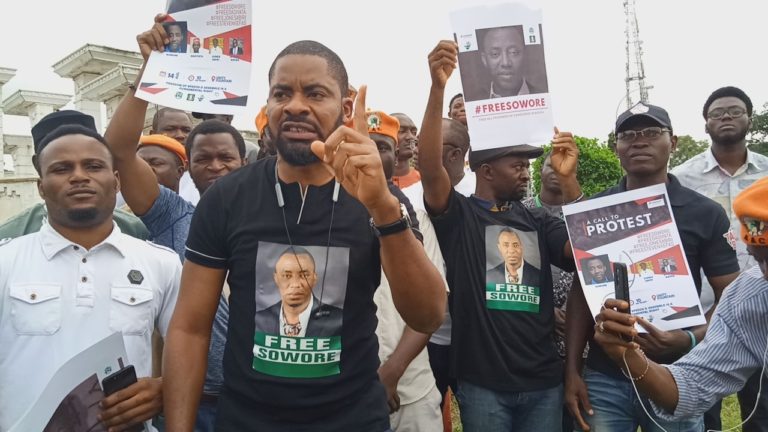
NIGERIANS gathered at the Unity Fountain, Abuja, on Wednesday morning to protest the continued detention of Omoyele Sowore, publisher of Sahara Reporters, and others who have been recently arrested.

The protest took place in the presence of security personnel. During one of his speeches, human rights activist Deji Adeyanju said the people need to know the level of intimidation the protesters are dealing with.

“When it’s time to go to Sambisa forest now, they will start crying,” he teased. “They will say the ammunition is not enough. They will go to their religious leaders to pray that they don’t want the transfer. But when it is time to intimidate comrades, you will see their big chests. They will start changing their voice.”

Our reporter noted the presence of 15 patrol vans parked close to the protesters, including ones from the Nigeria Prisons Service, Nigerian Army, Nigeria Security and Civil Defence Corps, and Rapid Response Squad. Also present were a bus from the FCT Fire Service and an Armoured Personnel Carrier (APC).

About 500 metres south of the park, opposite the Federal High Court, two vans and one APC were also stationed.

Towards the end of the gathering, six additional police patrol motorcycles arrived.

“Greatest of the greatest Nigerian people, please can we put our hands together,” Adeyanju said sarcastically once he noticed the overwhelming presence of the security paraphernalia.

“We just received six new bikes. They just joined us from the force headquarters. Please, can we put our hands together and celebrate them? We celebrate the police. We celebrate our security people. Oh, they are working. They are fighting crime all over Nigeria. There is no longer insecurity in the country.”

Adebayo Raphael, an Abuja-based human rights activist and development consultant, while addressing journalists described the system of government Nigeria currently practises as a democratic dictatorship.

“Nigeria has now turned into a festooned scar. In this country, we are no longer safe. In this country, we are no longer free. And in any country which practises democracy, where one of us is not free, then all of us are not free. If the freedom of one of us is taken, the freedom of all of us has been taken away,” he said.

“And so we must make it very clear to tyrant Buhari and all his cronies that we the people of Nigeria will not be cowed, that the voices of dissent in this country will not be subjugated, that our clamour for freedom will not wane, that it wouldn’t matter whether they mobilise one hundred people against us or they mobilise thousands of people against us, we will stand regardless of our numbers to say enough is enough. We will stand regardless of our numbers to condemn tyranny in every way possible.

“Stephen Kefas has been arrested. Sowore has been abducted. Jones Abiri has been abducted. So many others that we don’t even have their names. But you can see that despite these state-sponsored abductions, some of us are still here today. This is to show you the resilience of those they call Nigerians.”

He added that the activists and protesters will not give up until “the country is free” and all the arrested citizens are released, while the crowd repeatedly chanted “yes!” in agreement.

The Middle Belt Forum’s Deputy National Organising Secretary, Ndi Kato, also assured that the protest will be sustained in spite of the “campaign of fear unleashed”.

“We will come out whether bullets are flying. We will come out even if our friends are disappearing. We will come out knowing we may be the one to disappear tomorrow. Every day, we will come out,” she said.

“Today, you are alive. Tomorrow, you may not be. And people will move on because we are used to it. People will move on because no value has been placed on the life of any Nigerian. Your life is worth nothing as long as you are Nigerian.”

Kato appealed to the government to grant freedom to Abubakar Idris ‘Dadiyata’, Stephen Kefas, Sowore, as well as all who have been unlawfully detained in various states but whose cases do not have national coverage.

Cross-section of protesters and reporters at Unity Fountain on Wednesday

On Saturday, August 3, Sowore was arrested by operatives of the Department of State Services (DSS) following planned demonstrations in 21 states on August 5. They accused the human rights activist and 2019 presidential candidate of “threatening public safety, peaceful co-existence and social harmony in the country”.

On Thursday, the Federal High Court granted an ex-parte application by the security agency, filed under the Terrorism Prevention Act, to detain him for up to 45 days.

Kefas, a Kaduna-based journalist, was arrested in May by officers of the Rivers State Police Command for sharing an article, dealing with the death of Kajuru monarch Galadima Maiwada, on Facebook. And Idris, a PDP member popularly called ‘Dadiyata’, was allegedly abducted from his home by DSS operatives in August. His whereabouts and the circumstances leading to his disappearance remain unclear.

Nigeria’s foreign reserves hits bump, drops by $482.18 million in July – Report

0

NIGERIA’S foreign reserves recorded a shortfall of $482.18 million, following a sharp depletion of the reserves from $45.14 billion to $44.65 billion in July according to records obtained from the Central Bank of Nigeria, CBN.

In a report titled “Easy money: Time to create buffers’ by Nigerian based financial outfit, FSDH Merchant Bank, released in August, it blamed the falling reserves on low crude oil prices and low Foreign Portfolio Investments, FPI, inflows in the country.

FPI occurs when investors purchase non-controlling interests in foreign companies or government bonds to create economic inroads through capital inflows.

“The current level of the foreign reserve can still provide short-term support for the value of the Naira which is enough to cover over 13 months of imports,” the report revealed.

It also noted that the medium-term stability in the foreign exchange market will depend on the country’s ability to increase its foreign exchange receipts from both crude oil and non-oil products.

“The average benchmark price for Bonny Light in July 2019 stood at $66.24 per barrel when compared with the average price in June.

“However, in the last few days, the crude oil price has dropped below $60 per barrel as a result of trade tensions between the United States and China is likely to have impacts on the global economy. This may have negative impacts on revenue and other key prices in Nigeria,” it said.

The report forecasts a gloomy future for the Nigerian economy with regards to the daily crude oil production in Nigeria which decreased by 5.04 per cent from 1.83 million barrels per day in April to 1.73 million barrels per day in July.

“Though the 2019 budget benchmark is at 2.3 million barrels per day, the lower crude oil daily production compared with the budget benchmark may pose negative implications on Nigeria’s revenue receipts and fiscal buffers,” it said

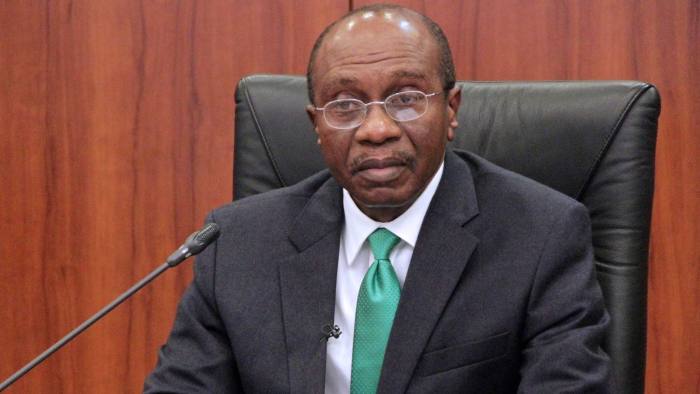
CBN Governor, Godwin Emefiele, in a report stated that the recovery of the foreign reserves from its low point 3 years ago was a sign of growth.

“Our external reserves have risen from $23 billion in October 2016 to over $45 billion in June. The foreign reserve will be conserved and utilised strictly for diversification of the economy, and not for encouraging more dependence on foreign food import bills,” he said.

He affirmed the need for a different strategy to grow the economy apart from relying on revenue from exports.

“While the drop in our export earnings arising from our reliance on crude oil exposed the fragility of our domestic economy in 2016, it also reinforced the view within the CBN and the Bankers Committee on the need to revise our growth strategy as a nation,” he stated.

He said with crude oil as a major source of the country’s foreign exchange, the nation’s economy will always be vulnerable to fluctuations in the price of crude oil.

South Africa pharm to pay UK NHS eight million pounds over illegal market competition

SOUTH African drug firm Aspen has offered to pay the National Health Service £8m, as part of a wider package, to resolve competition concerns over the supply of a fludrocortisone acetate 0.1 mg tablets.

The offering comes off the back of an investigation by the Competition and Markets Authority (CMA) into suspected anti-competitive arrangements regarding the drug.

PharmTimes reports that the arrangement marks the first time the CMA will secure such payment to the NHS in one of its pharmaceutical investigations.

The CMA has been investigating claims that Aspen entered into arrangements with two rival companies in 2016, and confirmed that competition law had been broken by Aspen paying competitors to stay out of the market. The arrangements subsequently left Aspen as the sole supplier of fludrocortisone, with the ability to set prices without facing any competition.

The CMA has announced that as a result of the case, Aspen approached the organisation with a proposed package to resolve the differences, which includes admission of illegality: Aspen admits it was party to an illegal, anti-competitive agreement, by way of settlement, and compensation to address CMA’s concerns: Aspen will commit to pay £8 million to the NHS – without the Government having to launch court proceedings for damages.

This is intended to address the CMA’s concerns that as a result of the impact of Aspen’s behaviour, the NHS paid a higher price for fludrocortisone.

The disgraced company will also pay a maximum fine of £2.1 million, once the CMA has concluded its investigation if it reaches a formal decision that the law has been broken. The CMA is continuing its investigation given other companies are involved.

Andrea Coscelli, the CMA’s chief executive, said that the organisation launched the investigation because they consider it “unacceptable for the NHS – and the taxpayers who fund it – to have to pay millions of pounds more than they should for this life-saving drug.

“This is the first time a CMA investigation will secure payment for the NHS. The £8 million Aspen has agreed to provide will save the NHS the time and expense of seeking damages in court. Importantly, Aspen has also committed to ensuring there are more competitors in this market, giving the NHS the opportunity to secure better value for UK taxpayers’ money in the future.”

He added that the organisation “welcomes Aspen approaching” to find a new way of addressing the CMA’s concerns.

The CMA currently has other unrelated investigations open in relation to six other pharmaceutical drugs.


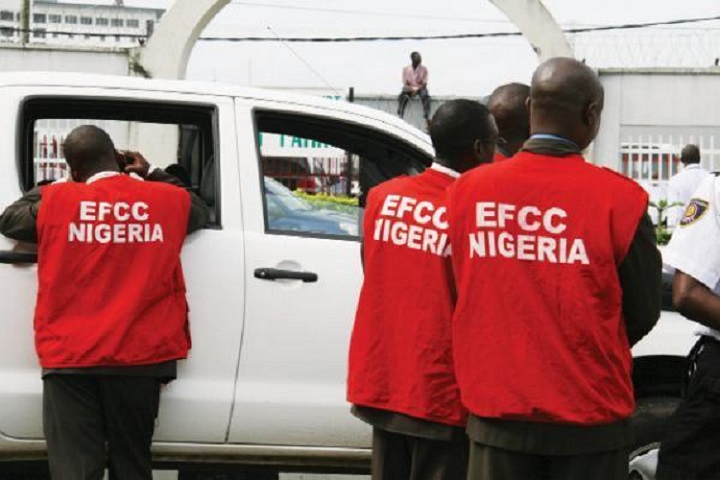
EFCC: Atiku’s son-in-law, Babalele arraigned for $140,000 money laundering

ABDULLAHI Babalele, the son-in-law to the former Vice President Atiku Abubakar, has been arraigned on a two-count charge bordering on money laundering.

Babalele was on Wednesday arraigned by the Economic and Financial Crime Commission (EFCC) at Federal High Court in Lagos.

The EFCC on August 9th filed a two-count charge against Atiku’s son-in-law for allegedly aiding the cash payment of the sum of $140,000 without going through a financial institution.

The prosecutor of the EFCC, Rotimi Oyedepo who signed the charges said Babalele had committed the offence since February 2019.

The count read thus:

COUNT 1: That you Abdullahi Babalele on or about the 20th day of February 2019 in Nigeria within the jurisdiction of this Honourable Court. procured Bashir Mohammed to make a cash payment of the sum of $140,000. 00 (One Hundred and Forty Thousand United State Dollars) without going through a financial institution, which sum exceeded the amount authorized by Law and you thereby committed an offence contrary to Section 18(c) of the Money Laundering (Prohibition) Act, 2011 as amended and punishable under Section 16(2)(b) of the same Act.

Count 2: That you Abdullahi Babalele on or about the 20th day of February,2019 in Nigeria within the jurisdiction of this Honourable Court, aided Bashir Mohammed to make cash payment of the sum of $140,000. 00 (One Hundred and Forty Thousand United State Dollars) without going through financial institution, which sum exceeded the amount authorized by Law and you thereby committed an offence contrary to Section 18(a) of the Money Laundering (Prohibition) Act, 2011 as amended and punishable under Section 16(2)(b) of the same Act.”

However, Babalele before Justice Nicholas Oweibo pleaded not guilty to the two-count charge.

Also arraigned by the EFCC was a former associate of Atiku, Uyiekpen Giwa-Osagie and a legal practitioner on a three-count charge bordering on a $2million money laundering in the build-up to the 2019 general elections.

The EFCC disclosed that in the charge was Erhunse Giwa-Osagie, a brother to Atiku’s associate.

The antigraft said the two defendants had conspired to make a cash payment of $2million on February 12, 2019, without going through a financial institution.

The duo pleaded not guilty to the charges.

Consequently, Justice Oweibo ordered that Babalele and the Osagie brothers be remanded at the EFCC custody pending the hearing of their bail application on Thursday, August 15.

Daura Emirate to Buhari: We only enjoy 24-hour power when you are around

PEOPLE in the neighbouring communities under the Daura emirate in Kastina have decried a shortage in power supply, which only improves only when President Muhammadu Buhari is in town.

Leaders from the five local government areas under the Daura emirate made this statement during a courtesy visit to the president at his home in Daura during Sallah.

“Anytime the President is around we enjoy 24 hours power supply. But if he is not around, the power supply is not always stable,” Mohammed Saleh, one of the leaders, said.

The leaders requested that the president addressed issues plaguing the communities.

Earlier in May, the Daura emirate council had suspended all activities regarding the celebration of Eld-Al-Fitr, due to reported cases of insecurities ravaging some part of the state.

Amongst such cases was the kidnap of the district head of Daura, Umar Musa, who was reportedly abducted by suspected bandits.

Also, 34 people were reportedly killed in some part of the state, which led to the prescription of capital punishment for kidnapping, cattle rustling and armed robbery.

However, Buhari in his reactions to the leaders’ outcries, said his mission is to fight for the poor while ensuring that campaign issues, such as security, economy and corruption are resolved.

The Emir of Daura, Umar Farouq, during the Sallah Durbar held in his palace, urged Nigerians to show support to the president in overcoming the challenges faced by the country.

The president had also hosted the Presidents of Guinea Conakry, Alpha Conde, who celebrated the Eid in Nigeria.

FOREX: Don’t give a cent to support food imports, Buhari instructs CBN governor

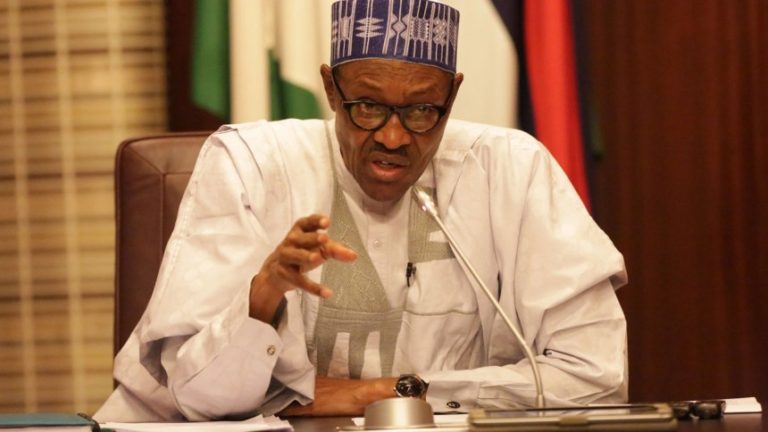
PRESIDENT Muhammadu Buhari on Tuesday said he had directed Godwin Emefiele, Governor of the Central Bank of Nigeria (CBN) to stop providing foreign exchange to food importers as the nation has grown sufficient food capable of feeding its citizens.

“Don’t give a cent to anybody to import food into the country,” Buhari instructed.

The President disclosed this when he played host to All Progressives Congress (APC) elected Governors as part of the Eid-el-Kabir celebration in Daura, Katsina State. He added that money kept in the foreign reserve would be spent solely to diversify the economy.

He emphasised the nation would no longer encourage food importation considering the high import bills.

In 2015, the CBN said the nation spent $2.41 billion on rice importation between January 2012 and May 2015.

While Emefiele lamented on the huge sum expended on food imports, Audu Ogbeh, former Minister of Agriculture and Rural Development (FMARD) also put the figure at $22 billion annually.

“Nigeria spends almost $22 billion every year on food importation. If we don’t fix agricultural problems in the country where families can feed on less than 15 per cent of its budget, then the country is in trouble.” Ogbeh stated.

In March, the CBN governor stressed how the country spends $500 million annually importing palm oil, aside from another $40 billion spent on textile imports yearly.

The current administration’s claim on rice production has also raised doubts on exact local rice production capacity.

However, Buhari noted that some states like Kebbi, Ogun, Lagos, Jigawa, Ebonyi and Kano had already taken advantage of the Federal Government’s policy on agriculture with huge returns in rice farming, urging more states to plug into the on-going revolution to feed the nation.

“We have achieved food security, and for physical security, we are not doing badly,” he added.

In a statement issued by Garba Shehu, Senior Special Assistant to the President on Media and Publicity, Buhari expressed delight on increasing youth involvement, including graduates on agribusiness and entrepreneurship.

APC Governors meet President Muhammadu Buhari in Daura, Katsina State
Photo Credit: Garba Shehu

The President informed that the incoming cabinet members would be enlightened, well guided and monitored to ensure they deliver on their responsibilities. According to him, their targets would as well be scaled up by the Office of the Secretary to the Government of the Federation.

He promised to attend the Presidential Policy Retreat organized for the ministers by the OSGF, insisting on compliance with laid down targets on key sectors of the economy capable of impacting the livelihood of the masses.

In his remarks, Dr John Kayode Fayemi, the Chairman of the Nigerian Governors’ Forum and Governor of Ekiti State, described the challenges confronting the states as ‘enormous’.

However, he assured the president of overcoming the problems.

Alhaji Atiku Bagudu, the Chairman of the Progressive Governors Forum and Governor of Kebbi State, applauded the President for his leadership style, maintaining a healthy relationship with the governors on an individual and collective basis.

“The country is more secure than in 2015, and the country is more prosperous than in 2015 because you are working for the majority of the people,” he claimed.

Nigeria Police’s Gender Unit lacks resources to investigate rape, says rights activist

THE Gender Unit, a department under the Nigeria Police, lacks financial resources to investigate allegations of sexual abuse and prosecute offenders, says Dorothy Njemanze, an Abuja-based rights activist.

The founder of the Dorothy Njemanze Foundation said this in an interview with The ICIR, noting that it is an important point that has to be made clear.

The Nigerian police does not have money for investigations,” she said. “So, whatever the case is, whether it is a child or an adult, the Nigerian police expect the people to bear the costs. We have a system that destroys cases and frustrates victims. It doesn’t make any sense whatsoever.”

She said the police often push the burden of prosecution to the victims who are ordinarily “struggling with their lives”. Because of this, she explained, her organisation has had to plead online for financial support to foot the bills having to do with criminal litigation for abuse victims.

She also mentioned a case reported by this paper in June, where the alleged rapist of two underage rape victims is yet to be apprehended after nearly two years, as a typical example of the shortcomings of the police.

“There is no money for investigations. There is no funding whatsoever for medicals,” she said emphatically.

“In fact, they mess up cases. Once, the accused has started giving them money, they start puncturing your story. We have seen so many cases that have been minuted to legal that were never taken up. 

“There is a particular 14-year-old girl; her mother scolded her in my presence. At the end of the day, that matter was minuted to legal by Mrs Ehindero. Till today, it never made an appearance in court. Never. Never. Never. It is wrong. Totally wrong.”

Njemanze added that her organisation, set up to address abuse-related issues to aid the healing and reintegration of victims, has to pay for police investigations, medical tests and reports, and pays police prosecutors every time they make appearances in court.

“The only case where the person has not pushed us to make payments was after he found out I’m a mad person,” she said, “because I told him I’ll raise your money from the internet. It dawned on him I was going to go out and put the information out there. I pulled a few stunts and made the case viral.”

Particularly, the Gender Unit, which the non-governmental organisation has written to on several occasions, is also not self-sufficient as it has to rely on complainants to effectively investigate allegations brought before it.

“Put it out there that people who Gender Unit has investigated and did not need to pay should come out,” she challenged.

“Even for this Justice-for-Chloe case, we wrote to Gender Unit. They did not do anything. We usually do write to them. But when we found out that it’s ending up wasting our paper and ink, we just decided to deal with the frustration and then go head up… because what they claim Gender Unit does is not true.

“They tell a lot of lies. They’ll come and tell you the police has a gender unit and the gender unit … It’s a lie. They don’t do anything. They frustrate us. See, I battle depression, and part of it is because I sit down and wonder how irresponsible our government and people who occupy authoritative positions are.”

Njemanze complained that the Nigeria Police hardly takes action if an officer is accused of flouting the law. She further condemned victim-blaming among law enforcement agents and health professionals. She has seen, for example, women asked at police stations what they did to provoke their husbands into assaulting them.

“There is currently another case we are following up on,” she narrated. “The two children involved are both under ten years, and they were seen by different doctors. One of the doctors was saying, ‘Ah. This child has been raped but this time around it was not rape’. That the child went to have sex as usual.

“Children under 18 years cannot consent to sex. If the mindset of a doctor is that a child under 10 years old went to have sex as usual, then there’s a problem. That tells you the quality of the medical reports that’ll come out of that place, tenable in court.

“And that child had an infection. The person at the lab, to make the children open up for swabs, threatened the children and said, “If nah the people wey go give you N200 now you go open your leg, common open your leg before I beat you here!” and the children opened their legs. Is that not rape? Rape happened again.

“And then at the police station, the policewoman said to them, ‘They don come here before because of you. Nah only you get that area? If you bring this kind report here again, I go beat you’. Meaning if anybody rapes the child again, the child should keep quiet. That is the system we live in. We see a supposed support system further traumatising children.

“How many people have the police told as long as they’ve been disvirgined before, they cannot be disvirgined again? How many have been forced to settle out of court?”

The Dorothy Njemanze Foundation, she said, often advises complainants to ask policemen who extort them for their names “and tell them please I need to write your name because we’ll get a refund from the NGO and they need to know exactly who I gave the money to”. They’ve observed that this approach deters officers from making demands for money. But, oftentimes, it means they also stop taking the case seriously.

“And so we have so many cases that are hanging in limbo; the owners of these cases are very very frustrated,” she added.

In July, The ICIR reported how Okokon Udo, a prosecution lawyer at the FCT Criminal Investigation Department asked the father of a three-year-old rape victim to bring N20,000 to work on his case file.

The 2019 Global Corruption Barometer Africa report released also last month ranked the police as the most corrupt institution in Nigeria and stated the judiciary to be the third most corrupt.

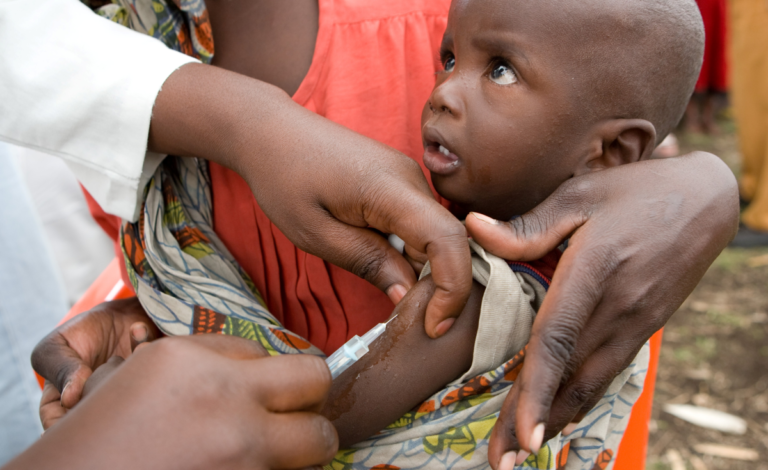
Nigeria has fourth highest confirmed cases of measles globally in 2019

SO far in 2019, Nigeria has recorded a total of 24, 994 confirmed cases of measles thereby, securing the fourth position in the world with highest recorded cases of the contagious disease.

This is according to a new measles surveillance data available on the World Health Organisation and published on Monday. The provisional data was based on member countries reports submitted monthly to WHO as of August 2019.

The WHO noted that between January and July 2019, reported measles cases were the highest that had been in any year since 2006.

It listed nine countries – Angola, Cameroon, Chad, Kazakhstan, Nigeria, Philippines, South Sudan, Sudan and Thailand- to be experiencing, currently, major measles outbreaks.

Five countries: Madagascar, Ukraine, Philippines, Nigeria and India had reported the highest number of cases this year. Nigeria had 24,994 confirmed cases of measles, preceded by Madagascar with 127,464 cases, Ukraine had 52,246, and the Philippines had 36,253. India number of reported cases was nearly up to Nigeria’s figure with 24,076 measles cases.


Breaking down the figure, in January, Nigeria had 2,983 measles cases, February was 4,905. The March figure was the highest with 7,120 cases. But there was a gradual reduction from April with 5,229,  May with 3,536, June with 971 and to July with 250 cases.

The country’s figure skyrocketed in 2019 as each of the whole years of 2015 to 2018 did not reach up to 20,00 cases. In 2015, there were 12,391 confirmed cases of measles. The figures for 2016, 2017, and 2019 were 17581, 11,188 and 7,018 respectively.

Meanwhile, WHO has clarified that the number of reported cases in 2019 reflected a small proportion of the true number of cases occurring in countries. “Many cases do not seek health care or, if diagnosed, are not reported. In addition, there is a one to two month lag time in reporting,” it noted.

For those reasons, WHO said the data provided under-represented the true number of cases, particularly those occurring in the last one to two months.

The global health agency said the largest outbreaks were in countries with low measles vaccination coverage, currently or in the past, which had left large numbers of people vulnerable to the disease.

“In a number of countries, measles is spreading among older children, youth and adults who have missed out on vaccination in the past,” it said.


Cases of Measles in Nigeria

Nigeria had the highest number of unvaccinated children under one year of age against measles in 2017, according to a UNICEF coverage report on Vaccine in April. It estimated that about four million Nigerian children missed out the first dose of measles vaccine that year.

The WHO identified the reasons why people were not being vaccinated to include lack of access to quality healthcare or vaccination services, conflict and displacement, misinformation about vaccines and low awareness about the need to vaccinate.

As measles is one of the world’s most contagious diseases, the best protection against the disease is through receiving two doses of the measles vaccine described as “a safe and highly effective vaccine”.

“High rates of vaccination coverage – 95 per cent nationally and within communities – are needed to ensure that measles is unable to spread,” said the WHO.

Measles caused approximately 110,000 deaths in 2017 all over the world.

The first sign of measles is usually a high fever, which begins about 10 to 12 days after exposure to the virus and lasts four to seven days.

Later the symptom would develop to a runny nose, a cough, red and watery eyes, and small white spots inside the cheeks. After several days, a rash erupts, usually on the face and upper neck.

Serious complications are more common in children under the age of 5, or adults over the age of 30, especially malnourished young children and HIV/AIDS patients.

Health complications resulted from measles include blindness, swelling of the brain (encephalitis), severe diarrhoea, ear infections, and Pneumonia.

According to the Nigeria Centre for Disease Control (NCDC), Nigeria has recorded 89 deaths as a result of measles as of May 12. The latest NCDC situation report on measles released on May 18 noted that Borno State has the highest number of the diseases followed by Katsina, Yobe, Kano and Kaduna.

Boko Haram: Bama celebrates first Sallah in 5 years

0

The Shehu of Bama Kingdom of Borno State, Kyari Ibn Umar El-Kanemi, has expressed delight after his people joined the rest of the world to mark the first Eid-el-Kabir celebration in his domains.

According to the monarch, this was the first time in almost five years the community partook in the religious feast celebrated across the globe by all Muslims.

“Today we are celebrating Sallah in Bama which we were not privileged to celebrate for the past five years,” an utterly elated Shehu told the News Agency of Nigeria (NAN).

“Indeed we have to be grateful to Allah SWT for sparing our lives and none among us here today that is thinking to live up to this moment to grace this Sallah celebration in Bama.”

Bama was the target of Boko Haram terrorists in the past, forcing natives and other inhabitants to flee their homes.

Umar El-Kanemi, the traditional ruler wasn’t spared as his wife and daughter were reportedly abducted in 2014 and released two years after.

The monarch, alongside his counterpart from Dikwa, Masa II Ibn Umar El Kanemi, even fled their communities to reside in Maiduguri.

However, peace has since been restored to the area thanks to President Muhammadu Buhari and the Nigerian Army under the dogged leadership of Lieutenant General Tukur Buratai.

As part of the rehabilitation and reconstruction process, the monarchs returned in July in the company of local government staff and primary school teachers accompanied by troops of Operation Lafiya Dole who regained the Kingdom back from Boko Haram terrorists.

An eyewitness account revealed that there was free movement of people around the town, especially in public places without fear of any violence or attacks by Boko Haram throughout the Sallah season.

There was also a mass prayer on Sunday for the first time in a long while, led by the monarch himself.

All these feats have been attributed to the gallantry of the Nigerian military and decisive leadership.

(NAN)

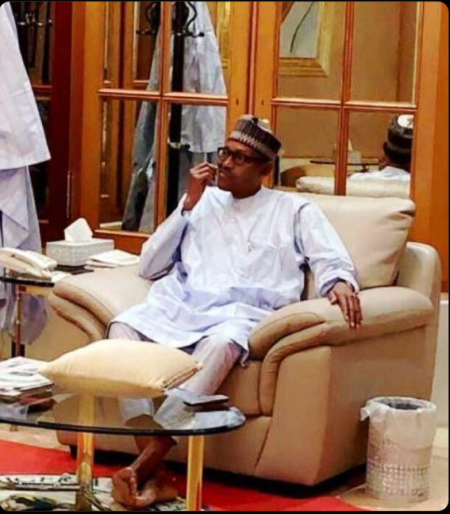
Ezekwesili, pro-Buhari members banter over president’s ‘tooth-picking’ picture

OBY Ezekwesili, former minister of education and pro-Buhari members on Monday exchanged banters over a trending picture of President Muhammadu Buhari.

The portrait, described as ‘Fiddling-Nero-type-picture’ by Ezekwesili was perceived as un-presidential and unworthy of public view.

Buhari was picking his teeth in the picture which has generated over 1,200 likes on Ezekwesili’s timeline.

The President had earlier visited Daura, Katsina State for a nine-day official trip to celebrate Eid-el-Kabir with family members. He was later joined by Prof. Alpha Conde, President of Guinea.

“That a Presidency @AsoRock and their allies found this unflattering ‘Fiddling-Nero-type-picture’ of the @NGRPresident worthy of public view really does take their celebration of deadly Incompetence to a stratospheric realm,” Ezekwesili tweeted.

“But then, it really is Governance of tooth-picking”.

She further condemned what she described as incompetence among political appointees and other officials of the current administration including the judiciary.

Nigerians react

Adebiyi Kayode @CallyKayode also condemned the picture. “This photo is all shades of wrong, I must confess.”

Emmanuel Ayomanor @e_ayomanor noted that the picture shouldn’t have appeared on the public. “That picture shouldn’t have come to the public. Surely you don’t understand what madam is implying. You should have just waka pass if you can’t comprehend. Thanks, madam for opening our eyes to seemingly obvious details. Much more GRACE.”

However, Buhari’s loyalists were quick to respond to the critic. Her picture of mild romantic gesture with Chief Olusegun Obasanjo, the former President resurfaced.

Tunde Obadimeji @Tunde said the former minister was seeking relevance.

“This grammar and post are not popular and I think this woman has outlived d public space, therefore she should quit, park somewhere and rest.”

Igbabu Terese @teresematt faulted Ezekwesili for her criticism describing it as hatred. “So a President cannot pick his teeth again. This isn’t a criticism but hatred”.