Home Blog Page 2318

Why Twitter suspended Osinbajo’s twitter account

ON Saturday, August 10, the social media space was inundated with reactions as to why the official twitter account of the Vice President, Prof. Yemi Osinbajo was suspended.

The federal government last Thursday resumed the disbursement of the N10,000 Trader Moni for petty traders in Bayelsa state.

This generated mixed reactions among many people, with some alleging that the Trader Moni scheme was a tactical means of buying votes considering that the governorship election in the state  is just some months away.

Digital analysis of the vice president’s twitter account showed that the account might have truly been attacked by trolls.

Trolls on social media are people who deliberately provoke others online by saying inflammatory and offensive things. They promote hate speech, attack an opponent’s character and say things to appeal to people’s feelings rather than their intellect.

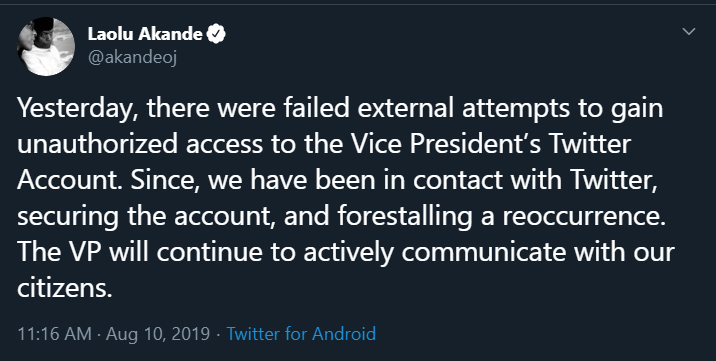
Laolu Akande, Senior Special Assistant to the Vice President on Media and Publicity on Saturday had tweeted about a failed attempt to hack into the Vice President’s Twitter account.

“Yesterday, there were failed external attempts to gain unauthorized access to the Vice President’s Twitter Account. Since, we have been in contact with Twitter, securing the account, and forestalling a reoccurrence. The VP will continue to actively communicate with our citizens,” Akande said in the post.

In reaction to the tweet, speculations by twitter accounts owners said the Vice President made a post about the Trader Moni which got his account reported for vote-buying and was later unverified and suspended.

A search of the Internet into previous tweets made by Osinbanjo using Wayback machine, an online tool that archives the internet itself debunks the speculation that the account was suspended on the ground of making a post on the Trader Moni because no post in that regard was found.

According to Twitter, the blue tick that indicates a verified account can be lost if the account intentionally misleads people by changing one’s display name or bio; if the account promotes hate and/or violence against, or directly attacks or threatens other people on the basis of race, ethnicity, national origin, sexual orientation, gender, gender identity, religious, affiliation, age, disability, or disease; Inciting or engaging in harassment of others; violence and dangerous behaviour.

From historical tweets recovered, no tweet from @profosinbajo appears to violate these conditions. Also from curated web shots, the name and bio remained the same, ruling out the first condition.

Again, according to Twitter, accounts can be suspended for the following reasons;

Spam: Most of the accounts we suspend are suspended because they are spammy, or just plain fake, and they introduce security risks for Twitter and all of our users. These types of accounts are against our TwitterRules. Unfortunately, sometimes a real person’s account gets suspended by mistake, and in those cases, we’ll work with the person to make sure the account is unsuspended.

Account security at risk: If we suspect an account has been hacked or compromised, we may suspend it until it can be secured and restored to the account owner in order to reduce potentially malicious activity caused by the compromise.

Abusive Tweets or behaviour: We may suspend an account if it has been reported to us as violating our Rules surrounding abuse. When an account engages in abusive behaviour, like sending threats to others or impersonating other accounts, we may suspend it temporarily or, in some cases, permanently.

According to Nana Nwachukwu, a public interest digital researcher, a common factor remains that somehow Twitter rules may have been violated not necessarily by the handle but in a manner that places the account security at risk, which also follows the same pattern of a troll attack on the account. This brings in the announcement by the Laolu Akande on attempted unlawful access to Osinbajo’s account.

Twitter operates through a community reporting system. Typically accounts like @profosinbajo which is verified and belonging to a high-ranking Govt official are usually suspended where suspicious activities are noticed by Twitter API.

Timeline of the troll attack on Prof Yemi Osinbajo’s Twitter account @ProfOsinbajo

On August 8, the federal government resumes TraderMoni in Bayelsa State

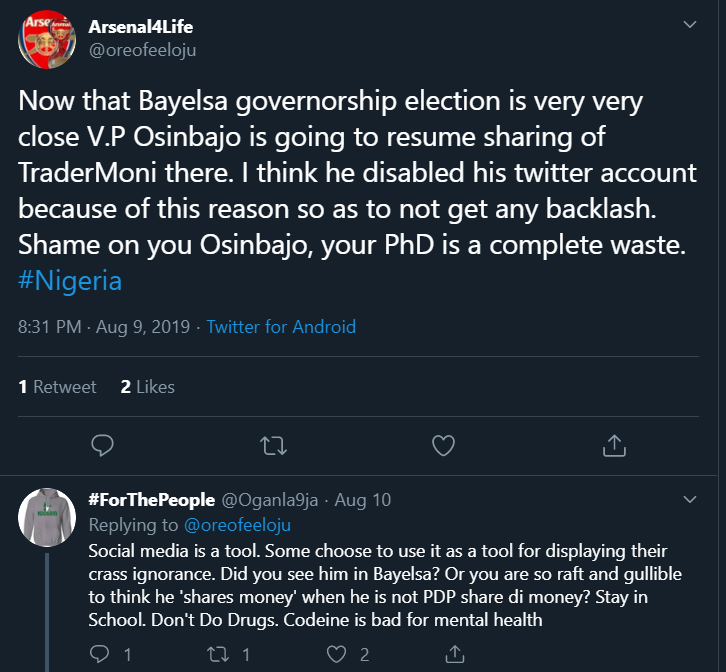
Reactions on Twitter;

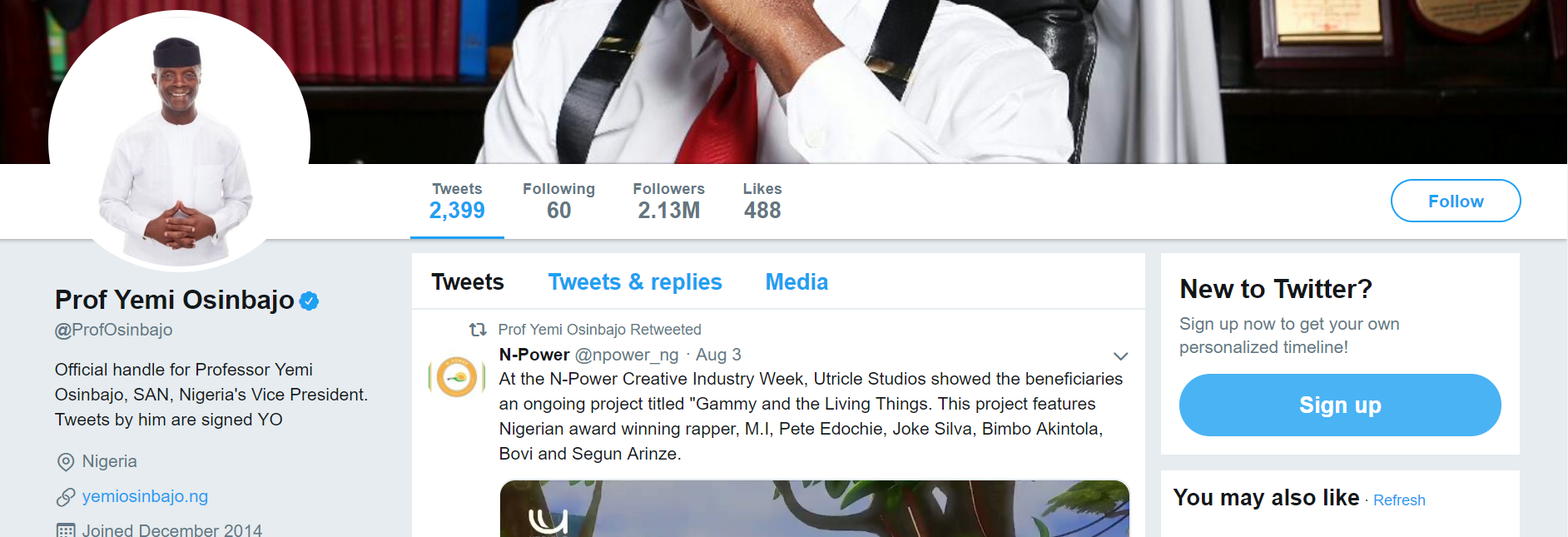
Image from Mark Graham’s Nigerian Archive on Wayback Machine


The last tweet by @ProfOsinbajo on August 8, 2019, was a retweet of NPower
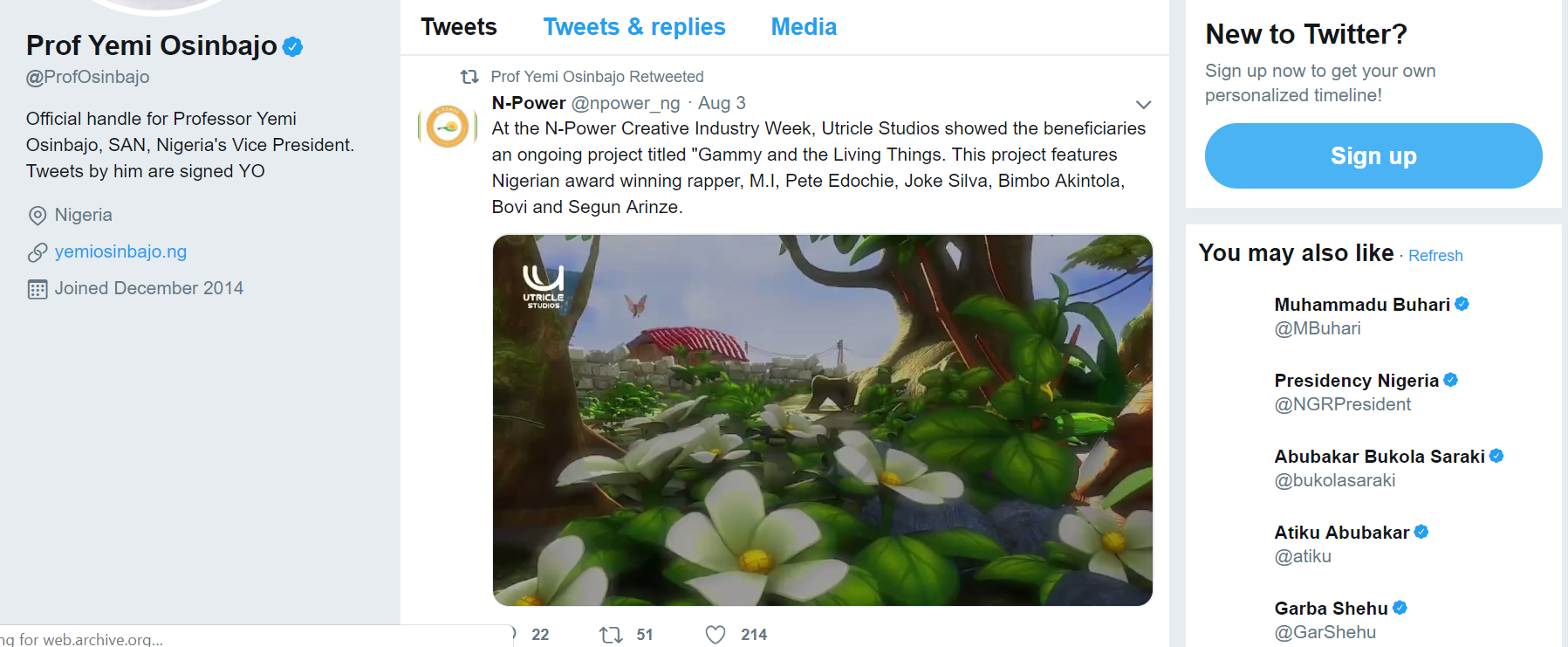
On August 9, Web Capture from the account at 00:13:17 showed the account was still the same as above with no changes. (see image below)

Image from Mark Graham’s Nigerian Archive on Wayback Machine

At 16:13:35 hours, the Vice President’s account had become unverified with follower count down to 1.28million from 2.13million and following only 53 persons from 60 previous followings with only 3 tweets as against the previous 2,399 tweets. There is no current record of those unfollowed at the time. This showed a troll attack pattern.
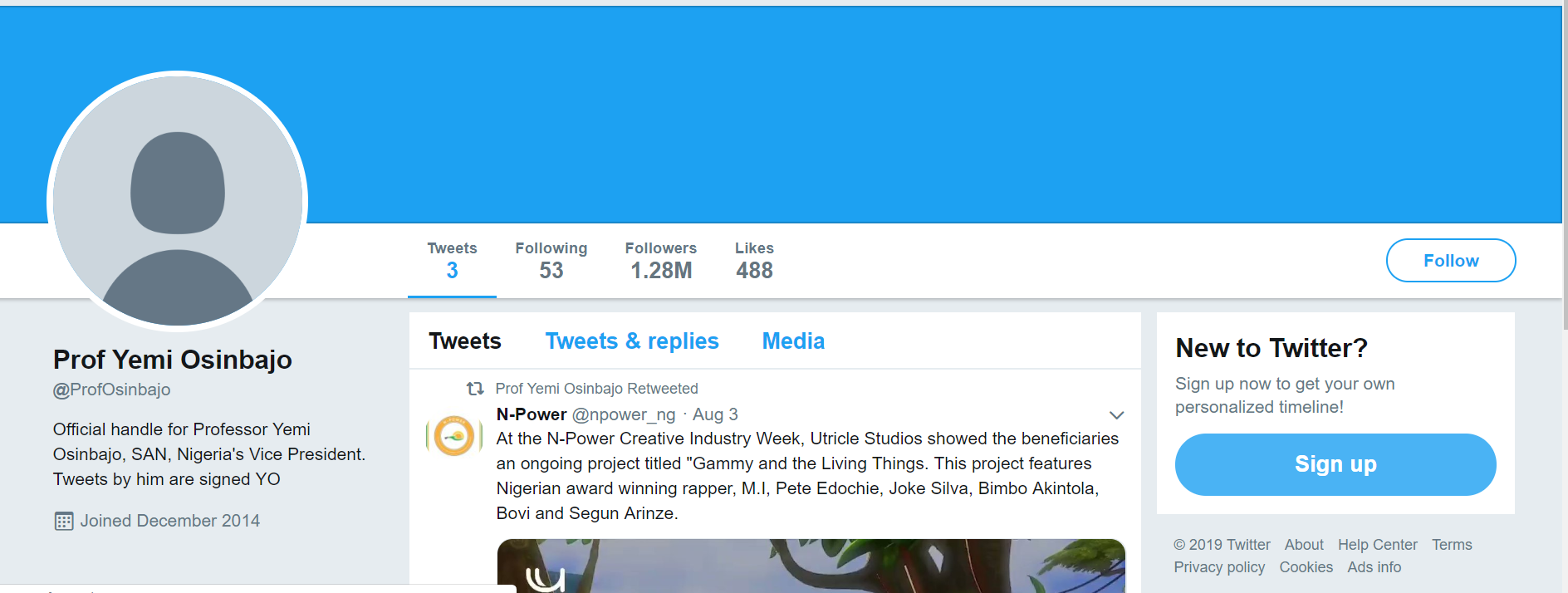
At 22:50:19, the account was still down and showed the exact same image above.

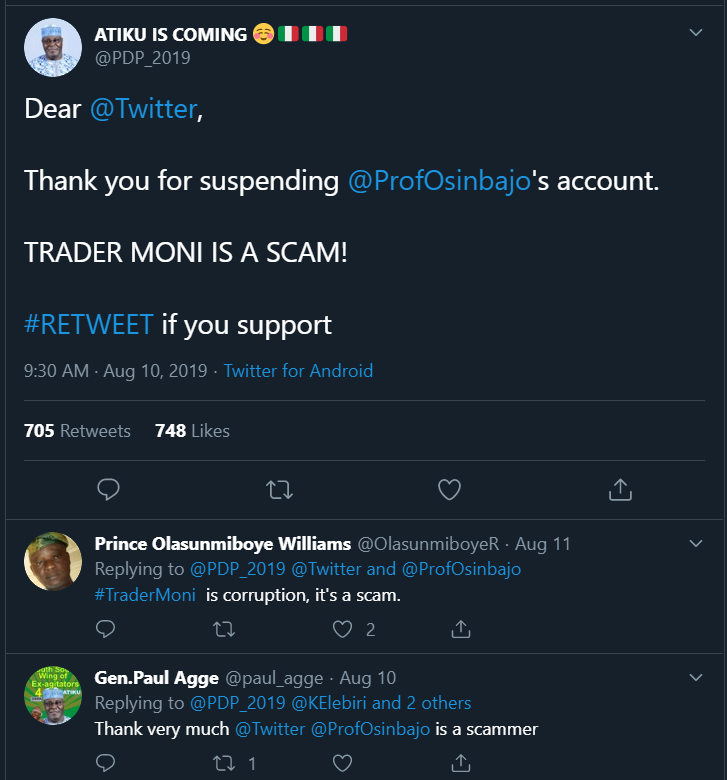
Twitter reactions to the account being down from known opposition sympathizers/members

On August 10, reactions on Twitter


Reaction from the Vice-President’s Aide
At 09:39:00, the account had been restored but without the verification and had the follower count down to 1.16million. It appeared the tweet archive had been deleted.
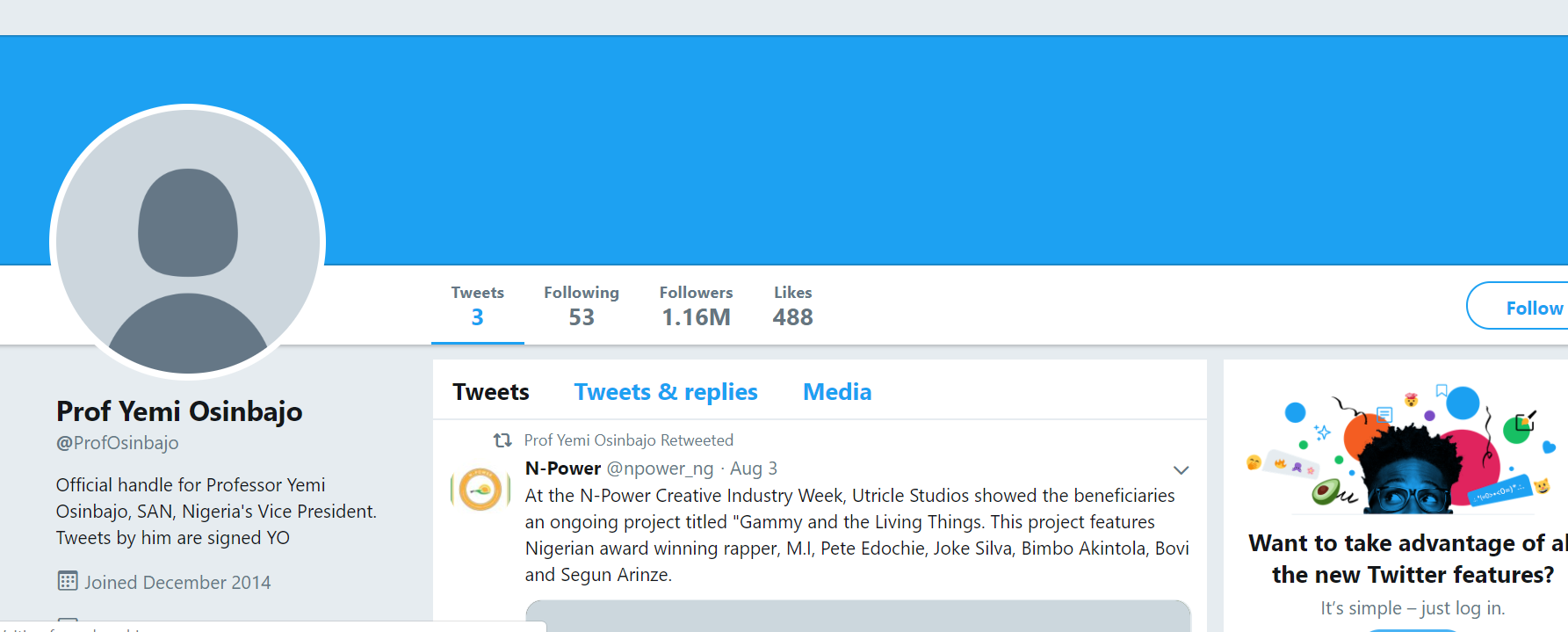
 

At 16:30:41 hours, the follower count had gone down to 1.1million followers (see image below) and the account was fully suspended.
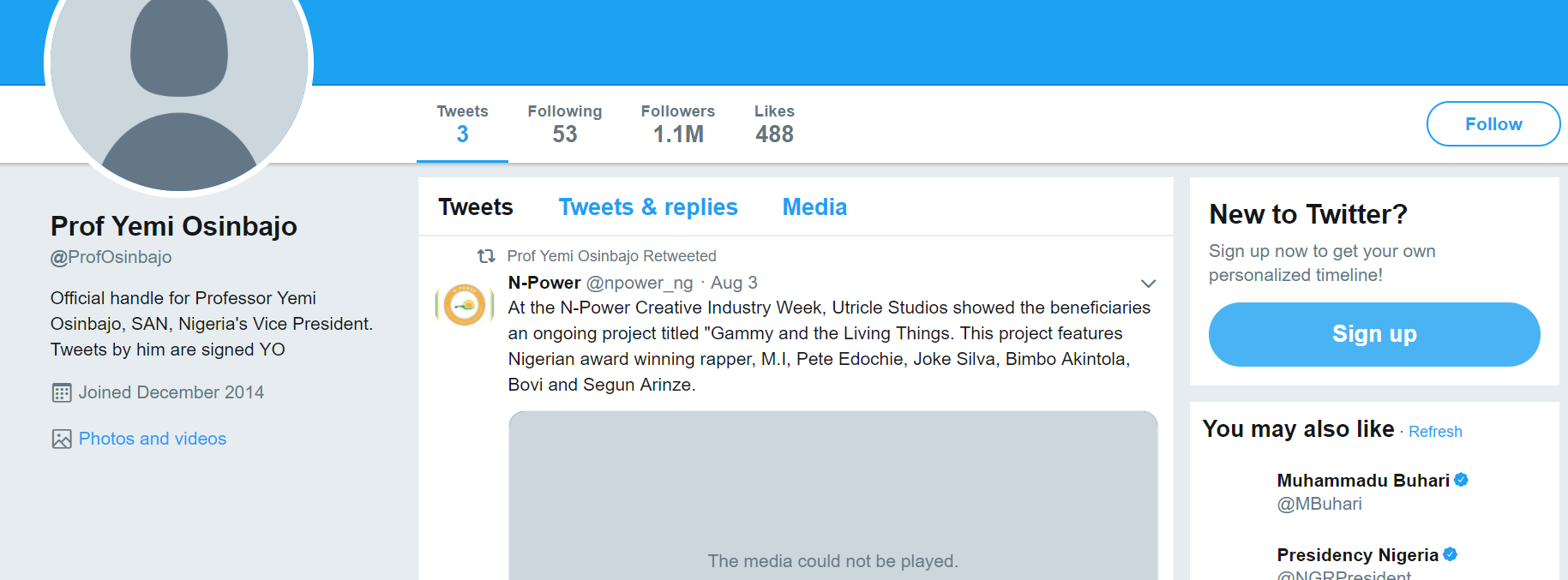
At 01:55:20, the account appeared restored and follower count climbed up to 1.11million as in the image below. The account was unverified and still did not have an image or header.
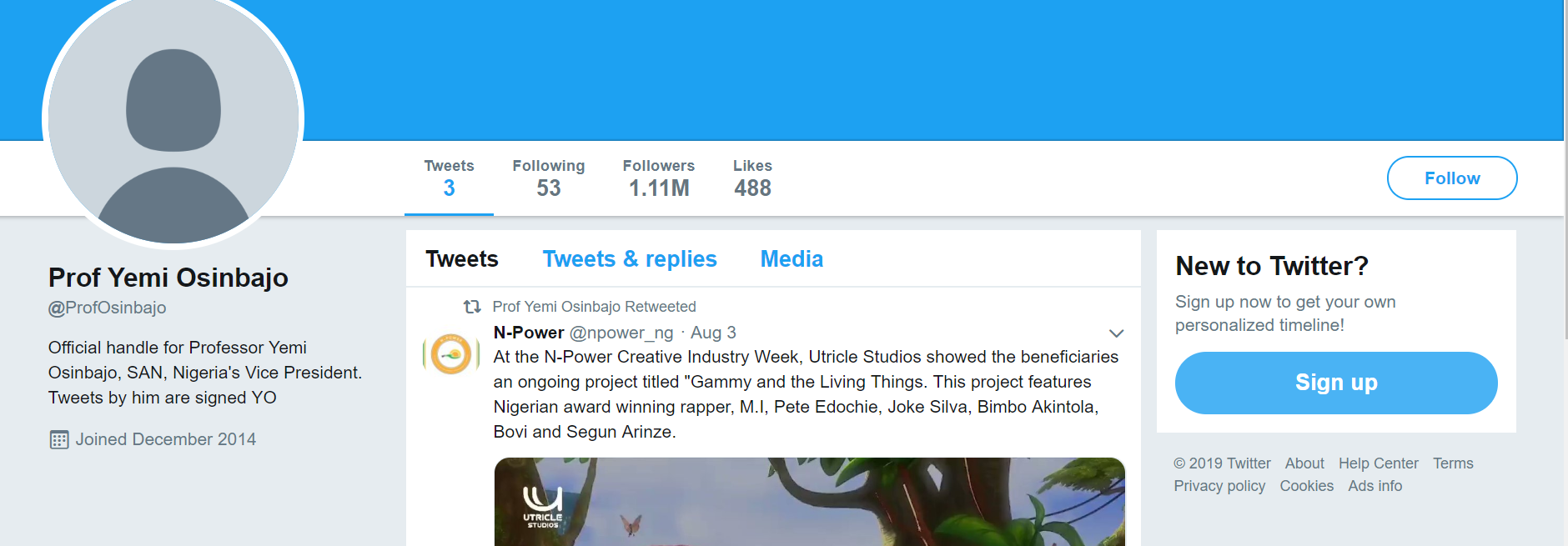
At 12:40:36, the account was climbing up in followership count

The account had been fully restored as at 17:00:00 hours and sent out Sallah messages to Nigerians at about 17:17:00 hours.

Conversations around the Trader Moni and Osinbajo can also be tracked  here and here.

This report was put together by Damilola Ojetunde, Data Analyst at The ICIR and Nana Nwachukwu, a Public Interest Digital Researcher.
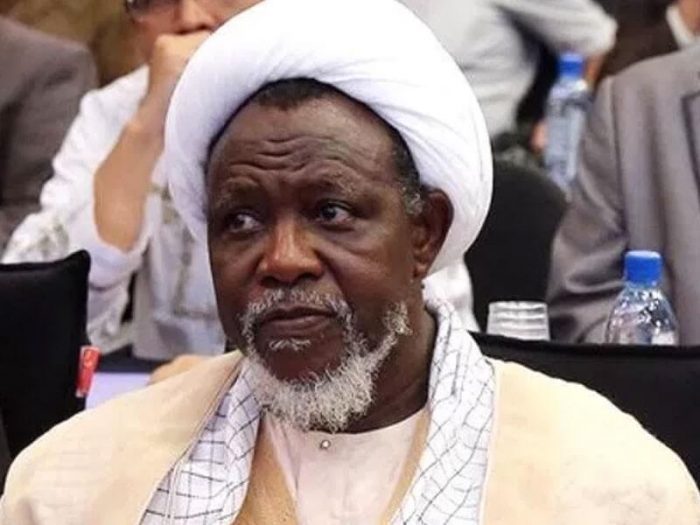
El-Zakzaky: 186 doctors from seven nations write Buhari

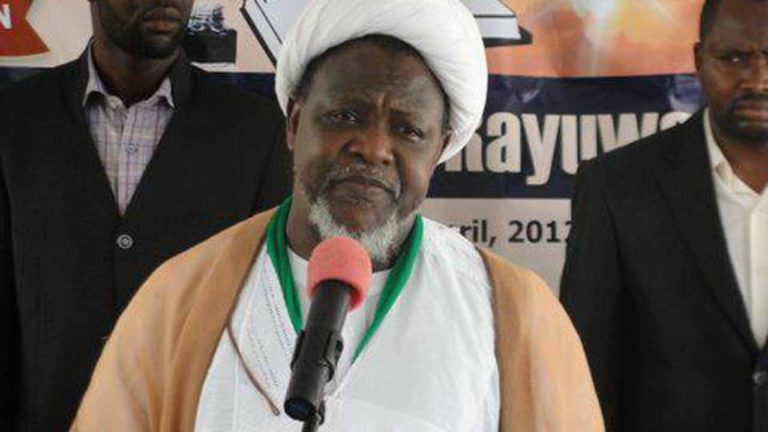
Not fewer than 186 Medical Doctors from seven countries have written to President Muhammadu Buhari, expressing their concerns over the deteriorating medical condition of the released leader of the Nigeria Islamic Movement (NIM), Ibrahim El-Zakzaky.

The doctors are from Pakistan, India, Iran, Afghanistan, Syria, Lebanon and Iraq.

According to a report by FARS News Agency, the Federal Government should transfer the Islamic clergy and his wife to a well-equipped hospital.

They claimed the victim is already suffering from acute insomnia, Ischemic heart disease which could lead to Myocardial Infraction, aside from heavy metal toxicity such as Lead deposit in his system.

El-Zakzaky and his wife were sighted at the Nnamdi Azikwe International Airport, Sunday preparing to journey to India for medical treatments.

They were temporarily released by Justice Darius Khobo of the Kaduna State High Court to seek treatment abroad after repeated demands by Femi Falana, the defense counsel as well as protests by the cleric’s followers.

The protesters were further proscribed as a terrorist group by the federal government for insisting on the release of their leader El-Zakzaky.

The full text of the letter is as follows:

“In the name of God, The healer

From the community of Doctors

To the President of the Republic of Nigeria, Mr. Buhari.

In the past several months, the world has constantly received troubling news regarding the health of one of the prominent figures in Nigeria, Shaikh Ibrahim Zakzaky. Both Shaikh Ibrahim Zakzaky and his wife are kept in prison and the health status of both of them is very alarming.

We have chosen to be doctors even after knowing that this job is very difficult and troublesome, but we chose to save people’s lives and preferred the health of society over our personal interests.

According to the medical reports regarding the health status of Sheikh Ibrahim Zakzaky:

  1. He is suffering from total blindness in the left eye and is also suffering from vision problems in the right eye including glaucoma and progressive macular atrophy. According to the diagnosis of the visiting physicians, Shaikh Zakzaky will lose his vision sooner or later if the current circumstances do not change.
  2. He has shown symptoms of Ischemic heart disease which can lead to Myocardial Infraction.
  3. He is also suffering from severe cervical spondylosis which has resulted to nerve root compression and symptoms are progressive causing insomnia.
  4. The experiments show that he has heavy metal toxicity including Lead and Cadmium. Laboratory tests that are performed on May 31st, 2019 show that blood lead level is 171.94µg/dl. Later on June 18th, 2019 this level was reported to be 231.48µg while in the last laboratory test the blood lead level was three times more than the toxicity level (grade 5 of poisoning).

Based on the points highlighted above, Shaikh Ibrahim Zakzaky should be transferred to a well- equipped medical center that has Neuro-ophthalmologist, glaucoma specialist and low vision expert, cardiologist, orthopedist, and neurologist. Also, he may need to have surgery to reduce intraocular pressure.

We, doctors of different nationalities cannot take the health of any human for granted. This is something that is inherent in our obligation as doctors. Ignoring the critical health status of Sheikh Ibrahim Zakzaky can end up in irreparable consequences.

We request the government and parliament of Nigeria to immediately transfer him to a well-equipped hospital to prevent any unfortunate incidents. A group of doctors from Pakistan, India, Iran, Afghanistan, Syria, Lebanon and Iraq.

“Sheikh Zakzaky, a prominent Shiite leader, has been in detention along with his wife for close to four years despite the deterioration of his health conditions.

“Last Tuesday, in an exclusive interview with FNA, Dr. Pourrahim Najafabadi, MD, said Sheikh Zakzaky needs to be cured by an experienced medical team of physicians in a specialized multi-specialty hospital outside Nigeria, since there is no such medical center in the African country.

“With the current physical condition of the Sheikh, especially the virulent lead poisoning, Sheikh’s life is seriously at risk by delayed treatment. Meanwhile, there is a need for special medical care even in case of complete medical treatment. There is serious risk to Sheikh’s life if he is kept under detention,” said Najafabadi, the founder and spokesperson of a group of expert physicians who have volunteered to treat Sheikh El-Zakzaky.

See list of the doctors here.

Nigerian Army charges soldiers to be of good conduct, following death of police officers

0

IN a bid to forestall clashes with police personnel, the Nigerian army issued directives to soldiers to guide their conduct after the death of three policemen by soldiers in Taraba state.

Felix Omoigui, a brigadier-general, in a letter signed on behalf of the chief of army staff, Tukur Buratai directed its personnel to be cautious in their approach when dealing with police officers.

“In the aftermath of the unfortunate incident involving troops of 93 bn, Takum and members of the Intelligence Response Team of the NPF at Ibi LGA of Taraba State on August 6, 2019, inciting and inflammatory comments are being made by the NPF on the regular and social media platform,” the letter revealed.

In the letter circulated on Sunday evening, the army directed its personnel travelling with a pass, to be in mufti and circumspect in their conduct.

“This is capable of inciting the rank and file of the NP to exhibit aggressive tendencies against NA personnel. Accordingly, all troops on IS, Internal Security, duty as well as personnel travelling in and out of uniform are to be circumspect in their conduct to avoid escalation,” it reads.

On August 6, police officers on a clandestine operation to arrest a suspected kidnap kingpin were attacked by soldiers from 93 Battalion who opened fire on them, killing three officers and a civilian on the spot.

The police who identified the suspect as Hamisu Wadume, was disappointed that soldiers had set free a man that its detectives were trailing for several years before they got a chance to take him into custody.

Although the army admitted that soldiers had attacked the police team which led to the death of the police officers and a civilian, it blamed the incident on poor intelligence and disclosed its readiness to cooperate with the investigation.

“Consequently, formations and unit commanders are to educate troops to be cautious in their dealings with members of the Nigerian Police, NP, in view of this development,” it concludes.

Hong Kong cancels 200 flights amid major countrywide protests

HONG Kong International Airport has cancelled all departing flights on Monday, as thousands of anti-government protesters occupied and caused disruption in  11th week of protests.

Passengers have been told not to travel to the airport, which is one of the world’s busiest transport hubs.

In a statement, officials of the airport quoted “seriously disrupted” operations as a reason for the shutdown as they were cancelling all flights that were not yet checked in by Monday afternoon.

Hong Kong International report is one of the busiest in the world, handling 1,100 flights daily across about 200 destinations.

More than 160 flights scheduled to leave after 18:00 local time (10:00 GMT) would not depart.

Many have condemned the actions of police, who on Sunday were filmed firing tear gas and non-lethal ammunition at close range.

Some protesters wore bandages over their eyes in response to images of a woman bleeding heavily from her eye on Sunday, having reportedly been shot by a police projectile.

The Hong Kong unrest was sparked due to the introduction of a bill introduced in April that would allow people accused of crimes against mainland China to be extradited.

The bill met with lots of criticism as many believed that those sent to the mainland could face an unfair trial and violent treatment under China’s court system and could put activists and journalists at risk as they argued the bill would give China more control over Hong Kong.

Protesters at Hong Kong airport. Credit: BBC

Earlier today, a top Chinese official said the protests — now in their eleventh week — had “begun to show signs of terrorism” as protesters’ demands have changed since the beginning of the protests and they are now calling for complete withdrawal of the extradition bill, withdrawal of the “riot” description used about the 12 June protests, amnesty for all arrested protesters, creation of an independent inquiry into alleged police brutality and Universal suffrage for the Chief Executive and Legislative Council elections.

Calls have also been raised for the resignation of Carrie Lam, Chief Executive of Hong Kong who they view as a puppet of Beijing.

The Chinese government and military have been saying for days/weeks that they can be called upon by the Hong Kong government to preserve security and stability in Hong Kong if needed.

As videos have been circulating in Chinese state media of exercises in Hong Kong’s neighbouring city of Shenzhen conducted by the People’s Armed Police (PAP), a paramilitary group under the direct control of the Central Military Commission, headed by Chinese President Xi Jinping.

This latest video is the clearest message yet from Beijing as it hardens its rhetoric with the protests in Hong Kong showing no sign of abating.

El-Zakzaky, wife spotted at Abuja airport leaving for India

0

IBRAHIM El-Zakzaky, leader of the banned Islamic Movement in Nigeria (IMN) and his wife, Zeenat, have been spotted at Nnamdi Azikiwe International Airport in Abuja.

The couple would leave the country on Monday for India, where they would receive medical attention for an undisclosed health challenge.

They were arrested in December 2015 and have remained in DSS detention until last week when they got court’s approval to travel on account of ill -health.

Meanwhile, one hundred and eighty-six doctors from Pakistan, India, Iran, Afghanistan, Syria, Lebanon and Iraq have written a letter to President Muhammadu Buhari concerning Sheikh El-Zakzaky’s physical conditions.

The letter published on Monday by Fars News, an Iranian news agency, quoted the doctors asking the Nigerian government to transfer him to a well-equipped hospital as soon as possible.

It was, however, not indicated whether the letter was written after a Kaduna High Court last week approved leave for El-Zakzaky and his wife Zeenat, to seek medical attention in India.


(NAN)

UI students query varsity management over fees paid for items not provided

0

By Yusuf AKINPELU

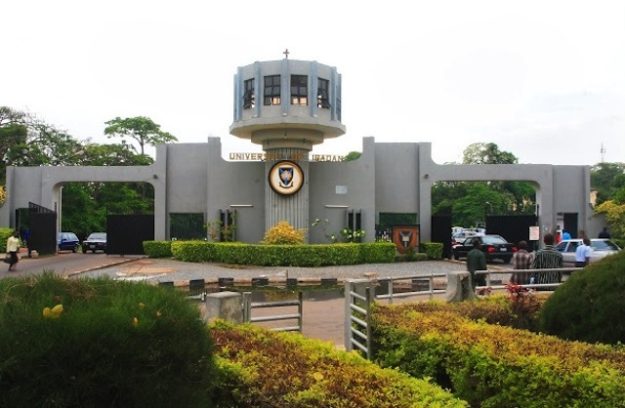
THERE is a growing disquiet among students of the University of Ibadan over a number of fees they pay for items that were not provided, The ICIR can report.

The concerns raised by the students stem from the items that have always appeared on the breakdown of their school fees but have not always been provided by the university authorities.

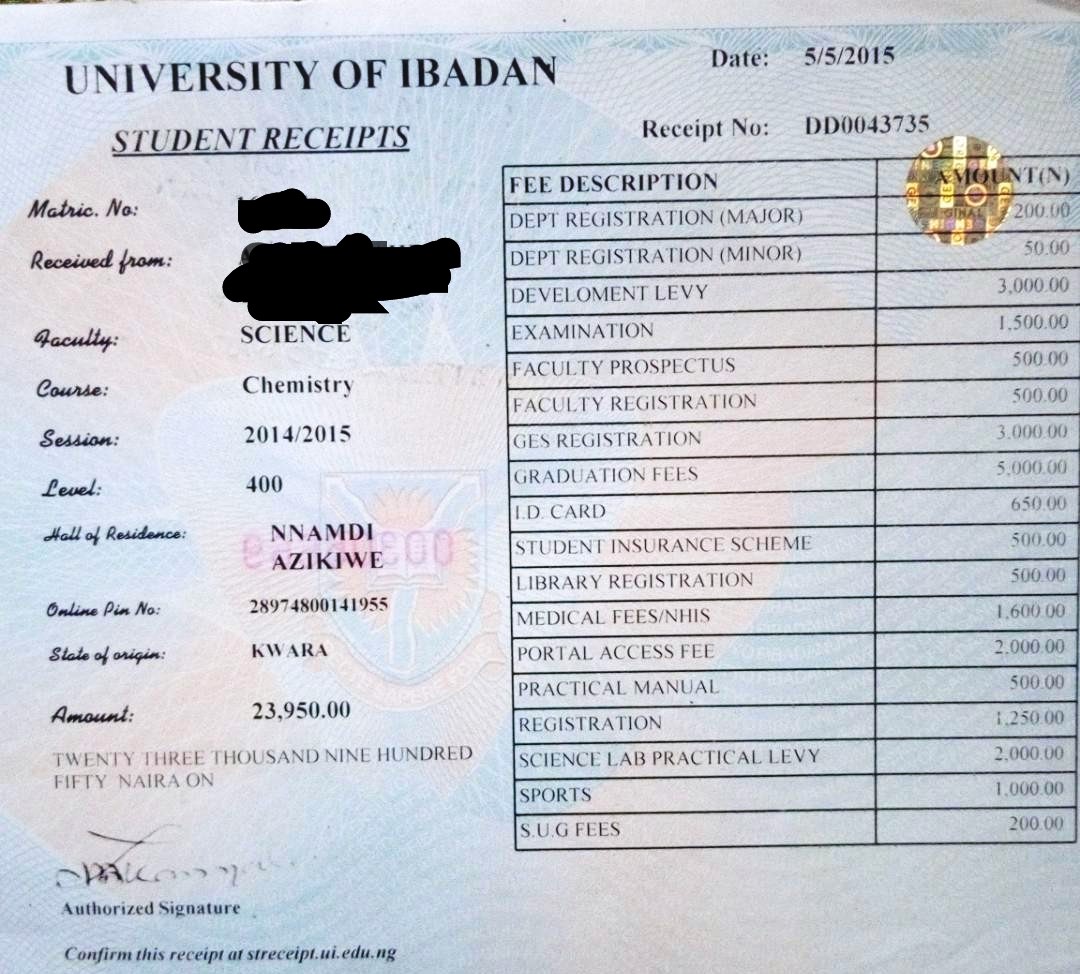
The students who spoke anonymously for fear of being persecuted said undergraduates are made to pay  Student Union Government fee, despite that the Union has been proscribed by the university since  2017.

Although they said the school’s Vice-Chancellor, Abel Idowu Olayinka, directed that the money should be refunded, the students told our correspondent they didn’t get a refund.  And the following session, students were still compelled to pay SUG fee.

Another item students of the University Ibadan pay for is Faculty Prospectus, charged at ₦500. Graduates of the University confirmed they yearly pay for the booklet but not every student obtained a copy throughout their years in the college. Some students only got the prospectus only once or twice throughout their years.

Hassan Sanni, a former faculty president while an undergraduate, said he didn’t get the prospectus in his years at the university.

But he said, in a private chat with his faculty’s Dean last session, there was a plan to have an updated prospectus, which will contain a new syllabus for the faculty and would be distributed to students.

A sample of receipt to students of the University of Ibadan showing items they paid for but never given.
Photo Credit: Yusuf AKINPELU

“It was not ready till I graduated,” he said. “Because they collected money for it, they [the university managemet] should have provided it before students graduate.”

Tomisin Odunmbaku, a 2016 graduate of Statistics, when asked if he ever got a copy of the prospectus, said, ‘“Not even once”.

“We were not even given the student ID cards in our final year.”

Students every session are charged  ₦1, 350 for an identity card, but the university does not provide one until last year after the 2017 student protest. Nobody accounted for the I.D card levies collected in the years past.

Another receipt from 2015 academic session showing those items, Photo Credit: Yusuf AKINPELU

A 300-level engineering student told The ICIR that the students were compelled to pay for I.D again in the 2018-2019 session, despite the fact there was no new identity card given to them.

He also criticised the management for collecting ₦1, 000 for Chemistry Practical Manual every session, whereas the manual was only given once when they were freshers.

His colleagues also confirmed that the less than 10-page manual was only given to students in their first year, though they are paid to pay for it every session.

More Concerns

At the start of the 2018-2019 session, the University introduced  a new fee called Technology Fee, pegged at ₦6, 500. And the notification of the increase was so short that students complained bitterly.

“The notification for the imposition of the fee was quite short. A lot of students, including me, did not know about the technology fee until we resumed for this new session. In fact, I had to call home to send me additional money so as to pay my technology fee,” a student told The ICIR.

When the campus press, AFAS Press, asked the Vice-Chancellor the rationale for the increase, the VC said, it was to “provide fast, reliable and robust internet services to students.”

This is how he responded to the question of the student journalists:

“The University is opening up internet access to students on campus (to a capped volume per student per semester/session). As such there is an on-going investment on additional network infrastructure/ bandwidth.

“The bandwidth is projected to be increased in the first instance from the present 475 to 775 Mbps. It is worth mentioning that the bandwidth increase will be dedicated to the new student network.

“The bandwidth cost will grow from N64 million to about N100 million. This is excluding other required network infrastructural upgrades. I do hope this clarification helps in providing justification for the Technology Fee.”

But it’s two months into the academic calendar, the students said they are yet to see any improvement in the school’s internet service system.

“We are yet to hear of anything about it (technology fee),” Ojedele, a student  said, adding, “Except we’d be given our Wi-Fi passwords tomorrow.”

He wondered how the leadership of the university can be trusted in the future when they fail to keep a simple promise.

Other students are uncertain of what purpose the technology fee will serve. Is it for internet services, as claimed in some quarters, or for portal maintenance, as others claimed?

“They said it is for portal maintenance. What are they maintaining?” a sophomore from the Faculty of Education queried.

“With the ₦6, 500, we should have access to the internet whenever we want to use it. We paid ₦6, 500, yet we can’t even access anything.  It’s extortion. They are just extorting us,” she lamented.

Due to the difficulty in accessing the internet, some tech-savvy students have resorted to using passwords assigned to staff.

According to The Higher Education (THE) World University Ranking, University of Ibadan has a full-time student population of 25, 416. It also said undergraduate and postgraduate students are in the ratio 50:50. It, therefore, means that the undergraduate population estimate of the university stands at 12, 708 students. When the number of the undergraduates is multiplied with the technology fee of N6,500, it amounts to ₦82, 602, 000 per session.

No one is extorting anyone —University’s reaction

Speaking on the school’s plan on the utilisation of the technology fee, Tunji Oladejo, the university’s spokesperson, says “no one is extorting anyone.” He rather insisted that the ivory tower is underfunded.

But he declined to make further comment. “I am always misrepresented by the press. So, I may not pick your call anymore,” he said and hung up later. Also, messages sent to the Vice-Chancellor were not responded to.

Problem of poor funding
Public record shows that all federal universities in Nigeria are underfunded.  In recent years, allocation to the education sector has ranged from five to seven percent of total budget. The 2019 figure stands at 7.05 percent of the total budget.

According to the Office of the Accountant General of the Federation, from 2011 to 2018, a combined total of ₦101,694,545,436 was accrued to the University of Ibadan. Of this amount, ₦2,025,051,401 (less than 2 percent) was released to the university. And the university spent only ₦769,485,563  out of the amount released (38 percent).

Muhammad Abba, a Gombe-based educationalist said institutions must work out ways with some bodies through grants and others to attract adequate funding. He said institutions must be innovative in seeking more funding. “Universities are primarily research-based institutions meant at solving problems,” Abba said.

On her part,  Victoria Ibiwoye, the Director of OneAfricanChild Foundation for Creative Learning, also noted that institutions must use creative means to drive the education system forward. She, nonetheless, placed the major responsibility on the government.

“Government are duty bearers as far as funding education is concerned, but they can’t do it alone,” Ibiwoye said. “So, they need to create a friendly environment for partnerships with stakeholders like CSOs, local and international NGOs working in the education space. Even when the resources are available to these CSOs, if the environment is not conducive, they will be forced to take the aid elsewhere.”

Prepare for floods, FEMA warns Kubwa, Kuje residents

THE FCT Emergency Management Agency has advised the residents of Kubwa, Gwagwa-Karimo, Kuje, Airport Road and Gwagwalada to be wary of possible flooding.

The Director-General of FEMA, Alhaji Abbas Idriss, in a statement made available through their official Facebook page @fctemergencymanagement  said that torrential rainfall had increased the water level at the Usuma Dam and spilled into the Usuma River Channel.

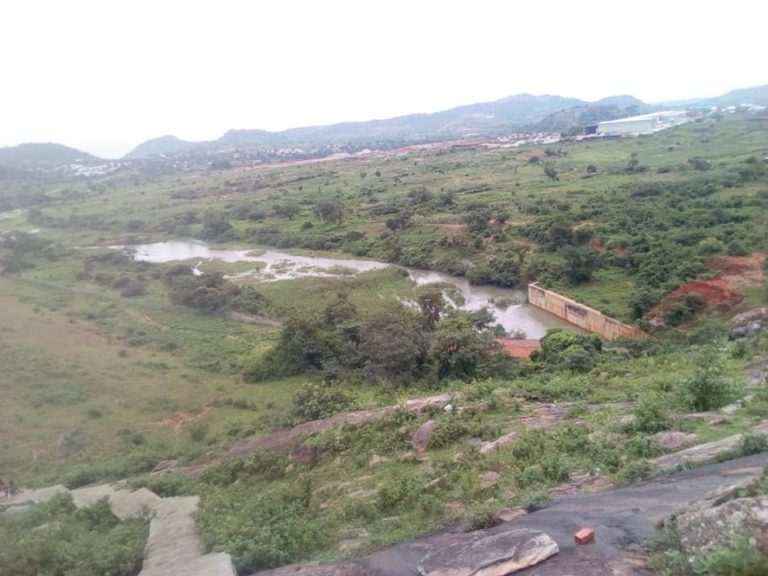
“This is to notify the general public that due to the recent torrential rainfall there has been an increase in the water level of the Lower Usuma Dam making the Dam to spill into the Usuma River Channel. People leaving along the Usuma Dam channel will experience an increase in the volume of water along the River Channels.
Areas mostly to be affected are; Kubwa, Gwagwa-Karimo, Kuje, Airport Road and Gwagwalada,” the statement read.

Based on the above, Idriss advised residents of the above settlements to be wary of possible flooding and  should also observe the following simple precautions:

“They should observe simple precautions because not all floods are alike. Some develop slowly, sometimes over a period of days. But flash floods can develop quickly, sometimes in just a minute and without any visible signs of rain.”

He, therefore, enjoined communities to listen to the radio or television for information concerning the flood situation.

“Always be aware that there could be possible flooding. If there is any possibility of that in your area, move immediately to higher ground. Do not wait for instructions to move.”

He also urged the residents of Kubwa and Kuje to be aware of streams, drainage channels, and other areas prone to sudden flood.

Idriss said that flash floods could occur in those areas with or without such typical warnings.

The director-general also cautioned residents against walking through moving water, adding that six inches of moving water could make people fall.

“Do not drive into flooded areas. If floodwaters rise around your car, abandon the car and move to higher ground if you can do so safely.

“If you do not do that, you and the vehicle can be quickly swept away. After your escape, look for a safe environment, call FEMA RESCUE TEAM on 112 Toll-Free Emergency Number for prompt
response,” the statement said.

It will be recalled that Nigeria Hydrological Services Agency (NIHSA) a few days ago alerted Nigerians of more flooding, appealing the 36 states to prepare for the upcoming flooding as the Rivers Benue and Niger keeps rising.

Similarly, a story by The ICIR in May confirmed that most drainages in Abuja were clogged with a mass of wastes, causing water to find unplanned paths to pass.

“Once you block the natural path where water can pass, what it would result to is flooding,” said John Harry, National Secretary of the Nigerian Environmental Society.


EFCC: Ambode dissociates self from alleged N9.9bn fraud

FORMER Governor of Lagos State, Akinwunmi Ambode, on Friday refuted claims that his account was frozen by the Economic and Financial Crimes Commission (EFCC).

Ambode, in a statement, through his media aide Habib Aruna, disclosed that the said accounts reportedly frozen by the federal high court belonged to the Lagos state government and was not associated with him.

“Those accounts were opened in the course of normal operations by the Lagos State Government for its administrative purposes and not for the former governor’s personal transactions as was being wrongly insinuated and have been operated to ensure smooth operations of government activities by previous and present administrations,” the statement said.

On Tuesday, the federal high court, sitting in Ikoyi, Lagos had ordered the freezing of the sum of N9.9bn belonging to the Lagos State Government.

Justice Chuka Obiozor, the presiding judge gave the order, to freeze the accounts following an ex-parte application filed by the Economic and Financial Crimes Commission, EFCC.

However, the statement reads, “The former governor was not and will never be involved in any unauthorized use of government property and resources”.

He said he won’t confront the EFCC because there was no communication between him and the antigraft agency.  However, he emphasized that his family and loved ones did not deserve the “unwarranted attacks on his well-earned reputation”.

The EFCC had traced N9,927,714,443.29 from the state accounts into an FCMB bank account opened on September 17, 2018, during the administration of the immediate past governor of the state, Akinwunmi Ambode, and operated by Adewale Adesanya.

Adesanya is the Permanent Secretary in the Office of the Chief of Staff to the former governor, Ambode.

The antigraft agency disclosed that Adesanya and other signatories to the account made a fraudulent transfer from the accounts of the Lagos State Government and dispersed the funds kept in the said accounts.

INEC sacks Cross River REC for declaring governorship ambition at office premises

THE Independent National Electoral Commission (INEC) has sacked its Resident Electoral Commissioner (REC) of Cross River State, Frankland Briyai, on the ground of breaching the code of conduct while declaring his political ambition.

Briyai who was the electoral commission boss at Cross River State had declared on Thursday, August 8, his ambition to contest in the upcoming Bayelsa state governorship election, prior to the announcement of his resignation. The gubernatorial poll would be conducted by INEC on November 16.

While at the commission’s office in Calabar, he declared that he would contest the election under the platform of the All Progressives Congress (APC).

After Briyai made his position known to journalists at his office on Thursday, he announced his resignation from INEC job.

However,  a statement signed by Festus Okoye chairman of information and voter education committee for INEC claimed that the Commission was yet to receive Briyai’s resignation letter.

“Although this was done at the commission’s Cross River State office in Calabar, the commission is yet to receive any communication on this from Briyai.

“Section 306(2) of the constitution of the Federal Republic of Nigeria states that the resignation of such appointment takes effect on receipt of the letter of resignation by the appointing authority – in this case, the President,” the statement read in part.

INEC also frowned at the use of the commission’s premises and facilities for his political pursuit.

It described Briyai act as “unlawful and contrary to the Code of Conduct subscribed to by all INEC officials”.

As a result of not tendering an official letter to relay his resignation, the electoral umpire, thereby, sacked him from his duties, withdrawing all powers delegated to him. It directed the Administrative Secretary of the State office to oversee the office and take over the functions and duties of the REC until further notice.

Sowore, DSS and language of ‘revolution’

By Theophilus ABBAH

AT the centre of Department of State Security (DSS’) arrest of Mr. Omowole Sowore at the weekend over the protest #RevolutionNow is the meaning of the noun ‘Revolution.’ Erudite spokesman of DSS, Peter Afunanya, justified the security agency’s ‘preventive measure’ by not just defining ‘revolution,’ but provided extended meaning of the word to include: “… threats of sabotage, threats of subversion, threat of terrorism and, of course, ethnic agitations, separatist agitations, economic sabotage and others.” On the legacy and social media, there is rancorous debate on two issues: the meaning of the word ‘revolution’ and the propriety of Sowore’s arrest and detention by SSS.

This intervention is meant to provide linguistics insight that could illuminate our understanding of the face-off between the State and the Coalition for Revolution (CORE). There are two dictionary definitions of revolution. One is historical and the other is figurative. The Cambridge Dictionary provides the historical definition as “change in the way a country is governed, usually to a different political system and often using violence or war.” The dictionary accompanied this definition with a typical example, thus “The French Revolution changed France from a monarchy to a republic.

The country seems to be heading towards revolution.” The concept of revolution is tied to the 18th and 19th Century European ideology of ‘propaganda of deed,’ which gave birth to the French Revolution, and later Marxism. It is, therefore, understandable if, to Europeans, revolution is seen as equivalent of terror. In fact, the French Revolution was at a point unashamedly called the Reign of Terror. It is this atmosphere that comes to mind when we agree with the DSS that Sowore and his cohorts were a danger to the Nigerian State.

Looking at the use of the word from a different perspective, it is necessary to invoke the linguistics concept of ‘Felicity Condition.’ The concept is widely discussed in the field of Pragmatics, which deals with the critical study of words, signs and symbols. Felicity Condition simply means, for a statement to be considered as being capable of performing an action, such word or statement must meet certain [contextual] conditions. For instance, if a messenger in an officer threatens to issue a written query to his manager, it is clear that it is an empty threat because he does not have the authority to do so. But if, in reverse, a manager threatens to issue a cleaner a query, we know that threat is genuine; we may begin to plead with the manager to temper justice with mercy because the manager has the authority to query the cleaner.

In line with the above, the natural question is, ‘does Sowore and his cohort have the capacity to violently overthrow Buhari’s government?’ Perhaps, the DSS needs to investigate and provide ample evidence that when CORE threatened #RevolutionNow, they have amassed lethal weapons, militia groups, and other ingredients of insurrection which all combined are capable of displacing Buhari for Aso Rock Presidential Villa. As at now, what the DSS has done successfully is to invoke the Terrorism (Prevention) Act 2013. In this Act, the word that is close to the offence Sowore is accused of is “incitement.” In the Act, “incites” and “incitements” are mentioned six times. The one that may be relevant in this case is found in a section that defines the word “support” for a terrorist act. Subsection 2 (a) talks about: “incitement to commit a terrorist act through the internet, or any electronic means or through the use of printed materials or through the dissemination of terrorist information,” as punishable under the act.  However, to successfully invoke this section of the law, the DSS would have to prove the ‘act of terror’ in #RevolutionNow movement.

For those who line up behind Sowore, there is a linguistic escape route for their use of the word ‘revolution.’ It is in what is called figurative language use, and umbrella concept for allusion, metaphor, symbolism, personification, synecdoche, hyperbole (exaggeration), pun, and even simile. If we say, ‘the cleaner has been fired,’ do we mean the cleaner has been cast into fire? If we say ‘the cleaner sermonized his innocence to the manager,’ does that mean the cleaner had become a bishop? Also, if we say ‘the soup transported me to heaven,’ do we mean the soup has become a carrier which has the capacity of tearing through outer space into heaven?

In its second definition of revolution, the Cambridge Dictionary provides its figurative meaning, as different from its literal meaning. It says, “big change or improvement in the way that something works or looks, or in the way that people do a particular activity:” Among the examples the dictionary writers used to illustrate this figurative use of ‘revolution,’ includes, “This biomedical revolution includes procedures and strategies in therapy, diagnosis, and prevention of diseases.” When the dictionary talks about ‘biomedical revolution,’ it does not mean there was a violent overthrow of the regime in order to diagnose or prevent diseases. Here, revolution is used to describe the remarkable change that biomedical discoveries have brought into the treatment of diseases.

My instinct tells me that Sowore and his elements in CORE used the expression ‘#RevolutionNow’ as a ‘clickbait’ or catch-phrase for the planned protest in order to attract national attention. And this may be an act of indiscretion on their part. However, there is need for a huge paradigm shift in the way this country is governed at the moment. Both online and offline, Nigerians are tramautised by palpable fear as killings in various shades seem to have come to stay. There is evidence that security operatives have come to their wits end. They now leave everything to their natural course, including the killings, expecting a divine intervention to halt the mayhem at some point along the line. Nigerians would be very glad if the DSS can prevent many of the criminal acts tagged on criminal Fulani herders, just the way they have halted #RevolutionNow protest.
Dr. Theophilus ABBAH,  a journalist, writer, researcher, and trainer, lives in Abuja.