THE Coalition for Whistleblowers Protection and Press Freedom condemns the attack and harassment of one of its members, Order Paper, by Hon. Tony Nwulu representing Oshodi/ Isolo Federal constituencies of Lagos state.
The coalition refers to the threats to the staff of OrderPaper and its Publisher, Mr Oke Epia, and considers the Honorable’s actions as a breach of the constitutional rights that allow journalists to do their lawful work.
The Orderpaper crossed paths with Hon. Tony Nwulu after publishing reports on constituency projects nominated in Honorable Nwulu’s name which he was unable to properly account for.
Mr Nwulu was on record threatening Mr Epia and his organisation to “take you down”, a chilling utterance that is a direct violation of the fundamental rights of Journalists to hold government officials accountable.
Journalists are under obligation, by the powers of Section 22 and section 39 of the Nigerian constitution, to hold people in government accountable to their oath of office and their pledge to their electorate.
The Coalition advises Honorable Nwulu to desist from further threats otherwise it would be forced to pursue legal action against him.
Nwulu has denied the allegation.
The coalition comprises of Premium Times, Sahara Reporters, OrderPaper, The Cable, Daily Trust Newspaper, International Centre for Investigative Reporting, Wole Soyinka Centre for Investigative Journalism, Premium Times Centre for Investigative Journalism, African Centre for Media & Information Literacy (AFRICMIL), Civic Media Lab, and Civil Society Network Against Corruption (CSNAC).
Others are the International Centre for Investigative Reporting (ICIR), International Press Centre (IPC), Media Rights Agenda (MRA), Nigeria Union of Journalist (NUJ), Paradigm Initiative, Socio-Economic Rights and Accountability Project (SERAP) and HEDA Resources Centre.
PRESIDENT Muhammadu Buhari on Tuesday said to name anyone as his successor in 2023 would create problems, thus would rather keep it to himself.
He revealed this at the Presidential Villa, Abuja when he played host to members of the Progressives in Academics (Pro-Acad) who paid him a visit.
The group, according to reports, advised the President to start nurturing a youth who would replace him after expiration of his second term in office.
But he explained that such a decision would create problems for him, adding that whoever wants to become president of the nation would need to be industrious and cannot just achieve the aim overnight.
Buhari himself had failed in three attempts to win the presidential election – 2003, 2007 and 2011 – before he eventually emerged in 2015, through a merger with four other political parties to form the All Progressives Congress. He was re-elected into office after the March 2019 presidential election.
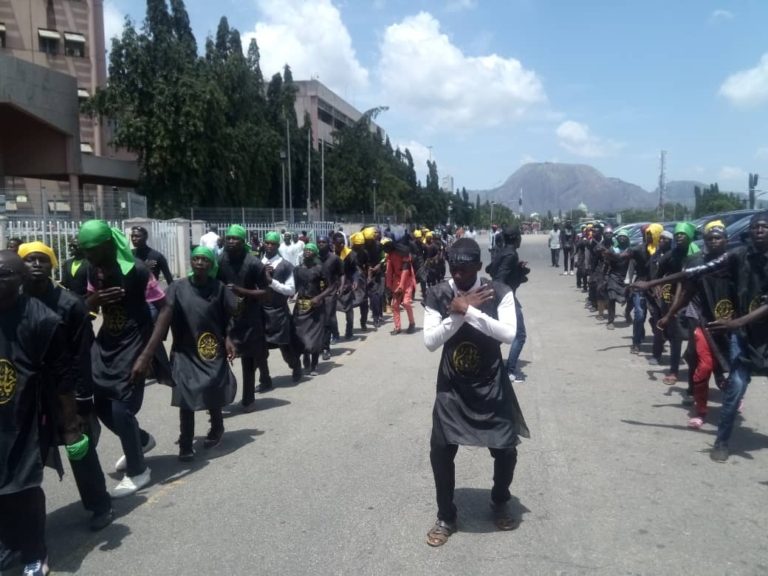
THE Federal government has officially declared the Islamic Movement in Nigeria (IMN) led by Ibrahim El-Zakzaky, a terrorist group in the country and thereby ban its activities.
The Inspector-General of Police, Mohammed Adamu, announced the proscription of the Shi’ite sect at a press conference on Tuesday held at the force headquarters, Abuja.
Adamu said any person who associates with the group would be treated as an enemy of Nigeria.
“Any person engaged or associating, in any manner that could advance the activities of the proscribed Islamic Movement in Nigeria, shall be treated as a terrorist, enemy of the State, and a subversive element and shall be brought to justice within the context of the Terrorism Act.
“The import of this is that all forms of procession or protest by IMN is now illegal and thus banned, he said.”
The recent development came after a protest conducted by the group on July 22 which turned brutal, leading to the death of Usman Umar, Deputy Commissioner of Police and Precious Owolabi, a member of the National Youth Service Corps (NYSC) who was serving with the Channels Television.
The Shiite group has held a continuous protest for the release of their leader, Ibrahim El-zakzaky with his wife, Zeenat who have been in the confinement of the Department of State Security (DSS) since 2015.
On Last Friday, a federal high court in Abuja had also ordered the proscription of the activities and existence of IMN following an ex parte application filed by the federal government through the office of the attorney-general of the federation. The court declared that the activities of the group in any part of the country “amounts to acts of terrorism and illegality”.
A copy of the court order obtained by PUNCH.
Giving the reasons for the banning of IMN on Tuesday, Adamu said the activities of the group had overtime constituted a “grave threat to the national security, law and order, socio-religious harmony, peace, good governance and the sovereign integrity of the Federal Republic of Nigeria”.
The police boss said some of the group activities included the pledging of allegiance to foreign countries. He added that the group was enjoying political, financial and training support from these countries with the “aim of advancing their destabilising intents within Nigeria”.
“Unauthorised blocking of public highways, engagement in illegal roadblocks, imposition of illegal curfews and checkpoints, raids on security assets, prevention of arrest of their members, invasion of court premises to abort legal proceedings involving IMN members, refusal to submit to ordinary security checks and attacks on security agents which led to the death of several Nigerians,” Adamu outlined.
The police said the sect had set-up a para-military guard known as ‘Hurras’. And the force accused that the Hurras has been terrorising the local residents.
“They have also instituted unregistered security outfits and performed paramilitary ceremonies, hoisting of flags, combat exercises, parades and inspection by the IMN leader reminiscent of State authority.
“Let me affirm that in relation to the Islamic Movement in Nigeria, in view of their increasing engagement of terror tactics and other violent and subversive activities which contravene the Terrorism Prevention Act 2013, as amended, and vide the judicial pronouncement of the Federal High Court, Abuja on 26th July, 2019, the federal government has classified them as a terrorist group and has accordingly, proscribed the El-Zakzaky-led Islamic Movement in Nigeria,” said police.
Meanwhile, Adamu made it clear that the Shi’ite sect remained free to practice their faith.
“For the purpose of clarification, Nigeria is a secular state with constitution provisions guaranteeing the freedom to practice our faith. This, however, must be exercised in a manner that will not threaten our national security,” he said.
Adamu clarified that the El-Zakzaky-led Islamic Movement in Nigeria, which “does not recognise or accept the constitution and government of the federation, is the sole organisation that has been classified as a terrorist organisation and proscribed.”
The Committee to Protect Journalists (CPJ) has urged Tanzanian police to disclose the whereabouts of investigative journalist Erick Kabendera, who was on Monday evening whisked away by six unknown people claiming to be police officers, TheEastAfrican has reported.
The six men, who were not in uniform and refused to identify themselves, also confiscated the phone belonging to Kabendera, his wife and neighbours who had recorded or taken pictures of the incident at the journalist’s home in the capital Dar es salaam.
“The manner in which this journalist was taken, by men claiming to be police, is very ominous and further evidence that the press is not safe in President John Magufuli’s Tanzania,” said CPJ Sub-Saharan Africa Representative Muthoki Mumo. “Authorities must immediately disclose if they are holding Erick Kabendera, and for what reason, and ensure the journalist is returned safely to his family.”
In a statement on its website on Monday, CPJ said it is concerned about Kabendera’s safety, especially after reports suggested he was not at Oysterbay Police Station where the unknown people claimed they were taking him to.
When colleagues and a lawyer from the Tanzania Human Rights Defenders Coalition went to the police station to check on the journalist, Kabendera was not there, CPJ said, quoting Watetezi TV, a news outlet associated with the coalition. Watetezi TV reported that police at the station referred the lawyer to the Central Police in Dar es Salaam.
Artisanal and Small-scale Gold Mining (ASGM) is an exploration by individuals or a group of persons with little or no technical skills. This undertaking has become a frequent phenomenon in Nigeria. In Osun State rural communities, residents and over 5,000 artisanal gold miners are ignorant of the death lurking around, as a result of exposure to toxins, and environmental hazards. Olugbenga ADANIKIN writes about the dangers of illegal gold mining, government’s neglect, failed promises and arbitrary land sales for mining.
IT was a wet Monday morning. It had rained heavily overnight in Ifewara village, Atakumosa Local Government Area of Osun. Artisanal gold miners in the ancient town, predominantly northerners set out to various mining sites as early as 7:00 am. Armed with tools such as diggers, shovel, head pan, and used paint-plastic, they, moved in droves to the mines, regardless of the morning drizzle.
Seated opposite the Adimula Ifewara palace, The ICIR observed how commercial motorcyclists convey the miners – three passengers on a bike – to mining locations. From their chit-chat, it was easy to know they are mostly youths from the northern region of Nigeria, some came from as far as the Niger Republic, Mali, and Chad.
Artisanal miners armed with tools set out on Monday morning to the mines in Ifewara community Picture Credit: Olugbenga Adanikin The ICIR
“Gold mining is not for a lazy man,” says Mr Sunday, a hairstylist who owns a barbing shop near Ifewara Motor Park.
“Just behind my house, some young men died while mining the gold. It happened when the ground collapsed on them and before rescuers could come, they were already dead. So, in this whole community, women don’t mine. Indigenes who are into mining are not even up to 10. The labourers are mostly Hausas.”
Sunday said he had been tempted to venture into the gold mining business but reconsidered due to the risk. “The risk is too high,” he said.
The young barber said he makes an average N10, 000 daily, which according to him, was enough to cater for his needs. Yet, he is tempted to join the miners because two of his friends had built a house from the gold business while he still lives in a rented apartment. “Maybe I should have joined them,” he said.
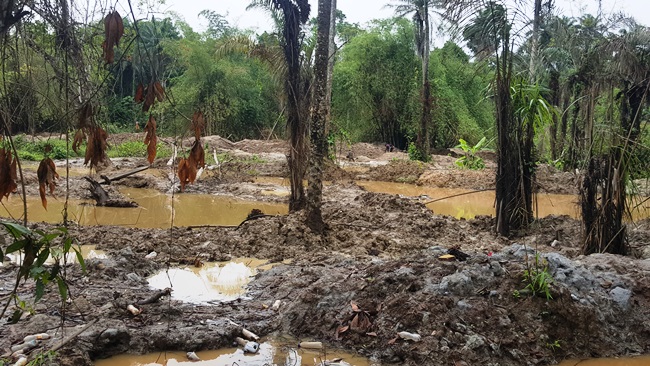
An abandoned mine at Moremo neighbourhood, Ifewara, Osun State shows a destroyed ecosystem Photo Credit: Olugbenga Adanikin
As the conversation was on-going, his friend drove past in a Navy Blue colour 2009 Toyota Camry XLE. Sunday paused, pointing at him, “That is the fellow I was referring to.”
A trip to the mining sites
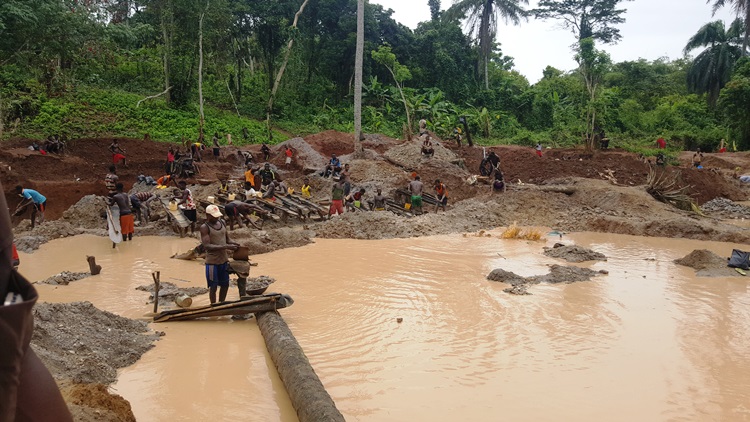
After a general observation of the community, this reporter decided to visit mining sites within Ifewara. The motorcycle taxi meandered through a narrow crooked path that stretches into the middle of thick forest. Within Atakumosa local government area, there are over 500 sites with no license from the government, except for the approval from traditional rulers, said the young man who worked as a fixer for the reporter. Arriving at Odubale gold site, the reporter and his fixer were welcomed by hostile and stern-looking youths who were obviously disturbed by the appearance of a stranger. But for the interruption, the miners were busy scavenging for gold in deep brown shallow water.
The destruction of the ecosystem and loss of biodiversity and national forest going on are unbelievable. But it appeared no one cared.
“Wetin…Wetin happen?” the miners aggressively queried the reporter in pidgin English. They became apprehensive upon sighting the reporter but the fixer quickly intervened.
Scores of artisanal miners at Odubale gold mining site, about 2. kilometres away into the thick forest of Ifewara, Osun State. Photo Credit: Olugbenga Adanikin, The ICIR
The ICIR observed as the miners, in their hundreds, kept digging, and manually sorting the excavated soil with the hope of getting gold particle. Sadly, most times, what someone realised is a small particle of gold due to crude methods of mining and processing. The small quantity is later sold at N11,000 per gram.
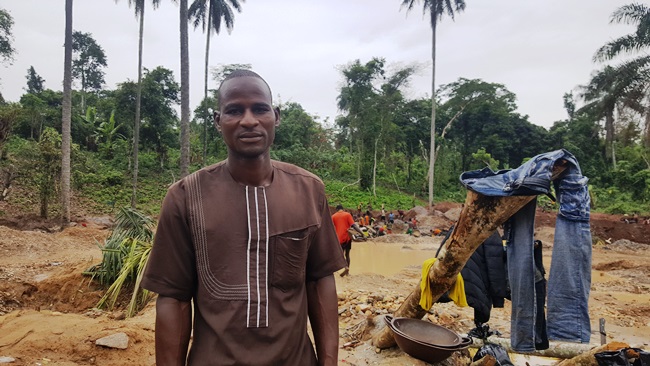
In Ifewara, there are over 3,500 artisanal gold miners. “We are many, even more than 3,500,” says Abdul-Rasheed Usman, Seriki of Ifewara Hausa Community. He had spent 18 years in the village and was installed as chief to govern the Hausas. “We cannot do this gold business without government. We don’t even know how to reach out to the government because we work with Igbo here, Hausa, Yoruba and Fulani.” He spoke through Yusuf Attahiru, the Youth Leader who doubles as Secretary to the Hausa community.
Gold being measured at Ibodi mining site Photo Credit: Olugbenga Adanikin, The ICIR
Isah Mohammed, 32, from Zamfara State measures Gold in Grams at Ibodi site, Osun State.
Photo Credit: Olugbenga Adanikin, The ICIR
Seriki of Hausa Community in Ifewara Community. Photo Credit: Olugbenga Adanikin, The ICIR
Makeshift shop where miners take soft drinks while relaxing Photo Credit: Olugbenga Adanikin, The ICIR
Little quantity of gold mined by the local labourers at Sabo, Ibodi, Osun State
Photo Credit: Olugbenga Adanikin, The ICIR
Unidentified miner at Ifewara site Photo Credit: Olugbenga Adanikin, The ICIR
In Ibodi community, another mining settlement, Seriki Sani Saidu puts the figure of miners at over 1,000. The population would have been more, but for the rainy season. Some of the workers left the mining job temporarily to farm in the North while others suspended the job due to the Muslim fasting. The ICIR finds out that most miners work without basic protective gears such as safety guards, footwear, nose-guard except a few who had headlamps.
Those with headlamps could work at nights and could dig as far as 100 metres radius underground, manually with no fear of getting trapped under the bowel of the earth.
“We have dug underground to that side and that side but we no die. God decides my fate, one can die anywhere,” says one of the miners, Kabiru Awal, with a smile.
Video of Kabiru Awal, a gold miner who had visited 3 cities in search of better living before resolving to mining
Having lived in Lagos, Port Harcourt and Ibadan with no economic breakthrough, Awal, a native of Kebbbi State resorted to mining. For seven years, he has been a gold miner. Within that period, he only made N1.5 million. That is an average of N200, 000 annually. “If I could get money today, I’ll leave the job,” he says.
All the miners that spoke to The ICIR said they need support from the government but denied ever getting help. “We cannot survive without help from the government. We don’t even know whether the government will help with small money and payback on installments,” says Rabiu Mohammed, a father of four children and two wives – Fatimah and Yeserah Rabiu.
He left Daura, Katsina State in 2016 for Osun. He had relocated when he heard of the job opportunity in the mining town. Scores of others also moved to Osun following the ban in Zamfara state. Venturing into the mining business was better than engaging in criminal activities, he said. “Anyone you see here has a good mind. You know you have come to suffer so you can make good money”.
Rabiu Mohammed, a father of four left Daura, Katsina State in 2016 for Osun to work as an artisanal gold miner. Photo Credit: Olugbenga Adanikin, The ICIR
He had earlier pleaded with the miners to allow The ICIR conduct interviews and take pictures. Rabiu further took time to take the reporter round the mine, lamenting the neglect by governments. He subsequently introduced younger workers, Bashiru Lawal (18), Sabe Musa (20) and Anas Adamu (25) all from Safana local government, Katsina State.
However, The ICIR gathered that since the Federal Government banned mining activities in Zamfara State, the artisanal miners have been moving in droves to Osun. In order to better manage the situation, traditional rulers of each gold mining community had to install ‘Seriki’ among the Hausa residents. Through this system, the local traditional rulers relate with the Serikis who then helps check miners’ excesses with the hope of also ensuring safety in the communities.
Job creation at great risks
Most youths take to artisanal mining because they are poor and the majority of these young ones could be found in Zamfara, Kebbi, Katsina, Kwara, Borno, Kaduna, Niger, Jigawa, Yobe, Osun states including the Federal Capital Territory (FCT). Though mining is a great employer of labour, the job comes at a cost.
Young miners – Bashiru Lawal (18), Sabe Musa (20) and Anas Adamu (25) at the gold site Photo Credit: Olugbenga Adanikin The ICIR
“Artisanal mining is poverty-driven, majority of them just want to eke a living, so it creates lots of jobs” Ojeka Patrick, Director MMSD told The ICIR.
Mr Olusegun Oladipo, ex-President, Nigerian Society of Mining Engineers, believes that it provides over a million jobs for Nigerians, a figure the Federal Ministry of Mines and Steel Development (MMSD) later put at 500, 000. However, across the states, the World Health Organisation (WHO) puts the number of miners at risk of mercury poisoning – a deadly chemical at 850, 690.
Health, environmental implications of artisanal gold mining
Studies show that artisanal gold mining is capable of destroying the ecosystem and worst still, causes terminal diseases such as cancer, respiratory failure and untimely death of workers and residents around the mining communities.
A study by the Artisanal Gold Council (AGC) conducted in partnership with Global Environment Facility (GEF) in 2014 highlights some of the above dangers. It states that as long as workers engage in crude methods of gold mining and processing, especially those who solely rely on mercury for processing, they are easily exposed to acute respiratory failure.
Behind the young miner is an underground dug by the workers, Atakunmosa West LGA, Osun State Photo Credit: Olugbenga Adanikin The ICIR
Specifically, “exposure to mercury poses a great danger to human health including toxic effects on the nervous, digestive and immune systems, including sensitive organs such as the lungs, kidneys, skin and eyes and may pose serious health threats to unborn babies and children under the age of five,” recent WHO report says.
Last year, the federal government committed to developing a National Action Plan to reduce the use of mercury for ASGM. At the event, which had attendance Mr Jean Bankole, the UNIDO Country Director, Dr. Abdukadir Muazu, Permanent Secretary, MMSD, all acknowledged how mercury poisons thousands of miners in the country. But, over a year after the federal government endorsed the Minamata Convention to check the persistent use of mercury for gold activities, nothing significant has been achieved while implementation is very slow.
In 2016, a WHO working document developed as a guide for healthcare officials working in artisanal gold mining areas further links the severe human health and environmental impacts of ASGM to the Minamata Convention. It affirmed that the lives of small scale gold-miners are threatened by terminal diseases.
Dr Julius Adeduntan, a medical expert at the Osun State University Teaching Hospital in an interview with The ICIR in Osogbo listed silicosis and chronic cough as major ailments vulnerable to the miners due to excess exposure to toxic fumes, dust and other elements inhaled on site.
“In a short time, it may not be obvious, but over a long time, it could cause occupational lung diseases, such that they begin to have dust deposits in their lungs. Then, they start having chronic coughs that don’t respond to conventional treatments, some could have issues with their lungs…,” says Adeduntan.
Department of Geology, Obafemi Awolowo University (OAU), Osun State Photo Credit: Olugbenga Adanikin The ICIR
Dr Olorunfemi Akintunde, a Geologist who teaches at the Department of Geology, Obafemi Awolowo University, Ife, told The ICIR that lives of the residents especially the miners are being destroyed in bits. He said based on findings on the goldfield in Osun State, ASGM poses serious environmental and medical problems if wrongly explored.
“Aside from the gold, there are other elements that are polluting the soil and even the water. They are zinc, arsenic, silver, and lead so there is no way you will recover gold without these elements,” says Akintunde.
“These will create environmental problems for farming because they will mix with the soil and some will find their way into the groundwater system. So, when you ingest all these elements, lives are being destroyed in installments. It’s a major problem.”
Dr Adetunji Ademuyiwa, also from the department in OAU, expressed worry on the destruction of the ecosystem such as cocoa farms that have existed for decades. “Of course, the locals are making what they called money but at a very great expense.”
This investigation was done with the support of International Centre for Investigative Reporting (ICIR) and Ford Foundation.
Some months before the 2019 general elections, a number of governors in South East Nigeria indicted the federal government of negligence in implementation of capital projects. Promptly reacting, the Federal Government reeled out a 69-road and bridges projects’ list purportedly ongoing and at different stages of completion billed at over N100 billion purportedly drawn from Sukuk Bond and Presidential Infrastructure Development Fund under budgetary allocations.
Similar to an earlier fact finding mission by Ripples Nigeria, to verify the claims, PATRICK EGWU picked and visited 12 of the listed projects to ascertain the level of government’s commitment, and the level of completion of the projects.
Nkporo-Abriba-Ohafia Road project —Abandoned by Contractor
IT was about 12:46pm, midday Monday, February 4 on a sweltering afternoon when this reporter arrived the take-off point of the Nkporo-Abriba-Ohafia road project. The ride through a rough patchy stretch of road with a taxi was far from being adventurous.
As the reporter looked at the faces of a few residents walking by, their facial expression of disappointments said it all.
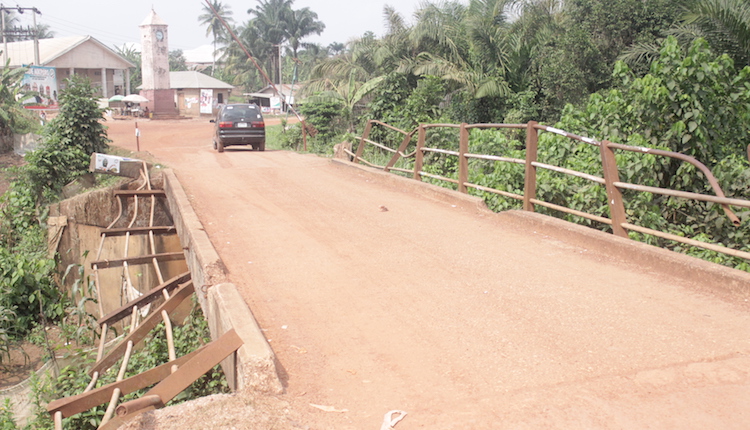
Continuing the trip via the only bridge in Nkporo linking the community with other communities and nearby states like Enugu, Ebonyi and Cross River, one is faced with an almost impassable motorway depicting a collapse waiting to happen.
Sadly, residents of this community have to make their way across this death trap each day of their lives.
Even students, who use the bridge every day to-and-from their schools, say the risk falling off the bridge because the handrails easily fall off at a light touch. In fact, motorists, who convey commuters and goods, lament attendant loss of lives in addition to damages incurred while navigating the bad roads with untold difficulty.
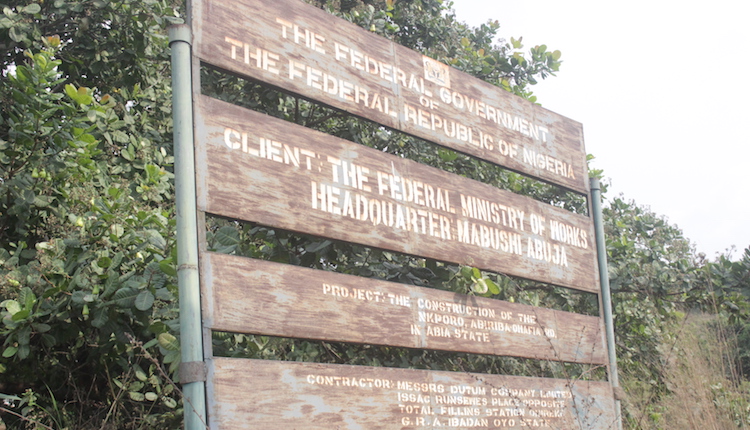
And to say this road project with contract No: 6130, had been awarded to Dutum Construction Nigeria Limited since May 30, 2012 at the huge cost of N2,739,105,600.20 billion, raises a lot of questions. Its construction was to be completed, sealed and commissioned for commuters’ use in two years; that was by 2014.
Seven years later, however, the road and bridge projects linger unfinished. Shockingly, contractors handling the projects were nowhere to be seen. When Ripples Nigeria visited the project sites, commuters and nearby residents bemoaned the sad reality that construction workers had since left the projects site and yet to return. Residents further expressed doubts if the contractors will ever return, given the way things are done in Nigeria as they shook their heads, waving their hands with resigned regrets.
A bridge in the community has almost failed with bent hand rails as cars slowly navigate to avoid falling off. Photo by Patrick Egwu.JPG
Taking the reporter further into the projects site, a tour guide disclosed that the residents are not happy because, not only did the contractors abandon the projects; the bit they did was also shoddy and substandard.
On a bit-by-bit verification of the projects, it was clearly seen, despite the FG’s claim of ongoing works, that only a small portion of them were constructed and completed. It was also observed that these were works done years back, not in the recent times, as proved by the residents.
Till the time of visit in February 2019, the Okwoko part of the road leading to the bridge and only local market in the community, where diverse traders engage in sundry transactions, remained largely untouched, let alone done. In the milieu, this reporter witnessed first-hand, the strain motorists and cyclists wade through in their bid to navigate the bumpy road.
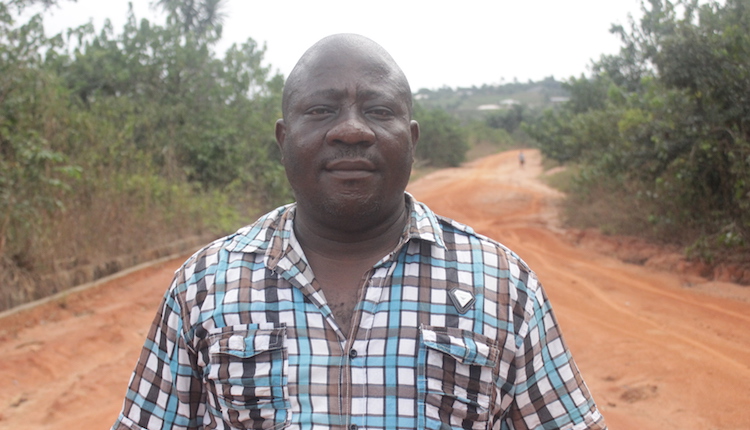
Speaking on their plights fueled by abandoned projects, a community resident, Kalu Akuma, said: “The road has made it difficult for our people to access other communities because equipment brought for the job by the contractors are fairly-used. Most times, they are not even working. Till present, compensations are yet to be paid to those whose houses, built along the road path, were demolished. It is for this and other reasons that we want the FG to hasten up and finish the road projects because that is very important to us.”
Kalu, a resident of the community said the contractors handling the project abandoned the site for a long time until recently. Photo by Patrick Egwu.
Also sighted by the road side are two stationed tractors nearly rickety, surrounded by grasses. Expressing his disappointment at the slow pace of works, Hon Amb. Arunsi Nwankwo Uka, the traditional ruler, said it was quite unexpected. His words: “What the FG told us at the inception was that the timeline of the project was two years. But up till now, not much has been done.”
A shop owner along Okwoko road, added: “we wrote a petition to the federal ministry of works. They told us that the money released to them has not been fully utilized. So, I am highly disappointed with what we are seeing. They are supposed to complete this road to a certain level based on the money released to them. But if you go to that bridge, you will see how motorists struggle to pass through. It’s really a big challenge for us.”
Umuahia-Bende-Ohafia Road —Rehabilitation ongoing
IN 2018, when Prosper Kalu sighted tractors’ movements in front of his residence, he dismissed it as the usual elections and votes-hungry politicians’ gimmick. Little did he know then that they were tractors to be used for the rehabilitation of the Umuahia-Bende-Ohafia road.
Kalu noted that prior to the rehabilitation, the road was impassable. He added that if anyone visited during a rainy season, it was always very impossible to get any means of transportation as commercial transporters would decline plying the route. That’s to stress how bad the road was.
Listed as the oldest project under investigation, the Umuahia-Bende-Ohafia Road was awarded on October 3, 2005 to Niger Construction Limited at N2, 093,033,385.88 billion. With contract No 5821, its rehabilitation had been previously stalled for about 15 years.
Residents noted that it was the recent intervention in fixing bad spots with asphalt along most parts of the road linking it to Umuahia and Bende that gave some signs of rehabilitation. Yet, motorists and tricycles were seen as they struggle to dodge patched spots on the roads.
On a drive from the state capital in Umuahia to Bende and Ohafia, pockets of craters and pot-holes remain, causing a nightmarish ride for road users. Stuck on a lonely patched road leading to Umuahia was a motorcyclist. He had a heavy load on his back seat, but looking at the bad road ahead, he disembarked and began to manually maneuver the motorbike to get to the other end of the terrible portion.
Whilst a large portion of this road had been rehabilitated, some parts are yet to be attended to. Responding to an email enquiry sent to Niger Construction Limited, the Managing Director, Engr Elie Chedid, asked this reporter to provide his phone number so he could call. Minutes later, he called and said that the project in question was completed years back.
He, however, said he has directed the Area Manager of the company to search for the project’s contract and make it available. About an hour later, he sent an email that they have lost the documents of the contract.
“The project you are asking for is as old as 2005 (14 years old), so I am afraid to inform you that we have lost most of the documents related to the project. Moreover, the whole management team has been completely changed since that time, thus even story-telling may not be available,” part of the email read.
Works ongoing at the Bende-Arochukwu-Ohafia Road. Photo by Patrick Egwu
Arochukwu-Ohafia Road —Works ongoing at Bende
Sounds of heavy duty tractors bellowed as the ground shook at the level hilly grounds opposite the Army Barracks in Ohafia. Trucks toot their horns as danger’ signals as they drop off the contents on the project site.
With a section of the road barricaded, on-coming vehicles are prevented from obstructing the construction works. This was complemented with the regular “Slow down, men at work” sign-posts.
To show they meant serious business, workers, with their crested vests, were seen working on a construction yard few meters away from the project site. Also seen were some heavy duty tractors conveying granite and asphalt to the field at intervals.
A few other field workers not yet too busy surrounded a nearby make-shift kiosk where a middle-aged woman sold food and drinks to them.
Efforts to speak with the contractor-in-charge of the site was stalled as he was said not to be at the construction yard. However, a senior staff of the engineering company, Bilal Ahmed, head, mechanical section, gave assurances that the project will be completed before 2021, which is the agreed date for completion.
“The work is moving efficiently and we are going to end the work in Arochukwu which we normally call kilometer 00. As you can see, a lot of machines are on ground to make sure the work will be faster. Initially, we said the project will take up to four years to be completed. But from my personal observation, it cannot get to that point before we complete it,” Ahmed said.
He however, claimed not be competent to speak on the monies allocated or spent on the project.
At the Bende-Arochukwu-Ohafia Road, major construction works could be seen going on at the project sites. Water ways and drainages were being constructed at both ends of the road to allow for easy flow of water during the rainy season or in cases of flooding.
A jointly awarded rehabilitation project in July 2018 to Hartland Nigeria Limited. Whilst N5,490,680,078.33 was budgeted for the Bende-Arochukwu-Ohafia Road, the sum of N199,475,325.00 was allotted for the Bende-Arochukwu-Ohafia Road Phase II. A section of Ohafia towards the beginning of the road leading to Arochukwu has been constructed. But works remain ongoing at another section of the road.
A regular road user, Sunday Ogah, noted: “We are happy with the ongoing works. Before it’s a nightmare passing through here because of the bumps, but things are different now. The rehabilitation work is such a big relief for us.”
Motorists struggle to pass through the damaged section of the road. Photo by Patrick Egwu
Attempts to speak with the contractor handling the project on the status of the contract and monies released were not successful. The administrative manager at the construction yard who identified himself as Muritala, told this reporter to write to the ministry of works for approval. Knowing that this would take a longer process due to the bureaucratic bottlenecks, this reporter sought another way of getting a hold of the contractor. Using his contact at the yard, the phone number of the project manager, Hishan Yass, who doubles as the contractor, was obtained. During a telephone conversation, Mr Yass told this reporter to also write to the ministry to get approval before he can release the contract details and other such information.
“We are not hiding anything. There is nothing to hide; but you have to either speak with our public relations officer or write to the ministry of works through the controller before I can give you any information,” Yass said at the other end of the telephone. When asked how much the company has received so far, he said “I’m sorry I can’t tell you anything.”
Works stopped at the Umuahia-Ariam-Ikot Ekpene Road
AT the failed section of the Umuahia-Ariam-Ikot Ekpene Road, motorists and cyclists hoot their horns as they jostle to drive past. Commuters inside one of the buses were audibly heard mumbling with impatience at motorists on the other end as they all bellowed on one another to clear the obstruction so they could navigate out of the commotion.
No works were seen going on during the reporter’s visit to the site. By the road side, a heap of granite and sharp sand could be seen as motorists plying the road try to dodge it. Also, pot-holes and bumps spread across the road prevent easy and safe navigations of vehicles.
But whilst majority of the road remain in a very bad shape and in need of very urgent intervention, the section leading to the Federal University of Agriculture, Umudike, remains passable for road users. Stones and gravels were also sighted used to fill up the bad spots, with pot-holes further compounding shuttling through the roads for motorists.
An elderly man who lives along the road, Pa Michael Udoka, lamented his agony to the reporter. He retorted: “I don’t care whether it is PDP or APC, all I want them to do is to come and fix this road. Every four years during elections, they will come and make promises to us and give us money to vote for them. But after the election, that is the end of the story. We continue facing our challenges by ourselves.”
While taking pictures and videos of the bad spots of the road which were filled up with stones, a commuter who was in a moving bus, sneaked through the window and shouted: “Please snap all the pictures and do the video recordings. Perhaps, that will compel them to come and fix our road for us.” About the same time, another commuter in the bus added: “I hope this is still not for campaigns?”
Other residents also informed the reporter that for the emergency repairs of the Umuahia-Ariam-Ikot Ekpene road failed sections, in February 2018, an amount of N156,469,825.05 was awarded to Desak Construction Company Nigeria Limited. Sadly, till date, nothing has been done on the road despite the fact that it connects to neighbouring states like Cross River for example.
Efforts to speak with the contractors or other officials of the company were unsuccessful as they had moved from the construction site. Information on their website did not give details on how they can be reached. A Corporate Affairs Commission (CAC) registration search on the company reveals that it was incorporated on December 21, 2012 with the purpose to “carry on business of construction works and maintenance, plumbing works both conduit and surface plumbing materials, suppliers, electrical installations among others.”
Partly done, Ahiaukwu-Amangwo-Umuahia Road still needs rehabilitation
Nine years ago, in December 2010, the road project for Ahiaukwu-Amangwo in Umuahia-Ngwa, was awarded to La Ann Engineering Nigeria Limited at the sum of N589,544, 3017.65. Then, it was meant to be completed in one year. Today, it still lingers.
The project remains partly done with only a few of the sections partly motorable while a larger part remains untouched.
At the time of the reporter’s visit, no signpost was seen to hint on its details, neither was there any indication of ongoing works, nor signals that constructions may likely start anytime soon.
A shop operator close to the failed section of the road, John Chike, bemoaned to the reporter that: “It is only in that area of the road project that one witnesses such a situation. If you move up a bit, you’ll see that it is fair enough. So, I really don’t know why they don’t want to come and finish the work.”
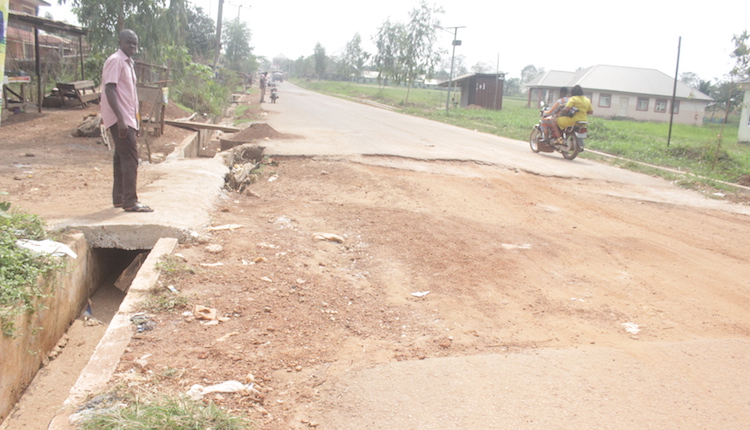
A man stands at an uncompleted section of the road. Photo by Patrick Egwu
As the reporter vividly experienced, while the road from Ahiaukwu is travelable, the Umuahia section remains in a very bad shape, begging for urgent repairs and intervention, as most parts of the road are pot-holed and washed up.
Along the busy impassable section of the road, road users especially tricycles and vehicles find it difficult to pass through the bumpy spots.
A CAC search on the company shows that it was incorporated on May 10, 2002 with the purpose of “carrying out business as traders and builders and contractors for construction works of any kind.”
At Enugu-PH Expressway, road works ongoing
When the reporter arrived a section of the road leading to the popular Umuahia Tower by 7:30a.m on February 6, a group of construction workers were seen fixing their equipment and getting ready for the day’s task. About five heavy duty and pickup trucks were stationed along the busy road as regular cars and commercial buses drove by.
After a few minutes, the reporter saw two of the tractors parked along the road leave for the construction site. They were then followed to their yard where he witnessed as they carried granite and sand.
Sighting the road beginning from Lokpanta leading to Okigwe, Umahia Tower and Aba; works could be seen currently ongoing up to where it connects with the Enugu-PH Dual Carriageway Sections 1 and 2.
The Section 1, with contract Number 6208, for the rehabilitation and reconstruction of Enugu-Port Harcourt dual carriageway all the way from Lokpanta to Umuahia Tower was awarded to Setraco Nigeria Limited for N39,548,900,597.79 billion, on August 21, 2018.
As at the time of investigation in February 2019, the project had reached about 50 percent completion.
At the site, tractors and heavy duty vehicles were seen parked along the road close to the Tower. Construction workers were also seen moving about the project site and handling different equipment while some were directing the tractor unloading granite and sand to the exact spot to unload.
The site’s project manager, Mohammed Yusuf, said workers are ready to ensure speedy completion of the ongoing works on the project. When asked of the timeline for completion, he directed the reporter to the Federal Controller of Works in the state.
The situation is not different at the Section 2 of the road project. With Contract Number 6209, rehabilitation and reconstruction of Enugu-Port Harcourt dual carriageway which spans from Umuahia Tower to Aba Township Rail Road Bridge crossing at the cost of N50,892,770,722.04 billion which was awarded to Arab Contractors Nigeria Limited on August 21, 2018.
It was found to have been awarded on the same date with the Section 1 and has reached an appreciable level of completion.
When contacted for comments, the deputy project manager handling the project who gave his name as Hussein, said he was at the airport waiting for his flight to Egypt for his annual leave. He, however, gave the phone number of the project technical manager, Engr Ahmed who was acting in his place.
Engr Ahmed did not respond to several calls put across to his phone.
Olokoro-Isiala-Oboro-Nnono Junction – deserted
Findings reveal that this is, perhaps, another abandoned road project. A drive along the road from Olokoro to Isiala to Oboro and Nnono showed no works going on at the site. There was also no project signpost to indicate the exact spot of the project.
It was a project awarded on December 21, 2010 to Bok Company Nigeria Limited at the sum of N515,315,493.00 with Contract Number 6091.
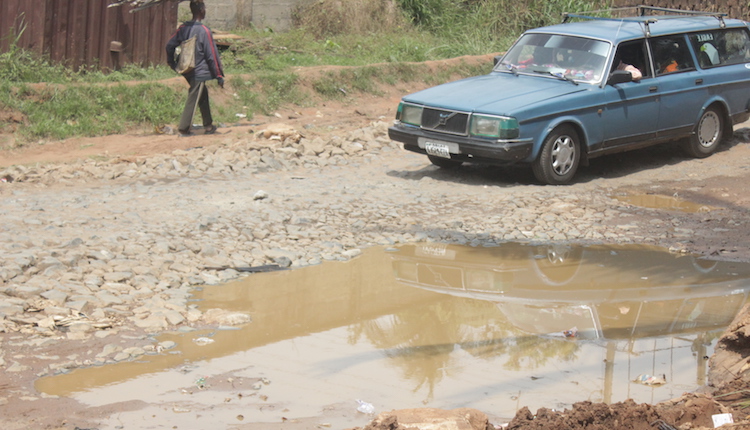
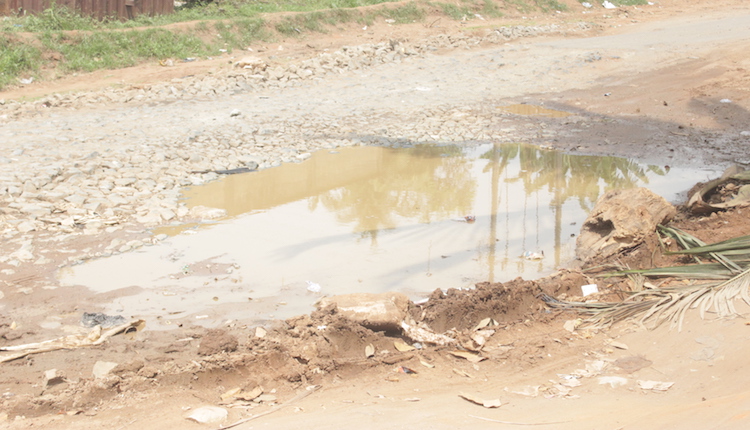
A failed section of the road with mud water logged in the middle. Photo by Patrick Egwu
Till date, investigation reveals, it has not received its deserved attention as specified in the contract agreement. Except for a small section of the road, which was rehabilitated to a point in 2018, the reporter saw that a larger portion has been washed up by rainfall. However, most part of the road remains untouched, creating havoc for users.
When the residents living around the bad spots of the road were asked if they have seen works ongoing at the site, or movement of tractors and heavy duty vehicles as indication of construction activities, they responded in the negative.
In unison, they informed the reporter that they have not seen anything of road works in their vicinity. They also pointed out to the reporter if he could see any sign of life. But they all agreed that they want the government to help them build the road as lack of it is badly affecting their movements and businesses.
The sight of the reporter’s camera nearly drew the ire of some young men and cyclists who were converged at a community square. Typical of a communal life, they were seen engrossed in some conversation while other passersby went about their daily routine.
As they saw the reporter attempting to snap pictures and do video recording of the spot where the road project stopped, a cutlass wielding young man came closer and demanded why he didn’t first seek their permission. The reporter introduced himself and despite that, the young chap insisted he should have sought permission “from the boys around”. He intoned: “If not, they will see you as working for somebody or your personal interest.” Thereafter, the reporter continued on his mission to the location.
Later, a community resident, James Emeaghara, informed the reporter that “since 2010 when the project was awarded, this is where they stopped their work (Pointing). And going down, you will see that because the bridge has not been completed and the road is very bad, we cannot connect the other community.”
On being awarded eight years ago since March 10, 2010, with contract Number 6063, to Rhas Nigeria Limited for N990,673,340.00 million, the construction of Olokoro-Ahiaukwu-Itaja-Okwu-Obuohia-Ikwuano Road, was expected to last five years.
It has, however, been abandoned while other sections worked on were poorly executed. Close observations also show that the initially completed sections are always crying for reconstruction as some parts have washed-out while flooding have damaged the waterway constructed along the road.
Prince Nweze, a cyclist who frequently plies the road conveying people to the neighbouring community said: “It’s been a long time they constructed the road but stopped at a point. It is incomplete, but the one they did was fine.”
Also, the bridge that links the area to other communities and states has remained uncompleted. Motorcyclists have to pass under the bridge to turn around to the drivable end of the road. When they turn around, they have to push their motorcycles up the hill before hopping on it to continue their journey.
Speaking on the situation, Site Manager, Rhas Nigeria, Moses Onyegbule, disclosed that main works on the project commenced about two years ago around May 2017 until August 2018. He noted that when they stopped at the bridge; he had hoped that within a few weeks’ time, the rest of the job will be completed quicker, according to the message received from his boss.
He told the reporter that he expects work to commence soon as the contractor informed him via text message that they are getting ready to return to the site. When this reporter asked for the contractor’s phone number to speak with him on the contract and monies released, he declined.
Probing further, Emeaghara who worked as part-time staff for the company during the early stage of their work, said he believes monies meant for the completion of the work has been embezzled as the contractors abandoned their equipment in his compound for some years now and are yet to complete his payment.
Moses Onyegbule, the site manager of the company said they would soon return to work. Photo by Patrick Egwu
“They have stolen the money for the work. If not, why have they not come back to finish it up.”
A CAC search on the company shows that it was incorporated in December 16, 1991 with the purpose to “carry on business of general merchants, traders, importers, commission agents, carriers or in any other capacity in Nigeria.”
Sections of Abriba-Arochukwu-Ohafia remain unconstructed
NOW in its sixth year, the construction of Abriba-Arochukwu-Ohafia Road, awarded since 2012 to Beks Kimse Nigeria Limited at a budget of N2,265,982,372.50 billion with contract number 6158; remains a largely incomplete project.
Large chunks of the road are laced with pot-holes, while other areas are patched.
A commuter simply identified as Emmanuel said the contractors might have finished their work and left since last year. “But on plying the road, you’d see patched works. Then, two heaps of asphalt were seen dumped by the road side. Also, along the same road, a deep gully like an erosion spot, almost dividing the road into two, can be clearly seen.”
The reporter saw that a cordon was used to alert road users to the portion of danger for them to apply caution. On a closer look, the erosion site shows that no recent or previous work had been done on that road given the size of its expansion.
It is so bad that each motorist that gets to that point is forced to slow down to a snail speed as they try to gently traverse before they could dare attempt to increase their speed.
Ohafia-Oso Road in Abia/Ebonyi —project ongoing
SHARING a common boundary are the Ohafia-Oso road project linking Abia to Ebonyi state. It is sited along a border patrol check point between the two states.
A sign post of the project commissioned in 2012. Photo by Patrick Egwu
It was awarded to Uniglobe Construction Engineering Limited in December 2012 at a budgeted sum of N2,293,965,030.00 with Contract No 6160. As at the time of visit, works was seen ongoing on the project.
It was however noted that most part of the works were being handled by the Ebonyi State Controller of Federal Works.
A motorcyclist, Sunday Uka, affirmed that the road runs from Abia to Ebonyi State. He said: “We stay here and see them carrying sand and moving their machines and going inside where they are working.”
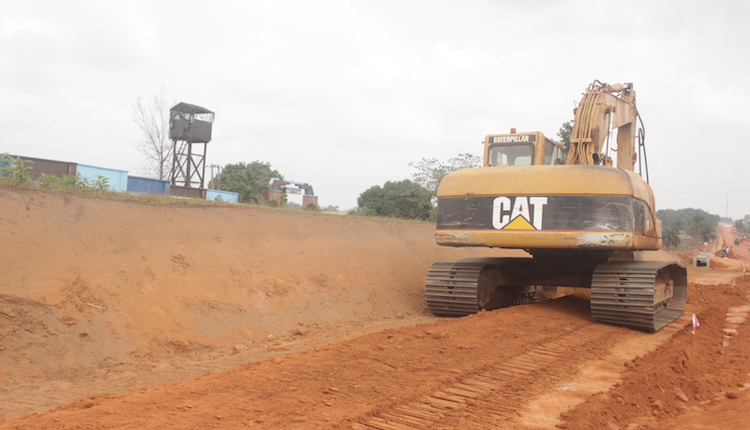
The reporter also saw heavy duty tractors moving granite to the site while field workers were practically tying bolts to the knots.
A commercial cyclist, Chibuzor Chukwu, affirmed that works have been ongoing with trucks visibly conveying construction materials to the site. Pointing towards the site, he said: “If you just wait awhile, you’ll see how much works is being done. One only hopes they will finish it in time.”
When this reporter did a Google search on the company, two addresses of the company; One in Nigeria, the other one in the US were seen. When the phone number on the website was dialed, the person who answered the phone said he no longer works with the company, but said they are still located in Port Harcourt. When asked if he could provide any information on the company when he worked with them, he declined.
The company was incorporated on July 11, 1985 but later changed its name from Uniglobe Construction Limited to Technical Systems Engineering Limited on September 1, 2011. According to its registration records, the objects of the company include; to manufacture all types of garden furniture and other types of furniture for export and domestic use; to borrow money and to guarantee the payment of performance of any debts, secure, mortgage among others. Nothing in its registration details shows that it is licensed to engage in construction work.
A tractor at the site, levelling the ground. Phot by Patrick Egwu
Erring contractors will be penalized —Government official
In the bid to grasp the level of government awareness of the rots in the road projects, the reporter spoke with Engr Nwankwo Chukwudike, Federal Controller of Works under Federal Ministry of Works. He is the official assigned to supervise all federal government projects in Abia State.
Chukwudike admitted that most of the projects under investigation were awarded by previous administration of former President Goodluck Jonathan. He said that only a few were awarded by the current government. He added that most of the previously awarded projects were paid for by the present administration.
He also spoke on variation in costs, which he said were due to a rise in the cost of construction materials since the contracts were awarded. For instance, the prices of materials like cement, granite, oil and other site equipment have gone up since some of the projects were awarded years ago. He then lamented that it affects the progress of works.
He showed the reporter a file containing projects’ specification for each contract as he reiterated that though they were awarded as far back as 2010; some of the works done between 2010 and 2012 were not paid for until 2016. “And I can tell you that was when the contractors began to perform,” he said.
He was then promptly queried that if the contractors were performing at all, why were some of the projects abandoned and uncompleted? He responded that efforts are on to bring every contractor that abandoned any projects to book. “I assure you that their contracts would be revoked and awarded to new contractors,” he told the reporter.
Chukwudike then continued to stress on some of the challenges met on ground when the projects were re-awarded. He said: “By the time they were being paid, most of their previous rates became obsolete. You know what a bag of cement was sold for back then as different from what it is now; the price of petrol then and what it is now. I want to believe you now have a feel of what I am talking about. However, the FG is finding it difficult to make a blanket increase in rates. If such is done, it will be very difficult for any government to bear the weight. So, all the projects that are currently ongoing were the ones which were awarded newly,” he noted.
Engr. Nwankwo Chukwudike, the Federal Controller of Works in the state said works are ongoing and non performing contractors will have their contracts revoked. Photo by Patrick Egwu
He further said that the government is looking at the possibility of an increase in their rates so that the contractors can come back to sites.
To do this, he added: “We are trying to see whether we can use a little variation of price in the increase of basic rates of items as cement, petrol, iron, bitumen –vitals for road construction -to cushion the effect of the lower prices. A meeting was held with most of them in Abuja recently to see how this will work. They also promised to do something. Some other projects are also on hold because of poor rates.”
Asked what happens to already paid monies to contractors should their contracts be revoked, Chukwudike said: “If any contractor had worked for the money paid, the work done is there already. Similarly, if you pay somebody for a job done, everyone sees it there on the road. For instance, if you visit the project site, you will see that some works had been done for the money paid. But if a contractor decides not to come, we will terminate the deal. And if there is anyone already paid but has damaged the works, such will make refunds. That’s the usual way things are done with government contracts. Because once we terminate, we determine, and thereafter, checks are done to verify who is owing whether it is the government or contractor.”
On the performance of respective projects, he said some contractors have achieved about 20 percent while that of Enugu-Port Harcourt are nearing completion. “They were awarded just in 2018 and are among the ones performing very well with about 50 percent in performance. Hopefully, they will complete it on their contracts specified period.”
Adding that the government cannot be totally absolved on the slow pace of works, Chukwudike said: “Due to late and incomplete payments, the little that contractors did in 2018 are yet to be paid for. So, they are not there because of poor rates which will affect cost of construction materials in the market as well as the last certificates they submitted. It is still being processed for payments. Hopefully, once they are paid, we expect them to come back to continue works, so they can speed up completion. More importantly, we hope that variation of prices will really enable them continue the work.”
This investigation was supported by the John D. and Catherine T. MacArthur Foundation and the International Centre for Investigative Reporting, ICIR.
The Nigerian National Petroleum Corporation, NNPC, on Monday announced it was set to collaborate with the Army Engineering Corps to put an end to the violation of its pipeline right-of-way by individuals and communities across the country.
Ndu Ughamadu, head of the NNPC Public Affairs Division, in Abuja called the violations on the right of way of its pipeline by as “dangerous” with serious implications.
He stated the system 2E oil pipelines which constitute a network of pipelines that stretch from Port Harcourt-Aba-Enugu and links to Makurdi.
“The infringement on the statutorily guaranteed 25-metre setback for the infrastructure has been detrimental to the free flow of petroleum products and harmful to dwellers of illegal structures and shanties because of the combustible nature of hydrocarbon,” he said.
Standard safety practices specify a permanent right-of-way for underground pipelines should range from 25 to 50 feet wide, but it may vary.
Noting the inseparable link between the cases of oil pipeline right-of-way-encroachment and incessant pipeline vandalism and oil theft with an attendant negative effect on the economy.
He affirmed that the creation of the minimum 25-metre buffer for the pipeline is designed to allow for maintenance, repairs and replacements of pipelines as the need may arise.
Explaining further, he stated that the buffer ensures that those living close to the lines were shielded in the cases of leakage, rupture or explosion, which is a first step towards the eventual removal of such structures by the team of Army Engineering Corps, its downstream subsidiary, Nigerian Pipeline and Storage Company, NPSC, embarked on extensive consultation and enlightenment exercise.
“The exercise would be targeted at violators in affected communities, because the safety and wellbeing of the people remains paramount,” he said.
Ughamadu said that based on penetrating reconnaissance executed by the Army engineers stretching from Ogale-Eleme community in Port Harcourt -Aba axis to Otade community in Enugu-Makurdi leg, structures in violation of the pipeline safety corridor have been identified.
And the affected areas had also been clearly marked and a notice of imminent removal served on affected occupants.
Ughamadu noted that the essence of the red flag was to bring urgency to the situation along the PH-Aba-Enugu-Markurdi line whose level of violation is about 75 per cent with clear cases of individuals channelling products into private homes.
“Such incidents are not only crystal clear cases of economic sabotage, but poses an unimaginable danger to the entire neighbourhood,’’ he said.
ARMED bandits reportedly killed at least 65 people after an attack on a funeral procession in a village near Maiduguri, the Borno State capital.
The attack is regarded as one of the deadliest on civilians recently, according to reports.
The attackers had shot at mourners on their way from a funeral in Nganzai district near Maiduguri.
Mohammed Bulama, Council chairman of the local government who spoke to reporters stated that 21 people were killed while returning from the funeral on Saturday and another 44 people also died when they tried to regroup to defend themselves.
President Muhammadu Buhari, in a statement on Sunday, through his Special Assistant on media, Garba Shehu, condemned the attack on the mourners.
He said that he had received assurances from the armed forces that the terrorists who committed these killings “will pay a big price for their action.
“The federal government is firmly and resolutely committed to taking all necessary measures to safeguard the nation’s security. This administration is determined to end the menace of terrorism,” the statement reads.
He said a major exercise has begun to hunt down the attackers with air patrols by the nation’s Air Force and ground operations by the army.
The president assures the residents of Maiduguri and the citizens settled in IDP camps that they will receive increased protection from further attacks by the assailants.
It is unclear which particular group was responsible for the attacks as the Boko Haram group and its splinter rival group Islamic State in West Africa, ISWA, usually carry out attacks in the area.
Vigilantes and local hunters have taken up arms to safeguard local residents with increased complaints that the military does not do enough to defend them.
Boko Haram, which seeks to establish an Islamic caliphate in northern Nigeria, has carried out several attacks across Northern Nigeria, including in Abuja.
The group’s activities have, however, been contained within Adamawa, Borno and Yobe by security operatives since 2016.
THE Oyo State Governor, Mr. Seyi Makinde on Sunday disclosed that Governors from the South-West States have resolved to deploy new security architecture before end of August to address insecurity situation in the region.
He said the Oyo State, in particular, would launch its new security strategy before 5th September, the date scheduled to mark his 100 days in office.
“I and other governors of the South-West have met on how to launch a new security architecture before the end of August 2019,” says Makinde.
Makinde spoke at a special thanksgiving service in honour of his mother, Madam Abigail Makinde, held at St. Paul’s Anglican Church, Yemetu, Ibadan.
In a statement by Mr. Taiwo Adisa, the Chief Press Secretary to the Governor, the governors prior to Sunday have been meeting to proffer solutions to insecurity bedeviling the south-west region.
The first 100 days of this government will be on the 5th of September; we will launch a new security architecture in Oyo State before then, the governor said.
Makinde reportedly reacted to the state security concern expressed by the officiating minister, Ven. Samuel Osungbeju.
Nigerians in recent time have expressed concerns over increasing insecurity situation in the country.
Prominent leaders, especially in the South West region have also demanded better security measures to address the insecurity trend, especially in the wake of the incident that claimed the life of Mrs. Funke Olakunrin, Daughter of Afenifere Chairman, Pa Reuben Fasoranti.
Gani Adams, the Aare Onakakanfo of Yorubaland, also lamented over the situation, stressing that the people of the region would not allow themselves to be killed as chickens.
As early as 2016, the Afenifere Socio-Political group accused the Miyetti Allah Cattle Breeders Association of Terrorism.
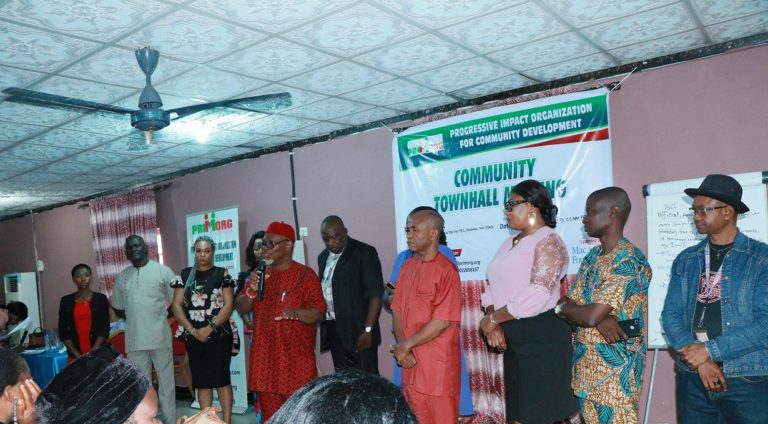
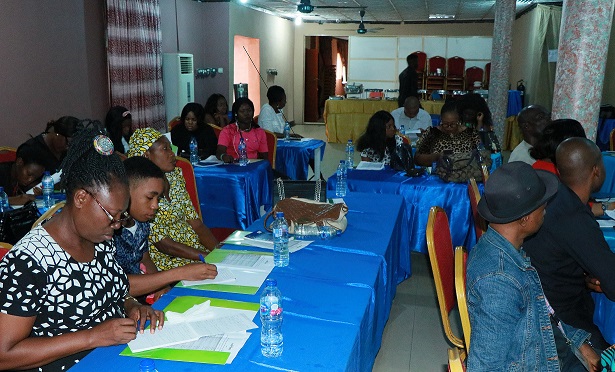
THE Progressive Impact Organization for Community Development (PRIMORG) in collaboration with National Population Commission (NPC) and Civil Society Organisations (CSOs) in Owerri, Imo State on Friday inaugurated an Advocacy Technical Team (ATT) to combat anti-corruption in the registration of birth in the state.
The technical team was inaugurated at a one-day community town hall meeting which focused on “extortion of nursing mothers during birth registration.”
The town hall meeting followed THE ICIR investigation into the dodgy practices of extortion of the National Population Commission registrars at the registration centres in the country.
Members of the ATT was tasked mainly on following up the activities of NPC in the registration of births in state and coming up with solutions to tackle the issues raised during the town hall.
Innocent Agwu, Director Vital Registration Imo State.
Innocent Agwu, Director Vital registration in Imo State in his goodwill message emphasised on the need for public sensitisation, pointing out that birth certificates were absolutely free for persons under 18 years of age.
“Birth registration is official, uniform, continuous, permanent and free,” Agwu said.
“We admit that the issue of extortion has been one of the things besieging vital registration, and I believe this meeting couldn’t have come at a better time than now because it is time that we also make the public realise that duplication of roles in the registration of birth is where the problem lies.
“Existing law between Local Government authority and National Population Commission accounts for the dichotomy presently experienced in the registration of birth in the country.
“The NPC due to lack of funds and manpower is often dependent on the local government and this has greatly limited our autonomy to carry out our job effectively.
“Most of the persons you find at the local government issuing birth certificates are not fully working for NPC,” he said.
In addition, Agwu bemoaned lack of inter-agency synergy, particularly among agencies such as NPC, NOA and ISPHCDA in the state.
Lizzy Ejiogu, former Executive Chairman, Imo State Universal Education Board, told The ICIR, that the low rate of birth registration is staggering in the state.
She explained that this was largely due to the lackadaisical attitude of NPC officials towards creating awareness of the scheme in the state.
“I have been in government for years, I was the former transition chairman Owerri West and I never for once have anything to do with NPC.
“The awareness is not there. For something that has to do with women and proof of identity, it should definitely not be toyed with. The National Orientation Agency has to step up its game.”Ejiogu said.
Participants at the PRIMOG town hall meeting in Owerri
Believing that the NPC has a duty to ensure that children in the state are registered as at when due, participants urged the Commission to curb corrupt practices identified in the scheme.
“Let’s not forget that extortion in whichever form it comes is extortion, and in this respect cannot be curbed if nursing mothers and other members of the public do not know what part they have to play,” said Ukah Ukachi, State Coordinator, National Human Rights Commission, Owerri (NHRC).
“Hence, we need to create awareness on the government and civil society level,” she added.
Participants also stressed the need for a two- way channel of communication between the Commission and members of the public as another measure of curbing the menace and ensuring that offenders are punished.
Participants at the meeting comprised civil society organizations, faith and community based organizations, community leaders, youth and women organizations as well as representatives of the National Population Commission (NPC), National Human Rights Commission (NHRC), National Orientation Agency, Nigeria Association of Women Journalists (NAWOJ), Imo State Primary Health Care Development Agency (ISPHCDA), National Orientation Agency (NOA), Imo State Primary Health Care Development Agency (IMSPHCDA).