Home Blog Page 2324

INVESTIGATION…Inside Nigeria’s oil-rich community where Agip breaks the law, endangering lives and livelihood of residents

1

The ICIR reporter, Amos ABBA visited Azuzuama, in Bayelsa State where oil spills from pipelines belonging to Agip persistently occur without a commensurate remediation effort from the oil firm to clean up the affected sites.

Edited by Ajibola AMZAT


ESTHER Godspower, 22, gave birth to her second child in April but the occasion did not call for celebrations.

The exhausting hours she had spent on sessions with local midwives on how to take care of her baby, and the money spent on baby’s clothes and accessories suddenly became wasted.

“I was expecting the midwives to put the baby in my arms when I delivered but the expressions on their faces explained everything to me. The sacrifices I made during pregnancy to ensure I gave birth to a healthy child just seemed a waste,” she told The ICIR.

Esther gave birth to a baby who died barely an hour after delivery but she has no idea why the child died because she didn’t give birth in the hospital. The traditional midwives who attended to her also had no explanations to give her.

“I was depressed for several weeks with the thought that I had a baby who just died suddenly without any sign of illness, it took me a while to recover from that shock,” she said.

Esther’s tragedy is familiar to other mothers in Azuzuama, a pollution hotspot of crude oil spills in Southern Ijaw local government area of Bayelsa State, but since the community is without a functional hospital there are no medical answers to this problem.
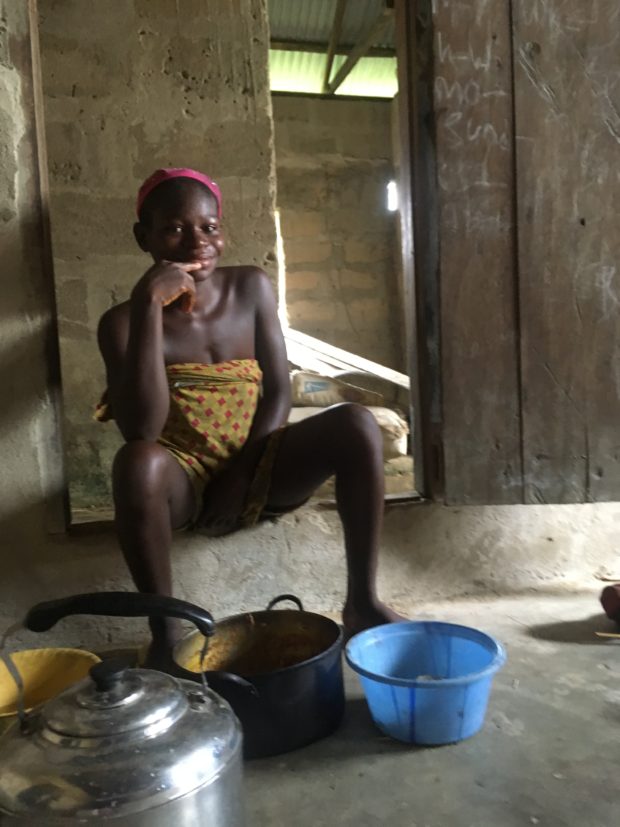
Esther Godspower sitting at the doorway of her house. Photo Credit: Amos Abba

However, researchers at the University of St. Gallen in Switzerland may have answers for women in the community.

A 2017 study carried out by Anna Bruederle and Roland Hodler which focused on the local effects of oil spills in the Niger Delta revealed that children born within 10 kilometres of an oil spill were twice as likely to die in their first month. Esther lives less than 10 kilometres to the site of a major oil spill in the community.

The study compared the health status of children born after a spill and their siblings born before a spill with its conclusion that the chances a baby dies within the first 28 days of life within 10 kilometres of oil spill site are high.

Esther’s experience captured in the research is not different from mothers in other communities where oil spill occurs regularly, whose babies die shortly after they are born.

A large-scale problem

Azuzuama in Bayelsa State is one of the host communities to Nigerian Agip Oil Company, NAOC where  Oil Mining Lease, OML 63, its largest oil field in Nigeria in terms of acreage, is located.

The oil-rich community has been a money-spinning haven for Agip since 1978 when it started its oil production but Azuzuama does not share from its success story.

Statistics from the Ministry of Environment in Yenagoa revealed that from January 2013 to April 2017, a total of 1,031 oil spill incidents had occurred on pipelines belonging to Agip in Bayelsa State, an equivalence of over 20, 550 barrels of crude oil.

Azuzuama shares the bulk of the pipeline ruptures with 900 cases recorded by the Joint Investigation team carried out by a team comprising the National Oil Spill Detection and Response Agency, NOSDRA, an agency charged with ensuring compliance to environmental legislation in the petroleum sector, Ministry of Environment and Agip officials who assessed the impacted sites.

It also revealed that 431 impacted areas were expected to be cleaned up or remediated by Agip to prevent the spill from posing a potential risk to the health and livelihood of people in those areas.

However, the pollution of the ecosystem in Azuzuama by Agip’s oil activities has continued unabated for years without the intervention of environmental regulatory agencies mandated to regularly carry out inspections.

When The ICIR visited several spill sites in the community, mostly from Agip’s Azuzuama’s export pipeline, the sites were not cleaned up and where cleanups were carried out, crude oil extracted from the river was disposed on vegetation.

Other oil spill sites which the reporter accessed barefooted had pools of crude oil which had not been cleaned up for months, others for years.

Gibson Isedirikonghen, a teacher in the community told The ICIR how the spills have been destroying their source of livelihood.

“There are several onshore sites where there have been oil spills for years, but Agip has nothing to clean them up. So, what we do is leave those sites and move to where the oil has not affected. If you have farmland that is affected by the spill it means you have to start looking for an alternative source of income other than farming or get another parcel of land,” he said.

He lamented about the frequent contamination of the river from the spill sites that were not cleaned whenever it rains.

“Whenever it rains, crude oil from those spill sites flows from the mangrove forests into the river which is very dangerous to us. It’s poisonous because the smell is choking apart from the other toxic effects on our body. When you inhale it, your body system reacts badly to crude oil. It’s terrible,” he said.

However, data obtained from the Nigerian Oil spill monitor, a website run by NOSDRA which keeps track of oil spills in the country shows that there are over 1,000 spill sites in Bayelsa State but there are no details or information about cleanups or remediation carried out by the oil firms – Agip included–that is listed on the portal.

Between a rock and a hard place

Mabel Theophilus carefully slides down her eight-month-old baby strapped to her back and lays him on a local mat while she washes the fishing nets she had used for catching fish.

For the twenty eight year old, single mother of two who had been fishing in Azuzuama creeks in Southern Ijaw local government area of Bayelsa state for over ten years, the stinging throat and constant headaches she feels whenever she inhales air around sites where there is an oil spill has always been the worst effects of crude oil spills she had encountered.

In January, her three-year-old daughter, Natasha, had a strange strain of rashes on her body. Mabel told The ICIR she started noticing it after bathing her consistently with water from the river that is frequently contaminated with crude oil leaking from compromised oil pipelines in the community.

Mabel knew it was risky bathing her baby with the contaminated water, but she did not expect a skin disease could result from it.

“Whenever I bathe Natasha with water from the river or she swims in the water she always complains of itching on her body but I always thought it would go away when she uses the water consistently,” she said. She was wrong.

The rashes had spread to every part of Natasha’s body disfiguring her skin, leaving scars on her from head to toes.

Mabel took her to the Azuzuama health clinic but the medical personnel at the facility were not trained to handle such cases so she resorted to herbal remedies for cure which worsened Natasha’s condition.

Natasha, with blemished skin. Photo Credit: Amos Abba

When asked why she has not taken her daughter to the hospital in Yenagoa the capital city.

She explained that the exorbitant costs involved in getting orthodox treatment for her daughter were beyond her means as her fishing business is becoming less lucrative due to the frequent oil spills contaminating the river.

“I will set traps in the river for days but what I catch cannot sustain the family for a day, the fish are no longer in the water as before, and when I can’t feed my small family is it hospital bills we’ll be talking about,” she asked in a distressed voice.

Speaking further, she said, “The transport cost from Azuzuama to Yenagoa by boat is ₦3,500, which means I have to spend more than ₦10,000 only on transportation, apart from the hospital charges  which I can’t afford currently because my fishing business is no longer as lucrative as before because of oil spillages.”

Though, a medical expert has not closely examined Natasha and diagnosed her case properly, Mabel is taking her chances with the fate that Natasha will be cured miraculously.

“I am praying that this strange skin rash should disappear because I don’t have money to spend on sickness when we have not eaten properly,” she said.

Her plight mirrors the struggles of residents in Azuzuama community whose attention to their health condition depends on their earnings from fishing and farming which has suffered setbacks from frequent oil spills that kill fish in their river and destroy crops.

Clinic without doctors

The only health facility in Azuzuama is without a signpost. It boasts of four admission rooms, a consulting room and a hall mostly for antenatal patients.

The building serves not only as a clinic but also as a residence for some of the health workers who converted two of the admission rooms to their personal use.
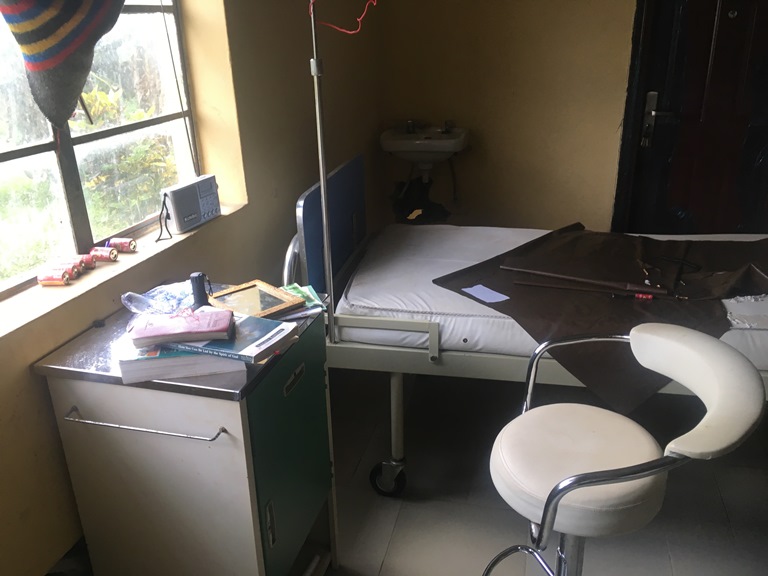
One of the wards in the clinic has been converted into a living residence for volunteers. Photo Credit: Amos Abba

A three-man medical team, of whom none is a doctor or nurse, manages the clinic. Apart from immunising children and conducting antenatal sessions, most cases brought to them are beyond their expertise.

Ibuomo Faforu, a health volunteer who arrived at the clinic in February described the conditions at the clinic as “difficult” because they rarely have drugs available so patients have to take a three-hour journey by boat to Yenagoa to get to a proper hospital.

“We buy drugs with our money to sell to the patients who come for treatment or bring their kids with mild cases of fever, measles, but when it comes to serious cases like typhoid they have to look for solutions in Yenagoa where there are hospitals because we don’t have drugs to treat such ailments. It has been difficult here,” she said.

There is one doctor per 5,000 people in Nigeria, according to Isaac Adewole, the former minister of health, compared with the World Health Organization, WHO, a recommendation of one per 600 people.

Azuzuama with a population of about 10,000 people is without a single doctor, leaving residents in the community vulnerable to contractible epidemics such as air and waterborne diseases.

Deborah Leighe, a tailor had passed out when she was given an injection by one of the volunteers at the clinic to bring down her high temperature.

She had a fever accompanied by high temperature. Her condition was deteriorating as she has started to have hallucinations.

Neighbours rushed her to the clinic where a volunteer in the clinic administered an unnamed injection to her.

“I fainted immediately the injection entered my body, people who were close to the hospital had to come in and pour water on me before I was revived.”

She said the clinic needs qualified doctors to function as a proper hospital.

“We don’t trust people at that clinic, even if there is no hospital in Azuzuama can’t we be entitled to a trained doctor,” she queried.

Losing the coin in the fish’s mouth

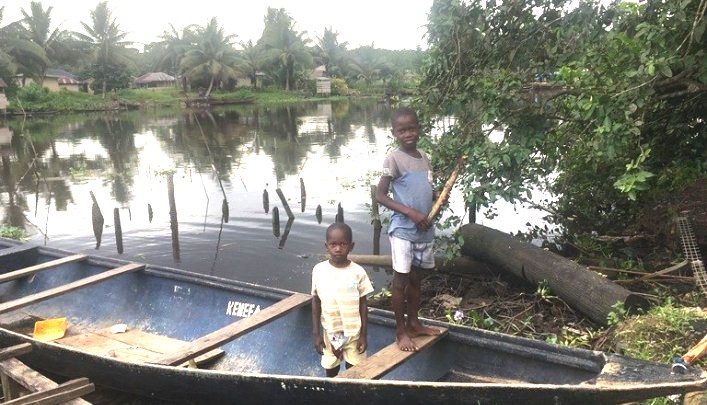
Azuzuama waterfront was known as a fishing hub until regular oil spills from Agip’s activities which started in 1978 changed the ecosystem.

Fishes in the river have become scarce and those available reek of crude oil, a condition that reduces their commercial value. Also, the fishes are thinner and smaller.

Ongbehe Udoma, deputy chairman of Azuzuama Community Development Committee, CDC, who spoke to The ICIR blamed the dwindling fortunes of fishing on the irresponsible practices of Agip in cleaning up its spills in the community.

“The size of fishes is no longer as it used to be, they are now smaller and when you cook it you perceive the odour of crude oil in the fish. The fishes I caught when I was a boy in this village are no longer in the river. Currently, as it stands you can’t use fishing to fend for your family in Azuzuama but it wasn’t always like this,” he recollects.

He says further, “The problem with Agip has always been cleaning up spills from their pipelines, if their pipeline is vandalized they say we are not entitled to compensation but we are saying clean up the spills so people whose source of living is tied to fishing and farming can earn a living.”

Tubotamuno Ilaye switches between farming and fishing to make ends meet but her resort to engaging in farming was an act of survival.

Tubotamuno Ilaye who left fishing for farming to avoid the dangers of oil spill. Photo Credit: Amos Abba

She had started fishing in 1998 but stopped two years ago after she escaped death when she almost choked in crude oil that spilt near the river after falling asleep in a canoe while fishing.

“I could no longer continue fishing as a business after I was rescued from drowning in crude oil because I was always falling sick at regular intervals. I had to start farming, but it’s difficult to get space for farming because the oil spill is everywhere. I started gathering bush mangoes (Ogbono) to sell and survive,’ she said.

She still goes back to fishing but not frequently, her fishing routine now revolves around setting traps for lobsters for food.

“I still try to fish in the dry season but it’s just to set a trap to catch lobsters,” she said.

Yet, she is not entirely free from exposure to crude oil.

“Whenever I step my feet in the water at some places to check my traps even where the water is waist-deep, crude oil that had sunk to the river bed will start coming to the surface. Even the lobsters I catch, are not safe for eating,” she said.

Nigeria consumes over 1.8 million metric tonnes of fish annually but produces a million, leaving a deficit of over 800,000 metric tonnes, which is imported annually according to the United Nations High-Level Panel of Experts on Food Security and Nutrition report in 2018.

The report suggests that if environmental degradation in the Niger Delta persists then Nigeria’s hopes of becoming self-sufficient in fish production may never materialise.

Ebikake Evire, Principal of Comprehensive High School, Azuzuama, explained some of the challenges faced by residents in the community.

“When crude oil spills on land, it is absorbed into the soil, and water table. As you’ve noticed in this community there is no potable water. We drink from that contaminated water, we wash our clothes there and every domestic activity carried in this community is done using that water. When you cook fish from that river it breaks into bits when it is cooked. It’s not like normal fish,” he said.

A law-breaking multinational

Eni holds over 98 per cent ownership stake of its Nigerian subsidiary, Nigerian Agip Oil Company, NAOC. The company had started oil exploratory activities in Azuzuama since 1978 but regular oil spills which pollute the ecosystem of the community has complicated its relationship with the host.

From 2013 to 2018, the oil firm had allocated a total of €1.247 billion on environmental provisions to cater for estimated costs for environmental clean-up and remediation of soil and groundwater in areas where it’s business activities had created pollution problems across the world.

The NOSDRA Act mandates oil firm to clean up or carry out remediation when reliable cost estimation is within 24 hours.

The pollution created in Azuzuama from Agip’s pipeline has continued unabated for over years without the intervention of environmental regulatory agencies mandated to regularly carry out inspections.

The ICIR reached out to Agip to get an interview appointment with the Public Affairs Manager, Evans Ijeoma but all efforts made was frustrated.

When The ICIR visited Agip’s corporate headquarters in Abuja to book an appointment with the Public Affairs unit, a security staff took extra measures in checking the credentials of the journalist before assigning him to another a guard who took him to the mailing room where he dropped the letter and was escorted out of the premises.

An official letter dated 1 July 2019 was hand-delivered and was duly received by the mailing department of the oil firm but until the time of filing this report, there was no response to the letter.

Reminders sent to Agip were also not acknowledged by the oil firm.

Helpless NOSDRA

NOSDRA is an agency charged with ensuring compliance with environmental legislation in the petroleum sector.

The agency ascertains the area where remediation or clean up work should take place, conducts inspection work and determines the compensation to be paid to those affected.

Oil firms managing a pipeline are saddled with the responsibility to clean up any outflow of oil along its pipelines and remediate the environment within 24 hours of a spill irrespective of the cause or nature of the spill as stipulated by the NOSDRA, Act 2005.

A fine of one million naira was pegged as a penalty to be paid by the defaulting oil firms for failure to clean a spill while failure to report a spill attracts a fine of five hundred thousand naira for each day the incident is not reported.

The Director-General of the National Oil Spill Detection and Response Agency, NOSDRA, Idris Mohammed, in an interview with The ICIR stated that his agency compels oil firms to clean up the environment where spills occur irrespective of the cause of the spill.

“The oil companies are mandated to cleanup whenever there’s a spill but I can’t deny that the rate of spills is higher than the rate of remediation no doubt about that because everyday pipelines are being vandalized in Bayelsa State. So, as an operator, you will have to choose between cleanup or operations.

“For example, Nigerian Agip Oil Company has a unit called search and repair where they use a chopper to monitor their pipelines and fix leaking ones. To that effect, we placed our officials on a rota duty so that our officers can keep tabs on them. That’s not what it’s supposed to be, but we still ensure they clean up,” he said.

Contrary to his claims, Azuzuama communities are still covered with a deluge of oil spills that have spread across farmland and river. And Agip, the company responsible to clean the environment continues to look away as if nothing has happened.

The vegetation in the community is losing its natural green colour.    Photo Credit: Amos Abba

Chris Nku, an environmental activist with the Stakeholder Democracy Network, SDN, said the failure to pass the NOSDRA amendment bill has made the agency handicapped in its functions.

“NOSDRA has to be more empowered to do its job because they lack the capacity and manpower to fully carry out their function that’s why the NOSDRA amendment bill should be passed.

“Their challenge is autonomy where they have to be more independent, for instance, they depend on the oil companies’ to take the lead in carrying out cleanup or remediation because they lack capacity, if they don’t have that capacity then they won’t do their jobs,” he said.


 

1,800 lives lost as Ebola outbreak reaches one year in Congo

0

AS today marks one year since the government of the Democratic Republic of the Congo declared an outbreak of the Ebola virus disease in the country, more than 2,600 cases were confirmed with over 1,800 deaths.

The outbreak had been declared a public health emergency of international concern on July 17 when it kept spreading in Congo.

A new case of Ebola was confirmed on Tuesday in Goma, the second case was confirmed in July in Goma city that consists of more than one million people and shared a border with Rwanda.

“The disease is relentless and devastating,” said the United Nations (UN).

It is expressed in a  joint statement from WHO Director-General Dr Tedros Adhanom Ghebreyesus, UN Secretary-General for Humanitarian Affairs and Emergency Relief Coordinator Mark Lowcock, UNICEF Executive Director Henrietta Fore, and World Food Programme Executive Director David Beasley published on Wednesday to mark the one year.

The United Nations agencies said the latest case happened in a dense population centre which underscored the very real risk of spreading beyond the country’s borders. They added that there are urgent needs for a strengthened global response and increased donor investment.

They praised healthcare workers, mostly Congolese, working on the front line in the affected communities, describing their actions as “heroic efforts”.

“Despite their ceaseless work, the disease continues to spread,” said the agencies.

While 2,600 people were confirmed to have Ebola, the UN agencies said almost one in three cases was a child where each had gone through “an unimaginable ordeal”.

Ebola is a close contact disease. It passes from mother to child, husband to wife, patient to caregiver, as well from the dead body of a victim to the mourning relative.

“The disease turns the most mundane aspects of everyday life upside down — hurting local businesses, preventing children from going to school and hampering vital and routine health services,” UN explained the transmission’s impact.

“The challenges of stopping further transmission are indeed considerable. But none are insurmountable,” they added.

There is a vaccine for ebola but in Congo, not everybody is vaccinated. Of the 87 million Congolese, slightly above 170,000 people were vaccinated.

The Ebola outbreak in Congo had occurred in an active conflict zone which had made the response far more complicated because of insecurity. The UN said the health workers and facilities were usually on armed attacks.

“In some of the affected areas, violence is preventing us from reaching communities and working with them to stop further transmission,” said UN agencies.

They called on all parties to the violence to ensure that responders could do their work safely and that those seeking care could access it without fear of attacks.

“At this critical juncture, we reaffirm our collective commitment to the people of the DRC; we mourn for those we have lost, and we call for solidarity to end this outbreak,” they noted.

The global agencies said they were proud of their work so far with the support of the Congolese government to protect those at risk, and care for those affected.

Outlining their achievements, the statement included that 77 million of both national and international travellers were screened, over 440 thousand patients and contacts were provided with food assistance which was crucial to limiting movement among people who could spread the disease.

It also noted that more than 10,000 handwashing sites were installed in locations marked critical and more than 25,000 school-children in ebola-affected areas were provided food everyday to help build trust within communities.

“Now we must build on those achievements, but to do so we urgently need far more support from the international community,” UN said.

For 100 per cent of the cases to be treated, the agencies said it required “an exceptional level of investment.”

EFCC arraigns Kaduna businessmen for N6m land fraud

THE Economic and Financial Crimes Commission (EFCC) on Tuesday arraigned one Magaji Mijinyawa and Shehu Mahamoud before Justice Darius Khobo of the State High Court sitting in Kaduna on a four-count charge bordering on fraud and obtaining money by false pretence.

A statement by Tony Orilade, acting Spokesperson of EFCC on Wednesday disclosed that both Mijinyawa and Mahmoud in June 2017 obtained, under false pretence the sum of N6,227,000 from one Aliyu Mohammed Gusau for the sale of three plots of land at Rigachikun, Kaduna.

Orilade said while the court found their claim to be false, they have committed an offence contrary to Section 1(1)(a) of the Advance Fee Fraud and Other Related Fraud Offences Act, 2006 and punishable under Section 1(3) of the same Act.


READ ALSO:

Gusau who petitioned the two businessmen at EFCC said, he later found out after the commencement of construction work on the said land, that it belonged to the state government, and had been set aside for the construction of a primary school.

While paraded in court, both Minjiyawa and Mahmoud pleaded “not guilty” to the charges.

Following their plea, counsel for the Commission P.C.Onyeneho, urged the court to fix a date for commencement of trial, and to remand them in prison.

Defence counsel, M.I. Ashir, however, prayed the court to grant his clients bail.

Justice Khobo in his ruling granted them bail in the sum of N2million and one surety each, who must have a landed property with Certificate of Occupancy, which must be verified by the court and the EFCC.

The case has been adjourned to October 22, 2019 for trial.

In a related development, the EFCC also presented two witnesses against one Abayomi Oke who is being prosecuted on a one-count charge bordering on issuance of dud cheque before Justice Khobo of the Kaduna State High Court.

The first prosecution witness, Ishaq Danjuma, an operative with the Commission, while being led in evidence by counsel for the EFCC, M. Lawal stated that:

“I know the defendant in a case I personally investigated through a petition received by the Kaduna zonal office of the EFCC written by one Abdullahi Zubairu on the 8th of January, 2017 on issuance of dud cheque valued at N7.2million.”

He also told the court that about N2million was recovered from the defendant and released to the complainant, noting that it was part of the money ought to have been covered by the cheque.

Testifying as the second prosecution witness, Ruth Ayuba, a relationship manager with UBA, Ahmadu Bello Way branch, Kaduna told the court that the EFCC wrote to the bank requesting to know why a cheque issued by the defendant was dishonored upon presentation.

“The bank dishonored the cheque, because the account was dormant and had insufficient funds at the time of presentation,” Ayuba said.

She further stated that the cheque was a third party one and needed to be cleared.

“The clearing centre returned the cheque saying the account was dormant,” she added.

Justice Khobo, thereafter, adjourned the case to October 22, 2019, for the continuation of trial.

At least 371 people killed since January and dozens of villages sacked in Zamfara— Amnesty International

THE Amnesty International says insecurity is escalating in northwest Nigeria’s Zamfara State, with daily killings and kidnappings by armed bandits, leaving villagers in constant fear of attack.

In a report released on Wednesday, Amnesty International said thousands of people have been displaced by a conflict which began in 2012 as a result of clashes between farmers and herders.

“This is Nigeria’s forgotten conflict. The authorities’ failure to act has left villagers in Zamfara at the mercy of armed bandits, who have killed hundreds of people over the course of two bloody years,” said Osai Ojigho, Director of Amnesty International Nigeria.

Ojigho revealed that at least 371 people have been killed in Zamfara in 2018 alone, adding that, at least 238 of these killings took place after the deployment of the Nigerian air force.

“Previous military interventions have failed to end the killings, especially in rural areas of Zamfara,” he said.

He lamented that the government is still neglecting the most vulnerable communities in this region.

“When we visited the region, villagers told us they had pleaded with the government to help them after receiving warning letters from the bandits ahead of attacks but had received no protection. The Nigerian authorities have repeatedly claimed to be tackling the situation, but the mounting death toll tells a different story.”

On Friday 27 July, 18 villages in the Mashema, Kwashabawa and Birane districts of Zurmi local government area of Zamfara state were attacked, leaving at least 42 people dead. At least 18,000 residents of the affected villages who were displaced over the weekend are now taking refuge at various locations in the local government headquarters. The following day a further 15 people were kidnapped in Maradun local government area.

On Saturday 28 July, President Muhammadu Buhari announced the deployment of 1,000 troops to Zamfara. This is the third time since November 2017 that the authorities have deployed the military in response to attacks, but villagers told Amnesty International that this has not translated into protection for remote, vulnerable communities.

Between Sunday 7 and Thursday 12 July, Amnesty International visited communities in five local government areas of Zamfara state – Zurmi, Maradun, Maru, Anka and Tsafe. Although security forces were present in the state capital Gusau, researchers saw soldiers and air force personnel in only two of the villages they visited, Birane and Bagega.

Villagers described feeling helpless and on edge, constantly bracing themselves for attacks. Men said they are sleeping outside their homes and in trees as a way of keeping vigilant, while women and children are sleeping together in groups for protection.

Villagers described a pattern where they receive warnings ahead of attacks, including by phone, ordering them to pay huge sums of money or be killed or abducted.

A villager from Gidan Goga said: “Before Ramadan, the bandits called with the same number they called me with two weeks ago and said if we didn’t pay them N500,000 (USD $1,400), they would come and kidnap me or the village head. Right now, we are living in fear.”

In several communities, villagers said they were afraid to venture more than a few kilometres into the bush, which is preventing them from farming. They would not take Amnesty International researchers to see attack sites for fear of meeting the bandits.

A village elder from Gidan Goga told Amnesty International: “We cannot go to farm far from our village. Two weeks ago, I got a call from one of the bandits, saying they are the owners of the forest. He asked me to tell the village head to tell all villagers close to the forest to vacate the villages and come here, Gidan Goga. He said the only way they’d allow the villagers to continue staying was if they paid them five million Naira.”

In a village in Maru, villagers said the only time they see security forces is when they are escorting workers to the state governor’s farm.

“There’s no security here and we live in fear. We can’t go to farm because of fear, meaning it is difficult to feed our families. To go to farm, you need security. The governor’s farm is not too far from here and security forces go with his workers whenever they have to go there,” one man told Amnesty International.

He added that villagers would wait until the governor’s workers were being escorted and travel alongside them to take advantage of the security presence.

A senior police officer in Zamfara told Amnesty International that the police lacks the logistics and manpower to deal with the crisis in the state.

“The crisis in Zamfara is making life hell for villagers, yet it is clearly low down on the list of government priorities. These killings must stop immediately, and those suspected of criminal responsibility must be brought to justice in fair trials. The Nigerian authorities have a responsibility to protect the lives of everybody in the country, including people in poor and rural communities,” said Osai Ojigho.

Teenager raises alarm on Twitter over father’s attempt to kill him

“PLEASE save me…I am a victim of domestic violence, I don’t want to die”, this is the emergency call Philla Phong, a teenager resident in Ogun State, made  Tuesday, on Twitter after being molested by his father.

Phong, identified as @PhongPhilla on Twitter, cried out on the social media over an attempt by his father to kill him.

He said he was abandoned with his grandmother at 18 months after his father sent his mother parking.

“Someone should please save me ……. I’m suffering from domestic violence….my biological dad hates me and is threatening to kill me…we have never had a good rapport.”


READ ALSO:

“He left me at 18 months and sent my mum away so my grandmother has been taking care of me,” Phong tweeted.

Phong tagged three social media influencers @thepamilerin, @Alex_Houseof308 and @officialpillze, two of those who have over 171, 000 and 127, 000 followers, respectively in order to widely disseminate his predicament.

Within 24 hours, his tweet has generated over 15,000 likes and more than 19,000 retweets.

Narrating his ordeal, he shared how he was molested by his father whom he claimed to be a cultist.

“We just used to talk on phone since …..then, he came home around January ….since then, he do beat me and molest me. He says he is a cultist and would kill me even though my grandma still begs him to calm….yesterday night was when he broke the Camel’s back…”

He went further: “I was watching television and he came in and saw me watching it, and he got vexed and asked why I was watching that particular channel (Disney) and I was surprised at that query, then, out of annoyance, he went to the kitchen and broke a ceramic plate and jumped on me and started stabbing me.”

Phong had to scream for help because his grandmother was not nearby. Hearing the noise, the grandmother rushed out, pleaded with Phong’s father to forgive the boy and let him be, but Phong noted his father insisted he would ‘kill’ him and that he was bewitched, “…I was sent to him…”

“….but due to my grandma’s begging, he left me alone and my grandmother helped me treat the bruises.”

Phong said he could not attend school the next day due to the pains and abuse meted out at him the previous day. His father had expected he attends school irrespective of his condition but the grandma said he should remain at home, possibly to seek medical attention. However, “he got annoyed and started beating me again till I shouted and he wanted to break my phone but my grandma saved me.”

The teenager said he was thereafter taken to the hospital where he was treated for a deep cut, with 18 stitches around his body.

Philla Phong
Source: Twitter

“Please someone should save my life. My dad hates me. I don’t want to die please,” he cried.

“…..I don’t want your money, all I want is your help. Please help me. He has promised to make me sad.”

According to the abused, “he even went ahead to tell my friends that I stole money and I do beg for food which I don’t. Please save me….I am a victim of domestic violence …”

“He said that he will not let me have rest. I should have taken pictures yesterday but I was so weak so I just took two.”

Nigerians react

@simplysnipes advocated urgent assistance for the teenager stressing that it could lead to suicide if care is not taken. “Here is a cry for help, before suicide or murder of an innocent life becomes the case.”

Twitter handler, identified as Deputy Commissioner of Police (DCP) Tunji Disu @Tunji Disu1 advised Phong to visit the nearest police station to report the case.

“Let him go and report at the Police station”, he tweeted.

Interestingly, another twitter handler from Ghana @peezarian advised the abused victim to take the next bus to Ghana with a contact number he could use upon arrival.

“Bro take the first bus to Accra Ghana if you can call this line sharp 0264352369. Get as far away as you can from that psycho bro look sharp.”

Abimbola Oyeyemi, Ogun State Command Police Spokesperson told The ICIR he had no knowledge of the incident but promised to contact the Divisional Police Officer (DPO) in charge of the area as soon as the location is established.


FACT: In three consecutive budgets, Ondo made no provision for renovation of state assembly complex

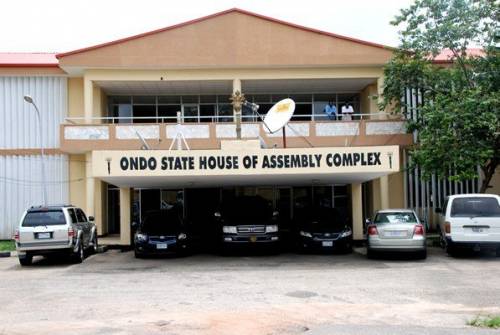
AVAILABLE evidence has shown that Ondo State Government under the leadership of Governor Rotimi Akeredolu has actually not made fund available for the renovation of the State House of Assembly complex, The ICIR can report.

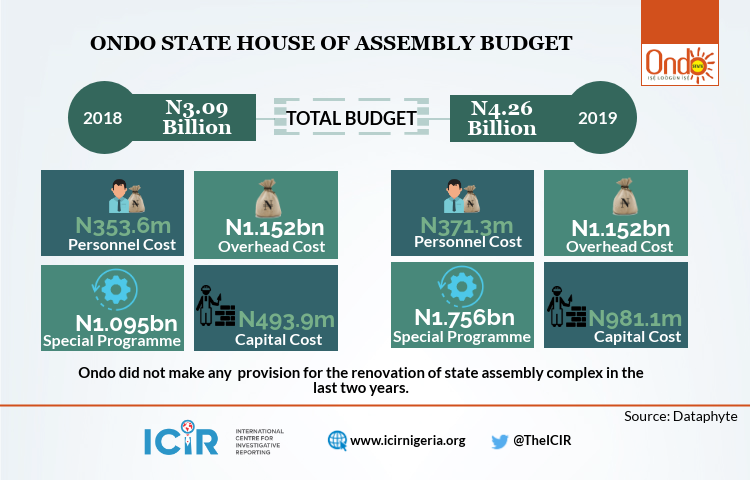
Copies of the State House of Assembly annual budget for the year 2017, 2018 and 2019 obtained by The ICIR revealed that there was no budgetary provision for the renovation of the assembly complex in those years.

In 2017, the state assembly overhead cost which covers expenses such as local travels, maintenance of vehicles, maintenance of furniture; welfare package among other expenses was N621, 720, 836. But there was no provision for the renovation of the assembly complex.

Similarly, the 2018 approved budget for the overhead cost for the state assembly was N1,152, 500, 00, yet no provision was made for the renovation of the chamber. The same amount was budgeted for 2019 with no amount earmarked to change the face of the dilapidated assembly constructed in 1979.

The state’s lawmakers have been at loggerheads with the governor since Wednesday, July 24 when a snake reportedly fell from the ceiling of the assembly complex during plenary, disrupting the day’s legislative business.

Reports say the snake fell from one of the damaged ceilings of the hallowed chamber.

After the incident, members of the house concluded that the chamber was no longer safe for legislative work and decided to inform the state governor, especially when a ceiling also caved in, directly where the speaker was sitting.

“The whole house was agitated and when we look around we saw the damage the termite had done to most of the woodwork in the ceiling,” said the Chairman, House Committee on Information, Olugbenga Omole.

“At that point, we had to call ourselves and adjourned the sitting. That chamber is no longer safe for legislative business and because of that, we decided to adjourn indefinitely. The house will be going on an indefinite recess.

“We need to intimate the state governor Rotimi Akeredolu about this development and we have decided to meet him on this,” Omole added.

There were also reports that no snake fell from the ceiling, but the lawmakers who were disgruntled used the hoax to get the attention of the state governor to the dilapidated state of the assembly complex.

But the governor expressed disappointment with the “lies” orchestrated by the lawmakers after visiting the complex.

The governor said the lawmakers had only made the attempt to blackmail the state and ridicule his government.

The angry governor, who was in the company of his Chief of Staff, Mr. Olugbenga Ale, said his “government would not condone any act of blackmail”.

However, the lawmakers after a meeting on Tuesday issued a communique in which they jointly lamented the state of the assembly complex.

In the communique, they alleged that the complex had not been rehabilitated in the last 10 years.

“We want to state, without any equivocation, that no fund had been released to the House of Assembly for capital projects in the last five years in spite of budgetary provision,” said Success Torukerijo, the member representing Ese Odo Constituency who read the communique on behalf of others to journalists in Akure.

He said there has not been any cash backing for the renovation of the House of Assembly in the past 10 years.

“It is pitiable that the Ondo State House of Assembly Complex is the worst in terms of infrastructure in the whole country,” Torukerijo added.

Governor Akeredolu started his second term in office on February 24, 2017, after winning a tightly contested gubernatorial election on November 27, 2016.


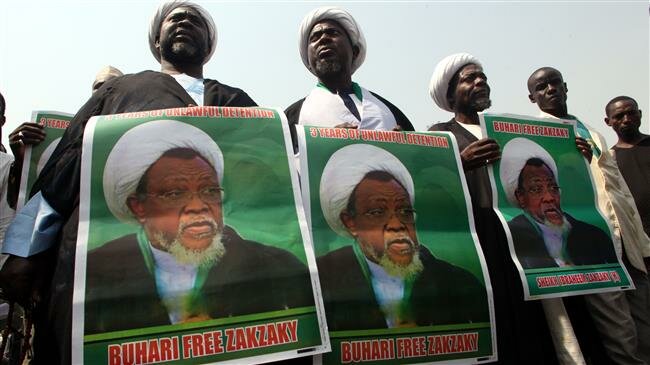
Shi’ites heads to court over proscription

THE Islamic Movement in Nigeria is to challenge the court order obtained by the federal government banning the operations of the organization.

Spokesman of the Movement, Ibrahim Musa confirmed that “we will be in court challenging the proscription”.

Musa who spoke through a phone message on the recent accusation by a rival Shiite group that IMN was a fake organization accused the leader of the rival Shiite sect, Al-Thaqalayn Cultural Foundation, Sheikh Hamza Lawal of being a government agent out to destabilize IMN.

According to Musa, “Hamza Lawal, had failed woefully to create division within the ranks of the Islamic Movement in the past and the government.

“He is not worth being dignified with a response. He has been in the corridors of power for a while now and on their payroll to distract attention, cause confusion, and are known by various names in the past – Shia traitors, commercial Shia and the rest.

“When in 2015 government massacred members of the Islamic Movement, they celebrated and rushed to form another organization called SHIMAN to be an umbrella organization to finalize the “burial of IMN” with government support, so as to deceive the public into believing that Shi’ites is not the target.

“These same “Shia-groups” were again the ones who earlier this year came out to endorse Buhari for another term. Thus Hamza Lawal and his cultural group are a distraction not worth our time”.

NAN

I can never undermine a journalist, I believe in freedom of the press—Tony Nwulu

A FORMER member of House of Representatives, Tony Nwulu who has been at the centre of a threat allegation involving the publisher of Orderpaper, Oke Epia, says he has a lot of respect for journalism as a profession and cannot undermine a journalist.  

“I have a lot of respect for journalists and the media as the fourth estate of our democracy, especially in the face of the risk that they undertake on a daily basis to keep us informed,” Nwulu said in a statement issued in Abuja on Wednesday and made available to The ICIR.

“I say this with a special tribute to the late Precious Owolabi, a corper who served as a correspondent with Channels TV but was shot dead while on duty.”

On Tuesday, the Coalition for Whistleblowers Protection and Press Freedom issued a statement condemning the attack and harassment of one of its members, Order Paper, by Nwulu.

But in his statement titled, “Epia is a politician hiding under journalism to defame me,” the former lawmaker who sponsored the ‘Not –too-young-to-run bill’ in the 8th National Assembly, said the bill enjoyed the greatest media support because of the tireless efforts of journalists ‘who supported me.’

Reacting to the allegation that he was using the police to persecute the publisher of Orderpaper, he said Epia ‘is not a journalist but a political hatchet man simply doing the bidding of his sponsors under the umbrella of the press.’

He said he reported the matter to the police because of the weight of the allegations made against him.

“I am the one who went to the Police. I did this to exercise my constitutional rights as someone who has been defamed under the guise of “journalism”.

According to him, the publisher of Orderpaper has been whipping up sentiments, hiding under the false allusion that he is a journalist and tagging media houses both locally and abroad.

“But the truth is, he is not a journalist. He is a politician that has held political office as the Chief Press Secretary to Emeka Ihedioha, the incumbent governor and my rival during the last governorship elections in Imo State,” said Nwulu, who also contested the governorship election in Imo State in February under the United Progressive Party (UPP).

He also denied allegation of threats to the journalist, saying “I am aware Epia has equally alleged that I have issued threats to his life.”

“Nothing could be further from the truth and I challenge him to produce any evidence of such threats. These are barefaced lies calculated to court public sentiments.”

On the allegations that money meant for the constituency projects was missing, Nwulu said the allegations were unsubstantiated, stating that “no responsible media house anywhere in the world should use words like “missing funds” or “tens of millions” without any shred of evidence to back up such claims.”

“It is against the tenets of professional media practice just as it is a common principle of law that he who alleges must prove.”

He expressed optimism that the law would take its course and the truth is allowed to prevail at the end of the investigation into all the allegations by the police.

“I also hope that this will serve as an incident that enriches broad conversations around the professional ethics that guide the practice of real journalism.”

ICRC supports 4,392 households with emergency reliefs  

THE International Committee of the Red Cross (ICRC) on Tuesday said it has supported 4,392 households in Monguno town with emergency relief items including those recently displaced by the armed conflict in Borno State.

They were supported with solar lamps, cooking equipment, blankets among others.

“These families fled the violence, leaving everything behind them. We’ve supported a total number of 4,392 families with mats, blankets, clothes, solar lamps, cooking equipment, and hygiene kits among others, to allow them to cover their basic needs” said Sadiq Baba Ahmed, ICRC’s Economic Security Field Officer in Monguno.

According to the humanitarian organisation, there are currently over a dozen of internally displaced persons (IDP) camps in Monguno town – all of which are overstretched.

“For months, our people have been subjected to a lot of suffering, most of them without a single mat to put their heads on”, said Musa Haruna, a community leader in Fulatari Camp where about 1,500 households received the ICRC’s supports.

“Since December 2018, we have witnessed a huge influx of IDPs, mostly from Kukawa Local Government. These people have been forced out of their homes due to the hostilities and are in a dire situation,” said Mr. Ahmed.

The ICRC also disclosed ongoing plans to construct 2’000 family shelters in some of the camps, aside the supports for clinics in Monguno.

EFCC stops suspect from flushing away phone, arrests 15 ‘Yahoo Boys’ in Ibadan

THE Economic and Financial Crimes Commission (EFCC) says its operatives at the Ibadan zonal office on Tuesday botched an attempt by a suspected internet fraudster to flush his phone through a water closet in order to deny access to potentially incriminating data about him.

The 20-year-old suspect, Fisayo Falade, was among the 15 young men arrested in Ibadan on Tuesday for internet-related crimes when the Commission’s operatives conducted a raid on two locations in the ancient city, a statement by Tony Orilade, acting EFCC spokesperson revealed.

Ten of the suspects were arrested at Akatanpa Powerline, while the other five were nabbed at Kushenla area of the state capital.

Ranging between the ages of 20 and 28 years, the suspects were allegedly hiding behind fake names and identities to perpetrate fraud, dispossessing their unsuspecting victims of their hard-earned money.

Orilade explained that the suspects alleged involvement in internet-related frauds was reported to the Commission by members of their neighbourhood who noticed their expensive ways of life even though they are supposedly undergraduates, and without any known source of income.

Items recovered from them include two exotic cars, laptops, mobile phones and several documents containing false pretences.

“The suspects will be charged to court as soon as investigations are concluded,” the EFCC spokesperson said.