THE Nigeria Army says it is not under any obligation to let a disengaged officer know the reasons for his or her dismissal.
This was made known by David Ighodaro, an officer in the legal services department of the Nigeria Army, while giving witness during the hearing of a suit filed by Mohammed Suleiman, one of the 38 senior army officers that were compulsorily retired in 2016.
Many of the officers said they were not issued any query or reprimand neither did they undergo any kind of internal disciplinary measure before their controversial dismissal. Some of them said they saw their names on national television and newspapers before their dismissal letters got to them.
Mohammed Suleiman, one of the affected officers, had dragged the Army before the National Industrial Court (NIC) asking the court to declare his dismissal null and void and order his reinstatement.
Appearing before the court as a defence witness on Monday, Ighodaro said the army reserved the right to hire and fire any of its officers who goes against his condition of service.
“The army reserves the right to hire and fire its officers including the claimant for actions, conducts, among others which bother on indiscipline, unprofessionalism, threat to national security, among other reasons,” Premium Times quoted Ighodaro as saying.
“The army council has no obligation or duty to even give reasons for the compulsory retirement of the claimant.”
This claim is, however, false. Checks by The ICIR reveal that an officer could only be dismissed after having gone through a court-martial, according to the Armed Forces Act.
Under cross-examination, Ighodaro said he was not aware if Suleiman was ever subjected to any internal disciplinary measure before he was summarily dismissed.
Following Ighodaro’s testimony, the prosecution counsel informed the court that it was closing its case and would await the judgement of the court.
The case was subsequently adjourned to September 26, 2019, for adoption of written addresses.
A similar case involving a dismissed army officer, Danladi Hassan, had been decided in favourof the claimant in January this year.
In that judgement, Justice Sanusi Kado of the National Industrial Court ruled that the letter of dismissal issued to Hassan was null and void, and ordered the Nigeria Army to reinstate him with all his rights and privileges.
GOVERNMENTS have a responsibility to protect their citizens against external aggression and internal violence. The first is usually the responsibility of the military. The second duty falls on the police.
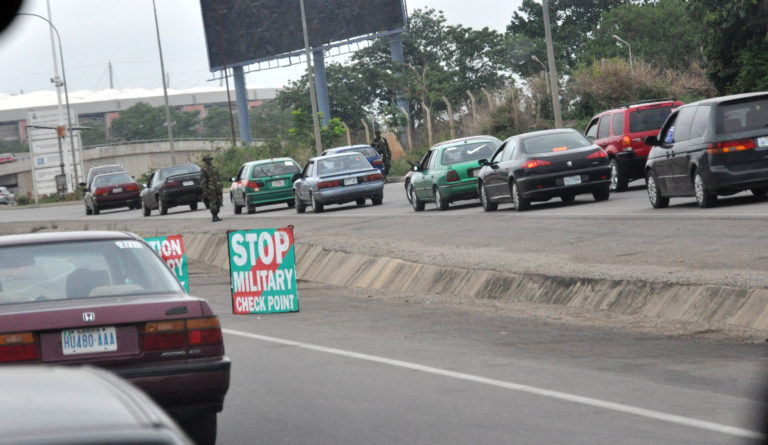
But in Nigeria, the government often deploys the military to restore order and to keep the peace. This is largely due to the inability of the police to contain violent conflicts, particularly in areas where armed groups are active.
This is the situation in Jos, the capital of Plateau State in the centre of Nigeria, just north of the administrative capital Abuja. The military has been used to maintain security since violence broke out between Christians and Muslims in September 2001.
The violence has evolved into one of the most enduring conflicts in Nigeria. Initially, angry young people used crude implements such as axes, sticks and machetes. Now various organised ethnic and religious militias wield small arms and light weapons. The conflict has spilled over into most parts of the state, with a pattern of hit-and-run attacks developing.
Several studies have indicated support the use of the military as a “necessary evil” to ensure the return to peace in the region.
But my study found that using the military to quell internal conflicts and restore order causes several problems. These included undermining the legitimacy of the military mission, as well as failing to quell the violence. In my PhD thesis I concluded that the conduct of soldiers only worsens the security situation for ordinary people.
I identified two factors as responsible for the problems. The first was a lack of military professionalism. Soldiers often intimidate and coerce civilians. They also engage in corruption and extortion, especially at military checkpoints. Some soldiers also subject civilians to psychological and emotional abuse. Yet others engage in blatant and flagrant acts of sexual and gender-based violence.
The second factor I identified was the fact that the command-and-control structure of the military is at odds with the way society operates.
These problems could be addressed with effective civil control of the military. But the study argues that civil control is weak in the country.
The use of the military
The response of the Nigerian government to growing levels of insecurity has increasingly been to use the military. Several peace and security conferences and commissions of inquiry have been instituted. But these yielded little or no result due to the lack of political will by the government to implement the recommendations.
The military has been deployed because of the weaknesses and inadequacies of the Nigerian police. Inadequate training, shortage of manpower as well as policing equipment, coupled with excesses have added to the erosion of public trust in the police and their legitimacy.
But the use of the military has introduced a host of new problems.
In my study I set out to understand whether the Nigerian state is exercising adequate civil control of the military to ensure that it doesn’t become a threat to the citizenry and exacerbate insecurity. I conducted 55 one-on-one interviews with civilians in six local government areas in Plateau State.
The study found that civilians see the military as exacerbating insecurity. For example, increased militarisation has led to people’s movements and activities being severely restricted. And several emergency rules have been declared. These have involved suspending civilian government and replacing it with military administrators.
Another finding was that dereliction of duty is rife among soldiers, with some choosing which distress calls from citizens to respond to or not.
On top of this, there’s tension between military culture and civilian values. The military operates a culture which follows an authoritarian leadership style, and is combat-focused. For their part, civilians are more likely to seek resolution to issues and to use the criminal justice system to adjudicate problems.
This has led to relations between civilians and the military becoming severely strained.
Lack of civil control
A bigger problem is the weak civil control over the Nigerian military. This has led to a lack of accountability and compliance with rules of engagement.
Nigerian law subordinates the military to civil control and parliamentary oversight. Ideally, this should ensure that the military acts within its mission and mandate. But, the problem lies with implementation. The culture of civilian supremacy over the military is not as yet well institutionalised.
The result is that citizens counteract abuse by the military in various ways. One way is to simply comply with the demands and orders of the soldiers, even when they are illegitimate. Another entails non-violent resistance or non-compliance. For example, it’s common for civilians to refuse to cooperate and share information with the military.
A third way is to collaborate with compromised soldiers. The fourth is to use various forms of violent resistance. This involves people either aligning with armed groups, or forming their own. This proliferation of armed groups worsens insecurity.
My study also showed a sharp difference of opinions between people of different religions. Christians contended that the military was biased in favour of Muslims. For their part, Muslims didn’t share this view.
What needs to happen
The use of the military is not an effective intervention against internal armed conflict. This is especially so in states with weak institutional control over the military as is the case in Nigeria.
The more recent setting up of a peace building agency is a more plausible alternative towards bringing the violent conflict to an end through effective mediation and peace education. The use of the military needs to be reconsidered and the peace building agency should focus on reuniting people and bridging the gap between the reactive security measures with proactive conflict prevention strategies. This is the only way in which trust and relative peace can be restored in this once peaceful Nigerian state.
SENATE President, Bukola Saraki, says he is not aware of the new set of guidelines on media accreditation which was issued by the National Assembly on Monday.
Saraki said the document did not emanate from his office or from the office of the Speaker of the House of Representatives, Yakubu Dogara, and that it would be investigated.
“The attention of the President of the Senate, Dr Abubakar Bukola Saraki, has just been drawn to a story that is circulating on social media about the National Assembly issuing new guidelines to journalists. These alleged guidelines have not emanated from either the Senate President or the Speaker, and will be promptly investigated,” read a statement issued on Tuesday by Olu Onemola, Saraki’s Special Assistant on new media.
“The public should note that the 8th National Assembly has been committed to the freedom of the press as exemplified by its work to bring governance closer to the people through live streams and live tweets.
“This is because the leadership of the 8th National Assembly believes strongly in the freedom of the press and in carrying the Nigerian public along. Hence, the Senate President and all his colleagues will continue to work to ensure that these freedoms remain unhindered.”
The Nigerian Guild of Editors (NGE) had criticised the new NASS guidelines, accusing the eighth National Assembly of attempting to put the press in chains.
“The guild is disappointed that the same 8th National Assembly which benefited immensely from free press in its moments of trial has turned round to put the same press in shackles and chains,” the NGE said via a statement on Tuesday.
“We reject this crude abrasion of our constitutional rights to freely disseminate information. It cannot stand,” the statement read in part.”
Also, the National President of the NUJ, Christopher Isiguzo, described the new NASS guidelines as “satanic, draconian, anti-press freedom, and anti-democratic” and urged the authorities of the National Assembly to withdraw it within 24 hours.
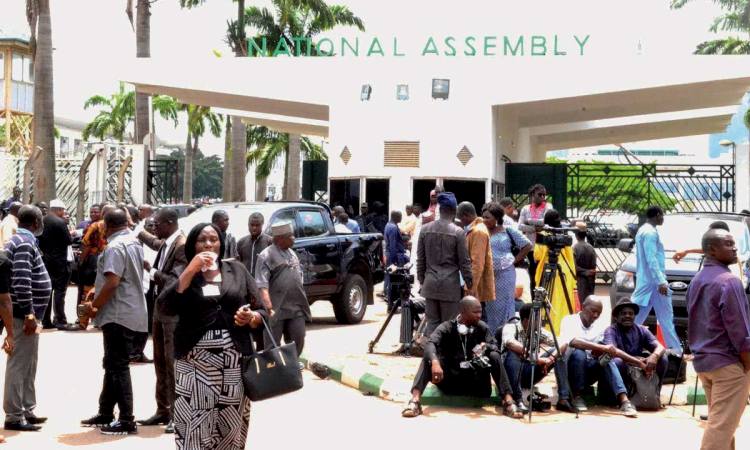
THE Nigeria Union of Journalists (NUJ) has rejected the new guidelines issued by the National Assembly which the legislative arm of government said must be met before a media house is accredited to cover legislative activities in Nigeria.
The new guideline was contained in a statement issued on Monday by the National Assembly Director of Information, Agada Emmanuel, and it would come into effect by June 11, 2019.
Speaking to The ICIR on Tuesday, President of the NUJ, Christopher Isiguzo, described the new guidelines as “satanic, draconian, anti-press freedom and anti-democratic”, and asked the leadership of the National Assembly to withdraw it in the next 24 hours.
Isiguzo said it was disheartening that the legislative arm of government which is being looked upon to enact relevant laws for the country in keeping with the principles of democracy, is now the one seeking to impede the freedom of the press.
“It is so sad that the legislature, which is, of course, a strategic arm of government in a democracy, could be the one that is now trying to gag the media,” Isiguzo said.
NUJ President, Christopher Isiguzo
“We will not accept it. We have asked them to withdraw the satanic guidelines within 24 hours, after that we intend to call an emergency meeting of our Federal Working Committee and, of course, we would know the next line of action.
“But in the immediate, we reject the purported guideline as released by the National Assembly Management.”
Isiguzo said he would be on live television later in the day to discuss more on the latest development.
Similarly, the Nigerian Guild of Editors (NGE), in a statement on Tuesday, also rejectedthe new NASS guidelines for media accreditation describing it as intended only to serve “the myopic interest of its chroniclers and purveyors”.
“The guild is disappointed that the same 8th National Assembly which benefited immensely from free press in its moments of trial has turned round to put the same press in shackles and chains. We reject this crude abrasion of our constitutional rights to freely disseminate information. It cannot stand,” the statement read.
According to the NASS guidelines released on Monday, television stations are required to present only one reporter and one cameraman for accreditation, radio stations are allowed only one reporter, while online media organisations are allowed one reporter and one photographer each. Also, those classified as “independent producers” are allowed one reporter and one cameraman each.
Media organisations to be accredited must, among other things, show evidence of membership of professional bodies, while the journalists must produce evidence of their membership of the Nigeria Union of Journalists (NUJ).
For online media houses, they must have at least 5000 viewership per day and the site must have been in operation for 5 years.
Below is the complete guidelines as released by the NASS authorities on Monday”
NEW GUIDELINES FOR THE ACCREDITATION OF MEDIA ORGANISATIONS, JOURNALISTS/ CORRESPONDENTS COVERING THE NATIONAL ASSEMBLY
1.0 NUMBER OF JOURNALISTS/CORRESPONDENTS TO BE ACCREDITED FOR PRINTS, ELECTRONIC AND ONLINE MEDIA FOR SENATE AND HOUSE OF REPRESENTATIVES RESPECTIVELY.
1.1 Television – 1 Reporter and 1 Cameraman
1.2 Radio 1 Reporter
1.3 Independent Producers – 1 Reporter and 1 Cameraman
1.4 Online Media 1 Reporter and 1 Photographer
2.0 CLASSIFICATION OF ACCREDITATION
2.1 Permanent Accreditation
2.2 Temporary Accreditation
2.3 Foreign/international Media Houses
2.4 Freelance
3.0 REQUIREMENT FOR PERMANENT ACCREDITATION OF JOURNALISTS/CORRESPONDENTS FOR PRINT, ELECTRONIC AND ONLINE MEDIA ORGANISATIONS
3.1 Evidence of certificate of incorporation of the media organisation.
3.2 Evidence of membership of professional bodies for media organization.
3.3 Proof of membership of Nigeria Union of Journalists (NUJ) with registration number.
3.4 Code of certification from the National Library for the media organization.
3.5 Functional Bureau in Abuja (Staff Strength not less than 5 Editorial staff and daily circulation of 40,000 copies for the print media with evidence to support the claimed circulation figure.
3.6 Media Houses must be publishing daily and on weekend (Applicable to Online Media).
3.7 Re-certification form must be signed and endorsed by the Chief Executive Officer (CEO) of the Media organization Bureau Chief, City Editor as the case may be.
3.8 The Media organization concerned must have experience of covering proceedings of the National Assembly for at least two (2) years before applying for permanent accreditation.
3.9 All media organization will submit a copy of its income tax return for the last two years.
3.10 All online media must have at least 5000 viewership per day, the site must have been in operation for 5 years and provide satisfactory evidence to this effect with clippings of the news utilized (especially parliamentary news).
3.11 Only television stations with national coverage and specific independent producers with current running programme on the National Assembly will be allowed access into the Chambers on a permanent basis (All the production crew will be accredited as an entity).
3.12 All correspondents must attach a photocopy of letter of appointment of the media organization on whose behalf request has been received for grant of accreditation.
3.13 All freelance journalist seeking permanent accreditation must show evidence of not less than 5 years coverage of the National Assembly proceedings/full editorial focus and publication on parliamentary reportage.
4.0 It is only Journalists and correspondence whose media organisations meet the above requirements for Permanent accreditation that will be entitled to carry National Assembly Identity Card/Membership of the respective Press Corp.
5.0 All other media organization who do not meet the above requirement will be captured under the Temporary accreditation status and they will not be entitled to carry National Assembly Identity Card/Membership of the Press Corp of the Senate and House of Representatives.
6.0 All Temporary accredited media houses, journalists/correspondents shall be allowed permit into the National Assembly for specific coverage not exceeding one (1) week in the first instance and not more than twice in a month.
7.0 All foreign/international media houses seeking accreditation shall abide by all the Diplomatic Protocols established by the Ministry of Foreign Affairs for foreign media organizations, the Code of Ethics for Nigerian Journalists and security clearance before accreditation will be considered upon the recommendation from the Ministry of Foreign Affairs.
8.0 All permanently accredited journalists/correspondents shall submit a recertification letter from the Chief Executive Officer (CEO) of their media organization on a sessional basis failure to which accreditation shall be withdrawn forthwith.
9.0 All accredited media organization will be considered as a single entity in the issuance of passes irrespective of their membership of Senate and House of Representatives Press Corp.
10.0 This new accreditation guidelines shall come into effect from June 11 2019.
UNTIL August 2017, I was the Director-General of the Bureau of Public Service Reforms (BPSR), with the daunting task of reforming Nigeria’s Federal Public Service. As part of that role, I sought to move the focus of Public Service Reforms away from the Public Service unto the public. This was a deliberate tactical approach that sought to change the approach to public service reforms from inputs to outcomes. Problems with the Public Service are often complex and intractable. There are various reasons why Public Service Reforms are difficult in most environments and are particularly difficult in developing countries, such as Nigeria.
In countries such as ours, the public service reformer is often dealing with myriad systemic input problems in the organisation he is trying to reform, including lack of electricity, insufficient financial provision, lack of working tools, poor internet access, poor staff motivation and systematic corruption. The combination of these, and any one of them for that matter, is sufficient reason to explain away a lack of improvement in public service delivery. Focusing on the outcome expected, rather than the problems with the inputs, gives the reformer a better chance of driving reforms in dysfunctional environments.
The need to deliver the outputs expected forces the system to align the required inputs to achieve the expected outcomes, rather than focusing on the difficult task of trying to solve all the input problems before we can get the improvements in service delivery that the public expects and deserves. We will use the tortious issue of obtaining a Nigerian passport as a demonstration of how it could be done.
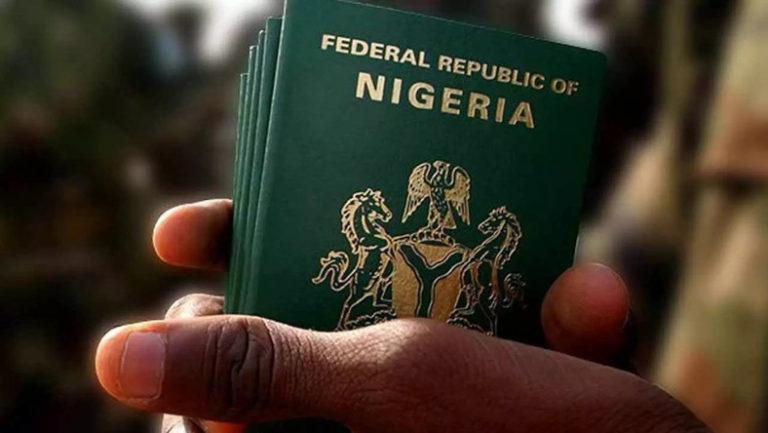
Many Nigerians go through a painful, dysfunctional and extortionate process when they try to obtain an international passport. Given its population and the absence of a focus on outcomes by the Comptroller-General, Lagos residents suffer the most. It is virtually impossible to obtain a Nigerian passport in Lagos without “knowing someone” and paying above the official rate of N15,000 for a 32-page passport and N20,000 for a 64-page passport. Even after paying more than double the official price and making obeisance to god-like Immigration officials, applicants are still confronted with the claim that “there are no booklets.”
The Comptroller-General of Immigration often makes a categorical, but hollow, assertion that there are sufficient booklets nationwide, but the experience of citizens is clearly contrary to that claim. It is either that the Comptroller-General is being economical with the truth or that his officers are deliberately making things difficult in order to derive corrupt benefits from the dysfunction, and that the Comptroller-General is not interested in doing anything about it.
Overcoming this logjam is relatively straightforward. Nigerians can obtain an international passport in a week without needing to know anybody and without paying a kobo more than the official price. In the next few paragraphs, I will outline how this can be done.
The first step is for the Presidency to demand from the Immigration Service the service standards for issuing Nigerian passports. The last time, that I am aware of, such service standards were set for passport issuance was under the SERVICOM regime in 2004. At that time, the Immigration Service undertook to provide international passports within one week, but expectedly within 72 hours.
Most people, including the Immigration Service, currently appear not to be aware of this service standard. Nobody monitors performance against these standards, and although passport issuance is part of the Ease of Doing Business initiative, the Presidential Enabling Business Environment Council (PEBEC) has achieved little or nothing in this regard.
It is important for the Immigration Service to commit to this standard, or revisit the standard and set a more realistic one and make the targets publicly-known, and for PEBEC and the National SERVICOM Office to publicly report the performance of the Immigration Service against these standards. In order to meet the existing performance standard, or whatever new standard is set, it is necessary to take a number of straightforward actions.
First, all payments must be made online. Notionally, this is already the case, but in practice, citizens are often unable to make online payments, forcing them to have personal contact with Immigration officers and their touts, who extract corrupt rents for “helping” people. The payment systems are often unavailable, either due to weaknesses in technical infrastructure or as a result of deliberate sabotage. Indeed, those that “stupidly go and pay online” are made to suffer interminable delays and forced to regret their attempts to do things properly.
The Comptroller-General and PEBEC should be monitoring the frequency of “network” downtimes by location and tackling cases where the downtimes are as a result of deliberate sabotage. The good thing about technology is that there is always an audit trail that tells you who has done what to the system, at what time, in which location. They should also be monitoring how quickly applicants that pay in advance online receive their passports.
Even when an applicant successfully pays online, another major pinch-point is the capture process. Nigeria does not really have a passport renewal process. Every passport application is deemed to be a new application requiring fresh biometric capture. This would ordinarily not be a problem, particularly given the sensitive security nature of international passports. The process of being “captured” is, however, another corruption ‘toll gate.’ It should be possible to simply book an appointment for capture online, appear on the appointed date and time and be captured within 15 minutes.
Currently, the appointment system tends to give you an appointment in 6 years’ time when the validity of the passport you are applying for is only 5 years! This forces you to seek out an Immigration officer that will “help” you, of course in the expectation of “appreciation.” There does not seem to be any willingness on the part of the Immigration Service to apply the simple technical fix required to make the appointment system work.
The Immigration Service knows the number of passport applications that it gets each year. It also knows that Nigeria’s population growth rate is 2.6%. How hard can it be to ensure that we have enough booklets to cover all applicants? I mean really! Unlike National Identity Cards, passports are not issued for free but for a fee. The Federal Government should configure the Treasury Single Account to ensure that the fees generated from passport issuance is used to ensure the availability of passport booklets at all times.
If, as a result of exchange rates, the price of the passport is too low, especially as it is currently printed abroad, the Immigration Service should review the price and gradually increase it over time. Passport issuance is not a social service. Having said that, every effort should be made to print passports in the country.
Every Nigerian knows that if you give enough cash to Immigration officials, you can get your passport in less than 6 hours. We also know that Nigerians like to leave things late, often applying for a passport within just days of needing to travel. Of course, pressure of time on the applicant is a compelling reason why they would pay for “help.”
It is easy for the Passport Service to put in place an Emergency Fast Track process that charges four times what the normal rate of passport application is. Those that are in a hurry can pay N60,000-N80,000 per booklet to government, rather than into the private pockets of Immigration officials, and the funds can be reinvested into improving the passport process and even incentivising Immigration officers. Those that are not in a hurry and can wait a week, or whatever the new service target that the Service sets, can pay the normal price and get their passports without begging or bribing anyone.
Finally, the recent data integration between the Nigeria Immigration Service and the National Identity Management Commission (NIMC) is commendable. When a Nigerian has a National Identity Number issued NIMC, there is really no reason why they should not be able to obtain their passport within one week of submitting all required documentation. They should be able to pay online, book an appointment for biometric capture, get captured within 15 minutes without begging or bribing anybody, and be given an appointment for when to collect their passports.
The performance of the Immigration Service on each of these steps should be monitored and publicly reported. Until this is possible, the One-Government mantra in Executive Order E001 is simply hollow rhetoric and the Vice President’s recent charge that Nigerians should not pay a bribe to obtain a passport simply a political statement.
These suggestions are not new. They were given to the Immigration Service in 2017as part of a BPSR study on removing the bottlenecks to passport issuance when I was the BPSR Director-General. Before then, a SERVICOM assessment of the Passport Service in June 2006 came to pretty much the same conclusions. The Immigration Service seems to lack the willingness to address the issue and appears to have the power to get away with it.
The Vice President, who is the head of PEBEC, should use the power of his office to ensure that they implement these recommendations and that the Passport Service does not continue to get away with the current dysfunction in passport issuance, to the detriment of Nigerians.
Dr Abah is the former Director-General of the Bureau of Public Service Reforms. He is currently the Country Director of DAI, a global development company. He tweets @DrJoeAbah. This article was originally published by Business Day.
NIGERIAN government has once again failed to explain the reason why a foreign oil vessel, MT Anuket Emerald, with International Maritime Organisation Registration Number 9393644, earlier convicted of oil bunkering in Nigeria by Justice Ibrahim Buba of the Federal High Court, has continued to evade justice.
The Panama Flag-flying ship, crewed by three Russians, three Ukrainians, Eight Filipinos, and one Georgian, was said to have violated Section 19 (6) of the Miscellaneous Offences Act Cap M17, Law of the Federation of Nigeria, 2004, an offence punishable under Section 17 of same Act, and it has been duly convicted and forfeited to the Federal Government of Nigeria in June 10, 2015.
According to EFCC investigation, its conviction followed the offences committed by the ship on February 27, 2015, and its owners: Combe Shipping Limited, Monjasa DMCC, and Glencore Energy UK Limited, among others.
The judgment reportedly was subject to the incontrovertible evidence presented at the hearings and proved beyond reasonable doubts by the Prosecution Counsel, Rotimi Oyedepo, defence counsel, Babajide Koku, EFCC’s Senior Detective Superintendent, Abdullahi Alaya and the captain of the tanker, Artur Pakhladzhian.
The ship, whose crewmen were each bailed the tune of N750 million because of their inability to provide Nigerian sureties, also lost it Appeal on January 15, last year, when Justice Garuba Haruna of the Federal Court of Appeal, Lagos Division, upheld their conviction and the forfeiture of their vessel by Justice Buba.
Names of the crewmen, according to the court charge sheets, are Artur Pakhladzhia, Sergo Abbgarian, Vasily Shkundich, Vitaliy Bilour, Hlarion Regipor, Laguta Oleksiy and Cadavis Gerarado.
Others are Kretov Andry, Badurian Benjamin, Chepikov Olksan, Naranjo Antero, Patro Christian, Alcayde Joel and Caratiquit Beyan.
But instead of facing the wrath of the law, by being impounded and forfeited to the government of Nigeria, as ordered by both courts, Anuket Emerald appears to sail in freedom.
Usually, when a foreign ship is accused of whatever criminal offence, as it is in MT Anuket Emerald’s case and pronounced convicted and or forfeited through a judgment of the court of competent jurisdiction, the law, according to the investigation, takes effect immediately.
This means, the Nigerian Navy, through a notice from the Ministry of Justice, would swing into action, impound the vessel, take possession or transfer it to either the Nigeria Maritime Administration and Safety Agency (NIMASA), Nigeria Port Authority, Shippers’ Council or the Special Presidential Investigation Panel on Recovery of Public Property (SPIP), as the case may be.
Its content is also supposed to have been taken over by the Nigeria National Petroleum Commission (NNPC).
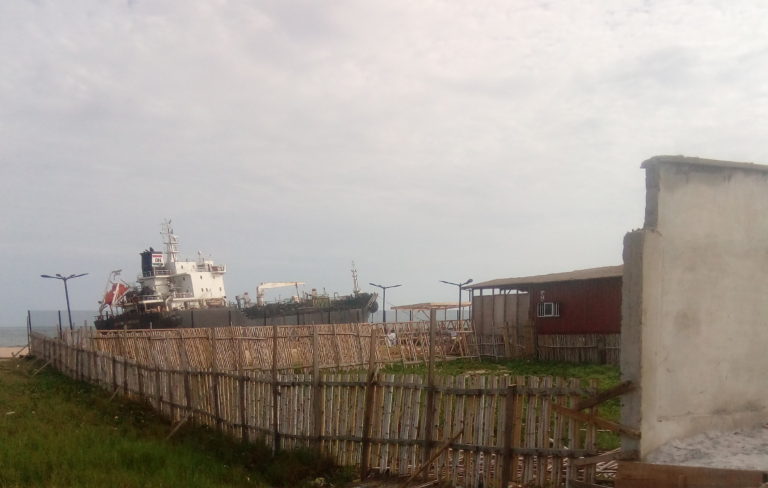
But MT Anuket Emerald’s case appears to be an exception, as the ship has been spotted twice, docked in Elegushi Beach, a private resort in Lekki, Lagos State, engaging in a yet another suspicious transaction.
As earlier reported by The ICIR, the Panama-flagged Ship was again sighted at Elegushi beach on Friday, April 19, carrying out some trans-loading operation.
At the distance of about 100meters, the vessel was seen being sucked off through six different pumping hoses, offloading its 1.5million tonnage content into waiting petrol tankers.
Most of the tankers were branded NIP Oil.
This reporter observed that the suspicious activities around the ship are being protected by the personnel of the Nigerian Navy, the agency mandated by the law to enforce the court judgment. The naval men were supported by the Elegushi special security operatives as well as members of Oodua People’s Congress (OPC).
Findings revealed that the ship’s operation may not only constitute economic sabotage; it also comes at a huge ecological cost to the environment as a huge measure of black oil were seen being discharged into the waters, thereby polluting the lagoon and endangering the marine lives in it.
On the stretch of about half of the beach shoreline, oil spillage, covering about as long as 12 fits in-between the waves and the shoreline was conspicuously seen.
Special factory rocks used to barricade the dangerous spots for picnic swimmers have all been darkened by the spillage.
Unsuspecting picnickers who dived into the water soon withdrew, angrily, when they notice oil stain on their bodies.
“Yes, I know the water is oily; too bad. But I have to swim. I travelled all the way to Lagos for the Easter Holiday and more particularly to enjoy the beach life here in Elegushi,” said Daniel, one of the frustrated picnickers sighted at the beach during this reporter’s visit.
But unlike Daniel, many other people won’t take such a risk.
“Who will go to Elegushi Beach again? God forbid! That beach that has been taken over by black oil,” said Miss Chidinma Nwapka, a Pharmacist and a one-time regular visitor to the resort until the Anuket Emerald birthed at beach disposing of its toxic content.
Bad business for beach traders
Nwakpa’s discomfort is shared by many others, including business owners’ at the beach, who are said to be operating under stringent conditions.
“We have complained to the authority about the oil spillage by the ship. But they didn’t take any action,” said one of the stall owners, who pleaded anonymity because of possible backlash.
“As you can see, this is Friday, Good Friday of Easter. On a good day, everywhere is supposed to have been taken over by picnickers, and we are supposed to be in good business.
“But beach lovers appeared to have all deserted us because of the activities of that ship that contaminate the water and ruin our businesses,” the business owner continued, pointing at Anuket Emerald Vessel, some 100 meters away as he vented his frustration.
As this reporter explores the beach, he called the attention of one of the commercial photographers at the beach to give him some photo shots, in an attempt to capture the image of the vessel, using it as a photo background.
As this was being done, a lanky, oil-soaked Hausa man came rushing, shooing them off.
“Please leave this place. Don’t put me in trouble,” he warned.
“Put you in trouble! How,” this reporter probed.
“See, the (Nigerian) Navy gave me instruction to make sure that nobody takes the photo of this ship or the offloading activities going on here,” he explained, begging us to leave.
The explanation that our reporter is a picnicker who just wants to enjoy himself and have a variety of beachside photos fell on the deaf ears.
“That is how they have been doing since January,” the photographer, who identified himself as Jamiu Adedeji, found his voice, accusing the Nigerian Navy of overzealousness.
“If they catch me photo shooting you near the ship, they will arrest me, arrest you and cease my camera,” Jamiu warned this reporter.
But the Nigerian Navy authorities has exonerated itself of any wrongdoing. Rather it said all enquiries should be directed to the Ministry of Justice, which it claims is supervising the operation.
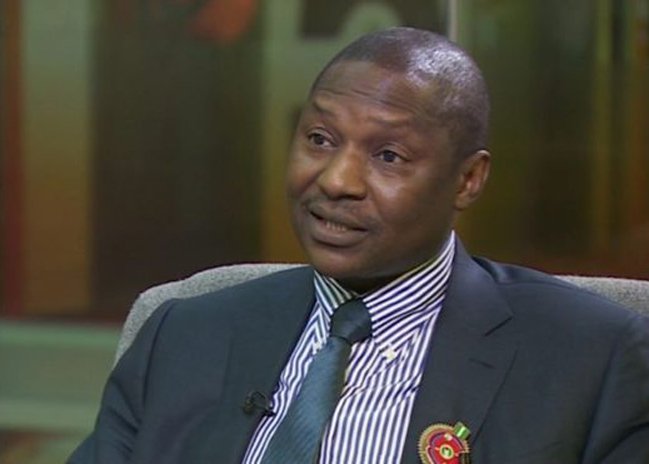
File photo: Attorney General of the Federation, Abubakar Malami (SAN) ordered the Navy to secure the ship.
Speaking with The ICIR on phone, the Director of Information for the Nigerian Navy, Commodore Suleman Dahun, who acknowledged that he was aware of the operation of MT Anuket Emerald in Elgushi Beach, explained that the Attorney General of the Federation, Abubakar Malami (SAN) is not only in charge of the operation, but expressly ordered the Navy to secure it.
“Actually, the whole process is driven by the Federal Ministry of Justice. The evacuation of the product in the vessel, to be specific, is being conducted by the Federal Ministry of Justice. The Navy’s responsibility is to ensure the physical security of the vessel, making sure it is not stolen or ambushed,” Dahun said.
The reporter asked whether the naval spokesman is aware of the conviction and forfeiture judgment on the said vessel, he said “yes, we are aware of it. And like I have said before, our role on it is restricted to ensuring the physical security of the vessel; nothing more nothing less.
“The evacuation of the content is being supervised by the Federal Ministry of Justice,” Dahun insisted.
Not satisfied, the reporter further asked whether the evacuation of the ship at Elegushi is preparatory to the enforcement of the court judgment, the Navy PRO’s response was less revealing this time.
“It would be better to seek more clarifications from the Ministry of Justice if you want to know more about the whole issue.
“What I know and been reliably informed is this simple fact that we [the Nigerian Navy] are responsible for the security of the vessel. Any legal or another dimension to it should be referred to the Ministry of Justice,” he added.
But there are mounting questions surrounding the legality of the operation of MT Anuket at Elegushi beach. Why has the ship remained on Elegushi Beach, a private resort in Lagos for the past five months? Why is its content being evacuated secretly and to where is it taken to? Why carrying out such operation in a private beach? Is the operation preparatory to the final forfeiture of the ship? How long does it take to impound a forfeited foreign ship and the process? These are questions yet to be answered by the concerned authorities.
On May 3 and 5, the reporter attempted to follow the trucks to their destination where they off-load the oil, but it turned out that the truck departs the beach only at night, making the surveillance difficult. One of the trailers is branded Total Oil, and the other branded IVECO.
The Minister of Justice and Attorney General of the Federation, Abubakar Malami (SAN), was contacted for an interview in order to verify the Navy’s claims on his ministry’s involvement, but no response was provided.
Calls, text and WhatsApp messages sent to his personal GSM were all ignored.
When contacted, Spokesman of the Economic and Financial Crimes Commission (EFCC), the agency that investigated and led the prosecution of the convicted ship, Tony Orilade, was not forthcoming about the MT Anuket Emerald Ship. He told The ICIR that he was not familiar with the matter but asked for time to make proper findings and get back.
As at the time of filing this report, he was yet to get back with his findings.
However, a senior official of the Commission who pleaded for anonymity said the matter is far beyond the EFCC. According to him, the Office of the Minister of Justice and Attorney of the Federation had instructed the anti-graft agency to hands off the matter.
“The man in charge of the case explained the politics involved so much so that the Office of the Attorney General of the Federation came up with a letter purported to be from the presidency instructing that we hand off the matter,” he said.
“The minister came up with a letter from the presidency that ought to be for a specific directive and now he is using it for the general directive.
“Once it happened that way, there’s nothing we can do, said the EFCC official who apparently was lamenting the tight corner the Commission has been boxed into by the Minister’s directive.
The EFCC source also noted that there has been an age-long rivalry between the Commission and the Office of the Minister of Justice and Attorney General of the Federation over the handling of high profile cases.
“It happened when Aodoaaka was the Minister, even when Adoke was the Minister and now it is repeating itself,” he lamented.
“They always don’t give the Commission free hand to work. That’s where we are.”
The Office of the Minister of Justice and Attorney General of the Federation has in recent past taken over high profile cases from both the EFCC and ICPC. Many of such cases have been settled out of court and a similar fate may be waiting for the MT Anuket Emerald Ship’s case.
Government officials stonewalling
The Nigerian Ports Authority’s Marina headquarters was also visited in the course of this investigation.
The NPA, which assumes the Landlord duty of all the nation’s seaports, in spite of whatever concessions that may be in place with private operators, was contacted to understand why the MT Anuket Emerald Ship chose to offload its content at a private beach, having been convicted and forfeited to the government of Nigeria.
Suwaid Isah Ali, Assistant General Manager, Corporate and Social Responsibility, Industry and Port Promotion of NPA, declined to give an answer.
Ali, who noted the inquisitions on Friday afternoon, April 26, promised to forward same to NPA central operating centre where all inbound-outbound Ships are being monitored; and get back to us.
According to him, “…we are working on your questionnaire and hopefully, we should be responding soon…”
He has not gotten back as at Monday, May 21, 2019.
Also, the Nigerian Maritime Administration and Safety Agency (NIMASA), the body responsible for the administration of the nation’s marine activities, including the safety and security of the waters, was contacted over the estranged vessel.
But the agency also appeared clueless on the matter, as it offered no scintilla of useful information on the inquisition.
Instead, its public relations officer, Isiche Osamgbi, who initially told this reporter that he would “check the data and revert” regarding questions sent to him on Thursday, April 24, never did as at Friday, May 21, 2019. He didn’t pick his calls afterwards.
Mr. Okoi Obla, Chairman, Presidential Special Investigation Committee on Public Property (SPIP) was contacted on phone by The ICIR on the matter and he promised to confirm same with the Ministry of Justice before getting back.
He has not got back as at the time of filling in this report. All the calls put through to him afterwards were also ignored.
As one of the partakers in the suspicious transaction, the Palace of the Oba of Elegushi, HRM, Oba Saheed Elegushi, when contacted, gave some “responses” that were never consistent with facts available.
According to the Personal Assistant to the King, Mr Temitope, “the ship in question had some technical issue, which resulted in the break [at the Beach]
“All the relevant agencies of the Federal Government are aware and making efforts to move it away…,” he said.
Meanwhile, a frontline Maritime Lawyer, Barrister Osuala Emmanuel Nwagbara has pleaded that it was in the interest of the public good for the government officials to educate Nigerians and be transparent accordingly on the status of the said ship.
Nwagbara, one of the maritime arbitrators in the country explained that “a ship is a chattel and like any other chattel, once it is forfeited, it becomes the property of the beneficial country.”
According to him, “It is very important to state that once a ship is forfeited, being a chattel, possession is immediately taken of it for the purpose of control. It would be unlawful to allow any person to trade with such a vessel on a commercial basis.”
Nwagbara added that “once a vessel is forfeited to a country, especially Nigeria in this case, the law allows two things to happen. One, the government may appropriate such vessel to public use such as deploying it to the Navy as a sovereign asset or for a specific public purpose.
“The other thing that may happen to a forfeited vessel is that it is sold through an open and transparent bidding process. Any person who buys such ship is free to put it to commercial use as the person deems fit.
Calling for further investigation into the matter, Nwagbara said his sense of curiosity was aroused by the report of the ship’s activities at Elegushi Beach, given “the fact that government does not engage ordinarily in the commercial distribution of petroleum products in such manner report.”
Meanwhile. many tankers are still being driven to Elegushi Beach almost on a daily basis to get a refill from MT Anuket Emerald, and the detail of the operation remains a secret.
“IT’S like a pharmacy in here,” said Atoo, 43, attempting to break the ice as he welcomed visitors into his living room in the Apo Resettlement area of Abuja, the federal capital city.
On the armrest of a Chesterfield sofa lied a drug sachet containing vitamin C tablets. And right across the room was a green desk with an eye drop, a number of other drug packs, prescription notes, and a polythene bag from a popular pharmacy.
Three days before this visit, Richard Atoo had been a victim of armed robbery carried out by men who disguised as taxi drivers and passengers. By the time they were done with him, Atoo was left with over 30 knife wounds that nearly ended his life.
His right eye was still bloodshot while adhesive bandage covered almost all of the left section of his head.
“I least expected that I’ll fall a victim,” he said.
A mass communication graduate of the University of Jos and father of two, Atoo has been in and out of Abuja since 1994 and decided to settle in the city to work in 2007 because of the many opportunities. And not once in all those years was he ever robbed, until the night of Tuesday, April 23.
The time was minutes to 8 pm. Tired and heading towards the Area 3 junction, he had flagged down a taxi along Ogbomosho Street, Area 8, Garki. The cab appeared to have two passengers, one sitting beside the driver and the second at the back. Nothing about the men or the vehicle appeared suspicious, but as soon as Atoo boarded, the tinted glasses were wound up.
He was pinned down by the robbers. Men, well-built and in their late 30s, forcefully collected his two smartphones and searched for bank alerts. Their victim’s Automated Teller Machine (ATM) card was however not on him, and so they could not withdraw the huge sums of money they saw.
“I guess that infuriated them,” Atoo said, fidgeting with a bandage plastered above his lip. “They started stabbing me in many places. They had a gun too. I think at a point they thought I was dead because there was blood all over the car. The whole place was messed up. Anytime they struck me, I would feel blood splattering everywhere!”
After snatching his cash and phones, worth well over N100,000, they pushed him out of the vehicle roughly at the same spot he was abducted. No one helped him despite his cries until a taxi driver pulled over, picked him up, and dropped him at the gate of Wuse District Hospital, where they stabilised him, sutured his wounds, and prescribed medications.
His only regret from the entire experience, he lamented, is that he could not get the phone number of the taxi driver who saved his life.
A sustained increase
One chance robbery is a growing threat to security on the streets of Abuja. Residents of the capital city lose their assets to the criminals nearly every day. From the accounts of victims and hospital sources, the people robbed end up losing their phones, money and, sometimes, lives.
When asked how frequently Wuse District Hospital’s Accident and Emergency Unit receives one chance victims for treatment: “Everyday!” replied a healthcare worker. The medical director, Sa’ad Idris told The ICIR the hospital’s head of nursing also fell prey in April, two days to this interview.
Kubwa General Hospital. Credit: People Magazine/Bridgette Matjuda
Okey Mbaleme, a Consultant Orthopaedic Trauma Surgeon at the hospital informed this reporter they get an average of 20 cases each month一but “that would be conservative,” he made sure to add.
“It is a very very big problem,” Mbaleme said thoughtfully. “It is very rampant. It used to be seasonal, but now it has heightened. There has been a sustained increase.”
The hospital at times can admit as many as two or three victims in a night. Some of them sustained severe injuries to their brain, deep fractures, spinal cord injuries, paralysis, trauma, and “terrible cuts”.
An optometrist at the Kubwa General Hospital, who for safety concerns asked not to be named, also confirmed the frequency of the attacks, adding that her cousin was recently assaulted by the criminals, and lost her savings.
“The rate at which we see victims in this eye clinic is too much. The thing is too much,” she said repeatedly. “It is alarming and it wasn’t like this in previous years. Something needs to be done.” She noted that robbers often go for the eyes in attacking their victims and some of the patients become permanently blind after the incidents.
The dark spots the robbers frequently operate include Wuye junction, Galadimawa roundabout, Gwarinpa junction, Federal Housing junction Kubwa, Wuse Market, Area I, Airport Road Lugbe, among others.
Different tactics, same goal
One chance robbers have two things in common. They all make use of cars and are after their victims’ money or other valuables. Though their tactic varies; it is aggressive. Most victims report that the attackers are within the age bracket between 20s and 40s.
At times they make use of Point-of-Sale machines to withdraw from their victim’s account, and at other times they use ATMs while the account owner is still taken hostage. Often, they operate in the early morning hours, or early evening from 6 pm till late into the night.
They either make use of private cars disguised as taxis or, green commercial taxis registered in Abuja. The car could have only men as passengers or include one or two females to reduce suspicion, a trick that worked in the case of Roheemat, a fashion designer when she boarded what she thought was a taxi in April at Gwarinpa junction.
One chance either ply the restricted routes known locally as “Along”, or ride freely to specific destinations based on instructions. On one Tuesday night in 2015, Chidinma Okwudiri, a media consultant and scriptwriter, was a victim of robbers who fell into the second category. It was a commercial taxi, green golf car, boarded at Wuse II. Minutes into the trip, another person emerged from the trunk of the car and joined the passengers at the back seat. After beating her, the robbers snatched her bag, necklace, and wristwatch.
Okwudiri recalled her experience in the hand of the robbers.
“The driver was struggling at the trousers trying to take it off. I didn’t know what he was trying to do, and that was the point when I got scared.
“When they got to an area in Zone III, the driver was on speed but they just opened the door and pushed me out of the car without slowing down. Then they sped off. I still have the scar on my right knee where I landed. It never left.”
There are also those who make use of taxis and reportedly charms commuters without resorting to violence. They try to convince their victim that one of them was able to steal a huge amount of money from a rich client or employer and then persuade him or her to accompany them to a supposed ritualist to “cleanse” the money so they could share equally. Counting on the greed or fright of their victim, the ritualist asks each of them to bring a sum of money for his services.
A female corps member, new to Abuja, who narrated her experience to The ICIR said she boarded one of such vehicles at the Central Business District in April, hoping to return to her host’s residence in Lugbe. One of the fraudsters, a lady, started discussing with her in Yoruba and convinced her to play along and leave since they would injure her since she might snitch. She observed that while the driver was a Northerner, the second passenger was an Ibo man.
She followed them to a remote area to meet the traditional medicine expert, “Mama Gwari’s son”, who asked them to bring N210,000 for the cleansing. She lied she did not have her ATM card, and convinced them to take her to Lugbe junction to retrieve the card in order to withdraw.
“This is our opportunity to become rich,” the lady passenger had told her in Yoruba during the return trip. “Even if you don’t have up to that N210,000, just bring N50,000. We can persuade the baba to collect it.”
Chigbo, nicknamed Simba, an area boy at Berger junction, one of Abuja’s most vibrant bus-stops, said though they do not know who the criminals are, they have ways of suspecting when they are operating. Usually, he explained, they don’t stay close to the bus-stops where there are crowds.
He added: “They only park along and say remain one, remain one. And sometimes when the passenger wants to enter, one of those inside would claim he has an injury, come down, and then they’ll put the new person in between four people. And then they often ask where you are going, instead of you asking them. If you say you are going anywhere, they would say they are going there too.”
Passed on
Not all victims have been lucky, as Atoo. In December, one of the ushers at the EYN Church of the Brethren, Utako, died on the way to the hospital after he was robbed and stabbed. He had gone to Apo to drop his car with an auto mechanic for repair, called his wife to inform her he would soon be home but fell into the wrong hands. The pastor-in-charge and chief security declined to speak on the incident “because of its security nature”.
Another resident whospoke to this reporter disclosed that his neighbour also lost his life around on December 20 to similar circumstances. He explained that, having lost their breadwinner and a sense of safety, the family decided to relocate from Abuja.
Then again, three days to Christmas, a young lady posted to Abuja for the compulsory National Youth Service Corps scheme became a victim. On December 14, she was abducted by the mobile armed robbers and shot after she was shoved out of the vehicle. There are numerous other cases of lives lost to the menace, most of which do not make the headlines.
FCTA painted taxis sometimes used for “one chance” robbery
Traumatised
Some of those who escaped death in the hand of one chance robbers show signs of emotional distress, hyperarousal, and hypervigilance. Atoo, for instance, mentioned that he has felt jumpy since his close shave with death.
“When I sit down, I have a feeling like they are grabbing me,” he said with an upset look. “You know, I will just jump. And I’m still feeling it. I’m still feeling it … The shock is still very much alive.”
Joseph Olayanju, administrative manager at the International Centre for Investigative Reporting who was robbed on March 14 and battered on the face, related similar experiences. He is afraid of being close to other humans, except people he trusts or knows.
“Anytime I find myself in a commercial vehicle, the next thing is I begin to assume the people inside are criminals,” he said. “Then if I’m going to Kubwa, when I look in a vehicle and the people appear normal, I quickly enter regardless of where the car is going, even if it won’t get to my destination.”
Olayanju added that, unlike in the past, he has learnt to leave the office early and feels uneasy anytime nightfall approaches.
It takes time before many victims recover emotionally. Okwudiri estimated that she was messed up by the incident for at least “one good month”. “I was traumatised badly. I lost some weight. I was a walking shadow of myself for a while,” she said.
For over two weeks, she could not sleep without a knife under her pillow and a friend had to remove it. Now, she checks the driver’s seat and trunk before boarding any taxi.
“It has happened that at times when I tell them I want to see their trunk they just speed off. It happened to me two or three times,” she added. “Still, when I enter a car at night, I’m always at alert. Everything in me is alert. I want to see anybody’s next move and what is going to happen. Even if I check the trunk and everywhere else, I am always very alert.”
Nine in 10 residents have been victims or know someone who was
As many as nine in 10 residents of Abuja who participated in a poll conducted by The ICIR, to measure the prevalence of ‘one chance’ incidents in the city among other indices, have either had an encounter with the robbers or know someone who has.
15.6 per cent of the respondents said they themselves have been victims of the menace, while 59.4 per cent replied that they know persons who were victims. 12.5 per cent said they have both been victims and know others who have as well, and only 12.5 per cent belong to none of the categories.
Seven in 10 (66.7 per cent) of the respondents said they do not “feel safer living in Abuja today, compared to previous years”. Only 8.3 per cent replied otherwise, while 25 per cent is undecided.
On the effectiveness of the Nigeria Police in tackling the crime on a case to case basis, 66.7 per cent of the relevant respondents said the police were not helpful “at all” in tracing the criminals and recovering stolen assets. No one thinks the police were “very helpful”, 3.3 per cent said they were fairly helpful, and 30 per cent said they did not bother to contact them.
Some of the victims who spoke to The ICIR complained of the police not following up on information provided by them, and others fear that going to the police will only cause them to lose money in two places without obtaining justice.
Maliq Aina, whose sister, Aishat,was robbed of N500,000 in March, said they gave up hope of getting back the money after noticing the police’s strange reluctance to act—though they had gone to the bank to temporarily freeze the recipient’s account, identified the account owner and got his picture from the ATM security camera, and also paid a lawyer N100,000 to get a court order.
“The police was informed of the incident and were given the criminals name and picture for easy identification but they claimed they couldn’t apprehend them,” Aina told our reporter.
“The interesting part is when we got a court order for the reversal of the money and we thought we were the only one who had the copy, we discovered the police somehow had it too. And when the bank said the money is no more there, they [the police] went silent about it.”
GT Bank confirms withdrawal and sends image of robber to Aina’s lawyer
Abuja streets: a safe haven for crime
The inadequacy of streetlights in Abuja may have contributed in no small measure to the rise of criminal activities in the city. Many parts, including major road networks, are dark at night.
The reporter observed this trend for instance on the Murtala Mohammed Expressway linking Berger junction to Kubwa, a route particularly notorious for frequent one chance attacks. While a couple of the streetlights at the junction are working, a major part of the road stretching to Kubwa, a trip of over 30 kilometres, are dark.
A few street lamps are still functional around Gwarinpa junction, one km after Starview Palace Hotel, but the rest of the road is dark except for illumination from roadside filling stations, halogen lamps from nearby factories, and headlights of passing vehicles.
Vendors at Berger junction confirmed that the police patrol vehicle stationed at the area often parades on the Berger-to-Kubwa lane in the night. However, taxi drivers, including James who has travelled the Berger-Kubwa route regularly for over five years, said not once have they been stopped by policemen on the road for a random security check.
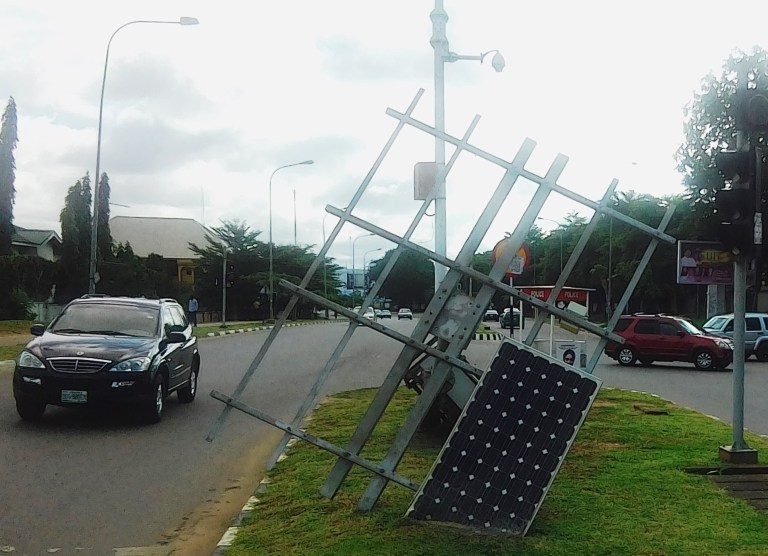
The absence of Closed-Circuit Television (CCTV) cameras also has contributed to the difficulty in tracking and arresting robbers. The ICIR reported in 2017 that security cameras planted on major roads in Abuja did work for long after their installation, though as much as N76 billion was spent on the project. Many of them have since been vandalised and stolen by hoodlums.
A bank source, however, told the reporter that, in cases where ATMs are used to withdraw from the victim’s account, the face of the culprit is captured by the machine’s camera and this image may be requested for by the account owner or police. Where a transfer is made instead, the recipient’s account can be frozen for a maximum of 48 hours. A court order is required to either extend the freezing period or reverse the transaction.
Damaged CCTV camera installed on major Abuja road, adjacent Radio House and International Conference Centre. Credit: ICIR/Yekeen Akinwale
In a bid to deal with the menace, the FCT Police Command recently established an Anti-One Chance Squad headed by a chief superintendent of police. But the squad is yet to nip the crime in the bud.
Danjuma Tanimu, the Command’s Deputy Public Relations Officer, told this reporter the police is doing all it can to arrest the robbers and raise awareness among the populace on how to remain safe. He also said they enjoy a good relationship with the commercial banks, from whom they get useful information.
“We have strategic checkpoints across the city,” Tanimu said in response to a question about preventive measures. “We provided more Rapid Response Squad (RRS) vehicles. If you go round, you will see them. They are there, except if there is an emergency they must attend to.”
Asked if he thinks the lack of functioning CCTV cameras is impeding the fight against one chance, the deputy PRO replied in the negative.
“That we don’t have working CCTV is not contributing to one chance,” he said after a brief pause. “If an individual has the mindset to commit a crime, he will commit a crime. If the CCTV is not working, we have our gadgets like walkie-talkie. It’s working 24 hours … So CCTV cannot stop police from checkmating the activities of criminals.”
He urged the public to inform the police anytime they see something suspicious and assured them of the officers’ readiness to act promptly. Police emergency numbers that may be called include 09052397880, 08024130926, 09051488448, and 07014951751. “The moment they call, they will be connected to the control room, which is available for 24 hours.”
‘The FCT administration is fully aware’
The FCT Administration’s Director of Security, Adamu Gwary, has said the government is “not unaware” of the emerging trends and the FCT minister has recently approved certain proposals aimed towards finding solutions.
“The minister has directed the commissioner of police to come up with remuneration in terms of financial inducement to those who provide actionable intelligence on criminal hideouts or black spots within the FCT,” he said.
He disclosed that the administration is also partnering with media organisations, such as Brekete Family and Sports Radio, to better inform and orient residents, as well as sister agencies in neighbouring states. He mentioned a surge in population as a possible factor that has led to increased criminality.
Gwary also said there are plans to better regulate the operations of unpainted taxis, otherwise called kabukabus, and every driver will have to be registered under a licensed transport operator.
The FCT administration, he further noted, has taken special interest in deploying mobile streetlights to dark areas of the town, and also hopes to expand already existing pilot CCTV projects to other parts of the FCT.
“Very soon,” he concluded, “residents of the FCT will heave a sigh of relief with regards to issue of emerging security threats within the territory.”
Ifeanyi Ughamadu, PRO to FCT Transport Secretary, also agreed that the spread of unpainted taxis is a huge push to one chance incidents. The previous administration recorded some success in registering and regulating these cars but compliance has since dropped, he said.
He added that a meeting of stakeholders in the transport sector will be held in May. “The essence is to discuss all relevant problems in the transport sector in the FCT after which we will come up with resolutions that will be binding,” he said.
With all hands on deck …
The problem of one chance is one that can be cut back with the right amount of commitment, discipline, and collaboration between the public, government and security agencies. This is the view of Ben Okezie, a security analyst, columnist, and chief executive officer of BRANE Security.
Residents boarding taxis should note number plates, especially at the rear, and avoid vehicles in which the boots and back seats are connected such that someone hiding in the trunk can easily batter the passenger.
“Then the security agencies, the police and Road Safety Corps, should ensure they are present on all those areas designated as Along,” he said.
He also urged the government to amend criminal laws to make sure vehicles used for robberies are impounded once suspects are arrested and prescribe severe penalties to dissuade criminals. It is also important to create jobs to keep the country’s teeming young population productive, he said.
Okezie stressed the need for research into modern methods and the incorporation of technology, especially security cameras and biometric data, into crime fighting.
“It is very important,” he added. “What electronics can do is greater than what 100 or 500 policemen can do. We should invest in it.”
Mbaleme also pointed out the need to have universal health insurance coverage so that victims can get immediate attention from all hospitals, and then a public transportation network to reduce reliance on private cabs.
A faceoff seems to be brewing between the National Financial Intelligence Unit (NFIU) and state governors following a directive by the former that governors would no longer be allowed to access funds meant for local governments in their states.
The NFIU had set June 1, 2019, as the take-off date for the new regulation but the governors, under the aegis of the Nigerian Governors’ Forum (NGF) would have none of it, insisting that the NFIU was reaching beyond its authority.
Both the NFIU and the NGF are quoting sections of the Nigerian constitution to back their arguments for and against the new regulation.
In a statement on May 15, the NFIU said its directive to banks to ensure that governors no longer have access to LG funds was based on “its understanding of the 1999 constitution that no debit is allowed on any local government funds unless and until the funds are credited to and reach the bank accounts of a local government in any state of the federation”.
However, in a petition to President Muhammadu Buhari, Governor Abdulaziz Yari of Zamfara State, who is also the Chairman of the NGF, accused the NFIU of “stoking mischief and also deliberately seeking to cause disaffection, chaos and overheat the polity”, and urged the President to order the Unit to quit “encroaching on or even breaching constitutional provisions”.
What the constitution says about revenue allocation
Section 162 of the 1999 constitution prescribes how revenue should be distributed between the three tiers of government namely, the federal, state and local governments, as well as the judiciary.
Sub-sections three to eight of Section 162 read as follows:
(3) Any amount standing to the credit of the Federation Account shall be distributed among the Federal and State Governments and the Local Government Councils in each State on such terms and in such manner as may be prescribed by the National Assembly.
(4) Any amount standing to the credit of the States in the Federation Account shall be distributed among the States on such terms and in such manner as may be prescribed by the National Assembly.
(5) The amount standing to the credit of Local Government Councils in the Federation Account shall also be allocated to the State for the benefit of their Local Government Councils on such terms and in such manner as may be prescribed by the National Assembly.
(6) Each State shall maintain a special account to be called “State Joint Local Government Account” into which shall be paid all allocations to the Local Government Councils of the State from the Federation Account and from the Government of the State.
(7)Each State shall pay to Local Government Councils in its area of jurisdiction such proportion of its total revenue on such terms and in such manner as may be prescribed by the National Assembly.
(8) The amount standing to the credit of Local Government Councils of a State shall be distributed among the Local Government Councils of that State on such terms and in such manner as may be prescribed by the House of Assembly of the State.
It does appear, going from the sections of the constitution cited above, that state governments are in charge of local government funds and disburses to them according to the prescription of the state assemblies.
There is no particular clause in the National Financial Intelligence Unit Act (2018)that gave the Unit express authority to determine how states and the local governments under them manage their funds.
Arguments for and against the new guidelines
Spokesperson of the NFIU, Sani Tukur, in an interviewlast week, maintained that the NFIU has authority, based on its enabling Act, to issue the guidelines.
“Any bank that connives with governors or local government chairmen to breach the directives will face the necessary sanctions,” Tukur said
He also added that if an international fraud was committed using the joint state and local government account, international anti-graft agencies could sanction the financial institution in which the account was domiciled instead of sanctioning Nigeria as a country.
Tukur maintained that the NFIU was not advocating for the abolition of joint state and local government accounts. “That account has a constitutional backing,” Tukur said. “What we are pushing for is that the account should not be used by state governors for withdrawals and payments; it should be used for the distribution of funds to local government councils.”
The National Union of Local Government Employees (NULGE) also supports the move for LG autonomy. Ibrahim Khaleel, NULGE’s National President, said the NFIU directive was in order and did not contravene the constitution.
“The guideline issued by NFIU is to protect funds that are allocated from the federation account for the development of LGAs from unnecessary diversion and siphoning by governments of the state. If any state government is not comfortable with this guideline, it means the state government is tampering with funds meant for the LGAs because if it is not so, it will not have any reason to go against what the guideline is talking about,” Khaleel was quoted by ThePunch as saying.
However, the PDP Speakers’ Forum agrees with the NGF that the NFIU had no business interfering with how states disburse funds to the local governments under them.
“They (the NFIU) are meddlesome interlopers. They are going into an area they have no jurisdiction over and my advice is that the Federal Government and the National Assembly should focus more on creating a true constitutional autonomy for local government areas,” said John Gaul Lebo, a lawyer and the Speaker of the Cross River State House of Assembly. Lebo is also the chairman of the PDP Speakers’ Forum.
“NFIU is not the National Assembly and, therefore, cannot make laws. They cannot give a deadline on such matter because the constitution does not recognise NFIU for that,” Lebo told ThePunch.
THE Economic and Financial Crimes Commission (EFCC) says it saved Imo State about N5 billion that would have been used by the incumbent governor, Rochas Okorocha, to influence election results.
According to the head of EFCC’s South East Zonal Office, Usman Imam, the money was part of the N8 billion Paris Club Refund paid to Imo State by the federal government to assist it in the payment of workers’ salaries.
Imam, during a chat with journalists, said Okorocha had deliberately refused to use the funds for what they were intended only to start distributing cash a few days to the election.
He said the EFCC had initially prevented the governor from accessing the entire N8 billion, but following persistent pressure, the commission allowed N2 billion to be withdrawn for salaries to be paid.
“About N7.9 billion is what had been blocked, although with pressure, subsequently, about N2.5 billion was released for salaries,” Imam narrated to newsmen. “On the whole, we have over N5bn of those funds blocked; we are following up to see what actually happened.
“Honestly, what we discovered was that within two days, N700 million was withdrawn in cash; N200m on the first day and N500 million on the second day and all these monies were disbursed in a manner that was honestly unpalatable.
“Distribution to school teachers; I don’t know, schools that you were not funding and you woke up on the eve of the election and withdrew N500 million cash and start distributing N1000 each or so to teachers. Whatever that means, I don’t know.
“When we came in, we were able to save about seventy something million of the funds that we discovered were not disbursed, we also blocked it. People are still answering questions as to who asked them to move those monies, monies that were blocked at the banks.
“The sad story about this was that these monies were the intervention funds; the bailout funds that the Federal Government released to states to pay salaries when they were having problems paying salaries.
“They didn’t utilise that money to pay the salaries; they warehoused it and kept it until the election period, they started attempting to draw down the money.
“Whatever happens, we have saved over N5 billion of that money, as we talk, two weeks to handover. Probably, the next government would have that money to use it better.
“There are a lot of other general investigations going on in Imo right now.”
The Acting EFCC Chairman, Ibrahim Magu, had confirmedthat Okorocha is being investigated, but he would not give more details, saying that more information would be given at the appropriate time.
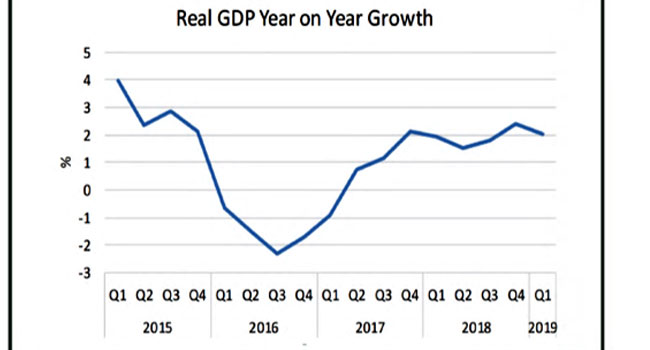
NIGERIA’s economy grew by 2.01 per cent in the first quarter of 2019 as the nation’s oil sector which is the economic mainstay shrank, according to records obtained from the website of National Bureau of Statistics, NBS, published on Monday.
The growth rate also called the Gross Domestic Product, GDP, is the benchmark for the size of the economy which is expressed quarterly to show a periodic measure of how the economy is faring.
Within the period, the non – oil sector grew by 2.47 per cent while the oil sector contracted by 2.40 per cent indicating a drop from the last quarter of 2018 pegged at 2.38 per cent which was likely to have been boosted by state spending in the run-up to February and March elections the report states.
“It is worth noting that general elections were held across the country during the first quarter of 2019 and this may have reflected in the strongest first-quarter performance observed since 2015.
“Aggregate GDP stood at N31.79tn in nominal terms. This aggregate was higher than in the first quarter of 2018 which recorded N28.44tn, representing a year-on-year nominal growth rate of 11.80 per cent. The aggregate was, however, lower than in the preceding quarter of N35.23tn, by -9.75 per cent,” the report reads.
The report for the first quarter of 2019, showed that the GDP grew by 2.01 per cent in real terms in the first quarter, compared to 2.38 per cent in the fourth quarter of 2018. While the growth rate in the first quarter of 2018 was 1.89 per cent appreciating by 0.12 per cent.
Real GDP is the economic output of a country adjusted for the effects of inflation.
The Central Bank of Nigeria, CBN, earlier in the year had predicted a forecast growth of 3 per cent for 2019 partly due to projections driven by higher crude oil prices.
Analysis in a Bloomberg report shows that a decline in growth could increase pressure on the Central Bank to cut interest rates further when it announces its policy decision which might increase lending rates.
The report also revealed that the non-oil sector contributed 90.86 per cent to the nation’s GDP in the first quarter of 2019, which is slightly higher than 90.45 per cent recorded in the first quarter of 2018 but lower than the fourth quarter of 2018 which was put at 92.94 per cent.