The Nigerian National Petroleum Corporation, NNPC, on Tuesday announced that its annual payments into the Federation Account in 2018 surpassed its projections in the 2018 budget with over N41 billion.
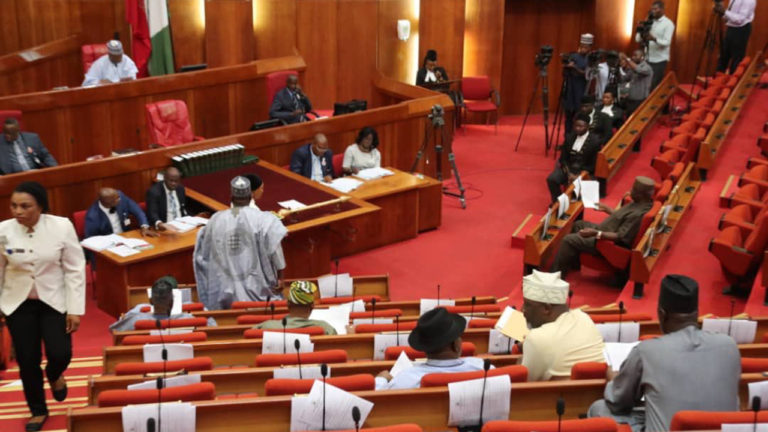
The Managing Director of NNPC Capital, Godwin Okonkwo, representing the Group Managing Director, Maikanti Baru, during a presentation to the House of Representatives Ad Hoc Committee on the Investigation of the Non-Remittances of Funds to the Federation Account by the Nation’s Oil firm between July 2017 and December 2018 made this disclosure during the hearing.
He stated, that the corporation remitted N1.26 trillion as against the estimated N1.22 trillion in the 2018 budget.
In a statement, Ndu Ughamadu, NNPC spokesperson quoting the GMD hinted that against the 2.3 million barrels per day, mbpd, proposed in the 2018 budget, the national daily production for the period under review averaged between 1.9mbpd and 1.89mbpd.
Baru stated the two sources of inflows into the Federation Account from the NNPC which includes equity crude oil sales, less cost of recovery from the Joint Venture, JV, cash call arrears and domestic crude less cost of recovery.
“The current management of NNPC ensures it contributes to the cost of the production of crude oil and gas in the upstream sector to avoid a repeat of the mistakes of the past. If we had made cash call payments in the past, the arrears we are liquidating now would not have arisen.
“The current situation creates a win-win scenario for the country. The NNPC is strategically saving for the rainy day to make a better future for all of us by liquidating the arrears,” Baru said.
He said the NNPC regularly balances its books with the Federation Account Allocation Committee, FAAC, and the JV cash calls in order to make sure that the future generations do not suffer from the legacy debt.
Legacy debts simply refer to debts that were incurred and inherited as part of an asset.
He said the NNPC had cleared its backlog of unaudited account, stating the delay was from Joint Venture partners that were being awaited to turn in their budget performance for the 2018 budget circle to be completed.
Chukwuka Onyema Wilfred, Chairman of the Ad Hoc Committee, praised the NNPC for responding to all the issues raised, adding that the interface would go a long way to putting to rest allegations of non-remittances of funds against the NNPC.
In a related development, Ndu Ughamadu, NNPC Group General Manager, Group Public Affairs Division rebutted claims that the NNPC exempted people living with disabilities from its ongoing recruitment exercise according to a report.
“We have a corporate policy here and we do employ many of the physically challenged persons in the corporation. We have one with us here at the corporate affairs division.
“We have them accommodated also in this ongoing recruitment and also under our Corporate Social Responsibility, CSO, we have helped a lot of the physically challenged especially in the Niger Delta area,’’ he said.
THE federal government has again filed terrorism charges against Jones Abiri, a journalist based in Yenagoa, Bayelsa State, months after he was released from illegal detention.
Abiri was arraigned in court on Wednesday on fresh accusations of terrorism, economic sabotage, and fraud, according to court papers made available to Premium Times by his lawyer, Samuel Ogala.
The journalist was alleged to have sent text messages to officials of Shell and Agip, two international oil companies operating in Bayelsa State, threatening to blow up their infrastructure if they refused to meet his demands.
Abiri was also accused of actually leading a gang of militants to blow up pipelines in Bayelsa.
Recall that Abiri was abducted by operatives of the Department of State Services (DSS) in 2016, and was kept incommunicado in custody for two years. It took a media outcry before the government charged him to court in July 2018 on trumped up charges of terrorism and criminal intimidation.
Before and after pictures of Jones Abiri, shortly after he was released in July 2018, two years after he was arrested by the DSS in July 2016.
The government, through the Minister of Information and Culture, Lai Mohammed, at the time, claimed Abiri was not a journalist as he did not belong to the Nigerian Union of Journalists. Mohammed said Abiri was arrested for his involvement in pipeline vandalism, crude oil theft, and militant activities in the Niger Delta.
The truth, however, according to reports, was that Abiri’s arrest had to do with a story he published via his local newspaper, ‘Weekly Source’, with the headline: “Governor Dickson’s bad policies wreck Bayelsa”. Another headline in the publication read: “Rumble in the military… Inside the coup plot story”.
The publication that got Abiri arrested in July 2016
Abiri was later granted bail after which he filed a case in court demandingthe DSS to pay him N200 million in damages for illegal detention. The court gave judgement in his favour, orderingthe DSS to pay him N10.5 million.
It is not clear whether the DSS has obeyed the court order. However, Abiri was rearrestedin March this year, snatched at gunpoint by men suspected to be DSS operatives and whisked away.
Kingsley Ladein, also a Yenagoa-based journalist who witnessed the arrest, said a white Hilux and black jeep pulled out from Ayabowei Plaza and armed men jumped out, threatening to shoot Abiri if he moved.
“The guns they carried were similar to those carried by the secret service,” Ladein said.
The Federal Government boasts regularly that it feeds primary school pupils with 594 cattle, 138,000 chickens, 6.8 million eggs and 83 metric tons of fish on weekly basis. It is confident that pupils get a balanced diet. In this report, the first of a six-part, multi – newsroom investigation, on the Federal Government’s school feeding programme, YEKEEN Akinwale, who visited the Southwestern states of Ondo, Oyo, Ogun and Osun states, discovered among other things that what the pupils are fed is far from being balanced.
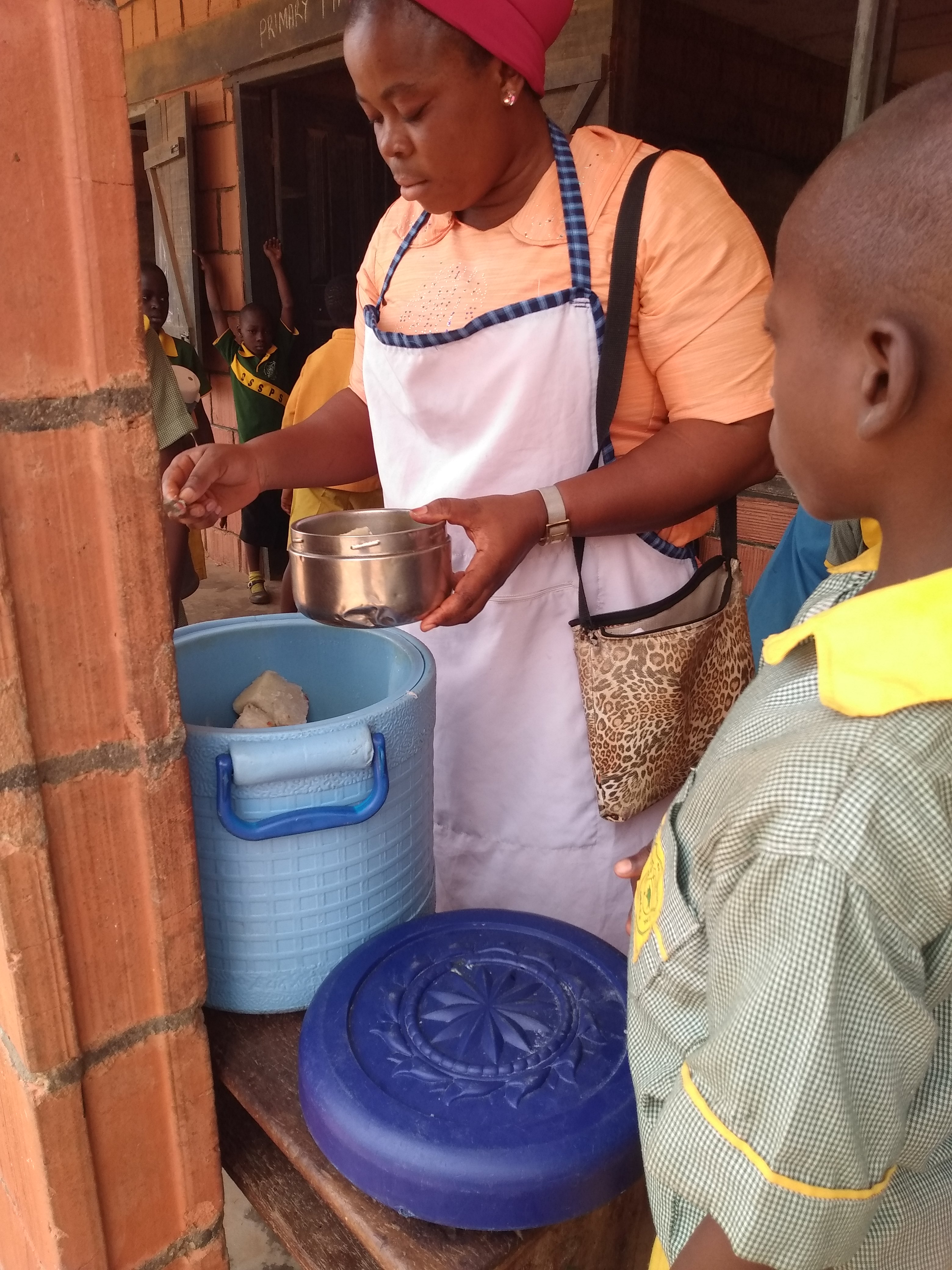
ONCE her motorbike races into the expansive premises of St. John Anglican Primary School, Oba-Ile, Ondo State, Olorode Solape becomes a pupils’ delight.
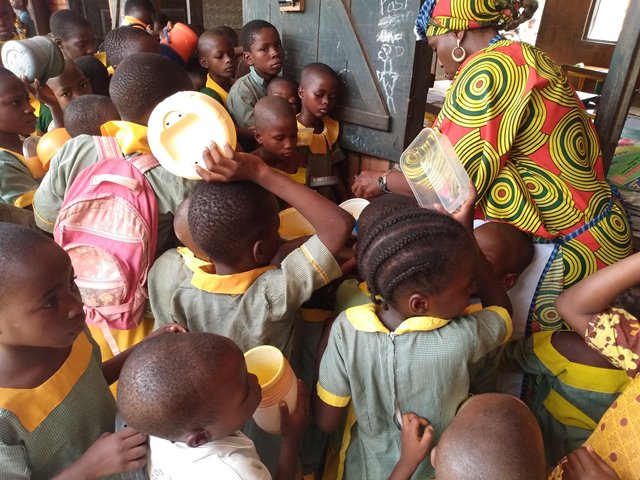
The sight of coolers loaded with food is what delights the kids. Right from the main gate of the school to where the motorbike halts to offload food containers, pupils would run after her.
The kids are always happy to see her with coolers loaded with food —because they know it would soon be time for them to queue for food — the food is meant for them.
Solape is the only one of the two vendors assigned to the school still on duty —her counterpart stopped coming around a long time ago.
“The second person came briefly and we are not seeing her again,” she reveals. The ICIR found out that the absentee vendor stopped coming to the school due to complaints about the quality of food she was serving the children. This was after the school’s Health Officer, Adeleye Deborah whose duties include checking the food daily lodged complaints about the quality of her food.
And for the pupils, there is no better moment than when the food is served—for that reason, food keeps them in the school even when any one of them is feeling sick, he or she would prefer to eat before going home for treatment.
“The food reduces truancy and absenteeism by the pupils,” Afolabi Olufunmilayo, Assistant Head Teacher of the primary school attests to the potency of the food to retain pupils in school.
No time like break time
There is no time like break time for pupils – they are always eager to get their food from the vendor. Photo Credit: The ICIR/YEKEEN AKinwale
Running after the food vendor and cheering her is a daily exercise for the pupils who are mostly those in Primary 1 to 3. For them, ‘Iya Olounje’ (food vendor) as they call Solape is their jolly good friend.
She is the reason most of them look forward to coming to school everyday, because, they will eat free food with cooked egg, fish or meat no matter the size.
The pupils no longer bring garri (a common staple food among the ordinary Nigerian) to school as they often did in the past, the Head Teacher reveals.
By 10 am every day—Monday to Friday—the food vendor is already in the school waiting for her friends (the pupils) to observe their break time. Solape serves food to 115 pupils—Primary 1 to Primary 3—under the National Home Grown School Feeding (HGSF) programme launched in 2016 by the administration of President Muhammadu Buhari.
She is one of the 95,422 cooks otherwise known as vendors engaged by the Federal Government for the HGSF programme which itself is part of a N500 billion funded Social Investment scheme announced by the administration to tackle poverty and improve the health and education of children and other vulnerable groups.
In Ondo State, there are over 1,000 vendors catering for about 78,000 pupils in public primary schools, according to Special Adviser to the Ondo State Governor on Public and Inter-Governmental Relations, Olubunmi Ademosu.
Misgivings by parents, teachers and pupils on the quality and quantity of food
The Federal Government says it is targeting to feed 24 million pupils across Nigeria under the HGSF programme that currently runs in 26 states of the federation. If it succeeds at reaching 24million pupils, it will make it the largest of its kind in Africa.
According to statistics released by Vice President Yemi Osinbajo, the government feeds public school pupils with 594 cattle, 138,000 chickens, 6.8million eggs and 83 metric tons of fish on a weekly basis.
But despite these claims of a huge number of cattle, chickens and metric tons of fish being fed to the pupils, many of them, including their teachers as well as parents, have reservations about the size of what is served on their meal as either meat, fish or chicken as well as the quantity. Each billboard that promotes the school feeding programme shows pupils with plates filled with food and recognizable meat or fish. In reality, however, this is not obtainable in many of the states implementing the programme.
This calls to question the claim of balanced diet served to the pupils by the Federal Government.
The ruling All Progressives Congress (APC) boasts that scheme is widely recognised for its multiple benefits for schoolchildren, particularly in low and middle-income countries. It says evidence shows that children are more likely to stay, attend and be able to learn through the provision of school meals.
Investigations by The ICIR confirm the misgivings that pupils and their parents have about the school feeding programme. Though they are happy that they are getting free meals, they argue that whatever is worth doing at all, is what doing well.
From Oyo, to Ondo and Ogun state, the size of meat, fish and chicken served on the food for the pupils has been a major source of concerns for teachers, the pupils and their parents.
Rachael Adebayo- She wants the size of the food and meat to be increased Photo Credit: The ICIR/YEKEEN Akinwale
But the kids are not keeping quiet about it. Nine-year-old Adebayo Rachael in Ondo State is at the vanguard of protest against the size of the meat and the quantity of the food.
For her size and intelligence, Rachael is not a kid to keep quiet when she is not okay with anything. Her petite size and witty candour speak volume of a brilliant girl with a potentially brighter future. She is just a Primary 2 pupil at St. John Anglican Primary School, Oba-Ile, in the outskirts of Akure.
She had finished eating her portion of the meal served by the vendor and decided to keep her classroom clean.
As Rachael sweeps the floor, she dishes out instructions to her peers not minding the presence of this journalist and a teacher standing nearby. The break time was nearly over.
“You carry this chair,” Rachael yells at a classmate, holding a broom in her right hand.
But as this journalist engages, Collins Ibro, a nine-year-old classmate of the little girl, who eats spaghetti instead of the beans served to all of them, a vocal Rachael interjects. “Sir, the food they are serving us is small,” she says, “They should make it more,” she adds.
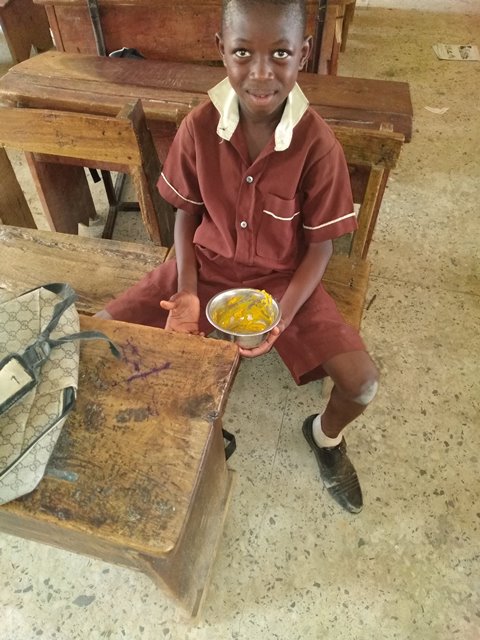
Truly, only two measures of a medium size plastic spoon are served every pupil by the vendor as a meal—the reason Ibro augments the meal with a plate of spaghetti his parent prepared for him. He says the beans would not sustain him till the time he would go home because he would also wait after school hours for extra-mural classes.
Collins Ibro brings extra food from home because the school meal is not enough for him. Photo Credit: YEKEEN Akinwale
Like Rachael—Ibro says there would be no need for him to bring a portion of extra food from home if the quantity of food served in school increased.
For the day’s meal, she and her peers in the school were served beans and crayfish stew. On that day, they were meant to be served their meal with a piece of fish, but across the state, no pupil ate fish as the vendors were not given fish at the designated place by the state government. Each time this happens, the pupils’ diet for the day is incomplete.
The supplier, it was found, could not make the fish available the previous day — so the vendors improvised by adding crayfish to the stew for the pupils. All the vendors spoken to at the two schools visited confirmed the aggregator did not supply fish for the day. Each state government selects aggregators as they are known to supply fish, meat, chicken and egg at subsidised rates for the school feeding programme.
It is not only the quantity of the food served that bothers the kids. They are also not happy with the size of the meat being served with their meal.
The billboard promoting school feeding where pupils are served plates filled with food, but in reality, the quantity of the food is a far cry. Photo Credit: YEKEEN Akinwale
“The meat make e big, write am down sir” says Rachael wittily with a broad smile on her face. “The meat is small ‘kulukulu’ like ‘eku’, like rat, she makes jests of the size of the meat.
In Oyo State, pupils are not given meat, fish or egg with their food on Monday and Friday. For those in Ogun State, they are not served any meat or fish on Friday when porridge is the meal for the day. This is according to the feeding roaster followed by the vendors.
On Monday and Friday in Ondo State, the pupils are served with their meal, crayfish and fish sauce respectively—no real meat, egg or fish on the meal.
Rachael and Ibro are not alone in their protests about the quantity of the meal.
Elsewhere at Ondo State Special Primary School, Airport Road, Akure, nine-year-old Ezekiel Thena who is in Primary 3 says his parent still gives him a token of N100 to buy confectionary like ‘buns’ or ‘puff puff’, to augment the meal served in school. Like his peers at St. John Primary School, the meal was served on that day was without fish despite being on their diet roaster for the day.
Emmanuel Thena eats a slice of yam served him with crayfish stew, the meal ought to come with fish but vendors were not supplied fish. Photo Credit: YEKEEN Akinwale
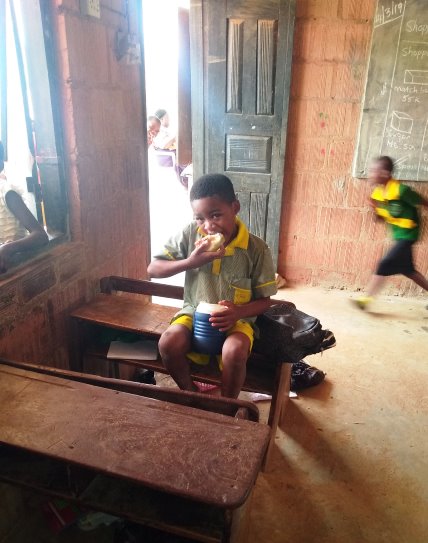
At the school, each pupil is served one piece of boiled yam—and Ezekiel who munches the yam sitting on a desk backing the classroom says, another piece of yam would not be a bad idea if he is given. He complains about the size of the chicken that accompanies jollof rice—his favourite—every Thursday.
The pupils were meant to eat plantain and fish stew that day, but they were served a mixture of yam and plantain because vendors could not get plantain in the market.
So, obviously, the government has to think of sustainable means of sourcing the food, including meat and fish, that the pupils are served.
“We were not given fish and yesterday we could not get plantain,” says Ajisafe Folake, one of the two vendors attached to the school. She serves 100 pupils. The other vendor, Ibrahim Oluwafunmilayo who serves 71 pupils daily in the school almost did not come that day because of the dearth of plantain.
“I didn’t want to come today because I couldn’t get plantain,” she explains. “I had to add yam to it, though yam was meant for Monday.”
“If I didn’t come, the pupils won’t eat and that would not be good,” the vendor adds.
The headteacher at the Special Primary School, Ayoko Olayinka Prosper, also has reservations about the quantity of the food given to the pupils, says she is satisfied with the quality. “The school feeding programme is okay,” says a very welcoming Prosper.
“The quality of the good is okay, but the quantity, let’s forget about that. But the quality is okay,” she stated. She is quick to point out the positive side of the school feeding programme—increase in enrolment.
“I can say that the programme is increasing pupils’ enrolment,” she quips as she rummages pages of the school registers to reel out the school population. “More parents are enrolling their wards now.”
“For instance, we had just 152 pupils in Pry 1to 3 in 2015/2016 academic session, but the population has increased to 169 in 2016/2017 just a session when the programme started,” Prosper reveals.
But the headteacher wants the programme to be extended to primary six. Presently, it caters for only pupils from Primary 1 to 3.
Truly, pupils in the lower classes are already keeping the food for their siblings in upper classes. Ifeoma Akeredolu, a pupil in Primary 3 keeps her own share of the food for her elder sister in primary 6.
The quality and quantity of the food notwithstanding, pupils were excited to eat in school without payment.
Once the bell rings for break time, pupils at both St. John and Ondo State Special Primary schools would rush out, form a long queue— each holding his or her plate—and stretch out same to the vendors to serve them. From Monday to Friday, this is a routine they repeat.
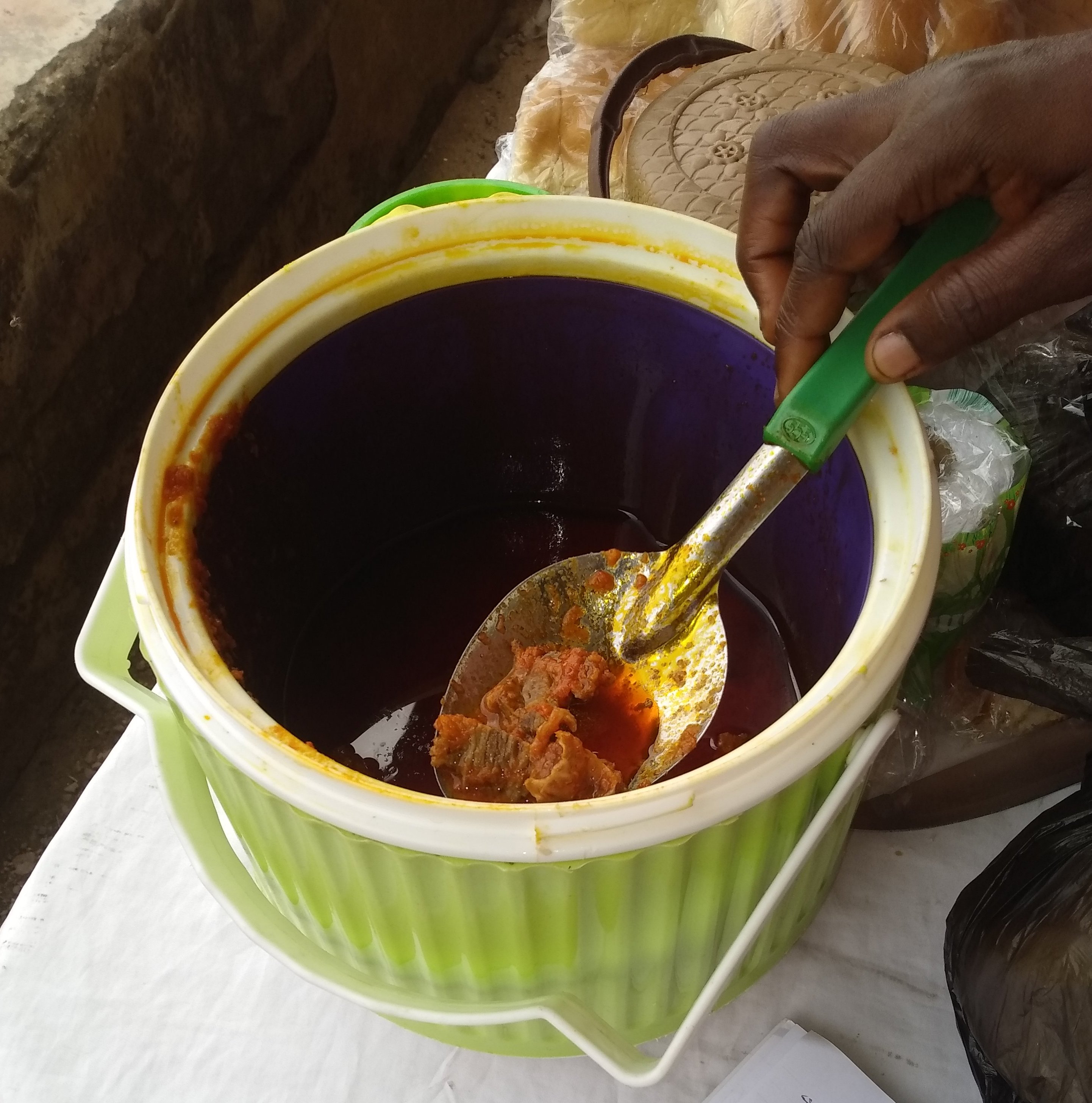
On Monday they are served cooked yam and crayfish stew, Tuesday it is white rice, vegetable soup and beef—“a tiny size beef,” says Folake, the food vendor at Ondo State Special Primary School. “You can hardly see the meat on the food.”
It is beans and egg on Wednesday, while the pupils are served jollof rice and chicken on Thursday. Friday is for plantain, stew and fish.
The quality of the food served the pupils though with ‘tiny meat, chicken and fish,’ cannot be compromised—each school appoints a health mistress or teacher who ensures quality control of the meal on a daily basis.
Where is the meat? The meat served on the meal is small that it is hardly visible. Photo Credit: YEKEEN Akinwale
It is only the quantity they cannot influence, as the vendors said they were instructed to give each pupil one and a half spoonful of food each day.
Though a number of parents are happy that the government is alleviating the hardship parents are passing through, they believe the quantity and quality of the food must be improved.
In Iseyin, Oyo State, a parent who simply identified himself as Bashorun, says the Federal Government should go back to the drawing board and set up a monitoring team on the school feeding programme if there was no one in place. The team, he explains, will monitor the quality of food served to the pupils across the country.
“In my own view, though I’m not in government, lack of proper monitoring accounts for this,” Bashorun says.
“If there is what they call checks and balances which I call monitoring, without checks and balances, you release the money, N100 per child do we monitor if they are actually given N100 worth of food?
“Is there any monitoring body to ensure that they are being served the expected quality and the issue of coming with personal plates in this modern-day, even in our own time we didn’t have takeaway plates but the government provided aluminium plates with cover.”
But the National Coordinating office of the programme says it has monitors who move around schools to verify what’s going on.
“There is a Federal Monitoring structure where we send monitors. They are called verification officers who are more like locals around there,” says the Programme Manager National Home Grown School Feeding Programme, Adesanmi Abimbola.
“They move around and visit the schools to ensure that everything is going on fine. We also have independent monitors who are Civil Society Organisations, CSOs, currently monitoring the school feeding programme. Then we also have the National Investment Social Office (NSIO) that also monitors all the social investment programmes.”
Bashorun is particularly not satisfied with the quality and quantity of the food the pupils are receiving which according to him is far cry from what used to be the free meal in public schools in the past. This, he blames on lack of monitoring by the government.
Apparently giving the government a spat on the back and also scolds it at the same time, he says, “I’m not trying to condemn the effort of government in totality but it is nothing to write home about.”
“Go and see what the children are being served even my dog cannot eat it. Is it the quality you want to compare? Is it the food itself? And you need to see the meat; it is not even up to my finger that they were being served,” They are being served rubbish,” Bashorun adds disappointedly.
“This is my own view. The government should go back to the drawing board. If it is not in place, it should set up a monitoring body that will monitor round the country, the quality of food being served.”
But Yakubu Yekini Kolawole—Chairman Parents Teachers Association (PTA) Army Children Primary School, Iseyin, is full of praises for the Federal Government for initiating the school feeding programme. He has two children in the school who are benefiting from the feeding programme.
The school feeding programme is actually not new in the Nigerian system—the government initiated the Home Grown School Feeding and Health Programme through the Universal Basic Education (UBE) Act 2014. The Act stipulates that, at a minimum, all state primary schools must provide one meal a day to each pupil.
After presiding over a PTA meeting in the school, the chairman notes that “the school feeding is a great relief for parents,” adding, “because it is quite hard for some households to eat once in a day. We thank God for providing the food for our children.”
Kolawole also affirms that pupils no longer run away from school. “God will continue to help the government, we are grateful to them,” he prays.
As the spokesperson of parents in the school, he confirms to The ICIR that “parents are complaining about the quantity of the food and meat each pupil is served,” “but you people should help us tell the government to improve on that.”
This is a sentiment shared by Kikelomo Oshibogun, the PTA Chairperson of St. Peters Anglican Primary School, Imosan, Odogbolu Local Government, Ogun State. For her, the school feeding programme couldn’t have come at any better time when many homes were struggling to provide three square meals.
She maintains that the meals represent a balanced diet for the kids, but the government, according to her must see to how the tiny size of fish and meat served the kids as protein on the meals can be increased.
“We don’t mind if they can increase the size of the fish and meat, because the food is working well on our children,” says Oshibogun whose three children attend the school.
Since one aggregator supplies fish to vendors in Ijebu-Ode and environs in Ogun State, it is not surprising that kids at St. Peters and Orphanage Primary School, also in Imosan are served with bean-sized fish on their meal.
According to Baoku Oluwakemi, a vendor attached to the Orphanage Primary School, the supplier cuts, packs and seals the meat and fish.
“They need to increase the size of the meat and fish,” she recommends. The vendors in the local government pick up meat and fish from designated suppliers. “We don’t cut or determine the size of the meat and fish,” Baoku adds whose food caters to 96 pupils in the school.
This could not have been a one-off incident; it is similar at Army Children School 3, Iwo- Road, Ibadan, Oyo State capital.
The size of the meat served the pupils on a day they are eating a loaf of bread each with meat and stew is comparable to the tip of a finger.
“The size of the meat is very small like a stone,” says, Salawu Kehinde, Head Teacher of the school. “Even at home, you don’t give children such tiny meat.”
The stone-sized meat – even the vendors complained about it. Photo Credit: YEKEEN Akinwale
She also laments that fruits no longer accompany the meal for the pupils unlike when it initially started. The ICIR gathered that pupils were enjoying fruits such as pineapple, watermelon served with their food, “but that has since stopped now,” says the Head Teacher.
But Toyosi Ajobo, the coordinator of about 3000 vendors in Oyo State defended the decision of the government not to allow the vendors to buy meat, fish and egg from the open market. She says the government was wary of feeding the pupils with adulterated meat or fish.
On the size of the meat, she says the size commensurates with the amount of money being deducted from the money paid to the vendors. “No, the meat size is not like a finger, it’s according to the body demands of the pupils. It’s enough for the pupils based on their age,” Ajobo argues.
When asked to explain why the pupils were not supplied plates by the government, she replies, “it’s not part of the programme to give pupils plate.”
Complaints by vendors—Real reason food quantity is small
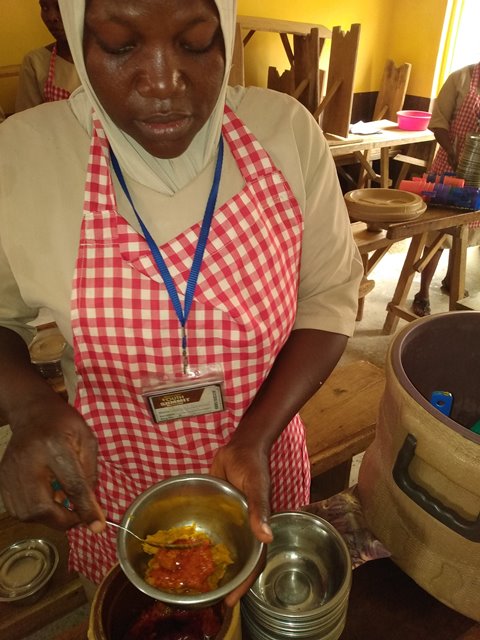
Vendors say they are not making profit from the school feeding programme. Photo Credit: YEKEEN Akinwale
Currently, a total of 95,422 cooks also known as vendors are engaged in the schools feeding programme. The government says it has empowered these cooks who are women but the cooks are not too happy with the social services they are rendering.
Besides the deduction which is the payment for the meat, chicken, fish and bread to the aggregators from the money paid to them, the payment often is not regular. The National office of the school feeding programme pays the vendors and aggregators directly. Each vendor is paid based on the number of pupils assigned to her.
From Oyo state to Ogun, Ondo and Osun—school feeding vendors are asking for a better deal. The government spends N70 per child under the school feeding programme in a day—out of this sum, money for meat, chicken, egg and bread are deducted —so what is left is used to prepare the food by the vendor.
So, in truth the N70 government says it uses in feeding a child per day is actually covers the cost of food items and payment of the cooks for their labour and transportation.
The vendors lament that what they usually have left is not sufficient enough to make any gain, because they are not paid a salary by the government.
They want a better deal from the government. Photo Credit: YEKEEN Akinwale
In order for them to be able to save money as their own gain, vendors confided in The ICIR that they struggle to spend the amount to prepare food for the children without compromising the quality.
“We are not paid a salary as vendors,” says Ogunlade Adeshola, a vendor at St. Peters Anglican Primary School, Imosan, Odogbolu Local Government, Ogun State. “It is from what they pay us that we get our own commission. That’s why the food is small.”
To prepare food for 98 pupils assigned to her, she is paid N53, 000 fortnightly.
Her argument seems to be weighty—she receives N106, 000 in 20 days to feed 98 pupils—the implication is that the vendor spends N54 to feed a child in a day. Invariably, N5, 292 is spent to feed 98 pupils in a day.
From the government’s claim of N70 per child in a day, it means that N16 is spent on fish, meat and egg while the balance of N54 goes into preparing the food. This leaves little or nothing for the vendor as profit.
Ajobo, the coordinator of vendors in Oyo State corroborates this. She says what is left for vendors after deduction for fish, meat, egg and bread is N50. “It’s N50 per child after the deduction for egg, bread and meat.”
Adeshola, who is one of the three vendors assigned to the school, discloses that there have been times that they (vendors) spent their personal money to prepare food but were not paid back by the government.
This is already having consequences as vendors say no payment, no food. “If they don’t pay us, we don’t prepare food,” she says with a tone of finality. “There was a time we spent our personal money to prepare food and they didn’t pay us back.”
Like Adeshola, Azeezat Ajoke who caters for 113 pupils in the same school says she trusts in God for profit from the school feeding services. She also receives N53, 000 to prepare food for the kids. In her case, she wants to know how much is the state government deducting from the money payable to her for the payment of cooking pots and other utensils given to them when they were engaged.
“We were given cooking materials like pots and coolers,” Ajoke reveals, “since then they have been deducting money from our pay and we are wondering for how long they will be deducting our money.”
“Let them call us for a meeting to know what is left and how much they have deducted so far from our money.”
As of May 2018, Ogun State Government said more than 270,000 pupils in 1,510 public primary schools were benefiting from the schools feeding programme while there are 2,948 food vendors.
The story is not different in Oyo State where 2,578 food vendors are serving over 168,450 pupils in 2,408 public primary schools.
At Army Children School, Iseyin, Oyindamola Fausat is the only food vendor serving the pupils. She is paid N120, 000 monthly to cater for 139 pupils in four weeks.
“They pay me N120, 000 and it lasts one month, Fausat tells The ICIR. “I’m telling them that the pupils are many.”
On whether she makes a profit from the money, short of lamenting her plight, she says “I’m happy with what I have; at least I can eat and feed my children out of it.”
She reveals that the government often defaults in payment of the money and once that happens, there is no food for the pupils. “Sometimes they don’t pay and once they don’t pay, we don’t cook,” she states emphatically. “You know that 13 weeks make a term, there’s never a time we were paid the 13 weeks.”
Although their counterparts in Osun State are enjoying a monthly stipend of N4, 000 being paid by the state government as transportation allowance, those in Ogun, Ondo and Oyo are not so lucky.
Only vendors in Osun State get a monthly stipend as transport fare from the state government. Photo Credit: YEKEEN Akinwale
As for Oluwafunmilayo who caters for 71 pupils at the Ondo State Special Primary School, she is paid N68, 000 to prepare the food. What gets to her after the deduction for meat, fish and egg is just N43. She complained of spending as much as N600 each day on transportation to and fro the school.
“We are not paid a salary and we will be happy if the money per pupil can be increased to N200 because at the moment, what we do is not profitable,” she laments.
When reacting to these complaints, Programme Manager, National Home Grown School Feeding Programme, Adesanmi Abimbola, admits that there are a lot of unresolved issues with the vendors and the school feeding programme.
On the payment of vendors, she explains that payment is based on the availability of funds. According to her, money is not paid directly to the state governments but to the vendors and aggregators who supply fish, meat and egg. “Where an aggregator does not supply an item, we stop the aggregator, she added.
The aggregators must be members of an association whose state governments have recommended to the national office.
“When we first started we paid them first ten days but we pay them every 20 days subject to fund release, subject to the holiday period,” says Abimbola.
“We already have a budget of three, three months with the school calendar. Every three months is what we use.”
She says her office usually sends money to states where schools are not on holiday. However, the conditions on which the money cannot be released are if the list of the cooks is not complete and their request did not come on time, she adds.
“There are a lot of unresolved issues. Once we pay a state, the payment schedule goes back to the state officer.”
“We go during our verification period and check the number of the pupils per food vendor. We do an enumeration of the children which include taking their weight and size and also snap their pictures which we upload on to our portal,” she says about monitoring the programme.
Abimbola maintains that the supply of items such as egg, fish and meat had been arranged with poultry associations, fish cooperatives or butchers association because where an egg is sold for say N40 or N50 in the open market, they sell it for N28 to the schools feeding programme.
“The states choose the aggregators that supply these items. We only go during our verification period to find out if the cooks are actually feeding the pupils.”
Addressing enrolment, retention and truancy —Osun Stateexample’s of school feeding
Ajayi Ebenezer wants more food—he finishes a plate of porridge served during the school break time—and he quickly eats the banana served along with the food.
Ajayi Ebenezer: The school feeding keeps him and his siblings in school. Photo Credit: YEKEEN Akinwale
The petite six-year-old Primary 1 pupil at Union Baptist Elementary School, Alekuwodo, Osogbo, would ordinarily be absent from school if there was no food to eat in school—from Monday to Friday, he can’t afford to miss any of the meal the vendors are serving.
His look paints a picture of a child truly in need of help—his unkempt appearance suggests he had not had a bath for days and his tattered knickers reveal much about the standard of his living.
But as he stands by the entrance of his classroom looking towards the school’s expansive compound, he licks the banana peels concealed in his right hand. “I love the food they serve us,” he says with a broad smile on his face.
For him and his two other siblings in the same school, eating three- square meals a day at home is usually a herculean task.
They don’t eat an egg at home, and it has been difficult for their father, a security guard in a private school, and a jobless mother to cater for their needs, including paying examination fee which is just N200 per pupil. But they are kept in the school by the school feeding programme.
The school management takes responsibility for the payment of their examination fee as part of efforts to retain them in the school. “We pay their exams fee,” says Oyedemi Grace, the headteacher of the school. She says many pupils, like Ebenezer, Segun his elder brother and a sister are encouraged to come to school because of the food.
“Due to the condition of the country, many pupils now have access to a balanced diet in the school,” the Head Teacher says. “They eat meat, fish and egg that they cannot afford at home.”
This is apparently true—Ayomide Afolayan who is a Primary 4 pupil in the same school does not want the school feeding programme to end—“I love the food they are giving us everyday and I won’t be happy if they stop it,” Ayomide says as he eats with bare hands because he left his spoon at home.
Ayomide Afolayan: He eats his food without a spoon
Since 2012 when Osun State Home Grown School Feeding and Health Programme was relaunched after it was first rolled out as a pilot project in 2006, it has impacted on school enrolment.
According to data released by the state government, the school feeding programme covered 1,378 public schools, in the beginning, providing a meal once a day for pupils in primary 1-3. In a publication on the school feeding programme known as O’ meals, the government says the programme impacted positively on school enrolment with an increase of 38, 000 pupils, representing 25 per cent within four weeks of its introduction.
The document revealed that enrolment increased from 155,318 on May 31, 2012, to 194, 253 as of June 30, 2012. By December of the same year, the state government extended the school feeding to pupils in Primary 4. This, the publication reveals increased the total number of pupils being fed to over 252,793.
While the Federal Government pays for the feeding of pupils in Primary 1-4, Osun State Government makes provision for those in Primary 4, reveals the State Programme Officer, Kehinde Olaniyan.
“Under the programme, pupils benefitting from the O’meals eat chicken twice in a week, egg, fish and meat once in a week,” Olaniyan explains. She, however, admits that there has been a pocket of days when meats particularly chicken could not be served with the pupils’ meal.
According to statistics released by the National Bureau of Statistics (NBS), Nigeria Primary School Enrolment by state 2013, Osun State had the highest rate of primary school enrolment in the country which was put between 70 per cent and 80 per cent.
This, the administrators of the programme say has changed the standing of Osun State which UNESCO in 2012 said had the second-highest number of out-school children in the South West after Oyo State.
The state government says it spent N7 7million per day, N38.5million per week and N169.4million in a month to feed 155,318 pupils in the beginning. It adds that the cost has since jerked up to N14.8million per day, N74million per week and N325.6million in a month as school enrolment shoot up to 252,793 pupils.
There are no current data to verify these claims. The only school enrolment data provided by the Federal Ministry of Education shows school enrolment from 2012 to 2016. However, figures, 400,591 assigned to Osun State in 2012 and 2013 are the same. This suggests that there was no single enrolment in the state between 2012 and 2013 despite the existence of the school feeding programme in those years, which makes the data unreliable.
The programme is in its third year in all the states where it’s being observed, but Abimbola says the government has not measured the impacts of the school feeding on school enrolment and retention of pupils.
In an interview with The ICIR, she explained that the impact assessment is planned for 2019 which is the third year of the programme. At the moment, the Federal Government does not have data of how the programme has impacted on school enrolment except records from the schools.
However, the O’ Meals programme as the school feeding is called in Osun State is arguably a trailblazer for the Federal Government school feeding programme. It has run in the state for seven years and has served as a model to many other states.
For instance, while pupils in states like Oyo, Ogun and Ondo go to school with their personal food plates and some do not have at all, Osun State Government in its template for running the school feeding programme provides complete eating set— a stainless plate with a cover, spoon and a plastic cup—a set to a pupil in all the 1,384 primary schools in the state.
The pupils are also served fruits everyday alongside their meal which pupils in other South West states don’t enjoy—Oyo State Government did a similar thing in the beginning but has since stopped, no reason was given. They also get a fruit juice once in a week, Olaniyan says.
Pupils are served cocoyam (pink species) in their menu because of its higher nutritional value over yam. Smallholder farmers are cultivating the crop and supplying the food vendors.
In its implementation of the school feeding programme, Osun State also carries out a deworming exercise on all the pupils in its elementary schools once in a year—those in Primary 1to 4.
“School children are extremely vulnerable to the micronutrients deficiencies induced by worm infections,” says Taiwo Adeagbo, Director of the State School Services at the Basic Education Board.
“Children are in a period of intense physical and mental development and critically need the vitamins and minerals that are lost through worm infections.”
Adeagbo who flagged off the 2019 deworming exercise at Anthony Dozie School in March explains that treating school pupils for worms is one of the simplest and most cost-effective interventions for improving a child’s health.
The state government procured deworming drugs for the pupils and trained some primary school staff how to administer the drugs to the pupils.
This investigation was supported by the John D. and Catherine T. MacArthur Foundation and the International Centre for Investigative Reporting (ICIR)
RESIDENTS of Lagos State are about to experience some respite as President Muhammadu Buhari has issued an order for the removal of the heavy-duty trucks causing traffic gridlock in the Apapa area of Lagos.
According to a statement by the presidency on Wednesday, the presidential order is a fallout of an extra-ordinary Federal Executive Council meeting held on April 25, 2019.
“A Presidential directive has been issued for the immediate clearing up of the Apapa gridlock and the restoration of law and order to Apapa and its environs within 2 weeks,” the statement read.
“To facilitate this important assignment, operators of trucks and tankers have also been directed to vacate the Port Access Roads within the next 72 hours.”
The statement added that during the extraordinary FEC meeting which was attended by top government officials, including members of the Nigerian Ports Authority (NPA), the Nigeria Navy, the Lagos State government and the Federal Ministry of Works, Power and Housing, lasting solutions to the Lagos gridlock were discussed and decisions reached.
“Consequently, a Presidential Taskforce, chaired by Vice President Osinbajo, was established to restore law and order to the area within 2 weeks,” the statement read further.
“Members of the taskforce include Mr. Kayode Opeifa, former Commissioner of Transport in Lagos State, as the Executive Vice Chairman; a representative of the Presidential Enabling Business Environment Council (PEBEC); the NPA, and the Nigerian Shippers’ Council (NSC).
“Other members include a special unit of the Nigeria Police led by a Commissioner of Police, representatives of the Truck Transport Union, the Lagos State Government through the Lagos State Traffic Management Authority and other relevant MDAs.
“The Nigerian Navy and all other military formations have also been mandated to withdraw from traffic management duties in and around the Apapa axis, while military and paramilitary checkpoints in front of the ports and environs are to be dismantled.
“In addition, LASTMA has been authorised to move into Apapa as the lead traffic management agency, while the NPA is to commence the immediate use of the Lilypond Terminal and Trailer Park A as a truck transit park.”
All affected government Ministries, Departments and Agencies (MDAs) were mandated to adhere to the presidential directive.
HE was in court that day on one of his many legal crusades against the government of General Ibrahim Babangida. It was 1990. From the court premises, he was snatched by the hordes of security men who had come to take him away. It was not unusual for Chief Gani Fawehinmi, the late Nigerian scourge of dictatorships to be so arrested. The only difference this day was that no one knew where he was taken to.
It took two or three days before information trickled in that he was driven at breakneck speed to the Air Force wing of the Muritala Mohammed Airport in Lagos and secretly flown out of Lagos in a military Hercules transport plane.
To where? No one seems to know. A couple of days later I got a whiff of information from the National Concord newspaper reporter in Maiduguri that he may have been taken to the Borno State capital and from there driven to Gashua.
The journey from Maiduguri to Gashua on a good day was five hours.
I ran to Fawehinmi’s house and briefed Ganiat. She immediately decided she must be on her way to Gashua. I told her, without hesitating, that I will be on that trip with her. All I needed do was inform my editor and get permission and resources to move. That itself was not a problem. Gani was a good copy for an editor any day and all of us in the newsroom were sympathetic to his cause if we were not his collaborators.
The following day, I, Ganiat and a lawyer from his legal chambers faced the airport. It was a tough time, a period when the family was closely monitored and harassed by security men. Ganiat did a bit of a disguise covering her head and face with a scarf so as not to be recognized by eagle-eyed security men at the airport. We boarded a flight to Maiduguri without being discovered.
We arrived Maiduguri and headed to the motor park where we squeezed ourselves with other passengers into a Peugeot 504 car for the tortuous journey to Gashua in search of Gani, Ganiat’s husband, my hero and benefactor.
We got to Gashua, I think at about 8.00 pm. We didn’t know where to go. At the park, we asked for direction to the best hotel in town. The commercial motorcycle operators put heads together and decided on the then Gashua “five-star” hotel. We proceeded to the hotel on a bike ride with a lot of apprehension that our presence in the town could have been known by the security and our lives may be endangered.
With our hearts in our mouths, we rode the rough and dusty road to the hotel. On getting there, there was only one staff. He mans the reception of the hotel. He welcomed us cheerfully and gave us the keys to our rooms. I noticed we were the only guests at this hotel. Luxury or what is decent was not our priority for that night. We only needed somewhere to rest our heads till the morning when we began our quest to locate the detention locale of this gadfly and irrepressible enemy of the oppressors.
I turned on the tap of the toilet in my room. Not a drop of water came out. I was sweaty. My limbs ached. The weather too was almost unbearable. I touched the bed and it felt like an oven. If I could get a bucket of water I could at least cool down my body a bit and take a few hours of rest.
I decided to engage the guy who manned the hotel. “Hello, could I please have a bucket of water?”, I asked. “Yes he said”, adding “ but that will be when I return from the SSS office”. SSS was the State Security Service which has now transformed to DSS, Directorate of State Security. I was curious, not without a suspicion of what was in the offing. I decided to probe further and asked. “What are you doing at this time at the SSS Office?” “Oh, they said if any guest comes in here I should come and report to them”. I told him he should quickly go and come back to give us water to bath. “Alright sir”, he said.
I quickly dashed to Ganiats room. “Madam we have to get out of here”, I told her. I explained why. She packed her things and off we went leaving the keys on the door. We found ourselves on a desolate road walking and sometimes running while she tried to keep up with me. We did not know where we were going. We kept going until we saw a motorcycle rider and waved him down.
We both jumped on the bike and he asked us where we were going. We knew nowhere. I quickly put on my thinking cap. Take us to the nearest secondary school. He drove us to one. We got to the gate. My instinct was on the high and I told the gateman we were there to look for the youth corps members in the school and will appreciate if he could take us to their quarters. Without hesitating and asking questions he agreed.
We got to the house and there were three of them, all of them Yorubas and a particular one from Lagos. After introducing ourselves they welcomed us and asked us what our mission was. We told them and they gave us seats.
They said it was God that has directed us their way. They said as soon as Fawehinmi was brought to town he fell critically ill and has been taken to the hospital. They claimed to know the doctors taking care of him who, incidentally, were youth corps members too.
One of them offered to go look for the medical doctor. The other chose to go and buy food for us. Our food came while we waited for the emissary to the doctor. It was fried yam. We tried to eat. It was as cold as a dog’s nose and full of sand as well. We tried to eat but we could not do much of that. Then began a sand storm, mosquitoes also began their orchestral performance and we conductors slapping our ears, head and face. I saw tears dripping from Ganiat’s eyes. I tried to console her.
Shortly after, our emissary to the doctor came with him. The doctor told us Gani was reacting to treatment. He asked Ganiat to write on a small sheet of paper to be taken to Gani that night in the hospital. She did. Madam begged that he should please do everything possible to ensure Gani got good treatment and also be extra vigilant that he was not poisoned.
Then came the revelation. “Madam”, the doctor said, “Chief was my benefactor. It is payback time”. We didn’t know what that was. He then explained. He was a medical student of the University of Maiduguri and a unionist. Prof Jubril Aminu, the then Vice-Chancellor expelled him and some of his colleagues. Gani fought their case from the lower court to the Supreme Court without taking a kobo and that was how he got back to school to complete his studies and became a medical doctor. Our mouths were agape. We could not close it. This certainly is divined.
He left with Ganiat’s message and came back with Gani’s own from his hospital bed. We sat on chairs until the wee hours of the morning and made our way to the park early enough before the goons could rise from their bed to stake out the park for us. We drove to Maiduguri and took a plane back to Lagos. Mission accomplished. The following day National Concord reported ‘Gani Hospitalized In Gashua’.
Such has been the life of this gentle, meek but courageous and fiercely loyal wife of Chief Gani Fawehinmi. She has been to virtually all the horrible (which one is not?) jail houses in Nigeria in search of her husband. From Kirikiri in Lagos, to Ikoyi to Alagbon to Gashua, Sokoto, Kuje and many more, Ganiat stood like a rock behind her man in trouble and out of trouble. We are glad today that she is alive to see her grandchildren and celebrate this landmark.
We celebrate you today as you clocked 70. Your husband has been recognized nationally for his role in fighting for democracy, the rights of the people and for good governance. One day, while you are still alive, honour shall come to you too.
Happy birthday to the Amazon of our struggle.
Babafem Ojudu is the current Special Adviser to President Muhammadu Buhari on political matters.
THE National Assembly has withdrawn the controversial set of guidelines it issued on Monday setting out the conditions that must be met before a media organisation would be accredited to cover the activities of the legislature.
This was made known by Ezrel Tabiowo, the Chairman of the Senate Press Corps, during a live television interview on Wednesday.
Tabiowo who phoned into the programme said he had been briefed by Agada Emmanuel, Director of Information of the National Assembly, prior to the release of the guidelines, but that he did not know the full details until he saw a copy of the document.
“By the time I walked into the office on Monday and I looked at a copy of what was presented to us, it was very very disappointing,” He said.
Tabiowo said he is the Secretary-General of the West African Parliamentary Press Corps, and as such, he understands the globally accepted guidelines for covering parliamentary activities, and that the document issued by the National Assembly authorities was “clearly a diversion from what the actual practice is”.
“However, sometime yesterday (Tuesday), I was summoned by the clerk of the National Assembly and he apologised for the embarrassment which the release of the guidelines caused, and he assured me that they were immediately suspending the guidelines, and he asked me to come up with something a lot more internationally acceptable,” Tabiowo said.
Ezrel Tabiowo, Chairman of the Nigerian Senate Press Corps.
Before now, Tabiowo said the National Assembly Press Corps had a by-law that guided its activities and took care of accreditation of media houses and journalists that cover the parliament. He said the authorities knew about the existence of the by-law but never thought it wise to consult them before coming up with the new set of guidelines.
Going forward, Tabiowo, who reports for Blueprint Newspaper, said the Press Corps would come up with actual guidelines that would be presented to the National Assembly for consideration and approval.
Both the Senate President, Bukola Saraki, and the Speaker of the House of Representatives, Yakubu Dogara, had denied knowledge of the new guidelines, saying it did not emanate from their respective offices.
The Nigeria Union of Journalists and the Nigeria Guild of Editors have also condemnedthe so-called guidelines, describing it as “satanic, draconian, anti-press freedom, anti-democratic and anti-people”.
THE Association of Resident Doctors of Chukwuemeka Odumegwu Ojukwu University Teaching Hospital (COOUTH) Amaku Awka, Anambra State, says the indefinite strike action embarked upon by members of the association will continue.
Obinna Anigbaoso, President of the association, told The ICIR that a meeting between the association and Governor Willie Obiano on May 16, did not yield the desired results.
Anigbaoso said some of the issues raised by the association during the meeting with Governor Obiano include the partial payment of doctors and the denial of service training to qualified medical personnel, among many others.
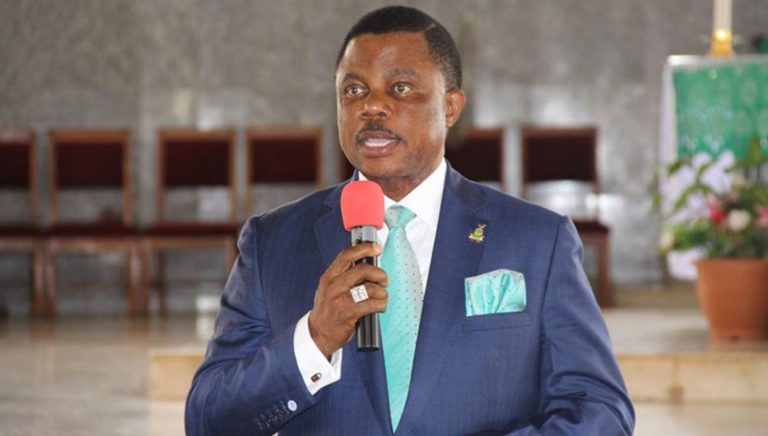
“We met with the governor on Thursday (May 16), he wanted to know our challenges and we made our challenges known to him, which were partial salary payment to doctors as we get 40% of the full salary, contrary to what others are paid,” Anigbaoso said.
“The governor expressed empathy, in terms of the partial payment facing doctors. He told us he is aware that doctors and even other workers earn badly, that the pay is poor, and that he is concerned.
“He claimed that if he had the fund, he would try to pay everybody the commensurate salary but he has some limitation. He said the current expenditure was on the high side, and the government is having challenges increasing the IGR (Internally Generated Revenue) due to debt and embezzlement.
“He said the IGR hasn’t come to the level that he would want, and at the implementation of the new minimum wage the current expenditure would come up some more.
“He said once they implement the new minimum wage and its guidelines are out, he would add N12, 000 for all civil servants in state since the minimum wage has come up from N18,000 to N30,000”.
Anigbaoso said the governor promised to revisit the doctors’ case after a year, hoping that the IGR would increase by then.
The outcome of the meeting with the governor was not acceptable to the members of the association and during their meeting on Monday, May 20, they resolved to continue the indefinite strike until the government honours the agreement it signed with them in January promising to commence full payment of their salaries by April.
“We were not happy, about the resolution. Yesterday there was a general meeting fixed, I did my best to convey the general message, and the response in the house was unanimous, nobody was happy,” Anigbaoso told The ICIR on Tuesday.
“They found it unacceptable saying the new minimum wage is not an offer, as their payment structure has nothing to do with it.
“So we pass a unanimous resolution that the indefinite strike would continue until the government adheres to our demands. We can’t go back and wait for another one year.”
All attempts to get the reaction of the Commissioner for Health in Anambra State, Dr. Joe Akabuike, have yielded no result. Repeated calls to his phone line kept ringing out and a text message sent to him has not been replied as at the time of this report.
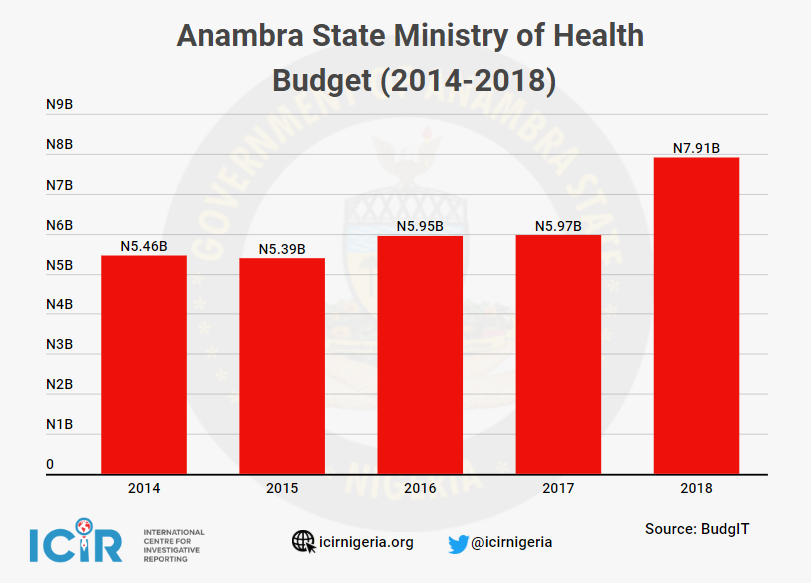
A look at the budgetary allocation to the health sector in Anambra State since the Obiano administration took office in 2014 shows that the sector has received a total of N30.68 billion.
In 2015, it received the sum of N5.39 billion, in 2016, N5.95 billion, in 2017, the budget rose slightly to N5.97 billion, and in 2018, N7.91 billion was allocated to the health sector.
However, despite the seeming increase in the budgetary allocation to the health sector in the past six years, the striking doctors say there has not been any significant improvement in health services in the state or in the welfare of medical practitioners.
The association had noted earlier in their statement to the press that these challenges have lingered for about seven years, resulting in an exodus of doctors to other states and a professional stagnation of doctors, due to lack of adequate wages and service training.
It is not clear yet when the resident doctors would call off their industrial action but one thing is certain, it is the citizens of Anambra state that would be the worst hit as the face-off between the state government and the doctors drags on.
THE CLEEN Foundation, a non-governmental organisation promoting public safety and access to justice, has launched an online platform that enables the digitisation of and public access to court judgements, known as Uwazi.
The launch took place on Tuesday at a one-day capacity building workshop for stakeholders held in Abuja.
Funded by the MacArthur Foundation, Uwazi was designed by the Human Rights Information and Documentation Systems (HURIDOCS), a data-based human rights organisation.
Benson Olugbuo, the NGO’s executive director, in his opening remarks read by Ruth Olofin, the programme manager, noted that CLEEN Foundation has worked with the justice sector since its establishment in 1998.
He said the broader goal of the new initiative, tagged Promoting Accountability and Transparency in the Criminal Justice System, is to end corruption, ensure effective justice delivery, and improve the country’s criminal justice system. It is also expected to promote accountability and transparency in the fight against corruption.
“It will be recalled that before the 2019 general election, we collaborated with the Nigerian Police Force and other security agencies to train security officials deployed for election duties.
In addition, during the general election, we deployed technology to monitor the activities of security agents under our Election Security Management Project. We were able to report to Nigerians real-time development from the field,” Olugbuo said.
Believing that technology is the way to go in solving some of Nigeria’s problems, he said Uwazi boasts of functionalities that include search, filter, tracking of documents, cross-referencing, and the viewing and downloading of court rulings within the reach of the public.
“It is important to note that the concept of digitisation of court cases is not new,” the executive director said.
“It is being practised in Nigeria and other countries. For instance, electronic legal documentation has been firmly established and stable in Austria since 1999. And in the United States, digitising court proceedings and electronic online case files have been the standard in their federal courts in over a decade.”
Olofin said CLEEN Foundation has two data collectors in each of eight states: Abuja, Anambra, Ekiti, Enugu, Kaduna, Lagos, Ondo, and Oyo; but is on the lookout for more personnel and volunteers. The data collectors observe court proceedings, especially ones related to corruption, get a copy of the judgement, and then upload on the platform.
“We are bringing an angle to the project where the public, legal practitioners, and scholars can go online and access the court cases that we have uploaded on the platform,” she explained. “As we speak now, we have about 262 cases on the Uwazi platform, including those on corruption and financial crime.”
She said the foundation plans to establish resource centres where people can get hard copies of the documents that have been uploaded on the platform, especially for those without internet access. The first of such centres will be launched in Oyo State in June.
In a hands-on technical session, Gabriel Akinremi, a senior IT officer at CLEEN Foundation, took the participants through a step-by-step process of tracking and uploading cases on the platform. In response to a question from The ICIR, he said lawyers and members of the public interested in collecting data for the platform are welcome to apply with CLEEN Foundation.
Also in attendance at the launch were Tolulope Agunloye, a project manager with BudgIT who spoke on how ICT may be applied in fighting corruption; Amina Salihu, Senior Programme Officer at MacArthur Foundation; as well as representatives from the Ministry of Justice, Federal High Court, and Nigeria Police.
Going through the Uwazi platform, The ICIR observed that as of the time of writing there are 137 cases on the website related to financial crimes, 106 related to corruption, 15 related to accountability, and 62 “other related cases”. Also, 234 cases have been decided, 18 are subsisting, and six are pending.
The majority of these cases (70) were decided or are ongoing in the Federal Capital Territory, closely followed by Anambra with 47 cases and Enugu with 46.
Some of the documents scanned and uploaded, through the use of Optical Character Recognition (OCR), can be easily copied if previewed; but this is not the case for all the uploads. For the latter category, the words in the court judgements are displayed as part of search results.
Currently, the platform does not allow users to upload documents on court proceedings or provide additional information about uploads.
Though there are filters according to court type, case type, case status, state, and originator of the document, it is difficult for users to narrow the search results to specific judges, accused persons, prosecuting agency, length of the case, and so on.
VICE President Yemi Osinbajo, Secretary to the Government of the Federation, Boss Mustapha, and former Lagos State Governor, Bola Tinubu, are some of the dignitaries expected to grace the book launch in honour of Dapo Olorunyomi, publisher of Premium Times.
This is contained in a statement issued on Tuesday by Chido Onumah, Coordinator of Africa Centre for Media Information and Literacy (AFRICMIL).
The book, titled ‘Testimony to Courage’, is a collection of essays in honour of Olorunyomi’s accomplishments in Nigeria’s media sphere. It was edited by Chido Onumah and Frederick Adetiba, has over 90 contributions from a spectrum of Olorunyomi’s teachers, colleagues, associates and mentees.
The date for the book launch is Monday, May 27, at the Shehu Yar’Adua Centre, Abuja.
Other dignitaries expected to grace the event include Chris Anyanwu, a serving member of the Nigerian Senate; Ekiti State governor, Kayode Fayemi, who will also deliver the keynote address, and Kabiru Yusuf, publisher of Daily Trust newspaper, who is expected to chair the occasion.
According to Onumah, “the book of essays was conceived after Olorunyomi’s 60th birthday in November 2017”.
“Among the contributors are Asiwaju Bola Tinubu, Mallam Nuhu Ribadu, Ogbeni Rauf Aregbesola, Prof Biodun Jeyifo, Prof Ropo Sekoni, Prof Umaru Pate, Prof. Lai Oso, Femi Falana, SAN, Dare Babarinsa, Kunle Ajibade, Dr Sola Olorunyomi, and Dr. Tunde Akanni.
Others include Dr. Tobi Oluwatola, Dr. Kole Shettima, Jude Ilo, Abdul Mahmud, Lanre Idowu, Ibim Semenitari, Idowu Obasa, Dr. Jibrin Ibrahim, Hafsat Abiola-Costello, Gbemiga Ogunleye, Richard Akinnola, Sunday Dare, Eze Anaba, Azu Ishiekwene, Owei Lakemfa, Oke Epia, Prof. Farooq Kperogi, Ohimai Godwin Amaize and Lara Owoeye-Wise.
“The book has a foreword by celebrated poet and author, Odia Ofeimun, and will be reviewed by Dr. Chidi Odinkalu.
“Dapo is a symbol of how through an independent media and vibrant civil society citizens can press for a better deal.
“The idea behind this book is to celebrate people while they are here with us. We feel that someone like Dapo who has sacrificed his all for us deserves to be honoured while alive.
“As readers will note in essay after essay, more than 90 persons came up with their individual testimonies about this man; his courage, integrity, dedication, selflessness and brilliance.”
Beyond the launch, the book would be made available throughout the country, and beyond, Chidoh stated.
THE Federal Government on Tuesday announced it has reviewed downward the charges paid at Unity Colleges from N83,000 to N49,500.
Outgoing Minister of State for Education, Anthony Anwukah made the announcement at a valedictory press conference held in Abuja.
He also said that the government had pegged Parents Teacher Association (PTA) levy at N5,000 across the board, thereby ending arbitrary charges of N75,000, which nearly inhibited access to unity colleges.
Anwukah disclosed that President Muhammadu Buhari had approved the establishment of a Secondary Education Commission that will oversee the operations of secondary schools in the country.
He explained that the current administration has spent a total of N7billion to provide security in all the 104 Unity Schools across the country.
“The Buhari administration had spent a total of N7billion on the provision of security infrastructure in the last four years,” Anwukah said.
‘‘Against the backdrop of insecurity in the north-east, affected by ‘Boko Haram’ as well as incidents of kidnapping in parts of the country, the Federal Government decided to provide basic security facilities in all unity schools.
The Minister reiterated that the Unity schools in the country would continue to exist as long as the Buhari administration is in power.
He disclosed that the government had embarked on the construction and rehabilitation of classrooms, hostels, laboratories among others across the schools.
‘‘Having taken this position, we embarked upon the rehabilitation of unity colleges in all the ramifications required,” he said.
‘‘In spite of the economic downturn, we have done well in terms of investment in capital expenditure.”
He also expressed optimism that the Federal Government would expeditiously look into the recommendations that have been made in terms of improving funding for the education sector.