Home Blog Page 2370

Dressing Iran for barbecue

By Owei LAKEMFA

IT was Sunday, May 12, near the port of Fujairah, in the Gulf of Oman, United Arab Emirate (UAE). Four commercial ships were bombed. Two of them, Amjad and Al Marzoqah are tankers owned by Saudi Arabia; the third, A. Michel, a UAE flagged fuel bunker barge; and the fourth, a Norwegian tanker, the Andrea Victory.

The attacks fitted perfectly into the United States (U.S.) Maritime Administration’s alert of Thursday, May 9, which claimed that: “Since early May, there is an increased possibility that Iran and/or its regional proxies could take action against U.S. and partner interests, including oil production infrastructure, after recently threatening to close the Strait of Hormuz. Iran or its proxies could respond by targeting commercial vessels, including oil tankers, or U.S. military vessels in the Red Sea, Bab-el-Mandeb Strait, or the Persian Gulf.”

So what other proof is needed? Who does not know that Iran blew up the ships; is that not logical, or is it not what those preparing Iran for barbecue want the world to believe?

The Emirati minister of state for foreign affairs, Anwar Gargash announced “investigations” but said his country had already made its “own readings and conclusions.” He then made a rallying call that: “The international community (should) assume its responsibilities to prevent any parties trying to undermine the security and safety of maritime traffic.” It was a little veiled invitation for Western powers to carry out an invasion.

A day after the incident, the UAE invited the U.S. to “investigate” the situation. What gave the UAE the impression that it is the U.S. – which has announced its intention to destroy Iran – that is best suited to investigate? By inviting the Americans to investigate, the UAE had excluded the U.S. from any suspicion or complicity. By extension, it has also excluded American allies, because the U.S. is unlikely to indict its allies.

The UAE is not giving Iran the benefit of doubt. It is also not giving an ear to the cries of the Iranian Foreign Ministry that these attacks might be part of the: “plots by ill-wishers to disrupt regional security.”

Within hours of the American military investigation team getting to the UAE port, it made a predictable “initial” assessment, finding Iran guilty. The Americans leaked a report claiming that Iranian or Iranian-backed proxies used explosives to blow a 5-to-10-foot hole in, near or just below the water line of each of the ships.

That same Monday the U.S. was invited to “investigate” the attacks, its secretary of state, Michael Pompeo, flew to Brussels for talks with Germany, France and United Kingdom on how to handle Iran.

Saudi Arabia also has its own conclusions. Its energy minister, Khalid al-Falih said the bombings were part of plans to “undermine the freedom of maritime navigation, and the security of oil supplies to consumers all over the world.”

If we follow the Saudi logic, then which group or country has motives to endanger maritime navigation and oil supplies in the area? Certainly, it is not Iran because its national interests and economic survival are tied to free maritime navigation in its the Persian Gulf, which is an extension of the Gulf of Oman (Indian Ocean). Iran also has no reason to sabotage oil supplies because it derives 80 per cent of its earnings from oil, while 45 per cent of its workforce is in the industry. As such, despite American sanctions, military buildup and threats of invasion, it would amount to committing suicide for Iran to endanger oil supplies in the same waters it uses to sell its own oil.

Besides these, the unprovoked American sanctions against Iran are biting, while the Americans are flying their F-15s, F-35s and B-52 bombers in the Persian Gulf. The Iranians are seeking how to overcome these challenges and defend their country. Hence, it will make no sense for them to attack civilian ships in the UAE, including Saudi tankers and a European vessel. The Iranians are intelligent enough to know that such an act is likely to pitch them militarily against the combined forces of the Gulf Cooperation Council, which includes Saudi Arabia, UAE, Kuwait, Oman and Bahrain.

Again, we can ask, which groups or countries stand to gain in an armed conflict between Iran and the Gulf States? Which countries stand to benefit if the Muslim states attack each other or if their territories become battlegrounds? Which countries have been threatening to attack Iran and will, therefore, be glad if this job is done for them by the Gulf states? Which countries are supplying weapons in the Gulf and would want more sales? Which will be interested in getting their more modern weapons tested in a real war situation?

I suspect that the attacks were carried out to pitch the Gulf states against Iran or present a basis for declaring war against it. This deceptive art of levying war is an ancient one. When Britain decided to colonise Uganda in the 19th Century, it secured the services of a mercenary, retired Major Frederick John Dealtry Lugard to pacify its inhabitants. Lugard sent agents into the majority Muslim areas to kill Christians and blame it on the former, and then sent other agents into Christian areas to kill Muslims in supposed retaliatory attacks. This led to war and after the Ugandans had significantly weakened themselves, Lugard intervened to impose peace and colonialism.

Texas was part of Mexico. The emergent American state invaded Mexico and annexed Texas. Then in 1844, America offered the Mexicans $25 million to buy New Mexico. The offer was rejected, so America under President James Polk decided to engineer a pretence for war. It got General Zachary Taylor to carry out patrols on the uncharted American-Mexico border. This led to a skirmish and America declared war. Through such subterfuge, America extracted 500,000 square miles of land from Mexico.

When America and Britain eyed Iraqi oil in 2003, they manufactured the falsehood that President Sadam Hussein was supporting terrorist groups and that Iraq had weapons of mass destruction, which Prime Minister Tony Blair claimed represented: “a real and present danger to Britain”. On the other hand, American President George Bush lied that Sadam was importing large quantities of uranium from the Niger Republic to build nuclear weapons.

If the West wants war in Iran, it can do so under any pretext, including claiming to fight terrorism, defending democracy, rescuing the Iranian people from dictatorship, defending maritime trade or finding it guilty of bombing the four ships in the UAE port. However, it should think it through; a war against Iran can easily degenerate into a religious war leading to an international conflagration, which may consume a number of nations and send millions to early graves. It is cheaper to allow for peace.

Owei LAKEMFA, a former secretary general of African workers, is a human rights activist, journalist and author.

Nigeria keen to help Gambia replicate TSA policy

THE Office of the Accountant-General of the Federation, OAGF, says it will fully support the visiting Gambian team on its quest to learn operations of the Treasury Single Account (TSA).

A statement by Henshaw Ogubike, the Deputy Director, Press, OAGF, on Friday in Abuja, said Mohammed Usman, the acting Accountant-General of the Federation (AGF), gave the assurance.

Usman gave the assurance when he received the Gambian delegation who were in Nigeria to understudy the workings of the TSA.


READ ALSO:

He assured the team that the OAGF was prepared to share experience with it on TSA on its operates in Nigeria so it could replicate same in Gambia.

He said Nigeria would tap from the Gambians’ success story on Government Integrated Financial Management Information System (GIFMIS).

He also recollected how Gambia had hosted delegations from Nigeria on a study tour of GIFMIS about 15 years ago.

Usman itemised the activities lined up for the team which includes, lectures by subject matter experts, interactive sessions, and meeting with key stakeholders.

He added that the team would also visit Lagos where it was scheduled to meet some of Nigeria’s key players in the e-payments and FINTECH space whom he said were vital to an endeavour like TSA.

Sylva Okolieaboh, the Director, TSA, enjoined the visiting team to pay attention to every little item slated for discussion.

He promised to deliver on the promise of the Minister of Finance, Zainab Ahmed, to supply all their needs in terms of adequate knowledge of TSA so that the dream of a standard TSA in Gambia could be realised.

The team had earlier paid a courtesy call on the Minister of Finance who advised that relevant states that had implemented TSA successfully in Nigeria should either be visited or invited over to Abuja to avail the Gambian team their experiences. This, he said, was to equip them properly to successfully implement it in The Gambia.

The Gambian Team was led by the Permanent Secretary, Ada Gay, and Momodou Bah, the Accountant-General, Ministry of Finance and Economic Affairs.

They both spoke of their expectations of learning a whole lot from Nigeria to enable them break the bottlenecks that may likely impede their progress in the delivery of TSA.

(NAN)

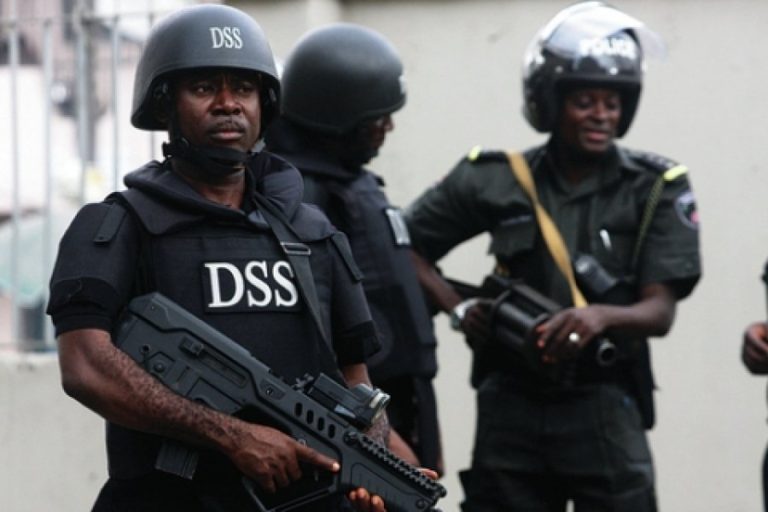
Breach of peace, subversion by aggrieved politicians will not be condoned, DSS warns

THE Department of State Services (DSS) has warned aggrieved politicians to desist from plans to take laws into their hands or engage in acts capable of breaching the peace.

It also warned that it would not condone any form of extra-judicial activities or methods designed or adopted by persons or groups to subvert constituted authorities.

“Instructively, defaulting persons will surely be brought to book,” DSS spokesman, Peter Afunanya, warned in a statement.

The secret police condemned the recent activities of some unscrupulous elements in the name of Nigeria Continuity and Progress (NCP) which it said: “unpatriotically called for a revolution and forceful change of government in the country”.


READ ALSO:

It said it is aware that the “group is working in tandem with a body of subversive agents and adversaries of the Nigerian state, with an aim to create an atmosphere of insecurity and use same to cause disaffection among the people.

“It is evident that the misguided group and its cohorts have also planned to instigate widespread violence against the government in order to actualise their infamous agenda of forceful change of regime.”

In line with the service’s mandate of ensuring the internal security of Nigeria, the DSS said it would stop at nothing to achieve calm in the nation and would continue to work with other agencies and stakeholders to ensure that every segment of the populace pursues their legitimate aspirations in an environment that is devoid of fear or hindrance.

“The DSS not only supports the consolidation of democracy in Nigeria, but will leave no stone unturned in rooting out persons or groups desirous of truncating the process or undermining the country’s peace and corporate existence,” Afunanya said.

“The service will, therefore, not condone any form of extra-judicial activities or methods designed or adopted by persons or groups to subvert constituted authorities.”

The Defence Headquarters (DHQ) had similarly on Tuesday disassociated the Armed Forces of Nigeria (AFN) from a document calling for the overthrow of the Muhammadu Buhari democratically-elected administration.

Muhammed Wabi, Deputy Director of Defence Information accused  NCP, of being behind the document.

Wabi alleged that the document called for the setting up of an “interim government’’ in place of the elected government.

“The Armed Forces of Nigeria (AFN) wishes to dissociate itself from the rascality and intentions as espoused in a document being circulated by a faceless group named Nigerian Continuity and Progress (NCP) calling for support of a revolution to oust the current democratically elected government and in its place establish an illegitimate interim government.

“The AFN condemns the undemocratic and demonic actions of the author of the document.

“Accordingly, members of the public are enjoined to discountenance the content of the documents being circulated by NCP and equally condemned in totality, the call to derail our hard-earned democracy,’’ the statement said.

Wabi said that the AFN was “very mindful of its constitutional responsibilities’’ and would not be misled into any act that would undermine democracy as enshrined in the 1999 Constitution as amended.

“The AFN remains unflinchingly loyal to the Constitution, as well as President Muhammadu Buhari and Commander-in-Chief of the Armed Forces of the Federal Republic of Nigeria.”

(NAN)

Court strikes out suit seeking to declare Saraki, Dogara’s seat vacant

A SUIT filed by the Legal Defence and Assistance Project (LEDAP), a Civil Society Organisation, seeking the removal of Senate President Bukola Saraki and Speaker Yakubu Dogara from office, has been struck out by the Federal High Court, Abuja.

Justice Okon Abang who presided over the case on Friday ruled that the plaintiffs had no locus standi to file the case in the first place.

LEDAP had approached the court asking it to order Saraki, Dogara, and the other lawmakers who defected from the All Progressives Congress (APC) to other parties in July 2018, to vacate their seats as their defection were not in keeping with the provisions of the constitution.

A total of 37 members of the House of Representatives, including Dogara, had defected from the APC on July 24, 2018. Thirty-two of them joined the PDP, four pitched tents with the African Democratic Congress (ADC) and one refused to announce the party he was joining.

That same day, about 15 Senators also dumped the APC for the PDP.

LEDAP based its suit on the provisions of Section 68 (1) (g) of the 1999 Constitution as amended which provides that a lawmaker would vacate his seat if, “he becomes a member of another political party before the expiration of the period for which that House was elected; provided that his membership of the latter political party is not as a result of a division in the political party of which he was previously a member or of a merger of two or more political parties or factions by one of which he was previously sponsored”.

However, in their response, the defendants asked the court to strike out the suit because LEDAP had no locus standi to file it in the first instance.

In his ruling on Friday, Justice Abang agreed that the plaintiff has no locus standi to file the suit even though it has merit.

Abang held that a Supreme Court ruling had clearly spelt out the conditions upon which a lawmaker could defect to another political party and that the respondents, in this case, did not meet that requirement.

He, however, added that “the plaintiff that instituted this case is not a political party that sponsored the election of the lawmakers”.

“Also, the plaintiff is not the Independent National Electoral Commission(INEC) that regulates the activities of political parties and monitor elections. The plaintiff is not a registered voter in Nigeria. They are not members of the National Assembly. None of the political party that sponsored the lawmakers is a party in this case. They (the plaintiff), therefore, lack the capacity, legal power to institute the case. The plaintiff’s case is incompetent and thereby struck out,” Abang held.

In the case of Godswill Akpabio, who also defected from the PDP to the APC, Justice Abang said Akpabio acted within his right as he was able to prove that his former party, the PDP, had expelled him from the party before his defection.

Facebook bans accounts owned by Israeli firm targeting Nigeria, other African countries

About 265 accounts were shut down by Facebook for ‘coordinated inauthentic’ accounts that originated in Isreali focused on Nigeria, Senegal, Togo, Angola, Niger and Tunisia along with some activity in the Latin America and Southeast Asia.

Nathaniel Gleicher, Head of Cybersecurity Policy for Facebook on Thursday through a statement on the Facebook newsroom revealed the people behind this network used fake accounts to run page, disseminating contents and artificially increasing engagement.

“They also represented themselves as locals, including local news organizations, and published allegedly leaked information about politicians.

“The Page administrators and account owners frequently posted about political news, including topics like elections in various countries, candidate views and criticism of political opponents,” he said

Gleicher said an internal investigation revealed that the individuals behind this network are linked to Isreali Company Archimedes Group.

“The people behind the phantom accounts spent around $812,000 (£634,941) for adverts between December 2012 and April 2019, Facebook said, and these were paid for in Brazilian reais, Israeli shekel and US dollars,” he said.

However, Gleicher said that the organization and all its subsidiaries are now banned from Facebook, and it has been issued a cease and desist letter.

It is yet to be verified if the company is connected to Isreali NSO that is alleged to be the brains behind the spyware that facilitated the killing of Jamal Khashoggi, Washington Post journalist killed in the Saudi consulate in Turkey.


S’Court strikes out River State’s challenge of Onnoghen’s suspension as CJN

THE Supreme Court has struck out the suit filed by the River State Government challenging the suspension of Walter Onnoghen as Chief Justice of Nigeria (CJN).

A five-man panel of justices, headed by Justice Paul Galinje, gave the ruling on Friday in Abuja, saying that the court does not have the jurisdiction to entertain the matter.

However, one member of the panel, Justice Mary Odili, gave a dissenting judgement saying that the application was in order and that Onnoghen’s suspension was against the laid-down procedures.


Read Also:

Onnoghen was suspended from office by President Muhammadu Buhari following allegations of corruption and false assets declaration. Buhari also swore in Tanko Mohammed to serve as Acting CJN.

Onnoghen would later tender his resignation to President Buhari.

Consequently, the Rivers State Government filed an application before the Supreme Court asking it to assume original jurisdiction on the matter in accordance with the provisions of section 232 (1) of the constitution.

The section reads: “The Supreme Court shall, to the exclusion of any other court, have original jurisdiction in any dispute between the Federation and a State or between States if and in so far as that dispute involves any question (whether of law or fact) on which the existence or extent of a legal right depends.”

However, the federal government, through the Solicitor General of the Federation, Dayo Apata, argued that the Supreme Court could only assume original jurisdiction where the matter in contention was between a state and the federal government. It argued that the case of Onnoghen’s suspension was not between the federal government and the Rivers State government hence the Supreme Court cannot assume jurisdiction on it.

Delivering the lead judgement on Friday, Justice Galinje agreed Apata’s submission that it lacked jurisdiction to entertain the matter since it was not originally between the federal government and the Rivers State government.

Galinje then ruled that the panel would not go into the merit of the substantive application, which is to determine whether Onnoghen’s suspension followed due process or not.

In her minority ruling, however, Justice Mary Odili pointed out that section 232(1) of the constitution also empowers the Supreme Court to assume original jurisdiction where the dispute involves any question on which the extent of a legal right depends.

She, therefore, held that the court had jurisdiction in the matter and decided to entertain the original application.

Odili, who is the wife of former Rivers State Governor, Peter Odilli, went on to uphold the application of the Rivers State Government, ruling that Onnoghen’s suspension by President Buhari was in violation of relevant provisions of the 1999 constitution as amended.

Why we demolished Abuja night club… FCT Minister

THE FCT minister, Mohammad Bello, said Caramelo night club was demolished because the property was being used for purposes other than that for which it was originally approved.

The minister said this during a press conference after Thursday’s Federal Executive Council (FEC) meeting chaired by Vice President Yemi Osinbanjo.

According to him, acquiring a land or property either by lease, hire or sale, especially in Abuja, is governed by rules and regulation.

“You do not lease or even sublease out a property meant for a hospital to be converted into a night club, without getting a right approval. Even if you get land, the purpose is very clear.  Any transaction you do on land, whether it is a lease, hire, or sale, is governed by rules and regulation.”

He said, that the decision reached on the demolition of the night club was a last resort and that by demolishing the building, the property now belongs to the government.

Caramelo Suites after Monday’s demolition.

“You can check the COO (Certificate of Occupancy) for the regulation if there are flagrant abuses, and all effort to correct that abuse is not done, it reverses back to the government,” Mohammed said.

The minister said that contrary to what the general public might want to believe, his administration is not usually in a haste to demolish the property and that demolition is usually the last resort.

“For every demolition made, may be a hundred was saved,” he said, adding, however, that people should always follow the rules in all that they do especially with regards to landed property in the Federal Capital Territory.

A few weeks back, officials of the FCT Administration conducted a raid at Caramelo night club and arrested about 100 ladies who were accused of prostitution. The development prompted wide condemnation from gender-advocacy groups and human rights activists, especially as no male offender was arrested in the raid.

The facility was demolished in the morning of Monday, May 13, and witnesses said the FCTA officials that carried out the demolition did not allow workers in the nightclub to evacuate any property, thus, equipment, furniture and drinks belonging to the club all perished.

Court asks ex-NNPC GMD, Yakubu to open defence in money laundering case

JUSTICE Ahmed Mohammed of the Federal High Court, Abuja, has struck out the no-case submission filed by Andrew Yakubu, former Group Managing Director of the Nigerian National Petroleum Corporation (NNPC) in the corruption charges filed against him by the Economic and Financial Crimes Commission (EFCC).

Tony Orilade, the spokesman of the EFCC, said Yakubu was ordered to open his defence as the trial judge ruled that the prosecution had established a prima facie case against him.

Recall how in February 2017, the EFCC, acting on information by a whistleblower, conducted a search on a building in Kaduna allegedly owned by Yakubu and recovered about $9.8 million and £74,000 in cash. The monies were kept in a fire-proof cabinet and the building was an ordinary-looking bungalow which nobody would ever suspect housed such a huge amount of money.

Yakubu would later explain that the monies were gifts by persons he refused to name.

The monies were confiscated and the EFCC filed a lawsuit asking the court to order the forfeiture of the money to the federal government. Yakubu was also charged with money laundering and fraud.

He was briefly remanded in Kuje Prison in the Federal Capital Territory but was later granted bail in the sum of N300 million. The court also granted an order forfeiting the $9.8 million and £74,000 to the government.

The EFCC closed its case against Yakubu in October 2018 after calling seven witnesses and presenting documents that were admitted in evidence. But the defence counsel filed a no-case submission saying that the prosecution had not established any criminal case against the accused person.

However, in his ruling on Thursday, Justice Mohammed said he agreed with the defence that some of the charges against the defendant had not been established by the prosecution, but added that there were cases to answer on the other counts.

“I agree with the defence counsel that the prosecution has failed to prove the essential element of transportation of money on counts five and six,” Mohammed said.

“Even though I am tempted to discharge the defendant on counts one to four, I am however constrained to ask the defendant to explain how he came about the monies recovered from his house.

“Fortified with my position, the defendant is hereby ordered to enter his defence in respect of counts one to four.”

The charges bothered on Yakubu’s failure to fully disclose the monies in his Assets Declaration form, as well as receiving a cash payment of the said sums without going through a financial institution, an offence under the Money Laundering (Prohibition) Act 2011.

The matter was thereafter adjourned to July 3, for Yakubu to open his defence.

NYSC members will earn minimum wage, Finance Minister confirms

ZAINAB Ahmed, Nigeria’s Minister of Finance, has confirmed that members of the National Youth Service Corps (NYSC) will also benefit from the revised national minimum wage.

Ahmed gave the clarification while addressing a press conference at the headquarters of the Ministry of Finance on Thursday, saying that the committee set up by President Muhammadu Buhari to work out the modalities for the implementation of the new minimum wage took the NYSC into consideration.

Recall that it was based on the report of the Bismark Rewane-headed committee that Buhari signed the new minimum wage bill into law, thereby approving an increment from N18,000 to N30,000 for the least worker in Nigeria.

The finance minister, during the press conference, explained why the new minimum wage was yet to take effect, saying that a lot of other calculations were yet to be worked out with regards to the increments that would apply up the ladder of the federal civil service.

“Apart from the increase of the minimum wage from N18, 000 to N30, 000, there is also the consequential adjustment that we have to negotiate with the labour unions,” Ahmed explained.

“The total implication of that would be worked out only after the negotiations and that would involve determining how much increase every other staff that is above the minimum wage would get. It could be a flat amount or a proportion.

“The other aspect that is clear is that there would be an increase for the National Youth Service Corps (NYSC) as well because by the Act they should earn at least the minimum wage and the NYSC also has to increase to that N30, 000.

“So, because we have not done the negotiation with labour, I cannot give you the details of what we are projecting because it is simply on projections, at the end of the day, it is what we agree with labour that will be the amount that is due.”

NYSC members currently earn a monthly allowance of N19,800, which took effect from July 2011. Before then, they earned approximately N9,700.

There had been many rumours of an increment in corps members’ allowance over the years, with some saying it had been increased to N31,800 and others N49,800, but none of them had proven true.

Poor power supply, faulty elevators frustrate staff of information ministry

THE hour was 1 pm on Wednesday, May 15, and power supply at the Radio House, Abuja, had just been cut. Ironically, the entire hallway on the ninth floor echoed with cheers of workers who seemed to be familiar with the power outage. 

Five of them, seconds before then, were inside one of the building’s elevators going towards the top floor. Fortunately, just as the power went out, the elevator’s doors had opened to allow one or two exit. Fearing the worst and without a thought, everyone immediately rushed out and opted to use the stairs instead.

“It used to trap people o!” a guard on one of the lower floors told this reporter, referring to the elevator.

“Seriously!” he exclaimed dramatically. “Some may take up to 30 minutes inside. Like yesterday, there was no light. Everybody was following the staircase. Up and down, they were using the staircase till evening time. Kparam-kparam-kparam, come down … kparam-kparam-kparam, go up. No be small thing o.”

The elevator, which the reporter himself used prior to that conversation, is not properly ventilated. It also does not have a backup power source. And so whenever there is an outage and it is in use, the persons inside tend to feel uncomfortable due to excessive heat and lack of fresh air.

There are reports of people who fainted in the past as a result of suffocation and had to be rushed to the hospital. This was especially common during the heat wave of earlier months, one worker said.

Damilola Ojetunde, an Abuja-based journalist who was at the ministry on Thursday afternoon for accreditation, also narrated his difficult experience to The ICIR.

At the ground floor, the elevator’s floor counter indicated that it was on the third floor and descending. About ten persons queued to use the facility.

“All of a sudden, the elevator’s operator ran towards us screaming, ‘Nobody should enter, nobody should enter. It’s not going. It’s not going,” Ojetunde recalled, with a look of frustration.

“I asked him why we were not allowed to enter since the elevator was obviously working. He then replied that there is no light and they want to switch off the generator. Later, I had to go through the stairs to the ninth floor. When I finally got to the office, I had to sit for a good 10 to 15 minutes to catch my breath before I could do anything. I was exhausted.”

Ninth floor, Radio House, without power supply on Tuesday, May 14. Credit: Damilola OJETUNDE/The ICIR

It is not unusual for many of the floors on the 12-storey building, including those housing the Federal Ministry of Information, to be without power supply, especially in the past couple of weeks. Even with electricity supplied, light bulbs at the corridors have gone bad, leaving many floors without illumination.

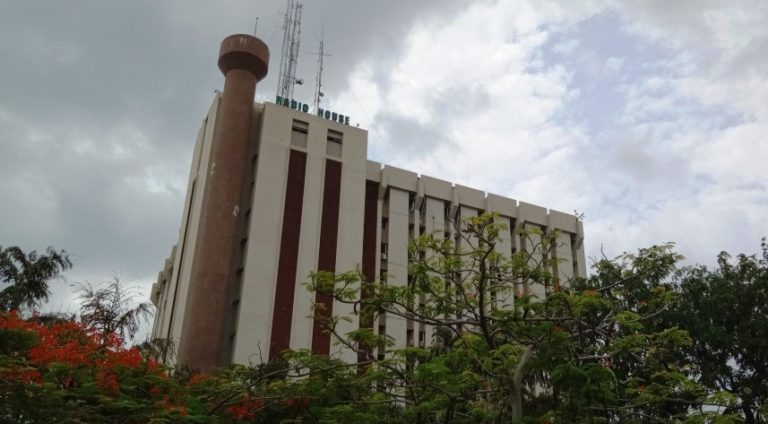
The Radio House is a giant brown structure situated at Herbert Macaulay Way, Area 10, Garki. For many years, it has housed various organisations: Kapital FM on the ground floor, Federal Radio Corporation of Nigeria (FRCN) on the first floor, and Voice of Nigeria on the sixth and seventh floors, while the ministry has offices on all other floors.

There are six elevators originally installed in the building, but only two have worked in a long time. Security posts have been placed directly in front of some of the elevator doors, signalling that they’ve been abandoned for a long period.

The information ministry’s powerhouse, containing huge generators, is another eyesore. The interior has become dusty and full of cobwebs, and the generators which are capable of powering the entire structure are hardly switched on. According to sources, they are only used on days when the power supply is not expected from the Abuja Electricity Distribution Company (AEDC). And, on those days too, they are only put on between the hours of 9 am and 2 pm, after which “everybody shuts down”. The powerhouse has, however, not been used at all recently.

“If you ask the people in charge of maintenance what the problem is, they will tell you ‘no diesel’,” a source told The ICIR

“I feel it’s part of the power outage in Abuja that’s affecting everywhere because sometimes I will be in the office and a friend will call me from the secretariat to complain about outage and ask whether we still have light. So it is now becoming a norm. Even government offices don’t have a power supply, and then the substitute for power supply is not well utilised.”

The radio stations in the building, because of the need to constantly broadcast programmes, have independent means of generating power. It was learnt that the FRCN sometimes assists with powering one of the elevators whenever there is an outage to ease the movement of visitors and workers at the ministry.

People wait for the elevator on the poorly lit ground floor on Thursday, May 16, right before power outage. Credit: Damilola OJETUNDE/The ICIR
Minister, Perm. Sec. abandon offices

The information minister, Lai Mohammed, and the permanent secretary, Grace Isu-Gekpe, different sources say, are hardly seen within the premises. Before the present administration, the ministries of information and culture were separate, but President Muhammadu Buhari had them merged.

Edem Duke was Nigeria’s minister for culture and tourism under the previous government and, at the same time, Labaran Maku was information minister.

Consequently, Mohammed inherited two offices, one at the Radio House and the second at the federal secretariat where the ministry for culture and tourism used to be. His absence from his primary place of assignment has led to flippancy in how the infrastructural needs of the ministry are handled.

Isu-Gekpe also only shows up occasionally, especially for management meetings—which are sometimes held at the Press Centre on the ground floor rather than on the eighth floor where the minister’s office and board room are. The centre is meant to serve as a meeting point between government, journalists, and the public, and a venue for press briefings.

As a result of their constant unavailability, the one elevator labelled for the exclusive use of the “Honorable Minister and the Permanent Secretary” has become the most used by all, without discrimination.

The powerhouse, Federal Ministry of Information. Credit: ‘Kunle ADEBAJO/The ICIR
Workers discouraged, productivity drops

The frequent loss of power and unreliability of the elevators have hindered the ministry from getting the best out of its workers. For various reasons, including body size and health conditions, some find it difficult to use the stairs.

“It is affecting everything,” one employee said. “Some people cannot even work. There are people who will tell you pointblank they can’t climb the stairs, and it’s not their fault.

“There are some directors I know that once they come and the lifts are not working, they just go back or go to [the ministry of] culture because there will definitely be light there. Key offices like Human Resources Management, Procurement, and the rest have offices there too.”

Some workers, the employee also disclosed, often lounge at the mosque all day, and do not bother entering the main building. There are those who simply take their bags and leave when the power supply is cut.

It is believed that the bulk of the problems will be resolved if the information minister returns to operate from the ministry’s premises.

N655m budgeted for electricity, maintenance in 4 years

Figures from the approved budgets between the 2015 fiscal year and 2018 show that the Federal Ministry of Information and Culture budgeted up to N655 million in four years on electricity and maintenance related expenses at its Abuja headquarters.

Since the present administration came into power, the ministry has budgeted N94 million on electricity charges, N326 million on maintenance services (including maintenance of generators), and N43 million on generator fuel—all overhead (recurrent) expenses. It is believed that recurrent budgeted sums are invariably released by the finance ministry.

Also, as part of its capital expenditures in 2017, the ministry budgeted N68 million on the provision of inverters and solar power. In 2016, it budgeted N100 million on the purchase of new generators, N12 million on electricity-related repairs, and N12 million on the installation of inverters.

Calls placed to the information minister were not answered and a text sent to his phone to ask what he is doing about the ministry’s infrastructural challenges has also not been replied.

On two occasions that The ICIR called Joe Mutah, chief press secretary to the minister for comments, he said he is “on the road” and will return the call when he arrives, but declined to give a specific time.