Home Blog Page 2470

How period poverty plagues women in Abuja communities

0

According to the Study International, more than 1.2 billion women all over the world do not have access to basic sanitation. Menstrual periods are open secrets but period poverty suffered by many women in Nigeria is shrouded in absolute secrecy. Another report has it that women that experience period poverty is likely to suffer from anxiety or depression. Jennifer Ugwa of The ICIR writes about the plight of women in Abuja communities that are plagued by period poverty.


THE United Nations Sustainable Development Goals 1 and 6 are aimed towards ending poverty in all its forms everywhere, ensure availability and sustainable management of water and sanitation for all.  This goal extends to paying special attention to the needs of women and girls and those in vulnerable situations. But these goals are yet to be attained.

However, while some would rather smile through their problem, few are ready to tell their stories, and among this number is Fatima.

“Su wanene ,Menene Sukeyi? Zasu bamu kudi ne” (Who are they? What are they doing? Are they “giving us money”?) Fatima asks her companion.
Sun zo suyi Magana Akan lafiya ku ne, Naji an zo an raba muku pad”, “They are here to talk to you about your health, I hear they came to share pad,” the friend replies as she turns her head sharply with a look of disbelief towards the reporter in their midst from the end of the room where she is reclining on the floor.

All of the women experience period poverty

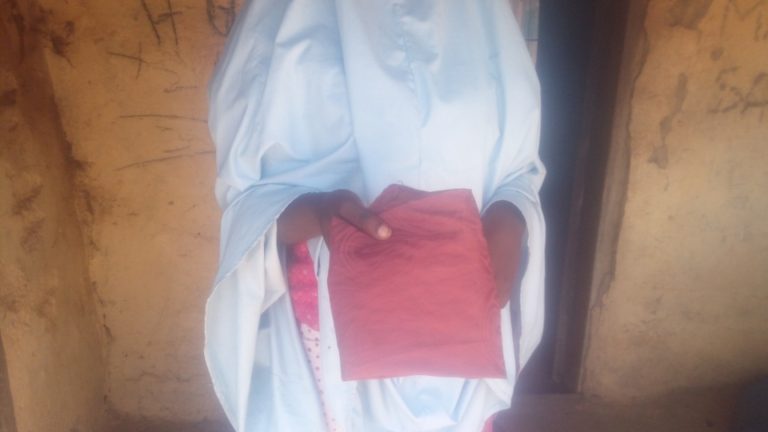
-Fatima is 25 years old, a stay -at home mother who has been married for eight years with four children. During an interview with The ICIR,  she brings out a piece of old cloth she uses for the menstrual period from a black polythene bag. She ensures her friends are not around when she brings it out. She cannot remember the precise time she started menstruating but one thing she does remember is that she has been using pieces of old cloth for her monthly sanitary needs all her life.

“I use rags for my menstrual period. Sometimes, my private part itches, but I don’t know whether it’s an infection,” she said, pointing to her pubic region.

“I will like to use a sanitary pad instead of rags. I told my husband to buy one for me, but he said there is no point, that I should keep using the rag, that he is not complaining,” she says, her gaze now fixed on the ground.

We use our cardigans to cover the blood stain

In Shere, Bwari Area Council of Abuja, Fatima is not the only woman experiencing period poverty or inability to afford sanitary wares.

About 51 women comprising both adolescents and adults in the community say they all use pieces of old cloth for sanitary pads.

Khairat Usman and Zabbau Ibrahim, both 18, are in SS3 at the Shere Government Secondary School. These teenagers use rags as sanitary pads too.

“When I am going to school I use rags, that is all I have to use. I don’t get stained all the time, but sometimes if I stain myself; I will use my school cardigan and cover the stain,” Zabbau says.

Privacy is something that Khairat yearns for among other things. She would have to change the rags she uses four to five times while in school as she experiences heavy bleeding.

“When I want to change, I have to go when the bathroom is empty, or when my friends will not see me because some of the girls will look at me somehow.

“Because of that, I don’t go to change every time, that is why when I stain myself I will use my sweater to cover my skirt,” she says.

The two girls say that when they are out of pieces of cloth to use or have to deal with wet or moist cloth, they do not go to school on such days.

One of the girls with a piece of cloth she uses for her period.

The ICIR learns that most of the women that use rags do not sun this piece of cloth outside. The same plight affects Umaru Hajar, a primary six pupil in Passo area of Gwagwalada. Hajar uses rags for her monthly period and, during school days, has to wear a single piece of cloth for up to seven hours.

“I go to school by 7:30 am and I come back around 1:30 pm in the day.  I change the rag that I wore to school when I come home.

Hajara says that whenever she is menstruating she never misses going to school with her cardigan. The cardigan has since become her saving grace “Even if I forget it, I will go back and carry it, because if my cloth stains I  use my cardigan to cover it.”

 Period poverty and infections – our cross to bear

Tegha Ruben runs a private consulting agency in Gwagwalada but despite her level of financial independence, she is no stranger to period poverty.

“Ordinarily when I am supposed to use four pads in a day I am restricted to using just two. When you have to use four pads in a day and six  is the required number, which in most cases could be higher, and then it is clear you cannot afford to go above 4 per day, now that is the worst kind of poverty, when you cannot take care of your personal needs.”

Tegha says that in a month she makes use of two packs of pad or three. Tegha uses Virony as a brand of sanitary pad. One of the packs she said contains 14 pieces and in a month she needs 2 to 3 packets at the price of N3,250.

“When they say ‘to use for not more than four hours,’ within one hour I have changed like two times.”

“I plan for it because I know that is how it appears because you can’t even be economical, in fact, sometimes I don’t even go to work. In the night, I wake up to two times in the night to change, and this is different from the ones I have used during the day.

“Blood has an awful smell, take for example when you drop the blood of an animal somewhere, just leave it for some minutes, when you come back there you will see that it will change colour and you will see flies around it or on it because it is smelling.

“It is the same thing with us because when you try to manage the pad and you sit on it too, the same smell is there and it goes back to the body.

“I have treated infections too, but sometimes they say it is toilet infections. But I think too much management of pad can even cause it,” she says.

The narrative does not change either with Remi Tamima, a secondary school teacher in Gwagwalada Government College.

“I never knew period poverty was a thing. I just assumed it is the cross I have to bear. Actually, menstrual periods are stress, it is a stress to women; it is something that when it comes there is a kind of unhappiness. I always have it in mind that for every month I have to be ready whether I can afford sanitary pads or not, it is entirely unavoidable for every woman.

“Managing my period is hard. Sometimes I menstruate twice a month. At first, I thought something was seriously wrong with me, like I was not normal, the feeling of being the only one having this problem at that time was choking.

“Since I needed more than one pack of pads and could not afford to buy sanitary pads for the one month I had to use tissue papers.  In a day, I used about 6 big rolls of tissue papers in a day, In fact, most people in this community use rags including my students.

“Sometimes I change frequently, obviously not because I have enough pads, but because of the heavy flow, though I still try to drag-out the time and manage one pad as long as I can. Since you can’t afford pads, all you need to do is to make sure that this stress is taken off your shoulders for that month.

Tamima said that although she is not sure if the itching she experiences in her private part is due to the use of tissue papers. She, however, downplayed it by pointing out that infections are normal.

“Actually some people said that the use of tissue causes infection, but I don’t know, I also notice that when you use pad after some time, it will start itching you.”

Fifty-five-year-old Salamtu Sani is the mother of six children, have four daughters, one she said is married and two are still leaving with her, providing sanitary wares for the two girls on a monthly basis is a tedious work for the mother.

“I know that the use of rag is not good, but I don’t have money. My children ask me to buy them pads but I still tell them to use rags because me I did not have the money.

“The youngest said that she won’t go to school if I don’t buy pad like the ones her friends are using.

“Me I did not use a pad, I am not using it, is foam and rag that I use, But if I have the money maybe I can buy a pad and try it too. But if the government can help, they should help us,” she said smiling shyly.

Aderemi Christy, an officer in the Rural-urban Water Sanitation and Hygiene, (WASH) a Non- Governmental Organisation founded by UNICEF that aims to provide access to safe water, adequate sanitation and hygiene education told The ICIR  the use of items of clothing is something that the women cannot avoid. “Not just in Nigeria, but in Africa generally, most women are the breadwinners, so the question of what sanitary products will I use comes last, that is if they even remember it.”

On health implications

Doctor Mahumud Rabiah, a gynaecologist at the National Hospital Abuja, also said that the use of wrappers or pieces of clothing is unhygienic and could lead to ascending infection.

“The materials or rags that are often used during menstruation are usually dirty and not hygienic and can allow the infection to move from the outside to the inside. Having this infection can lead to different problems.

“In the long-run women infected could experience recurrent virginal discharge, pelvic inflammatory diseases, which could lead to chronic pelvic pain and in most situations, could block the fallopian tube and this could result to infertility and marital disharmony.” She said.

In addition, Mahumud said that some sanitary products are manufactured by the producers with profits in mind first while consideration for the users comes last.

An estimate of the 31 years bill


Sanitary pads with a premium cotton surface, magnetic, anion strip to avoid odour and relieve menstrual discomforts, according to medical practitioners are best suited sanitary pads for women.

Through a market survey, The ICIR found that sanitary pads of these qualities are often within the range of N1,000 and N 1,700 for one pack (10 pieces).

If periods last for from 1- 7 days, with an average of five days for most women, and one single pad is worn at the average length of 3 hours, then in 24 hours, a total number of 8 pieces of pads should be used.

An average five days cycle means that a woman would use approximately 40 pieces of pads every month at the cost total cost of N4,000. For 12 months, a woman must have spent N48,000.

All things being equal, an estimation of one woman’s sanitary purchase at least from the age of 14- 45(Menopausal age) will be N1,488,000 (One million four hundred and eighty-eight thousand naira, only).

Investigation shows that period poverty is experienced by women both in the rural and urban settlements. More than 55 women interviewed in Shere and Passo have never used sanitary pads before, and there is still no comprehensive data on the number of women that suffer period poverty in Nigeria yet.
 

FACT CHECK: Peter Obi’s eleven false claims at VP debate

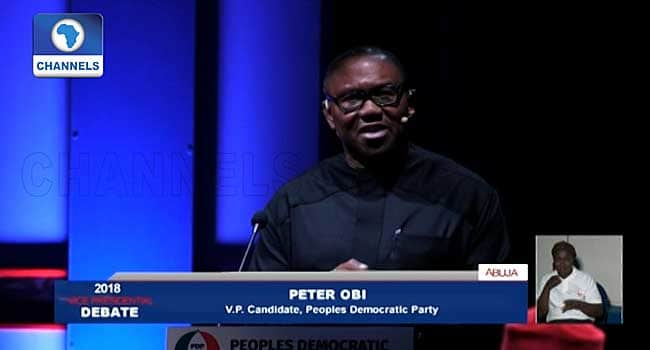
VICE Presidential candidate of the People’s Democratic Party (PDP), Peter Obi, evidently gave out the greatest number of facts and figures at the recently organised vice presidential debate, but The ICIR has found that a good number of them were false, grossly exaggerated or only partly true.

The debate, which featured five running mates for the 2019 general elections was put together by the Nigeria Elections Debate Group (NEDG) and the Broadcasting Organisations of Nigeria (BON).

Others who participated include Yemi Osinbajo of the All Progressives Congress (APC), Ganiyu Galadima of the Allied Congress Party of Nigeria (ACPN), Khadijah Abdullahi-Iya of the Alliance for New Nigeria (ANN) and Umma Abdullahi-Getso of the Young Progressives Party (YPP).

In this fact-check, The ICIR shares its findings on thirteen sets of claims given by the PDP candidate.

Claim: Nigeria’s poverty rate grows at 6% per minute

“We now live in a country where we have the highest number of poor people in any nations, 87 million, and growing 6 per cent every minute,” he said.

Not only is this claim outrageous on the face value, but it is also not true. According to the Brookings Institution, “each April and October, the World Poverty Clock data are updated to take into account new household surveys and new projections on country economic growth from the International Monetary Funds’s World Economic Outlook” and these data form the foundation for poverty trajectories computed for 188 countries across the world.

Today, the clock says we have 90.7 million Nigerians who are extremely poor — that is, 46.4 per cent of a population of 195.5 million. Data highlights from the clock, Brookings noted in June, show that “extreme poverty in Nigeria is growing by six people every minute”. It is possible this is how the PDP vice presidential candidate had intended to phrase his statement.

Verdict: The claim is false. If we follow the premise of Nigeria’s poverty rate growing by 6 per cent every minute, it means by the fourteenth minute, the entire population (assuming even that it grows to 205.8 million) will be extremely poor.

Claim: Nigeria dropped on HDI from 152 to 157 …

He said: “Our HDI has dropped from 152 to 157, our global competitive index has dropped from 124 to 127. In terrorism, we have moved from seven to number three behind Iran and Afghanistan.”

Nigeria ranked 152 out of 173 countries according to 2015 Human Development Report developed by the United Nations Development Programme (UNDP). And in the latest report of 2018, the country has dropped to 157 out of 189 countries. It should be noted however that the human development index value improved from 0.514 in 2015 to 0.532 in 2018.

According to World Economic Forum’s 2015-16 Global Competitiveness Report, Nigeria ranked 124 out of 140 countries, an improvement from the 127th position of the previous year. In the 2017-2018 report, which is the latest, the country now ranks 125th out of 137 countries. Nigeria’s score also dropped from 3.46 to 3.30. Nigeria had ranked 127 in the 2016-2017 report.

For the Global Terrorism Index, prepared annually by the Institute for Economics and Peace, Nigeria’s position has not shifted since 2015. In the 2015 report, Nigeria was ranked 3rd out of 129 countries and, in the 2018 report, Nigeria again ranks 3rd out of 138 countries, just behind Afghanistan and Iraq (— not Iran as Obi said). The country’s performance has, however, improved from 9.213 in 2015 to 8.660 in the latest report.

Verdict: The claim is partly true. While Obi is right about Nigeria’s worsening performance — in relation to the rest of the world — on the first two indices, he is wrong with respect to terrorism.

Claim: Nigeria uses over 50 per cent of revenue for debt management and owes N22.7 trillion

He said: “Today we are virtually at a level where our debt is not sustainable because we are using over 50 per cent of our revenues to service debt, which means we don’t even have enough to be able to do infrastructural projects that are highly needed in this country.”

The latest figure on Nigeria’s public debt stock as at June 30, 2018, is available on the website of the Debt Management Office (DMO), which centrally coordinates the management of the country’s debt. According to the report, the total domestic and external debts owed by the federal government, state governments and the Federal Capital Territory stand at N22.38 trillion.

When it comes to debt servicing, the International Monetary Fund (IMF) has said the country spends more than 50 per cent of its revenue on servicing. This was according to Amine Mati, the Senior Resident Representative and Mission Chief for Nigeria, when he presented the “Regional Economic Outlook for Sub-Saharan Africa – Capital Flows and the Future of Work” in Abuja in November.

The ICIR has, however, gone through the said IMF report and could not find any part which supports this claim by Mati. While he was correct to say Nigeria’s growth rate for 2018 is 1.9 per cent, the report does not specifically mention Nigeria’s rate of debt servicing to revenue. But it has two indices on government debt as a per cent of GDP (24.8) and external, official debt as a per cent of GDP (8.2).

The DMO had said in January that Nigeria’s spending on debt servicing stands at 34.02 per cent of revenue — as likewise noted in its 2017 Report of the Annual National Debt Sustainability Analysis (DSA), the latest of such reports.

A look at the approved budget for 2018 confirms this claim by the DMO. The total of expected oil and non-revenue is N7.17 trillion and the total debt service is N2 trillion, thus making the percentage 28.1 per cent. But we will arrive at 30.5 per cent if we use the proposed oil revenue of N2.4 trillion.

Verdict: The claim is partly true. While the figure on Nigeria’s debt stock is true, the statement about the country’s debt servicing as a per cent of revenue is inconsistent with figures from the DMO and budgetary instrument.

Claim: Bank loans are about 15 per cent of GDP… China is 250 per cent of GDP

“Your banks today, all the loans they have given are about 15 per cent of your GDP, when other countries are doing 50, 100 percent. China alone is doing 250 per cent on their GDP as credits to businesses, to private sector,” Obi said, while answering a question on driving investments to the economy.

According to data sourced from the IMF and made available on TradingEconomics, which provides more than 20 million economic indicators for 196 countries, in Nigeria, domestic credit provided by the bank sector as a per cent of the GDP for 2017 is 26.56 per cent. For China, the figure stands at 215 per cent.

Verdict: The claim is exaggerated.

Claim: In 2015, we attracted $21 billion in FDI, and only 12 last year …

“In 2015, we were attracting $21 billion in foreign direct investment. We attracted only 12 last year. Our GDP was 520 in 2015 and per capita was 2,500. Today, it is under 1,900,” the PDP candidate said in justifying his point that fighting corruption is not an economic policy.

On Foreign Direct Investment, according to records of the World Bank, Nigeria’s FDI started going downhill from $8.8 billion in 2011 to $3.1 billion in 2015. In 2016, it rose to $4.4 billion and was $3.5 billion in 2017. We have similar data from the Central Bank of Nigeria, broken down into various quarters.

Information on the IMF website states that Nigeria’s Gross Domestic Product (GDP) per capita in 2015 was $2,763, in 2016 it dropped to $2,207, and it dropped even further to $1,994 in 2017. The GDP per capita, in 2018, has however risen to $2,050, and the IMF projects that it will continue to rise till it gets to $3,317 in 2023. IMF reports also that Nigeria’s GDP in 2015 was $494 billion, and not $520 billion.

Verdict: The claims are false. The FDI figures were grossly exaggerated. Also, while the GDP per capita in 2015 and 2018 were understated, the GDP of 2015 was exaggerated.

Claim: Nigeria has only 2 million vehicles, 10 per 1000

He said: “It [subsidy] is a waste… what are you actually subsidising? Look at it. Nigeria has one of the low car ownership in the world. It is 10 per thousand. So we have only two million vehicles, and you are paying almost a trillion when we have 87 million people that are poor.”

According to data from the National Bureau of Statistics (NBS), Nigeria’s estimated vehicle population as at the second quarter of 2018 is 11,760,871, and the vehicle per population ration was put at 0.06 (as against Obi’s 0.01).

In 2017, commercial vehicles accounted for 53.8 per cent of the total vehicle population, private vehicles accounted for 44.5 per cent, government vehicles accounted for 1.65 per cent and diplomat vehicles made up to for 0.1 per cent.

Verdict: The claim is false and grossly exaggerated.

Claim: 40 per cent of the GDPs of China, Indonesia and Malaysia from manufacturing

“No country that is doing well… If you look at the GDP of China, 40 per cent is from manufacturing, Indonesia 40 percent, Malaysia 40 percent. Even in the western world… yours is under eight, and your factories are closing down,” he said.

According to 2017 data from the World Bank, while the manufacturing sector contributes 29.3 per cent to China’s GDP, it contributes 20.12 per cent to Indonesia’s GDP and 22.3 per cent to Malaysia’s GDP — none of the figures as high as that cited by the PDP candidate.

Obi also said the contribution of Nigeria’s manufacturing sector to the GDP is “under eight per cent”, but the World Bank records put it at 8.74 per cent.

Verdict: The claims are false.

Claim: Total bank loans today is N19tn and only 0.5% goes to SMEs

He said: “You can look at your loan portfolios. Today, the total loan from the banks is N19 trillion, and only … 0.5 per cent of that goes to your SMEs, where in the countries it is about 20 percent.”

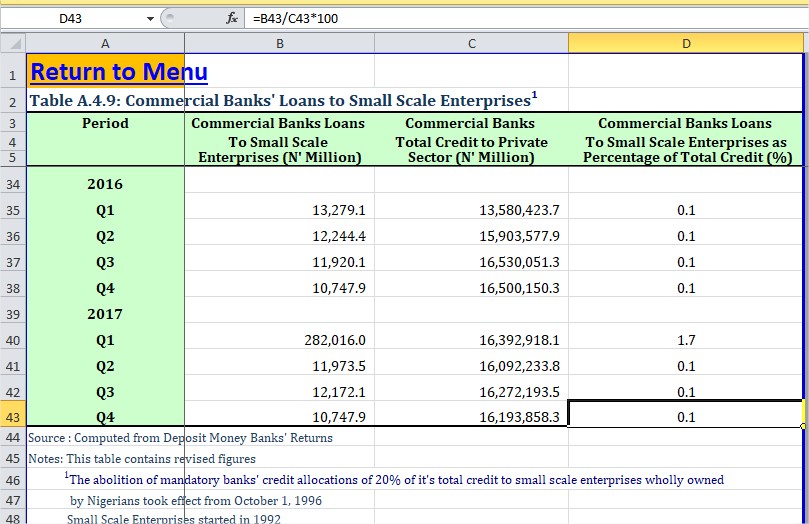
It is the Central Bank of Nigeria’s Statistical Bulletin on Financial Statistics that provides official figures on bank loans and what percentage goes to small-scale enterprises. According to the latest bulletin of 2017, in the year’s fourth quarter, the amount of commercial bank loans that went to the private sector was N16.2 trillion.

Out of this, N10.7 billion went to small-scale enterprises, which amounts to 0.1 per cent. The only periods when the percentage increased between 2014 and 2017 was in the second quarter of 2014 and the first quarter of 2017 when it was 0.2 and 1.7 per cent respectively.

Verdict: The claim is exaggerated.

Source: CBN Statistical Bulletin, 2017
Claim: The power generation in Indonesia is 50,000 for 250 million people… 

“…If you can support the SMEs properly and be able to work on your manufacturing, which then leads to the issues of power, because what we are generating today is too low. Look at your competitors, the lowest that you can see in the MIND countries is Indonesia that is generating 50,000 for 250 million people and you are generating about 4,000 for 200 million,” Obi said.

To begin with, the current population of Indonesia, based on the latest United Nations estimate, is  268 million.

Then according to data from the U.S. Department of Commerce’s International Trade Administration, by the end of 2016, Indonesia’s “installed generation capacity was 58,541 MW, with 40,461 MW (75%) generated by state-owned National Electric Company (PLN) and the remainders, 13,254 MW and 2,434 MW are produced by independent power producers (IPPs) and private power utility (PPUs) respectively”.

It is not clear what Obi meant by “MIND countries” or what exactly he said — perhaps it was an acronym for emerging economies such as “BRICs” is used to refer to Brazil, Russia, India, China and South Africa.

Verdict: The claims are inaccurate and outdated.

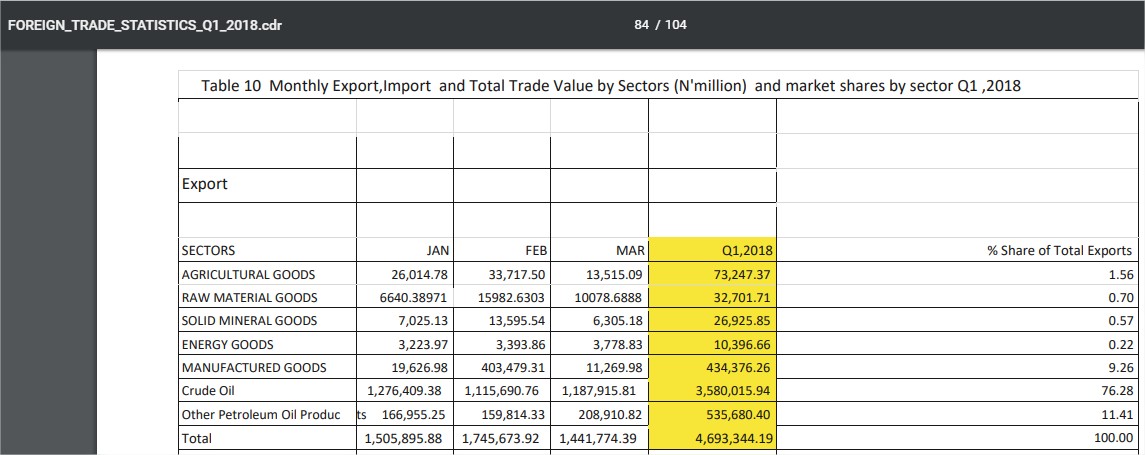
Claim: African trade today is less than 9% … Oil gives 80% of our forex


“African trade today is less than nice percent, and ff we get it right it can go as high as 30 per cent or 40 percent. The foreign exchange you are saying today you’re now earning from oil, oil now gives you 80 per cent of your foreign exchange, when in effect if you do the right things, you can have twice than coming from manufacturing,” he said, while commenting on the African Continental Free Trade Agreement.

The 2018 African Trade Report developed by the African Export-Import Bank notes that intra-Afican trade is at 15 per cent (nearly double Obi’s claim), compared to Europe’s 67 per cent, Asia’s 58 per cent, North America’s 48 per cent, and Latin America’s 20 per cent. According to Brookings, in 2016, intra-African exports made up 18 per cent of total exports.

Source: NBS

On the other hand, the contribution of oil products to Nigeria’s foreign exchange is closer to 90 per cent than 80. According to the NBS, crude oil and other petroleum products constituted up to 87.7 per cent of Nigeria’s foreign exchange earnings in the first quarter of 2018.

Verdict: The claims are false and understated, respectively.

Claim: I have invested aggressively in education as governor, taking my state from being 28th to number one…

“The more you invest in education, the better your economy. So we will aggressively invest in education. I have done this even as a governor of a state, where I took a state from being number 28 to number one, because we know the value of education. I was the first to equip all our schools with ICT… Go to HP, I bought the highest [number of] computer[s] ever bought by a government in Africa: 30,000. So I know the value,” he said.

Truly, Anambra State was declared first among states in Nigeria in the 2013 West African Senior School Certificate Examination (WASSCE) followed by Abia, Rivers and Lagos states; and the Anambra State Commissioner for Education, Uju Okeke, attributed the feat to Obi’s policies in the education sector. The same feat was achieved the following year when his tenure came to an end.

It is also true that the former governor’s acquisition of computers for secondary schools has been acknowledged. In 2014, at the 25th Annual Conference of the Nigeria Computer Society, Obi was awarded for his contributions along the line.

“On the assumption of office, the former Governor embarked on the computerization of schools and offices in Anambra State. Today, all public offices in the State have computers unlike before him, when manual typewriters were still in use,” David O. Adewunmi, the society’s president said.

“He purchased more than 30,000 desktop and laptop computers for secondary schools in the State. The last purchase was 22,500 units of laptop computers from HP at the ratio of one computer to 10 students, the largest for computer purchase for school in the entire African continent.”

It is not clear if this last claim applied generally or was restricted to sub-national governments only. Records, however, show that countries such as Rwanda, Kenya, and South Africa have implemented much more ambitious educational computer projects before 2015.

The ICIR could not confirm whether Anambra State’s secondary schools were ranked 28th by WAEC before Obi’s administration.

Verdict: The claims are true, to the extent which they can be verified.

Claim: NPA has an office and guesthouse in London…

Obi said: “Nigerian Ports Authority, for years, looked at the expansion that is coming and everything and decided not to invest. Instead, we are using money wrongly. Nigerian Ports Authority is the only ports in the world that has an office, even a guesthouse, outside its country of operation. They have a guesthouse in London; and that is the problem.”

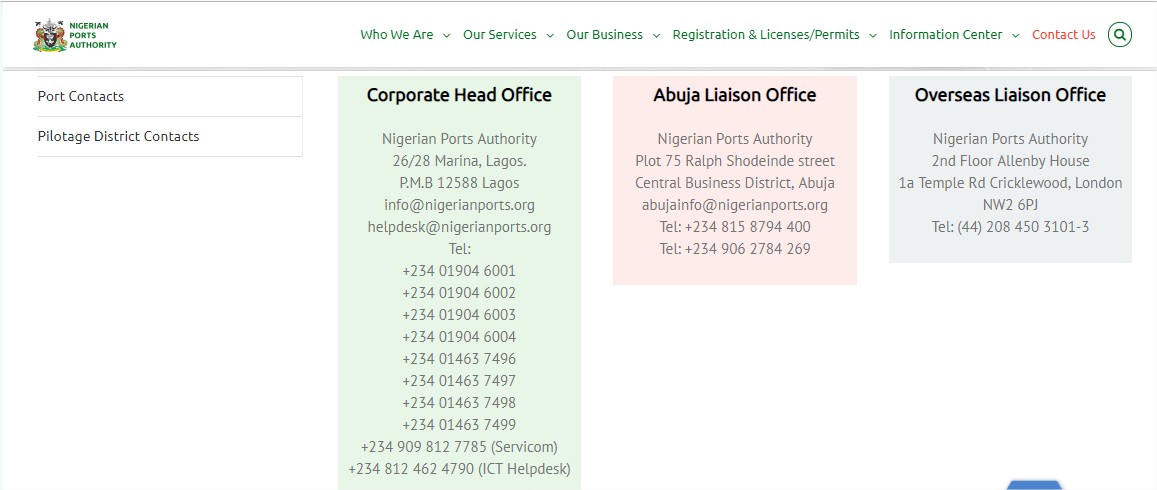
NPA’s contact page

Checks on the website of the Nigerian Ports Authorities show that the agency has an “overseas liaison office” with the physical address stated as: 2nd Floor, Allenby House, 1a Temple Rd Cricklewood, London. The ICIR could however not confirm if the agency has a guesthouse in the same city, or if it is the only ports authority in the world to have an office outside national borders.

Verdict: The claim about the overseas office is true, while others could not be ascertained.

Claim: Buhari on March 26, 2015… said he should be removed if he doesn’t deliver

“We are in a situation where, four years ago, on March 26 2015, our president said to us, ‘if I fail to deliver, choose your leader.’ The question is: Have they delivered?” Obi said in his closing statement, as the audience cheered.

There is no record of Buhari delivering a reported speech on this day. What he did though was sign a second peace accord alongside then President Goodluck Jonathan, which was initiated by the National Peace Committee. Bola Tinubu delivered a speech the previous day at the 7th Annual Bola Tinubu Colloquium, and he said nothing close.

The ICIR has also studied the president’s acceptance speech of April 1, 2015, inaugural speech of May 29, 2015, independence day speech of October 1, 2015, and speech at the swearing-in of ministers on November 11, 2015, and could not find the statement credited to him by the PDP vice presidential candidate.

It should be noted also that March 26 was nearly one week before Buhari was declared president-elect by the Independent National Electoral Commission, which would have made the utterance of the attributed statement premature.

Verdict: The claim is false and could not be substantiated.

VP Debate: Osinbajo says FG has built six tech hubs, sixty-three days to elections

VICE President Yemi Osinbajo says the Muhammadu Buhari administration is investing heavily in technology as it understands that it is the future of economic development.

According to him, the administration has set up six technology hubs in the six geopolitical zones of the country.

Osinbajo was speaking during the vice presidential candidates’ debate in Abuja which was held on Friday, exactly sixty-three days to the general elections.

“These technology hubs are being funded by the federal government, some of them are part funding,” he said.

The vice president added that the government is paying special attention to STEM (Science, Technology, Engineering, and Mathematics) education, and has expanded it to become STEAM (Science, Technology, Engineering, Arts, and Mathematics).

“We have also invested heavily, even here in Abuja, in five model classrooms, for technology,” Osinbajo said. “We are looking at what to do on technology training, and how to make technology training available for everyone”.

This, according to Osinbajo, will include setting up “a technology advisory group”, comprising Nigerian technology experts around the world, perhaps to advise the government on how best to go about ICT development in the country. (He could not finish his sentence before his time was up)

The ICIR cannot confirm whether the federal government has indeed set up tech hubs in all the geopolitical zones in the country.

In October of 2016, at an event in Ogun State, Osinbajo said the tech hubs were being built, one in each zone, with an additional “two super hubs, one in Lagos and one in Abuja”.

“We are building, at the moment six innovation hubs in the six geopolitical zones with two super hubs, one in Lagos and one in Abuja. They are basically to provide opportunities, especially for young people who are looking for investments in technology,” Osinbajo said.

He, however, did not specify where in the six geopolitical zones the tech hubs were being built, just like he did not say, during Friday’s debate, the cities where the tech hubs are located.

Osinbajo’s spokesman, Laolu Akande, when contacted for clarification by The ICIR, said the federal government has so far worked on several of such hubs.

“For regions and sectors where there is Innovation activity, we worked with existing players in the ecosystem,” he explained.

Providing details, he added: “In the North Central and South East, we ran the Start-Up Nigeria project supporting startups with Ventures Platform Hub in Abuja and Genesys Hub in Enugu. In the North East, we set up the North East Humanitarian Innovation Hub in partnership with the International Committee of the Red Cross.

“In the South West, we set up the Premier Hub, Akure in partnership with the State Government and other private sector actors. In the South-South we set up the Marydel Hub, in partnership with the Edo Innovates program of the State Government. And also run programs and projects in the Tinapa Knowledge City.

“In Lagos, we set up the Nigeria Climate Innovation Center, in partnership with the Enterprise Development Center in the Lagos Business School, and the World Bank. The centre is part of the World Bank’s Climate Technology Program. In the North West, we are working with Colab, who have been listed to benefit from world bank GEM funds, and the Kaduna ICT Hub set up in 2016 by the state government in partnership with Zenith.”

Health budget: Buhari spends only N5 per citizen per day, says Peter Obi

VICE presidential candidate of the Peoples Democratic Party (PDP), Peter Obi, says Nigeria’s current health budget translates to N5 per citizen daily.

Obi, speaking during the debate for five vice presidential candidates in the 2019 general election on Friday, said it was the high point of inefficiency for a government to vote such low amount to health while paying trillions in petroleum subsidy.

“There’s no way a country can have a budget of N34o billion for health, which translates to N5 a day for its citizens, and then pay a trillion for subsidy,” Obi said.

He was arguing against the continued payment of petroleum subsidy by the Buhari administration despite telling Nigerians that subsidy had been removed and that the federal government was saving billions every month as a result.

Continuing, Obi who is the immediate past Governor of Anambra State, said: “There’s no way you can have an education budget, which is the most critical component of a development, at four hundred and something billion, and you are paying a subsidy of a trillion. It is a waste.

“We need to reverse it because you are not dealing with the engine that will drive your economy tomorrow.”

The N340.45 billion that was voted for the health sector in the 2018 budget represents 3.9 per cent of the total budget sum, and it is lower than the 4.1 per cent allocated to the sector in 2017.

Out of that amount, N269.34 billion was voted for recurrent expenditure, while only N71.11 billion will be used on capital expenditure.

This is in spite of the numerous health challenges that have bedevilled the health sector, including the outbreak of numerous disease across the country, such as cholera, meningitis, monkeypox, Lassa fever, and more recently, Yellow fever.

Also, young Nigerian medical doctors have continued to leave the country in their numbers, to the UK, USA, Canada, etc, in search of better working conditions.

The development is a far cry from the Abuja Declaration signed by African leaders, including Nigeria’s, at an AU meeting in Abuja in 2001, where they pledged to devote at least 15 per cent of their countries’ annual budget to the health sector.

Also, the federal government have continued to go against the National Health Act, signed into law in December 2014 by then President Goodluck Jonathan, which provides that one per cent of the consolidated revenue fund of the federal government should be set aside to finance health initiatives in the country.

Whether the Buhari-administration will comply with the above provision in the 2019 budget, is yet to be seen. The budget will be presented to the National assembly on Wednesday, December 19, 2018.

FACT CHECK: Unemployment rate: Peter Obi is half right

PETER Obi, vice-presidential candidate of the Peoples Democratic Party (PDP has claimed that the unemployment and underemployment rate in Nigeria rose from 24 per cent in 2015 to 40 per cent in 2018.

Obi made the claim at the just concluded vice presidential candidate debate organised by the Nigeria Elections Debate Group (NEDG) and the Broadcasting Organisations of Nigeria (BON).

His goal is to make the economic policy of Buhari look worse than bad.

“In 2015, unemployment and underemployment rate used to be 24 per cent, but now, it is about 40 per cent” Obi claimed

VERIFICATION OF CLAIM

To verify the claim, The ICIR looked through data and reports published by the National Bureau of Statistics (NBS) on unemployment and labour.

UNEMPLOYMENT/UNDEREMPLOYMENT DEFINED

The labour force population covers all persons aged 15 to 64 years who are willing and able to work
regardless of whether they have a job or not. The definition of unemployment, therefore, covers persons (aged 15–64) who during the reference period were currently available for work, actively seeking for work but were without work. Underemployment, however, occurs if one work less than full-time hours, which is 40 hours, but work at least 20 hours on average a week and /or if you work full time but are engaged in an activity that underutilizes your skills, time and educational qualifications.

UNEMPLOYMENT AND UNDEREMPLOYMENT RATE FIGURES FROM 2015 TO 2017

Data obtained from a report titled “Unemployment/underemployment report Q3 2016″ from the website of the NBS shows that Nigeria’s unemployment and underemployment rate in Q1 2015 was 29.1 per cent, it increased to 35.2 per cent at the last quarter of 2016.

The latest report by the NBS shows that unemployment and underemployment rate for Q1 2017 was 37.2 per cent and rose to 40.0 per cent in Q3 2017

CONCLUSION

Obi’s claim is correct on one side and not correct on the other side. He said that “Unemployment rate used to be 24 per cent in 2015, but now, it is about 40 per cent”. Available official records support his claim for 2017 figure. However, the rate was slightly higher than he claimed it to be in 2015; the rate was 29.1 per cent. Therefore, Buhari should not be held accountable for 5.1 per cent loss of job

The unemployment and underemployment rate in Nigeria kept increasing since 2015, it has RISEN to 40 per cent as claimed by Obi.


Duke to challenge court decision removing him as SDP presidential candidate

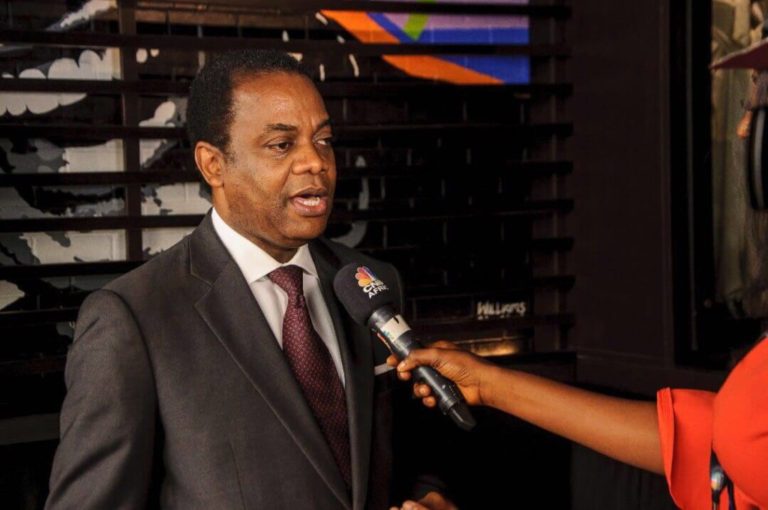
FORMER Governor of Cross River State, Donald Duke, says he will challenge any decision that seeks to subvert the wishes of the majority of members of the Social Democratic Party (SDP) who voted him in as their presidential candidate.

Duke said this in reaction to the ruling by Justice Hussein Baba-Yusuf of the FCT High Court on Friday removing him as the SDP presidential candidate and replacing him with former Minister of Information, Jerry Gana.

Justice Baba-Yusuf upheld Gana’s argument that according to the SDP constitution, the National Chairman of the party and its presidential candidate cannot come from one zone. Both Olu Falae, the SDP National Chairman, and Donald Duke are from the southern region of the country.

“The law has crystallised that political parties should abide by the regulations which they have made by themselves. The claimant laid sufficient evidence to have the judgment in his favour; it is a clear violation of the party’s constitution; the court cannot wave right over illegality,” the judge ruled.

He subsequently declared Duke’s votes at the SDP presidential primary election null and void and declared that Gana was the winner of the election. He also urged Duke to quit parading himself as the party’s presidential candidate.

Reacting to the judgement, Duke said that “every Nigerian who meets the legal requirement is entitled to contest for the office of the President”.

“Any law that seeks to curtail or subvert that right under any guise is unconstitutional, null and void and of no effect,” Duke told the News Agency of Nigeria (NAN).

“The delegates of our great party, at its convention in October, overwhelmingly elected me as their presidential Flag-bearer. Any attempt to subvert their wishes through the instrumentality of the courts will be challenged.

“As a Law abiding citizen, I urge my supporters and members to remain calm as we are confident that the decision of the Court will be upturned on appeal. We are optimistic that the Appellate Court will reach a decision that reinforces the essential tenets of the Constitution of the Federal Republic of Nigeria.”

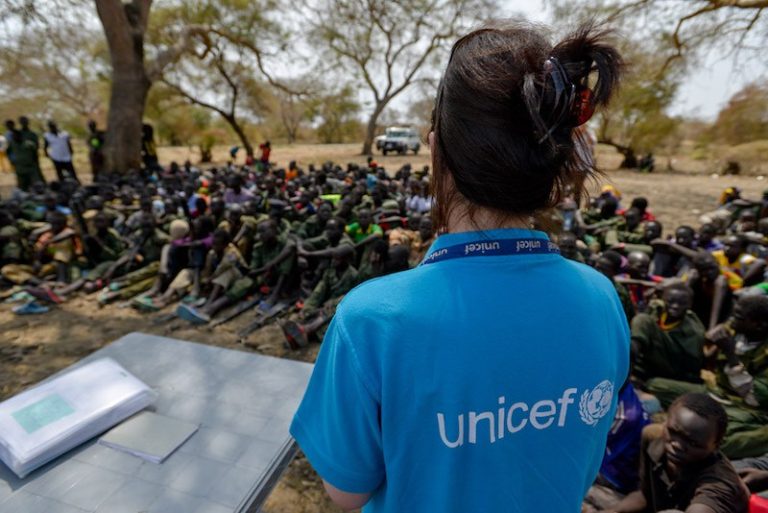
Army lifts controversial three-month suspension on UNICEF hours after announcing it

JUST hours after announcing a three-month ban on the activities of the United Nations Children Fund (UNICEF) in the North East, the Nigerian military authorities have lifted the controversial suspension.

Onyema Nwachukwu, the Deputy Director of Army Public Relations, issued a statement on Friday, accusing UNICEF of spying on military formations and thus jeopardising its operations against Boko Haram.

“The Theatre Command Operation LAFIYA DOLE is suspending the operations of the United Nations International Children’s Emergency Fund (UNICEF) in the North East theatre until further notice,” the statement read.

“This has become inevitable since the organisation has abdicated its primary duty of catering for the wellbeing of children and the vulnerable through humanitarian activities and now engaged in training selected persons for clandestine activities to continue sabotaging the counter-terrorism and counter-insurgency efforts of troops through spurious and unconfirmed allegations bothering on alleged violations of human rights by the military.

“Information within the reach of this Command specifically indicates that the organisation commenced the said training on Wednesday 12 December 2018 at the Ministry of Finance Conference Hall, Musa Usman Secretariat, Maiduguri and ended on Thursday, 13 December 2018. The Theatre command will not tolerate this kind of sabotage from any individual, group of persons or organisation.”

Later on Friday, a presidential spokesman, Garba Shehu, issued a statement saying that the commander of Operations Lafiya Dole will have a meeting with UNICEF tomorrow “to resolve the issues of concern regarding some of the actions of UN agency”.

But the army issued another statement saying that the suspension has been lifted after “extensive deliberations” between leaders of the army and UNICEF representatives.

“During the meeting, the Theatre Command admonished the representatives of the organization to desist from activities inimical to Nigeria’s national security and capable of undermining ongoing fight against terrorism and insurgency,” Nwachukwu stated.

“The Command also urged UNICEF representatives to ensure they share information with relevant authorities whenever induction or training of new staff is being conducted in the theatre.

“Consequently, after extensive deliberations on the need to seek modalities to work harmoniously with the security agencies in the theatre of operation, the Theatre Command has henceforth lifted the three months suspension earlier imposed on UNICEF activities in North Eastern Nigeria.”

Tears, prayers as army buries soldiers who died in recent Boko Haram attacks

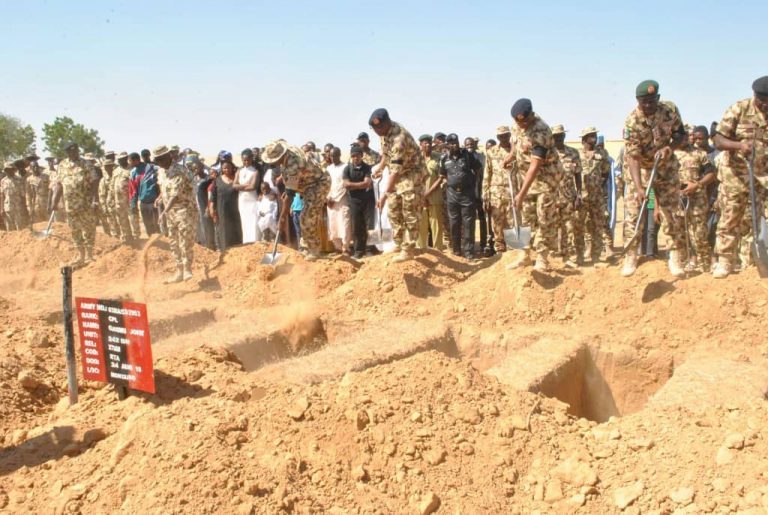
THE remains of some of the soldiers that were killed in recent Boko Haram attacks in Borno State, North East Nigeria, were buried on Friday.

The funeral was held at the military cemetery of the Maimalari Cantonment in Maiduguri, the Borno state capital, and was witnessed by the families of the deceased soldiers as well as representatives of government and military top hierarchy.

Representing the Chief of Army Staff, Tukur Buratai, at the event, the Chief of Army Training and Operations, Lamidi Adeosun, eulogised the fallen soldiers for their courage and bravery in protecting their fatherland. He also urged the media to desist from reports that could weaken the morale of the soldiers who are risking their lives daily in the counterinsurgency operations.

Adeosun maintained that the Nigeria Army, though shaken by the recent attacks, remains resolute and determined in decimating Boko Haram and eliminating all threats to the nation’s territorial integrity.

Governor Kashim Shettima of Borno State was represented at the event by his deputy, Usman Dukwa, while the Shehu of Borno also sent a representative.

The funeral service was officiated by Christian and Islamic clerics.

There had been reports that as much as 100 soldiers were killed in Metele in the recent Boko Haram attack, but the Army Spokesperson, Sani Usman, put the number of deceased soldiers at 23.

Usman said the army had taken notes of the media organisations that published or broadcast fake reports about the attacks and would take legal actions against them.

Below are some pictures of the burial of the soldiers on Friday.

Family members of the deceased soldiers weeping at the burial ceremony.
Bodies of the deceased soldiers were wrapped with the Nigerian flag
Army boots and cap were also placed on the coffins as a mark of courage and bravery.
Family members of the fallen heroes paying their last respect.
The marked graves of the fallen heroes.

VP Debate: Osinbajo contradicts self, says FG still pays fuel subsidy

VICE President Yemi Osinbajo, has admitted that the federal government still pays subsidy on petroleum products, despite insisting for a long time, and even boasting that it had made away with the issue of subsidy payment.

Osinbajo made the admission during the debate by vice presidential candidates of five political parties taking part in the 2019 general election, on Friday, in Abuja.

He, however, said that the subsidy “is being taken from the balance sheet of the NNPC (Nigeria National Petroleum Corporation)”.

He argued that “subsidy helps” and that once it is removed, the prices of almost all goods and services will skyrocket and that the common man will be the worse off for it.

“Subsidy is useful now,” Osinbajo maintained.

Over the years, even before the All Progressives Congress (APC) won the 2015 presidential election, the party has been vocal, and sometimes confrontational against the payment of subsidies to independent petroleum marketers.

Indeed,  petroleum subsidy has been one of the many avenues through which massive corruption is being carried out in the country.

In January 2012, Nigeria was literally shut down as hundreds of thousands of citizens took to the streets in protest of the decision of the then President, Goodluck Jonathan, to stop the payment of petroleum subsidies. That protest was led mainly by members of the opposition political party at the time, majority of whom are now in the ruling APC.

Following the nationwide protests, Jonathan restored the subsidy payments and peace was restored.

About a year after President Muhammadu Buhari took over power in 2015, he announced that he was removing the payment of subsidy, and this resulted in an increment in the pump price of petroleum in the country. Premium Motor Spirit (PMS), commonly referred to as petrol, rose from N87 to between N141 and N145.

In December 2016, Osinbajo boasted that the removal of fuel subsidy saves Nigeria N15 billion on a monthly basis.

“Amongst others, the downstream sector has been deregulated with the elimination of petroleum subsidy. This policy has removed from government, a burden of not less than N15.4 billion monthly,” Osinbajo said, through Abubakar Malami, the Attorney General of the Federation who represented him at an event.

But by April 2018, the Minister of State for Petroleum Resources revealed that the federal government pays over N1.4 trillion in what he termed “under-recovery” for the supply of petroleum products across the country. The term “under-recovery” simply means subsidy.

But Osinbajo, in May, insisted that “the federal government is not, at the moment, paying for any subsidy”.

“If you are buying and selling fuel, you would have to be able to pay for it. So, it’s not a question of government provision for a subsidy, the federal government, at the moment, isn’t paying any subsidy.”

He insisted that it was the NNPC, not the FG, that bears the cost of petrol subsidy. But the NNPC is owned and run by the Government. In fact, President Buhari also doubles as the substantive Minister of Petroleum Resources, and, according to the NNPC Group Managing Director, Maikanti Baru, gives the final directive on whatever happens in the ministry.

Recently, the National Assembly recently commenced an investigation into allegations that the NNPC diverted over $1 billion from the dividends of the Nigerian Liquefied Natural Gas (NLNG) and used same for illegal petrol subsidy payments.

However, a report by the Chairman of the Senate Committee on Gas, Bassey Albert, on Wednesday, cleared the NNPC of any wrongdoing.

Osinbajo, Obi, others spar at vice presidential debate

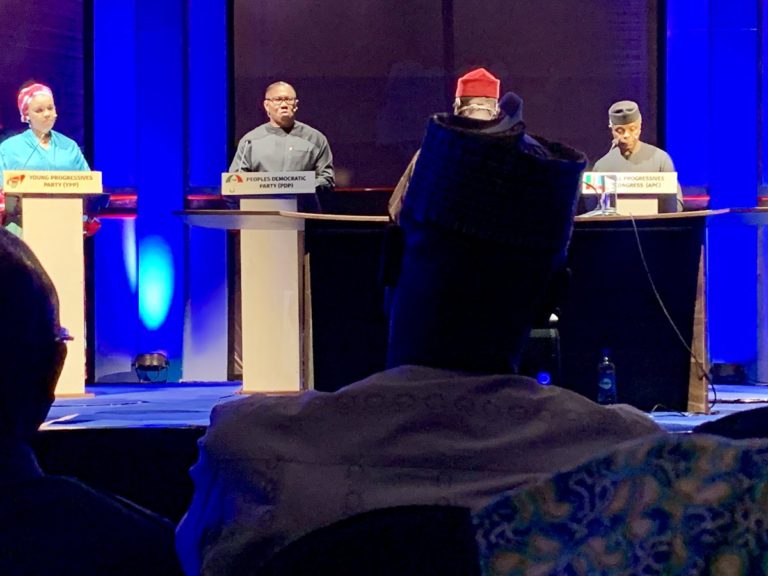
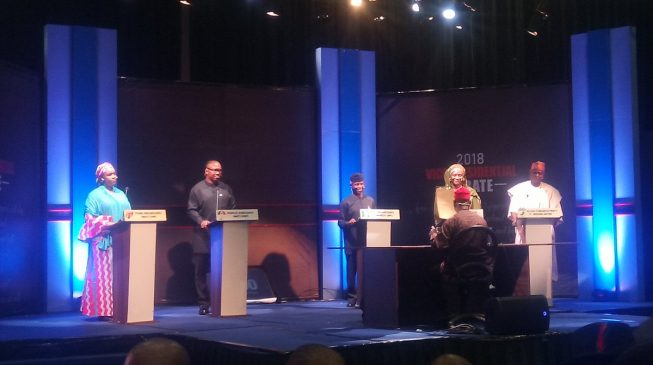
THE vice presidential debate ahead of the 2019 general election kicked off at 7 pm on Friday with Vice President Yemi Osinbajo of the ruling All Progressives Congress (APC) going head to head against Peter Obi of the Peoples Democratic Party (PDP).

Among the topics that came up during the debate were the issue of the war against corruption, petrol subsidy, diversification of the economy, the Continental Free Trade Agreement etc.

Vice Presidential candidates of the Allied Congress Party of Nigeria (ACPN); Alliance for New Nigeria (ANN); and Young Progressives Party (YPP), Ganiyu Galadima, Khadija Abdullahi, Umar Getso, respectively, also took part in the debate.

On the war against corruption, Obi said the Buhari administration was going about it the wrong way. He said the economy is almost brought to a standstill in the guise of fighting corruption.

“You cannot shut down your shop because you are pursuing a thief,” Obi said. He noted that almost all economic indices in the country are down from what they used to be in 2015 when the APC took over power.

In response, Osinbajo said given the massive corruption that has happened in the country in the past, the fight against corruption demanded the thoroughness which the present administration is giving to it.

He noted that all the international economic organisations were unanimous that corruption is the major hindrance to development and growth in Nigeria, hence the zeal with which the Buhari administration is combating it.

On the issue of subsidy, Osinbajo admitted that the government is still paying some sort of subsidy but that the subsidy “is being taken from the balance sheet of the NNPC”.

He maintained that “subsidy helps” and that once it is removed, the price of almost everything will shoot up. “Subsidy is useful now,” Osinbajo insisted.

But Obi disagreed, saying that what the Nigerian government is subsidizing at the moment was “inefficiency”. He said there is an average of 2 million cars on Nigerian roads, and as such subsidizing petrol does not make much economic sense.

He also said that prices of goods and services could remain stable if petrol subsidy was removed and the government in power does the right thing.

On economic diversification, Obi said when voted into power, he and Atiku’s government would focus on industrialization and manufacturing as that is what drives almost all the developed economies of the world.

He pointed out that countries like China, Malaysia, and Indonesia, has the manufacturing sector contributing over 40 per cent to their Gross Domestic Product (GDP), while in Nigeria, out of the over N19 trillion being owed commercial banks, less than three per cent went to Small and Medium Enterprises (SMEs).

To this, Osinbajo responded that the Buhari administration has set up SME hubs in about 20 states of the federation to boost small businesses. He also pointed out that the government has set up independent solar power plants in various markets across the country also as a means of encouraging small and medium businesses. Examples of the markets where solar power plants had been established are the Ariara Market in Aba, Abia State, and the Sabon Gari market in Kano, Kano State.

On the refusal of the Buhari administration to sign the Continental Free Trade Agreement (CFTA), Osinbajo said the Nigerian government was being careful not to sign any agreement that could hurt its economy.

He noted that even the Manufacturing Association of Nigeria (MAN) rejected the agreement, alongside some other professional bodies in the country.

“We are a private sector-driven economy,” Osinbajo said, “the Continental Free Trade Agreement could kill local industries.”

But Obi said if the PDP was voted into power, it would sign the agreement.

On foreign policy, almost all the candidates agreed that Nigeria’s foreign policy will focus more on economy and security, but Obi said a PDP government will not keep borrowing the way the APC administration is currently doing.