Home Blog Page 2469

Farmers-herdsmen crisis: Nigerian govt has done little to prevent rising killings, according to Amnesty report

0

THE persisting deadly clashes between farmers and herdsmen across Nigeria are exacerbated by the failure of government officials and agencies to respond swiftly and adequately to complaints, investigate occurrences and bring the offenders to book.

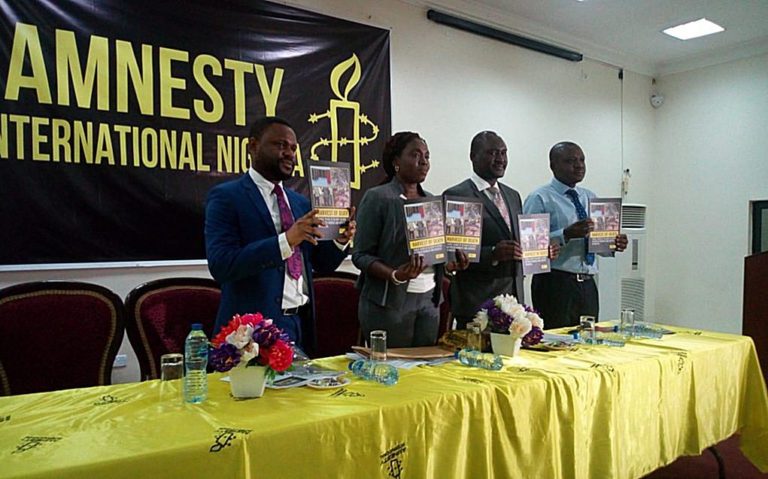
This is the conclusion of Amnesty International (AI), a non-governmental organization focused on addressing human rights violations, in its report released on Monday and titled “Harvest of Death: Three Years of Bloody Clashes Between Farmers and Herders in Nigeria”.

At the launch of the report in Abuja, the London-based NGO, revealed that at least 3,641 deaths had been recorded and independently verified to be direct result of the crisis in the past three years, adding that thousands of people had been displaced and had suffered different levels of injury.

According to the 70-page report which is based on reports and studies from January 2016, 57 per cent of the deaths, that is 2082, occurred in 2018 alone. There were 814 deaths recorded in 2016, and 745 recorded in 2017.

Addressing newsmen and stakeholders at the ceremony, Osai Ojigho, AI’s Country Director for Nigeria, said the organisation’s researches found that security forces were usually positioned close to the attack locations and were mostly slow to act. In other instances, they were given prior warning about impending raids but did nothing to avert them.

“The Nigerian government has displayed what can only be described as gross incompetence and has failed in its duty to protect the lives of its population and end the intensifying conflict between herders and farmers,” Ojigho said.

“The authorities’ lethargy has allowed impunity to flourish and the killings to spread to many parts of the country, inflicting greater suffering on communities who already live in constant fear of the next attack.”

She explained that the report is based on field trips to 56 villages in five states, and the analyses of 230 documents, including medical records, security reports and media reports, as well as 262 interviews with natives, eye witnesses, community leaders, medical practitioners, religious leaders and government officials.

“Our research shows that these attacks were well planned and coordinated, with the use of weapons like machine guns and AK 47 rifles, yet little has been done by the authorities in terms of prevention, arrest and prosecution, even when information about the suspected perpetrators was made available,” she said.

“The Nigerian authorities have an obligation to protect the right to life as enshrined in the constitution and other international and African regional human rights treaties. Yet, communities told Amnesty International that when they reached out to security forces on impending attacks, no action was taken.

“On the 2nd of May, 2018, for example, 33 villagers were killed and five villages torched in the Numan Local Government Area in Adamawa State, despite security forces being informed 16 hours prior to the attack that gunmen had started driving nearby.

“Residents of Bang, Nzumosu and Gon villages confirmed to Amnesty International that soldiers came to
their villages, but only patrolled the area briefly and then left. According to research undertaken on the ground by Amnesty International, the soldiers were deployed before and even patrolled in the area on the afternoon of 2nd May and then withdrew shortly before the attackers arrived. Villagers kept calling and complaining about withdrawal. But when they called, the number they had was reportedly switched off.

“In Nasarawa state, they wrote to the Inspector-General of Police on the 10th of March 2017 to protest against incessant attacks by herders. The villagers told Amnesty International that the police asked them for N150,000 allegedly for logistics, which they paid. Just three police officers were sent, but they refused to go to the villages, complaining of bad roads.”

AI’s Country Director also lamented the failure of various authorities, including state governments, the Nigerian Army and the Nigeria Police, to respond to the organisation’s enquiries after the findings were shared with them. Only the Enugu State government gave a timely response, she revealed, to say that five suspects are currently facing prosecution over the killing of 12 people in Nimbo community of Uzo Uwani Local Government Area.

Shedding more light on the report, Seun Bakare, AI Nigeria’s Programmes Manager, said it was concluded with a number of recommendations to the federal government, state governments and the international community. One of such recommendations, he pointed out, is for government to end impunity because “the only reason why these attacks have continued is because people become bolder and bolder by the day when they are not held accountable for right violations”.

“Beyond that, there is a need for government to address the immediate root cause and the remote causes of this conflict,” he continued.

“They must ensure that members of the two communities enjoy their human right, including right to land, to water. It is also important that the government protects and addresses humanitarian needs as thousands have been displaced as a result of this conflict and entire communities have been sacked.

“It is important that the government stands up to help these communities. If we fail to help them, then the cycle continues. We have also proposed to the government that there is a need to continuously equip and train police on modern policing techniques compatible with international warring standards in order to effectively deal with the current challenges.

“Also on accountability, independent commanders should be investigated and prosecuted for attacks in areas where troops under their commands were stationed and where there is evidence that they failed to stop these attacks.”

Meanwhile, the Nigerian Army, in a statement made public on Monday, accused Amnesty International of working hard to destabilise the country.

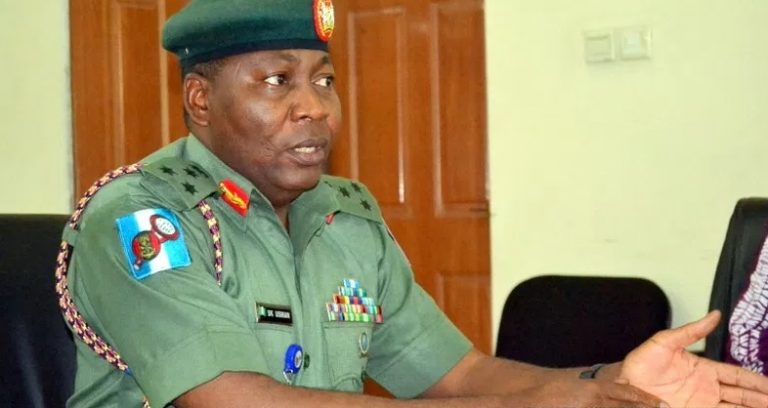
“The Nigerian Army has no option than to call for the closure of Amnesty International offices in Nigeria if such recklessness continues,” Army spokesperson, Sani Usman, said.

Saudi Arabia rejects resolution on Khashoggi murder, warns against external interference

SAUDI Arabia’s Ministry of Foreign Affairs has rebuked a resolution passed by the United States Senate condemning Saudi Arabia’s Crown Prince Mohammed bin Salman for the murder of journalist Jamal Khashoggi.

“The Kingdom of Saudi Arabia rejects the position expressed recently by the United States Senate, which was based upon unsubstantiated claims and allegations, and contained blatant interferences in the Kingdom’s internal affairs, undermining the Kingdom’s regional and international role,” the Saudi ministry said in a statement, posted on Twitter Sunday evening.

“The Kingdom categorically rejects any interference in its internal affairs, any and all accusations, in any manner, that disrespect its leadership,” the statement said.

CNN reports that the resolution passed by the US Senate last week concluded that “Crown Prince Mohammed bin Salman is responsible for the murder of Jamal Khashoggi”.

Khashoggi, a US resident, and Washington Post columnist was murdered and dismembered in Saudi consulate in Turkey in October. He was an outspoken critic of the Saudi government.

The CIA concluded that the Saudi Crown Prince personally ordered Khashoggi’s murder. Saudi government, however, denied that the Crown Prince was involved in the murder.

What the VP debate taught us about the alternatives to APC/PDP

0

By ‘Fisayo Soyombo

IN a country of 91 political parties in theory but just two in practice, a vice-presidential debate was always going to be a hard sell. For many reasons.

When the Nigeria Elections Debate Group (NEDG) and the Broadcasting Organisations of Nigeria (BON) announced the five parties to participate in the exercise, not many Nigerians could, off the top of their heads, name the respective vice-presidential candidates. Okay, we know the presidential candidates that are Obiageli Ezekwesili, Kingsley Moghalu and Fela Durotoye, but, for many, it still hasn’t sunk that their parties are Allied Congress Party of Nigeria (ACPN), Young Progressives Party (YPP) and Alliance for New Nigeria (ANN) in that order. Minus the press statements announcing their emergence, ANN’s Khadija Abdullahi-Iya, ACPN’s Ganiyu Galadima and YPP’s Umma Getso were unknown quantities until the night of the debate. The presidential debate, scheduled for January 19, 2019, was always going to be the real deal.

That hasn’t changed, of course. But with the benefit of hindsight — and ignoring the big sin of overlooking one or two other parties who should have been invited — we can thank NEDG and BON for that VP debate. It offered us deep insights into the core of the APC-PDP battle, and even deeper ones into the composition, depth and structure of the alternate parties. It helped us to know that 2019 is about the thief versus the shopkeeper.

To the discerning, Peter Obi’s parable of the shop and Yemi Osinbajo’s rebuttal tells a lot about what the two parties genuinely think of themselves, and of each other, in terms of their economic management potentials and their corrupt tendencies. In marshalling his argument, Obi recalls how unemployment levels have risen and Foreign Direct Investment (FDI) fallen in the current administration despite the much-vaunted anti-corruption crusade. “You’re not creating jobs, you’re not doing the right thing and you’re just fighting corruption,” he says. “You can’t shut down your shop and be chasing criminals.”

Osinbajo’s rebuttal included the refrain: “…if you allow criminals to steal all the inventory in the shop, there’ll be no shop. That’s the problem. And what has happened to Nigeria in the past 16 years is what the World Bank told us, that the major cause of our poverty is corruption.”

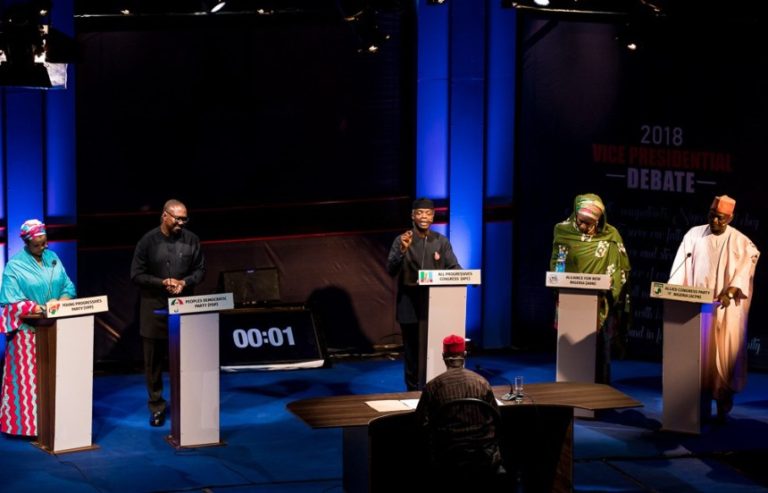
Peter Obi and Yemi Osinbajo, candidates of the PDP and APC.

Obi fell short of expectations in his economy versus anti-corruption argument. His position was to justify the superiority of corruption plus economic astuteness on the one hand over anti-corruption plus economic mismanagement on the other hand. Meanwhile, the expectation was that he would revisit the corruption in the Muhammadu Buhari administration: the fraudulent NNPC deals for which Ibe Kachikwu wrote Buhari in 2017, the nepotistic secret recruitments at the Central Bank of Nigeria (CBN), the N200m grass-cutting scandal over which the President delayed sacking the erstwhile SGF Babachir Lawal for many months, among many others. In the moment when it mattered, Obi forgot all these. It’s good news, actually, because for those who have reduced the 2019 election to a PDP-APC battle, now they know that their vote is either against one of corruption and economic mismanagement, or for one of supposed economic competence and incorruptibility. Sadly, that’s nothing but a reproduction of the devil-and-the-deep-blue-sea scenario of 2015.

The next logical step, then, would be to look in the direction of one of the smaller parties offering Nigerians an escape from the APC-PDP hegemony. But, on the evidence of their vice presidential candidates’ display at the debate, ACPN, ANN and YPP owe Nigerians an apology. Their candidates — Ganiyu Galadima, Khadija Abdullahi-Iya and Umma Getso — demonstrated unpreparedness for the debate, gross lack of understanding of national issues and utter underestimation of the enormous responsibilities that come with deputising for the Nigerian President.

Galadima was there for the limelight. Given a few minutes to open his remarks, he goes on and on about his gratitude for the stage, then reminds us he also featured at the 2015 debate “though as presidential candidate of the ACPN”. Abdullahi-Iya tells us she is “vying for the post of VP because I am concerned about every one of the over 2.1million children in the IDP camps in the northeast, who are scattered all over Nigeria. I am also concerned about the 13million children who are out of school.” Nothing wrong about caring for children but that can’t be the number one reason for seeking that office. If Abdullahi-Iya had any sniff of the Constitution, she would have known the Vice President is the Deputy Chairman of the Council of State, the Deputy Chairman of the National Defence Council; and, most importantly, the Chairman of the National Economic Council (NEC). Surprisingly, there was no single economy-related question that Abdullahi-Iya answered convincingly. She would be more remembered at the debate for her numerous “good evening, sir” when introducing her comments than for making any noteworthy contribution.

Umma Getso, vice presidential candidate of the YPP.

Neither did Getso fare any better. Asked what she would do to improve the aviation sector in Nigeria, her response was: “All we need is patriotic leaders. Patriotism will save Nigeria’s aviation sector.” Asked elsewhere to explain what would be the economic thrust of her administration for the aviation sector, Getso answered: “The major thing a typical Nigerian needs to look into is to see how we can rekindle patriotism in our hearts. To be candid, what Nigeria just needs is patriotic leaders, leaders that have Nigeria at heart. This is just what I’ll say about the aviation sector.” So, if we were to vote for Kingsley Moghalu, this is the Vice President he would give us? One question for Moghalu: what offence have Nigerians committed to deserve the punishment of an Acting President Getso in your absence?

Khadija Abdullahi-Iya, vice presidential candidate of the ANN.

On the simple but far-reaching matter of fuel subsidy, all three alternate candidates played to the gallery: subsidy must go. Even Obi supported this stance — same tune Buhari sang pre-2015 yet subsidy has remained in his four years at the helm. But no one with full grasp of the matter can advocate subsidy removal without addressing the corollary challenge of the ripple-effect spike in cost of transport, housing, food, goods and services; everything. Only Osinbajo did this.

The vice-presidential debate has taught us that the alternate parties are not ready. YPP, ANN and ACPN are approximately one-man shows incapable of running a government. If elected, Ezekwesili, Moghalu and Durotoye would struggle to constitute a proper cabinet. It took Buhari six months, it probably would take them a year — unless, of course, they want to populate it with people who have little to offer beyond their faith in their principal. None of Ezekwesili, Durotoye or Moghalu has an able deputy; that’s a sure sign of a tumultuous government that would eventually climax in self-implosion, were they to win.

It’s time alternate parties understood that the thirst for power and passion for change are not enough to succeed in the seat of governance. Beyond throwing constant jabs, however deserved, at the government of the day, these parties should spend the next four years building proper structures and propagating their ideologies within the party in such a manner that a VP candidate can discuss the party’s ideals almost as eloquently as the presidential candidate. Until then, they are not ready.

Soyombo, former Editor of the TheCable and the International Centre for Investigative Reporting (ICIR), tweets @fisayosoyombo


Army accuses Amnesty International of trying to ‘destablise’ Nigeria with false reports

0

THE Nigerian Army has called for the closure of the Amnesty International (AI) offices in Nigeria, alleging that there is credible evidence that the organisation is working hard to ‘destabilise’ the nation.

Sani Usman, the army spokesman in a statement on Monday, said that the organisation’s attempt to destabilise the nation was noted through the fabrication of fictitious allegations of alleged human rights abuses against the Nigerian security forces.

“They have tried over the years using Boko Haram terrorist’s conflicts, Islamic Movement in Nigeria, some activists and now herders-farmers conflicts,” he said.

Usman also alleged that the organisation had been organising clandestine sponsorship of dissident groups to protest, as well as unfounded allegations against the leadership of the Nigerian military.

“The NGO is at the verge of releasing yet another concocted report against the military, ostensibly against the Nigerian Army,” he said. “Consequently, Nigerians should be wary of Amnesty International (Nigeria) because its goals are to destabilise Nigeria and to dismember it.

“The Nigerian Army has no option than to call for the closure of Amnesty International offices in Nigeria if such recklessness continues,” Usman said.

The army had accused AI in the past month of falsifying reports on the clash between the Islamic Movement of Nigerian members and members of the military along the Keffi-Maraba highway road in Abuja.

Usman also accused the Nigerian branch of AI of deviating from the core values, principles and objectives of the original parent body in the United Kingdom.

This development comes just three days after the Nigerian Army accused United Nations Children’s Fund  (UNICEF) of impropriety and suspended all its activities in the northeast. Hours after announcing a three-month ban on the activities of UNICEF in the North East, the suspension was later lifted .

Meanwhile, a coalition of civil society organisations is asking the Chief of Army Staff, Tukur Buratai, to urgently provide information on 2015, 2016 and 2017 budget implementation of the Nigerian Army.


ICIR reporter wins DAME’s investigative reporter of the year

0

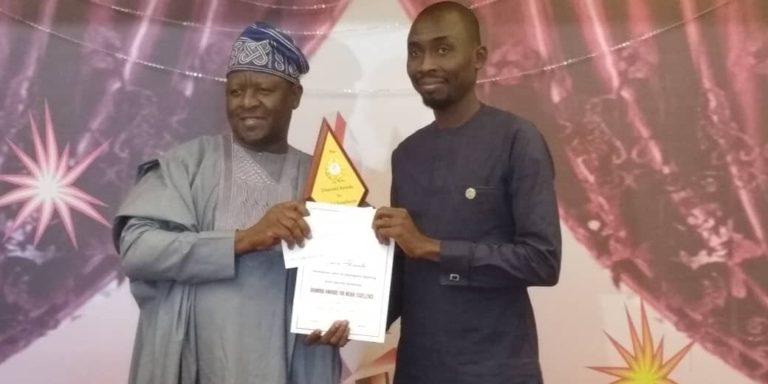
YEKEEN Akinwale, an investigative reporter with The International Center for Investigative Reporting (ICIR), has been announced winner of the Best Investigative Reporting category at the 27th Diamond Awards for Media Excellence (DAME).

The event was held on Saturday at the Radisson Blue Hotel, Ikeja, Lagos.

Akinwale’s winning entry was an investigative report that exposed the shabby state of primary health care centers in several South Eastern states despite huge expenditure by the federal  government.

Bayo Akinloye, a former reporter with The Punch newspaper who had two entries in the Investigative Reporting category, grabbed first and second runner up places respectively.

The Punch newspaper recorded highest winners as it received top prizes in eight categories, while The Nation Newspaper won two awards, Daily Trust (one), Nigerian Tribune (one) and  The Guardian (one).

The Punch was named the Best Designed Newspaper.

The prize for Editorial Cartooning went to Daily Trust’s Mustapha Bulama for his September 2, 2017 entry “Hate Speech”  while The Punch’s Saheed Olugbon won the News Photography category with his “Traders at Ojuwoye Market” published on July 3, 2017. The media house also came first in the Agriculture Reporting category with Kunle Falayi’s  entry titled “Rice farmers bemoan fate as 38 million hectares of land waste away”.

Samson Folarin of The Punch won the prize in the Lagos Reporting category. His entry, “VIS men accused of burning impounded car in Lagos”, was on the travail of a painter in the hands of officials of the Vehicle Inspection Service and the eventual resolution of the case.

The paper won in the Sports Reporting category with Eric Dumo’s “Gold in the midst of clay: Remarkable stories of female athletes shaming disabilities, published on April 1, 2017.

Eniola Akinkuotu of The Punch won the Child Friendly reporting category. His story, “How stigma, government policies cause 60,000 HIV deaths annually, was published on December 27, 2017.

Tribune clinched the Editorial Writing prize with an entry titled: “Being candid on Buhari’s absence”, published on February 17, 2017. Lekan Sote’s “Towards making Nigeria a nation”, published on June 7, 2017 in The Punch, beat Omotoso’s “Atiku visits Obasanjo” and Oladesu’s “The journey to nationhood” to second and third runner up.

The Chief Executive Officer (CEO) of Diamond Publications Limited Mr. Lanre Idowu, described all the nominees as winners. He explained that the objective of the award was to entrench the culture of professionalism in Nigerian journalism.

“In this season of political campaigns, the media needs to be more even-handed in their assessment of political actors and their messages. They need to identify the issues early and seek clear answers from the candidates,” he said.

Idowu urged the media not to “join the purveyors of fake news” and challenged journalists to promote factual unbiased reporting in the build-up to the 2019 polls.


Encomiums, sneers, controversies as Buhari clocks 76

PRESIDENT Muhammadu Buhari is celebrating his 76th birthday and goodwill messages have been coming from across the the country for a man who has had the opportunity to preside  over the affairs of Nigeria in two different periods in the country’s history.

Only one other Nigerian – Olusegun Obasanjo – has matched that achievement of being a military Head of State and a civilian president. But Buhari has an edge over Obasanjo because the former was a military governor and later a minister.

Encomiums were not in short supply on Monday as many Nigerians, regardless of party, ethnic or religious divides, updated their social media statuses with happy birthday messages for the president.

However, there were those who still raised the controversial issue of Buhari’s ‘true age’ and whether he should still be running for the post of the president at his age.

A short video of Buhari inspecting giant, hand-crafted birthday greeting cards and cakes has been posted on Twitter by Bashir Ahmed, the President’s Personal Assistant on New Media, as well as a video of a special parade by the soldiers working at the Aso Rock Presidential Villa.

One of Buhari’s loyal supporter on the social media, Akinsola, described him as “a man who has been exemplary in life and his commitment to Nigeria, a man who has a great sense of humour, and a man who genuinely loves the Nigerian people”.

Another one described the president as “hated by few… loved by most…(and) respected by all for his integrity”.

There were also messages from neutral individuals who have no affiliation with any political party, as well as from supporters of the opposition Peoples Democratic Party (PDP) posted words of prayers and goodwill for him, albeit with sneer.

For instance, this tweet by one handle with the username ‘Ade of Nigeria’ which read: “You may not like him. He may not be the best Nigeria has to offer, as the President. Today, however, he’s our leader and sure deserves our prayer. Happy Birthday, Mohammed Buhari.”

And this tweet by one Chidi Okereke, “Today is President Buhari’s birthday and all I want to do is wish him good health and more years. Hopefully he celebrates the next one as an elder statesman.”

Even Buhari’s main opponent for the presidential election, Abubakar Atiku, also posted his own birthday message, praying for God to give the president long life and good health “to witness how we get Nigeria Working Again”.

Then, there were posts suggesting that Buhari could be older than 76. This belief is widely expressed but there has been no evidence. Like this tweet by one ‘ClintonViceB’ which read: “Who else thinks 76 is just Buhari’s football age and that he is well over 76 years of age?” In Nigeria, footballers are believed to quote age figures lower than their real age, hence the term ‘football age’ to connote someone who says he is younger than his real age.

This controversy over President Buhari’s age was heightened in 2017 during his 75th birthday when he said he thought he was 74 but was told he was 75.

Also, there is the question of whether Buhari, at 76, is still strong enough to handle the rigours and stress that come with being in charge of the largest economy in Africa.

Buhari had once admitted in 2015 that at 72, there was a limit to what he could do. “I wish I became Head of State when I was a Governor, just a few years as a young man. Now at 72, there is a limit to what I can do,” he said at the time.

If Buhari wins the presidential election in 2019, he would be 80 years old by the time his second tenure comes to an end.

SERAP, EiE, BudgIT ask Buratai to account for 3 years army budgets

THE Socio-Economic Rights and Accountability Project (SERAP), Enough is Enough (EiE), and BudgIT have asked the Chief of Army Staff, Tukur Buratai to urgently provide information on the 2015, 2016 and 2017 budget implementation of the Nigerian Army.

The civil society group also specifically demanded for details of the amounts released and expended by the army  during the three-year period.

The group’s demand is contained in a joint Freedom of Information (FOI) request sent to Buratai asking the army chief to furnish them with the amounts released expended various operations, such as  Lafiya Dole,  Safe Haven, Python Dance, Ruwan Wuta, Delta Safe, Mesa, Harbin Kunama, Awatse, Tsera Teku and Crocodile Smile.

According to a statement on the official website of SERAP, the FOI request sent last week  was signed by Bamisope Adeyanju of SERAP, Seun Akinyemi of EiE and Atiku Samuel of BudgIT.

The group said it would take all appropriate legal actions under the FOI to compel the army to comply with the request if  the army fails to release the information after 14 days of receiving the FOI request.

The civil society group maintained that the  transparency of the budget process and its implementation is an essential condition to achieve good governance.

The group argued that the details of expenditure by the army would shed light on military spending, adding that it would stop the perceived lack of transparency and accountability in the spending of military budget, which has been a subject of intense public debate and concern.

“Several billions of naira allocated to the military to defend the country and protect its people have neither contributed to improving the ability of Nigerian soldiers to fight Boko Haram and other armed groups nor provided the much-needed security especially for Nigerians in the North-east of the country,” the group said.

The FOI request read in part: “the information being requested does not come within the purview of the types of information exempted from disclosure by the provisions of the FOI Act. The information requested for, apart from not being exempted from disclosure under the FOI Act, would serve the national interest,public welfare, public interest and peace, human rights, good governance, transparency and accountability.

“By virtue of Section 1(1) of the Freedom of Information Act, 2011, we are entitled as of right to request for or gain access to information, including information on 2015, 2016 and 2017 budget implementation reports of the Nigerian Army, and the amounts released (financial implications) and expended in fiscal years 2015, 2016 and 2017 for the various operations listed, which have yielded no tangible result.”

“Also, by virtue of Section 4(a) of the FOI Act, when a person makes a request for information from a public official, institution or agency, the public official, institution or agency to whom the application is directed is under a binding legal obligation to provide the applicant with the information requested for, except as otherwise provided by the Act, within 7 days after the application is received.”

Military dismantles checkpoints in Adamawa after report of wrongdoing

By Ibanga Isine

THE Nigerian military has disbanded all its security checkpoints in Adamawa State, The NEXT EDITION can authoritatively report today. Information received by this newspaper indicate that the Commanding Officer of the 232 Battalion, Lt. Col. Haruna was summoned to Abuja by the military high command.

The action followed reported cases of widespread extortion, sabotage of the country’s economy and the war against the insurgency.

The NEXT EDITION had in an audacious report uncovered how security operatives are helping in funnelling foodstuff and huge volumes of petrol and other fuel products to the deadly group.

Weeks of investigation by our correspondent revealed how soldiers, police, customs, immigration and civil defence operatives frequently receive bribes and turn a blind eye as fuel marketers and smugglers divert truckloads of petrol and foodstuffs to Boko Haram enclaves and neighbouring countries.

Through interviews with security operatives, marketers and undercover exploration of the dark market, this newspaper has obtained details of the well-coordinated transactions and is able to provide a glimpse into a largely unreported and unregulated operation that has clearly fed the insurgency and helped prolonged the nine-year war.

The reporting also showed the impact of the large-scale murky operation on the nation’s petro-economy.

Read the full investigation here: INVESTIGATION: Nigerian security forces sabotage war against insurgency, supply food and petrol to Boko Haram.

Information received by this newspaper showed the Commanding Officer of the 232 Battalion in Mubi, Lt. Col. Haruna was promptly summoned to Abuja by the military high command.

His invitation, it was learnt, followed petitions and complaints about extortion and other illegal activities by some officers and men under his command.

“Lt. Col. Haruna was summoned to Abuja last week and he spent days at the Army headquarters before coming back to Mubi,” a highly classified source told one of our editors.

“We don’t know what happened but as soon as he came back, he ordered all the checkpoints under the command to be dismantled and brought all the soldiers back to the barracks.”

But our correspondent reported that the dismantling of the military checkpoints did not affect the 232 Battalion only but the whole 23 Armoured Brigade, Yola.

Our correspondent who went round the major gateways to Yola reported that the detachments of soldiers, who were constantly on a 24-hour operation, have been removed.

Not only are the soldiers removed but the sandbags and drums and other barricades used in restricting vehicular movements have been removed.

However, a week after the military, police, civil defence, immigration and customs promised to investigate the alleged extortion and sabotage their respective spokespersons are yet to get back to us.

Yaba boys, stop touching us… women protest ‘sexual harassment’ by traders in Lagos

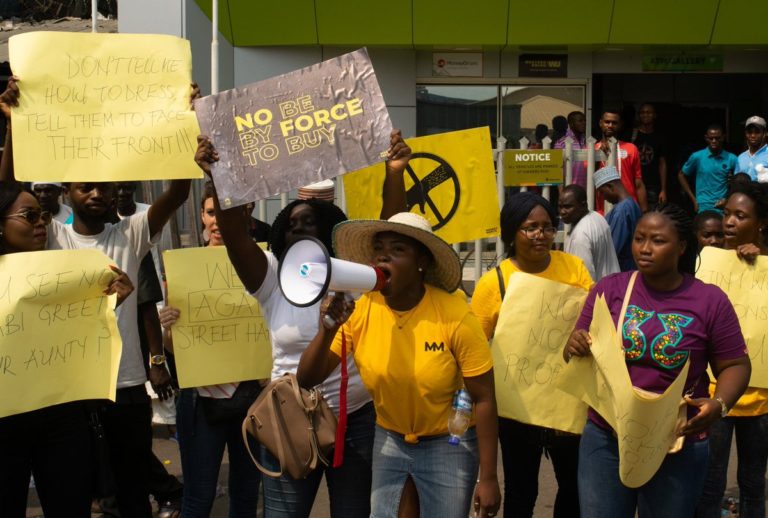
TIRED of incessant touching and groping by male traders in the popular Yaba Market in Lagos State, some women took to the streets in protest on Saturday.

Armed with placards and accompanied by policemen, the women chanted as they went around the market, “Yaba boys, stop touching us”.

As the girls carried out their peaceful protests, some of the traders were seen chanting back at them, “we must touch”, “who no like beta thing? (who doesn’t like a good thing?)”, etc.

Some of the male traders even started attacking the girls, hurling sachet water at them.

It turned out, according to narratives on the social media, that the unruly behaviour of Yaba traders has been going on for several years, in fact, Yaba Market has become notorious for these unruly traders who would always touch and grope female passers-by and customers, in the guise that they are asking for patronage.


READ ALSO:

Adaku Ufere, whose Tweeter handle read simply as “The Law“, wrote: “Nigerian men are a vile species. This is so triggering, brings back so many memories of walking through Yaba or Balogun as a child and dodging the hands of adult men. No matter how hot the day, I’d be fully covered hoping it’ll help and nope, they’d still harass. Predators.”

Another Tweeter username, Uncle Ajala, corroborated the women’s claim, saying that “Yaba market men are notoriously known for groping. They touch women anyhow, which is bad, now the ladies that are tired of their stupidity are protesting against their barbaric acts, and they’re still harassing them for protesting against their disgusting behaviours. Madness”.

Some tried to insinuate that the traders behave in such unruly manner perhaps because they were not educated, but many disagree.

One Akanke Onijibiti, narrated an experience she had while in the University of Lagos (UNILAG), when some boys in the male hostels harrassed female students who passed through there at night. He said the boys shone flashlights to the ladies buttocks “saying that we were going to do ashawo work so we should give them their own share first”. Ashawo is the Nigerian lingo for a commercial sex worker.

“So don’t try to say “they don’t know” or “those market men are illiterates”, what they exhibited was normalised trash behaviour men have been getting away with for a very long time and women are tired of the bullshit. We are fighting back to own the right to our bodies,” Onijibiti tweeted.

Spice, another Tweeter user also expressed similar sentiments. “Passing any UNILAG boy’s hostel at any time of the day is a reason why I know this Yaba men behaviour is not down to illiteracy,” She wrote.

Even persons who had similar experiences in other higher institutions such as the University of Ibadan and the University of Benin also spoke up.

On what could be done to stop the ugly culture of groping women who went to Yaba market to do their shopping, many offered different solutions ranging from closing down the market temporarily, or women boycotting the market, to security personnel doing their job and arresting the molesters.

“Temporarily Shutting down Yaba market and other places where female customers are constantly harassed is the solution to the problem,” wrote Nicholas Ibekwe‏. We have seen how sealing of market has helped address sanitary problems in the past. Cudgels swinging soldiers will make things worse.”

But another user has a different opinion. “The most effective thing for those Yaba people is a boycott of the market by women. Their market can’t be so great that there are no alternatives anywhere else. If they understand that their pocket will be affected directly by their animalistic behaviour, they will change,” E_gbu_na wrote.

But for ‘Tito O Tobi‘, “a couple of arrests in that Yaba market will set them straight… It’s really quite simple. The faces of these crazy molesters should just be noted… Storm the market, pick them up, close their shops. Lock them up for a while .. Send a strong warning to the market excos.”

Apparently, the issue of groping women, or touching them unnecessarily and inappropriately, is not just a problem at Yaba or Balogun Market in Lagos. Nigeria is a somewhat patriarchal society where women are most of the times treated unequally to their male counterparts.

FACT CHECK: Scrutinising Osinbajo’s misrepresentation about free trade agreement, and other claims at VP debate

VICE President Yemi Osinbajo was not entirely truthful about the African Continental Free Trade Area during his presentation at Friday’s Vice Presidential debate, The ICIR has discovered.

The debate, which featured five running mates for the 2019 general elections was put together by the Nigeria Elections Debate Group (NEDG) and the Broadcasting Organisations of Nigeria (BON).

Others who participated include Peter Obi of the People’s Democratic Party (PDP), Ganiyu Galadima of the Allied Congress Party of Nigeria (ACPN), Khadijah Abdullahi-Iya of the Alliance for New Nigeria (ANN) and Umma Abdullahi-Getso of the Young Progressives Party (YPP).

In this fact-check, The ICIR shares its findings on Osinbajo’s statement about the free trade area as well as six other claims.

Claim: The continental free trade area has been negotiated for years and these negotiations started under the previous government

“I think my rebuttal is simple. The question really is that the Continental Free Trade Area has been negotiated for years. The negotiation started under the previous government. So the question of consultation or non-consultation and when it ought to have taken place really could have taken place many years ago when they started these negotiations,” he said in rebutting an argument presented by the PDP vice presidential candidate.

The Vice President was correct to say that the continental free trade agreement has been negotiated for years, but he was mistaken to have stated that the negotiations started under the previous administration.

While preliminary planning for the agreement started in 2013 with the inaugural meeting of the Continental Task Force on the Continental free Trade area in Addis Ababa, negotiations did not start until June 2015, when the African Union launched negotiations at the 25th Ordinary Summit of Head of States and Governments in South Africa.

Contrary to Osinbajo’s claims, President Muhammadu Buhari represented Nigeria at this summit in Johannesburg, as he had been sworn into office the previous month.

Verdict: The claim is false.

Claim: Nigeria imported $5 million of rice daily five years ago, and today we are down to 90 percent less

He said: “Barely five years ago, this country was importing $5 million of rice every single day. Today, we are down to 90 percent less. We are producing 90 percent of the rice that we consume and we are importing only two percent of what we used to import.”

It is key to first note that the figures given by the Vice President are self-contradictory. On the one hand, he said imports have reduced by 90 per cent; and then seconds later he added that Nigeria now imports only 2 per cent of what it used to import.

Moreover, the worth of rice Nigeria imported on a daily basis before 2016 depends on who is talking. In July 2015, Governor of Central Bank of Nigeria, Godwin Emefiele, said figures available with the CBN show that “from the period January 2012 to May 2015, the country had spent over 2.41bn dollars on the importation of this commodity [rice].” This, in other words, means the country spent $2.2 million on rice importation every day in those three years.

However, Akinwumi Adesina, then Minister of Agriculture and Rural Development, said in 2013 that Nigeria spent N356 billion annually and nearly N1 billion daily on rice importation. Using the exchange rate of 160 Naira to a dollar applicable then, it would mean the country spent $6.3 million on importing the commodity every day.

As a matter of fact, statistics about rice importation and production have generally been conflicting and lack transparency. While it is true that imports from Thailand have dropped by 96.7 per cent, statistics from the same source suggest that smuggling from Benin Republic and Cameroon may have increased as imports by them increased by an almost equal measure. Besides, the federal government’s figure does not account for rice imports from other countries.

Information Minister Lai Mohammed said in November that Nigeria’s rice consumption is 6 million metric tonnes, while local production capacity is 4.9 million. This means the country produces 81.6 per cent of what it consumes — as against the VP’s 90 per cent.

In May, Agriculture Minister Audu Ogbeh had said the country produces between 5.8 million to 6 million tones of rice. To make matters even more confusing, Sadiq Daware, National Treasurer of the Rice Farmers Association of Nigeria (RIFAN), said in October 2017 that the country’s consumption rate has increased to 7.9 million tonnes and production has increased to 5.8 million tonnes.

But, two months after, RIFAN’s National Vice President, Segun Atho said the association’s rice production for the year was 15 million metric tons whereas “Nigerians can only consume six to seven million metric tons”. He added that Nigeria can now start exporting excesses to other African countries.

Meanwhile, the 2018 World Agricultural Supply and Demand Estimates, which is approved by the World Agricultural Outlook Board, say that Nigeria’s rice production is at 3.78 million metric tonnes, while 3.0 million metric tonnes are imported. An e-mail sent to the United States Department of Agriculture by The ICIR asking for how it arrived at its figures has not been replied yet.

Verdict: The claim is partly self-contradictory, and the figures available for substantiation are not uniform.

Claim: At least 400,000 people so far brought out of poverty with conditional cash transfer scheme

“Under the NSIP, we have the Conditional Cash Transfer Scheme, taking at least 400,000 people so far out of poverty,” he said just before the moderator interjected.

The Vice President also made this claim in September, but The ICIR has been unable to match it with other sources from the government. It was pointed out in a previous report that Maryam Uwais, Special Adviser to the President on Social Investment Programmes, gave a much lesser figure of 297,973  while addressing newsmen in November.

Again, the APC 2019 campaign manual, also released in November, states on page 12 that “almost 300,000 Nigerians now receive N5,000 monthly, across 20 states [with] N12.8 billion so far disbursed to beneficiaries.”

At the time of the report, The ICIR has been unable to get the National Social Investment Office to clarify the apparent contradictions in the provided figures, as calls placed to Iquo Ayi, the office’s Programme Officer, were not answered, and texts sent to her are still without reply.

Verdict: The claim cannot be corroborated, and it conflicts with other figures provided by the Federal Government.

Claim: We have spent 2.7 trillion in two budget cycles on capital

He said: “In the past three years, the government of President Muhammadu Buhari has spent N2.7 trillion on capital in two budget cycles. That is the highest ever in the history of Nigeria, despite earning 60 percent less than the previous government.”

In 2016, according to documents released by the Office of the Accountant-General of the Federation, the total cash release for capital projects was N1,219,471,747,443 (N1.2 trillion) and, in 2017, the figure rose to N1.6 trillion — making a total sum of N2.8 trillion spent in the two fiscal years.

Verdict: The claim is true.

Only two months ago, however, while addressing participants at the 9th Presidential Quarterly Business Forum in Abuja, the Vice President had goofed by understating the achievement. “We have spent so far in two budgets, N1.7 trillion in capital investment,” he had said.

Claim: We have set up six tech hubs in all six geopolitical zones

In one of his rebuttals, the VP said: “With respect to technology … at the moment, we have set up six technology hubs in the six geopolitical zones. Those technology hubs are being funded mainly by the federal government. Some of them are part-funded.”

The Buhari Media Centre has made a similar claim in its list of “Ongoing/Completed Projects By The Buhari Administration Across 36 States”, which mentions ICT innovation hubs in the FCT and Lagos as part of the government’s achievements.

But going by the details provided to The ICIR on Saturday by Laolu Akande, Senior Special Assistant to the VP on Media and Publicity, Osinbajo is not entirely correct. Akande explained that the administration did not set up hubs in all of the regions but “worked with existing players in the ecosystem” for places where there is already observed innovation activity.

Giving examples, he said the federal government ran the Start-Up Nigeria project to support start-ups in collaboration with Ventures Platform Hub in Abuja (for the North Central) and Genesys Hub, Enugu (for the South East).

However, the spokesperson said in the North East, the North East Humanitarian Innovation Hub was set up in partnership with the International Committee of the Red Cross, and Premier Hub was set up in Akure in partnership with the State Government and other private sector actors.

“In the South-South we set up the Marydel Hub, in partnership with the Edo Innovates program of the State Government, and also ran programs and projects in the Tinapa Knowledge City,” he added.

“In Lagos, we set up the Nigeria Climate Innovation Center, in partnership with the Enterprise Development Center in the Lagos Business School, and the World Bank. In the North West, we are working with Colab, who have been listed to benefit from world bank GEM funds, and the Kaduna ICT Hub set up in 2016 by the state government in partnership with Zenith.”

Verdict: The claim is partly true.

Claim: Under PDP, Nigeria fell 64 places in the World Bank index of ease of doing business

“I thought the candidate of the PDP would at least acknowledge that while under the PDP, we fell 64 places down on the World Bank index. Under us, in eighteen months, we have moved 24 places up in the ease of doing business,” he said, in reaction to Peter Obi.

Though the Doing Business Report, a co-publication of the World Bank and the International Finance Corporation, has its origin in a paper published in 2002, the ranking of world economies was not introduced until 2006. That year, Nigeria ranked 94 out of 155 countries.

Under the previous administrations led by the People’s Democratic Party, the country’s rank only slightly improved in 2012 and 2013. In 2014, Nigeria dropped further to 147 and this worsened further to 170 in the 2015 report. Since the 2016 report gathered data from June 2014 to June 2015, and it ranked Nigeria 169 out of 189 countries, it means the country fell 75 places under the previous government.

Today, in the latest report for 2019, Nigeria is ranked 146, which means the country has moved up 23 places since the All Progressives Congress took over control of the executive arm of government at the federal level.

Verdict: While the Vice President’s claims are not exactly accurate, they are close to the true figures as may be deduced from the Doing Business Reports released between 2006 and 2019. The number of places Nigeria has improved since APC took over would, however, be 24 if the 2018 ranking were used.

Claim: Poverty was 80 million in 2004 and increased to 112 million in 2014

“Poverty in 2004 in Nigeria was 80 million. As of 2o14, it went to 112 million in Nigeria. What we set out to do from 2015 was to reduce that poverty and contain it,” Osinbajo said in his closing remark.

According to the National Bureau of Statistics, 54.7 percent of Nigerians lived in “absolute poverty” in 2004. At this time, the country’s population was estimated at over 138 million, meaning the number of extremely poor Nigerians then would be at least 75.5 million.

In 2014, the bureau’s findings revealed that the number had increased to 112 million, which represented 67 per cent of the country’s 167 million population — though the World Bank’s Nigeria Economic Report of the same year concluded that poverty rates may be significantly lower (33.1 per cent) “using newly-available data on growth, poverty, and living standards”.

Verdict: The claim is true — using statistics provided by the National Bureau of Statistics.