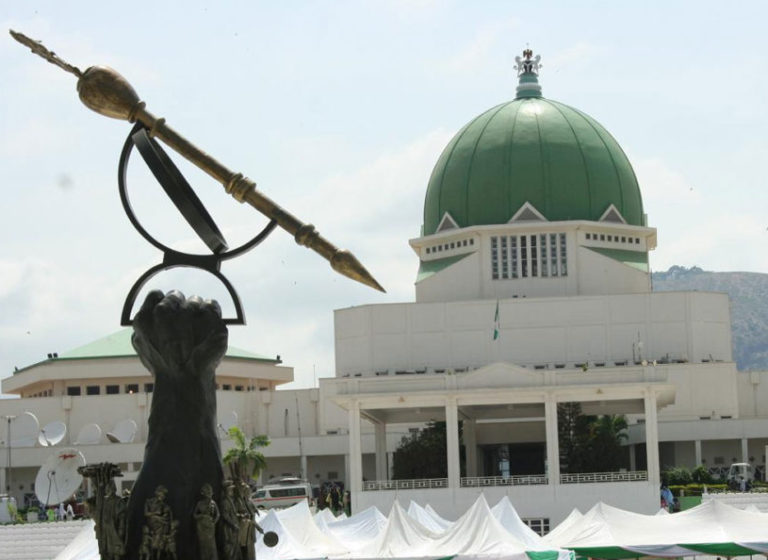
There was chaos and disorder in the National Assembly as President Muhammadu Buhari presented the 2019 budget proposal to a joint session of the Senate and the House of Representatives on Wednesday.
There had been concerns over whether the ongoing strike by the National Assembly workers would affect the scheduled presentation of the budget proposal. However, it was not the workers but the lawmakers that constituted the nuisance and disorderliness that characterised the event.
Right from when Buhari entered the green chambers of the House of Reps, shouts of “Sai Baba, Sai Baba” rented the air by the lawmakers belonging to the All Progressives Congress (APC). The cheers, added to attempts by some of the lawmakers to get close to the president, further prolonged the time it took for him to walk down to the platform.
My phone camera just captured this 10-second video, the arrival of President @MBuhari at the National Assembly to present the #Budget2019 to the joint session of the Assembly.
The opening prayer which was led by one lawmaker each from the Christian and Muslim religions was also characterised by noisemaking by the lawmakers. Some reports say some of the lawmakers actually traded blows while the presentation process had commenced.
When Buhari eventually mounted the podium to address the legislators, he was constantly interrupted, either by the APC lawmakers cheering unnecessarily or by PDP lawmakers incessantly interrupting the president with words like “it’s a lie”, “propaganda”, “campaign speech”, etc.
At a point, Buhari had to caution the unruly lawmakers saying: “May I remind members of the National Assembly that the world is watching us. We are supposed to be above this.”
Also, as soon as Buhari ended his speech, the chaos and rowdiness resumed, as APC lawmakers commenced another round of “Sai Baba” and “Next Level”, while the PDP lawmakers returned the favour with their own protest chants.
Speaker Dogara, who was called upon to give the vote of thanks was not allowed to speak as the noise continued with the legislators all shouting or singing at the top of their voices
This is the first time such chaos is being witnessed during budget presentation, and it may be connected with the controversies that have rocked the Senate and the House of Reps, especially following the recent gale of defections that resulted to both the Senate President and the Speaker of the House to dump the APC for the PDP alongside many others.
The rowdy session at the budget presentation attracted criticisms from Nigerians on the social media.
“This is appalling and completely irresponsible. For so-called lawmakers to be behaving this way? Sane Nigerians can now see the quality of characters we call lawmakers here? How will the world see us if the second arm of government is filled with street urchins?” wroteone Ayourb, whose Twitter handle is ‘The Godfather”.
Another Tweeter user wrote simply, “2019 budget presentation. You feel sorry for Nigeria with our executives and the National Assembly.”
FORMER Chief of Defense Staff (CDS), Alex Badeh, is dead. Badeh was a retired Air Chief Marshal.
His death was announced by the spokesperson of the Nigeria Air Force (NAF), Ibikunle Daramola, through a statement on Tuesday night, saying that Badeh was shot “when his vehicle was attacked while returning from his farm along Abuja-Keffi Road”.
Badeh was appointed Chief of Air Staff (CAS) by former President Goodluck Jonathan and later became CDS, replacing Vice Admiral Ola Ibrahim.
Before his appointment as CDS, Badeh had served as the 19th Chief of the Air Staff of Nigeria. He was the fourth air force officer to hold the position. He was the third Air Chief Marshall in Nigerian history.
Badeh started his flying career at the 301 Flying Training School on the Bulldog Primary Trainer aircraft in 1979. In 1982, he attended the Undergraduate Pilot Training at Vance Air Force Base in the United States Air Force. He also attended the Armed Forces Command and Staff College, and National War College Nigeria as a member of Course 14.
As at the time of his death, Bade was facing a corruption trialbrought against him by the Economic and Financial Crimes Commission (EFCC) for allegedly diverting about N3.97 billion from NAF’s account.
He pleaded not guilty to the charges and was briefly remandedin Kuje Prison in Abuja before he was later granted bail with the sum of N2 billion.
During the course of Badeh’s trial, witnesses told the court how he approvedhundreds of millions, sometimes in dollars, to be released from the NAF account, and used same to purchase choice properties in Abuja, including a mall and mansionsfor his children.
The case is still ongoing at the Federal High Court, Abuja.
PRESIDENT Muhammadu Buhari has disagreed with the Senate over the total amount of money it approved to be reimbursed to state governments by the Federal Government.
This debt arose from projects carried out by state governments which ordinarily ought to have been done by the states on behalf of the Federal Government.
According to a letter Buhari wrote to the lawmakers, which was read on the floor of the Senate on Tuesday, the Federal Executive Council (FEC) had approved the sum of N487,8 billion to be reimbursed to 25 states, but the Senate raised the sum to N488,74 billion to be paid to 21 States. This represents an increase of over N890,5 million from the amount approved by FEC.
The Senate also left out four states from the list of states it approved for the reimbursement while increasing the amounts approved for each state except four.
Buhari, in his letter, noted that the amount approved by FEC was based on the recommendations of the Bureau of Public Procurement as required by the Public Procurement Act, and asked the lawmakers to forward to the executive arm of government the details of how they came about the increased figures for 17 other states.
“The amount approved by the National Assembly for reimbursement by 21 states are higher than the amounts approved by the Federal Executive Council for reimbursement to 25 states,” Buhari wrote.
“The amounts approved by the National Assembly for reimbursement to each of the 21 states is higher than the amounts approved by FEC to each of these states except for Adamawa, Jigawa, Kano and Niger.”
He, however, said that the executive will go ahead with the reimbursements as approved by FEC, while awaiting the Senate to review their decision on the four states whose reimbursements it did not approve, namely: Bauchi, Delta, Kogi, and Taraba State.
“Where the amount approved by the National Assembly is the same as the amount approved by FEC, the jointly approved amount will be reimbursed. The states are Adamawa, Jigawa, Kano and Niger,” Buhari’s letter read.
“Where the amount approved by the National Assembly is higher than the amount approved by FEC, the amount approved by FEC will be reimbursed. The states are Akwa Ibom, Anambra, Ebonyi, Benue, Edo, Ekiti, Enugu, Gombe, Imo, Kwara, Lagos, Ondo, Ogun, Osun, Oyo, Plateau and Zamfara.
“And where no amount is approved by National Assembly, no reimbursement will be made. The affected states are Bauchi, Delta, Kogi and Taraba.”
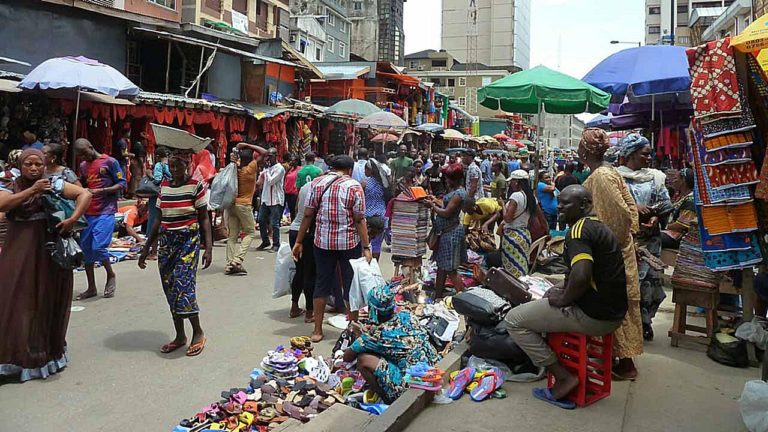
THE National Assembly is considering a comprehensive bill which, if passed, will enable the federal and state governments to regulate street trading, levy vendors, and make sure that across the country, individuals without permanent structures cannot trade without a license.
Named the “Nigerian Street Trading Regulation Commission (Establishment, Protection of Livelihoods, etc.) Bill, 2018”, was sponsored by Okorie Linus Abaa, the lawmaker representing the Ohaozara/Onicha/Ivo constituency of Ebonyi State at the House of Representatives. The Policy and Legal Advocacy Centre (PLAC) states that the bill passed through first reading on July 12, 2018.
According to its explanatory memorandum, the primary aim of the proposed law is to generate revenue for the Federal Government through the establishment of the Nigerian Street Trading Regulation Commission (NSTRC). It says the purpose of the agency shall also be providing an institutional and formal approach to protecting the livelihoods of street traders, domestic workers and others within the informal sector.
Job creation for hundreds
The enactment of the bill will see to the emergence of new jobs for various individuals, from the federal level to local government area. The proposed Nigerian Street Trading Regulation Commission (NSTRC), will be headed by a director-general.
The commission shall also have a secretary, a legal adviser, thirty-seven state directors, one representative of the Central Bank of Nigeria, a representative of the National Identity Management Commission, a representative of the National Pension Commission, a representative of the National Insurance Commission and a representative of the National Commission for Nomadic Education.
The other government agencies represented on the commission are expected to be responsible for the award of grants and loans, the creation of a digital database, provision of pension services, provision of insurance policy, and implementation of a formal education framework for street traders.
Asides the federal commission, the bill also provides for the establishment of State Street Trading Committees which are to consider applications for the award of street vending licenses and delimitation of street trading zones within the states and the Federal Capital Territory (FCT).
The state committees shall in turn be constituted by Local Government Area Commissioners or Chief Executive Officers of the Local Government Area (LGA) Street Trading Committees, and other representatives of the LGA committee including the medical officer, planning authority, traffic police, association of street vendors, market associations, traders associations, non-governmental organisations, banks, among others.
Excerpt from the Nigerian Street Trading Regulation Commission Bill, 2018
Job loss for countless others?
If the provisions of the bill are strictly implemented, it is expected that millions of Nigerians who are engaged in one form of street trading or the other will lose this source of livelihood and may be forced into alternative ventures. And the bill has broad a definition for the term “street trader”.
Section 31 defines it as “a person engaged in vending of articles, goods, wares, food items or merchandise of everyday use or offering services to the general public, in a street, lane, side walk, footpath, pavement, public park or any other public place or private area, from a temporary built up structure or by moving from place to place and includes hawker, peddler, squatter and all other synonymous terms which may be local or region specific.”
Part Four, sections 18 to 25, deals with the manner in which street trading will be regulated. According to it, no person can engage in street-trading unless they have a licence (valid for a limited period), accompanied by an identification card.
To get the licence, an amount will be paid and an undertaken must be signed with the State Street Trading Committee to swear, among other things, that the applicant has no other means of livelihood. The spouse or child of a street trader may use his or her licence in the case of death, illness or disability.
Every five years, section 19 says, the State Street Trading Committee shall conduct a survey of street vendors based on “street trading zones” under its jurisdiction. Existing vendors will be accommodated in the trading zones but only “subject to a norm conforming to two and half per cent of the population” and “in accordance with the plan for street trading and the holding capacity of the street trading zones”. They will not be able to trade in non-street trading zones.
What happens when the street traders identified in the first survey are more than the zone’s holding capacity? According to Section 20(3), “the State Street Trading Committee shall carry out a draw of lots for issuing the certificate of street trading for that street trading zone and the remaining persons shall be accommodated in any adjoining street trading zone to avoid relocation.”
Section 31 explains that the holding capacity is the maximum number of street traders who can operate in any trading zone as determined by the local government area on the recommendations of the State Street Trading Committee.
The bill requires every trader to pay periodic maintenance charges for civic amenities and facilities provided in vending zones to maintain cleanliness and to ensure public properties are in good condition and are not damaged or destroyed.
Also, a street trader operating without certification or who contravenes the terms of his certificate may be evicted by the local government area, may be fined, may have his goods seized and, if he or she does not obey a notice to vacate, “shall be liable to pay for every day of such default”.
Asides becoming “a self-sufficient revenue generating Commission of the Federal Government of Nigeria”, other objectives of the street-trading commission include to provide technical assistance through capacity building across the value chains, to reduce the cost of borrowing by street traders from commercial banks, to provide technical advice to street trading businesses, etc.
Not the only law, not the first time
Though it appears to be the first national attempt in this direction, it is not the first time lawmakers or governments in Nigeria have sought to regulate street-trading. Preceding the bill is the Street Vendors (Protection of Livelihood and Regulation of Street Vending in the Federal Capital Territory) Bill, 2018, sponsored by Lovette Idisi for the FCT. The first reading took place on January 17, 2018.
Ebonyi State, where the federal bill’s sponsor comes from, recently clamped down on roadside traders in Abakaliki as it invoked the provisions of the state’s environmental law prohibiting road obstruction. Other states have taken similar steps in driving petty traders away from the streets. But no matter how much force is deployed, the traders keep returning to the streets.
According to latest figures from the National Bureau of Statistics (NBS), there are 15.9 million Nigerians who are without jobs (that is 18.8 percent), and about 18 million are underemployed. As a result, millions are driven to the informal sector which contributed 41.4 per cent of the country’s GDP in 2015.
The International Monetary Fund even says the sector constitutes up to 60 per cent of the entire economy. Coming right after agriculture, trading activities account for 26 per cent of the informal economy.
Section 16 of Nigeria’s constitution directs the government to “protect the right of every citizen to engage in any economic activities outside the major sectors of the economy”. It also says the state is to “control the national economy in such manner as to secure the maximum welfare, freedom and happiness of every citizen on the basis of social justice and equality of status and opportunity”.
The New York Times, a US-based newspaper, has published a new video that reveals how Nigerian soldiers shot unarmed Shiite Muslims protesting the prolonged detention of their leader, Sheikh Ibrahim El Zakzaky.
The Nigerian Army had admitted killing six members of the Islamic sect between October 27 and October 29, 2018.
The army said that the protesting Shiites were armed with stones and petrol bombs which they used to attack soldiers.
Contradicting the claims of the army, the New York Times said a video which it had obtained showed that the soldiers shot at civilians who were fleeing the scene.
The report reads, “But a close review of video from the largest and most deadly of the protests, as well as interviews with more than a dozen witnesses, clearly shows the military opening fire on unarmed demonstrators, sometimes shooting indiscriminately into the crowd at close range as people turned and tried to flee.
“Photos and videos recorded that day show at least 26 bodies. The group said it had collected a total of 49 bodies during four days of protests.
“The killings are the latest example of a military that for years has been accused of human rights abuses, with rarely any punishment or action taken, despite President Muhammadu Buhari’s promises to crack down on military violations and restore security in the country.”
According to New York Times, some of the corpses had bullet wounds at the back, indicating that they were shot while fleeing.
“The melee began that day as more than 1,000 marchers approached a military checkpoint. Soldiers arrived to block off the road. An armoured vehicle with high-calibre weapons patrolled the highway. After soldiers began to fire, they targeted protesters fleeing the chaos. Many of the injured were shot in the back or legs,” the report stated.
The newspaper noted that the killing of Shiite protesters six weeks ago generated little outrage in the country as neither Buhari nor members of the opposition condemned the killings.
The Islamic Movement in Nigeria, founded about four decades ago and inspired by the Iranian Revolution, has been repeatedly labelled a terrorist threat. In Kaduna, where many of the members live, the group is barred from protesting or assembling.
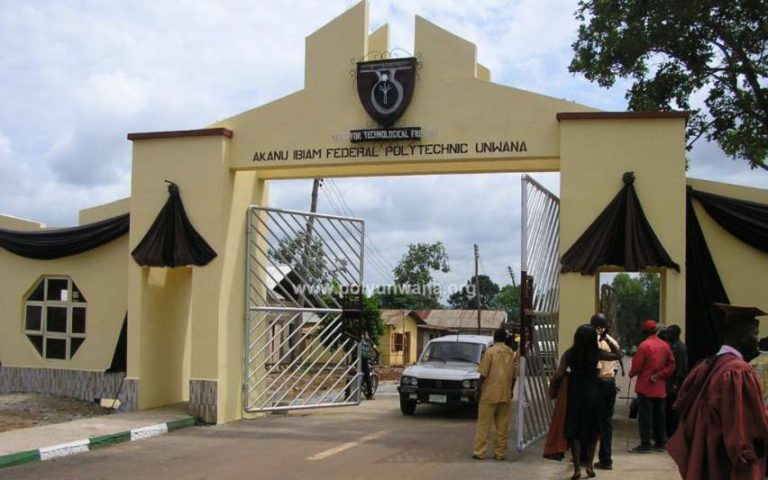
TWO female students: Osinachi Janet Oko and Gladys Egwu of Akanu Ibiam Federal Polytechnic, Unwanna, Afikpo in Ebonyi State, have raised an alarm over threats to their lives after they exposed their lecturer of sexual harassment.
The students accused the Head of Department of Marketing, School of Business Studies, Ezumah Chris Obi, of sexually harassing them and subjecting them to other forms of abuse.
After the New Telegraph first reported the allegation, the students said they now live in fear.
The lecturer, Obi, allegedly invited the students at different times and attempted to sleep with them without success.
As a result of their refusal to cooperate with him, Obi allegedly denied the students the opportunity to defend their projects before external supervisors and insisted they would not graduate from the school except they agreed to sleep with him.
Obi refused to answer the reporter’s call and did not reply messages sent to his mobile phone for his comments and to clarify his alleged suspension as the HOD by the management.
Following media reports on the matter, the lecturer and some of his allies, including students of the institution, have continued to mount pressure on the two students to withdraw their petitions against Obi.
The Rector of Akanu Ibiam Polytechnic, Ibe-Enwo Ogbonnia, however, failed to take any definite action on the matter two weeks after the students’ petitions were submitted to his office. He claimed that he had not received official complaints from the victims.
Ogbonnia said the institution was following due process on the matter, but refused to say the specific steps taken so far on the matter. Subsequent text messages sent to his mobile phone were not replied.
Although two weeks after acknowledging receipt of the petition through the reporter, Ogbonnia only invited one of the affected students, Janet Oko, to his office for confirmation of the content of the petition.
The second victim, Gladys Egwu, said she was neither invited for her for briefing nor received response from the management after she submitted her petition on November 7.
The students, who said apart from receiving strange calls from unknown persons on the matter, their guardians have also been receiving calls from allies and friends of the accused lecturer, threatening them to advise the students to withdraw the case.
They said that some of the institution’s students have verbally attacked them and warned them to desist from bringing down their lecturer.
They added that some other persons have blamed them for crying out loud, saying they had tarnished the image of the institution by their action and that they should have just endured without bringing the name of the polytechnic into disrepute.
“It has been very difficult for us since the matter was reported in the newspaper,” Oko said. “While others commend us for being brave enough to cry out, some have particularly attacked us for tarnishing the image of the school.”
She said, “there have been many stories about us with some even tongue lashing us for our action. But each time I wanted to regret my action, my spirit tells me that my integrity as a woman matters and anything suffered in the defence of this integrity cannot be too much to bear. I am only bothered about my security because there have been several strange calls on my phone and strange movements around me.”
She recalled how one of her classmates called and began to talk rudely to her, condemning the decision to make the matter public. “My mother took the phone from me and warned the caller very seriously. In fact, I have since deleted the person’s number from my phone.”
On her part, Egwu explained she had received a call from someone claiming be a police officer investigating the matter and asked her to meet him at a specific location.
“I was surprised and I had initially agreed to meet the person at 2 pm the following day. But when I discussed with my family members and guardians, we agreed not to meet anybody anywhere,” she said.
A rights organisation, Socio-Economic Rights and Accountability Project (SERAP) has petitioned the Minister of Education, Malam Adamu Adamu, and the Independent Corrupt Practices and other Offences Commission (ICPC) to urgently intervene in the matter.
In the petition signed by its Senior Legal Adviser, Joke Fekumo, SERAP urged the minister to urgently ensure that the allegations are properly investigated.
SERAP noted in its petition to the minister that the rising cases of sexual harassment on the campus, calls for urgent attention of the ministry and other relevant stakeholders. It added that if not urgently addressed, the fate of female students will continue to hang in the balance.
Fekumo said: “On Thursday, two letters were sent out on the matter. One was to the Minister of Education, Malam Adamu Adamu and our prayer was that he should urgently commissioned full investigation into the allegations of the issues of attempted rape, sexual harassment and intimidation of the two female students. We urged the Minister to use his good office to ensure that these allegations and all other forms of human rights abuses are impartially investigated and that anyone found guilty is punished.
“We also urged the Minister to ensure adequate protection for the safety and security of the two students, and that he should ensure an end to sexual harassment and victimisation of the students by the lecturer (Obi). We also pleaded with the Minister to take urgent step to address these issues.
“The second petition was addressed to the ICPC Chairman and we copied the Rector of the polytechnic the two letters. The case of sexual harassment is part of other offences captured in the Acts establishing the agency, and we feel the speed with which it intervened in the case of the OAU should be replicated in this case. Apart from relying on the New Telegraph report, we also interacted with the female students and captured all these in our letters.”
SERAP said it believes both the minister and the ICPC would ensure justice is done on the matter, and pledged that it would follow up on the case.
Police officers have barricaded the premises of the National Assembly complex, preventing workers from gaining entrance into the building.
Patrol vans barricaded the entrance close to the Eagle Square while security agents were searching journalists, construction workers, vendors and a few others who were allowed to enter the premises.
This move follows a directive by the leadership of the National Assembly which asked the State Security Services (SSS) and the police to secure the chamber for plenary.
According to a statement by the Clerk of National Assembly, Mohammed Sani-Omolori, the measure is to enable members and staff come in and perform their legitimate duties without any hindrance.
Workers of the National Assembly under the umbrella body of Parliamentary Staff Association of Nigeria (PASAN) on Monday disrupted normal activities in protest of what they called poor working conditions.
The protest followed a four-day warning strike that commenced on Monday.
The leaders and management of the National Assembly held an emergency meeting last night, after which they directed the police and SSS to secure the premises ahead of President Muhammadu Buhari’s presentation of the 2019 Appropriation Bill on Wednesday.
The ICIR earlier reported that the National Assembly workers had demanded pay rise, promotions, training, among other things.
FOURTEEN persons who attended a wedding ceremony at Ungwan Paa-Gwandara village located in Jema’a local government area of Kaduna State, on Sunday evening, ended up in the morgue after unknown gunmen opened fire during the event.
Seventeen others who were also at the wedding sustained various degrees of gunshot injuries and many of them are in critical conditions.
The News Agency of Nigeria (NAN) quoted one Joshua Paul, a resident of the community, as saying that nine of the deceased victims had died on the spot, while five died at the Kafanchan General Hospital on Monday morning.
The police are yet to comment on the development. Kaduna State has witnessed several violent attacks by hoodlums.
In October, Governor Nasir El-Rufai imposed a 24-hour curfewon parts of the state on two separate occasions following outbreaks of violence that also claimed lives.
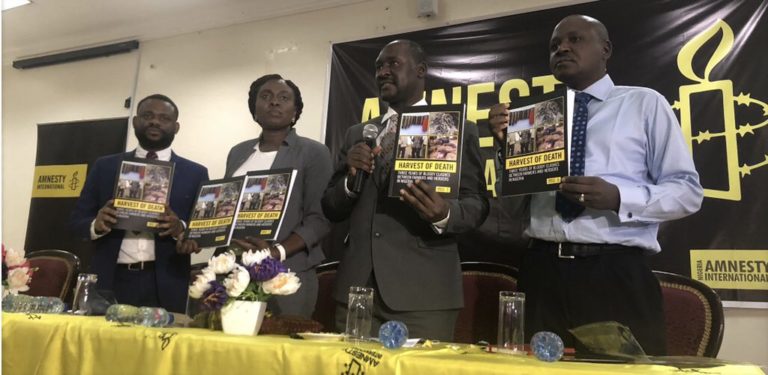
AMNESTY International (AI) says it cannot be deterred by the “empty threat” of the Nigerian Army, calling on the military to rather study its report so as to address the problems highlighted in it.
Auwal Musa Rafsanjani, chair of AI Nigeria, said this on Monday while responding to questions at the launch of its latest report, “Harvest of Death: Three Years of Bloody Clashes Between Farmers and Herders in Nigeria”, in Abuja.
Describing the threat as “unnecessary hostility on issues that affect all of us as human beings”, he said the organisation will not be joining issues with the military and will rather advise them to note the recommendations in its report and tackle the challenges.
“This threat to shut down Amnesty International is not the solution to violent conflicts and everything we are seeing in Nigeria,” the AI boss said.
“What Amnesty is really saying is that they have a duty and responsibility as enshrined in our laws and constitution to protect the lives and properties of Nigerians, and their failure to do that is not acceptable because they are supposed to be helping to protect the lives and properties of the citizens of Nigeria.
“So we are not joining any issue with anybody. We are not agents of destruction. We are not a politically motivated organisation. We are purely a human rights organisation, which in so many instances, even some of the security agents are victims of human rights [abuses], only for them to come out and start looking for Amnesty International to speak about their issue.”
Rafsanjani also said everyone is prone to having their human rights violated at one point or the other, adding that it is crucial for there to be a voice like AI that can speak on behalf of the voiceless. He said the threat “is not the solution to the negligence or tardy response to issues of human rights and providing safety and security for Nigerians.
“Like we have said, a lot of government officials at the state, local and national level have failed to take proactive measures. Nobody is responding in a timely manner… We are saying that please can you engage in more proactive dialogue and put structures in place that will ensure that we prevent the conflict before it happens,” he added.
“We are not just interested in reporting all these things. We are just quoting this because we want them to take action. This is our response to the army: We are not a threat, we are rather partners in progress because we don’t want this violence to continue. If you are sincere and you are actually protecting the citizens, you should use these findings to see how you can improve the work you are doing.
“You should be bold enough to address those lapses, but to come and be threatening a group that you cannot even stop is not supposed to be. Government cannot stop Amnesty International from documenting and monitoring human rights violations whether in Nigeria or outside Nigeria. So … it is just an empty threat.”
Sani Usman, Army spokesperson, had released a statement earlier on Monday accusing AI of working hard to destabilise the country by using fictitious allegations about rights abuses, and threatening to close the group’s offices “if such recklessness continues”.
“They have tried over the years using Boko Haram terrorist’s conflicts, Islamic Movement in Nigeria, some activists and now herders-farmers conflicts
“The NGO is at the verge of releasing yet another concocted report against the military, ostensibly against the Nigerian Army. Consequently, Nigerians should be wary of Amnesty International (Nigeria) because its goals are to destabilise Nigeria and to dismember it,” he said.
On Friday, the Nigerian Army had announced a three-month ban on the activities of the United Nations Children Fund (UNICEF) in the North East, accusing the organisation of spying on military formations and sabotaging its war against terrorism. It, however, lifted the ban after some hours.
RICHARD Akindele, a former professor with the Accounting Department of the Obafemi Awolowo University (OAU), Ile-Ife, has pleaded guilty to charges of soliciting for sex in order to award grades to a female student.
A recording in which Akindele was heard demanding to sleep with his student, Monica Osagie, five times before she could pass his courses had gone viral, prompting the management of OAU to initiate an investigation against him.
But despite that Akindele was expelled from OAU after the panel of investigation found him guilty, the Independent Corrupt Practices and other related offences Commission (ICPC) filed a suit against him for alleged abuse of office.
In one statement, the ICPC said Akindele had agreed to a plea bargain in exchange for a lighter sentence. However, when he was arraigned before Justice Maureen Onyetenu of the Federal High Court, Osogbo, Osun State, he pleaded not guilty and was remanded in prison.
When the case came up for hearing on Monday, the prosecutor, Shogunle Adenekan, told the court that Akindele has agreed to change his plea from ‘not guilty’ to ‘guilty’.
Adenekan said all parties in the matter agreed to the plea, and he begged the court for a suspended sentence for the accused person.
Delivering her ruling after an hour break, Justice Onyetenu sentenced Akindele to two years in prison, refusing to accede to pleas by the prosecution for a suspended sentence.
She said Akindele’s crime was weighty and that the punishment was necessary so as to serve as a deterrent to others, and reduce incidences of sexual harassment in institutions of higher learning in Nigeria.
Olusegun Awonusi
While Akindele has been punished for his crime, the same cannot be said about Olusegun Awonusi, a professor of English Studies at UNILAG, who was also accused by a female student of sexual harassment.
The student who spoke to Linda Ikeji, a popular Nigerian blogger, on condition of anonymity, even provided nude pictures of the lecturer which she claimed to have taken during an encounter in the lecturer’s office.
“I have completely given up when it comes to academics he has failed me on tests before. When I talked to him concerning it he told me I should know what to do I am an adult. I feel so dirty for even allowing such an old man touch me. But he doesn’t even care,” the victim narrated.
At the time the report was published, the management of UNILAG said it had put up a panel to investigate the case but till date, nothing has been heard of the matter.