Home Blog Page 2467

IDPs lament inadequate food, poor shelter in Borno as PCNI completes assignment in less than one year

By Shamsiyya Haruna

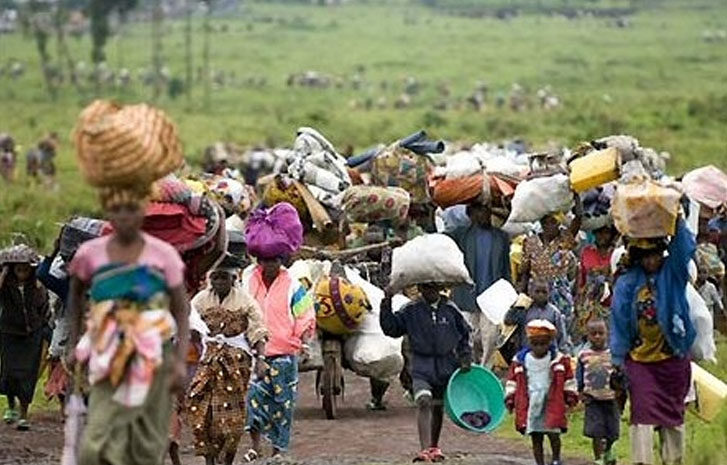
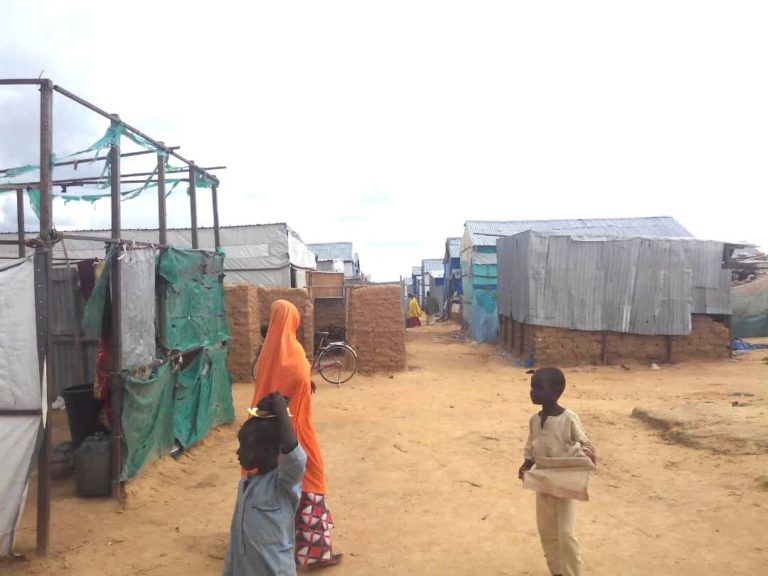
Internally Displaced persons (IDPs) in Borno State are agonizing over inadequate food and poor shelter, despite the intervention of Presidential Committee on the North East Initiative (PCNI) and humanitarian organizations working in the area to improve the condition of living of the displaced resident in various camps.

According to them, the food items distributed by aid workers often finish within two weeks, and it takes many days before the displaced receive a new supply, despite the government’s promise to provide food items at the end of every month.

The situation may even get worse as PCNI rounds off ts assignment next year.

Freedom Radio observed that the IDPs, most of who were farmers prior to the Boko Haram attack, could no longer go to farms, and therefore have to depend on food distributed by international agencies, such as United Nations World Food Programme (WFP). WFP has assisted not fewer than 1.2 million displaced people in the North East.

But many of the IDPs told Freedom Radio that their food items now come in short supply and the available shelter could not accommodate all the displaced.

According to  National Population Commission (NPC), there are estimated 1.7 million IDPs in over 321,580 households across six states of North-East Nigeria with 40 percent residing in camp-like settings in urban areas, plus 1.4 million returnees. And the number is rising.

The displaced people urged the government to return them back to their homes to continue their agricultural activities, as they are tired of receiving handouts that are barely enough to feed their family, and that hardly come on time.

Mr Talle, a refugee from Marte local government, a neighbouring area of Chad living in Bakassi camp, said the government has sent some of the IDPs back to their villages, but it seems the government has forgotten the remaining IDPs.

Reacting to the development, Borno state commissioner for rehabilitation and reconstruction, Professor Baba Gana Umara Zulum said the state government is working tirelessly in taking the remaining IDPs back to their villages, but before then, the government wants to ensure that normalcy has returned to such areas.

During a visit to most of the IDP camps, Freedom Radio found many children playing, though they were supposed to be in schools.

Most parents in the camps cannot afford to send their children to school.

Similarly, the tents that serve as shelter are torn apart due to overuse. IDPs said some of the tents have been in use for more than two years, whereas the lifespan of the material used in making the tent is six months on the average.

Most families sleep on a mat, as they do not have a blanket and other sleeping materials. When it rains, the tents got torn apart.

For some, no stored food in their rooms, except the mats on which they lay.

IDPs in Gubio Camp have similar complaints as others – No food, no shelter, no education. Mamman Abacha and Malama Hauwa expressed deep bitterness over their state of lack.

Former chairman of the Borno State Emergency Management Agency, Grema Terap, said the food shortages were due to alleged diversion of the food items which was suspected being sold in the markets, thus, they have complained about the issue to the National Assembly, but yet no action has been taken.

Reacting on the development, NEMA north-east zonal coordinator Bashir Idi Garga denied the allegations, adding that the agency was fully able to provide food for the internally displaced persons in the region.

According to him, NEMA is partnering with the international donor agencies to address the problem facing the IDPs in the northeastern part of the country.

It was in 2016 that President Muhammadu Buhari established the PCNI, to resettle and rebuild the North East region. Speaking during the inauguration of the committee, the president said the Committee should take a quick look at the conditions of the IDPs and take urgent remedial measures to alleviate their conditions.

In an interview with Freedom Radio, Vice Chairman of the committee, Alhaji Tijjani Tumsa said the alleged diversion of foodstuff has decreased compared to three years back.

Reports indicate that the Presidential Committee will exist for a period of three years, and it will be funded through federal, state and local government appropriation, as well as funds from the private sector and international development partners.

Falmata, who is one of the refugees living in Bakassi Camp, complains that, apart from inadequate food, their children are out of school, adding that poor feeding, sanitary conditions, lack of proper medical attention are the major challenges facing them in the camp.

IDPs experience poor feeding, sanitary conditions and lack of proper medical attention.

Most parents in the camps cannot afford to send their children to school because of the conditions they found themselves.

Malam Baana Bukar, who lives in the Teachers’ Village Camp, says their major problem is a shortage of food, saying that they are living in the camp for almost three years, but yet they are battling with starvation.

IDPs living in informal camps, such as Kushari, Jiddimuri, Wulari, Galtimari, Ajiganar among others, face difficulties in accessing basic needs such as food, education and healthcare.

Hafsat, a mother of four living in Jiddimuri Camp said before then, NEMA supported them with some food items on monthly basis but the program had wound up now.

Reacting, Garga says for security considerations, they have moved on severely for advocacy visit to let them know the dangers inherent in staying in the camps without been registered by government agencies.

Within Maiduguri, internally displaced populations are battling with inadequate food, while IDP camps and camp-like settlement are disorganised with extreme humanitarian indicators across all sectors.

These are part of the problems for which PCIN was set up. But two years after, the condition of the internally displaced persons in the northeast appears to be getting worse.

This investigation is supported by the Ford Foundation and the International Centre for Investigative Reporting, ICIR.
Hassan takes over from Jibrin as new Environment Minister   

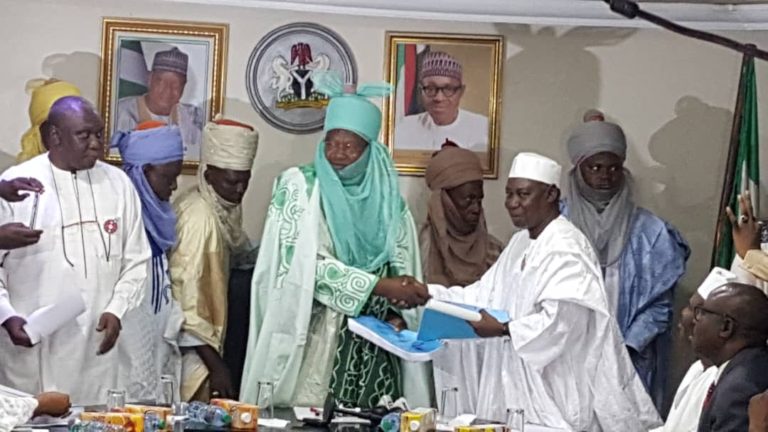
THE former Minister of State for Power, Works and Housing II, Surveyor Suleiman Hassan has been appointed as the new minister of Federal Ministry of Environment.   

The ex-minister, Ibrahim Jibril, who was recently crowned as the new Emir of Nasarawa, has urged his successor to confront the environmental challenges facing the country.

He spoke during the handover ceremony held on Tuesday in Abuja.

“Everybody knows that within the normal budgetary provision, it will be difficult to address environmental challenges across the country. Therefore, anybody who will be here must put his or her thinking cap to find alternative means of moving the ministry forward and addressing numerous environmental challenges across the country,” Jibril said.

Nigeria is currently battling with environmental problems ranging from gas flaring, oil pollution in the Niger Delta region, erosion mostly in the South East, plastic waste pollution as well as desert encroachment in the 11 northern states among others.

The country currently ranks second globally in open defecation with 25 per cent of the population practising open defecation.

Last October, the ministry commenced a review of the nation’s National Environmental Sanitation Policy after it was first developed and launched in 2005 by the former administration chaired by President Olusegun Obasanjo.

For the Ogoni cleanup, the former minister said the remediation exercise of the polluted land “has gone far,” and expressed hope that it would continue to get the needed attention.

Already, the oil companies have released $180 million for the clean-up exercise, he confirmed.

“I am proud to say that I am going to hand-over to my successor at least $170 million from the escrow account and the details will be sent to him. $10 million will be paid severally. He will see in the handover that we still have about $5 million which is in the domiciliary account of the ministry and about N200 in another account.”

Jibril applauded President Muhammadu Buhari for his commitment to the environment sector, describing him as the first president in the history of the country to consistently attend the Conference of Parties (COP) 21 on climate change – Paris Agreement in 2015, Morocco COP22 in 2016 and Poland COP24 in 2018.

He further disclosed that the federal government would establish three additional federal schools of forestry in the country.

In his acceptance speech, the new environment minister promised to address environmental challenges affecting the country.

He also promised to pay more attention to staff welfare, and to the great green wall project as well as combating oil degradation in the affected region.

Hassan, a former registrar at the Quantity Surveyors Council of Nigeria, was the chairman of the defunct Congress of Progressive Change in Gombe State.

He was among the 46 ambassadorial nominees President Buhari sent for confirmation by the Senate last October.


NMA blames cancer spread on poor media coverage, legislation

NIGERIA Medical Association (NMA) has blamed the increased incidence and menace of cancer on poor reportage and legislation, hence called for appropriate media attention and adequate laws to address carcinogens found in the Nigerian environment.

This disturbing issue of cancer was raised in an official report presented by Francis Faduyile, NMA President, on the occasion of the association’s National Executive Council meeting (NEC) in Abuja.

The official report revealed that inhalation of tobacco smoke, industrial pollution and inadequate implementation of existing laws on cancer control and insufficient diagnostic and treatment facilities have helped set cancer incidence and resulting deaths on the fast lane.

The Federal ministry of health in the National Cancer Control Plan (2018 – 2022), recorded that cancer is responsible for 72,000 deaths in Nigeria every year, with an estimated 102,000 new cases of cancer annually, with breast and cervical cancers as the two most common types of cancer responsible for approximately 50.3 per cent of all cancer cases in Nigeria.

Cancer treatment is not provided for in the National Health Insurance Scheme, moreover, the cost of managing cancer patients is expensive. These, NMA laments have been the main factors responsible for increased incidence and burden of cancer in Nigeria.

More so, NMA went on to complain that the funds designated to the health sector from the budget have been insufficient. This has translated to neglect, as well as inadequate funding of registries and cancer research in the country.

Governments at all levels were therefore called upon to institute effective cancer prevention and control strategies aimed at reversing the rising incidence of cancer.

The Federal Ministry of Health’s National Cancer Control Plan (2018 – 2022), features the following strategic goals: Encourage lifestyle modifications that reduce contact between individuals and carcinogens for all Nigerians; make screening services and early detection of cancer available for all Nigerians;  to improve access to quality, cost-effective and equitable diagnostic and treatment services for cancer care; to ensure the availability of drugs, consumables and functional equipment for cancer care in Nigeria; and to increase cancer awareness and advocate for cancer control among the populace.

It is assumed that the implementation of the National Cancer Control Plan will address the spate of cancer in Nigeria to a reasonable extent, even though practical steps taken towards implementation are yet to be seen.

More than 437,000 persons displaced in Cameroon crisis, says UN

The United Nations has reported that the number of Cameroonian refugees in Nigeria has spiked to more than 437,000 over the past months. 

And many have resorted to living in bushes and makeshift shelters with no support since October 1, 2017, when a crisis erupted between the Anglophone and Francophone Cameroon after the formal declaration of independence

David Manan, Country Director for the Norwegian Refugee Council in Cameroon in a statement said that the situation is worrisome and called on the government and all parties involved to assist the displaced person by ensuring that the living conditions are improved.

“We are deeply worried by the ongoing conflict and the increasing displacement figures. Parties to the conflict must ensure that civilians in the area are protected and are able to safely access life-saving assistance,” Manan said.

The United Nations estimates that the number of people displaced from their homes in Cameroon’s Anglophone Southwest and Northwest region and in the neighbouring Littoral and West regions has reached 437,000.

Manna said that many people are without any support and lack basic sanitary facilities, clean water, food and access to medical care.

He said that insecurity in the affected areas has restricted aid agencies from venturing into these parts to offer the required assistance, adding that the agency does not have enough manpower to attend to the needs of every affected person.

“The needs we are witnessing in the Southwest and Northwest regions are alarming and there are too few agencies on the ground to provide the necessary aid due to limited funding.

“We call for more donors to prioritise this crisis to allow more agencies to respond so that we can stem the rising tide of suffering and displacement.

“Displaced families who receive our assistance have told us that they share it or give it to their relatives who did not yet receive any assistance and desperately need help.

“Many people are hiding in the bush with no support, fearing for their lives,” Manna said.

The NRC is distributing household items, shelter, and hygiene kits in Northwest and Southwest regions with support from the Swedish International Development Cooperation Agency (Sida), Norwegian Ministry of Foreign Affairs (NMFA) and European Civil Protection and Humanitarian Aid Operations (ECHO).

Annoh, one of the refugees that fled home said that she would share whatever she gets from her husband who is hiding in the bushes as this is the first time she is receiving relief materials since 2017.

“He has nothing but the clothes he was wearing when he fled,” she said.


Senate confirms Owasanoye as ICPC chairman 16 months after his nomination

THE Senate has approved the nomination of Bolaji Owasanoye as the substantive Chairman of the Independent Corrupt Practices and other related Offences Commission (ICPC).

Owasanoye and eight other members of the ICPC board were confirmed during Thursday’s Senate plenary session, sixteen months after their nomination was announced by Vice President Yemi Osinbajo, on August 1, 2017. Osinbajo, at the time, was the Acting President as President Muhammadu Buhari had travelled out of the country on medical leave.

Their confirmation followed the adoption of the report presented by the Senate Committee on Anti-corruption headed by Chukwuka Utazi.

The ICPC board members that were confirmed on Thursday include: Obiora Igwedebia (Anambra, South East), Okolo Titus (Enugu, South-East), Grace Chinda (Delta, South-South), Olubukola Balogun (Lagos, South-West), Abdullahi Maikano Saidu (Niger, North-Central), Yahaya Umar Dauda (Nassarawa, North-Central), Hannatu Muhammed (Jigawa, North-West), and Adams Bello (Katsina, North-West).

In his presentation, Utazi said the nominees possess the experience, integrity and professionalism to effectively carry out the responsibility for which they had been nominated.

It took this long for the ICPC board members to be confirmed because as at the time of their nomination, the Senate was having a face-off with the executive arm of government and in protest, had resolved to step down the confirmation of any other presidential nominees.

When the nominees for the board of ICPC was first announced in August 2017, an investigation by The ICIR showed that the list contained the names of two individuals – Maimuna Aliyu and Sa’ad Alanamu – who were also being investigated by the same commission.

Following the report, Osinbajo withdrew the two nominees. Both of them are now facing separate corruption charges filed against them by the ICPC.

Owasanoye, who graduated as a lawyer at the age of 21 and was appointed a professor of law at 38, is the fourth substantive chairman of the ICPC.

He takes over from Ekpo Nta whose tenure as ICPC Chairman came to an end in 2017. Between early 2017 when Nta was removed and now, the commission has bee headed by acting chairmen.

However, unlike the ICPC, the Acting Chairman of the Economic and Financial Crimes Commission (EFCC), Ibrahim Magu, remains in an acting capacity as he is yet to be confirmed by the Senate.

Atiku: There’s no single economist in Buhari’s cabinet

THE Peoples Democratic Party (PDP) Presidential candidate in the forthcoming general election, Atiku Abubakar, says Muhammadu Buhari government does not understand economics.

Atiku  added that Buhari has no economist as a member of his cabinet.

He spoke on Wednesday at a town hall meeting with businessmen and manufacturers in Abia State.

He promised to ratify the African Continental Free Trade Agreement (AfCFTA) which Buhari had failed to endorse.

“The free trade Africa will give Nigeria the opportunity to dominate the African market as long as we make safeguards to protect our local industries,” he said.

AfCFTA is an initiative of the African Union to eliminate tariffs on intra-Africa trading and services with single continental market that will also promote free movement of  people.

It is believed that if Nigeria, largest economy in Africa, agrees to the pact, it will be the largest trade agreement since the formation of the World Trade Organisation in 1995.

“I am for free trade as much as possible, provided our own national interest is protected” Atiku said.  “This is because today, the Nigerian economy is two third of West African economy. We know that our goods find their way throughout the West African sub-continent and sometimes up to central Africa.”

On single digit lending to traders, Atiku said the lending rate should be at 5 per cent rather than the current 9 per cent.

“Already the BOI offers a single digit but not good enough, you can come down lower. At the moment, I think it gives about nine per cent because I have taken one but I believe we can come down to as low as five per cent which is still doable within our economic environment.

“So again, it all depends on the will of the government and also the people who manage the economy. The point is that with this government, there is even no single economist in the cabinet. There is nobody who knows, as far as the economy is concerned.”

He identified the need to review the nation’s fiscal and monetary policies, stressing that his party is blessed with resourceful economists who are capable of ensuring his administration offers single digit interest rate for manufacturers and also lower the current lending rate.

Buhari defends N305 billion petrol subsidy in his N8.83 trillion 2019 budget

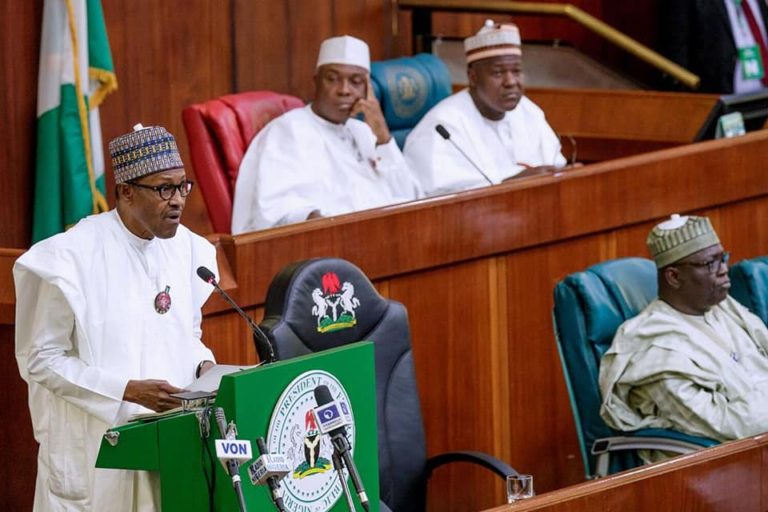
PRESIDENT Muhammadu Buhari has presented a budget proposal of N8.83 trillion for 2019 to a joint session of the National Assembly on Wednesday. He  again made a strong case in support of petroleum subsidy.

Delivering his speech amidst cheers and jeers by supporters and opponents, Buhari explained that the 2019 budget is divided into:  N4.04 trillion recurrent expenditure, N2.031 trillion capital expenditure, N492.36 billion statutory transfer, and N120 billion sinking fund. The sum of N2.14 trillion was also allocated for debt servicing, according to Buhari.

The Budget was premised on a crude oil benchmark of $60 dollars per barrel, an expected crude oil production of 2.3 million barrels per day (including condensates), an exchange rate of N305 for one US dollar, estimated GDP growth of 3.01 per cent, and an expected inflation rate of 9.98 per cent.

Expected revenue generation is projected at N6.97 trillion, made up of oil revenue of N3.73 trillion, non-oil revenue of N1.39 trillion.

Speaking further, Buhari said: “We have allowed N305 billion, equivalent to $1 billion United States Dollars, for under-recovery by NNPC, on Premium Motor Spirit in 2019. We will continue working to bring it downward so that certain resources are freed up to meet the development needs of our people.”

“Under-recovery” is a technical term that the Buhari administration uses in place of subsidy.

Explaining why his government is now voting money for fuel subsidy after criticising it during the Goodluck Jonathan administration, Buhari said that “in a period of economic challenges, higher purchasing power is weak, we must reduce some of the burden on Nigerians.

“The problem with subsidies in the past was abuse and corruption. Today, the government, through the NNPC, is the sole importer of PMS, and therefore, the under-recovery is from the NNPC trading account. This means [that] the possibility of some marketers falsifying claims is removed,” he said.

During the Goodluck Jonathan administration, the APC thoroughly criticised him for subsidising petroleum products instead of fixing the country’s refineries and stopping the importation of refined products.

In January 2012 when Jonathan announced he was stopping subsidy, the APC in collaboration with other civil society groups, led a massive protest that shut down the country until Jonathan  rescinded his decision.

Shortly after winning the 2015 election, Buhari, who is also the substantive Minister of Petroleum Resources, announced the deregulation of the downstream sector, which effectively means the removal of all forms of petroleum subsidy. This led to an increase of petrol pump price from N87 to N145.

At the time, Vice President Yemi Osinbajo said that the removal of fuel subsidy saves Nigeria N15 billion on a monthly basis, and Ibe Kachikwu, the Minister of State for Petroleum Resources, also said that all Nigeria’s refineries will be fully functional and the country will no longer be importing fuel by 2019, or he would resign.

Recent events have since revealed that the Federal Government kept subsidising petroleum products to the sum of billions of dollars, even when such expenditures were not captured in the budget.

Buhari did not, in his speech at the National Assembly on Wednesday, say anything about plans to fix the nation’s three refineries or the earlier proposal to set up modular refineries in some states of the federation. Whether these projects are contained in the budget details, will be known in the coming days as the document becomes more available to the public.

Alex Badeh: Remembered for allowing Boko Haram invade his hometown

THE former Chief of Defense Staff (CDS), Alex Badeh, will be remembered for a number of things – top of which must be that he could not defend his hometown from being captured by Boko Haram.

Badeh was murdered on Tuesday night by unknown gunmen along the Abuja-Keffi expressway as he returning from his farm, according to a statement by the Nigeria Air Force.

Born on January 10, 1957, and joined the Air Force as a member of the Nigerian Defense Academy’s 21 Regular Course, Badeh was commissioned as a pilot officer on July 3, 1979.

Badeh’s military career was largely successful as he became the third Nigerian to rise to the rank of Air Chief Marshal and became the Chief of Air Staff in 2012 and CDS in 2014.

But many Nigerians will remember Badeh, perhaps, for his inability to do the job given to him by ensuring that the country was safe.

Badeh could not protect his own hometown, Vintim, in Mubi North Local Government of Adamawa, from the rampaging Boko Haram terrorists between October and early December of 2014. The insurgents took over the town and destroyed  Badeh’s house.

Later in 2017, while speaking at a public gathering, Badeh would tell the audience that even after the army recaptured Mubi from Boko Haram, he still could not visit his hometown because “everything I had has been destroyed”.


READ ALSO:

As events unfolded after the 2015 general election, it turned out that Badeh had overseen a regime of gross corruption while at the helm of affairs at the Nigeria Air Force.

“Fantastically corrupt”

While the corruption case against Badeh is still open at the Federal High Court, Abuja, testimonies by witnesses so far suggest Badeh had lots of questions to answer.

For instance, Salisu Abdullahi, a retired Air Commodore and former Director of Finance of the Nigeria Air Force, told the court that Badeh once instructed him to buy houses for two of his sons in an upscale area of Abuja.

“When Kam (Badeh’s second son) saw the house, he didn’t like it. When my chief (Badeh) saw it, he said we should look for another one,” Abdullahi narrated. They later bought another house at the sum of N330 million, he said.

The house for Badeh’s first son, Alex Badeh Jnr, was allegedly  purchased at N260 million, renovated with N60 million, and furnished with N90 million, making it a total of N410 million.

Those were just some of the property belonging to Badeh which EFCC confiscated. One of such property is a N1.1 billion mansion in the Maitama area of Abuja which was later converted by the FG as an office for the Theophilus Danjuma-led Presidential Committee on the North East Initiative.

So much for a man who was appointed by former President Goodluck Jonathan “because he was prudent in the management of resources allocated to the NAF”.

Tributes pour in

Prominent and ordinary Nigerians have expressed their condolences to the Badeh’s family.

Senate President Bukola Saraki described  Badeh’s death as “great loss”, while Yakubu Dogara, the Speaker of the House of Representatives, said his death was “both saddening and alarming” and called on the appropriate authorities to ensure “that those responsible are swiftly apprehended and brought to justice”.

12 years after fire killed 260 people in Abule Egba, inferno again engulfs this area of Lagos

0

TWELVE years after at least 260 people were killed and 60 injured in an oil pipeline blast in Abule Egba in Lagos, the area again went up in flames in the early hours of Wednesday

Unconfirmed reports put the number of casualties at five – four persons with minor cases and one person that had serious injury.  Vehicles  and other properties were consumed in the inferno as residents scampered for safety.

This is not the first time that Abule Agba is experiencing a fire outbreak of this magnitude. In 2006, at least 260 people were killed in the area by fire, according to BBC. The previous catastrophic fire happened as hundreds of people were scooping fuel from a pipeline punctured by thieves.

The Lagos State Emergency Management Agency (LASEMA)  confirmed that today’s fire which started in the morning was caused by oil spillage from a tanker involved in pipeline vandalisation.

Although the fire had been contained, it left behind massive destruction of property. Residents were seen on the scene trying to salvage what they could from the rumbles.

Photo credit: The Punch


Nigeria’s unemployment rate increases by 4.3 per cent in one year

THE unemployment rate in Nigeria has increased from 18.8 per cent in the third quarter of 2017 to 23.1 per cent in the quarter of 2018, an increase of 4.3 per cent.

According to the “Labor Force Statistics – Volume I: Unemployment and Underemployment Report” released by the National Bureau of Statistics (NBS) on Wednesday, the total number of people classified as unemployed increased from 17.6 million in the fourth quarter of 2017 to 20.9 million in the third quarter of 2018.

The report shows that out of the 20.9 million persons classified as unemployed as at third quarter of 2018; 11.1 million were underemployed; while 9.7 million did absolutely no work.

It further stated that 90.1 per cent (8.77 million) people of the unemployed were with no job because they were first-time job seekers and have never worked before; 0.9% per cent of the unemployed are doing nothing because they were previously employed but lost their jobs.

The report stated that the working-age population (people between 15 – 64 years) increased from 111.1 million to 115.5 million within one year

A few days ago, President Muhammadu Buhari ordered the Statistician-General of the National Bureau of Statistics, Dr. Yemi Kale, to change the high unemployment statistics and reflect the rising rate of employment in the agricultural sector.

Garba Shehu, Senior Special Assistant to the President on Media and Publicity said on TV that during a recent meeting with the Federal Executive Council, Kale admitted that the NBS was only focusing on the creation of white collar jobs and not the agricultural and the informal sectors.

The presidency pointed out that recent labour statistics has not reflected what is termed ‘departure’ from the previous report.

“There was a departure last week. The NBS chief had addressed the federal cabinet and he made the admission himself that they had concentrated analysis over time on white collar jobs and they had not taken cognisance of job creation in areas of agriculture.

“Rice Producers Association of Nigeria made the open claim and nobody has challenged them up until the time that we speak, that they had created 12 million new jobs,” Shehu said.

He also said the President subsequently told him to go and admit his error to members of the public and make appropriate changes.

A quick check on the website of the rice farmers association shows that the said 12 million new jobs that Shehu mentioned is that of the association’s members.

“RIFAN has over 12.2 million members who are involved in Rice farming, Milling, Storage and Management, Trading and Marketing, Export, Research and Training and Allied businesses,” the association wrote.