Home Blog Page 2481

Former Chief of Defence Staff to face trial Jan 16 for fraud

0

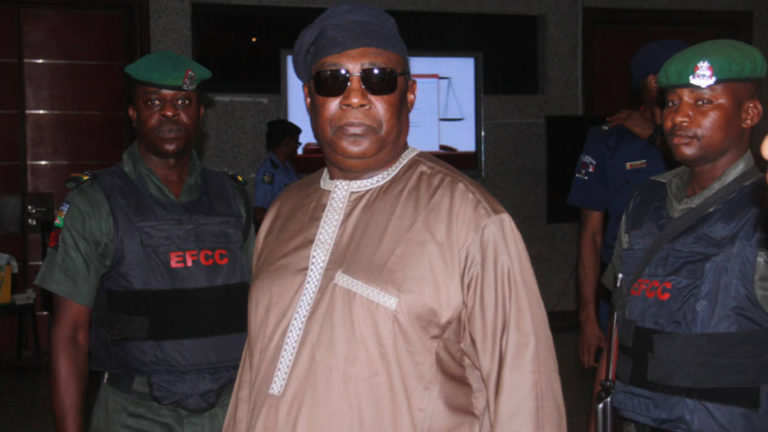
The  trial of Chief of Defence Staff, Alex Badeh, has been slated for January 16, 2019, on the alleged N3.97 billion fraud charge preferred against him by the Federal Government.

Lawyers for both parties agreed on the date on Thursday at the Federal High Court, Abuja, following the failure of the defence team to enter a no case submission as was agreed on October 23 when the matter came up.

Counsel to Badeh, Mr. Akin Olujimi (SAN), told the court that failure of the court’s registry staff to avail him of the records of proceedings involving 22 witnesses made it impossible for the defence to file a no case submission.

“Based on our application on October 23, to make a no case submission, your lordship granted the defence and the prosecution permission to file and exchange written addresses on the no case submission.

“I must report that we had some difficulties in getting recording of proceedings of the trial from the court registry.

“The last proceeding that we got from the registry in respect to this matter was that of October 27, 2016.

“That proceeding ended with PW seven and all together, we have called 22 witnesses in this matter that means there is a deficit in the production of proceedings with regard to 15 witnesses,” he said.

According to Olujimi, we consider this a great handicap and so we have decided to go ahead and call evidence in response to the case made by the prosecution.

“In this regard, the defence would no longer file a no case submission, rather, proceed to defend their case.’’

The Prosecution Counsel, Mr. Rotimi Jacobs (SAN), however, told the court that there was no record to show that the defence had applied for the record of proceedings from the court nor filed a no case submission.

According to Jacobs, to say that non availability of records is the reason for not filing the no case submission is a rather lame excuse.

Jacobs prayed the court to call on the defence to open its case.

The trial Judge, Justice Okon Abang, in his ruling disagreed with the defence that the failure of the registry to make records of proceedings of the case available was responsible for them abandoning the no case submission application.

He said that it was not the fault of the registry since the defence made no application for the records to be released to them.

The judge, however, adjourned the matter till January 16 and 17 for Badeh to open his defence.

The News Agency of Nigeria reports that Badeh was arraigned on 14 counts bordering on fraud, to which he entered a “not guilty” plea for all counts.

The former defence chief is standing trial for allegedly abusing his office by diverting N3.97bn.

The diverted money is said to have been meant for arms purchase in the face of worsening destruction by Boko Haram terrorists.

NAN
Edo, Abia states outshine others in development planning contest at Niger Delta Development Forum

0

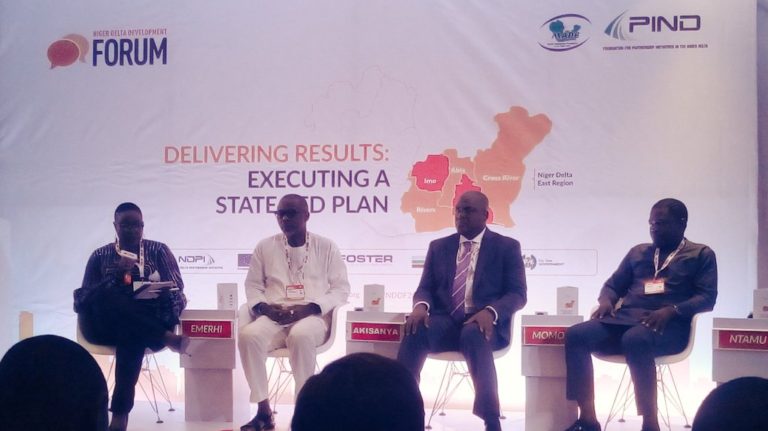
OUTDOING five other states of the Niger Delta region, Edo and Abia states have been announced as winners of the maiden edition of a long-term development plan pitching competition organised as part of events at the 7th Niger Delta Development Forum (NDDF). Other participating states included Ondo, Delta, Bayelsa, Imo, and Akwa Ibom.

The forum which was held on Tuesday and Thursday, in Edo and Rivers states respectively, is a project of the Foundation for Partnership Initiatives in the Niger Delta (PIND) and supported by a range of development partners.

The competition was introduced, the organisers explained, to serve as a window for the nine states of the Niger Delta to share their expectations and plans for long-term developmental planning processes led by the state governments and for them to get expert recommendations on policy actions and strategies.

Top government officials were invited to eloquently present their states’ economic roadmaps and development strategies, as well as how they intend to fund and implement the stated plans. They were also engaged by a panel of judges who provided feedback and quizzed them based on observations.

The winning states will be offered extensive technical assistance and capacity support towards ensuring their aspirations are brought to reality.

Speaking on the performances, Chichi Aniagolu-Okoye, Country Director of Water Aid and one of the judges at the event, congratulated all participants and said all the presentations were impressive and well-researched. She also advised the various governments to prioritise their policies wisely, while also paying attention to how the civil service and civil society may help in executing plans.

“It’s important that the states pay attention to their comparative advantage,” she said. “I know that, if you are a state government, there are so many competing interests. Ask yourself what are the three things that if you do, you will be able to catalyse development; for instance, electricity.

“A lot of the plans we heard were really quite external; they were not looking internally. We should ask: How do restructure the civil service to be able to deliver on the plans because part of the reasons our plans have not worked so far is because the structure to deliver them are very weak.”

Other judges included Joe Abah, Country Director of the Development Alternatives Inc.; Toyosi Akerele, founder and Chief Executive Officer of Rise Networks; Seun Akinsanya, Lagos State Director of Economic Planning; Abel Akeni, Head of Innovation at BudgIT; and Seun Ojo, Head of the Nigerian Economic Summit Group’s Public Policy Intelligence and Reform Management Unit.

In his welcome address, Dara Akala, PIND’s Executive Director, thanked the foundation’s development partners, and allies from the civil society sector and media for their support. The first edition of the forum took place at exactly the same venue back in 2012, he noted light-heartedly.

He also explained that the 2018 edition of the forum is focusing on development planning as way of consolidating on the resolutions reached in the previous year.

“The purpose really is for us to harmonise and discuss key development issues, and what we are always trying to achieve is to influence government policies of the region, to foster partnerships through this forum, and to attract investment into the region,” he said.

“We do know that there is a school of thought that believes that we don’t need plans, that it is not plan that is our problem, it is execution. But we simply defer from that. We need execution no doubt; but we also need very clear, comprehensive and coherent plans that will underpin development efforts at the subnational level In Nigeria and, in particular, in the Niger Delta region.

“There are several kinds of agendas in the states, but what is often missing is that long-term strategic plan that will transcend the life of any administration,” Akala added. “That is where we want to get the states to be.”

The Niger Delta Development Forum is an annual event organised by PIND and supported by other organisations such as Market Development in the Niger Delta (MADE), the European Union, Department for International Development (DFID), Faculty for Oil Sector Transformation (FOSTER), and Development Alternatives Inc. (DAI).

ASUU to students: This struggle is for your good

THE Academic Staff Union of Universities (ASUU) has called on the general public, especially students of the various universities in the country to show understanding with the lecturers who are currently on strike because the struggle is for their (the student’s) good.

Biodun Ogunyemi, National President of ASUU, said this during an interview with the News Agency of Nigeria (NAN) on Thursday in Lagos.

He expressed fear that the strike may not be called off any sooner as there has not been any concrete headway in the negotiation between ASUU and the federal government.

“We want to call on our students and parents to show understanding with our struggle as we are in this together,” Ogunyemi said.

“The whole essence of this struggle is to ensure that our students get worthy and deserving certificates that they will be proud of anywhere they may find themselves in the world.

“The struggle is to ensure too that we save Nigerian universities from going the way our public primary and secondary schools have gone.

“We do not want our universities to go the same way because a lot of our parents may not be able to afford the private university fees.”

“Unless Nigerians rise to the occasion and join ASUU in putting pressure on both the Federal and state governments to pay adequate attention to our universities, secondary and primary schools, we may be facing a total collapse of our educational sector.”

Ogunyemi said that the federal government last met with ASUU representatives on Monday, November 26, “but nothing tangible came out of the meeting”.

“Rather than come out with firm commitment on what to do about these demands, they were appealing to us to go back to the classrooms while they tackle the issues; and to us they have missed the point,” he said.

“We were told that the negotiation will continue on Friday, November 30 but up till now, as we speak, I have not received any notice of meeting to that effect.”

ASUU began this current round of strike action on November 5. The lecturers said they will not return to the classrooms except the government implemented the Memorandum of Action (MoA) it signed with the union in 2017.

According to Ogunyemi, the MoA if implemented will result in improved working conditions and welfare package for the lecturers and an upgrade in facilities across government-owned universities in the country. (NAN)

We have lost only 39 soldiers in the past 2 months, army clarifies

THE Nigerian army lost only 39 soldiers in a number of Boko Haram attacks in the last two or three months, says former spokesman Sani Usman.

Usman made this known in a statement he issued on Wednesday on behalf of the Chief of Army Staff, Tukur Buratai, in response to the reports that over one hundred soldiers were killed by Boko Haram in the attacks.

He maintained that “since 2015; the Nigerian Army in conjunction with sister services and other security agencies have systematically degraded the capabilities and capacity of Boko Haram terrorists and many successes were achieved”.

“However, in the last 2 to 3 months, we have noticed daring moves by the terrorists, increased use of drones against our defensive positions and infusion of foreign fighters in their ranks.

“Specifically; the Nigerian Army troops deployed at Kukawa, Ngoshe, Kareto and Gajiram came under attack at different times within a 2-week period between November 2 and 17, 2018; each of these incidents was successfully repelled and several members of the terrorists killed.

“However, a total of 16 personnel were killed in the course of these attacks while 12 soldiers wounded in action and are receiving treatment at our military medical facilities.

“One of the Nigerian battalions; 157 Task Force Battalion, deployed under the auspices of the MNJTF was attacked at their Base on the outskirts of a town called Metele on November 18, 2018.

“During the attack, the troops were forced to withdraw and several casualties were recorded. As at date 23 personnel were killed in action and 31 personnel wounded and have been evacuated to several medical hospitals within Borno State.”

While condoling with the families of the deceased soldiers, Usman noted that the new tactics being employed by the terrorists has prompted the army leadership to continually review its operations to come up with ways to better deal with the challenges.

He said the recent attacks on army formations in Borno State was what necessitated the change of venue for the 2018 annual Chief of Army Staff conference from Benin City, Edo State, to Maiduguri. This is “to enable the Nigerian Army leadership get closer to the troops on the ground and to better appraise our activities, assess our performance and identify our shortcomings as an Army”.

Prolonged silence

It took over five days and a barrage of news reports for the Nigeria Army authorities to acknowledge the Boko Haram attacks on Metele and other army positions in the North East. And when the authorities did issue a statement, they were silent on the number of casualties, saying only that the attacks were repelled.

But some of the soldiers who survived the attacks told newsmen on condition of anonymity that they were outnumbered and outarmed by the insurgents that attacked them. One said he had to pull of his uniform and ran for his life, while another said the attackers made away with a large cache of arms and ammunition belonging to the army.

During a television interview last Sunday, Presidential spokesman, Femi Adesina, tried to justify the silence by the army leadership over the recent Boko Haram attacks. He said that it was standard practice all over the world for the military to disclose casualty figures.

But that claim was invalidated in  a report by the ICIR, following leads provided by Anna Cunningham, a freelance journalist with France 24. The report showed that several developed countries, including The United Kingdom, United States of America, and France, have dedicated websites where an updated list of deceased soldiers are published on a regular basis.

Nigerians abroad send home equivalent of national budget annually — VP Osinbajo

VICE President Yemi Osinbajo has said that Nigerians in diaspora send home the equivalent of Nigeria’s annual national budget and one of the world’s largest remittances.

He said this on Wednesday at the ongoing maiden edition of the Nigerian Diaspora Investment Summit (NDIS) held in Abuja, according to a statement made available to the press.

Themed “Activating Diaspora Investments for a Diversified Economy,” the summit was put together by  Abike Dabiri-Erewa, senior special assistant to the president on foreign affairs and diaspora, in collaboration with other stakeholders, with the aim of attracting investments into the country.

Speaking at the event, the vice president assured stakeholders of the federal government’s willingness to facilitate the inflow of skills and investment and as well as praised the country’s huge annual diaspora remittances.

“Every year, Nigerians abroad send back the equivalent of about $20 billion [N7.3 trillion] home,” he observed, “almost the equivalent of our federal budget.

“Even as Foreign Investments have ebbed and flowed over the years, this remittance flows, a large percentage of which is informal, have mostly remained stable. Our diaspora community is an important resource, in terms of revenue for Nigeria.

“The Nigerian diaspora, like most Africans in diaspora, have an emotional connection with their homeland that has impelled them to maintain contact with their home countries. The Internet and social media have of course, made it a lot easier for you to stay connected with home.”

The present administration, he said, wishes to create an appropriate atmosphere to make diaspora investments more structured, secure, and better utilised for maximum economic benefits. He added that the premium placed by the government on the Nigerian diaspora is made obvious with the creation of the office of Senior Special Assistant to the President on Foreign Affairs and the Diaspora and, more recently, the Diaspora Commission.

“This inaugural Nigerian Diaspora Investment Summit is a further demonstration of our seriousness about the role of the Nigerian diaspora in building our country. We want to partner with you and listen to you and implement your advice and insights,” he said.

The vice president’s remarks about diaspora remittances was confirmed in a report by the World Bank which said in April that Nigerians abroad wired $22 billion (N8 trillion) home in 2017 — the largest in Africa and the fifth largest in the world. In 2015, this figure was $21 billion, according to the Migration of Remittance Factbook of 2016.

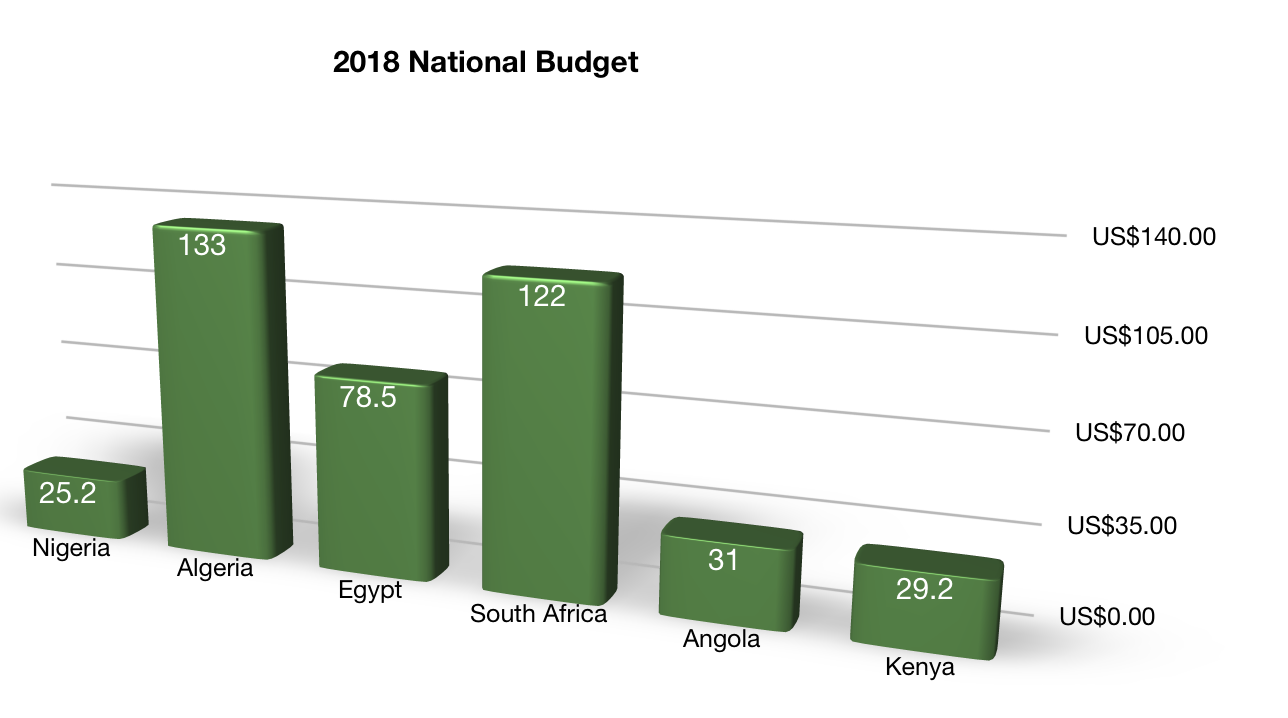
While these figures are often a little above the country’s annual budgeted amounts, Nigeria’s budgets have over the years been noted to come far short of those of other countries, including neighbouring African countries.

Checks by The ICIR revealed that, for the 2018 fiscal year, despite being Africa’s largest economy, while Nigeria’s total budget is N9.1 trillion ($25.2 billion), that of South Africa is R1.67 trillion ($122 billion), Algeria’s is $133 billion, Egypt’s is LE 1.41 trillion ($78.5 billion), Angola’s is AOA9.6 trillion ($31 billion) and Kenya’s is Sh3.074 trillion ($29.2 billion).

Source: Wikipedia and govt websites

What this modest budgeting shows, Tope Fasua, Chief Executive of Global Analytics Limited, observed in November, “is that successive Nigerian governments have not been dreaming. Not enough revenue is being generated, yet we are one of the most profligate countries in the world.” 

Boko Haram has been restricted to border towns, says Nigerian Army

“THE Armed Forces of Nigeria, led by the Army has done a yeoman’s job in compliance with the presidential directive to degrade and defeat Boko Haram”, and has successfully pushed the terrorist group to the borders of the country from about 22 local government areas they occupied prior to the Muhammadu Buhari presidency.

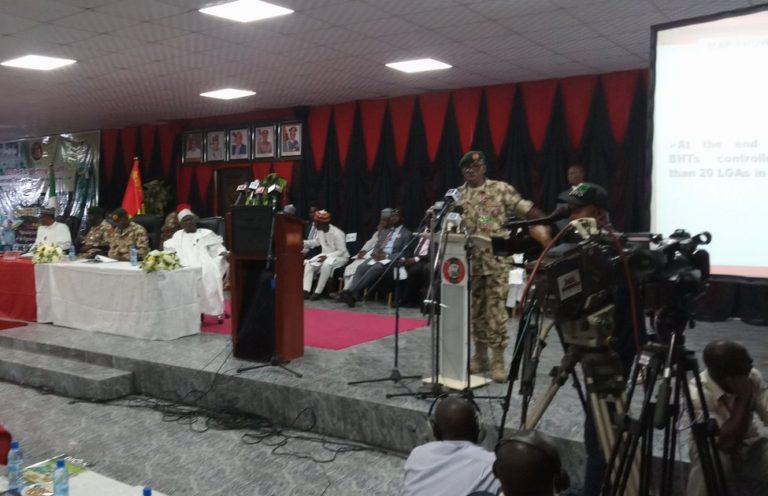
This was the submission of the Chief of Army Training and Operations, Major General L.O Adeosun, while presenting a comprehensive narrative of the counter-terrorism operations of the Nigerian Army in the North East region of the country from 2015 till date.

Adeosun was making the presentation at the opening ceremony of the 2018 edition of the Chief of Army Staff annual conference in Maiduguri, Borno State.

He stressed that the government was not wrong to insist that Boko Haram has been technically defeated, explaining that the counter-insurgency operation is an asymmetric warfare and not a conventional one where one can declare victory by taking control of the enemy territory and capturing the enemy flag.

Adeosun, who made an elaborate powerpoint presentation, showed several maps detailing the progress made by the Nigerian military, led by the army, in dislodging Boko Haram from the territories where they held sway and pursuing them to the borders.

“We should not forget that what we are confronting is not conventional, what we are confronting is asymmetry terrorism, insurgency, which is different from where you can have red and blue lines and you can say that after crossing this red line and capture the flag and the headquarters, that the battle is won and lost. Asymmetry warfare is no way like that,” Adeosun said.

He said that as at 2014, the Boko Haram were comfortably attacking targets in the North Central and North West regions, far away from their major area of concentration, the North East, where they had taken control of several local governments.

But with the ascension to power of President Buhari and the subsequent appointment of Tukur Buratai as the COAS in July 2015, the tides changed. “Operations were reinvigorated in the 3rd quarter and concluding parts of 2015, (and) change in the dynamics within the North East and across the country in terms of spheres of control and penetration of the terrorists were noticed,” Adeosun said.

“At the end of one of the so many operations that was conducted within the year, which was ‘Operation Rescue Finale’, in December 2016, Boko Haram was only occupying forest terrains inside Alagarno and Sambisa, as well as the marshy terrains of the Lake Chad Basin.”

Adeosun said that so far in 2018, the army has conducted several operations either on its own or jointly with the Cameroonian army, one of which was “Operation Last Hold to resettle some internally displaced persons who were yearning to return to their homes… and over 35,000 internally displaced persons were resettled into their respective communities.

“Our major concern now is their [the insurgents’] locations within the thin lines of our borders with our contiguous countries. This has given them the opportunity to cross to the other side, regroup, rearm, and take support from their international allies. This is what has been given us the current problem.

“The problem we are facing now is not only Boko Haram, we are facing support to Boko Haram both in personnel and equipment through ISWA, that is: Islamic State in West Africa, and they are christened by the Islamic State in the various locations where they are, in Libya, in Iraq, and Syria,” he said.

Buhari visits soldiers injured by Boko Haram, promises to wipe out the insurgents

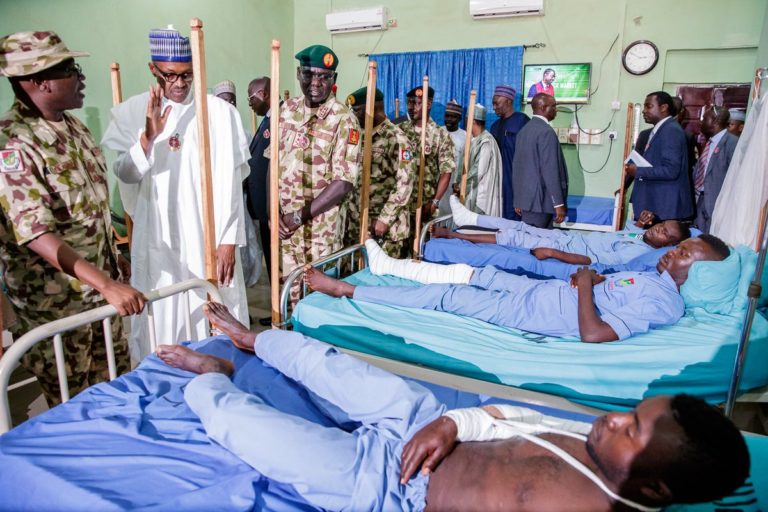
AS part of the activities to mark the opening of the 2018 edition of the annual Chief of Army Staff conference in Maiduguri, Borno State, President Muhammadu Buhari visited wounded soldiers  receiving treatment in the hospital.

The President had, during his keynote address at the opening ceremony of the conference pledged to continue to provide the armed forces with the necessary assistance, both in terms of equipment and welfare, in order for them to ensure that Boko Haram is “wiped out of the face of the earth”.

In a tweet later on Wednesday, Buhari wrote: “Today in Maiduguri I visited our wounded troops. Across the North East, we have officers and men fighting bravely and tirelessly to keep our country safe from terrorism and violence. I salute their sacrifice on our behalf. And may the souls of the fallen rest in peace.”

Also, President Buhari tweeted that as the Chairman of the Summit of Heads of State and Government of the Lake Chad Basin Commission (LCBC), “I am convening a consultation of Heads of State and Government of the LCBC, for November 29, 2018, in N’Djamena, Chad”.

“The objective of the one-day meeting is to review the security situation in areas affected by the Boko Haram insurgency, as well as adopt measures to enhance the capacity of the Multinational Joint Task Force (MNJTF) to secure the region.

“I have invited the presidents of the LCBC member countries: Chad, Cameroon, Niger, and the Central African Republic, to attend the meeting. Also invited is the President of the Republic of Benin, which also contributes troops to the MNJTF (Multi-National Joint Task Force).”

Boko Haram has renewed attacks against the Nigeria military, leading to massive loss of lives on the part of the troops.

Reports last week indicated that over one hundred officers and soldiers of the Nigerian Army were killed in one of such attacks in an area known as Metele in Borno State.

First DraftNews, ICIR unveil CrossCheck Nigeria to fight fake news

AS the 2019 general elections draw closer, the International Centre for Investigative Reporting (ICIR) and the FirstDraftNews have unveiled a website platform tagged ‘CrossCheck Nigeria’ to address the menace of fake news and misinformation in Nigeria.

The website is aimed at verifying news, pictures and videos that circulate on all social media platforms in order to authenticate or debunk claims emanating from such.

Speaking at the launch of the website in Lagos on Wednesday, Executive Director of ICIR, Dayo Aiyetan said Nigerians can freely log onto the website, post pictures, videos and any other information they want CrossCheck Nigeria to verify to curb the circulation of fake news in the country.

“It’s important to get ways to make journalism viable in today’s world. We are here today to find ways to combat misinformation that can affect our elections,” Aiyetan said.

While explaining the operations of the website, Managing Director of FirstDraftNews, Jenni Sargent, said the website uses research-based methods to fight misinformation and disinformation emanating from the social web.

Media executives at the event decried the worrisome increase of fake news in Nigeria, noting that journalists must uphold the core ethics of reporting the truth at all cost and times.

A member of the Editorial Board of the Guardian newspaper, Martins Oloja, said fake news is ‘deliberate propaganda aimed at destroying the truth’.

While attributing the evolution of technology and social media as major factors for the growth of fake news, Oloja called on journalists to be more vigilant and dig deeper to maintain the role of gatekeeping for the society.

“The moment customers notice you are no longer credible, you are finished in journalism. The foundation is truth and accuracy and if you don’t have them in journalism, you will lose business,” he said.

Also speaking, the Publisher of The Niche newspaper, Ikechukwu Amaechi, advised journalists and media publishers to maintain their credibility at all cost, saying once your medium is no longer credible, the newspaper dies naturally.

“Daily Times was once the fastest selling newspapers before. But when it begin to publish more of propaganda as a result of government influence, it collapsed,” Amaechi noted.

Amaechi stressed that journalists need to make sure that they don’t compromise credibility.

Ronke Raji, who spoke on behalf of the CEO of Channels Television, John Momoh expressed concern about the way some Nigerians share misinformation on social media such as WhatsApp. She warns that such practice could set the country one fire if not curbed promptly.

Pedro Noel of the AFP remarked that the “aim of this project is essentially to teach people that it is not difficult to check your information.

“We are all capable of checking information.”

Police arrest activist Deji Adeyanju over anti-government protest, arraign him in court

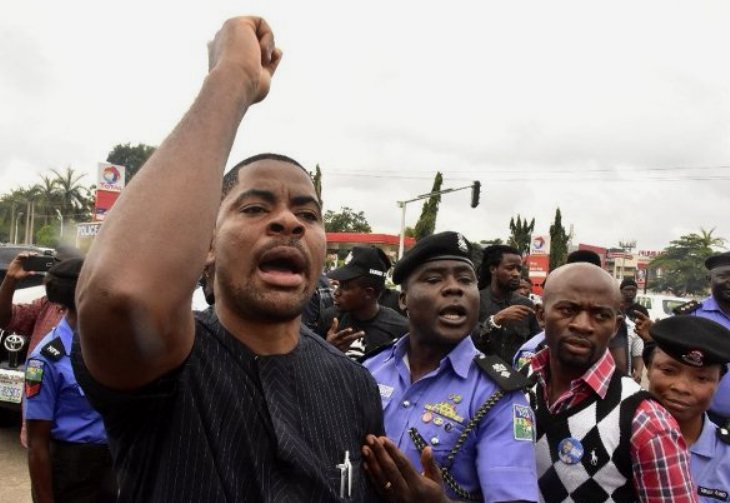
JIMOH Moshood, the Public Relations Officer of the Nigeria Police Force, says police  arrested Deji Adeyanju, a popular activist, on Wednesday and  arraigned in court in Abuja.

Moshood stated that Adeyanju was arrested alongside two others namely, Daniel Abobama and Boma Williams, during a protest. They were accused of criminal defamation and breach of peace.

The police spokesman said Adeyanju, Abobama, and Williams had committed offences contrary to the criminal statutes by their conduct both physically and online.

He cited some placards and screenshots of Adeyanju’s social media posts which he said were defamatory, derogatory against constituent authority, and capable of inciting public disturbance and breach of law and order.

Moshood said the arrest of the trio did not violate either the Nigerian Constitution or the police establishment powers, adding that they have rights. “These rights must be observed with decorum, in good faith and without violating the rights of other millions of Nigerians to free movement and access to safety and security across the country,” he said.

Adeyanju tweeted earlier in the day that his group was on the way to Force Headquarters to hold a rally against Police partisanship tagged 

The activist is known to have taken part in a number of anti-government protests. He was the co-leader of the ‘Resume or Resign’ group which, during the time President Muhammadu Buhari was away in London on medical leave, called on him to either return home and resume duties or resign.

Also, Adeyanju is part of the ‘Our Mumu Don Do’ group that is clamourig for a drastic change in the status quo of doing things in Nigeria.


Reports say he has been arrested at least three times so far in 2018 while leading or participating in protests.

A hashtag #FreeDeji Adeyanju is already trending on the social media as Nigerians call on the police to release Adeyanju.

Seven things Buhari said at the 2018 COAS annual conference

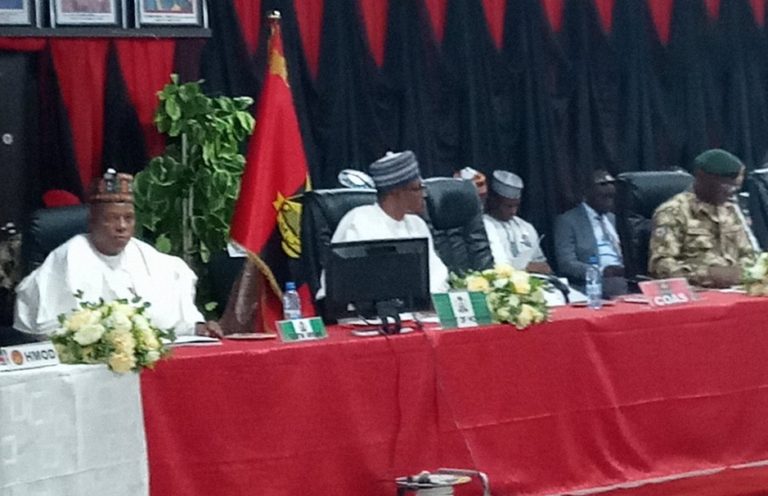
PRESIDENT Muhammadu Buhari was the Special Guest of Honour at the 2018 Chief of Army Staff (COAS) which held in Maiduguri, the Borno State capital on Wednesday.

In his keynote address at the event, Buhari commended the army leadership for changing the venue of the conference which was initially scheduled for Benue State, to Maiduguri. He said it was a thoughtful thing to do as the troops that are taking part in the counter-terrorism operation, “deserves all the attention our country’s leadership can demonstrate to them”.

Here are six takeaways from President Buhari’s address at the conference:

Commendation for general improvement in security

Buhari pointed out that one of the cardinal objectives of his administration is security, and in this regard, the Nigerian army has recorded significant successes. He noted that the North East is a lot more peaceful than was the case before he took over power, several persons abducted by Boko Haram have been rescued and many internally displaced persons have been returned to their homes.

Outside the North East, “the efforts of the military have also stabilized the security situation in the Niger Delta, and other parts of the country, and curtailed the clashes between herdsmen and farmers”.

“I must commend the selfless sacrifices of our armed forces, especially the officers and soldiers of the Nigerian Army, who, by virtue of their commitment to operations all over the country, have brought about the desired peace,” Buhari said.

The President also said that despite the recent setbacks and operational losses recorded in the Northern part of Borno State, “I know that you are doing your best to reverse this trend, and I want to assure you that no effort will be spared in providing the necessary support you require to complete your task”.

He also paid tributes to the officers and men who have paid the supreme prize in the course of the anti-terrorism operations, as well as all other victims of the insurgency.

Preparation for 2019 general election

As the 2019 general election draws nearer, Buhari urged all the members of the armed forces to live up to their responsibilities and remain non-partisan and apolitical.

“In addition, you must all remain vigilant throughout the electioneering period, and alongside other security agencies, prevent every form of violence that could disrupt the process in line with your rules of engagement,” he said.

Reduction in human rights abuses allegation

The president also noted that there has been a “drastic reduction in human rights allegations against the Nigerian Army”. He urged the officers “to continue to ensure that all troops remain committed to the observance of all international human rights laws and laws of armed conflict”.

Commendation for the handling of Gen Alkali’s disappearance

Buhari also commended the army for the professional manner with which it unraveled the perpetrators involved in the disappearance of the late General Idris Alkali, who was waylaid by hoodlums in Jos, Plateau State, on his from Abuja to Bauchi.

Alkali’s body was dumped inside a well after he was killed by the hoodlums who also pushed his vehicle into a mining pond and made away with his valuables. His remains was brought back to Abuja where he was given a befitting burial.

Buhari said that the unraveling of Alkali’s disappearance and the attendant arrest of the suspects involved in his murder, “attests to the capabilities that exist in our security apparatus”.

“I want to assure you that the perpetrators will be brought to book,” he promised.

Improved welfare

As the Commander-in-Chief, Buhari assured that he would do everything within his power to continue empowering the army by providing it with all necessary equipment and enablement required for the officers and soldiers to prevail on the field.

“I also want you to be aware that I am currently looking into measures to improve your entitlements and welfare generally,” he said.

Commitment to fighting corruption

Buhari reiterated that his administration remains committed to its cardinal objectives of boosting security, restoring the economy, and fight against corruption. This, he said, is “to ensure a steady, sustainable and inclusive economic growth”.

“Our commitment to entrenching purposeful and accountable leadership remains firm, because it is the base from which peace, security and national development will be built,” he said.

“I, therefore, wish to reiterate that leaders of all strata of society, including our armed forces, must embrace the wind of change that is blowing across the country for good.”

Contemporary security challenges

As part of his concluding remarks, Buhari urged the army officers, as they review their activities so far in 2018, to “concentrate on the contemporary security challenges facing our nation, and proffer ways of surmounting the challenges”.

“I am convinced that this conference will renew the vigour and dedication for which the Nigerian Army is known,” he said.

The opening ceremony of the 2018 COAS annual conference was also attended by other top government functionaries, including the Governor of Borno State, Kashim Shettima; the Minister of Defence, Mansur Dan-Ali; the former majority leader of the Senate, Ali Ndume, among others.