FEMI Otedola, the founder of Zenon Oil, has denied the claim that he offered to bribe former House of Representatives’ member, Farouk Lawan, when the latter chaired a legislative committee that probed alleged fuel subsidy scam.
Otedola said this while testifying before the Federal Capital Territory High Court on Wednesday in the bribery case brought against Lawan by the Federal Government.
Lawan was caught on camera stuffing dollar bills into his flowing dress and some into his cap, money he accepted as bribe from Otedola in order to remove his company from the list of those being probed for subsidy scam
At the hearing on Wednesday, Otedola said he could not have offered to influence the lawmakers as he was certain his company was never part of the companies that received subsidy grants from the Federal Government at the time.
Lawan had actually demanded $3 million which he said would be used to settle the other lawmakers. However, after receiving the initial $500,000, Lawan removed Zenon Oil from the list of companies being probed.
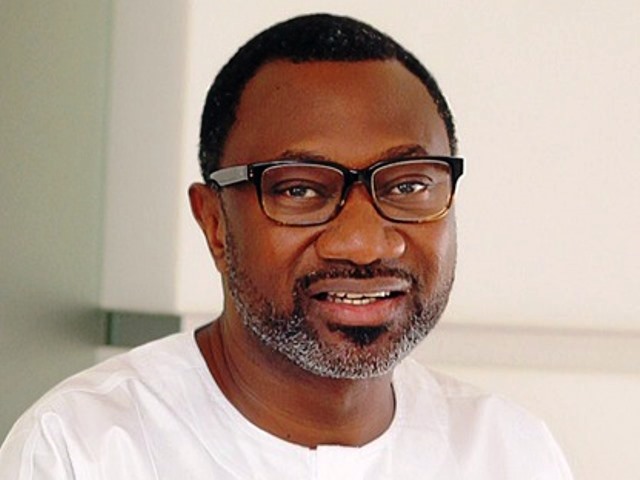
Femi Otedola
“I could not have put pressure on him because Zenon Oil was not involved in the theft of the subsidy fund,” Otedola told the court.
“He did demand. And if he did not demand, why will he collect and expect a balance of $2.5 million? He mentioned to me that the $3 million will be shared by himself and some other members of the House.
“Moreover, the company in question was not involved in the importation of petroleum motor spirit (PMS) and as such never applied to withdraw from the petroleum fund.”
“I did not offer any $3 million, because I was one of the biggest players in the business. And I reported the matter initially when I found out about the scam. And he (Lawan) mentioned to me that several companies that were involved in the scam were paying. And I reported to the SSS.”
The case was adjourned 28, 2019, for the witness to be cross-examined.
Lawan was first arraigned before Justice Adebukola Banjoko of the FCT High Court in February 2013 alongside another accused person, Boniface Emenalo, for allegedly receiving a total of $620,000 from Otedola.
Justice Banjoko later pulled out of the case after he was accused of bias by the defence.
The charge was later amended to reflect that the actual amount Lawan received was $500,000, not $620,000, and as such, Lawan was re-arraigned in December.
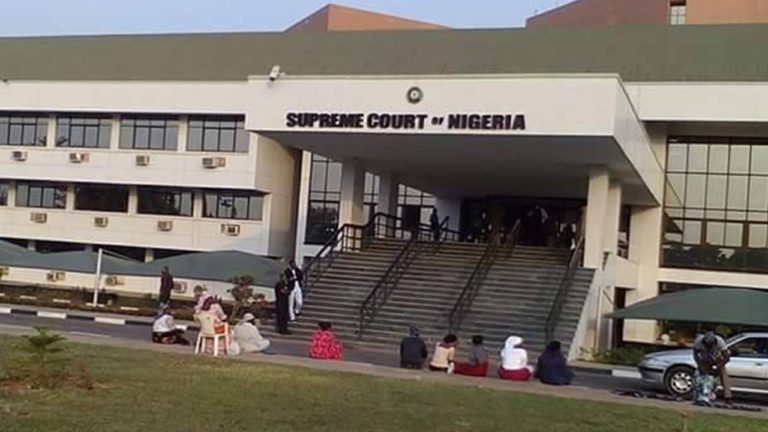
PRESIDENT Muhammadu Buhari has appointed Musa Abaji as a Justice of the Supreme Court of Nigeria, as confirmed in a letter he sent to the Senate on Tuesday.
Bukola Saraki, the Senate President, read out the letter to members of the house in a plenary session. The President had written that the appointment was made in accordance with the advice of the National Judicial Council.
“In line with 1999 constitution upon the advice of the National Judicial Council, I hereby refer for confirmation of the appointment of Justice Musa Abaji as the Justice of the Supreme Court of Nigeria.
“While hoping that this is expeditiously considered by the Senate, accept the assurances of my highest regard,” the letter read.
In a second letter, the president declined to assent to the Institute of Chartered Biochemist and Molecular Biology of Nigeria Bill 2018. He stated as his reason that, if passed, the bill will infringe on the mandate of the National University Commission and the National Board for Technology Education.
He also pointed out drafting issues on the bill.
“Pursuant of section 68(4) of the constitution, I hereby convey to the senate the decision on the 5th November 2018 to decline presidential assent to the Institute of Chartered Biochemist and Molecular Biology of Nigeria bill 2018 recently passed by the National Assembly for the following reasons;
“A. The provisions of section 13(3) to give the chartered biochemist and molecular biology power to approve the academic program and even close down programs in tertiary institutions will infringe on our mandate of the National University Commission and the National Board for Technology Education.
“B. There are certain drafting and administrative issues in the bill, including the failure in section 13(8), 14 and 22(2) to designate a chairman for both the practice and publicity committee and or specific process for how a chairman should emerge for either of the education, practice and publicity committees.
“This can lead to confusion in the administration of the council,” the president wrote.
THE Abuja Federal High Court has dismissed the no-case submission filed by Raymond Dokpesi, founder and emeritus Chairman of DAAR Communications Plc, in the ongoing corruption trial against him.
The Economic and Financial Crimes Commission (EFCC) made this known via it’s Twitter handle on Wednesday.
“Justice John Tsoho of a Federal High Court Abuja rules that Chief Raymond Dokpesi, founder of DAAR Communications Plc, has a case to answer in the alleged N2.1bn fraud case brought against him by the EFCC,” the tweet reads.
Dokpesi is alleged to have received the N2.1 billion naira from the office of the National Security Adviser in 2015, then headed by Sambo Dasuki, who is currently in the custody of the Department of the State Services (DSS).
The EFCC said the money was part of the $2.1 billion meant for the purchase of arms for the Nigerian Armed Forces but which was diverted during the run-up to the 2015 general election, adding that Dokpesi ought to have known that the monies he received from Sambo were proceeds of a corrupt activity.
The Commission had closed its case against Dokpesiin May this year, after calling a total of 14 witnesses and tendering several exhibits, but the accused person, through his counsel, Kanu Agabi, filed a no-case submission, saying that the witnesses and exhibits presented by the prosecution were not enough to establish a prima facie evidence against him.
But at the resumption of trial on Wednesday, Justice John Tsoho ruled that a prima facie evidence has been established and that Dokpesi has a case to answer.
One of the prosecution witnesses had told the court that monies were wired directly from the account of the NSA domiciled in the Central Bank of Nigeria (CBN) to accounts belonging to DAAR Communications in several instalments of N500 million, N620 million, N113million, among others.
Of those amounts, N68 million was used to construct Dokpesi’s house in his hometown, Agenebode, Edo State.
The case was adjourned to February 20 and 21, 2019, for Dokpesi to open his defence.
IN an attempt to draw attention to the achievements of the federal government in diversifying the nation’s economy, Vice President Yemi Osinbajo has reeled out figures about the Anchor Borrowers Programme (ABP) which conflict with all other available sources, The ICIR discovers.
One of the most celebrated achievements of the federal government under the leadership of President Muhammadu Buhari are those related to agriculture. The president made sure to emphasise them during his meeting, in April, with British Prime Minister Theresa May. He said it during his Democracy Day speech in May, and has mentioned it on several other occasions.
He has, in fact, accused Nigerian news organisations of under-reporting these achievements, especially as they relate to the local production of rice and the significant drop in imports.
Occupying the centre stage in this narrative is the Anchor Borrowers Programme, to which the bulk of the successes recorded has been attributed. However, as with a number of other top projects executed by the federal government, the ABP has been soiled by secrecy and a lack of transparency — especially in the population and identities of beneficiaries.
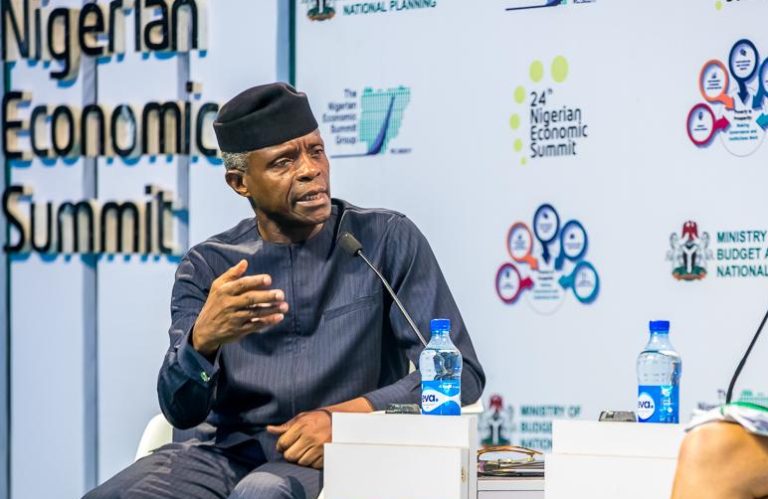
Speaking at the 24th Nigerian Economic Summit on October 22, Osinbajo appeared to have exaggerated statistics concerning the ABP, which is coordinated by the Central Bank of Nigeria’s Development Finance Department (DFD).
“Through the Anchor Borrowers’ Programme,” he said, “credit is given directly to smallholder farmers, and the Anchor Borrowers programme is our agricultural programme for financing smallholder farms.
“And the CBN and 13 participating banks have so far had given credit totalling to N120.6 billion, and this has been given to 720,000 smallholder farmers, who [are] cultivating 12 commodities so far including; Rice, wheat, cotton, Soya beans, Cassava, poultry and groundnut across the 36 States and FCT.”
The Vice President’s figures, however, cannot be traced to any other source, even as they conflict with those which have been provided by the Buhari Media Organisation (BMO) and corroborated in the administration’s scorecard.
According to the BMO, self-described as “a not-for-profit organisation that seeks to amplify the good work … of the Pres. Buhari administration”, the Anchor Borrowers Programme has made available “N82 billion in funding to 350,000 farmers of rice, wheat, maize, cotton, cassava, poultry, soy beans and groundnut; who have cultivated about 400,000 hectares of land”.
The same figures are contained and elaborated in the recently unveiled scorecard and manifesto of President Buhari tagged ‘The Next Level’. About 80 per cent of the N82 billion funding has gone into rice production, the document states, “further driving the nation’s target of attaining self-sufficiency in rice production”.
Lauretta Onochie, Buhari’s social media aide made a similar claim in October when she highlighted sixty-four (64) achievements of the federal government, in reaction to allegations of non-performance.
Likewise, Anne Ihugba, the Head of Corporate Communications at the Nigeria Incentive-Based Risk Sharing System for Agricultural Lending (NIRSAL) has said, through the agency which supervises mapping of farmers and disbursement, the ABP is creating over 250,000 direct jobs for farmers and up to 1.25m indirect jobs.
According to reports, NIRSAL’s entire database of farmers nationwide, from where beneficiaries of the borrowers’ program are drawn, has captured details of only over 400,000. This, as well, is a far cry from Osinbajo’s claim that 720,000 smallholder farmers have benefited from the programme.
Blemished by secrecy, shortcomings
The Anchor Borrowers Programme was established by the CBN in fulfilment of its developmental functions. President Buhari launched it in November 2015, with the objective of creating “economic linkage between smallholder farmers and reputable large-scale processors with a view to increasing agricultural output and significantly improving capacity utilization of processors.”
Funding for the project is sourced mainly from the N220 billion Micro, Small and Medium Enterprises Development Fund (MSMEDF) of the CBN, which was launched earlier in 2013.
Despite various calls, details of the claimed beneficiaries of the programme have not been made available by the CBN for independent verification, thus raising doubts about the fund’s credibility.
Investigations have revealed that various other shortcomings are hampering the project’s implementation such as the distribution of expired seedlings, late distribution of fertilisers, delay in fund disbursement, non-compliance from financial institutions, diversion of money into private and unqualified hands, as well as grossly inadequate coverage in various states.
Meanwhile, NIRSAL confirmed in a phone conversation with The ICIR that it is the only body in charge of disbursing funds to farmers under the scheme. An e-mail further sent, upon request, to the Head of Corporate Communications requesting for the latest figure of how many farmers have benefitted so far under the social welfare credit programme, has however not been attended to following an acknowledgement on October 25.
A call placed to CBN’s helpline for the Commercial Agricultural Credit Scheme for the purpose of seeking similar clarifications was however not answered.
THE Attorney-General of Kwara State, Kamaldeen Ajibade, has told the Ilorin High Court that Michael Adikwu, the prime suspect in the Offa robbery attack that occurred in April this year, died while in police custody, but many Nigerians believe he was murdered.
Ajibade said this on Wednesday when five of the robbery suspects were arraigned before Justice Halimat Salman on charges bordering on armed robbery and culpable homicide.
Adikwu, a former policeman who worked with the force’s Special Anti-Robbery Squad (SARS) was said to have killed about 22 persons during the robbery attack. According to Jimoh Moshood, the spokesman of the Police, Adikwu was dismissed from the force for allegedly helping a criminal suspect to escape from custody. He was later charged to court and was sent to jail in 2013, and upon his release in 2015, he became an armed robber.
He was later arrestedalongside many of his gang members, but people began to raise eyebrows when the police paraded the suspects in May, and Adikwu was not among them.
The suspects claimed that they were being sponsored by the Senate President, Bukola Saraki, and the Governor of Kwara State, Abdulfatah Ahmed, and had been used by both leaders to disrupt elections in the past. Both Saraki and Ahmed denied the allegations.
Also when Nigerians, including Saraki, started to ask questions regarding the whereabouts of the prime suspect of the robbery attack, especially following rumours that he was shot dead in the presence of the other suspects in order to coerce them to confess, Moshood insisted that he was alive and was still in custody.
“Michael Adikwu is in police custody. You know he is the one that led the killing of 22 people. He is helping the police in investigation… There is a state in the south-west where they kept him… ; that is where he is. I can’t mention the state. He is in one of the south-west states,” Moshood said at the time.
Moshood had also accused the Kwara State government of foot-dragging in prosecuting the Offa robbery suspects, saying that the police had concluded its investigations and handed the case files to the State’s Attorney-General.
The police spokesman had said that more than 20 “principal suspects” were arrested in connection to the robbery incident, but only five persons were arraigned in court on Wednesday, namely: Ayoade Akinibosun, Ademola Abraham, Ibikunle Ogunleye, Niyi Ogundiran, and Salahu Azeez.
The suspects, however, could not take their pleas as the prosecution team, led by the Kwara Attorney-General, Ajibade, asked for an adjournment to enable it to amend the charges as a result of the death of Adikwu.
The trial judge granted the request and adjourned the case to November 30 for the suspects to enter their pleas.
When the ICIR contacted Jimoh Moshood on Wednesday, he said he had no idea where the reporter got his information from. When he was told that the information was given in court by the Kwara State Attorney-General, Moshood said could not comment on a matter that is already before the court.
Twitter reacts
However, many Nigerians who reacted to the development on the social media believe that Adikwu was either murdered by the police, perhaps to cover the real sponsors of the gang, or he had died as a result of torture at the hands of the security operatives.
“(In) June 2018, I accused the Nigerian Police of murdering the mastermind of Offa Robbery and now it has been confirmed in court that armourer and mastermind, Michael Adikwu “died” in police custody,” tweetedAbdul Mahmud whose Twitter handle read ‘The Great Oracle’.
Another Twitter user wrote: “We’ve been waiting to hear a contradictory story, but it’s finally out that he died in custody, how did he die? we all know he was killed, simply because they want to nail it on someone! The Nigerian Police and their wayo ways.”
A Twitter handle with the username ‘A Concerned Nigerian’ wrote, “The Nigerian Police carries out extrajudicial killings EVERYDAY. Each day there is one suspect gunned down or tortured to death by the evil and unrepentant police officers. My elder brother, a few years ago, died in police custody before we could secure his bail. He was tortured by officers.”
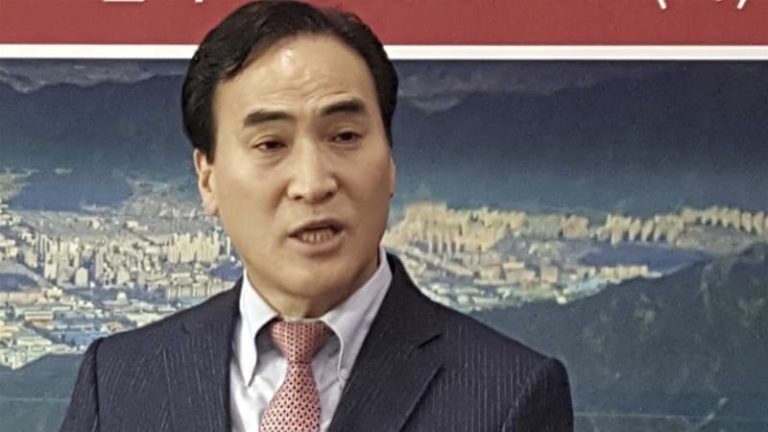
Interpol has elected Kim Jong-yang of South Koreaas its new president, according to the international police body.
Jong-yang, who had been serving as acting president, was elected for a two-year term at the body’s annual congress in Dubai on Wednesday, finishing the four-year term of his predecessor who was arrested in China this year.
“Our world is now facing unprecedented changes which present huge challenges to public security and safety,” Jong-yang told Interpol’s general assembly, according to the agency’s Twitter handle.
“To overcome them, we need a clear vision: we need to build a bridge to the future.”
Jong-yang, 57, worked in the South Korean police for more than 20 years before retiring in 2015.
South Korea’s President Moon Jae-in congratulated Jong-yang on becoming the first South Korean to head the organisation.
“We’re very proud. I, together with our people, am sending congratulations,” Jae-in wrote on Twitter.
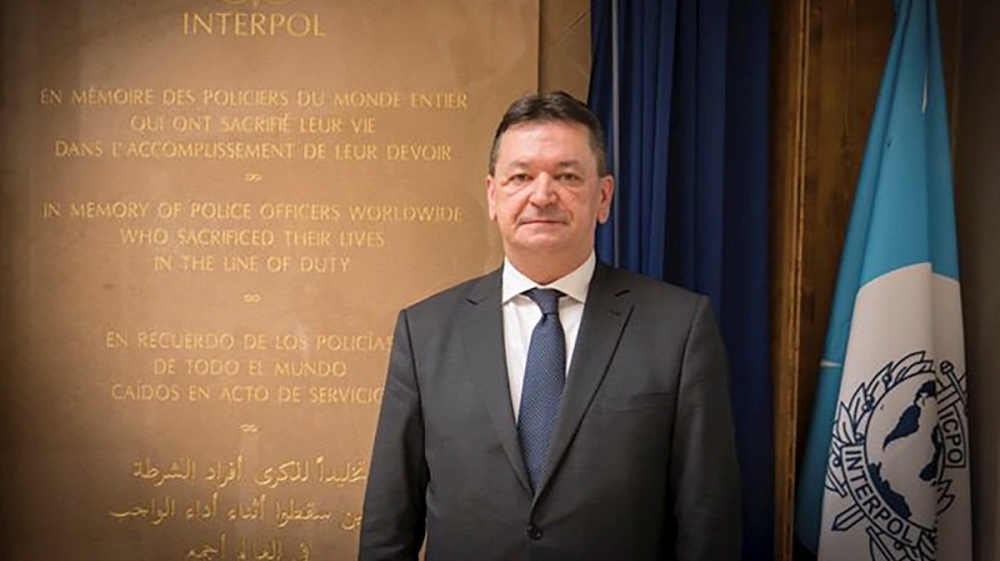
The South Korean’s election is a blow to Moscow’s efforts to reserve the position for a Russian candidate, Alexander Prokopchuk.
The United States, Britain, and other European nations rejected Prokopchuk’s candidature saying his election would lead to further Russian abuses of Interpol’s red notice system to go after political opponents and fugitive dissidents.
Following the vote on Wednesday, the Kremlin said that clear outside pressure had been exerted on the election, but that it did not see any factors that would render the process illegitimate, Russia’s Interfax news agency reported.
Prokopchuk is a former major general in Russia’s interior ministry (AP)
Interpol is best known for issuing “red notices” that identify a suspect pursued by a country, effectively putting him or her on the world’s “most-wanted” list.
William Browder, a British fund manager critical of the Kremlin who has been arrested repeatedly at Russia’s behest before being released again, told BBC radio in London: “[Prokopchuk] has been responsible for trying to chase me down and have Interpol arrest me seven times.”
Jong-yang’s predecessor
The election of Jong-yang comes following former Interpol chief Meng Hongwei’s resignation after he was arrested in China in September on bribery and corruption charges.
Meng had disappeared in China for 13 days before his arrest was made public in October.
China’s Ministry of Public Security said that Meng’s suspected corruption and violation of laws “gravely jeopardised” the ruling party and the police, according to a report in the South China Morning Post.
Authorities also said Meng was in this situation due to his own “willfulness and for bringing trouble upon himself”.
France, which hosts Interpol’s headquarters in Lyon, received Meng’s resignation as president of Interpol with immediate effect.
Meng’s wife Grace said her husband sent her an image of a knife before he disappeared during a trip to their native China.
Making her first public comments on the issue, Grace told reporters in Lyon that she thought the knife was her husband’s way of trying to tell her he was in danger.
She said she has had no further contact with him since the message that was sent on September 25. Grace also said four minutes before Meng shared the image, he had sent a message saying: “Wait for my call.”
She read a statement during her press conference in Lyon, but would not allow reporters to show her face, saying she feared for her own safety and that of her two children. (Aljazeera)
Destino Pedro of Angola has been elected delegate, by the world police to represent Africa in a three years term alongside other Interpol Executive committee members.
President Muhammadu Buhari has again listed as one of his achievements the N2.5 billion Northern Ishan Regional Water Supply project in Edo State, a project that is yet to be completed.
The project was No.3 on the list of eight projects captured in the Next Level Campaign Manual of the president for the 2019 election.
Earlier, while marking his third anniversary in office on May 29, the president also list the uncompleted water project as his achievement in office.
The ICIR reported in July 2018 that the project was not completed despite the claim by the Presidency in the Fact Sheet published two months before the ICIR report.
It’s not only the current administration that has claimed credit for this uncompleted project. President Buhari’s predecessor, Goodluck Jonathan’s administration also listed the project as completed.
In reality, however, Northern Ishan Regional Water Supply project remains uncompleted till date.
The project is still hampered by issues of reticulation, delayed construction of road to the river and compensation to land owners.
Genesis of Northern Ishan Regional Water Supply
The main office of the water supply project at Ugboha community which remains shut. Photo Credit: YEKEEN Akinwale
Northern Ishan Water Supply Project was awarded in 2005 by former President Olusegun Obasanjo to provide water to Ugboha, Uromi and environs. It was awarded to Chinese construction company, CGC, at the sum of N2.2billion, but the figure was jerked up to N2.4billion in 2009.
Work stopped at the site, four years after work commenced on the project.
In 2014, Friday Itulah, a member of House of Representatives representing Esan South-East/Esan North-East Federal Constituency moved a motion for the completion of the project.
Itulah, also a former Speaker of Edo State House of Assembly said insufficient water reticulation in the community hosting the water in-take plant led the Federal Ministry of Water Resources to appropriate in 2012 the sum of NI70 million which he said was not released for the project.
The sum, Itulah told the House then was to be released through Owena River Basin Development Authority to DADIM Integrated Concepts Limited for the reticulation.
According to him, another N130 million was to be released for outstanding payment, compensation and revitalisation of equipment by the Ministry to the main contractor- CGC, which he said was also not released.
In all, a total of N300 million delayed the completion of the project in 2014 and Itulah suggested for its inclusion in the 2015 fiscal year Appropriation Act.
In essence, what delayed the completion and commissioning of the project were outstanding payment, compensation and revatilisation of equipment by the Ministry to the main contractor- CGC.
But in 2018, four years after he moved the motion for the completion of the project, it has remained uncompleted −the water reticulation is still not done.
Essentially, reticulation of water at the host community of the project—Ugboha was a major bone of contention. Out of the 70 tap heads contained in the bill of quantity for the community, only half of it was provided. The six tap heads that are the closest to the dam at Egwuare Ugboha are not even working.
The Ugboha Progress Union (UPU), an interest group that was fronting for the payment of compensation to owners of land taken over by the government for the construction of water supply project and water reticulation said the government failed to pay the sum of N3,808 million calculated as compensation.
Twice listed for commissioning but not completed
Defaced: Angry Ugboha youths defaced the signpost of the project at the main pump station. Photo Credit: YEKEEN Akinwale
In 2011 and 2012 under former President Goodluck Jonathan, the Northern Ishan Water Supply Project was listed as completed and ready for commissioning − but attempts by that administration to commission it was rebuffed by the people of the community on the issue of water reticulation and compensation for damaged farm and properties.
Former Minister of Water Resources, Sarah Ochepke, under Jonathan in her mid -term report(2011-2013) listed the water supply project among others as completed and ready for completion.
In the report, Ochekpe said the water project gulped N2.497 billion had created 120 jobs and would serve 150,000 people.
Also, Obadiah Ando, her predecessor, in his Roadmap for Water Sector, 2011 listed the project as completed and ready for commissioning.
Former Vice President Namadi Sambo in 2012 was expected to commission the project, but a protest by the host community over the insufficient water reticulation and compensation to landowners and farmers, whose properties and economic trees were affected, led to the postponement of commissioning.
An uncompleted project, yet commissioned
Lai Mohammed, Minister of Information and Culture and Suleiman Adamu, Minister of Water Resources handing over documents of the water supply project to Godwin Obaseki, Governor of Edo State at a symbolic commissioning held at the Governor’s Office in Benin City Photo Credit: File Photo
To take credit for the work not done, the water project was commissioned despite protest by the host community that it was not completed, the residents said.
In November 2017, Suleiman Adamu, Minister of Water Resources listed Northern Ishan Water Supply project among eight projects to be commissioned in early 2018.
The project, he said, was one of the 116 abandoned or uncompleted projects the Buhari administration inherited.
He said his Ministry conducted a technical audit and prioritized the hitherto uncompleted or abandoned 116 major projects inherited.
And despite unresolved issues on water reticulation, bad road to the dam, unpaid compensation, the Minister of Information and Culture, Lai Mohammed, on May 23, 2018 in the company of Minister of Water Resources, Adamu, and other officials of Federal Ministry of Water Resources and those from Edo State Government headed for Ugboha to commission the project −but it was a mission impossible − they were chased away by angry mob at the community who set up fire and barricaded Ugboha main junction in protest against the shoddy job done.
The angry mob, majorly youths from Ugboha made the commissioning impossible even with the presence of heavily armed security operatives that accompanied the Ministers and their entourage.
But the commissioning was done at the Edo State Government House, Benin City on the same day. At the Government House, the Minister handed over the documents of the project to Governor of Edo State Godwin Obaseki, as a completed and commissioned project.
Adamu was quoted as saying that the government was satisfied with the quality of the job done.
“We have finished our intervention programme and we are here today to hand over the project to the Edo State Government led by Governor Godwin Obaseki,”Adamu said while handing over the project documents to the Governor.
The Commissioner for Energy and Water Resources, Yekini Idiaye, confirmed to The ICIR that the project was not completed.
Also during a meeting in June, a month after the ‘symbolic commissioning’ of the project in Benin City, during a meeting between the state government and leaders of Ugboha community, the Commissioner saidsteps were being taken to address the grievance of the people of Ugboha with regard to the reticulation of the water project in Ugboha, as deadline for completion has been set for December 2018.
“We have not seen flooding like it occurred this year,” said most victims of the recent flooding incident in the North-central part of the country. The disaster is reported to have afflicted hundreds of thousands of Nigerians across different states, leaving many dead and many more displaced. For four days, The ICIR‘s ‘Kunle ADEBAJO visited Niger, Kogi states, and the FCT, some of the worst-hit areas, to feel the pulse of the direct victims. In this two-part report, he shares how what is seen as an act of God coupled with the actions and inaction of government has driven various communities to starvation, homelessness and despair.
“Come! Come to my house,” voices from various directions plead. “Come and cover the damage to my house. You mustn’t leave without coming to see for yourself.” The natives of Gbami, and other communities in Lapai Local Government area call on The ICIR reporter to share their loss and stories of neglect with the world.
For Yishua Abdullahi, not only was his house greatly damaged, he also lost his maize and cassava crops. Likewise, the flood ravaged the house of Ahmed AbdulMalik, which he built in 2003. It appears nearly as though an explosion recently rocked the area, blowing off parts of the building. The only thing holding the shifted rooftop from collapsing is a couple of tree branches. It was formally a five-room apartment, but four rooms have been damaged, leaving only one room that offers little from protection from the rain.
Yunusa Mohammad, another resident of the village, fares no better. His prized possessions such as a generator and furniture items were literally destroyed. Like many others who are homeless, he had to move in with family members still lucky to have a place to call home. Mohammad plans to rebuild his damaged house, but he has no money to do so now.
Many other buildings in the village lie in ruins due to the flood. The villagers have devised methods to prevent structures still standing, such as using a fuel-powered machine to channel incoming water back in the opposite direction. Despite the havoc, Gbami is not among the worst-hit because the homeless locals from other communities still find refuge close to the village.
Yunusa Mohammed’s damaged house
AbdulMalik stands in front of his damaged house
Village chief, Gbami
Yunusa Mohammed stands in front of his damaged home
Showing this reporter around the vast farmland of the people, Uthman Ahmed, a resident of Gbami, laments the devastation visited on them by the inclement weather. “This place wey you dey see ba, all, nah water destroy am,” he says.
“My own farm is there too,” he adds, pointing ahead with a long stick he grabbed on the way. “From it, I can get like 30 bags of rice, but mine is not even much.”
Asked what the worth of the visible farmland is, Ahmed says at least 700 bags can be harvested from the immediately visible land on the right. “I’m not talking about this other side o, or the places we’ve been passing. From this other side, you can get 800 bags.”
The people do not have anything to do unless government wades in, he adds. At a time, food items were distributed in Muye to flood victims from various communities, but the little supply has already been exhausted.
He also complains about not seeing any representatives of government around to see how they are fairing, and assist with their needs.
“Government doesn’t pay us visits here,” he says. “We’ve not seen anybody. Since the flooding, we’ve not seen anybody. They only supplied small food and it was only once they brought it. The politicians have not done anything for us. Not one of them visited us to see how we are faring.”
Damages to building in Gbami, Niger State
Damages to farmland in Gbami, Niger State
Damages to farmland in Gbami, Niger State
Damages to farmland in Gbami, Niger State
Damages to farmland in Gbami, Niger State
Damages to farmland in Gbami, Niger State
Damages to building in Gbami, Niger State
At least N20 million in crops lost to the Niger
Mohammed Umar, who holds a diploma in Community Health and a farmer in Gbami, tells this reporter there are plots of farmland extending beyond the places visited and estimates that the entire affected region is triple what could be viewed from a standpoint. In naira, it will be worth over 20 million, he says, especially because more individuals had embarked on farming because of the federal government’s agricultural policies. But the flood struck hard before it was time for harvest.
“We have never experienced water like this before,” he says, shock still was written all over his face. “If not that the water has started receding, you will see engine boats passing through this place down to Ebbo.”
Weeks ago, there was an outbreak of cholera in a neighbouring village and it took time before it could be managed. Malaria has also become common since the flood, leading to the death of persons from other remote communities. Umar says the Primary Health Centre at Gbami ordinarily does not have drugs, but some were sent in response to the cholera outbreak.
Yawa-Kara: Separated from the world, neglected by govt.
Usually, with a rugged motorcycle, one can enter into nearly all communities in Lapai, including the remote parts. But since the flood, communities, including Yawa, have been inaccessible because of water, except through a boat.
As our boat waddled through a brown pool of water, flowing from the Jebba Dam, one could see thick stems darkened by moss, forming a cluster in the middle of the river. Far away, farm sheds are seen half-buried in water. Fishnets tied to tree branches are spread below the water.
“All of this place used to be a rice farm,” Ahmed says as he gently paddles the boat. “During the dry season, this is just land where you can ride a bike.”
At Yawa-Kara, there is a Primary Healthcare Centre, submerged in water. It is obvious there is no drug, and the nurse had travelled for days, the villagers disclose.
On the wall of buildings nearby are politician posters. A couple of cement bags lying by the wall have become rock-hard, bags of rice have gone rotten, and maize-grinding machines have started to gather rust.
Yawa-Kara and Yawa-Dompo cannot be accessed except through the use of a boat
Shuaib Sidi, who speaks on behalf of Saidu Idris, the community chief, narrates how residents of the village had migrated to the outskirts of Gbami to survive the flood. People mostly camped in the bushes for weeks until the water subsided. By the time they returned, many met collapsed houses. Therefore, some victims took refuge in the community mosque.
Corroborating Ahmed’s earlier remarks, Sidi confirms that some persons came from Muye to give the people rice and garri. This food supply, he says to the agreement of others, only lasted for two days.
“Many people did not get even one mudu,” he adds. “They only gave to some leaders. Youth no get anything from the food supply … All of our farms, water has washed away. We don’t have any food now.”
Though there used to be plenty fishes in the river, that is no more. People can no longer fish because of the flood, he says.
One of the Yawa’s flood victims, AbdulMalik Yahaya, was wounded at the time of the flood and so was prevented from carrying most of his properties to safety. With his family, he moved to the border end of Gbami. By the time he returned, his house was no longer there and his valuables were destroyed.
Husseini Umar, a father of three also lost his brick house and his farm of rice and beans to the torrent. He together with his two wives and their children erected a shed where they lay till his fortune change
“To feed my family is very hard now,” he says with a sad face. “Everyone is just facing their own problems; we are all waiting upon the government to assist.”
The horrible living condition of the people has made many vulnerable to sickness. Children, especially are frequently down with malaria fever. “No be small. Heavy sufferness!” he cries, holding tightly to an oar with his left hand. “Every now and then, we go for treatment.”
Damage caused by flooding in Yawa, Niger State
Damage caused by flooding in Yawa, Niger State
Damage caused by flooding in Yawa, Niger State
Damage caused by flooding in Yawa, Niger State
Damage caused by flooding in Yawa, Niger State
Community mosque in Yawa-Kara now serves as refuge to residents rendered homesless by flood
Damage caused by flooding in Yawa, Niger State
Damage caused by flooding in Yawa, Niger State
Damage caused by flooding in Yawa, Niger State
Permanent Voter’s Card belonging to Idris Abdullahi
Idris Abdullahi, the chairman of the All Progressives Congress (APC), Muyegba Ward, also has been afflicted by the flood. Among other things he has lost was a section of his house. He is now left with a single room, which he shares with four wives and seventeen children.
During the interview, Abdullahi brings out his Permanent Voters’ Card (PVC) as evidence he votes and is active politically. He says, if his family had not received any form of assistance from elected leaders, he would have resolved not to vote for them. “But at least they brought one mudu of rice, though they’ve not promised anything else.”
“Even if we call our politicians, they won’t answer,” young men standing nearby chip in, “because they have gotten what they need. Next year, we’ll vote for another party.”
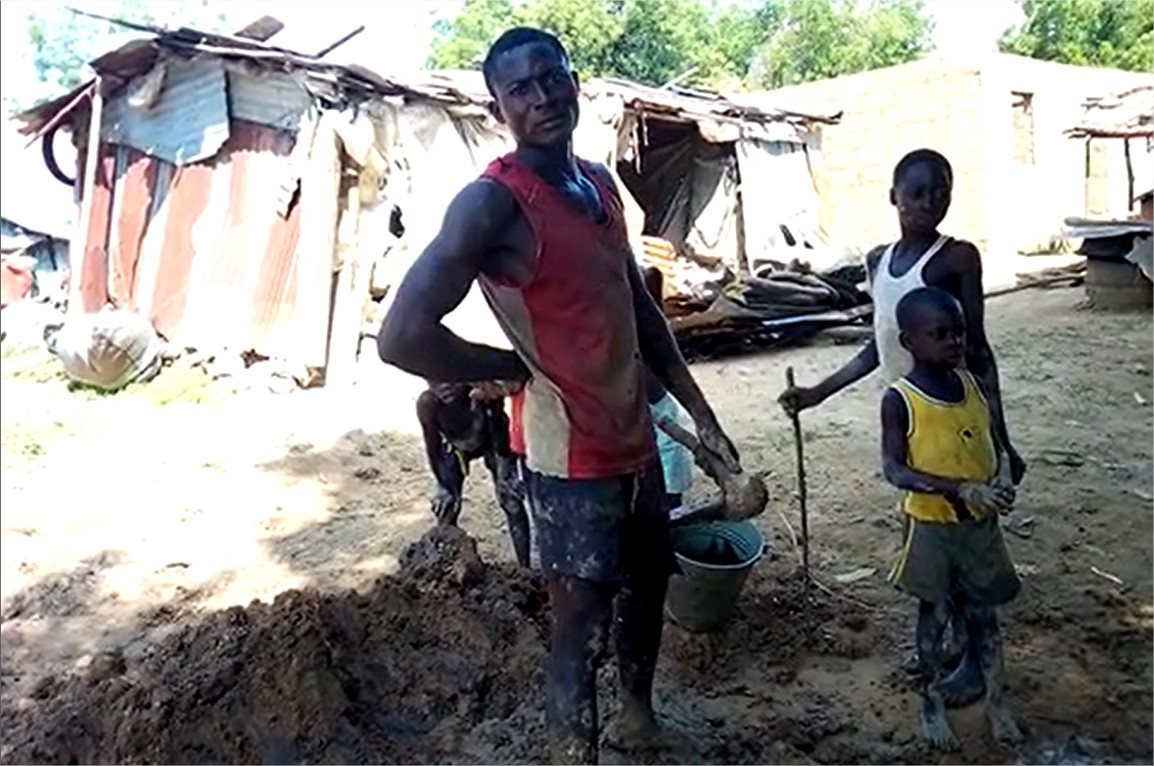
Residents of Yawa-Dompo, about a kilometre from Yawa-Kara, also say they only received one mudu of food supplies. In the village, Ibrahim, a young man with two wives and three children, is seen covered in cement as he toils to rebuild his wrecked home. Presently, he sleeps in a temporary structure made of bamboo, rusty zinc sheets and sacks. He tells this reporter he is using cheap sticks and cement to build another house because he does not have money to build a decent house.
Ibrahim, rebuilds his home using cheap materials as he shares a makeshift with his large family
‘Our leaders have abandoned us’
In Lapai Local Government, there is Old Muye and New Muye. But while the latter has no record of damage to houses, it is a different stroke for the former where both houses and farmland are devastated beyond repair. Residents of Old Muye moved to New Muye for temporary shelter when the flood persisted.
Next to New Muye is the village of Doba, lying by both sides of the road and spreading across lower plains close to the river, a few miles away from Girinya, Kogi State.
The government provided food items and promised, in September, also to provide building materials, but nothing has been done. Officials of the National Emergency Management Agency (NEMA) who once visited to assess the situation have also not returned.
Several houses belong to Ayuba Saliu, 39, his mother and brothers have all suffered great damage. Personally, he says he has lost not less than N2 million, including cash crops from his six hectares of farm, money, fishing instruments and canoe. Most residents now pay to live in Girinya and Muye till they are able to rebuild their homes.
The state governor, Abubakar Sani Bello visited the community on September 12, but he did not walk around the communities to see the damages for himself. Apart from the governor, none of the representatives of the people at various political offices has come to render assistance or even give moral support, says Haliru Doba, a young resident of Doba.
“He [Bello] only stayed along the road opposite GSS Secondary School, Muye, and then left in a helicopter,” he recalls. “He was not here for up to two hours. He just went to see the Chief of Muye and left. He came around 2 O’ clock and did not spend up to two hours.”
“We are the ones who supported them, but now, since they got into office, they have forgotten us. We are not demanding anything, but they should at least help us with this problem.”
He also explains that though government officials have always mouthed relocation as the only solution to the constant disasters, it is difficult to execute in reality — not only because people have lived in the communities for centuries but because of the lack of resources needed to relocate.
“How do you relocate when you don’t have food, buildings or farmland where you are relocating to?” he asks. “It’s like starting afresh, and to start fresh life is not easy.”
An insincere government, a thieving people?
Both the government and the various communities afflicted are to blame for the tragedy suffered by the people of Niger State. This is the position of one of the top officials who took part in planning the distribution of relief items in Lapai Local Government.
While the governor has not shown any commitment, the people have also not been sincere, and have been discovered to unlawfully appropriate relief items, a community elder who pleaded for anonymity expresses a mix of concern and frustration.
“The little that was given to be shared for them, the day we went, they had stolen almost everything,” he discloses. “The vigilantes who were guarding those things said they’d kill them if they didn’t allow them to take because it’s their own. So we don’t know the people that took it, whether they are actual beneficiaries or other people that are not even affected who think anything from the government is awoof.”
He alleges that the President of the Association of Kakanda [people in the riverine area] in the region said he was given only N50,000 to transport relief items, though he received N400,000. Eventually, the association president did not show up at the meeting held at the Emir of Lapai’s palace to agree on the sharing formula.
He also condemned the insensitivity of the governor as well as his ethnic bias.”I don’t blame him. Since they’ve been having governors in this state, everybody has been thinking of his own side only, but it’s not only your side that is voting for you. It’s everybody.”
He says the state governor has been given a plan to resettle people in the flood-prone areas and that he would need to allocate plots and compensate them, but his excuse has always been that he does not trust any of the staff at the Ministry of Land.
“Initially, he gave 100 per cent of the relief materials to Mokwa, his side. And when we complained, he said we would share it 50:50.”
When members of the Kakanda Association, to whom delivery was made, were asked for the waybill, they responded that they did not have it. According to the community elder, the bag of rice that is meant to be 500 was instead said to be 410, kegs of palm oil that were originally 200 were said to be 150, and so on.
“So they themselves had stolen, and by the time the materials arrived in Muye again, the people also played their own game,” he concludes.
Damages caused by flood in Doba, Niger State
Damages caused by flood in Doba, Niger State
Damages caused by flood in Doba, Niger State
Damages caused by flood in Doba, Niger State
Damages caused by flood in Doba, Niger State
Damages caused by flood in Doba, Niger State
Damages caused by flood in Doba, Niger State
Damages caused by flood in Doba, Niger State
Damages caused by flood in Doba, Niger State
Damages caused by flood in Doba, Niger State
L.G: We have not stopped working
At the Lapai Local Government Secretariat, this reporter meets with the secretary, Mohammed Ibrahim Batengi, who says the government is still working on alleviating the effects of the flood. He raises a spiral-bound 2008 report on flooding to prove his claim, and also says two representatives of the affected areas (Association of Kakanda) had just left his office.
According to him, the local government does its best to involve all stakeholders, including the people and the emirate council, to ensure fairness and accountability. This coalition regulated the distribution of materials from the state government, which included rice, beans, guinea corn, red oil, groundnut oil and garri.
“We have a committee which oversees the items brought, instead of sitting as a council to distribute,” he says. “We don’t have anything as our own here, but whatever is coming comes to us.
“The state government that time provided relief materials and we asked the communities to generate the list of those affected, village by village. Each village brought a list, of people that lost their houses and or farm products.”
He says the local government has not received any material support from the federal government and is still expecting. He also informs our reporter that the National Emergency Management Agency (NEMA) has not made any move to work with the secretariat in distributing materials.
He admits there have been cases of people breaking into stores to make away with relief items before they are shared, but adds that the recent deployment of soldiers and policemen has curbed this. The solution, Batengi, suggests is for the affected people to relocate to a safer region, especially during the rainy season, but he adds that the government has not done enough to actualise this plan.
“There is a site allocated to the villages affected as a new location. But along the line, a lot of things fell out. There are some things to be provided by the government. I think we have the site here. Nobody came there to develop it. That’s why we said the government itself was to do something which it has not done. I know there is an already earmarked area in these villages… once those things are provided, they are supposed to move.”
Local Government Secretariat, Lapai, Niger State
Synergy of experts, forecasting needed — says Geographer
A lecturer at Ibrahim Babangida University, Lapai, with expertise in marine science, Ishaku Bashir Yakubu, has said collaboration between decision-makers, contractors and academic researchers is important if Nigeria hopes to escape the yearly flooding festival.
He says climate change is one of the leading causes of flooding. Being part of the tropical region, Nigeria is affected by the tropical maritime. More evaporation leads to excessive convective activity, which causes cloud formation and eventually heavy rainfall.
The natural soil surface, he explains, has different rates of evaporation, infiltration and porosity. Increased heating triggers a high rate of evaporation and less infiltration. Once the soil is tampered with, it might get saturated faster, absorb less rainfall, and then causes flooding and gully erosion.
“For us to overcome issues like this,” Yakubu advises that the government should develop an environment with recourse to the natural cycle because any alteration on the environment will have an equal feedback.”
He recommends that, just as it is the practice in developed nations, rainwater should be intercepted and conveyed to a particular channel for surface runoff after necessary calculations on evacuation capacity.
“Then again, you can see the way this pavement has been made,” he says, pointing in the direction of the window. “You know that for the interlocks, there’ll be low infiltration, so there’ll have been provision again that will evacuate water on the surface from the side, through this channel created.
“You can see, in our own case this is missing. When it is raining for ten, fifteen minutes, you’ll notice water logging.”
With serious forecasting, he continues, Nigeria will be able to know how much rain is expected and what measures to put in place to avert disaster. He says despite the highly unstable weather system in developed countries such as the United States, they often have minimal collateral damage because of the power of forecasting.
“What they do is that two months or so to the occurrence, if it is one that the intensity has been projected to destroy properties, they will ask all people around the vulnerable areas to move. They will now evacuate. If it is one that will stop you from going out, they will tell people to stock all the food supplies they need and activate medical services in case of any emergency,” he notes.
Tools such as Virtual Geographic Environment (VGE) are available that may be used also in Nigeria to achieve similar results but, he explains, the challenge is the lack of constant power supply.
“With VGE, the developed world put imagination into reality. They run this model on them and create artificial rainfall to see what happens if you have rainfall for thirty minutes, which area and which area are affected and by how much? So that is how they’re able to know this place is highly vulnerable and this is less vulnerable to such events. It gives them more effective adaptive measures.”
“But for you to render VGE, let’s say, simulated for five minutes,” he adds, “you will need nothing less than 24 hours uninterrupted power supply. Now let’s say you’re rendering for say one or two days, you’ll need like a whole week of uninterrupted power supply.”
Yakubu recommends that government officials, project contractors and civil engineers work in synergy to ensure policies and infrastructure are environment friendly. “There must be collaboration between experts,” he emphasises. “Once you don’t have that, you’ll design a system and it’ll fail.”
Ishaku Bashir Yakubu: “There must be collaboration between experts”
NEMA: We are moving from relief to rehabilitation soon
The Public Relations Officer of the National Emergency Management Agency (NEMA), Sanni Datti, in response to how the agency has so far responded to the flooding incident, has told The ICIR assistance is still at the stage of relief intervention.
He says Vice President Yemi Osinbajo, who is the chairman of NEMA’s governing council, has been acting the government’s spokesperson and face on matters of flooding, and has visited most of the affected states to share government’s plans.
“Now that much of the water has receded and some of the communities are now dry,” he says, “attention will now be focused on their rehabilitation.”
Datti adds that the Director-General of NEMA, Mustapha Maihaji, during a recent visit to Kogi State to inspect intervention efforts, reiterated that support will be given to flood victims so they may return to their homes. He says he believes this means basic materials needed to restore them back to their original lifestyle, including building materials, will be made available.
He says: “Right now, what we are giving to them is just food items, feeding materials. It does not include building materials like cement and the rest. Maybe if that time comes, some support will be given to them on how to recover what may have been damaged.”
On communities that have not benefited from the distribution of relief items, he says he is aware staff of the agency made efforts to enter into the remotest parts of the flood-prone areas. He also tells The ICIR the federal government has plans to grade some of the water channels which will drain excess water once there is heavy rainfall.
“In fact, we are not just looking at immediate intervention of relief and rehabilitation of those affected. We are looking ahead towards future years to ensure that this thing is not left to be reoccurring,” he asserts.
Issues with state govt, lack of insurance … reasons for delay in relief
Difficulties in working with the government of Kogi and the non-provision of insurance for officials of the State Emergency Management Agency (SEMA) are among the major reasons for the delay in distributing relief materials to Kogi flood victims. This The ICIR learnt from Hajiya Fatima Kasim, who is the coordinator of NEMA’s Emergency Operation Centre for Kogi and Edo states.
She confirms that relief materials have been received by the state agency and that distribution has started in Lokoja, with IDP camps being prioritised above host communities. She also says, if not for a workshop held in Abuja, the agency would have proceeded to begin distributing in Koton-Karfe, then other local governments.
“I am right now in Abuja, attending a workshop,” she says. “So hopefully next week, we’ll be around. We are going to KK [Koton-Karfe] next week God-willing.”
Explaining why there has been a delay in the relief distribution, she says arranging for logistics because of the difficulty in accessing some communities was a contributory factor.
“And then first we had to profile them to know the quantity of food we are taking,” she adds. “It was the profiling that took time, because you know most of us are not from these areas. So we depended on the state to lead us. We needed to know the number of houses because this time around we want to do it based on households.”
“The state … you know how they are … they were not too … how will I even say it… they had issues,” she says hesitantly. “The state had issues, that was why we didn’t finish the profiling on time.”
Asked what she meant by ‘issues’, she heaved a sigh and politely declined to speak further. One of the challenges again, she explains, is the risk to lives of SEMA employees who have no insurance.
She says: “We had issues … some people went somewhere and the boat stopped on the high sea. So to get people to go and risk their lives on that basis… you know it’s not as if the state SEMAs are insured. So those things needed to be ironed out. Those are some of the challenges, but we’ve been able to surmount them.”
Meanwhile, NEMA’s Head of Operations in Abuja, Samuel Bitrus, declined to speak with The ICIR, saying, unlike the public relations officer at the head office, he is not in a position to comment.
Aliyu Shehu Kafindangi, the head of NEMA’s operations in Kwara and Niger, did not answer calls from The ICIR and has not responded to enquiries on why communities have not received relief items from the agency.
Also, attempts by The ICIR to get in touch with the government of Niger State have wound up unsuccessful as the telephone line received has not been available. The contact page on the government’s website is also not available.
NEMA, according to a recent report, supervised the distribution of food items to 480 displaced persons in Shiroro Local Government, Niger State, thanking the people for their patience. Maihaja, the NEMA boss, also promised that “the federal government will respond with damaged needs assessment, whereby we will come up with details of the destruction and plan for reconstruction and recovery of all lost property.”
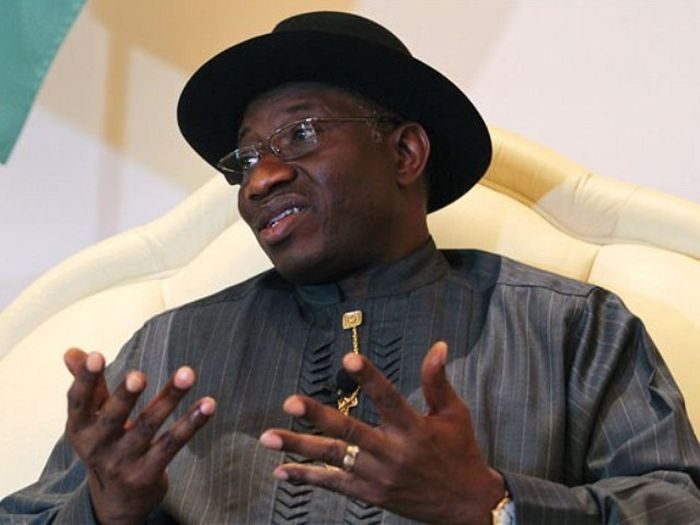
FORMER Nigerian President, Goodluck Jonathan, says the narrative by the ruling All Progressives Congress (APC) that it inherited an empty treasury when it took over power in 2015, is a “blatant lie”.
This was contained in Jonathan’s new book titled ‘My Transition Hours’ which was launched in Abuja on Tuesday. In the book, Jonathan said the Muhammadu Buhari government abandoned the policies already set in place by his administration, and embarked on “a persecution spree and vengeance mission”.
“Rather than forge a coalition and build on the momentum we had gathered when they (the APC) eventually took office, they went on a persecution spree and vengeance mission. That the country slipped into recession soon after we left office was a self-inflicted injury caused by misplaced priorities. The narrative of inheriting empty treasury is a blatant lie,” Jonathan wrote.
“It also amounts to standing facts on their heads to continuously claim that recession was caused by so-called mindless looting. The truth is that the opposition, in a bid to undo our government, became its own undoing when it got to power, because of the burden of justifying deliberate misrepresentations.
“Even after winning the election and forming the government at the centre, the blame game continued. When two brothers fight to death, it is the neighbour that inherits their father’s wealth. And we have seen neighbouring nations like the Republic of Benin and Ghana reaping from the capital flight out of Nigeria.”
Jonathan maintained that he had a lot of experienced and competent individuals who worked with him and has gone ahead to be appointed into higher positions all over the globe.
“Just consider that my minister of state for health, Dr. Muhammed Ali Pate, is now a professor at America’s Duke University, as well as a Senior Adviser to the Bill and Melinda Gates Foundation based in Washington DC. My minister of Agriculture, Dr. Akinwunmi Adesina, is now the President of the African Development Bank (AfDB).
“My Co-ordinating minister, Mrs. Ngozi Okonjo Iweala, is the chairperson of the Board of the Global Alliance for Vaccines and Immunization (GAVI) and the African Risk Capacity (ARC). She also sits on the board of Twitter and the Asian Infrastructure Investment Bank, just as she is a Senior Adviser at Lazard and a Director at Standard Chartered Plc in the United Kingdom, amongst others.
“My minister of communication technology, Dr. Omobola Johnson, is currently chairperson of custodian and Allied Insurance Limited as well as the Global Alliance for Affordable Internet.
“Ms. Arunma Oteh, who I appointed the Director-General of the Securities and Exchange Commission (SEC). Under her steady and skilful direction, Nigeria’s equity market grew in metric proportions, and by the time I left office in 2015, the market had tripled in size to $150 billion in value. Two months after I left office, Ms. Oteh was appointed a Vice-President and Treasurer at the World Bank.
“With such personalities on my cabinet, no one can factually say we were ‘clueless’ or inept. The evidence of performance is simply overwhelming. We gave Nigeria an impressive and steady GDP growth rate at 6.7 per cent per annum,” Jonathan wrote.
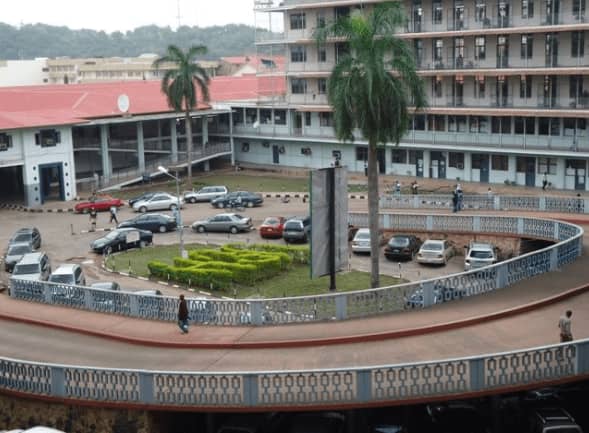
SHAMSUDEEN, a student of the University of Ibadan had wanted to complete his project work before the submission deadline of November 30 set by the school.
His hope, however,has hit the rock due to the University College Hospital’s failure to release the data he needed.
On July 9, Shamsudeen made a request to obtain the number of patients with sickle cell anaemia admitted by the College Hospital over the last ten years to assist his project work.
At the Hospital, he was directed to the Ethics Department for the needed data.
There, a Mr Simeon Nnaji at the Ethics Department told him to write a proposal which he eventually submitted on the 20th of July.
When the response came 20 days later, it was a mail requesting him to come for the reviewed copy of his
proposal.
With corrections effected on the initial proposal, he was asked to submit four copies of the reviewed copy and a disk containing it.
But after submission, he received another mail asking him to come back to see newly discovered errors in the copies submitted. This time around, he was to submit another two copies of the latest version of the proposal.
Shamsudeen was almost giving up on ever getting a response when eventually, on September 13, he received another mail telling him he could come for his Ethical Approval.
Ethical Approval is the document that shows that the data requested is fit for collection and that the person making the request is worthy.
It’s a letter from the Director of IAMRAT (Institute For Advanced Medical Research And Training) that gives the applicant an approval to begin research or collect data.
However, to get it, a token of 1000 must be paid as an Ethical Approval fee.
After payment, he was directed to CMAC Department where he was asked to pick the data requested from the Department of haematology. On getting there, Shamsudeen met another setback.
He was asked by the HOD to submit a new proposal addressed to the Department.
He did.
“The next day when I got there, the HOD said they have not been releasing their data all this while because they worked for it and sweat for it.
“I was really downcast. It pained me to the bone. He told me that, even if they would be releasing the data, my supervisor would give them the assurance that their names would be listed in my project.”
Even after paying N1,000, the HOD was still not willing to release the information even though it has been released by the Medical Advisory Committee.
Without a way forward, Shamsudeen is left only with the option of starting the project from the scratch. This means he has to change the topic.
“Everything I have written so far is a waste of time because I can’t move ahead if I don’t have the data. We were told to submit our project by ending of November. I now need to change my topic.”
Another student who declined to be identified for fear of victimisation had a similar experience.
“At the office, I was given guidelines on how to write a proposal for my ethical approval. I was also told to make four spiral bind copies of the proposal and a disk containing the proposal. I did,” she narrated.
She, like Shamsudeen, went back and forth that eventually led to nowhere.
“I was given a small piece of paper containing the things to be submitted whichincluded a payment of N1000, two spiral bind copies of the corrected proposal and a disk containing the corrected proposal.”
Nothing happened until after a month of waiting.
“After I collected it, I did not bother to go there again since the collection of the ethical approval took me like a month to get.
“When the ethical approval took me a month to get, why won’t the data I need not take me more than 2 months to get?” she lamented.
Getting information from UCH is about whom you know.
While many students could not get past the stage of Ethical Approval, Tomiwa (not real name)was “privileged” because her sister works in UCH.
“If not for my sister who works there, I wouldn’t have been able to get the data,” she said
Nonetheless, she too went through the stress of getting data from the Hospital even after paying and after she had already gotten approval, it still didn’t matter.
“We went through all the procedures and also got our ethical approval all for nothing. It is not easy at all for UI students to have access to UCH data,” said Tomiwa.
What the law says
Sections 1 and 2 of the FOI Act establishes that a person has the right to apply for information or records that are in the “custody or possession of any public institution or private bodies providing public services, performing public functions or utilising public funds.”
In case of refusal to provide the needed information, section 7, subsection 1 of the Act, mandates that “the institution shall state in the notice given to the applicant the grounds for the refusal, the specific provision of this Act that it relates to and that the applicant has a right to challenge the decision refusing access and have it reviewed by a Court.”
In fact, Section 7, subsection 5 further puts it that when such refusal is established to be wrongful, the defaulting institution or officer is liable on conviction to a fine of N500,000.
‘FOI is not UCH, it is for Aso Rock’
In order to have a firsthand experience of the situation, this reporter, on November 11, sent an FOI request to the mail of the Chairman of the Medical Advisory Committee (cmac@uch-ibadan.org.ng). Till date, no response has been gotten — not even an acknowledgement in the least.
On November 18, a reminder was equally sent; yet no response has been gotten.
Again, on November 12, when this reporter paid a visit to submit the FOI request to the Federal hospital, the request was rejected by the staffer on duty at the Hospital’s Medical Advisory Committee (MAC) who identified himself as Mr Babatunde.
“What is it you want? You need to get an ethical approval first,” he said, adding that, “Without it, you can’t get anything here.”
When this reporter told him the request is an FOI request and the Nigerian constitution recognises it, he downplayed its relevance, saying the act is not binding on UCH.
“Nigeria’s law?” Mr Babatunde retorted. “That is your own law. That Law ends in Abuja, in Aso Rock; it does not work here in UCH. I’m busy right now check back tomorrow.”
He insisted that whoever would get any data from UCH must obtain an ethical approval. But experiences of many students have shown that, getting information from the hospital is equally hard, and in fact, sometimes a waste of time. And paying for ethical approval is no guarantee to getting data.
Mr Ayodeji Bobade, head of information, University College Hospital
UCH reacts
The Hospital’s Head of Information Department, Ayodeji Bobade, said during a phone interview that the FOIA has not “being domesticated in Oyo state” even though UCH is a federal parastatal.
Attempt to explain that he has a wrong interpretation of the law was rebuffed.
He later dropped the call and several calls made later using different numbers were not answered. Also, a text message sent to his line was not acknowledged nor responded to.





![FLOODED AND FORSAKEN: How govt’s nonchalance has worsened fate of Niger’s riverine communities [2]](https://www.icirnigeria.org/wp-content/uploads/2018/11/IMG_20181031_120707-e1542195528580-rain-e1542195576100-768x449.jpg "FLOODED AND FORSAKEN: How govt’s nonchalance has worsened fate of Niger’s riverine communities [2]")