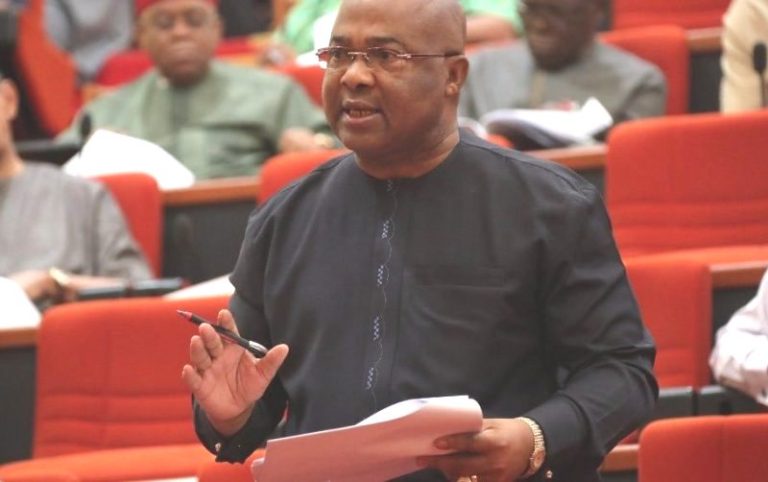
HOPE Uzodinma, the sitting Senator representing Orlu Senatorial District of Imo State, was “arrested” on Sunday by the Special Presidential Investigation Panel for the Recovery of Public Property headed by Okoi Obono-Obla.
As at noon on Monday, Uzodinma was still in custody, with Obono-Obla confirming to the media that he (Uzodinma) has been evading arrest since last year.
While some Nigerians were quick to claim that Uzodinma’s arrest may be connected to his face-off with Governor Rochas Okorocha of Imo State.
Uzodinma is currently aspiring to contest for the Imo State Governorship position on the platform of the All Progressives Congress (APC), but Okorocha has ‘endorsed’ his son-in-law, Uche Nwosu, to succeed him as Governor, while he (Okorocha) is aiming to unseat Uzodinma in the Senate.
But the presidential committee on asset recovery explained that Uzodinma was picked up in connection to a contract his company was awarded for the dredging of Calabar channel during the presidency of Goodluck Jonathan.
Though the company, Niger Global Engineering and Technical Company Limited, has received the total sum of $12.5 million (about N26 billion) for the contract, investigations revealed that it did not carry out any work on the Calabar Channel.
This issue was brought to the public domain via a publication by Premium Times in June 2017, following a memo written by the current Director General of the Nigerian Ports Authority, Hadiza Usman, to the Minister of Transportation, Rotimi Amaechi, informing him of the development.
It was based on the publication that Uzodinma was arrested at the Nnamdi Azikiwe Airport, Abuja, on Sunday.
“We have been looking for him since we saw the wonderful investigation that Premium Times carried out on the matter, and then we were also helped by a petition which a citizen took time to forward to our panel,” Obono-Obla said on Monday.
“The petition went to the presidency, and then it was forwarded to us for action.
“We have made all efforts to get him, including writing to him and the Senate on several occasions, but he ignored our invitation and evaded our attempts to get him to come and explain what he did.
“He got a contract to dredge Calabar Ports, which we all know can help this country’s economy significantly, but refused to do it.”
Obono-Obla, who himself is facing a certificate forgery scandal, said that his committee does not have the powers to detain a suspect for a long time, adding that Uzodinma would be released after he had written a statement, and subsequently, he would be charged to court.
However, Obono-Obla’s comments appear to have gone against the ruling of the Abuja division of the Court of Appeal on November 5, 2018, saying that Special Presidential Investigation Panel (SPIP) for the Recovery of Public Property does not have powers to arrest or prosecute a suspect nor confiscate anybody’s asset.
“The Recovery of Public Property (Special Provisions) Act does not confer any prosecutorial powers on the SPIP,” stated the Appeal Court judgment which was read out by Justice Hussein Muhktar.
“The powers conferred on the SPIP under the Act is limited to investigation and cannot prosecute under the Act or under the EFCC Act or any other Act.
“The SPIP, upon conclusion of investigation can only submit its report to the President. The SPIP cannot obtain forfeiture orders from any Court whatsoever. The SPIP cannot exercise the powers of the Attorney General of the Federation or the Chairman of the EFCC.”
“JOURNALISM entails a high degree of public trust. To earn and maintain this trust, it is morally imperative for every journalist and every news medium to observe the highest professional and ethical standards” — Preamble, Code of Ethics for Nigerian Journalists (1998).
For three days in March 1998, some of the country’s finest journalists, plus newspaper owners and other stakeholders, gathered in Ilorin, the capital of Kwara State, to forge what till date remains the most recent version of the ethical code guiding journalism practice in Nigeria. The Nigerian Guild of Editors (NGE), the Nigerian Press Council (NPC), the Nigerian Union of Journalists NUJ), the Newspaper Proprietors Association of Nigerian (NPAN) were all represented. The ensuing document was an upgrade on the one in existence since 1979.
Exactly 20 years on, Kwara State returns to the summit of a delicate yet thrilling debate about ethical journalism, not because another gathering of journalists has been convoked but because a son of the soil has fallen victim to the relative obscurity to which the 1998 document has fallen.
On Thursday, Lai Mohammed, the Kwara-born Information Minister, was seen telling reporters in a viral videothat the government was spending N3.5 million monthly to feed Ibrahim El-Zakzaky, the Shi’ia sect leader who has been in detention since December 2015. In the six-minute-fifteen-second video, Lai can be heard four different times saying the information should be kept “off the record”. In an instance, he specifically says: “This should be off the record… I am only giving you all this background information so you know how to write your story.”
Lai’s off-the-record revelations were passed on to the public by internet platform, Oak TV. Following Lai’s cry of betrayal, Oak TV delivered a letter of apology to the Minister, and claimed to have sanctioned “all the team members involved”. The only problem is Nigerians won’t stop discussing the incredulity of feeding a detainee with such humongous sum. Of more journalistic and scholarly importance, however, the debate rages: should Oak TV — and the legion of media outfits that jumped on it — have published the video?
Before delving into the debate about the propriety of publishing the video, it has to be said that something is fundamentally wrong with this so-called regime of change if it truly spends N3.5million monthly on an accused for whom it has disobeyed a court order for his release, and at a time the government can’t just muster a measly N30,000 as minimum wage for workers. Maybe some will also argue, perhaps rightly so, that Lai got his comeuppance in the end — for being such a notorious inventor of propaganda for the selfish interests of the then opposition party and a cynical manipulator of information to the benefit of the now ruling government.
Still, should that video have been published? The answer — and it is not hard to explain — is no. Section 4 of the Ethical Code, tagged ‘Privilege/Non-disclosure’, states clearly: “(i) a journalist should observe the universally accepted principle of confidentiality and should not disclose the source of information obtained in confidence; (ii) a journalist should not breach an agreement with a source of information obtained as ‘off the record’ or as ‘background information.’” Not only did Lai say “off the record”, he particularly clarified he was only offering the journalists background information for their stories.
Although they haven’t expressly said so, most of those arguing for the spilling of the video can fall back on other sections of the Ethical Code. In the second, titled ‘Accuracy and fairness’, the code says “the public has a right to know”. A part of the document’s preamble also states: “In the exercise of these duties, a journalist should always have a healthy regard for the public interest.”
Is there, therefore, a clash of interests between the public’s right to know and the journalist’s respect for off-the-record information? No. Combining these two provisos would mean something like: ‘the public has a right to know, but through any means other than the publication of off-the-record information’. And this is possible. In this specific case, the answers are not set in stone, but there are a number of possibilities.
One — probably the least desirable and surely not in a video — would be to state Lai’s claim but attribute it to a Federal Government source rather than him. In any case, according-to-a-source stories are a permanent fixture in Nigerian journalism. Another would be to take Lai’s claim to the Interior Minister or the Director-General of the Department of State Service (DSS), both of who should know; whether they say yes or no, it’s a story. Yet another is to attempt to force the information out of the government with an FoI request, with failure to respond gifting the journalist the liberty to announce Lai’s claim even without revealing the source. The possibilities are limitless. Lai’s revelation, in fact, can be the springboard for investigative reporting to ascertain the cost of feeding or generally caring for a DSS detainee or an EFCC detainee or a prisoner. Or for El-Zakzaky himself!
The wide publication of the Lai video also raises a string of worrying questions about the practice of journalism in the new-media age. One that personally bothers me is the growing transformation of the media to an entity that sees itself as useful solely for news dissemination — what’s happening to educating the readers? What’s happening to analyzing, interpreting and processing the raw news so that readers are better placed to make informed decisions with them? This shrinking of robust journalism is one reason Lai’s revelation was not considered valuable beyond its news mileage.
It is also wondrous how the media is comfortable with setting a certain standard for the rest of the society yet lowering it for itself. For example, over the past two weeks, the media has been vociferous in its criticism of the Army for gunning down dozens of Shi’ites in Abuja. That criticism is valid because the Army’s Rules of Engagement (RoE) state clearly when and how a soldier can apply fire. There must be “grave danger” to the life of the soldier; and even then, “fire must be aimed and controlled”. The RoE forbid “indiscriminate firing”. All these the Army flouted, and for this it was roundly criticized by the media. How then can the media fall short of the rules of its own rules of engagement?
I have been taken aback by arguments reprimanding Lai for saying on camera something he didn’t want published. Baffling thought pattern, actually. As long as he wasn’t on live TV, and knowing the taped videos would still be edited pre-publication, he acted within reasoning. A few months ago, I taught an investigative journalism class during which a participant questioned the morality of undercover reporting; he just couldn’t understand why a journalist would obtain information in an environment where he isn’t known to be one. In one of my answers, I shared a finding from Borno State during an undercover adventure in June 2016. But first, I asked that my disclosure should be off the record. And the cameras were on, too. During that trip, I found myself in a certain room where there was access to the official — not the press-release manipulations — number of the total number of soldiers who had been killed by Boko Haram in just the first six months of that year. And boy, were the numbers staggering! I gave the figure to the class but I again impressed it on them that this information couldn’t be made public. All I wanted to prove to the class was this: there are certain information you will never have unless you go undercover.
That this debate has existed at all is one more reminder of how the disruption of journalism practice by technology is not all gains. In more intellectually-conscious climes, last week’s off-the-record drama would spark scholarly incursions into the changing values of 21st-century journalism. It would trigger intense concerns about the gaping hole of self-regulation that must be filled if the media must bountifully harness the pluses of Internet-driven media explosion. Personally, I remain worried that while the audience for journalism is larger today than it was, say, a decade or two ago, the mindset is remarkably smaller.
Soyombo, former Editor of the TheCable and the International Centre for Investigative Reporting (ICIR), tweets @fisayosoyombo
ON Thursday, Mohammed El-Yakub, who is the Managing Director of Gotel Communications, Atiku Abubakar’s Adamawa-based media organisation, said his boss had approved minimum wage for all staff of his companies. He also put the total of these beneficiaries at “over 100,000”.
“The N33,000 new salary scale, which takes effect from November 2018, includes domestic servants and all categories of workers on the former VP’s payroll,” El-Yakub told Sahara Reporters.
This claim is coming shortly after the committee on the review of the national minimum wage recommended N30,000 as the new national minimum wage to the federal government.
Among Atiku’s known companies and organisations are Adama Beverages (producers of Faro water), American University of Nigeria (AUN), Gotel Communications, Rica Gardo & Standard Microfinance, Prodeco, ABTI International Secondary School, and Intels Nigeria Ltd. He is also said to have once ventured into maize and cotton farming.
In Atiku’s defence, Reno Omokri, former aide to ex-President Goodluck Jonathan, said in October that only three of Atiku’s companies, including the AUN, have created up to 50,000 jobs. The All Progressive Congress “is silly to say Atiku must list jobs he created,” he tweeted. “Their focus should be jobs @MBuhari created.”
“Let me humor them. From just American University of Nigeria, Faro, Rica Gardo & Standard Microfinance. Atiku created 50k jobs, to mention a few. APC, list Buhari’s jobs!”
While The ICIR could not verify how many persons work under the beverage and finance companies, it can report that the staff strength of AUN is just slightly above 1000.
Responding to a recent enquiry e-mailed to the school on the subject, Daniel Okereke, the university’s Executive Director of Communications and Publications said the staff strength of the school constitutes of 1,082 Nigerians, over 80 foreigners and an additional temporary staff of four.
.@OfficialAPCNg is silly to say @Atiku must list jobs he created. Their focus should be jobs @MBuhari created. Let me humor them. From just American University of Nigeria, Faro, Rica Gardo & Standard Microfinance. Atiku created 50k jobs, to mention a few. APC, list Buhari’s jobs!
A good number of companies, reputably larger than those established by the People’s Democratic Party (PDP) presidential candidate, are known to have employee populations which are lesser than 100,000. One of them is the Dangote Group of Companies, a multinational conglomerate owned by Aliko Dangote, Africa’s richest man.
The conglomerate, the largest in West Africa and one of the largest on the continent, comprises Dangote Cement, Dangote Sugar and Dangote Refinery, and is reported to employ only over 30,000 people, as at 2017, generating revenue in excess of $4.1 billion. Dangote Cement alone has operations in up to 10 African countries.
Another great example is Royal Dutch Shell PLC, a British-Dutch oil and gas company with headquarters in the Netherlands, and the sixth-largest company in the world according to revenues in 2016. The company also has operations in over 70 countries. Nevertheless, as at 2016, Shell employed an average of 92,000 workers, as stated in its 2016 sustainability report.
ExxonMobil, a United States-based multinational oil and gas corporation and the world’s ninth largest company by revenue, also employs far less people than Atiku Abubakar, if the claims of his associates are to be accepted.
As at 2017, the company had only 69,600 employees globally, according to Statista, an online statistics, market research and business intelligence portal. The company’s staff strength declined compared 2001 when it employed 97,900 people.
Reckitt Benckiser Group PLC (RB), a British multinational consumer goods company which produces Dettol, Strepsils, Air Wick, Durex among several other products and has operations in 60 countries across the globe, had as at 2017 only 37,000 employees.
Further checks revealed that Shoprite, Africa’s largest food retailer with over 500 outlets has “a current estimate of 130 000 employees”. Nestle Nigeria has a staff strength of just over 2,300 direct employees.
Also, according to the Nigerian Banks Financial Transparency Report of 2010, 14 top banks in Nigeria including First Bank, Zenith Bank and United Bank for Africa (UBA), had a total staff strength of 59,807 as at 2009, leading to a wage bill of N265 billion.
The 2013 annual reports and accounts of Nigerian Breweries PLC, which has several large-scale breweries across the country, put its staff strength at 3,195 — a reduction from the 2012 figure of 3,214.
Interestingly as well, the total number of Nigerians employed by the Lagos State Government only surpassed 100,000 in 2017, when it grew to 100,433 after an additional recruitment of 5,000 persons that year. This was according to Olabowale Ademola, the State Head of Service, who spoke at a ministerial press conference in Ikeja.
Based on the staff strength of leading multinational companies, it is obvious that the claims of Atiku having over 100,000 employees are open to questions. And it is most unlikely that he has such number of staff.
USMAN Yusuf, the suspended Executive Secretary of the National Health Insurance Scheme (NHIS), says his suspension was the handiwork of some fraudulent Health Maintenance Organisations (HMOs) partnering with the agency.
Yusuf made this allegation in a video he shared via his Twitter handle @ProfUsmanYusuf on Thursday to tell his side of the story on the corruption allegations leveled against him.
He said that the day he was suspended was the exact day he was to present a report on the HMOs that had qualified to be licensed by the NHIS.
Yusuf said Nigerians should ask why he suspended on that Thursday, October 18th and not on the 20th.
“Thursday was the day I was supposed to present to the council the number of HMOs that have qualified for licenses. My suspension was nothing but preemptive strike and a coup,” he said.
Yusuf explained that the HMOs in Nigeria usually get paid by the NHIS but would not pay the hospitals they serve. He said that was the problem he met when he was made the Executive Secretary in July 2016.
He said there are 57 HMOs in Nigeria which are in three classifications, the defense, police and civilian HMOs. The defense and police have one each, while the other 55 HMOs are for the civilians. Yusuf said he had solved the first two HMOs crises, but the civilian HMOs have lots of impunity.
“We pay HMOs in Nigeria three months in advance to pay hospitals but they will not pay the hospitals,” he said. “And Nigerians are not treated well because HMOs have not paid hospitals.” Rather, Yusuf said the HMOs fix the NHIS money in banks to generate interests or be used as a collateral for bank loans.
According to him, HMOs are non-licensed entities, and the only contract that is in existence between the them and the NHIS was the one of 13 years ago, when it was created. “This is what I met: non-license entities that are paid three months advance but not paying hospitals,” he said.
Yusuf said he found it offensive that billions of naira are going to non-licensed HMOs, hence, he established a forensic audit that looked into the affairs of the HMOs. Subsequently, he directed that all HMOs be licensed. And to be licensed, he said, non-indebtedness forms signed by the Chief Medical Directors of all the hospitals the HMOs serve must be presented to the NHIS.
“On the day I want to present the report that would give out the numbers of HMOs that are qualified to work with NHIS was the day I was suspended,” he said.
Yusuf said another thing he wanted to achieve was that the HMOs return all the N1.025 billion that was given to them illegally between 2013-2015, as revealed by an investigation conducted by the Department of Security Services (DSS).
He said his administration had recovered 75 percent of the money, and that he had threatened that by December this year, if the monies were not fully paid, he would delist the affected HMOs and hand them over to Economic and Financial Crimes Commission (EFCC).
The HMOs, Yusuf said, are looking for means to maintain the existing state of affairs. “They are the ones that are inciting the rancor in the NHIS boardroom,” he said. “If I was stealing money, Nigerians would not hear anything about it. It would be done quietly as it is being done.”
While the suspended Executive Secretary maintains his innocence, the NHIS governing council, as well as the Minister of Health, Isaac Adewole, think otherwise.
Enyantu Ifenne, Chairman of the NHIS Council, said the Executive Secretary refused to carry out the board’s decisions on critical issues and noted that there was institutionalized corruption at the agency. She said Yusuf was “fraudulently inflating the cost of biometric capturing machines,” and had “attempted to illegally execute N30 billion in federal government bonds”.
A report of the investigative panel set up by the Ministry of Health to probe Yusuf indicted him of high-handedness, budget distortion, fraudulent cost manipulation, illegal investments and unprofessional manipulation of the human resources of the agency.
According to the panel, Yusuf oversaw the siphoning of up to N919 million from the coffers of the agency in the name of payment to consultants for staff training.
The report stated that in some instances, the number of purported trainees was far more than the entire number of employees at the NHIS, while in some other instances, some employees were registered for the same training in two different states at the same time, with the facilitators charging as high as N250,000 per participant.
Yusuf, a professor of Haematology-Oncology and Bone Marrow Transplantation in the United States prior to his appointment in July 2016, had earlier been suspended in July 2017 by Isaac Adewole, the Minister of Health, over similar allegations and petitions against him. But he was reinstated in February this year by President Muhammadu Buhari.
In the video he shared on Thursday, Yusuf said the allegations against him had been investigated by the EFCC and ICPC and he was cleared before he was reinstated. He, however, said that if there are fresh allegations, he is willing to present himself to the appropriate authorities for further investigation.
Yusuf said he was not guilty because “the allegations against him are unproven.”
NIGERIA hopes to leverage on the opportunity presented by the ongoing Africa Investment Forum (AIF) in South Africa to attract funding for several critical infrastructural projects, including the Brass fertilizer project and the geometric hydropower project, among others.
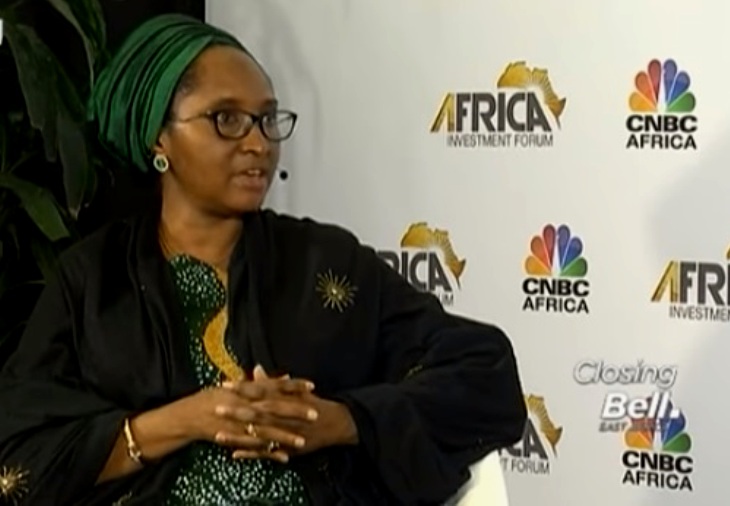
Minister for Finance, Zainab Ahmed, said this during an interview with South Africa’s CNBC Television, on the sidelines of the AIF which isorganisedby the African Development Bank (AfDB).
Ahmed explained that the Muhammadu Buhari administration launched the Economic Recovery and Growth Plan (ERGP) focus lab, from which it was able to harvest potential investment of about $22 billion. Out of this sum, projects worth about $10 billion were almost already to be commenced, but required “just a little push”, she said.
“So, part of what we hope to achieve in this three-day session is to crystalise financing for six of those projects. One of them is the Brass fertilizer project and there’s also the geometric hydroelectric power project, and four others.
“It is important to us because the power projects bring about a potential for us to the oviate the power deficit that we have in the country. The brass fertilizer project, on the other hand, expands the already existing fertilizer production capacity that we already have in our country. Even though we have up to 22 fertilizer plants that are producing but there’s still a gap.
“So it’s important for us that the deals for these two projects especially are closed within these three days, and we hope that that will happen. If it does, it becomes a very big boost for our economy.”
Ahmed described the AfDB as Nigeria’s bank, pointing out that the country is the largest investor in the AfDB, alongside South Africa.
“AfDB is our bank,” she said. “Together with South Africa, we are the largest investors in the AfDB, and we are looking to invest even more.
“It is a business that is doing very well, we are very happy with the progress that the AfDB is making and therefore we are situating ourselves to invest even more.
“AfDB has become a catalyst of growth; when Nigeria went into recession, it was AfDB that was the first that provided budget support to Nigeria. And then the World Bank said, ‘okay, we would also do this’, and other people followed.
“It became a catalyst for us and today we still ascribe one of the reasons why we were able to come out of recession quickly is because of the support that our bank, AfDB provided.”
Ahmed also commended the current president of the AfDB, Akinwumi Adesina, for the positive innovations he brought to the Nigerian agricultural sector during his time as the Minister of Agriculture during the presidency of Goodluck Jonathan.
These solid foundations, Ahmed said, has positioned the Agric sector as one that is currently contributing about 23 percent to Nigeria’s Gross Domestic Product (GDP) with huge potentials for more.
“We are building on the good foundations that Dr. Akin Adesina had laid. He started a fundamental change in the agricultural sector, a lot of very transformative things,” Ahmed said.
“We are looking at agriculture not just for feeding the nation, but as a business that is already contributing significantly to our GDP. Today agriculture contributes about 23 percent to the GDP and the potential is huge.
“There are more and more people going into agriculture at different levels, but especially at the processing value chain, which is where 70 percent of the value is,” she said.
“As government, we are putting in place policies to support those businesses, to provide financing to them, to support them when they are going to borrow, we have risk sharing schemes.”
THE need to maintain integrity by journalists and media practitioners in the country is the way forward for the Nigerian media to effectively carry out its obligations of holding the government accountable to the citizens.
This was the thrust of a one-day programme organised by the Civil Society Legislative Advocacy Center (CISLAC), in collaboration with Transparency International (TI), for journalists in Abuja on Thursday.
The programme centered on how to monitor and report corruption and money laundering issues in Nigeria. It was aimed at increasing public and political awareness about anti-money laundering mechanisms to effectively prevent, report and punish the laundering of corrupt proceeds in the country.
With the theme, “Enhancing investigative and reporting skills of journalists in combating Money laundering/Corruption in Nigeria”, the event had over 30 Nigerian journalists in attendance, selected from across the country.
Participants at the event were unanimous that the welfare of journalists should be prioritized in order to get rid of some unprofessional conducts that have come to characterise the practice of journalism in Nigeria, the most notorious being the ‘brown envelope’ syndrome.
In a presentation titled ‘Money laundering and illicit financial flows in Nigeria’,Gloria Okwu, CISLAC’s Programme Officer, emphasised the need for journalists to familiarize themselves with the anti-corruption laws in the country to effectively combat corruption.
She said, “journalists need to be aware of the ICPC act and the position of the law on corruption issues to be able to effectively fight corruption.”
Also speaking at the event, the CEO of Center for Financial Journalism, Ray Echebiri, said the poor remuneration of journalists can, in most cases, be traced to poor revenue generation by several Nigerian media houses.
He said there is a need for media organisations to seek innovative ways of diversifying their resources in order to increase revenue generation, which will translate into better welfare for workers.
“The Nigerian media finds it difficult to support the welfare of journalists because it depends on advertorials for revenue generation but to thrive they have to diversify,” Echebiri said.
“The Economist, for instance, has little space for adverts but they have a publishing arm and are into different businesses so they can afford to pay their journalists very well.”
He also urged the journalists to employ the use of open and legitimate practices to obtain information without infringing the rights of the subject involved in their investigation.
During the event, a panel was set up to further to deepen discussion on the responsibility of journalists in investigating corruption. The panelists included Diego Odey, Niyi Solewe of BudgIT, Amos Abba of The ICIR, and Martin Ayibakuro of the African Network for Environment and Economic Justice. The interactive session centered on the ethical responsibility of journalists in maintaining transparency in the Nigerian media space.
Also, Ronald Mutum, a reporter with Daily Trust and recipient of the Transparency International’s one-month fellowship to London to enhance his knowledge on defense budgeting and procurement, spoke of his experiences in London and provided tips on how to obtain information from law enforcement agents.
The National President of the Nigerian Union of Journalists (NUJ), Chris Isiuguzo and Jessica Ebrard from Transparency International Secretariat in Berlin, both of whom spoke via video call, commended the initiative.
THE vast majority of Nigeria’s top universities either do not have official electronic mailing addresses or do not actively use them in responding to enquiries and requests, The ICIR has discovered.
A report published in May by The ICIR already established that the e-mailing culture among federal universities in the country is still very poor as only 13 out of 15 schools to whom enquiries were sent eventually responded.
Expanding the scope of the study, The ICIR again mailed an enquiry to universities on Tuesday, October 9 ― this time to 38 federal, 36 state and 43 private universities reported in 2017 to be among Nigeria’s best. Asides the total of 114 institutions on this list, close also to what may be obtained from the latest Webometric Ranking, the National Open University of Nigeria (NOUN), Nigeria Defence Academy (NDA), and Nigerian Law School were also included as part of the recipients.
Essentially the enquiry, presented to be from a doctoral candidate to aid ongoing research, requested for the current population of the schools, with a breakdown according to the number of students and staff strength. “If possible, I wish to also find out if the institution is residential and the percentage of students who benefit from available infrastructure for accommodation,” the e-mail added.
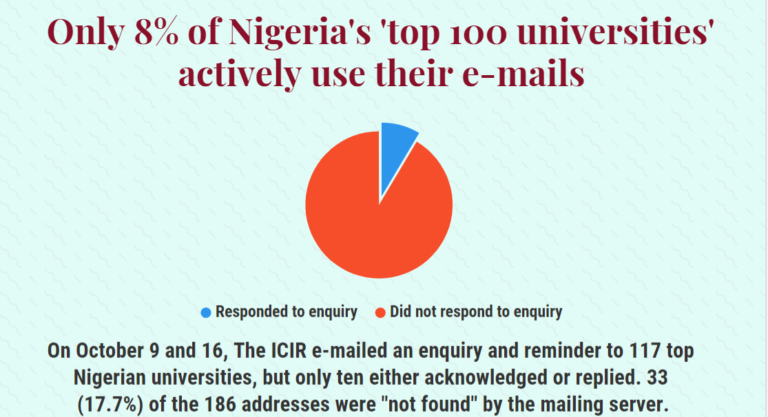
This enquiry was sent to a total of 186 e-mail addresses belonging to 117 institutions; and a week later, on October 16, a reminder was sent to the addresses.
Only 10 responded, acknowledged mail
Out of the over one hundred universities to which the enquiry was sent to , responses came from only ten (10) ― that is 8.5 percent.
The universities that were among the first set to respond include Redeemer’s University, Federal University of Petroleum Resources, Baze University, University of Ilorin, American University of Nigeria, Ekiti State University and Ladoke Akintola University of Technology.
Forty minutes after the e-mail was dispatched, Ipenko Ademola, Redeemer’s University’s Principal Assistant Registrar, sent a response directing the reporter to the school registrar. The latter, in his response, asked for the purpose of the request and a “letter of introduction to the effect” ― though the information asked for ought to be publicly available.
After an hour and half, Kennedy Ebakata, Special Assistant to the Vice Chancellor of the Federal University of Petroleum Resources, replied to say the enquiry “has been forwarded to the Registrar for appropriate action”. For Baze University, no worded response was received but Oshioreamhe Aghedo, the school’s Dean of Students, was copied by the general contact address.
The following day, October 10, the Vice Chancellor of University of Ilorin sent a response, likewise directing the reporter to the registrar or the university website. The registrar, who was part of the original recipients, however had no reply.
Daniel Okereke, the Executive Director of Communications and Publications, American University of Nigeria (AUN), also replied on October 10, giving answers to all enquiries. Total population of students, he wrote, is “slightly above 1,040 (Graduate 156, Undergraduate Above 900)” and for staff, nationals are 1,082 (as at September 2018) while expats are over 80.
He also said, “The institution is residential with about 98% of students on campus.” AUN’s Director of Communications, Innocent Nwobodo, also replied on October 19 to redirect the enquiry to the school’s Office of Institutional Research & Effectiveness, which he said had been copied and was equipped to address the questions.
The Examinations and Records Department of Ekiti State University also responded on this day, advising that the mail be directed to the Vice Chancellor. The school’s VC, however, did not respond to a mail sent to him on October 16.
Oddly, in its response on October 11, Ladoke Akintola University of Technology (LAUTECH) said, to get a response, the reporter “will have to make it formal by writing an official letter of request to registrar through your HOD”.
LAUTECH: “You will have to make it formal by writing an official letter of request…”Redeemer’s University asked for the purpose of the request and a “letter of introduction to the effect” ― though the information asked for ought to be publicly available
Following the reminder of October 16, four additional replies were received. One was from another official of AUN, Abba Tahir, Vice President for University Relations, who politely apologised for a belated reply and gave the assurance that his colleague would “package the required information and revert back”.
As promised, on October 19 and 24, his colleague, Amina Yuguda, responded with figures of total student and staff population.
Amos Kolo, Registrar at the Federal University of Technology, Minna (FUTMinna), sent in a response on October 26, with a two-page attachment signed by Jacob Yisa of Exams and Records Unit.
According to the document also dated October 26 and which was printed and scanned to answer the enquiry, the school has an undergraduate population of 19,355, a postgraduate population of 2584, a staff population of 2357, and the hostels accommodate a total of 2712 students.
Ife Oluwole, Deputy Registrar at the Federal University of Technology, Akure, also sent a response on the same day as FUTMinna. Writing on behalf of the Vice Chancellor, Joseph A. Fuwape, Oluwole said: “Kindly find below the information you requested for: student population 2017/2018 academic session: undergraduate- 17,505, postgraduate – 3,937, staff population – 2,461. The university is residential. About 10% of the student population benefit from the available residential bed spaces.”
Finally, on October 29, Bingham University, a private university founded in 2005 by the Evangelical Church Winning All (ECWA), also replied with a detailed breakdown of the current population of academic staff and students. It stated among other things that there are 238 members of academic staff, 2906 undergraduate students and 44 postgraduate students, 98 percent of whom reside on campus. The mail was signed by Nuhu Gado.
Soon after the first e-mail was sent out, an automatic response was received from Benue State University’s server, thanking the reporter for contacting the institution and assuring that the “mail is received with thanks and shall be treated urgently”. No urgent response has, however, been provided three weeks after.
Though not all the replies were helpful, only the aforementioned ten institutions provided responses at all to the enquiry. Out of the ten, four are federal universities, two are state universities, and four are private universities.
In other words, only 10.5 per cent of federal universities, 5.5 per cent of state universities, and 9.3 per cent of private universities responded. No response was received from the other 109 universities that were also e-mailed.
33 addresses ‘not found’
Soon after the enquiry was sent to the 186 addresses extracted from the various school’s official websites, the mail delivery subsystem declared 17.7 percent of the addresses as “not found”.
“The email account that you tried to reach does not exist,” said the automatic reply for 33 addresses, which belonged to 22 universities.
The other nine schools have other addresses on their sites that are valid. They are: University of Ilorin, University of Abuja, Usman Dan Fodio University, Federal University of Technology Akure, University of Agriculture Makurdi, Federal University Lokoja, Baze University, Al-Qalam University and Kebbi State University of Science and Technology.
Five of six addresses belonging to the University of Agriculture, Makurdi, returned mailer daemons and for Usman Dan Fodio University, it is four out of five.
13 universities are without e-mail addresses
The ICIR also observed during the period of the study that 13 of the universities have no official e-mail addresses on their websites; and out of these, at the time of report, seven had contact forms as an alternative means of communication.
The 13 are: University of Jos, Federal University Dutsin-Ma, Delta State University, Federal University Otuoke, Benson Idahosa University, Lead City University, Joseph Ayo Babalola University, Crawford University, Igbinedion University, Caleb University, Federal University Lafia, Bauchi State University, and Wesley University of Science and Technology.
With countless crucial but broken links, pictures that would not load and a design that is not user-friendly, the website of the Federal University Dutsin-Ma is deficient. The “contact us” page button is one of the numerous site navigations that are not functional.
That of Delta State University, which has no link stated as contact page, is beset with similar problems. It was also observed that Lead City University has as many as 17 telephone numbers stated on its homepage but not one email address.
A look through the website of Joseph Ayo Babalola University revealed that it has neither an official email address nor a contact form. For the Federal University, Lafia, established in 2010, the website did not load when it was checked on October 6. It is, however, now stated to be “under construction by Directorate of Management Information System (MIS)”. Most of the links are still broken, including the student portal, and the contact page has neither phone numbers nor an email address.
In May, The ICIR conducted a similar but smaller investigation that involved 15 federal universities. The email sent to these universities was titled “Enquiries on Post Graduate Programme and Financial Contribution” and requested for the university’s fee structure as well as unique benefits of enrolling in the post graduate programme.
It also said the writer intended “to give a small donation to the institution to advance its research projects and ICT presence”, and asked for the best means to do this.
Not much has changed, five months after this report. The six universities observed then to have invalid addresses on their websites still do: University of Ilorin, University of Abuja, Usman Dan Fodio University Sokoto, Federal University of Agriculture Abeokuta, University of Ibadan, and Federal University of Technology Akure.
Out of the 15 schools, only Federal University of Technology, Akure, and the University of Nigeria, Nsukka, responded in the first study. This figure dropped to one in the second as no response or acknowledgement was received from the University of Nigeria.
Unlike in the first report, however, the official address of the University of Ilorin Vice Chancellor acknowledged The ICIR‘s enquiry and offered guidance on how an answer may be sought.
Comparing South Africa and Nigeria
Compared to Nigerian universities, South African tertiary institutions appear to be doing much better when it comes to response to electronic enquiries. On Monday, November 5, the same enquiry sent to local universities was sent to 25 top South African universities, according to UniRank, a leading international higher education directory.
Out of the 59 addresses curated, three returned mailer-daemons ― this is 5 per cent, compared to Nigeria’s 17.7 per cent. Six of the universities have auto-responders, to assure the sender the message has been received. This is 24 percent, compared to Nigeria’s 0.85 percent.
Also, as many as eleven replies were received in total, representing 20 per cent response rate. The responses came from that five universities: University of Pretoria, University of Witwatersrand, University of Capetown, Stellenbosch University, and Nelson Mandela University.
The ICIR also observed that many of the South African universities have detailed contact pages, containing phone numbers and e-mail addresses of key officials as well as all faculties.
It is noteworthy that this result is in spite of the fact that only four days have passed since the enquiry was sent, while Nigerian universities had over three weeks. Also, unlike in the local experiment, no reminder has been sent to the South African institutions.
One of the replies from University of the Witwatersrand, Johannesburg
Missed grants, admission offers … effects of nonchalance
Oluwaseun David Adepoju, Lead Facilitator at TECHmiT AFRICA, who spoke to The ICIR observed that postgraduate admissions and scholarship grants have been lost due to the lacklustre attitude of universities to electronic mails, and added that there is no excuse for not using the 46-year-old technology.
“From my recent experience with a public university in south west Nigeria, I discovered that the university had all the corporate emails on the university website for the sake of just having them listed,” he recounted.
“I sent mails to three of the addresses on the website and all of them bounced back to me as mailer daemons. This situation is an indication the mails have not been used in a long time. Many university graduates have lost postgraduate admissions abroad because their university in Nigeria could not reply the mail sent from these universities abroad to confirm their documents. What a sad reality.”
He recommended that ICT units of various universities should assign a number of email accounts to each worker in the unit to facilitate responsiveness. “This will add immensely to the image the university has in the international community,” he said.
Other Nigerians have also narrated, in reaction to a report by The ICIR, how the technical shortcoming has affected them ― from someone whose admission into a Norwegian institution was cancelled because University of Ilorin did not attend to a request for certificate confirmation to another whose friend had to buy fuel and data bundle for officials at the Federal University of Technology, Owerri, before they could attend to a mail concerning him.
It is however, notably, not only universities which hardly acknowledge and respond to e-mail enquiries. Public institutions in Nigeria are generally observed to be disconnected from the addresses and telephone numbers stated on their official websites. Some, in fact, fail to update their physical addresses months after they have relocated.
A recent report by The ICIR established that 20 out of 24 federal ministries in the country do not respond to enquiries sent to their official addresses. 11 of the 26 email addresses extracted from their websites were found to be invalid. The Ministries of Education, Information and Culture, and Science and Technology, do not have official e-mail addresses on their websites and fail to reply enquiries sent through listed contact forms.
NUC keeps silent
The National Universities Commission (NUC), set up by the federal government to ensure quality higher education, has not responded to The ICIR‘s question on how it plans to make Nigerian universities more ICT-compliant in a digital era.
Ibrahim Yakasai, the commission’s director of press invited our reporter to his office but was not available at the agreed time of visit and for several hours. Calls to his phone have since not been answered and texts sent to him have yet to be replied.
THE Consumer Protection Council (CPC) has warned Nigerians to be careful and parboil their beans extensively before consuming as there is credible intelligence that some retailers use harmful chemicals to preserve beans from being attacked by insects.
This warning was contained in a statement signed by the Director General of the CPC, Babatunde Irukera, on Friday.
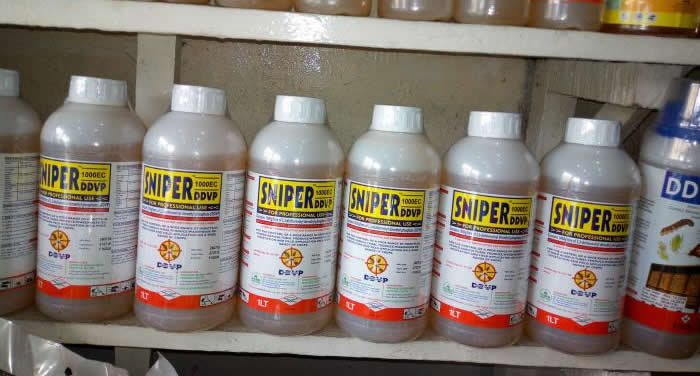
Irukera stated that the CPC has confirmed that some traders, “mostly in the open market are using a pesticide, 2.2-dichlorovinyl dimethyl phosphate (DDVP) compound, otherwise marketed and known as “Sniper” to preserve beans, and more particularly to eliminate or protect from weevils”.
Sniper, according to Irukera, can be harmful when human beings are unduly exposed to it “by inhalation, absorption, direct skin contact or ingestion”. He explained that though the traders may not have intended to endanger lives by lacing their beans with the chemical, there exists the “risk of injury on account of consumption of beans exposed to, or treated with Sniper”.
Irukera cautioned traders on the dangers of using unauthorised chemicals to preserve food items. He however pointed out that cooking significantly reduces the risk of exposure from pesticides “as most are diminished under extended periods of direct heat in excess of 100 degrees”.
“The best possible caution is to avoid subjecting food items to pesticides (that are) not in accordance with prevailing food safety regulations,” he said.
An official of the Consumer Protection Council confirmed to The ICIR that the statement, which has already gone viral on the social media, was indeed issued by the Council’s DG.
In March 2017, three persons, said to be siblings, were arrested in Lagos for allegedly lacing their beans with ‘sniper’in order to keep away insects. Their shop was also sealed by the authorities. But a fresh video is currently being circulated on the social media showing some people purportedly using the chemical to preserve beans from insects.
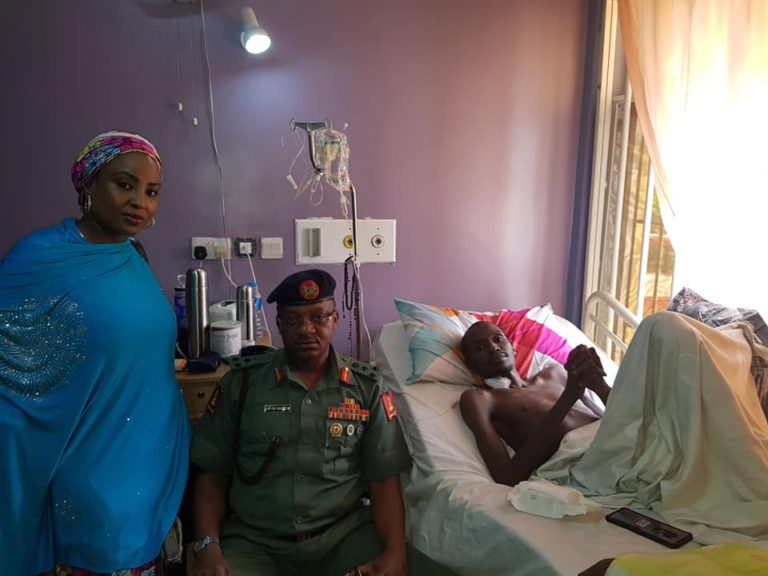
THE Nigerian army has urged the public to disregard reports on the social media saying that Zakari Sani, the Captain that was injured in an ambush in Benue State, has been abandoned and was not being adequately taken care of.
According to the Defence Headquarters, Sani “was badly wounded” when he was “ambushed alongside other soldiers in Benue State while on operation whirl stroke”. The incident occurred on Tuesday, November 6.
Several reports on popular social media platforms claim that the army has refused to fly the wounded officer abroad for better medical treatment.
One of such messages posted on Twitter by a handle with the username ‘Diamond Heart Foundation’. It read: “I’m afraid we are in a wicked country! Those so-called leaders are in haste to fly to foreign hospitals for minor ailments. But here is a captain who faced enemies, sacrificing his life (and) family’s happiness for Nigerians, has been abandoned in one bangabanga hospital.”
The tweet, which was posted on Thursday, was shared alongside a graphic picture of someone, purported to be Captain Sani, whose stomach – torn open, down to the groin region – was badly sutured.
This is regardless of the fact that the army authorities had explained that Sani was receiving the best medical treatment available in the country and will be transferred abroad if it became necessary.
In a statement shortly after the incident, the Acting Director of Defence Information, John Agim, explained that right from the moment Sani was involved in the ambush in which he was wounded, the army has ensured that he got the best of care.
“The officer was badly wounded and was evacuated to Benue State University Teaching Hospital, Makurdi where he was initially stabilised and later evacuated to Ceda Crest Hospital in Abuja for higher management outside of the operations theatre,” Agim, a Brigadier General, stated.
“Ceda Crest Hospital is one of the best hospitals in the country as at today. The team of doctors and other medical staff including expatriate are attending to the officer whose situation though serious is getting better by the day.
“He has undergone several medical procedures which have helped to stabilise him further. The Chief of Defence Staff has placed Medical Surveillance on the officer for eventual medical evacuation outside the country.”
Agim further explained that in standard medical practice, foreign medical evacuation cannot happen without the consent of the doctor that is administering stabilisation treatment to the patient, “otherwise the intended objective may not be achieved when the patient is evacuated abroad”.
“If Captain Zakari (Sani) had been hurriedly taken out of the country without the stabilization treatment, according to the medical advice, the outcome may not be certain,’ he said.
“The general public is hereby informed that Captain Zakari Sani’s treatment is consciously administered for his best interest. He is to undergo some medical procedures after which, he will be stable for any other treatment abroad as necessary.
“Nigerian military takes the health of its personnel seriously and would do anything to sustain the health and vitality of all, in order to be fit to defend the territorial integrity of our great nation.”
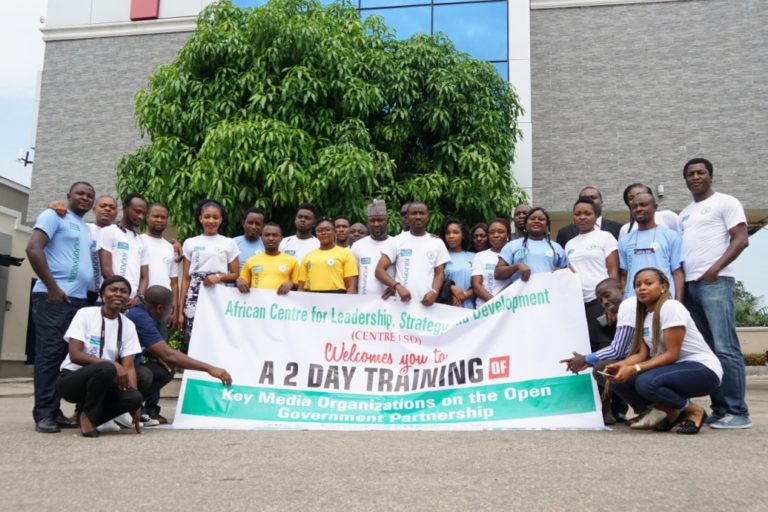
THE African Centre for Leadership, Strategy and Development (LSD) has brought together journalists and members of the civil society on two-day training on Open Government Partnership (OGP).
The training which was held on Wednesday and Thursday at Idrinina Hotel Lokongoma, Lokoja, in Kogi State focused on the role of the media and advocates in strengthening transparency in governance.
The International Centre for Investigative Reporting, Premium Times, Radio Nigeria, The Guardian, Silverbird TV, PTV, ThisDay, News Agency of Nigeria (NAN), among others were part of the media organisations represented.
Joshua James, the lead media OGP in Kaduna State, said the media play critical role in ensuring good governance.
“While we cannot formulate policies we can make the government to formulate relevant policies,” James said. “The media should in its functions be a feedback mechanism between the government and her citizens.”
He urged journalists to deepen their understanding on critical national policies and programmes by partnering with civil society organisations (CSOs) and government agencies in utilising available local resources.
Journalists during one of the training sessions had the opportunity to identify some challenges and solutions to reporting OGP-related issues.
Uchenna Arisukwu, Programme Coordinator of LSD, said the OGP is a global platform for reformers, which the media is part of.
He said: “Part of our function is to sensitise the media on the role they have to play in OGP so that they can effectively play their role as watchdogs of the government and bring about transparency. In totality, OGP is about openness.
“OGP is expected to make Nigeria a better place if all is implemented. I dare to say that from all the policies and programmes of government OGP, stands, unique and, if you ask me, revolutionary because it is co-creation between government and CSOs. It cuts across all the strata of the Nigerian state and on different issues.
“So if we are able to sort out corruption, we are like 75 per cent done with our problems and OGP is thriving around transparency and accountability. So when the system is open to probes, it will greatly reduce corruption in Nigeria.”
Arisukwu noted that OGP serves as an instrument of accountability to the citizens. “Because the government has promised accountability and openness, it will enable the common man to hold the government to the promise of openness, accountability, and transparency.
“They need to understand how to apply the wonderful principles of OGP and how they can apply it to their lives and support it to succeed in Nigeria. OGP for me is the shortest route to Nigeria’s transformation if well implemented.”
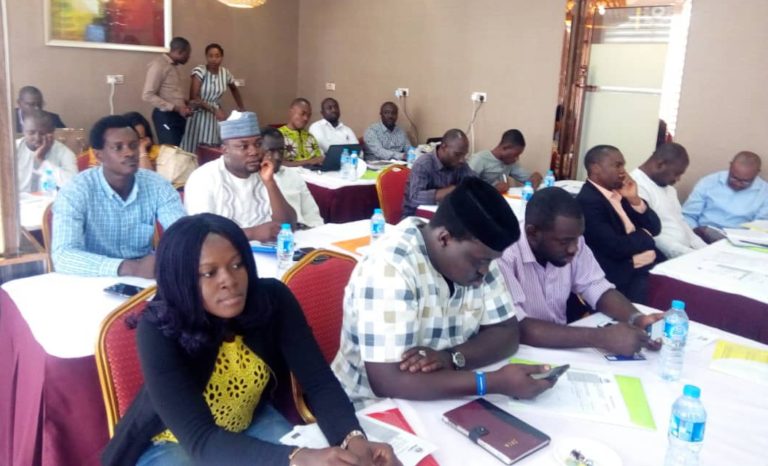
Participants at the training
Julian Osamoto, a journalist from Kapital F.M Abuja, told The ICIR the training has exposed her to the core essence of OGP.
“I learnt that the OGP is an instrument of accountability and transparency. I have been hearing of OGP but I didn’t know I could be a stakeholder. This training has actually shown me that I have been indirectly applying OGP but with this knowledge, I have grasped that I can do more,” said Julian.
Akintunde Babatunde, Programme and Research Officer with the Premium Times Centre for Investigative Journalism (PTCIJ) also noted the training is a necessary reinforcement process.
“The training has reinforced my belief that the media that can hold government accountable in a bid for government to be more transparent should be a major part of the pushers and implementers of the OGP,” he said.
According to Adedoyin Ojosipe, Media and Advocacy Officer at the African Centre for Media and Information Literacy (AFRICMIL), the training served as a platform that calls media practitioners to action while pointing out that though the concept of OGP is not new to the media, it has been a role played indirectly by the media.
“Holding government accountable, informing government on the plight of the masses and doing solution based reporting has been a part of media objectives,” Ojosipe said. “However, training has only created a re-awakening on why we need to up our reports in community development, making our leaders more accountable and making the masses buy into co-creating and co-owning a transparent process that can lead to improvement in their standard of living.
OGP is a coalition of equal partners from civil societies, stakeholders and the government, focused on improving transparency, accountability, citizen participation and responsiveness to citizens through technology and innovation to foster transparency.
At the International Anti-Corruption Summit organised by the government of the United Kingdom in May 2016, President Muhammadu Buhari affirmed his commitment to strengthening anti-corruption reforms through implementing programmes aimed at exposing corruption, punishing the corrupt and providing support to the victims of corruption, and driving out the culture of corruption.
This commitment led to the sourcing for avenues to deepen institutional and policy reforms which led to Nigeria joining the OGP in July 2016 as the 70th country.
The organisation was founded in 2011 by 8 countries namely: U.S, United Kingdom, South Africa, Indonesia, Brazil, Norway, Mexico, and the Philippines. It currently has 79 member nations and sub-national governments including Nigeria, Ghana, Kenya, and Malawi.
The partnership is voluntary with domestically-driven initiatives. OGP is a community of people who identify local issues and proffer local solutions to these issues according to the international standards and then proffer solution to the issues.
Although voluntary, member states must meet some eligibility criteria’s of which there are fiscal transparency, declaration of assets, citizen engagement, and access to information.