back to top
Home Blog

#Ekitidecides: Why vote-buying persists in Nigeria despite laws and arrests

0

By Nigeria Fact-checkers Coalition

Why vote-buying persists in Nigeria despite laws, arrests and repeated promises to stop it

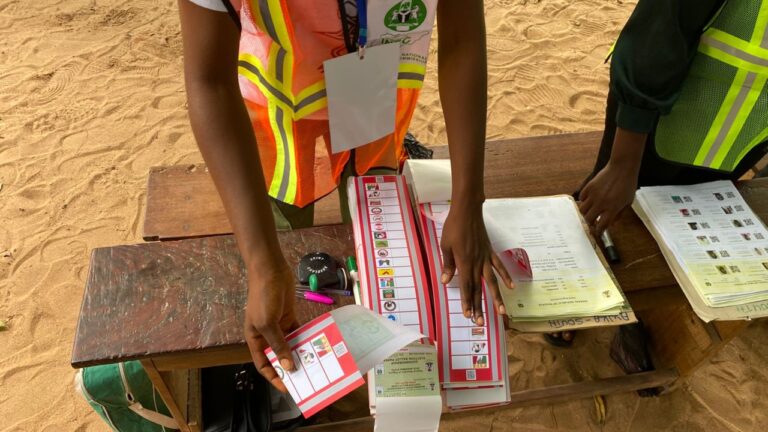
While voting was ongoing in some polling units across Ekiti State, allegations of voter inducement have resurfaced despite repeated assurances by the Independent National Electoral Commission (INEC) and the existence of laws aimed at curbing the menace.

Ahead of the governorship election in Ekiti State, INEC Chairperson, Professor Joash Amupitan, described vote-buying as one of the biggest threats to Nigeria’s electoral process and directed security agencies to arrest and prosecute offenders. Similar warnings were issued to the police, the Economic and Financial Crimes Commission (EFCC), and the Independent Corrupt Practices and Other Related Offences Commission (ICPC) to help effect arrests.

Despite these warnings, concerns about voter inducement have persisted. While vote-buying in Nigeria has traditionally been associated with cash payments made near polling units, developments during the Ekiti governorship election suggest the practice may be evolving into more subtle forms.

On election day, Saturday, 20 June, videos and photos circulating online showed bananas being distributed by supporters allegedly linked to the All Progressives Congress (APC), a campaign-branded truck allegedly used in sharing bread to residents, and security personnel receiving packs of cooked rice.

What does the law say?

Nigeria’s Electoral Act prohibits bribery, corruption and inducement during elections. Section 121 of the Electoral Act 2022 makes it an offence for any person to directly or indirectly give, lend, or provide money or valuable consideration to influence how a voter casts their ballot.

The law also criminalises receiving such inducements. Offenders risk fines, imprisonment, or both. Despite these provisions, arrests and successful prosecutions remain rare.

Why has vote-buying not been eradicated?

  • Weak enforcement

One of the biggest challenges is enforcement. Election observer groups have repeatedly documented cases of vote-buying across Nigerian elections, yet prosecutions and convictions remain relatively limited compared to the scale of reported offences. Observers argue that weak accountability and the slow pace of prosecution reduce the deterrent effect of existing electoral laws and contribute to a culture of impunity. 

  • Poverty and economic hardship

Nigeria’s prolonged economic challenges have made many voters vulnerable to inducements. For citizens struggling with rising food prices, unemployment and declining purchasing power, immediate material benefits may appear more valuable than campaign promises.

  • Difficulty in gathering evidence

Vote-buying often occurs discreetly. Transactions may happen away from polling units, through intermediaries, or after voters have shown evidence of voting. This makes it difficult for electoral officials and security agencies to gather sufficient evidence for prosecution.

  1. New and indirect methods

Political actors have become more sophisticated in how they engage voters. Instead of direct cash payments, inducements may be disguised as welfare support, food distribution, transportation assistance or other forms of material aid.

This evolution creates legal and ethical grey areas, especially when items are distributed during election periods and near voting activities.

Written By: Amarachi Onwuzulike, Fact-checker

Edited by: Opeyemi Kehinde, Lami Sadiq and Simbiat Bakare

Oyebanji wins re-election as governor of Ekiti

THE Independent National Electoral Commission (INEC) has declared Ekiti State Governor, Biodun Oyebanji, the winner of Saturday’s governorship election in the state.


Oyebanji, a candidate of the ruling All Progressives Congress (APC), polled 319,224 votes to defeat his closest rivals in the opposition Peoples Democratic Party, Mayokun Oluyede, and African Democratic Congress, Dare Bejide.

Oluyede garnered 40, 543 votes, while Bejide polled 12,872.

The Returning Officer for the election, Adenike Oladiji, a professor and the Vice Chancellor of Federal University of Technology, Akure, while declaring Oyebanji the winner Sunday morning, said: “I, Adenike, am the returning officer for the 2026 Ekiti governorship election…Oyebanji Abiodun Abayomi, having satisfied the requirements of the law, is hereby declared the winner and stands re-elected.”

Responding to his victory, the governor wrote in his Facebook account: “The voice of the people has reverberated from every part of our great state, and the message is clear. I am deeply humbled by the scale of this victory. Securing a clean sweep across all 16 local government areas, and 85 per cent of the popular vote, is a humbling vote of confidence from Ekiti Kete.”

He further wrote: “From our urban centres to our most remote communities, you have spoken with one thunderous voice for continuous development, stability, and a future of endless opportunities. This mandate means that our work must touch every household even deeper. There are no winners or losers today; there is only one united Ekiti determined to continue its journey of upward mobility.”
The governor pledged to honour the trust reposed in him by continuing to lead with humility, dedication and fairness.

Poll: Economic activities return to Ado Ekiti as election-day restrictions end

0

RESIDENTS of Ado Ekiti resumed their normal activities on Saturday evening, nearly an hour before the police-ordered restriction of movement officially ended. 

The ICIR reported that the Ekiti State Police Command had restricted vehicular movement across the state, ahead of the governorship election, as part of efforts to prevent electoral violence and other vices while ensuring the safety of voters, officials and sensitive materials.

The Police Public Relations Officer, Sunday Abutu, a superintendent of police, disclosed this in a statement in Ado-Ekiti on Friday.

Abutu said the restriction would take effect from midnight (12:00 a.m) to 6:00 p.m and cover both intra-state and inter-state roads within the state.

The measure was part of comprehensive security arrangements aimed at ensuring a peaceful, orderly and violence-free election.

The police noted that the restriction would apply to all forms of motorised transportation, including private and commercial vehicles, trucks, tricycles and motorcycles.
However, The ICIR observed that businesses began to resume minutes after 4 pm in parts of Ado, the Ekiti State capital. At the time, some officials of the Independent National Electoral Commission (INEC) were seen on different streets, on motorcycles and in vehicles, moving election results and other material to their offices after the sorting and counting of votes.
This organisation could not immediately confirm whether the police had arrested anyone for violating the movement restriction. But the development appears to be a recurring trend in many commercial cities across Nigeria, particularly those with a high concentration of tertiary institutions, government establishments, and significant economic activity, such as Ado Ekiti.
Meanwhile, The ICIR reports that the election was largely peaceful across the state, with the election still ongoing in some polling units, including that of the Peoples’ Democratic Party’s governorship candidate, Wole Oluyede, at the Osaguru Hall, Unit 6, Ward 3, Ikere Ekiti.
While filing this report, most residents were anticipating who will become the state’s next governor after the conclusion of the poll.
The state Governor Biodun Oyebanji, who sought re-election for a second and final term, is facing challengers from 10 political parties in the exercise.
The winner will assume power on October 16, when the first-time tenure of the current administration ends.

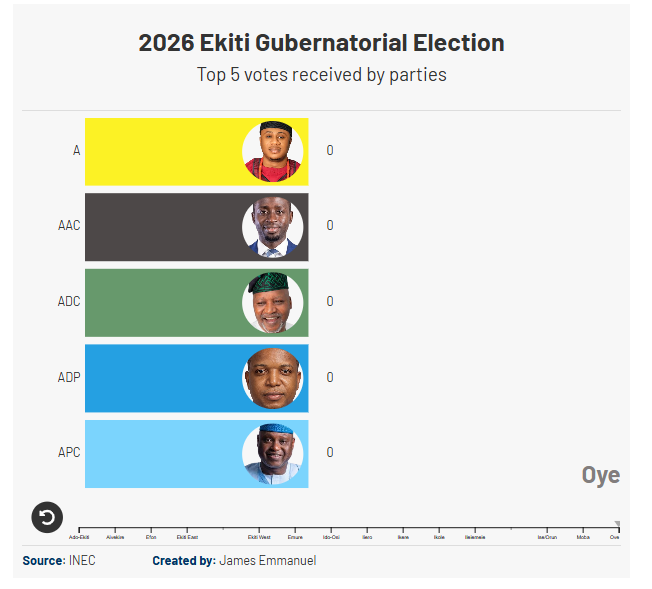
Dashboard: 2026 Ekiti Governorship Election Result

This will be updated with election results when they are announced by the Independent National Electoral Commission (INEC)


Ekiti Poll: Sorting, counting of votes commences across polling units

0

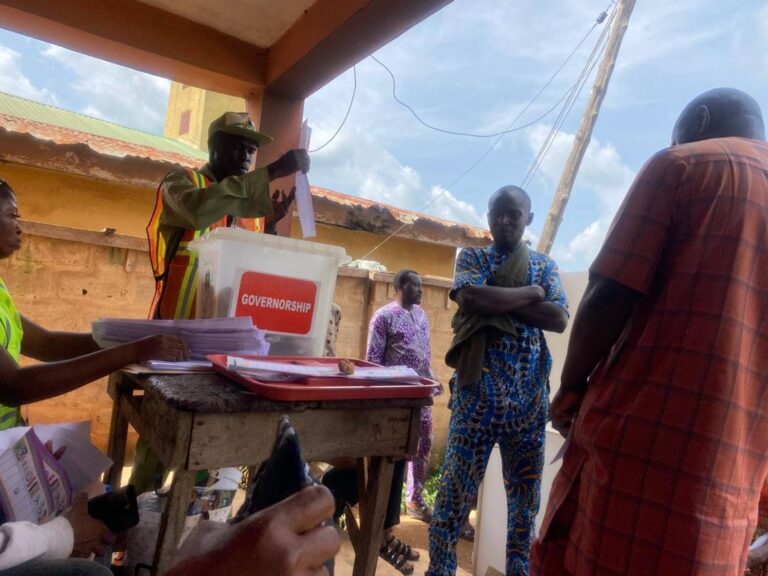
AD-HOC staff of the Independent National Electoral Commission (INEC) have commenced sorting and counting of votes in several polling units across Ekiti State following the conclusion of voting in Saturday’s governorship election.

Reports from polling units monitored by The ICIR and CJID showed election officials sorting ballots in the presence of voters, party agents and election observers.

At Polling Unit 008, Ward 07, Mary Mount Primary School, Olora-Elemukansi, in Ado Local Government Area, counting commenced shortly before 3 p.m. and was ongoing as of the time of reporting.

Similarly, at Polling Unit 006, Ward 11, St. Pius Catholic School in Ikere-Ekiti Local Government Area, election officials began counting votes after polls closed. 

At Polling Unit 05, Ward 1, in Moba Local Government Area, the Presiding Officer was seen counting votes in full view of voters and party agents who gathered around the polling unit to monitor the process.

At Polling Unit 004, Ward 07, Apadaba area of Ilawe Local Government Area, sorting of ballots was ongoing while party agents prepared to observe the counting process.

Election results have also been announced in Polling Unit 010, Ward 008, located in front of Obadofin House in Ikole Local Government Area.

According to the result announced at the polling unit, a total of 132 votes were cast, with the All Progressives Congress (APC) securing 130 votes. The All Progressives Grand Alliance (APGA) received one vote, while one ballot was declared void.

The Ekiti governorship election is being contested by 12 political parties across 2,445 polling units in 177 wards, with over one million registered voters eligible to participate.

As of the time of filing this report, vote sorting and counting were ongoing in many polling units across the state, with collation expected to commence thereafter.

Meanwhile, voting is still ongoing in several other polling units observed by the CJID and The ICIR.

Ekiti Poll: Yiaga Africa raises concerns over discrepancies in ballot papers, result sheets

0

ELECTION observer group Yiaga Africa has raised concerns over inconsistencies in election materials deployed by the Independent National Electoral Commission (INEC) for the ongoing Ekiti State governorship election.

In a preliminary statement during the election on Saturday, June 20, the group said it identified discrepancies on ballot papers, polling-unit result sheets and the final list of candidates published by INEC.

Yiaga Africa said its observers, deployed to 250 randomly sampled polling units across the state, reported the inconsistencies during the early stages of voting.

According to the group, the Form EC8A polling-unit result sheets contain space for 15 political parties, while the ballot papers used for the election contain space for 19 parties. 

However, INEC’s final list of candidates, as updated on its website on June 18, reflects only 14 political parties participating in the election.

The organisation warned that the discrepancies could create confusion during voting, vote counting and collation.

“These inconsistencies might create confusion during voting and collation. Where result sheets include parties that are not on the ballot, presiding officers may record zero votes for parties that voters did not see. Conversely, where voters cast ballots for parties not reflected on the result sheet, such actions could create uncertainty in recording, reconciliation, and collation,” the group said.

Yiaga Africa attributed the inconsistencies to developments that followed the publication of INEC’s initial list of candidates in January 2026, including court rulings and administrative changes affecting parties’ participation in the election.

The group noted that some of the changes did not appear to have been fully reflected across all election materials and may not have been adequately communicated to the public.

The organisation called on INEC to immediately clarify the final list of participating parties and candidates and explain the differences between the ballot papers, result sheets and previous announcements.

It also urged the commission to issue clear written guidelines to presiding officers and collation officials on how to complete result sheets in line with the law and relevant court judgments.

The Ekiti governorship election is being contested by 12 political parties across 2,445 polling units in 177 wards, with over one million registered voters expected to participate in the exercise.

Accord candidate alleges ₦20,000 vote buying as police warn against electoral offences

0

THE governorship candidate of the Accord Party in the Ekiti State election, Opeyemi Falegan, has alleged widespread vote buying, saying voters were paid as much as ₦20,000 in some polling units.

Falegan, who voted in the Idofin area of Ado-Ekiti, also accused security agents of failing to stop the alleged inducement, saying some officers appeared to “synergise” with those involved.

“It was really sad to see vote buying everywhere at 20k per vote and security agents synergising with those acts,” he said in a post shared on Facebook after voting.

His allegation comes amid an earlier report by The ICIR, which quoted observers describing cases of voter inducement in parts of the state. Observers also noted instances where party agents recorded voters’ names, issued numbered slips after voting, and distributed items such as biscuits and drinks around polling units.

In some locations, voters were reportedly asked to write down their names soon after casting their ballots, with claims linking the process to incentives.

Speaking further, the Accord candidate alleged irregularities in the voting process, claiming the Bimodal Voter Accreditation System (BVAS) was malfunctioning in some areas, forcing a resort to manual accreditation.

I hereby condemn this process and conclude no election in Ekiti State,” he said.

“BVAS is not working, INEC, shame on you. Now they wanna do manual voting. This is fraud, and APC is writing numbers. There is no election in Ekiti state,” the Accord Party candidate said in another post. 

The ICIR reports that his claims on BVAS malfunction align with field observations from several polling units, where voters reported difficulties with accreditation due to delays and failures in facial capture by the system. 

Meanwhile, the Nigeria Police Force has warned against electoral offences, including vote buying, vote selling, ballot box snatching, violence, intimidation and other acts capable of disrupting the election.

The police, in a statement after the commencement of the poll, said such offences undermine democracy and would not be tolerated, adding that offenders would be arrested and prosecuted in line with the law.

“Electoral offences undermine democracy and will not be tolerated,” the Force warned.

The ICIR reports that the election is being contested by 12 political parties across 2,445 polling units in 177 wards, with about 1.02 million registered voters expected to decide whether Governor Oyebanji of the All Progressives Congress (APC) secures a second term or a new governor emerges.

Oyebanji, who won the 2022 governorship election with 187,057 votes, is facing challengers from eleven other political parties in a race being closely monitored by election observers.

Ekiti decides: BVAS glitches and other hiccups amid peaceful process

0

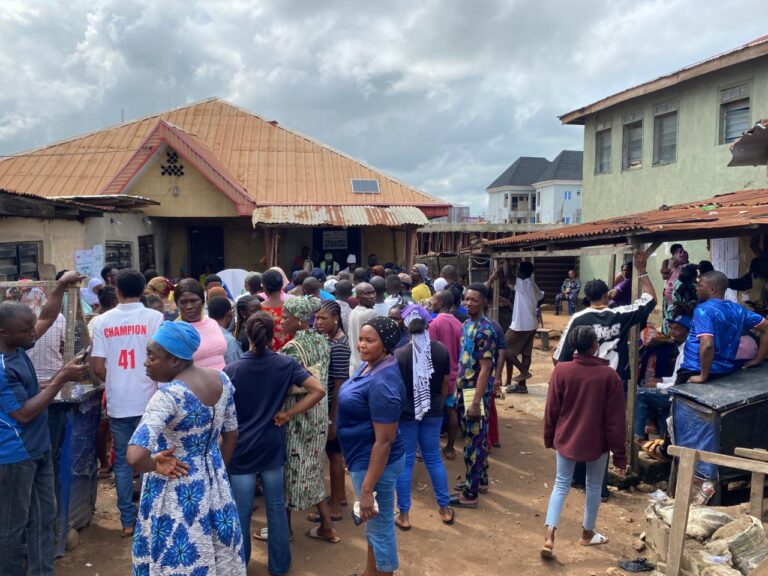
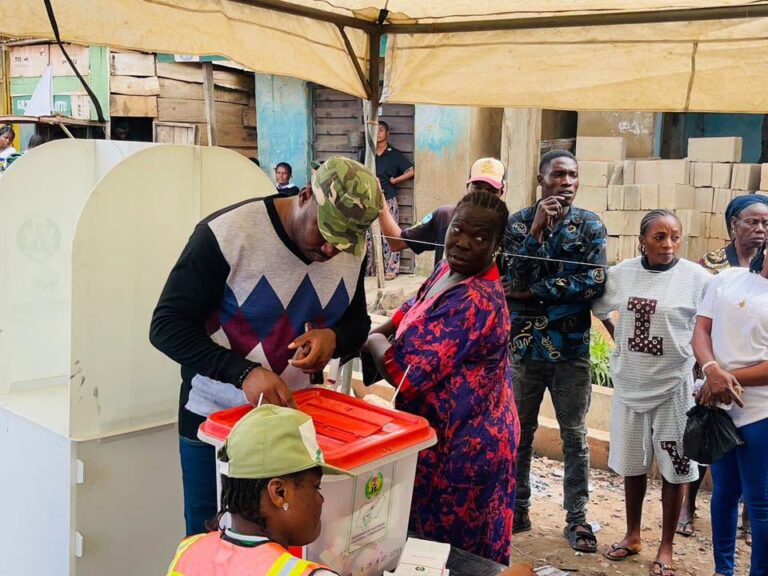
THE Ekiti State governorship election, Saturday, remained largely peaceful across most polling units across the state. However, there were reports of malfunctioning Bimodal Voter Accreditation System (BVAS) devices, attempts by party agents to influence voters and other hiccups. 

Observers deployed across local government areas reported that in Ise/Orun Local Government Area of Ekiti State, accreditation was delayed at Polling Unit 001 after the BVAS malfunctioned, leaving voters, including elderly and priority voters, stranded for hours.

At another polling unit in the same LGA, electoral officials struggled with poor network connectivity, forcing them to rely on a power bank while voters waited for accreditation to commence.

Similarly, in Ado Local Government Area, voting was halted at a polling unit in Irona Ward after the BVAS reportedly stopped working, leaving accreditation stuck at 12 voters despite a queue of waiting electorates.

In Ido/Osi Local Government Area, several voters complained that although they possessed valid Permanent Voter Cards (PVCs), their names could not be found on the BVAS register, preventing them from being accredited and voting.

A similar accreditation challenge was reported at a polling unit in Ward 7, where a woman repeatedly failed accreditation despite several attempts by election officials. Witnesses said someone at the polling unit suggested she be given N5,000 as compensation for being unable to vote, a proposal she rejected while expressing frustration over her inability to exercise her franchise.

At Ejigbo Farm 2 Polling Unit in Oye Local Government Area, polling officials reportedly complained that the indelible ink marker being used could easily be wiped off. Observers reported that a man who had already voted allegedly returned and attempted to vote a second time, triggering complaints from officials and voters at the polling unit.

Across several polling units, observers also reported party agents attempting to accompany voters into ballot booths or remaining within restricted areas despite electoral guidelines.

In Ise/Orun, party agents were seen lingering around ballot booths and following elderly voters into the voting area, resulting in a disagreement with security personnel. At another polling unit in the same LGA, a party agent was reportedly found inside the voting cubicle with a voter.

Meanwhile, election officials in Ijero, Ilejemeje, Ekiti West and parts of Ado reported low voter turnout, with many polling units recording only a handful of voters by late morning despite the peaceful atmosphere.


EkitiDecides: Oyebanji votes, expresses satisfaction with poll

GOVERNOR Biodun Oyebanji, on Saturday, cast his ballot at his Okelele, Polling Unit 003, in Ikogosi, Ekiti State, describing the exercise as positive.

Oyebanji, who is seeking re-election, was accompanied by his wife, Olayemi. The wife cast her ballot at 11:32 am, followed by the governor, who exercised his franchise at 11:33 am.

Addressing journalists afterwards, Oyebanji said, “The report across the state has been positive. The election is going on smoothly. People are exercising their franchise. We are happy voter turnout is impressive…There is a linkage between what is happening today and their future. We are happy everything is going well.”

He urged voters to be patient with INEC, adding that with some patience, every eligible voter would vote.

“They (INEC) have told me that nobody will be disenfranchised.”

The governor said his administration would continue with his 30-year plan for the state if re-elected.

The ICIR observed hundreds of voters at the governor’s polling unit, while other polling stations in the town experienced lower turnout.

Security officers, including those from the Nigeria Police Force, Nigeria Immigration Service (NIS), and State Security Service, besieged the governor’s polling booth hours before his arrival. The ICIR reporter could not find a similar number of security officers in other units he visited in the state.

There are also a large number of election observers and officers of the Economic and Financial Crimes Commission (EFCC) at the governor’s town.

The ICIR reports that over one million voters (1,059,360) who collected Permanent Voter Cards (PVCs) are expected to participate in the poll, taking place across the 16 LGAs in the state today.

Oyebanji is contesting against 11 other contenders for the most exalted political seat in the state.

The ICIR reported the Situation Room saying the Ekiti governorship poll would be a litmus test for INEC’s readiness to conduct free, credible and fair elections in 2027.


#Ekiti Decides2026: 6 ways to fact-check election rumours spread on WhatsApp

0

By Nigeria Fact-checkers Coalition

Residents of Ekiti State are at the polls today, June 20, to elect a new governor. And as with every Nigerian election, WhatsApp will be full of claims about the candidates, the process, and the result.

Here is how to check the claims, photos, voice notes, and videos that will likely circulate on WhatsApp during and after voting.

  1. Look out for the ‘Forwarded’ tag

Most false claims on WhatsApp circulate as forwarded messages. You will see a small arrow icon and the word “Forwarded” above such messages. This does not automatically mean the content is false, since real news is forwarded too, but it is a sign to be cautious, since you cannot tell who wrote it or where it originated.

  1. Check the official sources

If a message claims that a candidate has withdrawn from the race, that a polling unit has been relocated, or that the Independent National Electoral Commission (INEC) has made an announcement, check INEC’s official website and verified social media handles, as well as the pages of the political parties and the named candidates. INEC regularly publishes updates on its activities, and a genuine development of that scale would appear there, not only in a forwarded WhatsApp message.

  1. Search for the claim online

Copy the key details in the message, such as names, locations, or figures, and search them on Google. If something newsworthy actually happened in Ado Ekiti, Ikere, or any other local government area in the state, credible Nigerian newsrooms would likely have reported it. If nothing comes up except the same message being shared on other platforms, treat the claim with suspicion.

  1. Verify photos and videos

Photos and videos of violence, ballot snatching, or vote buying resurface during every election cycle, often recycled from previous elections or from entirely different states and countries. Use Google Reverse Image Search to check where a photo first appeared online. For videos, tools like InVID can help confirm whether footage is old or has been used elsewhere before.

  1. Be wary of messages designed to provoke fear or anger

Messages that push you to act immediately, such as warning you to avoid a polling unit or to spread a claim before it is “taken down,” are often designed to spread quickly rather than to inform. Genuine updates from election authorities and credible media houses are usually calm and specific, with clear sources, not urgent and alarming.

  1. Reach out to fact-checking organisations

If you come across a message you are unsure about, send it to a fact-checking organisation such as The Continental, FactCheckHub, Africa Check, Alkalnci or DUBAWA before sharing it further. These organisations take public submissions and have previously verified claims during Nigerian elections. Once a fact check is published, share it back into the group where you first saw the false claim, so others who saw it also see the correction.

By Blessing Amala Muonwe, Fact-checker

Editor: Bamas Victoria & Simbiat Bakare