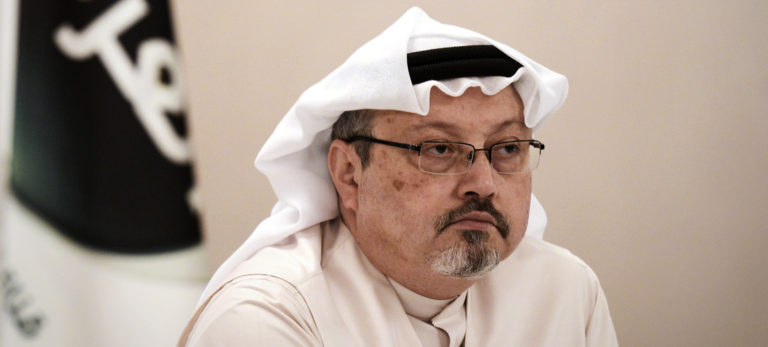
Contrary to the previous claim by the Saudi government that the late Jamal Khashoggi died in a rogue extradition operation, the Turkish prosecutor’s office has disclosed that the late Saudi journalist who entered Saudi consulate in Istanbul, Turkey on October 2, was indeed strangled to death immediately he arrived the mission building before his body was cut into pieces.
“In accordance with plans made in advance, the victim, Jamal Khashoggi, was choked to death immediately after entering the Consulate General of Saudi Arabia in Istanbul on October 2,” the chief prosecutor, Irfan Fidan, said in a statement released on Wednesday.
“The victim’s body was dismembered and destroyed following his death by suffocation.”
The chief prosecutor also confirmed that Khashoggi’s death was premeditated. He made this known yesterday after the departure of the Saudi chief prosecutor, Saud al-Mojeb, from Istanbul after a two-day visit.
But despite the fact that Saudi Arabia has admitted that the killing of the Saudi journalist was premeditated, it has not explained how.
Al-Mojeb, for instance, failed to answer the questions: “Where is Khashoggi’s body? Who was the alleged local collaborator that the Saudis say took part? What do the Saudis know about who planned the murder?”
The kingdom also has denied that the 15-man team that allegedly assassinated Khashoggi was acting with the knowledge or authorisation of the royal court.
Turkey’s statement on Wednesday undermined the insistence of Trump and his secretary of state, Mike Pompeo, that Turkey was satisfied with Saudi Arabia’s cooperation in the investigation to date, The UK Guardian has reported.
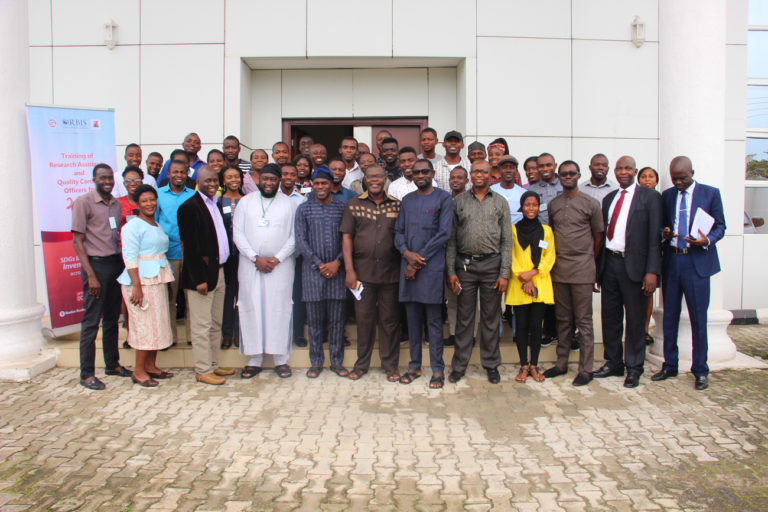
AS part of its efforts towards meeting the Sustainable Development Goals ( SDGs) target by 2030, the office of the senior special assistant to President Muhammadu Buhari on Sustainable Development Goals headed by Adejoke Orelope-Adefulire in collaboration with the Oyo state government has commenced training for the second batch of research assistants that will help in generating data to assist the state in carrying out relevant projects in the state.
The training was put together in partnership with a private firm, Orbis Consulting Limited to conduct a baseline inventory survey on Education, Water/Sanitation, Vocational Skills and Primary Healthcare.
Special Adviser to the Oyo State Governor on Sustainable Development Goals, Temitope Fajana, said: “The data obtained from the 15 local government areas in the first and second phases of the exercise will be used in designing policies and projects and also in making community development decisions across Oyo state”.
“The focus of the baseline survey is to achieve the Sustainable Development Goals by 2030,” Fajana said.
“The inventory taken by the research assistants is to help the government in identifying deficiencies, plan, and take the needed steps when and where necessary.”
Also speaking during the training exercise, the National Coordinator of the Civil Society Coalition on Sustainable Development in Nigeria, Tola Winjobi, commended the pacesetting role of Oyo state in the baseline survey.
The team lead of Orbis Consulting, Yakubu Gana, took participants through a presentation on what is expected of them with respect to the identification of facilities provided through the MDGs/SDGs Conditional Grants Scheme and other Paris Club Debt Relief Gains expenditure as a basis for further interventions.
Similarly, Sola Fagorusi of Onelife Initiative for Human Development, a non-governmental organisation that is also taking part in the project, shared insights on the data collection tool. He said the research assistants will be using the Open Data Kit for the field survey “to ensure that field findings are accurate and the geo points are properly captured”.
Fagorusi added that there would also be quality control officers who would supervise the work of the research assistants to ensure an error-free result.
Participants at the training exercise were selected from the 33 Local Government Areas in Oyo State.
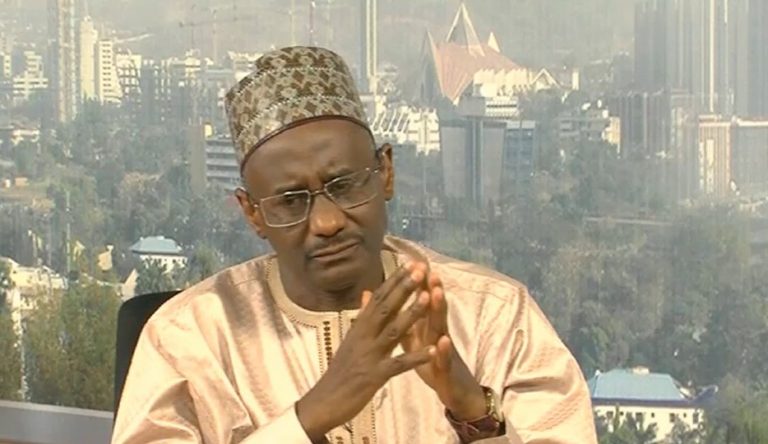
PRESIDENT Muhammadu Buhari has finally approved the temporary removal of the embattled Executive Secretary of the National Health Insurance Scheme (NHIS), Usman Yusuf, pending the determination of the investigation into allegations of corruption against him.
The recent development was contained in a statement issued on Wednesday by Olusegun Adekunle, a Permanent Secretary (General Services Office) in the office of the Secretary to the Government of the Federation (SGF).
According to the statement, Yusuf has been ordered by President Buhari to proceeds on administrative leave with immediate effect in order to allow the investigative panel to carry out its task without interference.
Consequently, Ben Omogo, a director in the office of the Head of the Civil Service of the Federation, has been deployed as the Acting Executive Secretary of the NHIS.
The statement read: “The federal government has observed with deep concern the growing tension between boards and chief executives and their attendant implications for governance.
“For the avoidance of doubt, the government will neither tolerate acts of indiscipline from any appointee nor will it harbour any acts of corruption.
“Government will, however, ensure that due process is followed strictly in trying to maintain discipline and probity in public service.
“With specific reference to recent developments at the National Health Insurance Scheme, Mr. President has after due consideration approved the establishment of an independent fact-finding panel to investigate the alleged infractions by the executive secretary and report back within two weeks.”
This action by President Buhari has put an end to the face-off between the NHIS boss and the agency’s governing council.
The governing council had placed Yusuf on an indefinite suspension to allow for an independent investigation into the allegations against him, but he refused to obey the directive insisting that only the President has the powers to sanction him.
The development had split the workers at the NHIS into two factions with one supporting the Executive Secretary and the other against.
NOT fewer than 45 supporters of the Islamic Movement in Nigeria (MIN) have been killed by the Nigerian soldiers over two days, when the Shi’a Muslim group held a peaceful religious procession around Abuja, an independent investigation by Amnesty International has revealed.
The use of excessive force by soldiers and police led to the killing of MIN group members, the report says.
In a statement released on Wednesday by Isa Sanusi, the Media Manager of Amnesty International Nigeria, the researchers hired by the London-based non-governmental organization visited five different locations in Abuja and Nasarawa state where they discovered wounded IMN supporters receiving treatment, including two locations where bodies were deposited.
The researchers spoke with victims, eyewitnesses and medical practitioners, and analysed videos and photographs of those injured and killed during the protests, which took place on Saturday and Monday.
“We have seen a shocking and unconscionable use of deadly force by soldiers and police against IMN members. Video footage and eyewitness testimonies consistently show that the Nigerian military dispersed peaceful gatherings by firing live ammunition without warning, in clear violation of Nigerian and international law,” said Osai Ojigho, Director of Amnesty International Nigeria.
“Those injured were shot in different parts of the body – head, neck, back, chest, shoulder, legs, arms – and some of them had multiple gunshot wounds. This pattern clearly shows soldiers and police approached IMN processions not to restore public order, but to kill.”
Amnesty International says the military used automatic firearms during Monday’s protest, in which at least 122 protesters sustained gunshot wounds and at least 39 were killed, and six others killed in protest on Saturday.
According to the organisation, the research team counted 24 bodies (23 male and one female) and trusted sources provided details of 21 others. Two of the bodies seen had their legs severed, which Amnesty International’s military and weapons expert analysed as consistent with injuries caused by a heavy fully-automatic machine gun such as a PKM or DShK.
“I was running with my friends when I realised I had been shot. We were running away from the big vehicle that was shooting. I don’t know how long the shooting lasted but it lasted for more than 30 minutes before I was shot. I came from Gombe a month ago to be part of this protest. My parents are in Gombe and I’m the only one from my family that came to Abuja. They are aware of my condition and said I should be careful and that this is God’s will,” a 15-year-old boy told the researchers.
An IMN member who witnessed the Monday attack said he did not expect soldiers to shoot at them again considering what happened on Saturday.
“We were marching to town and were very peaceful but before we realised what was happening, they opened fire on people. How could they use an APC on peaceful protesters? Are we Boko Haram? Does anybody deserve to be treated like this? Are we not Nigerians and don’t we have the right to protest? They did not even care that there were women children among us.”
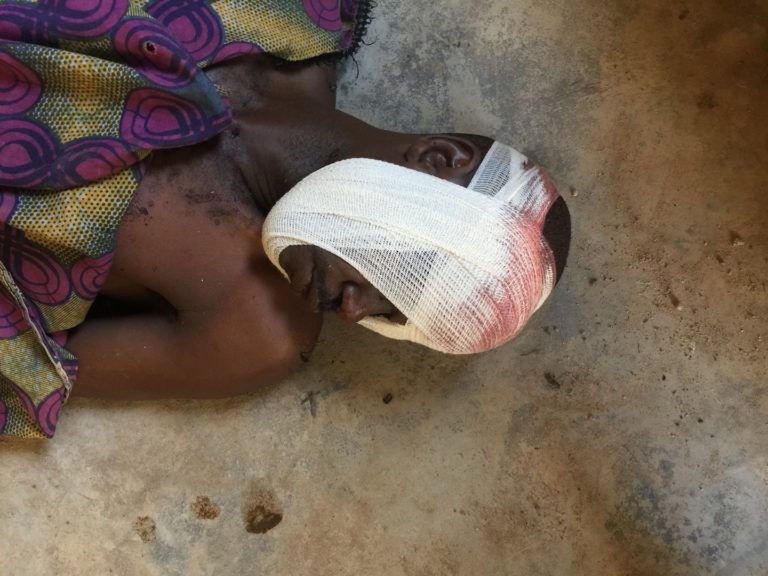
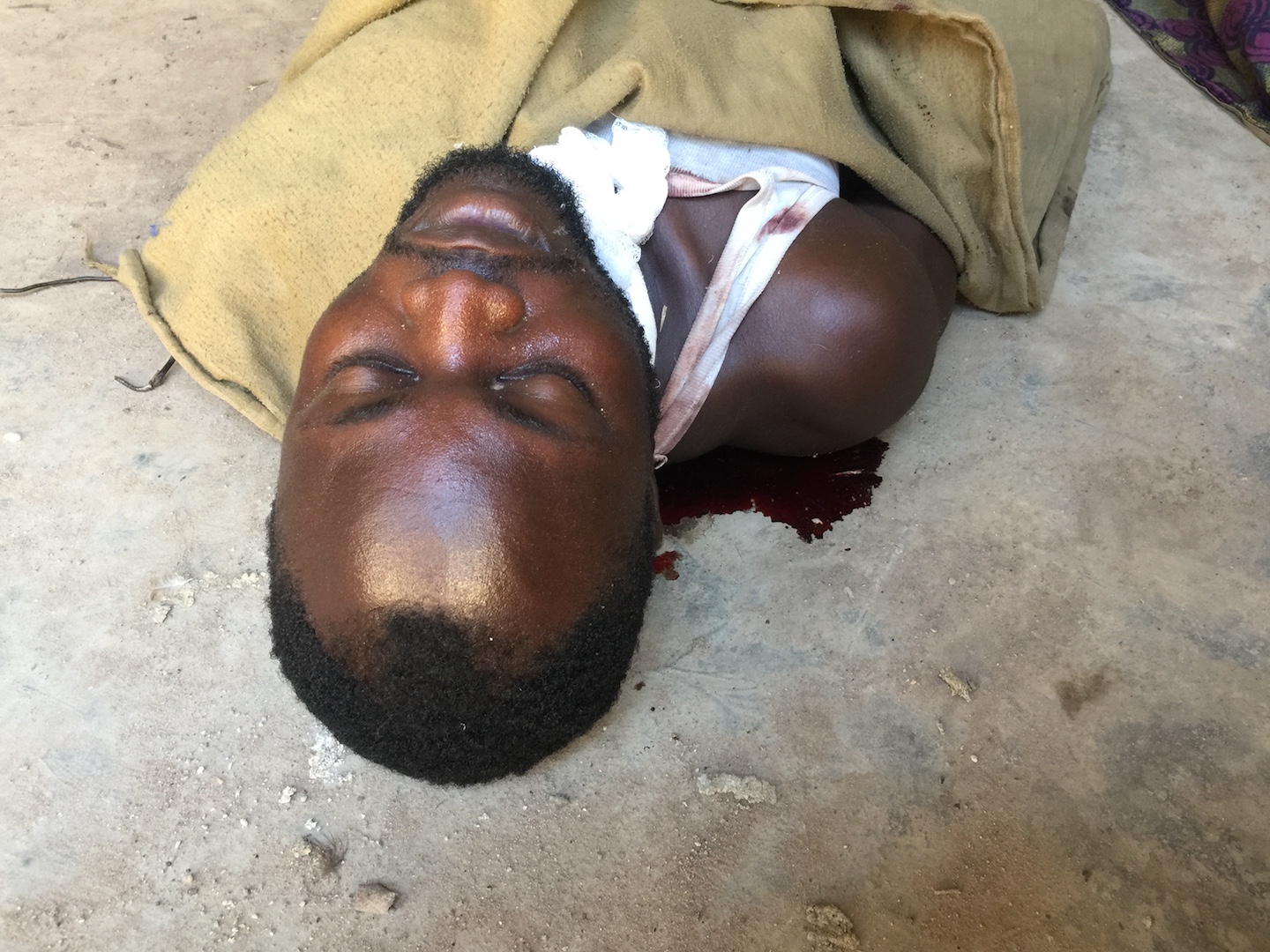
A Shi’a member lay dead after sustaining a gun injury. CREDIT: Amnesty International
Another member expressed the group’s resolve to press on until their leader is released. “They seem not to realise that they can’t stop us. We have made up our minds that we won’t stop protesting and demanding the release of Sheikh [El-Zakzakky]
“The more they use force and try to stop us, the more our resolve. One thing that we will not do, however, is to be violent because Sheikh does not want that. Even if they kill Sheikh today, we won’t carry arms.”
Ojigho said the Nigerian military seemed determined using tactics designed to kill when dealing with IMN gatherings.
“Many of these shootings clearly amount to extrajudicial executions. This violent crackdown on IMN protesters is unjustified and unacceptable. They were perfectly within their rights to hold a religious procession and protest and there was no evidence they posed an imminent threat to life.”
Many injured IMN supporters have sought medical treatment in unofficial buildings due to fear of arrest if they go to the hospital.
One medical worker near Abuja told Amnesty International: “From yesterday (Monday) I attended to 57 people with gunshot wounds, most of them still having the bullets lodged in their bodies. We are only trying to stabilise them by arresting the flow of blood before sending them to the hospital. It is not an ideal situation because this is an uncompleted building, not a hospital. I am hoping that they get to the hospital today.”
Since a massacre of over 350 IMN supporters which took place in Zaria in 2015, the Nigerian authorities have consistently sent in the military to respond to IMN protests or marches.
This strategy is partly to be blamed for the bloodshed witnessed on Saturday and Monday, Amnesty says.
There are reports that stones were thrown by protesters as a response to the use of lethal force, to which security forces responded with tear gas and more gunfire.
“We are once again calling on the Nigerian authorities to impartially investigate and bring to justice those responsible for the extrajudicial execution killing of IMN supporters, including the commanders who gave the orders for live bullets to be used,” said Ojigho.
Another Shi’a protester receiving treatment after a gun wound. CREDIT: Amnesty International
“The continuous failure to investigate these gross human rights violations is fuelling a dangerous disdain for the sanctity of human life in Nigeria.”
International law prescribes that security forces policing demonstrations must not use firearms against protesters unless they pose an imminent threat of death or serious injury, and only if there is no lesser way to avert such threat.
“They must never use firearms to disperse a demonstration, even if it turns violent. Firearms must never be used as a tactical tool for the management of demonstrations: they may only be used for the purpose of saving another life.
“The Nigerian authorities have an obligation under international law to ensure there is a full and independent investigation of deaths at the hands of security forces and that those responsible, including in the command structure of the security forces, are held accountable under the criminal law, says Ojigho.
The IMN is a Shi’a religious and political organisation whose leader, Ibraheem Yaqub El-Zakzaky, has been a proponent of Shi’a Islam in Nigeria since the 1980s. During protests on Saturday and Monday, IMN members demanded the release of El Zakzaky, whose detention was described by a federal court in December 2016 as unlawful and unconstitutional. Between 12 and 14 December 2015, according to Amnesty International, more than 350 IMN members were killed by security forces in Zaria, Kaduna State.
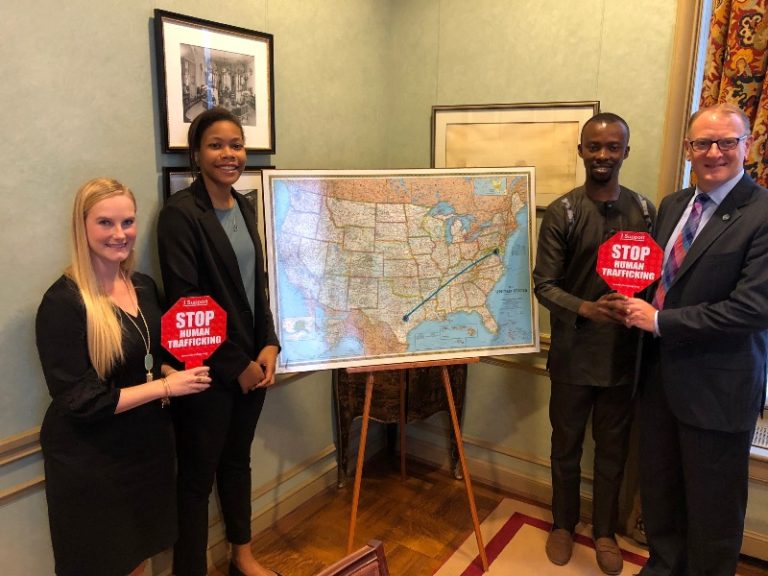
THE invitation to participate in the International Visitors Leadership Programme (IVLP) was a great opportunity and platform for me to explore best practices, innovative approaches and policies to tackling human trafficking. I saw it as a platform to refuel my energy for the fight against human trafficking in Nigeria.
On arrival in Washington DC, I was anticipating the impact of the visit. I was imagining what it would be like being the only anti-human trafficking visitor to engage, learn, and exchange ideas with over 10 human trafficking organizations and government agencies. Before we headed for the first meeting, Mr. Philip Brown- my liaison officer asked me, “Joseph, since this program was specifically designed for you, I hope you will be able to make the best use of it?” This triggered my heart the more to learn and share my experiences with the organizations and agencies.
On 24th September, 2018, I visited Meridian International Centre, Washington DC for an opening session of the International Visitors Leadership Program (IVLP), where Mr. Mark Rebstock, Vice President of Meridian Centre and Ms. Caitlin Betterdorf shared interesting details about IVLP and how to get the best from engaging different organizations and federal agencies. Thereafter, I had a two hour-interesting learning session with Dr. Lenneal J. Henderson (Adjunct Professor of Government College of William) on the overview of the U.S. system of government, its decentralized nature and the decision-making process that flows from the system.
Meetings with government agencies
During my meetings with the U.S Department of Health and Human Services and the U.S Department of States-Office to Combat Human Trafficking, I was amazed at the level of importance the U.S government attached to ending human trafficking. I saw a government that has demonstrated a strong political will to combating human trafficking, and stimulating virtually all the federal agencies to take strategic actions against human trafficking through the Presidential Inter-agency Taskforce Against Human Trafficking (PITF), which comprises: U.S Department of State, Department of Treasury, Department of Defense, Department of Justice, Department of Interior, Department of Agriculture, Department of Labour, Department of Health and Human Services, Department of Transportation, Department of Homeland Security, and Department of Education.
Also, I noticed that the willingness and political will of U.S Government to combating human trafficking was demonstrated in many obvious ways, and one of which was yearly funding for anti-human trafficking projects through different federal agencies. This indicates that the U.S government has set a pace for other countries in fighting human trafficking. However, there is a need for U.S government to increase funding for prevention projects, and as well adjust its current approaches to identifying victims and minor among migrants at her border.
Apart from the federal government, my meeting with Mr. Todd Latiolais at the Office of Child Trafficking Team of Texas Government revealed that most state governments in the United States have state laws/policies and initiatives to tackle trafficking in persons. This was really what I expected from state governments in Nigeria.
Meetings with civil society organizations and associations:
I had an interesting and inspiring discussion with civil society organizations (CSOs) in Washington DC and Austin, Texas. Each of my meetings with different CSOs offered a unique information and experience to me. During my visit to Polaris Project team, I toured their building observing the flow of information of the U.S National Human Trafficking Hotline which they have been operating for more than three years. It was motivating to meet young people at Polaris Project championing one of the greatest campaigns and movement against human trafficking in the United States. Their expertise in using data to stimulate action against human trafficking was superb.
It was exciting meeting and sharing experiences with Vivian Huelgo of American Bar Association (ABA), and Ms. Claire Wilkinson of International Justice Missions. While discussing with Ms. Huelgo, I learnt different approaches to increasing the interest of lawyers in combating human trafficking, and after speaking with Ms. Wilkinson, Vice President, Africa programs of International Justice Mission, I felt the urgent need for religious groups in Nigeria, including Christian and Muslims, to be engaged in combating human trafficking.
At Austin, I had the privilege of participating in the meeting of Texas Coalition against Human Trafficking where I learnt and as well shared my anti-human trafficking experiences. Meeting them was an opportunity to inspire and network with my fellow “Warriors” in the fight against human trafficking.
During the concluding part of my stay in Austin, Texas, I visited Casa Marianella and Austin Safeplace to explore their facilities, learn how they are rehabilitating survivors, and meet with some of the survivors of human trafficking from Africa, North America and South America.
As the figure of the victims of human trafficking continues to rise in Nigeria, the federal government, through relevant agencies such as the National Agency for the Prohibition of Trafficking in Persons (NAPTIP), must as a matter of necessity and urgency, come up with robust policies and programmes to tackle the menace.
Joseph OSUIGWE is the founder and Executive Director of the Devatop Center for Africa Development, a nonprofit organization focused on combating human trafficking and gender-based violence.
DONALD Duke, former governor of Cross Rivers State and presidential candidate of the Social Democratic Party (SDP) has claimed he earns an average of N156 thousand in a month since 2015.
The presidential candidate, who promises to improve tax collection and compliance by deploying up-to-date technology if elected president, pays an average of N13 thousand tax per month.
The claims about his earnings were contained in tax certificate he submitted to the Independent National Electoral Commission (INEC).
The two-term ex-governor between 1999 and 2007 stated that he earned N1,763,157 in 2015, N1,894,736 in 2016 and N1,960,526 2017 from doing business.
He then paid tax of N150, 000 in 2015, N170, 000 in 2016 and N180, 000 in 2017.
However, Duke’s earnings and tax payments do not reflect his lifestyles. His extravagant black power bike at the 2016 Calabar carnival costs more than his combined earnings in three years.
But more telling is that Duke paid just a tax of N500,000 in three years despite his huge pension as a former governor.
He pointed out in the form he submitted to INEC that he had never been indicted for fraud by any judicial panel. He is also one of the ex-governors that had never been investigated by the Economic and Financial Crimes Commission (EFCC).
Duke who was born on 30 September 1961 graduated from Ahmadu Bello University in 1982. He later bagged LLM in Business Law and Admiralty from the University of Pennsylvania in 1984.
He became the Commissioner of Finance, Budget and Planning to the third republic civilian governor Clement Ebri and later the member of the National Economic Advisory and Intelligence Committee under the Abacha regime before he became a governor in 1999.
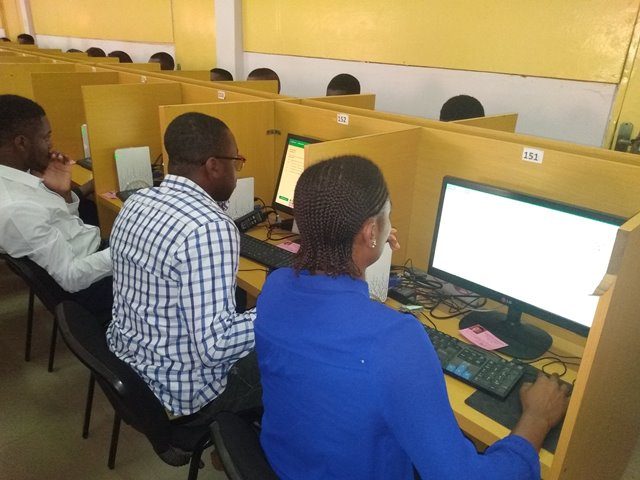
A total of 903 foreign-trained Medical and Dental graduates on Wednesday sat for an assessment examination organized by the Nigerian Medical and Dental Council to be qualified for medical practice in Nigeria.
Explaining the reason behind the examination, Registrar of the Nigerian Medical and Dental Council, Tajudeen Sanusi said that the examination is a global practice that helps to ascertain the level of competency of medical and dental graduates trained outside their jurisdiction.
“Assessment exam for the foreign-trained medical and dental graduates is a global practice that if you trained in a jurisdiction other than yours and you go to another jurisdiction, they want to assess your level of competency so that you can be licensed to practice,” Sanusi said at the headquarters of Joint Admission and Matriculation Board (JAMB), Bwari, the venue of the examination
“Meaning that even those of us that were trained and fully registered in Nigeria, if we decide to go to Ghana, they have to sit for the assessment exam and pass before being licensed to practice in Ghana.”
Asked if how many of the graduates would be registered after the examination, he said though, Nigeria needs more doctors, “quantity cannot be taken for quality.”
“If all of them can pass, I would be fine because we need more doctors in Nigeria, but because we don’t have enough does not mean we should take quantity for quality.”
There is no accurate data on the number of medical doctors currently practicing in Nigeria
In 2015, Folashade Ogunsola , a professor of medicine and chairman, Association of Colleges of Medicine of Nigeria saidNigeria needed no fewer than 237,000 medical doctors to meet World Health Organisation (WHO) standard, and there are about 35,000 doctors working in the country today.
WHO’s ratio for any country to have enough doctors for its population is 1:600 (one doctor of every 600 persons, but it is estimated that at least 2,000 medical doctors leave Nigeria yearly for the United Kingdom, United States, Canada, Australia, United Arab Emirates (UAE), and South Africa.
Speaking about the incidence of quackery in medical practice, Sanusi remarked that quackery is a matter for law enforcement agencies to tackle.
“By our law, anybody that is not in our register list, we have nothing to do with that person. At the best, we can only come in as a prosecution witness when they are arraigned before any court of competent jurisdiction.”
THE body of Idris Alkali, the retired major general who got missing in September, has been found.
The remains of the retired general was discovered in Guchwet in Shen of Jos South LGA of Plateau State, five days after a shallow grave was discovered by the army search party, where his body was suspected to have been buried.
Alkali had been declared missing since September 3 when he set out from Abuja to Bauchi en route Jos. His vehicle was later found in a mining pond where three other vehicles were also discovered.
The leader of the Operation Search and Rescue, Umar Mohammed, a brigadier general,said a parade would be held for the retired officer.
Alkali was the Chief of Administration in the Nigerian Army headquarters, Abuja, before his retirement and eventual demise.
THE Nigerian Police has arraigned Osun State Senator, Ademola Adeleke, and four others before the Federal High Court, Abuja, on a four-count charge of examination malpractice.
On September 19, just days to the Osun State governorship election in which Adeleke contested as the candidate of the People Democratic Party (PDP), the Nigerian police issued a statement summoning Adeleke to report himself at any police station nearest to him, for allegedly conniving with the principal of a secondary school in Osun State to allow him to sit for the 2017 SSCE organised by the National Examination Council (NECO).
But President Muhammadu Buhari ordered the police to stay action on the matter until after the governorship election. Eventually, Adeleke lost the controversial election by a slim margin to the candidate of the All Progressives Congress (APC) Gboyega Oyetola.
The case first came up for hearingbefore Justice I.E Ikwo on October 15 but Adeleke was not in court to take his plea, prompting the trial judge to adjourn till October 31.
At the resumption of trial on Wednesday, Adeleke and his co-accused persons pleaded not guilty to the charges.
The other defendants in the case are Aregbesola Muftau, principal of Ojo-Aro community grammar school Osun state; Gbadamosi Ojo, registrar of the school; Dare Olutope, a teacher in the school, and Sikiru Adeleke, a cousin to the senator who was also alleged to have been involved in the malpractice.
Adeleke and his cousin Sikiru were said to have conspired with the other three accused persons to fraudulently register for the June/July 2017Senior School Certificate Examination organised by the National ExaminationCouncil’s, as students of Ojo-aro community grammar school, Osun State.
Having pleaded not guilty, the court granted bail to Adeleke and two of the other defendants who had filed their respective bail applications ahead of the arraignment. They were ordered to deposit their travelling documents passport with the court’s registrar as part of their bail conditions.
THE leadership of Nigeria Labour Congress (NLC) says it would not accept the N22, 500 minimum wage proposed by the Nigeria Governors’ Forum.
The governors’ forum had late Tuesday announced that states can only afford to raise the national minimum wage from N18, 000 to N22, 500 as against the N30, 000 being demanded by organised labour.
But the President of NLC, Ayuba Wabba while addressing a press conference in Abuja on Wednesday, said the Congress condemned “unequivocally the communique issued by the Nigeria Governors Forum on October 30, 2018″, describing it as an “attempt to undermine the authority of Mr. President.”
“This position should be equally condemned by all.”
This is coming after the Federal Government also said it was not in support of the N22,500 minimum wage proposed by the Nigeria Governors Forum.
The Minister of Labour and Productivity, Chris Ngige, made the stance of the Federal Government known on Channels Television’s Sunrise Daily.
“The governors have not even done enough. I told them that this N22, 500 was even rejected by the Federal Government,” he said.
Wabba at the press conference urged members of the Congress “to continue to mobilize in preparation for the commencement of an indefinite strike on the 6th of November if by then necessary steps have not been taken to adopt the recommendations of the Tripartite Committee.
“We wish to reiterate our position adopted at our National Executive Council (NEC) meeting of 23rd October 2018 that any figure below N30,000 will not be accepted by us,” the NLC president said.
He said that the Congress ‘ demand is that the constitutional, legal and morally right step to take is for the Chairman of the National Minimum Wage Tripartite Negotiating Committee to submit the report of the already concluded National Minimum Wage negotiations to President Muhammadu Buhari for transmission to the National Assembly for consideration and passage into law.
While noting that the Nigeria Governors Forum is not a negotiating body but merely a political organization for the convenience of state governors, Wabba said only 21 state governors sent in their memorandum quoting figures when the tripartite committee from inception sent letters to each state government to send in their memoranda as their contributions to the new national minimum wage negotiating process.
He added that the demand of organized labour was not N30,000 but N66,500.
“Our demand is N66,500. N30,000 is the compromise figure arrived at the end of negotiations by the tripartite partners – Government, Employers and Organized Labour. The new minimum wage was a product of intense negotiations that lasted for almost one year,” he said.
The Governors, he further explained had six representatives on the Tripartite Committee – one state governor represented each of the geopolitical zones.
“The representatives of the state governors were part and parcel of the work of the negotiating committee from beginning to the end. It is important to note that the National Minimum Wage is not an allocation to workers. It is a product of negotiation by the tripartite partners,” Wabba explained.
The unilateral pronouncement by governors of N22,500 Minimum Wage is an abuse of every known principle of industrial relations, labour laws, processes and international best practices.”