Home Blog Page 2649

VIDEO: My story is one the world would want to hear, says Omarosé, Nigerian-American who served under Trump

Omarosé Manigault-Newman, the Nigerian-American lady who recently resigned from Donald Trump’s administration, says the world would be interested in her story as the only African-American Female in the Trump White House.

Speaking to ABCNews’ Good Morning America, Omarosé said she had witnessed “things that have made me uncomfortable, that have upset me, that have affected me deeply and emotionally.”

Her resignation takes effect from January 20, 2018.

Watch a clip of the interview below:

Preacher, actress, broadcaster… Meet Omarosé, the US-born Nigerian who just resigned from Trump’s administration

Not many, especially in Nigeria, have heard about Omarosé Manigault-Newman, who was, until Wednesday, the only African-American female holding a top office in the Donald Trump-led United States government.

Omarosé, whose father is of Nigerian descent, resigned from her role as Director of Communication in the Public Liaison office at the US White House.

Before becoming a staff in the White House, Omarosé had worked as a broadcaster, a reality TV participant, an actress and even a preacher.

JOURNALIST

According to Wikipedia, Omarosé graduated with a bachelor’s degree in broadcast journalism in 1996 from Central State University in Wilberforce, Ohio. She later moved to Washington, DC, to attend Howard University, where she earned a master’s degree and worked toward a doctorate in communications but she did not finish.

REALITY TV STAR

Omarosé first became popular in 2004 following her participation in the first edition of ‘The Apprentice’, a reality TV programme sponsored by the NBC, starring Donald Trump, then a billionaire businessman.

She was described as a controversial, and sometimes, acrimonious character, and was ranked 45th in TV Guide’s ‘The 60 Nastiest TV Villains of All Time’.

Omarosé  was the only participant in ‘The Apprentice’ to be re-invited for the sequel, ‘Celebrity Apprentice’ in 2008. She was eventually fired in the 10th episode, after serving as the project manager of the team.

ACTRESS

Omarosé had several roles as an actress but she is more widely known for appearing in Soul Sistahs (2006), Knock ’em Dead (2014) and We Are Family (2017).

She dated late American Actor, Michael Clarke Duncan, whom she met in 2010. Duncan later died of a heart-related ailment in 2012.

PREACHER

In August 2009, Omarosé  enrolled at the United Theological Seminary in Ohio to pursue a Doctor of Ministry degree.

She received a preacher’s license in February 2011 from her church (Weller Street Missionary Baptist Church in Los Angeles, California) and was formally ordained on February 27, 2012.

In February 2012, she was working on finishing her degree at Payne Theological Seminary.

Omarosé narrated how she came to the decision of becoming a preacher when she visited an orphanage in West Africa, where she encountered a little girl who “was dying of AIDS”.

She said: “It was at that moment, looking into the face, in the eyes of this dying child that I received my call to the ministry.

“Upon returning to the United States, I put reality television on hold. I put everything on hold and returned to seminary full-time.

“There were people who felt like because I had done the (Apprentice) show so many years ago that maybe that disqualified me from the ministry. I’m not really certain.

“But boy did I hear from the critics, and to them I have to say that they underestimate the power of God’s ability to transform a person’s life.”

SO WHY DID SHE RESIGN?

Though there are some reports saying she was fired, Omarosé maintained she voluntarily decided to quit. She however would not elaborate more as her resignation takes effect from January 20.

“I have seen things that have made me uncomfortable, that have upset me, that have affected me deeply and emotionally, that has affected my community and my people,” Omarosé said.

Nevertheless, Donald Trump took to twitter to bid Omarosé farewell and wish her better times ahead.

The task of making life greener in Nigeria, the GHIF story

0

By Michael Orodare

Whichever perspective you may want to view it from, there is a very high level of poverty in Nigeria, and it is having its toll on the socioeconomic development of the people and the largest black nation in the world. Access to fundamental needs such as food, water, clothing, shelter, may sound cheap; they are not cheap for the poor Nigerian for whom poverty has become a companion.

According to a report by the National Bureau of Statistics, NBS, about 112 million Nigerians (representing 67.1 per cent) of the country’s total population of 167million live below poverty level.

In the midst of all these agonising reports of poverty, a non-governmental organisation has been working so hard to make life easy for the people from the north to the south of the country.

Many have been heard and reported about NGOs fighting one social courses in the country, but what is perhaps less known yet is that one among them is doing all these without soliciting funds from local and international donors.

Located in Abuja, the capital city of Nigeria, Green Heart Impact Foundation (GHIF), the NGO, has already saved thousands of lives from the claws of poverty, and remains resolute on making life greener for the people who make up the Nigerian poverty index.

Founded by Munira Suleiman Taninu in June 2014, GHIF has been assisting and empowering the less privileged across the country through innovative programmes that address root causes of poverty, from the north reported with the highest level of poverty to the south.

Perhaps no one feels the pulse better than one who has had first-hand experience of what it means for people not to have access to basic needs of life; this informs why the Founder of GHIF decided to take up the task of helping people get out of the claws of poverty and hardship with her personal income.

“I grew up in the north with a very large family. While growing up, people came to our house every day to ask for food and other needs,”says Munira.

“In every family in the north, you’ll have four people around you who depend on you for basic needs of life. I grew up helping my father to assist the needy, so that drew my attention and it became my passion to help people who don’t have. Although I am not a rich person, I still try as much as I can to help.”

The President of GHIF is no doubt proud of the sterling achievements of her NGO in few years without external support.

Three-year-old Zahra’u is one of the success stories of the humanitarian efforts of GHIF. Zahra’u lay helplessly at the malnourished unit of the Asiya Bayero Children Hospital in Kano as her hapless parents watched the clock tick, probably expecting death to take her; they had no hope of giving her a chance to live. She was critically ill and suffered from a severe case of malnutrition. She was at the throes of death; it was just a matter of days before she lives to live no more.

“When the GHIF team visited the hospital during one of our routine visits, we found few children suffering from malnutrition, but Zahra’u’s condition caught our attention and prompted immediate action from the team. We had to pay people to donate blood for her and other malnourished children who needed blood donation at the hospital. We donated health, food and other materials to her,” Munira narrates. Zahra’u survived.

During one of its community services, the GHIF team also discovered Mallam Hassan, with his four children, resident in Kano. He suffers from a form of disability that has prevented him from getting employed to meet the needs of his family.

“The GHIF team took interest in his case. We visited his home which was in a deplorable state. From our interaction with his children, none of them was enrolled in a school. This prompted a quick intervention. We renovated Hassan’s home and built a shop for him to start trading in food commodities supplied by GHIF while we enrolled all his children in school,” Munira said.

Today, millions of children in Nigeria especially in the northern part have dreams, but many of them don’t see it coming through because poverty has denied them access to the major step of reaching their dreams – education. The Permanent Secretary, Federal Ministry of Education, Adamu Hussaini, recently said Nigeria has the highest number of out-of-school children in the world. He puts the figure of out-of-school children in Nigeria at 10.5million of the cumulative 20million out of school children in the world.

There are over 130 million girls around the world that are out of school, and statistics show that by the year 2030 this population may double. The girls, from age 10 and above, are not just out of school, they roam the streets hawking for their parents. Hawking has taken the place of books; many of the girls are given away into marriage once they reach their teenage years, to probably rich men who the parents of the girls believe can give succour to their hardship.

In Nigeria, aside from the fear of underage marriage, the present plight of girl-child hawkers from age 10 and above represents a major health and socioeconomic challenge, which is known to be a preliminary step to societal ills such as prostitution, drug abuse and human trafficking, which sequentially have an adverse effect towards the development of the nation. To tackle this, the GHIF team recently flagged off a project to reduce girl child hawking in Nigeria, tagged #BooksOverTray

The GHIF President says “the project aims to reduce the number of girl-child hawkers across the nation via a process that identifies and extracts the girl-child hawkers from the circle of child labour through provision of educational grants and empowerment for their parents/guardians”.

Taking girls off the street from hawking can be difficult, especially when the finances and the livelihood of the family depends on them, the move could be met with brick walls from their parents who depend on the ‘tray’ as a source of daily meal ticket for the family.

Putting this into consideration, Munira says “GHIF adopted the strategic approach of empowering the mothers as they take the tray away from their daughters, so the hardship won’t felt”.

“In the last two months, we have taken 54 girls off the streets in five northern states; 10 each from Kano, Kaduna, Sokoto, Niger and 12 from Borno State, and we have also empowered 54 mothers to start up businesses while we enrolled their daughters in a boarding school, all expense, from tuition fees to books, their feeding and other needs, paid for by the GHIF team,” she says.

It is widely believe that African women are a major economic force in their homes and policy makers believe empowering the women translate to empowering the family. This seems to have informed Munira’s decision to make the mothers economically independent while their daughters go to school.

Munira does not see herself as an affluent African lady, neither is she a money bag, one would then wonder how she gets funding for all the huge work the GHIF team has been doing in the last three years.

“Collaboration and support from the team and my personal finance have been our source of finance. I put 10 per cent of monthly income from my events centre in Abuja, my farm and transport service into the foundation,” she says. “I wanted to do something different, my dream was to make it stand out and prove that NGO can run without soliciting for funds from international donors, government and the affluent in the society.”

From the Internally Displaced Persons (IDPs) camp in the North East and Abuja, to Sokoto, to Kano, to Wauna village in Lere local government area of Kaduna State and other parts of the country where GHIF has empowered widows with grinding machines, spaghetti making machines and sewing machines, among others, to start up businesses, men and women are also being equipped with innovative skills to make them stand out in the society. GHIF has stamped an indelible mark on humanitarian service in Nigeria with the empowerment of over 4,000 people across the country.

Like every other African lady, Munira had dreams while growing up. This dream she pursued vigorously from childhood, studying through the university and bagging a degree in Sociology from the University of Abuja and a Certificate in Communication from Harvard University. But unlike other African ladies pursuing a career in the banking or oil and gas sector, that’s not Munira’s way of being the woman of her dream. Fulfillment for her is about uplifting the less-privileged in the society, and make sure they all smile to bed every day.

Munira and her GHIF team have chosen their path, and no doubt they have chosen rightly, to empower the less privileged, give them a fillip for better life, and also contribute to turning around the poverty index in Nigeria.

Court extends ‘killer wife’s’ prison stay to February 2018

Justice Yusuf Halilu of the FCT High Court, Jabi, has refused to grant bail to Maryam Sanda, who is standing trial for allegedly murdering Bilyamin Bello, her husband, in their Maitama, Abuja, residence last month.

Sanda is the daughter of Maimuna Aliyu, former Executive Director of Aso Savings and Loans, whose nomination to the Board of the ICPC was overturned after the ICIR revealed she was being investigated for alleged corruption by the same agency.

Though Sanda had initially been arraigned on a two-count charge of culpable homicide and tampering with evidence, to which she pleaded not guilty, the charges were later amended to include her mother, Maimuna; his brother, Aliyu, and another suspect whose name was given as Sadiya.

According to the prosecution, the newly-added defendants were the ones who had tampered with the crime scene before investigators arrived.

At Thursday’s hearing, they all pleaded not guilty to the charges against them.

Joseph Daudu, counsel to the accused persons, presented a medical report before the trial judge, urging him to grant the defendants bail, especially as Maryam, the principal suspect, is a nursing mother.

However, the prosecution team, led by Jacob Idachaba, opposed the bail application, saying that though he sympathizes with the baby, it is insufficient reason to ask for bail for the principal suspect.

As for the other three defendants, Idachaba argued that they should be in prison custody, adding however that the court should use its discretion to determine whether to grant them bail or not.

In his judgement, Justice Yusuf Halilu held that the principal suspect was strong enough to face trial, adding that the medical report presented by the defence counsel did not state that her ailment could not be adequately treatedat the prison’s medical facility.

“I have gone through the arguments of counsel for the defence and that of the prosecution as well as section 161 (2) of the ACJA relied upon by Daudu with regards to exceptional cases,” Justice Halilu said.

“However, there must be cogent evidence to show that the sickness the first defendant is suffering from is that which cannot be taken care of within the medical facility. It is not enough to include a medical certificate.

“Effort must be made to show that the defendant cannot be treated in the medical facility at the detention camp.

“I have seen from where I am, which is close to the duck that the first defendant is strong enough. The first defendant who has been inside the duck for over an hour is very strong.

“On the whole I am not favourably disposed to granting the first defendant bail. My discretion in her favour is hereby withheld.”

For the other defendants, Halilu granted them bail on the condition that they must produce “two sureties with evidence of residence within the centre of Abuja”.

“They shall deposit their travel documents in court. The two sureties shall deposit documents for their landed properties to the registrar of the court,” he said, before  adjourning the case to February 5, 6 and 7, 2018.

Governors approve $1bn from excess crude account for Boko Haram war

0


The 36 state governors of the federation have approved the release of $1 billion from the Excess Crude Account (ECA) to boost the Federal Government’s fight against Boko Haram.

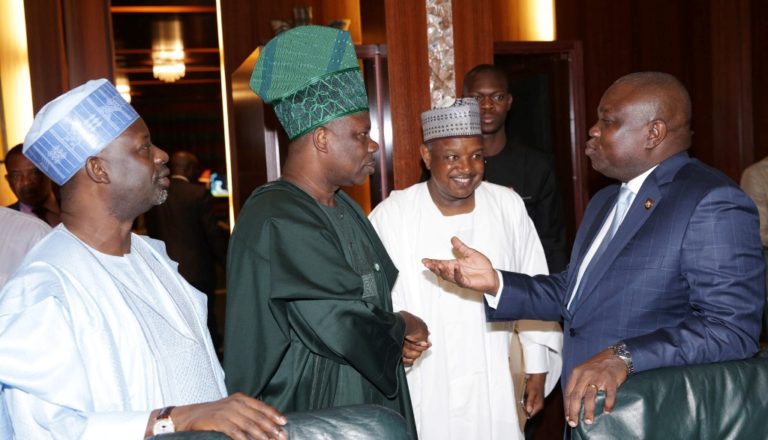
Godwin Obaseki, Governor of Edo State State, disclosed this on Thursday to State House correspondents after the meeting of the National Economic Council (NEC)) at the council chamber of the Presidential Villa Abuja.

The meeting, attended by all the state governors, was chaired by Vice President Yemi Osinbajo.

“We are pleased with the Federal Government achievements in the insurgency war; and in that vein, state governors have approved that the sum of $1 billion be taken from the Excess Crude Account by the Federal Government to fight the insurgency war to its conclusion,” Obaseki said.

Hassan Dankwambo, Governor of Gombe State, who spoke earlier, said the Excess Crude Account had a balance of $2.317 billion as of December 13, 2017.


Jibrin to Buhari: Don’t let Dogara get away with the falsehood in his biography


Abdulmumin Jibrin, suspended former Chairman of the Appropriations Committee of the House of Representatives, says President Muhammadu Buhari has never met with him over the budget padding allegations he made against Yakubu Dogara, Speaker of the House.

Jibrin, who made this known in a series of tweets of Thursday, called on Buhari to “make clarification if indeed such event ever took place”.

He was replying to comments attributed to Dogara in his biography, written by Dele Momodu and set to be presented to the public on December 22.

The biography, titled ‘A Reed Made Flint’, claimed that after Jibrin had accused Dogara and other principal officers of the house of budget padding, Buhari met him and warned him never to raise such arguments again if he had no evidence to substantiate his claims.

“Although Hon. Jibrin himself had subtly blackmailed Mr President on a Channels TV interview, he still managed to get some elements in the security services to ferry him before Mr. President where he made the allegations of padding against us,” Dogara was quoted as saying in the book.

“As a principled and experienced leader that the President is, he sought to know where the other leaders of NASS were when the budget was padded by just four leaders of the house.

“None of our traducers could answer the question. Since he does not suffer fools gladly, he told them that except they answer the question nobody should bring up the subject matter to him again.

“That was how the lying cowards left him and never returned. They dare not mention anyone in the Senate or the House Leadership when every informed person knew that no position on any aspect of the budget can be taken without the concurrence of the Senate.”

But in his reply, Jibrin said: “Mr President is known for his integrity and disdain for lies. It will be in the public interest if he respectfully makes clarification if indeed such event ever took place. It will be a huge disservice to the country if Speaker Dogara is allowed to get away with such falsehood.

“Moreso that Mr President wrote the forward to the book and by implication giving some validity to such falsehood against himself as well.

“After writing 3 letters to Mr President seeking audience without response, I gave up. I did my best and left everything to the anti-graft and security agencies.

“The false allegations in the book has left me with no choice than to speak out as my last resort to clear such lies.

“It will be unfair to me if we allow Speaker Dogara in continuation of his witch hunt against me after keeping me illegally away from the House for 15 months to use the name of Mr president in his expensive image laundering in an attempt to clear himself of any wrongdoing.”

Jibrin said he had been in court for the past 15 months challenging his illegal suspension from the House. He called on Buhari “to appeal to Chief Justice of the federation on our behalf for speedy dispensation of justice in this matter of utmost national importance”.

“We challenged the suspension in court with an originating summons. It’s a constitutional matter. The case has been in court for 15 months,” Jibrin said.

“A similar case in respect of Sen Ndume was dispensed with within three months by the court! We don’t want to believe something is wrong.”

VIDEO: It’s a baby boy for Nigerian migrants who fell in love at Libyan cell

Two Nigerians, Stephen Ekhiator and Mabel Emmanuel, met at a migrants’ detention camp in Libya and fell in love with each other. Today, they have a son together.

Ekhator narrated to BBC Africa how he had tried several times to cross the Mediterranean sea into Italy but could not succeed.

“You cannot determine your wife to be, or where you can find her. It can just happen suddenly,” Ekhiator said.

“He [his son, David] was born inside the deportation camp. We were in the deportation camp together when she [his wife] was giving birth.

“I felt bad; every day I cried. I couldn’t even eat. I must say Libya is a prison, a life where there is no freedom.

“I have tried [crossing the sea] five times; I failed. Twice my boat capsized on top of the sea. What I will tell people that want to go (to Libya) is, ‘never even think about it.'”

Ekhiator then burst into a song in pidgin English: “Who no go no go know, who no go no go wetin we see.” Then he adds: ”That’s how we always sang it in the deportation camps.”

Thankfully, however, Ekhiator and Mabel are part of the migrants who were recently repatriated to Nigeria following the intervention of the International Orginisation for Migration (IOM)

Watch the video below, courtesy of BBC Africa:


My client has been paid and he didn’t run mad, says Ikoyi whistle-blower’s lawyer

Yakubu Galadima, the lawyer of the whistle-blower who provided information that led to the recovery of about N13 billion from a residential apartment in Ikoyi, Lagos, says his client has received the first tranche of his reward by the Federal Government.

Galadima told journalists that his client did not run mad on receiving his payment, contrary to the predictions of Itse Sagay, Chairman of the Presidential Advisory Committee on Anti-Corruption (PACAC).

Sagay had said that FG delayed payment of reward to the whistle-blower because he could have run mad if such huge amount of money was paid to him at once.

Galadima also said the whistle blower travelled out of the country hours after receiving part of the N421m reward.

“My client confirmed to me that he had received a credit alert from the Federal Government. He travelled out of the country this morning (Wednesday morning).

“He has been paid the first installment but there were many tax deductions. Yes, we are happy.

“I will give you details later but I can confirm now that he has received some money. As you can see, my client did not run mad as predicted by Prof. Itse Sagay.”

Galadima praised the government for keeping its promise, adding that the payment of the reward to his client signifies government’s commitment to the whistle-blower policy.

A couple of weeks ago, Kemi Adeosun, Minister of Finance, had said the money for the payment of reward to whistle blowers had been approved.

She said the money would be paid directly into the whistle-blower’s account and not that of his lawyer or anybody else’s.

Adeosun also said that all the taxes accruable on the amount would be paid directly into the account of the state government where the beneficiary resides.

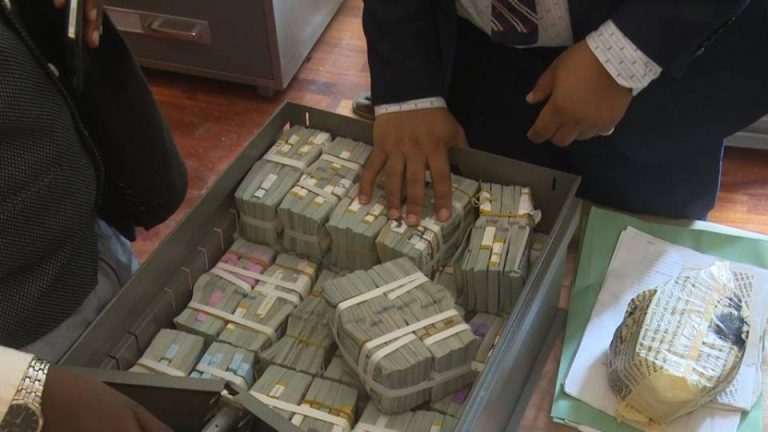
In April this year, the EFCC recovered huge sums of money in local and foreign currencies – totaling N13 billion – from flat 7bn, Osborne Towers, Ikoyi, Lagos State, following an intelligence from a whistle-blower.

Ayodele Oke, former Director-General of the National Intelligence Agency (NIA), laid claim to the money saying it belonged to the agency.

According to Oke, the money was approved for the NIA by President Goodluck Jonathan in 2015 to enable it carry out some “covet operations”. But Oke could not satisfactorily explain how and why the money ended up in a residential apartment allegedly owned by his wife.

Attempts to arrest Oke last week was unsuccessful, as DSS and NIA operatives stationed at his Maitama, Abuja residence refused to cooperate with the EFCC personnel that came for the operation.

In biography written by Momodu, Dogara addresses budget padding allegations

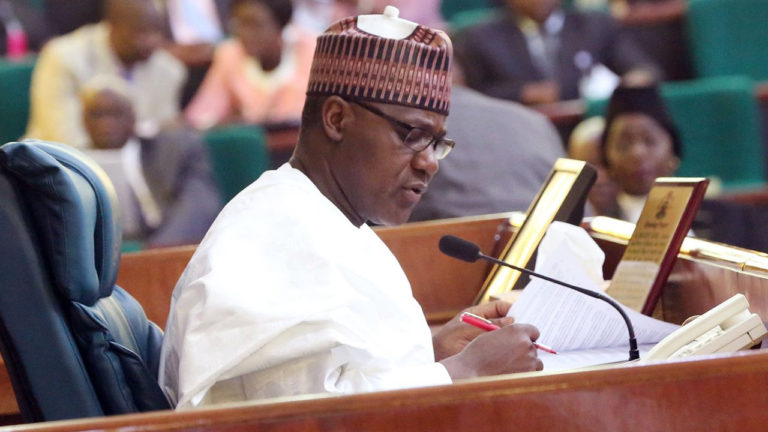
Yakubu Dogara, Speaker of the House of Representatives, says he never interfered with the 2016 budget or tried to exact undue influence on the House committee on appropriation, then headed by Abdulmumin Jibrin.

Dogara made this known in his biography — A Reed Made Flint — written by ace journalist Dele Momodu, a copy of which was obtained by TheCable newspaper ahead of its public presentation scheduled for December 26.

Sometime in July 2016, shortly after he was removed as Chairman of the appropriation committee, Jibrin began making series of allegations against Dogara and three other principal officers of the House: Yusuf Lasun, Deputy Speaker; Alhassan Doguwa, Chief Whip; and Leo Ogor, Minority Leader.

Jibrin alleged that the four lawmakers illegally inserted phantom projects worth hundreds of billions of naira into the 2016 budget.

He was later suspended from the House for 180 legislative days after he refused to withdraw the allegations.

But in his biography, Dogara said he never even knew what was in the budget, as he trusted that the appropriation committee, under Jibrin’s leadership, was competent enough to handle the budget.

“My kind of nature is not the kind that insists on breathing down your neck, having given you an assignment,” Dogara was quoted as saying in the book.

“So, attempting to interfere in everything committees are doing was not my line. I believe in giving everyone considered competent enough to handle posts to thrive in them.

“I don’t believe in making my colleagues feel distrusted. I give you that freedom to do your work. Having trusted you, I will not bother you too much. I never went to Jibrin to ask for anything in the budget. Never! Even once!”

“Occasionally both leadership of the Senate and the House would meet and ask [Danjuma] Goje [Chairman of the Senate Appropriation Committee] and Jibrin to give the position of things, how discussions on the 2016 Budget were going on, how they were doing and so on and so forth.

“But I gave him absolute free hand to operate. He did that up to a point that the Budget was written and compiled I hadn’t seen anything.

“I didn’t know what was there. As a matter of fact I didn’t even know the kind of projects that he has included for me or any other person in the Budget.

“I was even in London when they submitted the details to the President for his assent. It was only after I got back home that Jibrin brought the details of the budget to me for the very first time.

“Absolutely, I had no hand, no prior meeting with the committee. I didn’t sit with them at the secretariat to say ‘Oh, include these projects for me. You must do this. You must do that.’ Never! Even for a day.”

Dogara admitted that Jibrin, who had supported Femi Gbajabiamila in the run-up to the election of the House Speaker, later defected to his team and supported him 100%.

“I will say that although Honourable Abdulmumin Jibrin wasn’t with our team initially, he later supported me 100%, wholeheartedly. Luckily his secretariat wasn’t far from ours and he was handy.”

Dogara, however, added that people had warned him that “it is suicidal to entrust such an important post (of appropriation chairman) to such a man” as Jibrin, but he never listened.

SETBACK: Anti-NGO bill records zero support during public hearing

The Non-Governmental Organizations Regulatory Commission (Establishment) Bill has suffered its first major setback, recording zero support during Wednesday’s public hearing at the House of Representatives.

The bill, which was introduced by Umar Buba Jibril in June 2016, had passed the first and second readings despite several protests by NGOs.

At the hearing on Wednesday, Peter Akpatason, Chairman of the House Committee on Civil Society Organisations and Development Partners, asked the audience whether anyone supported the bill but no one answered in the affirmative.

Outside the national assembly complex, a crowd of protesters comprising members of the civil society and NGOs bore placards and chanted songs urging the House to kick out the bill.

Speaking at the hearing, Hassan Kukah, the Catholic Bishop of Sokoto Diocese, said he decided to lend his voice to the call for the withdrawal of the NGO bill because he was convinced that there are existing laws that already captured everything the bill seeks to achieve.

“I stand with civil society very firmly,” Kukah said. “We have enough laws already to cover every sphere of the country.

“The intentions might be right but I think we can channel our energy to other things.

“Without civil society, democracy will be in danger in Nigeria. We have so many laws covering what this bill is seeking to do.”

The NGO bill has been roundly criticised by many Nigerians who believe it was a sinister move by the legislature to gag civil society organisations.

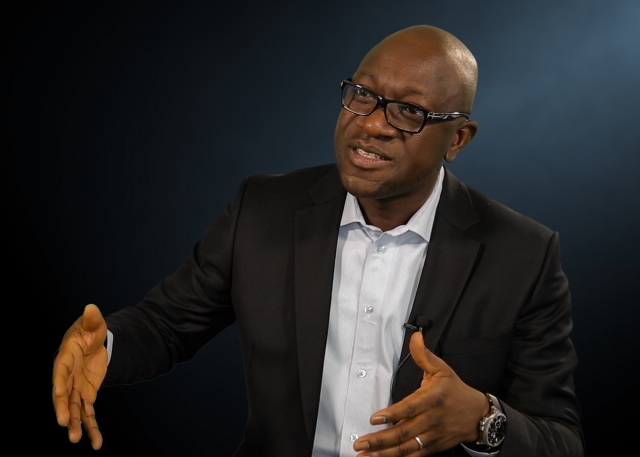
Among the major opponents of the bill is Chidi Odinkalu, former Chairman of the National Human Rights Commission (NHRC), who has written extensively and produced video clips to sensitise Nigerians on the dangers of allowing the bill get passed into law.

Akpatason promised that his committee would make its recommendations to the House in plenary without prejudice.