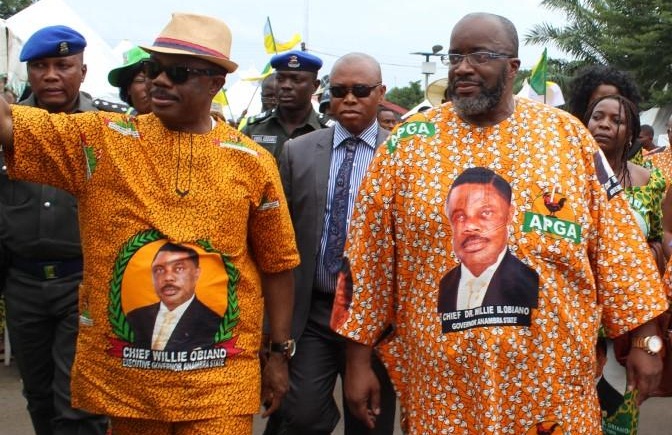
Emeka Ojukwu jnr, son of Chukwuemeka Odumegwu Ojukwu, founder of the All Progressives Grand Alliance (APGA), has decamped to the All Progressives Congress (APC), saying he is leaving the shadows for light.
The younger Ojukwu made his declaration on Wednesday in Awka, at the final campaign rally of Tony Nwoye, candidate of the APC in the Anambra governorship election holding on Saturday.
The rally was attended by President Muhammadu Buhari; John Odigie-Oyegun, National Chairman of the APC; 12 APC governors and other prominent members of the party
“It is time to leave the shadows for light. Every now and then, they come out with my father’s shadow to confuse the people,” Ojukwu said.
“Mr President, I am proud to stand here today in support of you and in solidarity with the APC and our candidate, Tony Nwoye.”
According to Ojukwu, APGA is a means to an end, not an end itself.
He recalled that his father joined the National Party of Nigeria (NPN) in the Second Republic in order to ensure that Igbo people remained in the mainstream of Nigerian politics.
In his response, Oyegun said Nwoye would do a repeat of 2015, when Buhari defeated then incumbent President, Goodluck Jonathan.
He urged the people of the state to vote en masse for the party and Nwoye on Saturday.
The defection of Emeka Ojukwu from APGA to APC may not do much harm to the electoral fortunes of Willie Obiano, the sitting Governor of Anambra State, who is also running for a second term in office.
Unlike his father, the younger Ojukwu has not been a significant figure in Anambra State politics.
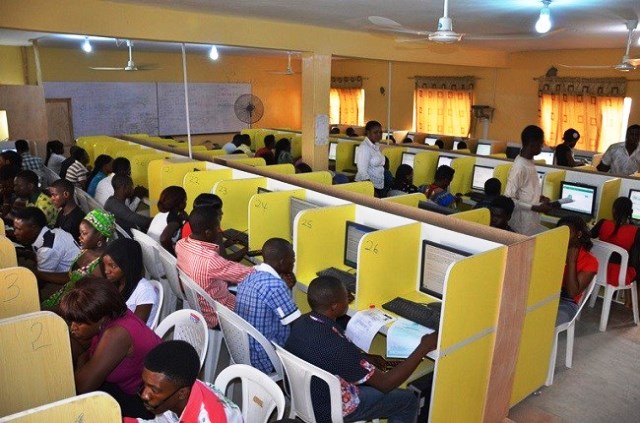
The Joint Admission and Matriculation Board (JAMB) has proposed March 9 to 17 for the conduct of the 2018 Unified Tertiary Matriculation Examination (UTME).
Ishaq Oloyede, Registrar of JAMB, said this on Wednesday during a meeting with stakeholders on the plans and programmes of the Board in 2018.
Oloyede said the mock UTME will hold from January 22 to 27 and it will be only for students who have indicated interest.
He added that the price of the form will be N5000.
“The mock examination is starting the same date the sales of form is ending. Eye glasses are to be examined properly before candidates are allowed into the examination hall,” Oloyede said.
The news that Moji Christianah Adeyeye will become the new Director-General of the National Food Drug Administration and Control (NAFDAC) has been in the media for some days now but it only became official on Tuesday.
“The President of the Federal Republic of Nigeria, His Excellency, Muhammadu Buhari, GCFR, has approved the appointment of PROFESSOR MOJI CHRISTIANAH ADEYEYE, as the Director-General of National Agency for Food and Drug Administration and Control,” read a statement issued on Tuesday by Mohammed Nakorji, Assistant Director (Press), Office of the Secretary to the Government of the Federation.
Stakeholders in the sector have described the appointment as a round peg in a round hole given that Adeyeye is coming into the job with curriculum vitae that is quite extraordinary.
ONE ADEYEYE EACH IN THE EXECUTIVE AND LEGISLATURE
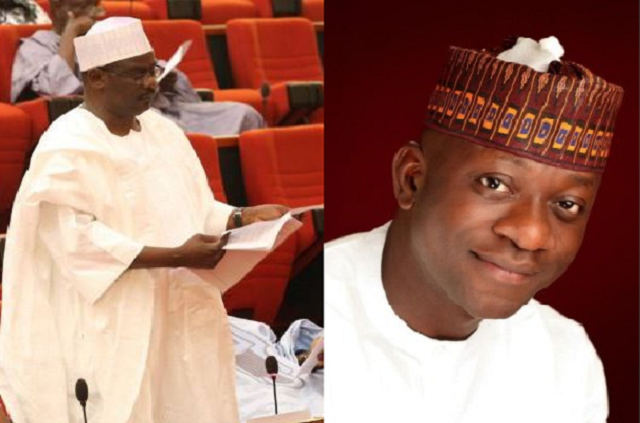
Olusola Adeyeye
Moji Adeyeye, a Professor of pharmacy, is the wife of Olusola Adeyeye, the outspoken Chief Whip of the Senate, who himself is a Professor of Biology.
The couple have three children: two daughters and one son.
Perhaps the regular bickering between the legislature and executive, a major characteristic of the Muhammadu Buhari administration, is about to get more interesting.
LIONESS, OWNER OF FIVE PATENTS
Moji Adeyeye graduated from the University of Nigeria, Nsukka, in 1976 with a bachelors’ degree in Pharmacy. Graduates of UNN are usually referred to as Lions/Lionesses.
She had brief stints at the University College Hospital, Ibadan, and Baptist Hospital, Ogbomoso, between 1976 and 1980 before proceeding to the University of Georgia, Athens, GA, USA, where she obtained a Masters’ and Doctorate degree in Pharmaceutics in 1985 and 1988 respectively.
Adeyeye is the owner of six patents, including one each on the production of anti-retroviral drugs and drugs for treatment of breast disease.
A patent is an authorisation or licence conferring a right, especially the sole right to exclude others from making, using, or selling an invention.
She has mentored over 15 PhD and M.S candidates, and has published several books and research articles in reputable journals across the globe.
ORGANISATIONS FOUNDED
Adeyeye is the founding Chair of Biopharmaceutical Sciences and Professor of Pharmaceutics and Drug Product Evaluation at the College of Pharmacy, Roosevelt University in Schaumburg, Illinois, United States.
She is also the founder of Drugs for AIDS and HIV Patients (DAHP), a nonprofit organisation committed to prevention, education, care and treatment of HIV/AIDS children in Nigeria.
Adeyeye founded the ‘Sarah Extended Family Homes for Children’ an extension of DAHP, which aims to provide care for children with HIV/AIDS from kindergarten to the university.
She is also the founder of Elim Pediatric Pharmaceuticals.
Since the President sacked Paul Orhii in February 2016, NAFDAC has not had a substantive Director-General. Yetunde Oni and Andrew Magbojuri have had spells at different times as acting DGs.
Grace Diashe says she has not had a sound sleep since November last year when she started work as a nurse at a rural health centre.
The 47-year old mother of three is the only qualified health worker at the only health centre in Edikwu-Icho, a swampy community of about 2,500 people in Apa Local Government Area of Benue State.
Dominated by Tiv speaking people, the agrarian community is cut off whenever it rains, as five-foot deep flood water covers the only road that links it with the outside world.
Mrs. Diashe recounted her experience on a day she went to the local government headquarters to replenish her centre’s drugs stock.
“I was on my way back and the rain was heavy. When we got to a hill, the okada man (motorcycle taxi operator) said he could not go any further. I had to carry the drugs on my head and started wading through the flooded road under the rain. I fell several times and the flood would have carried me away,” she said.
Edikwu-Icho village has no electricity. But the health centre has a rechargeable lantern and a small electricity generator, which Mrs. Diashe and her assistants use only for deliveries or emergencies at night.
According to the nurse, the centre attends to about 15 patients from the community and its environs daily. In a month, she said, she takes about 25 deliveries.
“We lack staff, drugs and equipment,” she lamented.
Assisting Mrs. Diashe at the centre are three community extension workers. They all work 24 hours with no shifts.
“I only have three health attendants assisting me. If I am carrying out delivery and I encounter challenges, I refer the person to Aliade, which is far,” she said.
“If there is a doctor here, he would handle these issues and save lives. But which doctor will come here? It is hard to get a qualified doctor to agree to work in this kind of community with no light, basic amenities and terrible road covered with flood water,” she said.
THE ABANDONED PHC
To help tackle the health challenges in the community, in 2014, the National Primary Health Care Development Agency, NPHCDA, allocated a primary health care project to Edikwu-Icho.
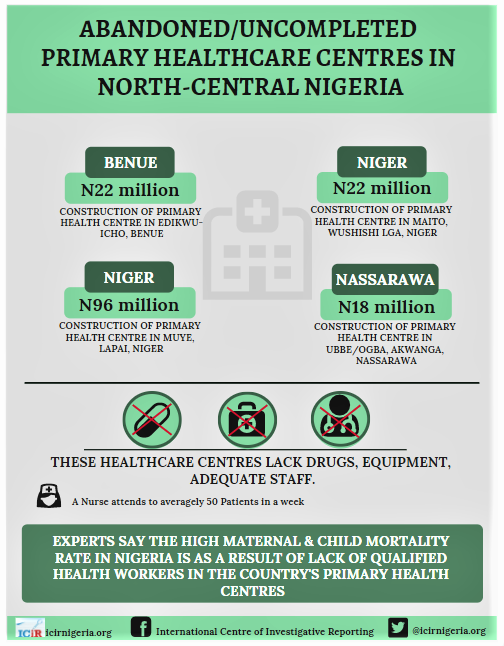
The agency awarded a N22 million contract for construction of the facility to Ogason Construction Ltd. The roofing and painting of the building excited Mrs. Diashe and her colleagues. But the excitement lasted only a while.
Going by the blueprint of the NPCDA, a PHC will have one or more doctors, a pharmacist, a staff nurse and other paramedical support staff to provide outreach services such as immunisation, preventive and basic curative care, monitoring and evaluation services, as well as maternal and child health services.
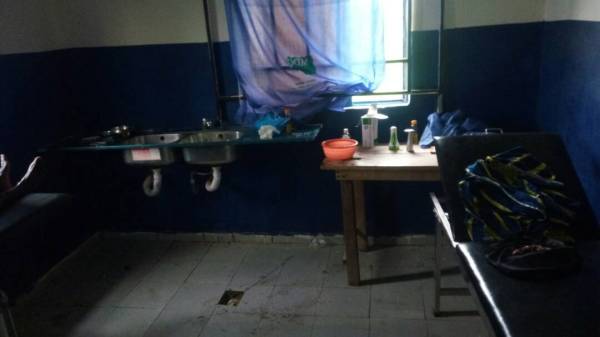
Poorly equipped labour room in Edikwu Icho health centre
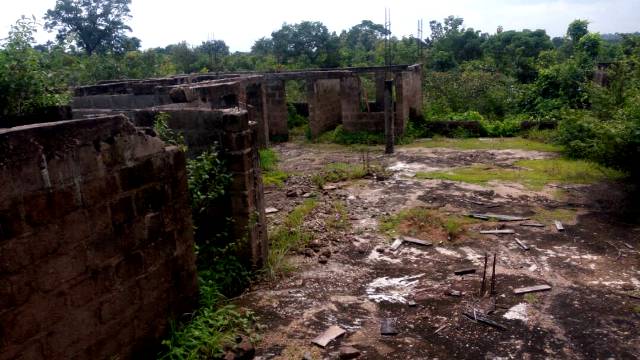
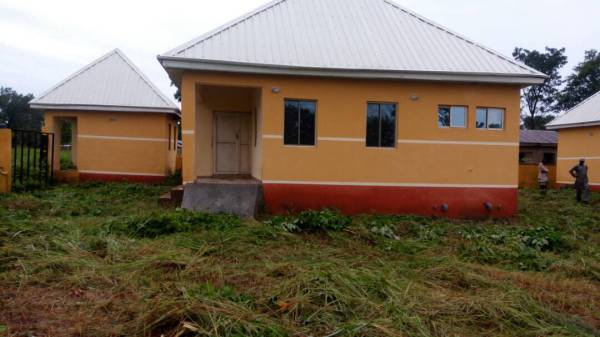
By the time this reporter visited in August, the project in Edikwu-Icho had long been completed but abandoned. The building was under a thick bush with the gate under lock and key.
So the only functional health centre in the community has thus remained the one where Mrs. Diashe works. It was built as a Millennium Development Goals project by the President Goodluck Jonathan administration.
“If they had completed all the work in that place and equipped it, we would have moved over,” the health worker said, pointing in the direction of the abandoned PHC.
Apart from Malaria drugs, immunisation kits and other health packages usually donated by non-governmental organisations, there are no other drugs for Mrs. Diashe to dispense to her patients.
The situation in Edikwu-Icho mirrors the challenges health workers face in several health centres across Nigeria, especially in rural areas.
The federal government in January this year said it had concluded plans to engage 200,000 voluntary health workers to improve delivery of immunisation, antenatal care and other health services in rural areas. The announcement followed the flag-off of a scheme to revitalise about 10,000 healthcare centres across Nigeria.
But about 10 months later, all the eight primary healthcare centres visited in Niger, Benue and Nasarawa states in North-central Nigeria had no doctors, drugs or equipment. The few health workers at the centres attended to multitudes of patients, often working no shifts.
Completed but abandoned health centre built by NPHCDA in Edikwu Icho community, Benue state.
According to experts, the high maternal and child mortality rate in Nigeria reflects the widespread lack of qualified health workers, and simple and cost-effective interventions at the primary health care centres in the country.
MORE WORRYING CASES
The sorry state of Nigeria’s PHCs is also reflected in Maito, a village in Wushishi Local Government Area of Niger State. Bats hung from the roof of the dilapidated building, with the droppings of the rodents spreading a heavy stench over the facility.
The centre was constructed by NPHCDA through a contract awarded to Sycamore and Vie Ltd. also at N22 million. But since the building was completed, it has not been equipped or staffed and was overgrown by weeds and occupied by goats when Premium Times visited in August. The people of Maito had thus continued to rely on an old, dilapidated clinic.
A nurse at the clinic, Mariam Mohammed, told this reporter that she had decided to leave her job due to the neglect of the centre by government.
“It is not proper to treat a sick person here,” she said. “Some people will come here, look at the environment and go back.”
Dilapidated building at Maito Primary Health centre, Wushishi LGA, Niger state.
“The ceiling of our injection room fell down. As you can see, it is wide open. I have to cover my nose throughout the day because of the stench.
“I don’t want to contact disease because of treating people. We have complained about this condition. If nothing is done, I will leave,” Mrs. Mohammed said.
The health workers at the PHC in Adawa Mbiaise Ullam in Gwer East LGA of Benue State got tired of complaining and decided to contribute money to help the local government.
“Up to 25 health centres in this local government contributed N70,000 and gave to the authorities to supply us drugs since we are not getting them free,” Samuel Ajonu, a health attendant told this newspaper.
“But since March when we made the contribution, we have not heard from them or seen the drugs.”
Mr. Ajonu said the centre has two volunteer nurses and “an OIC (officer in charge)” visits every fortnight. He said inadequate drugs, equipment and qualified staff top the challenges of the centre.
“There was a time an 18-year-old girl was unable to deliver,” Mr. Ajonu recalled. “We were rushing her to the clinic at St. Vincent’s Hospital but the child came out on the way. The girl had a severe tear and had to be stitched. If we had proper equipment and a good doctor, this could have been averted.
Health centre in Adawa Mbaise Ullam in Gwer East Local government, Benue state funded by Millennium Development Goals Project.
“We don’t have enough staff, no lab technician. It is even hard to do immunization here because most times, I will be the one to do everything,” he said.
There were 11 health workers, including nurses, at the primary health centre in Ubbe/Ogba in Akwanga Local Government Area of Nasarawa State. A new building awarded at N18 million by NPHCDA to Swaleys Nigeria LTD was abandoned.
The nurse in charge of the existing centre, Grace Edero, told PREMIUM TIMES: “If they had completed that clinic, we would have moved in there because this one no longer contains us.”
“Drugs and equipment brought for the abandoned health centre were stockpiled in the chief’s place. When we approached him to give them to us to treat people, he said he does not know us and cannot release them.
“They are there rusting while many people are in need of those drugs and equipment,” Mrs. Edero said.
The chief was attending a burial somewhere outside the community when the reporter called at his residence.
The health workers in Ubbe/Ogba also complained about poor pay. “We only get paid by percentage,” a nurse said.
NPHCDA awarded a N96 million contract for rehabilitation of the PHC in Muye in Lapai LGA of Niger State. The structure was well built, with a large open ward, labour room, children and female wards, doctors office and staff quarters. It also has an ambulance, a solar power facility and a sturdy gate post.
Abandoned PHC at Ubbe/Ogba Akwanga LGA, Nasarawa State
When this reporter arrived the centre at about 3:30 p.m. in August, the centre was wide open but with nobody around at the facility. A probe around the village led to a male nurse and an assistant running the huge facility.
“The centre has no doctors, qualified midwives, pharmacists or nurses. There were also no security persons or labourers. “We don’t even have a driver for the referral vehicle,” Ibrahim Abdullahi, one of the workers said.
“We treat at least 15 people daily and we don’t have shifts. That’s why we leave the place open and go home to attend to personal needs because we cannot be here every hour. It is just two of us.”
WHOSE RESPONSIBILITY?
Provision of health care providers is the responsibility of the federal and state health ministries, according to the National Health Act of 2014.
The federal government through the health minister, however, has the bulk of the responsibility.
“The minister, with the concurrence of the National Council shall determine guidelines that will enable the state ministries and LGAs to implement programmes for the appropriate distribution of health care providers and health workers.
“The minister shall make regulations with regards to human resources management within the national health system,” Part 5 of the law reads.
Through the NPHCDA, the federal government says it is ready to do more to ensure PHCs work optimally, especially to meet the Universal Health Coverage, UHC component of the Sustainable Development Goals.
Speaking at a programme in Abuja, Faisal Shuaib, the Executive Director of NPHCDA explained that primary health care is important for achieving UHC.
He said improving efficiency requires oversight of PHCs in LGAs with partners. He said a programme was being introduced at local levels to promote efficiency.
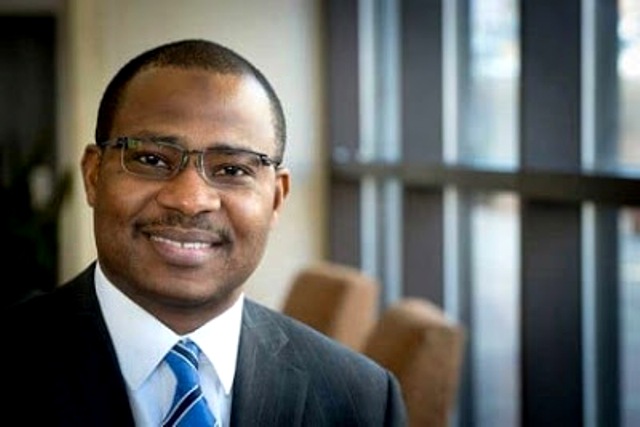
Faisal Shuaib
“This programme will engage 20 women per ward that will be trained over three months to provide simple intervention for health service delivery,” Mr. Shuaib said at the event organised by the Premium Times Centre for Investigative Journalism and its partners.
It, however, appears the programme Mr. Shuaib talks of is yet to take off. Findings in the course of this report show that most PHCs in rural Nigeria are understaffed, while the few hands there are overworked. A nurse attends to an average of 50 patients in a week, often working day and night.
WHAT NEEDS TO BE DONE
Henry Ewunonu, a pathologist in Abuja, said what has to be done to deliver quality health care to more Nigerians is clear.
“Every health facility has standard requirement on human resources. That is what separates hospitals from PHCs and health posts and so on.
“There are two national health strategic development plans. One is ongoing while another one is in the making. None of these plans have actually dwelt on human resources for health. That is the standard nomenclature for health, manpower. None has addressed it,” Mr. Ewunonu said.
“We have never as a nation done a situation analysis on this. Given our size, what should be the number of doctors, nurses, pharmacists at every health institution?”
According to Mr. Ewunonu, adequate distribution of human resources for health is the responsibility of the federal and state health ministries.
“Part 5 of the National Health Act addresses the issue of human resources. It is the duty of the Honourable Minister of Health, in conjunction with the commissioners of health in the states that will sit down and plan for human resources for health in there various domains in such a way there will be a balanced distribution.
“It is responsibility of government because the ministry of health has the powers to formulate policies and make regulations while NPHCDA is the implementing arm of the government.”
Mr. Ewunonu, a medical doctor, told this newspaper that another issue bedevilling adequate distribution of staff at the grassroots level is poor standard of living.
“Everybody wants to live in the city. You know what life is like in the villages. What will make that doctor to leave AMAC and decide to go and work in Karshi village? No light, no water and again insecurity.
“That is why Nigerian Medical Association advised the government to map out plans for rural practise allowance. It is done in many other parts of the world. This will entice doctors to move into these rural areas.”
In her reaction, the Commissioner for Health in Benue State, Cecelia Ojabo, in whose state Mrs. Diashe’s PHC lies, declared support for government’s plan to put PHCs under one roof, saying it was a key to proper distribution of staff.
“Right now, we are on the verge of bringing all PHCs under NPHCDA; that is putting all PHCs under one roof. When we do that, then we will be in the position to evenly distribute the workers”, Mrs. Ojabo said.
While the government tarries on its actions, the PHC in Edikwu-Icho remains abandoned and Mrs. Diashe continues to strive to help members of the Benue community in the makeshift facility.
This investigation is supported by the John D. and Catherine T. MacArthur Foundation and the International Centre for Investigative Reporting.
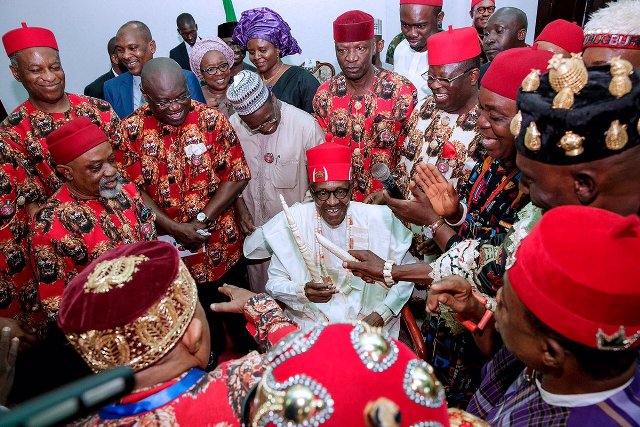
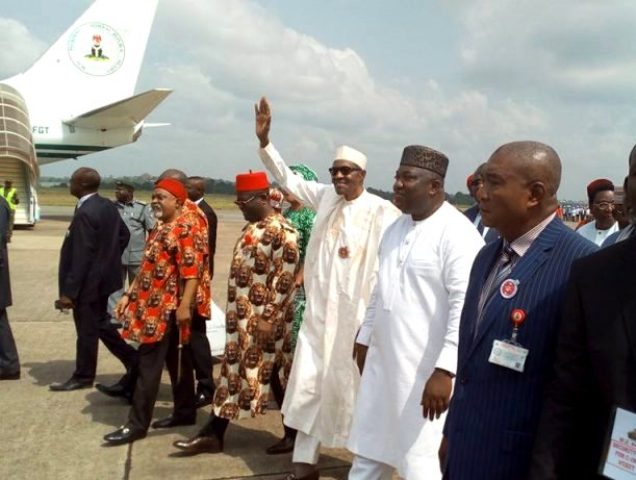
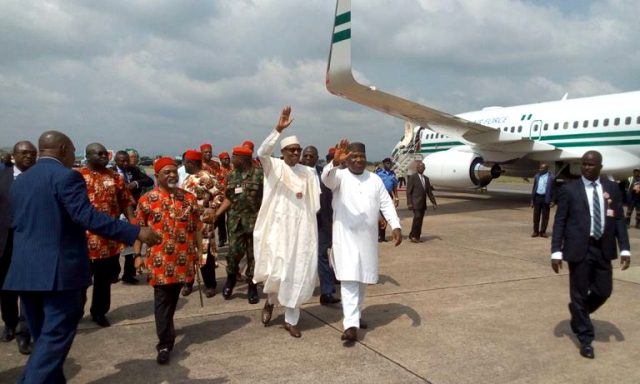
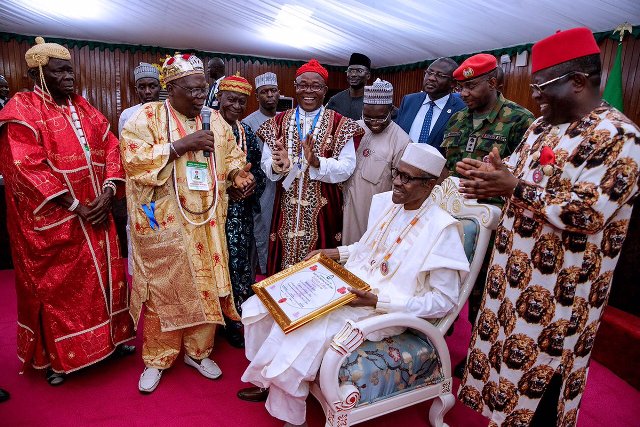
President Muhammadu Buhari has received double chieftancy titles – Enyioma 1 of Ebonyi and Ochioha Ndi Igbo 1 – in Ebonyi State, South East Nigeria.
Buhari landed at the Akanu Ibiam International airport in Enugu Tuesday afternoon, to a very warm reception by four out of the five South East governors, as well as traditional leaders.
The governors were Ifeanyi Ugwuanyi of Enugu State, Rochas Okorocha of Imo State, Okezie Ikpeazu of Abia State and Dave Umahi of Ebonyi State.
From the Airport, Buhari continued his journey to Ebonyi, from where he is expected to visit Anambra State on Wednesday.
This is Buhari’s first visit to the region since winning election in 2015.
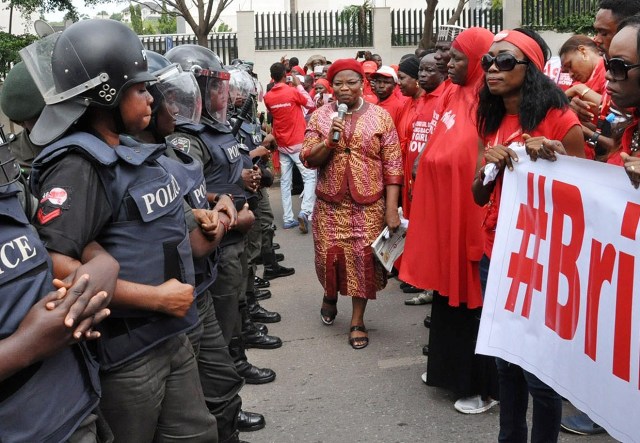
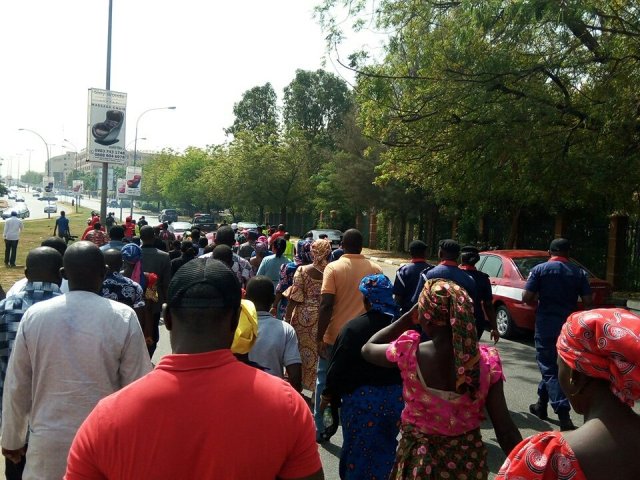
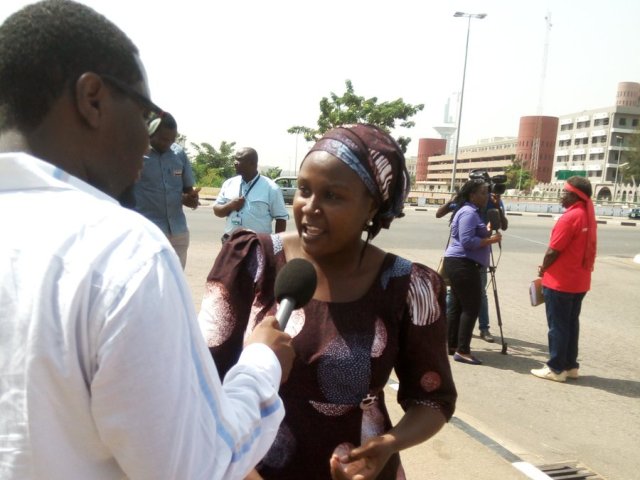
Oby Ezekwesili, former Minister of Education, and her Bring Back our Girls (BBOG) group were prevented from marching to the Aso Rock presidential villa on Tuesday.
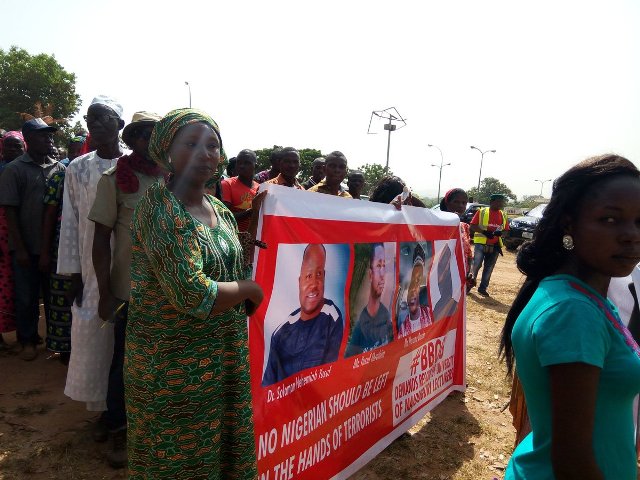
The BBOG group had said it would resume its protest for the release of the remaining Chibok schoolgirls who are still being held by Boko Haram terrorists, as well as the lecturers of the University of Maiduguri who were part of the NNPC oil exploration team in the Lake Chad Basin.
But armed policemen were deployed to prevent the protesters from having access to the Villa.
Watch the video below courtesy of Sahara Reporters:
Today, WE .@BBOG_Nigeria march!
Today, WE MARCH for:
1. Our remaining 113 #ChibokGirls .
2. Our Lassa Women and Police colleagues.
3. Our UniMaid Lecturers.
WE MARCH because .@AsoRock the Federal Government owes THEM a Constitutional DUTY of RESCUING THEM ALL NOW!
The Senate has recalled Ali Ndume, its former Majority Leader, who was suspended for 90 days following allegations against Bukola Saraki, the Senate President and Dino Melaye, Chairman of the Senate Committee on the FCT.
Meanwhile, Abdulmumin Jibrin, former Chairman of the House of Representatives Committee on Appropriation, is yet to be recalled to the House more than one year after he was suspended.
The decision to recall Ndume was taken at a closed-door session of the Senate on Tuesday, presided over by Ike Ekweremadu, Deputy Senate President.
This is coming few days after the Federal High Court, Abuja declared Ndume’s suspension illegaland ordered that all his outstanding salaries and allowances be settled.
“In the closed door session, the senate also discussed the suspension of Ali Ndume and resolved that he should resume sitting in Wednesday 15th November 2017 since he has served his suspension of 90 legislative days without prejudice to the current court processes.”
Ndume was suspended for allegedly embarrassing Saraki and Melaye after he requested for an investigation into certain allegations against the two lawmakers.
Saraki was said to have imported a bullet-proof car into the country without paying the appropriate import duty and as a result, the car was impounded by officials of the Nigeria Customs Service.
Melaye, on the other hand, was accused of parading a forged certificate from the Ahmadu Bello University, Zaria, when he did not actually graduate.
However, a Senate committee was set up to look into the allegations and both Saraki and Melaye were cleared.
But while Ndume is being recalled unconditionally, the leadership of the House of Representatives is insisting that Jibrin must tender an apology letter before his suspension would be lifted.
“Jibrin will also have to notify the House. He will write an apology letter too. You know there are other conditions he will have to meet to complete the procedure,” said Abdulrazaq Namdas, Chairman of the House Committee on Media and Public Affairs, during a press briefing in September.
Jibrin, for his part, says he cannot apologise as that would mean that he is withdrawing his allegations against Dogara and others.
He wants the country’s anti-corruption agencies to conduct an independent investigation into the issues he raised.
1 year today of denying my constituents representation in the House and 1 year taken off my 4 year CONSTITUTIONAL mandate…ONLY IN NIGERIA! pic.twitter.com/ofxnyoOLS5
We have so far served 14months in suspension. However slowly, surely justice will come for me and my people. I wish to thank my constituents for their patience and keeping faith. The experience of last 14months has turned out to be probably the best I have had in my entire life.
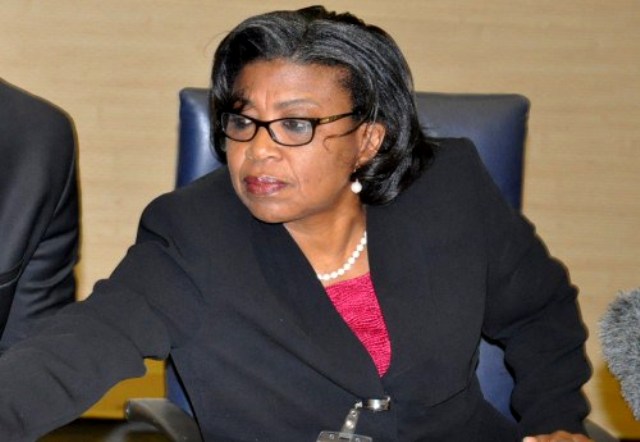
Patience Oniha, Director General of the Debt Management Office
The Debt Management Office says Nigeria’s total debt stock stood at N20.37 trillion as at September 30 this year.
This represents a 3.6 percent increase from the N19.64 trillion debt profile as at June 30.
According to a statement made available to journalists in Abuja on Tuesday, the DMO said domestic debt accounted for 76.96 percent, while external debt made up the remaining 23.04 percent.
Specifically, the domestic debt stock stood at N15.68 trillion, an increase of 4.1 per cent when compared to N15.03 trillion as at June 30.
External debt, on the other hand, rose by 1.9 percent to N4.69 trillion, from the N4.6 trillion under the same period.
According to DMO, the data shows that the federal government was right when it said that the country’s huge domestic debt was partly responsible for the high cost of debt servicing.
This is why the DMO supports President Muhammadu Buhari’s recent move to secure a fresh $5.5 billion external debt.
The amount which comprises of $2.5 billion in new borrowing to partly finance the N2.32 trillion deficit in the 2017 Appropriation Act and $3 billion to repay maturing domestic debt is expected to achieve a reduction in interest costs of about N75 billion and N91 billion respectively when compared to the interest cost of borrowing in Naira in the domestic market.
It will also contribute to attaining FG’s target ratio of 60:40 between domestic and external debt, the DMO said.
The DMO further explained that increased external borrowing will result in more availability of funds to the private sector and lower domestic lending rates.
These will enable the private sector contribute to growth and lead to higher level of external reserves to support the Naira exchange rate.
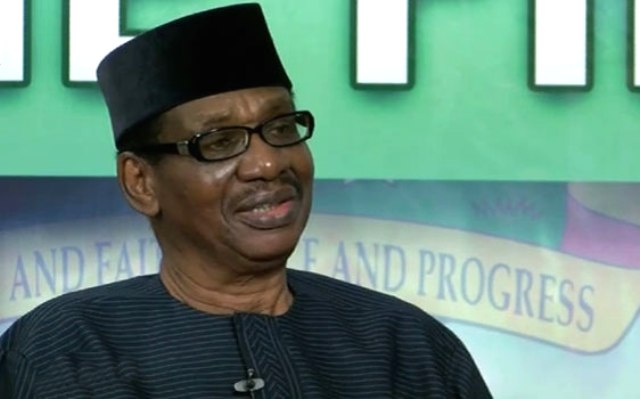
Itse Sagay, Senior Advocate of Nigeria and Chairman of the Presidential Advisory Committee Against Corruption (PACAC), says the whistle blower that led to the recovery of billions in Ikoyi, Lagos, might have gone mad if his commission was paid to him upfront.
Sagay said this during an interview with newsmen on Monday, adding that it was important for the young man to receive series of mental and financial counseling before his reward could be released to him.
The EFCC said it recovered a total of N13 billion in that operation, which means that the reward accruable to the whistle blower according to the whistle-blower policy of the federal government, runs into several millions of naira.
“What I gathered from my inquiry is that the man is not sufficiently stable to receive such a huge sum of money,” Sagay said.
“He is like someone who will almost run mental when he gets the money and will use it in an irresponsible manner, attracting not only undesirable people but even danger to himself.
“I think what they wanted to do for him was to provide counsellors. Not just counsellors for character and mental situation but counsellors who would be like consultants that would help him to really invest the money and plan in such a way that he doesn’t throw it away in five minutes.
“They are trying to help him. Nobody is denying him anything. They are trying to help him but he just misunderstands the intention.
“And like everyone that has been deprived for a long time, he is so desperate to have it but from what I can see, if they just give him everything, it won’t last more than a month or two because so many people will start finding ways to get to him and taking their portions from him.
“So, they were just trying to help him but he became hysterical.”
Sagay said the decision to pay the whistle blower in tranches is a good one as it will prevent him from spending everything in one fell swoop.
“It is better to pay him in tranches. I agree with the government because if not, he will throw it away,” Sagay said.
“This is valuable money that government could have used for millions of unemployed and wretchedly poor people. One man is getting it and he just wants it so that he can blow it all in five minutes? No.
“The government has a responsibility to see that his excitement does not end in seeing the money being thrown away irresponsibly. So, I agree with the government.”
It was Ibrahim Magu, Acting Chairman of the EFCC, who first said that the Ikoyi whistle blower had been paid and is now a millionaire.
The claims prompted Yakubu Galadima, lawyer to the whistle blower, to issue a statement insisting that his client has not received a dime so far.
Galadima said that at some point, the whistle blower was invited to the headquarters of the Department of State Services (DSS) and was detained for more than one month.
He however said that since the government has promised to pay him by the end of November, he will exercise some patience until then.
“As far as I am concerned, if the money is not paid by the end of this month, I am ready to tell the whole world but if they act favourably, their image will be redeemed,” Galadima said.
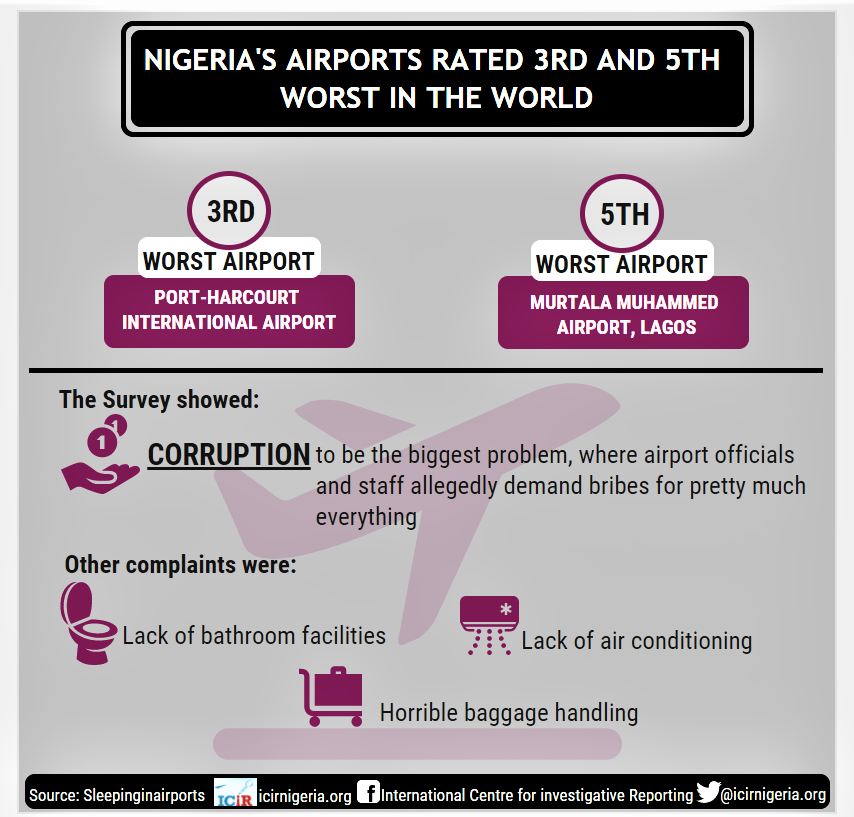
Two of Nigeria’s airports, the Murtala Muhammed Airport (MMA), Lagos and the Port-Harcourt International Airport (PHIA), are among the five worst airports in the world, according to a 2017 airport survey.
The Port Harcourt Airport was rated the worst airport in 2016 but it moved up two places to become the third worst airport for overall passenger experience while the Lagos Airport was rated fifth worst.
Travelers were asked to rate the airports worldwide based on their overall airport experience. The criteria for the evaluation include: comfort (gate seating & availability of rest zones), services, facilities and things to do, food options, and Immigration/Security.
Other factors were customer service, cleanliness, navigation and ease of transit, sleep ability.
The survey result showed that corruption was the biggest problem with airport officials and staff allegedly demand bribes for pretty much everything
Other complaints by the travelers included lack of bathroom facilities, lack of air conditioning, horrible baggage handling, and the tent that serves as the arrivals terminal.
“Every official asks you for money. Don’t tell them you have cash, otherwise, the customs official will take you to the dark room,” said one of the respondents, adding that “if you give money to the official, you can bring anything on to the plane”.
However, the Federal Airports Authority of Nigeria (FAAN) rejected the result of the survey, saying that it failed to take several factors into consideration before arriving at a result.
“The report failed to reflect that the Port Harcourt Airport terminal is under construction while the recently implemented executive order has revved up passenger experience at the MMA,” said Henrietta Yakubu, General Manager, Public Affairs of FAAN, in an interview with Daily Trust.
“The terminal is under construction and those that are rating the airports should have waited for the terminals to be completed.
“The ease of doing business implementation has also righted a lot of wrongs at the airport especially in Lagos. And those soliciting for bribe have reduced drastically.”
According to the survey, the Juba International Airport in South Sudan was ranked the worst airport in the world, followed by the King Abdul-Azeez International Airport, Jeddah, Saudi Arabia.
Other airports on the list of 10 worst airports in the world are: Heraklion International Airport, Greece; Thira National Airport, Greece; Julius Nyerere International Airport, Tanzania; Rhodes International Airport, Greece; Beauvais-Tille Airport, France and Tashkent International Airport, Uzbekistan.