Daphne Caruana Galizia, the journalist who led the Panama Papers investigation into corruption in Malta, was killed on Monday in a car bomb near her home.
“There are crooks everywhere you look now. The situation is desperate,” she wrote in her last blog post an hour before her car exploded.
According to Maltese media, Galizia told the police two weeks ago that she had received death threats.
The 53-year-old was killed near her home in Bidnija, a village in northern Malta, where her car, a Peugeot 108, was destroyed by a powerful explosive device that blew the vehicle into several pieces and threw the debris into a nearby field.
Galzia was a blogger whose posts sometimes attracted 400,000 readers a day, out of the Malta’s population of 420,000, having more readers than the combined circulation of the country’s newspapers.
She was described by the Politico website as a “one-woman WikiLeaks”.
She began her career as a columnist with the Sunday Times of Malta in 1987. She later became Associate Editor of The Malta Independent.
She had relentlessly accused various Maltese politicians and other officials of corruption in her popular Running Commentary.
Her most recent revelations pointed the finger at Joseph Muscat, Malta’s Prime Minister, and two of his closest aides, connecting offshore companies linked to the three men with the sale of Maltese passports and payments from the government of Azerbaijan.
Over the last two years, her reporting had largely focused on revelations from the Panama Papers, a cache of 11.5m documents leaked from the internal database of the world’s fourth largest offshore law firm, Mossack Fonseca.
The data was obtained by the German newspaper Süddeutsche Zeitung and shared with media partners around the world by the International Consortium of Investigative Journalists (ICIJ) in Washington.
REACTIONS TO HER DEATH
Several organisations and individuals have expressed shock over her murder and called for justice.
ARTICLE 19, a non-governmental organisation that defends freed of information and expression, called for a full, independent and speedy investigation into the murder of Galzia.
It described her killing as an alarming attack on press freedom, saying the perpetrator must be brought to account and measures taken by the Maltese government to further secure the safety of journalists following this attack.
The Guardian reports that the European Commission said it was horrified by the murder, praising the journalist for her “dedication to the truth” and pioneering investigative work.
“The right of a journalist to investigate, ask uncomfortable questions and report is at the heart of our values and needs to be guaranteed at all times,” it said.
At a meeting of EU ministers in Luxembourg on Tuesday, Matti Maasikas, Estonia’s EU Affairs Minister, said: “The killing is an unacceptable assault on the freedom of speech and democracy; the perpetrators must be brought to justice.”
Asked whether the EU should investigate the rule of law and alleged corruption in Malta, Maasikas said it was a matter for the EU executive.
In a tweet, Frans Timmermans, First Vice President of the European Commission, said he was “shocked and outraged” by the murder. “If journalists are silenced, our freedom is lost.”
Matthew Caruana Galizia, son of the murdered journalist who is also an investigative reporter, said his mother was killed for exposing corruption.
“My mother was assassinated because she stood between the rule of law and those who sought to violate it, like many strong journalists,” Matthew wrote in a moving and at times graphic Facebook post.
“But she was also targeted because she was the only person doing so. This is what happens when the institutions of the state are incapacitated: the last person left standing is often a journalist. Which makes her the first person left dead.”
Prime Minister Muscat said “everyone knows Caruana Galizia was a harsh critic of mine, both politically and personally, but nobody can justify this barbaric act in any way”.
He tweeted that it was “a spiteful attack on a citizen and freedom of expression” and vowed that he would “not rest until justice is done”.
She is survived by her husband and three sons.
About 3,000 people honoured her in a candle-lit vigil in Sliema, near the capital Valletta, the night after she died.
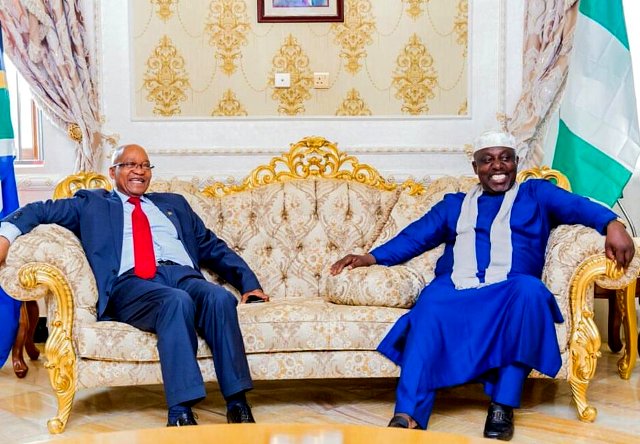
Rochas Okorocha, Governor of Imo State, says erecting the statue of Jacob Zuma in Owerri, the state capital, is part of his strategy to draw “good things or investments” to the state.
Okorocha said this in response to criticism by the opposition Peoples Democratic Party (PDP) over the honour he conferred on Zuma, whose Presidency in South Africa has been plagued with accusations of corruption and abuse of office.
According to a statement issued by Sam Onwuemeodo, Chief Press Secretary to Okorocha, the PDP should hide its face in shame for not attracting any high-profile visitor to Imo in the 12 months when it was in power.
“If it was in the days of PDP, schools and markets would have been shut down, and roads closed, because President Zuma was coming,” Onwuemeodo stated.
“But none of such things was done because Rochas and his government have human face. The PDP, for the 12 years they held sway, never attracted any meaningful visitor to the state, except PDP NEC members who were coming to loot the state.”
Onwuemeodo explained that the major reason for Zuma’s visit to Imo State was to show support for Okorocha’s humanitarian endeavours and to sign a memorandum of understanding between the Jacob Zuma Education Foundation and Rochas Foundation College of Africa.
The statement added that Zuma’s visit also afforded notable Igbo businessmen an opportunity to meet the South African President face-to-face to discuss business opportunities.
Some of the businessmen who met with Zuma, according to Onwuemeodo, are Leo Stan Ekeh, Chairman of Zinox Computers; Pascal Dozie, founder of Diamond Bank and Innocent Chukwuma, Chairman of Innoson Motors.
Onwuemeodo added that the Imo State government, under Okorocha, is determined to bring development to Imo state and would not be deterred by criticisms from “enemies of our people”.
“In case these ‘Galatians’ do not know, if all we need to do to attract good things or investments to Imo is erecting statues, then, we have no option than to erect as many of such structures as possible,” he stated.
“We owe no one apology. Rochas made a promise to open the doors of Imo to the rest of the world for good, and he is doing that; we cannot be deterred by these enemies of our people.”
Thousands of physically-challenged children across the country are at risk of missing out on education, as many of the government-run special schools supposed to meet their educational needs are on the verge of collapse.
The schools, which were specifically built for persons with physical challenges, including Down Syndrome, have received N10.6 billion grant from the Universal Basic Education Commission (UBEC) within a period of 10 years but have little or nothing on ground to show for it.
A document made available to The AUTHORITY by UBEC, and signed by its Director of Social Mobilisation, Bello Kagara, shows that the Commission disbursed over N10 billion to the 36 states and Federal Capital Territory (FCT) between 2006 and 2016 to support special education, with private providers receiving a significant chunk of N3.06 billion of the money.
According to UBEC, the special education fund is two percent of its consolidated revenue from the federation account, and it is disbursed annually to provide infrastructures such as classrooms, boreholes, instructional materials, teaching aids and other deliverables in schools for those with disabilities.
The fund is different from the 50 per cent matching grant released to states to support the basic education sub-sector, where UBEC has disbursed over N300 billion as of August 21, 2017.
A recent visit to some of the special education schools located in the Federal Capital Territory, Nasarawa, Edo and Anambra states revealed a sordid state of affairs. Apart from the commonly identified problems of students not living in decent condition and lacking access to health services or proper feeding, most of the schools’ structures could easily be mistaken for abandoned homes left behind by the nation’s former colonial masters.
In one of the schools, Special School for Physically Challenged, Umuchu, Anambra State, there were no good structures. The only major proofs of the presence of a school were a dusty signboard and obsolete blackboards hanging on dilapidated open rooms that serve as classrooms.
One of the sub-standard structures serving as classrooms in School of the Physically Challenged, Umuchu, Anambra.
Investigations further revealed that both the mentally retarded students and the deaf and dumb are forced to share same dilapidated dormitory in the school due to the absence of other structures to serve that purpose, thereby exposing them not only to the risk of missing out from the desired education but also at the danger of not being properly protected from neglect and abuse.
Other special needs schools visited, which have a semblance of good structures, are battling with the challenges of lack of teaching aids, adequate teachers and other facilities required to provide education to handicapped students.
School for the Blind, Deaf and Dumb, Isulo, Anambra State, which parades a number of beautiful structures, is one of the schools battling with lack of facilities to meet the special educational needs of the children.
According to Felix Nwaochi, President-General of Isulo Community, the school is seriously in need of water supply as many of the blind students have to fetch water from a stream to survive in the school.
“The school does not have water. The students go to the stream to fetch water. The road leading to the stream is not good; they need assistance to make that road good because there is erosion gully (on that road), and some of those blind students fall inside when they want to fetch water,” he lamented in an emotion-laden voice.
Nwaochi, who commended the efforts of Willie Obiano, the state governor, in revamping the school, however, called for assistance from well-spirited persons to support the handicapped school as government alone cannot meet its needs.
“They are expanding the school and they have converted it to secondary level …but if you go to that school you will see that it is still not conducive to a relaxed atmosphere for blind people. If that place is landscaped, it would have been better because they (students) used to fall indiscriminately in that school. The teachers are supposed to live in the school to take care of the students, but they don’t have accommodation. They don’t have sufficient funds to feed the students too. They don’t have playing field; they don’t have equipment like Braille that they are supposed to have for learning. Their Braille and typewriters are obsolete.”
Kate Omenugha, a Professor and Anambra State Commissioner for Education, who bared her mind on the development, admitted some of the challenges but insisted that the state government was doing everything possible to gradually meet the needs.
“We don’t play with physically-challenged people,” she said.
“What we are doing is a gradual development. If you saw the state of Isulo before the development, you would not believe it. We are also coming to that of Umuchu; it is in phases and we have already started with the construction of one new structure.
“We have sunk a bore hole for them too. Our dream is to move the mentally retarded people to Isulo because that is why we have so many structures there. So the big picture is to move the mentally retarded people to Isulo. If we restructure the one in Umuchu, we will leave it for the old people because they currently mix, old and young people.”
She said the problem of water supply in Isulo could have been handled by the school management by fixing the borehole in the school as government releases a monthly subvention– about N50, 000 and N500, 000 to its administrators.
In FCT, which is supposed to serve as a model for the states, based on its strategic importance as the nation’s seat of power, the special schools in the territory are not better-off.
It was found that the FCT administration can only boast of three handicapped schools to serve the thousands of physically-challenged children in the territory and can hardly meet the feeding needs of the children even as most of the schools’ facilities are gradually rotting away.
The FCT, which has a landmass of about 8, 000 square kilometers, is two and half times the size of Lagos, but only has the special schools in two of its six area (local) councils, Kuje and Abuja Municipal (AMAC), leaving hundreds of disabled children several miles away out of school.
A visit to FCT School of the Blind, Jabi, revealed that most of the foods being consumed by the students are donations from philanthropic bodies. It has remained in perpetual darkness since January 2017, following disconnection from the national grid over its inability to pay electricity bill.
Another disabled school in FCT, Abuja School for the Handicapped, Kuje, built in 1999, is going through difficult times as its students are grappling with dehumanizing conditions.
Our investigation showed that the dormitories, especially that of the male students’, have no good beds, toilets and potable water. It was gathered that efforts by the school management to seek help from wealthy individuals and corporate organizations were not approved by FCT UBEB over its fear that such open soliciting for assistance could expose the government as inept.
A teacher‚ who requested not to be named‚ said some of the students sleep on bad foams placed on bare floor and that feeding has always been a major problem. This was confirmed by sordid state of the dormitory and the broken beds that littered the area.
Adamu Jatau Noma, Director, FCT UBEB, however, said that the board was aware of the challenges affecting the schools but added that the agency was yet to get the 2015/2016 special education fund from UBEC. Noma, who spoke through Lawal Sani, board’s spokesman, said government was working hard to ensure that the needs of the schools are met.
funding of special schools for 10 years
The FCT UBEB has so far received N8.2 billion from UBEC as 50 percent matching grant to support basic education and another N184 million for special needs education. It also received N1.03 billion as 50 percent matching grant to support basic education for all children of school age in the Territory between 2005 and 2006; the money increased to N1.46 billion in 2007/08 and N1.15 billion in 2009 to 2010.
The matching grant increased substantially from 2011 to 2014 as a result of the increase in crude oil prices witnessed in the international market. The FCT UBEB accessed N1.72 billion and N1.98 billion from UBEC within a space of four years, but the money witnessed a downward trend in 2015 and 2016 with the board receiving a little above N876 million.
However, the inability of the agency to put its special schools in good shape continues to leave many parents in search of alternative places for education of their handicapped children.
A private home for handicapped children run by a Catholic priest, Rev. Father Anthony Ananwa, which provides education free of charge, is gradually serving as an alternative for some disabled children who may not be able to cope with damning shortcomings in the government-run schools.
Rev. Fr. Ananwa (in cassock) now runs a home that provides education needs for handicapped children free of charge.
The priest, who named the home ‘Jesus Abandoned Charity Home’, said: We have 39 (disabled persons) in our homes in Oraifite, Anambra State and Kuje, Abuja. We have school for them. But here in Abuja, we have teachers who come here to teach them.
“We give them food, education, accommodation and clothing but education is a major concern of us. Some of them are suffering from cerebral palsy or autism; in that case, they cannot understand many things. But some of them that can understand, we provide private teachers.”
According to Ananwa, most of the children in the home were brought in by their guardians. “Their guardians bring them to us because some of them are orphans; we have wheel chairs, we have physiotherapists’ materials, the wife of Kogi State Governor recently provided us with materials and she is also providing us medical doctor and nurses to take care of them.”
He appealed for more support as the home in Abuja lacks electricity supply. He called on the Anambra State government to help in the registration of the school in Oraifite.
“I want to see that my school is registered,” he said. “Our secondary school finished Junior WAEC few months ago. Would you believe we could not get supervisor? We had to take our students, and some of them are physically-challenged, to other schools.”
While the handicapped children in Abuja special schools continue to wish for a better future, it is still far from ‘uhuru’ for children with disabilities in Nasarawa State, which prides itself as the most special education-friendly state in the country.
The state spent about N17.6 billion on basic education within the last 10 years, with N8.84 billion of the money received as UBEC matching grant while another N159 million was disbursed to the state as special education grant. But despite the pronouncement by Governor Umaru Tanko Al-Makura to provide comprehensive free education from kindergarten to secondary school level for handicapped persons, the promise is yet to be translated to concrete actions..
Al-Makura, who also has little physical disability as he cannot do without hearing aids, created a ministry for special education and went as far as initiating three signature projects for handicapped education, one located in each of the three senatorial zones in the State. The three projects, which are being executed with the support of UBEC at the cost of N2 billion, were initially billed for completion in 2016. However, more than half way into his second tenure as governor, the comprehensive special schools located in Lafia, Gudi and Keffi are yet to be completed — a measure of how serious the government takes special education.
A recent visit to the project sites in Gudi, Akwanga Local Government Area and Keffi, Keffi Local Government Area as well as Lafia, revealed that apart from the school in Lafia, others are still far from completion. The one located in Keffi appears more like an abandoned project.
“The railway that passes here and this (disabled) school that they are constructing are the only government presence in this village (Gudi) but I don’t know why they don’t want to finish the work in that school,” said a community leader who simply identified himself as Musa Madaki .
An official of the firm handling the school project in Gudi, who craved anonymity for fear of incurring the wrath the company, said apart from the issue of irregular payment on the job done so far, the undulating terrain of the school is a major challenge as the contractor has spent millions of Naira to level the area. He, however, said the project would soon be completed and handed over to the government.
In a chat with The AUTHORITY, Jonathan Ayuba, a Professor and Commissioner for Special Education, Science and Technology, said the delay in the project was due to the death of one of the contractors. He said the state already has three schools for the disabled, and that the new comprehensive schools under construction would be opened for use by January 2018.
“We already have special schools but these ones [under construction] are comprehensive from nursery to senior secondary school. All the needs assessment was done and we are at the point of getting the required staff. We are also trying to establish the enabling Disability Right Commission through a bill sent to the House of Assembly,” he explained.
While there may be rays of hope for handicapped children in Nasarawa State, the reverse seems to be the case in Edo State. The State has so far received about N7 billion as UBEC matching grant for basic education and another N184 million to shore up special education but has failed to access another UBEC grant of N3.1 billion and about N30 million special education fund.
The poor access of the education grants by the state continues to take a toll on its education sector, especially its special schools. The Etsako Handicapped School, Auchi, is one of the schools that are suffering from government neglect. The school, which is supposed to serve disabled persons from the Edo North Senatorial District, has failed to receive attention from successive governments. The school, established in 1979 for deaf and dumb students, was rebuilt by Yisa Braimah, a senator who represented Edo North between 2007 and 2011 as a constituency project.
A resident of the area, Eunice Akems, decried the lack of boarding facilities in the school and said that many parents with handicapped children are usually left with no option of providing education for them as there is also the lack of good private special schools to meet such needs.
“I have a relative that was supposed to attend this special school in Auchi but I was discouraged because they don’t have hostels, and there is no way she alone could be going there from home because of her physical challenge.”
The special school, tucked inside Akpekpe Model School in the heart of Auchi, has only one fast-dilapidating structure, and has remained like a ‘lepers’ house as residents of the area said no serious academic activities is taking place there as a result of lack of teachers and teaching aids.
“Most of the so-called students normally engage in begging when the school is supposed to be in session and there are no boarding facilities in the school,how do you expect disabled children to be coming to such a school every day and learn in a busy place like that? If the government is really serious on handicapped education, they know what to do,” an official of the Etsako West Local Council, who simply identified himself as Momodu said.
Others declined comment on the issue, unless with the permission of relevant authorities in Benin City, the State’s capital.
Dr Christopher Adesotu, Edo State Commissioner for Education, did not respond to calls and text messages to his phone for comments on the plans of the state government to revamp the school.
Editor’s Note: This investigation was supported by the John D. and Catherine T. MacArthur Foundation and the International Centre for Investigative Reporting, ICIR.
Nasir El-Rufai, the governor of Nigeria’s Kaduna State, likes to make headlines.
While receiving a visiting World Bank delegation recently, he revealed that a test given to primary school teachers had elicited startling results.
They had been given questions set for primary four pupils, who are aged 10.
The teachers had been expected to score at least 75%, the governor said.
“But I am sad to announce that 66% of the teachers did not get that.”
He blamed the hiring of unqualified teachers for the problem and promised to put an end to it.
But the state’s teachers’ union secretary, Adamu Ango, has disputed the governor’s claim, calling it cheap media propaganda.
He has challenged him to make the examination paper public and measure the results alongside internationally accepted teaching competency examinations.
Unsurprisingly, teachers in the state are not happy – especially with the frequent tests they are made to take, saying this is the third such test in within a year.
All other test results should be made public, if the governor is to be fair to them, they argue.
And could the governor not also release some of their outstanding allowances unpaid for two years now?
Both sides may be right up to a point.
Teachers are not known to be motivated – and it is not a career path many Nigerians opt for by choice.
Many see it as a stop-gap before getting their dream job.
“Recruitment has also become a nightmare for employers who come across graduates unable to string together five correct sentences”
CLASS SIZES ARE ALSO A BIG ISSUE
A teacher friend of mine once invited me to her primary school where class sizes ranged from 90 to 120 plus pupils.
Even the most enthusiastic teacher would have trouble getting the attention of such a class, most of whom are likely to be seated on the floor, winking, pinching and playing pranks – making learning almost impossible.
Politicians also prefer to commission contracts to build classrooms that can be seen from the outside, rather than equipping them or training and motivating the teachers to do their work inside them.
There is also an over emphasis on gaining certificates, even those of doubtful quality.
‘MIRACLE CENTRES’
So many schools are only keen to churn out students with the required grades on paper but who cannot defend them in practice.
It has also led to the proliferation of what are called “miracle centres” – schools or examination centres where almost everybody is guaranteed a good grade at a price.
A relation who teaches at one publicly funded school told me that thanks to such “miracles”, he has encountered students who have spent 12 years in basic education but who are unable to even copy the answers to exam questions that teachers write up on blackboards for them to copy out.
This explains why in addition to the national exams needed to gain admission to universities, polytechnics and other colleges, these higher education institutes insist on conducting their own separate tests to make sure that all the wonderful marks a candidate professes to have are genuine.
Frequent university strikes mean undergraduate courses can take longer than expected
Recruitment has also become a nightmare for employers who come across graduates unable to string together five correct sentences.
With basic education in such a bad state, especially in publicly funded schools, well-off parents have been voting with their money to send their children to private schools.
Indeed the class division in Nigeria is especially glaring in terms of what school one’s child attends.
STUDENT EXODUS
Meanwhile, there has been an explosion of universities from just two at independence to the current 155.
But frequent strikes have meant that students are never sure how many years it will take them to graduate, even though on paper their course it is for a specified period.
This has prompted a big exodus of students who can afford to go to tertiary institutions in far flung corners of the world.
Those unable to finance fees and other costs in the US, Europe or Asia go closer to home, opting for the Benin Republic, Ghana, Uganda and other African countries.
In fact some of the private universities in Ghana, Benin and Niger were set up by Nigerians eager to cash in on such opportunities.
Since only a fraction of Nigeria’s population can afford to pay the fees for private schools and universities, fixing the public school system remains the only sustainable way for the country to adequately educate its citizen, if only to a basic level.
On the whole, most Nigerians agree that there is a crisis in the education sector – though there is no agreement on the reason why and how best to tackle it.
A shock-and-awe approach like that of the Kaduna governor may grab headlines, but it is unlikely to improve the morale of capable and committed teachers who are the corner stone of any education system.
Mannir Dan Ali is the Editor-in-Chief of Daily Trust Newspaper. This article was first published by BBC as part of its ‘Letter from Africa’ series.
EDITOR’S NOTE: This piece was first published in 2013 by Flair Nigeria. From today till Sunday, the ICIR will reproduce the five-part series in the light of the resurgence of killings in Plateau State, to help readers understand the genesis, depth, brutality and possible solutions to violence in the state.
For 11 days in December 2013, ‘FISAYO SOYOMBO scoured the perilous villages of north-central Plateau State where more than a thousand people have been slaughtered in the last two years. After covering an estimated 13,117km, he returns, in this five-part series, to tell the chilling story of venomously-orchestrated serial killings that should worry not only the federal and state governments, but the ordinary people, including those living faraway from the plateau.
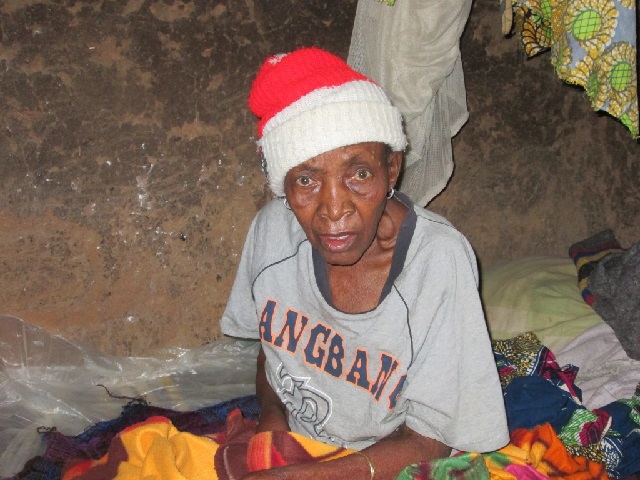
Marene Uttawal speaks slowly — sparingly. And when she does, it is with the help of an interpreter. She moves only sparingly as well. And, again, when she does, her motion is hardly beyond rotational. This is because she is paralysed in the lower region of the body.
Anyone who knew her nine months back would shudder now at how unkindly fate has dealt with her. Going on 105 years at the time, she roused from sleep at dawn every day to take her turn on the farm like nearly everyone else in the village. Working year-round in a manner that belied her old age, she more than subsisted on the maize, guinea corn and Irish potato farm she tended.
105-year-old Uttawal… bed-ridden since the murder of her son and grandson
Then came the devastating halt. In March 2013, “unknown armed men suspected to be Fulanis” invaded Mile-Bakwai Village — located in Mangor, Bokkos Local Government Area of Plateau State — gunning down 18 people, among whom were her son and grandson. On hearing the news, Marene suffered a stroke, which resulted in partial paralysis of her lower limb. She has been bed-ridden ever since.
BETWEEN THE DEVIL AND THE DEEP BLUE SEA
It is easy to curse Marene’s luck when her doom is reviewed in isolation. Not so in other circumstances. For sure, Felix Davou would have happily taken her place. Felix was only four months old when gunmen broke into his parents’ home in mid-November 2013 and fired at his stomach, disembowelling him and summarily snuffing life out of him before he even knew what “life” meant. Four other members of his family were also murdered in that raid. That was in Tatu Village, Jos North Local Government. In that attack, November 26, 2013, 15 people — mostly women and children — were murdered.
Bullet-riddled door of house where four-month-old Felix Davou was gunned down
Elsewhere in Rawurum Village in Barkin Ladi Local Government (9°32′00″N 8°54′00″E), another nursling was being put to death. In one of the crudest manifestations of depraved thirst for blood, invaders placed a gun in the mouth of Julius Bula and pulled the trigger! At just five months old, there was no chance Julius would live for a split-second more.
It may be hard to imagine a harsher fate for an infant. But actually — and sadly — there is. Whether David or Gyang or Rotji, no one knew what the baby’s name would have been had he/she been born. The foetus was only “seven months” in its mother’s womb when the bullets of a cold-blooded killer hurled it back to just where it was emerging from. Those who would have known — the father and mother — did not survive the attack either, the former, in fact, dying in a most gruesome manner (He was shot twice, after which his head was “scattered completely” with a big stone.). The four other members of the family breathed their last that night as well. The family of 48-year-old Irmiya Chollom Deme was, simply put, exterminated.
The torched house where the eight-man household was annihilated
As the latter parts of this real-life narration would authenticate, the killings in the villages of Plateau, when weighed on the scale of brutality, are unrivalled anywhere in Nigeria since the Civil War of July 6, 1967 to January 15, 1970. Not even killings masterminded by Boko Haram rank any close.
On the gauges of consistency and casualty figures, too, the Plateau killings offer sufficient reasons for any conscientious Nigerian to be troubled. In the five months of May to September 2013 alone, 67 Berom — one of the most populated ethnic groups in the state — were killed. So says the Berom Youth Movement, a group dialoguing with other ethnic communities to stem the killings.
In the same period, eight people were injured, 844 cows rustled, 45 farms destroyed, eight houses burnt, and nine motorcycles burnt or wrecked. The veracity of these claims was, subsequently, independently ascertained. In all, from January to December 2013, at least a total of 535 people were murdered. And in the 10 days leading up to the end of the year, there is scant assurance that the figure will remain unchanged.
GENESIS OF THE CRISIS
Hard as it is to imagine, Plateau State actually earned its epithet, ‘Home of Peace and Tourism’. While by 1985, each of Kano, Borno, Kaduna, the defunct Gongola, and Bauchi states had suffered at least one high-casualty bout of ethnicity or religious violence, post-Independence, Jos, the Plateau State capital, remained the quintessential bastion of peace in the north, notwithstanding its cosmopolitan ethnic and linguistic makeup.
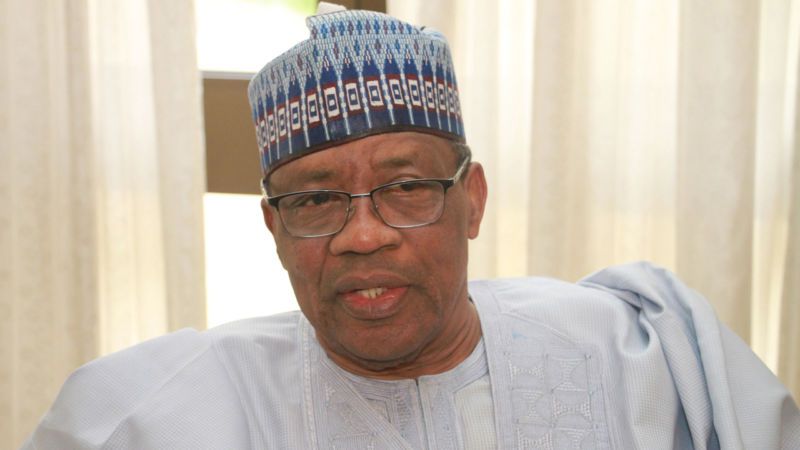
It was Ibrahim Babangida, the then Military Head of State, who upturned that order. In 1991, Babangida, a Hausa from Niger State, sanctioned the creation of Jos North Local Government in a manner that the indigenes — most populated by the Berom, Anaguta and Afizere tribes — believed to have advanced Hausa-Fulani interests.
Both the indigenes and the Hausa-Fulanis were seething with pent-up rage that was ultimately unleashed three years after, following the seesaw appointment (and subsequent reversal) of Alhaji Aminu Mato, a Hausa and a Muslim, as Chairman of the Caretaker Management of Committee of Jos North Local Government.
When the appointment was announced by Mohammed Mana, a Lieutenant-Colonel and Military Administrator of the state, the indigenous ethnic groups revolted. And when it was overturned, the Hausa/Fulani community went berserk. The fusion of this two-way aggression was a riot on April 12, 1994 that claimed five lives, as well as two markets, an Islamic school and a mosque. Ever since, Jos has been soldierly in its emergence as a den of horror killings, zooming forward and never cowering in the battle of its diverse peoples for ethno-religious dominance.
National Caretaker Chairman of the Berom Youth Movement, Mr. Rwang Daylop Dantong provides an illuminating perspective to the 1991 rumpus over Jos North Local Government, which he says set the template for all other politically motivated killings in the state, Jos particularly, till date. He traces the 2001 crisis, during which more than a thousand were killed, to the same Jos North tussle.
Dantong: the foundations of the killings were laid during Babangida’s tenure
“The Hausa community, whom we were hosting here on the plateau, decided to initiate this jihadist policy of taking over somebody’s land. They sought ways of overtaking the Jos City,” Dantong says. “So they wrote a memo to Babangida without involving the stakeholders, the owners of the land.”
According to Dantong, when Babangida granted their request against the interest of the indigenes, “in such a manner that he carved the Jos North to favour the Hausa community”, the indigenes revolted, because despite the creation of Jos North, they “still outnumbered” the Hausas in the place.
“That year that it was created, indigenes, especially the Berom, were highly aggrieved,” he adds. “It was the year of election, so we didn’t participate — out of protest.”
He would later concede that the Berom blundered by boycotting the election. Their attempt to reverse that error was accompanied by bloodshed.
With the Berom boycotting, Ismaila Mohammed, a Hausa-Fulani, coasted to victory in the chairmanship election. The Berom contested subsequent elections and won; but by then, the Hausa-Fulani already considered themselves more populated, and therefore found no rational reason to lose an election.
“When we returned to our senses, we agreed to protect our land by participating in subsequent elections,” Dantong says. “And so, in subsequent elections, we outnumbered them. Each time we won, they thought they were more in number, so they resorted to violence. So, basically, from 2001, the violence in Jos has been spawned by elections.”
In recent times, though, Jos itself has lost its infamous status as a lair of bloodletting, instead ceding the ignominy to the many villages on the peripheries of the state, where the killings have been more ethnic than political.
CASUALTY VERSUS BRUTALITY
With the template for violence already laid in 1994, a recurrence was only a matter of time. That happened in 1998 when a Berom man, accused of plucking garden eggs without authorisation from a farm owned by a Hausa, was beaten to stupor. The Berom rallied round their man while the Hausa backed theirs, and the result was the killing of an unconfirmed number of people.
On September 7, 2001 — first time the city of Jos was turned to a hellhole — disagreements over the attempt of a Christian lady to navigate a road blockade by an ongoing Juma’at service triggered a violent clash. Combined with mounting tension over the appointment of a Hausa, Alhaji Muktar Mohammed, as Coordinator of the Jos North Poverty Eradication Programme, the clashes lasted six days, leaving hundreds dead and several thousand others displaced.
Further crises in 2002, 2004, 2008, 2010 and 2011 were either of religious, political or ethnic colouration and attracted the interest, however frothy, of the government. While the root of the clashes has largely remained unchanged, the pattern, method and the scale have. Dishearteningly, the brutality of these killings has surged. What began as a clash of groups has now degenerated to the serial, unidirectional killing of a certain group of people.
‘KILLING THE DEAD’
The graves where Abednego Nanan (left) and Chorbis Nanan (right) were buried
Obadiah Bolka Nanan pushes aside the hollow plate from which he and his brother, Rotji Nanan, 21, are scooping porridge. It is barely 15 minutes since his arrival from the farm in Kukah Village, Shendam Local Government (8°53′00″N 9°32′00″E / 8.88333°N) — the same farm where his ninety-something-year-old father was shot and hacked to death three months ago.
His skin glistens, sweat streaming from underneath his hairlines to just beneath his ankles. Not only has he had a hard day at the farm, life has been hard for him since September 10, 2013 when he lost his father and his brother in a single attack.
Whenever both father and son went to the farm, it was the norm to return home in the evening, at 7pm or thereabouts. But this time, none returned by dusk, prompting the family to dispatch a search team to the farm. Two lifeless bodies were all they saw.
Whenever Obadiah reflects on the double tragedy, he is enveloped by sweat on the outside and tears in the depth of his heart — not so much for why they were murdered, but how.
“They shot him. They slew him. They destroyed him,” he says, clenching his fist and gnashing his teeth in anguish. “They cut him with knife at the back of his neck. They cut him with axe on the head. They slashed his right temple, and they still cut his right eyes down to his cheekbones.”
Obadiah… describing how his grandfather and brother were butchered
His 22-year-old brother Chorbis Nanan was dispatched with a single gunshot that holed his brain from a side of the head to the other. “He was shot in the head,” Obadiah adds, demonstrating with his index and middle fingers pointed at his right temple. “There was a bullet wound on either side of his head. They shot him when he was hunting for firewood.”
To Obadiah, his slain 90-year-old-plus grandfather was more than ‘the father of his own father’. Pa Abednego Nanan Jilang was essentially his father, his natal father having passed on in 2001 after failing to survive a sickness. This is why he inadvertently uses “grandfather” and “father” interchangeably on the late Abednego.
The attackers reportedly poked fun at the two slain men, positioning their bodies as though they were sound asleep. Their corpses were retrieved with the help of the Police and buried some 100 metres from the main family house.
‘AFTER SHOOT AND CUTTING HIM, THEY SET HIS BODY BLAZE’
The resting place of slaughtered Nansoh
Before the interview can start, the video must be turned off, Grace Nansoh, 23, insists. It is not cowardice but candour. She understands the inevitability of an emotional breakdown in the course of the interview. She is human, after all. Very few ladies whose fathers have been “killed three times over” can survive a video interview without caving in to the enormous emotional drain of recounting the experience.
Teary-eyed, Grace narrates how her ill father, 50, was stranded at Zamchang Village in Wase Local Government (located 126km south-east of Jos) during an invasion by the Hausa/Fulani, how he telephoned his wife to render real-time account of the razing of many houses, how the Hausa/Fulani menacingly besieged the village with the sole intention of ousting the Taroh and any other non-Fulani within reach, how he was short-circuited by ill-health and was consequently overhauled and mauled while fleeing.
“He was killed while escaping,” Grace recalls, the tears in her eyes blossoming into watery balls that inelegantly nestle on her eyelashes. “Actually, I don’t know how to say it.”
Grace soon finds a way to, after recovering from a two-minute poignant capitulation headlined by a seven-second spell when tears unrestrainedly gushed out of her eyes.
“I saw his body,” she says in a shaky, grief-stricken pitch. “First, they shot him, then they macheted several parts of his body. After that, they set his body ablaze.”
The dismembering of Mr. Nansoh did not end there. As Grace explains, one of his eyes was knifed, as well as one of his hands.
“It was evident that they inflicted several wounds on him with the aid of machete and knife,” she concludes with a heave signalling resignation to an unalterable fate. “When his body was brought home, we buried him over there” — a rough-and-ready tomb prepared by burrowing through the sand to make out just enough space for a body, culminating in a heap of sand on which a sizeable stone gives away the positioning of the cadaver.
DYING FOR LOVE
The blood-blemished ground where Chollom Irmiya was wasted
On another day or perhaps under a separate circumstance, late Chollom Irmiya Deme, a resident of Tatu Village in Barkin Ladi Local Government, might have evaded the killers’ bullets.
Left with two choices — life, villainy and misery on the one hand; and martyrdom on the other hand — the 48-year-old, rather than abandon his family in the cold, chose the latter, exhibiting remarkable bravery by returning to protect his family against armed killers. For his guts, he was rewarded with death — cruel death.
“Chollom was first to escape from the house when random gunshots rent the air,” recalls Pam Adamu Jugu, chosen to speak on behalf of Head of Tatu Village on account of his fluid elocution of the English Language.
“I believe that he must have come out to verify the goings-on; and when he saw the gunmen approach, he ducked.”
The killers did not bother to comb the environs for the breadwinner. They instead went for his wife and five other members of his family. It worked.
“From his hiding, Chollom heard his darling wife scream ‘Daddy, daddy; we’re going to be killed,’” Pam continued, his breath seizing for a moment as he approached the tragic climax. “He could not help himself, so he had to emerge from hiding to defend his family. Sadly, he was overpowered by the attackers, because they outnumbered and out-armed him.”
Another view of the house where the rest of his family were shot and set ablaze
The assailants shot Chollom in the stomach, before crashing a mammoth stone on his head. “They broke his head into pieces,” Pam blurted chillingly. “They destroyed him completely.”
While Chollom’s “complete destruction” was ongoing outdoors, a split gang of gunmen indoors was busy bloodying the six occupants to death. After an unsuccessful attempt to forcibly enter the house, they circled it, blazing gunshots inwards from window to window. Mrs. Yop Irmiya, 37, was shot in the stomach, the same stomach housing her seven-month pregnancy. Rose Irmiya, their nine-year-old daughter; Challom Irmiya, their nine-year-old son; Chollom’s brother, and an unidentified person, all fell to the killers’ bullets.
Inexplicably dissatisfied with just gunning all seven down, the assailants then proceeded to set their bodies ablaze. Save that of the head of the family who was slaughtered outside, the corpses of five of the other six were seared. The sixth was charred beyond bodily identification. In under an hour, the entire Chollom Irmiya household had been annihilated.
Blood on the Plateau is a five-part series. This is the first in the series. You may read the second here
The Federal Ministry of Health has written a letter to the Nigerian Medical Associations (NMA) to alert doctors on the increasing number of human kidney trafficking.
According to the letter, signed by Wapada Balami, Director of Hospital Services in the Ministry of Health, the presidency is alarmed by the rise in illegal harvesting and transplanting of human organs.
It specifically asked the NMA to inform all the doctors in the relevant specialities “so that Nigerians will be circumspect while embarking on medical tourism in other countries”.
The letter was in response to the arrest and prosecution of 41 suspected human kidney traffickers in Egypt.
The presidency said the office of Egypt’s Prosecutor-General had issued names of private hospitals in Giza area of Cairo involved in the trafficking of human kidneys to include:
Dar al-shefa in Helwan, Cairo
Al-Bashar Specialist Hospital in Faisal, Giza
Al-Amal Centre for General Surgery in Maurinteya, Giza
Dar Ibn Al-Nafis Hospital, Giza
Mike Ogirinma, NMA President, told Daily Trust that NMA might not have the power to stop the illegal trade of human organs but the association could investigate the issue.
“If some of our colleagues are in that trade, that is very disheartening,” he said. “For us as an association, we may not have such powers to stop it but we can investigate.”
President Muhammadu Buhari is billed to travel to Istanbul, Turkey, on Wednesday to participate in the 9th D-8 Summit beginning on Friday.
This was contained in a statement signed on Tuesday by Femi Adesina, Special Adviser to the President on Media and Publicity.
Buhari will also embark on a working to Ankara, the Turkish capital, on the invitation of Recep Tayyip Erdogan, President of Turkey.
“In Ankara, the President will have a tete-a-tete with his Turkish counterpart while delegations from both countries will hold discussions in various fields including defence cooperation, security, educational and migration issues,” the statement read.
“The Nigerian leader will also visit the Grand National Assembly of the Republic of Turkey in Ankara where he will meet with the Speaker, Ismail Kahraman.
“While in Istanbul, the Turkish commercial centre, President Buhari will use the occasion of the D-8 Summit to bolster warm and growing ties across a broad range of areas of cooperation with leaders of the D8-member countries, namely Bangladesh, Egypt, Indonesia, Iran, Malaysia, Pakistan and Turkey.”
The D-8, also known as Developing-8, is an organisation for development cooperation among eight developing countries of the world, namely: Bangladesh, Egypt, Indonesia, Iran, Malaysia, Nigeria, Pakistan, and Turkey.
The theme for this year’s summit is ‘Expanding Opportunities through Cooperation’.
At the end of the summit, the Heads of State and Government would adopt a communiqué, also known as the ‘Istanbul Declaration’.
Buhari will be accompanied on the trip by some ministers and top government officials, including Hameed Ali, Comptroller-General of the Nigerian Customs Service.
It is also expected that Buhari and Ali will discuss the illegal importation of firearms into Nigeria from Turkey, with a view to putting an end to the ugly trend.
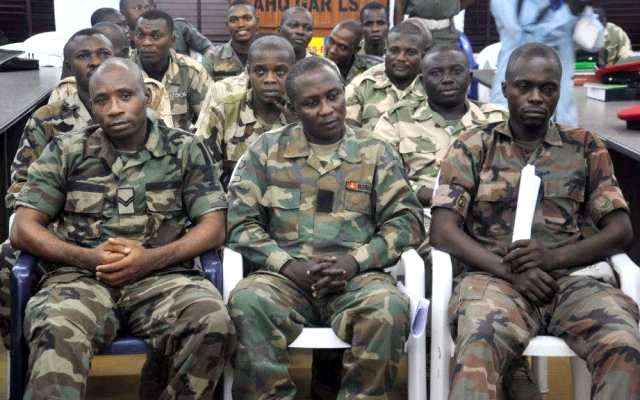
Some of the soldiers accused of refusing to fight Boko Haram appear before a court-martial in Abuja on Oct. 15, 2014. Photo Credit: VOA
Soldiers serving jail terms at the Kirikiri Medium and Maximum Security Prisons have cried out to President Muhammadu Buhari to forgive them whatever wrongdoing they had committed and grant them pardon for the sake of their families.
The soldiers are those sentenced to death by a military court martial in 2014 for demanding weapons before going to confront Boko Haram terrorists, but whose cases were later reviewed and commuted to 10 years imprisonment by the Chief of Army Staff..
They include the 12 soldiers convicted in September 2014 and sentenced to death by a court martial for demanding for weapons when the General Officer Commanding the 7th Division of the Nigerian Army visited a military camp in Maiduguri, and the 58 others sentenced to death in December by another court martial for similar offence.
ICIR met the soldiers during an undercover visit to the prisons last week and interviewed them on how they’re faring and the conditions in the prisons.
The soldiers revealed that some Boko Haram suspects brought into the prisons had all regained freedom while they have continued languishing in jail.
A corporal, who acted as their spokesman, said: “The people we risked our lives fighting in Sambisa Forest who were brought here are being released one by one while we remain in jail. This is traumatic for all of us and we are begging our commander-in-chief to grant us pardon for the sake of God and our families.”
The soldiers also disclosed that the military authorities had stopped their salaries and their families had become impoverished.
“Most of us are the breadwinners of our families but we are in jail and our families have no one to take care of them. Our children have dropped out of school and we can’t help them,” said another soldier, as the others all nodded their heads in agreement.
They pointed at a soldier whose daughter was to write WAEC this year but had to drop out of school for lack of money.
But even life in the prison has been hectic and traumatic. The soldiers all complained about the exploitation by prison officials from the security men to the top.
They alleged that food ration in the prison was pathetic and that any prisoner who wanted to eat decent food had to prepare his own food or request his family to bring food to the prison.
“Prison officials request money from people who bring us food right from the gate to inside the prison. Sometimes a visitor who brings food pays as much as N3,000 each time they bring food into the prison otherwise they would not be allowed in. For God’s sake, how can we cope with this?” a soldier asked with anger on his face.
But corruption in the prison does not end there. According to the soldiers, prison officials sell food stuffs and soup ingredients provided by government and NGOs to prisoners. The soldiers pointed at a store behind the prison entrance gate where the reporter saw onions, salt, yams and other food items being packaged.
“They will parcel the food stuffs from the store and give to the prison traders who help them sell to us,” the soldiers alleged.
When the ICIR confronted the prison officials with these allegations, they denied all. Abdulrasheed Ogundare, the prison Welfare Officer who thought he was speaking to a human rights lawyer, denied all the allegations.
On the release of Boko Haram suspects from the prison, he said there was nothing like that. “Those that were released were suspects raided from Lagos and brought to the prison, not the Boko Haram from Sambisa. Those ones are still in our custody. We don’t even allow them go out like the other prisoners.”
He called a prisoner to confirm whether Boko Haram suspects in the prison were being released, but the prisoner neither confirmed nor denied. “I don’t know; I’m not sure,” he responded, squeezing his face and walking away.
“Don’t mind the soldiers, we didn’t release any Boko Haram,” the Welfare Officer repeated to the reporter.
On prisoners’ feeding he said they were well-fed and that the caterers were graduates of catering. “If you’re in prison you cannot expect to feed as if you’re at home,” he said in response to allegation of poor meals. He however said most of the prisoners were “self-feeders”, meaning they arranged their own feeding.
He also denied that prison officials were exploit the prisoners, saying such allegations had not been brought to the notice of prison officials. “We are doing our best to take care of the prisoners and if you look at them very well you will see that they are feeding very well.”
Sani Usman, a Brigadier General and Director of Army Public Relations, refused to be drawn into any discussion on the issue, saying the case was of the soldiers was still in court.
“You’re aware that Femi Falana is in court over the case of the soldiers, so why do you want me to comment on a case that is in court?” he asked.
Femi Falana, Senior Advocate of Nigeria (SAN), appealed the jail terms given to the soldiers by the Chief of Army Staff.
He said although the soldiers were charged with mutiny, “the only allegation proven against them at the courts-martial was that they protested the refusal of the military authorities to provide weapons to fight insurgency”.
Falana, as well as many other Nigerians, called on President Muhammadu Buhari to grant pardon to soldiers in view of the circumstances under which they committed the alleged infractions.
They also argued that unlike many soldiers who deserted the army, the convicts were ready to defend the territorial integrity of the country, but had only made a legitimate demand for equipment to fight the insurgents who were better equipped and motivated.
In September 2015, months after he was sworn in as President of Nigeria, Muhammadu Buhari told select reporters in New York, USA: “I will remain Minister of Petroleum. I will appoint a minister of State for Petroleum.”
And true to his words, two months when Buhari allotted portfolios to his cabinet members, he named himself Petroleum Minister.
Buhari said he was taking the step as part of efforts to sanitise the oil industry, notoriously characterised by opacity and corruption in monumental proportions.
This appears, on the surface at least, a good enough reason, given that Buhari was voted into power by citizens who appeared fed up with the level of corruption in the country.
However, people who should know say the move is illegal, judging by the provisions of the constitution.
On Monday, Olisa Agbakoba, a Senior Advocate of Nigeria (SAN), filed an application urging the court to remove Buhari as Minister of Petroleum, saying his double portfolio is illegal.
Agbakoba quoted sections 138 and 147 of the constitution as the basis for his law suit, but what does the constitution say?
CONSTITUTIONAL PROVISION
Section 138 of the 1999 constitution (as amended) states: “The President shall NOT, during his tenure of office, hold any other executive office or paid employment in any capacity whatsoever.”
The office of a minister is surely an executive one, since the Federal Executive Council (FEC) comprises all ministers and other key appointees of the President.
Also, Section 147 (1 and 2) of the constitution states: “There shall be such offices of Ministers of the Government of the Federation as may be established by the President. Any appointment to the office of Minister of the Government of the Federation shall, if the nomination of any person to such office is confirmed by the Senate, be made by the President.”
Buhari did not undergo any senate confirmation before announcing himself as Petroleum Minister.
LEGAL EXPERTS’ OPINIONS
In the suit he filed before the Federal High Court in Lagos, Agbakoba insisted that it was unconstitutional for Buhari to hold two executive offices at the same time.
“I looked at Section 138 of the 1999 Constitution and I verily believe that it disqualifies the President from holding executive office, including that of the Minister of Petroleum, during his tenure of office as President,” he said.
“I also know that the President did not go through nomination process and confirmation by the Senate, before holding the office of Minister of Petroleum Resources.
“I again looked at Section 147(2) of the 1999 Constitution and I verily believe that it prohibits anybody from holding the office of a minister of the federation without confirmation by the Senate.”
Similarly, Ikechukwu Ikeji, a practising lawyer, agreed with Agbakoba that the constitution does not permit Buhari to hold another executive office while still a serving President.
For Ikeji, Buhari’s non-appearance at the Senate for confirmation as Petroleum Minister is secondary, because he is not qualified to be Minister in the first place.
Quoting section 138 of the constitution, Ikeji said it was clear that Buhari is not qualified to hold ministerial position.
“If you look at chapter six, part one of the constitution, it provides for federal executives; it is under this part that ministers are appointed,” Ikeji said on Monday during Channels Television’s Politics Today.
“And if you look at the makeup, the composition of the Federal Executive Council, you will agree with me that ministers are members of the Federal Executive Council, which means simply that ministers are members of the executive. In order words, a minister is holding an executive position.
“Having cleared that, the question is: ‘is the President holding an executive position if he is holding the position of Minister Petroleum Resources?’ I think the answer is clear and simple: yes.
“So I think that it is unconstitutional for the President to hold that executive position. It is clearly against the express position of this section 138.”
CONCLUSION
It is clear that Buhari’s dual position as President and Minister of Petroleum Resources is not in tandem with the provisions of Section 138 of the constitution. However, in the words of Ikeji, “it requires the court to so declare it”.
Binta Nyako, the judge in charge of Nnamdi Kanu’s treason trial, says Enyinnaya Abaribe, one of the sureties who signed Kanu’s bail bond, must produce the accused in court or forfeit the N100 million bail bond.
Abaribe, the senator representing Abia South Senatorial District at the National Assembly, is one of the three persons who stood in for Kanu when he was granted bail in April.
The bail conditions given to Kanu includes that “he must provide three sureties in the sum of N100 million each”.
The court had said: “One of the sureties must be a senior highly placed person of Igbo extraction such as a senator.
“The second surety must be a highly respected Jewish leader since Mr. Kanu said his religion is Judaism, (and) the third surety must be a highly respected person who owns landed property and is resident in Abuja.”
When trial resumed on Tuesday, Ogechi Ogunna, Abaribe’s counsel, told the court that he had filed an application requesting that his client be discharged as a surety to the accused person.
But Justice Nyako said Abaribe must choose from one of three options namely: to produce the defendant in court and then apply to be discharged as a surety; to forfeit his N100 million bail bond or to request for more time in order to produce the defendant.
Ogunna then told the court that his client was “not in a position to do any of these”, but when the presiding judge insisted, he opted to be given more time.
The other two sureties that stood in for Kanu did not appear in court on Tuesday, neither were they represented.
At a gathering in New York, USA, Abaribe had expressed fears that signing Kanu’s bail bond had put him in trouble.
“We are now in trouble, because we do not know where he is and how to contact him,” he said, adding that “those who support Kanu’s agitation should think twice”.