Home Blog Page 2707

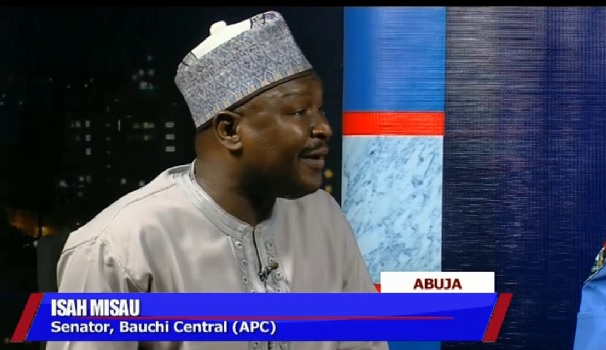
SPOTTED: Senator Misau was three years old when he graduated from ABU in 1977!

How old exactly is Hamman Isah Misau, the senator representing Bauchi Central Senatorial District in the eighth National Assembly? And when did he finish his university education?

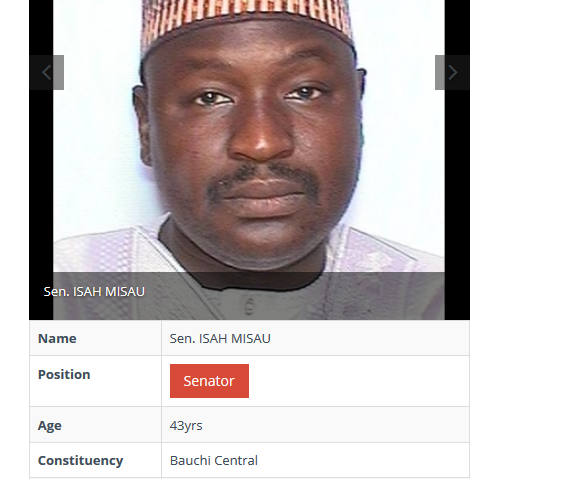
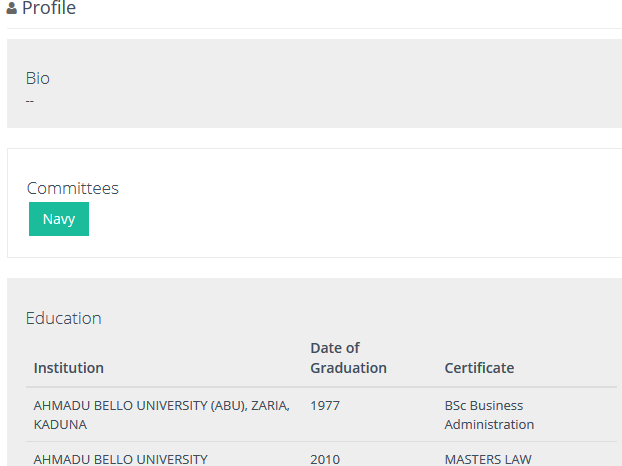
These are the questions begging for answers after a random search by the ICIR yielded his profile on the official website of National Assembly.

According to that profile, Misau graduated from Ahmadu Bello University (ABU) Zaria in 1977 after studying Business Administration; and he holds a Master’s degree in Law, which he obtained in 2010.

But, according to the same profile, Misau, who is currently in the eye of the storm following his bribery allegation against IGP Ibrahim Idris, is 43 years old. This implies that he was born in 1974 and, more damningly, that he was just three years old when he graduated from ABU.

In a flashback to his time as a policeman, the ICIR detailed how Misau prevented Ibrahim Liman from assuming the role of ADC to the FCT Minister for at least seven months after the official appointment.

SOCIAL-MEDIA SAVVY MISAU

Maybe the famed printer’s devil is to blame. But Nigerian Biography, an online platform, says Misau was born in 1970. Were this to be correct, Misau left university aged seven. genius!

Misau prides himself on being the youngest senator in the current National Assembly.

“Thank God, the older senators don’t look down on me,” he told Daily Trust in an interview last year.

“They give me the opportunity to voice out my feelings, both in the chambers and during committee sittings. Sometimes, I even forget that I’m the youngest when I’m relating with them. Likewise, they do also forget that they are older.”

Given his self-avowed social-media compliance, it is a surprise that he hasn’t noticed age versus graduation discrepancy on the NASS website.

“Some of them [older senators] rely on me when it comes to certain things; they request for my inputs, especially on issues concerning youth,” he said in the same interview. “I get information on Twitter, Facebook and other social media platforms which, to certain extent, age may not permit the older senators to read them.”

So, why hasn’t Misau spotted his bio-data on the National Assembly’s official website?

THE OTHER SIDE OF AGE FALSIFICATION

Misau would not be the first, and maybe not the last legislator — should that be the case — to falsify his age. One particularly striking example was not of age reduction but exaggeration.

Salisu Buhari, first Speaker of the House of Representatives at the turn of the Fourth Republic, lied his way to the lower chamber, falsifying his age. To become a federal lawmaker, he claimed he was 36 years old as of 1999, although he was born in 1970, meaning he was only 29 at the time and was one year short of the minimum age requirement to be in the House. But that was not his only lie.

He claimed to have attended University of Toronto in Canada and graduated with a degree in Business Administration, but the university denied he was ever a student of the institution. It was also discovered that after falsifying his credentials to gain admission into ABU, he was expelled and barred from participating in the National Youth Service Corps (NYSC).

When he was found out in 2000, Buhari broke down in tears, saying: “I apologise to you. I apologise to the nation. I apologise to my family and friends for all the distress I have caused them.

“I was misled in error by my zeal to serve the nation. I hope the nation will forgive me and give me the opportunity to serve again.”

NOT THE FIRST WEBSITE ERROR

Is it possible Misau’s age versus university graduation on the NASS website is an error? Quite possible — and this wouldn’t be the first time.

In August 2006, the website of the Nigerian Football Association (NFA), as it was then known, stated Obafemi Martins’ date of birth as as May 1, 1978, which means he was 28 years at the time instead of the 21 he was claiming.

The NFA soon clarified, though, that it was an “administrative error”, and apologised for the confusion.

So, Misau wouldn’t be the first victim of “administrative error”. But someone must apologise!


ASUU accepts FG’s ‘concrete proposal’

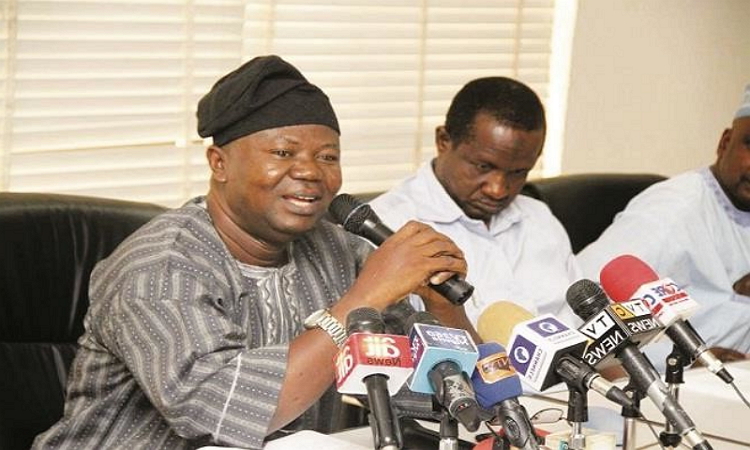
The Academic Staff Union of Universities (ASUU) has reached an agreement with the federal government.

The accord comes after a 12-hour meeting between the leadership of the union and a government delegation led by Adamu Adamu, Minister of Education.

Addressing journalists at the end of the meeting, Biodun Ogunyemi, National President of ASUU, said the dialogue yielded “a concrete proposal”, but that the union would have to reach its members for a decision.

“Now we have some concrete proposal that we will take back to our members for consideration,” he said.

Also addressing journalists, Adamu said the demands of the union had been taken care and that it would call off its strike within a week.

Since ASUU embarked on strike on August 14, the government has held meetings with the union, which were deadlocked, until that of Thursday.

ASUU went on the strike owing to the failure of the government to implement the 2009 agreement it reached with the union.

The union is asking, among other things,the government to pay its members their earned allowances and to increase funding for universities.

Paying for the climate in Nigeria

0

By Stephen Aina

The second law of thermodynamics, as posited by Isaac Newton, states that “for every action there is an equal and opposite reaction”.  On the surface, the law can pass for a line in poetry. Nevertheless, the scientifically inclined will effortlessly conjure imaginary scenes where an object is being acted upon by a force at varied angles of inclination.

The foregone paragraph is never an attempt to dive into the intricacies of physical science, but was adumbrated to emphasize the need for caution as the society strives to derive greater level of luxury from the environment. The rapidly changing environment and periodic colossal damages to lives and properties induced by natural disasters are enough to pique the human instinct that the business-as-usual scenario and dispositions to the environment is no longer fashionable and can only lead to distasteful consequences.

The recent happenings across the nation are kind reminder of the correctness of the “rephrased” second law of thermodynamics. It says, the society should not be hopeful of eating tomorrow the cake it neglected to preserve today. Heatwaves, flash floods, crop failures, and many more natural tragedies typify a cake that is going bland. Meningitis has debilitated many precious lives in the extreme north and flash floods play second fiddle to none in the destruction of lives and properties across Nigeria.

The common denominator to natural disasters is that the least privileged citizens are always at the receiving end of climatic vicissitude. Their capacity to mitigate and adapt to climate vagaries is abridged, often, by their non-literate status, visionless leadership at all tiers of government and empty community extension efforts.  Even though climate change further impoverishes the poor, the rich are beginning to reckon that they are also not fully immune to back-kicks from the environment. Recent flooding in the metropolitan areas of Lagos state defiled the superfluity of luxury to wreak towering havoc on properties in addition to the discomfort and pains visited on residents of stately estates.  Water levels in some areas climbed up as high as 1.9 meters, high enough to submerge and damage choice cars and appliances.

Indisputably, the floods only paid the estates a courtesy visit, even though uninvited, as the genuine landowner that was displaced through indecorous blockades (debris) on culverts and the serial cut-and-fill operations on wetlands to accommodate the grey of concretes. Future deluge could be more devastating!

As the dust raised by the floods settles, it is important not to lose the lessons. That for every action or inaction, the environment will yield in response to the level of perturbation and the people, either poor or rich, may have to bear the consequences.

Some states, with Lagos leading the efforts, have shown noble commitment towards sustainable use of the environment, but much can still be done in the areas of wetland management, stream channelization, tree planting and waste management.  As efforts are in speedy gears to turn states into mega-cities and make states wear the appearance of Dubai, the environment should be at the heart of every developmental stride and decision-making bearing in mind the peculiarities of each state.

A report released in 2016 by the World Health Organization (WHO) on urban air quality recorded Nigerian cities among the worst polluted cities in the world with particulate matter (PM) concentrations 32 times higher than the recommended level. Onitsha ranked as the worst city in the world apropos of air pollution. In parallel, the air in most cities is too dirty and lethal for the human lungs. An estimate by the Organization for Economic Co-operation and Development (OECD) puts possible annual premature deaths from polluted air to about 712,000 in Africa.

Again the poor among the society who spends more time outdoor to eke a living are the most impacted — even though the well-to-do are also not spared. The affluent who adopt the abatement option and rituals of confinement to air-conditioned spaces often lock themselves out of the healing ingredients and ample freshness in the natural air. The affluent tend to become heat-intolerant and suffer the risk of respiratory infections from contaminated air filters. In addition, air conditioners operate on hydrofluorocarbons (HFCs) to achieve cooling. This chemical is carcinogenic at high concentrations and a more potent greenhouse gas creating an island of heat around mansions and castles of the affluent.

Economic growth and development come at certain costs to the environment and such costs are to be borne by everyone, particularly business firms whose activity add considerably to biodiversity loss and reduction in environmental quality. Business owners operating fleets of industrial power sets and automobiles, including those regularly discharging effluents and greenhouse gases into the environment, are expected to blaze the trail of climate financing in Nigeria.

Non-governmental Organizations (NGOs) and other nature advocates in developing countries may soon experience financial stress following the United States (US) hostile stance on the Paris Agreement on climate change mitigation. Despite existing alliance by few state governors to neutralize President Donald Trump’s hasty pronouncement and sustain the US commitment to the Paris Agreement, the executive order is weighty enough to create spiraling aftermaths on the accessibility of climate funds to developing countries.

Sequel to the aforesaid, developing local content for financing climate change mitigation and adaptation programmes is essential to the survival of the conservation sector and also vital to sustaining the gains of conservation efforts in Nigeria. Climate financing in the local context will provide the needed bail-out for NGOs, Community-based Organizations (CBOs) and Civil Society Organizations (CSOs) to engage in effective advocacy campaigns and create job opportunities to curtail rural-urban migration.

Beyond the glamour of political correctness, and exchange of pleasantries and handshakes by stakeholders from both the public and private sectors at workshops and summits, business firms and moguls in Nigeria are encouraged to show dedicated commitment and support to programmes designed to create awareness, plant trees, rehabilitate shorelines and conserve biodiversity.  This may, however, not happen until relevant laws with pathways to environmental protection are activated and enforced.

The burden of responsibility is now on major greenhouse gas emitters, conservation agencies and the ogas at the top to forge doable alliance to drive climate and biodiversity financing in Nigeria. A shift from the usual profit-driven and tight-fisted left-handed approach to business to the liberal and ethical right-handed posture to environmental business is required.

Otherwise, a future where consumers will become sufficiently literate in environmental matters as to avoid certain services and products from firms that are not branded as ecofriendly will be desirable in the campaign for a safer planet. Until such moral resolution reinforced by quality control acts is attained, the least privileged citizens will continue to involuntarily “pay” for the offences of many firms to the climate. This is a livid case of heightened climate injustice and amounts only to double jeopardy as consumers equally pay to secure goods and services from the firms.

Since literacy in the common sense does not always translate to environmental literacy, key stakeholders in the conservation sector should soon develop blueprints adaptable to different genre of businesses to sensitize firms and clients alike on the need to embrace the ideals of a green economy. An economy that seeks to minimize the attendant environmental and social risks from all economic production activities. Every citizen has the right to clean air and water.

With the average global CO2 concentration now 15% more than the recommended safety threshold of 350 part per million (ppm), the world is on the precipice of a climate crisis.  Nevertheless, the imminent plunge is needless and can be reversed, albeit slowly, if the tenets of climate justice are ingrained and imbibed enough to guide the discharge of social responsibilities by corporate organizations in Nigeria.

A number of options are available to firms with high carbon emission rates to reduce their carbon footprints, an ostensible environmental risk and harbinger of global warming. None of the options towards a low-carbon future are without financial obligations and dedicated sacrifices. Heavy polluters can transit to becoming carbon neutral institutions by exploring biological options to counteract the onset of climatic extremes in Nigeria. Carbon offsetting provides firms with an inexpensive option of reducing their carbon footprints through investments in forestry. The forests can offer both immediate and long-term respite to the nuances of climate change including damping the capacity of runoffs to wreck havocs through canopy interceptions.

Carbon credits can be voluntarily purchased by firms to create a market scenario where monetary transactions are consummated to incentivize owners of sustainably managed forests to perpetuate forests on their lands for carbon sequestration. Forests are potent sinks for carbon dioxide, a major greenhouse gas in the atmosphere. Firms can likewise choose to collaborate with communities and relevant conservation outfits to set-up, own and manage bio-sequestration farms in any part of the country to offset emissions in excess of the limits allowed by safety regulations.

On a final note, greenery reformation is the next anticipated and desired revolution in Nigeria. It is a revolution long overdue to cushion adverse back-kicks from the climate. A revolution to provide massive job opportunities and stem the unsavoury surge of social vices.  A revolution to pay for the accumulated years of climate offenses, either voluntarily through investment in the green reformation or involuntarily as victims of climate change.

God bless Nigeria

Aina is of the Nigerian Conservation Foundation (NCF), Lagos. He can be reached via stephen.aina@outlook.com

The matter of 38 army officers (1)

0

By Emmanuel Onwubiko

I’m compelled for the second time in less than two years to write on this vexed issue of the alleged wrongful dismissal of 38 senior military officers of the Nigeria Army because of newly emerged information which goes to show that most of them were, indeed, not afforded a right to fair hearing.

Over a year and half ago when the Army through its public relations department published a release indicating the retirement of these soldiers, we were regaled with a cacophony of sensational allegations that the dismissed officers were caught committing a range of offences during the 2015 elections and for playing one role or the other in the monumental heist that allegedly occurred in the office of Colonel Sambo Dasuki the then National Security Adviser (NSA).

Dasuki is facing a barrage of court cases accusing him of diverting over $2 billion of money meant for purchases of weapons that would have been deployed in combating the armed Boko Haram terrorists.

When the retirements were announced at that time, many public affairs analysts alleged that the purge affected mainly senior officers of South East of Nigeria and some others from the South South, while only very few hail from some states in the North West or North East of Nigeria. The Chief of Army Staff is Kanuri of North East of Nigeria whilst the Minister of Defence is from Zamfara in the North West of Nigeria.

There were, therefore, allegations that the decision to retire those senior officers was a deliberate purge of mainly Igbo officers.

The Public Relations Department of the Army was predisposed to supply on demand the official reasons for the action. At that time, there wasn’t any other narrative available to writers so the official angle that trended necessitated an earlier media intervention I did, which some media houses published.

The immediate reason for this second article is to clear the cobweb of doubts which my first piece raised over a year and a half ago, particularly due to its publication in Daily Sun last week, even when I did not send it in for publication.

The publication of the first copy I did on this same matter over a year and half ago is coming against the backdrop of emerging facts which have established legally sustainable grounds to ask the President of Nigeria to take a good look at the allegations of wrongful dismissal raised by these 38 Army officers, most of whom were never invited to appear before the internal panels that probed allegations of alleged misconducts of military officers during elections in 2015 or the panel that investigated the alleged arms budget diversion.

Human Rights Writers Association of Nigeria (HURIWA) has therefore decided to add our moral voice to demand justice because if the allegations of wrongful dismissal aren’t investigated and quality redress provided, it would be a total institutionalisation of injustice.

Augustine of Hippo had argued that any government that is averse to honesty and justice is at best a bunch of criminals.

When I penned the first material on the gale of military retrenchments, I did not have the privilege of getting the other side of the matter since only the official channels of the military were available and those affected military officers weren’t accessible or willing to speak to independent media or civil rights activists like us. The first article basically quoted official accounts copiously since I could not get the other side.

From available materials and from findings made available by the affected thirty-eight senior Army officers, they described their circumstances for exiting as wrongful dismissal from the Nigerian Army and accused Brig-General Mansur Dan Ali (rtd), the Minister of Defence, General Abayomi Olonisakin, Chief of Defence Staff, and Lt. General Yusuf Buratai, the Chief of Army Staff, of victimisation of innocent senior officers.

Through their lawyers, these military officers successfully fought their alleged illegal dismissal through the legal platform of National Industrial Court. The officers, as law abiding officers, have also approached the President, urging him to review the circumstances surrounding their unjust removal from the only professional career that they have known virtually all their entire adult life.

The retired officers alleged that Ali, Olonisakin and Buratai abused their offices with impunity by maliciously punishing innocent officers. They, indeed, cited series of facts and figures which sound very convincing and merit a review. This is the reason I’m disturbed that someone can bring up an old piece I penned down when there was only one source of information.

What does that person circulating my stale article aim to achieve? The truth should, indeed, prevail and this is the reason my group and I are demanding that President Muhammadu Buhari takes a second look at this case to douse the tensions generated by the skewed retirement process that adversely affected the Igbo speaking nationality. Even Rivers State has seven top officers wiped off the map of the Army even when they are claiming innocence.

In a petition dated August 22, 2017 and addressed to President Buhari by the law firm of Abdul Muhammed LP, which this writer has, the officers recalled that at the beginning of this administration, two panels were instituted to inquire into allegations of electoral malpractices by Nigerian Army personnel and allegations of corruption associated with arms procurement under the office of National Security Adviser (NSA).
The officers also noted that sometime in June 2016, the Nigeria Army under the leadership of the troika of Ali, Olonisakin and Buratai presided over an abrupt sitting of the Army Council that saw to the punishment by compulsory retirement of the 38 senior officers of the Nigerian Army.

The petitioners also told President Buhari that after their unjust retirement, some of the officers wrote letters of redress for the president’s mature consideration of their individual cases, through the Chief of Defence Staff as provided by the Harmonised Terms and Conditions of Service (Officers) 2012 but the military authorities deliberately refused to show proof of transmitting the said letters to the president as required by regulations.

Onwubiko is head of the Human Rights Writers Association of Nigeria (HURIWA) and writes from Abuja. He blogs@www.emmanuelonwubiko.com, www.huriwa@blogspot.com.


READ ALSO:

Atiku: After using our money and influence to win, this govt sidelined me

Atiku Abubakar, former Vice President, says he was one of the people whose “money and influence” were used to hand victory to President Muhammadu Buhari in 2015, but he has been sidelined by the same government.

Speaking during a telephone interview with the Hausa service of VOA, Atiku also said the government has failed on many fronts in the fight against the Boko Haram insurgents, wondering why the counter-insurgency operations have lasted for more than five years without any tangible result.

Atiku maintained that the Buhari-led administration has “failed in many fronts” with regards to the issue of combating terrorism.

“Yes, there were successes but not comprehensive success because the Boko Haram miscreants are still very active, killing our people and many local government councils in Borno and Yobe are under their firm grip,” he said.

“People cannot dare go back to their dwellings. This thing baffles me. I never imagined that Nigeria would fight a protracted battle with Boko Haram for five years.

“At a time, we fought the Biafra war, which was more complicated because of the terrain in the South but the Biafran soldiers were roundly subdued in 30 months. But here we are, fighting an endless battle with the Boko Haram and there’s no end in sight.”

Atiku also criticised the current anti-corruption campaign of the federal government, saying it has achieved very little.

“How many people were arrested, prosecuted and jailed? How much was recovered from the looters?” he queried.

“When we [former President Olusegun Obasanjo and himself] came on board in 1999, I remember we recovered between $4.5 and $4.7 billion from those who looted under [late Sani] Abacha.”

Atiku lamented that the All Progressives Congress (APC) had sidelined him after using his platform and resources to achieve electoral victory in 2015.

“Honestly speaking, I’m still a member of the APC; I was part of all the processes, including campaigns until success was achieved,” he said.

“But sadly, soon after the formation of government, I was sidelined. I have no relationship with the government, I’ve not been contacted even once to comment on anything and in turn, I maintained my distance.

“They used our money and influence to get to where they are but three years down the lane, this is where we are.”

Atiku’s interview with the VOA came on the same day Aisha Alhassan, Minister of Women Affairs, told the BBC Hausa service that she would not support Buhari should he decide to seek re-election in 2019.

Alhassan said that Atiku had been her godfather even before she ventured into politics and therefore has her support for the next general election.

“Let me tell you today, if Baba says he is going to contest in 2019, I swear to Allah, I will go before him and kneel and tell him that ‘Baba I am grateful for the opportunity you gave me to serve your government as a minister but Baba just like you know, I will support only Atiku because he is my godfather,'” Alhassan was quoted as saying.

Sagay talks like he is under the influence of some substance, says senate

0

Itse Sagay, a professor of Law and Chairman of the presidential Advisory Committee on Corruption (PACC), talks like a man who is constantly under the influence of some substance, the Senate said on Wednesday.

Delivering a public lecture in Lagos on Tuesday on the topic, ‘The Many Afflictions of the Anti-corruption Crusade in Nigeria’, organised by the Nigerian Society of International Law, Sagay had branded the National Assembly as comprising “self-serving lawmakers who allocated N125 billion to themselves alone this year”.

He said while the United States President earns $400,000 per annum, a Nigerian senator earns over $1.7 million.

He added that besides a basic salary of N2.4 million per month, they earn allowances such as hardship (50 percent of basic salary), newspaper allowance (50 percent), wardrobe allowance (25 percent), entertainment (30 percent), recess (10 percent), and leave (10 percent), among others.

The total allowances, he said, amounts to N29.5 million per month and N3.2 billion per annum.

“Perhaps the most notorious example of the legislators’ resistance to the war against corruption is the rejection of the right of the executive to choose the persons who will spearhead that struggle,” he said.

“The clear impression is created that Nigerian legislators are in office for themselves and not for the populace.

“Not surprisingly, the National Assembly has not passed a single bill for the promotion of anti-corruption war since it commenced business in July 2015. The Whistle Blowers Protection Bill, the Proceeds of Crime Bill, and the Special Criminal Court Bill remain in a virtual state of stagnation. What evidence do we need to establish the hostility of the Eighth Assembly to the anti-corruption war?”

But responding in a statement issued by Aliyu Sabi Abdullahi, Chairman of its committee on media and public affairs, the Senate urged President Muhammadu Buhari to rein Sagay in for “spreading falsehood and making hate speeches against the National Assembly”.

It wondered if Sagay is “possessed”, saying he “employs the language of a tout with no civility” and is fond of “using every opportunity he has to make public speeches to disparage the federal legislature by using uncouth and unprintable words to describe the legislators and the institution they represent”.

“Sagay has been one of the few divisive elements in the Buhari administration who believe their relevance is enhanced only when they create constant tension between the legislature and the executive while also setting members of the executives against each other,” read the statement.

“While we ignored past statements made by the Professor of law, his recent speech at a public lecture in Lagos, organised by the Society of International Law, where he gave false details about the salary and allowances of the legislators and the various bills passed, bordered on inciting members of the public against the legislators and deliberately circulating hate speech, which the government is working hard to contain.

“Ordinarily, we would ignore Sagay whose statements and attitude present him like a rascal and sadist instead of a former university teacher. However, his last speech in Lagos, during which he was reeling out false and exaggerated figures about the salaries and allowances of legislators, and also lied about the passage of anti-corruption bills, showed that he just deliberately set out to undermine the legislative institution and lower its reputation in the estimation of right thinking members of the society and we therefore believe we should put him in his rightful place.

“As an academic whose creed should be to find facts and make comments based on truth, we believe that Sagay should stop spreading beer-parlour rumours about the salaries and allowances of legislators when he could simply get the facts from the Revenue Mobilization and Fiscal Allocation Commission (RMFAC), which is the body constitutionally charged with the responsibility of fixing salaries and allowances of all public officials.

“Let us make it clear that our salaries and allowances are open books and the details can be taken from the RMFAC by any interested party.

“Prof. Sagay, at his lecture in Lagos, also made comparisons which did little credit to his background as a lecturer as he was talking of the salary of the United States President and that of a Nigerian legislator. That is like comparing oranges with apples. Only a senile, jaded, rustic and outdated Professor of Law like Sagay will make such a comparison which falls flat on its face, even to an ordinary lay man. Surely, Sagay is basing his analysis on street talks.”

The senate argued that Sagay could not even check the records before proclaiming that the National Assembly had not passed a single bill for the promotion of anti-corruption war since it commenced business in July 2015.

It clarified that that the 8th National Assembly was inaugurated on June 9, 2015 not July, and also stated that it had passed the Whistle Blowers’ Protection Bill, Witness Protection Bill, Mutual Legal Assistance in Criminal Matters Bill and the Nigerian Financial Intelligence Agency Bill.

“This man talks like a man who is constantly under the influence of some substance and perhaps possessed as he employs the language of a tout with no civility. He is probably constantly excited and incensed by the fact of having his first opportunity to find himself in the corridors of power,” the statement continued.

“He pontificates and talks as if the war against corruption of the Buhari administration depends solely on him to survive. He once publicly attacked the Attorney-General of the Federation and accused him of not doing enough to prosecute the war. In the Lagos speech, he took a blanket swipe at the judiciary and rubbished that entire institution, which he, as a lawyer, has the professional, ethical and constitutional duty to respect.

“This is a man who cannot stand for Councilorship election and win. We challenge him to state what his contributions are in the election of our amiable President, Muhammadu Buhari and what new ideas he has contributed to making the fight against corruption more effective since his appointment.

“With an easily excited man like him as head of an advisory body, the nation has continued to lose anti-corruption cases in courts due to the failure of his advice. He needs to do more work and talk less because media prosecution cannot win the war on corruption.”

The Senate therefore urged the President to caution Sagay and “stop him from further creating needless tension in the relationship between the executive and the legislature”.

Boko Haram, other terrorists profiting from Sahel’s porous borders, says UNDP

The United Nations Development Programme (UNDP) says weakness in management of border areas and laxity in controlling of movements of people and goods in Sahel region have created substantial trans-border criminal activities, human trafficking and illicit flow of arms.

According to Samuel Bwalya, Country Director of UNDP in Nigeria, these weaknesses are profiting transnational criminal groups and terrorist organisations that are destabilizing and threatening human security at the community and national level through their illicit activity in and beyond border areas of the Sahel region.

He spoke in Abuja on Wednesday at a regional symposium to launch the survey project report on small arms and light weapons in the Sahel.

Bwalya, who was represented by Mandisa Masholugu, UNDP Deputy Country Director, said the international community has raised concerns about the proliferation of illicit small arms as a serious impediment to social and economic development in the Sahel region and its neighbouring countries.

He however noted that a draft action plan on management of illicit proliferation of small arms and light weapons should be in the future a reference point for institutional and non-governmental actors, including international partners in support to regional effort on management of illicit proliferation of small arms.

Also speaking at the event, Halimat Ahmed, Commissioner, Political Affairs, Peace and Security, ECOWAS said the survey was conducted in nine countries among which are five ECOWAS member states: .

Other states that participated in the survey she said are Cameroon, Central Africa Republic, Mauritania and Chad.

“This symposium is an attempt to evaluate and develop a common strategy in the fight against proliferation of small arms and light weapons in the region especially the Sahel where at various points of its huge expanse, the world has seen and felt the negative impact of small arms and light weapons in our region,” said Ahmed who was represented by Joseph Ahoba, Head Small Arms Division of ECOWAS.

“This effort is noteworthy for the reason of the fundamental objective of promoting better understanding of the challenges posed by the illicit proliferation of small arms and light weapons and the inter-linkages of that international crimes such as drug and human trafficking, the challenges of transhumance as well as the upsurge of terrorism in the region.”

FLASHBACK: How, as a policeman, Senator Isah Misau prevented FCT minister’s ADC from assuming work

Isah Misau, the senator representing Bauchi Central at the National Assembly, has been receiving a little more attention from the media since late August, when he accused Ibrahim Idris, Inspector-General of Police (IGP), and other top figures of the force, of collecting bribes, “ranging from N10m to N15m” from commissioners of police, state mobile commanders and Special Protection Units (SPU) commanders, for favourable postings.

The police fired back by claiming Misau is a deserter, for not properly resigning before leaving the force to pursue his political ambitions. However, that allegation has now been cleared, with the Police Service Commission (PDC) confirming earlier in the week that the senator indeed resigned appropriately.

But the resignation matter was not the only controversy to remember from Misau’s time as a policeman.

In April 2010, when Bala Mohammed was appointed Minister of the Federal Capital Territory (FCT), he didn’t have an Aide-de-Camp (ADC) for at least seven months due to Misau’s desperation to hold on to the post.

Ibrahim Liman, an Assistant Superintendent of Police, was the ADC posted to serve Mohammed by the FCT Police Command. But Misau didn’t allow him report for duty, as he continued mounting serious pressure on Mohammed to retain him as his ADC.

At the time, Mishau had been ADC to Adamu Aliero, the immediate past FCT Minister, as well as Aliyu Modibbo Umar, who preceded Aliero in office. Therefore, he stayed behind when Umar was removed as FCT Minister, and went underground for 55 days when Remi Babalola was the Supervising Minister of FCT.

However, when Aliero was appointed, he resurfaced. It was learnt that Misau, who was ASP when he was posted to FCT and had then risen to Deputy Superintendent of Police (DSP), never used his new rank until then, as this would require him to go for a DSP course, which he didn’t want to attend.

Worried by Misau’s continuous refusal to leave the FCT, Haruna John, then FCT Police Commissioner, met with the new Minister over the matter. However, Misau had acted faster, going to the official quarters of the Minister to invoke ethnic sentiments as he hails from Bauchi State just like the Minister.

Having not received his new ADC at the time, the Minister was boxed to a corner, as he was careful not to offend the FCT CP, Goke Adegoroye, his own Permanent Secretary, kinsmen from Bauchi and some lawmakers whom Misau had contacted to push for his retention as ADC.

Anytime Liman, the new ADC, went to the Area 11 office of the FCT Minister with his letter of transfer, he was always told by the Minister’s Secretary  and others loyal to Mishau that the Minister was either busy or not available at the office.

The development created bad blood between the FCT Police Command and the Force Headquarters, the latter offering support to Misau, being a son of Mohammed Hamma Misau, a retired Assistant Inspector General of Police.

Misau looked to be on course to elbow Liman out of his appointment — until Leadership newspaper reported the story in November 2010. It proved the end of Misau’s enforced stay as ADC to Mohammed. Not long after, Liman was allowed to assume his job as the minister’s ADC.

I swear to Allah, if Buhari runs in 2019, I will support Atiku, says Buhari’s minister

Aisha Alhassan, Minister of Women Affairs popularly known as Mama Taraba, says Atiku Abubakar, former Vice-President, remains her political godfather and definitely has her support for the 2019 presidential election.

Alhassan said this in an interview with BBC Hausa, swearing by Allah that she would not support President Muhammadu Buhari over Atiku should the former decide to re-contest in 2019.

“Atiku has been my godfather even before I joined politics. And again, Baba Buhari did not tell us that he is going to run in 2019,” Alhassan said.

“Let me tell you today that if Baba says he is going to contest in 2019, I swear to Allah, I will go before him and kneel and tell him that ‘Baba I am grateful for the opportunity you gave me to serve your government as a minister but Baba just like you know I will support only Atiku because he is my godfather… if Atiku says he is going to contest.

“If because of what I said, I am sacked, it will not bother me because I believe in Allah, that my time has elapsed; that is why.

“Baba is not a mad man like those calling for my sack. They have been sending it and spreading that if Baba sees this I will be sacked‎.”

Alhassan narrowly lost the 2015 Taraba State governorship election to Darius Ishaku of the Peoples Democratic Party (PDP).

QUESTION: Will Nigeria ever abide by AU’s ‘Abuja Declaration’ on health?


A healthy population is truly the best insurance to help the economy thrive. This was the main premise of the 2001 Africa Union ‘Abuja Declaration’.

One important and well-acknowledged criterion for determining quality of livelihood is good health, which the people can have when access to quality healthcare is guaranteed. Adequate funding for health by government is very important to quality healthcare delivery, especially for women and children.

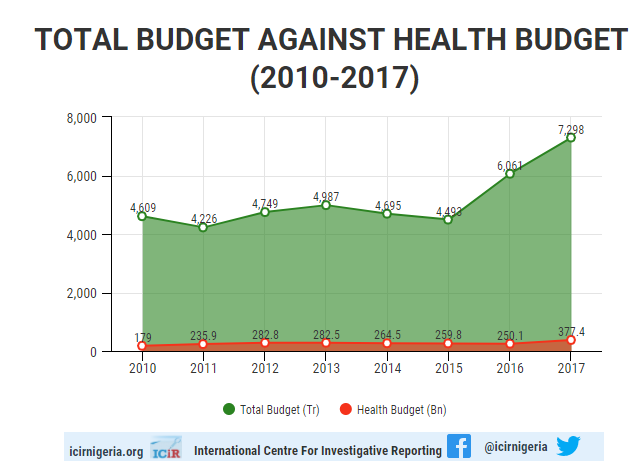
Knowing this, heads of state of African Union countries met in April 2001 in Abuja and pledged to set a target of dedicating at least 15% of their annual budget to improving the health sector. A look into the Nigeria’s health budget for the past seven years (2010-2017) shows that provisions for the health sector have remained below 15% as agreed in the Abuja Declaration.

Over the past seven years, the Federal Government’s health budget has fluctuated, with percentages ranging from 3.81% — being the lowest allocation — in 2010, to 5.58% in 2011. The year 2012 had the highest budgetary allocation of 5.95% to the health sector.

In terms of amount allocated to health in past seven years, 2017 budget has had the highest amount budgeted at ₦377.4bn naira. However, that equates to only 5.17% of the total budget. At the state level, only Bauchi State has allocated 16% of it total budget to the health sector, while only three of the 36 states of the federation (including the FCT), have their health budgets very close to the 15% mark set in the declaration. The three states — Kaduna, Niger and Nasarawa — allocated 12.4%, 11.6% and 10.4% respectively to health in their 2017 budgets.

Nigeria is among the worst places in the world to accommodate a child, infant or mother. This is because one in eleven of all children who die in the world under the age 5 are Nigerian.

Sadly, the country’s health system has been neglected for long and this has led to negative health indices. The 2015 DTA from the World Health Organisation (WHO) showed that the life expectancy at birth is 53 years, which is below the Sub- Saharan Africa’s average of 56. Another index is the maternal mortality ratio, which stands at 814 per 100,000 live births, infant mortality rate stands at 71.2 death in every 1,000 live births and under-five mortality rate at 89 in every 1,000 live births.

Nigeria’s heavy out-of-pocket spending

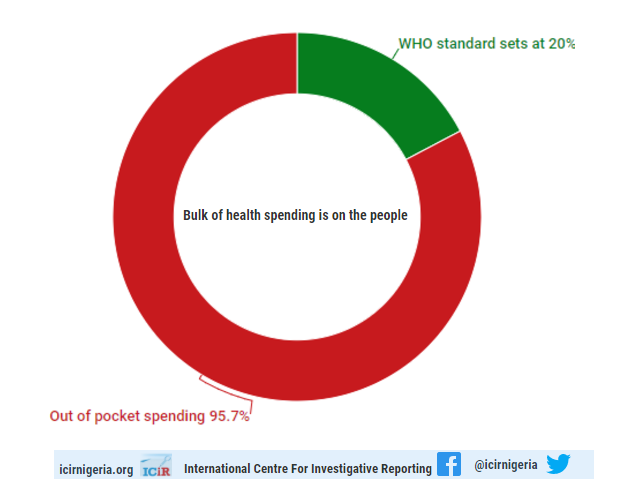
The World Health Organisation (WHO) defines out-of-pocket payments (OOPs) as direct payments made by individuals to healthcare providers at the time of service use. According to WHO, Nigeria’s out-of-pocket spending is 95.7% as against the recommended benchmark of 20%, which means Nigeria is 75.7% away from the recommended benchmark. This depicts that the bulk of health spending is on the people.


Were the Abuja Declaration to be fulfilled, the implication is the achievement of a healthy Nigerian population, a development that would lift the country economically and socially.