Home Blog Page 2708

Borno farmlands deserted after Boko Haram’s beheading of two farmers

Farmers in remote parts of Borno State want the military to provide them with adequate security to enable them harvest and evacuate their farm produce.

Babakura Lawal, Ward Head of Alau Ngafate community, who made this request on Wednesday, urged the army to increase its patrol and surveillance activities in the area.

Lawal said the demand became necessary following the number of farmers who had been killed or kidnapped by Boko Haram insurgents while working on their farms.

“On Monday, Boko Haram insurgents attacked and beheaded two farmers while two others were still missing,” NAN quoted Lawal as lamenting.

“We are a farming community of about 5,000 people. We cultivated crops such as cassava, maize, sorghum, millet and vegetables. It is now time for harvest, but we cannot go to the farms for fear of the insurgents.”

Lawal gave the names of the deceased farmers as Madu Mustapha, 25, and Bulama Musa, 65.

Also speaking on the development, Abba Alau, the Councillor representing the area, added that the insecurity in the area had cost the farmers enormous losses as they could not harvest their crops.

Alau noted that hundreds of hectres of plantations were on the verge of perishing due to farmers’ inability to harvest.

“We call for deployment of military and other security personnel to the area. Alau is just five kilometres away from Maiduguri,” he said.

Boko Haram occupied vast areas of Borno State at the peak of the insurgency until 2015 when the military mounted a sustained counter attack, which has largely been sustained ever since.

However, the insurgents continue to mount series of surprise attacks and suicide bombings in remote villages of the state.

Eid-el-Kabir — the fear that pierced our hearts

Finally, the D-day arrived and it was greeted with both happiness and a dash of trepidation by Muslims and Christians on the streets of Suleja, Niger State. The few that walked the streets kept throwing glances at everybody and nobody — none could be trusted!

In the wee hours of the morning — as early as 4.00am — residents set out on their journey into the Abuja city centre for their daily activities, but it appeared nobody was in the mood for converting their private vehicles into taxis as is usually the case. None of the drivers seemed willing to pick up passengers — not for the normal fare of between N200 and N250, or for any price at all. And when any car dared stop, the driver vehemently refused to take in women wearing long hijabs.

Zainab tried to jump on to what appeared to be the last bus heading towards Berger before the road would be locked for the Eid prayers, but shouts of “ba zan jeba” (I’m not going) rented the air as the conductor refused to allow her, and as a result anybody, from gaining entrance into the moving bus.

The face-tight bus conductor wouldn’t listen to the plea of other passengers for the hijab-wearing lady and her baby to be allowed to enter the bus; he kept fending everybody off.

The road was deserted save for few children who ran up and down the road as the Mallams selling the much-needed Sallah rams called out to them to look out for traffic.

The visibly-enraged passengers called out the conductor for preventing the women from entering the vehicle on the excuse that they could be suicide bombers. “Wicked man”, one of them blurted out, “na you be Boko Haram, leave am make she enter na, if na your mama you go push am?”

But the children appeared oblivious of what was going on around them, as they were seen running about gaily in their newly-sown clothes.

One of the residents in the Kwamba quarters of Suleja expressed hope that the Eid prayers would not encounter any hiccup. “Allah is faithful and the day’s festivity will go on fine inshallah,” he quipped with enthusiasm.

The apprehension of the people about a possible Boko Haram attack during the Sallah celebrations was not misplaced. There had been a number of bomb blasts in Abuja, all occurring in outskirt towns, such as the 2011 Christmas Day bombing at St Theresa’s Catholic Church in Madalla, very close to Suleja, and the Nyanya bombing in 2014.

More than 120 lives were lost in both incidents; and although years have since passed, the scars remain fresh in the hearts of the people.

The much-awaited Sallah has come and gone, but the painful experience that crept from the past and the fear of the unknown still shackles the people.

FORSAKEN CHAMPIONS: Nigeria’s para athletes battle penury

0

On this day last year, Team Nigeria arrived Rio, Brazil, for Paralympics 2016. Fourteen days later, they landed Nigeria’s Abuja Airport to a cheering crowd of dancers and onlookers who gathered for a glimpse of the champions and their medals. The team had hauled 12 medals including eight gold – the best result in Team Nigeria’s Olympic and Paralympic history. Today, the same team now lavish in penury as is revealed in this special feature first published by The Guardian.


By Lolade Adewuyi

Every morning, Olajumoke Olajide rises around 4:30am from her Amukoko residence to get to the National Stadium where her coach, Aliu Adebayo, waits for her to begin the day’s training. Her travails in this community on the outskirts of Lagos, a neighbourhood where unemployed youths run rampage and rape is rife, starts from the bus stop where she requires two people to help her board the yellow danfo bus. Many times, she has to wait for more than an hour before a helpful conductor agrees to fold up her 15 kilogrammes wheelchair and stow it into the bus and onwards to Surulere.

Olajumoke Olajide

Olajide lost the use of her legs when she was four years old after falling ill. She says an injection caused paralysis to her lower limbs, a classic case of poliomyelitis. Her parents ran helter-skelter in search of solutions, visiting healing homes, orthodox and religious as she became confined to using leg braces and crutches that came with pains so she started to crawl.

She dropped out of school in Primary Six when her parents could not afford the high cost of a special needs school and was asked to learn shoe making but could not sustain her interest.

Moving in with her aunty in Orile Iganmu led her to a chance meeting with a neighbour, a night club bouncer who encouraged her to take up sport in order to engage herself. In 2009, Olajumoke had a life changing experience when she met people with different levels of paralysis at a charity donation organised by the MTN Foundation in Rowe Park, Yaba.

“When I got there, I forgot about my disability when I saw other people that had worse than me. I cried with them but made many friends that day,” she said. She left the place with a tricycle in tow and the name of a coach at the stadium.

She went to the powerlifting arena where she met Coach Are who encouraged her to keep coming. But someone advised her instead to go to the tracks where she met Coach Adebayo who would put her in a racing wheelchair for the first time.

“He took me as his own sister and encouraged me. He showed me what I am capable of achieving,” she said.

Following the early body pains of active competition, Olajumoke settled down to track and field where she began to compete in T53, a category for athletes who have spinal injuries since her condition had worsened over time. She won the gold medal in the 100m wheelchair race at the National Sports Festival Eko 2012 in Lagos. And she became a member of the national team.

In 2016, Olajumoke broke the 11-year-old African T53 100m record that was held by Kenyan Anne Wafula, at her first international race, the International Paralympic Committee Athletics Grand Prix in Dubai.

It was a moment of personal fulfilment and triumph after many disappointments. “I didn’t know the moment when I started crying, I was so happy,” she said. She was left out of the Nigerian Paralympic Team to the Rio 2016 Olympic and Paralympic Games but has not given up hope. “When I saw my colleagues win medals in Rio I cried and told myself ‘one day I will become a Paralympian and I will win something when I get there.’”

According to figures released during the 2016 International Day of Persons with Disabilities (IDPWDs), 19million Nigerians live with at least one form of disability. But this has not stopped many from taking part in sport. Nigeria won her first gold medal at the Paralympics in 1992, four years before gold was won by an able-bodied athlete at Atlanta ‘96. At Rio 2016 where the country got a bronze in football, para-athletes won eight gold medals in a total haul of 12 which has led for calls to prioritise the Paralympics above the Olympics. Yet, the treatment that para-athletes have received has been incommensurate with their output as Onye shares an even worse experience.

Lauritta Onye

ONYE’S BIG HEART

Lauritta Onye, 33, was one of the stars of the 2016 Paralympic Games. Outgoing and highly personable, Onye won a gold medal in the F40 shotput for women when she broke her own world record and her celebration twerk was shown on TV screens across the world. Born with achondroplasia which makes her adult height 4ft 1in, Onye laments that nothing has changed for her since that success.

“I thought that my country was going to honour me and I was going to be awarded. When we got to Nigeria, they welcomed us at the airport in Abuja. The next day we were all asked to return to our destinations. They did not take us to see the President,” Onye said. The President has yet to call for the team.

Frustrated at the lack of financial rewards for her achievement while her opponents have been rewarded, Onye said her motivation for continuing in the sport has waned. Having no car, she gets around by public transport and suffers when it rains because she has to walk through floods, where she sometimes has to be carried across drains.

“There are bills I have to pay and because I am an athlete I am unemployed, I do not receive a salary. I need a car because I don’t have long legs to jump over gutters and people have to carry me, it’s not good. After all my hard work…” she lamented.

“When people recognise me in public transport, they ask why do I still take public transport as an Olympian. When I am coming to training and I see flooded streets, I cannot jump because I don’t have long legs. Men take advantage of me, they say ‘let me carry you my baby.’ It’s annoying.”

Onye once fainted during training because she had not eaten. “I fainted because I had not replaced the lost energy. It is very embarrassing for me.”

Her gold medal, which hangs in her house, is a reward for a decade of hard work where she has reached beyond her physical limits. However, Onye continues to find it hard to participate in international competitions that should help her rankings. The Nigerian para-athletes can’t find funding to attend competitions this year and Adebayo’s academy can’t do anything about it.

ADEBAYO’S SACRIFICE

The Paralympic Committee has a standard categorisation for athletes, with the coding prefix T (track) and F (field). National athletics coach, Aliu Adebayo, trains Track athletes with limb deficiency (T51), leg length difference (T52), impaired muscle power (T53) and those with impaired range of movement (T54).

Adebayo Aliu

Adebayo himself, won a T54 men’s 100m gold for Nigeria at the 1999 All Africa Games in Johannesburg, but poor preparations meant he lost the title in Abuja, four years later, and in Algiers, in 2007. He said that it was due to lack of competition. “We went and rested on our oars when the competition went back home to prepare to beat me,” he reflects.

Back then there was nothing for para-athletes to do. They just showed up to compete after a few days in camp.

His coaching career took off as he saw the need to use his experience to prepare younger athletes. His life has been dedicated to supporting para-athletes and helping them find purpose in a country where even able-bodied people struggle for a living.

He recalls the day Olajide first came to the stadium. “She came with her mother who was crying about the amount of pain that her daughter would suffer, but I assured her that all would be well.

“I told her, ‘Look at me, am I not on the wheelchair too? How will I hurt her? Mark my words, these tears you are shedding will become joyful tears tomorrow’,” he said.

Having sent the mother away, Adebayo proceeded to turn the 22-year-old into a top athlete just like he had done for others before.

Adebayo spends personal funds to ensure his athletes can get access to international standard wheelchair and other training equipment, sometimes at the detriment of his own family. Adebayo’s work with other para-athletes has taken a toll on his family’s finances but he has vowed never to stop creating the change he wants to see happen.

“My wife and I have agreed that she will take care of breakfast and lunch for the children while I bring home dinner,” he said, with a lump in his throat.

So, every morning, Adebayo waits for his athletes at the National Stadium not minding what the weather is and where the money is going to come from. “I tell my athletes who are now abroad to always remember to send something to assist those following behind, that’s how we were able to buy top wheelchairs for our training.”

And he has been able to make many of them dream beyond their circumstances. Michael Olugbenga Adeniji, a T53 wheelchair athlete belongs to the foundation run by Adebayo. He travels from Ikorodu every morning via BRT buses to train at the stadium. His joy is that the BRT buses are free for physically challenged people but would like to see specialist sport centres built for para-athletes across the state.

T51 class athlete, Lucky Ajudua, was inspired by watching para sports on television and so came to the stadium to pursue his dreams. “I want to win a gold medal for Nigeria at the Paralympics one day,” he said.

Babatunde Sheriff, a T54 athlete has been participating in the sport for eight years. Sport, he said, has helped him to become accepted in society. “I am able to pay for my house rent and do other things,” he said.

STRENGTH DESPITE ADVERSITY

As she rests after her session, Olajide shouts out instructions to a younger athlete who is doing his rounds on the tracks. It is her own way of taking up responsibility for other athletes just as her coach has admonished.

She dreams of reaching the top of her sport one day and having the opportunity to give back to the sport just like her coach Adebayo is doing.

“The one thing I would like is to help change the perception about disabled people. The way people look down on us is not good,” she said.

“I feel discouraged sometimes because we have not been able to attend any championships this year. Someday maybe we will stop practising and go find other things to do.”

Onye, who has been in films and is a star on the big screen, hopes to settle down and raise her own family soon. She would be happy to have a partner that will support her athletics dreams and maybe finance some of her international travel to compete. However, she’s also aware that marriage could mean ending her career.

Still, her sense of humour shines through. “I want a man who is God-fearing, fashionable and romantic. I have been approached by many men but I am taking my time because all that glitters is not gold.” Speaking of gold, exactly how much is needed to keep Nigeria’s Paralympic champions and hopefuls, well engaged and ready for future medals?

Nigerian para-athletes in training at the National Stadium, Surulere, Lagos


IS THIS THE FUTURE?

To win medals in any sports competition requires a huge investment in training, facilities, coaching staff, diet and overall well-being of the athlete. For example, the United Kingdom, according to uksport.gov.uk, spent £5m to prepare athletes for the Atlanta ‘96 Olympic games. By UK standard, that amount was considered a token because it landed Team Great Britain on the 36th spot on the overall medals table.

But since that time, UK Sports, the body responsible for funding UK’s Olympic athletes has spent more than £900million on preparing athletes for the games. More than £274m was allocated to support Olympic athletes for Rio with an additional £73m spent on the country’s Paralympians.

That investment did eventually pay off – UK earned a second spot on the overall medals table in both the Olympic and Paralympic games. Not surprising, Nigeria came a distant 78th and 17th respectively on the overall Olympic and Paralympic medals table respectively. Notwithstanding the success, the UK is not resting on its oars. Between 2017 and 2020, it plans to spend over £70m to prepare Paralympians for the Tokyo 2020 Paralympic games. Much of the funds come from the National UK lottery and government subventions. Nigeria on its part, has no official record of how much it spends on her athletes.

For doing their country proud at the last Olympic games, US Paralympians each got $5,000 for winning Gold, $3,000 for Silver and $2,000 for winning Bronze medals, even though most of the athletes complained they should have gotten same reward as their able-bodied counterparts.

Why are Nigerian para athletes having it so difficult in spite of recording such international feats for the green-white-green flag? The Secretary General of the Paralympic Federation of Nigeria, Chinedu Osuoha attempts an explanation:

“Government is saddled with catering for more than 40 sporting federations, the government alone can’t do the magic, corporate bodies have to step in.”

In June 2017, FrieslandCampina WAMCO Nigeria announced a renovation of the para athletes power gymnasium in Nigeria’s National Stadium, Lagos. Under the partnership with the country’s sport ministry, the food and beverage company will refurbish the gymnasium and equip with facilities. This arrangement also includes provision of nutritional support for athletes.

Many of the athletes agree that corporate sponsorship is the way out of Nigeria’s sporting mess. But until then, Onye, Olajide, Adebayo, Sheriff, Adeniji, Ajudua and their many colleagues vow to keep training for as long as they can. The question is, for how much longer?

Photos taken by Bunmi Amosun.


National assembly’s august visitors and their strategic importance

0

By Bamikole Omishore

The term ‘August Visitor’ is usually used to describe the visit of a highly dignified or important person or an unexpected visitor with unusual importance and influence. And such is the only way to term the last month’s visit of the delegation of United States Congressmen to Nigeria. The importance of this meeting between the US Congressmen and the Nigerian National Assembly led by the Senate President, Dr. Abubakar Bukola Saraki is one that Nigerians will not forget in a hurry.

What makes the occasion more remarkable is that since the return of democracy in Nigeria 18 years ago, this particular visit had the largest delegation of visiting Legislators from the US; a pointer to the fact that the United States of America and the International Community as a whole are starting to notice the giant strides of Nigeria’s Parlament.

The leadership of the National Assembly has without doubt brought an improved level of Openness, Participation and Transparency to Government decision making, especially in the areas of Oversight and Accountability. This singular act has gone a long way in helping Nigeria earn the trust and respect of the global community. It is therefore no surprise that with the visit of the delegation of US congressmen, the issue of sales of fighter jets to Nigeria and other human right issues which have since been outstanding will be immediately addressed. The importance of this meeting is such that the global community now has a new-found respect for the Nigerian National Assembly, the Nigerian Government, Nigerians and Nigeria at large.

In the past, the US had expressed grave reservations about the sale of arms to Nigeria stemming from the fact that the latter’s leadership was largely seen as lackadaisical and viewed with a certain level of cynicism. This could be traced to the lack of an active role of the Parliament in key decision making in the past, a view which may have been seen as a step away from proper democracratic tenets and ideals. It is particularly noteworthy that at the time the meeting took place, the Nigerian National Assembly and the US Congress were both on recess but as Chairman of the 8th National Assembly and President of the Senate, Saraki understood the importance of such congressional visit and was able to mobilize and assemble a high-level delegation from both chambers of the federal legislature to receive the August Visitors.

The world is a vast place and for members of the US Congress, arguably the most powerful and influential Legislature in the world to see the importance to interrupt their recess to visit Nigeria and the Nigerian Parliament, then it leaves to imagination the ripple effects of this move to the rest of the world.

The present National Assembly and in particular the 8th Senate has done well in delivering democratic dividends and mirroring the real values of democracy to the world in general. Another international feat recorded recently was the visit of a delegation led by the Senate President to Berlin, Germany in March and how the visit kicked off bilateral discussions on alternate power and energy production in Nigeria by German companies in partnership with Nigerian enterprises. This move if actualised, can be a major economic boost to the country, particularly in the area of provision of the much-desired stable power supply for a more productive economy.

Furthermore, another pointer towards the recognition of the present National Assembly internationally was the visit of the delegation of over 40 Chinese businessmen to Nigeria. Without blowing the trumpet of the leadership of the Senate, these visits and international exchanges show that the Senate understands the language of business and the grave importance of a strong, viirile economy in a democracy. These strategic moves did not just begin with the visits of different international bodies and organizations to Nigeria but points to the efforts by the Nigerian Legislature and its leadership to ensure that business in Nigeria is operated in a serene, conducive and less-cumbersome environment.

The visit to the Made-In-Aba Trade Fair and the invitation of the owner of Innoson Motors, an indigenous automobile manufacturing company to the Senate and ultimately, the amendment of the Public Procurement Act all remain visible. It is needless to state that without doubt, these important legislative interventions by the Senate have won the hearts of international institutions around the world and may have been one of the reasons for the visit of the US Congress to the Nigerian National Assembly. As the Senate resumes from recess, it is expected that some of the gains and benefits of the meeting with the US Congressmen will be unveiled as the attendant positive effects on the nation’s economy and security cannot be over – emphasized.

Bamikole Omishore is a Special Assistant to Senate President.

Buhari cancels FEC meeting ‘because of Sallah holidays’

Lai Mohammed, Minister of Information, has announced the cancellation of Wednesday’s Federal Executive Council (FEC) meeting.

This is the second cancellation of the FEC meeting since President Muhammadu Buhar’si return from his 103-day medical leave in London.

In a statement on Tuesday, Mohammed explained that the meeting was called off because the government could not prepare for it as a result of the two-day public holidays declared for the Eid-el-Kabir celebrations.

“This week’s Federal Executive Council (FEC) meeting will not hold due to inadequate time to prepare the documents for the meeting,” read a statement signed by Segun Adeyemi, Mohammed’s media aide. “The
two-day public holidays declared for the Eid-el-Kabir celebrations left little or no time to prepare for the weekly meeting.”

It is not clear as of the time of filing this report whether Buhari, who travelled to his hometown, Daura, Katsina State, for the holidays, had returned to the Aso Rock Presidential Villa in Abuja.

But Garba Shehu, one of his spokesmen, tweeted a photo of him watching Monday night’s Cameroon-Nigeria World Cup qualifier from his house in Daura.

Following the cancelled FEC meeting of August 23, Femi Adesina, Special Adviser to the President on Media and Publicity, said that there was no law stating that the FEC meeting must hold every week.

“There is no law that says the Federal Executive Council meeting should hold every week. There is no law that says it must be weekly. Under a past administration, it used to hold once every two weeks,” Adesina said.

“So, there is no law that says it should hold every Wednesday. It depends on what you have on the agenda to discuss. The President is the Chairman of that meeting. So, he has the discretion to hold or not to hold (the meeting).

Asked whether the cancellation of the meeting meant that the FEC would no longer meet weekly, Adesina said since the inception of the Buhari administration, the meeting had not been a weekly affair..

“It did not hold every week; when this administration began, it did not hold every week. And right from then, it had been understood that the FEC would hold as often as there are things to discuss,” he said.

FISH FOR CASH: How the EU robs Africa of its seafood

0

The flowery legalese of any Fishing Partnership Agreement always appears to secure the sustainability of the domestic fisheries involved but really this economic document is Brussels’ strategy for plundering the abundant undersea resources of Africa’s maritime states. From Sao Tomé to Sierra Leone, evidence abounds that the EU merely pays lip service to its pledges for global development.


By Kolawole Talabi and Authur Debruyne

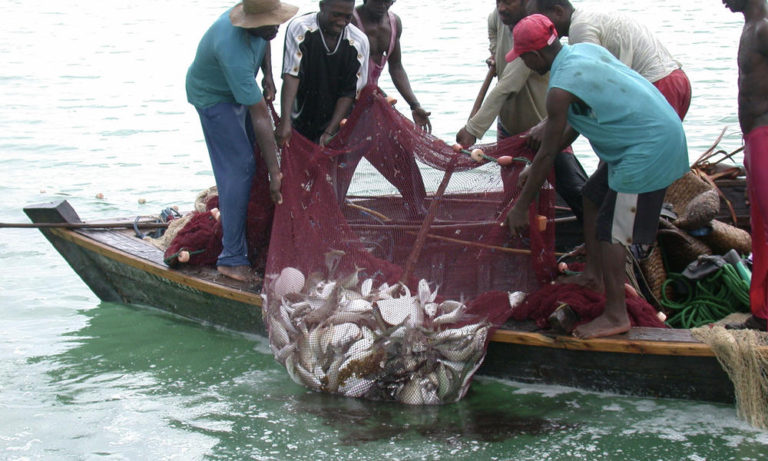
George Francis, 63, is a rugged fisherman and harbour master of Lumley Wharf in Freetown, the hilly capital of Sierra Leone. He’s been in the fishing business since the mid-60s shortly after his country gained independence from the United Kingdom. He has seen better days in the distant past. Nowadays, life is very hard and two of his daughters live in Nigeria from where they send him money regularly.

He says his misery began some 20 years ago when big industrial trawlers started prowling the shores of his seaside community. Outgunned by bigger boats, George is unable to catch enough fish for himself. He generally goes for small fishes like herring, but on the day these reporters spoke to him, he had caught just three little ones. His fellow fishermen were not so lucky. Several admitted to catching one or even none!

It was 10 past 6 in the evening.

“These trawlers are supposed to fish about 200 miles away from the shore,” Francis laments. “But they come into the coast at night and the government is aware of these incursions.”

Out of frustration, he once wrote to the Anti-Corruption Commission of Sierra Leone (ACC-SL) to report the illegal activities of the fishing vessels, but he was told that only the maritime authority could handle his case.

“The maritime authority can’t do anything,” he adds regretfully, “because when they get hold of these trawlers they don’t bring them in. Only $5000 to $10,000 [in bribes] will solve the problem.”

‘FISHY’ PARTNERSHIP AGREEMENT
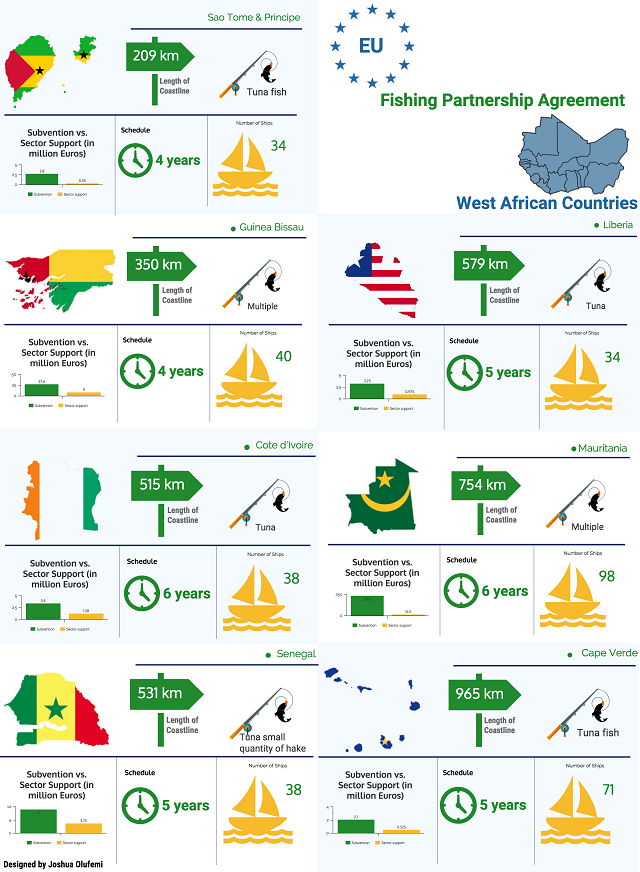
Sierra Leone is one of the countries in West Africa that haven’t signed a Fishing Partnership Agreement (FPA) with the EU. But this may not be the case in the nearest future: Europe has its eyes on the rich fishing grounds of this tiny ECOWAS nation. A delegation was in Freetown in late April to explore this possibility. Other countries that have signed the FPA in the region include Senegal, Sao Tomé and Principe, Cape Verde, Guinea Bissau, Liberia, Cote d’Ivoire and Mauritania.

“We’re in contact with coastal states possibly interested in setting up (or re-launching) an [agreement] with the EU, namely Ghana, Tanzania, Kenya and Mozambique,” says Aikaterini Apostola, press officer for health and food safety at the European Commission. “However most discussions are still at a very preliminary stage and it cannot be induced at present whether they would succeed or not.”

An FPA (also sometimes referred to as SFPA or in full, Sustainable Fishing Partnership Agreement) is essentially a document that allows European vessels to operate in a partner country (usually in the developing world) in exchange for revenue. In short, a fish-for-cash barter. These deals, although beneficial in some instances, are not without their disadvantages given the imbalance of power between the parties involved.

First, the European Union is the largest economic bloc in the world with a GDP that eclipses that of the United States. Its bureaucracy, centred on Brussels, is a well-oiled machinery that can take on any foreign concern or international jurisdiction on just about any matter. Even when Britain finally exits the union, it will still be one of the most powerful groupings of countries in the world. Only a few regional blocs can successfully challenge the clout of the EU.

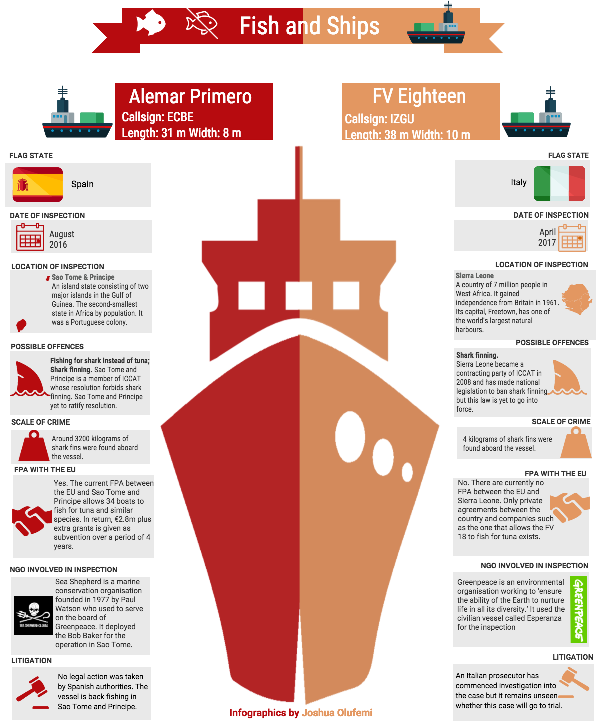
This partly explains why all small African states lack the bargaining power to obtain better deals during FPA negotiations with Brussels. In the case of Sao Tomé and Principe, an island nation in the Gulf of Guinea, the current protocol of the Fishing Partnership Agreement covers a four-year period from 2014 to 2018 and it allows 34 fishing vessels mostly from Spain, France and Portugal to catch tuna, a saltwater fish that is commonly bought off supermarket shelves.

In August of 2016, midway into the current protocol, a surveillance patrol by maritime authorities of Sao Tomé and Principe, together with campaigners from Sea Shepherd ― an international marine conservation organisation working to fight Illegal, unreported and undocumented (IUU) fishing across the planet ― intercepted the Alemar Primero, a Spanish-flagged boat that had been actively fishing sharks. Peter Hammarstedt, an American conservationist marshalled that particular operation, codenamed ‘Albacore I’.

The Bob Baker, a civilian offshore patrol vessel was deployed for the whole operation in Sao Tomé and Principe. The whole mission lasted two weeks.

On inspection, the Spanish boat had on board 87 tons of shark meat, processed and frozen. According to Joao Pessoa, director of the fisheries department of Sao Tomé and Principe, the Alemar Primero had been licensed to fish for tuna. So they lodged a complaint with the EU DG Mare.

“We were dumbfounded since we thought this boat was fishing tuna, not sharks,” Pessoa said. “The agreement is supposed to encompass ‘similar species’, but we assumed they would be in the tuna family. Not so according to the EU, that told us the agreement includes sharks, referring us to annex 1 of the UN Convention on the Law of the Sea of 1982.”

But Pavel Klinckhamers of Greenpeace disagrees with the EU’s stance. And so does Peter Hammarstedt of Sea Shepherd.

“Sharks and rays are cartilaginous fish and are quite distinct from bony fish like tuna,” he confirms in an email. “Sharks are certainly no tuna. But you see that under tuna agreements, and for example ICCAT that regulates tuna catches in the region there are specific guidelines on catching sharks as by catch of tuna fishing.”

Klinckhamers is the international project leader for Greenpeace oceans campaigns in West Africa. Earlier in the year, he had inspected dozens of fishing vessels for infractions ranging from the use of nets with mesh size that are wide off the mark, improper documentation and possession of shark fins.

Hammarstedt provides a more nuanced perspective on the ambiguous language of the agreement.

“The EU is correct in saying that several species of sharks, including those [found] on the Alemar Primero, are covered as annexed species, but to then have a European vessel take just sharks feels disingenuous; that was the feeling that Sao Tomean authorities got. If in negotiations with [Brussels] you talk about tuna, and you, as the representative of a developing country, sign a tuna agreement, then even though you accept that some other species will be caught, you still leave the negotiations with the feeling that most of the catch will be tuna.”

FISHING OR FINNING?
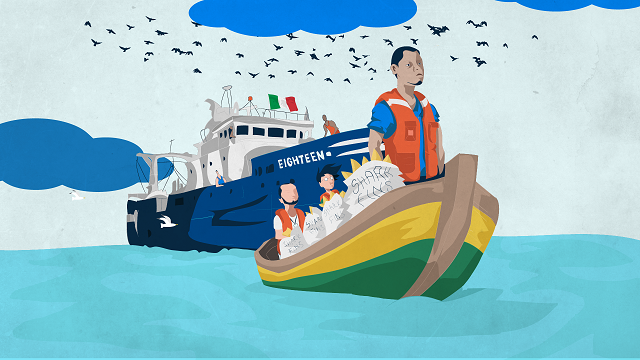
Despite having a longer coastline than Africa although it is the smaller of the two continents, Europe has fully met its fishing quotas. In fact, the EU fishing fleet is at an overcapacity of about two and half times of what they can sustainably catch in Europe’s fishing grounds. Hence the urgency for its vessels to go further afield to meet home demand for cheaper and healthier sources of animal protein. But meeting one’s food needs should not be confused with targeting protected species as the case of Spanish boat in Sao Tomé and Principe reveals.

Apart from the 87 tons of shark meat discovered aboard the Alemar Primero, more than three tons of shark fins were also found by the fisheries inspectors. Since 2003 EU-flagged vessels have been prohibited by Council regulation from carrying shark fins that have been detached from the body of the animal. (The regulation was last revised in 2013.) Each year, over 70 million sharks are caught globally, of which a sizeable portion are finned, to satisfy the palates of Chinese eaters who relish shark fin soup. The Congress of the United States is also considering legislation that bans shark fin trade.

The EU says “the practice of removing shark fins and discarding the remainder of the carcase at sea represents a serious threat to the conservation of these species and to the sustainability of fisheries.” Nonetheless rising demand for shark fins, mainly from mainland China, is growing.  Shark fins are premium goods, similar to caviar in Western cuisines. What is more, their unreasonably high prices (shark fins can fetch up to $650 per kilogram) means greedy merchants will stop at nothing to supply affluent consumers. Hence the promulgation of stringent finning controls.

But then, legislation isn’t always backed up with enforcement and the Spanish-flagged Alemar Primero has since returned to sailing and fishing in African waters.

In April during its ‘Hope in West Africa’ tour, Greenpeace in company of Sierra Leonean fisheries officials boarded the FV Eighteen ― an Italian-flagged vessel licenced to fish for tuna yet four  kilograms of shark fins were found hidden on its deck. The captain, David de la Fuente, a Spaniard, was promptly instructed by the inspectors to seal the shark fins in a bag (which would be used as evidence) and proceed to port. Since it is not yet illegal under the current Sierra Leone law to have shark fins on board, the vessel could not be seized.

This legal loophole might have allowed the FV Eighteen to leave the Port of Freetown unpunished. But Gaspare Asaro, the Italian owner of the company, refused to accept any blame for the incident. Instead, he pointed accusing fingers at the African crew who he claimed have since been fired.

As should be expected, it was the African hires who bore the brunt of the outcomes of the poor oversight of the European captain. Back in Freetown, the reporters spoke with widows and parents who had lost their grown-up children because they had had to go further out at sea as a result of the actions of industrial trawlers. George Francis, the fisherman from Lumley, had experienced gross abuse from these fishing vessels. He says they cut his nets in the open sea, leaving him without a source of income for months.

GASPARE ASARO SOLDIERS ON WITH HIS DEFENCE

“We fished about five  tons of smooth-hounds [a species of sharks], over that expedition lasting 30 to 40 days,” he says in a telephone interview. “Some of the fish caught [was] consumed by the sailors on board. They cooked the fish for themselves, and then left that bag of fins openly on the deck.”

He went on: “The [sealed] bag was removed from the boat and brought to Senegal for sample analysis. The shark fins were not seized, but we, for our own sake, took this bag and analysesead it. We are completely transparent. Those who are less transparent are the Spaniards who exploit fishing more aggressively.”

While Asaro claims his company is innocent, he denounces the EU’s fisheries policies. Alluding to Brussels’ unfair treatment of boats from Italy, he says funding from the European community has gone mostly to some select countries including, Spain, the flag state of the Alemar Primero.

But the EU says it thoroughly explained what the ‘tuna and similar species’ of the agreement meant to Sao Tomé and Principe fisheries authorities during the last Joint Committee meeting that took place in October 2016. Queries on the actions taken by Brussels against Alemar Primero’s incidence of finning were carefully deflected.

Both Pessoa and Klinckhamers described the EU’s response as ‘bizarre’ but they also conceded that African authorities needed to take on more responsibility for their fishing grounds. In the case of Pessoa, he admitted that although Sao Tomé and Principe is a member of the International Commission for the Conservation of Atlantic Tunas (ICCAT), the resolutions forbidding the finning of sharks has not been ratified by his country’s government. Sierra Leone too has recently made laws that ban shark finning, but it is yet to enter into force.

During the open day events organised by Greenpeace at the end of their campaigns in Sierra Leone, Charles Roger, the deputy minister of fisheries, was keener about the work of NGOs fighting IUU fishing in his country than developing the capacity of Sierra Leone to do so by itself. But organisations such as Greenpeace and Sea Shepherd would rather that African governments rise up to the challenge of natural resources governance.

“It’s mainly for the authorities to follow up cases of IUU fishing in their jurisdictions,” Klinckhammers says. “If you look at Sierra Leone, it gets around $7 million selling licences and with $3.5 million you can do a lot of work in fisheries management and yet you see the government looking at the World Bank and the European Union to make it happen for them.”

“One of the strengths of our campaigns around the coast of Africa is that we’re really providing just the transportation service to get law enforcement agents out where they need to be to board and inspect these ships,” Hammarstedt adds. “Getting a response from European countries falls under the responsibility of Sao Tomé and Principe as well as Gabon.”

THE FUTURE OF FISHING
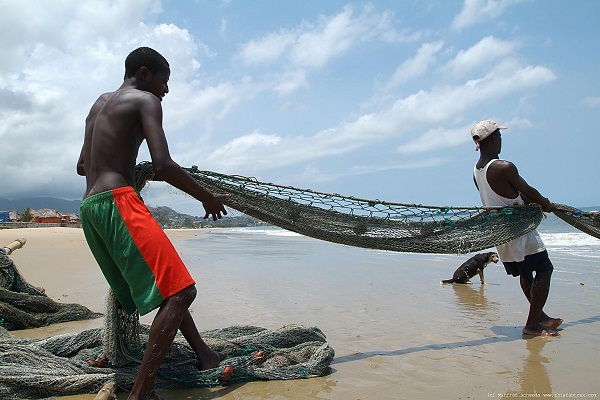
The global community is beginning to understand the significance of fish for food security especially in Africa where conflict is an everyday experience for millions of people. In June, the United Nations convened an ocean conference in New York City, where President Ali Bongo Ondimba of Gabon announced 20 marine protected areas covering 26% of Gabon’s waters. It was widely cheered as the way forward.

Aaron MacNeil, an associate professor of biology at Dalhousie University in Halifax, Canada, however believes there’s no single solution to the problems associated with IUU fishing around the world. MacNeil is also with Global FinPrint, a team of international scientists conducting a worldwide census on sharks and rays.

“Marine reserves work in some places but not in others,” he noted via Skype. “International agreements such as CITES are welcome development but still poverty and culture can stand in the way of progress. The pressure for sustainability is on the EU because West Africans can’t police their waters.”

For many years, marine environmentalists have been calling for a common management of fish stocks between countries in the region. One possible management regime even incorporates Morocco alongside Mauritania and Senegal, two West African countries with significant fish stocks. The main reason given for these calls is the migratory nature of species between the countries involved. Yet, despite the lip service being paid to this idea, these three countries haven’t taken action, possibly out of reluctance to diminish allowable catches, which will invariably impact on revenue generated from fishing licences.

The shark fin irregularities of Alemar Primero was certainly reported to European Commission’s department for maritime affairs and fisheries, DG MARE, but very little is known about the action taken on the case. After several weeks of seeking Brussels’ official response on the actions taken against the Alemar Primero’s horrible finning records in Africa, an email came that defiantly avoided the issue of the shark fins. Similarly, enquiries were made to the Ministry of Agriculture and Fisheries, Food and Environment in Madrid but the corresponding officials used an evasive counterargument to explain why Spain did not punish the offending vessel.

“In the archives of the General Secretariat of Fisheries, [the] Alemar Primero ship was the subject of an act of infringement and promptly sanctioned by the authorities of Sao Tomé and Principe,” the Spanish spokespeople responded, months after the  first request for comments.

“Since it cannot be punished twice for the same offence, under the legal principle of non bis in idem, Spanish authorities have failed to start, as required by the legal principles that govern our legislation, an infringement procedure. At present, the said vessel is exercising absolute normal fishing in the waters of Sao Tomé and Principe.”
However, Joao Pessoa, the director of the fisheries department of Sao Tomé and Principe, said  in a follow-up telephone call that the penalty meted out to the Spanish boat was for other offences and not for shark finning since the act itself was not yet an offence in his country. Thus, the Spanish authorities were found lying about why they wouldn’t follow through on an EU legislation that specifically bans finning within and outside EU borders.

Madrid should have imposed a heavy fine as punishment for the fishing infringements committed by the Alemar Primero in Sao Tomé and Principe. But then, it seems calling these offenses ‘infringements’ trivialises their gravity. Ideally, they should be designated as violence against animals, the same way trophy hunting for rhino horns and elephant tusks is frowned upon.

“One of the major problems with fisheries offences is that they are often treated as administrative offences as opposed to crime,” says Peter Hammarstedt.

He subsequently recommends: “Criminal activity must be seen as an economic activity that will continue as long as it is profitable and the risk or consequences of getting caught are less than the benefit of breaking the law. In my opinion, they should be fined substantially, the cargo should have been seized and auctioned in Sao Tomé, the captain should have his license removed, the vessel should have its fishing license removed and they should be disqualified from receiving further EU subsidies. The latter point is particularly important.”

Meanwhile, an Italian prosecutor has begun investigation on Asaro’s shark fin incidence, but it’s too early to know if the case will go on trial in a Sicilian court.

Although the prosecutor declined to comment on the case, a statement from the Italian Coast Guard said: “Regarding your request for information received on 21 August in connection with the inspection on the Eighteen fishing trawler, we can confirm that the Centro Controllo Area Pesca (Control Centre of the Fishing Areas) of Palermo has begun an investigative activity, which is still ongoing, and therefore covered by the ‘confidentiality of investigations’ which at this stage forbids us from providing details of the case.”

Having exhausted all legal channels to resolve the challenges he faces, George Francis ― the old fisherman from Lumley ― thinks, perhaps, violence is the only option left to get the attention of the authorities.

“There’ll be war in Sierra Leone again,” he says “and it will start with the fishermen. We don’t wish for it, but if it has to happen, it will happen.”

Disclaimer: Although support for the investigation came from the Flanders Connects Continents programme of Journalismfund.eu, the funders had no editorial oversight whatsoever in the course of the reportage.

For the love of meat, ‘inu eran’ and ‘fuku elegusi’, you must read this!

1


*Viewers discretion is advised.

By Kikiope Oluwarore

Beware, you might just be eating these as your meat and inu-eran!!!


Nigeria is a country of meat-lovers. Across geographical locations, cultures, tribes, and socioeconomic status, almost every family consumes meat regularly in our country.

“Meat” commonly refers to all kinds of animal carcass that have been slaughtered for consumption and as a source of animal protein. Frequently, for the sake of preference and reference, we distinguish meat by their respective animals, such as cattle meat (beef), goat meat, pig meat (pork) etc. Also, we consume the (fleshy) meat along with meat offal in Nigeria. Offal, (commonly known as inu eran in Yoruba language) refers to all edible organs of the animal apart from the (fleshy) meat. These include lung, liver, kidneys, spleen, small and large intestine, heart etc. These offal products are indeed common delicacies among Nigerian meat consumers as it is widely consumed to accompany various meals, soups, and stews.

Now, for health and food security reasons, it is important that all food-processing plants or institutions pay attention to quality and hygienic processing of their raw food products before selling to the public for consumption. In the case of meat and offal, abattoirs and abattoir workers are generally responsible for slaughtering, processing, and selling them to the public for consumption. However, for most Nigerian abattoirs, the highly unhealthy and unsanitary conditions in which these meat and offal are produced is appalling and of great risk to public health. A particularly unhealthy practice is the habit of selling a visibly-infected meat and offal to the public for consumption.

In many cases, when an animal has an ongoing infection or disease, the evidence of this infection can be seen in the affected internal organs of the animal’s body. This include all the offal products as listed above, especially the intestines, lungs, liver, kidney, and heart. These signs of disease may be seen in these organs as tubercles (like in tuberculosis infections), presence of live worms and their eggs (like in worm infestations), abscess, change in normal coloration of organ, change in normal texture of the organ etc.

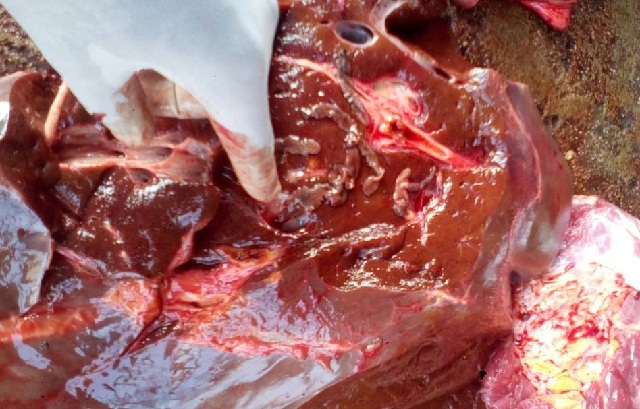
Can you see this liver with worms?

For an infected organ to be sold as offal in Nigerian abattoirs, the main danger lies in the fact that these infections can be transferred to humans when they consume the meat offal. And for a country like Nigeria where little or no meat inspection is done and butchers commonly sell their unhygienic meat without supervision, consuming infected offal is a remarkable health risk. Diseases that can be transmitted from consuming infected meat and offal include tuberculosis, worm infections, salmonellosis, brucellosis, anthrax, protozoan infections etc., causing a variety of poor health symptoms and death in humans.

Out of these infections, worm infections and tuberculosis are considered the most commonly encountered in diseased offal and are most easily identified in Nigerian abattoirs and meat markets.

‘WORMY’ WORMS

Liver infected with tuberculosis

Worms are infectious parasites that cause harm by either taking nutrients meant for your body, sucking your blood, and/or destroying vital organs in the body. Worms can infect both humans and animals alike and as such can be transferred from animals to humans by consuming infected meat or offal. Depending on the type of worm, worms (and their eggs) can be present in almost any organ (meat or offal), but can be mostly found in small and large intestine, liver, lungs, kidney, and heart.

Examples of worms that infect animals and can be transmitted to humans are tapeworms, flukeworms and roundworms. These worms are very dangerous to humans, especially children, pregnant women and people with low immunity, causing a variety of clinical signs such as stomach pains, diarrhea, vomiting, weight loss and poor growth, cough, anemia, edema, and death. In severe cases, they reproduce and are highly populated in the person’s intestine such that they block the intestinal lumen or cause extensive damage to the body’s vital organs such as heart, lung, liver, brain and kidneys – leading to death of the person.

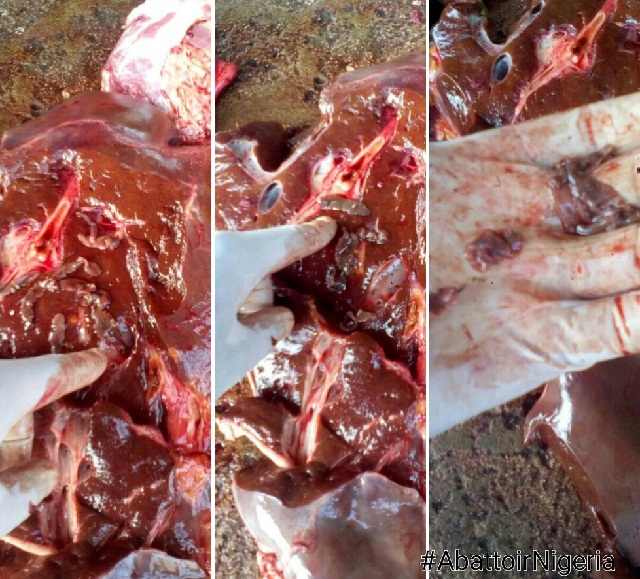
A pointer to several live worms wriggling out of a liver that was just harvested from cattle slaughtered in a Nigerian abattoir. This liver was eventually smuggled out by the butchers to be sold to the public for consumption.

Worm infections are highly ubiquitous among the animals slaughtered in Nigerian abattoirs, but their meat is still sold to the public for consumption, anyway. Some worms are large enough to be seen with the naked eye, wriggling out of the animal’s affected organs to escape while the animal is being butchered. Other worms cannot be easily seen with the naked eye in meat or offal. In all cases, it is most difficult to see the worms’ eggs with the naked eye. It is important to note that the eggs laid by the worms as part of their reproductive cycle remain as dangerous as the worms themselves, and can grow to become adult worms when transmitted to humans.

This video shows live worms wriggling out of the liver of cattle that was just slaughtered in a Nigerian Abattoir. These diseased organs are kept for sale by butchers for human consumption. Consumption of this liver as inu eran means that the worms and their eggs will be transmitted to the human. Worm infestation in humans has been known to have deleterious health implications, especially in children and pregnant women

TUBERCULOSIS LUNGS AND LIVER (FUKU ELEGUSI)

Have you ever been to the market to buy the offal – fuku (lung) or edo (liver)? And the fuku had some dark to grayish-white areas or elevations with some of them protruding out of the surface? And then the meat seller, in a bid to convince you that the meat is safe, cuts a little piece and pops into his/her mouth to chew? Or maybe you just love the feel of “strong, crunchy” fuku that you can chew like a biscuit and that will last longer in your mouth like chewing gum?

A lot of people from the Yoruba tribe in south-western Nigeria would instantly recognise the common phrase Fuku Elegusi. It is even considered a delicacy for some sellers and consumers, as it is said to “last longer in the mouth” as opposed to the normal lung that has a shorter chewing time due to its softer, spongy consistency. Recognising this preference, some butchers attract their customers by telling them that “the meat is fuku elegusi”.

Alas, Fuku Elegusi, is a serious health hazard for those who buy, cook, and consume it. In fact, in developed countries, the animal from which such fuku was harvested would be slaughtered and destroyed. But let’s come back to our reality in Nigeria.

Now, what are the health implications of Fuku elegusi?

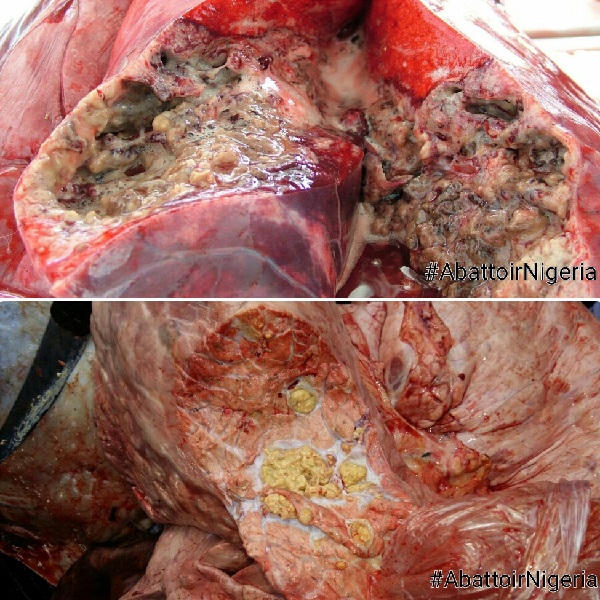
Fuku Elegusi comprises the visibly infected parts of a lung that has been previously infected with tuberculosis. It is usually harvested for public sale and consumption from a butchered animal that had a chronic case of tuberculosis. Therefore, consumption of Fuku Elegusi presents a high, direct risk of getting infected with tuberculosis. Note that these infected parts (called tubercles) can also be found in other organs such as liver, intestine and kidneys.

Two different lungs harvested from slaughtered cattle at two different Nigerian abattoirs. Though the first lungs (upper picture) was successfully condemned by meat inspection officers, the second was eventually smuggled out by the butchers to be sold to the public for consumption.

We should know that tuberculosis (TB) is still a disease of high global priority due to its high prevalence and incidence worldwide, especially in sub-Saharan Africa. Also, the disease is common as a co-infection in people living with HIV and those with low body immunity. WHO mentioned that in Nigeria, there is high prevalence of TB in humans, stating that in 2014, about 160,000 people in Nigeria had died from TB while 570,000 were living with TB. Now, the percentage of those who got Bovine TB (TB from cattle that produces our ‘meat’) is largely unknown, but it is key to note that Bovine TB and Human TB (TB transmitted between humans) have the same clinical signs and manifestation and is difficult to distinguish which is Bovine TB or Human TB.

Once tuberculosis infection is established in the body of an animal or human, it spreads to sites and organs in the body, such as lungs, liver, kidney and intestines. In her peer-reviewed research article, Dupe Hambolu corroborated the high risk, customary behaviour of eating Fuku Elegusi among butchers. When she interviewed butchers at Oko-Oba Abattoir, Lagos, she found out that almost a quarter of the study participants actively ate Fuku Elegusi and more than 70% of the study participants did not know that eating Fuku Elegusi could be a source of Bovine TB in humans. It is important to note here that Lagos is one of the most literate and urban cities in Nigeria. Therefore, there is a strong possibility that these unhealthy acts and lack of knowledge on Fuku Elegusi is more pronounced in less urban and rural parts of the country.

These two kidneys were harvested from two slaughtered cattle in a Nigerian abattoir. The liver on the left was confirmed to have tubercles from a tuberculous infection, while the one on the right has been completely damaged by an unconfirmed infection. Both were eventually smuggled out to be sold to the public for consumption.

PROTECT YOURSELF!!!

It is important that for your own health and safety, you must watch out for infected meat/offal and avoid them AT ALL COST. By stopping the consumption of meat and offal infected with worms, tuberculosis and other diseases, you would be protecting yourself ]and preventing the spread of such diseases to others. Furthermore, you should spread the word and educate others, even as you visit your favorite butcher and meat seller in the market. Be sure to examine thoroughly the kind of meat and offal (inu eran) you purchase for your consumption. If you are not comfortable with the appearance of any animal product, DON’T BUY IT, no matter the amount of pressure mounted on you to buy or the ‘marketing skills’ of the seller.

As shown in this video, we advocate that for your health’s sake, be vigilant and careful on the kind of meat you eat. Protect yourself from infections in infected meat.

More importantly, since we don’t currently have an enforcement of rules and regulations for meat inspection and meat hygiene in Nigeria, you must cook your meat and offal very well to ensure that to the best of your ability, pathogens are killed and rendered inactive in your body. Note that cooking your meat does not kill all pathogens as some pathogens remain resistant to heat and can still be transmitted to humans by consuming the infected meat. Also, remember that although some animals, meat and offal may seem healthy to eat, some may be harbouring infections and parasites that are yet to physically manifest and be recognised.

This is a time to unite and advocate for an enforced standardised process of meat hygiene in the country. A lot of risky practices are going on inside these abattoirs; and if care is not taken, we might soon have an epidemic and huge public health issue to contend with.

This investigative report was supported by the Code4Africa #ImpactAfrica project. You can participate in discussions on social media – Facebook, Twitter and Instagram – using the hashtag, #AbattoirNigeria

Nigeria officially out of recession but it’s ‘still too soon to cheer’

Figures from the National Bureau of Statistics (NBS) show that Nigeria’s Gross Domestic Product (GDP) for the second quarter of 2016 grew by 0.55 percent.

This development, according to Yemi Kale, the Statistician-General of the Federation, is the fifth consecutive positive growth since the first quarter of 2016, signifying that Nigeria is technically out of recession.

According to Kale, the GDP grew from -0.91 percent in the first quarter of 2017, to 0.55 percent in the second quarter. This is against the -1.49 percent GDP recorded in the same quarter of 2016.

There was visible growth in almost all the sectors of the economy, including manufacturing mining, agriculture and oil and gas.

But analysts say that although the figures show a growth in the economy, it is too early to cheer, as it will take some time before citizens start noticing the change in terms of money in their pockets.

Speaking during a Channels Television programme, Bismack Rewane, an economic expert, said there must be significant growth in certain key sectors, especially production and employment, before Nigeria can pat itself on the back.

Rewane noted that the 0.55 percent growth in the GDP is still about 2.3 percent lower than the population growth rate of the country.

“In other words, Nigerian women give birth to 14,000 babies every day. The output here… will only feed technically about two or three thousand babies,” he said.

“So we have to increase our production to over 2.8 percent to be equal to the amount of new mouths that are coming in every day.

“Also we need to grow at above 5 percent to absorb the unemployed. So there are two issues here; one is, how much production do you need to increase to take care of the new mouths; and two, how much activity do you need to be able to absorb the unemployed so that we can have some social stability?

“That’s why we say [the out-of-recession story] is good news but it’s too soon to cheer. There are a lot of work to be done.”

However, Yemi Kale, who also appeared on the same programme, pointed out that there are three phases of economic recovery especially as in the current Nigerian context.

He said: “You have to first get out of recession with quality growth, and that’s anything from .00001 to whatever percent positive. Then from there you start to recover.

“My definition of recovery is going back to where you were before the slump, which is basically where we were in 2014 where we started the slow down.

“Then you start to grow and that means become more sustainable, taking it to more sustainable levels.

“So I think even though this is very good news — at least we are not contracting — this is just the first stage. The second stage is getting us to where we were before the contraction started and then from there we go further.”

Troops ambush Boko Haram terrorists, recover bicycles

Troops of Mobile Strike Teams, MSTs, 21, on Operation Lafiya Dole, laid a successful ambush against some Boko Haram terrorists in the early hours of Monday along the Firgi-Banki Junction road, Borno State.

According to Sani Usman, the Director of Army Public Relations, “the Troops neutralized a large number of the Boko Haram terrorists, while other terrorists sustained gunshot wounds.”

Among the many items recovered from the insurgents were “18 Bicycles, 15 Bags of grains, 17 Gallons of grain, 5 Empty gallons, 6 Cutlasses, a Sword, water bottles and pairs of slippers”.

Usman stated that “the MSTs were recently inaugurated by Tukur Buratai, the Chief of Army Staff launched through Ibrahim Attahiru, the Theatre Commander of Operation Lafiya Dole”.

“It will be recalled that the Chief of Army Staff, Lieutenant General TY Buratai, through the Theatre Commander, Operation LAFIYA DOLE, Major General Ibrahim Attahiru, recently inaugurated the Mobile Strike Teams (MSTs),” the statement by Sani read in part.

“The teams are the highly-trained and well-equipped groups injected into Operation LAFIYA DOLE with the mandate of securing the Main Supply Routes (MSRs) in addition to conducting limited clearance operations.”

On August 31, the army authorities announced that five top Boko Haram commanders were “neutralised” in an onslaught against the insurgents.

The names of those killed in the attack were given as Abu Dujana, Man Tahiru, Man Chari, Abdullahi Abu Sa’ad and Goni Bamanga.

It was also on August 31 that the 40-day deadline given by Buratai for the army to produce Abubakar Shekau, the Boko Haram leader, elapsed.

But the army authorities said the deadline had been elongated, saying they came very close to apprehending Shekau who is one of the world’s most wanted terrorists.

Stories about me supporting Biafra are false, says Chimamanda Adichie

Chimamanda Adichie, award-winning Nigerian author, says stories on the social media purporting that she is in support of the Biafran agitation are false.

Adichie issued the disclaimer via a post on Facebook on Monday.

She posted one of the headlines that read: ‘Enough of this Political Correctness, I am a Biafran and Nothing Else — Chimamanda Ngozi Adichie’

“This headline below, and other similar headlines, which appeared on some websites: are false,” she wrote.

“They are completely invented; along with some accompanying quotes which have been attributed to me. I did not say or write those words.”