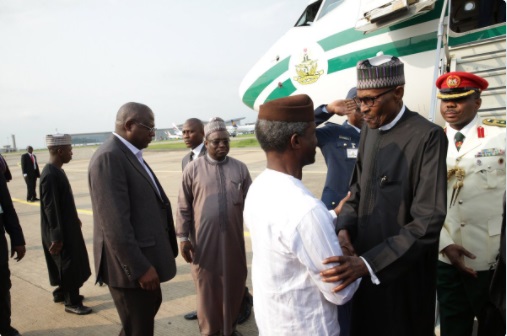
President Muhammadu Buhari has returned to the country, ending a 103-day medical vacation in the United Kingdom.
The plane conveying the President touched down at the presidential wing of the Nnamdi Azikiwe International Airport, Abuja, at exactly 4:36pm.
Buhari was received by virtually everyone who matters in his government, led by Yemi Osinbajo, his deputy, who then proceeded ahead of him to the presidential residence.
Activities at the Nnamdi Azikiwe International Airport, Abuja, and the presidential villa, have gone up a notch following the announcement of President Muhammadu Buhari’s imminent return to the country.
According to NAN, the villa is agog with activities, as staff and security personnel are making last-minute preparations to receive the President.
Other itinerary members of staff in the presidency are also on standby, while security vehicles and personnel attached to the President’s convoy have since left for the airport to receive the him.
NAN also observed that members of the Presidential Guards Brigade were seen moving towards the airport after conducting rehearsal at the Arcade in Abuja.
Buhari’s prolonged absence sparked protests both in Nigeria and London, with demonstrators asking for his resumption or resignation.
He left Nigeria on May 7 for the second round of his medical treatment in London after receiving 82 Chibok school girls freed from among the almost 300 abducted by Boko Haram in 2014.
While in London, Buhari received a number of visitors, including Yemi Osinbajo, the Vice President; leaders of the All Progressives Congress (APC), state governors; Justin Welby, Archbishop of Canterbury, Bukola Saraki, Senate President; and Yakubu Dogara, Speaker of the House of representatives.
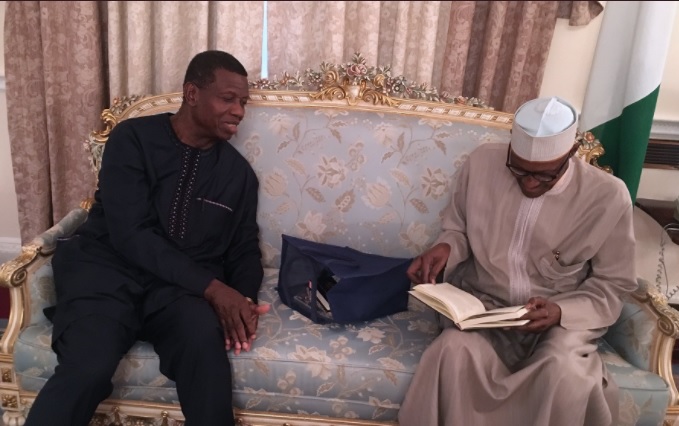
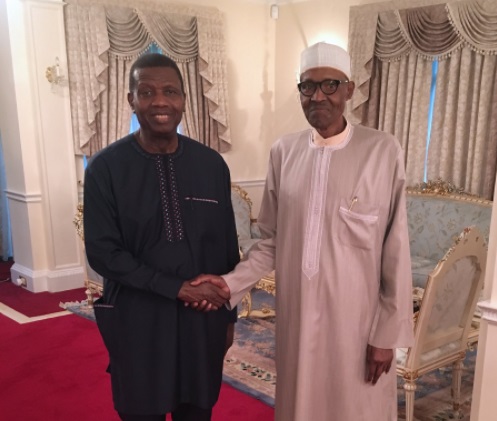
Enoch Adeboye, General Overseer of the Redeemed Christian Church of God, was the last to visit the President, on Friday.
Buhari is expected to arrive the Nnandi Azikiwe International Airport Abuja at 3pm on Saturday, and he will make a national broadcast to Nigerians at 7am on Monday.
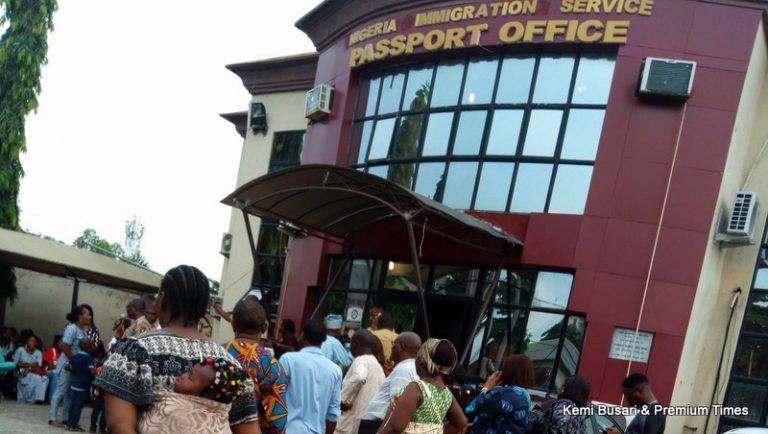
Pretending to be an applicant, Kemi Busari of PREMIUM TIMES investigates Lagos passport offices where Nigerians pay as much as double the approved fees to obtain an international passport.
I arrived at the Alausa, Ikeja passport office of the Nigerian Immigration Service, NIS, at 6:50 a.m. on Friday June 23 in heeding to the advice of a friend who initially kicked against my mission.
‘You have to get there early, people start to queue as early as 5:30 a.m.,” my friend had said.
The cloud was pregnant on this day, thus creating a gloomy picture of the sky; a picture which largely mirrored my seemingly impossible mission – fact-finding on the dichotomy in the amount quoted online against the real amount of acquiring an international passport; and uncovering other acts of corruption in the passport offices.
Almost every time I informed a colleague or relative of my intention to acquire an international passport, I was usually greeted with an all-too-familiar reaction: “Can you pay this amount? I got mine in just one day through so, so, so and so person.’’
Other times, the conversation took the form of “Okay, I know one immigration officer who helped my friend facilitate his and he was issued the next day, here’s his number – ring him up or brace yourself up for a long, long wait at their office.”
The day’s business was yet to commence as the door of the main building remained shut when I arrived at the office. However, there was a security guard, a middle-aged man wearied by the pressure of age, checking prospective applicants in, giving them numbers. The numbers made them eligible to a tag which determined how early they would be attended to.
It was now 7:20 a.m. and photographers who also operate as touts in the surrounding buildings had started arriving.
THE IDEAL
According to the Act establishing it, the Nigeria Immigration Service has as its core mandate: control of persons entering or leaving Nigeria; issuance of travel documents to bonafide Nigerians in and outside Nigeria; issuance of residence permits to foreigners in Nigeria; and border surveillance and patrol.
However, the second mandate, which includes the issuance of international passport – a traveling document required by Nigerians to gain access to and cross other country’s borders – has reportedly been fraught with barefaced racketeering over the years.
According to the information posted on NIS website, a 32-page passport for ages 0-17 and 60 years and above goes for ₦10,750 (₦8,750 for Passport Booklet, ₦2,000 for Address Verification Fee) while that of citizens between ages 18-60 is issued at ₦17,000 (₦15,000 for Passport Booklet, ₦2,000 for Address Verification Fee).
The 64-page booklet passport, on the other hand, goes for ₦10,750 and ₦22,000 for persons between ages 0-17 and 60 years and above and 18-60 respectively.
This is the paragon, but the reality which stared me in the face on this early Friday morning transcended the imaginable.
THE MORE YOU LOOK, THE LESS YOU SEE
I approach one of the photographers on ground called Sunday and told him I needed a passport. Sunday, who combines photography with ‘touting,’ explained how he would ‘help’ me, from registering online to filing and capturing, all to be supervised by an ‘officer’ who would get me the passport in little or no time.
“We have the 32-page passport and the 64-page, but I advise you go for the 64-page if you want it quick. For the 32-page, I can do it for N28, 000 but the 64-page is not less than N35, 000,’’ Sunday explained, smartly prodding his first customer for the day to paying the maximum.
THE 64-PAGE ‘ABOVE’ 32-PAGE?
“There is a scarcity of the 32-page booklet in Nigeria, and it’s not as if they didn’t produce from the country where it is being imported. They are producing it but the dollar rate has prevented Immigration from buying more, and the price we charge here is still the same.’’
To get more out of Sunday, I assumed the role of an agent.
I informed him that my customers were four but that he had to give me some level of assurance before we finalised the deal.
“I want to do more than one but the only problem I have with you now is the price and I will like to meet the officer who works for you so that I will be assured that I’m in safe hands,” I said.
Sunday was quick to answer, switching between English and Pidgin with seamless ease: “I want you to do it with me not because of the money but because of customers you’ll bring for me after today. Believe me ‘bros’, I can do this thing better and faster than officers,” he said, referring to immigration officers.
“A photographer processes a passport better and faster than civil servants paid to do the job?”
But how? I wondered in silence.
“Most of them can’t finish the bulk of work they have at hand,’’ he offers what seems like an escape from the reality. “They won’t tell you when you approach them of course. If they say one week, expect your passport in two weeks. Some are even afraid of adding up to what they have at hand. But for me, I will handle it well.
You’ll even see everything from the beginning till end.’’
Some minutes of insistence to speak with Sunday’s “officer” proved futile and so, I decided to end the conversation.
“Here is my number, save it with Sunday passport and ring me up whenever you are ready,” he concluded.
Armed with this information, I headed for the entrance of the passport office. The time now was 7:40 a.m.
POWERFUL TOUTS
“Good morning sir!” I said.
“What can I do for you,’’ the stern voice of a man in mufti greeted me as I got to the gate.
The middle-aged man whom I took for a security guard who was holding the forth for the immigration officers, had been wearied by the task of checking people in.
He asked me to follow him to the registration point after I explained that I needed a passport for myself.
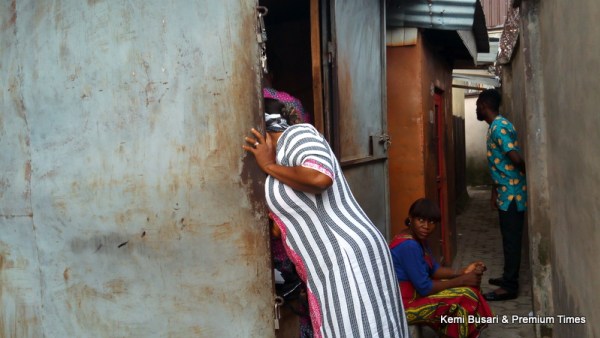
The Alausa Ikeja NIS office is a one-storey building with adjoining makeshift structures built with planks and iron linings on the space between the main building and the fence.
Registration shops at the Alausa passport office
Each of the shops had similar gadgets, including a computer system, a photocopying machine, a bench that can take as much as three people at once, and some folders.
We stopped at the first shop where we met a lady. The security man explained my intention to acquire an international passport to the lady and went back to his duty post.
“Take this form and fill. We do 32-page for N28, 000 and 64-page for 35, 000,’’ said the lady whose identity, either as a shop owner or attendant, could not be ascertained immediately.
She was obviously not willing to attend to a customer who would ask so many questions and when she realised that I was one, she told me to ‘just fill the form and ask questions later.’
By her explanation, the form after it was filled would be used to register for applicants online before handing it over to immigration officers.
In essence, the shops as shanty as they appeared perform the crucial functions of registration and bank transactions for applicants on behalf of NIS. And without passing through these shops or that of other touts around, one may not be registered for an international passport.
Registration point used by touts as Ikoyi office
After scanning through the form, I informed her that I didn’t have the required documents at that moment and that four other people whom she would register were on their way if only she would reduce the price and at least introduce me to an immigration officer who would handle the processing.
She declined.
“32-page is N28, 000 and you’ll get it after six weeks,’’ she replied with no further explanation.
“What’s your name so that I can ask when I come,’’ I asked in a final attempt to get her attention.
“Just ask for Bola passport,” she replied, not taking a second off the keyboard from which she was typing on the computer.
“Just make sure you tell that person who brought you here that you haven’t registered so he won’t think I’m working ‘behind’ him,’’ she added quickly.
I left Bola’s shop and was jolted by the crowd of applicants in the premises, which was now more than double what I left just over 20 minutes ago.
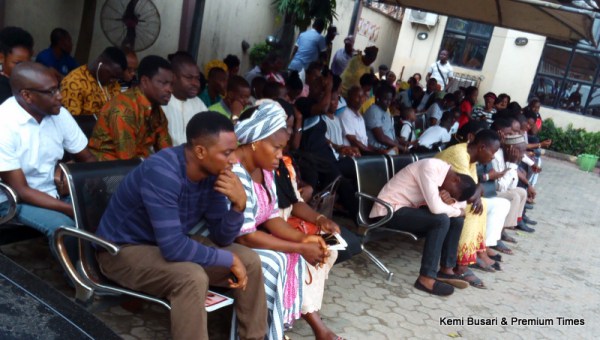
By 8 a.m., the seats are filled up already
In the last attempt to speak with an officer who worked with the touts, I decide to join the crowd. I made my way to the side of the tent – a structure constructed by NIS to shield the waiting applicants from the sun or rain – where I found an abandoned tyre obviously unoccupied due to its level of dirt. This would serve as my seat for the next hour.
FINALLY, I GET TO SPEAK WITH AN OFFICER
As the clock ticked, more applicants trooped in. This time, the number of people in standing position had comfortably doubled the ones seated.
By 8:58 a.m., a female officer emerged from the main building. Speaking through the microphone erected under the tent, she opened the business of the day.
“Good morning all. On behalf of the management of the Alausa passport office, you are most highly welcome. My name is Grace, I’m the Public Relations Officer, PRO, of this passport office and I’m here to familiarise you with our activities for today.”
In the next 10 minutes, she would explain the process of fresh application, renewal, capturing, the collection of passport and other intricacies.
She explained that applicants billed for the collection of their passports were the ones the office would attend to while those who were around for other purposes were to come back in the next five hours. She added that names would be called in batches of 50 people at once.
As she reeled out the names of those to be attended to, I observed some immigration officers come out of the main building, hand over passport booklets to applicants amid the final exchange of naira notes, without questioning.
She came back for the second round of announcement by 10:50 a.m. This time, her announcements, mostly repetitions, had become of little interest to me but her last sentences finally gave me access to an officer.
‘’We do not condone backdoor processing of passport here in Alausa office,” she said.
“If you meet any of our officers to do this for you, you’ll be embarrassed and you’ll still not get your passport. In case you have any question, you are free to meet me or any other officer.”
After the second round of name calling, I had my first experience with an officer.
TOUTS AS ‘AUTHORISED’ AGENTS
Applicants in standing positions in Alausa office
Corruption in Alausa passport office does not only exist with the officers but in the structure and administration of the office.
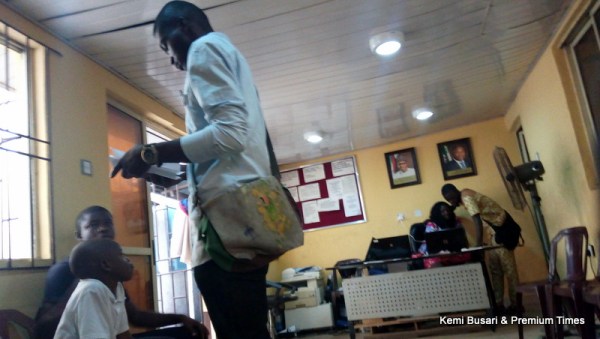
The office has no inquiry or customer service desk, the sort you have in banks, where one could learn the procedures for applying or renewing an expired passport. If there was any such desk, they did a masterful job of hiding it.
The best and alternative way of transacting with touts is to meet immigration officers who offer ‘official help’ at a cost, mostly determined by the size of an applicant’s pocket.
Also, the actual registration has a lot of complications as I would be tutored by Mr. Halliday, my first officer contact.
“Follow me,” he said after telling him that I was a fresh applicant.
Mr. Halliday, a good-looking officer, perhaps in his 40s, led the way to the shops where I was first directed to by the security guard.
Once I realised he was leading me to one of the touts, I protested and demanded a direct transaction with NIS.
The three-minute tutorial that followed confirmed the impossibility of my request.
“Young man, let me explain to you how we work here. You see these people here, they are our authorised agents. They work hand in hand with the immigration. They collect the money on our behalf, get you registered and after that hand you over to us for other processing,” he said.
“You don’t need to be scared of them, they can’t dupe you. I will take you to someone now and after your payment, I will help you to do everything without stress.’’
Mr. Halliday led me to a shop, just beside the one I visited earlier. The attendant, a female, informed me that I had to pay N28, 000 for 32-page passport and must first apply for mine, even if I was expecting ‘100 people.’
“Take my number and call me when you are through,’’ Mr. Halliday, now “Halliday passport” on my phone contact list, said as he left the shop for his duty post to hunt for more applicants.
I took the form and as I filled it I saw two other officers heading for the next shops with intending applicants. With their movement, the corruption intricacies at the registration stage become clearer to me.
HOW IT WORKS
Each officer with the NIS has one or more touts whom they work with.
The touts receive cash on their behalf, do online registration and hand over the applicant to the officer he or she works with.
In this kind of arrangement, the applicant is asked to pay more, say about N12, 000, above the approved price and this excess payment ends up in the hands of the tout, his or her affiliated officer and others who help in facilitating the deal.
But who gets what? How? In the next hour, I arrive at another passport office for a more revealing bout.
The Academic Staff Union of Universities (ASUU) says the industrial action it embarked upon on Sunday was needless, but it was forced into it by the federal government.
It said the government had shown that it does not mean well for the country’s education sector, hence the necessity of the strike action it commenced on Sunday.
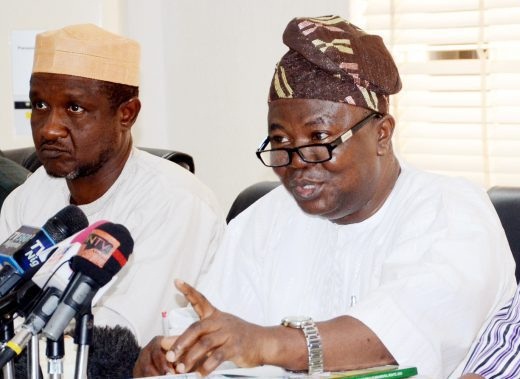
Biodun Ogunyemi, President of the union, reiterated that the strike would not be called of unless its demands are met.
He said ASUU would call off the strike only “when the government is ready to do the right thing as we spelt out during our engagement with the government at the National Assembly in November last year”.
“In November last year, when we went to the National Assembly, the issues were itemised, seven, eight of them. The government was expected to have followed that pathway, to follow what I would call the action plan for resolving the matter.
“But for deviating from the action plan, the government exposed itself to the suspicion that it didn’t mean well. If it meant well, it must go back to that plan and from there, we address the issues.
“It is because it didn’t act on the understanding, that is why we are back to where we are.
“This action was needless; it is like we were forced into it. Implementation must commence and the implementation we are talking about is not the issue of renegotiation.”
Ogunyemi further explained that in 2013, the federal government had agreed to put in N1.3 trillion over a period of six years in order to revitalise Nigerian universities.
“The first year, the government was to release N200bn, which it did, but it took a long time for us to access it. But since that release in 2013, no single kobo has been released thereafter,” he said.
“For 2014, N220bn was not released. Again 2015 and 2016, nothing was released up to the third quarter of 2017.
“In all, we can estimate the outstanding amount to be about N825bn for revitalisation of our universities.
“In the last two years, what has been allocated to education in the budget is between six and seven per cent. Even in countries where they had wars like Rwanda and Sudan, they are still allocating well above 20 per cent to education.
“Our citizens are rushing to Ghana, most universities there are public universities.”
Noting that Nigeria loses N500 million to education tourism annually within Africa, Ogunyemi blamed the development on the ruling class whom he accused of killing the country’s education system so that their children, who were given quality education abroad, could return to dominate the poor.
A meeting between the federal government and ASUU held on Thursday but it was deadlocked.
File: President Paul Biya (left) of Cameroon and President Olusegun Obasanjo of Nigeria (right), and former United Nations Secretary-General Kofi Annan (centre), during mediation talks over the issue of Bakassi Peninsula. Photo credit: unmultimedia.org/allafrica.com
Etinyin Etim Okon Edet, Paramount Ruler of Bakassi and Chairman of the Cross River State Traditional Rulers’ Council, says former President Olusegun Obasanjo failed to fulfill his promise to the people of Bakassi after the area was ceded to Cameroon in 2008.
Speaking during an interview with the Punch, the monarch said Obasanjo would still be very useful in solving the problem, adding: “I am sure that is why God is still keeping him alive.”
Okon Edet stressed that he still has respect for Obasanjo “as a father, brother and friend”, but added that the former President was hasty in accepting the judgement of the International Court of Justice (ICJ) despite the availability of room for appeal.
“There are other countries of the world, even America and Britain, that have had similar experiences and they did not cede their territories,” he said.
“Why was our own so hasty? The rush in which Bakassi was ceded and the rush in which the people were asked to leave, if we had that corresponding rush in resettlement, nobody will hear about the issue of Bakassi again.
“We had expected that same rush in resettling the displaced people but it was not there. We have wasted all these time and many people have died in the process. He (Obasanjo) will be very useful in helping us solve this problem.”
Okon Edet recalled that he held several meetings with Obasanjo at the time and the latter promised him that there was nothing to worry about.
“I visited the Aso Rock Villa within that period up to five times to have interaction with the President; he showed us so much love and assured that all was going to be well.
“Even when the guys took up arms and declared a republic, he called me again to tell my boys to calm down that the latter days shall be better than the former.
“He said this in the presence of some electronic journalists who recorded our conversations. As the President of the country, I had no doubt about what he said.
“But unfortunately, he did not keep to his promise. He is still alive and I intend to visit him soon. He is a man I personally have respect for as a father, brother and friend.
“I will visit him to tell him that ‘oga we still dey, we nor dey kampe, but we still dey. So sir, you have influence all over the world and within Nigeria, can you use your influence to resettle my people? I think he had good intentions just like he resettled the people in the Lake Chad Basin area.”
He lamented that his people have not been treated fairly as they are now scattered all over the place.
“We are citizens of the world, we should be treated fairly. We are all scattered now. Some are within Cross River State while others are in Akwa Ibom State and they want to come back together to live in the same community,” he said.
“At the moment, it is only God’s grace that is upon my people and me. When you are psychologically tortured, it is worse than the physical torture.
“Several things I would have done for my people with the ideas I have, I can no longer display my full potential as a traditional ruler because of the impediments. Where do I go to now? Do I go to Ogoja or Ikom or Adamawa to begin to build a new palace? I need to be given a place so that I do the things I would have loved to do.
“I do not want to waste my energy and resources on something that will not last. Let them resettle us properly and tell us this is it. Nobody will want his place to be ceded or given out to any other person. Obasanjo will be helpful in solving this problem that he created.”
In August 2016, President Muhammadu Buhari reiterated that Nigeria will abide by the ICJ rulingon the Nigeria/Cameroon border dispute.
“We will abide by the law,” Buhari told visiting Mohammed Ibn Chambers, Special Representative of the Secretary-General, at the Presidential Villa, Abuja.
“Having accepted the judgment of the ICJ, we are ready to support the security and logistics requirements of the Cameroon-Nigeria Mixed Commission to carry out the border demarcation.”
Femi Adesina, Special Adviser to President Muhammadu Buhari on Media and Publicity, has a word for the “haters” of the President — “repent in ashes and sackcloth”.
Writing in an opinion on Saturday, Adesina said that “in spite of what haters, wailers, and filthy dreamers imagine, and which they spew out”, over President Buhari’s ill-health, “God remains merciful and immutable. He has the final say”.
He maintained that despite the falsehood and outright lies being peddled about by some politicians and others concerning the President’s health, the President he saw had significantly recovered.
He said: “As we strode into the living room, I saw with infinite pleasure, the great object of my mission. Standing tall and ramrod straight was President Muhammadu Buhari, with that ubiquitous smile in place.
“He was looking a lot better than he had ever looked in the past eight months. My heart leapt for joy, and sang praises to God.
“Was this not the man they said was on life-support machine? Didn’t they say he could neither walk nor talk? But he was welcoming Alhaji Lai Muhammed, and calling him by name. I was next. I shook the hands of the man I had admired since his days as a military Head-of-State, a man I am not ashamed to call my leader and President today, and any day.”
“The President had words for each member of the team, which showed that he had been following events back home very keenly. He commended the Minister of Information and Culture, saying, ‘Lai, you are all over the place. I see you virtually every day. You have been working very hard.'”
“Pointing to Abike Dabiri-Erewa, he said, ‘She is here in her constituency. But me, I am here reluctantly’. We all laughed, and Dabiri-Erewa jocularly issued what you could call a quit notice, saying she didn’t want the President in her constituency again.”
Adesina repeated how Buhari told them that he was okay now and felt he could return home but that the doctors were in charge. “I’ve learnt to obey orders, rather than be the one giving the orders,”Adesina quoted Buhari as having said.
“If you have met the President personally, he is usually full of wisecracks, and this day was not different,” Adesina wrote.
“He said he had been watching the protests by people who wanted him to return home post-haste, or resign. He mentioned one of the leaders of the protest by name, and laughed. I did not discern any malice in the laughter.”
Adesina noted that Aisha Buhari, wife of the President, Halima his daughter, and Yusuf his son were present when the team were treated to a nice meal at the dining.
“It was a setting which a man blinded by bile, and suffused with hatred, had described as a previous fast breaking session at Aso Villa during a Ramadan season. Father, forgive him, for he knows not what he says. We ate, heartily. Our appetites had been stimulated by the state in which we met our principal,” he said.
“The health status of our President … was a testimony to the healing powers of God. This was a man gravely ill, but restored miraculously. It can only be God.
“In spite of what haters, wailers, and filthy dreamers imagine, and which they spew out, God remains merciful and immutable. He has the final say. If I were a hater, I would repent now, in sackcloth and ashes.
“Yes, I’ve been to London to see the King. The Lion King. But unlike the pussycat in the nursery rhyme, I didn’t frighten any mouse under the chair.”
Not a few tongues had wagged over the fact that President Muhammadu Buhari was outside the country on medical vacation for weeks on end, and no member of his media team was with him.
Many times, we had been confronted by journalists on why we were sitting pretty in Nigeria, while our principal was confronted by severe health challenges in London.
How did I feel about the situation? I had always told the media, and others who cared to listen, that whoever is on a presidential entourage at any time is the prerogative of the President. In the first 20 months of this administration, the President had made scores of trips, both locally and internationally. There was none, and I repeat, none, in which the media team was excluded. We were always there to keep the world abreast with what the President was doing.
When President Buhari first needed to travel for holiday and medical attention in January this year, it was deemed a private trip, in which the media was not needed. On such journey, you naturally would need security details, your personal physician, protocol and domestic aides, and those were the ones that went. Media? It depended on the principal. What was essential was that the channels of communication be kept open.
When the fuss came that the media handlers of the President were transmitting at best third hand information to the public, it did not bother me as much as it did some people, particularly, journalists. The discretion to have anyone with him at a given time was that of the President, and there was nothing anybody could do about it. I was in direct contact with those who were around him, and that was the best in the circumstances.
When the rumour mill went int overdrive sometime in January that the President had passed on, the first person I called was his personal physician. He laughed, saying nothing of such happened. I was thus confident enough to debunk the malicious information. Before he returned on March 10, in what turned out to be the first leg of his medical treatment, President Buhari had spoken with me personally on phone, the details of which I made available to the public. It was sufficient for me.
The President left again on May 7. I was with him at home till he left for the airport. Information dissemination followed the same pattern, as on the first trip. The aides on hand told me whatever was necessary, and I communicated same, never for once making it appear that the information was first-hand. It was the best and honest thing to do. You work for a straightforward man, it would be a disservice to him for you to begin to spin and bend information.
Never! Not once did I agitate to visit London to see the President. I was trusting enough to receive whatever information was passed to me, knowing the kind of man we serve. Blessed are those who have not seen, and yet believe. A lot of people were using paracetamol for what they considered my headache. They continued to fret that I was not in London, but it didn’t bother me a bit. Ask my wife and children, they would tell you that I am never in unnecessary hurry. I don’t push things, but the lines always fall for me in pleasant places. I have learnt to take all things in my strides, and let the Divine powers work out the rest.
Some people will erroneously call it a laid-back approach, but those who are discerning would see that I had always excelled in whatever I did- physical, professional, spiritual, domestic etc. No need to sing my own praises. Not unto us, but unto Him, be all the glory and praises.
And then, on Wednesday last week, “come came to become” (apologies to K.O Mbadiwe). I received a communication to proceed to London to see the President, along with other members of the presidential media team. To lead the delegation was Alhaji Lai Mohammed, Minister of Information and Culture, while others included myself, Mallam Garba Shehu, Lauretta Onochie, Bayo Omoboriowo, and the Nigerian Television Authority team of Adamu Sambo and Emmanuel Arinhi. Senior Special Assistant on International and Diaspora Matters, Abike Dabiri-Erewa, who was in London on another official matter, eventually joined us to see the President on Saturday.
Leaving the country through the Nnamdi Azikiwe International Airport on Friday morning, one was as conspicuous as a tiger in a teashop. All that knew me, and saw that I was headed for London, naturally said: “Please give our greetings to Baba o.” They just took it for granted that I was going to London to see the King, and not the Queen this time, as made popular by the pussycat in the nursery rhyme.
The trip aboard the British Airways Boeing 777-200/300 was pleasant and pleasurable. It was like a whole city in the sky. The Nigerians who saw me and my colleague, Mallam Garba Shehu, onboard, also jumped to the same right conclusion as those at the airport: “Please greet Baba for us o.”
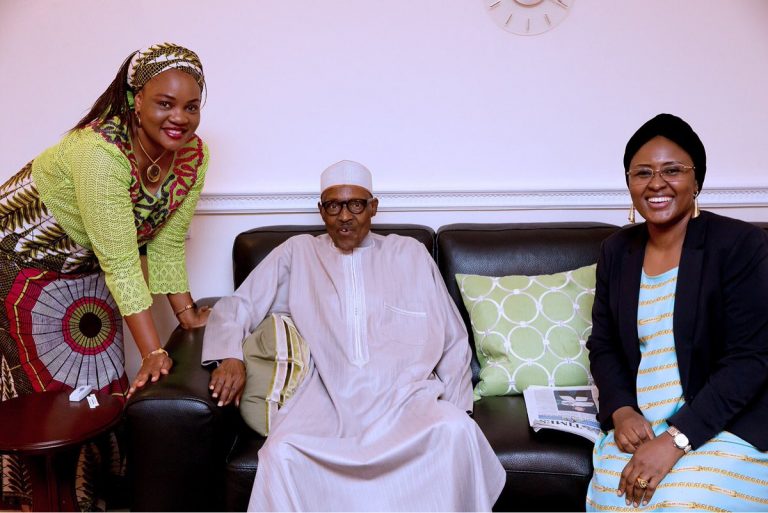
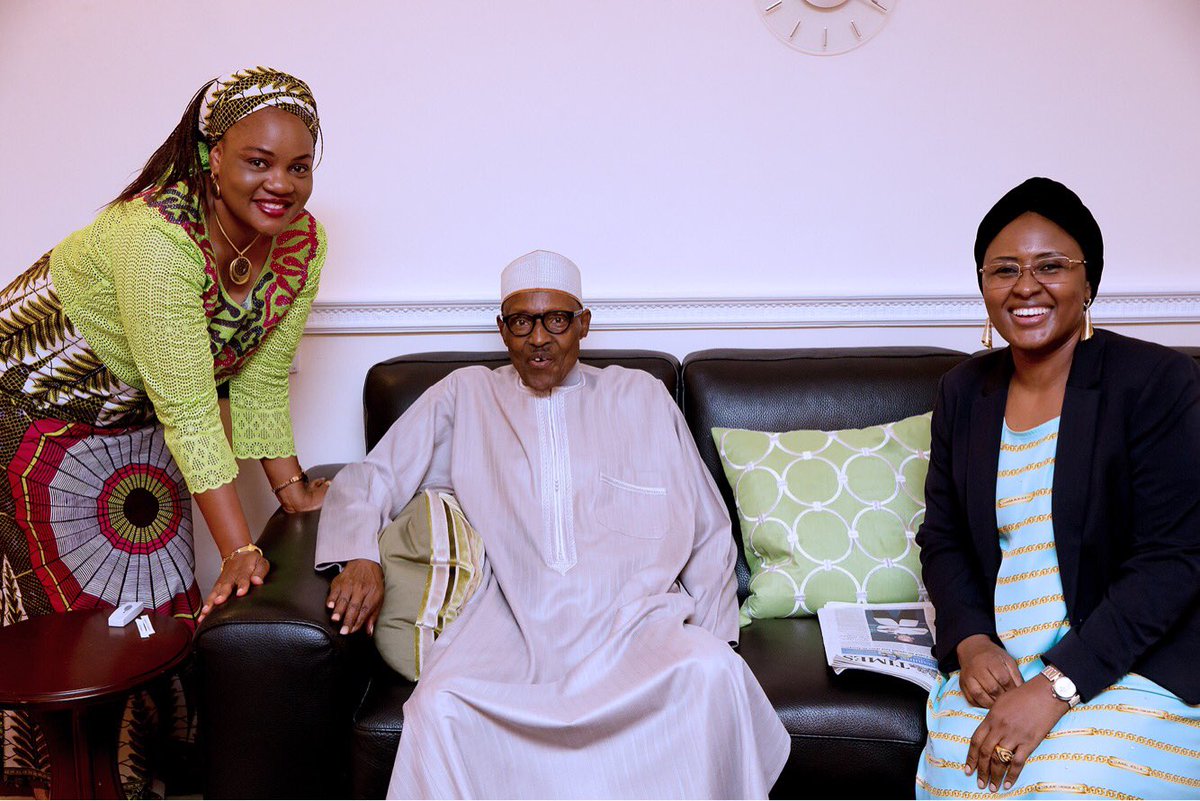
On Saturday afternoon, we were ferried from our hotels at the appointed time. At Zero Hour, we were at the Abuja House, Nigerian High Commission, London. As we strode into the living room, I saw with infinite pleasure, the great object of my mission.
Standing tall and ramrod straight was President Muhammadu Buhari, with that ubiquitous smile in place. He was looking a lot better than he had ever looked in the past eight months. My heart leapt for joy, and sang praises to God. Was this not the man they said was on life-support machine? Didn’t they say he could neither walk nor talk? But he was welcoming Alhaji Lai Muhammed, and calling him by name. I was next. I shook the hands of the man I had admired since his days as a military Head-of-State, a man I am not ashamed to call my leader and President today, and any day.
Seated, the President had words for each member of the team, which showed that he had been following events back home very keenly. He commended the Minister of Information and Culture, saying, “Lai, you are all over the place. I see you virtually everyday. You have been working very hard.” Pointing to Abike Dabiri-Erewa, he said, “She is here in her constituency. But me, I am here reluctantly.” We all laughed, and Dabiri-Erewa jocularly issued what you could call a quit notice, saying she didn’t want the President in her constituency again.
How are you, Mr President? “I am okay now. I feel I could go home, but doctors are in charge here, and I’ve learnt to obey my doctors. I’ve learnt to obey orders, rather than be the one giving the orders.”
If you have met the President personally, he is usually full of wisecracks, and this day was not different. He told us he had enough time to watch television, and commended the NTA particularly, and Nigerian media generally, for bringing him up to speed with what was happening back home. He said he had been watching the protests by people who wanted him to return home post-haste, or resign. He mentioned one of the leaders of the protest by name, and laughed. I did not discern any malice in the laughter.
President Buhari told us he seldom got sick, something he had told Nigerians on March 10, at his first return. When we told him millions of people were praying for him at home, in Africa, and even beyond, I saw the glow in his eyes, and he said: “May God reward them,” after noting that what Nigeria did in
The Gambia in January, which forced a sit-tight Yahya Jammeh to quit office, “fetched us a lot of goodwill and latitude.”
We talked about many issues, some of which are not due for public consumption yet. The President was obviously enjoying our company. Then the State Chief of Protocol, Ambassador Lawal Kazaure, popped up (as he always does) and indicated that the allotted time was over.
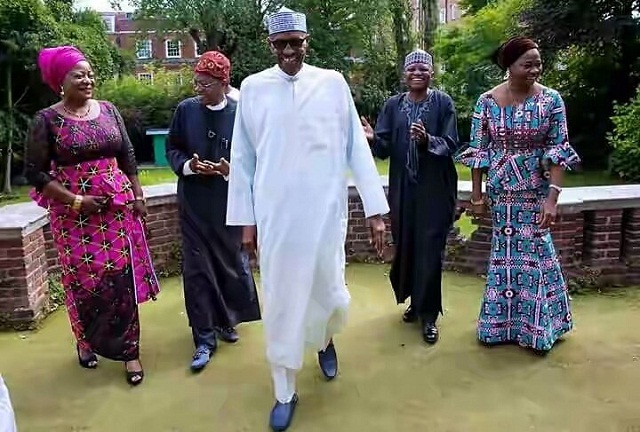
“Oh dear,” the President exclaimed, reluctant to see us go. It was time for photographs, and we walked into the garden. The President was spry, as he joined us. Bayo Omoboriowo clicked away, and those were the pictures you have seen. The President even almost sprinted, while going back inside. Omoboriowo captured that rare moment.
And to the dining room we proceeded. We sat at that famous table, laden with different kinds of fruits; banana, apple, pear, watermelon, and many others. It was a setting which a man blinded by bile, and suffused with hatred, had described as a previous fast breaking session at Aso Villa during a Ramadan season. Father, forgive him, for he knows not what he says. We ate, heartily. Our appetites had been stimulated by the state in which we met our principal.
Wife of the President, Mrs Aisha Buhari, was at hand to attend to us, urging us to eat as much as we wanted. Halima, daughter of the President, as well as Yusuf, his son, were also there.
It was a pleasure meeting all the presidential aides once again, and we greeted one another warmly: Yau and Lawal (trusted security details), Sunday (the personal cook of many decades), the ADC, SCOP, CSO, CPSO, the personal physician, Tunde Sabiu, Sarki Abbah, and many others. It was a grand re-union.
Lunch over, the President bade each person goodbye, with a handshake. We said to him, “See you soon, sir.” But when Dabiri-Erewa uttered the same, the President laughed, and declared: “No, we will leave you here, as this is your constituency.” The health status of our President, as earlier attested to by Justin Welby, the Archbishop of Canterbury, during his visit, was a testimony to the healing powers of God. This was a man gravely ill, but restored miraculously. It can only be God. In spite of what haters, wailers, and filthy dreamers imagine, and which they spew out, God remains merciful and immutable. He has the final say. If I were a hater, I would repent now, in sackcloth and ashes.
Yes, I’ve been to London to see the King. The Lion King. But unlike the pussycat in the nursery rhyme, I didn’t frighten any mouse under the chair.
Adesina is Special Adviser to President Muhammadu Buhari on Media and Publicity
President Muhammadu Buhari will return to the country today after 104 days of medical vacation in London, Femi Adesina, his spokesman has said.
“President Muhammadu Buhari returns to the country later today, after receiving medical attention in London,” Adesina said in a statement on Saturday.
“The President had left the country on May 7, this year, after handing over power to Vice President Yemi Osinbajo, who has functioned as Acting President since then.
“President Buhari is expected to speak to Nigerians in a broadcast by 7 a.m on Monday, August 21, 2017.
“He thanks all Nigerians who have prayed ceaselessly for his recovery and well-being since the beginning of the health challenge.”
Enoch Adeboye, General Overseer of the Redeemed Christian Church of God (RCCG), has visited President Muhammadu Buhari in London.
Buhari confirmed the visit, with pictures, via his official Twitter handle, with a caption: “I thank Pastor Adeboye for visiting today, and for his prayers and good wishes. May God continue to bless him and his work.”
I thank Pastor Adeboye for visiting today, and for his prayers and good wishes. May God continue to bless him and his work. pic.twitter.com/eds2rT1gG5
Adeboye becomes the second prominent religious leader to visit the President following the visit of Justin Welby, the Archbishop of Canterbury, on August 5.
Buhari has been on medical vacation in London since May 7, and all recent callers at the Abuja House, where he is recuperating, say his recovery is going on smoothly.
Buhari himself said last week that there had been “tremendous improvement” in his health — only that he he hadn’t been given the go-ahead by his doctors.
This is contained in a statement issued by Jimoh Moshood, the Force Public Relations Officer on Friday.
The NBS carried out the survey in conjunction with the United Nations Office on Drugs and Crime (UNODC).
The police authorities claimed that the so-called survey was carried out “two years ago” and does not reflect the fact that the present leadership of the Force “has fully keyed into the change mantra of the Federal Government of Nigeria, (the) Change Begins with Me (campaign) and total war against corruption”.
Moshood stated that the Force had also established and re-positioned its mechanisms for fighting corruption, bribery and other corrupt tendencies both internally and externally.
“The Nigeria Police Force sees the report as a clear demonstration of mischief and calculated attempt to promote campaign of calumny against police officers,” the statement reads.
“The report is entirely misleading, a clear misrepresentation of facts, essentially based on hearsay which made it unempirical, and the survey instrument absolutely inadequate and therefore a plain distortion of the improved situation in the Force as a result of the renewed commitment and determination to fight corruption, bribery and corrupt tendencies in the ranks of the personnel of the Force,”
“For avoidance of doubt, since the inception of the present administration of the Nigeria Police Force in July 2016, after the reported survey has been conducted and concluded, the Inspector General of Police has introduced and implemented diverse internal reforms aimed at bringing corruption to zero level in the Force.”
According to Moshood, some of the anti-corruption initiatives as introduced by the Ibrahim Idris-led Police Force include: the revitalization of the “X-Squad Unit” which is responsible for the “arrest, detention, investigation and prosecution” of corrupt officers; the launch of the Public Complaints Rapid Response Unit (PCRRU), which is responsible for “receiving and attending to reports of corruption from members of the public against Police officers”; and the collaboration with stakeholders in the criminal justice system and non-governmental organizations to train and re-train Police Personnel to shun bribery and corruption.
The statement the commitment of the Police under IGP Idris to “continue to fight, discourage and shun corruption, bribery and corrupt tendencies within and outside the Force, and continue to discharge its statutory responsibilities according to the rule of law despite the obvious distractions from the report”.