Home Blog Page 2738

Whistle-blower remanded in prison for misleading ICPC on ‘huge cash’ in Namadi Sambo’s house

0


The Independent Corrupt Practices and Other Related Offences Commission (ICPC) has charged one Abubakar Sani Chindo to a Kaduna State High Court sitting in Kaduna, Kaduna State, for allegedly providing false and misleading information to the Commission that former Namadi Sambo, Vice President, stashed huge sums of money in his house.

In a two-count charge filed before Justice M. T. Aliyu, ICPC accused Chindo of misleading the Commission as a whistle-blower, an action that contravenes Sections 64 (3) and 25 (a,b) of the Corrupt Practices and Other Related Offences Act, 2000 and punishable under the same sections.

The information provided by the whistle-blower had led to the unwarranted raid of Sambo’s residence, located at Alimi Road, Kaduna.

The accused, who appeared in court without a defence counsel, pleaded not guilty to the charge when read to him.

Although he prayed Justice Aliyu to grant him bail, the trial judge refused his bail application, noting that the accused needed a lawyer to perfect his bail conditions.

The judge therefore remanded him in prison custody to perfect the conditions.

If convicted, Chindo faces a prison term of 10 years or a fine not exceeding N100,000 as provided by Section 64 (3) of the Act.

Back in June, the ICIR had exclusively reported how a source very close to one of the operatives who executed the search warrant on Sambo’s home confirmed that the search team had been misled by a whistle-blower.

The source, an operative of Nigeria’s highly secretive security agency, said that they had gotten intelligence of illegal activities bothering on financial crimes in the former Vice President’s house and had obtained a search warrant before proceeding to his home in Kaduna.

“In the end, it turned out a false alarm because several hours of search yielded nothing,” he said. “You already know that if we found something, it would have been in the media by now. We found nothing incriminating in the ex-VP’s house.”

UPDATED: INEC halts moves to recall Melaye


The Independent National Electoral Commission (INEC) has halted the recall process for Dino Melaye, the Senator representing Kogi West Constituency at the National Assembly.

The plan to effect Melaye’s recall from the Senate is steeped in the outspoken senator’s long-drawn-out enmity with Yahaya Bello, Governor of Kogi State.

The recall has been the subject of a legal dispute, with the Federal High Court, Abuja ruling last week that the “status quo” should be maintained.

On Thursday, the commission announced its intention to abide by the ruling.

“The Independent National Electoral Commission (INEC) held its regular weekly today and considered the order given by the federal high court, Abuja dated 6th July 2017 directing the ‘parties to maintain status quo till the determination of the plaintiff’s motion on notice’ in respect of the suit filed by senator Dino Melaye seeking orders of injunction against the commission, to stop it from acting on the petition by the registered voters of Kogi west senatorial district,” Adedeji Soyebi, INEC’s National Commissioner, said in a statement.

“As a responsible, law-abiding institution, INEC will comply with the order. However, the commission has also decided to take immediate steps to vacate the court order and for the matter to be heard expeditiously.

“Whereas, the court adjourned hearing of the motion on notice on 29th September 2017, it should be noted that Section 69 of the 1999 constitution of the federal republic of Nigeria (as amended) sets a limit of 90 days from the date of the presentation of the petition (21st June, 2017) for the exercise to be completed.

“The commission also at its meeting today, approved a policy of comprehensive audit after all elections. This is in line with its commitment of ensuring transparency and overall improvement of the electoral process.”

Etisalat Nigeria changes name to 9Mobile


Etisalat Nigeria has announced a change of its brand name to 9Mobile.

This signals a final severance of all ties to the Etisalat group after the company in Nigeria was taken over by a consortium of financial institutions, following a failed $1.2 billion or N541 agreement.

The new name was announced at end of a management meeting of the company, which held on Thursday in Lagos.

Etisalat, Nigeria’s fourth largest telecommunication, has been shaken to its foundations by the failed debt agreement that led to the pulling out of the Mubadala Group, the highest investor in the company.

Mubadala, an Abu Dhabi-owned company, and Etisalat UAE mobile control 70 percent of the equity holding in Etisalat Nigeria, while Emerging Markets Telecommunications Services (EMTS), headed by Hakeem Bello-Osagie, former Chairman of the United Bank for Africa (UBA), controls the remaining 30 per cent.

The $1.2 billion loan was obtained by Etisalat Nigeria in order to finance a major network rehabilitation and expansion of its operational base in Nigeria, but following the economic recession that hit the country, the company was unable to keep up to its debt servicing agreements with its lenders.

A new board was appointed on July 4, to handle the takeover of the company by its new owners after a reallocation of shares, and Boye Olusanya, former Deputy Managing Director of Celtel Nigeria (now Airtel Nigeria), was appointed to head it.

However, few days later, Hatem Dowidar, Chief Executive of Etisalat International, made it clear that the group would no longer have anything to do with Etisalat Nigeria. He gave the company a three-week ultimatum to change its name.

“There’s a new board and we are not part of that company. We have sent our termination letter for the management agreement,” Dowidar said.

“Etisalat is among the top two in markets, such as the UAE, Saudi Arabia, Morocco, Egypt and Afghanistan.

“(Nigerian) lenders may try to continue to operate the company until they find a buyer (or) they may merge the company with the existing players in Nigeria.

“The brand agreement in either of these two scenarios won’t be a long-term thing, so we take out the brand; in the long term Etisalat won’t be in Nigeria.”

How multi-billion-dollar corruption landed Lula da Silva, ex Brazil president, a nine-year jail term


Luiz Inacio Lula da Silva, former President of Brazil, may be leading the polls for next year’s presidential election, but that advantage has evaporated as he has been convicted for bribery and money laundering and sentenced to nine years and six months in jail.

Lula, who was president between 2003 and 2010, was found guilty of embezzlement and receiving bribes from the state-owned oil company, Petrobras, in a massive corruption scandal known as “Car Wash”.

He remains free, pending an appeal of the decision but he has four other corruption charges hanging around his neck.

The sentence could scuttle Lula’s comeback bid in the October 28 election to decide the next president of a country that has been plagued by prolonged political and economic uncertainty, and has since slipped into recession.

NOT GUILTY

My hands are clean

Lula, widely acclaimed as having transformed Brazil during his eight-year presidency, is accused of benefiting from a scam in which billions of dollars were siphoned from fat contracts at the state-run oil company Petrobras.

He was alleged to have received a luxury seaside apartment as a bribe from one of Brazil’s biggest construction companies, OAS.

But he has repeatedly denied taking any bribes from anyone during or after his presidency, describing the investigation against him as a campaign to prevent his return to power.

“Never in the story of Brazil was someone was so persecuted and massacred as I am being in the last years,” Lula told a crowd of supporters after one of his court sessions in May.

His lawyer, Cristiano Martins, also criticised the proceedings immediately after they ended, saying in a statement: “What we have witnessed today in a Brazilian court room was a politically motivated attack.

“The hearing was a farce. Zero evidence was produced by the prosecutors whilst Lula and his legal team have produced overwhelming evidence of his innocence today.”

THE TRIAL JUDGE

Brasília- DF 04-08-2016 Juiz Sergio Moro na comissão especial de combate a corrupção. Foto Lula Marques/Agência PT

Forty-four-year-old Sérgio Moro is a crusading federal judge who has become a national hero for jailing the rich and powerful in a gargantuan corruption scandal.

This is how Igor Romario, a lead federal police investigator, described Moro: “The Car Wash investigation could not have just one hero. There are judges, prosecutors, detectives, but Moro is at the centre of it. Without him, we wouldn’t be where we are.”

Moro’s popularity has grown over the years that many Brazilians are suggesting that he should run for the presidency next October.

But another section of the country sees Moro as serving the interests of a cabal of billionaires who have also been accused of masterminding the impeachment of Dilma Rouseff, the female president that succeeded Lula.

In his verdict, Moro said of Lula: “Between the crimes of corruption and money laundering, there are sufficient grounds for sentences totalling nine years and six months of incarceration.”

DILMA ROUSEFF TRIED TO SAVE LULA

Dilma Rousseff Lula Da-Silva

Lula’s successor, Dilma Rousseff, was formerly his chief of staff before she was elected the first female Brazilian President. But she would be impeached and removed from office in 2016, following an alleged involvement in the “Car Wash” corruption scandal.

However, months before she was impeached, Rousseff tried to save her former principal from prosecution by handing him a ministerial appointment as the chief of her cabinet. Ministerial rank meant Lula was temporarily free from the risk of immediate arrest unless so ordered by the Supreme Court.

That was exactly what happened. The “Car Wash” case continued, Lula continued facing trial and Rousseff was impeached.

ANY SIMILARITY WITH NIGERIA?

Halliburton

Back home in Nigeria, there has been a number of corruption investigations involving highly placed politicial figures, including former Presidents, which have simply not seen the light of the day.

Many of these cases have been concluded and findings from them have been used to successfully prosecute and jail citizens of other countries who were found culpable.

Examples include the Halliburton and Siemens corruption scandals, and most recently, the Malabu oil deal scandal.

Investigations into the scandals have been concluded and culprits jailed in other countries but in Nigeria, because it involved “powerful” men, former presidents included, nobody has been made to face the music.

However, in January 2016, Abubakar Malami, Attorney General of the Federation, assured Nigerians that the Muhammau Buhari administration was not shying away from them because top military officers were allegedly involved.


READ ALSO:


A new health insurance scheme is gaining popularity in Edo — and it’s community-based

0


By Chinedu Ekeja

Like many market women in Benin City, Nosa Nosakhare, a trader at new Benin Market, has no knowledge of what a health insurance is. So she felt cheated when — after paying through her nose to fund her husband’s surgery at the University of Benin Teaching Hospital (UBTH) — she saw that a fellow patient was discharged after presenting “just a “card”.

In Nosa’s mind, she had seen yet another form of inequality and unfair treatment common in public institutions in Nigeria if you are not “connected”. She had wondered why somebody got discharged by presenting a card, but when she tried to know how and why, she was told “insurance” — a completely new term on her.

“Everything was free for them, including drugs, test and check up after surgery,” she said while narrating her experience without hiding her pain.

She was even pained the more when she remembered that she had gone to Esusu, a cooperative society, to borrow money to offset the husband’s hospital bill.

Since then, she has been on the lookout for an opportunity to put her family under an insurance cover. But with no knowledge of the Community-Based Health Insurance Scheme (CBHSI), she had concluded that such privilege like insurance was perhaps not meant for people like them since neither she nor her husband was a civil servant.

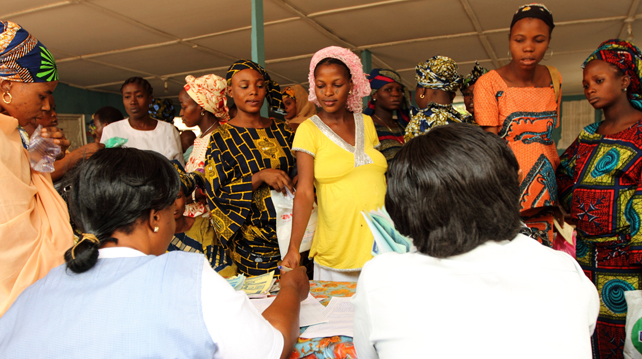
Nosa is one of several market women in Benin, the Edo state capital, who have expressed desire in joining the CBHIS. The women, under the Traders Welfare Union Of Nigeria, Benin City Chapter, gladly embraced the idea when some of their executive members were interviewed at their secretariats at New Benin Market on Tuesday, June 27, 2017.

They said they had no knowledge of such healthcare package, adding however that they were ready to pay between N1,000 and N2,000 monthly premium or more if a platform emerges and will lure their friends to be part of it.

‘OUR UNION WILL LIKE IT’

Lucky Orukpe, President of the Traders Welfare Union, welcomed the CBHIS idea, expressing confidence that thousands of market men and women would embrace it.

“If you check our market today, we have thousands of traders,” he said. “It’s a thing they will welcome because health is wealth. As President of this union, I personally love it and I know our union will like it.”

Orukpe complained that the only challenge is awareness, as his people have not been given proper information about the workings of CBHIS.

“The only challenge I see is that when people are not informed, they will not accept it, but when they are properly informed, they will  gladly accept it,” he said.

“What our people need is information, because information is access to progress.”

With her experience at the UBTH, Nosakhare needs not much orientation to embrace the idea, she is ready to bring others as well.

“This community-based health insurance, I love it very well, and I will join whenever I see any one formed,” she said.

“At UBTH in 2013, I experienced how insurance works. In fact, I will be the number one person to join and even bring more people to join.”

LESS MONEY, HEALTHIER LIFE

For Beauty Akhigbe who trades on footwear at the new Benin Market, she will join and bring her family along.

“I like the idea, I take my children to the hospital regularly and I know how much I spend. If finally one is formed, me and my family will be part of it,” she said.

Phenomena Orji, who trades in foodstuffs, said she hardly visits hospital because she rarely falls sick. However, she said her family will be covered as she loves the idea.

“Well for me, I don’t go to hospital. For about three years now I have not visited hospital or taken drugs,” she said.

“But I like the idea of CBHIS because we will pay less money. I will make sure my family joins, especially my children.”
Health Insurance women

As the dream of achieving a Universal Health Coverage continues to elude Nigerian government, federal and state citizens have continued to spend their hard-earned money to access health care services, through a difficult-to-sustain Out-of-Pocket (OOP) Model.

But as discussion continues to gain momentum across the country about the importance of having a health care financing model that guarantees a reliable, sustainable and affordable health care system, CBHIS is favoured as the best option for the informal sector.

ONLY TWO INSURANCE PACKAGES SO FAR

Currently, there are only two existing health insurance programmes covering the informal sector under the Community Based Health Insurance Programme (CBHIS) in Edo state.

The two groups are only in Edo North, while none exists in Edo Central and Edo South.

They are Auchi Allied Mutual Health Association, which has membership strength of 2,332 people with a monthly premium of N300 and First Akoko Edo Ilera Health Foundation, which has membership strength of over a thousand and five hundred and a monthly premium of N150.

According to Patricia Oviawe, State Coordinator of National Health Insurance Scheme (NHIS) in Edo State, there are at least four other groups going through the process of establishing theirs in the state.

Under the vital contribution Social Health Insurance Scheme (VCSHIP), only 540 people have enrolled so far in the state. They pay N15,000 premium per annual.

She said there was an improvement in enrollment rate, with about 100 enrolling this year alone so far.

These statistics show that only a negligible portion of the population, which is less than one percent, has a health insurance cover. This leaves greater chunk of the population, representing over 98 percent to their fate. They survive through either out-of-pocket (OOP) or self-help as could be seen in most rural communities where primary health care system facilities have gone obsolete.

Anticipations are already high, as residents of Edo State await the coming of the state Health Insurance Scheme.

INSURANCE FOR EVERY CITIZEN
Godwin Obaseki health insurance

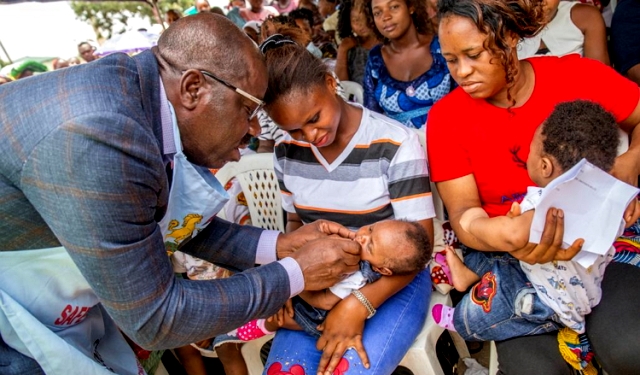
On May 1, 2017, Godwin Obaseki, Governor of the state, announced plans to introduce statewide Health Insurance Programme while addressing workers at the Sam Ogbemudia stadium.

The scheme, according to the governor, will hasten the Sustainable Development Goal (SDG) that targets Universal Health Coverage (UHC) for every citizens.

Speaking on the anticipated scheme, Odi Odiko, State  Director of Primary Health Care, said the State Insurance Programme would be all inclusive, as it will cover not only those in the state workforce, but also those in the informal sector.

“We have the civil servants who already have a data base, we know who they are, but they are not the only people who should benefit from health insurance. You also need other people to be part of it,” Odi said.

“There are people who work in the private sector who should benefit from health insurance; there is also need to take into consideration the market women, the Okada riders, the artisans who all need to benefit.”

However, he said all these would not be feasible until there is a legal backing to the scheme, which the State House of Assembly is currently doing.

Traders Welfare Union has more than 7000 members in Edo South alone, spreading in more than 10 markets within Benin metropolis.

If Auchi Allied Mutual Health Association, with less than 3000 members, can pay N300 monthly premium and the minimum collectable premium is N150, any group numbering 500 can buy insurance.

Two victories in four days. Watch out, APC! PDP is coming for you

Who would have thought, just one week ago, that any useful national political conversation would involve the moribund Peoples Democratic Party (PDP). But two positive developments, spaced by just four days, have altered the tide. In 2019, we will probably have a renewed bi-political battle on our hands.

UNEXPECTED PDP VICTORY IN OSUN

Ademola Adeleke 4

There’s no longer so much to say about PDP’s surprise victory in Saturday’s senatorial by-election. An office made vacant by the sudden death of Isiaka Adeleke, an All Progressives Congress Senator (APC) senator, the ruling party was widely expected to beat all comers. But to the surprise of everyone — maybe even the victorious party itself —  it was PDP that won.

The victory triggered talks of PDP’s possible re-emergence as a superpower, but they were tempered by the factionalisation at the top. It would seem that the kind of alliance mustered at the level of Osun West constituency could not be replicated at the national level. PDP was too nationally factionalised to even come up with an intra-party alliance, much less join forces with other political parties.

‘TWO FIGHTING’

Sherrif-Makarfi
Jonathan flanked by Makarfi (left) and Sherrif (right)

Two heavyweights — Ahmed Makarfi, a two-time former Governor of Kaduna State, and  Ali Modu Sherrif, two-time former Governor of Borno State — were both laying claim to the national chairmanship of the party. The crisis dates back to the 2015 presidential election.

After the party’s woeful outing at the polls, Adamu Mu’azu, its National Chairman at the time, resigned. Naturally, Uche Secondus, his deputy and native of Rivers state, assumed the reins. What would have been a peaceful transition was messed by complaints that since Mu’azu did not complete his term, his successor must come from the Northeast just like him.

FINALLY, WE KNOW THE CHAIRMAN

Ahmed Makarfi
Makarfi

One desperate contender was Ahmed Gulak, former Senior Special Assistant on Political Matters to former President Goodluck Jonathan, who, after securing a court judgment in his favour, literally invaded the PDP headquarters in Abuja to forcefully take over.

In February 2016, the National Executive Committee (NEC) of the party waded in by temporarily appointing Sheriff Chairman, since he is from the Northeast.

In May 2016, the party held a convention despite a court order stopping it; Makarfi emerged the Chairman; and in July, his emergence was validated by a Port Harcourt High Court.

However, in February 2017, an Appeal Court sitting in the oil-rich state adjudged Sheriff the legitimate Chairman. Finally, on Tuesday, July 12, the Supreme Court reinstated Makarfi. Game over!

WHAT NEXT?

PDP is fast consolidating. Already, Jonathan has offered his congratulations, taking care to note that “there are no winners or losers”.

“It is a verdict that will bring our party together,” he said. “As a senior member of the party, I hereby call on all those who left the party because of its leadership issues to return to their natural home and build the PDP.”

And coming just three days after an unlikely by-election success, PDP has gained considerable momentum, going forward. There are approximately two years before the next general election — that’s ample time, enough to alter current political calculations.

But this is not to suggest that building internal unity will be an easy task. Just look at the heavyweights who have dumped PDP for APC: Ken Nnamani, former Senate President; Sullivan Chime, former Enugu State Governor; Bukola Saraki, two-time former Governor of Kwara State; Atiku Abubakar, former Vice President; Barnabas Gemade, former PDP National Chairman; Aminu Tambuwal, former Speaker of the House of Representatives; Nasir el-Rufai, former FCT Minister; and the other governors who left with Rotimi Amaechi, ex-Rivers State governor, to form the breakaway faction that later ended up in the APC. How many of these can PDP lure back to its fold? Hard to tell.

APC MUST BE LOOKING ABOVE ITS SHOULDERS

APC

Two years of comfortable, perhaps complacent, political standing is surely coming to an end for APC — the comfort, not exactly the rein. Should APC remain in power post-2019, it would surely have earned it — if not by way of responsible leadership, surely by way on intense politicking.

It is particularly interesting that PDP’s rising stock has coincided with APC’s lowest (so far) moment of internal solidification. Buhari’s illness and trip to the UK has polarised the party and paved the way for some behind-the-scene manouvring by those eyeing the presidency in 2019; those are even on the one hand. On the other are those who sole interest is to ensure that Osinbajo, the Acting President, never gets a sniff of substantive power, either in the event of what is feared worst for Buhari or in the event that he chooses not to run in 2019. If PDP still has a few heads brimming with ideas, this is just the perfect time to strike.

HOW DOES THIS AFFECT NIGERIANS?

Voting

It is not subject to argument that one of the reasons for Jonathan’s 2015 loss is that millions of voters simply wanted a change in the party at the top; now, an appreciable number of those who demanded that change are now changing their minds. How calamitous it would be, therefore, were they all to be stuck with just one party, the APC, in 2019. A multiparty state, or a two-party scenario at least, is good for the robustness of Nigeria’s democracy.

Quite a number of people, though, try to deflate this point — and validly too — by noting that there is hardly any difference between the PDP and the APC. So it seems; the cross-defection among members of both parties is now so rampant that one cannot easily track the party composition of the National Assembly, for instance.

Still, half loaf is better than none. Better to have an APC-like PDP contesting against a PDP-like APC in 2019 than to be stuck with just APC. Or, to put it figuratively, better to stand in the rain with a broom in the hand plus an umbrella over the head, than with only a broom!

Fayose: Instead of hosting Osinbajo secretly, Buhari should speak to Nigerians publicly


Ayodele Fayose, Governor of Ekiti state, says Nigeria should be asking President Muhammadu Buhari to resign rather than wasting time on whether he truly met with the Acting President Yemi Osinbajo on Tuesday as was widely reported in the media.

Fayose made this known on Wednesday in a statement issued by Lere Olayinka, his media aide, describing the so-called visit of the Acting President Yemi Osinbajo to London as one deceit too many by the All Progressives Congress, APC-led government.

He demanded that President Buhari should address Nigerians via live video, and not a purported visit with no photo or video evidence.

“President Buhari has spent 65 days out of the country since he left on May 7, 2017 and no one has seen him. Yet Nigerians are being told that the Acting President Osinbajo visited him with no picture, no video to show except that of his (Osinbajo) entering and leaving the Abuja House in London,” Fayose said.

“Today is July 12, making 115 days that President Buhari spent abroad taking care of his health out of the 193 days in 2017, and what Nigerians are being told is that Acting President Osinbajo met him secretly in London, this is ridiculous.

“Should we be talking about President Buhari being met behind the camera by the Acting President at this time or the President resigning so that the country can move forward?

“Isn’t it funny that those who told Nigerians in 2010 that the health of the President, as a public figure, cannot be of interest only to his families and friends and that Nigerians have a right to know the President’s state of health are the same people in power now and are feeding Nigerians with tales of Buhari being met behind camera by the Acting President?

“It is therefore my position that Nigerians do not need this drama of Osinbajo’s behind the camera meeting with Buhari. Rather, what we want is that the President should speak to Nigerians publicly and disabuse the minds of the people who are of the belief that he is already incapacitated and cannot continue as President.”

Like Fayose, many Nigerians had taken to the social media to express their doubt at the purported visit of the Acting President to London.

This was in spite of Osinbajo’s claim that the President was “in high spirits” and “recuperating fast”.

It’s time to review age limit on public offices, says Dogara


Yakubu Dogara, Speaker of the House of Representatives, says the time has come to review the age limit for political offices in order to ensure that brilliant and exceptional Nigerians are not shut out.

While speaking on Wednesday at a public hearing organised by the House Ad hoc Committee on the Review of the 1999 Constitution at the National Assembly, Dogara said the parliament would not constitute a stumbling block to the wishes and aspirations of Nigerians for genuine changes in the Constitution.

“We note that the age limit for various offices currently contained in the Constitution is the minimum, not maximum,” he said.

“The wisdom of raising the minimum age for various offices should be appraised further to ensure that brilliant and exceptional persons are not shut out on grounds of age.”

In June 2016, the bill seeking to reduce the age qualifications for interested candidates to contest for the positions of President, governor and senate in the country to 30 years  passed second reading in the House of Representatives.

The bill, which also makes provision for independent candidature into the country’s electoral process, further reduces the age qualifications to contest for the House of Representatives and State Houses of Assembly to 25 years.

The bill is an alteration to Section 65, 106, 131 and 177 of the 1999 constitution; it seeks to open age qualification for the office of President to 40 years and above, governorship and senate 35 and above, and House of Representatives and state Houses of Assembly to 25 years and above.

But according to Dogara, the process of amending the 1999 Constitution by the 8th House of Representatives is in phases, and will be a continuous exercise as envisaged by Section 9 of the Constitution.

He stressed that restructuring of the country can only be achieved through the amendment of the Constitution, adding that the House is prepared to play its part in amending the Constitution when consensus has been reached by Nigerians.

The public hearing was organised to get stakeholders’ input on ‘A bill for an Act to alter the constitution of the Federal Republic Of Nigeria, 1999 (As Amended) to reflect the proposals initiated by the judiciary’, which was presented to the House by Walter Onnoghen, Chief Justice of Nigeria.

‘A one-hour meeting without photos’… How Twitter doubted Osinbajo’s visit to Buhari


Many Nigerians on Twitter are unconvinced that Acting President Yemi Osinbajo actually met with President Muhammadu Buhari in London on Tuesday.

Osinbajo told journalists on Wednesday that he and the President spent “well over an hour” discussing “wide-ranging issues”, adding that Buhari was in high spirits and was recuperating fast.

But the doubters said if that was the case, the presidency would have published photos or even a video of the meeting.

Below are a number of the reactions on Twitter:

We played a limited role in the spending of Abacha loot, says World Bank


The World Bank says it did not participate in the spending of the loot recovered from Sani Abacha, former Nigerian Head of State, returned from Switzerland between 2005 and 2006.

The bank said its role in the spending was limited as “the funds were returned directly from Switzerland to the Nigerian government”.

The bank made this clarification following a letter from Soci-Economic Rights and Accountability Project (SERAP) asking for details of the expenditure on the recovered loot.

A statement by Timothy Adewale, SERAP’s Deputy Director, said World Bank clarified that its role was strictly to carry out “ex-post analysis” on the expenditure.

“The funds were returned directly from Switzerland to the Nigerian government. They were programmed into the national budget and utilized by the Nigerian government in line with its National Economic Empowerment and Development Strategy (NEEDS), SERAP quoted Rachid Benmessaoud, World Bank Country Director for Nigeria, as saying on behalf of Jim Yong Kim, President of the World Bank Group.

“As agreed with the Nigerian and Swiss governments, the Bank’s role was limited to carrying out an ex-post analysis on their use with a particular focus on their contribution to the NEEDS World Bank.

“The monitoring and analysis of repatriated funds was undertaken at two levels through: (1) the Bank-led analysis of general budget expenditure trends, and (2) a budget monitoring survey which was a limited field survey of sample projects funded under the budget program and randomly selected from a list of projects provided by the government.

“The budget monitoring survey was conducted by joint teams representing both government agencies and Nigerian civil society organizations. The Bank’s role in this particular case was limited by the design and different from the type of comprehensive audits we can do when funds are spent in projects supported by the Bank. We would welcome the opportunity to meet with you to explain the Bank’s role in this matter in the near future.”

SERAP had sought to find out how the recovered loot from Abacha was spent, necessitating the clarification by the World Bank.