Home Blog Page 2759

UPDATED: CCT declares Saraki innocent of false asset declaration charges

0

The Code of Conduct Tribunal (CCT) on Wednesday cleared Bukola Saraki, President of the Senate, of the charges of false asset declaration brought against him.

According to Danladi Umar, Chairman of the tribunal, the prosecution did not sufficiently prove its case against the senate president.

The federal government, through the office of the Attorney-General of the Federation, had alleged that Saraki made the false assets declaration during his time as Governor of Kwara State.

He was also accused of operating a foreign account while still Kwara State Governor, contrary to the code of conduct for public servants in the country.

Saraki was docked for the first time before the CCT On September 22, 2015, on a 13-count charge that was later amended to 16 counts on April 28, 2016. In February the government further amended the charges against Saraki to 18.

One of the charges claimed that Saraki had stated in his assets declaration form that he acquired properties at Numbers 17a and 17b Mcdonald Road, Ikoyi, Lagos on September 16, 2006, from the proceeds of sale of rice and sugar commodities.

But investigations revealed that the said property were bought through a N507 million loan obtained from Guaranty Trust Bank.

On May 4, after calling four witnesses and presenting several documents that were admitted as exhibits, Rotimi Jacobs, counsel to the federal government, closed its case.

However, the defence team said it would file a no-case submission, adding that the prosecution was unable to establish a prima facie case against the accused person.

“Our submission is that the prosecution has not made out a case warranting an answer from the defendant,” said Kanu Agabi, the lead defence counsel.

Pointing out the ‘flaws’ in the allegations raised by the prosecution, Agabi noted that “there is inconsistency in the charges”.

“I urge your lordship to hold that is not an offence,” he added.

Agabi also urged the court to take note of the defence’s list of witnesses, whom the prosecution ought to call but failed to.

At the resumption of trial on Wednesday, Umar upheld the no-case submission filed by the defence counsel.
He pointed out that the testimonies of the four prosecution witnesses were discredited, and as a result were unreliable.

The federal government had earlier withdrawn a forgery case brought against Saraki and Ike Ekweremadu, the deputy senate president, for allegedly illegally altering the Senate’s standing rules in order to unduly favour Saraki’s emergence as President of the Senate.

24 hours after signing 2017 budget, FG begins work on 2018 budget

0

The Ministry of Budget and National Planning has officially kicked off the preparation of the 2018 budget proposals in order to meet up with the October target of submitting the document to the National Assembly.

While signing the 2017 budget on Monday, Yemi Osinbajo, Acting President, had said that the executive had resolved that the 2018 budget would be laid before the legislators latest by October to enable them conclude work on it by December so that it could be signed into law at the beginning of the year.

On Tuesday, an event tagged ‘Flag off the 2018 Budget Preparation Process’, was held at the Old Banquet Hall of the Aso Rock Presidential Villa, Abuja, although journalists were not allowed to cover the event.

The event was intended to update the ministers and other relevant stakeholders on the processes and procedures expected of the various government ministries, departments and agencies in the budget preparation.

It was also to ensure that the 2018 budget proposal is in line with the Economic Recovery and Growth Plan (ERGP of the federal government.

The ERGP’s projected that Nigeria would make significant progress to achieve structural economic change with a more diversified and inclusive economy in five key areas by 2020.

According to plan, the key areas include stable macro-economic environment, agricultural transformation, food security, sufficiency in energy and improved transportation infrastructure.

Oyegun: Nigerians will sack us if we make PDP’s mistakes

0

John Oyegun, national chairman of the All Progressives Congress (APC), says his party is aware it could be booted out of power if it makes the same mistakes as its predecessor in federal power, the Peoples Democratic Party (PDP).

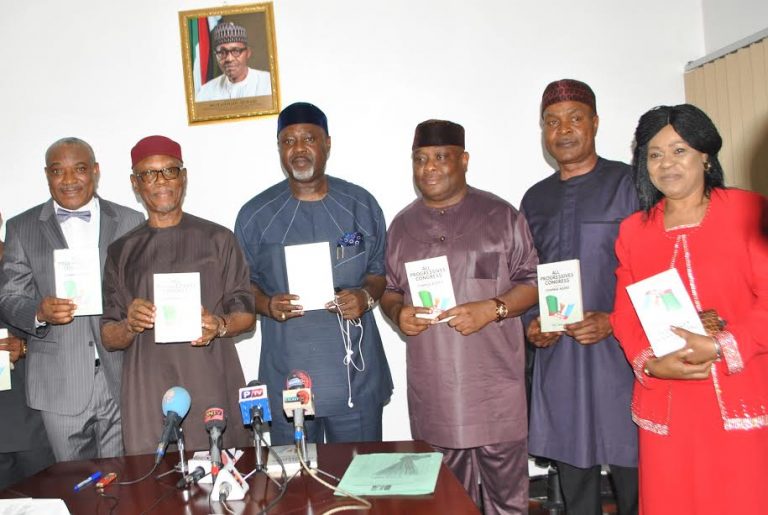
Odigie-Oyegun was speaking on Tuesday at the party’s national secretariat in Abuja, where he was formally presented with the book ‘APC: The Making of a Change Agent’, authored by Okoi Obono-Obla, Special Assistant to the President on Prosecution.

Describing the book as an insider account of the merger process that culminated in the formation of the APC, Oyegun encouraged other stakeholders who “participated intimately” in the formation of the APC to document their record of events for posterity.

He hailed the contributions and sacrifices of chairmen of the legacy parties that merged to form the APC: Atiku Abubakar, former Vice President; Bola Tinubu, former Governor of Lagos State; the new PDP and other stakeholders.

“It is important because in a few years, peripheral people, like [it] happens today in the case of June 12, sort of claim ownership of an event they know very little about… In fact, we encourage all those who participated intimately to document their record of what they think happened,” he said.

“Historians will then later take these slightly different versions considering the perspectives were you were standing to watch the show. And we will eventually have a comprehensive rendition of what happened.

“It was the first time a merger of that type had succeeded. It is the first time people had the intense nationalism to make the degree of sacrifice that was called for in agreeing to a merger. We had three party chairmen, and a lot of other individuals….

“We created a machine that has started a significant move in entrenching democracy in this country. What is democracy? It is the ability to hire and fire. It was the first time that Nigerians had the ability of firing and it has become internalised in our political psyche. We know that we should not make the mistakes of the PDP. We too now know that we can be fired and that is democracy.”

Recalling several past attempts at party alliances until the successful merger of the APC, Obono-Obla, author of the book, praised the APC legacy parties for merging to halt the PDP’s misrule, marred by insecurity, unemployment and bad governance.

“The book tells the story of the APC – How the APC was founded, the intense negotiations, support of the governor, and how the APC dethroned an incumbent government, unprecedented in the history of Nigeria,” said Obono-Obla, who served as Secretary of Congress for Progressive Change (CPC) Alliance/Merger Committee.

“It was necessary for a member of the merger committee to tell the story so that there is no distortion and misrepresentation of facts. This generation and generations to come will read this story and also see how the PDP failed so that the APC will not make the same mistake, because if we make that mistake, the Nigerian people will punish us as they punished the PDP… We should run a democratic party. I am happy that the APC National Chairman is doing his best and despite all the turbulence, the party is still one.”

Present at the book presentation were George Moghalu, APC National Auditor; Osita Izunaso, National Organising Secretary; and Emma Eneukwu, National Vice Chairman (South East).

Like Buhari, Bauchi governor embarks on foreign medical trip

0

Mohammed Abubakar, Governor of Bauchi State, is scheduled to embark on a trip to Saudi Arabia to check his health.

According to Bello Ilelah, Secretary to the State Government, the governor will be away for 17 days, during which his deputy, Malam Nuhu Gidado, will act as the state’s Chief Executive.

“His Excellency, Mohammed Abdullahi Abubakar Esq, Governor of Bauchi, will undertake a medical trip to Saudi Arabia, from Tuesday, 13th June, 2017, to Friday, 30th June, 2017,” read a statement signed by Ilelah.


Read Also:

“During his absence, His Excellency, Nuhu Gidado, Deputy Governor, will act as the Governor.”

Abubakar’s medical trip comes one month and six days after President Muhammadu Buhari travelled “indefinitely” to London for “medical follow-up” on an ailment that initially took him out of the country for 49 days.


FG ‘doing all in its powers’ to extradite Adoke over $1.1bn Malabu oil deal

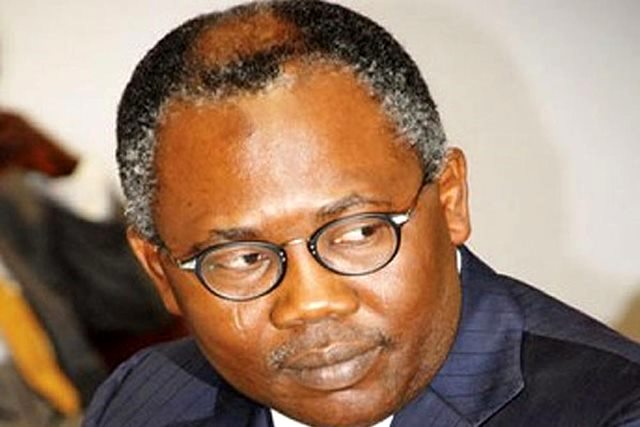
The Economic and Financial Crimes Commission (EFCC) says it will ensure that Mohammed Adoke, former attorney-general of the federation, will in due time be extradited to face criminal charges for his alleged involvement in the Malabu oil deal scandal.

This was made known by Johnson Ojogbane, counsel to the EFCC, on Tuesday in Abuja.

Adoke, alongside two oil companies, Shell and ENI, has been charged to court by the EFCC over a $1.1 billion paid by the oil companies in order to purchase an oil block, OPL 245 from the Nigerian government.

Reports have it that about $800 million of the money, which was initially paid into a Nigerian government account, was later diverted into the private accounts of Dan Etete, former petroleum minister. The diversion was allegedly approved by Adoke.

Several top government officials were said to have benefited from the largesse, including former President Goodluck Jonathan, who according to foreign investigators, may have received up to $400 million.

Though the EFCC has charged Adoke and nine other defendants, including Etete, Shell and Eni to court, the case is yet to fully begin due to the fact that the Adoke has not been in the country.

Justice John Tsoho of the federal high court Abuja had fixed the arraignment of the accused persons for June 13, but EFCC lawyer, Ojogbane, told NAN that the case could not proceed because the most of the defendants were at large.

He said: “The matter was adjourned until today for arraignment of the defendants, but up till now, we have not been able to secure the attendance of most of the defendants, because they are outside jurisdiction, that is they are outside the country.

“The Federal Government is doing everything within its powers to bring them back to Nigeria so that they can face their trial.

“The government will take steps, in collaboration with the international police (INTERPOL) to locate them and bring them back to Nigeria through extradition, which is a very cumbersome process, but it will be done.”

Ojogbane added that the case had been adjourned until October 26 after the court’s vacation to enable the prosecution intensify the extradition process.

Adoke, who is currently on self-exile abroad, had expressed fears from his base that he may not get fair treatment from the Nigerian government.

He later approached the court asking it to declare that whatever part he played in the Malabu oil deal was in response to the directive of President Jonathan.

In an affidavit filed before the federal high court Abuja, Kanu Agabi, Adoke’s lawyer, noted “that at all time material the plaintiff (Adoke) carried out the Presidential directive diligently, faithfully, impartially and in good faith and without any personal gain to himself nor to any other person except as was agreed to by the known parties to the parties.

“The plaintiff verily believes that he did not exceed the directives/approval given to him by the President and did nothing wrong to warrant his prosecution on account of the implementation of the Settlement Agreement.”
Agabi also asked the court to declare the prosecution of his client by the EFCC “illegal, null and void.”

Buhari’s illness, ‘Coordinating President Osinbajo’… five dramas that delayed budget assent


On Monday, the 2017 Appropriation Bill was signed into law by Acting President Yemi Osibanjo — one month and one day after it was passed by the National Assembly.

Here are the defining moments of the month-long wait:

BUHARI’S INDEFINITE MEDICAL TRIP

One week before the budget was passed, President Muhammadu Buhari travelled to London for an indefinite medical examination, 57 days after he returned to the country after a 49-day medical vacation in London.

His last official assignment before the trip was hosting the 82 Chibok girls released by Boko Haram. Of his next official assignments, the most important would have been budget assent, but the president’s health was failing and delay was too dangerous. Puzzle enthroned: who assents to the bill in the president’s absence?

ACTING — SORRY — COORDINATING PRESIDENT OSINBAJO

It didn’t take long for us to know we were in real trouble. Just three days before the National Assembly passed the budget, a letter from the “presidency” to the senate transferring power to Osinbajo was read on the floor of the Senate. It contained a curious phrase that generated the controversy.

When Buhari first travelled to the UK, he had written to the senate: “In compliance with section 145 (1) of the 1999 constitution as amended, I wish to inform the distinguished senate that I will be away for a short medical vacation from Monday, January, 23 to February 6th, 2017 and while I am away, the vice-president (Osinbajo) will perform the functions of my office.

But this time around, his letter read:  “I wish to inform the distinguished senate that I will be away for a scheduled medical follow-up with my doctors in London. The length of my stay will be determined by the doctors’ advice. While I am away, the vice-president will coordinate the activities of the government.”

From “performing the functions of my office”, Buhari had demoted (literally so) Osinbajo to “coordinating the activities of the government”. Did we say ‘Buhari’? We could swear Buhari didn’t know Jack about the wording of that letter; and those who knew remained in the presidency. There was no way they would allow a coordinating official sign the budget!

OSINBAJO’S LONG WAIT TO RECEIVE THE BUDGET

For eight days, Osinbajo did not receive the copy of the budget passed by the National Assembly.

On May 19, when the acting president finally received a copy, the presidency explained that ministries, agencies, and departments needed to examine the document before it would be signed into law.

HERE’S THE BUDGET — BUT WHO WILL SIGN?

Two days earlier at the end of the weekly federal executive council meeting, Lai Mohammed, Minister of Information and Culture, had caused furor over the identity of the person to sign the budget.

Responding to a question by a journalist, he said the decision on who would sign the document between Osinbajo and Buhari would be taken at the appropriate time.

Mohammed later denied making the statement and insisted that he was misrepresented by the media reports.

Segun Adeyemi, his special adviser on media, would later say: “When the Minister was asked a question relating to the signing of the 2017 budget, his response was: ‘When it is transmitted to the Presidency, the issue will be addressed.'”

But Laolu Akande, Osinbajo’s spokesman, had something entirely different to say: “Just so we are clear: when the time comes, everything is set, and he is satisfied, Ag. President Yemi Osinbajo will assent to the 2017 Budget.”

We didn’t need to be told there was a superiority tussle going on: Osinbajo has the powers to sign the budget. No, he doesn’t. No! Yes!

SHIFTING DATES OF BUDGET SIGNING

The appropriation bill was slated to be signed by Osinbajo on June 3 but it was postponed, fuelling speculation that the presidency would reject the budget.

Solomon Ita Enang, Senior Special Assistant to the President on National Assembly Matters (Senate), tried to allay such fears whens he said: “The Presidency is working within the constitutional time-frame required to process details of the 2017 budget passed by the National Assembly. There is no such plan by it to reject the 2017 budget passed by the National Assembly as alleged in some reports. The Presidency can only assent to the budget or withhold assent as the case may be.”

Then, Orji Uzor Kalu, former Abia State governor, entered the scene on June 4 when he said he had visited Buhari and his health had improved considerably; he was so sure the president would return before June 11. But the president didn’t.

However, by weekend, it had emerged that Buhari had given Osinbajo the go-ahead to sign the budget.

“Following the receipt of a full brief on the 2017 Appropriation Bill as passed by the National Assembly, and to buttress the unity at the highest level of government, President Muhammadu Buhari has indicated that it is in the interest of the nation’s economy for the Acting President, Professor Yemi Osinbajo, to sign the Appropriation Bill into law,” Garba Shehu, Buhari’s spokesman, said.

With the budget now receiving presidential assent, attention shifts to what percentage of it will be implemented in 2017, with nearly half the year already gone.

Another whistle-blower sacked — the second in three months


Murtala Ibrahim, a former auditor with the Federal Mortgage Bank of Nigeria (FMBN), is the latest person to lose his job after revealing a contract scam in the bank.

When Ibrahim refused to cover up a doctored financial report and blew the whistle about the contract scam in FMBN, he was transferred from the bank’s headquarters to one of its branches in the state.

He was subsequently issued a query and dismissed with the pretense that his service was no longer needed in the bank.

A statement by the Africa Centre for Media and Information Literacy (AFRICMIL), signed by Chido Onumah, the Coordinator, described the sacking of Ibrahim as another failure of the government’s whistle-blower policy.

In the statement, AFRICMIL demanded immediate reinstatement of Ibrahim, and urged Babatunde Fashola, Minister of Works, Power, and Housing, whose ministry oversees the bank, to order a thorough investigation of the scandal.

Ibrahim’s dismissal is coming after the much-publicised ordeal of Ntia Thompson, who was sacked by the Ministry of Foreign Affairs after he revealed a fraud at the Directorate of Technical Cooperation in Africa (DTCA), which is now under investigation by the Economic and Financial Crime Commission (EFCC).

Several efforts to reinstate Thompson, including a recommendation letter from the Head of Service of the Federation for his recall, have not yielded any positive result several months after he was sacked.

“Instead of persecution or victimisation, whistle-blowers like Mr. Thompson and Ibrahim ought to be rewarded for their acts of patriotism,” said.

He expressed worries that if the government cannot protect internal whistle-blowers, then outsiders and other Nigerians would not be expected to do much in the actualisation of whistle-blower policy.

AFRICMIL, a civil society organization working on building support for the whistle-blower policy of the federal government, called on the federal government to take decisive action on the protection of whistle-blowers by directing its full implementation by all Ministries, Departments and Agencies, MDAs, of government.

VIDEO: Kogi youths ask God to ‘punish’ Melaye

Angry youths from Kogi State on Monday blocked the road leading to the hometown of Dino Melaye, the lawmaker representing Kogi West senatorial district at the National Assembly.

Chanting anti-Melaye songs, the youths set up bonfires along the road, singing a Yoruba song that implores God to “disturb those disturbing us”.

Melaye and Yahaya Bello, the Kogi State Governor, have been at loggerheads, each trying to displace the other of his political base.

Watch the video here:

Dino had threatened to mobilise state lawmakers to impeach the governor, who in retaliation has mobilised youths and citizens of Kogi West to begin a recall process of the senator.

EFCC ‘invites’ Jibrin over corruption allegation against Dogara

The Economic and Financial Crimes Commission (EFCC) has invited Jibrin Abdulmumin, suspended member of the lower chamber, to volunteer more information on his allegations of corrupt practices and abuse of powers against Yakubu Dogara, Speaker of the House of Representatives.

According to a letter by the commission made public by Abdulmuminu, the investigation was opened following a petition by the accuser’s lawyers.

“The Commission has commenced investigation into the petition of Corrupt Practices and Abuse of Office reported on 1st of August by Hammart & Co (Tafida Chambers) on your behalf, against Hon. Yakubu Dogara, Hon. Yusuf Lasun, Hon. Alhassan Ado Degiwa, Hon. Leonard Okuweh Ogor and others,” read the letter.

“In furtherance of the investigation and due to unfolding findings, it has become imperative to request that you attend another interview with the team through Ibrahim Ahmed on 13th June,2017 at 3rd floor, Block A, No. 5 Fomella Street, Off Adetokunbo Ademola Crescent, Wuse 2, Abuja by 10:00am to clarify some issues to enable us to conclude investigation.

“Accept the assurances of the Executive Chairman’s highest regards, please.”


Back in 2016, Jibrin alleged that Dogara and three other principal officers of the House — Yusuf Lasun, Deputy Speaker; Alhassan Doguwa, House Whip and Leo Ogor, Minority Leader — made illegal insertions into the 2016 budget to the tune of about N450 billion.

Jibrin alleged that twelve other lawmakers were also involved in the budget-padding corruption.


All accused officials have denied involvement in any wrongdoing.

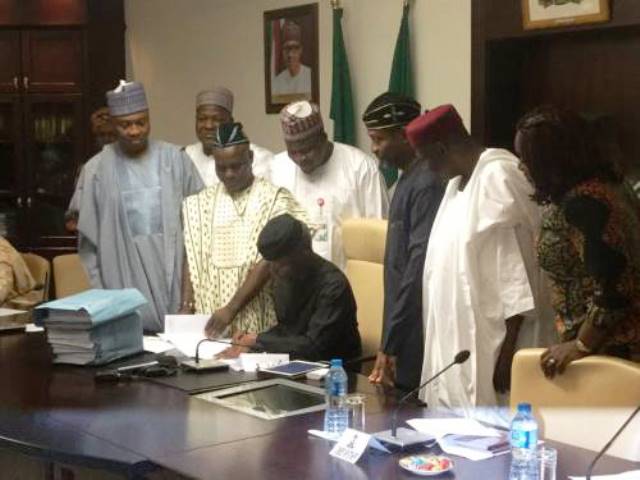
Osinbajo signs 2017 budget — one month after passage

0

Acting President Yemi Osinbajo has signed into law the 2017 budget proposal passed by the National Assembly on May 11, five months after the document was presented before the lawmakers by President Muhammadu Buhari.

The budget, which is christened “budget of economic recovery and growth”, was signed at exactly 4.40 pm on Monday.

Bukola Saraki, the Senate President, had earlier confirmed via a twitter post that the budget would be signed by 3 pm.

During the brief signing ceremony attended by Saraki and Yakubu Dogara, Speaker of the House of Representatives, Osinbajo commended the lawmakers for the work that went into the budget.

The Acting President described the 2017 appropriation act as “an important milestone in our economic recovery & growth plan laid in April by President Buhari”.

The legislators had increased the initial budget estimate submitted by the President from N7.30 trillion to N7.44 trillion – an increase of N143 billion.

The approved budget was based on the medium term expenditure frame-work/fiscal strategy policy, which stipulates a crude oil benchmark of $44.50 per barrel, an estimated crude oil production of 2.2 million barrels per day, and an exchange rate of N305 to a dollar.