Home Blog Page 2905

240 Repentant Terrorists Surrender To Military Authorities

0

240-repentant-terrorists-surrender-to-military-authorities


At least 240 Boko Haram fighters voluntarily surrendered to the Multinational Joint Task Force, MNJTF, on Monday after they came under intense pressure from troops.

Spokesman of the MNJTF, Muhammad Dole, a colonel, said in a statement that the mass defection took place in Bagasola town, in neighbouring Chad, considered by troops as Sector 2 Area of Responsibility (AOR).

The statement read in part: “The firepower of the Multinational Joint Task Force (MNJTF) ground troops and joint Air operation during the Operation GAMA AIKI forced a massive defection of remnants of the Boko Haram Terrorists (BHT).

“Sustained offensive operations and blockage of logistics supply routes made the terrorists’ locations untenable; as a result, BHT and their families abandoned their locations and surrendered with their arms to the nearest locations of the ground forces in the operation areas.”

The statement added that the 240 Boko Haram Terrorists were being profiled and camped in Bagasola.

Dole also stated that the Commander of the MNJTF, Lamidi Adeosun, stopped over at the camp of the ex-terrorists during his operational visit to Sector 2 AOR.

“The Commander commended the leaders of the ex- BHT for their courage and for taking the right decision to abandoned terrorism and insurgency for normal life.

“He assured them of safety and good care as long as they remain in the camps. He also urged them to encourage their colleagues in the bush to stop fighting and join them in the camps,” Dole stated.

According to the army spokesman, the peaceful disarming and profiling of repentant terrorists demonstrates the army’s professionalism and adherence to International Humanitarian Laws and Laws of Armed Conflict in combat operation.

He said that the Commander MNJTF donated money “for the purchase of two cows and 10 bags of assorted food stuff for each of the 2 groups for the welfare and up keep of the ex-BHT and their families.”

Dole also revealed that the total number of repentant terrorists that have so far surrendered to MNJTF troops in sector 2 is now “four hundred and sixty-four.”

“The ex-BHT are expected to receive training in different skills and small businesses as scheduled by government agencies and NGOs,” he stated.

The Commander also made cash donations to families of officers and soldiers who were killed in Action, KIA, or Wounded in Action, WIA, during the clearance operations.

Dole stated: “As part of encouragement and alleviation of suffering to the victims’ families and wounded personnel, the Headquarters, MNJTF made provisions of One Million CFA (1,000,000.00 cfa) only for each family of KIA and Five Hundred Thousand CFA (500,000.00 cfa) only for each WIA in the battle field.

“During the presentations in Sector 2 Bagasola (Chad) and Sector 4 Diffa (Niger), General Adeosun prayed for the souls of the departed colleagues for the supreme sacrifice they made in the service to humanity and praised the courage and bravery displayed by the WIA.”

Boko Haram Planning Major Offensive On Maiduguri

0
Boko Haram fighters
Boko Haram fighters

The Boko Haram insurgency group might be planning a major terrorist attack on Maiduguri, the Borno State capital, the www.icirnigeria.org gathered from a military source on Monday.

A reliable military source told our reporter on Monday evening that the military had intelligence of the planned terrorist onslaught on the Borno State capital and was ready with a battle plan.

This news comes on the heels of two successive explosions on Monday evening in the Bakassi area, the same neighborhood where an Internally Displaced Persons, IDP, camp is located.

Although there are no details yet about the explosions, which went off at around 8.00pm on Monday, the IDP camp, where more than 14,000 displaced persons are sheltered, is believed to be the target.

It is the third consecutive day that explosions are rocking the Bakassi area where the camp is located.

Our source said that the intelligence about the insurgent’s planned attack on Maiduguri was obtained from two members of Boko Haram who turned themselves in to military authorities in Damatturu, the capital of Yobe State.

According to the source, the two suspects who are being interrogated in an undisclosed location disclosed that the insurgency group plans to invade Maiduguri with more than 300 of its fighters, including several suicide bombers.

However, the suspects could provide no information about the nature and possible date of the attack, it was learnt.

It was gathered, however, that Nigerian troops have been put on high alert while there are plans to move more men to Maiduguri.

Attempts to get the Army spokesman to comment on the issue were unsuccessful as calls to his mobile phone went unanswered on Monday night.

Nigerian Govt. Knew About Rape Cases in IDP Camps But Failed To Act

0

NIGERIA-UNREST-BOKO-HARAM-HEALTH


By Chikezie Omeje

A report by the Human Rights Watch, HRW, indicating that Nigerian government officials and security agents have sexually exploited women and girls in the Internally Displaced Persons, IDP, camps, has forced President Muhammadu Buhari to order a full investigation into the sexual abuse allegation.

But most of the findings of the HRW were a confirmation of an investigative report published by www.icirnigeria.org on January  19, 2015 on the rampart cases of rape and child trafficking in IDPs camps across the Northeast.

The story, entitled : “ Grim Tales Of Rape, Child Trafficking In Displaced Persons Camps, chronicled sad tales told by victims and some aid workers in the IDPs camps but it was dismissed by the government, which said that there was no evidence even after setting up an investigation panel.

In the federal government’s reaction to the new disclosures by HRW, senior special assistant to the president on media and publicity, Garba Shehu said President Buhari was “worried and shocked” by the report.

The statement reads, “The welfare of these most vulnerable of Nigerian citizens has been a priority of his government. “Nigerians and the international community can rest assured that the allegations raised in the HRW are not being taken lightly.

“President Buhari has instructed the Inspector General of Police and the state governors of the affected states to immediately commence investigations into the issue.

“Their findings will determine the next course of action for the government and define an appropriate response.”

In its report released on Monday, HRW said it recorded 43 cases of women and girls in IDP camps in Maiduguri who had been abused by camp leaders, vigilante groups, policemen, and soldiers in July this year.

HRW said in the report that four of the victims were drugged and raped, while 37 were coerced into sex through false marriage promises and material and financial assistance.

According to HRW, many of those coerced into sex said they were abandoned if they became pregnant and they and their children have suffered discrimination, abuse, and stigmatization from other camp residents.

Eight of the victims told HRW that they were previously abducted by Boko Haram fighters and forced into marriage before they escaped to Maiduguri.

HRW told a story of how a 17-year-old girl said that just over a year after she fled the frequent Boko Haram attacks in Dikwa, a town 56 miles west of Maiduguri, a policeman approached her for “friendship” in the camp, and then he raped her.

“One day he demanded to have sex with me,” she said. “I refused but he forced me. It happened just that one time, but soon I realized I was pregnant. When I informed him about my condition, he threatened to shoot and kill me if I told anyone else. So I was too afraid to report him.”

The HRW’s findings are similar to our investigative report in which many aid workers in the IDP camps alleged that there was a conspiracy of silence among state officials which encouraged unscrupulous camp officials, including police, military and health officials to continue to exploit displaced persons, especially women and girls.

The ordeal of this 17-year-old is similar to what 16-year-old Laraba told the www.icirnigeria.org in Gombe that an official of the state emergency relief agency named Ibrahim took her from the camp where she was to his home on the pretext that she would be helping the wife with household chores.

“I was happy leaving the camp, but when we got to his house, there was no wife. He raped me continuously for three nights, locked me inside his house for days and threatened me.”

She continued, “I managed to escape and came back to the camp. I got pregnant. An old woman we call ‘Kaka’, gave me some leaves. I was bleeding for almost two weeks and smelling.”

Laraba said she had to suffer in silence as she could not tell anyone because she thought nobody would believe her and for fear of being sent away from the camp.

The investigative story by www.icirnigeria.org also contained the stories of other girls who were raped and sexually exploited by the camp officials and security agents.

HRW pointed out that victims of rape and sexual exploitation may be less likely to seek health care, including psychological counselling, due to the shame they feel, noting also that men used their positions of authority and gifts of desperately needed food or other items to have sex with women.

The www.icirnigeria.org story of nearly two years generated a lot of anger, particularly among international humanitarian agencies, forcing the government to set up a probe panel comprising members from the Department of State services, DSS, National Emergency Management Agency, NEMA, National human Rights Commission, NHRC, Journalists against Disaster, JAD, among others.

Interestingly, officials of some of these same agencies form the bulk of those accused of sexually abusing girls and women in the camps.

Curiously, the panel in its report which has never been made public said that there is no evidence to prove such cases of abuse in the camps.

Kukah Commends EFCC’s Treatment Of Detainees

0

kukah-commends-efccs-treatment-of-detainees


Outspoken Catholic Bishop of Sokoto Diocese, Matthew Hassa- Kukah has commended the Economic and Financial Crimes Commission, EFCC, on how it treats suspects who were being detained in the commission’s facility.

Wilson Uwajuren, spokesman of the EFCC, made this known in a statement released on Monday in Abuja.

Uwajuren quoted the Catholic Bishop as making the remarks after paying an unscheduled visit to the EFCC headquarters where he was shown round the commissions detention facility and clinic.

Kukah reportedly had a chat with the trio of Femi Fani-Kayode, Musiliu Obanikoro and Reuben Abati, three prominent members of the Peoples Democratic Party, PDP, who were recently arrested and detained by the anti-graft agency.

Uwajuren reported that Kukah described the detainees as cheerful.

“I discussed with some detained suspects like Femi Fani-Kayode, Musiliu Obanikoro and Reuben Abati; and I am quite pleased they are looking cheerful,” the EFCC spokesman quoted Kukah as saying.

He added that the clergyman was conducted round the facilities by the Commission’s acting chairman, Ibrahim Magu, after which Kukah had only words of commendation for Magu and his team.

He said: “I was also happy with the humility of the acting Chairman who took me round and the way he interacted with the detainees.

“This is what is important for our country so that nobody takes these kinds of things personal. I am happy I came.

“We are all staff of EFCC to the extent that we want a better country and we are doing what needs to be done.

“We’ll continue praying that God guides you, keeps you safe and ensure that we build a country that we all will be proud of.

“This country has suffered so much, but we hope and pray that we can bring the suffering and trauma to an end as we collectively fight corruption,” Kukah was quoted as saying.‎

The statement also quoted Magu as assuring the detainees that their being held in custody was nothing personal.

“It is not personal. This is all about Nigeria and making it better. And I think there is a consensus around this,” Magu said.

The EFCC spokesman noted that Kukah prayed for the detainees before his departure.

West and Central Africa Face Threats From Lake Chad

0

west-and-central-africa-face-threats-from-lake-chad1


The Minister of State for Foreign Affairs, Khadija Ibrahim, has said that the continued recession of the Lake Chad poses a lot of threats to the West and Central African Sub-regions, adding that about 40 million youth in the region have been exposed to poverty and unemployment as a result of the development.

She was speaking during a workshop on “Water Resources and Sustainable Environmental Management in the ECOWAS region” in Maiduguri, the Borno State capital.

Ibrahim, who was represented by Ahmed Gusau, said that the theme of the workshop was appropriate and timely because the receding of the Lake Chad has in no small measure contributed to the insecurity and strife on the African Continent.

She listed the countries most affected as a result of the recession of the Lake to include Nigeria, Chad, Niger and Cameroon.

“There is urgent need to brainstorm on the lingering issues of Water Resources and Environmental Management in the ECOWAS region,” the minister said.

“At the extended level of the African Union, AU., New Partnership for Africa’s Development, NEPAD, The African Peer Review Mechanism, United Nations Food and Agricultural Organisations, UNFAO, and so many other Multinational Institutions, the problems of water recession and environmental degradation have been frontally addressed yet the problems still persist.”

According to Ibrahim, an important angle to the receding lake Chad, is the devastation of the ecosystem caused by environmental degradation through refuse dump on coastal lines which emits toxins that are injurious to human health.

She noted that environmental pollution has been identified as the major reason for the depletion of ozone layer with harmful radiation on human body and skin diseases.

The minister however reassured participants at the workshop that the government will do its best to address the issue of receding Lake Chad, River Niger and any threat on the coastal line to reduce the menace of water recession and environmental degradation.

Chairman of the occasion and Vice-Chancellor of University of Maiduguri, Ibrahim Njodi, said that Boko Haram in the Northeast is a symptom of the challenges of water resource management in the Lake Chad Basin Areas.

Njodi who was represented by the University’s Deputy Vice Chancellor, Administration, Haruna Godowoli, said that the decision of Governor Kashim Shettima to shift his attention from Security to issues of water resources shows that peace is being gradually restored in the state.

The Borno State Head of Service, Yakubu Bukar, who represented Governor Kashim Shettima, said that the workshop will complement the efforts of the state government as it works to make life easier for citizens of the state whose lives had been devastated by the Boko Haram Insurgency.

Lawyers Protest DSS’ Refusal To Obey Court Orders

0

lawyers-protest-dss-refusal-to-obey-court-orders


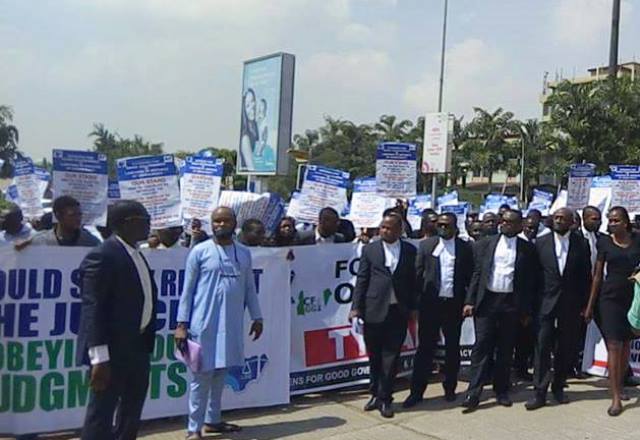
A huge number of protesters, made up of mainly lawyers,  took to major streets in the Federal Capital Territory, to protest the alleged continued disobedience of court orders by the Department of State Security, DSS.

The lawyers, who were joined by members of civil society organisations, took their protest to the Headquarters of the Federal High Court, in Maitama, as well as the offices of the Attorney General of the Federation and the National Human Rights Commission, NHRC.

They then made their way to the Three Arms Zone, where the Aso Rock presidential villa, the Supreme Court and the National Assembly are situated.

With regards to the issue of corruption allegations by the DSS against some judges, the protesting lawyers say the judges should not step down from cases involving the DSS, arguing that doing so would mean that they  have bowed to intimidation.

The protesters also want all judiciary workers to initiate an industrial action until the DSS obeys all pending judgments.

Witnesses say major roads in the Abuja city centre were barricaded as the protesters were being prevented by security agents from entering the villa.

The DSS has been accused of blatant disregard for court judgments and on more than one occasions, there had been instances where Judges had to lash-out on the Service for disobedience to court rulings.

On July 22, Justice Nnamdi Dimgba of the Federal High Court, Abuja, criticized the DSS for flouting an order of the court to remand a defendant in prison.

Dimgba had ordered that retired Air Commodore Umar Mohammed, who was arraigned before him the previous day, be remanded in Kuje Prison pending the hearing of his bail application, but the DSS instead kept the suspect in its custody and failed to produce him in court on the day of the hearing for his bail application.

Dimgba said that he took strong exception to the service’s disregard for the court’s order by keeping a defendant in its custody, describing it as an embarrassment to democracy.

On another date, August 9, when an application was brought before Justice Dimgba by the DSS, the judge refused to grant it.

“The court will not grant any application of the DSS until there is sufficient proof that all orders of the court have been obeyed,” Dimgba said.

“It will be counter-productive for the court to take this application and grant the reliefs sought by the DSS.

“This court hereby adjourns this application sine die until the applicant’s counsel files an affidavit deposing to the fact that all outstanding orders of this court on the DSS have been complied with,” the judge added.

Also the DSS had on more than one occasion refused to adhere to court rulings, granting bail to the former National Security Adviser, Sambo Dasuki, as well as the leader of the pro-Biafra group, Nnamdi Kanu.

 Airport Traffic Records 9% Drop

0
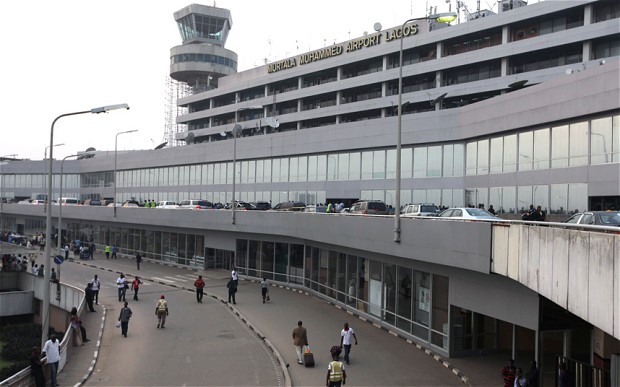
Murtala Mohammed International Airport, Lagos

Figures published by the National Bureau of Statistics reveal that the aviation sector has recorded a 9% decline in terms of Airport traffic in the second quarter of 2016.

The report showed a reduction in the numbers of aircraft, travellers, cargo weight as well as mails that were moved during the period as against what obtained in the first quarter of the year.

According to the NBS report, 54,405 aircraft arrived at, or departed from Nigerian airports in the second quarter of the year; a 9% reduction from the 59,808 aircraft recorded in the first quarter.

“A total of 59,808 aircraft arrived at, or departed from Nigerian airports in the first quarter of 2016, a decrease of 6.6 per cent relative to the previous quarter, and of 7.7 per cent relative to the first quarter of 2015.”

Also in the first quarter of 2016, a total of 3,549,360 passengers were recorded across Nigeria’s airports, but that figure reduced to 3,532,775 in the second quarter.

The report also revealed that there were 2,475,448 domestic passengers in the first quarter of 2016 and 2,411,251 in the second quarter, representing quarterly decline of 9.1 per cent and 2.6 per cent, respectively.

The aviation sector of the Nigerian economy has been one of the hardest hit by the current recession being experienced in the country.

A number of airline operators have either suspended operations or have been operating on a partial basis.

Recently, Emirates airlines and Kenya Airways announced that they were suspending flight operations to the Nnamdi Azikiwe International Airport, Abuja.

While suspension of Emirate flights took effect from October 22, that of Kenya Airlines would begin on November 15, 2016.

However, it appears plans are already at advanced stages by the federal government to concession the four major Nigerian Airports in order to achieve better results.

In September, two committees namely: the Project Steering Committee and the Project Delivery Committee, were inaugurated by the Minister of State for Aviation, Hadi Sirika, in Abuja, to oversee the process to concession.

Boko Haram’s Drug Supplier Nabbed

0

boko-haram-drugs-supplier-nabbed


Troops of Operation LAFIYA DOLE have captured Kadiri Umate, a suspected drugs supplier to the Boko Haram terrorists.

The suspect was arrested at Firgi and Zawan axis of Bama Local Governmnet Area, Borno State, while trying to cross into Sambisa forest.

Sani Usman, a Colonel and the spokesman of the Nigerian Army, said the suspect was sighted in company of other Boko Haram terrorists, at a crossing point.

“The troops pursued them but were only able to apprehend Kadiri Umate, 35 years, while others fled into the bush,” Usman stated.

He added that “the patrol team recovered 35 packets of 500ml of Glocose Intravenous infusion (Drip), assorted analgesics and pain killer drugs, clothes, bathroom slippers, insecticides, salt, kolanuts and a bicycle” from the suspect, who is currently “undergoing preliminary investigations.”

The army spokesman further stated that in a related development, “a suspected Boko Haram terrorists’ logistics and fuel supplier, Fantoma Lasani was arrested by troops in conjunction with Civilian JTF at Muna garage when he came to pick his wife to finally relocate out of Maiduguri.”

Usman described the suspect who hails from Flatari village in Bama Local Government Area, as “among the unpatriotic elements in the society that had been supplying Boko Haram terrorists with Premium Motor Spirit and Automative Gas Oil in Bama, Gwoza and Sambisa general area.”

House Of Reps. Probe Panel Summons Customs CG

0
Controller General of Customs, Hammed Ali
Comptroller General of Customs, Hammed Ali

A House of Representatives ad-hoc committee, investigating alleged payments by government agencies to firms and individuals from 2013 till date, has summoned the Comptroller General of the Nigeria Customs Service, NCS, Hameed Ali, a retired army general.

Ali was invited to explain the payment of about N250 million to a firm – Fortis Insurance – as insurance cover.

The probe panel, headed by Adekunle Akinlade, noted that the company to which the huge sum was paid was not licensed to operate, adding that the Customs boss did not submit any memorandum to the committee on the matter.

The committee therefore wants the Comptroller General to appear before it on Wednesday to explain the situation.

In a related development, the Akinlade-led probe panel said it also discovered the payment of the sum of N105 million by the Federal Road Safety Commission, FRSC, to another unlicensed insurance company, Chrome Insurance.

Top officers of some other insurance companies were also questioned by the committee over payments made to their firms.

They include: Chief Executive of Guinea Insurance Plc, Isioma Omoshie- Okokuku; the Technical Executive Director of NICON Insurance, Akinsola Ade, as well as the Managing Director of Niger Insurance, Kola Adedeji.

The insurance companies were directed to produce relevant documents on their engagement by government for the insurance contracts.

Read also:

Government Not Protecting Displaced Persons From Abuses – Human Rights Watch

0

human-rights-watch-says-government-not-doin-enough-to-protect-idps-from-abuses


The Nigerian government is not doing enough to protect displaced women and girls from sexual abuse and exploitation from officials in charge of Internally Displaced Persons camps across the Northeast region of the country.

This was contained in a report released on Monday by the Human Rights Watch, HRW, one of the international Non-Governmental Organisations currently rendering humanitarian assistance in the insurgency ravaged region.

The report stated that government officials and other authorities including, camp leaders, vigilante groups, policemen, and soldiers, have raped and sexually exploited women and girls residing in the IDP camps, adding that the government has done nothing to ensure that the victims have access to their basic rights and services, or to sanction the abusers.

Mausi Segun, a Senior Nigeria Researcher at HRW said: “It is bad enough that these women and girls are not getting much-needed support for the horrific trauma they suffered at the hands of Boko Haram.

“It is disgraceful and outrageous that people who should protect these women and girls are attacking and abusing them.”

In late July, 2016, HRW said it documented sexual abuse, 43 cases of rape and sexual exploitation of women and girls living in seven IDP camps in Maiduguri.

The group reported that “Four of the victims (said) that they were drugged and raped, while 37 were coerced into sex through false marriage promises and material and financial assistance.”

“Many of those coerced into sex said they were abandoned if they became pregnant. They and their children have suffered discrimination, abuse, and stigmatization from other camp residents,” it added.

Quoting another report by a Nigerian research organization, NOI polls in July this year, the HRW said that “66 percent of 400 displaced people in Adamawa, Borno, and Yobe states said that camp officials sexually abuse the displaced women and girls.”

On why these cases of sexual abuses were not being reported by the victims, HRW stated that they “feel powerless and fear retaliation if they report the abuse.”

The group narrated the story of a 17-year-old girl who just fled from Dikwa and was staying in an IDP camp in Maiduguri, and how a policeman had approached her for “friendship”

“One day he demanded to have sex with me. I refused but he forced me. It happened just that one time, but soon I realized I was pregnant,” the girl said.

“When I informed him about my condition, he threatened to shoot and kill me if I told anyone else. So I was too afraid to report him.”

HRW said that “Irregular supplies of food, clothing, medicine, and other essentials, along with restricted movement in the IDP camps in Maiduguri, compounds the vulnerability of victims – many of them widowed women and unaccompanied orphaned girls – to rape and sexual exploitation by camp officials, soldiers, police, members of civilian vigilante groups, and other Maiduguri residents.

“In some cases, men used their positions of authority and gifts of desperately needed food or other items to have sex with women,” reported the human rights group.

“A woman in a Dalori camp said residents get only one meal a day. She said she accepted the advances of a soldier who proposed marriage because she needed help in feeding her four children. He disappeared five months laterwhen she told him she was pregnant.”

The ugly development had resulted in a surge in cases of sexually transmitted diseases, including HIV, in the camps.

“A medical health worker in one of the camps, which has 10,000 residents, said that the number of people requiring treatment for HIV and other sexually transmitted infections has risen sharply, from about 200 cases when the camp clinic was established in 2014 to more than 500 in July 2016,” says HRW.

“The health worker said she believed that many more women could be infected but were ashamed to go to the clinic, and are likely to be suffering in silence without treatment.”

The Borno State Emergency Management Agency, BOSEMA, has direct responsibility for distributing aid, including food, medicine, clothes, and bedding, as well as managing the camps, while the National Emergency Management Agency, NEMA, supplies raw food and other materials for internally displaced people to the state agency under a memorandum of understanding.

The Boko Haram conflict has led to more than 10,000 civilian deaths since 2009; the abductions of at least 2,000 people, mostly women and children and large groups of students, including from Chibok and Damasak; the forced recruitment of hundreds of men; and the displacement of about 2.5 million people in northeast Nigeria.