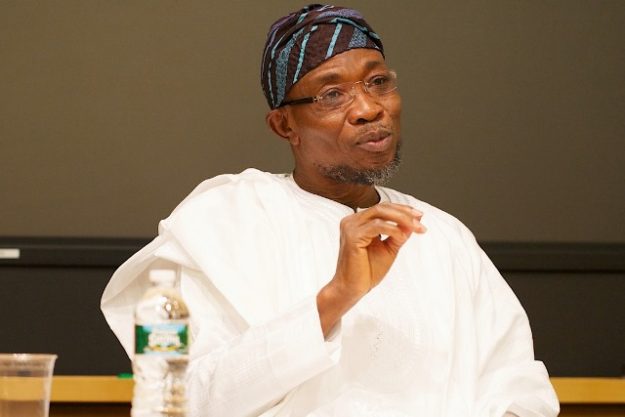
Kano state governor, Abdullahi Ganduje, on Monday stirred the hornets’ nest when he joined the debate on whether or not Nigeria should take another look at its federalism.
The governor, who spoke during a social event organized in honour of delegates to a pre-election meeting of the National Youth Council of Nigeria, in Kano, observed that geo-political restructuring is not the panacea to the nation’s current socio-economic woes, stressing that Nigerians need to restructure their mindsets to return the country to the path of progress.
To buttress his point, Ganduje said the United States of America, the world’s strongest economy, is a more geo-politically fragmented and heterogeneous society than Nigeria, but it has remained the strongest nation in the world.
He stressed that the US attained its present status because of the ability of its leaders to harness the positive thoughts and actions of its heterogeneous population and not by restructuring the country along geo-political divides as being advocated by some groups and individuals in the country.
Lamenting the high prevalence of corruption in Nigeria, he argued that youths are the best segment of the society to lead in the crusade against it in view of their physical and intellectual capacity as well as their leadership potential.
He called on the youths to lead attitudinal change and urged the government to devote more attention to tapping from the potentials of its youths for national integration and development.
Ganduje’s view against restructuring is widely shared by many, especially in the North where calls for restructuring are viewed as decoy to fragment the country.
But his view sharply collides with that of Atiku Abubakar, a fellow party man and former Vice President of the country.
Abubakar had used various public fora to advocate for restructuring as the panacea for the country’s political survival.
Last month in Kaduna, at the late General Usman Katsina Memorial Conference, he again repeated his call for restructuring of the country.
Atiku said: “The north and Nigeria have not been served well by the status quo and there is need for change.
“Who among us who went to primary and secondary school in the 1960s had much to do with the federal government? Did the northern regional government wait to collect monthly revenue allocations from Lagos before paying salaries to its civil servants and teachers or fixing its bridges and roads?”
Many of his critics in the North had described his advocacy as political gimmick to help him realise his ambition to be president in 2019.
However, calls for restructuring have become more strindent since Muhammadu Buhari became president last year. The calls have come more from groups that opposed his election such as the Ohanaeze Ndigbo and the Yoruba socio-cultural group-Afenifere.
Afenifere recently rebuked Vice President Yemi Osinbajo for saying at a function that what Nigeria needed was economic diversification and not restructuring.
Afenifere said Osinbajo was “under pressure” from the “upholders of the status quo”, and stressed that the central plank of the restructuring they advocate was for Nigeria to go back to true practice of federalism wherein, mineral resources that abound in all states would be freed from the exclusive list so that states would move into prosperity.
Chukwuemeka Ezeife, a chieftain of Ohanaeze Ndigbo and a former governor of Anambra State, in a reply to Osinbajo, also said: “Restructuring is what will keep us together in view of the prevailing economic challenges. It will reduce the cost of governance. It makes our diversity to be positive. It is either we return to the six(three) regional structures or 12 regional units.”
The government of Osun State did not receive any money from the federation account in April 2016 due to deductions by the federal government.
A report by PREMIUM TIMES said that the deduction was part of the N32 billion deducted by the federal government from states as repayment for bailout funds and other loans extended to the affected states and the federal government.
According to the report, Osun state’s April allocation from the federation account totaled N2.03 billion, but the sum was insufficient to offset the state’s total debt of about N2.391 billion.
The state still owes the federal government N361 million which will be deducted from subsequent months.
PREMIUM TIMES also reported that some other states saw their monthly share from the Federation account hugely reduced as a result of the deductions
Bayelsa State, for instance, had N3.207 billion deducted from the N4.812 billion allocated to it in April. The sum represents 66.7 percent of the State’s allocation.
Other deductions included Cross River State, N1.405 billion (63.46 per cent); Ogun, N1.185 billion (57.2 percent); Plateau, N1.248 billion (56.52 per cent); and Ekiti, N1.067 billion (55.33 per cent).
Seven states – Akwa Ibom, Anambra, Jigawa, Kogi, Lagos, Rivers, and Yobe – along with the Federal Capital Territory did not have deductions, as they did not collect the bail-out funds used for the deduction.
It was reported that apart from bail-out funds, which took about N3.078 billion from the affected states, loans the states are now repaying to the federal government include debts on Asset Management Corporation of Nigeria,AMCON, loans, commercial agricultural credit scheme, bond issuance programme, obligations to contractors, and deduction from excess crude account.
Other deductions include refund/payment arrears of derivation, foreign loans, special intervention/flood management projects, the national FADAMA project and reconstruction of commercial bank loans into FGN bonds.
President Macky Sall of Senegal is one African leader after my heart. Few weeks into his presidency, the man took one look at the balance sheet and decided the interest of the country would be better served by a single-chamber parliament and simply abrogated the upper house.
He was convinced and, the people of Senegal agreed with him, that the unwieldy two-chamber parliament he inherited was a drain on the economy. His action must have conserved much-needed funds for the country.
The call for a review of Nigeria’s National Assembly assumed a new dimension in the last few years following the realization that the parliament has become a drain on the economy. It all started when former Governor of the Central bank of Nigeria and now Emir of Kano, Muhammadu Sanusi II revealed that nearly a quarter of the federal budget goes into servicing the false lifestyle of federal lawmakers.
The lawmakers did not help the situation by involving themselves in unwholesome practices such as bribe-taking, extortion and forging or falsifying official documents and budget proposals for the purpose of corrupt enrichment.
Unlikely voices have joined the call of late. Worried by the unacceptable level of corruption among lawmakers and as part of events to mark his 75th birthday, former president Ibrahim Babangida proposed an arrangement where legislative duties will be conducted on part-time basis as a cost-cutting measure and a way to break the cycle of corruption at the National Assembly.
The former president revealed that the idea was high on the agenda of his government in 1989. His views echoed similar ones by Chief Joe-Kyari Gadzama, SAN, in a recent cerebral presentation on the issue.
Chief Gadzama had argued that aside saving cost, part-time legislative work will enrich the democracy project at much lower cost because it is the only way to encourage professionals who do not wish to abandon their primary callings to the National Assembly.
The Nigerian Senate (upper chamber)
He even suggested the idea of reserving seats in the National Assembly for professionals, as practised in some developing democracies, who will also operate on part-time basis as other members.
Still as part of cost-cutting measures, there are those who believe Nigeria should operate a single-chamber National Assembly.
In one of his major contributions to constitution making some three decades ago, President Olusegun Obasanjo made a robust case for a unicameral or, single-chamber legislature for Nigeria which he said best suited developing countries.
In his words, bi-cameral or, double-chamber parliaments are generally unwieldy and wasteful for developing countries. Problem is that on two different occasions, President Obasanjo had the opportunity to grab the front-page and twice he demurred!
Honestly, it is still puzzling that Obasanjo passed up the glory of the revolutionary idea. Who knows?
Had he pushed for a single-chamber parliament instead of busying himself with wasting precious time and tax payers’ money on the plan to stretch his tenure, Obasanjo’s aspiration to the fatherhood of the nation would probably have been adequately vented. But, that is as far as it could get!
Aside its unadvertised role as job-placement agency, the best-known benefit of double-chamber parliament, which is suitable for and, desirable in comparatively rich and literate democracies, is that it allows for checks and balances!
Here, the impression one gets is that the upper house, supposedly made up of ‘level headed’ people is capable of checking the supposed excesses of their supposedly ‘hot headed’ juniors in the lower house. It is devoid of commonsense to even imagine that this perceived benefit applies to Nigeria.
Developing democracies have no need for double-chamber parliaments. Aside being financial sink holes, double-chamber parliaments are mere duplication of roles and functions.
With two unwieldy, often-bickering and scandal-prone houses, Nigeria’s National Assembly with some four hundred and fifty mostly half-educated and mostly-lazy federal legislators is a major drawback.
And, mind you, the grouse here is not with representation in terms of numbers. With a population estimated at one hundred and sixty million, the National Assembly may not be overpopulated.
Trouble has always been the unreasonable and unrealistic chunk of the federal budget that services the false life style of a disingenuous few in a vast plain of poor, struggling people.
If self-regulation, a synonym for checks and balances is the main attraction of a double-chamber legislature, it could be better achieved through a less-costly, result-oriented and effective single-chamber assembly with a good mix of supposed cool headed and supposed hot headed members.
The Nigerian House of Representatives (lower chamber)
To achieve this is to retain the present 350 federal constituencies with legislators working on part time basis. In any case, the present arrangement of observing a 181-day legislative year is part-time, anyway!
Aside baiting professionals to bring their expertise to the table, part-time legislative work will eliminate the do-or-die approach to election to the National Assembly which many see as an instant route to wealth.
This is misplacement of priorities which in turn shuts out serious-minded people and thereby robbing the National Assembly of the services of the best minds.
Nigerians cannot continue to be represented by or, subsidize the false style, of poor quality lawmakers some of whom are stark illiterates anyway!
But, if for the loss of meal ticket many see part-time legislative duties as self-destructive, we can try the Ghana experiment which has a single-chamber legislature where cabinet positions are occupied by elected members of parliament.
The attraction with the Ghana arrangement is that it creates a healthy political arrangement where ministers take matters relating to their constituencies to parliament, update their constituencies as to happenings in the parliament as well as press the case of their constituencies at cabinet meetings.
This clearly eliminates a situation where people who cannot win elections in their backyards are rewarded with cabinet positions.
The problem here is not with members of the National Assembly who see their presence as a call to duty. As usual, problem is those who are so unimaginative to the point of not being able to survive outside politics.
They are the ones who have lost all sense of creativity and who will naturally resist any change to the present order with the proverbial last blood. And this is where patriotic and progressive minded members in the National Assembly have a historic duty to rise to the occasion.
History beckons! As the Buhari/Osinbajo administration steadies itself, it may not be a bad idea to look toward progressive lawmakers in seeking ways to jiggle the National Assembly.
Salkida fled Nigeria after he was threatened by Boko Haram. Photograph: Premium Times
By Samuel Malik
The Nigerian journalist declared wanted by the Nigerian Army in connection with Boko Haram has said he has no control over the group despite having contacts with some of its leaders.
“I neither decide for the government nor for Boko Haram,” he said.
Self-exiled Ahmed Salkida, who lives in the United Arab Emirates, UAE, with his family, was reacting to calls by some Nigerians for the Bring Back Our Girls campaigners to direct their planned protest today towards him instead of the government.
“Beyond what I report as news, I have no authority over those I report. Neither in government nor those of the terrorists fold,” he declared.
The BBOG plans to match to the Presidential Villa to demand the release of the Chibok girls following proof of some of them being alive in a video released by the insurgents recently.
Salkida, the only Nigerian journalist known to have contacts within the group and who has reported extensively and exclusively on its activities, said he is helpless in securing their release because he wields no influence over the sect.
Beyond what I report as news, I have no authority over those I report. Neither in government nor those of the terrorists fold
While admitting that he had in the past tried to use his contacts to secure the release of the girls, the Borno State-born journalist said such efforts brought him enemies rather than appreciation.
“I have written extensively on the issues that undermine the sanctity of our humanity as a nation such as the abducted Chibok school girls. I have even at the government’s request sought to use my professional access to affect possible release of the girls.
“This ground of sacrifice has sadly and repeatedly harvested the most unjustifiable professional hostility towards me,” he posted on his blog.
Salkida noted that his reporting on Boko Haram has made him stand out like a sore thumb both among government and its supporters but said other journalists in the past had suffered worse.
He, however, pointed out that government is capable of securing the release of the abducted school girls.
“I know that both the previous and current government in Nigeria publicly declared a commitment to get the girls released. I believe that any government that takes this as an obligation can achieve the set objective,” he said.
The Movement for the Emancipation of the Niger Delta, MEND, has said that Edwin Clark, an elder statesman, does not have the moral authority to negotiate with the federal government on behalf of the people of the Niger Delta.
MEND was responding to Saturday’s statement by the so called Niger Delta Avengers, NDA, militant group, that it would consider negotiating with the federal government only if Clark would be part of the negotiations.
The NDA had said in the statement that “We are going to support any collective/negotiation team emerging from the Chief (Dr.) Papa Edwin Kiagbodo Clark Niger Delta elders and genuine stakeholders conference to engage with the federal government of Nigeria, representatives from the home countries of all multinational Oil Corporations and neutral international mediators that will be focused on achieving the short, medium and long term frameworks and objectives to de-escalating conflicts in the Niger Delta.”
But in reaction to the development, the spokesman of MEND, Jomo Gbomo released a statement on Sunday, urging the federal government not to take neither the NDA nor Clark serious.
The statement said that “throughout the six years that his (Clark’s) ‘son’ former President Goodluck Jonathan was in power, the elder statesman kept mute and actively participated in the economic dismemberment of the Federal Republic of Nigeria.”
It also reminded Nigerians that “Chief Edwin Clark was recently named by the Reformed Niger Delta Avengers (RNDA) as a major supporter of the NDA.”
“Chief Edwin Clark lacks the moral authority to lead a discussion on the so-called “re-structuring” of the Nigerian Federation, at this critical point in the country’s history,
“Consequently, MEND reiterates its full support for the ongoing military presence in the Niger Delta region, even as we prepare to tour the region to drum support for the current administration in an exercise code-named “OPERATION MOSES”.
“MEND shall continue to insist that, so long as these elders and stakeholders do not categorically and publicly denounce the NDA, the Federal Government should also continue to ignore them,” the statement concluded.
President Muhammdu Buhari at his swearing in on May 29, 2016
By Godwin Onyeacholem
In the light of almost two decades of horrendous governance under the PDP administration, the call for change by a large section of Nigerians was expectedly overwhelmingly loud.
Thus, this piece is a response to Garba Shehu, Senior Special Assistant to the President on Media and Publicity, who indeed holds the copyright to the first leg of the title of this piece which I have slightly modified – as can be seen in his latest defence of President Muhammadu Buhari’s APC administration.
After 15 tortuous months in the life of the current administration, a period largely mediated by growing criticisms in the midst of persistent agony of diminished expectations, Shehu, a man you can never accuse of being inattentive, came to what was meant to be a rescue with a well-publicised apologia titled, “Is this the Change we voted for? Yes, It Is.”
And in a spirited effort to convey his message, Shehu provided the question as well as the answer. Given his current station in the presidency, it is hard to fault his emphatic submission. But with due respect to him, however, I hold a different view: Although Nigerians believed in Buhari and indeed voted massively for change, I’m minded to point out that what has been served so far in real terms doesn’t seem like the change Nigerians voted for Buhari to deliver.
Yet, there are a couple of areas one would be inclined to agree with Shehu, especially concerning what this administration has done regarding security and corruption.
Sometime in November 2010, my friend and colleague from our Tell magazine days in the early 90s, Segun Adeleke, and I, interviewed Buhari, then a presidential candidate of the Congress for Progressive Change, CPC, in one of the suites at Transcorp Hotel, Abuja.
The interview titled, “Soon There Won’t Be Enough Money to Steal”, was a cover story for GIRAFFE (Vol. 1 No. 2 November 2010), a monthly magazine which we briefly published. Then, it was clear as now, that Buhari’s priority areas would be security, corruption and indiscipline.
Hear what he said when asked which direction he would be taking Nigeria if elected as president in 2011 elections: “There are two fronts. One is security. This country is terribly insecure. No serious investor can bring his money here to build factory, provide employment and goods and services when there is no power, when there are no roads, no water. Look at what the country has been earning for the past 10-11 years and look at the state of infrastructure in this country. Corruption is responsible for that. The whole world knows it. We have said it. We will still have zero tolerance for corruption and indiscipline.”
Although the country still faces security challenges in the widespread menace of herdsmen, kidnapping for ransom, rising ethnic agitations and renewed bombings down south, no honest assessor will deny that Buhari has diligently confronted this problem especially by limiting the threats hitherto posed by the Boko Haram insurgents operating from the north-east region.
One grey area though remains the issue of the Chibok girls who have been in the custody of Boko Haram for more than two years. You would expect that by now, one way or the other, we ought to have arrived at a closure on this matter. But on the whole, this administration has done far better than its predecessors when it comes to security.
The same single-mindedness has been applied in tackling corruption, even if there are still reservations. All those who looted funds meant to buy weapons for the military are being identified and called to give account. In many cases, such funds are being returned while there are also court cases to bring culprits to justice.
However, in the life of his administration, you would expect that Buhari would make the famous byword of his inaugural broadcast (I belong to everybody, and I belong to nobody) really stick. But there have been occasions tempting enough for one to assume that our president is exclusively for a class of people.
In a government vigorously waving the banner of change, you would expect Buhari not to close his eyes, for instance, to the fact that his ministers have yet to follow the path he and the Vice-President had taken by publicly declaring their assets.
After all, strictly interpreted, change means that you want to do things differently from past administrations.
You would expect him to instantly address the first major embarrassment to his government when one of his foremost cabinet members stuck out his feet at a public function for one of his aides to polish his shoes in full glare of the public. It would not happen in countries where the leadership places premium on the dignity of the human person.
You would expect him to have halted the secret, largely nepotistic employments in some government institutions like the Central Bank of Nigeria and Federal Inland Revenue Service and demand a process that gives all Nigerians access to vacant positions in such places.
In fact in a government of genuine change, all those responsible for those sham employments should themselves by now be out of jobs.
Also, there are reports in the public domain that some highly-placed officials of the presidency, under our President’s very nose, are neck-deep in shady deals running into billions of naira, acting as agents of some crooked business persons.
By now, you expect Buhari to have used those reports to first suspend the officers so mentioned, and then launch an independent investigation into their activities. Any vindication of the media reports would mean automatic sack and possibly prosecution. No cover-up under any guise.
There are a legion other issues that are of serious concern to a great majority of Nigerians, and that should worry this administration. The pattern of appointments Buhari has made so far is one of them. And truly, a dispassionate assessment of these appointments would justify the questions Nigerians are posing.
Take one for example: Why would a man who is already chief of staff to the President also be appointed a board member of a major government organization? Has the president by this appointment not short-changed another person in a different section of the country who ought to have been appointed to this position?
Yes, Buhari comes across as credible with an admirably high integrity quotient; the only former Head of State who as at 2011 never owned a property outside Nigeria. But this virtue, against the backdrop of our multi-ethnic and multi-cultural society, has not been enriched enough by a healthy dose of balancing, fairness, compassion and common touch.
This government claims to be one of change; therefore, this president should be one who occasionally pays instantaneous visits to areas of crisis and disasters of alarming proportions wherever they occur in this country.
Again an example: Rather than leave it to the vice-president’s wife, nothing stops Buhari from taking a trip to Kubwa to see the family of the slain woman preacher, and once again use the opportunity to re-affirm the freedom of religious practice as enshrined in the constitution and the hunting down by all means of perpetrators of such heinous crimes.
Those are the periods strong messages are necessary. It is the kind of thing a President Obama would easily do.
By the way, the country is still waiting for the President on his promise before the election to reduce drastically the number of aircraft on the presidential fleet. He had said then that some of them would be sold off to cut cost. That has yet to happen, more than one year after he assumed office.
All of this, and much more that can’t be cited here, fuel a contrary standpoint to Shehu’s in the answer he gave to his question. To him I say, with all sense of modesty: No sir, this is substantially not the change we voted for.
Godwin Onyeacholem is a journalist. He can be reached at gonyeacholem@gmail.com
Turkish President Recep Tayyip Erdogan has said that the suicide bombing which killed 51 people in the city of Gaziantep on Saturday, was carried out by a 12 to 14-year-old child.
Erdogan said the so-called Islamic State, IS, was behind the attack, which targeted a Kurdish wedding party as the guests danced in the street.
Gaziantep, near the Syrian border, is known to have several IS cells.
He added that the bomb wounded 69 people, 17 of them seriously.
Reports say the city, which has a population of about 1.5 million people, was already on edge because of events in Syria, where IS has been battling Syrian Kurdish forces.
Turkey has been hit by a series of bombs both by IS and Kurdish militants in the past year.
The last IS attack on Istanbul airport in June killed more than 40 people.
The jihadists have recently lost ground in northern Syria, including a former stronghold, Manbij. Syrian rebel soldiers are preparing to advance further into the IS-held province of Jarablus.
In a written statement published by local media in Turkish, President Erdogan argued there was “no difference” between IS, the Kurdish militants of the PKK, and followers of US-based cleric Fethullah Gulen, whom he blames for the coup attempt last month.
“Our country and our nation have again only one message to those who attack us – you will not succeed!” he said.
Niger State Governor Abubakar Bello and Inspector-General of Police, Ibrahim Idris
Niger State Governor, Abubakar Bello has said that the state would partner with the Nigeria Police on improved security.
Bello stated this when he paid a courtesy visit to the Inspector General of Police, Ibrahim Idris, at the Force Headquarters, Abuja.
“In line with the cardinal priority of our administration and the determination to ensure peace and security, Niger State Government will partner with the Nigerian Police on how best to improve on the security situation in the state,” he told the IG.
The governor who expressed confidence in the police added that he was delighted with the resolve by the Inspector General to ensure improved security in the Niger state.
“We had a very fruitful discussion with the IGP with regards to how security can be improved within the state. I am glad that the response I got from him shows that effort is being made by the Nigerian Police to improve on the situation in Niger State”.
In his remarks, the Inspector General, Ibrahim Idris, said the Nigerian Police and Niger State Government are planning a lot of collaborations to deal with the security challenges in the state.
The IG who acknowledged that there were security challenges in recent times in Niger State, said the police and the government have decided to come together to see how best this challenges would be addressed.
“As you are aware, of recent, we have been having few security challenges in the state. We have decided to partner together to see how this challenges would be effectively addressed,
“We have planned a lot of strategies to see how best to improve security situation in Niger State”.
He then called on the people of Niger State to support the police to serve them better.
Boko Haram insurgents on Saturday morning attacked a village, Kuburubu, in Damboa local government area of Borno State, killing six persons and abducting about 13 others.
A member of the youth vigilante group, Civilian JTF who spoke anonymously told our correspondent on phone that attackers rode on four motorcycles to the village at about 5 am when everyone was still at sleep.
He said before everyone could be fully awake they entered some homes killing six people and kidnapping 13 others, leaving many wounded.
He said: “The hoodlums were in Kuburubu village today (Saturday), riding four motorbikes; they were eight in number and armed with guns.
“They attacked the village at about 5 am when everyone was still sleeping; they killed six persons and abducted about 13 others which they led into the bush.”
According to him, those abducted include seven women, five teenage boys and a teenage girl.
“The insurgents looted all the food items, and carted away livestock including goats, camels, and their chickens.”
He said after the looting spree they set the village ablaze.
Kuburubu is a boundary village between Chibok and Damboa local government of Borno state, Northeast Nigeria; about 80 kilometres away from Maiduguri.
The leadership of the Benikrukru Community in Gbaramatu Kingdom, Warri South-West Local Government Area of Delta has insisted that Chevron Nigeria Limited,CNL, must halt its operation at Abiteye oil field.
This was contained in a press statement signed by the Community chairman and secretary, Victor Eseimieghan and Boan Ojogun respectively and made available to newsmen on Saturday in Warri.
The community leaders were reacting to Friday publication in a national daily in which the oil company was asked to disregard the order to stop operation.
“Our attention has been drawn to a publication by the Chairman and Secretary of the Egbema Gbaramatu Communities Development Foundation (EGCDF), Mr. Michael Johnny and Jude Ukori respectively.
“The publication called on Chevron to disregard the ultimatum issued by Benikrukru Community because the body does not enjoy the support of the community and that security agents should be on alert.
“The leadership of the Benikrukru Community wish to insist and state that we stand by the ultimatum issued to CNL to shut down Abiteye field if the grievances of the community are not addressed,” they said.
The leaders also said that Benikrukru community just like every other communities where Chevron has its operational base was not answerable to the EGCDF adding the community’s demand was beyond the body.
Some of their demands included: compliance with local content, dispute over land ownership, unresolved spill issues, employment and others.
They, however, warned Chevron against divide and rule strategy and urged the company to attend to their demands speedily.
Deji Haastrup, Chevron’s General Manager, Policy, Government and Public Affairs had in a statement issued on the crisis assured that the differences will be amicably resolved.