The federal government has threatened to withdraw the licenses of two local fertilizer manufacturing companies over alleged economic sabotage.
The National Security Adviser, NSA, Babagana Monguno, issued this threat at a meeting with manufacturers of fertilizer in Abuja, saying that the attacks on oil infrastructure in the Niger Delta is being carried out with commercial explosives.
Monguno said that over 9,000 kilograms of explosives and 16,420 pieces of detonators have been used by the militants, adding that a store manager and five other employees of an explosives distribution company, alleged to be suppliers of explosives to the Niger Delta militants, has been arrested.
The incessant bombings by the Niger Delta militants and Boko Haram militants have caused both economic losses and human lives in the country.
This over time has drawn concerns from the local and international community for ways of ending the attacks.
However, the NSA was clear in his warnings that the federal government will not compromise in the provision of adequate security for its people.
Abdulmumin Jibrin arriving APC Headquarters on Monday
The All Progressives Congress, APC, has waded into the ongoing budget-padding controversy in the House of Representatives, involving the former Chairman of the House Committee on Appropriation, Abdulmumin Jibrin and the Speaker, Yakubu Dogara, asking the former to stop going public with his allegations.
This was communicated to Jibrin on Thursday in a letter by Lawal Shuaibu, APC’s Deputy National Chairman, North.
“As you are aware, the party, and indeed the government, has not been happy over the recent development in the house of representatives over the issue of the 2016 budget. We found it embarrassing to have to deal with another new phenomenon you tagged ‘budget padding,’” the letter read.
“Arising from the series of meetings we held with you over the subject matter, the national working committee had decided to request you to henceforth avoid issuing any public statement on this matter.
“This includes statements through social media or other means of transmitting an opinion on the matter to the public, as the party is now looking into it towards finding possible solution.”
Recall that Jibrin had met with party leaders on Tuesday to explain the series of allegations against the speaker, and three other principal officers of the House of Reps.
Earlier on Monday, he had gone to the headquarters of the EFCC, ICPC, DSS and the Nigerian Police in Abuja to formally submit a petition against Dogara and others.
All hell was let lose after Speaker Dogara announced the removal of Jibrin from his position as the Appropriation committee chairman.
No sooner had that happened than the Kano State lawmaker took to the social media to accuse Dogara of illegally inserting about N250 billion into the 2016 budget.
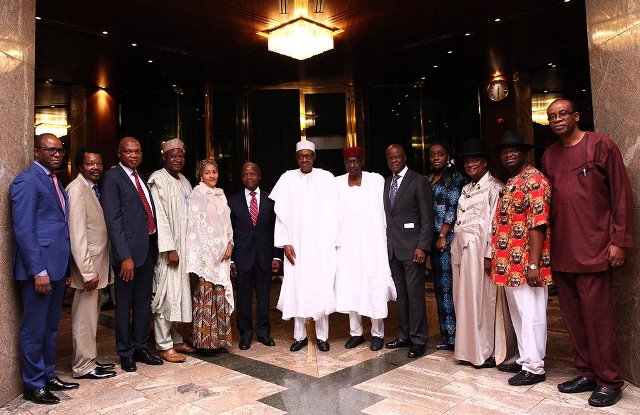
President Buhari in a group photograph with members of the Governing Council of the Ogoni Land Clean-up
President Muhammadu Buhari has inaugurated the Board Of Trustees, BOT, and members of the Governing Council for the clean-up of Ogoni land, while restating his administration’s commitment towards the exercise.
The Inauguration ceremony held at the Presidential Villa, Abuja on Thursday.
The federal government had in June 2, launched the clean-up of Ogoniland with a promise to expedite action on it, but criticisms have trailed the delay in kick-starting the project, weeks after the exercise was launched.
The 13-member BOT will be chaired by Wale Edun, and has Ibrahim Jibril, Minister of State for Environment; Kemi Adeosun, Minister of Finance and Ibe Kachikwu, Minister of State for Petroleum Resources as members.
Others include, Peter Medee and Bebe Okpabi, representatives of Ogoni stakeholders; Osagie Ogunbor of Shell Petroleum Development Company, SPDC; Insula Massimo of AGIP and Nicholas Terraz of Total.
Mike Emuh is representing other Niger Delta Communities while Nnimmo Bassey is from HOMEF, a Non-Governmental Organization.
A UNEP Observer is expected to be part of the board while a legal adviser, who will also act as the board’s secretary will be appointed by the governing council.
The Governing Council is headed by the Minister of Environment, Amina Mohammed. Other members include Ibe Kachikwu; Minister of Budget and National planning, Udoma Udo-Udoma; Minister of Niger Delta Affairs, Usani Usani, and National Security adviser, NSA, Babagana Monguno.
Others are Nsima Ekere, Managing Director (designate) Niger Delta Development Commission, NDDC; Osagie Okunbor, SPDC; Anyakwe Nsirimowu representing IHRHL, an NGO; and Roselyn Kanya, a Rivers State Commissioner.
The council members also include, Pyagbara Legborsi, Ben Naneen, Kammy Ngelala, Batam Ndegwe, Timi Agari, Pamela Esiri, Israel Kayode, Emem Okon and a UNEP observer.
According to a report by the United Nations Environment Programme, UNEP, it will take between 25 to 30 years to restore the oil-polluted environment to a clean state.
President Buhari, during a visit to the United Nations office in Nairobi, Kenya, had urged the United Nations to give more support for his administration’s efforts to clean up the region.
“When I came into office on May 29, 2015, one of the first tasks I carried out was to authorise the implementation of the recommendations of the United Nations Environmental Programme (UNEP) for the clean-up of Ogoniland.
“The devastation caused by oil spillage has destroyed many lives and livelihoods and is clearly one of the reasons why many people in that region lost faith in government and resorted to the many criminal activities we are seeing in the region today.
“The action our government took to implement UNEP’s recommendations has given the indigenes of the region hope that there are better days ahead.
“Let me, therefore, express appreciation on behalf of the government of Nigeria to UNEP and other development partners for their cooperation and support on this very delicate matter and also request for their continued support as we implement the recommendations and transform the fortunes of the region,” President Buhari had said.
The Defence Headquarters, DHQ, has assured Nigerians not to panic as a result of the announcement of a new Boko Haram leader, adding that it is irrelevant and inconsequential to the Military’s operation In The North East.
Rabe Abubakar, Director of Defence Information, told the News Agency of Nigeria, NAN, that the military remained focused on its operation in the north east adding that the announcement of a new leader for the group was only aimed at seeking attention and relevance.
“As far as we are concerned, what Boko Haram or their cohorts are doing is of no relevance to our operations against them. We are just focused on clearing the remnants of the insurgents that are scattered around.
“What they are doing is to seek relevance and to tell the world that they are still around whereas they have been decimated. Their latest move is the antics of a fading group and I believe that in the shortest time they will be history,” the army spokesman said.
The so-called Islamic State of Iraq and Syria, ISIS, had announced that Abu Musab al-Barnawi is now the new leader of Boko Haram, taking over from Abubakar Shekau.
Nothing was said by the terrorist group regarding the whereabout of Shekau.
Women and children at an IDP camp in Adamawa State, Nigeria. Photo: UN Women/Ikechukwu Attah
More than 2,000 girls and women have been abducted by Boko Haram in Nigeria. The international community continues to advocate for their safe return. But after the girls are back, what happens to them? What happens to the children of rape and their young mothers?
She was not even 16. Boko Haram rebels abducted Hussaina Dahiru from her home in the Madagali area of Adamawa State, Nigeria, in May, 2015. Ms. Dahiru, along with 13 other girls were taken to the Sambisa Forest and forcibly married off to one of the insurgents, who already had three other wives. Soon after, she became pregnant.
“Life in the insurgent’s den was oppressive and unbearable,” recounted Dahiru, when she met with UN Women representatives in Nigeria. She had recently escaped from Boko Haram.
Food was scarce and punishments were severe. “If your husband did not go for operation, you would not be given food.”
The captive women and girls were frequently beaten. Attempting escape was nearly impossible and often fatal. Those who were caught trying to escape were butchered; their butchered body parts were shown to the others.
In February 2016, heavily pregnant and unable to bear the daily terror and hunger, Ms. Dahiru took a chance and managed to escape. She ran through the night and at daybreak, a soldier found her on the Midu road in Madagali and helped her find refuge. A member of the Child Protection Network (CPN) in Adamawa state eventually introduced Ms. Dahiru to UN Women.
Hussaina Dahiru’s story doesn’t have a happy ending. Two months after her escape, on 16 April, she died during childbirth. Her child survived and is being cared for by her aunt. The Ministry of Women’s Affairs has provided food and provisions for the child and for the foster mother. However, like most children of rape committed by Boko Haram insurgents, stigma surrounds him. The family and the community are yet to decide whether they would keep the child or give him up for adoption.
Ms. Dahiru’s story is dismally common—a 2015 report by Amnesty International estimated that more than 2,000 women and girls had been abducted by Boko Haram and used as sex slaves. The consequences of this violence extend across generations and cripple communities.
Adjaratou Fatou Ndiaye, UN Women Deputy Representative of West and Central Africa, recently met with internally displaced women and girls during a field visit.
“Most of them have lost the families that they could depend on…and may have children they now have to support,” she said.
“While some of them expressed their desire for education, most pointed out that their immediate need upon returning to their respective communities is acquiring skills—such as tailoring, knitting, soap-making, farming and entrepreneurship—so that they can make a living,” Fatou Ndiaya added.
UN Women Country Representative Dr. Grace Ongile and Rev Father Mathew Kukah speaking to women at an IDP camp in Adamawa State, Nigeria. Photo: UN Women/Ikechukwu Attah
UN Women is working with girls and women who have survived Boko Haram’s violence through the “Emergency Assistance to Internally Displaced Women/Girls and Survivors of Boko Haram Terrorism Attacks in Nigeria” programme funded by the Government of Japan.
The programme is being implemented in Adamawa, Bauchi and Gombe states in Nigeria, where the majority of the displaced women and returning abductees go to find refuge, and focuses on rebuilding their lives through emergency assistance, psycho-social support and economic empowerment.
It tailors and strengthens the humanitarian response in Nigeria by addressing the unique needs and realities of women and girls.
*This article first appeared in UN Women and is published here with permission.
Rotimi Amaechi, Minister of transportation and former governor of Rivers state, gave false information when he reportedly said that Nigeria was under recession during the administration of former President Goodluck Jonathan.
Amaechi reportedly made the comments while granting an interview on a Television Programme, ‘The Osasu Show’ alleging that the then Minister of Finance and coordinating Minister for the Economy, Ngozi Okoknjo-Iweala, had begged him, as the then chairman of the Nigerian Governors’ Forum, not to reveal that Nigeria was in recession.
“If you remember as governor, I said we’re broke. The minister for finance (Ngozi Okonjo-Iweala) came to my office in Abuja here and pleaded with me that I shouldn’t say it again,”
“So I knew as chairman of governors’ forum, that we had gone into recession under Goodluck (Jonathan),” Amaechi was quoted as saying in the interview.
The controversial Minister, in the same interview, also said Nigeria was generating 7,000MW of electricity under President Muhammadu Buhari, before the resurgence of militant activities in the Niger Delta.
He blamed the militants – Niger Delta Avengers – for poor power generation in Africa’s largest economy.
“Don’t forget that until these so-called Avengers began to bomb, we had got to 7,000 megawatts, and what he promised was ten at the end of the first term,” Amaechi had said.
“By the time the avengers, or whatever they call them started bombing, the minister of power, had driven the thing to 7,000 megawatts. Unfortunately, they began to hit the gas facilities, so what would you do?”
But in a Fact Check conducted by THE CABLE, it was gathered that the claims were false.
According to the report, “The International Monetary Fund (IMF), CNNMoney, New York Times and leading economic bodies agree that a recession can be easily identified by “two consecutive quarters of decline in a country’s real (inflation adjusted) gross domestic product (GDP)”.
They, however, add that on a global scale, one may need more than this metric to call a recession. IMF particularly says “it is often better to consider a wider set of measures of economic activity to determine whether a country is indeed suffering a recession”.
“According to the National Bureau of Economic Research (NBER), a private research organisation, which maintains a chronology of the beginning and ending dates of US recessions, recession cannot be covered up.”
The NBER’s Business Cycle Dating Committee defines a recession as “a significant decline in economic activity spread across the economy, lasting more than a few months, normally visible in production, employment, real income, and other indicators”.
But Amaechi claimed that Okonjo-Iweala had “begged him” not to disclose to Nigerians that the country has gone into recession.
The report added: “Goodluck Jonathan became Nigerian president on May 5, 2010 and relinquished power by May 29, 2015.
“Central Bank of Nigeria data shows that there was never a single quarter of negative GDP growth from 2010 to 2015, and no “two consecutive quarters of decline (negative growth) in a country’s real (inflation adjusted) gross domestic product (GDP)”.
“According to World Bank and the National Bureau of Statistics (NBS) opendata project, Nigeria experience annual economic growth ranging from 7.8 percent in 2010 to 2.7 percent in 2015,” it said.
On the issue of electricity generation, the FACT is that Nigeria, in its 55-year history, has never generated 7,000MW
The Cable’s report said: “According to Wall Street Journal, which quoted the World Bank and Energy Information Administration, Nigeria produces less than half as much electricity as North Dakota for 249 times more people.
“Meanwhile, the federal ministry of power, has said the highest level of power generation in the country, in the space of over half a century, was recorded on February 2, 2016, when the country generated 5,074 MW” and “this 1,926 MW short of Amaechi’s claim.”
Vice President Yemi Osinbajo, speaking at an event at the University of Ibadan May said: “Nigeria, for the first time, was actually generating 5,000megawatts, which was the first time it will happen in the history of the country,” Osinbajo added.
The Cable added that as at July 26, when Amaechi made this claim, data from the Nigerian Electricity Regulation Commission, NERC, showed that power generation peaked at 3,082 MW for the week.
Justice Nnamdi Dimgba of the Federal High Court, Abuja, has granted bail to Abiodun Agbele, an ally of Governor Ayodele Fayose of Ekiti, in the sum of N500 million for alleged money laundering.
The judge also ordered the applicant to produce two sureties in the sum of N250 million each, who must own properties within the FCT or in the Ikeja or Victoria Island areas of Lagos State.
He said that the sureties could be private businessmen, professionals or civil servants, adding that if in the civil service, he must not be less than the rank of a director.
Dimgba, while granting the accused bail, said that the prosecution could not substantiate its claim that the defendant would jump bail.
“Taking a holistic appraisal of all the materials before me, I am not convinced that the prosecution has provided sufficient evidence as to stop the court from exercising its jurisdiction to grant bail.
“I hold, therefore, that I am inclined to admit the defendant to bail and I so admit him,” Dimgba declared.
The judge held that Agbele would forfeit the N500 million to the Federal Government if he jumps bail, while ordering the defendant to deposit his international passports with the registrar of the court and must not travel abroad without the permission of the court.
He further said that the trial shall be accorded accelerated hearing and the defendant would remain in prison custody until he perfected his bail conditions.
The case was adjourned till October 26 and 27 for hearing.
Agbele was arraigned by the Economic and Financial Crimes Commission (EFCC) on Wednesday on an 11-count charge bordering on money laundering, to which he pleaded not guilty.
He and four others – still at large – are standing trial for conspiring among themselves to commit an illegal act to launder N4.6 billion transferred from the Office of the National Security Adviser, NSA.
The others charged with Agbele were Musliu Obanikoro, Lt. A. O Adewale, Tunde Oshinowo, Olalekan Ogunseye, and Sylvan Mcnamara Limited.
The Court of Appeal has upheld the election of Yahaya Bello as the validly elected governor of Kogi State.
Governor Bello’s electoral victory is being challenged by James Faleke, a sitting house of representatives member and former running mate to Audu Abubakar.
Audu Abubakar was the initial governorship candidate for the All Progressives Congress, APC in the election that held in November 2015, and was already coasting to victory before he died suddenly with the elections yet to be concluded.
The Independent National Electoral Commission, INEC then asked the APC to nominate a replacement for the deceased and Bello, who had come second in the APC governorship primary, was nominated but Faleke refused to be his deputy, insisting that he should be the Governorship candidate.
He challenged the emergence of Bello as governor and asked the tribunal to declare him, Faleke, governor.
But on June 6, the Election Petition Tribunal, sitting in Abuja, dismissed Faleke’s petition, saying the lawmaker was unable to prove his case.
It also held that all votes cast belong to political parties, “it is the political party, through the instrumentality of its candidate that runs for election”, adding that Faleke lacked the locus standi to challenge the election results since he was never a deputy governor-elect.
Faleke appealed the tribunal’s judgement and the appeal has now been thrown out.
Over 200 units of luxury duplexes and 2-4-bedroom flats constructed by the Kano State government under Rabiu Kwankwaso, now a senator, may become abandoned properties unless the new administration in the state is able to find corporate buyers for them.
The houses are in three residential estates named Kwankwasiya City, Amana City and Bandirawo City located on the outskirts of Kano metropolis and were constructed between 2012 and 2014.
Investigations by www.icirnigeria.org indicate that former Governor Kwankwaso committed N4.1 billion from the state’s pension fund into the project, which was designed to provide decent housing and further open up the ancient city.
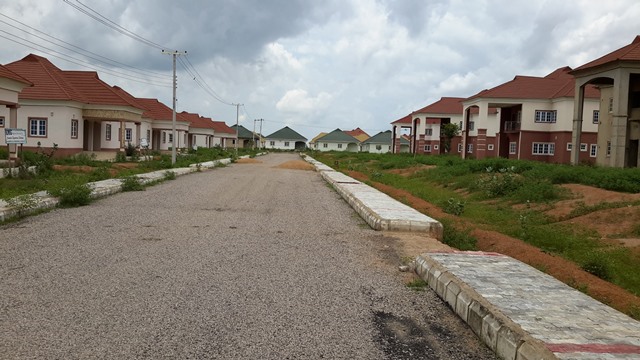
Houses in Bandirawa City
The houses were to be sold to civil servants and other residents interested in owning their own homes. However, the problem is the cost of the houses. The two-bedroom flats go for N15million while the four-bedroom duplexes have been put on sale for between N30 million and N35 million.
Since 2014 when the estates were completed, the state has failed to get buyers for the house and there is growing concern that the N4.1 billion pension fund committed to the projects may have been wasted.
Government officials who spoke to this news website said those who had shown interest in buying the properties complain that the prices are too high by Kano standards, and wondered why the state government would embark on such a project without considering the capacity of end users.
“In Kano, no one will put N30 million down to buy a four-bedroom flat when half of that money can build a decent four-bedroom in the city,” said Umaru Lado, a staff of the state Ministry of Education.
When the reporter visited the estates last week, there was no one living in any of the flats or duplexes and the roofs of some of the buildings were caving in. The paints were falling off on some of the walls.
Houses in Kwankwasiya City
Kwankwasiya City, which has not less than 20 four-bedroom duplexes, was constructed by Birsa Engineering International Limited, a Minna based construction company. The estate has underground electrification. The duplexes go for N35 million each. But all the houses are unoccupied and overgrown grasses were noticeable right from the entrance of the estate.
Isa Yunusa, an estate manager, told www.icirnigeria.org that it would be difficult for the state to get buyers for the properties at the prices they are being offered for sale.
He said: “You know, Kano is not like before. Business has slowed down considerably in the city due largely to the religious crisis that has plagued the state and the activities of Boko Haram insurgents. Many people, especially non-indigenes who could have been attracted to buy the houses, fled Kano because of these problems.”
He said unless the government was willing to sell the houses “at give-away prices” it may not get buyers.
Auduwa Maitangaran, chairman of Indigenous contractors in the state, disclosed that that Kwankwaso administration owed the group’s members over N200 billion for work done. He led his members on a visit to Governor Abdulahi Ganduje in October, 2015 to seek the his assistance in paying the debt.
Asked whether the government was thinking of bringing down the prices of the houses to make them affordable, Mohammed Garba, commissioner for Information, said bringing down the prices would amount to wastage as government would not be able to recoup its investments.
“As you know, the government spent N4.1 billion pension fund on these estates and if we have to pay back the pension board. If we slash the price too much, we ‘ll be losing a lot of money. That is our dilemma now. But we are seriously looking for buyers and we have been talking to organisations and individuals who may be willing to buy. It is a serious problem for us because the houses are not affordable and we need the money,” the commissioner stated.
Critics of Kwankwaso have criticised him for embarking on the construction of luxury estates when he knew that only very few could have the means to purchase them.
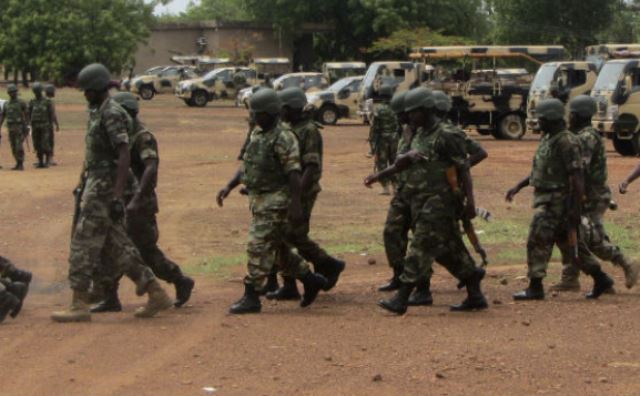
The Nigerian Army and Nigeria Police were on Wednesday engaged in a gun battle in Geidam local government area of Yobe State.
Channels Television reports that residents of Geidam town said “sporadic and prolonged gun duel between the two Nigeria forces caused “pandemonium” in the town.
Witnesses said soldiers and policemen engaged themselves in a serious gun battle as sounds of both small and heavy weapons were heard across town with much concentration around the Mai Idris Aloma Polytechnic, which is situated between the military base and the Geidam Police station.
George Okupe, spokesman of the 27th Task Force Brigade in Yobe State, and the State Police Public Relations Officer, Samaila Solomon, both confirmed the clash saying it was as a result of little misunderstanding between both parties.
The officers would not give further details on the misunderstanding but only said the situation has been brought under control.
On the level of casualties and destruction as a result of the gun duel, they said it was too early to assess the extent of damage but details will be given as they unfold.
The clash between security forces is the first since the commencement of the Boko Haram insurgency in Yobe State.
But there had been incidents of clashes between Army and Police personnel in Maiduguri, Borno State.
The latest of such clashes occurred on June 23 as a quarrel over the sharing of food items for Internally Displaced Persons, IDPs, at the Government House in Maiduguri led to a shootout that resulted in a policeman being shot in the leg.