A Nigerian human trafficker has been handed a 22-year prison sentence in the United Kingdom on a 12-count charge that included conspiracy to traffic persons for sexual exploitation, trafficking persons outside of the UK for sexual exploitation and assisting unlawful immigration.
The lady, Franca Asemota, was arrested by the operatives of the Economic and Financial Crimes Commission, EFCC, on March 24, 2015 in Benin, the capital of Edo State on suspicion of money laundering and was later extradited to the United Kingdom for prosecution.
38-year-old Asemota was part of a criminal network that trafficked girls, boys and women from Nigeria to Europe, using the threat of “juju magic” to guarantee their compliance.
For many months, she was wanted by the UK government for using London Heathrow airport as a transit hub.
After her arrest by the EFCC, Asemota was extradited to the UK on 27th January 2016 following a Federal High Court ruling on the extradition request filed by the office of the Attorney General of the Federation and Minister of Justice.
The successful prosecution underscores the important role cooperation between law enforcement organizations across the world, in this case between the National Crime Agency of the UK and the EFCC, can play in fighting transnational organized crime.
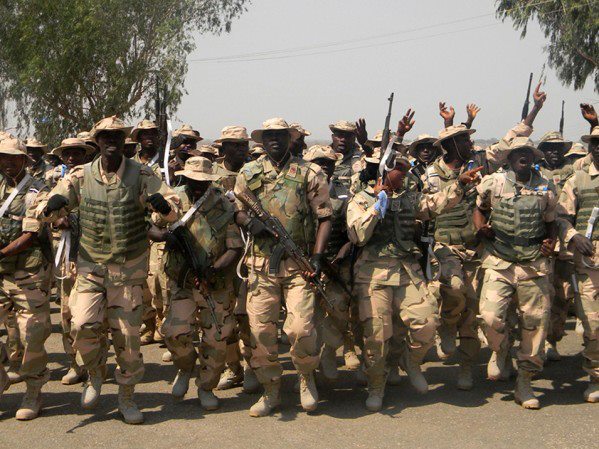
Nigerian Troops of the 121 Task Force Battalion, have launched vocational training/skills acquisition programmes for widows and Internally Displaced Persons, IDPs, in Pulka, Borno State.
Army spokesman Sani Usman on Thursday, stated that the programme which was flagged off by the Commander, 26 Task Force Brigade, Adeyinka Laguda, a Brigadier-General featured various kinds of vocational training including tailoring, soap making, poultry and fish farming, amongst others.
The aim of the scheme was to equip the victims of insurgency with the necessary skills that would help them earn a decent living and improve their living standards as lasting peace gradually returns to the Northeast region.
Adeyinka also commissioned a new medical centre established in Pulka by the unit in collaboration with UNICEF.
The event witnessed a large turnout of people including dignitaries from Borno state government.
The controversy in the Peoples Democratic Party, PDP, is anything but abating, as Jimoh Ibrahim, who is gearing to contest the Ondo State governorship position under the umbrella party, on Thursday obtained his nomination form from the Ali Modu-Sheriff-led faction of the party.
Ibrahim, while collecting the form, stated that the Chairman of the party’s National Caretaker Committee, Ahmed Makarfi has no right in law to lay claim to the chairmanship of the party.
He said that Sheriff is the person known to the law having taken over from Adamu Muazu who resigned as national chairman before the expiration of his tenure.
The controversial businessman said that he would better the lots of the citizens of the state by ensuring prompt payment of their salaries, promising to clear the salary arrears of workers in the state within his first 100 days in office.
Modu-Sheriff commended the aspirant, describing him as a capable hand that could turn the state around if giving the opportunity and promised to support him.
Meanwhile, the Ondo State chapter of the Peoples Democratic Party, PDP, has disowned Jimoh Ibrahim, saying he was not a member of the party.
Ayo Fadaka, PDP Director of Media and Publicity in the state, insisted that Ibrahim was a member of the Accord Party not the PDP as he claimed.
Fadaka said, “I can confirm to you that Jimoh Ibrahim is not a member of our party, the PDP, he has since been rid of his membership and we all know that he is a bonafide member of the Accord Party. So, for him now to be making a somersault to pick a form of PDP is a shameless thing anybody can do in this situation.
“Also I want to confirm to you again that Jimoh Ibrahim, apart from the fact that he is not a member of our party, he does not have any relationship with the PDP in any case and if he is taking a form from Sheriff, he confirms to the entire world where Sheriff is coming from “
Also, the Ondo State Commissioner for Information, Kayode Akinmade said the PDP and the present administration of Dr. Olusegun Mimiko were not bothered by the action of Ibrahim as he had never been a loyal member of the PDP.
Akinmade said, “He is not our member, during the last general election, he didn’t work for the PDP, we know who he worked for. As far as we are concerned there is no cause for alarm, Ondo State PDP is not shaken we are intact.”
Both Modu-Sheriff and Makarfi are laying claim to the leadership of the PDP in a crisis that is threatening to tear the opposition party into pieces.
Series of court cases have been initiated and different judgments given in the course of the leadership controversy, the latest being the order by Justice Okon Abang of the Federal High Court Abuja, barring the Makarfi-led faction of the PDP from going ahead with its planned Party Convention that was scheduled to hold in Port-Harcourt, the Rivers State capital onAugust 17.
The faction, however, insisted that it was going ahead with the planned convention and on Tuesday, released the names of the convention organizing committee.
The chairman of the Independent Corrupt practices and Other Related Offences Commission, ICPC, Ekpo Nta, has denied media reports that the case files of some former governors being investigated by the agency were missing.
Speaking to our reporters at the commission’s headquarters in Abuja on Tuesday, Nta said that the case files of former governors being referred to were handed over by the pioneer chairman of the anti-graft agency, retired Justice Mustapha Akanbi, to the office of the Chief Justice of Nigeria, CJN, in 2004.
The ICPC chairman said that there could not have been any investigation by the commission as the law setting it up does not allow it to investigate or prosecute persons who occupy the positions of President, Vice President, Governor and Deputy Governor.
According to him, the law mandates the ICPC to refer allegations of corruption against such high profile officeholders to the CJN who would then appoint a counsel to investigate the matter and make recommendations to the National Assembly on what to do.
“There are no cases of missing files in the ICPC. Those cases date back to Justice (Mustapha) Akanbi when the petitions were received,” he stated.
“If you read the ICPC Act, when there is an allegation against a serving governor, President, Vice President or Deputy Governor, the Act required that the commission should pass that petition to the Chief Justice of Nigeria who will set up a special counsel to do the investigation. That is the extent the commission is given a role by the law,” he said further.
The ICPC chairman added, however, that the commission was trying to convince the National Assembly to amend the law in order to allow the agency to investigate allegations of corruption against these categories of public officials before handing the case over to the CJN.
“Our thinking is that even if you appoint a special counsel to investigate the allegations, he would need investigations. So why don’t you allow the commission to do the investigation? So what we are telling the National Assembly is to let us do full scale investigation and we can hand the result over to the CJN.”
Nta said that all 27 case files involving former governors were handed over to the office of the CJN in 2004 by the then chairman of the ICPC.
The ICPC chairman also dismissed allegations that he was sitting on a case file involving allegations of corruption received by the commission against Godswill Akpabio, former governor of Akwa Ibom State and the Senate Minority Leader.
Media reports had insinuated that Nta was protecting Akpabio from being investigated and prosecuted because of a special relationship he had with the former governor, who hails from the same state as him.
In fact, Akpabio was said to have nominated the ICPC chairman to his position. The former governor was also reported to have sent emissaries to Nta ostensibly to convince him to hands off any corruption case against him.
Nta however denied having any relationship with the former governor of his state, adding that he also did not receive any emissaries from him.
“I am not sure the gentleman would say that he nominated me to this position. I am sure he would have been surprised himself to read that. I do not have that kind of relationship with him. And the person who made the appointment, the former President (Goodluck Jonathan) is alive…”
Regarding the petition before the ICPC against Akpabio, the agency’s boss said that the case file had been handed over to the EFCC because that agency also received similar petitions and had started investigations on them.
“The petitioner publicised it that he was going to send petitions to ICPC, EFCC and others. So when we received the petition, I did a letter to the EFCC and handed over to them to continue the investigation,” Nta said.
The ICPC chairman also spoke about the controversy surrounding his tenure, stating that his five years in office would end in 2017.
There had been controversy over when Nta was appointed as chairman of the commission, with some reports indication that having first been appointed in 2011, his tenure should end in 2016.
“We were sworn in as members of the board on November 29, 2011 by President Goodluck Jonathan, who refused to swear-in the then chairman for certain reasons. And he turned around and said ‘Mr Nta Ekpo you will act as chairman until I sort this out’. That was when I started acting.
“When my name was forwarded to the Senate for confirmation, I had to go through screening a second time and I appeared before the Senate and after clearance I was asked to come to the presidency for a fresh swearing in and I was issued a new letter as the substantive chairman on October 17, 2012.”
The ICPC chairman confirmed the receipt of a petition by former chairman of the Appropriation Committee of the House of Representatives, Abdulmumin Jibrin, against principal officers of the chamber, but refused to give any details.
Nta said that Jibrin came and personally submitted a petition to him but declined to speak further, arguing that the ICPC Act forbids him to speak on any allegation being investigated by the commission.
Section 64 (1) of the ICPC Act 2000 says: “Subject to Section (2), where any complaint made by any officer of the commission states that the complaint is made in consequence of information received by the officer making the complaint, the information referred to in the complaint and the identity of the person from whom the information is received shall be secret between the officer who made the complaint and the person who gave the information, and everything contained in such information, identity of the person who gave the information and all other circumstances relating to the information, including the place where it was given, shall not be disclosed or be ordered or required to be disclosed in public but only to the trial judge and defence lawyer in attendance in any civil, criminal or other proceedings in any court or tribunal.”
Information and Culture Minister, Lai Mohammed addressing the Nigerian Guild of Editors
The Minister of Information, Lai Mohammed, has commended the Nigerian Guild of Editors, NGE, for being part of the ongoing determined efforts to tackle the various challenges facing the country, especially in the area of the economy.
Speaking at the All Nigerian Editors Conference, ANEC, 2016 in Port Harcourt on Thursday, the Minister however urged the editors to do more by becoming the Champions of Change.
“Permit me to start my remarks by commending the Nigerian Guild of Editors for the well-thought-out theme for this 2016 Conference, which is ‘Economic Diversification: Agriculture as an option for a prosperous Nigeria’.
“As you are all very much aware, Agriculture is one of the sectors we have identified in our economic diversification programme, aimed at moving the country away from a mono-product, oil-based economy, under our Change Mantra.
”It is therefore delightful that you have chosen to deepen the discourse by the choice of your theme for this conference. Even more impressive is the fact that Editors have taken up the challenge of contributing their quota to the ongoing efforts by this Administration to revamp the economy and return Nigeria to the path of sustainable growth and development,” he said.
Mohammed however said the NGE in particular and the media in general must do more by becoming the Champions of Change
“What I am saying in essence is that while the media owes it as a duty to keep Nigerians well informed about the situation in the country, it must do so in context. We are not saying we should continue to lament about missed opportunities, the massive corruption or profligacy of the past, but is it is important for Nigerians to know where and when the rain started beating them, that no provision was made for any umbrella to shield them from the elements, and that indeed genuine efforts are now being made to turn things around.
“One of such efforts is the unprecedented massive investment in infrastructure – roads, railways, power, etc. Road Contractors have been mobilised to sites, many of them long abandoned. Any contractor who is not on site is waiting for the rains to stop, not due to lack of funds.
“The Administration has kick-started the programme to link all state capitals by rail. All these efforts are creating jobs and putting money in the pockets of Nigerians.
“We must give hope to our people, while also giving encouragement to those who are working non-stop to revamp our economy. In one country that failed to save for the rainy day like Nigeria did, citizens are now having to cross to neighbouring countries to get essential commodities.
“The only reason we have averted such fate here is the committed, honest and disciplined leadership provided by President Muhammadu Buhari, the prudent management of the little resources that are accruing to the country now, thanks to the Treasury Singles Account, the unrelenting war against corruption, the rooting out of ghost workers and the increasing emphasis on agriculture that is sure to massively reduce our scandalously-high food imports in a short while,” Mohammed said.
The Minister said Nigeria’s economy is hard hit by the fall in the price of crude oil because the country failed to save for the rainy day, coupled with the fact that the country did not invest in infrastructure.
“Nigeria has nothing to rely on to cushion the effects of the lost earnings. Many other oil producing countries and fellow OPEC members are faring better, because they saved for the rainy day.
“Saudi Arabia, with about one fifth of Nigeria’s population, has in foreign reserves about 600 billion dollars (which is 23 times what Nigeria has in foreign reserves). United Arab Emirates, with less than 10 million people, has 75 billion dollars in foreign reserves. Qatar, with 2.4 million people, has 36 billion dollars in foreign reserves. Even Angola, with just 24 million people, has about 25 billion dollars in foreign reserves.
“Here in Nigeria, with oil selling consistently for over 100 dollars a barrel for many years, we simply failed to save for the rainy day, with the result that a country with a population of over 170 million today has just 26 billion dollars in foreign reserves.
“To compound this, the fall in the price of crude is having a ripple effect: the scarcity of Forex, which has resulted from the oil price crash, means that industries are struggling to get Forex to import raw materials and machinery. With falling imports, the Customs Service, which is another source of revenue, is collecting less duties. Taxation is also affected, as industries with no forex to import can neither employ more people nor produce more goods. Then, Nigeria has had to fight an existential battle to root out Boko Haram in the North-east,” he said.
The federal government has threatened to withdraw the licenses of two local fertilizer manufacturing companies over alleged economic sabotage.
The National Security Adviser, NSA, Babagana Monguno, issued this threat at a meeting with manufacturers of fertilizer in Abuja, saying that the attacks on oil infrastructure in the Niger Delta is being carried out with commercial explosives.
Monguno said that over 9,000 kilograms of explosives and 16,420 pieces of detonators have been used by the militants, adding that a store manager and five other employees of an explosives distribution company, alleged to be suppliers of explosives to the Niger Delta militants, has been arrested.
The incessant bombings by the Niger Delta militants and Boko Haram militants have caused both economic losses and human lives in the country.
This over time has drawn concerns from the local and international community for ways of ending the attacks.
However, the NSA was clear in his warnings that the federal government will not compromise in the provision of adequate security for its people.
Abdulmumin Jibrin arriving APC Headquarters on Monday
The All Progressives Congress, APC, has waded into the ongoing budget-padding controversy in the House of Representatives, involving the former Chairman of the House Committee on Appropriation, Abdulmumin Jibrin and the Speaker, Yakubu Dogara, asking the former to stop going public with his allegations.
This was communicated to Jibrin on Thursday in a letter by Lawal Shuaibu, APC’s Deputy National Chairman, North.
“As you are aware, the party, and indeed the government, has not been happy over the recent development in the house of representatives over the issue of the 2016 budget. We found it embarrassing to have to deal with another new phenomenon you tagged ‘budget padding,’” the letter read.
“Arising from the series of meetings we held with you over the subject matter, the national working committee had decided to request you to henceforth avoid issuing any public statement on this matter.
“This includes statements through social media or other means of transmitting an opinion on the matter to the public, as the party is now looking into it towards finding possible solution.”
Recall that Jibrin had met with party leaders on Tuesday to explain the series of allegations against the speaker, and three other principal officers of the House of Reps.
Earlier on Monday, he had gone to the headquarters of the EFCC, ICPC, DSS and the Nigerian Police in Abuja to formally submit a petition against Dogara and others.
All hell was let lose after Speaker Dogara announced the removal of Jibrin from his position as the Appropriation committee chairman.
No sooner had that happened than the Kano State lawmaker took to the social media to accuse Dogara of illegally inserting about N250 billion into the 2016 budget.
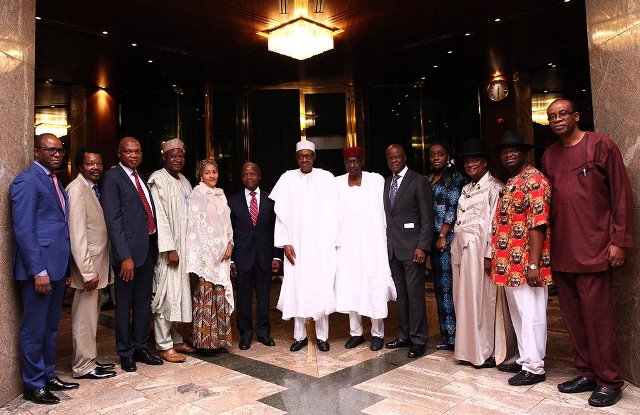
President Buhari in a group photograph with members of the Governing Council of the Ogoni Land Clean-up
President Muhammadu Buhari has inaugurated the Board Of Trustees, BOT, and members of the Governing Council for the clean-up of Ogoni land, while restating his administration’s commitment towards the exercise.
The Inauguration ceremony held at the Presidential Villa, Abuja on Thursday.
The federal government had in June 2, launched the clean-up of Ogoniland with a promise to expedite action on it, but criticisms have trailed the delay in kick-starting the project, weeks after the exercise was launched.
The 13-member BOT will be chaired by Wale Edun, and has Ibrahim Jibril, Minister of State for Environment; Kemi Adeosun, Minister of Finance and Ibe Kachikwu, Minister of State for Petroleum Resources as members.
Others include, Peter Medee and Bebe Okpabi, representatives of Ogoni stakeholders; Osagie Ogunbor of Shell Petroleum Development Company, SPDC; Insula Massimo of AGIP and Nicholas Terraz of Total.
Mike Emuh is representing other Niger Delta Communities while Nnimmo Bassey is from HOMEF, a Non-Governmental Organization.
A UNEP Observer is expected to be part of the board while a legal adviser, who will also act as the board’s secretary will be appointed by the governing council.
The Governing Council is headed by the Minister of Environment, Amina Mohammed. Other members include Ibe Kachikwu; Minister of Budget and National planning, Udoma Udo-Udoma; Minister of Niger Delta Affairs, Usani Usani, and National Security adviser, NSA, Babagana Monguno.
Others are Nsima Ekere, Managing Director (designate) Niger Delta Development Commission, NDDC; Osagie Okunbor, SPDC; Anyakwe Nsirimowu representing IHRHL, an NGO; and Roselyn Kanya, a Rivers State Commissioner.
The council members also include, Pyagbara Legborsi, Ben Naneen, Kammy Ngelala, Batam Ndegwe, Timi Agari, Pamela Esiri, Israel Kayode, Emem Okon and a UNEP observer.
According to a report by the United Nations Environment Programme, UNEP, it will take between 25 to 30 years to restore the oil-polluted environment to a clean state.
President Buhari, during a visit to the United Nations office in Nairobi, Kenya, had urged the United Nations to give more support for his administration’s efforts to clean up the region.
“When I came into office on May 29, 2015, one of the first tasks I carried out was to authorise the implementation of the recommendations of the United Nations Environmental Programme (UNEP) for the clean-up of Ogoniland.
“The devastation caused by oil spillage has destroyed many lives and livelihoods and is clearly one of the reasons why many people in that region lost faith in government and resorted to the many criminal activities we are seeing in the region today.
“The action our government took to implement UNEP’s recommendations has given the indigenes of the region hope that there are better days ahead.
“Let me, therefore, express appreciation on behalf of the government of Nigeria to UNEP and other development partners for their cooperation and support on this very delicate matter and also request for their continued support as we implement the recommendations and transform the fortunes of the region,” President Buhari had said.
The Defence Headquarters, DHQ, has assured Nigerians not to panic as a result of the announcement of a new Boko Haram leader, adding that it is irrelevant and inconsequential to the Military’s operation In The North East.
Rabe Abubakar, Director of Defence Information, told the News Agency of Nigeria, NAN, that the military remained focused on its operation in the north east adding that the announcement of a new leader for the group was only aimed at seeking attention and relevance.
“As far as we are concerned, what Boko Haram or their cohorts are doing is of no relevance to our operations against them. We are just focused on clearing the remnants of the insurgents that are scattered around.
“What they are doing is to seek relevance and to tell the world that they are still around whereas they have been decimated. Their latest move is the antics of a fading group and I believe that in the shortest time they will be history,” the army spokesman said.
The so-called Islamic State of Iraq and Syria, ISIS, had announced that Abu Musab al-Barnawi is now the new leader of Boko Haram, taking over from Abubakar Shekau.
Nothing was said by the terrorist group regarding the whereabout of Shekau.
Women and children at an IDP camp in Adamawa State, Nigeria. Photo: UN Women/Ikechukwu Attah
More than 2,000 girls and women have been abducted by Boko Haram in Nigeria. The international community continues to advocate for their safe return. But after the girls are back, what happens to them? What happens to the children of rape and their young mothers?
She was not even 16. Boko Haram rebels abducted Hussaina Dahiru from her home in the Madagali area of Adamawa State, Nigeria, in May, 2015. Ms. Dahiru, along with 13 other girls were taken to the Sambisa Forest and forcibly married off to one of the insurgents, who already had three other wives. Soon after, she became pregnant.
“Life in the insurgent’s den was oppressive and unbearable,” recounted Dahiru, when she met with UN Women representatives in Nigeria. She had recently escaped from Boko Haram.
Food was scarce and punishments were severe. “If your husband did not go for operation, you would not be given food.”
The captive women and girls were frequently beaten. Attempting escape was nearly impossible and often fatal. Those who were caught trying to escape were butchered; their butchered body parts were shown to the others.
In February 2016, heavily pregnant and unable to bear the daily terror and hunger, Ms. Dahiru took a chance and managed to escape. She ran through the night and at daybreak, a soldier found her on the Midu road in Madagali and helped her find refuge. A member of the Child Protection Network (CPN) in Adamawa state eventually introduced Ms. Dahiru to UN Women.
Hussaina Dahiru’s story doesn’t have a happy ending. Two months after her escape, on 16 April, she died during childbirth. Her child survived and is being cared for by her aunt. The Ministry of Women’s Affairs has provided food and provisions for the child and for the foster mother. However, like most children of rape committed by Boko Haram insurgents, stigma surrounds him. The family and the community are yet to decide whether they would keep the child or give him up for adoption.
Ms. Dahiru’s story is dismally common—a 2015 report by Amnesty International estimated that more than 2,000 women and girls had been abducted by Boko Haram and used as sex slaves. The consequences of this violence extend across generations and cripple communities.
Adjaratou Fatou Ndiaye, UN Women Deputy Representative of West and Central Africa, recently met with internally displaced women and girls during a field visit.
“Most of them have lost the families that they could depend on…and may have children they now have to support,” she said.
“While some of them expressed their desire for education, most pointed out that their immediate need upon returning to their respective communities is acquiring skills—such as tailoring, knitting, soap-making, farming and entrepreneurship—so that they can make a living,” Fatou Ndiaya added.
UN Women Country Representative Dr. Grace Ongile and Rev Father Mathew Kukah speaking to women at an IDP camp in Adamawa State, Nigeria. Photo: UN Women/Ikechukwu Attah
UN Women is working with girls and women who have survived Boko Haram’s violence through the “Emergency Assistance to Internally Displaced Women/Girls and Survivors of Boko Haram Terrorism Attacks in Nigeria” programme funded by the Government of Japan.
The programme is being implemented in Adamawa, Bauchi and Gombe states in Nigeria, where the majority of the displaced women and returning abductees go to find refuge, and focuses on rebuilding their lives through emergency assistance, psycho-social support and economic empowerment.
It tailors and strengthens the humanitarian response in Nigeria by addressing the unique needs and realities of women and girls.
*This article first appeared in UN Women and is published here with permission.