A Federal High Court in Abuja, has turned down the bail application of the former Deputy Governor of Osun State, Iyiola Omisore, who is presently in the custody of the Economic and Financial Crimes Commission, EFCC, over alleged fraud of 60 billion Naira.
Justice Olukayode Adeniyi held that Omisore’s application for bail is premature and incompetent, asking him to await the expiration of the 14-day remand order granted by a Court of Coordinate Jurisdiction before exercising his right to bail.
The Judge held that any attempt to grant the bail application will be tantamount to vacating a subsisting order made by the same court.
He added that the Administration of Criminal Justice Act makes it lawful for the EFCC to detain a suspect for the initial 14 days and another 14 days if circumstances warrant.
He adds that in the instant case, the court lacks jurisdiction to set aside the order it made for the remand of the suspect.
The federal government has said there is no truth in the insinuation that the report of the Presidential Committee on the Audit of Defence Equipment Procurement in the Armed Forces (2007-2015) was doctored for whatever reason.
This is contained in a statement issued in Abuja on Friday by Segun Adeyemi, special assistant to the Minister of Information and Culture Lai Mohammed, which said that “what has been released so far is the report of the audit covering the period 2011 to 2015, adding that the Committee would commence the audit of procurement from 2007 to 2010 as soon as the necessary documents are available.
”When the documents regarding procurement from 2007 to 2010 are available and scrutinized, the committee will then issue its report on that. The audit is being done on phases, and the report that was released on Thursday is the third of such,” the Minister said.
Mohammed assured Nigerians that the anti-corruption campaign by the federal government is non-discriminatory, and called on all citizens to keep an open mind as events unfold.
”No one should attempt to distract from the seriousness of the issues involved in this audit of defence equipment procurement. It is important to note that even though the total amount spent for procurement and operations within the period were N185,843,052,564.30 and $685,349,692.49, the irregularities in the awards ensured that the military did not get value for money, with very serious consequences,” the Minister said.
President Muhammadu Buhari has given approval to the Committee on Audit of Defence Equipment Procurement, CADEP, which is currently investigating procurement of arms in the military between 2007 and 2015, to carry out further investigation of those involved in the procurement during the period in review.
The committee made this known late Thursday evening in its Third Interim Report presented to the President.
According to the report signed by Jon Ode, a retired Air Vice Marshal and head of the committee, the total amount spent for procurement and operations within the period were N185,843,052,564.30 and $685,349,692.49.
The committee said it reviewed some of the contracts awarded by the ministry of Defence, MOD, and found out that most of the contracts were given out without “significant input” from the end users – the Nigerian Army.
Names of persons that played key roles in the procurement of arms between the period in review include that of 18 serving and retired military personnel, 12 serving and retired public officials and 24 chief executive officers of companies.
The military personnel include former Chiefs of Army Staff, OA Ihejirika and KTJ Minimah, JAH Ewanisha, U Buzugbe, ER Chioba, AAI Muraina, EJ Atewe – former commander operation PULO SHIELD, DD Kitchener, DM Onoyiveta, AJS Onibasa, M Mamman, N Ashinze, AA Abubagaji, AM Inuwa, MS Dasuki – former National Security Adviser, El-Hussaini Boyi, M Oyaduogba and Abubakar Usman.
The serving and retired public officials include Nurudeen Mohammed, Bukar Goni Aji, former Head of Service, Haruna Sanusi, E.O. Oyemomi, Abdulrazak Salau, Jonah Otunla, former Accountant General of the Federation, Josephine Opara, Abdullahi Maikano, John Bamidele, Buba Gamawa, Tajudeen Fetuga and Salisu Shuaibu.
Company CEOs to be probed are Olu Bamgbose, Amit Sade, Noam Sade, Jimmy Ntuen, O Ayandele, Hima Aboubakar, Gujja Attom, Maisudan Bello-Mohammed, Lawal Oriyomi, Chinedu Onyekwere, Eleojo Peters, Alon Samuel and Edward Churchill.
Others are Rohit Nandal, JM Claassens, Kingsley Onyeabor, Donald Peterson, Kaja Onyemachi, Ponnle Abiodun, Kime Ngozi and four others whose names were not given.
The committee cited various examples where contracts were awarded to companies that lacked the technical abilities to carry out the procurement or, in other cases, contracts were awarded without any verifiable bidding process.
In some other extreme cases, contracts were awarded, monies released but the projects have not been completed even till date.
“As an example, 3 contracts with a total value of N5,940,000,000.00 were awarded to DYI Global Services Ltd and Doiyatec Comms Nig. Ltd (owned by the same individuals) for the procurement of military hardware including 20 units of KM-38 Twin Hull Boats and 6 Units of 4X4 Ambulances fitted with radios. The committee found that the 2 companies collected N5,103,500,000.00, representing 86% of the total value of the 3 contracts worth N5,940,000,000.00, but only performed to the tune of N2,992,183,705.31,” the report read.
It added: “In another instance, 2 contracts were awarded to Baram International Nigeria Limited, amounting to N420,726,799.20 for the procurement of 53 Armoured Vehicle Spare parts at the cost of N169,916,849.77 and that of Ballistic Vests, Night Vision Binoculars and 3 Unmanned Aerial Vehicles at the cost of N250,809,949.50. Sadly, the contract worth N169,916,849.77 with 90 days completion time is yet to be completed 5 years after.”
The committee said in its interactions with field operators, it was “revealed that although the platforms and ammunitions procured for the Nigerian Army were deployed for the NE operations, most of them were over aged or expired and support spare parts were insufficient or completely not available.
“The platforms were prone to breakdown without immediate recovery support. The non-adherence to the procurement procedures resulted in procurement of some unreliable equipment that reduced the capacity of the Nigerian Army in the NE operations and resulted in avoidable loss of lives and equipment.”
The committee stated that it observed several breaches of laws and regulations on payments of With-holding Tax, WHT, and Value Added Tax, VAT.
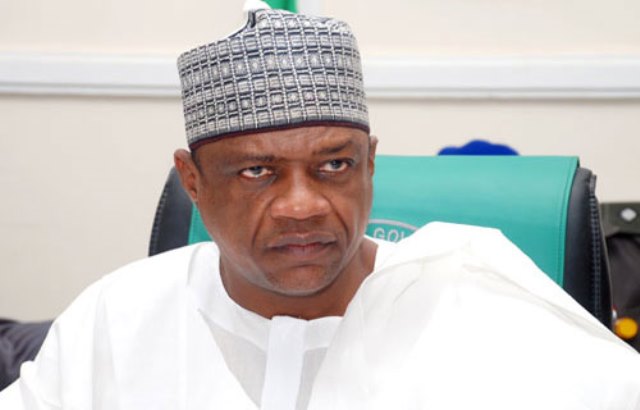
Governor Ibrahim Gaidam of Yobe State has called on the United Nations World Food Programme,WFP, to scale up its humanitarian intervention in his state in order to swiftly help people ravaged by Boko Haram insurgency.
The Governor made this appeal on Thursday when he hosted the agency’s Regional Director for West Central Africa, Abdou Dieng, at the Government House, Yobe.
Dieng was appointed as regional director of WFP two weeks after working as coordinator of UN response to the Ebola crisis in Guinea.
Accompanied by key officials of the WFP including Nigeria Country Director, Sory Ibrahim Ouane, Dieng described the humanitarian situation in the Northeast region as ‘complex’.
He said the WFP is keen to scale up its humanitarian intervention in Yobe State and the Northeast especially now that people affected by Boko Haram attacks were gradually returning to their communities.
He pledged to collaborate and coordinate with the Yobe State Government in the effort to provide succour to the victims of the Boko Haram insurgency.
Gaidam recounted the destructive impacts of Boko Haram on communities in Yobe State and said that up to 300,000 people were displaced by the insurgent group.
He said: “One of the biggest challenges before us and our partners is that of resettlement, reconstruction and rehabilitation of the affected areas and assistance to people whose property and assets were either destroyed or vandalized.”
He asked the WFP to provide further assistance to IDPs and other vulnerable people in the state.
Meanwhile Co- Chair of the Bill and Melinda Gates foundation, Bill Gates, the Chairman of the Dangote Foundation, Aliko Dangote have met with the Yobe State Government to appraise the progress made so far in the fight against polio and other child-killer diseases in the state.
The three parties had in January this year signed a memorandum of understanding, MoU, on strengthening routine immunization in the security threatened north east state of Nigeria.
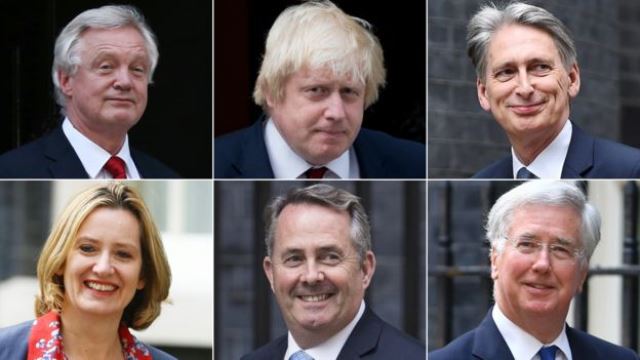
Top: David Davis, Boris Johnson and Philip Hammond. Below: Amber Rudd, Liam Fox and Michael Fallon
New British Prime Minister, Theresa May, has made sweeping changes in her first full day in office as she forms a new government.
First to get the boot was Michael Gove, former justice secretary under David Cameron, who has been replaced by Liz Truss.
Gove was one of the leading figures in the campaign to leave the EU and also contested for the PM position, but he came a distant third at the final round of voting by the parliamentarians.
Education Secretary, Nicky Morgan, was also sacked and former international development secretary, Justine Greening, was chosen in his stead.
Culture Secretary, John Whittingdale, didn’t make it either; but Health Secretary Jeremy Hunt retained his post and Philip Hammond is the chancellor.
Amber Rudd took over from May as Home Secretary, David Davis was made Brexit Secretary and Liam Fox took up a new post of Secretary of State for International Trade.
Michael Fallon was retained as Defence Secretary.
Andrea Leadsom , who pulled out of the race for the conservative leadership, was appointed Secretary of State for Environment, Food and Rural Affairs.
Perhaps the most surprising of May’s appointment so far is Boris Johnson, former Mayor of London and a key Brexit campaigners, who was appointed as Foreign Secretary.
Analysts had likened Johnson to US Republican presidential front runner, Donald Trump, due to the brazen manner with which he pursued the Brexit campaign.
He was wildly thought to be the next in line for Prime Minister before he ruled himself out.
A public hearing scheduled by the House of Representatives to look into the allegation of sexual misconduct brought against three members of the house by the US government could not holdon Thursday due to the absence of the US Ambassador to Nigeria, James Entwistle.
Entwistle had promised to come with video evidence of his allegation against three Nigerian lawmakers who attended a US sponsored leadership programme in Cleveland, Ohio.
Speaker Yakubu Dogara had constituted a panel to investigate the allegations following a petition by Entwistle in which the ambassador alleged that the three lawmakers sexually harassed hotel workers in Cleveland, Ohio, while on the leadership programme.
The legislators involved vehemently denied the allegations and one even threatened to sue the US government for character assassination.
The committee headed by Nicholas Ossai in its effort to find out the truth invited Entwistle to a public hearing, as well as the seven other members of the house that attended the leadership programme alongside the accused.
Entwistle reportedly said he would provide video evidence of the incidences as proof to substantiate his allegation; but at the hearing on Thursday, the ambassador was not present and no reason has so far been given for his absence.
The public hearing has been adjourned till July 20.
Minister of Finance, Kemi Adeosun, has said that even though crude oil gives Nigeria over 70 percent of its revenue, it constitutes only 13 percent to the country’s Gross Domestic Product, GDP.
The minister said this was a situation that must not be allowed to continue, stressing that it is the reason why the administration of President Muhammadu Buhari was focusing on non-oil revenue generation.
Adeosun made this assertion on Thursday, in Kano State, during the opening ceremony of the National Revenue Retreat with the theme: “Enhancing Revenue Generation for Sustainable National Development”. The retreat was attended by state officials from Lagos, Kano, Jigawa and Edo states.
She stressed that Nigeria must improves her revenue collection efforts as ‘revenue to GDP in the country is one of the lowest in the continent.
Adeosun stated that Nigeria’s tax to GDP is only 6 percent versus 26 percent in South Africa and 21 percent in Tunisia, stressing that the ministry of finance has committed itself to focusing totally on revenue generation.
She however said ,”our revenue focus will not burden Nigeria ,but will ensure that all revenue due to Nigerians ‘s government ,irrespective of the source ,is collected with high degree of efficiency ,fully receipted and properly accounted for,
“The days when revenue generating agencies acted as autonomous entities outside of the budget cannot be allowed to continue. Whether the funds are from fees and fines, from taxes or from projects, the law is clear that every naira must be paid into Consolidated Revenue Fund.”
She stated that discipline and accountability in the spending of public money is a trademark and policy focus of the President Buhari-led administration.
The minister posited that citizens will not willingly pay revenues if the funds are seen to be leaking or are being wasted, adding that all spending must start with revenue and therefore “we have commenced the work of plugging the leakages of government revenue.”
Minister of Budget and National Planning, Udoma Udo Udoma
The Minister of Budget and National Planning, Udoma Udo Udoma, has dismissed rumours that the federal government had dumped the National Integrated Infrastructure Master Plan,NIIMP, rather, he said the government was reviewing the document to make it conform to current realities.
A statement signed by Akpandem James, Media Adviser to the minister, said speculations that the plan might have been abandoned was fueled by poor appreciation of the essence of the NIIMP and lack of knowledge about recent developments regarding the document.
The statement reads: “For effective implementation of the NIIMP, the current administration embarked on a number of related key activities including developing a framework for identifying priority projects with infrastructure-heavy MDAs to form part of the 2017 Budget, as well as signed a Memorandum of Understanding with the Infrastructure Bank which will act as the Budget and Planning Ministry’s Advisor on NIIMP implementation.
“Also, a two-day pre-summit workshop was hosted by the Ministry with critical Stakeholders to prepare a roadmap for the implementation of Public, Private Partnership,PPP, projects; while also engaging with private sector industry players, especially on PPPs.
“The Ministry is in the process of concluding reality checks on the NIIMP document to address current developments in the global economy; and work is in progress on the development of the first Medium Term Delivery Plan for the NIIMP, which is expected to adequately capture priority areas of the current administration.”
The minister explained that the 2016 budget accorded priority attention to infrastructure development and allocated a substantial proportion of the first full-year budget of the administration to the sector.
“It was the largest of such allocation since the country returned to democratic governance in 1999; and clearly showed a determination by government to improve basic infrastructural facilities across the country,” he stated.
It could be recalled that integrated infrastructural development was only second to Economic Reforms in the ranking of the six pillars of the present administration’s Change Agenda. Others are Social Development, Governance and Security, Environment, and States and Regional Development.
The statement further stated that the first five years of the NIIMP document provides that energy, transport, social infrastructure and housing should be given priority due to their current relative level of under-investment; and the 2016 Budget gave priority attention to these sectors, with further room for enhancement in the planned 2017 Budget.
The NIIMP takes stock of existing infrastructure and identifies the required investments to bring them in line with the country’s aspirations. It also establishes sector targets, priority programmes and critical enablers for effective implementation.
Some of the major provisions of the NIIMP document include that priority attention should be given to:
investments directed at the roads sub-sector in order to refurbish cross-national highways as well as expand the regional road network and linkages to other modes of transportation,
electricity generation capacity and expansion of transmission infrastructure, as well as construction of supporting gas infrastructure,
expansion of mobile network capacity and the broadband fiber optic network,
increasing the number of housing units in order to close the current and projected housing deficit,
construction of facilities for education, hospitals, women and youth development, and sports, as well as,
investments in national vital registration system and construction and rehabilitation of facilities for all security institutions.
The minister stressed that the NIIMP estimated an annual allocation of N6.5 trillion for infrastructure development but that it became unrealistic in the face of contemporary economic realities, as the entire national budget for 2016 was just N6.06 trillion.
Amnesty International, the global human rights body, has accused authorities in Cameroon of violating human rights and denying citizens justice in the fight against the Boko Haram insurgency.
This accusation is contained in its latest report on human rights and justice in Cameroon, which the organisation says has been forwarded to the government in Yaoundé.
The report alleges that the human rights violations are significant in scale and that hundreds have been arbitrarily arrested on suspicion of being Boko Haram and held without access to lawyers, with many of them dying in custody.
“In seeking to protect civilians from brutal attacks that Boko Haram militants have launched in the Far North region of the country, Cameroon’s authorities and security forces have committed human rights violations on a significant scale. They have arbitrarily arrested hundreds of individuals accused of supporting Boko Haram, often with little or no evidence, and detained them in inhumane, often life-threatening conditions,
“Many of the detainees have been held in unofficial detention centres, with no access to a lawyer or their families, and often subjected to torture. Some have died in custody as a result of torture; others have been subjected to enforced disappearance, and their fate remains unknown to date. In cases when authorities bring these detainees to trial, their rights are routinely denied, and the use of anti-terrorist legislation and military courts leaves them with virtually no procedural guarantees,
“More than 100 people, including women, have been sentenced to death since July 2015 in deeply unfair trials, often based on little evidence. The context for these violations a significant growth in brutal attacks on civilians by Boko Haram in the Far North region of Cameroon throughout 2015 and into early 2016. Amnesty International has extensively documented crimes under international law, including international humanitarian law, committed by the armed group throughout this period.
“In response, the Cameroonian authorities have deployed thousands of security forces aiming to prevent such attacks and, in December 2014, the government passed a new anti-terrorism law. Between July 2015 and July 2016 Boko Haram conducted at least 200 attacks, including 46 suicide bombings, in the Far North region of Cameroon, killing over 500 civilians. 67 members of the security forces have also been killed since 2014. In over half of these suicide attacks, Boko Haram used girls to carry and detonate the explosives.”
The report, released Thursday morning, says Boko Haram has deliberately targeted civilians through attacks on markets, mosques, churches, schools and bus stations.
Amnesty International says that the report is based on more than 200 interviews conducted in 2016 and that it has documented incidents in which more than 160 people have been arrested on accusations that they support Boko Haram, and collected detailed information on 82 individual cases.
The report also says that Amnesty International researchers have analysed satellite images of one village in which houses were burnt by security forces, observed trials at Maroua’s military court, and consulted court documents.
Top government officials in Cameroon, including the Minister of Justice, the Minister of External Relations and the Minister of Defence, as well as military judges and prosecutors, and prison authorities were interviewed.
According to human rights body, the main findings of the report were also sent in writing to the authorities on 7 May 2016, but no response was received.
It accused security forces of carrying out hundreds of arrests – there are currently more than 1,000 people accused of supporting Boko Haram in detention – usually without warrants or even explanations, and often using excessive force.
“In one example, members of the Rapid Intervention Battalion unlawfully killed at least seven unarmed civilians during an operation in the village of Bornori in November 2014, and arrested 15 men, before returning in the following weeks to burn houses.
“In another example from July 7 2015, soldiers from the regular army rounded up and assaulted approximately 70 people in Kouyapé, while in the same month a soldier shot a 19 year-old student from Koza in the leg when he could not provide a code for his telephone when stopped by an army patrol one evening.
“Security forces frequently appear to rely only on secret and unverifiable denunciations by informants or circumstantial information, such as the lack of an identity card or a recent trip to Nigeria, rather than a reasonable suspicion of the commission of a crime. For example in Kossa, in February 2015, 32 men were rounded up and arrested based on accusations that the village was providing food to Boko Haram,
“Amnesty International documented 29 cases where people were subjected to torture. For example, Radio France International (RFI) journalist Ahmed Abba was stripped and beaten while detained at the DGRE, with no access to a lawyer or his family for over three months. The Minister of Communications, Issa Bakary, publically claimed that Abba’s lack of access to a lawyer was “in conformity with the antiterrorist law“, and that “his lawyer will have access to him when his interrogation is finished.”
The report reminds the Cameroonian authorities of their obligation to take all lawful and necessary measures to protect civilians from abuses committed by Boko Haram and bring the perpetrators of these abuses to justice, but doing so “while respecting the human rights of those it seeks to protect.”
This, it states, “would be consistent with commitments made by President Paul Biya to ensure that efforts to combat Boko Haram be carried out in full respect of Cameroon’s international human rights obligations.”
The report calls on the Cameroonian authorities to, among other things, put in place procedures to ensure that people are only arrested on the basis of a reasonable suspicion of having committed a crime, and are allowed immediate access to a lawyer and to receive family visits once detained.
It also the government to end the practice of holding and interrogating people at unofficial detention sites and provide unhindered access to human rights organisations and the International Committee of the Red Cross to all detention site, as well as sites such as military bases alleged to be used for unofficial detentions.
In addition the human rights organisation advocates the establishment of a centralised register of all persons arrested and detained, accessible to family members, and identify the whereabouts of all detainees.
The Nigerian government has been urged to ensure an inclusive, simplified and automated tax regime in the country.
The appeal was made on Wednesday by speakers at the 8th Wole Soyinka Centre Media Lecture Series held in Lagos.
The lecture series is an annual event organized by the Wole Soyinka Centre for Investigative Journalism and this year’s edition – with the theme: Tax Education, National Development and The Seminal Role of the Media – drew participants from different sectors of the economy.
Lead speaker, the first female president of the Chartered Institute of Taxation of Nigeria, CITN, Adebimpe Balogun, said that the problem of taxation in Nigeria is with the administration of the system. She gave an example with the difficulty to get tax refund in the cases of tax credit in the country.
In his own remarks, the chairman of the Federal Inland Revenue Service, FIRS, Babatunde Fowler, represented by the agency’s head of Communication and SERVICOM department, Wahab Gbadamosi, said that journalists should be better informed on tax issues and should take advantage of available data in order to educate their audience.
He said the FIRS is putting everything in place to ensure people pay their taxes effectively.
Edobong Akpabio, a discussant at the lecture and Vice President of the Nigerian Employers’ Consultative Association, NECA’s Network of Entrepreneurial Women, NNEW, stated that 97% of businesses in Nigeria are from Small and Medium Scale Enterprises, SMEs.
She said due to varying challenges, one of which is taxation, many SMEs in Nigeria die before their fifth birthday.
Akpabio stated further that another challenge with the payment of tax in the country was the lack of communication and proper customer service orientation exhibited by tax officials at agency outlets; adding that, “tax offices should be conducive for tax payers and free of miscreants”.
A tax Partner at PricewaterhouseCoopers, Emuesiri Agbeyi, said Nigeria’s tax system is one of the most difficult globally. She suggested that the tax system should be made simple and easy for comprehension.
She also emphasised the need to simplify the language used in tax laws to understandable English as most of the laws were written in the sixties.
A civil society representative, Abubakar Jimoh, who is the Communication, Information and Public Officer of the Civil Society Legislative Advocacy Centre, CISLAC, added that tax authorities need to have effective response to tax payers if they intend to get more revenue.
The Publisher of The Cable Newspaper, Simon Kolawole, stated that the country had been distracted up until now by revenue from oil. According to him, the media’s role in taxation is to educate government and the society. He added that taxation is a tool of relationship, thus it is the prosperity of businesses that can build compliance.
The Executive Director, Systemspecs owners of Remita, Deremi Atanda, said the use of technology would help reduce the cost of tax collection, but she lamented the lack of e-payment law in Nigeria, adding that a bill to that effect has been neglected for many years in the National Assembly.
While opening the event, the chair of the board of the Wole Soyinka Centre for Investigative Journalism, Ropo Sekoni enjoined all participants to play their role in ensuring there is a successful tax regime in the country, saying that the media also has the duty of ensuring the discussion on tax is left on the front burner to ensure the needed effect in the society.
Motunrayo Alaka, the Centre’s coordinator, lauded all speakers and participants for being part of the vibrant conference. She expressed optimism that the discussion would continue, most especially amongst the general public who are the most hit by the challenges of taxation.