The House of Representatives was thrown into a rowdy session on the first day of plenary after the Eid-el-Fitri break, during debates on a bill seeking to alter Section 308 of the 1999 Constitution in order to enable leaders of the National Assembly also enjoy immunity from prosecution while in office.
Section 308 is the section of the Nigerian constitution which allows the President, Vice President; State Governors and Deputy Governors to enjoy immunity over civil and criminal matters.
The motion was sponsored by Leo Ogor, the Minority Leader of the House, but it was vehemently opposed by Femi Gbajabiamila, the Majority Leader, who said that the timing of the bill is wrong, insisting that Nigerians will not support it.
“We must feel the pulse of the people,” Gbajabiamila said.
“There is something about timing, timing in any piece of legislation is important. There are issues in the senate and I pray it’s resolved.”
He also noted that no legislation in the world provides immunity for its presiding officers.
The House was divided in two with one section calling for the bill to be passed for second reading and the other section saying the bill should be thrown out.
In his verdict, Speaker Yakubu Dogara explained that any bill that seeks to amend the constitution is usually allowed to pass through the second reading, before being sent to the adhoc committee on the review of constitution, adding that “The bill can die even at the committee”.
The chairman of the Economic and Financial Crimes Commission, EFCC, Ibrahim Magu, has said that the anti-graft agency will soon go after lawyers who help their clients to commit crimes, with a view to prosecuting them.
The EFCC chairman who expressed concern that lawyers aide their clients to escape justice and get away with crime, said that such counsels have constituted an impediment to the fight against corruption.
Magu spoke at the beginning of a workshop organised by the Nigeria Bar Association, NBA, in collaboration with the Presidential Advisory Committee Against Corruption, PACAC, themed “Anti Corruption, Ethics of the Legal Profession and Justice Sector, held in Abuja on Tuesday.
He lamented situations where lawyers help their clients to launder money or purchase houses and other properties, knowing that the funds are proceeds of crime and assured that the EFCC would not spare such legal practitioners.
He observed that lawyers have a great stake in the fight against corruption as they have the responsibility to defend persons accused of economic and financial crimes, and urged them to put the nation first in their dealings.
To the consternation of lawyers and civil society players at the workshop, the EFCC chairman also urges lawyers to deemphasise the issue of fundamental human rights in the fight against corruption, as the interest of the nation is more important than individual liberties.
“We should deemphasise the issue of fundamental human right. Frankly speaking, what is important now is national interest. The country’s interest should be above any individual interest. You should put your actions on a scale and find out whether that thing is in the interest of the nation,” he said.
The EFCC boss also observed that some lawyers charge as much as a billion naira from some accused persons and work to help such persons escape justice not minding what crime they committed.
Magu, whose comments were applauded by members of the integrity community, civil society and journalists, received a cold reception among lawyers who apparently irked by his position.
But Magu’s position was actually reinforcing earlier stand of the chairman of the Presidential Advisory Committee, Itse Sagay, who berated lawyers who become partners in crime with their clients in the name of defending them.
Sagay said that lawyers have a duty to inform anti-corruption agencies or other relevant law enforcement agencies if he/she discovers that a client is involved in crime, reasoning that taking a brief does not mean a counsel should protect a criminal.
A lawyer who knows that his client is guilty should advise him to plead guilty before the court to save himself/herself and the court time.
The Professor of Law said that lawyers are duty to promote the well-being of society s their profession cuts across all facets of human life but lamented that lawyers engage in acts that pervert the cause of justice, just to satisfy their clients.
He opined that it is unethical and a breach of the rules of conduct of the legal for lawyers to exploit court procedures to bring about delays that can delay or impede the dispensation of justice.
Sagay frowned at several means my which lawyers abuse court processes to pervert the cause of justice, including frivolous applications, accusing judges of bias to initiate the transfer of a case.
The PACAC chairman admonished judges confronted with such ploys, particularly accusations of bias just before a ruling, not to capitulate but be courageous and stand firm against intimidation to deliver their judgements.
Sagay noted that other ploys employed by counsels to scuttle cases is their withdrawal from a case just before ruling and requests for client’s treatment abroad, adding that such tactics can turn lawyers into accomplices in criminal acts.
Like Magu, Sagay warned that lawyers who allow themselves to degenerate from counsel to accomplices through money laundering, forgery and other criminal acts will prosecuted by relevant law enforcement agencies.
The General Secretary of NBA, Afam Osigwe, in his own opening remarks said that the association decided to hold the workshop to discuss how lawyers who defend accused persons can equally help in the fight against corruption.
Osigwe, however disagreed with Sagay’s position, arguing that because of the confidentiality between a lawyer and a client, ”it is wrong for a lawyer to divulge confidential information to a third party.
While agreeing that “lawyers should not be a tool in the hands of clients to commit crime, he said that the time tested concept of counsel/client confidentiality is important and should never be breached.
The NBA scribe also frowned at suggestions that lawyers should provide information to law enforcement agencies about their client, arguing that lawyers cannot be expected to do the work of the anti-graft and other security agencies.
“Any provision of the law that turns lawyers into informants against their clients should be fought,” he stated, adding that “lawyers cannot gather information for the EFCC or inform against his client. It is wrong.”
Also at the opening of the workshop was the Minister of Justice and Attorney General of the Federation, Abubakar Malami, who was represented by Sylvester Enebor, Chief Justice of the Federation, CJN, who res represented by Justice Kudirat Kekere – Ekun of the Supreme Court and the President of the NBA, Augustine Alegeh, represented by Francis Ekwere, chairman, NBA anti-corruption committee.
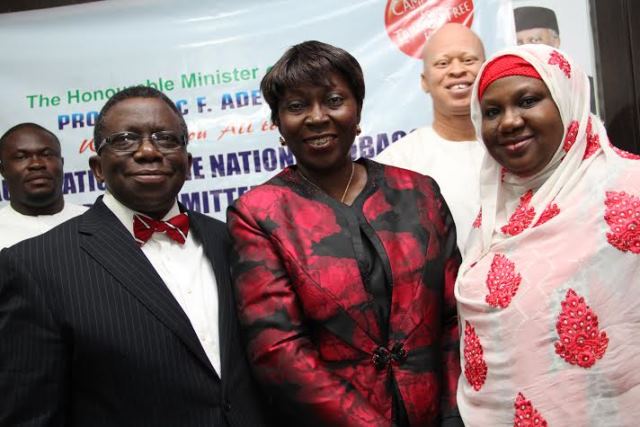
Health Minister, Isaac Adewole; NATOC Chairperson, Ukoli Onawefe. and Perm. Sec. Ministry of Health, Amina Shamaki
Minister of Health, Isaac Adewole says government will adopt all legal and administrative measures to ensure effective implementation of the National Tobacco Control Act.
The Minister said this in Abuja on Tuesday at the inauguration of the National Tobacco Control Committee, NATOC.
He reaffirmed government’s commitment towards “safeguarding and protecting the health of Nigerians from the risks posed by the use of tobacco and tobacco products.”
According to Adewole, “There is no permissible limit for tobacco use in whichever method, form or disguise because it is harmful to health. Tobacco, when used exactly as intended by the tobacco industry will maim and kill more than half of its users.”
The Minister said that tobacco use is responsible for 6 million deaths globally, through many medical conditions notably cardiovascular diseases, respiratory diseases, and cancers.
He charged members of the committee not to relent in the discharge of their responsibilities, pointing out that “tobacco has been red-flagged by both local and international health communities as a poisonous and highly addictive substance that requires urgent intervention.”
“It is therefore imperative to double our efforts in a sustainable and well-coordinated approach to enable us protect the health and wellbeing of Nigerians,” he said, before adding: “However, if we fail in our moral duty, we will be seen to be promoting and expanding tobacco business with dire consequences on Nigerians.”
The National Tobacco Control Committee is headed by Ukoli Onawefe, a Professor from the University of Jos; and its objective will be to advise and make recommendations to the minister on the development and implementation of tobacco control policies, strategies, plans, programmes and projects, in accordance with World Health Organisation Framework Convention on Tobacco Control, its implementing guidelines and protocols.
Also present at the inauguration ceremony was Hilda Ochefu, the West Africa Sub-Regional Coordinator for the Campaign for Tobacco Control Free Kids, a United States based organization.
Ochefu said the inauguration of the committee represented a bold step towards ensuring effective implementation of tobacco control measures in Nigeria.
“We are encouraged by this development as it will aid effective implementation of the tobacco control law and lead to reduction in disease burdens associated with smoking,” she said.
Akinbode Oluwafemi, the Deputy Executive Director of Environmental Rights Action/Friends of the Earth in Nigeria, also expressed delight at the inauguration of the committee saying “with this move, the Federal Government is sending strong signals that it wants to take public health issues much more serious than we have ever seen”.
Kano State Hisbah Board has said that the state government is making plans to commence arrangement for the wedding of another batch of 2,000 widows and divorcees in the state.
The board also refuted rumours that it had recorded about 4,000 divorce cases in the last one year, saying the mandate of the board only include settling disputes among couples, and not keeping record of divorcees.
The Director-General of the Hisbah Board, Abba Sufi, said the mass weeding, which was supposed to have taken place last year, was suspended by Governor Abdulahi Ganduje due to the economic situation the country was passing through.
But the governor promised to sustain the initiative in October last year when he directed the State Hisbah board to start arrangement for the wedding of another batch of 2,000 couples.
.
He noted that the program was introduced by the immediate past administration to check prostitution, divorce cases and other vices in the State,adding that the present government would not relent in continuing the programme,because it is touching the lives of the masses of the state.
Minister of State, Trade and Investment, Aisha Abubakar
The Minister of State for Industry, Trade and Investment, Aisha Abubakar, has said that the delay in signing of Economic Partner Agreement, EPA, by Nigeria is not an attempt to undermine the efforts of the ECOWAS commission as well as the EU on the already concluded EPA, but rather based on the need to address the economic challenges Nigeria is presently facing.
Speaking on Tuesday in Kano ,during a one-day sensitization seminar on EPA organized by the European Union, EU, and the Economic Community of West African States, ECOWAS, held at the Grand Central Hotel, She said “Nigeria and Gambia withheld their signatories to the agreement due to some identified issues of national importance that needed to be addressed.”
According to the minister “We need some time to consult further with the relevant stakeholders and agree on the next step, while our gathering today is a step forward towards finalizing on Nigeria’s position,” adding that trade agreement is too critical to be concluded and signed in a hurry.
“It became imperative that we reflect deeply on the trade liberalization deal with the EU and its long-term impact on the continents efforts towards industrialization and job creation,” pointing out that, “we need to leverage our abundant natural resources and large market to develop our industries.”
She however emphasized the need to create jobs, saying and increase intra-Africa trade.” Africa is on the rise and it is a very big and strategic market for any trading partner.”
She added: “We should diversify our economies, move away from export of raw materials by encouraging value-added export through industrialization and have a better share of the global market.”
Speaking at the occasion , the Head of EU delegation in Nigeria and ECOWAS, Michel Arrion who expressed worry over the delay in signing the EPA by Nigeria, said that, “Nigerian government seems to have some reservation over the signing of the agreement, adding that ”We are here to dispel this misconception and to put the record straight, not through fear or threats, but to make Nigerian government realize the attendant benefit that it will bring to the economic growth and development of the country through trade facilitation with ECOWAS,”
The Commissioner for Industry and Private Sector Promotion of the ECOWAS commission, Kalilou Traore said 20 countries have already signed the EPA, except Nigeria and Gambia.
The EU and its member states have committed to jointly fund the development dimension of EPA for at least 20 years through liberalization of trade in West Africa and to also improve the subsidy of processed products for export.
He added that already, 6.5 billion Euros has been set aside to support West Africa’s EPA Development Programme for the next five years.
The President of the Petroleum and Natural Gas Senior Staff Association of Nigeria, PENGASSAN, Francis Johnson says the union’s ongoing strike continues until all issues raised before the Ministry of Petroleum Resources and that of Labour are fully addressed.
Johnson said this after a closed-door meeting between leaders of the oil workers’ Unions and federal government representatives at the headquarters of the Nigeria National Petroleum Corporation, NNPC, in Abuja on Monday.
He insisted that the decision on whether or not to suspend the strike would be made by the national executive council of the union.
The dialogue had in attendance the Minister of State for Petroleum Resources, Ibe Kachikwu, the Minister of Labour and Employment, Chris Ngige, the Senior Special Assistant to the President on National Assembly Matters, Ita Enang, the Group Managing Director of the NNPC, Maikanti Baru, and leaders of PENGASSAN and NUPENG.
One of the issues discussed at the meeting was the implementation of the 2015 Collective Bargaining Agreement between the federal government and the unions, as well as the implementation of the Petroleum Industry Bill, PIB, and the state under which the oil workers operate, especially with regard to lack of power and bad roads.
Before the meeting went into closed-door, Kachikwu gave the assurance that all the issues would be resolved amicably.
The key issue of redundancy in the sector is expected to be addressed on Tuesday with the Minister of Labour and International Oil Companies, IOCs, but presidents of both PENGASSAN and National Union of Petroleum and Natural Gas Workers, NUPENG, say discussions so far have been satisfactory.
The PENGASSAN had last week declared an industrial action over the dispute, while NUPENG postponed its action pending the outcome of on-gong efforts to resolve the issues.
A visit round major petrol stations in the Federal Capital Territory, FCT, on Tuesday, shows that many of them were either not operating or were offering partial services and the queues were gradually returning.
The Ondo State All Progressives Congress, APC, has announced that members who are interested in contesting for the governorship of the state on the party’s platform are to pay N2 million development levy each.
Isaac Kekemeke, Ondo state chairman of the APC, made the announcement in Akure on Monday, saying the levy had been agreed upon by the aspirants and members of the state executive committee.
But sources say the party was using the new levy to reduce the number of aspirants which currently stands at about 50.
A party member said many of the aspirants do not really have any serious ambition, but rather intend to use their aspirations to negotiate, adding that the N2 million levy was aside from the amount that aspirants were required to pay for nomination forms that will enable them participate in the primaries.
Female aspirants, however, were to pay one million naira.
According to the rules for the primary as announced by the state party chairman, aspirants were also required to sign an undertaken to abide by the outcome of the primary and to work for the victory of the party in the election proper.
The party also advised aspirants against employing the use of thugs and violence while trying to convince delegates to support them, warning that any aspirant that engages in any untoward behavior would be held responsible.
Kekemeke maintained that there is no zoning arrangement and only delegates would chose who eventually becomes the party’s standard bearer at the governorship election which has been scheduled by the Independent National Electoral Commission, INEC, to hold in November this year.
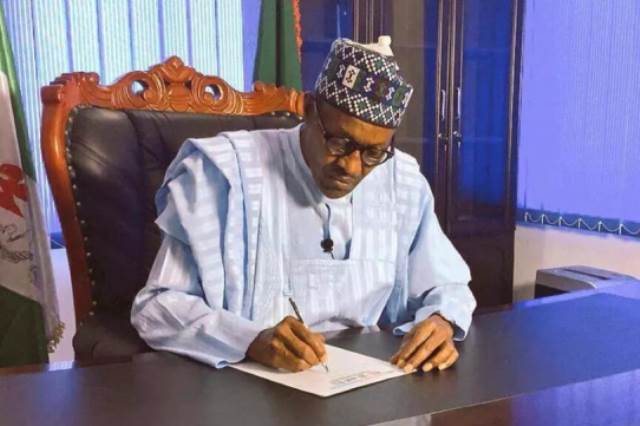
President Muhammadu Buhari has promised that Nigeria will fulfill its financial obligation to the African Union, AU, particularly on programmes and operations aimed at ensuring durable peace, stability and security on the continent.
President Buhari gave the promise while receiving Donald Kaberuka, the AU Envoy on the Peace Fund, adding that supporting peace operations, under the auspices of the AU, in several countries affected by conflict remains a foreign policy priority for his administration.
The President assured the AU envoy that Nigeria will also play a central role in seeking the EU and the UN to strengthen their support for crisis-prone African countries.
Buhari also used the occasion of the visit of the AU envoy to weigh-in on the situation in South Sudan and appeal for peace and calm in the country.
“The AU leadership has a crucial role in stabilizing the country and other African countries on the brink.
“What we can do urgently to stabilize South-Sudan is very important as African leaders meet in Kigali, Rwanda this month and later in September at the UN,” the President said.
Kaberuka, In his remarks, said funding AU-led peace support operations, which had remained a challenge for member-countries, was further compounded early this year with the EU cut in its allocation to the AU Mission in Somalia by 20 per cent.
Kaberuka said the AU summit in Kigali is expected to agree on a roadmap of alternative financing for AU-led peace support operations, including a proposal for African nations to fund 25 per cent of the Fund’s budget while UN contributes the balance.
The Presidency has appealed to officials and members of the Bring Back Our Girls, BBOG, campaign group not to relent in their support for the government in the war against terrorism.
Garba Shehu, the Senior Special Assistant on Media and Publicity to President Muhammadu Buhari, made the appeal in a statement issued in Abuja on Monday, in which he called on the group to continue to support the government in its effort to free all Nigerian citizens taken captive by the Boko Haram terrorist group.
Shehu described as false claims by the group that President Buhari had “broken all promises’’ made to the group about rescuing the missing Chibok girls and “that the government had been lackadaisical in the rescue mission.’’
According to Shehu, the past year of President Buhari-led administration has seen the Nigerian military step up operations at the Sambisa Forest, stronghold of Boko Haram terrorists, which has led to the capture of hundreds of insurgents.
“Also, records from the army show the rescue of no fewer than 15,000 captives, mostly women and children from the terrorists from February to date. “In addition, dozens of communities that were previously under the control of the terrorists have been liberated, allowing thousands of previously displaced citizens to return home and resume their normal lives,” Shehu said.
“Thousands of these women and children freed from captivity have also been reunited with their families. “This huge number of rescued women and children may not be prominent names, and their disappearance may not have generated any massive media attention and campaign. “However, their liberation is just as important as that of every other missing woman and child, and a testament to the devotion of our military personnel who daily risk life and limb in the effort to bring back every Nigerian citizen kidnapped by Boko Haram terrorists.’’
Shehu added that the federal government is focused on the welfare and rehabilitation of rescued Nigerians, many of whom were found in a state of severe malnutrition and illness.
He subtly accused the BBOG leadership of not considering the collateral damage which must have followed the claim that the President has been “lackadaisical” in rescuing the Chibok girls.
“The federal government’s focus has always been to free the Chibok girls alive and unharmed,’’ Shehu said
“It is misleading of anyone to preach that the Chibok girls are within easy grasp. If the military under the President knows where they are held, they will bring the Chibok girls home today’’, he said.
The Presidential spokesman added that the Presidency was open to renew cooperation with the BBOG group, international bodies, religious groups, social workers, and all others for smooth reintegration of those so far rescued from Boko Haram captivity.
He said groups such as the BBOG could also lend a helping hand to families of the military and other security agencies whose losses needed to be appreciated and focused upon.
The Federal Government says it has concluded plans to disburse $1.5 million to the 36 states of the federation and the Federal Capital Territory for the financing of primary healthcare system.
Minister of Health, Isaac Adewole, said this during the presentation of the National Healthcare Plan to officials of the World Health Organisation, WHO, in Abuja on Monday.
Adewole said that the neglect of the primary healthcare system was a major problem in the sector, lamenting that only 20 percent of Nigeria’s 30,000 primary healthcare facilities were working.
The Minister then outlined governments’ plans to revitalise the health sector including cash disbursement to states to finance primary healthcare.
Amina Shamaki, Permanent Secretary of Ministry of Health, also solicited for WHO’s financial and technical support.
The Regional Director of WHO for Africa, Matshidiso Rebecca, assured the government of the organisation’s support and urged that measures be put in place in order to encourage healthcare practitioners to stay in communities where primary healthcare facilities are situated.