Presumptive Democratic presidential nominee Hillary Clinton has received the much awaited endorsement from her former rival Bernie Sanders.
Sanders, a senator and former Democratic presidential candidate appeared alongside Clinton at a campaign event in New Hampshire.
Sanders hopes to have a large influence in the Democratic platform
“She will be the Democratic nominee for president and I intend to do everything I can to make certain she will be the next president of the United States,” he said.
“This campaign is about the needs of the American people and addressing the very serious crises that we face. And there is no doubt in my mind that, as we head into November, Hillary Clinton is far and away the best candidate to do that.”
Clinton thanked her supporters and credited Sanders for bringing new Americans into the political process, saying “I’m proud to be fighting behind you. It’s a time for all of us to stand together.”
Clinton spoke on a number of issues, including student debt, Wall Street, raising the minimum wage, the US tax code, reforming policing, strengthening the middle class, climate change, health care and reducing gun violence.
Sanders supporters have largely decided to support Clinton in an effort to stop presumptive Republican nominee Donald Trump from winning the White House.
Sanders has pressed Clinton to support his views on higher education, health care and the minimum wage.
“It is no secret that Hillary Clinton and I disagree on a number of issues. That’s what this campaign has been about. That’s what democracy is about,” said Mr Sanders.
“But I am happy to tell you that… there was a significant coming together between the two campaigns and we produced, by far, the most progressive platform in the history of the Democratic Party.”
Trump, who has been trying to court Sanders supporters, reacted to the development via tweeter, saying that Sanders has “totally sold out to Crooked Hillary Clinton. Fans angry!”
23 people have been killed and dozens more injured in a head-on collision involving two passenger trains in southern Italy.
Officials say the two trains were on a single-track line at the time of the crash, between the coastal towns of Bari and Barletta.
It was unclear what led to the collision, which happened in good weather at 11:30 local time in the southern region of Puglia.
A local prosecutor in nearby Trani said it was too early to speculate on the cause, although human error was likely to have been a factor.
Italian reports said one of the trains had come from Andria, and the other from Corato, a short distance to the south-east. Both were travelling at high speed.
Both trains had four carriages and images from the fire service showed wreckage strewn across a large area. Some of the carriages were so badly damaged there was little left but debris.
Corato Mayor, Massimo Mazzilli said the damage was so extensive it was as if a plane had crashed.
Rescuers set up a field hospital at the scene to help care for the large number of wounded passengers.
The local authorities have appealed for blood donors to come forward.
Prime Minister, Matteo Renzi interrupted a trip to Milan and returned to Rome, after ordering an investigation into the crash.
“I want to express my condolences to the families and I have ordered, with no holding-back, an inquiry to find who is responsible,” he said.
Italy’s Transport Minister, Graziano Delrio was also at the scene with ministry inspectors and local prosecutors to survey the wreckage.
The embattled National Chairman of the Peoples Democratic Party, PDP, Senator Ali Modu Sheriff on Tuesday said Buruji Kashamu, a senator, is not his political Godfather, stressing that he was nobody’s godson.
Sheriff stated this in a press statement by his spokesman, Inuwa Bwala.
In the statement, Sheriff called on all PDP loyalists across the country to desist from smear campaigns and address issues in their collective quest to find a lasting solution to the crisis that has beset the party.
The statement reads: “This call became necessary in the face of reports planted in some sections of the media, alluding that Senator Buruji Kashamu is a godfather to the National Chairman, Senator Ali Sheriff”.
It further states that: “While it remains obvious that the said report was part of the mischief and orchestrated smear campaigns embarked upon by some people, against the national chairman, it wish to state for avoidance of doubt that, he has no godfather in politics and Senator Buruji Kashamu could not have been one.
“It is becoming clear that, the PDP National Chairman’s critics have run out of ideas on how to achieve their selfish agenda, hence the resort to blackmail and blatant falsehood in order to distract Sheriff from manifesting his capacity to reposition the party.
“We must state that it was most uncharitable for anybody to imply that Senator Kashamu, who like every stakeholder in the PDP, is highly respected, and who makes inputs towards the progress of PDP, is Senator Sheriff’s godfather, as nothing could be further from the truth.
“As members of the same political party, and who believe in the progress of the PDP, there exists mutual understanding between the national chairman and all stakeholders who identify with his cause in this challenging period, including Senator Kashamu.
“With a very strong political history behind him, Senator Ali Modu Sheriff has an intimidating political credential and does not need a godfather to survive, as such, those bandying such mischief can neither succeed in distracting him from moving forward, nay pitch him against party members who identify with him,” the statement insisted.
The National Emergency Management Agency, NEMA, has delivered 13, 400 assorted bags of foods items to the Borno State Government for the feeding of Internally Displaced Persons, IDPs, in Maiduguri.
The items include 8000 bags (25kg) of rice, 1200 bags (50kg) of Maize Gritz, 1000 bags (25kg) of millet and 3200 bags (25kg) of Beans.
Mohammed Kanar, North East Zonal Coordinator of NEMA said the items were presented in line with the memorandum of understanding signed with Borno State Government on provision of food items for the feeding of internally Displaced persons residing in camps across Maiduguri for period of one month.
The items were received by the Deputy Governor, Usman Durkwa on behalf of the State Government and the IDPs.
He expressed gratitude at the continuous support by NEMA and assured that the items would be distributed to the intended beneficiaries.
Since the public presentation of the book We Are All Biafrans and the intervention of a former vice president of Nigeria, Atiku Abubakar, who chaired the event and delivered a speech titled “Restructuring for Nigeria’s national unity” – a speech I recommend to everyone interested in the unity and survival of Nigeria – the issue of restructuring Nigeria and negotiating its unity has once again taken the centre stage of national discourse.
No less a person than President Muhammadu Buhari has had to weigh in on the debate. During his Eid el-Fitr message to Nigerians on Wednesday, July 6, 2016, he was reported to have said: “I assure them (in reference to the Niger Delta ‘militants’) that when we were very junior officers, we were told by our leaders, by the Head of State, Gen. Gowon, that to keep Nigeria one is a task that must be done…we never thought of oil. What we were after is one Nigeria. Please, pass the message to the militants that one Nigeria is not negotiable. And I pray they better accept it. The constitution is very clear…I assure them there would be justice.”
Before President Buhari’s admonition, Nobel Laureate, Prof. Wole Soyinka, had noted during a parley with The Punch on Tuesday, June 28, 2016: “I am on the side of those who say we must do everything to avoid disintegration. That language I understand. I don’t understand (ex-President Olusegun) Obasanjo’s language. I don’t understand (President Muhammadu) Buhari’s language and all their predecessors, saying the sovereignty of this nation is non-negotiable. It’s bloody well negotiable and we had better negotiate it. We better negotiate it, not even at meetings, not at conferences, but every day in our conduct towards one another.”
The opinions of these two prominent Nigerians reflect the two divergent opinions on the issue of restructuring Nigeria or negotiating her unity. I had planned this article – that was before President Buhari’s remarks – as a cautionary note to the Left, progressives and genuine patriots in Nigeria. I believe they are the only ones predisposed and sincerely open to solving the current crisis. Regrettably, this is one issue that has divided the Left, progressives and patriots in Nigeria. This division has defined the kind of response – ranging from obfuscation and doublespeak to outright denial and combativeness – that has made it impossible to have a coherent national narrative and action plan. Since those who ought to speak out and act have maintained criminal silence and indifference, they have yielded the space to conservative analysts of every hue, hypocrites, blackmailers, anarchists, and fifth columnists.
So what are the issues in contention? There seems to be a general agreement, even among those who brought us to this near-tragic end, that Nigeria is not working for Nigerians. However, and this is where the divergence of opinions sets in, Nigeria is not working not because it is not workable, but because it has been rigged to fail. Take the issue of the civil war (1967-70) which President Buhari alluded to. That war was fought in part because of natural resources (oil specifically). That was the driving force of the so-called federal offensive and to some extent it also defined the geo-politics of what would become the secessionist Republic of Biafra. After 30 months of fighting and millions of lives lost, there was a “negotiated” settlement. A truce was declared with the catchphrase “No victor; No vanquished.”
Unfortunately, 46 years after the end of that internecine war, low-intensity conflicts by state and non-state actors are raging across the country, from Boko Haram in the North-east, Islamic Movement in Nigeria (IMN) and Arewa People’s Congress (APC) in the North-west, the Indigenous People of Biafra (IPOB) and other groups in the South-east, the Niger Delta Avengers and Bakassi Strike Force (BSF) in the South-south to the Oodua Peoples Congress (OPC) in the South-west and potential avengers in the North-central. What this tells us is that that war didn’t really end and hasn’t ended. What then do we do to fix Nigeria? The simple answer would be to return to the negotiation table.
To be clear, Nigeria has always been negotiated. The problem has been that the “victors” or those who control power at each round of negotiation have unilaterally defined the structure and politics of the country going forward. Again, I return to the issue of oil. Before independence in 1960, this was the “sharing” formula for crude oil revenues: Oil producing states (region) retained 67.4% of revenues, the federal government got 20%, non-oil states (regions) got 12.6%. After the civil war in 1970, the regime of Gen Yakubu Gowon through Decree No. 13 “negotiated” a new formula: Oil producing states retained 45% of revenues, the federal government got 55% while non-oil states got 0%. In 1975, the regime of Gen Murtala Muhammed in another round of negotiation through Decree 6, came up with this formula: Oil producing states would retain 20% of revenues, the federal government got 80% and non-oil states got 0%. In 1976, Gen Obasanjo, then military dictator, in his omniscience, gave oil producing states 0% of revenues while the federal government got 100% and the non-oil states got 0%.
President Shehu Shagari who came to power in 1979 brought a bizarre twist to the “sharing” formula. He retained the Obasanjo formula of 0% allocation to oil producing states and 100% to the federal government to be shared in this order: 50% shared equally among states, 40% shared based on population and 10% based on land mass. By 2000, during the reincarnation of Gen. Obasanjo as civilian president, a new revenue sharing formula was negotiated which gave oil producing states 13%.
As Prof. Yakubu Aboki Ochefu notes in the introduction to the book Nigeria is Negotiable, “Beginning from the Berlin West Africa Conference of 1884-85, the ‘negotiated’ existence of what eventually became Nigeria in 1914 (unfortunately, negotiated without the input of those who would eventually become Nigerians) has always been a part of its historical experience. Under British colonial rule, the economic and administrative structures of the country were continuously rejigged until independence in 1960.
“Between the official versions of the decolonisation history that gives a prominent role to our nationalist heroes for winning independence from the British, to others who believe in the ‘conspiracy theory’ of decolonisation, the process of how the region with the least democratic credentials ended up as the driver of a new democratic enterprise epitomizes aspects of the negotiated experience. As a country on its ‘third missionary’ journey to a truly democratic nation, the fundamental questions of nation building that began over 100 years ago have not been fully and or properly answered. We must collectively negotiate to ensure that we retain the map (of Nigeria) but change the way we exist under that map.”
On April 22, 1990, a group of young Nigerian army officers – mainly from a section of the country (the same army President Buhari told us last week fought to keep Nigeria one) – attempted to overthrow the military regime of Gen Ibrahim Babangida. While that abortive coup lasted, the rebellious soldiers excised five states of the federation – Sokoto, Borno, Katsina, Kano and Bauchi. That coup and the excision order were popular and well-received in many parts of the country. Clearly, if that coup had succeeded, the aftermath would have been another civil war. Gen. Babangida responded to that mutiny by dividing Nigeria into 30 states from 21 (just as Yakubu Gowon divided Nigeria into 12 states from four regions in 1967 to weaken the Biafra secession).
Having told ourselves a few historical home truths, let us quickly avail ourselves of one more opportunity to reclaim Nigeria. When people call for restructuring Nigeria, they make the call for a reason. And it should not be dismissed peremptorily. The rulers of the country use every opportunity to speak about the unity of Nigeria and hardly do anything to build or enhance that unity.
I don’t think the issue really is about the unity of Nigeria. Undoubtedly, many Nigerians want to live in a united Nigeria. It is important, therefore, that we do not conflate the issues. The call for restructuring Nigeria has nothing to do with the “dissolution” of Nigeria. You can believe that “Nigeria is non-negotiable” and still support the call for restructuring the country. That call is basically about building an inclusive and equitable nation; one in which your worth and position are determined not by where you come from or your religion; a nation founded on a popular constitution validated by “we the people”.
On a final note, let me emphasize that restructuring Nigeria has become a “categorical imperative” for the country. It is either we restructure or perish! Restructuring Nigeria is not an elitist concept (even if it is sometimes used by sections of the ruling elite to negotiate power) neither is it about splitting Nigeria. We can restructure (or negotiate) Nigeria without changing the internal map of the country; it is more about resource control rather than resource allocation; more about devolution of power and, therefore, responsibilities. It is about enhancing citizenship rights and the existential confidence in the country.
Of course, restructuring Nigeria is not a silver bullet or cure-all for our problems. But we can’t take on our problems as a nation without a generally acceptable and workable structure. In a sentence, we MUST “re-federalize”.
Onumah’s latest book is We Are All Biafrans. He can be reached through conumah@hotmail.com; Follow him on Twitter: @conumah
The House of Representatives was thrown into a rowdy session on the first day of plenary after the Eid-el-Fitri break, during debates on a bill seeking to alter Section 308 of the 1999 Constitution in order to enable leaders of the National Assembly also enjoy immunity from prosecution while in office.
Section 308 is the section of the Nigerian constitution which allows the President, Vice President; State Governors and Deputy Governors to enjoy immunity over civil and criminal matters.
The motion was sponsored by Leo Ogor, the Minority Leader of the House, but it was vehemently opposed by Femi Gbajabiamila, the Majority Leader, who said that the timing of the bill is wrong, insisting that Nigerians will not support it.
“We must feel the pulse of the people,” Gbajabiamila said.
“There is something about timing, timing in any piece of legislation is important. There are issues in the senate and I pray it’s resolved.”
He also noted that no legislation in the world provides immunity for its presiding officers.
The House was divided in two with one section calling for the bill to be passed for second reading and the other section saying the bill should be thrown out.
In his verdict, Speaker Yakubu Dogara explained that any bill that seeks to amend the constitution is usually allowed to pass through the second reading, before being sent to the adhoc committee on the review of constitution, adding that “The bill can die even at the committee”.
The chairman of the Economic and Financial Crimes Commission, EFCC, Ibrahim Magu, has said that the anti-graft agency will soon go after lawyers who help their clients to commit crimes, with a view to prosecuting them.
The EFCC chairman who expressed concern that lawyers aide their clients to escape justice and get away with crime, said that such counsels have constituted an impediment to the fight against corruption.
Magu spoke at the beginning of a workshop organised by the Nigeria Bar Association, NBA, in collaboration with the Presidential Advisory Committee Against Corruption, PACAC, themed “Anti Corruption, Ethics of the Legal Profession and Justice Sector, held in Abuja on Tuesday.
He lamented situations where lawyers help their clients to launder money or purchase houses and other properties, knowing that the funds are proceeds of crime and assured that the EFCC would not spare such legal practitioners.
He observed that lawyers have a great stake in the fight against corruption as they have the responsibility to defend persons accused of economic and financial crimes, and urged them to put the nation first in their dealings.
To the consternation of lawyers and civil society players at the workshop, the EFCC chairman also urges lawyers to deemphasise the issue of fundamental human rights in the fight against corruption, as the interest of the nation is more important than individual liberties.
“We should deemphasise the issue of fundamental human right. Frankly speaking, what is important now is national interest. The country’s interest should be above any individual interest. You should put your actions on a scale and find out whether that thing is in the interest of the nation,” he said.
The EFCC boss also observed that some lawyers charge as much as a billion naira from some accused persons and work to help such persons escape justice not minding what crime they committed.
Magu, whose comments were applauded by members of the integrity community, civil society and journalists, received a cold reception among lawyers who apparently irked by his position.
But Magu’s position was actually reinforcing earlier stand of the chairman of the Presidential Advisory Committee, Itse Sagay, who berated lawyers who become partners in crime with their clients in the name of defending them.
Sagay said that lawyers have a duty to inform anti-corruption agencies or other relevant law enforcement agencies if he/she discovers that a client is involved in crime, reasoning that taking a brief does not mean a counsel should protect a criminal.
A lawyer who knows that his client is guilty should advise him to plead guilty before the court to save himself/herself and the court time.
The Professor of Law said that lawyers are duty to promote the well-being of society s their profession cuts across all facets of human life but lamented that lawyers engage in acts that pervert the cause of justice, just to satisfy their clients.
He opined that it is unethical and a breach of the rules of conduct of the legal for lawyers to exploit court procedures to bring about delays that can delay or impede the dispensation of justice.
Sagay frowned at several means my which lawyers abuse court processes to pervert the cause of justice, including frivolous applications, accusing judges of bias to initiate the transfer of a case.
The PACAC chairman admonished judges confronted with such ploys, particularly accusations of bias just before a ruling, not to capitulate but be courageous and stand firm against intimidation to deliver their judgements.
Sagay noted that other ploys employed by counsels to scuttle cases is their withdrawal from a case just before ruling and requests for client’s treatment abroad, adding that such tactics can turn lawyers into accomplices in criminal acts.
Like Magu, Sagay warned that lawyers who allow themselves to degenerate from counsel to accomplices through money laundering, forgery and other criminal acts will prosecuted by relevant law enforcement agencies.
The General Secretary of NBA, Afam Osigwe, in his own opening remarks said that the association decided to hold the workshop to discuss how lawyers who defend accused persons can equally help in the fight against corruption.
Osigwe, however disagreed with Sagay’s position, arguing that because of the confidentiality between a lawyer and a client, ”it is wrong for a lawyer to divulge confidential information to a third party.
While agreeing that “lawyers should not be a tool in the hands of clients to commit crime, he said that the time tested concept of counsel/client confidentiality is important and should never be breached.
The NBA scribe also frowned at suggestions that lawyers should provide information to law enforcement agencies about their client, arguing that lawyers cannot be expected to do the work of the anti-graft and other security agencies.
“Any provision of the law that turns lawyers into informants against their clients should be fought,” he stated, adding that “lawyers cannot gather information for the EFCC or inform against his client. It is wrong.”
Also at the opening of the workshop was the Minister of Justice and Attorney General of the Federation, Abubakar Malami, who was represented by Sylvester Enebor, Chief Justice of the Federation, CJN, who res represented by Justice Kudirat Kekere – Ekun of the Supreme Court and the President of the NBA, Augustine Alegeh, represented by Francis Ekwere, chairman, NBA anti-corruption committee.
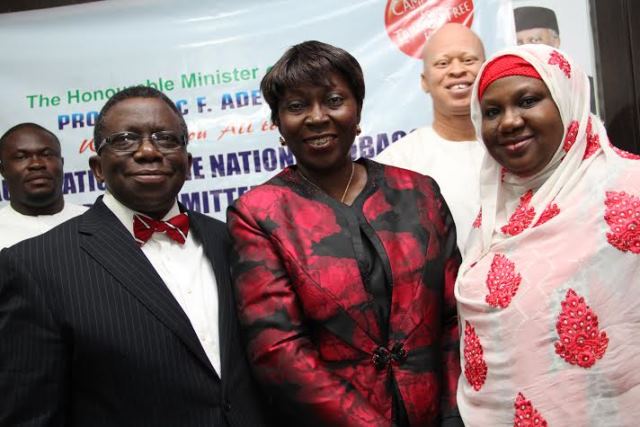
Health Minister, Isaac Adewole; NATOC Chairperson, Ukoli Onawefe. and Perm. Sec. Ministry of Health, Amina Shamaki
Minister of Health, Isaac Adewole says government will adopt all legal and administrative measures to ensure effective implementation of the National Tobacco Control Act.
The Minister said this in Abuja on Tuesday at the inauguration of the National Tobacco Control Committee, NATOC.
He reaffirmed government’s commitment towards “safeguarding and protecting the health of Nigerians from the risks posed by the use of tobacco and tobacco products.”
According to Adewole, “There is no permissible limit for tobacco use in whichever method, form or disguise because it is harmful to health. Tobacco, when used exactly as intended by the tobacco industry will maim and kill more than half of its users.”
The Minister said that tobacco use is responsible for 6 million deaths globally, through many medical conditions notably cardiovascular diseases, respiratory diseases, and cancers.
He charged members of the committee not to relent in the discharge of their responsibilities, pointing out that “tobacco has been red-flagged by both local and international health communities as a poisonous and highly addictive substance that requires urgent intervention.”
“It is therefore imperative to double our efforts in a sustainable and well-coordinated approach to enable us protect the health and wellbeing of Nigerians,” he said, before adding: “However, if we fail in our moral duty, we will be seen to be promoting and expanding tobacco business with dire consequences on Nigerians.”
The National Tobacco Control Committee is headed by Ukoli Onawefe, a Professor from the University of Jos; and its objective will be to advise and make recommendations to the minister on the development and implementation of tobacco control policies, strategies, plans, programmes and projects, in accordance with World Health Organisation Framework Convention on Tobacco Control, its implementing guidelines and protocols.
Also present at the inauguration ceremony was Hilda Ochefu, the West Africa Sub-Regional Coordinator for the Campaign for Tobacco Control Free Kids, a United States based organization.
Ochefu said the inauguration of the committee represented a bold step towards ensuring effective implementation of tobacco control measures in Nigeria.
“We are encouraged by this development as it will aid effective implementation of the tobacco control law and lead to reduction in disease burdens associated with smoking,” she said.
Akinbode Oluwafemi, the Deputy Executive Director of Environmental Rights Action/Friends of the Earth in Nigeria, also expressed delight at the inauguration of the committee saying “with this move, the Federal Government is sending strong signals that it wants to take public health issues much more serious than we have ever seen”.
Kano State Hisbah Board has said that the state government is making plans to commence arrangement for the wedding of another batch of 2,000 widows and divorcees in the state.
The board also refuted rumours that it had recorded about 4,000 divorce cases in the last one year, saying the mandate of the board only include settling disputes among couples, and not keeping record of divorcees.
The Director-General of the Hisbah Board, Abba Sufi, said the mass weeding, which was supposed to have taken place last year, was suspended by Governor Abdulahi Ganduje due to the economic situation the country was passing through.
But the governor promised to sustain the initiative in October last year when he directed the State Hisbah board to start arrangement for the wedding of another batch of 2,000 couples.
.
He noted that the program was introduced by the immediate past administration to check prostitution, divorce cases and other vices in the State,adding that the present government would not relent in continuing the programme,because it is touching the lives of the masses of the state.
Minister of State, Trade and Investment, Aisha Abubakar
The Minister of State for Industry, Trade and Investment, Aisha Abubakar, has said that the delay in signing of Economic Partner Agreement, EPA, by Nigeria is not an attempt to undermine the efforts of the ECOWAS commission as well as the EU on the already concluded EPA, but rather based on the need to address the economic challenges Nigeria is presently facing.
Speaking on Tuesday in Kano ,during a one-day sensitization seminar on EPA organized by the European Union, EU, and the Economic Community of West African States, ECOWAS, held at the Grand Central Hotel, She said “Nigeria and Gambia withheld their signatories to the agreement due to some identified issues of national importance that needed to be addressed.”
According to the minister “We need some time to consult further with the relevant stakeholders and agree on the next step, while our gathering today is a step forward towards finalizing on Nigeria’s position,” adding that trade agreement is too critical to be concluded and signed in a hurry.
“It became imperative that we reflect deeply on the trade liberalization deal with the EU and its long-term impact on the continents efforts towards industrialization and job creation,” pointing out that, “we need to leverage our abundant natural resources and large market to develop our industries.”
She however emphasized the need to create jobs, saying and increase intra-Africa trade.” Africa is on the rise and it is a very big and strategic market for any trading partner.”
She added: “We should diversify our economies, move away from export of raw materials by encouraging value-added export through industrialization and have a better share of the global market.”
Speaking at the occasion , the Head of EU delegation in Nigeria and ECOWAS, Michel Arrion who expressed worry over the delay in signing the EPA by Nigeria, said that, “Nigerian government seems to have some reservation over the signing of the agreement, adding that ”We are here to dispel this misconception and to put the record straight, not through fear or threats, but to make Nigerian government realize the attendant benefit that it will bring to the economic growth and development of the country through trade facilitation with ECOWAS,”
The Commissioner for Industry and Private Sector Promotion of the ECOWAS commission, Kalilou Traore said 20 countries have already signed the EPA, except Nigeria and Gambia.
The EU and its member states have committed to jointly fund the development dimension of EPA for at least 20 years through liberalization of trade in West Africa and to also improve the subsidy of processed products for export.
He added that already, 6.5 billion Euros has been set aside to support West Africa’s EPA Development Programme for the next five years.