Home Blog Page 3017

Ibadan: A City Of Deep Wells And Dry Taps

5
Oke Are in Ibadan. Pix by Hamed Adedeji

El Niño, bringing more heat and less rain, has been blamed for the late onset of the wet season in West Africa this year. However, budgetary cuts due to the current crash in the price of crude have reduced public expenditure on water supply in Ibadan, the capital of Oyo State of Nigeria. The result is water stress in the country’s third largest metropolis, and grave implications for health and hygiene for three million people.


By Kolawole Talabi

In 1997, when Sifawu Fatoke left her home in Ibadan for a year working in Europe she had to ensure her household of three children, four relatives and one middle-aged guardian were prepared for her absence. So, she started digging a well. Since the previous year, the supply of potable water from the Water Corporation of Oyo State (WCOS) had become too erratic.

Once her major source of water, aside the heavy rains which usually fell between early April and late November every year, the unstable water supply from WCOS had made Sifawu turn to another source — a community well sited about 50 metres from her residence. But there was a problem with getting clean water from this particular deep well.

“The community well had been dug by the local council for the entire neighbourhood,” Sifawu recalled.

“But the man who was placed in charge of the project had used his influence to ensure the well had been dug in front of his property. He would later make illegal demands on the rest of the community, dictating when and how much water each household could get per day.”

Frustrated by the inconvenience of having to fetch water so far from her house and by her neighbour’s unscrupulous behaviour, Sifawu began to enquire how much it would cost to dig a well on her own property.

After a few weeks, 13 rims of cast concrete, each 3-foot deep, were fitted into a circular pit dug within her compound. The project cost her 40,000 naira, a sizable amount at that time but she did not mind the expense. All she wanted was clean water for her family while she was away.

Running dry

Whilst the United States has its ongoing public water crisis in Flint, Nigeria’s version of public water gone awry is Ibadan. Unlike Flint, a small town in the state of Michigan, Ibadan is Nigeria’s largest city by area. It ranks third in population; only Lagos on the Atlantic coast and Kano by the fringes of the Sahara desert have more people.

Founded in 1829, the sprawling municipality of Ibadan sits delicately on seven hilly ridges between the verdant expanse of dense tropical rainforest to the south and the relatively drier savannah that dominates the country’s northern hinterland.

The city’s ubiquitous hills hint at the region’s geology. Much of Ibadan is underlain by impervious basement complex formations, the hardest kind of rocks. Little wonder inner-city districts are named Oke Ado, Oke Are, Oke Bola and Oke Padi — Oke means hill in Yoruba.

The municipality is among the earliest beneficiaries of public water supply in Nigeria, says the Water Supply and Sanitation Interim Strategy Note. In the early days of colonial rule, public water schemes were maintained by selling water with almost no financial support from the local administration.

By the middle of the 20th century, the newly created regions took over the development and management of water projects in their respective jurisdictions.

Unwilling to relinquish control, the regional governments continued to operate their water supply even as Nigeria attained independence.

Later, in 1966, the old Western region took the lead when it established Nigeria’s first water corporation. Afterwards, the various States of the Federation and the Federal Capital Territory began to set up their own public water boards or corporations.

The irony is that, with the entrance of state control, public water supplies gradually became erratic and in some cases moribund. In the early 1970s, the Ibadan Municipal Government invested heavily in public water projects.

Eleiyele Reservoir. Pix by Tobenna Okoye

Major pipelines were laid and the Asejire waterworks was commissioned. Successive administrations, mostly military regimes, were unable to build upon those achievements due to corruption. By the 1990s, taps across the city were beginning to run dry.

Despite the huge potential of the Asejire and Eleyele waterworks, these reservoirs have been largely underused. With a capacity of 186 million litres per day, Asejire can conveniently meet the domestic water needs of the estimated three million people of Ibadan.

The World Health Organisation (WHO) says the minimum water requirement for short-term survival for individuals per day is 20 litres. This figure doubles if personal hygiene needs — bathing and washing clothes are included.

Although the metropolitan population has increased in the last four decades, poor city planning is by far the biggest challenge facing the provision of potable water to the city. The Ogunpa River which could have provided the residents with fresh supplies of clean water is heavily polluted with domestic refuse.

As the city expanded, the river’s catchment areas were cleared to build roads and houses. Rainwater should have seeped through the soil to recharge the underground water system, but is now mostly lost as surface run-off, increasing the risk of floods in low-lying areas.

Worse still, an ill-planned channelization project in 2003 turned the river bed into a concrete alley. The channel quickly became an improvised dumpsite for human waste. The government claims that extensive renovation works have been carried out on the Asejire Reservoir, yet only a negligible fraction of Ibadan’s three million residents are connected to the public water mains.

This forces most people to depend on wells, boreholes and water vendors for their daily supply of water. In the course of this reporting, not one person I spoke to had access to the city’s water supply. Two doctors, four homeowners, one academic, and even a retired civil servant all decried the lack of portable water in their respective neighbours.

The 2015 estimates for capital expenditure on water resources in the Oyo State budgetary allocation totalled 2.2 billion naira — that’s 82% less than what was spent in the previous fiscal year. These subventions are yet to yield significant results.

Rising demand, falling supply

Since Sifawu dug her well 19 years ago, two boreholes and four deep wells have sprung up in her neighbourhood in the Ring Road district of the city. She says her taps have been completely dry for over a decade now.

In fact, Mr. Owolabi, an ex-commissioner, who served during the first term of the current Oyo State governor — Abiola Ajimobi, also had to drill a borehole when he moved into his residence in the same neighbourhood about three years ago.

The former cabinet member now supplies his neighbours with fresh supplies pumped from his own borehole on a daily basis.

Nonetheless, access to clean water is still a challenge for low-income tenants who lack direct access to deep wells on the same street where Sifawu lives. Out of the 12 houses in her neighbourhood, only six have a reliable source of water. Sifawu now jealously guards her well from intruders.

Recently, a hostel opened across her residence to provide accommodation for members of the National Youth Service Corps, Nigeria’s mandatory civil service draft for university graduates.

“Despite knowing that the water level had dropped due to the dry season, those corpers would not desist from coming here to draw water before dawn,” Sifawu lamented when I spoke to her in mid-April. “By the time they are done, the well has become too silty and the water is unusable for cooking for the rest of the day. I have told them not to come here again!”

She reasoned that if the rains had come earlier this year, the water table in her well would not have dropped so low. In fact, she claimed she had never experienced such a low level since she dug the well.

She added that while three wells in her neighbourhood had dried up due to the prolonged dry season, hers is one of the few that still supplied water.

She seemed satisfied that she had insisted that three additional rims of concrete be added to deepen the well, instead of stopping at ten rims when the diggers struck water at 30 feet.

Digging deeper

As more and more boreholes are drilled, the water table drops. The direct result is that new boreholes must be drilled deeper to reach the water table.

“In 1998 when I returned from Germany after my studies, you would generally hit water at a depth of 120 feet for boreholes,” explains Moshood Tijani, a professor of geology at the University of Ibadan.

“These days, especially in some parts [of Ibadan], you would need to go to depths of 180 feet before you get to the water table.”

Ibadan receives, on average, 1,420 millimetres of precipitation each year. Most of this comes as rainfall during the wet season, a period in which the city witnesses record showers — 29 days of precipitation between June and July.

These showers usually end as run off and the water finds its way into rivers and reservoirs such as the Asejire.

Still, some of the rains goes through the soil and becomes underground water, thus recharging the water table. This is the water source upon which Sifawu and most residents of Ibadan depend.

This year the rains came rather late as predicted by experts. The March to June 2016 Predictions for West Africa by the UN Office for the Coordination of Humanitarian Affairs says “below average precipitation is very likely over southwestern Nigeria.”

Water means health

“El Niño-induced weather extremes have especially affected…health and water, sanitation and hygiene,” said UN Under-Secretary-General, Stephen O’Brien in a speech in Geneva, Switzerland on April 26. “There are very worrying increases in acute malnutrition among children under five as well as water- and vector-borne diseases.”

Bolaji Durodola, a medical officer at Oni Memorial Children’s Hospital in Ibadan, agrees: “Diarrhoea is usually associated with poor hygiene practices.” In the last nine months, the pediatric hospital where Durodola practices, witnessed nearly 70 cases of gastroenteritis, mostly in children under the age of five.

Diarrhoea is, in actuality, a disease of the poor. It is estimated that 1.7 billion people suffer from it each year with just over half a million deaths in children in 2015 alone. Most of these deaths occur in sub-Saharan Africa and especially in Nigeria where 57 million people lack access to safe water. It begins when water which contains germs is ingested through drinking, and in some cases, via recreational sports such as outdoor swimming.

Urban streams are oftentimes polluted with human waste; so when children swim in such dirty water, they become exposed to the germs that can cause diarrhoea.

Rotavirus is the commonest germ that causes diarrhoea in children. This virus infects the cells lining the intestines and destroys them. The damage caused to these cells reduces the capacity of the intestines to absorb water, hence the watery stools observed in patients.

The result of this frequent passage of watery stools is dehydration. When the body loses a lot of water (and salts), the blood pressure falls dangerously low. Fainting spells and a rapid but weak pulse often precedes death. Rehydration, via oral intake of water, sugar and salts, is the standard method of treating the disease.

Dirty water

Two years ago while I was reporting on public hygiene in the city, I had spoken to Achiaka Irabor, a family health physician, who is now head of the Total Quality Management department at Nigeria’s foremost medical institution — University College Hospital (UCH). Inside Irabor’s consulting room, a public health nurse who requested anonymity summarily narrated how three newborn infants from an orphanage had been rushed to the emergency unit of the hospital. The fourth child had been brought in dead.

They all suffered from gastroenteritis; a diarrhoeal disease that is common in areas where access to clean water and sanitation is either lacking or inadequate. Together with her team, the nurse had visited the orphanage and discovered that the facility’s location on a hill had put it at a disadvantage in terms of accessing clean underground water.

All efforts by the management of the orphanage to dig a well had proved abortive since they couldn’t reach the water table. Lacking funds to opt for the rather expensive alternative, a borehole, they turned to private vendors for their supply of water.

Irabor recounted how she regularly saw faecal matter in the water her family bought from private vendors. The vendors, she added, sourced directly from the Eleyele waterworks. According to UNICEF, one gram of faeces can contain up to 10 million viruses, one million bacteria, 1,000 parasite cysts and 100 parasite eggs.

A tiny amount of faeces, when mishandled, is potent enough to kill many people. The risk therefore multiplies when sanitation is inadequate and in many poor communities, completely unavailable.

Thus, the hidden problem associated with overreliance on underground water is contamination from untreated sewage. Like most unplanned settlements, Ibadan lacks a central sewage system that collects human waste for treatment.

Most homeowners build septic tanks underneath their property, and from time to time, pump the raw sewage into holding trucks for onward disposal at undesignated locations, sometimes in streams and dumpsites. This usually results in algae bloom which can further reduce the quality of the rivers and streams.

Apart from the pollution of surface water such as river channels and their associated wetlands, there is also a higher tendency for leakages of sewage tanks into underground water.

Seeking solutions

“It is generally recommended that deep wells be sited 15 metres uphill from the location of a septic tank to reduce the risk of contamination,” explains Motunrayo Fagbola, a doctor who practices community health medicine at UCH.

Fagbola advises homeowners to test the quality of water obtained from underground sources for the quantity of certain chemicals.

“There are other properties of water that people do not consider when drilling for water. The general assumption is that water from a borehole does not need to be tested [because it is clean]. We tend to focus only on biological properties but high levels of fluorine in groundwater can cause fluorosis especially in children.”

Although Sifawu treats the water from her deep well from time to time with chlorine granules, she doesn’t use the water for drinking. She buys water from a borehole vendor, instead. In the first week of May, she called on her family doctor to complain about rashes on her body.

For as long as she could remember she has had skin irritations but she’s not certain if the water from her well is responsible for these skin problems. Yet she is on medication to ease the rash on her skin.

Kazeem Sanni, one of the relatives who still lives with Sifawu complained that he always has skin irritations whenever he bathes with water from the well.

“If I don’t boil the water to a high temperature, I will itch for at least 30 minutes after taking a bath,” Kazeem said.

“Even though the water is clean, I think something is wrong with it because I don’t itch whenever I visit my friends in Lagos and bathe with tepid water there. I can’t bathe with tepid water from our own well.”

Drawing from his experience while he was a doctoral student in Germany, Moshood Tijani recommends a return to the policy where public water is sold on a ‘pay-per-use’ basis because water has economic value. He argues that the socialist belief that water should be made available freely to the public is highly unsustainable and generally leads to wastages.

He went further by saying, “Privatising the water corporation is the only way of overcoming the longstanding problems associated with public water supply in Ibadan. We can also borrow a leaf from the Germans by constituting those privatized [water] corporations as non-profits.”

Now a grandmother, Sifawu is once again preparing to travel abroad this June, but this time around she has no dependents to worry about at home. Instead she’s visiting four of her grandchildren in North America.

She believes she won’t need to take her medication along on this trip. But as I watched her return it to the safety of her medicine box, it seemed she knows she would need it, again, when she returns home.

Kolawole Talabi works as an independent investigative journalist and he currently covers topics on the environment, science, culture and development.

“My Trial Is Persecution For Old Grudges” – Dasuki

0
Ex NSA, Sambo Dasuki

Former National Security Adviser, Sambo Dasuki, has told a federal high court in Abuja that some persons in government were punishing him for perceived grievances they hold against him while he was in active military service many years ago.

Dasuki, who did not name any particular person, said that the punishment being meted on him was out of mere vendetta.

In an emotion laden submissions while reacting to the government request for his secret trial, Dasuki who spoke through his counsel Joseph Daudu, SAN, told the court that he would leave his persecutors to the judgment of God.

“It is crystal clear that the defendant (Dasuki) is being punished by the powers that be for the perceived offences committed long before… we leave them to the Almighty God for his ultimate judgment”.

Dasuki had been arraigned before three different high courts for various allegations and was granted bail but was rearrested in December last year by the federal government and has since been held incommunicado.

At the resumed trial today, the federal government had approached the court, seeking secret trial of Dasuki who is facing charges of unlawful possession of firearms, money laundering and breach of trust.

In the fresh motion argued by the prosecuting counsel, Dipo Okpeseyi,SAN, government prayed the court to allow witnesses give evidence behind the screen to be provided by the court.

He held that the request hinged on the fact that Dasuki as a former top security chief has large loyalists across the country who may jeopardize the trial if done in the open.

He further submitted that Dasuki has in the recent past held the highest security office in the country and has loyalists in the security circle whose loyalty has been transferred to personality and whose actions might be inimical to prosecution witnesses some of whom are still in the service.

Okpeseyin cited the case of the government witness who was involved in a serious accident, resulting in multiple fractures and injuries, and said the incident has heightened the need to have the witnesses protected by the court.

He further submitted that in the highest military office where Dasuki served last, loyalty was the first, second and the last rule and because of the peculiar nature of loyalty some persons have for him within the military and beyond, those to give evidence in the trial were at one time or the other, staff of the defendant.

He stressed that since the witnesses are those of the court whose primary duty was to assist the court arrive at a just conclusion, the issue of security must be viewed with a serious concern.

He therefore urged Justice Adeniyi Ademola to screen the witnesses from the public in the interest of justice, and to protect them, their families and career.

But Counsel to Dasuki vehemently opposed the request for secret trial of Dasuki.

His argument was that it will breach the principle of fair trial.

He added that contrary to the position of the government, Dasuki cannot be a threat to the witnesses as he has been in the custody of the federal government since December last year.

Daudu argued that open trial is the minimum requirement in a criminal trial and as such, any attempt to opt for a secret trial in the instant case, which was not a capital offense will run contrary to Section 36 of the 1999 Constitution on fail trial.

The Defence counsel therefore asked the court to discountenance the claim made by the prosecution on the issue of loyalty in the military circle, stressing that such claim was a mere speculation and not backed up by facts.

On the accident of the witness, Daudu told the court that the accident would not have been caused by Dasuki, who has been in the government custody for almost a year.

He said that the alleged accident has no bearing with the request for secret trial.

He therefore urged the court to dismiss the application for secret trial as such will trample on the rights of the defendant to fair trial.

After taking argument from both parties, Justice Ademola fixed ruling and continuation of trial for September 13, 14 and 15.

MSF Says 200 People Have Starved To Death In Bama

0

Doctors without borders

Internationally renowned charity group, doctors without borders, MSF says about 200 refugees fleeing Boko Haram militants have starved to death over the past month in Bama, Borno State.

The group says a catastrophic humanitarian emergency was unfolding at a camp it visited where 24,000 people have taken refuge, adding that many people in the camp are traumatised with one in every five children severely malnourished.

Aid Ghada-Hatim, head of the MSF in Nigeria said “According to the accounts given to MSF by displaced people in Bama, new graves are appearing on a daily basis. We were told on certain days, more than 30 people were dying due to hunger and illness.

During the assessment, the MSF team said it counted 1,233 graves located near the camp which had been dug in the past year, 480 of which were for children.

“This is the first time MSF has been able to access Bama but we already know the needs of the people there are beyond critical,” Hatim says.

“Since 23 May, at least 188 people have died in the camp – almost six per day – mainly from diarrhea and malnutrition,” adding that the charity group is treating malnourished children in medical facilities in Maiduguri, the Borno State Capital.

The National Emergency Management Agency, NEMA, has also confirmed the report.

Mohammed Kannar, Northeast Coordinator of NEMA said the agency is working together with other aid agencies to ensure that IDPs are better taken care of.

AMCON Seizes Ben Murray-Bruce’s Properties Over N11 Billion Loan

0
Senator Ben Murray-Bruce

The Asset Management Corporation of Nigeria, AMCON, has sealed the premises of Silverbird Galleria in Abuja, belonging to Ben Murray-Bruce a member of the Nigerian Senate.

Two other companies belonging to the Bayelsa State senator has also been taken over by AMCON, including Silverbird Promotions Limited, and Silverbird Showtime Limited.

AMCON had on April 18 appointed Muiz Banire as Receiver/Manager over the sprawling assets of the three companies located at 133 Ahmadu Bello Way, Victoria Island, Lagos; Plot No 1161 Central Area Cadastral Zone AOO, Abuja; and Abonnema Wharf Road and Abali Park in Port Harcourt, Rivers State.

The takeover is sequel to an interim injunction granted by Justice Cecilia Olatoregun-Ishola of the Federal High Court, Lagos, on June 17 which allowed the Receiver/Manager to take possession of the said properties.

The properties were locked up by the agents of the Receiver/Manager in an exercise carried out under the supervision of men of the Nigerian police as directed by the Court order at around 8 am Thursday morning.

In the said order, Ben Murray Bruce’s companies are owing AMCON the sum of N11 billion which the companies have defaulted in paying up.

Kunle Adegoke, counsel to the Receiver/Manager, said the sealing up of the properties was lawful as there is a court order backing it up.

“It must be borne in mind that innocent depositors’ money is what the Common-sense propagator and his brothers have been living large and feeding fat upon, without recourse to the interest of the real labourers who own the money,” Adegoke said.

He explained that Murray-Bruce had used his companies to borrow monies from the Union Bank Plc in 2005 and 2007, but has defaulted in paying it back. He added that AMCON had purchased the loan from Union Bank in 2011 after the capital base of the bank became really shaky.

Adegoke said that a Receiver/Manager was appointed by AMCON to recover the loan when it became obvious Bruce was not ready to pay back the money.

Adegoke said it was hypocritical for the ‘Common sense’ senator to be pretending to have the welfare of Nigerians in mind while at the same time living luxuriously on proceeds from a loan he has refused to pay back.

Agents of the Receiver/Manager and officials of AMCON were seen on Thursday, sealing up the Silverbird premises in Abuja, Lagos and Port-Harcourt, backed by armed security personnel.

Murray-Bruce could not be reached for comments as calls to his phone lines were “not connecting.

However in a brief statement via his twitter handle, the common-sense senator said he was aboard an international flight at the time, adding that “the situation is being resolved and things will be back to normal.”

“In 36 years, Silverbird has grown and like any body, it will face challenges. Tough times don’t last. But we, as tough people, outlast them.”

UK Decides on EU Today

0
UK Prime Minister, David Cameron After voting with his wife in London

Voting has begun in a historic referendum on whether the United Kingdom should remain a member of the European Union or not.

According to provisional figures from the Electoral Commission a record 46,499,537 people are expected to take part in the exercise.

Polling stations opened at 7:00 am local time and will close at 10:00 pm.

It is the third nationwide referendum in UK history and comes after a four-month campaign by politicians for or against BREXIT – a term that means UK’s exit from EU.

The referendum ballot paper asks the following question: “Should the United Kingdom remain a member of the European Union or leave the European Union?”

Whichever side gets more than half of all votes cast is considered to have won.

After the referendum polls close, sealed ballot boxes will be collected and transported to the count venue for each of the 382 local counting areas.

These represent all 380 local government areas in England, Scotland and Wales, plus one each for Northern Ireland and Gibraltar.

Results from these areas will then be declared throughout the night, along with result totals from 11 nations and regions.

Depending on how close the poll is, the result may become clear before the final national result is officially declared by the Chief Counting Officer, who will be based at Manchester Town Hall.

The Electoral Commission estimates a final result “around breakfast time” on Friday.

The last nationwide referendum took place five years ago, when voters rejected an attempt to change the way MPs are elected.

The first one was in 1975, when the country was asked whether the UK should continue to be a member of what was then called the European Economic Community.

Read also:

Gunmen Kidnap Three Australians, One New Zealander, Others In Calabar

0

gunmen

Gunmen have kidnapped seven people in the outskirts of Calabar, the Cross River state capital, including three Australian citizens and one from New Zealand.

The hostages, two of whom police say later escaped, are contractors for Lafarge Africa, a cement company.

Viola Graham-Douglas, a spokeswoman for Lafarge Africa, said the company has been informed of the development and is working with security agents to ensure the safe return of all the men involved.

Meanwhile Australian Prime Minister Malcom Turnbull, has condemned the incident, describing it as a “very serious kidnapping”.

The New Zealand Prime Minister, John Key, on Thursday during a press conference in Wellington, said there was no chance of the government paying a ransom for the release of New Zealander being held hostage in Nigeria.

Key said the compromise would only put a bounty on the head of any New Zealander working in a volatile region thereby making the situation worse.


Army Dismisses Allegation Of Coup Plot

0
Ag Director, Army Public Relations, Sani Usman

The Nigerian Army has dismissed as untrue, dangerous and an abomination allegation that it is seeking to overthrow the government.

Reacting to a statement by the Joint Niger Delta Liberation Force, JNDLF, that some members of the army approached it for support to take over government, the army said such allegation is capable of distracting it in its efforts to end insurgency and other criminal activities in the country.

In a statement issued by army spokesperson, Sani Usman, the army distanced itself and said its men will never contemplate seizing power from a duly elected civilian government.

“We would like state in clear terms that that we are a product of democracy and a focused professional institution and would have nothing to do with such abomination and heinous crime.

“We wish to state further that the NA is the greatest beneficiary of democracy and therefore cannot ever contemplate any anti-democratic misadventure, certainly not under the command of the present Chief of Army Staff, Lieutenant General Tukur Buratai.

“We wish to further assure Nigerians and indeed all peace loving people that the Nigerian Army and indeed its personnel will never be involved in such terrible misadventure,” the statement read.

It added that it is investigating those behind the allegation with the intention of bringing them to justice no matter how long it takes.

FORGOTTEN SOLDIERS IV: Joy, the faithful lover

0

 Nwibani and wife, Joy

This is Part IV of the Fallen Soldiers series written by Fisayo Soyombo of TheCable with support from the International Centre for Investigative Reporting, ICIR


“I married him because I love him; there was absolutely no chance of me going for another man,” she says, flashing a rare grin before taking a flash to re-admire the man she married at a muted ceremony in Kaduna a little less than a year ago.

But those were not the words of an excited young bride tossed into delirium by a momentous opportunity to tell an enchanting love story.

Instead, they were the words of a young lady already matured by emotional adversity; they were the reflections of someone who had experienced both the illumination and darkness of love — someone who, at just 24, had become an epitome of the for-better-for-worse language of love.

Joy Johnson may have had only one man all her life, but the man she married in 2015 wasn’t the man she met and began dating in 2009. Seven years ago, she met a young, handsome civilian who rode a motorcycle for a living in daytime but trekked long distances with her at night for their daily routine of sharing sweet nothings.

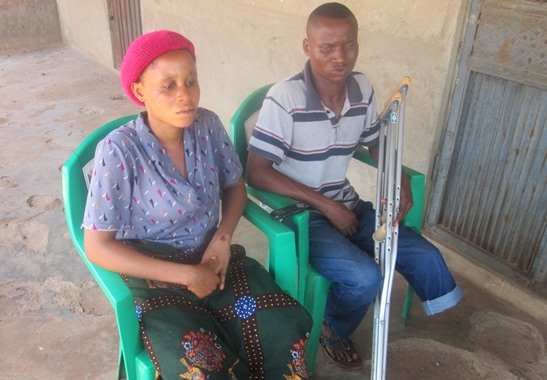
But one year ago, she was left with an amputee, a man who could no longer mount a motorcycle or walk a minute without aid, a man with whom sharing the rest of her life represented more of a burden than paradise. Yet, she chose to marry him.

Johnson had just finished serving breakfast to her husband and his army of equally-injured friends when she sat down at the 44 Nigerian Army Reference Hospital, Kaduna, to narrate how she embarked on a journey that continues to test the resilience of her love.

As she spoke, it was impossible not to admire the see-through beauty percolating from her face to her heart. What she had lost in limited education, she made up for with her strength of character.

Sweet lover in the oily village of Ogoni

“I met him in 2009,” she recalls, slipping into the melancholy that defined her entire afternoon.

“He hadn’t joined the army then; he was a motorcycle rider. He joined the army in 2011, then this tragedy happened to him in 2012.”

By “this tragedy”, Joy was referring to a raid by Boko Haram on Giwa Barracks, Gombe state, during which her husband suffered multiple gunshot injuries, the most severe of which led to the amputation of his leg in 2014. By that time, though, her husband had already done enough to convince her she owed him nothing but unfettered loyalty in his moment of tribulation.

“He won my heart with his character; I liked his way of doing things,” she says, casting a gaze at him as though wishing for the emptying of their past into the present.

“He was very calm and measured in his ways. If I asked him for anything, he never got angry; he never rebelled against the things I liked. He was always soft with me and he treated me really well.”

Joy says that back then, when Nwibani had his legs, he was a “very sweet” lover who broke bounds to please her.

“He was very caring. He would wash my clothes and even cook for me,” she adds, her face lighting up with positive emotion.

“He still does it, but surely not as often as before because even me, I won’t be able to bear it watching him wash my clothes in this condition.

“Back then, there were times when I was in the living room and he would be in the kitchen cooking for me — that time when his legs were intact. But now, all he can do in that regard is that if I’m in the kitchen, he’ll come and stay with me, playing with me and supporting me.”

The lovebirds were both in their Kana Gulle village in Ogoni, Rivers state, at the time. But when Nwibani joined the army in 2011, he was posted to Gombe state. This rendered their romance long-distance, but the fire continued burning as fiercely as it did back when they saw each other every day.

In October 2012, after he was shot in the leg, Joy literally became a nurse overnight, devoting several hours of her every day to tending to her husband’s wounds. The setback of the time didn’t seem like a dead-end; the army had promised him a prosthesis.

In fact, Kenneth Minimah, a retired lieutenant-general and former chief of army staff, had visited him in hospital and a photo of the duo graced the 2015 calendar of the Nigerian army, as proof of the army’s preparedness to “go to any length” in looking after injured soldiers.

“Immediately the tragedy happened in 2012, they told him they would give him an artificial leg,” she recalls. “Last year, the army took him to Lagos to give him an artificial leg, but the one he was given is actually fake. It’s not something he can use.”

Wedding after amputation


By 2014 when the leg was eventually amputated — after some careless medical mishandling culminating in the sight of maggots in the leg — they had been dating for five years and tying the knots was overdue. In 2015, she married him, despite protestations from a few “well-wishers” who thought she deserved more than a “one-legged solder”.

Some people told me to leave him, saying I should not marry an amputee and I should find another man, but no way!

“My mind didn’t work that way. There was absolutely no chance of me going for another man. My mind didn’t tell me to leave him, and I cannot do anything my mind doesn’t tell me to.”

As the endless wait for original prosthesis continues, Joy continues to serve her man as both wife and caregiver, helping him run the home, run errands, fetch water — helping him do everything a man with two legs would have done for himself, or what a prosthesis would have helped him do.

“I don’t have a job and I can’t have one yet because taking care of him is itself a fulltime job,” she says.

“Now, I help him fetch water when he needs to bathe or use the toilet. I prepare all his meals and wash his clothes. I do everything that he can’t do or that he can only do at great physical cost.”

Asked what she would be doing had her husband been given a prosthesis, she says: “You know, if I got some help, with just N500,000, I could set up a petty provisions business with which I can support him more.

“But, of course, even the business would be meaningless without prosthesis for my husband.”

Nwibani himself does not regret the choice of woman he made several years back. Without her, he says, it would have been far harder to cope with the loss of his leg and the army’s failure to redeem its pledge of a prosthesis.

“Now, there are so many things I cannot do by myself and when I tell her to, she does them without complaining,” he says with a smile in appreciation of his woman, which quickly thins out into a frown betraying his helplessness.

“The truth is I can no longer meet up with taking care of myself; she is the one who runs errands for me — up to the simplest of them such as buying odds and ends for me. Personally, I am not happy with my condition; I’m not happy that I can no longer fend for myself.”

No one to turn to

Nwibani Facebook

Take Joy out of Nwibani’s life, and there isn’t much to be joyful about. His father died back in 2010, leaving his aged mother and two sons. He has never had a sister. His only brother was shot dead in January 2016 during the bloodily-contested Rivers state legislative rerun. All these mean he is grateful for life.

“When I look at all I have experienced, I probably should not be alive by now; I should have died,” he says. “I know the pains I endured on the day I was shot. It was like dying every day — dying every morning and night. But I told God to promise that I would not die, and God preserved me.”

But they also mean he has “no one else to turn to”, which explains why neglect by the army hurts him that much.

“I am happy with God — but not with the army,” he says bluntly.

Look at me? Should I be in this condition for four years? Would it happen if I were their son or if my wife were their daughter? We don’t need their money; it is just to pay us our salary and allowance, and give us good treatment. If all these happened, nobody will grumble.

“But with the state of things, do you think anyone who knows me will be willing to join the army? When I travelled to my village, people were discussing me in hushed tones, wondering why a soldier should be in my sorry state.”

Nwibani reiterates that he asks for only one thing from the army: the chance to get as close as possible to his pre-attack physical state.

“All I need from the army is my leg — original artificial legs,” he says.

“I cannot continue using these crutches because they hurt me and leave marks on my ribs. If the army says move and you don’t, you are dismissed. But they told you to move and you did… you are now injured but the same army is not ready to take care of you. That is not fair.”

LOVE SEALED ON THE BATTLEFIELD

Nnenna Aguba (not real name) was eight-and-a half-months pregnant and in another few weeks, she would be calling her soldier-husband fighting Boko Haram in Borno state to inform him of the birth of their latest baby. Instead, it was her husband who called; he had been shot in Gunun Kurmi by insurgents and was recuperating at the 7 Division Hospital, Maiduguri.

Her husband, Benjamin, tall, sturdy and larger-than-life, is that kind of soldier born to face an insurgent group as recalcitrant as Boko Haram.

First injured on September 1, 2014 when his forehead was gashed by fragments of a Rocket-Propelled Grenade (RPG), Benjamin spent six weeks at the University of Maiduguri Teaching Hospital before heading straight back to the battlefront!

“I was first injured in 2014 when Boko Haram dislodged my entire unit from Bama. “As we were fighting on, they fired RPG, let me say 50 to 60metres from me,” he recalls vividly.

“It was just a passing fragment, so you can imagine what would have happened if the thing had met me directly. It would have affected my brain or I would have died. Fragment is very dangerous, RPG fragment, especially the heat.”

Soldiers withdrew when they were overpowered by that onslaught from insurgents, but Benjamin returned from the sick bed to help the army recapture the town “after six to seven months of planning”.

In December 2015, he was nailed again, this time in a deadlier attack. Forty soldiers had conquered a village and were preparing to advance to Alafa, another village, when hundreds of insurgents attacked them.

“When they attacked us, we pinned down and we were launching. But because they knew the location more than we did, they took another route and suddenly started attacking us from our rear.

“I was firing mortar, the 60mm; that is why they were looking for me. I fired two bombs already, and I got many of them. When they hit me, I tried to run but no way, so I fell down because the thing broke my bone. The bullet charged through my bone.”

Woman of gun (and God)

When news of his injury got to Nnenna, a soldier herself, she offered praises to God rather than panic.

“When he called to say Boko Haram shot him in the leg, I said ‘Thank God that you are alive,’” she says, slapping her two palms against each other. “I am a woman of God, so I gave God the glory that it was not his life that was taken.”

In a matter of months, she had two ‘babies’ to care for — one, the one she carried in her womb for nine months; the other, the one who was shot in Borno and was back home to continue his recuperation after surgery at the hospital.

As she cleaned and bathed and breastfed her toddler, she also fed her husband and cleansed his wound — all these in addition to rendering financial support for purchase of drugs.

“We spend a lot for the treatment. I have had to assist,” she admits.

“They take care of them at the hospital but we have also bought some minor drugs with our money.

“I support him because we are together in that we run a joint account. Some drugs we buy, while some are given to him there. But when he is at home and the drugs finish, we buy with our money.”

What God has joined together…

These sacrifices must have been easy to bear for her because theirs is one of the most intriguing love stories that could possibly emanate from the army. The two soldiers met in Lagos and within two months decided to spend the rest of their lives together.

Did it bother her that getting married to a soldier like herself was too big a risk to take, particularly for her children?

“It’s not risky,” she says with cocksureness. “It’s God that joined us together and what God has joined together, no man can put asunder.”

True. Both lovers should actually never have come together. That they eventually did must mean that nothing else can possibly put them asunder.

When Nnenna met Benjamin in 2010, she hadn’t even weaned the baby she had outside wedlock. Her ex, again a soldier, had thrown her out when he learned of the pregnancy.

“He sent me away, shouting at me that he didn’t love me and I should go and throw the child away,” she says slowly, soberly.

“My mother told me to report him at the office so that he could be responsible for the baby’s upkeep, but I told her I wouldn’t do that because I had committed him into God’s hands. The truth is that I had already forgiven him.”

Too good to be true

Perhaps Benjamin’s entry into her life was reward for her graciousness because within two months he not only desired to marry her, he vowed to take care of the baby.

“I told him everything that happened, the way my son’s father behaved to me,” she adds, her voice gradually becoming boisterous.

“He felt for me knowing I am a nice person. He wondered why someone would behave to me in that manner. He told me not to worry, that he would take care of the baby.

“He told me to allow my ex walk away, and not ask him for a dime over the upkeep of the baby. He said he would take good care of the baby, and even pay the child’s school fees. Even you, if you were me, wouldn’t you be happy?”

Those two months were the most shocking of her life; it all happened too fast for Nnenna to accept that it wasn’t a dream that would come crashing in no time:

“I didn’t expect that with a child outside wedlock, he would want to marry me so fast,” she concedes. “I was surprised. I was still in pains at that time because of what the other guy did to me.”

It is now six long years since the unfurling of that “dream” but it doesn’t appear destined to end anytime soon.

“I am happy; he has been so nice to me,” she enthuses about the man for whom she has now borne two children. “We are doing fine. Everything is moving smoothly before God and man. I thank God that today, everything is okay.”

Which explains why she harbours no animosity against her ex: “I have already forgiven him from the depth of my heart; I have.

“If he comes later that he needs his child, fine. If he doesn’t, fine. I give God the glory.”

Her husband now spends more time at home recuperating from his gunshot wound, only travelling to Kaduna occasionally to honour appointments with the doctor. The entire burden of his post-hospital care now rests on Nnenna, and it is a role she is more than happy to fulfill.

“I massage the leg with hot water. Sometimes he can’t stand up, even to pee; I help him up.

“I support him to the bathroom for his baths, I fetch water for him; I do everything for him. Sometimes it affects my work but I take time off so I can assist my husband, since he doesn’t have a leg.”

She intends to “continue doing everything” for a man who showed her the true meaning of love at a time when life meant little to her. And for this, she says she will not tire.

“I just love him,” she says, laughing sheepishly, childishly, unashamedly. “He is the one I love. I love him. He is so nice; he doesn’t have problem. He doesn’t hurt me; he pets me all the time.”

This love is the reason Benjamin can see out his recovery period with grace and look forward to the future with optimism.

“I will be patient till my leg heals,” he says, “because I’m returning to Borno once I’m fit; we have to finish off these foolish Boko Haram guys.”

THE DARK, HIDDEN WORLD OF WOUNDED SOLDIERS’ WIVES

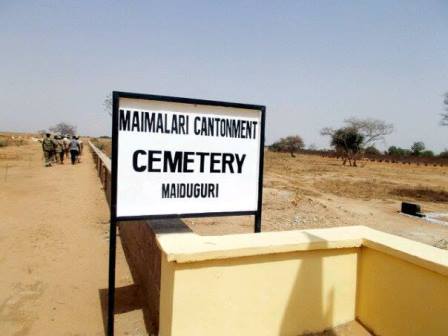
Maimalari-Cantonment-Cemetery

It is not in all cases that, like Nnenna, a soldier’s wife has the good luck of enjoying years of her husband’s love. The Nigerian army is undoubtedly killing insurgents in their thousands, but it is also grossly underestimating its own casualties.

For example, privately-seen death records of the army show that 894 soldiers had been buried in 2016 alone as of mid-May — excluding soldiers who were declared Missing In Action (MIA) and their likely death undocumented. Rarely do families of fallen soldiers get timely information on the fate of their loved ones, and the wives are the biggest sufferers.

“I swear to God whom I serve, some soldiers were killed here more than three years ago, and as we speak, nobody in their family has been notified by the army,” says a soldier who was posted from Lagos to Maiduguri.

“There are soldiers who have died and their wives keep calling me for information on their whereabouts, but since I am not the army, I am not the authority, it’s not my duty to tell them that their husbands have died.

“I just tell them: ‘Oh… you’ve not heard from your husband? Maybe he is one of the soldiers posted to a location where telecom network is unavailable.’”

By his explanation, wives of slain soldiers who are young and beautiful, and are not connected to top army officers, are at risk of sexual harassment while trying to claim their benefits.

“If you die and your wife is young with pointed breasts, they must sleep with her before paying her,” he claims, buttressing it with the encounter of a late soldier’s wife whom “one officer” tried to sleep with.

“In the process of applying for her husband’s claims, the officer was trying to hug her,” he says.

“That’s when the woman told him to keep the money. She had to open the door and leave in annoyance. She never returned there!”

Architects of their own misfortune

Sani Usman, spokesman of the army, has “stayed in this system for quite a long time” to know that soldiers usually make a mess of filling documents.

An example is that of “somebody” who is happily married with a wife and a kid, but names his “father or younger brother” as his next of kin.

“Now, in the event of death, such people, especially if you marry from far away, will come with all sorts of excuses; hardly does the real beneficiary get anything,” he says.

“I am a living witness… someone headed to war and he died, and they come for the collection of children’s sponsorship. One of the wives was saying that she was seeing the other child for the first time.”

He maintains that “it is not true that you process over and over again and still don’t get it”.

He explains, too, that “there are certain entitlements that are the responsibility of the Nigerian army, while there are those that are the responsibility of the directorate of military pension board, such as the group life assurance, death benefits and the rest”.

“If the documents are not correct it will not be processed when due,” he says, but then tells families of soldiers still awaiting their claims: “They should exercise patience and have faith in the system.”

However, he doesn’t say how long this wait would last.

‘There will be judgement!’

Not that the documents required to be tendered for claiming these benefits are easy to procure, anyway. One of them is the death certificate, but how can it be produced for a slain soldier whose body the army didn’t retrieve from the battlefield?

“Your husband was killed in Sambisa and his body left to rot there or acid poured on him, how do you obtain the death certificate?” the Lagos-to-Maidguri soldier asks, stone-faced.

He cites the example of Monguno, where, last year, soldiers went to recover corpses of slain colleagues, only to discover that some had already dried up “with their rifles in position”.

“How do you claim entitlement for those kinds of death?” he wonders. “My own belief is that on the day of judgement, everyone will give account for his works. Many have gone but dry bones will rise again.”

Editor’s Note: In the final episode of ‘Forgotten Soldiers’, the reporter shares his personal observations from his interactions with some of the protagonists of the war against insurgency, plus two fateful events that if they occurred in separate circumstances could have rendered him a victim of a bomb blast that killed four people and injured 19.

 Here, you can read parts one, two and three of the series.

Follow writer @fisayosoyombo


Military Launches Operation Delta Safe

0
Acting Director, Defence Information, Rabe Abubakar

The military intervention in the Niger Delta region, codenamed OPERATION PULO SHIELD, has been scrapped with immediate effect and replaced with OPERATION DELTA SAFE.

This is in line with the Defence Headquarters’ initiative to restructure the Joint Task Force for better service delivery, efficiency and effectiveness.

A statement signed by Rabe Abubakar, Brigadier General and Acting Director, Defence Information, said the move is in line with the vision and mission of the Chief of Defence Staff to contain the current security challenges in the Niger Delta especially protection of critical assets and provision of security in the area.

Under this arrangement, the Joint Operational Areas of the new outfit have been delineated into 3 sectors and 5 Operational Bases covering the entire Niger Delta, Ondo and Akwa Ibom States.  The headquarters of OPERATION DELTA SAFE would be in Yenagoa.

This development, according to Chief of Defence Staff, General Gabriel Olonisakin becomes expedient in order to inject new tactics and robust operational initiative to tackle the emerging security challenges in the Niger Delta region such as piracy, bunkering, vandalism and other criminal activities prevalent in the area.


Court Bars Ese Oruru’s Parents , Journalists

0
Ese Oruru
Ese Oruru

A Federal High Court in Yenagoa has barred journalists and parents of Ese Oruru’s, the minor, who was allegedly abducted by Yanusa Dahiru, from court as trial of evidence in private began on Wednesday.

Yanusa is standing trial on a five-count charge of criminal abduction, illicit sex, sexual exploitation and unlawful carnal knowledge of a minor, Ese Oruru.

The Prosecution Counsel, James Amate earlier told the court that Ese Oruru had delivered a baby and was available to give evidence.

Ese, 14-years, gave birth to a baby girl on May 26.

Justice Aliya Nganjiwa, the trial judge, who agreed to take the evidence in private said that the court would begin the trial after all cases for the day were dispensed with.

At about 2pm, Ese Oruru was sneaked into the court room through the back door after the Judge had ordered everybody including Ese’s parent and journalist to leave.

Dahiru’s defence team was led by Kayode Olaosebekan, while the prosecution team was led by James Amate. The Federation of Women Lawyers, FIDA, legal team representing Ese’s parent was led by  Dise Ogbise.

It will be recalled that the Court has on May 12 adjourned the case to determine ruling on private trial for Ese Oruru, minor.

Granting the application, Justice Nganjiwa, who premised his decision on the provisions of Section 36 subsections 4 (a) and (b) of the 1999 Constitution of the Federal Republic of Nigeria, as amended, said “the evidence of Miss Ese Oruru would be taken by the court in private and in chambers.

According to him, evidence would be taken in private, excluding all persons other than the prosecution, the accused’s counsel, court clerks and prison officials and any other persons if the accused person does not object.