
Home Blog Page 3188

Investigate Ekiti Rigging Audio Tape – Soyinka

0

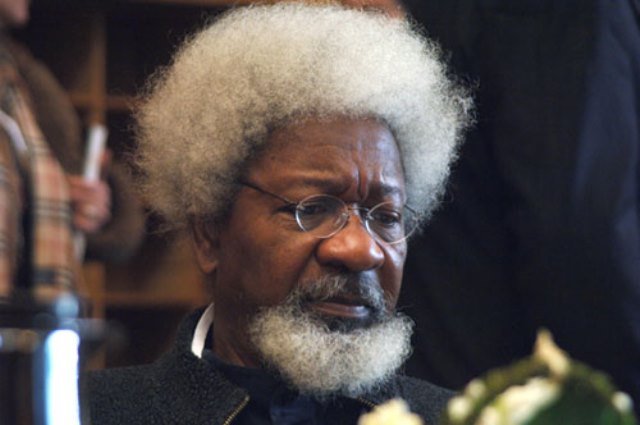
 Nobel Laureate Wole Soyinka has called for an investigation into the Ekiti rigging audio tape, which is being touted as evidence of collusion between top notch members of the People’s Democratic Party, PDP, and military commanders to rig the June 21, 2014 governorship election in which Ayo Fayose emerged winner.

In a statement released Tuesday, the Nobel Laureate urged the Independent National Electoral Commission, INEC, to work with the international community to conduct the investigation and make the findings of the exercise known to save Nigeria’s democracy, reasoning that brushing the issue aside as “just electoral malpractice” would be equal to criminal subversion and treason.

News of the secret meeting emerged a few weeks ago when an army captain, Sagir Koli, leaked the recording of a discussion involving Fayose, a former Minister of State for Defence, Musiliu Obanikoro, PDP governorship candidate in Osun State, Iyiola Omisore, the Minister of Police Affairs, Jelili Adesiyan; his predecessor, Caleb Olubolade and army commander, Aliyu Momoh, a brigadier general.

The trio of Adesiyan, Omisore and Fayose have since admitted their presence at the meeting but they insisted that election rigging was not the motive while Obanikoro insisted that he did not attend any such meeting.

Stating that for those who have nothing to hide, disrobing lies and forgeries and reinforcing truth is regarded as part and parcel of the obligations owed to democracy, Soyinka asserted that while the audio recording might indeed be a forgery, the burden of proof lies on the principal actors featured in the recording.

“The audio may well be a forgery. We are daily inundated with allegations, evasions, distortions, image plundering and image laundering, all under the permissive canopy of electoral proceeding.

“Once in a while, however, we encounter exposure of an exceptional dimension that appears to strike at the very root of Democracy, questions the validity of an entire electoral system and even erodes confidence in the integrity of the state,” Soyinka stated.

Explaining why he is constrained to call on INEC to investigate the incident, Soyinka stated that the event should be perceived as an extension of the electoral umpire’s scope of responsibilities, and that a full investigation would help the body in its projection of looming hazards of future electoral exercises.

“This is why, in the absence of a Constitutional Court or its equivalent, one is left with no other course than to call on INEC to also take formal charge of the recorded incident of this alleged conspiracy to pervert the course of Democracy,” he stated.

Soyinka also called for the active participation of the Economic and Financial Crimes Commission, EFCC, in the investigation because according to him, the main facilitator of electoral manipulation is money.

“At the fount of all electoral manipulation is the grim facilitator – Money! Here, for instance, is a lesson drawn from the travails of a former Inspector-General of Police in recent history,” he said.

He stated further, “Allied to this elite criminal corps – again, as alleged – was a former Chairman of the Senate Appropriation Committee turned governorship candidate.

“The evidence resides in the recording of a conspiracy against free and fair elections, later reinforced by a televised interview with the whistle blower – a military intelligence officer.”

The Nobel Laureate stated that if the formal agencies fail, then citizens must learn to assert their right of access to truth by following the practice in other societies, in which a Citizens Trial could be instituted, experts co-opted, and both accusers and accused invited to testify.

However, President Goodluck Jonathan, who is reported to have dismissed the audio recording as “mere fabrication” when the news of the recording emerged, has proffered explanations on why the tape could not be investigated and why he referred to the tape as a fabrication.

Admitting that he had not even listened to the tape,  the president stated that he originally dismissed it as a fabrication, despite admissions from key actors that the meeting actually held, because the person who recorded it did so to achieve a particular purpose and could have manipulated the discussion.

The president further clarified that his statement was not a denial of the fact that meeting was held but a rejection of the insinuation that the purpose of the meeting was to perfect rigging plans.

“I am not saying that a meeting in question was held or not held, but the issue of conspiring to rig, I said it was a fabrication,” he said.

The president also explained that the non-appearance of Sagir Koli and his reluctance to come forward and authenticate the tape is the reason why relevant agencies cannot commence investigation into the matter.

Speaking with Thisday newspaper, the President stated that he inquired from the director general of the Department of State Security, DSS, if the agency was investigating the matter, but was told that investigation could not proceed because Koli, who went underground after he was tipped off about the order from the army hierarchy to arrest him, has not come forward to validate the audio recording.

“In fact, when this story came up, I asked the DG Department of State Security Service if they had investigated the matter, and he told me that they had some investigations, and then called for the person who claimed he recorded it and that he disappeared and nobody can reach him.

“There was no formal petition before them, but because of the general interest, they wanted to have him interviewed to know where this was coming from. If someone comes up with a spurious allegation that has no substance and the person disappears, of course, what do you want me to do? Definitely, anytime we get him, he’ll have to substantiate his allegations. There is a lot of false stories being circulated and it is very sad,” the President stated.


 Suicide Bombers Kill Over 30 Persons In Kano, Potiskum

0

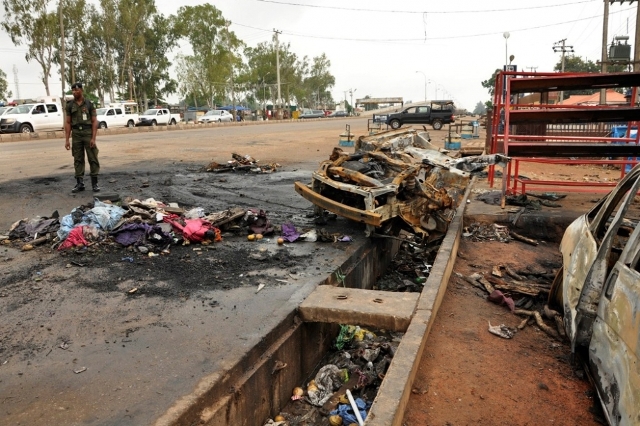
At least 30 persons have been killed in separate suicide bomb attacks incidents in Potiskum, Yobe State and the Kano State capital city, Kano.

Reports indicate that the suicide bomb attack in Kano, which occurred at around 3.00 pm at the very busy Kano Line Motor park, claiming the lives of 12 persons, injuring several others, was carried out by two persons.

Confirming the incident, the Kano State Commissioner for Police, Ibrahim Idris, stated that 12 persons, including the two suicide bombers, died in the attack.

An aid worker who requested anonymity, however, expressed fears that the casualty figures may be huge, stating that the motor park is one of the busiest in Kano.

The Kano bomb attack occurred a few hours after another suicide bomb attack in a motor park in Potiskum, Yobe State in which 20 persons were killed and over 50 others were critically injured.

Reports on the Potiskum bomb attack indicate that the perpetrator entered the motor park, disguised as a traveller heading to Kano.

According the report, the bomber boarded a car and took a seat before he detonated his ‎explosive-laden vest.

It would be recalled that a female suicide bomber had struck Sunday at the GSM market in Potiskum, killing five persons and injuring several others.


Nigerian Women Present Charter Of Demands To New Government

0

By Abiose Adelaja Adams

Ahead of the forthcoming general election, a women’s rights group has presented to the government that will emerge a charter of demands for action on gender equality and equity in Nigeria.

The conveners of the Charter, Women Advocates Research and Documentation Centre, WARDC, and the Nigerian Women Trust Fund, presented it to the only female candidate in the March 28 presidential elections, Remi Sonaiya, in Lagos recently.

“This signals the dawn of a new beginning for Nigerian women, as an agenda of minimum demands,” said executive director of WARDC, Abiola Akiyode Afolabi, during the presentation.

According to her, women’s rights are recognized and guaranteed in all international human rights instruments, but the activists are worried that Nigerian women still suffer inequalities in all spheres of human endeavour,  a situation that has continued to hamper their development and exclude them from mainstream politics and governance.

The document titled “The Five Political ‘Demands”, wants the party that wins the election to demonstrate political will and commitment to gender equality and women’s empowerment.

The rationale for this is the fact that the Nigerian government has ratified an array of regional and international conventions and agreements, all of which provide a comprehensive framework for the elimination of gender discrimination, promotion of gender equality and equity and the empowerment of women.

These instruments, which include the Convention on the Elimination of All forms of Discrimination against Women, CEDAW, the Nairobi Forward Looking Strategies, the Millennium Development Goals, the Protocol to the African Charter on Human and Peoples’ Rights on the Rights of Women in Africa (Maputo Protocol), the Beijing Platform for Action, are not effectively in force in Nigeria.

The women therefore want the incoming administration to: “establish a system of gender mainstreaming which incorporates 35 per cent of women in all sectors of government.”

The second demand is for the new government to “improve women’s participation in politics and decision-making.”

The charter claims that women constitute about half of the population but adds that they occupy only 33 per cent of ministerial positions and 7 per cent of legislative positions at the national level, the lowest in West Africa.

The document asks for, “a reform of electoral law to provide for affirmative action as a criteria for registration of political parties;”

It says further, “Henceforth no gender constitutes more than 65 per cent of appointees to public offices, including parastatals, diplomatic missions, cabinet, corporations and institutions.”

It would be recalled that in the history of Nigeria since independence, (both military and civilian) only President Goodluck Jonathan administration, has consciously given women more participation in politics and appointments.

For instance, throughout his eight years in office, former President Olusegun Obasanjo appointed only nine women into his cabinet. His successor, late President Umaru Musa Yar’Adua, had only seven female ministers, while the current PDP-led Jonathan administration has appointed 13 female ministers and five special advisers in six years.

The third demand of the Charter, the full document of which can be found on WARDC and Nigerian Women Trust Fund’s website, is that the government “Invest in women’s economic empowerment and livelihoods”

According to the document, the incoming government must institutionalize measures that increase women’s access to credit and capital – Micro-credit, SMEs, etc – while the Central Bank of Nigeria, CBN, should develop gender sensitive lending policies to enable women to benefit from loans.

The Charter advocates for the government to “commit to provide microfinance for at least 10,000 women in each state per year, as well as reducing unemployment, especially among women, by at least five per cent annually for four consecutive years.”

It also wants the National Assembly and State Assemblies to enact the Violence Against Persons Prohibition Bill into law and amend the criminal and penal codes to make spousal violence a criminal offense.

As its fifth demand, the Charter wants the federal government to “demonstrate principled transformational leadership.”
This is premised on the fact that accountability, transparency and commitment, which serve as the bedrock of transformational leadership, are qualities commonly possessed by women.

Thus, the women called for promotion of leaders who are gender responsive, exposed to knowledge and communication skills.

Commenting on women’s participation in politics, Adefunmilayo Tejuosho, who was elected as a lawmaker in Lagos State House of Assembly in 2003 said it is not enough to advocate for women participation, but that they must also prove to be qualified and competitive in whatever position they seek.

“Women can even be more than the 35 per cent we are demanding. We don’t have to restrict ourselves to that figure. It is all about women who are qualified and intelligent and can make a difference,” said Tejuosho, who sponsored the passage of the Domestic Violence bill into law in Lagos State.

N25bn Zaria, Ugbokolo Water Projects Suffer Neglect

By Simon Echewofun Sunday

“I can’t recall the last time we had tap water here in Zazzau (Zaria city). And for the manual boreholes, only two may be working in a group of five. You can also move around the City Gate to the Low Cost areas and see for yourself,” Bello Aliyu said while lamenting the pains residents go through as a result of water scarcity in the ancient city of Zaria, Kaduna State.
A series of Sunday Trust investigation on abandoned projects reveal how past administrations initiated a water expansion project from the main trunk in Zazzau to 23 communities without completion, several years after commencement.
Conducting our reporter round the city and its environs, as well as other neighbouring communities, including Samaru, a town that hosts major tertiary institutions in the state, Bello, who is also a member of the Kofar Doka Youth Association, KDYA, a peer group consisting of youths from age 19  in Zazzau, lamented how these communities have been locked in the shackles of acute water shortage for several years.
“Imagine that some Zazzau residents would go as far as a muddy river we call ‘Gurin Ba Bali’ (place of no rescue) to wash cloths and fetch water,” he said.
Another resident, Babale Zango, who resides in Zango town, about 10 kilometres from the Ahmadu Bello University (ABU), said the situation was usually worsened during the dry season when available alternatives like groundwater (well) must have dried off.
Said Zango: “This is the period when water vendors (mai ruwa) milk us dry. They could sell just 25 litres of water at N30 to N50. Think about how much we would spend on a daily basis, just to have water for domestic use. The situation is not so in the Hanwa GRA, still in Zaria, where they have taps running for them.”
Zaria, an ancient city located in north-western region of Nigeria, between Kano and Kaduna, accommodates over two million inhabitants and more than 10 major tertiary institutions, including ABU, one of the pioneer universities in Nigeria.
The Zazzau water supply system was constructed in 1939 and expanded in 1975. The current expansion project, which is yet to be completed six years after, however, began in January 2009 with a cost of N24.6billion. It is this inability of successive governments to complete the project that has subjected residents to acute water scarcity.
A report of February 2013, obtained by Sunday Trust, has it that the then Kaduna State Commissioner for Water Resources, Mr Sunday Marshall, claimed that the project was not abandoned, saying it had reached 78 per cent completion. He had said the project was slated for commissioning on December 2013 in line with the initial 36-month completion timeline.
According to the project manager, Mr Yusuf Kobo, on completion, the regional water works would deliver 150million litres daily, thereby providing potable water to at least 2.2million people in 23 communities across eight local government areas of the state, including Zaria, Sabon-Gari, Giwa, Makarfi, Ikara, Kudan, Soba and Kubau.
Sunday Trust gathered that the project has passed through three administrations, beginning with Vice President Namadi Sambo, who was the Kaduna State governor then.
Residents of Kofar Zazzau and Samaru areas, who spoke to our reporter, said the project progressed in 2010 with the laying of many pipes stored at a warehouse opposite the Nigerian College of Aviation Technology (NCAT), Palladan. But it was abruptly cut short after Sambo became vice president.
Sambo’s successor, the late Gov. Patrick Yakowa took it up, with Messrs Mothercat Nigeria Ltd as contractors. But it soon got stalled shortly after gunmen reportedly abducted two expatriates some few kilometres from the Zaria new water treatment plant being constructed. However, efforts were restored in May 2012 when the governor died in a plane crash.
Subsequently, Governor Ramalan Yero revived the hope of completing the project in 2013, with a renewed commitment to developing it by stages, including the water treatment plant, transmission mains and service reservoirs, rehabilitation and extension of distribution network, and network extension to the local governments.
Our reporter who visited the water treatment plant some 7kilometers from Zaria city, observed that although work was going on gradually, the intra-city pipeline connections have not been touched.
Speaking to Sunday Trust, the district manager, Kaduna State Water Board (KSWB), Zaria, Engr. Dalhatu Shehu, confirmed that work was going on at the treatment plant. He, however, said their headquarters in Kaduna would give further technical details.
“We have a public relations officer in our office at Obasanjo House who is authorised to speak on official matters.  We are not allowed to speak; but I can assure you that work is ongoing at the site. The project department is handling that while we are in charge of distributing the water on commercial basis. We cannot say anything about water production,” Shehu said.
Sunday Trust gathered from officials of KSWB at Olusegun Obasanjo House in Kaduna that Governor Yero was told of the new 2017 completion timeline by the project management team. The previous 36 months set in 2009 when it was conceived elapsed due to varied hurdles, the officials noted.
The desk officer of the Water Supply Expansion Project, Engineer Binta Yakubu said government had completed the Shika Dam at the western end of Ahmadu Bello University in Samaru town. This dam is expected to supply water to surrounding communities, while the Galma dam, some 100kilometers from Zaria, will cater for the needs of communities in the north-eastern section.
She explained that Shika dam and its ancillary services would be the one to gulp N24billion at the end. Although she said the dam was ready for use, other phases of the project are yet to be completed.
“If you finish your treatment unit you would have to transport your water to the town. Phase 2, which we call the transmission lanes and the reservoirs, when completed, will enable water to be conveyed from the treatment plant to the reservoirs,” she noted.
Yakubu said government got $83million loan from the Islamic Development Bank (IDB), with on-going processing, procurement of consultants and contracts award.
Meanwhile, the managers said Phase 3, which is installation of the distribution lines, would be processed by the $101million loan from the African Development Bank (AfDB).
Available records from the AfDB website have shown that it is up for procurement too.
However, officials of KSWB are optimistic that from what has been achieved already, the project would be significantly ready in 2015, barring any change.
Like the case of Zaria water project in Kaduna State, the Ugbokolo project is another neglected scheme.  But this time, it is not a state government project; it is that of a local council in Benue State.
With at least 176,647 population, Ugbokolo community is one of the oldest towns in Okpokwu, the oldest local government area in the state. The town, which hosts the only government-owned polytechnic in Benue State, is also popularly known as the hub of Garri processing and export. But there is no functional water infrastructure in sight.
Investigation by Sunday Trust revealed that residents, including students of  the Benue State Polytechnic, have resorted to helping themselves from the open streams around their environment, as well as buying water from haulage tankers to complement their water need, a necessity they have been deprived of by the local and state governments.

Villagers helping themselves from their only water source, Ideme River in Okpokwu LGA, Benue State
Some Ugbokolo residents who spoke to our reporter through a commercial farmer, Chief James Ogboji, said the absence of water supply facility had stalled various agro processing activities in the town.
“The people of Ugbokolo and Okpokwu are known for processing garri, which is transported to other regions of Nigeria. We are the largest oil palm and fufu (cassava meal) producers in the North, yet we don’t have potable water and other social amenities to help ease our work,” Ogboji said.
A 2011 survey in Ugbokolo community, published in the Canadian Journal of Sustainable Development, puts water consumption at an estimated 113,249 litres per day. The survey showed that rain water in the wet season, cisterns, rivers and streams are the sources of water supply. Tap water was not listed.
Our reporter gathered from an extensive tour of the town and the council’s headquarters in Okpoga town that there was a failed attempt to initiate a township water supply in Ugbokolo; as well as a resuscitation of an existing PCI water supply in Okpoga, which was abandoned for over two decades.
Chairman of the council, Mrs Juliana Obeta could not be reached for comments at the secretariat. It was learnt that, though a grassroots leader, she shuttles between overseas and her office.
A senior official at the council secretariat, who did not want his name mentioned because he was not authorised to speak, said the Ugbokolo water project was initiated in 2000, but was abandoned shortly by the then council chairman, Comrade Abba Moro.
“Apart from that, the Okpoga PCI water system was also abandoned for long; but Moro tried to fix it before he later abandoned it.
“Subsequent administrations have not thought of doing any water project at all, not even a capital project in the council.
“While people in Ugbokolo and the polytechnic have open streams and springs like Ab’ode stream, Ohimini, Mabe river, Okpoga residents have the Ideme river, which was even the source of supply to the general hospital in the council headquarters,” he noted.
In an interview, the former council boss and present Minister of Interior, Comrade Abba Moro, explained why he literally abandoned the water projects during his administration.
Moro, who spoke to Sunday Trust at his office in Abuja said, “I come from Okpokwu as you know, and I know that we have problems of water in parts of Okpokwu. We have a PCI water works in Okpoga, the headquarters.
“When I was chairman I attempted to resuscitate that project. We bought a pumping machine and tried to rehabilitate the pipes, only to discover that because of the decay of the pipelines due to long abandonment of the project, we needed to replace all the pipes. We didn’t have the financial capacity to do that; so I literally abandoned it at that point,” Moro said.
On the Ugbokolo water scheme, he said, “We also have a water project in Ugbokolo where the polytechnic is. That was a project that served the school.  Recently, attempts were made to expand the circulation to include the main town.”
The minister, who did not mention how much his administration spent on the projects as at 2002 when he abandoned them, said, “Some funds were provided for it in the 2013 budget, and the Federal Ministry of Water Resources officials undertook a survey of the project and some other projects that were intended for the local government.
“I have had reasons to ask my counterpart in the Ministry of Water Resources, Mrs Sarah Ochekpe, to fast- track that project. But some of these technicalities, I am told, require measured times; and therefore, they were not able to complete the final report and the award of that contract,” he noted.
He gave the assurance that neither he nor any illustrious son or daughter of Ugbokolo would abandon development efforts, saying, “I can tell you that the provision of water at the Ugbokolo water work, and possibly, the rehabilitation of the PCI water works in Okpoga are in the works.’’
He continued, “Hopefully, if not within the life of this administration, which will end in May 2015, wherever we find ourselves, knowing what we know, we will continue to ensure that those projects do not die like any other project.”
When contacted, officials in the Ministry of  Water Resources confirmed that the Ugbokolo water supply scheme was among the projects on which feasibility studies were initiated last year.  They added that on completion of the technical report, processes for contract procurement would commence.
But available figures from the 2013 amended budget for Lower Benue River Basin Development Authority (RBDA) show that the sum of N400million was appropriated for the construction of  a water treatment plant at the Benue Polytechnic in Ugbokolo.
Our findings showed that there is no sign of contract works presently at the polytechnic other than the feasibility study the ministry said it carried out.

 Additional Reporting: Dickson S. Adama, Kaduna. The project is supported by The Ford Foundation and the International Centre for Investigative Reporting (ICIR)


Nigerian Military Discovers Arms Abandoned By Boko Haram

0

 The Nigerian military said on Sunday that it had discovered large caches of arms abandoned by fleeing members of the Boko Haram insurgency group in Baga.

By Friday, Nigerian troops had successfully driven out the Boko Haram fighters and retaken Baga, a town in Borno State which was captured by the insurgents in January.

The arms abandoned by fleeing terrorists were discovered in some houses and surroundings area by Nigerian soldiers engaged cordon and search operations in Baga.

These disclosures were made on Sunday by the Defence spokesman, Chris Olukolade, a Major General

“Troops engaged in cordon and search in Baga continue to discover more arms of various background and shapes abandoned in some houses and the surrounding by fleeing terrorists. Heaps of weapons most of which were strange looking or destroyed are still being gathered. Many abandoned or destroyed motorcycles have also been discovered,” Olukolade said in the statement.

The Defence spokesman said further that a number of people who claimed to be residents of Baga have been taken in and are being interrogated to ascertain whether they were, indeed, residents of disguised Boko Haram insurgents.

Some of those being questioned, he said, are women.

“A number of individuals who claimed to be residents are also being interrogated in order to ascertain their identity and motive. The group consisting mostly women continued to hail and cheer the troops as they conduct thorough search in the area,” the military explained.

The military had warmed in the past that Boko Haram fighter usually merge with the local population when they come under attack in a bid to evade detection and arrest, and had asked residents of such places to be vigilant.

Olukolade said that one soldier was stabbed while another was shot during the cordon and search operation.

He said that the operation was still going on in and around Baga to ensure that the town is rid of all insurgents.


Again, Female Suicide Bomber Attacks Potiskum Market

0

By Musdapha Ilo, Maiduguri

In what now looks like a trend, a female suicide bomber again attacked the GSM market in Potiskum, Yobe State on Sunday, this time killing five people and injuring scores of others, some of them critically.

Two female suicide bombers had struck in the same market where phones and accessories are sold on January 11, killing about 20 persons and injuring many others.

In the latest attack, the lone female suicide bomber was said to have been accosted at the entrance of the market where security had been beefed up after the January incident but while she was being questioned she set off the explosives which were strapped to her body.

The incident occurred at about 1.00pm at the height of business activities in the market

The dead and the injured have been taken to the Potiskum General Hospital, where a member of staff confirmed that five persons were brought in dead while 46 others were receiving treatment for varying degrees of injuries.

Some of the injured were said to have been in critical condition and might have to be referred to other hospitals for treatment.

The Yobe State Police Command Public Relations Officer, Toyin Gbadegesin, an Assistant Superintendent of Police, ASP, confirmed the incident to journalists but said that he had not been briefed about the details.


READ ALSO:


“Yes, I can confirm to you that there is a blast at the Kasuwan Jagwal market (GSM market) in Potiskum where it happened last month but how it happened and the casualty figure are not been known,”  the police spokesman said to reporters on the phone.

The use of female suicide bombers by Boko Haram insurgents is becoming commonplace as they have been used to carry out attacks in Potiskum and Damatturu in Yobe State as well as Maiduguri in Borno State.


Nigerian Military Recaptures Baga From Boko Haram

0

The Nigerian military has driven out Boko Haram insurgents from Baga, successfully reclaiming the town in Borno state captured by the terrorists on January 3.

Many of the insurgents were killed while others fled, with some drowning in the Lake Chad in the process in a military operation that started with heavy aerial bombardment by the Nigerian Air Force.

.A statement issued on Saturday by the Defence spokesman, Chris Olukolade, a Major General, said the insurgents had laid more than 1,500 land mines along the routes leading to the town but that they were all cleared, allowing land troops to advance and take over the town after the heavy bombardment by the Air Force.

“Many of the terrorists died while an unknown but substantial number of them fled with various degrees of injury, in the series of encounter along the routes of advance of the as troops headed for Baga,” Olukolade said.

He said further that five anti – aircraft guns and rifles were captured from the Boko Haram fighter while five vehicles, including trucks, and 34 motorcycles were also destroyed in the operation to retake the town.

As had happened in other recaptured towns, a cordon and search operation has commenced in the town to arrest any insurgents that might have gone into hiding and to mop up arms and ammunition they left behind.

Before Baga, Olukolade stated that similar operations had been carried out by Nigerian troops to reclaim territory taken over by Boko Haram including Gajigana, Ngaze, Ngenzai, Marte Junction, Mile 90, Yoyo, Kekeno, Kukawa, Cross Kauwa, Kangarwa, Amirari and others.

More than 2,000 residents were reportedly killed on January 3 when hundreds of Boko Haram gunmen stormed Baga and succeeded in capturing the town.

The terrorists sacked the headquarters of the multi-national military task force based in the town and hoisted the sect’s flag in an attack still recorded as the bloodiest by the insurgents.


Lucky Man Is Freed From Death Row After 10 Years In Prison

By Abiose Adelaja Adams

Forty one year old Monday Ilade Prosper is, indeed, a lucky man. He walked free from the condemned persons’ cell of the Kirikiri Maximum Security Prison in Lagos last Monday after spending 10 years on death row for armed robbery.

He was discharged and acquitted of the crime of armed robbery for which he was sentenced to death in 2004. Even after the court freed him he could not breathe the air of freedom due to strikes, bureaucratic bottlenecks and alleged demands for gratification by some state officials.

Prosper was arrested in Benin and remanded to the Okoh Prison in 2003 for pouring sand into his employer’s eyes in an attempt to forcefully collect the three-months salary owed him.

Then a suspect, he claimed that he was asked to pay bail by the police and when he or his family could not pay it, he was charged for armed robbery, convicted and sentenced to death by hanging in 2004.

The Legal Defense and Assistance Project, LEDAP, an NGO working for the protection of human rights, took up his case, appealed his conviction and got the death sentence lifted and the man discharged and acquitted about six months ago

When Prosper regained his freedom on Monday, February 16, 2015, LEDAP brought him to its Lagos office where he interacted with journalists.

Looking frail and tamed, he told the story of his journey to jail and his harrowing experience living on the fringes of life and death.

“I was working for one man in Benin as his driver. So the man owed me three months salary. One day I said he should pay me two months from my money he owes, but he was doing somehow,” he began.

Occasionally, the voice of the 41-year old, who now looks a decade older than his actual age, trails off as he spoke.

“So one morning, as I wanted to close the door of his car, he said I should open it. He used his walking stick to whip me and started calling me names. So we were arguing, so I took his briefcase (containing money and some documents).

“He said I should give him, but I did not, so we were dragging it. So out of annoyance, I packed sand from the ground and poured it on his face so I can distract him and run away with it. That was how I collected the bag from him and ran away,” he recounted.

According to him, his employer reported the matter to the police in Benin.

He continued: “So I travelled to Delta State. I did not know that the police had been looking for me. When I returned to Benin, that was how one day, some police just came to my house and arrested me. The next thing, they put me in cell. I was there for three days.”

Police Torture

Prosper claimed that while he was in detention in Benin, he was tortured and forced to sign a statement confessing to armed robbery.

“They asked me for bail, but I didn’t have money.” He said none of his family members knew what happened. He couldn’t reach because he did not have a phone. GSM technology was still very new in the country at the time, he observed.

“Then they changed my statement and asked me to sign.I refused to sign because I didn’t write any statement like that. And they started beating me, torturing me.They brought out cutlass, the back of it and used it to whip my back. Eventually, I signed the statement. By the time they went to court, they remanded me to Okoh Prison. I was there for one year.”

The judgement

Prosper continues; “After that, they began my trial at High Court 3 in Benin. I was given a lawyer because I cannot afford one. But the judge was speaking in favour of the complainant (the employer) because they are close.”

In his defense, the lawyer argued that Prosper was being owed for three months and, more so, that he could not be charged with armed robbery because sand is not a dangerous weapon, particularly as the victim injured in any way.

“After several trials”, the ex-prisoner recalls, “one day, I was told at the court to go and die by hanging, I was destabilized. I was shattered. That day there was no one in the court. Even the complainant was not there.Then they handcuffed me and took me to the condemned cell in Benin.”

Waiting for the hangman

He recalled further: “Inside the condemned cell, they used to lock all of us inside. It is only if the warder iskind that he releases us to go out and play. And we are many, up to six people in one small room, very dark, no light there. Even the food they bring you can’t eat it. You will see cockroach inside eba. The beans will not have salt and it will not be well cooked.”

According to him, a lot of prisoners on death row die before they are even hanged. He said many of his mates ate poison, others fell sick and died of malnutrition, while some became homosexuals for lack of female partners. According to him, only Paracetamol is available in the prison hospital.

“Anytime we see the warder, we will be afraid, as per say we are condemned prisoners. So one day, they just come, and told all of us to go out. We thought whose turn is it today. I thought they want to kill someone. So that is how they divided all of us, some to Port Harcourt, Kano, and they brought me to Lagos in 2008.

After prison what next?

As he looked into the distance, trying to answer the poser about what he planned to do, it is obviously that Prosper is clueless as to what to do with the remaining part of his life. What he is sure of is that he would like to further his education and, perhaps, go to the university someday.

“I would like to further my education. I did WAEC, so I have my ‘O’ level school certificate. If I can get someone to sponsor me, I will like to go to the University,” he said. On the other hand he also wants to work for God somehow.

He was the pastor of the condemned persons’ cell in Kirikiri Prison. “I grew closer to God. He has told me that He will deliver me from here (prison) I will like to do the work of God, he said on the other hand,” he said.

Before his prison experience, he was an automobile mechanic, but doesn’t want to go back to that. He aspires to go to National Open University which some inmates have attended.

The campaign against death penalty

Prosper’s experience is suffered by many Nigerians who are sentenced to death, spend years, even decades on death row, only to be discharged and acquitted later, their productive years wasted and their lives shattered.

For several years, LEDAP has been championing the campaign to abolish death sentence and for the committal of such capital punishments to life imprisonments.

“We are not saying they shouldn’t be punished for their crimes. What we are saying is that a country that cannot give justice cannot take life,” said LEPAD’s executive programme manager of Adaobi Egboka.

“The criminal justice system is fraught with a lot of irregularities. We are saying that instead of one innocent man to be killed, it is better to set everyone free.”

Additionally, LEPAD’s national coordinator, Chino Obiagwu, explained that the organisation’s position on death penalty “is basically premised on high statistical data of wrongful convictions and sentences of innocent persons to death in Nigeria and around the world.”

For instance, thestatistics from the Nigeria law reports on deathpenalty cases compiled by LEDAP from 2006 –2011 show that 39 per cent of death sentences by trialcourts were quashed on appeal within the period,indicating a high risk of wrongful convictions andsentences.

Analysis of the total number of deathsentences passed by the various divisions of the highcourt in various states appealed between 2006and 2011 show that 69 out of the 113 appealcases got to the Supreme Court while 44 rested withthe various divisions of court of appeal. TheSupreme Court quashed 26 out of the 69 appealsthat came before it while confirming 43 of them.

Many human rights lawyers are worried that the execution of four death row prisoners -Chima Ejiofor, Daniel Nsofor, Osarenmwinda Aiguokhan and Richard Igagu – in Edo State in 2013, is a threat to the existing unofficial moratorium on death penalty in Nigeria.

“For a long time (up to 10 years) we have not had executions in Nigeria,until the Edo State governor acting on the President’s directive signed the execution warrant of death row inmates,” Obiagwu observed.

Nigeria is amongst countries like Saudi Arabia, China, Japan, Kuwait, et cetera, that still retain death penalty as a form of capital punishment in its laws. It would have been considered an abolitionist state in practice given that it had not practiced death sentence for the last ten years until on 2013 when the president, Goodluck Jonathan urged state governors to sign death warrants.

Apart from providing legal services to people like Prosper, LEPAD also has to worry about settling them meaningfully back into the society. It has found that this is difficult, particularly the task of getting them jobs.

“When they come out of prison like that, no rehabilitation or programmes to re-integrate them back into the society so they go back into crime and get re-arrested and into the prison again, Obiagwu observed.

.He lamented that only some few organizations, the Catholic church, for example, and some pastors, have plans for them.”

So LEPAD links them up to such groups where they can be followed up.

Egboka also observed that stigma is a main barrier to the reintegration of men like Prosper back into society.

“Who wants to employ an ex-prisoner. Everyone is suspicious. It is very difficult to survive, she laments. “Even family stigmatises them.”

According to her, they lost one of the released prisoners, Christopher Tobi, because the society rejected him after his release.

“He couldn’t cope with life anymore, he had lost his sight, he fell sick, and now no job outside prison, so he died.”

In Prosper’s case, he too had lost touch with his family. He was 30 at the time of arrest and so had no family to return to. But he still counts himself lucky. His story is better than that of many others who come out of prison experience maimed, blind or with permanent disabilities, result of torture suffered while in detention.

In a recent Amnesty International Report, “Welcome to Hell Fire”, Police torture in Nigeria is found to be routine, in spite of the fact the country is a signatory to the United Nations Convention Against Torture.

However, the spokesperson of the Lagos State Police Command Kenneth Nwosu, told the www.icirnigeria.org that torture is alien to Nigerian Constitution and as such the Nigerian Police does not condone it.

“If anybody tells you that a policeman tortured him, tell that person to call us,” he said. “Nigeria is signatory to a lot of international declarations against torture, so we believe in humane treatment. We don’t do it.”

“Ask anyone in detention, they will tell you they are there for the crime they committed. Our policy is 24-hour detention. If we detain anyone for more than that, its a maximum of 48 hours,” added Nwosu, a Deputy Superintendent of Police, DSP.

He said exceptional cases are only when the court is on strike.

However, LEDAP, which has litigated over 210cases of persons charged with capital offences in the last 10 years, disagreed with Nwosu.

“If the police in Nigeria can to do proper, detailed, investigation, these would not happen. The truth is that the real prisoners do not get to prison. This is the case with Prosper, it’s a minor issues that would have been settled with a bail, but he was coerced to make statements of what he didn’t do, and landed in jail,’ said Egboka:


International Reporting Project Fellowships Open To Journalists

The International Reporting Project, IRP, is now accepting applications for reporting fellowships on stories addressing health/development and religion.

Successful applicants will be expected to provide in-depth coverage of important, under-covered international issues.

Interested applicants may choose only one area of focus per application but must submit separate application forms for each if they would like to apply for both health/development and religion fellowships.

Concerning health/development, applicants may propose stories that examine maternal and child health; poverty; HIV/AIDS, TB, malaria, and other infectious diseases; nutrition and food security; education; access to roads and electricity; sanitation and water; sustainability; technology; equality and women’s rights.

The health/development fellowships are supported by a grant from the Bill & Melinda Gates Foundation, and have a strong preference for in-depth reporting from countries in Africa, Asia and Latin America

Applicants interested in writing stories addressing religion will be expected to examine its role as a source of tension or conflict; its relationship to politics, economics or access to health, housing or clean water; its impact on art and culture, religion and human rights; or other issues.

The IRP encourages applicants interested in the religion fellowships to propose stories and destinations not covered by recent IRP fellows on religion.

The religion fellowships are supported by a grant from the Henry Luce Foundation.

Entries will be accepted until Monday, March 16.

The time spent in the field is flexible; fellows may propose to report for two to seven weeks. Fellows may also choose to extend their fellowships at their own cost.

IRP will purchase the fellows’ round trip air tickets to and from their homes and destinations, but all other travel must be arranged and paid by the fellow. IRP will offer a stipend based, in part, upon the budgets that all applicants must submit.

Travel on these fellowships must take place no sooner than two months and no later than four months after the fellowship is awarded.

Eligibility

Applications are open only to journalists from Australia, Brazil, Canada, China, Egypt, Ethiopia, France, Germany, India, Indonesia, Ireland, Japan, Kenya, Nigeria, Norway, Malaysia, Mozambique, South Africa, Tanzania, Thailand, United Kingdom, United States and Zambia.

Reporters and freelancers alike are encouraged to apply, and special attention will be paid to innovative forms of storytelling and projects involving new media.

Depending upon the proposal, teams of journalists may be considered; in that case, each journalist would apply separately, and mention their intention to work with another applicant in their essay.

The fellowships are intended for professional journalists who have worked for years as professionals and who have a record of outstanding achievement in reporting for influential media outlets.

This fellowship is not intended for students or for recent graduates without much professional reporting experience.

How to Apply

All applicants are required to fill out an application form. To access the application form, click here (http://internationalreportingproject.org/fellowships_apply.php)

Applicants are also required to submit a budget, which assists in determining the amount of the stipend. Typical costs include domestic transportation; fixers or translators; hotel accommodations; visas; food; and any other expenses related to reporting internationally. Fellows are not required to submit receipts or post-fellowship expense reports.

For more information, interested applicants may access FAQs by clicking here (http://internationalreportingproject.org/about/fellowships/faq)


158 Released Boko Haram Abductees Reunite With Families

0


By Musdapha Ilo, Maiduguri

One hundred and fifty-eight people abducted by Boko Haram and released after three weeks have been reunited with their family members in Yobe State.

The abducted women and children had been taken by the insurgents late last year after a raid on a town in Gujba local government, 22 kilometres from the state capital, Damaturu.

But after three weeks in captivity, they were let go in January with no reason given for the being set free, the first ever such peaceful release of abductees by Boko Haram terrorists since the commencement of the insurgency in the North east.

Having been psychologically evaluated and treated, they were ready to be handed over to the families.

Chairman of the state rehabilitation committee, Ahmed Goneri, said 96 of the abductees were children, while 62 were adults, 15 of whom were widowed as a result of the attack on the town.

According to Goneri, the adults would receive two bags of rice, sugar, cartoons of noodles and a bag of salt as well as two sets of wrappers and in addition, the widows would be given N50, 000. Other would get N30, 000 to help them start a new life.

Abdulrahaman Dauda, the man who discovered the released persons, explained how he found them and the state in which they were. “A friend saw them in Kasaisa village and called to tell me. So, I used a truck to convey all of them and handed them over to security agents for further verification,” Dauda stated.

“I thank the security agents and the Yobe state government for all the support. When I saw them they were all out of their senses having gone through severe trauma after being held hostage for three weeks,” he added.

Narrating their experience in the hands of their captors, the victims said they were neither tortured nor starved.

“They did not maltreat us during our captivity for three weeks. We had enough food and drinks all through our stay in captivity. Any time they enter our apartment to preach their ideologies to us, they ask us to avoid looking at them,” Hauwa Mohammed, one of the freed women said.  “They will always criticise us as pagans. When they were releasing us, they asked us to prepare and join those pagans in the town. We thank God that we have reunited with our family members after three weeks of being in captivity.”

Another victim, Gambo Mohammed, said that their abductors “provided raw food items for us to cook ourselves. They would give us soaps, perfume and any other basic needs you can think about.”

Mohammed said that the freed people might have been let go by the fundamentalists because they refused to practise their brand of religion.

“We told them we would not practise their style of religion so they agreed to release us saying we should go and join the pagans who have the symbol of Green-White-Green Flag in Nigeria and that we would meet with us one day. We then told them we would join the pagans instead,” he recalled.