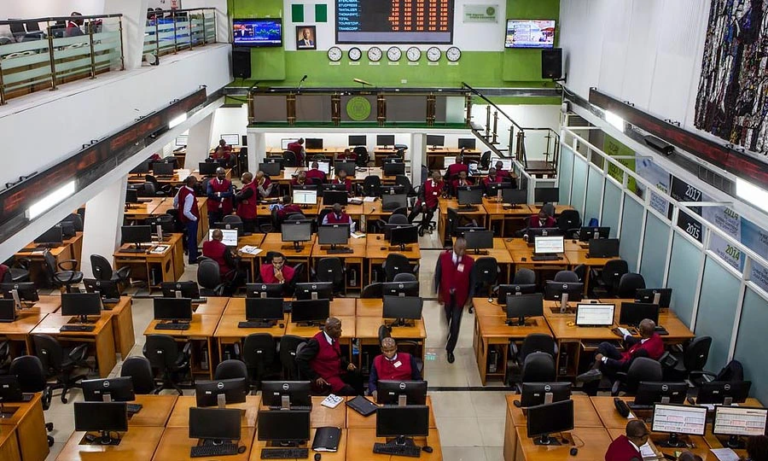
THE Nigerian Senate has passed the Investments and Securities Bill (ISB) 2024 to boost operations in the Nigerian capital market.
The bill, meant to repeal the Investments and Securities Act (ISA) 2007, was passed on the floor of the Senate on Wednesday, December 4.
It is aimed to protect investors and eliminate fraudulent dealings in the capital market.
It is also aimed to transform the capital market, encourage the influx of foreign investors as well as boost investors’ confidence, among others.
“The bill seeks to repeal the existing Investments and Securities Act 2007 and to establish a new market infrastructure and wide-ranging system of regulation of investments and securities businesses in Nigeria, especially in the areas of derivatives, systematic risk management, financial market infrastructure and Ponzi scheme and platforms.
“It was meant to establish the Securities and Exchange Commission as the apex regulatory authority for the Nigerian Capital Market. It will be a regulation of the market to ensure capital formation, the protection of investors, maintenance of fair, efficient and transparent market, and reduction of systemic risk,” the chairman of the Senate committee on the capital market, Osita Izunaso, said while leading debate on the bill.
He said further that the ISB’s main objective was to enact legislation that aligned with global dynamics relating to the regulation of capital markets through the provision of an innovative regulatory framework.
“It will protect the integrity of the security market against all forms of market abuse and insider dealing. It will prevent unauthorised, illegal, unlawful, fraudulent and unfair trade practices, relating to securities and investments,” Izunaso stated.
He added that the overriding purpose of the proposed legislation was to strengthen the capacity of the commission for the effective performance of its statutory mandate as well as reposition that vital sector of the economy for national economic transformation.
The director general of Security and Exchange Commission (SEC) Emomotimi Agama, at a recent conversation, hinted at the harsher penalties for Ponzi scheme operators through the ISB 2024, adding that it mandates a minimum fine of N20 million or up to 10 years in prison or both.
Agama said the bill explicitly prohibited Ponzi and pyramid schemes, fortifying protections for investors against illegal fund managers.
A notable amendment in ISB 2024 will allow the investor protection fund (IPF), established by securities exchanges, to cover investor losses linked to the deregistration of brokerage firms, extending beyond the current coverage of bankruptcy or negligence cases.
“This bill’s passage would be pivotal in setting Nigeria on the path to a world-class capital market,” Agama said.
In an interview, a capital market operator, David Adonri, toldThe ICIR that the ISA 2007 had become obsolete and needed to be repealed.
“As things change from time to time the law also has to be in tandem with the changes that are occurring in the market. We hope that the President will ascend to it.
“The capital market is faced with risks, one of such is tackling Ponzi schemes. With the new bill, those operating Ponzi can be indicted and punished for defrauding people,” he said.
THE International Centre for Investigative Reporting (ICIR) has been selected as one of 35 news organisations globally to receive a JournalismAI Innovation Challenge grant.
Supported by the Google News Initiative (GNI), the grant, according to a notice of selection by the organisation, aims to empower newsrooms to explore innovative uses of artificial intelligence (AI) in journalism.
The JournalismAI Innovation Challenge, an initiative of Polis at the London School of Economics, awards grants of $50,000 or $250,000 to the chosen organisations to help them experiment, implement and share best practices of AI technologies.
As one of the two Nigerian organisations to receive the grant, The ICIR’s project will focus on experimenting with new formats across mobile video and audio.
Beneficiaries were selected from 22 countries, namely Argentina, Brazil, Colombia, France, Germany, Greece, India, Israel, Jordan, Mongolia, Nigeria, Paraguay, Philippines, Serbia, South Africa, Spain, Switzerland, Tunisia, Turkey, Ukraine, United Kingdom and the United States.
According to the head of Ecosystem Investment Programmes, AI & Misinformation at GNI, Matt Cooke, the programme highlights a growing interest in responsibly integrating AI into journalism.
“We’ve worked with JournalismAI for six years to help develop industry research and share best practices with news organisations. We’re excited to build on that partnership by supporting this new programme to bolster small and medium-sized news publishers’ AI innovation efforts. We look forward to learning more about the selected projects, which we hope will inspire journalists and publishers around the world.”
The organisation noted that this year’s selection process was highly competitive, having received over 700 applications from across the globe.
While speaking on the challenging task of selecting 35 organisations from the list, the director of Strategy & Innovation at NPO and advisor to the programme, Ezra Eeman, stated that each selected project showed promise in advancing how newsrooms could responsibly leverage AI to serve their communities.
“The depth and creativity shown in the proposals demonstrates both the clear need for AI innovation in journalism and the industry’s readiness to thoughtfully experiment with these technologies. Each selected project shows promise in advancing how newsrooms can responsibly leverage AI to serve their communities,” he said.
THE National Drug Law Enforcement Agency (NDLEA) said it arrested 14,480 drug traffickers and seized 2.4 million kilogrammes of illicit drugs in the first 10 months of 2024.
According to the spokesperson of the agency, Femi Babafemi, the arrests and seizures were made between January and October 2024 at seaports, airports, land borders, and communities across the country.
Babafemi said the agency’s chairman, Muhammed Buba Marwa, presented the data on Wednesday, December 4, while briefing members of the House of Representatives Committee on Narcotic Drugs, who were on an oversight visit to the national headquarters of the agency in Abuja.
He said with the record of work done by the agency in the past 10 months,he was sure the NDLEA could beat its achievement in the previous three years.
“We have successfully located and destroyed 547,378 kilogrammes of cannabis plantations. Similarly, our drug demand reduction figure is onthe positive side.
“In the past 10 months, the agency counselled and rehabilitated 6,655 drug users. In the breadth, we conducted a total of 3,064 awareness campaigns and sensitisation lectures in schools, motor parks, worship centres, workplaces, and communities, among others, which reached 1,327,181 people,” he stated.
He cited the largest single heroin seizure of 51.90 kg in the history of the agency at the Murtala Mohammed International Airport in February, including securing life imprisonment sentences for some notorious drug traffickers, the arrest of the most wanted drug barons in Lagos, and the recent passage of the NDLEA Act amendment bill as some of the milestones of the agency in 2024.
While commending the lawmakers for their support in the outgoing year, Marwa urged them to remain steadfast so that the agency could achieve more.
In his remarks, the chairman of the House Committee on Narcotic Drugs, Abass Adigun, commended the leadership and personnel of the agency for their dedication.
He promised the agency that his committee’ would advocate for improved funding, modern tools, and a conducive working environment for all staff of the NDLEA.
THE Nigerian Senate has summoned the minister of aviation and aerospace development, Festus Keyamo, over incessant flight delays and cancellations suffered by passengers in recent times.
It also summoned the director-general of the Nigerian Civil Aviation Authority (NCAA), Chris Najomo, airline operators, and other relevant stakeholders.
At the Senate plenary on Wednesday, December 4, the upper chamber mandated its committee on aviation to investigate the involvement of airline operators in the issue.
The resolution followed a motion by Buhari Abdulfatai, an All Progressives Congress senator from Oyo State.
Abdulfatai said flight delays and cancellations were hurting Nigeria’s economy and eroding confidence in the sector.
The committee’s mandate is to investigate the matter, uncover the root cause, and propose a solution.
Latest data from the NCAA shows that passengers have been experiencing delays or abrupt cancellations of scheduled flights by airline operators in recent times.
According to reports, data obtained from the NCAA shows that 19,250 passengers were delayed for long hours during the first half of the year.
The half-year report of the NCAA indicated that many passengers faced severe challenges, including the loss of personal belongings at various Nigerian airports.
The NCAA data shows that 35,398 flight operations by 13 local carriers resulted in 16,945 flight delays and 696 flight cancellations within the period.
A breakdown of the report shows that Aero Contractor had 1,992 flight delays, Arik Air 1,378, Air Peace 5,350, and Azman 76.
Other carriers, including Overland Airways, Max Air, Ibom Air, United Nigeria Airlines, Green Africa Airways, ValueJet, and NG Eagles, also recorded flight delays.
Similarly, it revealed that Aero Contractors had 33 flight cancellations, Arik Air 32, Overland Airways 57, Air Peace 294, and Max Air 23.
There were also flight delays and cancellations along the international routes, the report added.
A lawmaker, Abdullahi Aliyu Ahmed, had threatened to sue Air Peace Limited for alleged breach of contract, including flight delays and disruptions, The ICIRreported.
THE Senate leadership has directed its committee on finance to suspend further action on the proposed tax reform bills pending the outcome of a high-level meeting with the attorney general of the federation (AGF).
The deputy senate president, Barau Jibrin, announced on Wednesday, December 4, during plenary that a special committee had been constituted to address contentious issues in the bills, with the meeting scheduled for tomorrow, Thursday, December 5.
The decision to set up the committee followed a series of deliberations by lawmakers aimed at resolving disagreements over key provisions in the proposed legislation.
The meeting is expected to serve as a platform for lawmakers to harmonise their positions and ensure that the bills align with national priorities while addressing stakeholder concerns.
Presidency speaks on gains of bills
Despite the promise of centralising Nigeria’s tax system and rewarding sub-nationals, the bills have sparked debates among mostly northern political elites.
Consequently, the senior special assistant to the president on media and publicity, Temitope Ajayi, in an explanatory statement on Wednesday, has shed more light on the bills.
Ajayi listed 10 ways the bills would serve the states better and enhance their capacity to earn more revenue as follows:
1. The Federal Government will cede five per cent out of its current 15 per cent share of VAT revenue to states.
2. The bill will transfer income from the electronic money transfer levy exclusively to states as part of stamp duties.
3. The bills seek to repeal obsolete stamp duty laws and re-enactment of a simplified law to enhance the revenue for states.
4. Under the new dispensation, the bills will usher in, and states will be entitled to the tax of limited liability partnerships.
5. When passed by the National Assembly, the tax bills will enable the state government to enjoy tax exemption on their bonds to be at par with Federal Government bonds.
6. Under the proposed tax reform, states will enjoy a more equitable model for VAT attribution and distribution that will lead to higher VAT income.
7. Integrated tax administration will provide tax intelligence to states, strengthen capacity development and collaboration, and scope of the Tax Appeal Tribunal to cover taxpayer disputes on state taxes.
8. The proposed tax laws grant powers for the accountant general of the federation to deduct taxes unremitted by a government or MDA and pay to the beneficiary sub-national government on personal income tax of workers of federal institutions in states.
9. Framework to grant autonomy for states’ internal revenue service and enhanced Joint Revenue Board to promote collaborative fiscal federalism.
10. Legal framework for taxation of lottery and gaming and introduction of withholding tax for the benefit of states.
The ICIRreported that the National Economic Council (NEC) has advised President Bola Tinubu to withdraw the bills from the National Assembly.
The NEC cited the need for more consultations and consensus-building among Nigerians before the National Assembly work on the bills.
MOST Nigerians are raising questions about transparency in the management of accruals from the proposed tax reform bills by President Bola Tinubu-led Federal Government, which have generated heated debate at the National Assembly.
The bills, which have now passed a second reading at the House of Representatives have faced stiff resistance from political heavyweights, mostly in Nigeria’s northern region.
On the flip side, the bills offer so much hope with regard to revenue improvement in the country but raise some transparency questions. Some analysts feared the gains might elude Nigerians as seen in the much-touted petrol subsidy removal by the Tinubu administration.
Most economic watchers who spoke with The ICIR expressed doubts that the revenue improvement promised by the bills might not impact much on providing governance deliverables to the masses.
“Tinubu is noted to be a tax master, but he has no credibility in accountability and transparency management of accruals from tax monies, “lead director, Centre for Social Justice (CSJ), Eze Onyekpere, told The ICIR.
Citing an example with subsidy removal, Eze said, “We all saw even partial removal of subsidy in the past and its impact. Whether it’s Abacha, we saw Petroleum Trust Fund, under Jonathan we saw Subsidy Reinvestment and Empowerment Programme-SURE P, but since Tinubu removed subsidy, we have seen nothing.
“My only challenge is that Tinubu has no track record of managing money prudently. He has a track record of improving taxes, but what he does with the money is a different kettle of fish,” he added.
The ICIRreported that amid stiff opposition from northern governors and lawmakers, the Senate passed the four tax reform bills proposed by Tinubu for second reading.
The bills passed a second reading after Opeyemi Bamidele, the Senate majority leader, led a debate on them on Thursday, November 28.
Recall that on September 3, the President submitted four tax reform bills to the National Assembly for consideration, based on recommendations from the Presidential Committee on Fiscal and Tax Reforms, led by Taiwo Oyedele, to review existing tax laws.
The bills include the Nigeria Tax Bill 2024, aimed at providing a fiscal framework for taxation in the country, and the Tax Administration Bill, which seeks to offer a clear and concise legal framework for all taxes, reducing disputes.
The other bills are the Nigeria Revenue Service Establishment Bill, which proposes to repeal the Federal Inland Revenue Service Act and establish the Nigeria Revenue Service, and the Joint Revenue Board Establishment Bill, which would create a tax tribunal and tax ombudsman
Recall, in October, the Northern Governors Forum at a gathering in Kaduna rejected the bills, stating that they could cripple the region’s economy if passed into law; a position shared by the 36 state governors the same week at the National Economic Council meeting presided over by Vice President Kashim Shettima.
One of the bills is seeking an alteration of the VAT sharing formula, reducing the Federal Government’s share from 15 per cent to 10 per cent but with a proviso that the allocation among states will consider the derivation principle.
What to know about the tax reform bill
1. Any business with less than N50 million turnover is exempted from tax payment.
2. Over 90 per cent of workers in the public and private sectors will no longer pay income tax.
3. Over 82 per cent of what low-income persons consume will be VAT-free.
4. Scrapping over 50 nuisance taxes suffered by local businesses.
5. VAT will no longer be calculated based on where the companies have their headquarters but where their goods are consumed.
6. The rich to pay more tax while the poor will stop paying.
7. Consumption tax collected by states will be eliminated.
8. The Federal Government’s share of value-added tax (VAT) to reduce from 15 per cent to 10 per cent as states and LGAs now get 90 per cent.
9. Those earning less than N1.7million monthly will now pay less income tax.
10. Customs, Nigerian Upstream Petroleum Regulatory Commission (NUPRC) and other govt agencies will no longer collect tax as only one agency will be responsible for the collection of all taxes in Nigeria.
11. Those receiving less than N9 million per annum could have their income tax cut by half.
12. The bills could lead to the abolition of other multiple tax laws like the Stamp Duty Act.
13. Over 90 per cent of small businesses would no longer pay profit tax.
14. Gradual increase of VAT from 10 per cent in 2025 to 15 per cent in 2030..with almost every good consumed by low-income earners exempted from VAT.
15. Many Nigerian companies pay over 60 types of different taxes and levies. The bill seeks to end this.
THE Ekiti State Magistrate Court in Ado-Ekiti on Wednesday, December 4, remanded a human rights lawyer and activist, Dele Farotimi, in custody after denying him bail following his arraignment on a 16-count charge of cybercrime.
Farotimi, renowned for his criticism of human rights abuses and advocacy for justice, was arrested following a petition filed by Afe Babalola, a senior advocate.
The charges, detailed under the Cybercrimes (Prohibition, Prevention, Etc.) Act, 2015, centre on allegations of defamation stemming from Farotimi’s book, Nigeria and its Criminal Justice System.
The case, with suit number MAD/1,476.C/2024, lists the Ekiti State commissioner of police as the complainant, according to Sahara Reporter.
It quoted court filings as saying excerpts from the book allegedly made damaging remarks about Babalola, referring to him in disparaging terms.
The filing shows the prosecution arguing that such descriptions were intended to harm the senior advocate’s reputation.
The charges partly read, “Count X: That you Dele Farotimi ‘m’ sometimes in 2024 authored, published and circulated your book titled: “Nigeria and its Criminal Justice System which was received and read all over the world including Ado-Ekiti within the Ado-Ekiti Magisterial District wherein you criminally defamed the person of Aare Afe Babalola, SAN, OFR, CON, FCIArb in page 70-71, of the said book where you stated: “But the court as though enthralled by whatever Afe the Circus Master had promised the justices, acted with utmost carelessness about the integrity of the court, the interest of the citizens and the State that they had been sworn to protect.
“The conspiracy was always a step ahead of us because some of the clients mistook key members of the confederacy of friends and helpers” which statement you knew were false allegation and likely to injure the reputation of the said Aare Afe Babalola, SAN, OFR, CON, FCIArb, LL.D by exposing him to hatred, contempt, ridicule and damage him in his profession and thereby committed an offence contrary to Section 373 of the Criminal Code Act and punishable under Section 375 of Criminal Code Act.
“Count XI: That you Dele Farotimi ‘m’ sometimes in 2024 authored, published and circulated your book titled: “Nigeria and its Criminal Justice System which was received and read all over the world including Ado-Ekiti within the Ado-Ekiti Magisterial District wherein you criminally defamed the person of Aare Afe Babalola, SAN, OFR, CON, FCIArb in page 80, of the said book where you stated: “But Afe knew that he could get the Supreme Court to do whatever he wanted and to rule however he asked. Pedro knew this too and he being the original Lagos boy, showed Afe a bit of Lagos magic. Afe Babalola and the Eletus might have killed the buffalo but had no way from feeding from the carcass.
“We have turned the corrupt triumph at the Supreme Court into a pyrrhic victory and it was at this point that Pedro craftily inserted himself into the plot” which statement you knew was false allegation and likely to injure the reputation of the said Aare Afe Babalola, SAN, OFR, CON, FCIArb, LL.D by exposing him to hatred, contempt, ridicule and damage him in his profession and thereby committed an offence contrary to Section 373 of the Criminal Code Act and punishable under Section 375 of Criminal Code Act.”
The ICIR reported how the police arrested Farotimi on Tuesday, December 3. His arrest was exposed by the 2023 African Action Congress (AAC) presidential candidate, Omoyele Sowore, in a post on his X handle.
Farotimi was subsequently transferred to Ekiti state, where he was later detained by the State Police Command.
His arrest has sparked outrage, with notable figures like the former vice president Atiku Abubakar, and presidential candidate of the Labour Party in the 2023 election, Peter Obi, describing it as a gross misuse of police powers and an assault on democracy and justice.
Also, the Nigerian Bar Association (NBA), on Wednesday, condemned his arrest, while also demanding his immediate release.
The NBA strongly condemned the alleged invasion of Farotimi’s law firm and the harassment of lawyers and staff within the premises by the police.
The NBA described the police actions as a troubling breach of the rule of law and the sanctity of the legal profession.
THE Nigeria Police Force (NPF) has suspended four officers linked to the theft of N43,160,000 (N43.1 million) being part of a larger sum recovered during an ‘unauthorised’ operation at the Nnamdi Azikiwe International Airport, Abuja, on August 26, 2023.
The officers, identified as Peter Ejike, a deputy superintendent, Ekende Edwin, Esther Okafor, both inspector and Talabi Kayode, a sergeant, were found culpable after an investigation revealed they conspired to steal a portion of the money while attempting to cover their tracks.
A statement by the Force spokesperson, Olumuyiwa Adejobi, on Wednesday, December 4, stated that the officers, attached to the Zone 7 Headquarters, Abuja, stole the money during an unlawful arrest of one Andrew Ejah, an employee of FATFAD Cargo Nigeria Limited, who was transporting ₦74,950,000 on behalf of his clients.
According to the statement, the team, acting on Ejike’s instructions, detained Ejah, misrepresented the recovered cash as ₦31,790,000, and later demanded a percentage of the funds to suppress the case.
The statement added that following the petition to the Force Headquarters by the owners of the money, which prompted an investigation by the inspector-general of police monitoring unit, forensic intelligence revealed that the officers photographed the money at the point of arrest but later claimed the device used was damaged and lost.
It also noted that the force discovered that the officers conspired to steal N43,160,000 and attempted to relocate it outside Abuja to cover their tracks.
Force spokesperson, said the officers’ actions amounted to criminal conspiracy, theft, and abuse of office, adding that their suspension was the first step towards prosecution.
He noted that their unprofessional conduct undermined public trust and fell short of the standards expected of police officers.
“After intense investigations and a series of trial, before duly constituted disciplinary panels, it was discovered that the officers took photographs of the suspect and the sacks of monies at the point of arrest but claimed the phone they used was damaged and subsequently lost, in an attempt to conceal their misconduct.
“However, forensic intelligence showed that this group of officers conspired and stole part of the money, amounting to N43,160,000, and tasked one of them to move the cash out of the FCT for hiding pending when the heat blows over. They thereafter resorted to several tricks and gimmicks in order to cover their tracks. One of which is the spread of this false narrative and misinformation to several online blogs and newspaper platforms.
“These officers have been suspended, being found culpable of serious misconduct, tampering with exhibits, abuse of office, corrupt practice, illegal duty, and acts unbecoming of a police officer. The movement of such an amount of money by the alleged cargo company could have been investigated and handled professionally by the police, but the officers were carried away by greed and therefore acted criminally and unprofessionally,” the statement read.
Adejobi further debunked allegations, he said were circulating in the media that the inspector-general of police, Kayode Egbetokun, was shielding a cartel involved in smuggling banknotes.
He described the claims as baseless and a deliberate attempt to distract from the officers’ misconduct.
“It is pertinent to note that the circulating false narrative is a sponsored misinformation cultivated by mischief makers who seek to divert attention from the criminal acts of the police officers by attempting to join issues with the inspector-general of police. The affected officers will be prosecuted upon conclusion of due legal and administrative procedures,” the statement added.
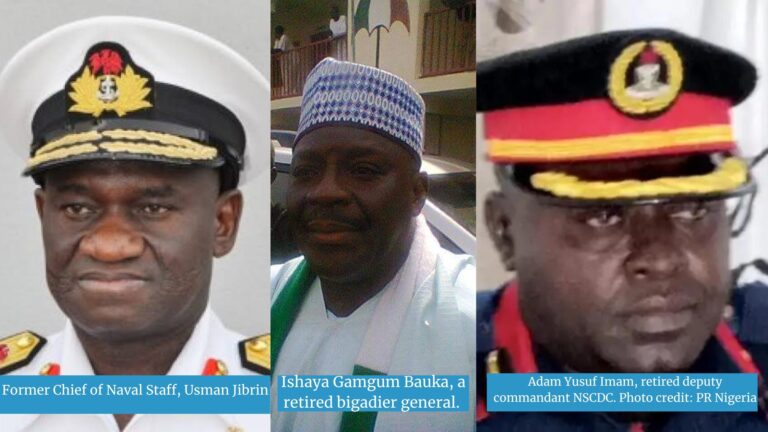
ON MAY 4, 2024, Inyang Ekwo, a justice of the Federal High Court, Abuja, issued a bench warrant for the arrest of Usman Jibrin, a retired vice admiral and former Chief of Naval Staff; Ishaya Gamgum Bauka, a retired brigadier general, and Adam Imam Yusuf, a retired deputy commandant of the Nigeria Security and Civil Defence Corps (NSCDC) in Kogi State.
The warrant followed money laundering charges brought against them by the Independent Corrupt Practices and Other Related Offences Commission (ICPC), after investigating a petition against them from a whistleblower.
Over five months later, the retired officers have remained defiant and have been evading arrest and failed to appear in court to face trial, raising questions as to whether they are above the law.
The ICPC said its inability to arrest the accused was because “they have gone into hiding.”
The court issued the arrest warrant after hearing a motion exparte filed by the commission, which submitted that Jibrin, Yusuf and Bauka were investigated for money laundering allegations and making false statements regarding the diversion of funds in their respective military and paramilitary institutions, into companies in which they allegedly had stakes.
The anti-graft agency stated that at the commencement of the investigation, the defendants were released on administrative bail on self-recognition because of their status as serving and former public figures but had since then refused to show up for possible arraignment in court.
The commission, therefore, prayed the court to issue a bench warrant for their arrest to face trial in the suit pending before the court.
The charges
Court documents seen by The ICIR indicate that while the ex-naval chief, Jibrin, is standing trial on a 10-count charge of money laundering, Yusuf and Bauka are being respectively prosecuted on a two-count charge over the same offence.
Also listed in the suit as defendants are companies allegedly involved in the laundering activities. They are Lahab Integrated and Multi-Services Ltd, Gate Coast Properties International Services Ltd, and Ummays Hummayd Energy Ltd.
The ICIR reports that over five months after the arrest warrant was issued following their failure to appear in court to defend themselves, the accused persons have been evading arrest, thereby stalling the money laundering case against them.
Several attempts by the ICPC to effect their arrest have been rebuffed as the ex-military officers and the NSCDC commandant were said to be taking advantage of the security protection around them to resist arrest.
Whistle-blower’s alarm
Findings indicate that the ICPC had launched an investigation into an alleged money laundering syndicate following a petition from a whistleblower dated December 11, 2020.
A copy of the whistleblower’s petition seen by The ICIR alleges that Jibrin, who became the Chief of Naval Staff in 2014 and retired in 2015, had allegedly used Adam Yusuf Imam, a deputy commandant with the NSCDC, and Ishaya Gamgum Bauka, a retired brigadier general, as fronts to amass illicit wealth within and outside Nigeria.
The whistleblower listed some companies used by the accused to perpetrate their alleged money laundering activities to include: Ummay’s Hummayd Energy Limited located at Kasuwandere Road, Gwagwalada Abuja; Ummay’s Hummayd Energy Limited, located opposite the Area Council Secretariat Gwagwlada Abuja, and Gamgum Nigeria Limited.
According to the petition, they also allegedly acquired houses located in Dubai and other properties within and outside Nigeria.
Also listed were cars allegedly acquired by Yusuf which include a Toyota Camry 2020, Toyota Hilux 2019, Mercedes Benz ML350, Toyota Avalon 2019, Mercedes Benz G-wagon 2016, Toyota Prado 2018, three Tippers, and nine fuel tankers.
The whistleblower sought a full-scale investigation by the anti-corruption agency to bring the perpetrators to book.
ICPC launches investigation
The ICIR gathered that on the strength of the petition, the ICPC launched an investigation into the money laundering allegations and eventually charged the suspects in court in 2023. However, despite the bench warrant issued against them in May this year after failing to appear for prosecution, the accused are yet to be arraigned.
During the investigation, the ICPC dispatched invitation letters to the accused and requested relevant documents from financial and non-financial institutions, ministries and departments and agencies of government. The trio had also been invited by the investigating team of the ICPC and released on administrative bail after writing their extra-judicial statements.
It was gathered that among the institutions the commission wrote to during its investigations are the Corporate Affairs Commission (CAC), the Code of Conduct Bureau (CCB), and the Federal Housing Authority (FHA), which were said to have availed the ICPC the relevant documents to aid its investigation.
Adam Yusuf Imam, retired deputy commandant NSCDC. Photo credit: PR Nigeria
A source at the ICPC privy to the investigation, who would not want to be named due to the sensitive nature of the matter told The ICIR, “After analysing extra-judicial statements, bank account statements and other relevant documents recovered in the course of the investigation, we found out certain unlawful dealings by the defendants and other persons now at large…”
The ICIR was also informed that following its investigations, the ICPC came up with “damning evidence” which indicated that Jibrin, Bauka, Yusuf and their accomplices illegally acquired properties through money laundering activities, using companies in which they had stakes.
Startling evidence
Among others, the ICPC’s investigation threw up evidence on how the ex-Naval chief impersonated his wife, Lami Idum.
Exhibits attached to the money laundering charge seen by The ICIR indicate that he impersonated Lami Idum (his wife), by signing his own signature against her name and passport photograph to open accounts for and on behalf of two companies – Lahab Integrated & Multi Services Limited and Gate Coast Properties International Limited.
Bank statements attached to the referenced charge showed that in June 2014, while still serving as the Chief of Naval Staff, Jibrin received N19,200,000.00 (N19.2 million) which was deposited by Sequential Resources into the Zenith Bank account belonging to Lahab Integrated & Multi Services Limited.
Curiously, the company’s account – Lahab Integrated & Multi-Services Limited – bears his (Jibrin’s) signature although it has the name and passport photograph of Lami Idum (his wife) as the sole signatory.
The funds, according to the first count in the money laundering case brought against the ex-Naval officer “formed part of the proceeds of an unlawful act to wit: fraud, and you thereby committed an offence contrary to Section 18(2)(d) and punishable under Section 18(3) of the Money Laundering (Prevention and Prohibition) Act 2022.”
In another transaction carried out in July 2024, Jibrin took possession of N28 million deposited by Errostier Property Ltd into the same Zenith Bank account belonging to Lahab Integrated & Services Limited.
In August 2024, yet another sum of N48 million was deposited by a company named BCO Track Resources Limited into the same Zenith Bank account owned by Lahab Integrated & Multi-Services Limited.
Ishaya Gamgum Bauka, a retired bigadier general. Photo credit: Andeh Adam Inbred on Facebook
Similarly, court documents sighted by TheICIR indicate that in April 2014, N35 million was deposited in the same account by BCO Track Resources Ltd while earlier in March 2015, another N35 million was deposited by Geocrat INV Ltd into another Zenith Bank account bearing Gate Coast Properties International Ltd. The account also bears Jibrin’s signature but has the name and passport photograph of his wife.
Another sum of N22 million had earlier been deposited into the same bank account belonging to Gate Coast Properties Ltd in March 2015 by a company called Sand Prop Ltd.
False information
Investigations also revealed that in March 2015, while registering Lahab Integrated & Multi-Services Ltd at the Corporate Affairs Commission (CAC), the retired naval chief signed his signature against his wife’s name as a director and shareholder. He also did the same in March 2013 while registering another company called Gate Coast Properties International Ltd.
On his part, Adam Imam Yusuf, former deputy commandant of the NSCDC, in June 2020, received N410 million as a deposit into his Zenith account number. Bank statements seen by The ICIR indicate that the deposit was made by a company called Gate Coast Properties International Ltd, believed to be owned by Jibrin.
Similarly, in January 2020, another N150 million, suspected to be proceeds of money laundering, was deposited into the same Zenith Bank account by Lahab Integrated & Multi-Services Ltd.
Further findings show that Ishaya Gamgum Bauka, a retired brigadier general, also linked to the alleged money laundering syndicate, in January 2020 took possession of properties described as Houses 21 and 23 at Second Avenue, Paradies Hills Estate, Guzape Abuja.
Documents seen by The ICIR indicate that N98 million, suspected to be proceeds of crime, was paid for the properties. In his extrajudicial statements to the ICPC team of investigators, Bauka claimed that the said sum (N98 million) being part payment for the purchase of properties in question was made through the Federal Housing Authority (FHA)/ENL-Consortium Ltd. by one Sayeed Shuaibu Muhammad, a business colleague.
However, Muhammad, an engineer, who was then working with a federal government parastatal, told the ICPC that Imam Yusuf (the retired NSCDC chief among the accused), who is married to his niece had credited his account with the said amount in two tranches without his knowledge and thereafter asked him to transfer the funds to another account.
In his statement to the ICPC, Muhammad said: “Imam Yusuf is an in-law married to my niece. On January 17, 2020, he called to reconfirm my First Bank account details after which he credited it with the sum of N38, 400,000.00.
“Out of surprise, I called him to confirm what that huge amount of money was meant for, but he said I should wait for an explanation later. On January 20, 2020, I received another credit alert of N60,000,000.00 from him again.
“I then briefed my account officer and on the same day, Imam Yusuf later called me and instructed me to pay the monies in four tranches into the Federal Housing Account in favour of Gamgum Nigeria Ltd. He claimed it was meant for the purchase of four houses for his boss, the former chief of Naval Staff, Admiral Usman Jibrin (Retd).
“After a while, Adam Imam Yusuf provided me with Ademu Lawal’s First Bank account details to credit N9,000,000.00 which I did on 21st January 2020.”
Muhammad revealed that Adam Yusuf owns Ummays Hummayd Energy Ltd with a total of three filling stations with about eleven trucks attached to them.
However, when called on November 13, 2024, by The ICIR to explain his relationship with Ishaya Bauka and his role in the matter, Yusuf declined to speak.
“Don’t call my line again on this matter,” he said and ended the call.
A peek further into ICPC’s investigation
Details of the ICPC investigation show that Adam Imam Yusuf, in active connivance with the former chief of Naval Staff (Jibrin) defrauded the federal government by indulging in questionable financial transactions through suspicious individuals and corporate entities.
Yusuf, according to the ICPC investigation, was used by Jibrin as a front to carry out financial transactions for the purchase of moveable and immovable assets worth billions of naira.
He was also alleged to have bought several other immovable assets outside Nigeria, including Dubai, through proxies and held the same in trust for Jibrin.
About 13 companies were said to be involved in laundering money through the purchase of properties for Jibrin. One of them, Bushi & Bushi Law Firm, was part of companies used as proxies to either receive money or buy properties for Jibrin as revealed in the ICPC’s investigation.
Findings also show that Bauka, the retired brigadier general, who hails from Takum Local Government Area of Taraba State, is a managing partner in the Bushi & Bushi law firm and an ally of Jibrin. He is also the owner of Gamgum Nigeria Limited, Beinkein Concepts and Joseph Hospitality Court. These companies are allegedly linked to the money laundering scheme.
It was further revealed that Bauka made a part payment on behalf of Jibrin for the properties described as House 21, & 23, 2nd 2 Avenue, Paradise Hills Estate, Guzape, Abuja sometime in 2012.
The ICIR gathered that Jibrin was invited to appear before the ICPC to defend the allegation of the properties linked to him, but he failed to do so. Rather, he wrote through his lawyers seeking time to enable him to honour the invitation.
“Despite the said letters on his behalf requesting for an extension of the date of the invitation at his convenience, he has failed or neglected to appear till date,” a source at the ICPC privy to the matter said.
Ex-Naval chief threatens The ICIR reporter
On Thursday, October 10, 2024, The ICIR reached out to the ex-Naval chief to get his response to the money laundering and evading arrest allegations by the ICPC, including his refusal to appear in court to defend himself.
However, when our reporter introduced himself and stated his mission, Jibrin fumed, questioning why the reporter was interested in the case involving him.
An attempt to explain that he was being given the opportunity to respond to the money laundering charges brought against him was rebuffed by the ex-naval chief.
Asked if he had gone to court to defend the charges, he snapped, “My friend, who are you to tell me whether or not to appear in court? Are you a policeman?
“Why can’t you go and investigate the cause of fuel price hike and what Nigerians are going through? The issue of giving palliatives, is that not enough for you to investigate?”
When the reporter insisted that he was doing his job, Jibrin threatened him, saying: “If you continue like this, I will come after you…
“Don’t ever try calling me again. If you want any details, go to court; find a way of getting in touch with me through the Nigerian Navy or the courts,” he fumed.
He added, “I am not a democrat; you can write any rubbish you like, and I will look for you. Tell whoever sent you to go to hell. Print it like that; investigative journalism my foot.”
The ICIR made several calls to the mobile number of Bauka, but they were unanswered.
He also did not respond to a text message sent to him on Wednesday, November 13, 2024, seeking his response to the allegations.
The text message which indicated delivered read: “Good day sir! I am a journalist with the International Centre for Investigative Reporting (ICIR), Abuja. I am reaching out to you regarding a money laundering charge brought against you by the ICPC at the Federal High Court, Abuja. Can you kindly let us know your level of involvement or otherwise in this matter? Thanks!”
In his extra-judicial statements to the ICPC dated August 23, 2021, Bauka admitted that Jibrin was his coursemate at the Nigerian Defense Academy (NDA).
“I have known him since 1978 when we all reported to the Nigerian Defence Academy (NDA) as members of Course 24.”
He said he was commissioned into the Nigeria Army in 1981 and retired in 2011 to go into business and legal practice.
“I do real estate as well as contracts and buying and selling of anything that is legal. I have companies registered with the CAC, namely: Beinkein Multi-Concepts Ltd; Joseph Court Hospitality and my law firm, Bushi and Bushi law firm. Beinkein does any form of legal contracts, Joseph Court does hospitality business and any legal contract too.”
He also told the ICPC investigators that he is the owner of two properties located within the Federal Housing Authority Estate in Guzape, Abuja. “I bought two units of four-bedroom duplex at N70,500,000 each,” he said.
Similarly, attempts to speak with Adam Imam were unsuccessful as his mobile phone line was unreachable.
They have gone into hiding – ICPC
The ICPC confirmed its investigation into the money laundering petition against the three accused persons, but said it was yet to effect their arrest because they had gone into hiding.
The spokesperson of the anti-graft commission, Demola Bakare, said: “The current situation is the commission’s inability to arrest the defendants because they have gone into hiding.
“Efforts were made to do this through their superior authorities, but to no avail, and efforts are still being made to see that they are arraigned.”
ICPC made futile efforts to arrest Jibrin
Sources inside the ICPC told The ICIR that several attempts to arrest the retired vice admiral following the bench warrant issued by the Federal High Court in Abuja had been rebuffed by his security details who resisted attempts by operatives to enter his house.
During one of the attempts, ICPC officials were said to have made a fruitless effort to arrest him at his house in Abuja.
“As we approached the gate, we were met by a team of heavily armed security details, sporting dark glasses. The team, comprising ex-servicemen, formed a human barricade, blocking us,” said a source privy to the operation.
According to the source, the stand-off continued for several hours with the ex-naval chief’s security personnel sneering: “You are not taking our boss anywhere.”
Navy, Army keep mum
The ICIR reached out to the Nigerian Navy and the Army over the money laundering charges filed against their retired officers at the Abuja Federal High Court. They failed to comment on the matter.
The Navy spokesperson, Aiwuyor Adams-Aliu, a commodore, was contacted on Saturday, November 23, 2024. Although he initially requested that the reporter send his response through a text message, he failed to respond after receiving our message detailing the inquiry.
Similarly, the spokesperson of the Army, Onyama Nwachukwa, a brigadier general, did not respond to inquiries made on Saturday, November 23.
Subsequent attempts to reach him via phone calls, WhatsApp, and SMS, were unsuccessful as he remained unreachable.
STAKEHOLDERS have raised concerns over the low uptake of modern contraceptives among Nigerian women, with data revealing that only 7.6 million out of the estimated 51 million women aged 15-49 are currently using modern contraceptive methods.
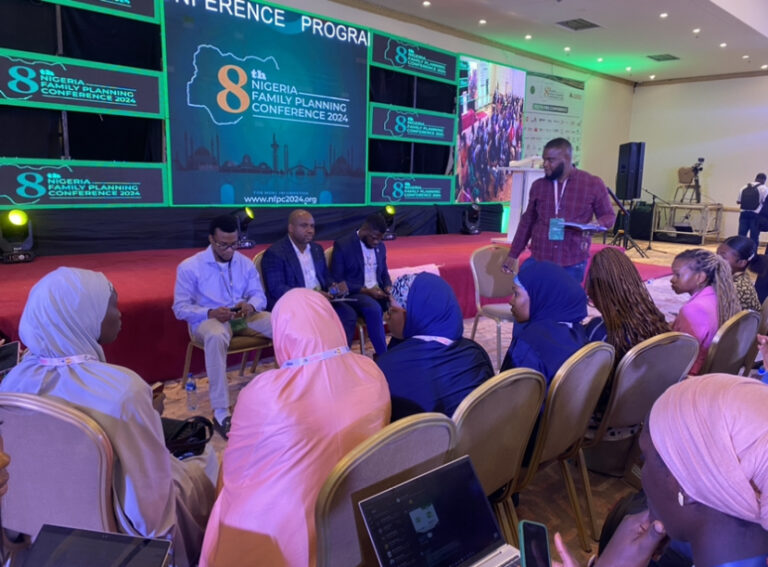
The data, presented by Jason Bremmer, Director of Data and Measurements at FP2030, during the 8th Nigerian Youth Family Planning Pre-Conference in Abuja on Tuesday, December 3, highlighted Nigeria’s ongoing challenges in addressing sexual and reproductive health.
Bremmer, who cited figures from the Nigeria Demographic and Health Survey (NDHS) and FP2030 Measurement Report 2024, disclosed that Nigeria accounted for 19 per cent of the global unmet need for modern contraception, with 24 per cent of Nigerian women having no access to the family planning services they required.
He noted that the country’s modern contraceptive prevalence rate (mCPR) among married women remained at 12 per cent – far below the government’s Family Planning Blueprint target of 27 per cent by 2030.
He stated that while modern contraceptive prevalence rates (mCPR) were rising among women aged 15–49, disparity remained in contraceptive methods used by married women versus unmarried adolescents.
The conference, themed “Enhancing Investments in the Next Generation: Ensuring Right-Based Reproductive Health Services for Adolescents and Young Persons,” brought together youth advocates, government officials, and development partners to discuss solutions to the barriers young people face in accessing family planning services.
Participants, who spoke at different panels, identified stigma, societal pressures, and limited availability of youth-friendly health services as significant challenges.
They highlighted the need for inclusive policies that consider the needs of adolescents and young people, particularly those in rural areas.
The panellists also emphasised the role of technology in expanding access to family planning services, advocating for telemedicine, mobile apps, and digital campaigns to increase awareness and accessibility, particularly for underserved populations.
Speaking at the event, Margaret Bolaji, chair of the Youth Sub-Committee, encouraged young people to take ownership of their reproductive health rights and leverage social media to amplify their voices.
She stressed that youth-led initiatives are crucial in advocating for change and ensuring reproductive health services are tailored to people’s needs.
On the government intervention, a representative of the Federal Ministry of Health Family Planning Department, John Ovuaye, reaffirmed the government’s commitment to improving access to family planning through budgetary allocations and inclusive health services.
He noted that addressing early marriage and inadequate SRH education required coordinated efforts involving communities, policymakers, and young people.
Ovuaye disclosed that the Federal Government had made provision in the 2025 national budget for FP commodities and services.
Participants at the event called for young people’s inclusion in shaping policies to address barriers to family planning access.