THE Office of the Registrar at Nnamdi Azikiwe University (UNIZIK) has affirmed the validity of its recent appointments of a substantive vice-chancellor Bernard Odoh, and Registrar Rosemary Nwokike, dismissing claims of annulment by the Federal Government.
In a circular dated November 1, 2024, the registrar, Rosemary Ifeoma Nwokike, clarified that there was no formal engagement between the university’s pro-chancellor and the minister of State for Education, countering any assumptions to the contrary.
The circular, addressed to the Federal Ministry of Education, emphasised that informal discussions had taken place, which did not alter or supersede the enforceability of a court judgment mandating the university’s Council to exercise its statutory authority in appointing the Vice-Chancellor.
This latest reaction follows controversies surrounding the appointment of Odoh as the vice-chancellor of Nnamdi Azikiwe University in Awka, Anambra State.
Odoh’s appointment has sparked a series of protests and counter-protests among various stakeholders, including members of the Academic Staff Union of Universities and the institution’s medical practitioners.
Background
Odoh was appointed on Tuesday, October 29, 2024, by the University’s Governing Council led by the Pro-Chancellor and Chairman of the Council, Greg Mbadiwe, during an interview with the candidates shortlisted for the position of vice-chancellor.
Challenging the council’s move, the Incorporated Trustees of the Medical and Dental Consultants Association of NAUTH, Nnewi, along with Victor Modekwe, filed a lawsuit at the National Industrial Court of Nigeria (NICN), according to reports.
The Associations were seeking an interlocutory injunction to prevent the 1st and 4th Defendants/Respondents, along with their agents, assigns, servants, representatives, or anyone acting on their behalf, from proceeding with the vice-chancellor appointment process based on the publication from September 12, 2024, until the court hears and determines the case.
The lawsuit, marked as No. NICN/ABJ/383/2024, includes Nnamdi Azikiwe University, the National Universities Commission, the Federal Ministry of Education, and the Council of Nnamdi Azikiwe University as the 1st to 4th Defendants/Respondents.
File photo of the controversial appointed UNIZIK Vice-Chancellor, Bernard Odoh
Also named in the suit are Carol Arinze Umobi, acting vice-chancellor, and Victor Modebelu, acting registrar of the University, listed as the 5th and 6th Defendants/Respondents, respectively.
The Academic Staff Union of Universities (ASUU) at the institution also, on October 29 filed a lawsuit challenging the appointments of Odoh and Rosemary Ifeoma Nwokike as vice-chancellor and registrar, respectively.
The claimants are seeking a perpetual injunction to prevent the two from representing themselves as or carrying out the duties of the vice-chancellor and registrar of the university, among others.
Despite the widespread protests regarding the alleged flawed process, the Governing Council convened and appointed Odoh, a former Secretary to the Government of Ebonyi State, as the university’s Vice-Chancellor.
FG voids appointment
Meanwhile, a memo from the Federal Ministry of Education has declared the appointment of Odoh as the vice-chancellor of Nnamdi Azikiwe University in Awka, Anambra State, to be null and void.
In a letter dated November 1 and addressed to the pro-chancellor/chairman of the Council, on behalf of the permanent secretary of the ministry, it was stated that no appointments would be made without reconciling with the aggrieved parties within the institution.
The letter, which also contained the annulment of the recent appointment of the university registrar, described the process as a “gross disregard for constituted authority.”
The letter reads, “Sequel to your meeting with the Honourable Minister of State for Education, (HMSE) held on Friday, 25th October, 2024, it was formally agreed that no appointments should be carried out by your Council without reconciling with the aggrieved parties in the University Community.
“It has come to the attention of the Ministry that your Council had gone ahead to appoint a Vice Chancellor for the University without the Representative of the Ministry, the internal council members and other Stakeholders on Tuesday, 29th October, 2024. This is a gross disregard to constituted Authority and is not in line with Extant provisions.
“Against this backdrop: I am directed to inform you that all appointments made so far are null and void. You are therefore requested put on hold all other appointments in the University pending the assumption on duty of the new Honourable Minister of Education,” it added.
UNIZIK registrar, office of VC insist on appointment
However, the embattled registrar Nwokike, who was supposedly removed by the education ministry, insisted that the process that brought the new vice chancellor was valid and duly followed.
She further detailed the appointment proceedings held on October 29, 2024, noting that all necessary protocols were observed despite the absence of a Ministry representative and other stakeholders.
According to the registrar, invitations were duly issued to ensure that all relevant parties were informed and had the opportunity to attend, noting that the meeting was attended by representatives from the Federal Character Commission and various Council members, which demonstrated broad representation.
“The meeting saw participation from representatives of the Federal Character Commission, external and internal Council members, and various other stakeholders, demonstrating a broad representation of interests. For further verification, attached are the attendance register, photographs documenting the proceedings, and copies of the official meeting notice sent to stakeholders,” the circular added.
She reiterated that the quorum was constituted in compliance with the Nnamdi Azikiwe University Act, ensuring procedural integrity throughout the appointment process.
This was also the position of the Office of the Vice Chancellor, which called on the public to disregard the letter allegedly issued by the Federal Ministry of Education, claiming it had annulled the appointment of Odoh as the institution’s VC.
In a statement released to journalists on Monday, November 4, Charles Otu, the personal assistant on Media and Publicity to the embattled VC, emphasized that Odoh’s appointment followed due process meticulously.
Otu highlighted that the university council operates as an “autonomous governing body.”
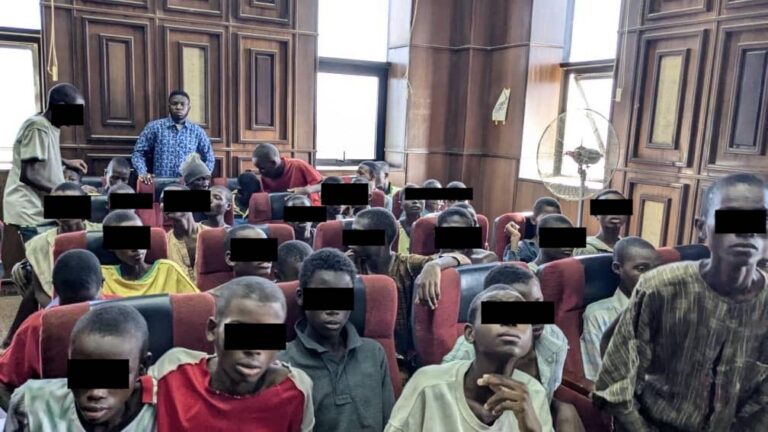
PRESIDENT Bola Tinubu today ordered the release of minors arrested, detained and charged to court for alleged involvement in the EndBadGovernance protests, following widespread outrage over their recent arraignment.
This was disclosed by the Minister of Information and National Orientation, Mohammed Idris, while briefing the State House correspondents shortly after the President swore in seven newly appointed ministers.
The arrest, detention and subsequent arraignment of the boy protesters sparked national backlash, with many Nigerians and human rights groups condemning what they described as inhumane and unjust treatment of children.
Many argued that the harsh response to peaceful demonstrators, especially minors, violated fundamental rights and set a troubling precedent for freedom of expression in Nigeria.
The ICIR reports that during the #EndBadGovernance protests, which drew thousands of Nigerians to the streets in a movement advocating for governmental transparency, accountability and an end to police brutality, several young protesters were arrested and detained. Among those detained were minors, reportedly held in various facilities under challenging conditions.
Recall that the minors who appeared in court on Friday, November 1, have been charged with a 10-count charge bordering on alleged treason and as conspiracy to commit a felony with intent to destabilise Nigeria, an offence contrary to Section 96 and punishable under Section 97 of the Penal Code Act.
However, the incident was heightened when some minors, who were among 76 persons set to be arraigned by the Nigerian Police Force (NPF), collapsed in the court on Friday, October 1.
One of the defendants slumped while the judge was reading the charges.
While announcing the President’s directive for their release, the information minister stated that it was without prejudice to whatever legal processes that are ongoing.
Tinubu further directed the Ministry of Humanitarian Affairs and Poverty Reduction to promptly attend to the welfare of the minors and to assist in facilitating their smooth reunion with their parents or guardians, wherever they may be in the country.
The minister also stated that a committee spearheaded by the humanitarian affairs ministry would be set up to look at issues surrounding the arrest, detention, treatment, and their release of the minors.
NIGERIAN crossdresser, Okuneye Idris, also known as Bobrisky might have jetted out of the country amid his ongoing trouble and legal ordeal with the EFCC.
Bobrisky in a series of posts on his Instagram story on Monday, November 4, announced his foreign trip but did not disclose his destination.
“See you soon, Nigeria. This girl bought a first-class ticket three times.” he wrote.
This comes barely four days after he was ejected off a KLM Airline flight bound for Amsterdam.
He was forced out at the Murtala Muhammed International Airport in Lagos and detained by immigration officers on the night of Thursday, October 31, while attempting to leave the country for London, the United Kingdom.
He was consequently taken to the headquarters of the EFCC in Abuja, where he was grilled regarding his bribery allegations against the commission.
He was later released on bail on Saturday after he reportedly denied bribing the EFCC in his confessional statement made at the commission’s headquarters.
According to The Punch, a source privy to the situation revealed that Bobrisky denied the bribery allegation in his statement at the EFCC headquarters. The source further mentioned that Bobrisky challenged the individual who posted the audio clip to substantiate it.
“He denied everything about releasing money to any official as a bribe to drop the money laundering charges against him. He denied it in his statement. He said the fellow who posted the voice note should come over to justify it. He said nobody requested money from him in the EFCC and he didn’t give anyone anything,” the source noted.
This incident came over a week after he was intercepted at the Sème border while allegedly attempting to flee the country on 22 October.
Recall, that allegations surfaced online from social media influencer Martins Otse, known as VeryDarkMan, claiming that while serving his sentence for abusing the naira, Bobrisky bribed prison officials and others to allow him to remain outside the prison.
He was said to have bribed senior prison officers to give him undeserved privileges as a convict.
The allegations prompted the minister of interior, Olubunmi Tunji-Ojo, to set up an investigative panel chaired by the ministry’s permanent secretary, Magdalena Ajani.
The panel stated that Bobrisky had access to special privileges during his incarceration, including a private cell, frequent visits, and access to electronic devices.
PRESIDENT Bola Tinubu has sworn in seven newly appointed ministers.
The new ministers were sworn in on Monday, November 4 at an event at the Council Chambers of the State House in Abuja.
The new cabinet members took the oath of office in two batches, consisting of four in the first batch and three in the second following the reading of their citations by State House Director of Information Abiodun Oladunjoye.
Among those sworn in are Bianca Odinaka Odumegwu-Ojukwu as the Minister of State Foreign Affairs, Muhammadu Maigari Dingyadi as the Minister of Labour & Employment, and Nentawe Yilwatda as the Minister of Humanitarian Affairs and Poverty Reduction.
Others include Suwaiba Said Ahmad, as the Minister of State Education; Yusuf Abdullahi Ata, as Minister of State, Housing, and Urban Development; Idi Mukhtar Maiha, Minister of Livestock Development; and Jumoke Oduwole, as the Minister of Industry, Trade, and Investment.
The ICIR reported that President Tinubu forwarded the names of new ministers he appointed on Wednesday, October 23, to the Senate for confirmation.
The President’s request was contained in a letter addressed to the Senate President, Godswill Akpabio, and read during plenary on Thursday, October 24.
According to the letter Tinubusought quick consideration of his request by the Senate.
The Senate immediately referred the request to the committee ofthe whole for consideration.
The ministers were later screened and confirmed by the Senate.
The ICIR reported that Tinubu fired five of his ministers on Wednesday, October 23.
He also sacked the minister of humanitarian affairs and poverty reduction, Beta Edu, whom he suspended in January over corruption allegations.
This decision was contained in a message posted on X by the presidency on Wednesday, October 23.
The ministers sacked are Uju Kennedy-Ohanneye (women affairs), Lola Ade-John (tourism), Tahir Mamman (education), Abdullahi Muhammad Gwarzo (state, housing, and urban development), and Jamila Bio Ibrahim (youth development).
The President also announced Sunday Dare, former minister of youth and sports, as his special adviser on public communication and orientation.
The President also reshuffled some ministers. Those affected include Uba Maigari Ahmadu from the Ministry of Steel Development to the new Ministry of Regional Development as Minister of State; Doris Uzoka-Anite from the Ministry of Industry, Trade, and Investment to the Ministry of Finance as Minister of State.
Similarly, theminister of sports, John Owan Enoh, was moved to the Ministry of Industry, Trade, and Investment as Minister of State; Imaan Suleiman-Ibrahim was redeployed as minister of state, Police Affairs Ministry, to the Ministry of Women Affairs; Ayodele Olawande, former minister of state for youth development, was promoted to full minister at the ministry; and Salako Iziaq Adeboye was moved from the Ministry of Environment to the Ministry of Health as minister of state.
Others are Yusuf Tanko Sununu from the Ministry of Education to the Ministry of Humanitarian Affairs and Poverty Reduction as minister of state; Moruf Olatunji Alausa was moved from the Ministry of Health to the Ministry of Education as the minister of state; and Bello Goronyo from Water Resources and Sanitation to the Ministry of Works as minister of state.
THE postponement of the deadline for the enforcement of the European Union Deforestation Regulation (EUDR) comes as a relief to Nigeria and other affected countries. However, not a few cocoa farmers in Nigeria are still in panic mode.
Had the European Union (EU) stuck to its deadline to enforce its European Union Deforestation Regulation (EUDR), initially fixed for December 30, 2024, a deadly blow would have been dealt cocoa farmers in the country who export the product.
Countries exporting cocoa, coffee, soya bean, oil palm, cattle, rubber and wood to the EU member-nations had been gripped by fear following the law, which was ratified by the European parliament in June last year.
In Nigeria, the authorities had come under intense pressure and criticisms for being lackadaisical about meeting the conditions so that the products exported by the country do not face rejection in the international market. Letters of appeal were written to the EU Commission by the National Cocoa Management Committee (NCMC) and Cocoa Farmers Association of Nigeria (CFAN) on the need to review the regulations and shift the deadline.
This is even as the NCMC was given a mandate to rally stakeholders towards ensuring that the European market, which takes about 80 per cent of Nigeria’s cocoa, is not lost.
The frantic efforts culminated in the launching of a national task-force by the minister of agriculture and food security, Abubakar Kyari, in Abuja on October 8, 2024. However, six days before the launch in Abuja, the EU, in a document signed on October 2, 2024, proposed a shift in the deadline.
Although it is yet to be formally ratified by the European Parliament, the proposal, which has been approved by the European Council, comes as a great relief to affected countries and their farmers, especially Nigeria.
The EUDR resolution
The EU had passed a resolution known as the European Union Deforestation Regulation (EUDR), in June 2023, giving 18-month notice to all countries exporting seven categories of agricultural produce to EU-member nations that failure to address the issues of deforestation in the farms, as well as undertake a survey of the land and the farmers would attract a ban of the export of the affected commodities to Europe.
Farmers of the affected agricultural products: cattle, wood, oil palm, rubber, soya, cocoa and coffee, majority of who were ignorant of the law, particularly cocoa farmers, continued to work tirelessly to meet the projection of the federal government on cocoa production by 2025.
The resolution, which was communicated to the authorities in Nigeria, as was done for other affected countries, stipulated a deadline of December 31, 2024.
Cocoa farmers in the dark about EU regulation
Prior to the happy turn of events, observing a seeming lack of concerted approach by the federal government to deal with the matter, many farmers, particularly in the southern part of Nigeria, expressed frustration towards the regulation.
Interestingly, many farmers were even unaware of the regulation that would have seriously impacted their business and income, as they were planning harvests in some cases.
Joseph Udida, a local Cocoa farmer
For instance, in mid-August, while the authorities in the country were in panic that the EU was about to drop the hammer on the cocoa industry, Charles Mgbe, a pastor and cocoa farmer in Ikom, Cross River State, oblivious of the threat on his produce, was already making plans for the harvests at the end of the year. The sales in previous years had brought celebration to the clan, and the signs this time, looked even brighter. He was one of the cocoa farmers in the area who were expecting to start the new year swimming in cocoa money.
He said, “This is farming season, and farmers are spraying now for the pods to come out so that by September, October, we will start harvesting.”
That excitement was driven by the development that saw Ikom, as a fast-growing hub of the cocoa business in Cross River State, as a result of which it had witnessed the proliferation of cocoa warehouses, and played host to exporters even with over 20 of them locally based.
In view of the fortune in the trade, more and more young people were getting involved, while the old farmers were happy making up for the losses in the past years. Individuals, family and government farms were being revived, while investors, both within Nigeria and abroad, opened shops in Ikom to receive the crop, bag and export the product.
The same was the case in Bendeghe, in the Etung LGA, another cluster of cocoa farming in the state. A lot of farmers went about drying cocoa beans in the open without much knowledge about the threat from the EU, to ban importation of their crops beginning from January 2025.
A farmer from Akwa Ibom State, Umanah Umanah, who said he worked for a trader, expressed shock when he was told of the EU regulation. He confessed that he had no prior knowledge of the threat.
In Delta State also, farmers were in the dark on what the EU regulation means.
A chief and a cocoa farmer in Nsukwa, Aniocha South LGA, who has a 30-hectare farmland,Tony Okofu, said though he had read it in the newspapers, he did not understand the import of the EU’s regulation.
I read it, but didn’t understand what it meant. I read something about deforestation and that they are not going to buy from countries not keeping the rules. I didn’t understand it until you just spoke about it now. I don’t know the number of trees that they think should not be in a farm. You have seen trees in my farm. I don’t know what they (EU) actually want.
He said, “I read it, but didn’t understand what it meant. I read something about deforestation and that they are not going to buy from countries not keeping the rules. I didn’t understand it until you just spoke about it now. I don’t know the number of trees that they think should not be in a farm.You have seen trees in my farm. I don’t know what they (EU) actually want.”
A cocoa farmer and kids heading to the farm.
Even though cocoa is not considered a major export crop in Delta State, the head of the Nigeria Export Promotion Council (NEPC), Florence Amukwa, in the state, said her council tries its best possible to sensitise farmers on the right thing to do before they could export their products.
She said, “We also go to them to see what they are doing on their farms. At times we invite experts who also give them knowledge on how they should go about it.”
Though there is an appreciable investment in cocoa, the agricultural products known for export in the state are cassava, oil palm and, to some extent, rubber. The contribution of Delta state to exportation of cocoa and rubber has dropped significantly over the years.
Findings show that many rubber plantations that previously dotted the central senatorial zone are giving way to residential habitations and food crop farms. Cassava, used in processing garri, is a staple food in the state that has joined export crops and its by-products are exported.
Though rubber fetched Nigeria a whopping $84 million dollars in 2022, while Nigeria is ranked 18th exporter in the world, the product lost its prime place as Nigeria’s 4th most valuable export in the 1960s and early 1970s to occupy the 22nd position among export products in the country in 2023.
In the case of cocoa, even at the national level, the highest production volume is said to be at 350,000 tonnes, the volume produced in the 1970s by the country. Nigeria’s ranking in cocoa has also dropped to the sixth in the world. But now that things are, once again, looking up for stakeholders in the industry, there is the likelihood that more people will begin to take interest in it, as it happens in other cocoa producing states.
With increasing gains from the exportation of cash crops in the state, particularly oil palm, individuals and corporate farmers have continued to expand plantations into forest reserves, and this has given both the ministry of environment officials, and people fighting for the protection of the environment, serious concern.
That is where the EU’s regulation on cocoa, and other products, strikes a chord.
An official of the environment ministry said that the threat issued by the EU to restrict import of cash crops from Nigeria was a welcome development. The official, who did not want his name in print because he was not authorised to speak for the ministry, said the measure would at least make some of the violators come to change their ways and help the work of the ministry.
Delta State has vast oil palm plantations covering about 100,000 hectares of land. The major estates are owned by the government but are leased to private companies to operate.
The Central Bank of Nigeria (CBN) recently launched the programme in the state on 33,000 hectares of land provided by 28 communities. Initiatives like this come with a lot of excitement.
A former commissioner for agriculture in the state, Julius Egbedi said, “The time to begin the expansion of the oil palm sector is now. The accelerated production of oil palm will reduce poverty in our communities, move the country from over-dependence on crude oil economy and promote agriculture.”
When the reporter visited the vast oil palm plantation at Nsukwa, its mill was in operation and workers were busy. But the management declined any interview.
Compliance efforts
There have been efforts, though not well coordinated, to comply with the deforestation rule in Nigeria. For instance, in Edo State, where the state government has encouraged estate farming in oil palms, there is an effort to ensure that investors in oil palm there plant a given number of trees for every one they cut.
According to Governor Godwin Obaseki, the state monitors the compliance. He said in an interview with TELL magazine in July 2024 that officials of the state government visited Indonesia and Malaysia to learn about oil palm plantation before starting the Edo State oil palm programme.
His said, “Under the programme, we are working with a group of investors. We have set up a self-policing mechanism to make sure that each investor gives us a development programme, which will show how they intend to go about making sure that they operate with success.
“Don’t forget, Edo State really had a head start as two oil palms listed on the stock exchange are already situated in the state. We had the benefit, the advantage and the knowledge of these companies to set up a programme. To also make sure that part of the programme ensured that we complied with global best practices, under what you call Responsible Palm Oil Cultivation Programme, we got the certificate. So, oil palm that is grown in Edo State is globally certified.”
Other states are following that footstep, but the challenge is that aside from the efforts coming a little too late, the authorities have not done enough to properly articulate a policy for all to follow and educate the farmers in the field.
Cocoa drying at Bendeghe.
That is not the only area where the farmer is yearning for government intervention.
Sunday Usi, who runs his family cocoa farm in Esimoko in Ndokwa East LGA of Delta State, when asked about the EU threat, said cocoa farmers in Ndokwa had suffered from flooding since 2021, with the 2022 being the most devastating. He expressed the regret that farmers were left to their fate any time this problem comes.
Lack of proper information
Many cocoa farmers also complained of lack of proper information dissemination on the matter. Not even when it came from third parties, like the produce buyers, who also may have been ignorant of the development on the deforestation rule.
Usi said produce buyers usually came from Oyo and Ondo states to take their produce off them. But he said they had never informed him about the EU’s threat to ban cocoa imports from Nigeria.
Perhaps, the farmers could be excused because the body they would normally look up to for information within the locality in that regard appeared to be in the dark too.
The Administrative Secretary of Cocoa Association of Nigeria (CAN), the umbrella body of cocoa dealers and merchants in Ikom, Cross River State, Egim Etta Tawo, was also unaware of the looming danger on the trade where he makes a living, and where he also occupies a position expected to see to the welfare of farmers there.
He said that he was not aware of the EU’s threat to ban cocoa from Nigeria for failure to conform to regulations on afforestation.
In the cities, especially in Abuja, the Federal Capital Territory (FCT), government and association officials were in panic mode, uncertain of what the next step of the EU would be to the appeals for them to shift the deadline. What they would not readily admit is that they were adopting the usual fire brigade approach.
Deadline extended but…
Had the EU not shifted the deadline, beginning from January 1, 2025, none of those products would have been legally allowed into any European country.
While the authorities in Nigeria started the race to address the conditions at the eleventh hour, our reporter sought to know how much preparations had been made to meet the stated conditions at the local level.
Findings show that the government had demonstrated ill preparedness. To start with, the farmers, for whom there should have been some form of education on the issue were unaware of the looming danger about four months to the deadline. Perhaps the most surprising response is the approach of the government to the threat to an agricultural product that contributes the highest to the national Gross Domestic Product (GDP). There were series of meetings between July and August involving the Cocoa Farmers Association of Nigeria (CFAN); National Cocoa Management Committee and the federal Ministry of Agriculture and Food Security, among others. The CFAN and the cocoa committee then wrote to the EU pleading for a shift in the deadline.
The executive director of the Cocoa Research Institute of Nigeria (CRIN), Patrick Adebola, said the challenge was that, unlike countries like Ghana, the cocoa industry in Nigeria is deregulated. The good news, he said, is that there is a movement forward, and that is because the National Cocoa Management Committee (NCMC), now has the mandate of the federal government to spearhead the supervision of the industry.
He said, “so, this body has now been saddled with the responsibility to organise the country on how to comply with the EU’s deforestation rule. Nigeria is the first country that would now have a task force on the EUDR.”
But this first step forward by Nigeria came barely four months to the deadline. Generally, the prognosis does not hold promises for the poor farmer sweating out in the field, hoping that the fortune will surpass the previous outcome in the international market.
At the local level, the attitude towards the EUDR is ambivalent. There are farmers who believe that were the EU to drop the hammer on them over deforestation, they would be targeting the wrong group of people. According to those in this school of thought, those who should be blamed for deforestation are the loggers. The cocoa farmers, they argue, can never be logically accused of attacking the forest, even when they clear the jungle for the purpose of planting. They argue that the farmer needs shade for cocoa, particularly while it is growing and, therefore, always plants another kind of tree to protect cocoa tree, from the nursery stage.
So, when they open the forest to plant, the cocoa farmer does not leave the land bare, and therefore ensures that cocoa is not susceptible to unfavourable weather. That is why there are other plants like banana, maize and yam planted along until the main crop matures.
For the trio of Mgbe, Joseph Udida, a farmer in Bendeghe and Flora Takim-Ndifon, President of Ikom Chamber of Commerce, Mines and Agriculture, the focus on farmers of cocoa, coffee and other produce is misplaced. Takim-Ndifon said the EU should be looking at practitioners of other trade in the rural community; the loggers.
She said, “When you are talking about deforestation, the focus should be on the loggers; those who log for immediate gain, not cocoa farmers.”
They advanced their argument by saying the farmers and community at large are at the receiving end of the activities of the loggers.
Udida said, “Trees help to conserve water. When the rain is falling, the trees retain the water in their roots and release them through evaporation and give rise to another rainfall. If it is not retained, it will fall to the ground and sink. Before the sun will hit the ground and get that evaporation it is not that fast and quick.”
According to him, the farmer, therefore, gets the flak because there was no protection for his crop. He said the depletion of the forest also affects the community because the removal of the trees that act as wind-shield exposes the buildings to hazard.
He said, “The forests used to reduce the wind. But now the wind comes directly to the houses and affects the buildings.” So, either way, deforestation is not a practice that the farmer wants to indulge in.
Farmers in Cross River State posit that to tame the loggers, pressure should be put on them by the government through the Department of Forestry. But the farmers see a problem of enforcement and policy crisis here. This is because loggers also occupy a space in the economy, such that stopping them would be virtually impossible.
Incidentally, they also export their products to markets that include the EU. And because of the weak laws in the West African countries, Nigeria inclusive, trees get felled and taken out of the country without loggers bothering about replacement. The European Union made a law, prior to the EUDR, known as the European Union Timber Regulation, EUTR, which sought to give guidelines towards the regulation of afforestation, thus forcing people to plant trees wherever there had been some measure of forest degradation. The EUTR imposed restriction on export of woods to the European countries from territories where there was no compliance.
However, there are no official records that would have enabled the government to motivate people to plant trees in such areas. It is believed that because of the steps taken by the EU, through the timber regulation, exports to Europe have been quite wobbly.
Checks show that the law did not stop the loggers, rather it encouraged illegal trade for which loggers got new markets. The latest beneficiaries are India and China. The EUDR is an offshoot of the EUTR, also adopted to combat the effect of climate change in the world.
Adebola does not really believe that African countries contribute much to greenhouse emissions enough to justify the imposition of the EUDR deadline.
On his part, Tawo, the administrative secretary of Cocoa Association of Nigeria (CAN) does not believe that the crux of the matter is deforestation. He said the EU is on the neck of Nigerian cocoa farmers over reluctance to maintain standard in the products sent across to foreign nations.
“The threat of not buying Nigerian cocoa is associated with not meeting international specifications not exceeding five per cent slaty; which is cocoa that is not properly fermented. The chocolate taste comes from fermentation. After breaking the cocoa, you cover it for about seven days to give it that flavor. But a lot of people are in a hurry. You can break cocoa today and start drying it tomorrow, and it won’t give it that flavour.”
The processing of cocoa before being exported has been criticised over the years. The haste in production that does not allow for fermentation, which would have increased the value of cocoa beans from Nigeria, is often an issue because there are farmers, who either because they lack the experience and expertise required to package their products or they are in a hurry to get them across to the merchants, fail to dry properly.
To Adebola, therefore, the problem of quality control is due to the absence of a national body entrusted with the responsibility to regulate the industry. This, he said, will now be adequately addressed through the NCMC. However, the authorities must ensure that this is done with all the seriousness that it deserves.
Tawo recalled the crisis experienced in June 2015, when the EU banned some agricultural products from Nigeria, including beans, because they contained a high level of pesticide, which was considered dangerous to human health.
Also, sometimes in 2021 there were speculations that the EU was planning to ban Nigeria’s cocoa but Mufutau Abolarin, the President of CAN, denounced the report. He reportedly told the News Agency of Nigeria (NAN), then that no such issue had been discussed at the Council of International Cocoa Organisation, ICCO, of which he is a member.
He was quoted to have said, “We can confidently affirm that at no time was Nigeria in the red list of any cocoa importing or consuming country, then or now.”
He, however, said that there were cases of complaints against the use of “adulterated and sometimes abuse of pesticides in cocoa production,” but claimed that such were being reduced through interaction and training of farmers.
But he did not deny the proposed ban that brought panic this time around. Rather, his association, the CFAN and the National Cocoa Management Committee had to persuade the EU to shift grounds on the deadline.
‘Efforts not approached with sincerity’
There are those who believe that efforts at meeting the 18-months deadline were not done with sincerity, which raises fears that nothing much might be done during the extension period.
The president of Calabar Chamber of Commerce, Industry, Mines and Agriculture, (CALCCIMA) Etim David Etim, blames officials of government whom he said are complacent and leave matters to gather dust only to resort to a panic mode at the tail end.
He said, “Before the EU does anything in terms of standardisation, they send out notices which may be three years back. It comes as an alert because they have taken a decision.
“Nigeria is in the receipt of the alert. Somebody is assigned to monitor those alerts. But most times, those alerts come only to government functionaries who are not farmers. He sees the alert on his email, he just looks at it and passes. Five years down the line, they now want to implement it then you start running helter-skelter like a headless chicken.”
Though the law was adopted in June 2023, the notification came way back in 2021. On November 17 of that year the European Commission published its proposal for a regulation of deforestation. Even that was a follow up to an earlier publication in 2019 of a communication on EU action to protect the global forest. One of the five options in the analysis published was eventually adopted after a report, said to have been subjected to ‘extensive consultation exercise’, was presented for consideration, the final version of which was agreed to in December 2022 by the European Parliament and the Council.
The EUDR leaned on the EUTR, its precursor, drawing lessons from its implementation. What that means is that Nigerian officials, knowing how the rule affected the wood industry, should have taken a cue from there to prevent the looming negative impact for the cocoa industry, conscious of the fact that it is the highest contributor to the country’s GDP, in the agriculture sector.
Stakeholders believe that the lacklustre attitude of the government in this case is unpardonable. They point out that the same sector had suffered from similar complaints in the past. That was in 2016 when some Nigerian food items were banned by the EU.
The United Kingdom also issued 13 border rejection alerts to Nigerian beans exporters between January and June 2015. This development was of great concern to Ngozi Okonjo-Iweala, Nigeria’s former coordinating minister of the economy and current director-general of the World Trade Organisation (WTO).
Cocoa seeds
She had lamented the losses incurred from the rejection of Nigeria’s agricultural products at the international level, while speaking at the launch of a programme in Abuja by the world body to help train Nigerians on meeting the global standard to prevent further losses.
“Nigeria is the world’s largest producer and consumer of cow pea. Sesame is primarily an export crop, and Nigeria is the world’s fourth leading producer, exporting to the EU, Japan, South Korea and other Asian markets.
“However, Nigerian cow pea and sesame exports have increasingly faced rejections in several destination markets due to non-compliance with international SPS requirements,” Okonjo-Iwea reportedly said.
Though the project held in March this year, it was designed to help stakeholders with international safety and quality certification for sesame and cow pea, the problem also affects other agriculture products. It will be recalled that the attempt to popularise the export of yam in 2017 by a former minister of agriculture, Audu Ogbeh, ran into controversy because some of the yam tubers went bad before they arrived at destination in the United States and Europe.
The former minister said then that Nigeria was the leading producer of yams in the world.
But why do products from Nigeria find themselves at the receiving end of international regulations and standards?
The chairman of the Ondo State Cocoa Council, Olusegun Awolumate, said, “The problem we have is that there is no functional coordinating body for these commodities at the federal level. That is why all efforts are not coordinated. I have been advocating for a central and functional coordinating body. What (I believe is that) the National Cocoa Management Committee doesn’t have the strength of what they should do.”
He said the move for the NCMC to metamorphose to that national body that will undertake proper coordination of the industry leaves much to cheer.
The closest Nigeria has got to that in recent years was under the administration of former President Olusegun Obasanjo, who set up the National Cocoa Development Committee. On the board of the committee were deputy governors of the cocoa producing states. That gave the states the zeal to align with the national objective to rev up the production of cocoa in Nigeria.
By the time Obasanjo left, production had moved from 165,000 metric tonnes to 300,000 metric tonnes. Unfortunately, that committee was not backed by law. So, the tempo of production went down when President Umaru Yar’Adua’s administration dismantled the committee.
Today, Nigeria is touted to produce 350,000 metric tonnes annually. That was its production in the 1970s when the country was number two in the world, after Ghana, which then was producing 380,000 metric tonnes. Sadly, Ivory Coast, which then came third with a production of 180,000 metric tonnes, is now leading the two countries with over two million metric tonnes. However, Ghana, in its case, has moved far beyond the 380,000 mark to over one million. Nigeria comes a distant sixth in the world now.
Last year, Ambassador Nura Rimi, Permanent Secretary, federal ministry of industry trade and investment, said, “our cocoa exports have grown significantly, with a revenue increase of 50 per cent in 2022. We aim to increase cocoa production to 500,000 metric tonnes by 2025.”
The question now is whether Nigeria is ready to meet up with the conditions even with the extension of the deadline.
Awolumate said, “We are talking but I don’t think we are ready.”
Though the NCMC and other stakeholders’ efforts have yielded time, those who should know in the industry said the CFAN and exporters actually drove that initiative. The President of CFAN said that government does not seem to be bothered about the problem faced by farmers in the sector. So, “cocoa farmers needed to write because, it is our business, it is our work, and we believe, it would affect us most if we did not work on it.”
This report, the first in two parts, is a collaboration between the International Centre for Investigative Reporting, ICIR, and Bushlink. It was supported with funds from the National Endowment for Democracy.
THE federal government through the Ministry of Foreign Affairs, has declared that Nigerians living in Libya are safe.
The ministry assured Nigerians living in the North African country of its commitment to their safety and welfare.
The Ministry gave the assurance in a statement on Sunday, November 3, signed by its spokesperson, Eche Abu-Obe.
The statement followed recent reports that Nigerians in Libya were being attacked by Libyan authorities, following the verdict of a recent ruling by the Confederation of African Football (CAF) against the Libyan Football Association (FA) which indicted them for their ill-treatment of the Nigerian team and officials while in Libya for a Nations Cup qualifying match in October.
The ministry underlined the government’s commitment to Nigerian citizens’ welfare in the face of diplomatic events by stressing its ongoing watchfulness and readiness to defend them overseas.
They also stated that as of the time of making its statement, Nigerians in Libya are going about their daily activities, devoid of any form of harassment by Libyan authorities.
The ministry reiterated that the well-being of Nigerian citizens anywhere in the world is a top priority of the Federal Republic of Nigeria and will continue to strive to safeguard it at all times.
The ICIR reported that CAF awarded all three points to the Nigeria Super Eagles in the abandoned Africa Cup of Nations qualifier match against Libya.
The CAF Disciplinary Board also awarded three goals to Nigeria from the botched match.
The decision to award the points and goals followed CAF’s investigation into what transpired in the October 15 Africa Cup of Nations second leg abandoned match in Benghazi, Libya.
The Nigerian Super Eagles abandoned the match following mistreatment by the host country.
The Libyan authorities left the Super Eagles, supporters, and staff stranded at its airport for almost a day.
In its decision, released in a statementon its website on Saturday, October 26, CAF declared that the Libya Football Federation violated Articles 82 and 151 of the CAF Disciplinary Code, in addition to Article 31 of the African Cup of Nations Regulations.
It thereforeordered the Libyan Football Federation to pay a fine of USD 50,000.
According to the body, the fine is tobe paid within 60 days of the decision.
The ICIR reported that the Super Eagles boycotted the reverse match.
The team defeated the Libyan Mediterranean Knights 1:0 at the Uyo Stadium on Friday, October 11, and hoped to be victorious again in the oil-rich North African nation the following Tuesday.
However, the team’s ordeal began on Sunday, October 13, when its flight was unexpectedly diverted to a different airport, away from Benghazi, where it was supposed to play a reverse match, causing the Super Eagles to be stranded for hours.
Images of the team circulated by the team’s captain, Williams Troos-Ekong, showed players lying on airport benches, visibly fatigued, as they waited for the crisis to be resolved.
Moving from the Al Abraq Airport would make the team travel by road for three hours before reaching Benghazi.
The team eventually returned home after abandoning the match.
AT the 20th African Investigative Journalism Conference (AIJC) held at Wits University in Johannesburg, South Africa from October 30 to November 1, 2024, journalists from across Africa raised an urgent call for action on journalist safety and press freedom amidst escalating threats on the continent.
Marking the International Day to End Impunity for Crimes Against Journalists, they addressed the increasing dangers faced by reporters, including harassment, imprisonment, and targeted killings for exposing corruption and human rights abuses.
Delegates included participants from countries across Africa, Europe, Asia, and the Americas, including nations as diverse as Nigeria, Argentina, China, Andorra, and Sweden. The gathering offered a rich mix of workshops, discussions, and networking events focused on advancing journalistic integrity, innovation, and cross-border collaboration.
While addressing the growing threats journalists face in an event that brought over 450 journalists from 32 African nations together, the participants urged governments to act swiftly and end impunity.
Their demands included releasing all journalists detained for their reporting, establishing an African tribunal for investigating crimes against the press, and banning government and private sector surveillance of journalists.
They also called on civil society and press freedom organisations to collaborate on rapid response mechanisms, offer legal and psychosocial support for journalists in distress, and strengthen protections for female journalists facing harassment.
“Effective collaboration and coordination among journalists’ safety organisations and human rights defenders, including by effectively reporting on attacks against the media and individual journalists; and to promote policies that safeguard media freedom and improve access to information laws, thus strengthening the legal framework that supports independent investigative journalism across Africa.
“Collaboration and coordination to establish dedicated helpdesks and reporting platforms for journalists and newsrooms facing online harassment, surveillance threats, or digital security breaches. Set up rapid response mechanisms for journalists in crisis; provide legal, emergency, or psychosocial support for journalists in distress; and facilitate the development of open-source digital tools for investigative journalists.
“Increased advocacy and capacity building for the safety of female journalists including developing strong newsroom protocols to address attacks on harassment of female journalists,” part of the communique adopted by the participants and endorsed by the African Editors Forum (TAEF) and other organisations at the AIJC 2024.
The conference also served as a consultation forum for UNESCO, which is working to develop risk assessment frameworks for the safety of journalists, with the AIJC participants emphasizing that journalism is a public good, vital to democracy, and called for African governments and media stakeholders to protect those who risk their lives to report the truth.
Earlier at the event, the convenor, Beauregard Tromp, while addressing the Congress of Journalists, said that a key focus of the AIJC was to develop grassroots investigative journalism on the continent through the 2024 under-30 fellowship program.
He noted that over 25 young journalists who displayed strong potential were fully sponsored to attend the conference, supported by partners like the Open Society Foundations, the Africa-China Reporting Project at Wits Centre for Journalism, and the Gates Foundation.
“We’ve also spoken at length about the need to strengthen Global South cooperation within the journalism community. We have established networks with our colleagues in the US and Europe, but we don’t have the same collaboration with colleagues in Latin America, Asia, and other areas.
“We’ve worked hard over the years with organisations like the Global Investigative Journalism Network (GIJN) to build and foster these relationships, attending events like the 2024 COLPIN conference in Madrid to learn more about how we can better engage with these communities.”
Ugandan journalist Blanche Musinguzi named Africa’s Best in 2024
In a highlight of the AIJC, Ugandan journalist Blanche Musinguzi was awarded the African Investigative Journalist of the Year Award for his groundbreaking investigation into the illegal trade of Congolese hardwoods through East Africa.
His investigation, titled “How Congo Trees are Smuggled through East Africa”, was supported by the Pulitzer Center and the Rainforest Investigations Network, exposing the far-reaching impacts of timber smuggling networks on local communities and ecosystems.
The award ceremony took place on October 31, with the convenor of judges Gwen Lister commending Musinguzi for his persistence, courage, and exceptional storytelling in navigating challenging conditions.
“It’s a story featuring great investigative research on the ground, persistence, and courage in a dangerous part of our continent, as well as profound reporting. It is also an accessible and well-written report, an often-overlooked component of journalism,” Lister said.’
The investigation traces the illegal processing and export of valuable timber from the Democratic Republic of the Congo to various countries worldwide.
“It’s also a story with great environmental impact, uncovering the people and companies behind widespread criminal activity with negative repercussions in many regions across Africa,” said Lister.
In his acceptance speech, Musinguzi reflected on his journey, sharing how his rural upbringing in western Uganda and his mother’s sacrifices inspired his dedication to journalism.
“Even now if you ask her, ‘What does your son do?’ she would not be able to tell you. She was able to provide me with my fees and send me to school, but she could not read my report cards. When I went to secondary school, my classmates’ parents were teachers and doctors, and so on, and they would come to visit their children, but no one could come to visit me – they couldn’t.
“So from a very young age, I learned to take things seriously. This award goes to all of us, and it’s an encouragement that we continue to do good work,” he said.
Runner-up honors went to Ghanaian journalists Manasseh Azure Awuni, Adwoa Adobea-Owusu, and Evans Aziamor-Mensah for their investigative series, “The GH₵ 3 Billion Lie”, which revealed the creation of parasitic companies used to siphon off taxpayers’ monies in the oil sector.
Third place was awarded to Hennie van Vuuren of South Africa for his work on the Russian Doll series, which explored covert operations surrounding South African military figures and Russian geopolitical interests.
THE Court of Appeal, Abuja, has cleared a former Chief Justice of Nigeria (CJN), Walter Onnoghen, of the charge that led to his removal from office in 2019.
Recall that on January 25, 2019, approximately 29 days before the presidential election, former President Muhammadu Buhari removed Onnoghen from his position as CJN and installed Tanko Muhammad, the next most senior Supreme Court judge, to assume the role of head of the judiciary.
About six years after he was convicted, a three-man panel of the appellate court, led by Mohammed Bello, exonerated the ex-CJN following a settlement agreement the federal government entered with him.
The federal government, through the Attorney-General and Minister of Justice Lateef Fagbemi, a senior advocate, had convinced the appellate court to not continue considering three different appeals the former CJN filed to contest his removal, conviction, and asset seizure.
The appellate court in its ruling directed the federal government to immediately unfreeze Onnoghen’s account with Standard Chartered Bank Nigeria Limited in accordance with the conditions of the settlement reached on October 24.
Buhari’s suspension of Onnoghen as CJN provoked mixed reactions from both within and outside the judicial circles, with the Nigerian Bar Association (NBA) describing it as a coup against the judiciary.
Onnoghen was later convicted by the Code of Conduct Tribunal (CCT) on a six-count corruption charge that was preferred against him by the FG.
It was alleged that he made a false declaration to the Code of Conduct Bureau (CCB).
The Code of Conduct Tribunal found the former CJN guilty of false declaration of assets and also barred him from holding any public office for 10 years.
Speaking about his removal as CJN in 2021, Onnoghen said his unconstitutional removal in the lead-up to the 2019 general election is a testament that the country’s judiciary is on life support.
Onnoghen said this during the unveiling of a book, “Fundamental Rights (Enforcement Procedure) Rules, 2009,’ written by Ogwu James Onoja (SAN).
He said he was removedbasically because it was rumoured that he held a meeting with the People’s Democratic Party (PDP) candidate in the 2019 election, Atiku Abubakar.
THE Independent Corrupt Practices and Other Related Offences Commission (ICPC) has brought Hauwau Abdulkarim, the current Provost of the Federal College of Education (Technical) (FCET) in Gusau, and Abdullahi Boyi, a lecturer at the Sokoto State College of Education (SSCE), before the court on allegations of certificate forgery.
The two were arraigned on a six-count charge before a judge, Muhammad Aliyu Sambo at the Sokoto State High Court.
The ICPC claims the defendants forged an appointment letter, which they allegedly used to apply for the position of Provost at FCET Gusau in Zamfara State. Both defendants pleaded ‘not guilty’ to all six charges.
This was contained in a statement on November 3, 2024, by the commission signed by its spokesperson, Demola Bakare.
Defence counsels of the duo each filed bail applications for their respective clients, urging the court to grant bail under fair terms due to the defendants established positions and cooperation during the investigation. The counsel representing the ICPC did not oppose the bail requests.
After reviewing the applications, Sambo granted bail with specific conditions aimed at ensuring the defendants’ attendance throughout the trial.
As part of the bail conditions, each defendant must present two sureties who are permanent residents of Sokoto State, with each surety required to sign a bond worth one million naira.
After bail was granted, the ICPC prosecutor requested a trial date, highlighting the Commission’s readiness to present witnesses and evidence to support the charges.
Sambo adjourned the case to November 21, 2024, for the commencement of the hearing.
THE Nigeria Police Force (NPF) has arrested 130 individuals (113 foreign nationals and 17 Nigerians), for their alleged involvement in high-level hacking and activities deemed a threat to national security.
The suspects, primarily of Chinese and Malaysian origin, were apprehended in a coordinated operation on Saturday, November 2, 2024, at Jahi, Abuja, where police said it discovered computers and advanced devices used to facilitate these criminal activities.
According to a statement by the Force spokesperson, Olumuyiwa Adejobi, on Sunday, November 3, the raid was led by Assistant Inspector-General of Police for Zone 7, Benneth Igweh. It included officers from the Nigeria Police Force Zone 7 Command and the National Cyber Crime Centre (NPF-NCCC).
“This strategic operation was conducted through a coordinated raid on a building at the Next Cash and Carry area of Jahi, Abuja, where the suspects reportedly used computers and other sophisticated devices to facilitate criminal activities.
“The operation which was led by the Assistant Inspector-General of Police for Zone 7 Headquarters, Abuja, AIG Benneth Igweh, on Saturday, 3rd November 2024, comprised officers of the Nigeria Police Force Zone 7 Command Abuja and the National Cyber Crime Centre (NPF-NCCC),” the statement read in part.
Following the arrests, the police said they had commenced a thorough investigation, including a scientific analysis of the evidence collected from the suspects. They added that suspects would be charged in court upon the completion of the investigation.
“We are investigating the matter and scientifically analysing the exhibits recovered from them. The suspects will be charged in court upon the conclusion of our investigations.
“We will update the public on the outcomes of our investigations as and when due,” Adejobi added.





![Cocoa farmers in panic mode, despite shift in EU’s deforestation rule deadline [part 1]](https://www.icirnigeria.org/wp-content/uploads/2024/10/fruit-3247447_1280-768x562.jpg "Cocoa farmers in panic mode, despite shift in EU’s deforestation rule deadline [part 1]")