Home Blog Page 442

Stop attack on journalists media, civil coalition groups tell Tinubu

0

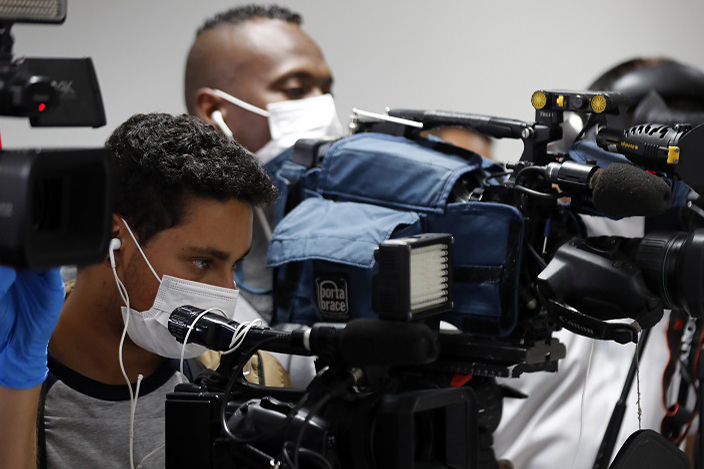
THE Centre for Journalism Innovation and Development (CJID), Citizens Gavel, and a coalition of 85 journalists, media practitioners, civil society organisations, and concerned Nigerian citizens have urged President Bola Tinubu to stop escalating attacks against journalists.

The groups issued a second urgent appeal calling for immediate action to end the persistent attacks and harassment of journalists and the media across the country.

The appeal followed the first letter dated July 29, 2024, which “urged the President to take immediate action to address the incessant and unwarranted arrest, unlawful detention and several other forms of harassment and intimidation meted out on journalists and the press in Nigeria”.

The letter further included recommendations that could help ensure the safety of journalists and the protection of press freedom in Nigeria.

In the initial letter the group said it highlighted that between May 29, 2023, and June 30, 2024, the CJID’s Press Attack Tracker documented 51 verified incidents of press freedom violations across Nigeria and 37 of these incidents occurred between January 1 and June 30, 2024, indicating a distressing escalation.

“Since the first letter was sent, the CJID’s Press Attack Tracker has documented not less than 90 confirmed cases of press attacks between July 1, and October 22, 2024,” they stated.

It added that the ongoing wave of press freedom violations, largely attributed to state actors, signals an alarming trend that endangers the safety of journalists and threatens the democratic principles of free speech and accountability.

Furthermore, the coalition stated that in its follow-up appeal to the President, the coalition restated their specific demands, calling on the President to take immediate action to implement laws and other measures directed at strengthening press freedom protection and ensuring that journalists and media professionals carry out their watchdog duties as guaranteed by the constitution, without fear of attack and intimidation.

It also asked to Conduct thorough investigations into recent cases of journalists’ detention and all reported cases of attacks on journalists, and ensure that the perpetrators are held accountable.

“Engage and pressure all the arms of government to commit to respecting press freedom by upholding and protecting the rights of journalists as guaranteed by the Nigerian Constitution.

Engage the security agencies, particularly the Nigerian Police Force, the Nigerian Army, and the State Security Service, also known as the DSS, on their roles in protecting press freedom and the importance of properly implementing the laws that relate to press freedom and freedom of expression.” The statement read.

The coalition further urged media professionals and stakeholders to engage in meaningful discussions on press freedom and the safety of journalists, to foster a more secure and supportive environment for journalism in Nigeria.

They called on the President to direct that any complaints against journalists be initially reviewed by the Nigerian Media Complaints Commission (NMCC), also known as the National Ombudsman and that a preliminary case be established before any journalist is summoned, detained, or prosecuted.

In observance of the International Day to End Impunity for Crimes Against Journalists, the coalition emphasized the critical role of the press in Nigeria’s democratic framework and encouraged the President to take clear actions to protect press freedom and ensure journalists can report without fear while expressing hope that the President would seize this opportunity to affirm Nigeria’s commitment to journalist safety and press freedom.


FG releases funds for NASU salaries, pension benefits

0

THE federal government said it has released funds to initiate payments of outstanding salaries to members of the Non-Academic Staff Union (NASU) in federal universities, along with retirement benefits to retirees under the Nigerian Union of Pensioners Contributory Pension Scheme.

A statement on Saturday, November 2, by the director of press and public relations at the Office of the Accountant-General of the Federation (OAGF), Bawa Mokwa, said the payments to NASU members had commenced, with many beneficiaries already confirming receipt of their salaries and benefits.

“The federal government has released funds for payment of withheld salary of Non-Academic Staff Union of Federal Universities.

“According to the OAGF, the Federal Government has also released funds for payment of benefits to retirees under the Nigerian Union of Pensioners Contributory Pension Scheme Sector.

“The OAGF said payments to the Non-Academic Staff of Federal Universities had commenced and many have confirmed receipt,” the statement read.

While emphasising its dedication to addressing longstanding financial obligations within federal institutions, the Office of the Accountant-General also reaffirmed the government’s commitment to the welfare of Nigerian workers and retirees.

The ICIR reports that the issue of withheld salaries has been a source of contention, with NASU and the Senior Staff Association of Nigerian Universities (SSANU) issuing multiple ultimatums demanding overdue payments and adherence to agreements, including the 2009 Memorandum of Understanding (MoU). 

In 2022, the federal government invoked a “no work, no pay” policy following prolonged strikes by university unions, a stance that many staff members have openly criticised.

On October 28, SSANU and NASU announced an indefinite strike to protest the non-payment of salaries, further disrupting university activities nationwide. 

In a joint statement, the unions emphasised that the federal government’s delays in addressing their demands had pushed them to take a stronger stance, urging university staff across federal and state institutions to join the industrial action.

Following the declaration, the Federal Government invited the Joint Action Committee (JAC) of the striking unions for dialogue.

According to SSANU vice president, Abdussobur Salaam, the meeting is scheduled for today (Thursday), October 31.  

Meanwhile another union in the education sector, the National Association of Academic Technologists (NAAT), on Wednesday, threatened to embark on a protest and strike in the next two weeks over withheld salaries.

It vowed to picket the federal ministry of finance on November 14 and organise a nationwide protest on November 6 in response to the “unpleasant way” university employees were treated.

The president of the NAAT, Ibeji Nwokoma, told reporters at Labour House in Abuja on Wednesday that the planned protest and strike arose from the government’s failure to meet his group’s demands, including payment of five and a half months of withheld salaries and the full implementation of a 2009 agreement with NAAT.

UNICEF to immunise 3.8m children against measles in Bauchi, Adamawa others

THE United Nations Children’s Fund (UNICEF) is set to vaccinate over 3.8 million children in four northern Nigerian states against measles.

The vaccination is aimed to curb measles among young children in Adamawa, Bauchi, Gombe, and Plateau states.

The health officer at UNICEF’s Bauchi Field Office, Patrick Akor, announced the campaign during a press conference in Bauchi on Friday, November 1, stating that the measles vaccination effort will kick off on Saturday and run for a week, according to Punch Newspaper.

“For the measles campaign, we have a target of 3.8 million children aged nine to 59 months across the four states.

“We have received over 4 million doses of measles vaccines, which have been supplied across these four states.”

In addition to the measles campaign, Akor highlighted an oral vaccination drive against polio in five northern states, targeting nearly 6.8 million children under five in Taraba, Plateau, Bauchi, Gombe, and Adamawa.

He said, “For the oral polio vaccination, we have a target of 6.8 million children aged zero to 59 months, which is under five years, across the five states of Taraba, Plateau, Bauchi, Gombe, and Adamawa.

“The total number of vaccines that have already been delivered is 7.4 million doses across these five states.

On his part, the agency’s Bauchi Field Office,  George Eki said UNICEF in collaboration with the National Primary Healthcare Development Agency (NPHCDA) and state-level partners, has provided logistical support, including vaccine distribution and cold chain systems essential for safe vaccine storage.

“There is logistical support we provide to the states. We have made vaccines available across the states for the campaign, and some other commodities are also made available through UNICEF’s support.

“The cold chain system that supports the cooling and storage of vaccines has also been provided by UNICEF.

“More importantly, advocacy, communication, and social mobilisation are core areas of UNICEF’s mandate in this exercise, where we provide support to all the states to ensure that people are informed about when the campaign will happen,” he said.

On Wednesday, April 19, 2023,  in its annual report on the state of children’s health, the United Nations disclosed that 67 million children partially or fully missed routine vaccines globally between 2019 and 2021 because of lockdowns and healthcare disruptions caused by the COVID-19 pandemic.


READ ALSO:


Of the 67 million children whose vaccinations were “severely disrupted,” 48 million missed out on routine vaccines entirely, UNICEF said, flagging concerns about potential polio and measles outbreaks.

The report stressed that Africa and South Asia were particularly hard hit with low vaccination coverage during that period. 

The percentage of children vaccinated worldwide slipped 5 points to 81 per cent – a low not seen since 2008 as a result of the decline in vaccine coverage among children in 112 countries.

33m Nigerians at risk of food crisis by 2025 — report

0

THE  Cadre Harmonisé (CH) Report for October estimates that over 33.1 million people across 26 states and the Federal Capital Territory (FCT) may experience a food and nutrition crisis from June to August 2025.

Released on Friday, November 1 2024 in Abuja, this forecast stems from an analysis led by the United Nations (UN) Food and Agriculture Organisation, the World Food Programme, Nigeria’s Federal Ministry of Agriculture and Food Security, and other key partners.

The states projected to be affected include Sokoto, Zamfara, Borno, Adamawa, Yobe, Gombe, Taraba, Katsina, Jigawa, Kano, Bauchi, Plateau, Kaduna, Kebbi, Niger, and Benue.

Additional states projected to be impacted include Cross River, Enugu, Edo, Abia, Kogi, Nasarawa, Kwara, Ogun, Lagos, Rivers, and the FCT.

The report highlights that this estimate includes around 514,474 Internally Displaced Persons (IDPs) located in Borno, Sokoto, and Zamfara.

It also reveals that roughly 25 million people across these 26 states and the FCT are already facing food crises.

Kouacou Koffy, the Food and Agricultural Organisation (FAO), country representative to Nigeria and the Economic Community of West African States (ECOWAS), urged immediate action and a coordinated strategy to tackle food and nutrition security issues in the country.

“With the concerted efforts of the government, CH stakeholders, and the international community, we can move closer to alleviating hunger and reducing suffering for Nigeria’s most vulnerable populations.” He said

Koffy noted that Nigeria faces multiple challenges, including economic pressures that drive up the prices of staple crops and agricultural goods, climate-related issues like floods and droughts, and insecurity.

He explained that the purpose of CH workshops is to assess food security data and influencing factors to pinpoint regions and populations vulnerable to food and nutrition insecurity in the country.

Additionally, he stated that these workshops aim to recommend effective measures to prevent or reduce current food crises.

Temitope Fashedemi, the Permanent Secretary of the Federal Ministry of Agriculture and Food Security, promised that the government would use the report’s findings to inform food and nutrition security initiatives throughout the states.

Balama Dauda, the CH Focal Person for the National Programme on Food Security, highlighted the main factors contributing to the food crisis, which include rising prices of food and non-food items, flooding, and insecurity.

#Endbadgovernance protesters fainting in court, publicity stunt – IGP

0

INSPECTOR-GENERAL of Police, Kayode Egbetokun has claimed that the suspects who collapsed in court before their arraignment did so intentionally, as part of a planned effort to draw negative publicity.

Egbetokun emphasised that medical aid was immediately given, highlighting the police’s dedication to the well-being of those in their custody.

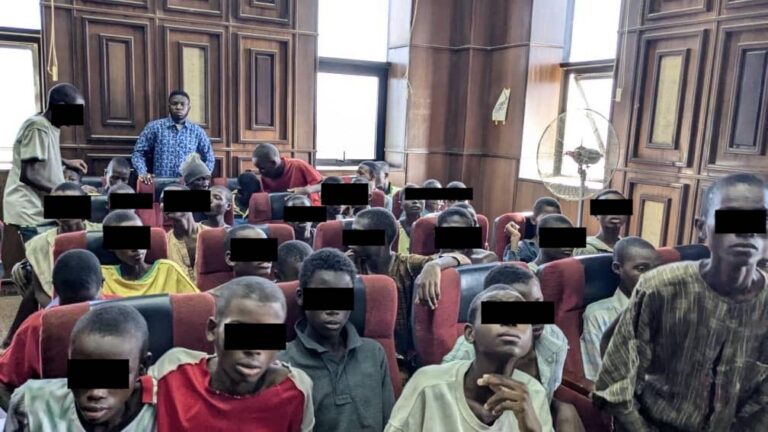
The ICIR reports that on Friday, November 1 2024, 76 suspects, mainly underage and appearing undernourished, were brought to court for charges related to the #EndBadGovernance protest. Some of them fainted and were quickly taken out of the courtroom.

After the arraignment, the court granted bail for each minor at N10 million, sparking criticism locally and internationally.

In a statement dated (archived here) November 1, but was posted on the force’s X page on Saturday, November 2, its spokesperson Muyiwa Adejobi, on behalf of the IGP, conveyed Egbetokun’s assertion that, according to Nigerian law, individuals who have reached the age of criminal responsibility are liable for their actions, irrespective of their age.

“Today, an unexpected incident in court saw six of the suspects suddenly rush out and faint, drawing media attention in a deliberate and scripted manner to attract negative attention.

Medical aid was promptly provided to these individuals, demonstrating the Police Force’s commitment to the welfare of those in its custody, irrespective of the allegations they face.” The statement read in part.

Egbetokun expressed that while the Nigeria Police Force is dedicated to delivering justice, it also remains mindful of individuals’ rights, including those of young people.

He explained that, under Nigerian law, individuals who have attained the age of criminal responsibility are held accountable for their actions, regardless of their age.

This approach, he noted, is consistent with global standards, where young offenders are also held responsible for serious crimes, as seen in countries like the United Kingdom. However, he emphasized that cases are handled with empathy and respect for human rights.

Egbetokun added that the charges against the suspects involved offenses such as destruction of public property and threats to national security.

He stated that the Nigeria Police Force recognises the public’s interest and guarantees that its officers will act professionally throughout while encouraging the public to approach the case fairly, emphasising the force’s commitment to transparency, adherence to best practices, and respect for both the rule of law and human dignity.

Interestingly, videos of the suspects in circulation showed them looking malnourished and frail. They have been in detention for over two months.

Nigerians outraged as government lawyer claims protesters in court not minors

THE narrative surrounding the arraignment of #EndBadGovernance protesters, including minors, has continued to spark public outrage after legal counsel revealed that all the 76 individuals arrested are ‘adults,’ not the minors the media has portrayed them to be. 

While addressing the media after the Friday proceeding, the counsel to the federal government, Rimazonte Ezekiel, labeled them as threats to national stability.

This declaration has fueled public anger against the Nigerian government and the police force, who many believe are desperate to try the minors and put them behind bail for protesting against the government.

Recall that, the minors who appeared in court on Friday, November 1, are being slammed with a 10-count charge bordering on alleged treason, as well as conspiracy to commit a felony with intent to destabilise Nigeria, an offence contrary to Section 96 and punishable under Section 97 of the Penal Code Act.

They were arrested and detained in August during the nationwide protest sparked by widespread economic hardship.

The ICIR reports how many Nigerians raised concerns regarding the severity of the charges, the due process afforded to the defendants, and the potential infringement on the rights of minors involved. 

Many took to social media to condemn the handling of the protests and urge the government to ensure justice.

The incident was heightened when some minors, who were among 76 persons set to be arraigned by the Nigerian Police Force (NPF), collapsed in the court on Friday, October 1.

One of the defendants, a minor who is under 18 years old, slumped while the judge was reading the charges.

The boy was taken to the court’s clinic with the lawyers present in the courtroom.

However, in response to this, Ezekiel stated that the boys captured in the video “followed their parents” to the courtroom, which contradicted the case file sighted by The ICIR, which listed the ages of the boys as below 18. 

His assertion also contradicted widely reported claims from both the media and the counsel for the defendants. 

Also, The ICIR gathered that in various cases, the Nigerian police have referred to some of the boys as minors, indicating they are below 18.

He said, “These boys that we brought to the court today are adults. Most of them are married men. None of them is a minor. Some of them are University graduates. The small kids you are seeing here today came with their parents to come and greet their loved ones.

“They are not even the real suspects standing trial in this case. These boys were arrested in Kaduna and Zaria. Do you know how much it costs us to be at this level of democracy in this country? These boys are trying to destabilise Nigeria using Russian flags and other countries while calling on the military to remove our president.

“Is it fair? To even remove the state governors. If they don’t want democracy again, are we forcing them? Everybody is enjoying their fundamental human rights. Nobody is abusing their rights. Everything is moving on well in the country only for these boys for no reason started protests with Russia and other countries’ flags.”

This characterisation has prompted backlash from lawyers and many Nigerians, who argued that the government is trying to paint the protesters as dangerous subversives instead of acknowledging their legitimate frustrations. 

In reaction, the governor of Kano State, Abba Kabir Yusuf, condemned the arraignment of teenagers in court during the court trial in Abuja

His said, “My attention has been drawn to the appearance of teenagers(some believed to be from Kano)in court today (November 1).

The commissioner of Justice has been instructed to act immediately on the issue mWe shall so everything possible to get them back to Kano,In sha Alla-AKY.,”the governor said in his official X account @Kyusufabba.

A human rights lawyer and former Head of Nigeria Human Rights Commission, Chidi Odinkalu reacted to the development in his official X handle @ChidiOdinkalu and queried the development.

“Did a Senior Advocate of #Nigeria,#SAN, actually sign a charge sheet to say there were adults? How is that not professional #malpractice?

In a similar vein, a senator, Natasha Akpoti-Uduaghan, has strongly condemned the long detention of minors involved in the recent #EndGovernanceprotests by the police authorities.

The lawmaker representing Kogi Central, in a statement issued in Lokoja on Saturday, November 2,by Arogbonlo Israel, her Chief Press Secretary, described the police action as “inhumane and unjust”.

According to her, detaining minors in a medium correctional facility is wrong and violates their fundamental human rights.

“This is because children should be tried in a juvenile court, where their identities are protected and not displayed or published in Court.

“I hereby urge the Controller of Prisons, Haliru Nababa, to investigate the detention conditions of juveniles at the Kuje prisons over improper facilities.

“Kuje medium security custodian centre is not designed for detaining children. The juvenile correctional facilities should be used instead,” she said

Nigeria’s universities need to revamp entrepreneurship courses – they’re not meeting student needs

0

By Abiodun Egbetokun, De Montfort University and Adedayo Olofinyehun, National Centre for Technology Management (NACETEM)

YOUTH unemployment has been a problem in Nigeria for decades. This is why policymakers are increasingly turning to entrepreneurship education as a solution. It is hoped that entrepreneurship will reduce reliance on formal jobs and create more opportunities for self-employment.

The unemployment rate stood at 5.3 per cent in the first quarter of 2024, representing a third consecutive increase since the second quarter of 2023. This is close to the 2023 global unemployment rate of 5.1 per cent.

Researchers and policymakers globally view entrepreneurship education as a key solution to youth unemployment.

Nigerian universities have been required since 2006 to teach at least one entrepreneurship course to undergraduates before graduation. All university undergraduates, no matter their course of study, receive entrepreneurship education before graduation.

This is clearly motivated by evidence that graduates who start businesses are most likely to start businesses that employ more workers over time. This should reduce unemployment, especially youth unemployment.

Admittedly, not all high-growth businesses are started by university graduates. However, global evidence shows that the most successful entrepreneurs are also highly educated.

18 years of entrepreneurship education

It is now 18 years since Nigerian universities were required to teach entrepreneurship. There have been limited studies evaluating the impact of the programme. Also, many of these evaluations use small samples and cover only one or two years. Their methodologies equally do not allow for definitive conclusions about the policy’s effectiveness.

As experts on innovation, entrepreneurship and economic development, we recognise that rigorous, long-term evaluations can provide deeper insights. We decided to address these limitations employing a more robust research design.

Our study sought to determine whether entrepreneurship education has had an impact on students. We used data from a sample of over 12,000 Nigerian undergraduates. The results show that despite a strong positive impact at first, the longer the policy has been in place, the weaker its effect.

Declining impact over time

Our latest analyses were based on a pooled dataset from four waves of surveys collected in 2007, 2011, 2016 and 2020/21.

We found that the entrepreneurship course initially had a strong positive impact on students’ expressed intent to start a business. However, this effect had weakened by 2021. The later sets of students did not express as strong an interest in starting a business as the earlier sets of students did.

We compared 12,000 students from six universities. Three started teaching entrepreneurship in 2007, others after 2011. We used advanced statistical methods to compare the students from the two groups of universities. One method helped us see the changes over time in each group. The other method ensured we compared similar types of students to get a fair result.

In 2007, 89 per cent of the students expressed interest in starting a business, while in 2021, 82 per cent did so.

Initially, more (93.7 per cent) students from the universities that started the course earlier were interested in becoming entrepreneurs compared to (73.1 per cent) students at universities that introduced the course later.

By 2016, the difference between the two groups of universities had disappeared (91.4 per cent v. 93.6 per cent).

By 2021, students from universities that started the course later showed greater (95.7 per cent) interest in entrepreneurship than those (70.1 per cent) from the earlier-starting universities.

The results imply that the longer the policy had been implemented in a university, the less its effect. And this raises the need for continuous monitoring of the policy’s effectiveness.

Our research shows that the entrepreneurship course does not fully meet students’ needs. Further, the quality of teaching fluctuates as lecturers change. More importantly, neither the universities nor the national universities commission consistently monitor the course success.

Policies can have different effects

In our study, we introduced a new way to categorise the different types of effects that a policy or programme can have. This helps us understand the immediate effects and how a policy works over time with different target groups.

For example, if the entrepreneurship education policy improved students’ interest in entrepreneurship last year, will it have the same effect on a new group of students this year, assuming nothing else changes? Answering questions like this will support the design of effective policies.

We identified instantaneous impact as the immediate effects observed shortly (five years) after the policy was implemented. Persistent impact means that the effects of the policy on a group of students last for a long time. This is usually between seven and 10 years after the course.

Cumulative impact involves the additional effects that stem from subsequent interventions. Such include business incubation or small grants to start a business. Consistent impact describes the recurring effects observed across different student cohorts over time. This helps in assessing the broader implications of policy initiatives.

This categorisation offers a plausible explanation for our result. While the policy had an immediate positive effect, it did not maintain the same impact on different groups of students over time. This highlights an important issue: the lack of ongoing evaluation and adaptation of how the policy is implemented. Policies, especially those aimed at education and skill development, must respond and adapt to changing circumstances. Without continuous monitoring even the most well-intentioned policies can become ineffective.

Way forward

Evaluations of educational interventions should be carefully designed to capture both immediate and long-term effects.

Then the curriculum and teaching methods can be modified to better align with the diverse needs of students – and the demands of industry.

The results of these evaluations should be openly shared with university administrators, lecturers, students and the public. There should also be clear accountability for making any recommended changes. This approach fosters trust and ensures that the system evolves to meet the demands of the labour market.

This approach is used in Finland, where the Finnish Education Evaluation Centre’s enhancement-led evaluation ensures that institutions consistently improve their educational offerings.The Conversation

Abiodun Egbetokun, Senior lecturer, Business Management, De Montfort University and Adedayo Olofinyehun, Researcher, National Centre for Technology Management (NACETEM)

This article is republished from The Conversation under a Creative Commons license. Read the original article.

AGF orders police to transfer #EndBadGovernance protesters case file amid outrage

0

AMID widespread outrage over the arraignment of minors among #EndBadGovernance protesters, the Attorney General of the Federation (AGF) and Minister of Justice, Lateef Fagbemi, has ordered the Nigeria Police Force to transfer the case file to his office for immediate review.

In a statement on Friday, November 1, Fagbemi cited the need for a comprehensive review to determine the next steps, while assuring his commitment to a fair process.

The minors are being slammed with a 10-count charge bordering on alleged treason, as well as conspiracy to commit a felony with intent to destabilise Nigeria, an offence contrary to Section 96 and punishable under Section 97 of the Penal Code Act.

They were arrested and detained in August during the nationwide protest, which was sparked by widespread economic hardship.

“There are some issues my office will need to look into regarding the matter to enable me to take an informed decision,” Fagbemi said in a statement.

This decision followed a nationwide outcry and calls for a fair reassessment of the charges and legal handling of the protestors, many of whom were charged with treason.

The initial arrests and subsequent arraignment of protesters—charged with treason and other offences—have drawn widespread criticism, especially as minors were among those detained. 

The ICIR reports how many Nigerians raised concerns regarding the severity of the charges, the due process afforded to the defendants, and the potential infringement on the rights of minors involved. 

Many of whom took to social media, condemning the handling of the protests and urging the government to ensure justice.

The incident was heightened when some minors, who were among 76 persons set to be arraigned by the Nigerian Police Force (NPF), collapsed in the court on Friday, October 1.

One of the defendants, a minor who is under 18 years old, slumped while the judge was reading the charges.

The boy was taken to the court’s clinic with the assistance of lawyers present in the courtroom.

While Fagbemi acknowledged the court’s authority, stating, “It is not within my power to alter the remand order or the January adjournment,” he expressed his intention to expedite the legal process. 

“I have directed the Nigeria Police to transfer the case file to my office and hand over [the] same to the Director of Public Prosecution of the Federation (DPPF) tomorrow, Saturday, 2nd November 2024,” he stated.

The AGF further directed that the case file be handed over to the Director of Public Prosecution of the Federation (DPPF) by Saturday, November 2, 2024. 

He instructed the DPPF to prepare a formal application for a revised, sooner court date, saying, “I have directed the DPPF to immediately put machinery in motion for consideration of the court to bring the adjournment date forward.”

The ICIR reported earlier that the Federal High Court, Abuja, has granted bail in the sum of N10 million each to minor #EndBadGovernance protesters who were arraigned for participating in the August 2024 protest on Friday.

Some minors who were sent to Kuje prison for not meeting the N10 million bail each granted them by the court  were subsequently rejected by officials at the facility.

According to reports, the minors who were granted bail on Friday, November 1, are under the age of 18 years, and in addition to the bail money, they were expected to provide one surety, who needs to be a civil servant.

But when they could not meet their bail condition, they were taken to the Kuje Correctional Centre.

Narrating what transpired at the Kuje Correctional Centre, the executive director (ED) of Hope Behind Bars, Funke Adeoye, stated that on getting to Kuje, 27 minors were rejected and were subsequently taken to the office of the Intelligence Response Team (IRT) in Abuja.

According to her, the prosecution team was trying to use a single remand warrant for all 27 minors, and the officers at Kuje rejected this and insisted that individual warrants are required for each minor.

Kuje prison officials reject underage #EndBadGovernance protesters

SOME minors among the #EndBadGovernance protesters who were sent to Kuje prison for not meeting the N10 million bail each granted them by the Federal High Court (FHC) Abuja have been rejected by officials at the facility.

According to reports, the minors who were granted bail on Friday, November 1, are under the age of 18 years, and in addition to the bail money, they were expected to provide one surety, who needs to be a civil servant.

But when they could not meet their bail condition, they were taken to the Kuje Correctional Centre.

Narrating what transpired at the Kuje Correctional Centre, the executive director (ED) of Hope Behind Bars, Funke Adeoye, stated that on getting to Kuje, 27 minors were rejected and were subsequently taken to the office of the Intelligence Response Team (IRT) in Abuja.

According to her, the prosecution team was trying to use a single remand warrant for all 27 minors, and the officers at Kuje rejected this and insisted that individual warrants are required for each minor.

She added that the correctional officers also expressed concern about the potential risk of holding the minors at Kuje, citing the possibility of sexual assault by other inmates.

Other sources also raised issues on the whereabouts of the remaining minors. According to a reliable source, 38 minors were taken to Kuje, but only 27 were counted at the facility and sent to IRT, which raised the question of where the others were.

The ICIR reported earlier that the FHC, Abuja, has granted bail in the sum of N10 million each to minor #EndBadGovernance protesters who were arraigned for participating in the August 2024 protest on Friday.

They are being slammed with a 10-count charge bordering on alleged treason, as well as conspiracy to commit a felony with intent to destabilise Nigeria, an offence contrary to Section 96 and punishable under Section 97 of the Penal Code Act.

They were arrested and detained in August during the nationwide protest in the country, which was sparked by widespread economic hardship.

They were arrested in Abuja, Kaduna, Gombe, Jos, Katsina and Kano.

However, confusion ensued in the court earlier when some minors, who were among 76 persons set to be arraigned by the Nigerian Police Force (NPF), collapsed in the court.

One of the defendants, a minor who is under 18 years old, slumped while the judge, Egwuatu, was reading the charges.

The judge had to quickly stop the proceedings and go back to his chambers because of the event.

The boy was taken to the court’s clinic with the assistance of lawyers present in the courtroom.

According to the charge, which was signed by a group of police lawyers headed by Simon Lough, the defendants and other people who are still at large allegedly conspired to commit a felony in Abuja and Kano between July 31 and August 4 while acting in concert and to destabilise Nigeria.

In August, many Nigerians trooped to the streets between August 1 and 10, 2024, to protest poor governance and economic hardships, which were said to have been caused or increased by President Bola Ahmed Tinubu’s reforms.

The protests were marred with violence, largely caused by the security operatives in places like Lagos and Abuja, where protesters were subjected to tear gas and harassment.

The tweets on the protest carry different hashtags, ranging from #RevolutionNow, #EndBadGovernanceInNigeria, #TakeItBack, #DaysofRage, and #TinubuMustGo.

Tinubu rejects NEC’s call to withdraw tax reform bills

0

PRESIDENT Bola Tinubu has declined the National Economic Council’s (NEC) recommendation to withdraw the proposed tax reform bills from the National Assembly.

The president instead urged the council and other stakeholders to allow the legislative process to address any issues through public consultation and debate. 

This response followed recommendations from the National Economic Council (NEC) to withdraw the proposed tax reform bills currently before the National Assembly.

According to a statement issued on Friday, November 1, by the president’s special adviser on information and strategy Bayo Onanuga, the president believes that the ongoing legislative process, including public hearings, provides ample room for necessary adjustments. 

The statement also emphasised that the bills should remain in legislative proceedings, with input welcomed at various stages, rather than undergoing withdrawal.

The ICIR reports that the new tax framework is part of the government’s plan to increase non-oil revenue amid fiscal challenges.

Given the rapid expansion in the telecoms and betting sectors, authorities are seeking to broaden the nation’s revenue base.

However, NEC cited on Thursday, October 31, the need for more consultations and consensus-building among Nigerians before the bills are transmitted to the National Assembly.

According to Oyo State Governor Seyi Makinde, who briefed newsmen after the meeting, the council acknowledged Nigeria’s underperformance in major revenue sources, including the tax-to-GDP ratio and other critical indicators.

Makinde also noted that NEC agreed that more sensitisation on the bill would foster consensus building and help Nigerians have a better understanding of the bills.

Meanwhile, acknowledging some points of contention, Tinubu stated that while diverse perspectives may exist, the urgency to realign Nigeria’s tax laws with global standards and foster national development takes precedence. 

He reiterated that the reforms are intended to address longstanding inefficiencies and better equip Nigeria for economic growth. 

Tinubu also assured that his administration would continue to welcome advice from the NEC and engage with stakeholders as the bills advance through the National Assembly.

On October 20, The ICIR reported that the Federal Government, through one of the bills, proposed a five per cent excise duty on telecommunications services, gaming, and betting activities.

The bill, titled “A Bill for an Act to Repeal Certain Acts on Taxation and Consolidate the Legal Frameworks Relating to Taxation and Enact the Nigeria Tax Act to Provide for the Taxation of Income, Transactions, and Instruments, and Related Matters,” is dated October 4, 2024.

However, it exempted baby products and locally manufactured sanitary towels from tax as part of the process to overhaul Nigeria’s tax framework.

According to the statement on Friday, the bill seeks to eliminate multiple taxation and make Nigeria’s economy more competitive by simplifying tax obligations for businesses and individuals nationwide.

While it also proposes new rules governing the administration of all taxes in the country, the bill is said to seek the re-establishment of the Federal Inland Revenue Service (FIRS) as the Nigeria Revenue Service (NRS) to better reflect its mandate as the revenue agency for the entire federation, not just the Federal Government.

“The Joint Revenue Board Establishment Bill: This Bill proposes creating a Joint Revenue Board to replace the Joint Tax Board, covering federal and all state tax authorities. The fourth bill will also establish the Office of Tax Ombudsman under the Joint Revenue Board, protecting taxpayers’ interests and facilitating dispute resolution.

“The bills’ overarching objective is to effectively coordinate federal, state, and local tax authorities, thereby eliminating the overlapping responsibilities, confusion, and inefficiency that have plagued tax administration in Nigeria for decades. 

“Under existing laws, taxes like Company Income Tax (CIT), Personal Income Tax (PIT), Capital Gains Tax (CGT), Petroleum Profits Tax (PPT), Tertiary Education Tax (TET), Value-Added Tax (VAT), and other taxing provisions in numerous laws are administered separately, with individual legislative frameworks,” the statement added.