TUNDE Ednut, a popular social media influencer and blogger, has claimed that the House of Representatives has split Oyo state into two states.
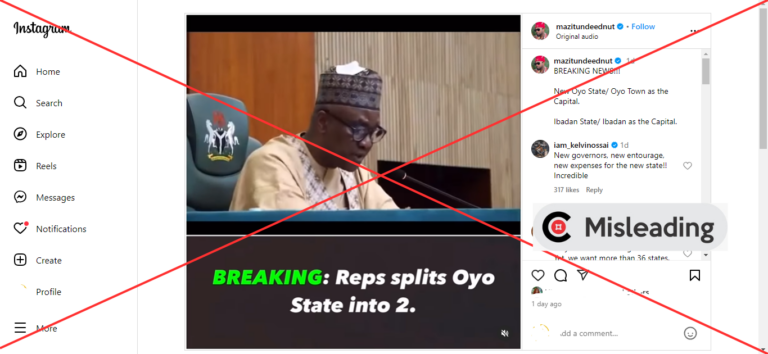
He made the claim in a post on Instagram as a caption to a 2+ minutes long video.
In the video, the speaker of the House of Representatives, Tajudeen Abass could be heard seeking the motion to pass the bill through a second reading.
Part of the video transcribed reads thus:
“The second order of the day is commencement of debate on the general principles of a bill for an act to alter the constitution of the Federal Republic of Nigeria 1999as amended to create new Oyo state with Oyo town as the capital city from Oyo state.Effect consequential change of the name of the remaining part of Oyo stateto Ibadan state with Ibadan city as capital city and define the local government areascomprising the two states and for related matters. Standing in the name of in the names ofHonorable Adeyemi Akeem Adeniyi and six others.
Honourable members who recall that the bill wasread the first time on Thursday, October 10, 2024. I now invite Honourable Adeniyi to move that the bill be read a second time.”
The caption alongside the video read:
BREAKING NEWS!!! New Oyo State/ Oyo Town as the Capital. Ibadan State/ Ibadan as the Capital.
This is followed by the inscription on the video which reads Breaking : Reps split Oyo state into 2
The post as at Wednesday, October 23, 2024, has gained a traction of over 52,000 likes, 6,327 comments and 10,800 reshares.
CLAIM
House of Representatives split Oyo state into 2 states.
THE FINDINGS
Findings by The FactCheckHub shows that the claim is MISLEADING!
Screenshot of the claim extracted from Instagram; Insert MISLEADING verdict
On Tuesday, October 22 2024, media organisations like The Cable, Premium Times and The Punch reported that a bill proposing the division of Oyo into two new states has passed its second reading in the House of Representatives.
Co-sponsored by Akeem Adeyemi from Oyo and six other lawmakers, the constitutional amendment bill was advanced during Tuesday’s plenary session. The bill aims to create a New Oyo state, with Oyo town as its capital, while renaming the remaining part of the state as Ibadan State, with Ibadan city as the capital.
In Nigeria, for a bill be passed to an act it has to pass through several stages such as the ;
Proposal stage, or the identification for the need of a bill
First reading
Second reading
Committee stage : where the analysis of the bill may include a public hearing where members of the public are invited to provide input, with their feedback being considered in the review process.
Third reading
Signing of the bill
Presidential assent; The approved version of the bill from both chambers is sent to the president for signature. The president’s signature is necessary to turn the bill into law, and according to Section 58(4) of the Constitution, the president must sign the bill within 30 days of receiving it.
Currently, the bill to split Oyo state into two has not been assented and the minority leader, Tajudeen Abass, has only forwarded the bill to the Committee on Constitutional Review for additional legislative action.
While the contents of the video are accurate, the keywords and captions used by the claimant depicts otherwise thereby making the headline misleading and a clickbait.
Clickbait headlines typically emphasize sensationalism rather than accuracy, contributing to the spread of disinformation. This approach can distort public perception of various issues, as readers might focus solely on misleading headlines without grasping the actual facts behind them.
THE VERDICT
The claim that the House of Representatives split Oyo state into 2 states is misleading; it is a clickbait headline. The bill has only passed its second reading and has been forwarded to the committee on constitutional review.
This report was republished from the Factcheckhub, read it here.
PRESIDENT Bola Tinubu has restricted the number of vehicles assigned to ministers and heads of federal agencies to three, in what he described as a measure to reduce the cost of governance.
In the directive, issued on Thursday, October 24, the President stated that no extra vehicles would be provided for their movement.
The statement, signed by the special adviser to the president on information and strategy, Bayo Onanuga, showed that the security team of the ministers and agency heads is limited to five personnel – four police officers and one State Security Services (SSS) officer.
“President Tinubu instructed the national security adviser to engage with the military, paramilitary and security agencies to determine a suitable reduction in their vehicle and security personnel deployment.
“All affected officials are expected to comply with these new measures immediately, underscoring the urgency and seriousness of these changes,” the statement added.
This move comes as Nigeria grapples with economic challenges, with citizens facing rising costs of living, spurred by fuel subsidy removal and inflation.
Tinubu had previously reducedthe number of officials on foreign and local trips.
The president reduced his foreign entourage from 50 to 20 and limited domestic trips to 25 officials.
The Vice President’s foreign and local delegations were similarly reduced to five and 15 officials, respectively.
The reduction in entourage also affects government officials across ministries, departments and agencies (MDAs).
“President Bola Tinubu has approved that anywhere he travels within this country, he will no longer accept or allow huge security delegations to be following him from Abuja, which attracts massive bills with respect to estacode and duty allowances from now on.
The ICIR reports that since Tinubu came into power, Nigeria has been experiencing significant economic hardship, driven by surging inflation, the floating of the naira, and the removal of petrol subsidy.
Tinubu’s announcement that the “subsidy is gone” on May 29, 2023, negatively impacted the economy as the price of fuel had more than doubled since then. This led to a surge in the price of commodities and a spike in inflation.
Following this removal, the World Bank announced that 7.1 million Nigerians were at risk of poverty if properly targeted measures such as disbursement of palliatives were not taken to manage the impact of fuel subsidy removal.
To cushion the effects of escalating food prices, electricity costs, and fuel expenses, the government has been doling out rice multiple times as palliatives targeted at vulnerable Nigerians.
However, these interventions have been plagued by reports of diversion, corruption, stampedes, and looting – patterns observed during previous administrations.
NOBEL Peace Prize laureate and Rappler co-founder, Maria Ressa, has expressed concerns over the growing toxicity of social media debates ahead of the U.S. elections.
She said the situation had been worse than what was experienced in the Philippines.
Speaking at the Thomson Reuters Foundation’s annual Trust Conference in London, Ressa described the findings from a Rappler review titled “2024 study on the US information ecosystem” as scary.
She said the U.S. information ecosystem had been “way worse than anything we have lived through in the Philippines”.
Ressa’s warnings come against the backdrop of a broader conversation about the global crisis of public trust, especially in the U.S., where the information ecosystem has become increasingly fractured.
Rappler’s studyrevealed how misinformation, disinformation, and political tribalism have fundamentally reshaped how Americans consume and trust information. According to the study, social media platforms, initially hailed for democratising access to information, have instead evolved into “amplifiers of hate and division.”
The study, which analysed three years of social and traditional media coverage of the most divisive issues in American society, shows that America faces huge challenge ahead of the November elections.
It further highlighted how the algorithms driving these platforms prioritise sensational content that deepens societal divides, making it difficult for voters to access reliable, fact-based information.
It noted that politicians and foreign actors had also exploited these platforms, turning them into powerful tools of disinformation and geopolitical manipulation.
While emphasising the alarming levels of polarisation and manipulation permeating the U.S. information ecosystem, Ressa explained how these dynamics have been worsened by the influence of social media platforms.
She also noted the dangers posed by disinformation and manipulation on social media platforms, pointing out that six out of ten Americans get their information from social media, which she referred to as “the human sewer.”
“Sixout of 10 Americans get their information from the human sewer – that is social media. How are we going to have a public information ecosystem that isn’t motivated by surveillance for profit? That isn’t insidiously manipulating us? That isn’t taking tools of advertising and putting them in the hands of geopolitical powers? In two weeks, the entire world is going to go check to see what the state of the world will be as a result.”
Ressa called for the development of alternative solutions and advocated for the creation of “deliberative technologies,” new digital tools designed to facilitate healthy public discourse.
These tools, Ressa said, could be a game-changer in the fight against disinformation and polarisation, creating spaces where “real people to have real conversations, without being manipulated for profit.”
The ICIR reports that Americans head to the poll on November 5, 2024, to elect their next president.
The two leading contenders – incumbent vice president and Democratic candidate, Kamala Harris, and the Republican flag-bearer, Donald Trump, are set to face off in what is anticipated to be one of the most factious elections in U.S. history.
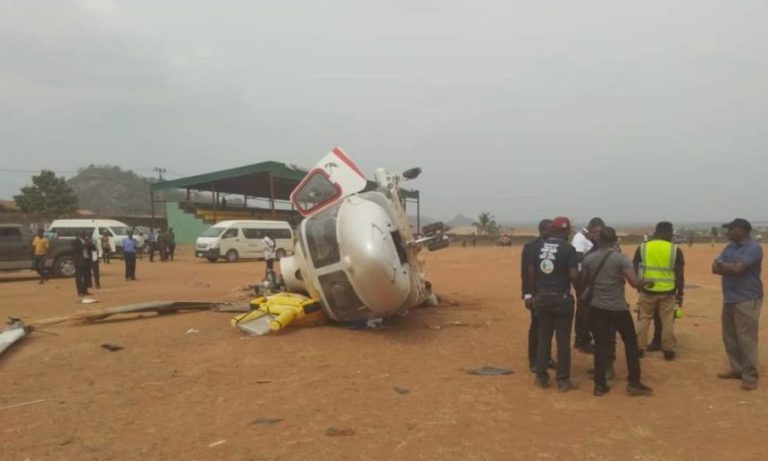
THE Ministry of Aviation and Aerospace Development confirmed three persons dead in a helicopter crash on Thursday, October 24, in Port Harcourt, Rivers State capital.
The ministry confirmed this in a statement released from the office of the minister, Festus Keyamo, and signed by the head of press and public relations, Odutayo Oluseyi.
According to the statement, the incident occurred at about 11:22 a.m. along the waterways in Port Harcourt.
The helicopter, a Sikorsky SK76 with registration 5NBQG and operated by East Wind Aviation, was en route from Port Harcourt Military Base (DNPM) to the Nuimantan oil rig when it crashed.
Eight persons were confirmed on board the aircraft.
“The Federal Ministry of Aviation has received the distressing report of a helicopter accident that occurred today, 24th October 2024, at about 11:22 am along the waterways in Port Harcourt.
“The aircraft, with eight persons on board, ditched into the waters near Bonny Finima in the Atlantic Ocean,” the ministry said.
The Nigerian Safety Investigation Bureau (NSIB) has been notified and emergency response teams were immediately activated, while search and rescue operations are ongoing with the support of the Nigerian Search and Rescue Unit, the Nigerian Civil Aviation Authority (NCAA), the National Safety Investigation Bureau (NSIB), and other relevant agencies, it said, adding that the neighbouring aerodromes had also been notified for support.
“While no emergency locator transmitter (ELT) signal was received, manual efforts to plot the location of the accident are underway, and all available resources, including the military and low-flying aircraft, have been deployed to assist in locating and rescuing any survivor(s). So far, three bodies have been recovered,” the ministry added.
According to the ministry, the minister of aviation, Festus Keyqmo, is working with all relevant agencies to ensure a coordinated response and to minimise casualties from the incident.
“Further information will be provided as details emerge. Our thoughts and prayers are with the families of those on board, and we are committed to providing the necessary support during this difficult time, Oluseyi stressed.
The ICIR reports that there has been a spate of helicopter crashes in recent times, resulting in casualties and loss of lives.
In December 2023, a Nigerian Air Force (NAF) helicopter with registration number NAF MI-35P crashed in Port Harcourt shortly after it took off for an operation against economic saboteurs in the oil-rich South-South state. The entire crew of five persons survived, but with various injuries.
In August 2023, a small aircraft crashed in the Oba Akran area of Ikeja, Lagos, and burst into flames. The four persons onboard narrowly survived the incident.
The ICIR also reported series of helicopter crash incidents such as the one that occurred in August 2020, when a helicopter operated by Quorum Aviation crashed in the Opebi area of Lagos, leaving three of those onboard dead.
In another deadly crash, the late chief of Army Staff, Ibrahim Attahiru, and 10 personnel were onboard the NAF Beechcraft 350 aircraft in May 2021 when it crashed near the Kaduna International Airport, killing all 11 military officers.
PRESIDENT Bola Tinubu has forwarded the names of new ministers he appointed on Wednesday, October 23, to the Senate for confirmation.
The President’s request was contained in a letter addressed to the Senate President, Godswill Akpabio, and read during plenary on Thursday, October 24.
According to the letter, the ministerial nominees are Bianca Onoh, the widow of the late Ikemba of Nnewi, Chukwuemeka Ojukwu, (minister of state for foreign affairs), Muhammadu Dingyadi (minister of labour and productivity), Jumoke Oduwole (minister of industry, trade, and investment), and Yusuf Abdullahi Ata (minister of state, housing, and urban development)
The list includes Idi Muktar Maiha (minister of livestock development), Suwaiba Ahmad (minister of state for education), and Nentawe Yilwatda (minister of humanitarian affairs and poverty reduction)
Tinubu sought quick consideration of his request by the Senate.
The Senate immediately referred the request to the committee of the whole for consideration.
The ICIR reported that Tinubu fired five of his ministers on Wednesday.
He also sacked the minister of humanitarian affairs and poverty reduction, Beta Edu, whom he suspended in January over corruption allegation.
This decision was contained in a message posted on X by the presidency on Wednesday, October 23.
The ministers sacked are Uju Kennedy-Ohanneye (women affairs), Lola Ade-John (tourism), Tahir Mamman (education), Abdullahi Muhammad Gwarzo (state, housing, and urban development), and Jamila Bio Ibrahim (youth development).
The President also announced Sunday Dare, former minister of youth and sports, as his special adviser on public communication and orientation.
The President also reshuffled some ministers. Those affected include Uba Maigari Ahmadu from the Ministry of Steel Development to the new Ministry of Regional Development as Minister of State; Doris Uzoka-Anite from the Ministry of Industry, Trade, and Investment to the Ministry of Finance as Minister of State.
Similarly, minister of sports, John Owan Enoh, was moved to the Ministry of Industry, Trade, and Investment as Minister of State; Imaan Suleiman-Ibrahim, was redeployed as minister of state, Police Affairs Ministry, to the Ministry of Women Affairs; Ayodele Olawande, former minister of state for youth development, was promoted to full minister at the ministry; and Salako Iziaq Adeboye was moved from the Ministry of Environment to the Ministry of Health as minister of state.
Others are Yusuf Tanko Sununu from the Ministry of Education to the Ministry of Humanitarian Affairs and Poverty Reduction as minister of state; Moruf Olatunji Alausa was moved from the Ministry of Health to the Ministry of Education as the minister of state; and Bello Goronyo from Water Resources and Sanitation to the Ministry of Works as minister of state.
THE regulatory arm of the Nigerian Exchange Group (NXG), has suspended the trading of Oando Plc’s shares on the exchange floor for non-compliance with regulatory rules.
The suspension takes effect from Thursday, October 24, according to NGX Regulation Limited (NGX RegCo), a wholly-owned subsidiary of the NGX Group.
It said Oando, an indigenous oil firm, had yet to submit its audited financial statements for the year ended December 31, 2023.
In a notice to trading licence holders signed by the head of the issuer regulation department, Godstime Iwenekhai, on Thursday, NGX RegCo noted that Oando had violated provisions of Rule 3.1 for filing of accounts and treatment of default filing, (default filling rules).
It cited the rule as stating that if an issuer fails to file the relevant accounts by the expiration of the cure period, the exchange will: Send to the issuer a second filing deficiency notification’ within two (2) business days after the end of the cure period; suspend trading in the issuer’s securities, and notify the Securities and Exchange Commission (SEC) and the market within twenty-four (24) hours of the suspension.
“Trading in the shares of Oando Plc has been suspended from the facilities of Nigerian Exchange Limited (NGX or The Exchange) effective today, Thursday, 24 October 2024 for not filing their audited financial statements for the year ended 31 December 2023,” the NGX RegCo said.
The ICIR can report that this is the second time in a year that Oando’s shares have been suspended from trading in the stock market.
In March, the Johannesburg Stock Exchange suspended trading in Oando shares due to its inability to meet the extended deadline to publish its 2022 audited financial statements after failing to meet the deadline to publish its interim results for 2023.
In June, however, the Johannesburg Stock Exchange lifted the suspension.
In a notification to the NGX and the investing public on July 3, Oando said the company would not be able to meet the expected filing date of July 31 earlier communicated to the public on April 8, 2024.
It stated in the notification, “In accordance with the extension applied for and granted by the NGX, the company expects to publish its 2023 audited financial statements and Q1 and Q2 2024 management accounts by Monday, September 30, 2024, thereby bringing up to date all its outstanding financial reporting obligations.
Further, the oil firm apologised for any inconvenience caused by its delay and promised to keep the market informed of any updates regarding the current situation.
In another corporate notice filed with the NGX earlier in October, Oando blamed the delay on its recent acquisition of Nigerian Agip Oil company.
The deal completed on August 22 this year where Oando acquired a 100 per cent divestment of Italian firm Eni onshore Nigerian assets, attracted a lot of controversies.
The controversies came following Oando’s unhealthy financial positions posted between 2019 and 2021 and the surprise that the company could acquire the Italian firm’s assets at about $500 million.
Controversies further trailed Oando’s acquisition of the Italian oil assets under its group chief executive, Adewale Tinubu, said to be the nephew of President Bola Tinubu, within a year of his office.
In June 2022, The ICIRreported that Oando faced huge financial losses and was on the verge of voluntary delisting from the Nigerian stock market.
The ICIR also reported in 2023 that Oando’s independent auditor, BDO Professional Services Chartered Accountants, in their auditor’s report, expressed worries over the company’s ability to continue as a going concern.
In its unaudited results for 2023, Oando reported that it rebounded from an N78.71 billion loss in 2022 to a N74.7 profit in 2023.
KEBBI and Akwa Ibom states have joined the growing list of Nigerian states ready to implement the new minimum wage for workers.
This development followed President Bola Tinubu’s signing of the new minimum wage bill into law in July, ending months of deliberations between government representatives, labour unions, and the private sector.
The President assented to the bill seeking N70,000 for workers on Monday, July 29, at the State House in Abuja, barely a week after the National Assembly passed it.
The revised minimum wage aimed at alleviating hardship faced by public sector employees, following fuel subsidy removal and other economic reforms by Tinubu’s government that have made life unbearable for most citizens.
Nigerian governors had opposed the N60,000 minimum wage initially proposed by the Federal Government.
The governors rejected the proposal in a statement by the director of media and public affairs of the Nigeria Governors’ Forum (NGF), Halimah Ahmed, on Friday, June 7.
Meanwhile, The ICIR can report that no fewer than 17 states have expressed readiness to implement the new minimum wage, with both Kebbi and Akwa Ibom state governments recently expressing their commitment to ensuring that workers receive the new wage as soon as the necessary processes are finalised.
On Wednesday, October 23, Kebbi State Governor Nasir Idris approved a new minimum wage of N75,000 for civil servants in the state.
Similarly, Akwa Ibom State Governor Umo Eno approved a new minimum wage of N80,000 for public servants in his state.
Other states, including Lagos, Ogun, Rivers, and Kogi have already approved similar wage adjustments, with some going as high as N85,000.
In the case of Lagos, The ICIRreported that the state Governor Babajide Sanwo-Olu, on October 16, approved N85,000 minimum wage for the state workers.
Also, Rivers State Governor Siminalayi Fubara approved a new minimum wage of N85,000 for civil servants in his state on October 18.
For Ogun, Gombe, and Ondo, the state governments have approved N77,000,N71,451.15, and N73,000 for their workers respectively.
This was as the Kogi State Governor Usman Ododo approved N72,500 minimum wage for the state’s civil servants.
Anambra and Borno have indicated their intention to begin paying the new minimum wage in October.
Adamawa, Ebonyi, Katsina, Kwara, and Delta have also announced the approval of the new monthly minimum wage of N70,000.
Similarly, Oyo, Osun and Benue State have expressed readiness to adopt the new minimum wage.
However, states including as Zamfara, Niger, Sokoto, and Jigawa have not yet disclosed if and when they will be paying the new wage.
The ICIRreported that the Zamfara government had only stated that it would begin paying the previous minimum wage of N30,000 in May 2024.
The state‘s readiness was coming five years after the N30,000 was signed into law by former president Muhammadu Buhari.
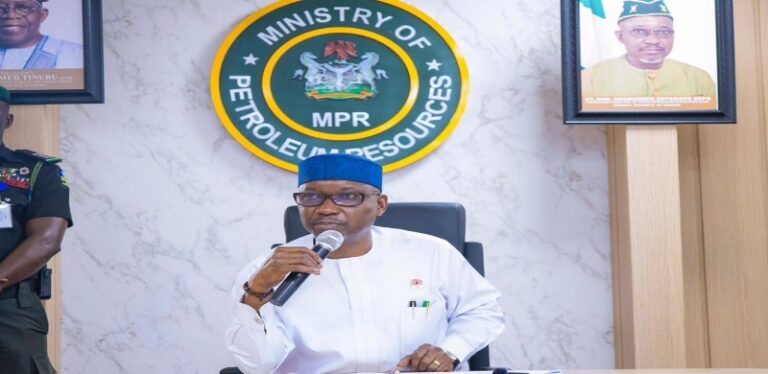
THE minister of state Petroleum Resources (Gas), Ekperikpe Ekpo, has expressed worries over the increasing cost of liquefied petroleum gas (LPG), commonly known as cooking gas.
He declared that it is unacceptable for Nigerians to be paying for the product at a premium price.
The minister spoke on the sidelines of a stakeholders meeting held in Abuja on Tuesday, October 22.
“As minister of state for petroleum resources (gas), I am deeply concerned about the persistent rise in the price of cooking gas.
“It is unacceptable that Nigerians pay premium prices for a commodity that we produce in abundance,” Ekpo lamented in a statement shared on his X handle..
He said despite previous efforts, including the establishment of a high-level committee led by Farouk Ahmed, the chief executive of the Nigerian Midstream Downstream Petroleum Regulatory Authority (NMDPRA), to address the issues, the price of cooking gas has continued to fluctuate.
He observed that, recently, the price of cooking gas has reached as high as N1,500 per kilogram from an average of N1,100–N1,250.
“On Tuesday, I convened a meeting with key stakeholders in Abuja to address these price increases and the hardship they bring to Nigerians,” Ekpo said.
The minister then directed the regulatory authorities to carry out short and long-term measures to address the skyrocketing price of cooking gas, worsening hardships faced by Nigerians.
On short-term measures, Ekpo said the NNPCL and LPG producers must halt exports of LPG produced in-country or import equivalent volumes at cost-reflective prices, effective from November 1.
He also directed the NMDPRA to engage stakeholders to create a domestic LPG pricing framework within 90 days, focusing on the cost of local production rather than external market indices like those from the Americas or Asia.
On long-term plans, he said, “Within 12 months, we will develop facilities to blend, store, and deliver LPG domestically. Exports will cease until the market achieves stability and sufficiency.”
The minister believes that the measures are essential to improving LPG availability, stabilising prices, and easing the economic burden on Nigerians.
“Our goal is to ensure that every Nigerian can access affordable cooking gas,” Ekpo said.
In its monthly report on LPG released on Thursday, October 17, the National Bureau of Statistics said the average retail price for refilling a 5kg cylinder of cooking gas increased by 4.19 per cent on a month-on-month basis from N6,430.02 in August to N6,699.63 in September.
On a year-on-year basis, it surged by 59.90 per cent from N4,189.96 in September 2023.
Also, the report showed that the average retail price for refilling a 12.5kg cylinder of cooking gas increased by 4.89 per cent on a month-on-month basis from N15,552.56 in August to N16,313.43 in September.
On a year-on-year basis, it rose by 76.41 per cent from N9,247.40 in September 2023.
The increasing cost of cooking gas has forced many Nigerians to shift the use of sawdust charcoal and firewood to make a living, amid their damaging effects on human health.
In a report, The ICIR revealed how constant exposure to smoke from cooking with firewood puts people at risk of respiratory issues and bad eyesight.
THE first part of this report exposed the excessive number of checkpoints along one of West Africa’s busiest highways, which connects Nigeria, Benin Republic, Togo, and Ghana, highlighting acts of impunity and human rights violations committed by state agencies charged with maintaining law and order. This second part delved deeper, uncovering how these agencies and their accomplices extort so much money from commercial buses travelling the route—where more than 45 buses convey hundreds of passengers every day.
Accra, Ghana – *Abednego (not his real name) has worked with a major Nigerian transport company for close to two decades, plying the Lagos/Accra route. Before his present role, he worked for many transport companies in Nigeria on local routes keep safety record. His outstanding performance in vehicle management and safety earned him a promotion to international routes in the early 2000s. Since joining his current employer, Abednego has regularly driven a 12-seater bus between Accra and Lagos, making the trip at least four times a week, barring leave or vehicle maintenance.
Abednego is one of the few drivers willing to speak out about the extortion by security agents along the international corridor linking Nigeria, Benin Republic, Togo, and Ghana. He believes the extortion affects not only the high fares paid by travellers but also the cost of goods and services and sub-regional integration.
“I’m speaking out because I am tired of the corruption on this road. My colleagues and even my manager won’t talk because they fear retaliation from the security agents,” said Abednego, who requested anonymity to avoid repercussions from both security agents and his employer.
However, air travellers within the four West African countries experience little or no form of extortion at the airports. Due to the regional reciprocity policy of the Economic Community of West African States (ECOWAS), the average air traveler from Nigeria to Ghana pays only a fixed fare and possibly extra charges for excess luggage. Passport stamping upon arrival is free. But the situation is different for motorists and travellers along the sub-regional route, especially those selling locally-made goods, who are forced to pay significant fees for passport stamping.
While it was easy for our correspondent to cross the borders of Benin Republic and Togo, we discovered that Ghanaians and other nationals faced rough treatment and extortion if they overstayed their Nigerian visas. The same also applied to Nigerians who overstayed their Ghana visas.
During the several trips taken by our correspondent, we observed that many passengers traveled with their passports and ECOWAS certificates. However, a significant number of others had no means of identification. Mostly West African nationals without identity cards were forced to pay higher fares. Drivers used the extra money to bribe immigration officers, allowing these passengers to cross international borders.
In 2022, when our correspondent started the investigation, he paid an average of N55,000 from Lagos to Accra with either an ECOWAS certificate or passport, and 650Ghc (N65,000) when traveling from Accra to Lagos.
For trips made without any form of identification, transport companies charged between N67,000 and N70,000 from Lagos to Accra, and between 750Ghc and 870Ghc (N75,000 – N87,000) from Accra to Lagos in 2022 and early 2023.
Passengers with passports or ECOWAS certificates currently pay N80,000 to travel from Lagos to Accra, while those without any proof of identity pay approximately N90, 000. This investigation involved 12 trips between November 2022 and February 2024.
On the final trip our correspondent took without any form of identification, the manager at the Ghana office of the transport company charged an additional N8, 700. “You must pay an extra N8, 700 so we can use it to clear you on the road,” the manager explained. “Our vehicle could be delayed by Immigration officials, and they might even pull you out.”
Tiered billing system
Abednego, while detailing the convoluted fare calculations for passengers, revealed that bus companies have a tiered pricing system based on the type of identification a passenger has. “Those with passports or ECOWAS certificates pay the standard fare from Lagos to Accra and from Accra back to Lagos,” he explained. “However, passports or ECOWAS certificates that have never been stamped at any of the borders—what we call ‘virgin’ passports—are charged more.”
Our correspondent asked immigration officials at each country’s borders why they charge more for “virgin” passports and no receipts are issued. The majority of officers remained silent, but a few who spoke up said it was standard practice.
He went on to describe how immigration officials along the Lagos-Badagry-Seme Highway exploit travellers. “Any passenger without a passport or ECOWAS certificate must pay a flat fee of N1, 000 at designated checkpoints and at the border. This fee also applies to other identity documents like national ID cards, driver’s licenses, and voter registration cards,” he said.
Passengers with “virgin” passports or ECOWAS certificates—those never stamped along the route—are required to pay N1, 000 to Nigerian immigration officers. Those without any form of identification must pay N2, 000 each Abednego noted that drivers handle these payments at two main immigration checkpoints, one in Agbara and another at the Seme border before entering Benin. Receipts are not issued for these transactions.
However, once the vehicle leaves Nigeria, payments for virgin passports or lack of identification are only required at the border crossings of the three neighbouring countries.
Navigating the muddle of unholy alliances
In a startling revelation, we found that clearing agents work in cohorts with security agents along the notorious West African corridor to extort drivers and passengers. The corridor, a critical route for cross-border transportation in the sub-region, has become a hotbed for these agents, who strategically work with the security agents to undermine the free movement of people and goods as guaranteed by the ECOWAS Treaty.
The ubiquitous agents, all male aged between 20 and 30, have established a pervasive presence at various border posts, creating an intricate web of influence. Commercial drivers crossing the borders of each country rely solely on them to facilitate smooth passage in exchange for undisclosed commissions.
Apart from the clearing agents, security personnel, particularly in Nigeria, enlist the services of shabbily-dressed and menacing-looking young men, commonly known as “Kelebe” – a term that encompasses both gangsters and cultists. This unholy alliance is primarily aimed at tackling motorists who are unwilling to pay bribes along the route from Badagry to the Seme border.
The “Kelebe” do not only custody the ill-gotten money from illegal tollgates to evade detection by anti-graft teams but also actively participate in operating the staggering 132 checkpoints along the Nigerian route.
The illegal partnership with the criminal elements raises serious concerns about the abuse of power and corruption within Nigeria’s security sector. It also undermines the very essence of the country’s law enforcement.
A confidential interview with a driver revealed the full extent of the exploitation occurring on Nigeria’s side of the highway. According to the source, when security operatives withdraw at night or go on break, the “Kelebe,” boys frequently take over the checkpoints, pocketing the bribes collected.
Almost every commercial driver operating the local route from Lagos to the Seme border has experienced the brutality of these violent thugs. Those who attempt to pass the checkpoints without paying often get nail barricades hurled at the tyres of their vehicles, forcing them to stop and comply.
No record, no receipts, no evidence
During our investigation, we found that the exact number of commercial vehicles traveling the route remains unknown. However, through informal interviews with drivers and border officials, we discovered that approximately 30 small buses and 15 luxury buses, transporting over 800 passengers daily, are subjected to extortion on a daily basis. This does not include the locally operated transport service providers who move passengers between one border and another, as well as those traveling from Lagos to Seme and from Accra to Aflao.
A top official from Nigeria’s Department of State Services (DSS) told our correspondent in confidence that the agency lacks precise records of people and vehicles entering or leaving the country’s borders. Also, when Guard Post contacted immigration authorities in the four countries concerned, they were unable to provide data on the number of people and vehicles entering or leaving their borders.
Investigation revealed a stunning amount of money being extorted from commercial buses traveling between Lagos and Accra. Each 10-seater bus trip results in an estimated N253, 596 in unlawful revenue. The rate becomes much higher for a 20-seater luxury bus, with over N507, 192 extorted for each trip.
When these data are broken down, the scope of the corruption becomes very glaring. Every day, no less than N15,215,760 million is extorted from transport operators and passengers along this route. This equates to N106. 5 million every week, N456,472,800 million per month, and a staggering N5.4 billion per year.
Shockingly, this ordeal is not limited to big transport firms; minivans and sedans plying the route are also targeted, although what is extorted and their exact numbers are unknown. Unfortunately, the funds that are extorted along the route do not benefit the governments of the four West African nations. Instead, they line the pockets of corrupt security agents and their allies.
Checkpoints and amounts extorted by different security agencies
We generated the data in the tables below using insights gathered both formally and informally from credible sources along the route, as well as our reporter’s firsthand experiences.
NIGERIA
While Nigeria had the highest number of checkpoints along the route, it was not responsible for the highest amount of extortion. In fact, with over 62 checkpoints, the Nigeria police extorted only N1,000.
Chart 1 shows the number of checkpoints from Nigeria’s Badagry town to the border with Benin Republic and what is paid inside border post and the amount extorted from a 10-seater commercial bus going to Ghana.
GHANA
Ghana came in second place, with 28 checkpoints stretching from Prampram Junction in Greater Accra to the border with Togo at Aflao.
Chart 2 displays the number of checkpoints from Prampram Junction in Greater Accra to Aflao, Ghana’s border with Togo and the amount extorted from a 10-seater commercial bus entering the country from Nigeria. The conversion was based on the black market rate in Ghana.
BENIN
Benin Republic has about 12 checkpoints created by three law enforcement agencies along a distance of approximately 163 kilometres or three hours and thirty minutes of driving time from its border with Nigeria to its border with Togo.
Chat 3 shows the number of checkpoints from Benin Republic’s border with Nigeria to its border with Togo and the amount extorted from a 10-seater commercial bus passing through the country. The conversion was based on xe.com currency converter app.
TOGO
The Republic of Togo, which has the best-maintained highway along the route, has only four checkpoints, the least number of the four countries.
Chart 4 shows the number of checkpoints from Togo’s border with Benin Republic to its border with Ghana in Aflao and the amount extorted from a 10-seater commercial bus passing through the country. The conversion was based on xe.com currency converter app.
Total number of checkpoints and amount extorted
Chart 5 shows the total number of checkpoints and amount extorted from motorists from Nigeria’s border city of Badagry to Prampram, a town on the outskirts of Greater Accra, Ghana.
This report was partly supported by the Norbert Zongo Cell for Investigative Journalism in West Africa (CENOZO) and the Journalism Retool House, a charity arm of GuardPost.ng
PRESIDENT Bola Tinubu has formally dismissed Beta Edu, the minister of humanitarian affairs suspended in January for alleged corruption.
The President, on Wednesday, October 23, appointed Nentawe Yilwatda as her replacement.
Tinubu also announced Idi Mukhtar Maiha as the minister for a new Ministry of Livestock Development he created in July.
Edu’s Dismissal over corruption allegations
In a leaked letter, Edu instructed the accountant-general of the federation, Oluwatoyin Madein, to pay N585 million into a private account managed by United Bank of Africa (UBA) and owned by Oniyelu Bridget Mojisola.
While Edu, through her media aide, Rasheed Zubair, admitted the payment, she dismissed accusations of wrongdoing and labelled them as blackmail.
The ICIR reported that Edu said the fund was for the payment of grants to vulnerable groups in Akwa Ibom, Cross River, Ogun, and Lagos states.
She maintained that Mojisola was a legitimate project accountant for a programme (GVG) within the ministry’s finance department and that the payment followed due process.
However, her claim contradicts Nigeria’s Public Sector Financial Regulation Act of 2009, which governs disbursement of public funds.
The development led to widespread criticism, prompting Tinubu to suspend her on Monday, January 8.
Reacting to the minister’s action, Tinubu said his decision to suspend her was in line with his pledges and commitment to uphold integrity, transparency, and accountability in managing Nigerians’ commonwealth.
Tinubu also directed the chairman of the Economic and Financial Crimes Commission (EFCC) to thoroughly investigate all financial transactions involving the ministry and its agencies.
Although Edu, consequently presented herself to EFCC over her indictment in the alleged fraud on January 9, the government did not provide further update on the probe.
With Yilwatda’s appointment, Edu has been finally sacked, indicating that the government most-likely found her guilty of the accusations against her.
Farmers-herders crises and the appointment of new minister
Tinubu said the Ministry of Livestock Development would help address the escalating farmers-herders crisis in the country while announcing the ministry’s creation in July.
Farmer-herder crisis is one of Nigeria’s most complex and protracted problems, where most of the country’s security challenges had its roots.
The conflict has been particularly severe in the North, including Benue, Plateau and Taraba states. Hundreds of people have been killed in attacks linked to the crisis in the past decade, while tens of thousands were displaced.
The ICIR reported how the conflict claimed lives and destroyed means of livehoods and other valuables in Plateau, and Nasarawastates.
It has also had severe impact on food production as many crop farmers could no longer go to their farms, while herders have also faced difficulty rearing their cattle amid climate change crisis.
Despite efforts by the government to address the situation, including state-level anti-grazing laws and other interventions, the crisis appeared to have defied solutions.
The ICIRreportedhow Zambia, Gambia and South Africa suggested solution to the crisis, with the challenge further escalating under former President Muhammadu Buhari, a cattle farmer.
It has also continued under Tinubu, one year after he took over power.
There have been killings in Plateau, Benue, Taraba, Osun, Oyo, Ondo, Ekiti, Enugu, Abia, Ebonyi and several other states with attendant deaths and disruption to crop and animal farming.
The call for a dedicated ministry to handle livestock development is not new. In 2020, the Miyetti Allah Cattle Breeders Association of Nigeria (MACBAN) urged the Federal Government to establish the ministry, citing the failure of a livestock department under the Ministry of Agriculture to effectively address the sector’s challenges.
The MACBAN’s national secretary, Othman Ngelzarma, said the ministry would help to confront and solve some of the sector’s challenges.
According to him, some of the challenges confronting the sector include cattle rustling, farmer-herder conflicts, kidnapping, banditry and neglect, especially concerning demarcation of grazing reserves.
The new minister, including others appointed with him on Wednesday by the President, will screened by the Senate at a later date.





![Road to extortion: security forces prey on travellers on Lagos-Cotonou-Lome-Accra route [part 2]](https://www.icirnigeria.org/wp-content/uploads/2024/10/its-wrong-947127_1280-768x576.jpg "Road to extortion: security forces prey on travellers on Lagos-Cotonou-Lome-Accra route [part 2]")


