A 23-YEAR-OLD Nigerian-South African beauty queen, Chidimma Vannesa Onwe Adetshina has withdrawn from the Miss South Africa ( Miss SA) pageant after a series of xenophobic attacks.
Adetshina has faced backlash after making it to the top 16 at the ongoingpageant.
In a statementon her Instagram page, the beauty queen appreciated all the people who supported her during her Miss South Africa journey.
“After much careful consideration, I have made the difficult decision to withdraw myself from the competition for the safety and well-being of my family and, with the support of the Miss South Africa Organisation, I leave with a heart full of gratitude for this amazing experience.
“I would like to take this opportunity to wish my fellow finalists all of the best for the remainder of the competition,” she posted.
Earlier on Wednesday, August 7, the South Africa Department of Home Affairs in a statement signed by spokesperson for Minister Duwayne Esauclaimed that Adetshina’s mother illegally obtained South African citizenship.
According to the department, the investigation into Adetshina’s matter was due to a request received from the organisers of Miss SA.
“From the information we have uncovered thus far, the Department of Home Affairs can indicate that: Prima facie reasons exist to believe that fraud and identity theft may have been committed by the person recorded in Home Affairs records as Chidimma Adetshina’s mother,” the department stated.
According to the statement, the department said Adetshina could not have participated in the alleged unlawful action of her mother, as she was an infant at the time the crime was allegedly committed in 2001.
The ministry added that “Innocent South African mother”, whose identity might have been stolen as part of the alleged fraud committed by Adetshina’s mother, suffered as a result because she could not register her child.
Adetshina was born in Soweto to a Nigerian father and a South African mother.
She has been targeted by some South Africans who claim she is not South African by birth.
According to a South African Vlogger, some South Africans are displeased that Adetshina made the top 16 in the pageant, adding that Nigerians in South Africa are known to engage in questionable jobs.
Responding to the trolls, the beauty queen said in various interviews that she is a South African and qualified to compete at the pageant.
“I am a South African citizen and I have met all the requirements to be a part of the Miss SA competition. The fact that my father is Nigerian does not take away from the fact that I am South African. My mother is South African, and I was born and raised in this country,” she said.
Also clearing the air on the issue, the Miss SA organisation, in a statement confirmed that Adetshina met all the requirements to participate in the pageant.
According to the Miss SA organisation, to be eligible to contest for the pageant, the contestant must be a South African citizen and possess a valid ID or passport. If the contestant holds dual citizenship, documents relating to both must be made available.
Also, as stated in the amended South African Citizenship Act, citizenship can be acquired by birth, descent, or naturalisation.
While most South Africans are against the Miss SA organisation allowing Adetshina to continue with the competition, in 2001, Vanessa Carreira, born to Portuguese-Angolan parents in South Africa won the Miss South Africa title.
The ICIR reports that South Africans have had several xenophobic attacks on Nigerians and other Africans over the past years, and the Nigerian government has yet to react to Adetshina’s case as of the time of filing this report.
The African Investigative Journalism Conference (#AIJC2024), in partnership with SKUP, the Association for Critical and Investigative Press in Norway and Bellingcat, invites applications to its intensive training course on the latest investigative journalism techniques.
The three-day masterclass will be held preceding the annual AIJC conference to be held on October 30, to November 1, 2024, at Wits University in Johannesburg, South Africa.
Investigative journalists in Africa can apply for a fellowship to attend a masterclass.
The masterclass on digital forensics, verification and OSINT tools, conducted by the Bellingcat team in English, will run from Sunday 27 October to Tuesday 29 October. Masterclass fellows will also be able to attend the AIJC conference and training sessions.
Masterclass attendance fellowships will be granted to experienced investigative journalists and trainers from African countries, based on their track records and recent work.
The deadline for the submission of application is August 30, 2024. Interested applicants can apply here.
BAUCHI State Governor Bala Mohammed has taunted President Bola Tinubu over his last Sunday’s nationwide address.
Mohammed, also the Chairman of the Peoples Democratic Party (PDP) Governors Forum, said Tinubu failed to address #EndBadGovernance protesters’ demands.
He said the President blew away a chance to win the protesters’ hearts.
The governor said this on Wednesday, August 7, at the PDP flag-raising ceremony for the Bauchi local government poll.
He urged the Federal Government to stop giving excuses to Nigerians.
“I have heard and with regrettable attention some of the ministers of the Federal Government saying that we have been given 70 trucks and 500 and something million, how much did the Federal Government make, and what did they do with it?” he queried.
He added that the policies of Tinubu’s government was not working.
According to him, the government must understand that its policies cause all the problems the citizens face.
“He (Tinubu in his broadcast) did not agree with the situation. He did not address the problems and challenges. The problems are not his alone but for all of us leaders from the presidency to the sub-national, down to the local governments.
“We can see that the manifestations have different colourations. In the North, it is a very big wake-up call for us to bring good governance and respect for people. There is anger and hunger, we have to address our problems of development,” Muhammed stated.
Following the nationwide protest against poverty and hunger, Tinubu on Sunday, August 4 called for calm via a nationwide broadcast, stating that his policies especially the removal of fuel subsidies would not be reversed.
In his address, the President expressed concerns over the loss of lives and destruction of property in states such as Borno, Jigawa, Kano, and Kaduna during the protest.
He urged Nigerians to suspend the demonstration and engage in dialogue.
The protest tagged #EndBadGovernanceInNigeria aims at addressing the lingering hunger crisis experienced since Tinubu assumed office in May 2023, according to the organisers.
THE Nigeria Immigration Service (NIS) has suspended one Okpravero Ufuoma, an Assistant Superintendent of Immigration II (ASI II), who was caught on camera soliciting a bribe from a traveller.
Reacting to the incident, which has generated reactions on social media, in a statement, the NIS’ Comptroller-General, Kemi Nandap, said the officer’s unprofessional conduct did not reflect the organisation’s values and ethics.
The statement containing the suspension was issued by the NIS’ public relations officer, Kenneth Udo, on Thursday, August 8, in Abuja.
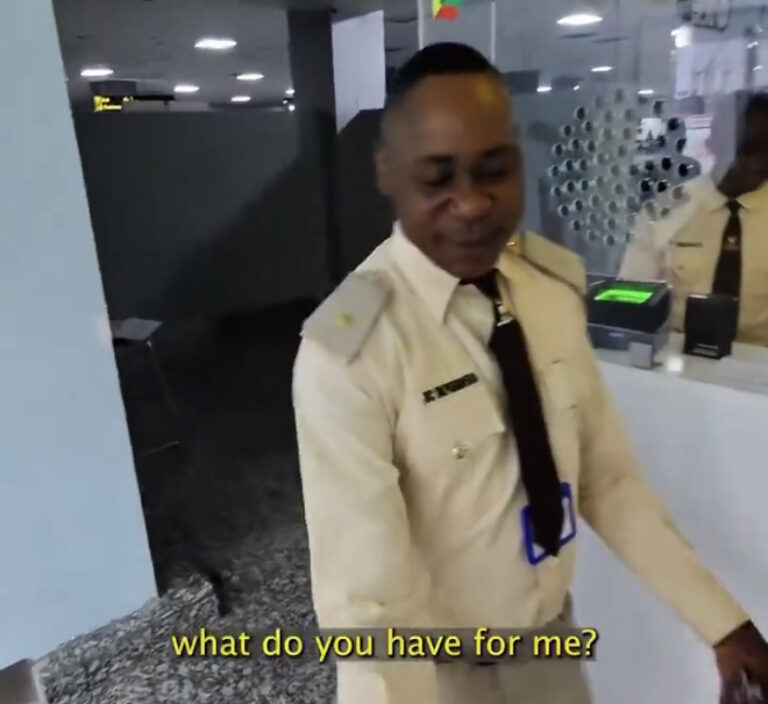
The video, captioned “This is how Immigration officers treat tourists in Nigeria,” and currently going viral, shows the officer demanding money from a traveler at an undisclosed location.
“The immigration officer was observed asking the tourist, ‘What do you have for me?’ When the traveler asked, ‘Money?’ the officer replied, ‘Anything.’
Even when the traveler said he had no cash, the officer insisted that the tourist bless him with something from his card.
Following widespread condemnation and public pressure, the NIS announced the officer’s suspension pending a full investigation into the matter.
While expressing regrets over the conduct of the officer, Nandap said the Service had a zero-tolerance policy on corruption and that any officer found guilty of such conduct would face severe disciplinary action.
“This disgraceful act is not a representation of our commitment to hospitality, reception, and courtesy.
“As a result, the officer in question has been indefinitely suspended pending the outcome of disciplinary procedures,” she said.
The Comptroller General reaffirmed the NIS’s dedication to rooting out corrupt elements within the NIS.
She further assured that the NIS would continue to strive for excellence in service delivery, in alignment with the ‘Renewed Hope Agenda’ of the Federal Government.
The NIS also urged the public to continue to report cases of misconduct by immigration officers to ensure transparency and accountability within the service.
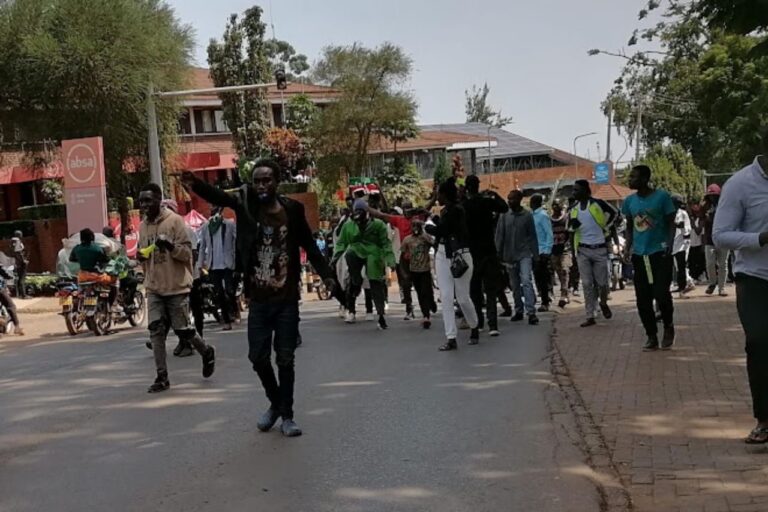
KENYAN police have fired tear gas at some protesters who took to the streets of Nairobi on a fresh protest against the country’s President, William Ruto.
On Thursday, August 8, police patrolled the streets of Nairobi’s Central Business District with roadblocks set up on major arteries and many shops shut. However, only a few protesters turned out.
The Kenyan police acting chief, Gilbert Masengeli, had on Wednesday, August 7, warned that ‘criminals’ intended to hijack the demonstrations, and advised the people to stay away from protected zones including the main international airport and the president’s official residence.
Kenya has been rocked with a series of protests since June this year. About 60 people have been killed with the police accused of using force and firing live bullets at peaceful protesters.
The protest started after the country’s parliament moved to pass into law a new Finance Bill.
The ICIR reports that following previous deadly protests, Ruto bowed to pressure and declined to sign the controversial Finance Bill.
Kenyans however continued to protest despite the president declining to sign the bill, demanding that the President and other leaders step down from their positions as they no longer believed in the administration.
Ruto responded to the calls after weeks of intense protests and fired his entire cabinet including the attorney general and leaving out the prime cabinet secretary, cabinet secretary for foreign affairs and deputy president.
Some African nations have recently been hit by nationwide protests against economic hardship and bad governance.
In Uganda, some youths took to the streets to protest against corruption in the country, despite the president, Yoweri Museveni’s warning.
The ICIR also reported how many Nigerians across some states including Lagos, Kaduna, Kano, Edo, and the FCT, took to the streets for some days, and protested against hunger tagged #EndBadGovernance.
THE Taraba State government has raised alarm over cases of fake tax collectors in the state.
The state, through its Board of Internal Revenue, warned all persons diverting government-generated revenue to personal accounts to desist or face the law.
Chairman of the State Board of Internal Revenue, Jeremiah Faransa, called on the public to be wary of fake tax collectors and pay their taxes only to the state’s treasury single account.
The Taraba State Governor
Agbu Kefas inaugurated the Board of Internal Revenue on June 19, with a mandate to enhance revenue collection mechanisms in the state.
Faransa disclosed that some people were short-changing the state government of its locally generated revenue by creating fictitious receipts and transferring taxes to personal accounts.
“The board’s goal is to stop leaks and harmonise the state’s internal revenue collection into the government’s treasury single account for the benefit of the people”, urging people who engage in such acts to stop or face the consequences.
Faransa further advised the public to pay their taxes into the state’s treasury single account rather than in cash and to be cautious of shady tax collectors.
The ICIR reported that Taraba State recently witnessed tax crises that brewed in the markets of Ardo Kola and Gassol communities.
As a result, locals and business owners in the affected areas staged protests against several taxes that they saw as being unfair and exorbitant.
Government officials have also been accused of mismanagement and corruption in tax collection processes.
Many taxpayers vowed to resist any attempt to force them to pay taxes, promising never to do so again.
The communities demanded responsibility, justice, and openness in the tax system in the state.
Meanwhile, the Taraba State government has discovered 864 civil servants receiving two to three salaries monthly.
This followed an investigation by the state’s head of civil service.
The results were released in a statement by the office of the Head of Civil Service in the state.
THE Senate Committee on Wednesday, August 7, interrogated the group chief executive officer (GCEO) of the Nigerian National Petroleum Corporation Limited (NNPCL), Mele Kyari, over the alleged importation of substandard petroleum products into the country.
The Senate ad-hoc Committee hearing is investigating alleged economic sabotage in the Nigeria Petroleum Industry, following recent allegations of inferior petroleum products in the country.
The chairman of Dangote Industries Limited, Aliko Dangote, had earlier urged federal lawmakers to probe ‘poor quality’ fuel in circulation at various filling stations and other retail outlets in Nigeria, stating that many vehicle issues could be traced to the “substandard” imported fuel.
Dangote had urged the House of Representatives leadership to set up an independent committee to verify the quality of petrol available at filling stations when he appeared before the house on Monday, July 22, The ICIRreported.
Earlier on July 18, the chief executive officer of the Nigerian Midstream and Downstream Petroleum Regulatory Authority (NMDPRA), Farouk Ahmed, had accused the Dangote refinery of producing inferior products compared to the ones imported into the country.
The ICIR reports that NNPCL, the state-owned oil company, is the sole importer of petroleum products into the country.
At the Senate hearing on Wednesday, the NNPCL boss said the NNPCL had no involvement in such an act.
Kyari’s response to the Senate was conveyed in a statement by the chief corporate communications officer of NNPCL, Olufemi Soneye.
He said, “The NNPC Limited has nothing to do with that as the relevant regulatory agencies will, by law, not allow any sub-standard product into the country.”
Kyari said he supports the calls for the ad-hoc committee to broadcast the interactive sessions live on national television to prevent misinforming Nigerians.
He said the country has enough infrastructure to produce two million barrels of crude per day but the challenges of crude oil theft, pipeline vandalism and absence of investment in the upstream are the major factors hindering the sector.
Kyari further argued that the NNPCL had not breached any of the enabling laws guiding its dealings with partners.
He said investors in local refineries ought to secure their feedstocks as well as find a market for their refineries, stressing that as a straightforward part of the refining business.
“The refining business is a straightforward business which any investor should know before coming into the market.
“Refining business is a straightforward business. You must secure (a source for) your feedstock and you must find a market. This is basic and this determines what happens in any refinery anywhere in the world. That is the business of refining. We have done nothing to sabotage any domestic refinery,” he explained.
The NNPCL boss said further that the law was clear on domestic crude oil supply obligations and on providing for local refineries, noting that the law provides for a “willing buyer and a willing seller,” arrangement.
FOLLOWING the nationwide protests rocking Nigeria over economic hardship, President Bola Ahmed Tinubu addressed citizens in the early hours of Sunday, August 4, 2024.
Since August 1, hundreds of Nigerians have taken to the streets to demand economic and political reforms including the reversal of some government policies. The protests which began peacefully, later turned violent in many states leading to the deaths of some Nigerians and the destruction of properties.
Media reports on Thursday (August 1) indicated that the #EndBadGovernance protest kicked off in Lagos, Abuja, Kano and Borno, among other Nigerian states.
The ICIR is providing LIVE UPDATES from the scene of the protests across the country here.
Addressing Nigerians via a nationwide broadcast in the early hours of August 4, President Tinubu highlighted some of the achievements recorded by his administration in the last 14 months to cushion the effects of economic hardship on the citizens.
The FactCheckHub team monitored the Nigerian president’s broadcast on Channels TV and examines the veracity of the claims in his speech as shown below:
CLAIM 1
Nigeria has increased crude oil production to 1.61 million barrels per day.
THE FINDINGS
Findings by The FactCheckHub show that the claim is FALSE.
According to the latest data from the Organisation of Petroleum Exporting Countries (OPEC), Nigeria’s average daily crude oil production stood at 1.276 million barrels per day (bpd) in June 2024 based on data submitted by the Nigerian government which is an OPEC member.
OPEC gathers data on crude oil production from direct communication from member countries and secondary communication, such as energy intelligence platforms.
This represents an increase of just 25,000 barrels daily from 1.251 million barrels bpd recorded in May 2024.
According to secondary sources, Nigeria retained its position as the largest oil producer in Africa with 1.362 million bpd in June 2024 closely trailed by Libya which produced 1.2 million bpd for the same month.
Has Nigeria increased crude oil production to 1.61 million barrels per day?
Although the chief executive officer of Nigerian National Petroleum Company Limited (NNPCL), Mele Kyari, in May 2024 said that Nigeria’s crude oil production was approaching 1.7 million barrels per day (bpd). He did not explicitly said that the country had achieved the feat.
THE VERDICT
The claim by Tinubu that Nigeria has increased crude oil production to 1.61 million barrels per day is FALSE; OPEC’s July report shows that it’s 1.362 million bpd in June 2024.
CLAIM 2
Nigeria has cleared all legitimate outstanding foreign exchange obligations of about $5 billion.
THE FINDINGS
Checks by The FactCheckHub show that the claim is TRUE.
Nigeria has faced significant economic challenges in recent years, including issues related to foreign exchange (FX) obligations and debt service ratios. The country’s dependency on oil revenues and fluctuating global oil prices have exacerbated these challenges, leading to substantial FX backlogs and mounting debt.
On February 5, 2024, the governor of the Central Bank of Nigeria (CBN), Olayemi Cardoso, said he inherited a $7 billion foreign exchange (FX) backlog when he became the head of the apex bank in September 2023. However, it has dropped to $2.2 billion. By March this year, the CBN said it had concluded the payment of $1.5 billion and successfully settled all outstanding FX obligations.
Have Nigeria cleared all legitimate outstanding foreign exchange obligations of about $5 billion?
The acting director of Corporate Communications at the CBN, Hakama Sidi Ali, disclosed that independent auditors from Deloitte Consulting meticulously assessed these transactions, ensuring that only legitimate claims were honoured.
She said any invalid transactions were promptly referred to the relevant authorities for further scrutiny.
“Clearance of the foreign exchange transactions backlog is part of the overall strategy detailed in last month’s Monetary Policy Committee meeting to stabilise the exchange rate and thereby curb imported inflation, spurring confidence in the banking system and the economy,” Ali said.
THE VERDICT
The claim by Tinubu that Nigeria has cleared legitimate outstanding foreign exchange obligations of about $5 billion is TRUE.
CLAIM 3
Decreased debt burden has given the Nigerian government more financial freedom and the room to spend more on funding essential social services like education and healthcare.
THE FINDINGS
Checks by The FactCheckHub show that the claim is MOSTLY FALSE.
Tinubu’s 2024 budget increased for Education compared to the previous year’s allocation. He budgeted N1.59 trillion for the education sector, representing 5.54 per cent of the total budget of N28.7 trillion. The budget, however, falls short of the 15 – 20 per cent recommendation by the UNESCO. Throughout Buhari’s eight-year tenure from 2015 to 2023, the education budget hovered between 6 and 8 per cent of total budget and Tinubu-led government has not surpassed this feat.
The same thing goes for the health sector. Tinubu allocated N1.34 trillion to the health sector, representing 4.64 per cent of the budget. This is lower in percentage than the N1.17 trillion (4.91 per cent) health budget approved by his predecessor (Buhari) in 2023.
In what is famously known as the Abuja Declaration, Heads of Government in Africa agreed to allocate 15 per cent of their national budgets to the health sector in 2001 at a meeting in Abuja. Successive Nigerian governments have since failed to meet up with this obligation including President Tinubu’s administration.
Has the decreased debt burden given the Nigerian government more financial freedom and the room to spend more on funding essential social services like education and healthcare?
In addition, Nigeria’s debt burden has increased contrary to President Tinubu’s claim.
The most recent data on the debt burden released by the nation’s Debt Management Office (DMO) show that Nigeria’s total public debts stood at N121.67 trillion ($91.46 billion) as of March 31, 2024 while it was N49.85 trillion as of March 31, 2023. That’s an increase of N71.82 trillion within the one year period under review, courtesy of the rising FX rate. Please note that the CBN Official Exchange Rate was US$1 to NGN460.35 as at March 31, 2023 whereas, it was US$1 to N1,330.26 as at March 31, 2024.
These were also corroborated by data from the CBN and NBS respectively.
THE VERDICT
Tinubu’s administration has not surpassed his predecessors in terms of increased funding to health and education sectors by percentage of the total budget, though there’s an increase in the sum allocated to each sector in the 2024 budget. Also, the claim that Nigeria’s debt burden has decreased is MOSTLY FALSE.
CLAIM 4
N45.6 billion has already been processed for payment to students and their respective institutions as loan.
THE FINDINGS
Findings by The FactCheckHub revealed that the claim is UNPROVEN.
President Bola Tinubu enacted an initial version of the student loan policy in June 2023 to grant interest-free loans to students.
NELFund opened the loan application portal on May 24, 2024 following which a pilot phase to serve federal tertiary institutions began.
On August 2, 2024, two days before Tinubu’s address, the Nigerian Education Loan Fund (NELFUND) announced that only N2.5 billion (N2,530,235,750) had been disbursed so far to the Nigerian students.
It also said a total of N442.4 million has been allocated as upkeep allowance to the applicants for July 2024 in six universities.
In an X post on August 5, NELFUND said it is diligently working to commence the payment process for students from approximately 55 additional tertiary institutions.
THE VERDICT
The claim that N45.6billion has already been processed for payment to students and their respective institutions as students’ loan is UNPROVEN; data released by the NELFUND indicate that only N2.5 billion has been disbursed so far, although there are other approvals that are in the works. The FactCheckHub could not independently ascertain that N45.6 billion has been disbursed to all participating students as claimed, due to insufficient data available.
CLAIM 5
The Consumer Credit Corporation with over N200 billion has been established.
THE FINDINGS
Findings by The FactCheckHub show that the claim is MOSTLY TRUE!
Before the announcement made by President Tinubu during the live broadcast, Nairametrics reported that he had approved the launch of the first phase of the consumer credit scheme which would be implemented in phases.
Screenshot of the registration details of CreditCorp’s website on WhoIS domain platform..
Has the Consumer Credit Corporation with over N200 billion been established?
However, findings showed that the amount rolled out for the scheme was not specified on the website.
THE VERDICT
The claim that the Nigerian Consumer Credit Corporation has been established with over N200 billion is MOSTLY TRUE; the scheme was announced initially and its website was created in April 2024, though there’s no proof that the agency has been funded with the amount reported for the scheme.
CLAIM 6
Fertilisers have been distributed to farmers in Nigeria.
THE FINDINGS
Findings by The FactCheckHub show that the claim is TRUE!
In May 2024, Daily Trust reported that the Federal Ministry of Agriculture and Food Security announced the commencement of the distribution of 2.15 million bags of fertiliser donated to it by the Central Bank of Nigeria (CBN).
The minister of Agriculture noted that the move was to prepare for the wet farming season which is targeted at enhancing food security in the country.
Also in July 2024, Premium Times reported that during a plenary session, Nigeria’s Senate President, Godswill Akpabio, noted that there was an ongoing plan to distribute about 60 fertiliser trucks to each state through the governors while commenting on a motion sponsored by Sunday Karimi (Kogi West) to urgently address the country’s impending food insecurity.
Have Fertilisers been distributed to farmers in Nigeria?
On July 31, 2024, the Punch reported that the Oyo State Government, in partnership with the federal government, announced the distribution of 21,000 bags of various fertilizers to more than 10,500 farmers across the state at no cost.
Olasunkanmi Olaleye, the state Commissioner for Agriculture and Rural Development, highlighted that this initiative aims to boost crop productivity, enhance food security, and increase the income of rural farmers. He emphasized that the state government is dedicated to improving agricultural productivity and supporting farmers’ long-term growth and success.
THE VERDICT
The claim that FG distributed fertilisers to farmers in Nigeria is TRUE; multiple media reports confirm the distribution of fertilisers to farmers in some states.
THE Nigeria Labour Congress (NLC) has condemned the invasion of its national headquarters – the Labour House – in Abuja by operatives of the country’s security agencies, including the military.
In a statement by its head of media and public relations, Benson Upah, on Wednesday, August 7, heavily armed soldiers, police officers and their counterparts from the State Security Service illegally invaded the Labour House.
The group noted that the security operatives swooped on the 10th Floor, showing no legal document permitting them to invade the premises.
“They arrested the security operative on duty and then commandeered him to the second floor where he was asked to produce the keys to the offices. When he told them that he had no such keys on him, they broke into the floor and ransacked the bookshop on the 2nd floor carting away hundreds of books and other publications.
“The invading troop claimed that they were looking for seditious materials used for the #EndBadGoveranance protests,” the NLC added in the statement.
The workers noted that their national executive council (NEC)condemned the high-handed manner that security agents treated protesters in many parts of the country, resulting in needless bloodshed that ensued and the sweeping mass arrests of those perceived to have led the protest.
The NLC also demanded that all the books and materials carted away by the security operatives should be returned before the end of work on Thursday, August 8, 2024.
“We make this demand given the illegality of the operation as there was no court order for the invasion, ransacking and looting of the publications.
“If this harassment continues, the Nigeria Labour Congress will not hesitate to call on its members to stay home until their safety and security are assured,” it added.
The ICIRreported that heads of Nigerian security agencies had vowed to unravel the sponsors of the #EndBadGovernance protest and make them face the wrath of the law.
They said that the protest sponsors were already on the security watchlist while their accounts were being tracked, adding that they would continue with the crackdown on criminals who have hijacked the protest in some parts of the nation.
The ICIR reported that insecurity, inflation, and a hike in the cost of living among others pushed many Nigerians to stage the protest.
The protests, which began on Thursday, August 1, have been marred by violence, largely caused by the security operatives in places like Lagos and Abuja, where protesters have been subjected to tear gas and harassment.
Despite attacks on peaceful protesters by security operatives, the security heads said that their officers engaged the protesters professionally across the country, adding that their officers used minimal force to disperse protesters from locations where the courts restricted them.
THE Crude Oil Refiners Association of Nigeria (CORAN) has revealed the reason why the domestic refineries, including the Dangote Petroleum Refinery, have yet to start uplifting crude in naira.
On July 29, Nigerian President Bola Tinubu directed the Nigerian National Petroleum Company Limited (NNPCL) to sell crude to Dangote Refinery and other upcoming refineries in naira, approving 450,000 barrels meant for domestic consumption for the Dangote refinery.
The directive which came following the Federal Executive Council (FEC) meeting was in a bid to intervene in the accusations and counter accusations between the Dangote refinery and the regulatory authorities in the oil sector over selling crude to the refinery.
The ICIRreports that management of the Dangote refinery has lamented not getting crude oil supply to its refinery, forcing the company to source crude from the United States another country for its 650,000-capacity nameplate refinery.
At a Channels Television programme on Wednesday, August 7, the publicity secretary of CORAN, Eche Idoko, said there is no refinery currently producing PMS in Nigeria.
He hinted that the reason why Dangote, Aradel, and other refineries have not activated their plant is because of the uncertainty around the regime of supplies, sales, and pricing of PMS.
He noted that should all the licensed refineries come on board, Nigeria would be able to produce about 1.3 million barrels per day (bpd).
“As it stands right now, none of our members that I know have started uplifting crude in naira,” Idoko said.
Idoko hailed the directive of the government but said there were still a few steps that have to be taken for it to become implementable.
According to him, there needs to be a regulatory framework that will enable local refineries to access crude through the naira, spelling out the quantity, pricing, supply, and other landing charges
“So, all the details are yet to be worked out. While it is a recent development, we will give the government the benefit of the doubt; we are hoping that in the coming days, they will be sitting down with us as stakeholders because you can’t shave a man’s head in his absence.
“We are hoping that we and our members will be part and parcel of the processes,” Idoko said
In terms of crude availability, in line with the Petroleum Industry Act, he hinted that the Nigerian Upstream Petroleum Regulatory Commission (NUPRC), working with the Nigerian Midstream and Downstream Petroleum Regulatory Authority (NMDPRA), has gone ahead to put in place a domestic crude supply obligation guideline.
“What we are waiting for is for that guideline to be gazetted. We have extensively debated and participated with other stakeholders.
“So, we have a document that we think mirrors the minds of all of the stakeholders to an extent,” he said.
According to Idoko, the association does not yet know whether the document has been gazetted but was sure that the NUPRC could know.
“If that document, the crude domestic supply guideline, comes on stream it could aid those of our refineries that are producing now to begin to access crude under the (naira) regime as regards the incentive that should come to us.
“But as it stands right now none of our members are accessing crude yet under this regime and we are actually asking the government to expedite this action so that people can begin to reap the benefit of refineries operating in the country,” he submitted.
As refined petroleum products are anticipated from the Dangote refinery this August, it is yet uncertain whether it will bring down the pump price of petrol currently selling at over N1,000 in some parts of the states.
Issue on price drop
According to the CORAN secretary, it would be misleading to speak at this time about what percentage of petrol price will drop when the local refineries start getting crude supply from NNPCL, explaining that two issues are of concern.
“If we are going to deal in naira, are we going to still allow the regime of dollar floating or peg the price at a particular exchange rate in the dollar so that we sell in naira?
“So, when that is determined then we will be able to say this is the landing cost for crude oil in naira because if it is going to be an equivalent of the dollar in naira then we will be able to do our computation,” he said
Idoko believes that if sold in naira it will give a lot of reprieve to the naira against the dollar in the exchange rate market, and positively impact the end price at which it will be sold to retailers.
The ICIR can report that the removal of petrol subsidy by President Tinubu about a year ago has landed many Nigerians into further hardships, and the reversal is one of the demands of the youth-led struggle which started on Thursday, August 1.