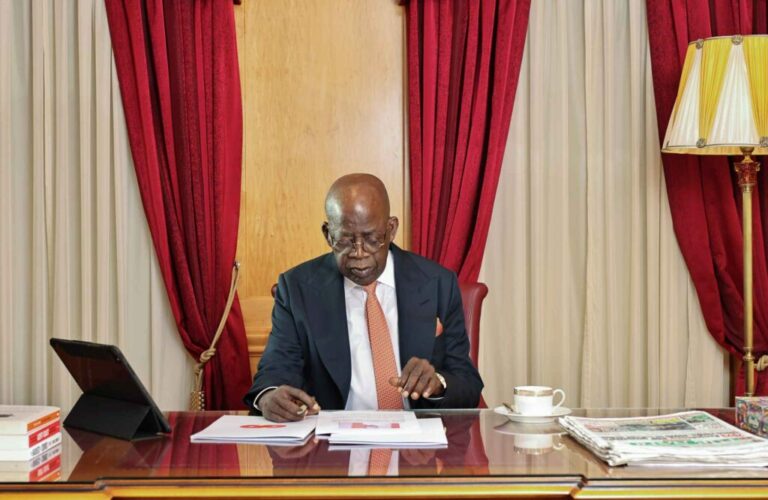
AS the nationwide #EndBadGovernance protests across Nigeria entered the fourth day, a coalition of civil society organisations has accused the government at all levels of escalating violence and unrest in the country.
In a statement jointly signed by 55 CSOs, including Yiaga Africa, Media Rights Agenda, and Accountability Lab, on Sunday, August 4, the coalition noted that the government’s response had been to suppress and delegitimise the protests using propaganda, politics, threats, intimidation, arrests, bribery, and blackmail.
The protests, driven by frustration over the high cost of living, failed government policies, and bad governance, according to the coalition, began with high hopes that the government would address citizens’ concerns.
It, however, stressed that the response from government officials, including the security operatives, had been largely dismissive and hostile, exacerbating tensions.
The ICIR reports that many Nigerians have trooped to the streets to protest poor governance and economic hardships caused by President Bola Tinubu’s reforms.
The protests have been marred with violence, largely caused by the security operatives in places like Lagos and Abuja, where protesters have been subjected to tear gas and harassment.
In some states, political thugs have allegedly hijacked the protest to cause mayhem, attacking demonstrators and looting properties.
With the attacks and looting in some states, generating outrages, President Bola Tinubu in his broadcast on Sunday, August 4, called on the protest organisers to dialogue with the government, and immediately suspend the protest.
While condemning the attacks on properties and lives, the President branded the protesters as ‘violent’ noting his “government will not stand idly by and allow a few with a clear political agenda to tear this nation apart.”
Meanwhile, the coalition said although the President had acknowledged the agitations of Nigerians and communicated some of the government’s plans, his address lacked what most Nigerians expected to hear and was devoid of conviction in delivery.
They also noted that he did not respond to the demand of Nigerians to cut down significantly on the high cost of governance, address insecurity and the unbearable cost of living.
They further expressed concern over Vice President Kashim Shetimma labelling protesters as ‘bandits and idiots.’
“The Secretary to the Government of the Federation (SSG), with disdain at a press conference, described the protests as ‘useless.’
Another instance the coalition gave was when the Senate President said protests could continue as long as officials kept eating.
It added that the Nigeria Police fired tear gas and used live ammunition against unarmed protesters, killing citizens.
“This is criminal, unlawful and a grave violation of their fundamental human rights. The Nigeria Police have beaten and physically assaulted peaceful protesters, including journalists and a person with a disability.
“The government is threatening to deploy soldiers to the streets. The implications of these threats are obvious, as we recall the outcome of the last time soldiers were deployed to respond to citizens’ protests (#EndSARS),” the coalition said.
The statement further reiterated that peaceful protest is a legitimate form of expression enshrined in international human rights instruments, and Nigeria’s 1999 Constitution (as amended), among others.
Citing relevant sections of the Constitution, it noted that the Constitution allowed citizens to publicly voice their concerns, express displeasure with government policies, challenge injustices, and participate actively in the democratic process.
“We are holding the government accountable for ignoring the protesters’ grievances and the negative outcomes of these protests.
“The violence and looting occurring in the #EndBadGovernance protests speak volumes about the failure of the government to validate and address the concerns of its citizens. The blame solely lies with the federal, state, and local governments, which have failed to provide security and welfare to the people,” the statement added.
The group urged the government to immediately focus on providing adequate security for the protesters, and prevent hired thugs and hoodlums from attacking protesters or disrupting the protest.
HADIZAH Sunday, a female farmer in the Saki West local government area of Oyo state was excited when she heard of the Central Bank of Nigeria’s (CBN) Anchor Borrowers Programme loan from a friend. She was happy that this would finally boost her farming business. Specifically in terms of expanding her farmland in Ataye, Saki and growing other crops like yam. But her excitement became short-lived. She wasn’t able to access the credit. Her inability and that of other women farmers to access credit has been a huge setback for the farming business in Oyo state.
Hadizah Sunday working on her farm Photo Credit- Fasilat Oluwuyi
In Oyo state, women farmers in rural communities’ struggle to access credit, gender-friendly farm implements and other supports despite numerous agricultural interventions by the government. This is compounded by insecurity in the state as herders’ cattle often destroy their crops.
Gender inequality in loan disbursement
In Nigeria, women make 70-80 per cent of the agriculture workforce, especially rural women, according to reports by the Civil Resource and Documentation Centre (CIRDC) and the Women Advocate Research and Documentation Centre (WARDC). Women farmers are believed to be responsible for a higher per cent of the food produced for consumption in the country, yet gender inequalities continue to exist in the farming business.
One of the oldest initiatives managed by the Central Bank of Nigeria (CBN) is the Agricultural Credit Guarantee Scheme Fund (ACGSF) in collaboration with the federal government through the Federal Ministry of Agriculture and Rural Development (FMARD). This fund guarantees up to 75 per cent of every credit extended to farmers under the scheme in case of any eventuality that may lead to loan repayment default.
While the credit support is targeted at both male and female farmers, findings show that the scheme has continued to benefit more male farmers in Oyo state than female farmers.
According to the gender data in the ACGSF report of the CBN, a total of N2,859,844,000 billion was given out as credit to 16,815 farmers in Oyo state from 2015 and 2022.
The report revealed that male farmers got the highest amount totalling N661,345,000 while female farmers got N289,900,000 between 2015 and 2020.
In 2015, a total of 4,028 beneficiaries got the sum of N749,949,050 as loan support in Oyo state, out of which 2,753 male farmers received N601,602,050 while 1,273 female farmers got N135,315,000.
Similarly, in 2016, the sum of N585, 335,000 loan was given to 5,228 beneficiaries. Out of this, 2,683 male farmers got N403,050,000 while 2,545 female farmers received N182,285,000.
ACGSF loan beneficiary distribution by gender in Oyo. PC: Women Radio.
From 2017, women’s access to credit facilities started to shrink and the number of women beneficiaries in Oyo started to decrease further. Out of a total of N307,405,000 given to 2,158 beneficiaries in 2017, 1,468 male farmers received N245,810,000 while 689 female farmers got N57,895,000. In 2018, 1,200 male farmers got the sum of N234, 925,000 as loan support with only 173 women getting N27,560,000.
From January to October 2020, ACGSF data on gender disaggregation of beneficiaries of CBN loan shows that men continued to get the larger chunk of loan support even though women account for 70-80 per cent of the agriculture workforce.
Out of the total sum of N162,420,000 given to a total of 815 beneficiaries, 691 men got N140, 260,000 while only 124 women received the sum of N22,160,000.
Findings from the CBN report on the ACGSF loan show that the gender data of beneficiaries were missing from its 2019, 2021 and 2022 reports.
Sakirat Adeniran has been farming for 30 years in Tokun Idode Oyo East local government.
She has not benefited from any loan support from either the CBN or the state government.
Sakirat grows maize, cassava, cowpeas among others and went alongside other female farmers to her local government secretariat to enquire about the loan as this would help her to increase her yields.
She was directed to visit a microfinance bank, but after two fruitless attempts, she gave up hope. ‘‘We only hear about all the loan support that the government is giving out to farmers. We did not benefit from it. Women hardly benefit from all the money they have been lending farmers,” she laments.
Picture: Sakirat Adeniran working on her farm in Oyo East LG on her farm [PHOTO CREDIT-Fasilat Oluwuyi]Another female farmer in Oyo East LGA, Suabatu Musbau, who has been into farming for over 20 years growing crops such as beans, maize amongst others, narrated how in her attempt to get a loan was made to submit passport
Another female farmer in Oyo East LGA, Suabatu Musbau, who has been into farming for over 20 years growing crops such as beans, maize amongst others, narrated how in her attempt to get a loan was made to submit passport photographs at different times, took pictures and paid a certain amount of money yet did not get the loan.
The story of women farmers in Iseyin and Saki East local government areas is not different. They lamented how the inability to access credit to finance their farming has been a huge challenge and setback despite many agricultural interventions, loans and other credit facilities available for farmers in the state. These are women who are either breadwinners and or are supporting their husbands, children and extended families financially for survival.
Picture: Suabatu Musbau in Oyo East on her farm [PHOTO CREDIT-Fasilat Oluwuyi]After hearing about the loan opportunity to help farmers in the state, Baliqees Adebayo who has been into farming for over 30 years growing crops like cassava and others in Ibarapa central submitted passport photographs and BVN all to no avail.
Picture: Baliqees Adebayo in Ibarapa Central LG on her farm [CREDIT? Fasilat Oluwuyi]
The Anchor borrowers programme
The Anchor Borrowers Programme (ABP) launched by former President Muhammadu Buhari in 2015 was created to support farmers in accessing credit to finance farming and increase agricultural productivity in the country.
The ABP loan was designed to deepen financial inclusion and grow smallholder farmers from subsistence to commercial farming with targeted beneficiaries as smallholder farmers and medium to large-scale farmers who are engaged in the production of agricultural commodities in Nigeria.
Though the CBN claimed it had disbursed a total of N1.1 trillion, smallholder women farmers across the five LGAs; Oyo East; Iseyin; Saki West, Saki East and Ibarapa Central in Oyo rural communities interviewed said they were yet to benefit from any government loan. Over the years, CBN reports have consistently omitted the gender disaggregation of ABP’s beneficiaries, despite the application form mandating intended beneficiaries to specify their gender.
Women are left out
According to a 2022 report by the Rockefeller Philanthropy Advisors Gender Centre of Excellence, about 98 per cent of Nigerian women are unable to get loans from Nigerian financial institutions. The report says women in rural areas and those with low education and limited decision-making power are excluded from credit facilities. The statistics reflect the challenges of women farmers in the five LGAs visited who said they were yet to benefit from any loan intervention despite their efforts.
Gender differences in loan approvals, the report recommended, should be documented. Analysing gender-disaggregated data would help to reveal the implicit biases in the supply of formal financial services. Highlighting the inequalities smallholder women farmers face, Small-Scale Women Farmers Organisation in Nigeria (SWOFON) Oyo state, in its charter of demand noted that though intervention programmes such as that of CBN and the World Bank Fadama exist in the state, its members have not benefited from any.
Aside the ACGSF Fund and the Anchor Borrowers Programme of the CBN, the Oyo State Agriculture Development Agency (OYSADA) said it has provided a series of interventions and support to farmers in the state. Over N207 billion was allocated to the Oyo State Ministry of Agriculture between 2019 and 2023. The Oyo State Agric credit corporation was allocated over N527 million in five years between 2019 and 2023. Women farmers interviewed in the five LGAs said they did not benefit from these interventions despite efforts in applying for loans.
One of them, Suaibatu Musbau, a farmer in Oyo East LG said, “The government made many promises to give us bags of fertiliser but these promises are empty.”
[Also, Sakirat Adeniran in the same LG lamented that farm support like seedlings and other farm implements did not get to them.
“They did not help or allow anything to get to us. There’s nothing like support for us”. Similarly, Rukayat Lukman in Iseyin also said there’s no form of support adding that money to buy drugs, sprayers for weed and others is a huge challenge.
Ineffective National gender policy on agriculture
In 2019, the National Gender Policy on Agriculture was introduced in Nigeria. The policy, according to Sabo Nanono, the then minister of agriculture was aimed at enhancing the equality of access to resources by farmers.
“The National Gender Policy in Agriculture is expected to drastically reduce the vulnerability of women to biases in agriculture, address the unequal gender power relation and bridge gender gap,” Nanono said.
Four years later, the policy has yet to reduce gender inequalities in the agricultural sector.
Battle with insecurity
Aside from the inequalities in agricultural intervention programmes, the financial constraints and lack of support from the government faced by women farmers in Oyo rural communities, they also contend with insecurity from herders.
Ibijola Aderoju, a farmer and widow in Saki East LGA had planted close to eight hectares of beans this year while expecting to yield a bountiful harvest and bring good profit. Ibijola recounted how one fateful morning while inspecting her farm, she found out her beans have been destroyed by cattle.
Picture: Ibijola Aderoju on one of her farms [Photo credit-Fasilat Oluwuyi]‘‘The beans destroyed by the cattle was more than eight hectares of land. They did not allow me to see the reward of my hard work,’’ she laments.
Sakirat Adeniran said she and other women farmers in Oyo East can no longer go to their farms alone for fear of insecurity. According to her, the herders are becoming a threat to them on the farms. She and other women farmers have now resorted to going to their farms accompanied by men for fear since they cannot confront the herders alone.
‘‘Whenever the herders should meet us on the farm, they say they will marry us, and any money they find on us that we are supposed to use for feeding they collect.
We do not know what to do about them anymore, they have taken over our farmland at our side in Tokun, we are helpless.’’
Suabatu Musbau in Oyo East LGA said: ‘‘We can no longer stay on our farm the way we used to do before now. The Fulani are taking over our farms, look down there; they have eaten most of the beans and maize that we planted. They will not let us rest.’’ Women farmers in other LGAs visited also cited insecurity as a challenge on their farms calling on the government and law enforcement agents around the farm to protect them.
In its national development plan 2021-2025, the federal government cited food insecurity as a major concern in the country due to a decline in food security. There have been calls to the state governments to enforce anti-open grazing law promulgated in 2020 but this has not been done. Baliqees Adebayo, a farmer in Ibarapa Central LG said despite their struggles as women farmers, the cattle prevent them from having good harvest. ‘‘If we plant cassava and maize, these cattle do not let us get a good harvest at the end of the day despite all our struggles. We call on the government to come to our aid on this herders’ issue.
Calls for help!
Women farmers in various LGAs in Oyo appeal for urgent support to access interest-free loans, equipment and other forms of assistance to boost their farming activities. “I rely solely on farming for survival. With no other viable employment options, government’s support in the form of interest-free loans would significantly enhance my farming business,” said Suabatu Musbau from Oyo East.
Sakirat Adeniran also in Oyo East LGA expresses her desire to expand her farming business but laments the lack of funding resources. “The government’s neglect is deeply distressing. We, as women farmers, deserve equitable access to government assistance. Despite owning and cultivating significant agricultural land, I am unable to expand my operations due to financial constraints. I implore the government to extend its support to us,” she appeals.
In Ibarapa central, Baliqees stressed the importance of government’s support in the form of interest-free loans, fertiliser, pesticides and gender-sensitive equipment to enhance female farmers’ productivity. Ibijola Aderoju calls for support in acquiring farming equipment and securing loans to improve agricultural practices. Hadizah Sunday from Saki West echoes the sentiments of many women farmers, highlighting the struggles they face without adequate support. She pleads with the government to prioritise assistance for female farmers to alleviate their plight.
Concerns regarding exclusion from farmer associations are also raised by Hadiza who said women are often overlooked in such gatherings.
Investigations across the five LGAs reveal that many rural women farmers are not part of any exclusive women-only farmer associations and lack awareness of organisations like SWOFON designed to address their needs. Rukayat Lukman in Iseyin LGA said she does not belong to any associations because women farmers in the area are never invited to meetings.
Picture: Rukayat Lukman in Iseyin LG on her maize farm [PHOTO CREDIT-Fasilat Oluwuyi]‘‘It is only men that attend these meetings. If we women can also gather so they can support us, we would form our own association so they can help us. As they are giving farmers support items like fertiliser, we are yet to receive anything. The men are not even telling us what is going on. We call on the government to assist us so we can also be beneficiaries of these loans by having a separate support for women farmers which will be different from that of men.’’
The Oyo State coordinator for Smallholder Women Farmers Organization in Nigeria, Atinuke Akinbade said most of the support that they got as an association was inadequate to cater to its large members. She said the association was planning to organise a sensitisation rally to reach women farmers in underserved communities who are unaware of SWOFON.
Akinbade said they do not have access to loans. ‘‘We divide ourselves by ten and we contribute money. Aside from this we do not get any other loan support. She called on the government to support women farmers in the state with grants, loans, fertiliser, machines amongst others.
Picture:Rukayat Lukman in Iseyin LG on her cassava farm. PHOTO CREDIT-Fasilat Oluwuyi]
Oyo government reacts
The Director agricultural tech, Oyo State Agriculture Development Agency (OYSADA), Joseph Ilori said it is only responsible for farmers who are medium and large-scale farmers directing that the reporter contacts another department in the agric ministry.
The director, Agricultural Extension Services Oyo State, Razaq Moruf attributed the problem of low access to credit by women farmers to inability to secure guarantors saying some of the loans target certain geographical locations.
Moruf said most of the interventions and programmes in the state such as GIZ and GAIN give 30 percent to women farmers but if the women farmers are not from the LGAs the programmes and interventions are being conducted, they would not benefit.
‘‘Most of the programmes stipulate that 40 percent should be youths, while 30 percent be women and others to partake. So, I would not say they have not been benefiting, it depends on where they are. We try as much as possible to give a substantial part of the allocation to the women farmers. In fact, we have a unit under our department dealing with women called women in Agriculture.’’
This report republished from Weomen Radio was done with support from the Women Radio Centre and the MacArthur Foundation.
THE organising committee directing the activities of the protest against hunger and hardship at the Gani Faweninmi Park, Ojota, Lagos State, says the protest continues on Monday, August 5.
They said in a statement, ‘Re-President Tinubu’s Broadcast on ongoing #EndBadGovernance Protest’, issued on Sunday, August 4.
It was signed by Hassan Taiwo Soweto, Ayoyinka Oni, and Oloye Adegboyega Adeniji for and on behalf of the #EndBadGovernanceInNigeria Organising Committee.
According to the organising committee, the activities for Monday’s protest will include holding a congress to discuss the President’s broadcast and issuing a press conference.
“We have listened with rapt attention to President Bola Tinubu’s broadcast earlier today, Sunday 4 August 2024, on the ongoing protest by the Nigerian youth and people over the condition of hunger and hardship in the country.
“We consider it rather unfortunate that it took President Tinubu three days of protest during which over 40 Nigerian people were massacred and several others injured across the country by security operatives and state-sponsored thugs before he realized the need to address the country,” the statement read.
The committee said it considered the President’s address an important victory for their movement, stressing that without their courage and resolve to dare the odds, Tinubu would not have taken the decision.
Tinubu had, in its national broadcast on Sunday, ordered the protest to be suspended.
In their view, the organising committee said this was tantamount to signalling the police, the army and so-called hoodlums to drown their movement in blood, just like EndSARS four years ago.
“The president cannot be approbating and reprobating at the same time. The President cannot offer an olive branch while at the same time holding a dagger to our throat.”
They alleged this played out earlier on Sunday at the Gani Fawehinmi Park, where thugs attacked protesters who had gathered for morning worship thereby injuring many, they said.
“We have on record the Assistant Commissioner of Police (ACP) Okafor, telling injured protesters the thugs were justified to have attacked them because they had no right to be there since the President has ordered the suspension of protest.”
To consider any offer of dialogue, the President needs to clarify if he wants to dialogue with us as slaves or as freeborn, they said, maintaining that the President had largely ignored protesters’ demands.
They urged the Nigeria Labour Congress (NLC) and the Trade Union Congress (TUC), the media, and the Nigerian Bar Association (NBA) “not to watch with arms folded as President Tinubu uses state terror to chase us out of the streets instead of addressing our demands.”
The #EndBadGovernance protest emerged from the suffering and frustration of ordinary Nigerian youth and people, and is planned for August 1 to 10, The ICIR can report.
“We are by this statement notifying the Commissioner of Police in Lagos state to ask his men and women not to harass and repress protesters in Lagos and across the country,” the organising committee added.
ACROSS the north-west region of Nigeria, the extrajudicial killing of persons suspected to be informants of bandits has left a trail of ruin that represents a broader institutional failing, as uncovered in this investigation.
Shukuriya Abdullahi firmly believes one thing: her husband was innocent. It was a little after 11 p.m. on a Wednesday in January 2024. Abubakar Anas had just returned home from his makeshift stall, where he sold provisions around the Sabon Fegi area of Tsafe in Zamfara, northwestern Nigeria.
Shoulders slumped, a weary Abubakar dropped the polythene bag in his left hand just at the entrance and, without a word, shuffled to the mattress tucked in one corner of the room and sank onto it.
As a trader in provisions, Anas’ days were often gruelling; he rises early before everyone else in his large family and retires late in the thick of the night, exhausted. He also sold cow milk and was popular among the locals. People called him, “Ididi, Mai Nono in Hausa; [Ididi, the milk man],” due to his popularity in the community.
For Binta Musa and her granddaughter, Fatima, life has not remained the same since her daughter was killed on the allegation that she was an informant to bandits. Photo credit: ICIR/ Abiodun Jamiu
He rasped out to his wife, Shukuriya, to prepare his bath water. As she rose to fetch the bucket, he started to doze off. But his eyes flew open the moment he heard ominous footsteps by the window.
He grabbed his torch and shone it through the darkness but there was no one behind it. The footsteps had also grown quiet. So, he relaxed and laid back.
“I heard another movement from the fence, like someone jumping into the compound,” Shukuriya recalled. Anas heard it, too. They were becoming more and more clumsy. So, he asked her to stay calm and reached for his nail-studded club to see what was happening outside.
That was the last time Shukuriya saw him!
“He [the husband] only went out to check. Then I heard a dagger being drawn, followed by his [the husband’s] exclamation, “barawo [burglar],” Shukuriya stopped abruptly.
Her one-year-old son, Muhammad, loitered near the door. She called out, wrapped him in her arms and began to feed him.
“They came in groups that night, cut him all over his body, plucked his eyes, cut off his nose and tongue. When he was taken to the hospital in the morning, he was unrecognisable. His corpse was brought back later by 9:pm,” she said.
Shukuriya firmly believes her husband was killed unjustly by local vigilantes. Photo credit: ICIR/Abiodun Jamiu
Anas was accused of being an informant to the terrorists plaguing the region. But his wife disagrees.
“We got married just over two years ago. And throughout our stay together, I never saw him keep unknown or suspicious company. He never even travelled out of Tsafe,” she defended him.
Reign of killing, kidnapping
For close to a decade now, the north western part of Nigeria has been a hotspot of unbridled killings and mass kidnapping. Armed gangs, known as bandits, have become more deadly as they spread their campaign of terror, especially in rural communities where security response is slow or totally absent.
There are believed to be as many as 30,000 of them operating in more than 100 gangs in the region. They sack villages, sexually assault women, impose levies on communities, kill locals, and control a million-dollar kidnap-for-ransom enterprise to keep their operations running.
Authorities have clamped down and launched offensives into their hideouts in the forests, including air raids, shut down telecommunication services in the past and even designated them as terrorists to allow for stiffer sanctions.
They had also dialogued and offered them amnesty in the past with a view to disarm them. Yet, thousands of them continue to occupy large swathes of the region’s ungoverned spaces which they use as springboards to launch attacks, stockpile weapons, and hold their abductees.
Informants’ extrajudicial killing
The armed gangs operate alongside a web of suspected informants who stay within local communities and provide them with information and other essential things like motorbikes, fuel, foodstuff, recharge cards, etc.
Two years ago, the authorities in Zamfara state passed a law that subjects convicted bandit informants to death sentence. But vigilantes — known among the locals as Yan Sakai — a loose band of local hunters and young people affected by the crisis, have now vowed to protect their communities from the raging storm of the conflict. Infamous for extrajudicial killings, they do not have the patience for the laws’ slow grind so, they take it into their own hands. Vigilantism thrives in these areas because the country’s security agencies are unable to adequately deal with the situation in the region.
They throw the label of “informant” indiscriminately such that suspected individuals like Anas are summarily executed without recourse to the law. Sometimes, local residents and researchers say, the accusation is just one way of settling personal scores.
Over the years, the state has wavered on how to keep the rise of vigilantism at bay, sometimes outlawing the group and, at other times, giving tacit support to residents taking up arms.
Early this year, local authorities in the region formally floated security outfits to complement the activities of security forces and — to some extent — address the scourge of local vigilantes.
Shukuriya’s husband, Anas, goes around with the passport photograph as a reminder of what they are. Photo supplied by Shukuriya.
The Nigerian laws guarantee the right to life and dignity. Late last year, the National Human Rights Commission (NHRC) raised concerns on the spate of unlawful killings of suspected informants by vigilantes in Zamfara.
The commission revealed that it was investigating five of such cases and urged the state authorities to devise measures to curb the atrocities. Sadly, rights violation persists.
Why informants’ extrajudicial killing is rampant – Human Rights Commission
The NHRC coordinator in the state, Abdullahi Abubakar, says extrajudicial killings of suspected informants are rampant in the state partly to the breakdown of order across rural communities in the state.
“The perpetrators of these acts, especially the Yan sakai are deeply rooted in the communities and mostly go scot free because of the breakdown of law and order in most of these areas.
“They killed and massacred their victims, most of whom were innocent, in the presence of their relatives,” Abdullahi said’ adding: “It’s also unfortunate that the state government is tacitly aiding the killings because they could have made a strong statement against the acts and arrested culprits, but they kept quiet. By that silence, innocent lives are being lost.”
“When communities feel that they have no recourse through the formal system of justice and security forces are unable to prevent attacks by bandits, and when communities feel that they have the tacit, if not explicit, support of the government to mobilise and arm themselves, it creates the conditions to initiate their own forces that engage in what is often another form of criminal behaviour, even though it’s under the guise of vigilantism,” explained James Barnett, a specialist in Nigerian politics and security at the Hudson Institute.
How suspected bandit informants are killed
There are no official figures on the number of people who have been extrajudicially killed on the mere allegation that they are bandits’ informants.
Local researchers say most suspects are killed slowly and in the most excruciating way, either in their homes or picked up along roadsides. Some have had their throat shredded and then left to choke in their blood. Some have hoods tied over their heads and their body parts cut into pieces until life trickles out of them; others are simply shot and left to rot away.
Such extrajudicial killings are not new in the region. In fact, analysts argue they are responsible for stoking up the conflict that has killed over 20,000 people, according to figures gathered by the Armed Conflict Location and Event Data (ACLED) project. The crisis has also displaced no fewer than 600,000 people across Kaduna, Kebbi, Sokoto, Katsina and Zamfara, says the International Organisation for Migration.
The fault line
“It was the local vigilantes that killed her,” Binta Musa bitterly alleged as she sat stiff-backed, peeling some potatoes. The backyard where she sat was once a lively gathering place for the family but became a hollow reminder of what she had lost.
She had barely uttered another word when she let out a bout of cough. Since that fateful day when her stepdaughter, Zeenatu, was brutally cut down by local vigilantes on the allegation that she was an informant, Musa’s whole life had not remained the same.
A day hardly goes by without the 50-year-old thinking about the easy-going daughter she single-handedly raised from childhood. She sees her in everything she does.
In her daughter, Fatima, she sees a glimpse of Zeenatu, the same infectious smile that lights up family gatherings. Even though her presence made it a little easier for her to cope with her loss, Musa could almost hear Zeenatu’s pitiful voice echoing to her whenever she went out to fetch water from the well.
Musa remembers everything that Zeenatu was.
The trouble leading to the death of the mother of three began with her husband, Yahaya, who was accused of conniving with armed gangs in the area. It was said that he would often slip into the bush, under the cover of night, to villages where the terrorists had stamped their authority.
When the rumours reached a fever pitch, the vigilantes went after him, but he was able to escape before they could swoop on him.
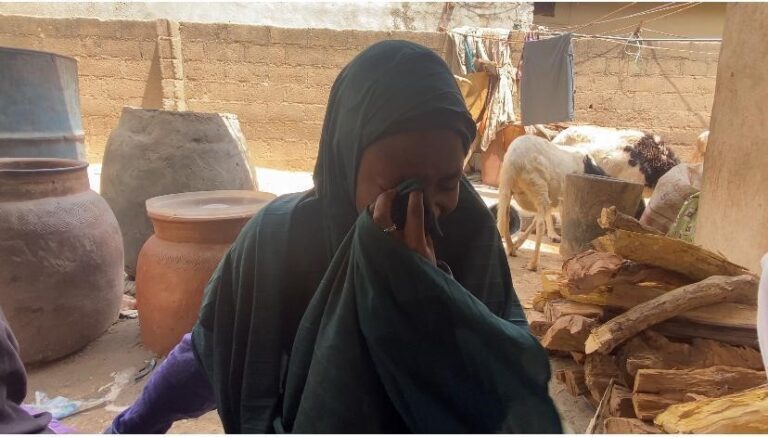
Fatima, 15, said she watched her mother, Zeenatu, being killed by her assailants. She wants justice for everything that has been done to her family. Photo credit: ICIR/Abiodun Jamiu
Zeenatu, 30, had also grown restless by this time and could no longer bear the weight of his alleged crime. One Friday, she gathered all she had and left with her daughters, Khadija and Fatima, hoping for a fresh start. It had been three months, but none of that mattered on the day she was killed.
The mother of three was returning from a visit to a grieving friend whose daughter was abducted when a blue car pulled beside her. Fatima gripped her mother’s hands tightly as two men jumped down from the car.
“Are you Ladu?” one of them who crossed her, looking fiercely, asked.
“What’s the matter?”Zeenatu retorted and attempted to walk past the two men as she held her daughter firmly. “They overtook us and stood in front of her and said, ‘We are talking to you,” Fatima, now 15, recalled.
“One of them said, ‘what are we waiting for then; let’s do our work.’” That was when she was hit in the head with a club even as another attacked her with a machete.
Fatima could not complete narrating her ordeal as tears streamed down her cheeks, settling on the deep green hijab she wore with a quiet splat.
“I was home when her little daughter rushed to me saying, ‘mama, mama, help me! My mother is being attacked. They want to kill her,” Musa chipped in.
Before they could get to the main road where the incident happened, the worst had happened; Zeenatu lay lifeless on the ground, her brain splashed across the road.
“She had no friends like that. You would hardly see her standing in the street with anyone. She was always in the midst of her children; they were her friends.
“They went everywhere together. After she was killed, they made a call saying that it was her former husband’s fate that befell her,” Musa told the reporter during an interview in her home in Tsafe around late April.
Public distrust
The inertia of the slow-turning wheels of the Nigerian justice system has over the years sparked public distrust among local population and makes extrajudicial killings an attractive alternative.
In addition to pervasive corruption in the country’s judiciary and unequal access to justice, court cases in the country often drag on for as long as 20 years just as many suspects languish in jail awaiting trial.
In rural north-west, the formal justice system operates parallel with the traditional justice mechanism and is also plagued by the same challenges.
Barnett believes the situation in the region represents this broader, institutional failing.
“The problem of informants is very real; the bandits have extensive networks and are able to utilise them, Barnett started, adding: “But the issue is that when there’s little recourse to the formal systems of justice, anyone can accuse anyone else of being a bandit informant.
“Even without due process, they take justice into their own hands. Of course, very often, this happens along ethnic lines with individual Fulani being targeted and accused of being informants, when in fact they’re not. This breeds grievances that contribute, in turn, to the broader crisis.”
Rights groups kick
Human rights groups have condemned the spread of extrajudicial killings in the region. Isa Sanusi, country director for Amnesty International in Nigeria, said authorities must hold such vigilante groups accountable.
“No reason can justify killing people based on suspicion of being informants. In most cases, people are labelled informants without due diligence and without recourse to the rule of law.
“The vigilante groups must bear in mind that they will be held to account for such atrocities. The state must also bear in mind that they are directly responsible for whatever atrocities committed by such vigilante groups,” he said.
Zamfara government keeps mum
Although authorities in Zamfara were contacted for comment as of the time of filing the report, multiple texts and calls made to the state commissioner for Security and Home Affairs, Bala Mairiga, were not returned.
Similarly, the spokesperson for the governor, Sulaiman Idris, promised to get back, but failed to do so by press time. Sulaiman said he was out of the country on official duty and promised to get back when he returned. Our reporter sent him reminders, but they were unanswered.
It was later learnt there was an order that bars government’s appointees and civil servants in the state from granting media interviews, especially as it relates to the security situation in the northwestern state.
Living on the edge
The pain of losing her daughter has taken a significant toll on Musa. She now lives in sorrow, unsure of what the future holds for her grandchildren even as she battles her own health challenges.
Before her gruesome death, Zeenatu sold food items, including other daily essentials and had big plans for her daughters. They attended one of the best schools in the area aside enrolling in Islamic classes, which they attended after school. But now, their education had taken an abrupt pause. The eldest daughter was married off recently. Musa has also become hypertensive.
“I really sympathise with the children because their mother also didn’t grow up with her biological mother. She died when Zeenatu was young. It’s sad,” she said, with Fatima in her lap.
“This one,” she continued, pointing at Fatima, “would often sit staring blankly. It saddens me a lot to the extent that it made me cry. And when I do, she would still be the one to console me, saying, ‘mama, please stop crying. Your health is weak and should anything happens to you, I would be all alone.”
She wants her daughter’s killers brought to book, but as with other victims of extrajudicial killings in the region, Musa is not close to finding justice or support for the children Zeenatu left behind.
Fatima’s education has suffered a setback but hopes to return to school someday. Photo credit: ICIR/ Abiodun Jamiu
Less than two kilometres away, in the dusty terrain of the Bakin Makabarta area of Tsafe, Zamfara state, Shukuriya sat numb under a tree in the compound, staring blankly into the distance. The mother of one is only bidding time before she starts selling the little, she has left to feed her family.
Life has since taken a dramatic turn for her. She barely has enough to feed herself and her one-year-old son, Muhammed, whom she is particularly concerned about. Most of the time, it is Muhammed’s piercing cries that reminded her they have not had any food for most of the day. And on other days, she relied on the benevolence of neighbours to get through the day.
A region blighted by poverty and lack of socio-economic opportunities; the north west is home to 45 million people who are living below the poverty line, according to the country’s statistical agency, National Bureau of Statistics.
The region also has some of the country’s worst health indicators. In Zamfara, for instance, no fewer than 950,000 women in the state are at high risk of maternal deaths, says the State Commissioner for Health, Aisha Anka.
As the conflict continues to spread across the region, an unprecedented level of malnutrition follows through as locals displaced from their homes struggle with basic needs like food and shelter — a situation, studies have shown, the terrorists are exploring to recruit more hands into their folds.
“The only means to ensure that people do not weaponise their grievances is to allow the rule of law to reign supreme. Firstly, the state needs to reach out to traditional communities and traditional institutions to bring offenders to justice. Otherwise, grievances will be weaponised and become a tool through which people are recruited into criminal gangs,” Oluwole Ojewale, an analyst at the Dakar-based Institute for Security Studies, adds.
Shukuriya recalled days not long ago when there was enough food in the house, much laughter, and enough fortune.
“This is not the life we ever thought we would experience. Food was always in abundance. But right now, it is like a daily struggle. We are currently out of food and may start selling our possessions to get food out of desperation. And if these things go, there’ll be nothing left between us and the streets,” she said.
A pit of despair
Musa Haruna, 26, is tired of the label that follows him like a shadow everywhere he goes. His mother, Hadiza, was killed on January 18 this year on the allegation that she was a bandit informant.
Hadiza had been bedridden for nearly seven years. She was diagnosed with fibroid and scheduled for surgery at the State Specialist Hospital in Gusau the week she was killed.
“She was home, confined to her bed. Most of the time, you would even think she was pregnant because she was always home, laying down,” Haruna, who is the eldest of four siblings, said as he fought back tears.
Haruna with his late mother, Hadiza, who was brutally killed on the allegation of being a bandits’ informant. Photo supplied by Haruna
It was just another ordinary day at his barbershop in Tsafe, Zamfara and Haruna was giving an elderly customer a trim when his younger brother burst through the door, eyes red with horror. “Yaya, come home. They have killed mommy,” he cried out between bated breaths.
“Inna lillahi wa inna ilaihir rajiun (indeed, we belong to Allah, and to Him, we shall return),” Haruna murmured as he felt the world crumbling beneath his feet. He stood there stunned as the clipper slipped from his trembling hands.
“I know that my mother has no connection with bandits. She was unwell and bedridden for almost seven years. How could someone accuse her of being an informant when she was unable to even afford her medical bills?” he asked no one in particular.
Like Anas, Hadiza was said to have been cut repeatedly until she breathed her last.
During her lifetime, Hadiza worked as a cleaner at the General Hospital in Tsafe. Though it was originally her grandmother’s job, she took it over as the former grew too old to cope. Each month, Hadiza would receive a small percentage of the pay to supplement her other income from selling cloth.
Later, rumours began to swirl that she was mistaken for someone else.
“They said they got the wrong information. Although we were encouraged to report the incident, I felt it would not bring her back and we don’t have any powerful backing,” Haruna added.
“In many of such cases we receive, people labelled ‘informants’ are just suspected without evidence,” Sanusi observed. “Sometimes calling someone an ‘informant’ is a way of settling personal scores. In some cases, it is only when the informant has been killed by mob violence that people discover he is actually not an informant.”
Lauwali Musa, commander of a vigilante group in Kaura Namoda, Zamfara, agrees that there are incidents of such extrajudicial killings in the state, but said he ensures that suspected informants arrested by his men are handed to the authorities.
“Some places do it (kill suspected informants) but from our side we don’t. When they bring suspects, I make sure they don’t kill them. It’s a must for the law enforcers to investigate first,” he said.
Lauwali has also had a bitter experience of extrajudicial killing of suspects like Hadiza as a family member had fallen victim in the past.
“My mother-in-law’s younger brother was accused of being an informant. He was just a farmer. He didn’t even have a phone, motorcycle, or even a bicycle. So, how could he be an informant?” He held his thoughts, before clearing his throat over the phone. “I have been trying so hard, really hard, to find out who killed him, but I could not.”
Hadiza’s death has created a big vacuum for her loved ones. Haruna is now responsible for his younger siblings. But one burden haunts him in the night: the stigma of being associated with bandits.
“Our name has been stained. The rumours that she was wrongly killed gave me a little comfort,” he said. “I will not avenge her death even if I get the chance. I will not repay evil with evil. Allah is sufficient,” he emphasised in a soft tone and sighed resignedly.
For a moment, Fatima paused, her fists clenched as she quivered, unsure of what to say next. In that heavy silence, fresh tears rolled down her chin. “I would avenge her death if I get the chance. She was killed in my presence. She committed no offence. But Aunty wouldn’t want that path for me. There is nothing I can do now but to beg the government for justice.”
THE International Press Institute (IPI Nigeria) has condemned the deployment of excessive force against journalists covering the nationwide protests at Moshood Abiola Stadium, Abuja.
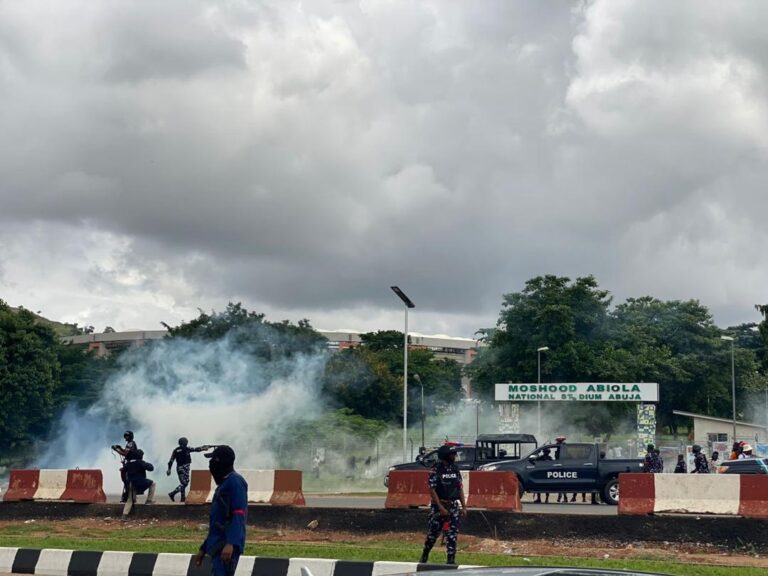
Several journalists covering the #EndBadGovernance protests were shot at on Saturday, August 3 by masked security operatives. Although, the journalists narrowly escaped unhurt, bullets rattled one of their cars.
Reacting to the incident in a statement signed by its president, Musikilu Mojeed on Sunday, August 4, the institute chided the security operatives for shooting at journalists despite wearing vests which had “PRESS” written on them.
“Many had cameras and drove vehicles with press written on them,” the statement added.
“Saturday’s shooting is even more worrisome as it came a day after the Chief of Defence Staff said on live television that journalists should stop giving protesters publicity.”
The IPI demanded an immediate investigation of the shooting incident targeted at journalists and call for the identification and punishment of officers involved, reported to be personnel of the police and the State Security Service (SSS).
“The media has a responsibility to cover the ongoing protests across the country, and journalists must be allowed to carry out their constitutionally mandated role without interference and intimidation by anyone.
“Targeting and shooting at journalists carrying out their lawful duties is tantamount to taking a wild shot at our democracy and it should be condemned by all.
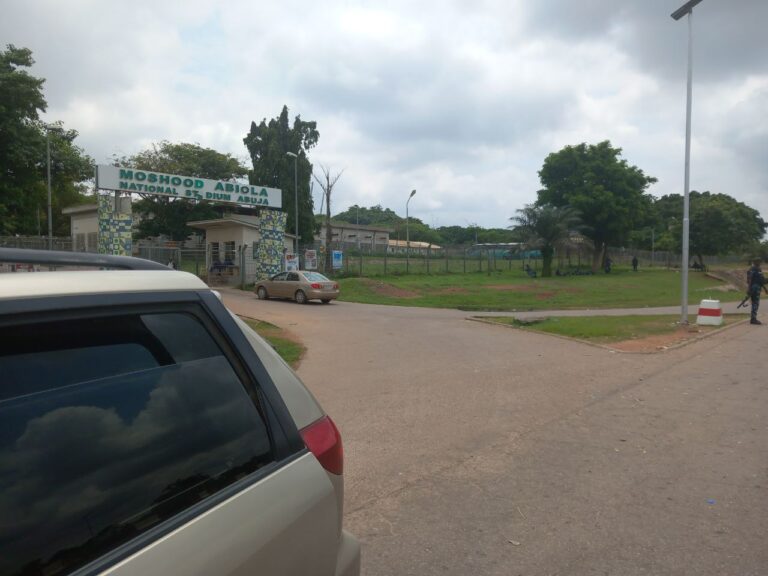
“The shooting happened at the main entrance of the MKO Abiola stadium. The firing of what is suspected to be live ammunition is unacceptable and is strongly condemned.”
The IPI noted that the shooting appeared premeditated as the journalists were particularly targeted and shot twice within minutes at the scene.
The ICIRreported that operatives consisting of the police, army and State Security Service (SSS) reportedly shot directly at journalists covering the #EndBadGovernace protest at the MKO Abiola stadium in Abuja on Saturday, August 3.
The incident happened shortly after the operatives had successfully chased away the few protesters who gathered at the venue on the third day of the nationwide protest.
A video journalist with The ICIR, Johnson Fatunbi who was at the venue of the shooting confirmed the incident.
According to him, the security operatives who were in masks came in several unmarked vehicles and started shooting to scare people away from the protest grounds.
Another journalist with The ICIR, Mustapha Usman narrated that the police personnel blocked the road in front of the stadium.
“They are shooting at us, they are stationed everywhere,” Usman said in a distress message sent to The ICIR from the venue.
Despite President Bola Tinubu’s address on Sunday, August 4, some protesters in Lagos took to the streets insisting the president has not addressed any of the issues raised as their demands during the protests.
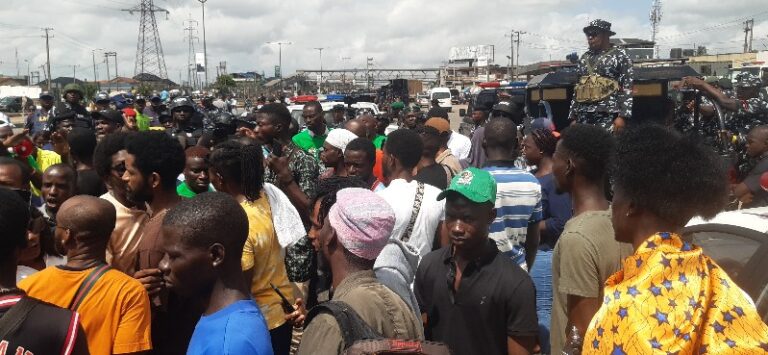
The protesters who gathered at Gani Fawehinmi Park, Ojota were also surrounded by policemen and other security personnel restricting them from marching beyond the park.
The ICIR reports that the president addressed the nation, four days after many Nigerians trooped to the streets to protest poor governance and hunger in some states.
In his speech, Tinubu boasted of some strides his administration has made in reforming Nigeria’s economy, despite the hardships many citizens continue to face.
He added that the violent protests that erupted in many states would only set the country backwards and make government to use scarce resources for rebuilding rather than on things that already exist.
The president however urged Nigerians to suspend the ongoing nationwide protest and engage in dialogue. He expressed deep concern over the loss of lives and destruction of property in states such as Borno, Jigawa, Kano, and Kaduna.
“The destruction of properties sets us back as a nation, as scarce resources will be again used to restore them,” Tinubu said, vowing that the government would not stand idly by while a few individuals with political motives seek to divide the nation.
“I commiserate with the families and relations of those who have died in the protests. We must stop further bloodshed, violence and destruction.
“As president of this country, I must ensure public order. In line with my constitutional oath to protect the lives and property of every citizen, our government will not stand idly by and allow a few to tear this nation apart,” he said.
The ICIR reported that insecurity, inflation and hike in the cost of living, among others, pushed many Nigerians to stage the protest.
Tinubu had stopped fuel subsidy and devalued the naira, thus causing a spiral hike in food and commodity prices.
THE ongoing protests against hunger and bad government might take a new turn in Lagos State as the protesters planned to march from the Gani Fawehinmi Park to Alausa in Ikeja on Monday, August 5.
This comes as President Bola Tinubu addressed Nigerians on Sunday insisting there was no going back on oil subsidy removal.
The decision to proceed to Alausa was jointly taken by the organisers and protesters on Saturday, August 3.
Their decision to take the demonstration beyond the police designated protest ground at the Gani Fawehinmi Park could be a sign of a shift in momentum in the hunger protest in Lagos.
On Thursday, August 1, Nigerian youths commenced a 10 days nationwide protest which entered its fourth day on Sunday.
In Lagos, the protest has relatively been peaceful as the security operatives restricted the protesters to the Gani Fawehinmi Park at Ojota.
At the protest ground on Saturday, the youth-led struggle gained momentum and more crowd than the number seen on the previous days.
The growing number of the protesters and their determination not to be cowed, it was gathered, led to the decision to take the struggle further on Monday and march to the Lagos State secretariat in Alausa.
Ahead of the Monday’s march, the organisers would share about 10,000 flyers to various communities in the state to mobilise more people to join the protest.
Since August 1 when the protest started, pockets of resistance by the heavily armed security operatives have been witnessed, preventing the protesters from marching beyond some spots along the Gani Fawehinmi Park.
Despite the resistance, the protesters have been civil and the Lagos protest peaceful relative to reports from other states where security operatives reportedly released teargas and even gunshots on armless protesters exercising their fundamental rights and on journalists reporting the happenings.
In an interview with The ICIR, Seyi Akinde, a member of the Committee for the Defence of Human Rights (CDHR), one of the groups organising the protest, said the protesters want President Bola Tinubu to meet the demands of the people.
According to him, the demands of Nigerians are clear, stressing that Nigerians are hungry, dying, and cannot afford to eat square meal any more as a result of the anti-peoples’ decisions the government has taken.
He noted that the removal of subsidy created an economic stagnation which has resulted in maximum hardship for the masses.
“While the leaders are living fat lives, the masses are living in austerity,” Akinde lamented, maintaining that the leader should make the bigger sacrifices.
“We are part of the organisers of this protest which is currently happening across Nigeria.
“Hunger and starvation need to end in Nigeria. We find ourselves in a very unfortunate situation simply because of the decisions of government,” he said.
The protesters demand that the President Bola Tinubu-led administration reverses the decisions he took when he came into office so that Nigerians can breathe, Akinde submitted.
Lagos Police raise concerns
Meanwhile, the Lagos State Police Commissioner, Adegoke Fayoade, on Saturday at the protest ground expressed worries that hoodlums might hijack the peaceful protest.
“We should not allow the protest to be violent. We should not allow hoodlums to infiltrate the camp of the protesters and turn it into a violent situation because once that happens, you will see looting all over the place.
“Innocent market women and men on the street would be robbed of their valuables, motorists and passengers would be robbed of their valuables, vehicles would be smashed and damaged, and lives to be lost,” the CP said.
The youth-led protest might likely continue after the planned 10-day demonstration should the President fails to meet demands of the people.
The ICIR reports that despite President Tinubu’s broadcast on Sunday, the protesters say he failed to address their demands.
Shortly after the president’s address, a group of protesters gathered around the Gani Fawehinmi Park on Sunday morning, chanting solidarity songs.
They insist the President has not addressed core issues raised by them despite touching on efforts by his administration.
THE ongoing nationwide protest in Abuja appears to have lost steam as no protesters were seen at the MKO Abiola stadium and some other parts of the nation’s capital as of 12pm on Sunday, August 4.
This situation might not be unconnected with the threat by the Nigeria police and other security operatives in the last four days, particularly yesterday, August 3, when the police and the State Security Services (SSS) shot tear-gas and ammunition at protesters.
The ICIR reported that the third day of the hunger protest in the nation’s capital turned violent as the security operatives intensified their crackdown on peaceful protesters.
Dressed in black uniforms and navy suits, the officers who drove in about six sienna vans fired rounds of bullets at close range at journalists who gathered opposite the entrance stadium with a few protesters who remained behind around 12pm on Sunday.
Meanwhile, since 9am today, The ICIR hasn’t sighted any protesters at the stadium even though there was a heavy police presence at the entrance of the stadium.
The ICIR observed that more security personnel also arrived at the stadium despite the absence of protesters on sight.
The same situation was witnessed at the Berger area as of the time of filing this report.
The ICIR reports that many Nigerians are protesting poor governance and economic hardships caused by President Bola Tinubu’s reforms.
PRESIDENT Bola Tinubu has refused to return the fuel subsidy despite demands by the ongoing #EndBadGovernance protesters that he reverse its suspension.
The ICIR reported that insecurity, inflation and a hike in the cost of living among others pushed many Nigerians to stage a nationwide protest, which began on Thursday, August 1.
Tinubu had stopped fuel subsidy and devalued the local currency – the naira – thus causing a spiral hike in food and commodity prices.
In a nationwide broadcast to Nigerians in the morning of Sunday, August 4, Tinubu said even though the decision to remove the fuel subsidy was painful, it was necessary because it had constituted a noose around the nation’s economic jugular and impeded economic development and progress.
“For decades, our economy has remained anaemic and taken a dip because of many misalignments that have stunted our growth. Just over a year ago, our dear country, Nigeria, reached a point where we couldn’t afford to continue the use of temporary solutions to solve long-term problems for the sake of now and our unborn generations.
“I, therefore, took the painful yet necessary decision to remove fuel subsidies and abolish multiple foreign exchange systems which had constituted a noose around the economic jugular of our nation and impeded our economic development and progress,” the President stated.
He said these actions blocked the greed and profits that smugglers and rent-seekers had made. They also blocked the undue subsidies Nigeria had extended to its neighbouring countries to the detriment of its people, rendering its economy prostrate.
“These decisions I made were necessary if we must reverse the decades of economic mismanagement that didn’t serve us well. Yes, I agree, the buck stops on my table. But I can assure you that I am focused fully on delivering the governance to the people – good governance for that matter.”
Tinubu further outlined measures aimed at cushioning the effects of the subsidy removal.
Among them was the launch of a compressed natural gas initiative (CNG) designed to power the transportation sector, significantly cutting costs and saving over two trillion naira monthly, which can be redirected to healthcare and education, argued the President.
Palliatives and Loans
To support this initiative, Tinubu revealed that one million conversion kits would be distributed at low or no cost to commercial vehicles, which consume 80 per cent of imported petrol and diesel. He noted that this initiative was expected to reduce transportation costs by about 60 per cent, thereby helping to control inflation.
He restated his administration’s commitment to youth development through the student loan scheme, claiming that 45.6 billion naira was already processed for payment to students and their institutions.
Additionally, he encouraged more young people to benefit from the newly established Consumer Credit Corporation, which he said had over N200 billion allocated to help Nigerians acquire essential products without immediate cash payments to reduce corruption and eliminate opaque cash transactions.
He also mentioned that an additional N50 billion each had been released for the student loan and credit corporation from the proceeds of crime recovered by the Economic and Financial Crimes Commission (EFCC).
Tinubu further announced securing $620 million under the Digital and Creative Enterprises (IDiCE) programme, which he said aimed to create millions of IT and technical jobs, making Nigerian youth globally competitive. He, however, decried the vandalisation of one of the digital centres in Kano during the hunger protest.
The President stated that 75,000 beneficiaries were set to receive N1 million micro and small business single-digit interest loans starting this month, and 10 MSME hubs had been built, creating 240,000 jobs, with five more hubs in progress.
“Payments of N1 billion each are also being made to large manufacturers under our single-digit loans to boost manufacturing output and stimulate growth,” he said.
Housing and Agric sector
In the housing sector, he said he had inaugurated the first phase of the Renewed Hope City and Estate in Karsana, Abuja, which is part of a larger plan to build six such cities across the nation’s geopolitical zones, each with at least 1,000 housing units.
Additionally, he announced that Renewed Hope Estates, with 500 housing units each, would be launched in every state, aiming to complete 100,000 housing units over the next three years.
To further support food production, Tinubu reminded Nigerians that he had directed the removal of tariffs and import duties on rice, wheat, maize, sorghum, drugs, and other pharmaceutical and medical supplies for six months among other initiatives targeted at supporting farmers.
PRESIDENT Bola Tinubu has urged Nigerians to suspend the ongoing nationwide protest and engage in dialogue.
In his nationwide address, on Sunday, August 4, the President expressed deep concern over the loss of lives and destruction of property in states such as Borno, Jigawa, Kano, and Kaduna.
“The destruction of properties sets us back as a nation, as scarce resources will be again used to restore them,” Tinubu said, vowing that the government would not stand idly by while a few individuals with political agendas seek to divide the nation.
“I commiserate with the families and relations of those who have died in the protests. We must stop further bloodshed, violence and destruction.
“As President of this country, I must ensure public order. In line with my constitutional oath to protect the lives and property of every citizen, our government will not stand idly by and allow a few with a clear political agenda to tear this nation apart,” the President added.
Tinubu further assured that those who had taken advantage of the protest would face the wrath of the law, adding that the security operatives should continue to protect lives and property.
“Under the circumstances, I hereby enjoin protesters and the organisers to suspend any further protest and create room for dialogue, which I have always acceded to at the slightest opportunity. Nigeria requires all hands on deck and needs us all – regardless of age, party, tribe, religion or other divides, to work together in reshaping our destiny as a nation. To those who have taken undue advantage of this situation to threaten any section of this country, be warned: The law will catch up with you. There is no place for ethnic bigotry or such threats in the Nigeria we seek to build.
“Our democracy progresses when the constitutional rights of every Nigerian are respected and protected. Our law enforcement agencies should continue to ensure the full protection of lives and properties of innocent citizens in a responsible manner,” he said.
He therefore outlined various initiatives to support economic growth, including the compressed natural gas initiative, student loan schemes, and large-scale housing projects.
Tinubu’s address came four days after many Nigerians had gone to the streets to protest against bad governance and hunger in some states.
The ICIR reported that insecurity, inflation and a hike in the cost of living among others pushed many Nigerians to stage the protest.
Tinubu had stopped fuel subsidy and devalued the local currency – the naira – thus causing a spiral hike in food and commodity prices.



![Picture: Sakirat Adeniran working on her farm in Oyo East LG on her farm [PHOTO CREDIT-Fasilat Oluwuyi]](https://www.icirnigeria.org/wp-content/uploads/2024/08/Picture4.jpg)
![Picture: Suabatu Musbau in Oyo East on her farm [PHOTO CREDIT-Fasilat Oluwuyi]](https://www.icirnigeria.org/wp-content/uploads/2024/08/Picture5.jpg)
![Picture: Baliqees Adebayo in Ibarapa Central LG on her farm [CREDIT? Fasilat Oluwuyi]](https://www.icirnigeria.org/wp-content/uploads/2024/08/Picture6.jpg)
![Picture: Ibijola Aderoju on one of her farms [Photo credit-Fasilat Oluwuyi]](https://www.icirnigeria.org/wp-content/uploads/2024/08/Picture7.jpg)
![Picture: Rukayat Lukman in Iseyin LG on her maize farm [PHOTO CREDIT-Fasilat Oluwuyi]](https://www.icirnigeria.org/wp-content/uploads/2024/08/Picture8.jpg)
![Picture:Rukayat Lukman in Iseyin LG on her cassava farm. PHOTO CREDIT-Fasilat Oluwuyi]](https://www.icirnigeria.org/wp-content/uploads/2024/08/Picture9.jpg)